
Judge, 1923-09-15 · page 22 of 36
Judge — September 15, 1923 — page 22: what you’re looking at
What you’re looking at
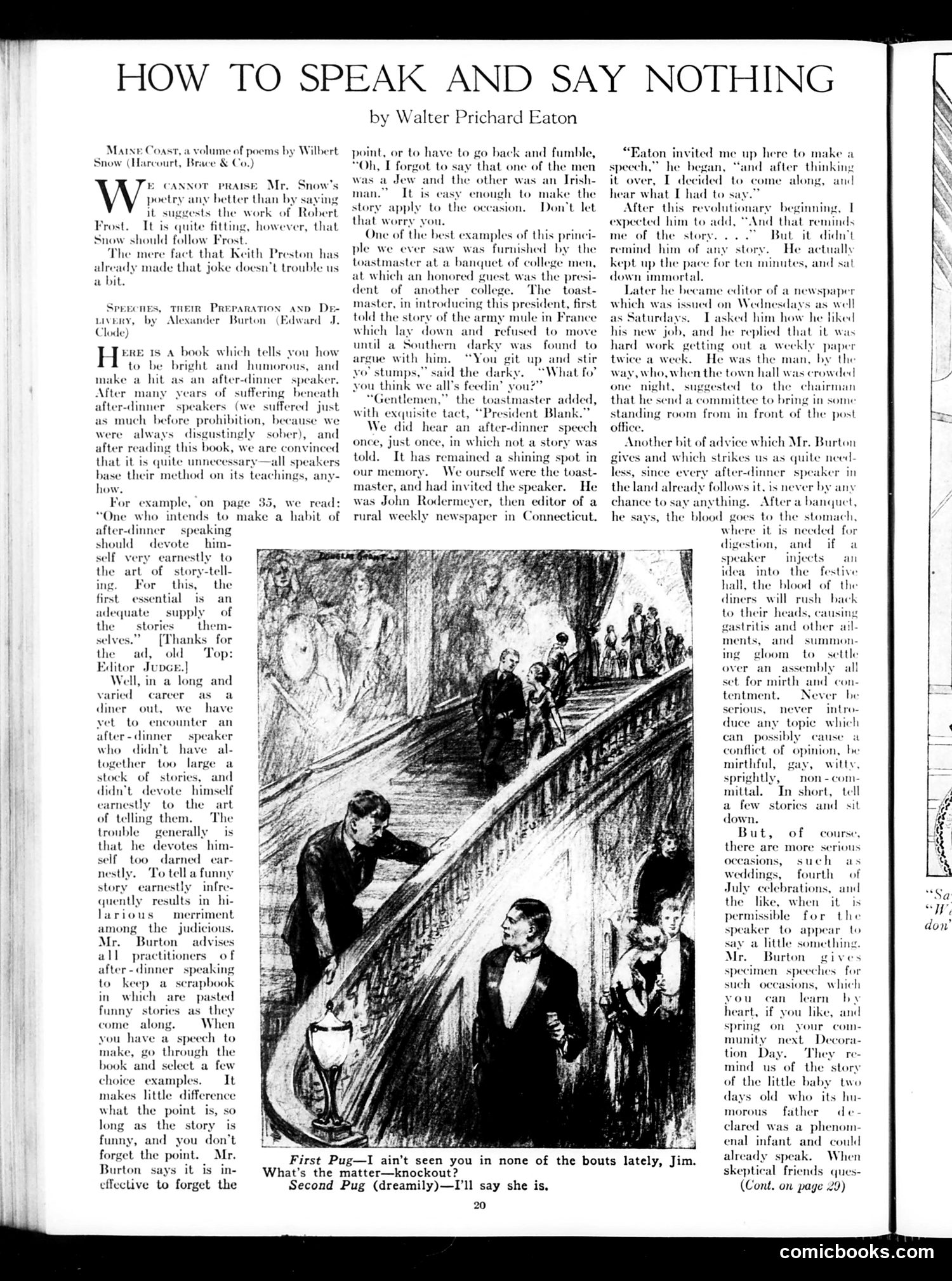
This is a satirical book review by Walter Prichard Eaton critiquing Alexander Burton's guide on after-dinner speaking. The central joke mocks the absurdity of Burton's advice that speakers should memorize funny stories and deploy them regardless of relevance to the occasion or audience. Eaton illustrates this principle with a devastating real example: a college banquet toastmaster introduces the president of another college by first telling a lengthy, pointless story about a mule in France, then simply adds "President Blank" as though the anecdote somehow introduces him. The cartoon depicts this awkward moment. Eaton contrasts this with John Rodermeyer, a Connecticut newspaper editor who gave the only dignified after-dinner speech Eaton ever heard—by pointedly refusing to tell stories at all, simply acknowledging he'd decided to attend and listen instead. The satire targets the mechanical, story-obsessed approach to public speaking that Burton recommends, suggesting it produces exactly the opposite of wit: forced, disconnected rambling that embarrasses both speaker and audience.
📄 Transcribed text from this page (OCR, searchable)
Machine-transcribed from the original scan — historical spelling and the odd misread are preserved.
HOW TO SPEAK AND SAY NOTHING Marve Coast, a volume of poems by Wilbert Snow (Harcourt, Brace & Co.) E CANNOT PRAISE Mr. Snow's poetry any better than by saying sts the work of Robert it sugg Frost. It is quite fitting, however, that Snow should follow Frost The mere fact that Keith Preston has already made that joke doesn’t trouble us a bit. Speecnes, Them Preparation ann De- Livery, by) Alexander Burton (Edward J. Clode) H" 1s A book which tells you how to be bright and humorous, and make a hit as an after-dinner speaker. After many years of suffering beneath after-dinner Speakers (we suffered just as much before prohibition, because we were always disgustingly sober), and after ing this book, we are convinced that it is quite unnecessary—all speakers base their method on its teachings, any- how. For example, on page 35, we read: “One who intends to make a habit of after-dinner speaking should devote — him- self very earnestly to the art of story-tell- ing. For this, the first. essential is an adequate supply — of the stories them- [Thanks _ for the ad, old Top: Editor JupcE.] Well, in a long and varied career as) a diner out, we have yet to. encounter an after-dinner — speaker who didn’t have al- together too large a stock of stories, and didn’t devote himself earnestly to. the art of telling them. The trouble generally is that he devotes him- self too darned ear- nestly, To tell d story earnestly infre- quently results in’ hi- larious — merriment among the judicious. Mr. Burton advises all practitioners of after-dinner speaking to keep asc in which are p: funny stories as_ they come along. — When you have a. speech to make, go through the book and select a few choice examples. It makes little difference what the point is, so long as the story is funny, and you don’t selves.” by Walter Prichard Eaton point, or to have to go back and fumble, “Oh, [ forgot to say that one of the men was a Jew and the other was an Trish- man.” It is easy enough to make the story apply to the occasion. Don’t let that worry you. One of the best examples of this princi- ple we ever saw was furnished by the toastmaster at a banquet of college men, at which an honored guest was the presi- dent of another college. The toast- master, in introducing this president, first told the story of the army mule in France which lay down and refused to move until a Southern ‘ky was found to argue with him. vu git up and. stir yo’ stumps,” said the darky. “What fo” you think we all's feedin’ you?” “Gentlemen,” the toastmaster added, with exquisite tact, “President Blank.” We did hear an after-dinner speech once, just once, in which not a story was told. It has remained a shining spot in our memory. We ourself were the toast- master, and had invited the speaker. He was John Rodermeyer, then editor of a rural weekly newspaper in Connecticut. “Eaton invited me up here to make a speech,” he began, “and after thinking it over, I decided to come along, and hear what [had to say.” After this revolutionary beginning, | add, “And that reminds But it didn't “tually nd sat kept up the pace for ten minute: down immortal. Later he became editor of a newspaper ich was issued on Wednesdays as well as Saturdays. [asked him how he tiked his new job, and he replied that it was hard work getting out a weekly paper twice a week. He was the man, by the way, who, when the town hall was crowded one night, suggested to the chairman that he send a committee to bring in some standing room from in front of the post office. Another bit of advice which Mr. Burton gives and which strikes us as quite need less, since every after-dinner speaker in the land already follows it, is never by any chance to say anything. After a banquet, he says, the blood goes to the stomach, where it is needed for digestion, and if a speaker injects an idea into the festive hall, the blood of the diners will rush) back to their heads, causing gastritis and other ail- ments, and) summon- ing gloom to settle over an assembly all set for mirth and con- tentment. ver he serious, never intro- duce any topic which can possibly cause a conflict of opinion, be mirthful, gay, witty. sprightly, — non-com- mittal. In short, tell a few stories and sit down. But, of course, there are more se oceasions, such as weddings, fourth — of July celebrations, and the like, when it is permissible for the speaker to appear to say a little something. Mr. Burton gives specimen. speeches. for such occasions, which you can learn by heart, if you like, and spring on your com- munity next Decora- tion Day. They re- mind us of the story of the little baby two days old) who its hu- morous father de - clared w |Ous: 1 phenom- Ra ae Yh Sas oe aan: enal infant’ and could forget the point. Mr. First Pug—I ain't seen you in none of the bouts lately, Jim. alteady speak. When Burt sit is in- What’s the matter—knockout? effective to forget the Second Pug (dreamily)—I’ll say she is, 20 skept friends ques- (Cont. on page 29) comicbooks.com