
A complete issue · 36 pages · 1921
Judge — March 19, 1921
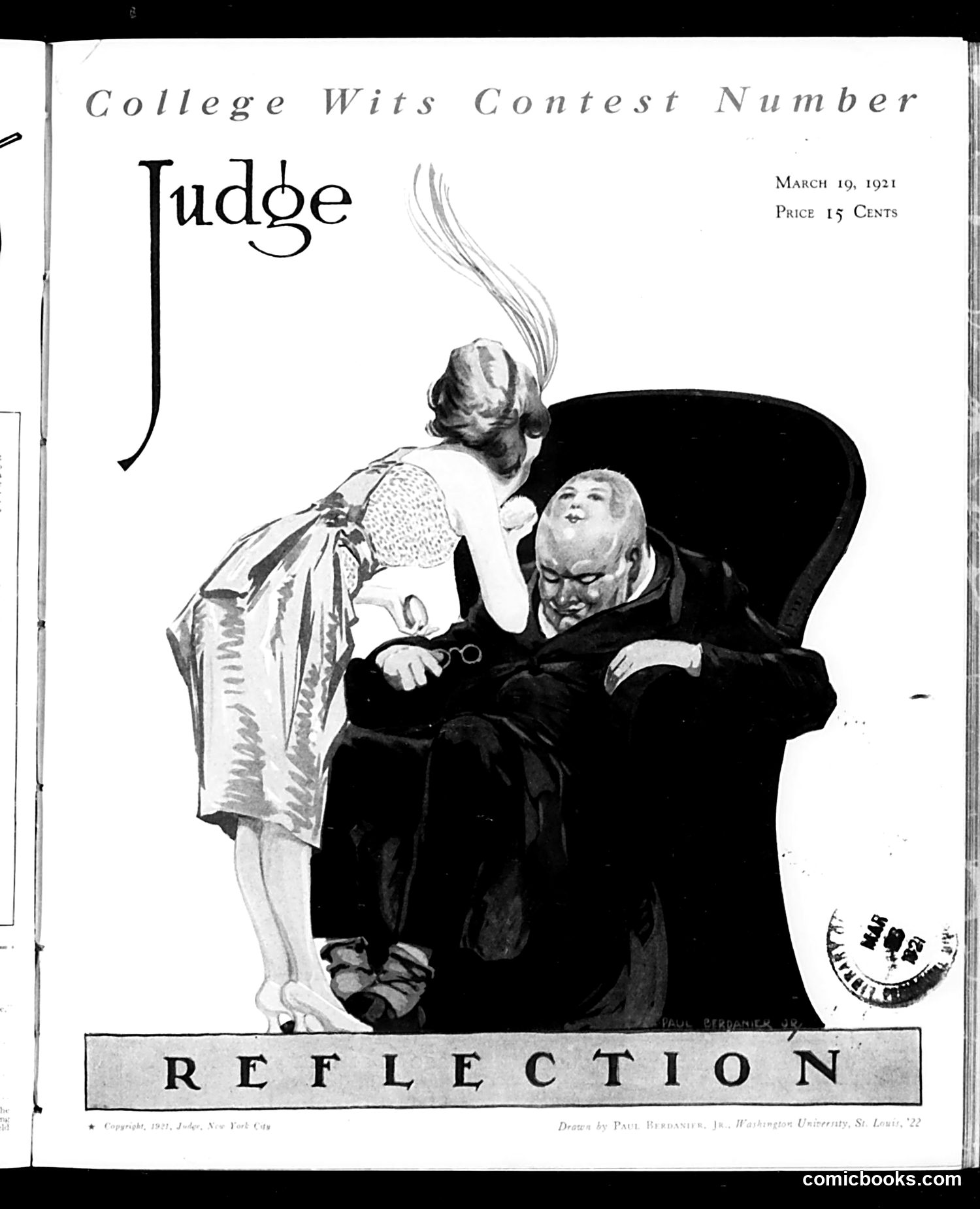
This cover depicts an older man in formal attire seated in a chair, gazing upward at his own reflection shown as a young woman. The title "Reflection" suggests the satire concerns vanity or self-perception. The cartoon likely satirizes either an aging politician or public figure who sees himself as younger/more vigorous than reality permits, or possibly comments on romantic delusion—an older man imagining himself as attractive to youth. The specific identities of the figures remain unclear without additional context from the magazine's issue. The drawing is credited to Paul Heprender Jr. from Washington University, St. Louis. At 15 cents, this was a typical price for Judge during the 1920s.
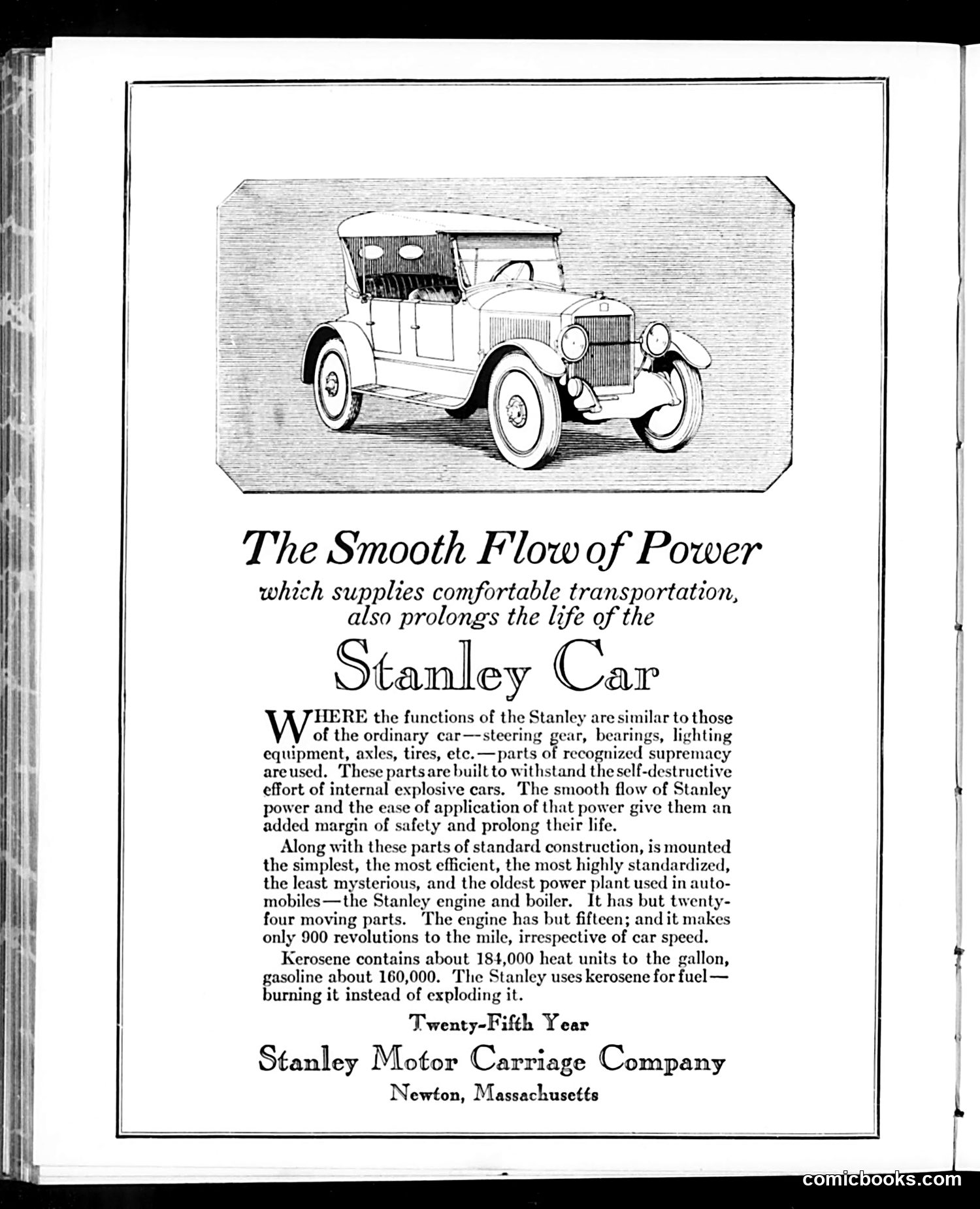
This page is **primarily an advertisement**, not satirical content. It promotes the Stanley Motor Carriage Company's steam-powered automobile, based in Newton, Massachusetts. The ad emphasizes the Stanley car's advantages: smooth, reliable power delivery from its steam engine; proven durability using established mechanical components (steering, bearings, lighting); and superior fuel efficiency. It notes the engine has only 24 moving parts (versus 15 in the boiler) and operates at 900 RPM regardless of car speed. The key sales pitch contrasts the Stanley's controlled burning of kerosene against gasoline's explosive combustion—positioning steam as safer and more elegant technology. This references the early automotive era when steam, electric, and gasoline engines competed for market dominance. The "Twenty-Fifth Year" notation suggests this celebrated the company's anniversary.
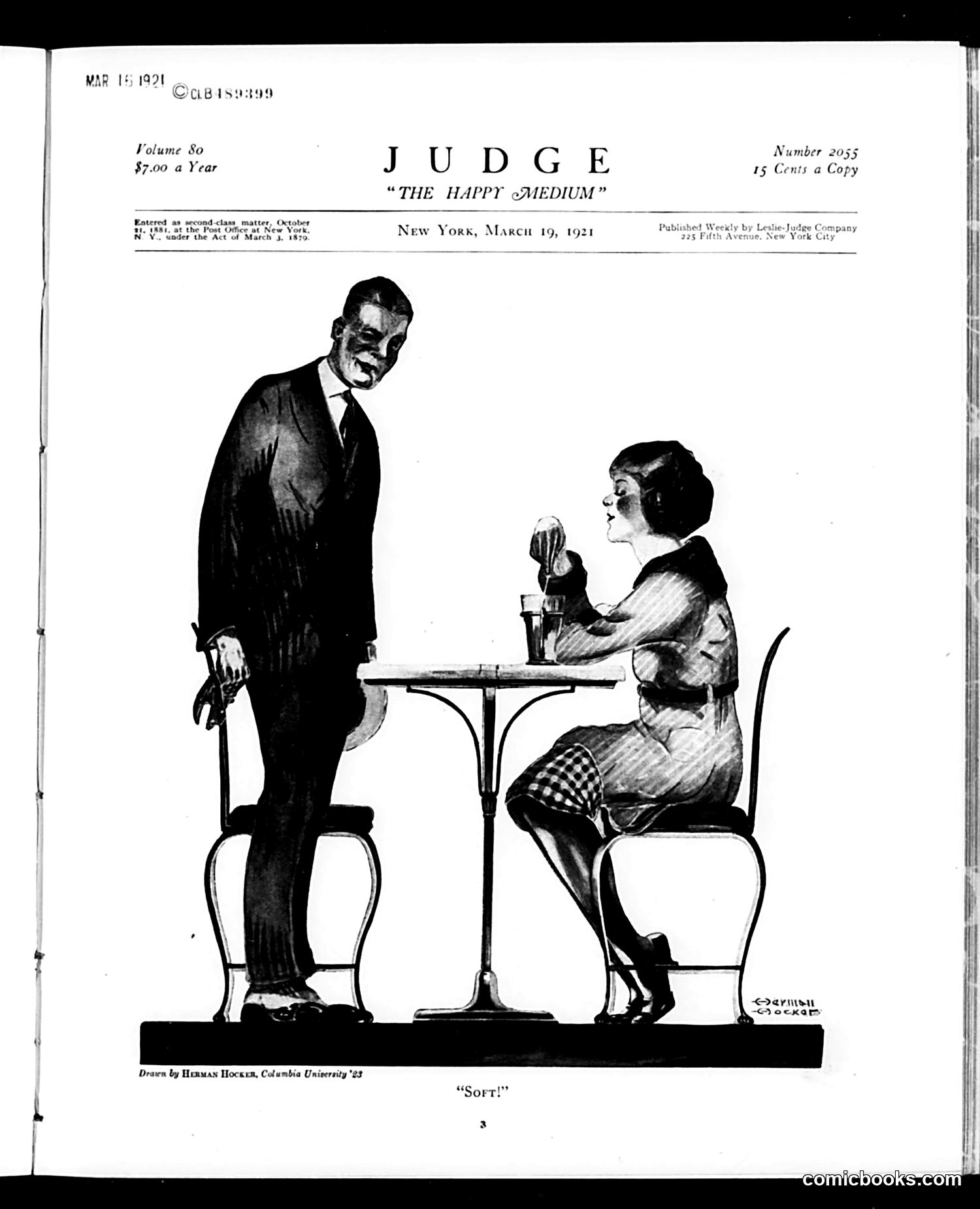
This cartoon depicts a social interaction between a well-dressed man and a woman seated at a small table. The man appears apologetic (given the caption "Sorry!"), suggesting he has either said or done something inappropriate or offensive. The woman's posture and expression suggest she is either offended or dismissive of his apology. The cartoon likely satirizes early 1920s dating or courtship conventions, possibly commenting on changing social relations between men and women during the post-World War I era—a period when women's roles and social freedoms were rapidly evolving. The specific offense or context remains unclear without additional editorial context, but the piece appears to critique male behavior or social awkwardness in romantic interactions of the period.
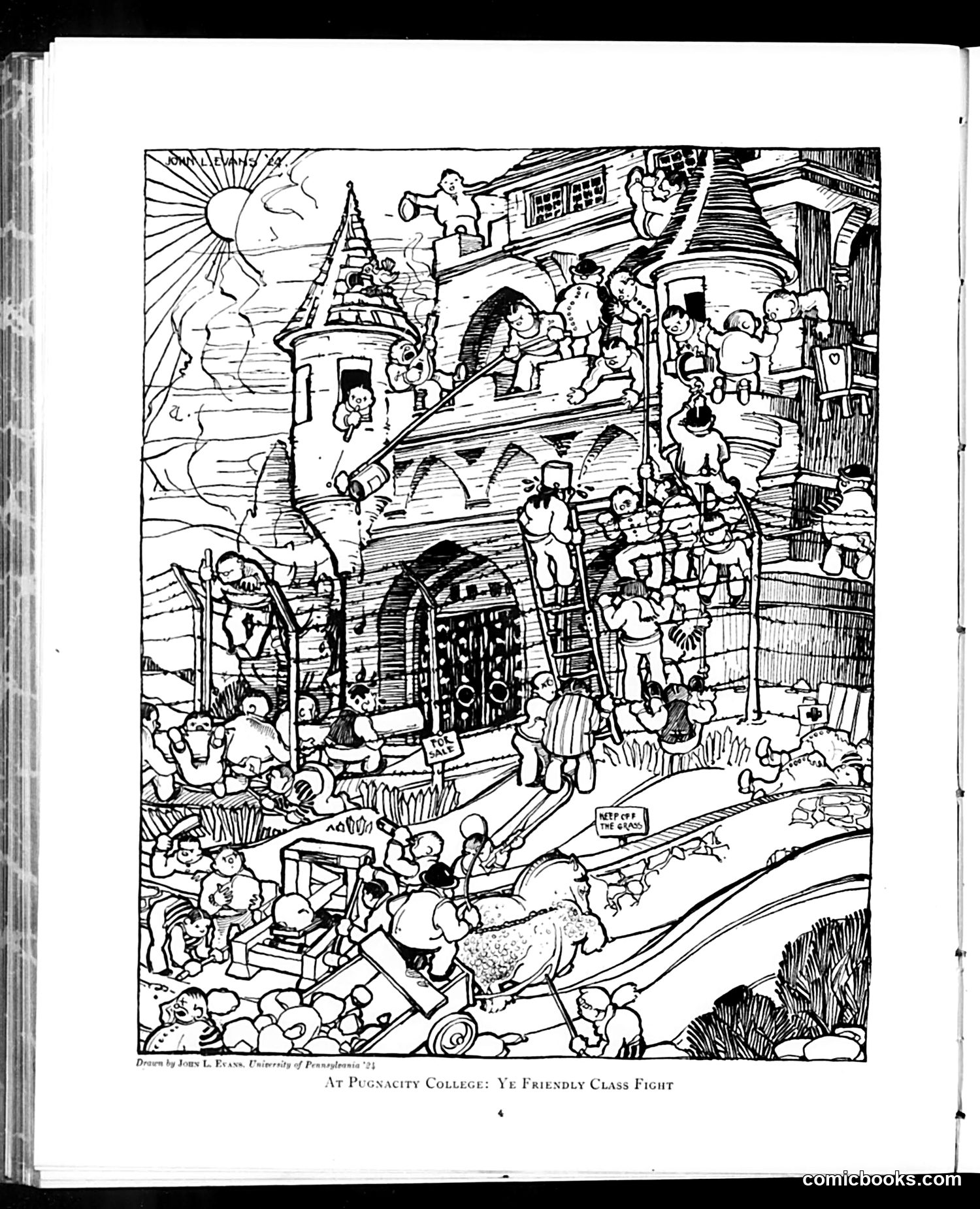
This cartoon depicts a chaotic scene at a college where students are engaged in a massive brawl around a building labeled as part of "Pugnacity College." The satire mocks college class rivalries and the violent "class fights" that were apparently common at American universities during this era (likely early 20th century based on Judge's publication period). The cartoon ridicules the tradition of organized inter-class combat by exaggerating it to absurd levels—showing dozens of students fighting indiscriminately while authority figures seem powerless to stop it. The title's sarcastic phrase "Ye Friendly Class Fight" underscores the irony: these violent confrontations, presented as friendly tradition, are actually dangerous spectacles. The satire critiques both student rowdiness and institutional tolerance of such behavior.
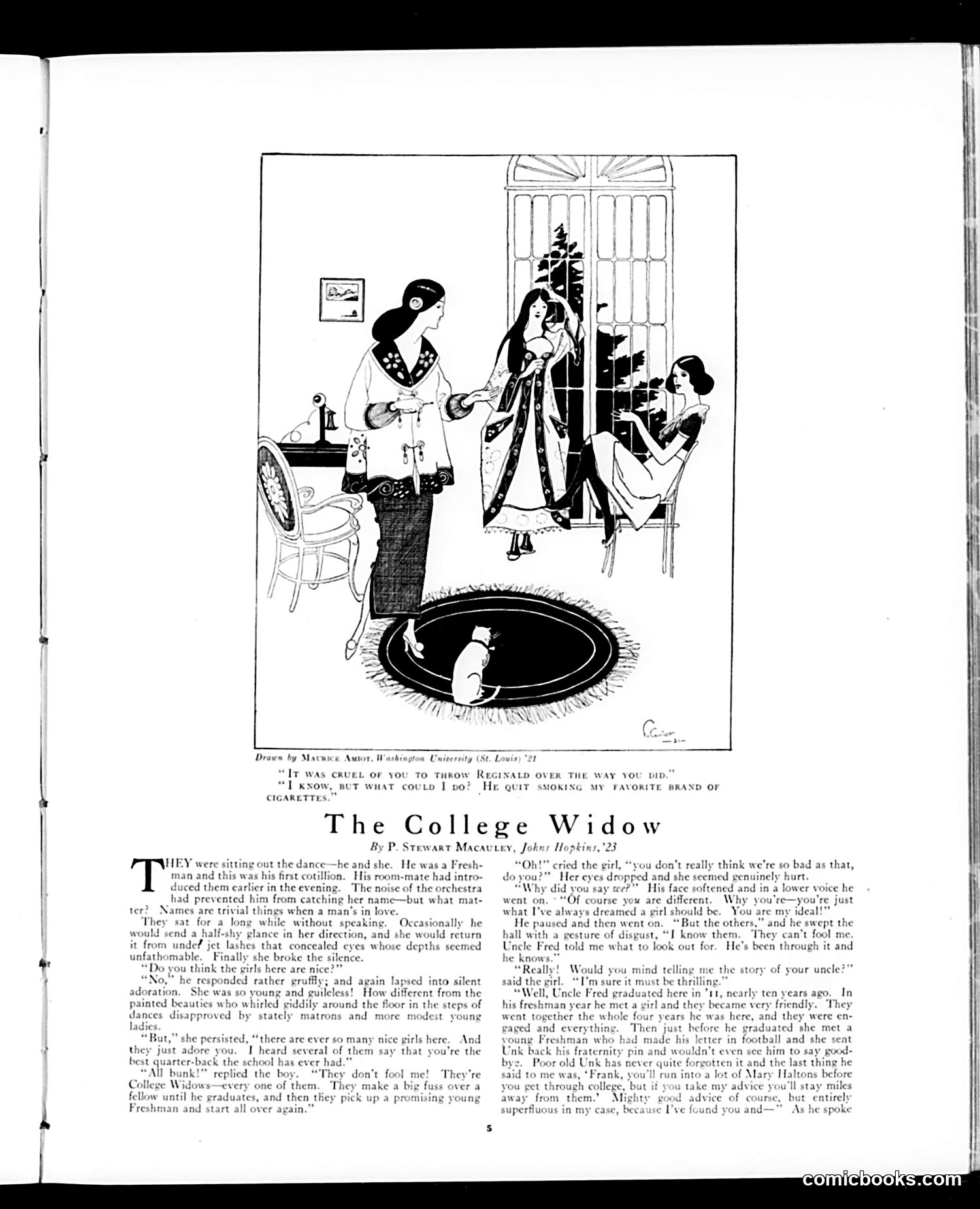
This is a short story illustration from Judge magazine, drawn by Maurice Amort (Washington University, St. Louis, '23). The narrative depicts a social scenario common to early 20th-century college life: the "college widow"—a woman (often slightly older or experienced) who dated numerous college men in succession. The illustration shows a young woman entertaining a male visitor while another couple sits nearby. The story's dialogue reveals the girl's romantic history: she's dated a fraternity man, an athlete, and currently entertains a freshman. The satire targets the casual dating culture and the somewhat predatory reputation attached to experienced women on college campuses. The humor derives from the girl's apparent serial dating pattern and the men's collective naivety about her romantic past.
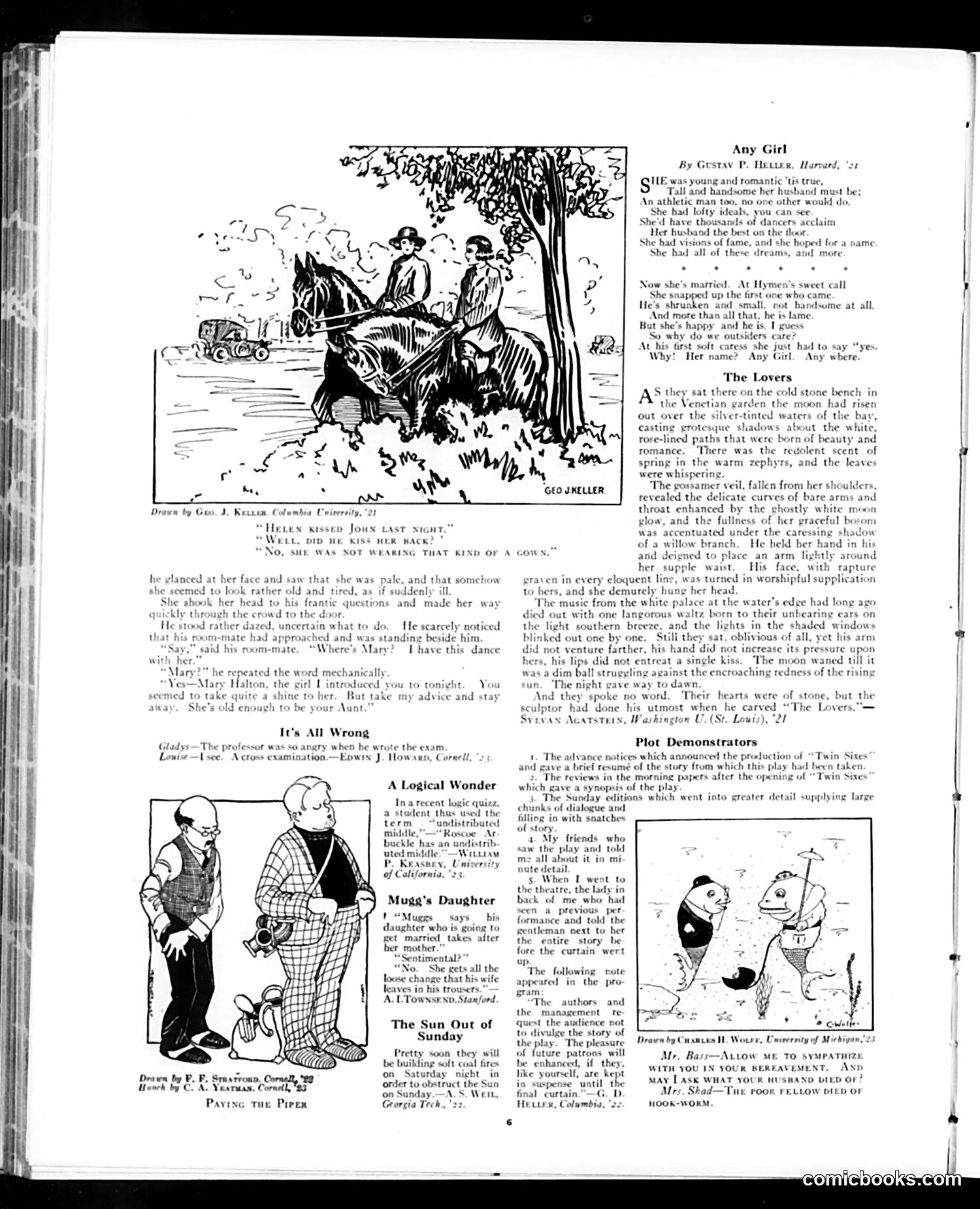
This page contains primarily **literary content rather than political satire**: several short stories ("Any Girl," "The Lovers," "It's All Wrong," "A Logical Wonder," "Mugg's Daughter," "The Sun Out of Sunday") with accompanying illustrations. The one clear cartoon, "Paying the Piper" (bottom left), shows two men in working-class clothing. The caption references paying "the piper"—a common idiom meaning facing consequences. The exact social commentary is **unclear without additional context**, but likely references labor disputes, economic hardship, or class conflict typical of Judge's satirical focus. The page reflects Judge's mixed format: combining humor writing with occasional social commentary rather than dense political cartooning.
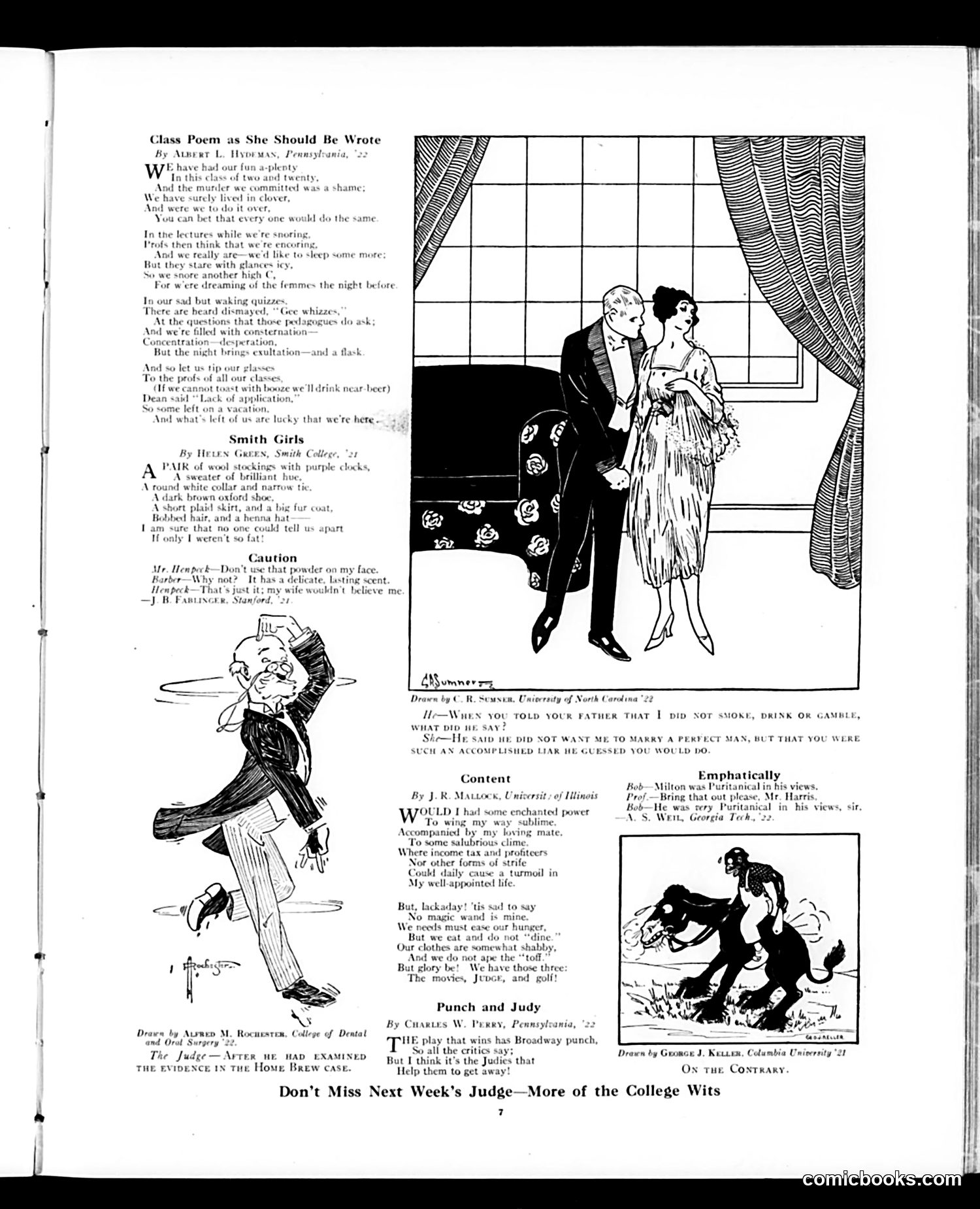
This 1920s college humor page satirizes undergraduate life through multiple sketches: **"Class Poem as She Should Be Wrote"** mocks pretentious student poetry by presenting a cynical, irreverent version acknowledging academic laziness, hangovers, and romantic obsessions rather than noble sentiments. **"Smith Gate"** and related sketches appear to poke fun at romantic entanglements and social awkwardness among students. **The "Home Brew" cartoon** references Prohibition-era humor—judges examining evidence of illegal home-brewed alcohol, a common speakeasy reference of the 1920s. **The engagement dialogue** jokes about a suitor lying to her father about not smoking, drinking, or gambling—the father paradoxically approves *because* he's such a skilled liar he'll be a suitable husband. **"Content" and "Punch and Judy"** appear to be brief satirical poems about student life and theatrical productions. The overall theme: satirizing college students as lazy, alcohol-consuming, romantically preoccupied, and dishonest—standard Judge magazine fare targeting educated young people.
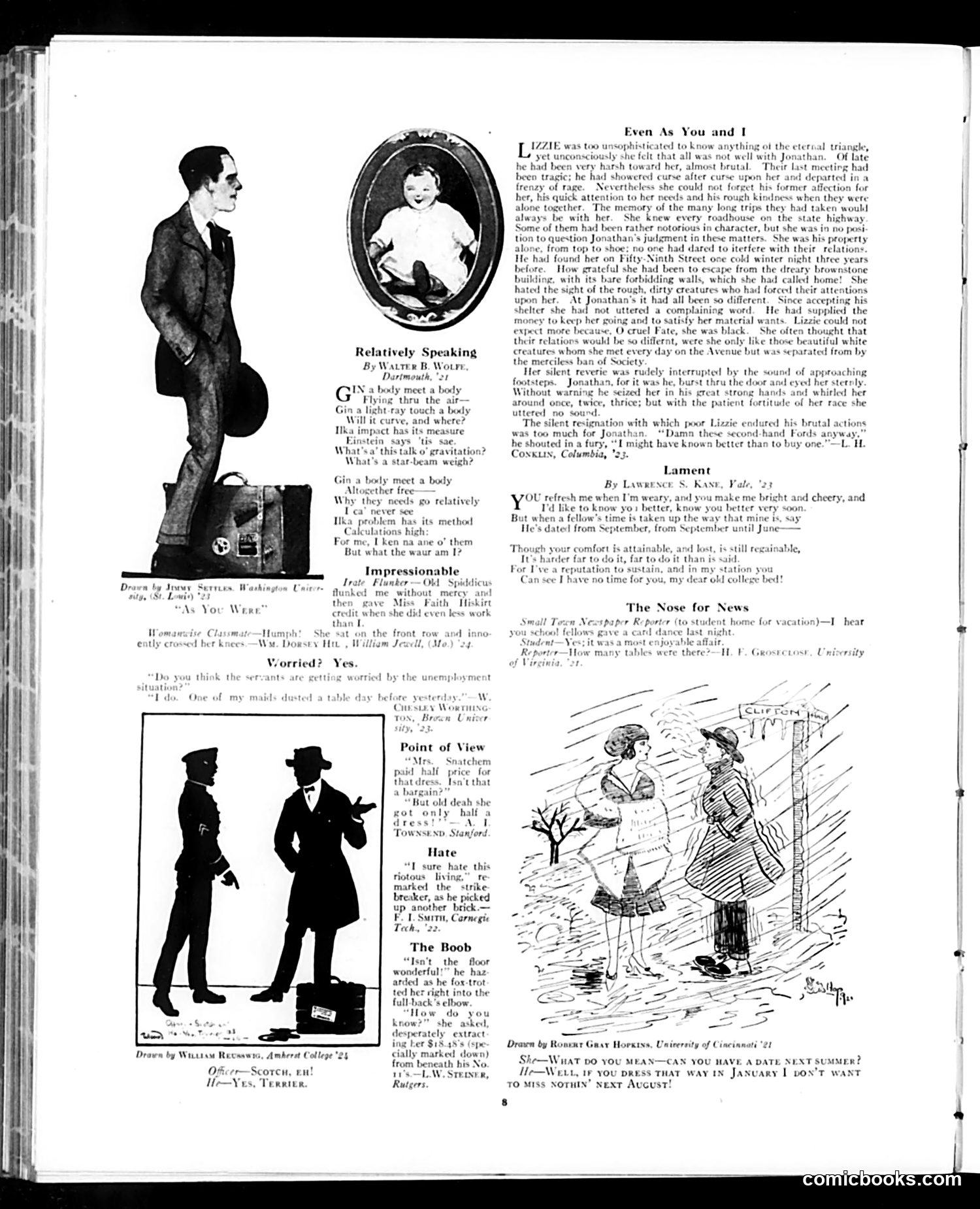
This page from Judge contains several short humorous pieces typical of 1920s college humor magazines: **"Relatively Speaking"** is a poem punning on Einstein's theory of relativity, using romantic/physics metaphors ("if a light-ray touch a body / Will it curve where?"). It's clever wordplay aimed at educated readers familiar with Einstein's recent fame. **"Impressionable"** satirizes academic favoritism: a professor flunks one student harshly while giving another credit for doing less work, implied because she's attractive ("She sat on the front innocently crossed her knees"). **"Point of View"** jokes about a cheap bargain—a woman buying a dress at half price but getting only half a dress. **"The Boob"** mocks an oblivious dancer who compliments the floor while dancing his date into someone's elbow, damaging her expensive shoes. **"Even As You and I"** appears to be serialized fiction about a woman named Lizzie and her volatile relationship with Jonathan, who drives recklessly in a secondhand Ford—suggesting lower-class circumstances and modern anxieties about automobiles. The tone reflects 1920s collegiate cynicism and modern dating culture anxieties.
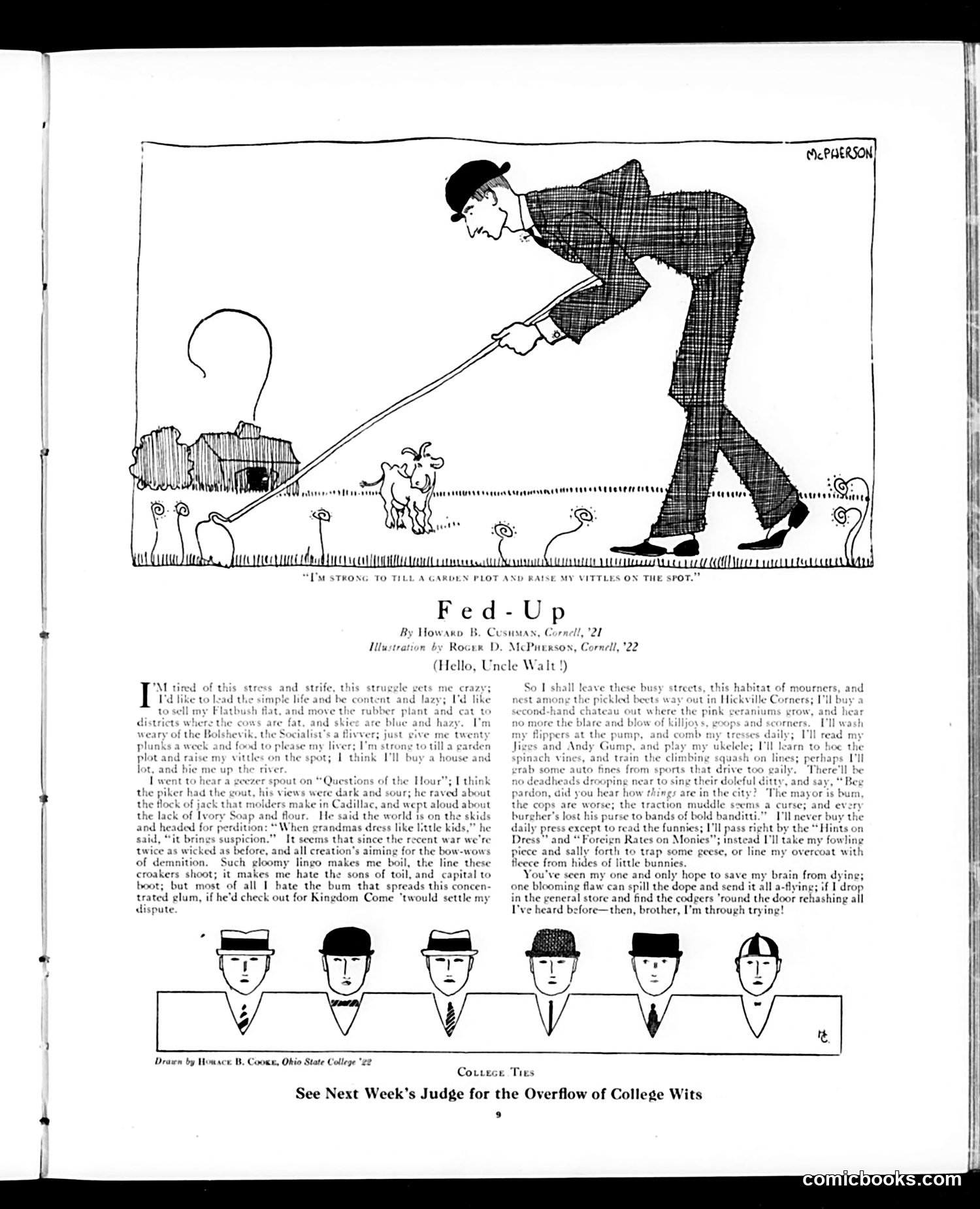
This 1921 satirical cartoon by Roger McPherson critiques urban malaise and the appeal of agrarian escapism. The illustration shows a tall, exasperated man wielding a spade, addressing "Uncle Walt" (likely referencing Walt Whitman's romanticization of nature and manual labor). The narrator expresses exhaustion with city life—its "stress and strife," labor disputes, pessimistic talk, and moral decay. He fantasizes about abandoning urban corruption for rural self-sufficiency: buying land, raising vegetables, and escaping what he views as civilization's decay and class conflict ("capital to boot"). The satire targets two audiences: young men seduced by pastoral idealism and the intellectual pretensions of such escapism. The accompanying "College Ties" illustration suggests mockery of educated men considering similar fantasies—viewing agrarian retreat as an impractical fantasy rather than viable solution to modern urban problems. The piece reflects post-WWI American anxiety about modernization, labor unrest, and social upheaval circa 1920-1922.
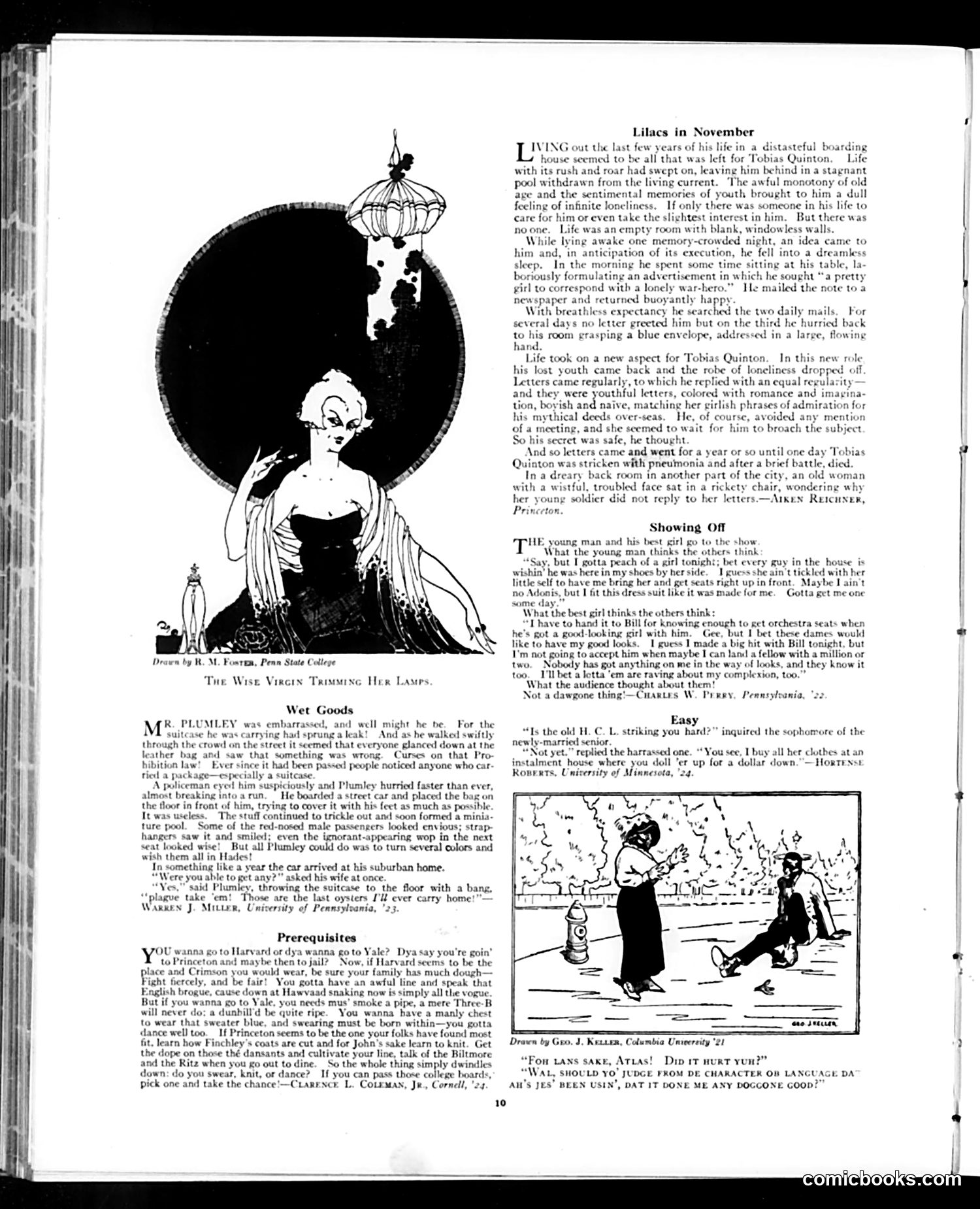
This page contains three humorous stories satirizing American social life, circa 1920s: **"Wet Goods"** mocks Prohibition enforcement. Mr. Plumley carries a leaking suitcase of contraband liquor (oysters are a euphemism) home on a streetcar. Everyone notices the telltale drips, forcing him to awkwardly rush through the journey. The joke: despite strict Prohibition laws, illicit alcohol remains impossible to hide—a commentary on the law's ineffectiveness and public complicity. **"Prerequisites"** satirizes college admissions obsession. It humorously catalogs superficial requirements at Harvard, Yale, and Princeton—proper accents, smoking pipes, specific sweaters—suggesting elite institutions value pretension over genuine qualification. **"Lilacs in November"** tells a sentimental story: lonely elderly Tobias Quinton advertises for correspondence with a young woman. The narrative depicts his desperate yearning for human connection in old age. The illustrations include a stylized fashion drawing and a casual scene depicting the college prerequisite theme. These pieces reflect Jazz Age anxieties about class, conformity, and social isolation.
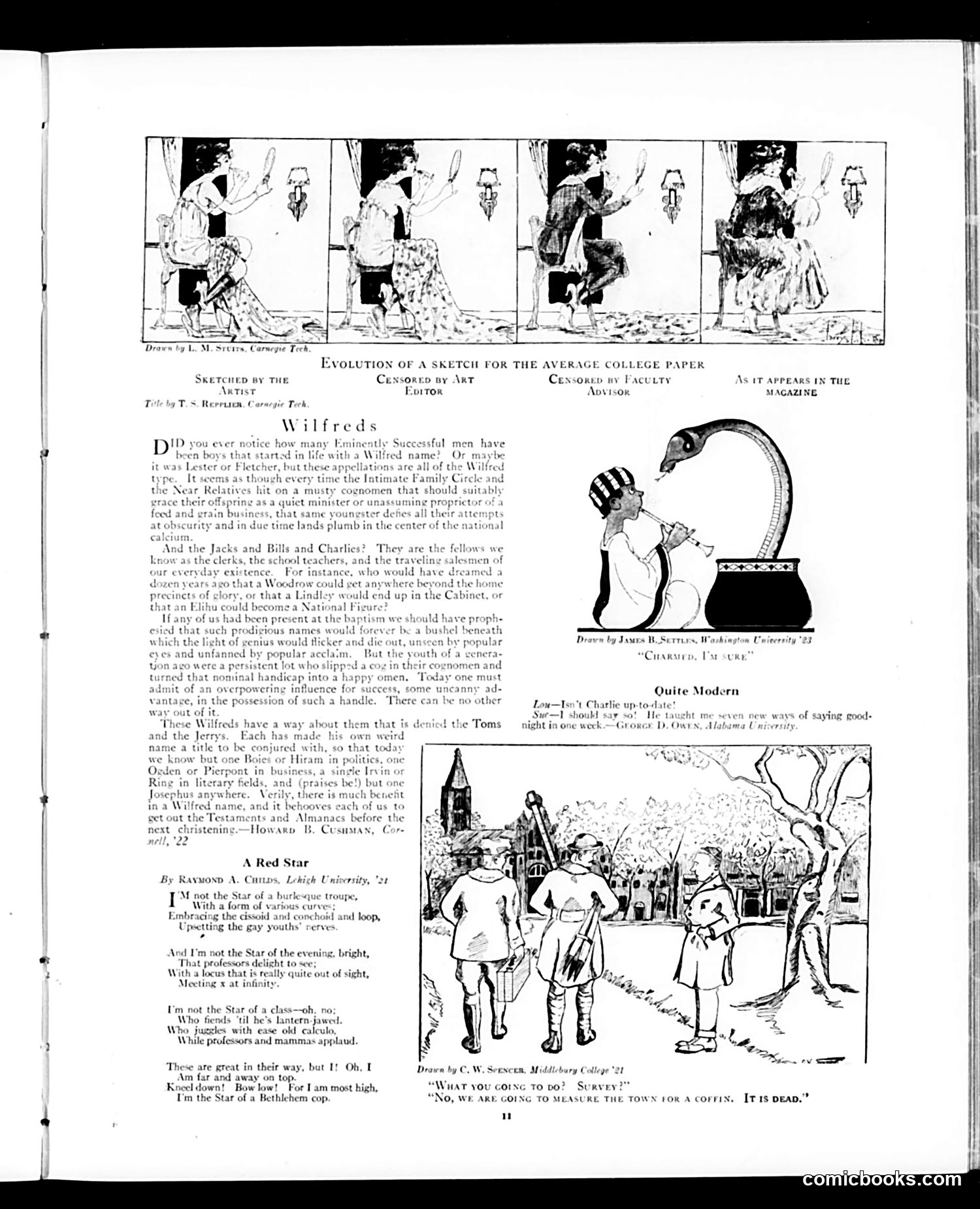
This page from *Judge* satirizes college humor publication censorship. The top section shows "Evolution of a Sketch"—how a single cartoon transforms as it passes through different editorial hands: the artist's original sketch, then versions "censored by" the art editor, faculty advisor, and finally "as it appears in the magazine." The progression likely shows increasingly sanitized or altered versions, mocking how college publications get watered down by institutional oversight. Below are three unrelated pieces: "Wilfreds" discusses naming conventions among successful men; "A Red Star" is a poem about astronomical references; and "Quite Modern" shows children planning to measure a town for a coffin (appears to be dark humor about someone's death, though the reference is unclear). The page critiques institutional control over student creative expression.
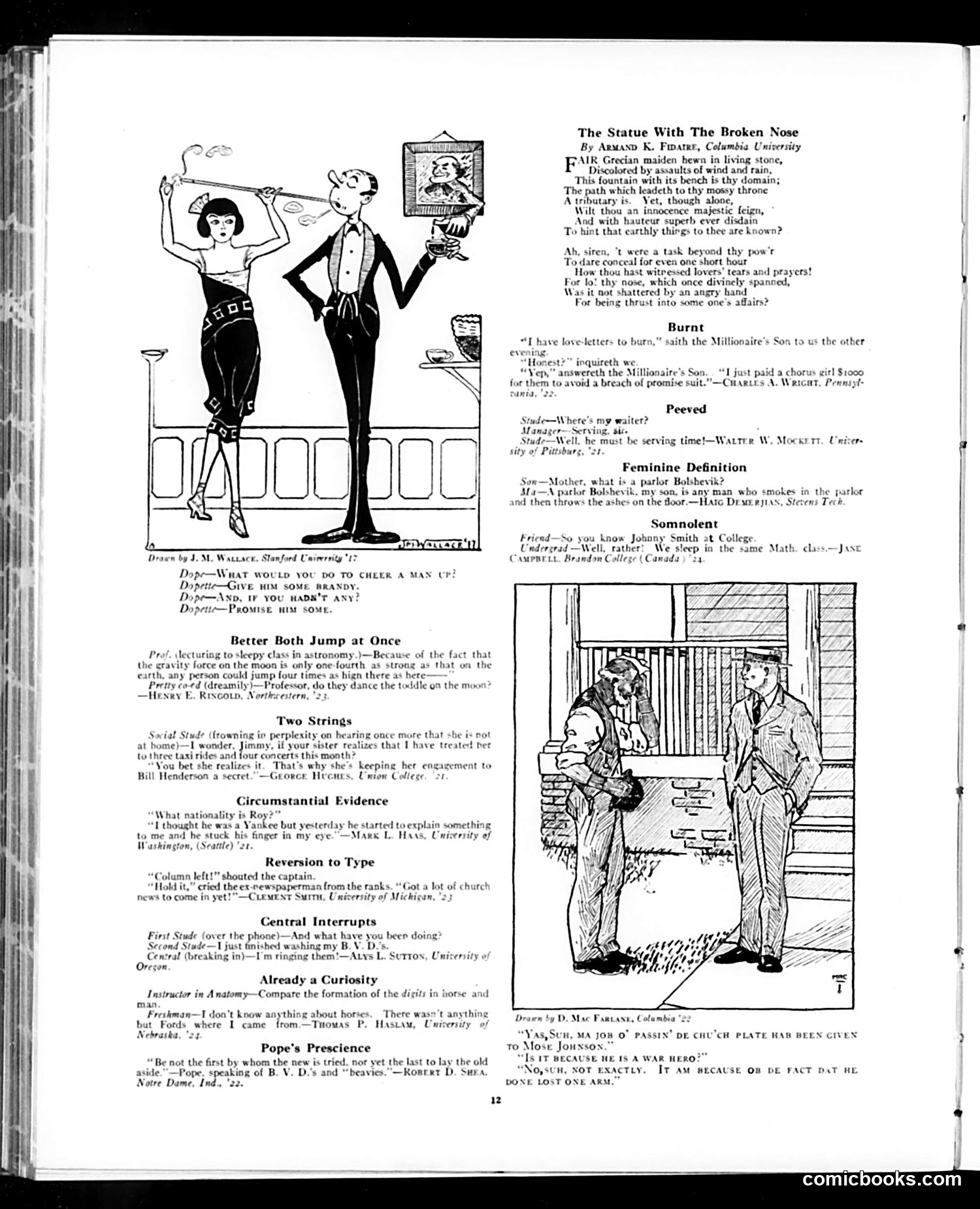
This page from Judge magazine contains short humorous pieces typical of 1920s college humor. The main cartoon shows a man and woman in evening dress examining an art piece—likely satirizing pretentious art appreciation among the wealthy. The textual jokes target contemporary social attitudes: **"Burnt"** mocks wealthy men paying off women to avoid breach-of-promise lawsuits—a real legal concern of the era. **"Feminine Definition"** stereotypes Bolsheviks (Russian communists, viewed with suspicion post-1917) as hypocritical parlor radicals. **"Better Both Jump at Once"** jokes about 1920s dating culture and the "toddle" dance craze. **"Already a Curiosity"** references the Model T Ford's dominance, suggesting younger generations knew only cars, not horses. The final cartoon caption satirizes racial attitudes of the period, using dialect humor about an African American man's employment—typical of Judge's casual racism. These pieces reflect 1920s college-educated youth's concerns: dating, wealth, communism fears, modern technology, and period-specific social anxieties.
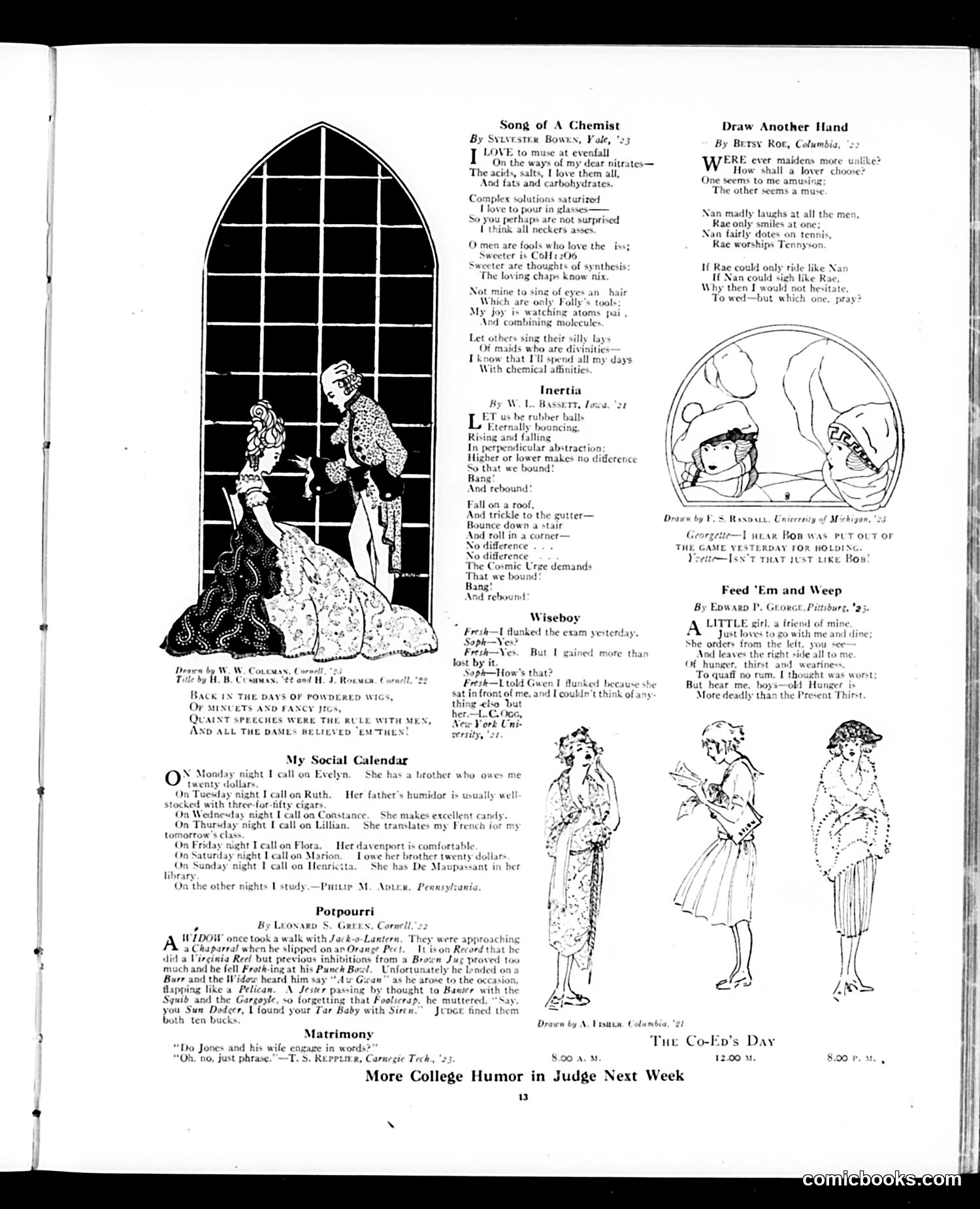
This is a college humor page from Judge magazine featuring several satirical pieces aimed at 1920s university students: **"Song of a Chemist"** mocks pedantic STEM majors obsessed with chemical formulas rather than romance—a jab at academics prioritizing their field over social life. **"My Social Calendar"** satirizes fortune-hunting college men who time social calls strategically: visiting girls whose families have money ("brother who owes me twenty dollars," "father's humidor is usually well stocked") or wealth markers like comfortable furniture. **"Wiseboy"** presents a simple joke where a freshman claims to have told a girl he passed an exam he actually failed—basic teenage male braggadocio. **"Draw Another Hand"** contrasts two female types: "Nan" (vivacious, laughs freely) versus "Rae" (reserved, worships heroes). It reflects 1920s debates about "modern" versus traditional femininity. The page overall targets college social hierarchies, romantic pretense, and gender stereotypes typical of early-1920s campus life. The drawings use period fashion and poses to reinforce these types.
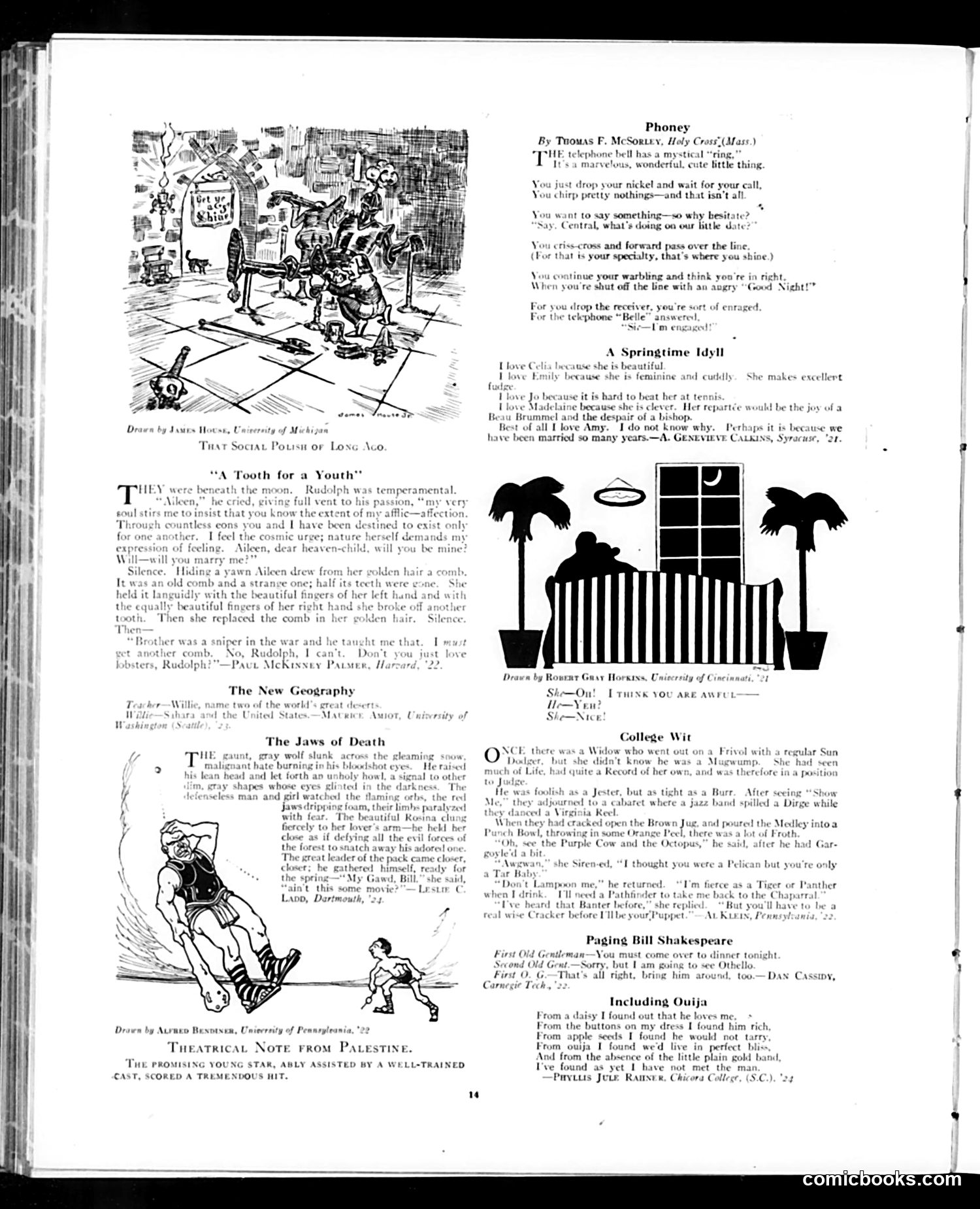
This page from Judge magazine (likely 1920s, based on attribution dates) contains several satirical pieces targeting young people and modern courtship: **"Phoney"** mocks the telephone as a romantic tool—a young man nervously drops his nickel, stammers platitudes to a telephone operator ("Belle"), and gets rebuffed. The satire targets both technological anxiety and awkward male courtship rituals. **"A Tooth for a Youth"** appears to be a romantic melodrama parody about a desperate suitor named Rudolph pleading with a woman named Aileen. **The illustrations** include a chaotic domestic scene and a minimalist tropical setting, likely accompanying humorous college submissions about youthful romance and modern life. **"College Wit"** and **"Paging Bill Shakespeare"** are joke sections satirizing pretentious college students making literary and theatrical references, and the "Ouija" section mocks women using spiritualist fads to predict romantic futures. The overall theme: Judge lampooned young people's earnest but bumbling attempts at romance using new technology and fashionable cultural trends.
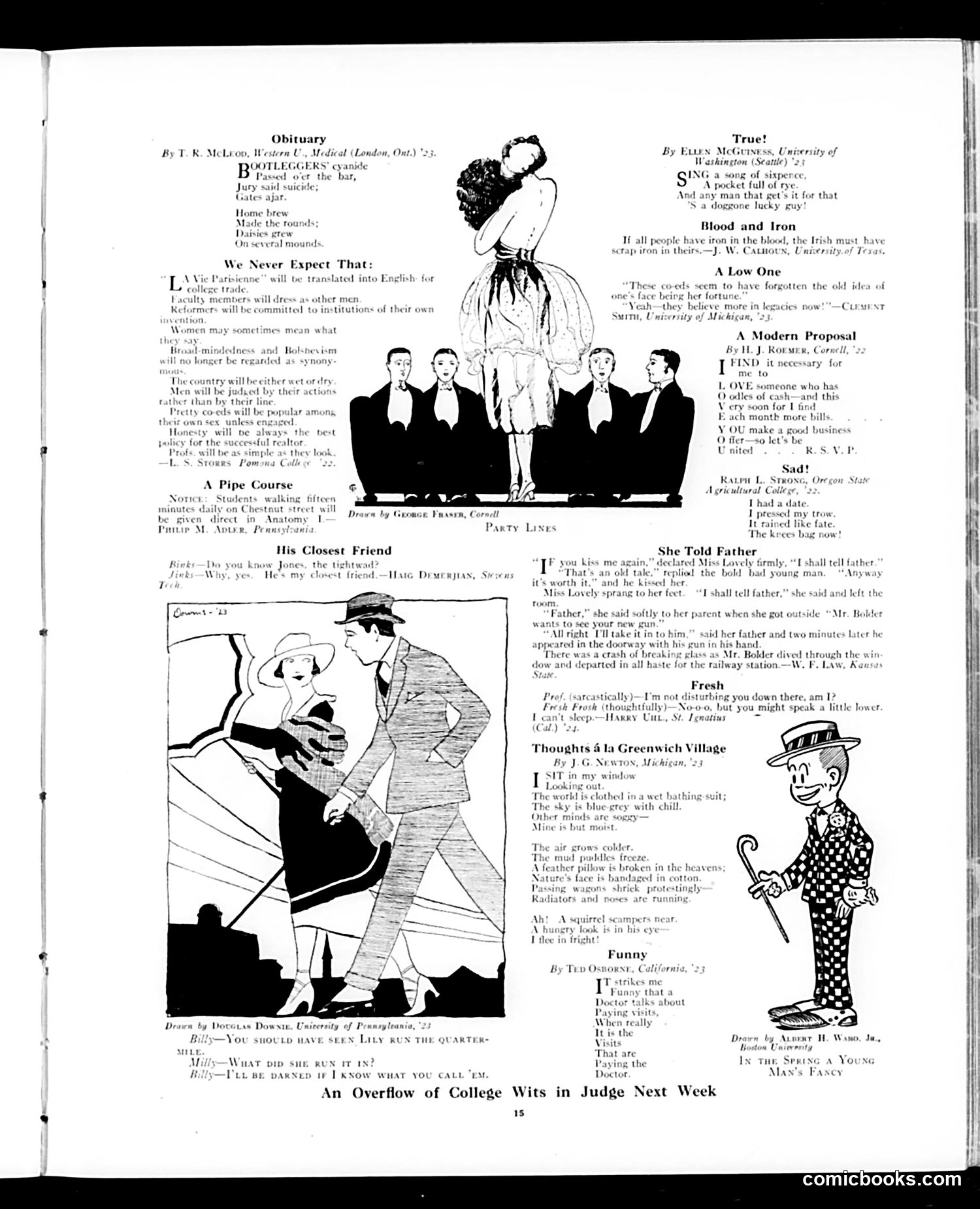
This is a college humor page from Judge magazine, featuring poems and cartoons by students from various universities ('22-'23 era). The content mocks early 1920s American social issues and college life. **Key satirical content:** - "Bootleggers" obituary mocks Prohibition enforcement (the "suicide" verdict for a bar owner) - "Blood and Iron" jokes about national stereotypes (likely German militarism references) - "Modern Proposal" satirizes dating/marriage economics—a female student proposes treating romance like a business transaction, accumulating "bills" monthly - The main cartoon "His Closest Friend" appears to show a man caught in an awkward romantic situation, with an irate father figure - "Thoughts à la Greenwich Village" parodies bohemian lifestyle pretensions **The overall theme:** College-age satire of Prohibition, courtship customs, social climbing, and bohemian affectation—typical 1920s student humor reflecting post-WWI social anxieties about changing gender relations and urban modernity.
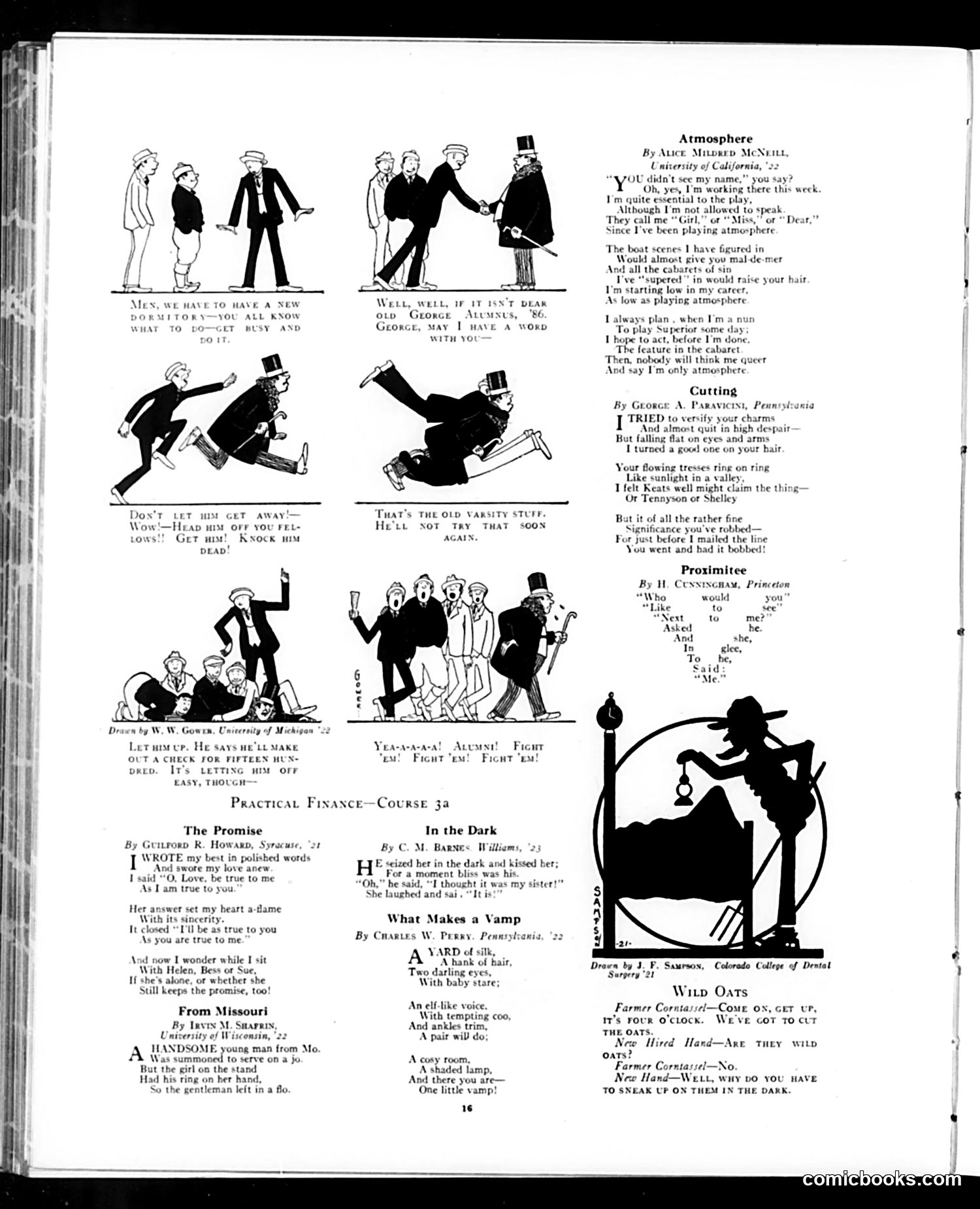
This page mixes humorous poetry and satirical cartoons from what appears to be a college humor issue (multiple contributors dated '22, suggesting 1922). The top cartoon depicts dormitory hazing—older students intimidating a freshman. The caption "You know what to do—get it and do it" references typical fraternity initiation pranks. The sequential panels show escalating physical comedy: chasing, tackling, and finally a brawl over a fifteen-dollar check, with the caption "It's letting him easy, though!" The cartoons mock collegiate traditions and masculine peer pressure through exaggerated slapstick violence. The accompanying poems ("Atmosphere," "Cutting," "Proximatee") appear to be college-themed romantic and social commentary. The page represents Judge's satirical focus on American social customs and campus life during the 1920s.
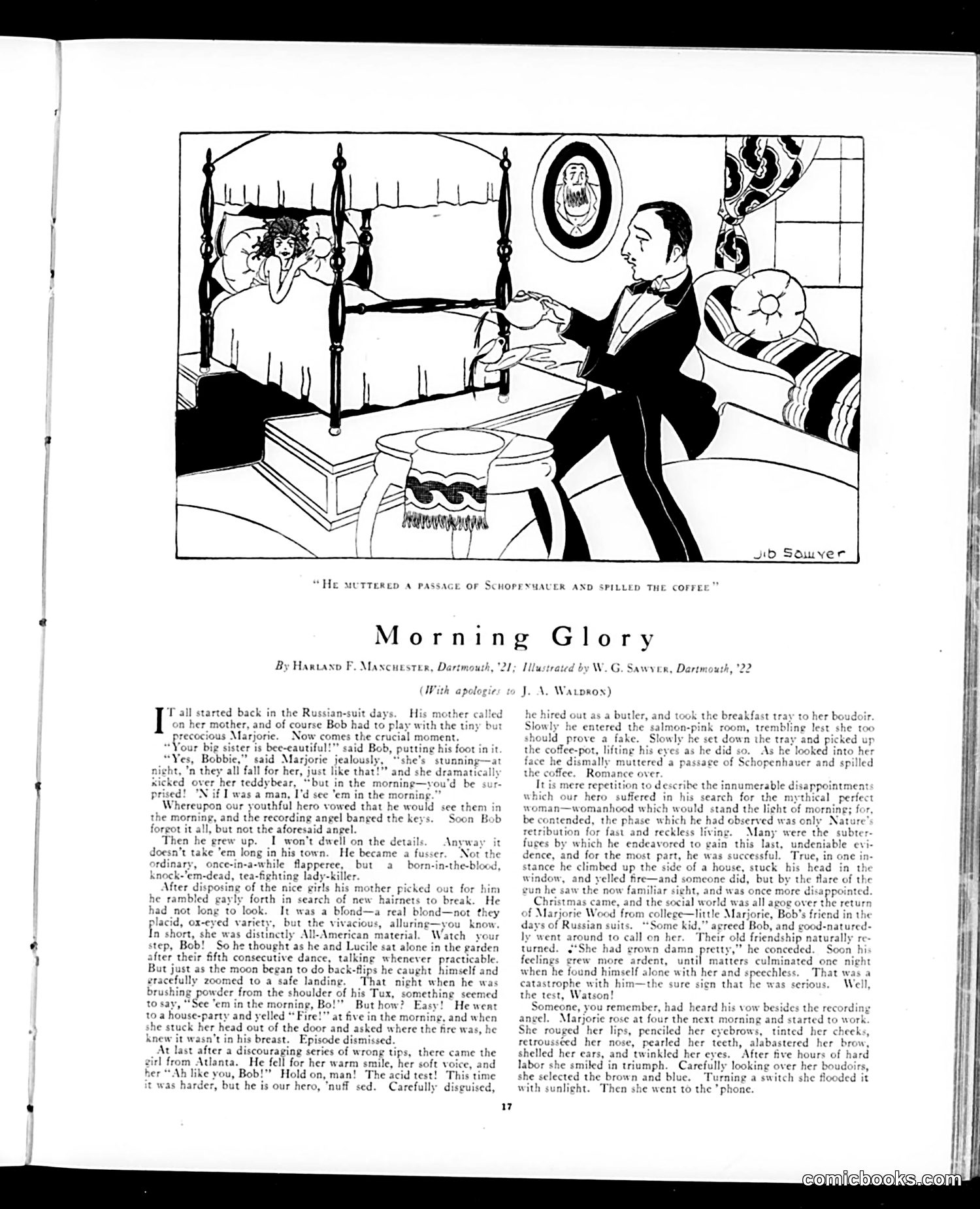
This is a short story illustration, not political satire. The narrative concerns a young man named Bob who, as a child, boasts to his sister Marjorie that he'll see women "in the morning"—meaning he'll judge them by their natural appearance rather than cosmetic enhancement. Years later, as a ladies' man, Bob falls for a girl from Atlanta. To teach him a lesson, Marjorie orchestrates a morning reveal: she exposes the girl's heavy makeup and artificial beauty enhancements applied the night before. The punchline involves Bob's disillusionment when he sees her unadorned face. The satire targets 1920s beauty culture and cosmetics—mocking both the elaborate artifice women employed and men's gullibility about feminine appearance. The Schopenhauer reference (visible in the caption) suggests philosophical commentary on romantic illusions. Published in Judge magazine's 1922 Dartmouth college issue, it's a morality tale about vanity and deception.
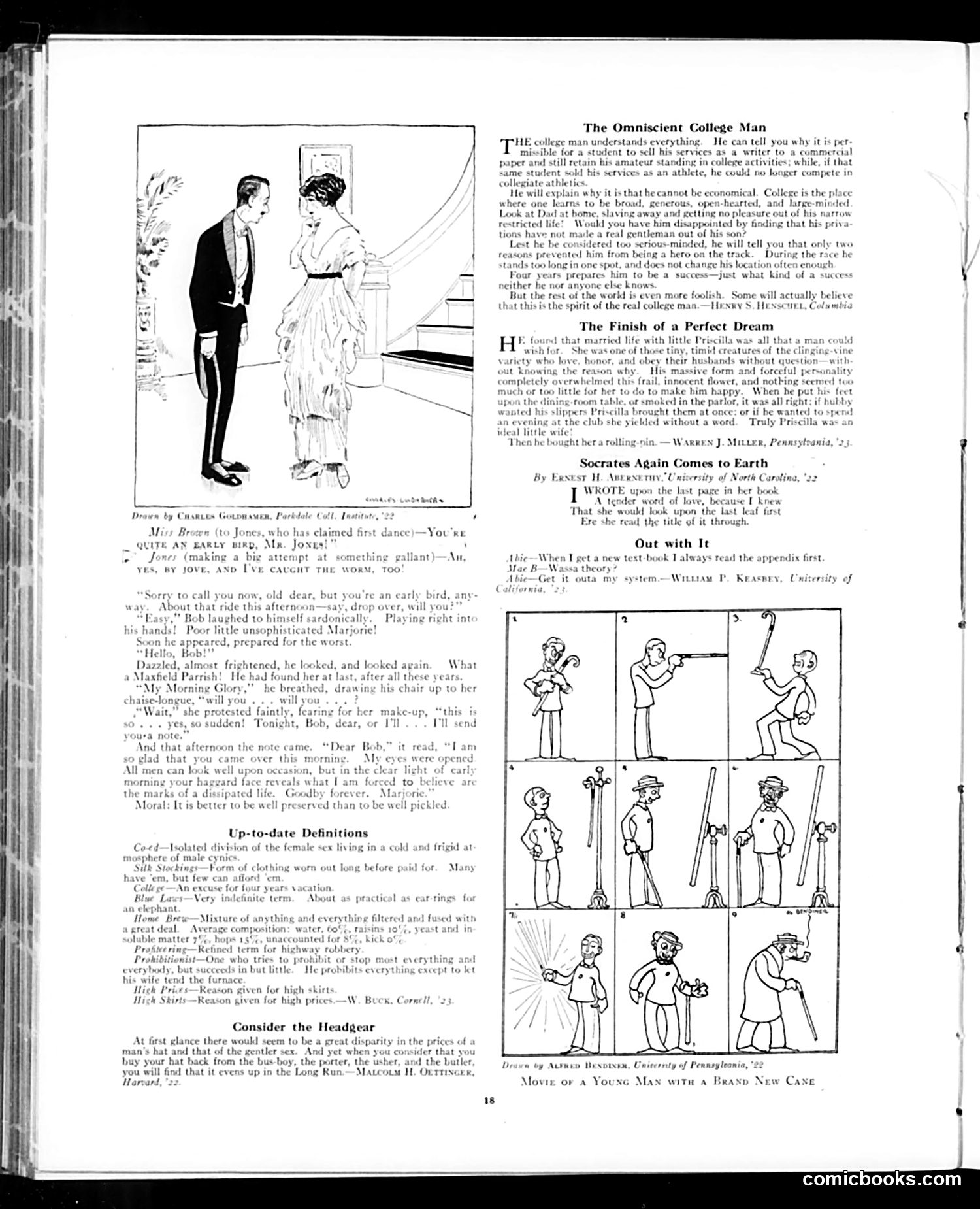
This page from *Judge* magazine satirizes college life and masculine pretension circa 1922. The main article mocks the "college man" who claims expertise on everything while actually understanding nothing—particularly the hypocrisy of collegiate athletics rules (amateur athletes can't be paid, but student writers can sell their work). The piece ridicules how college men adopt false sophistication and broad-mindedness while remaining narrow-minded about their own contradictions. The accompanying cartoon vignettes mock various college-era social dynamics: a man arriving late to a date but proudly announcing he's "caught the worm"; definitions lampooning collegiate slang and pretension; and a piece satirizing naive newlywed dynamics where the husband dominates his "frail, innocent" wife unchallenged. The humor targets educated young men's self-importance and the gap between their imagined sophistication and actual behavior—a recurring *Judge* theme criticizing upper-class American youth culture.
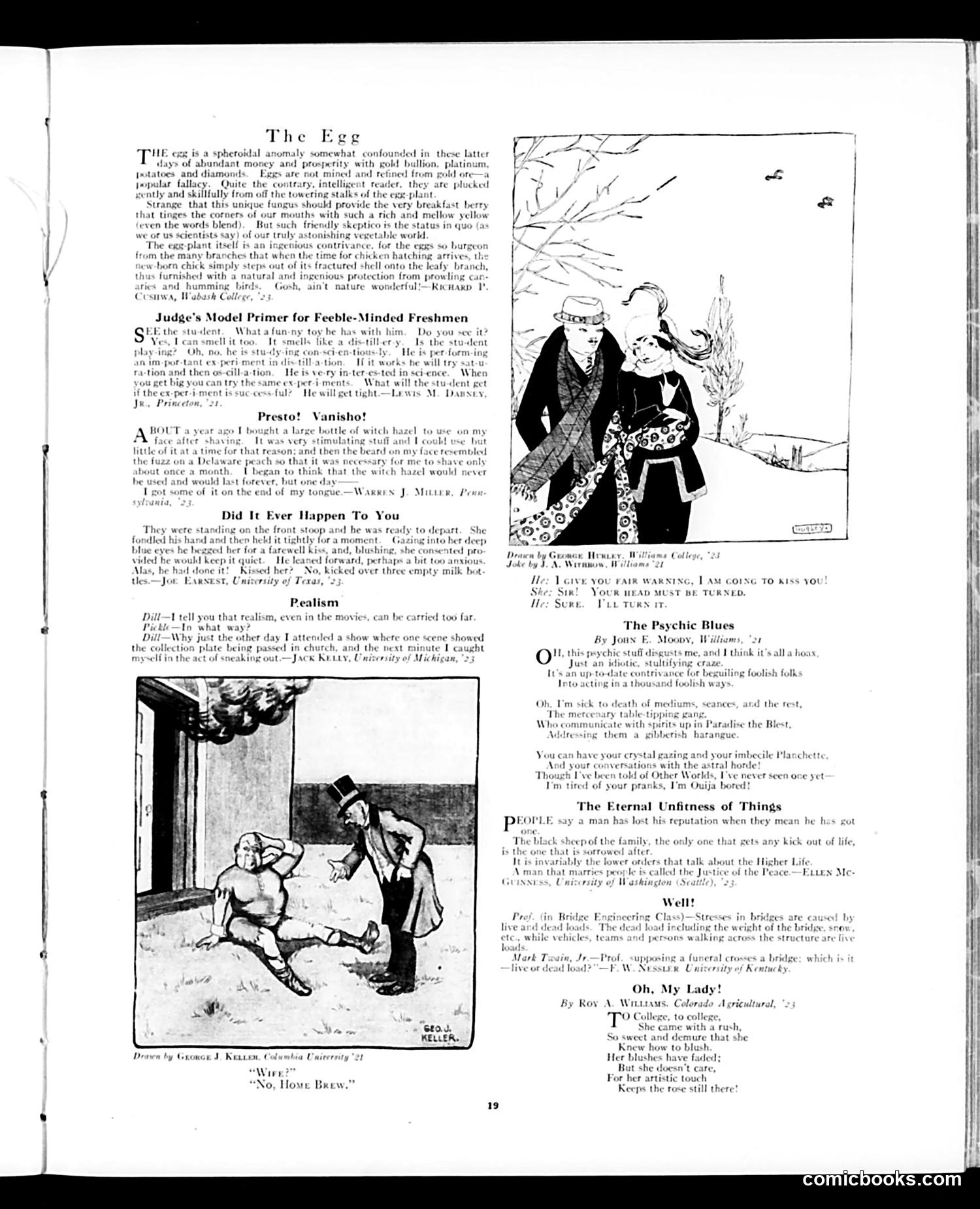
This page from the satirical magazine *Judge* contains several humorous pieces targeting college students and intellectual pretensions circa 1921. **"Judge's Model Primer for Feeble-Minded Freshmen"** mocks naive college freshmen through a fake educational primer, suggesting young students engage in clumsy romantic experimentation ("oscillation") presented as scientific inquiry—satirizing both student foolishness and pseudo-intellectual posturing. **"Pealism" cartoon** ridicules excessive realism in cinema and life. The joke: a man attends church and is so committed to "realism" that he's caught sneaking out—the humor lies in applying artistic principles absurdly to everyday morality. **Other brief pieces** mock spiritualism ("The Psychic Blues"), relationship absurdities, and social pretension. The overall tone targets young educated men for their vanity, pseudo-science interests, and romantic incompetence—common *Judge* themes mocking the Jazz Age college crowd's affected intellectualism and shallow sophistication.
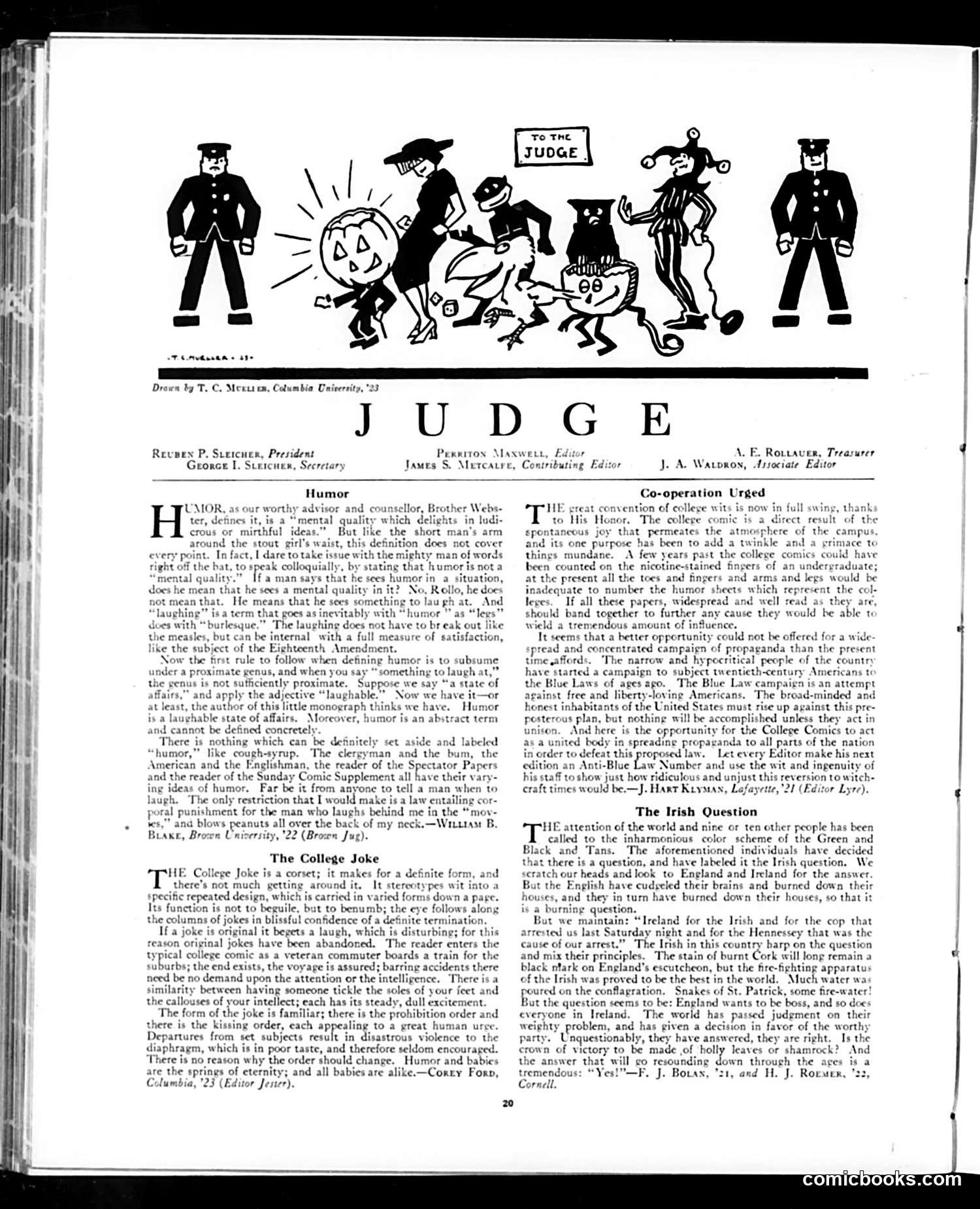
This page from *Judge* magazine presents editorial commentary on humor and comedy, with a satirical cartoon header showing various figures being brought "TO THE JUDGE." **The Main Content:** The page contains three editorial essays about humor: 1. **"Humor"** — A philosophical discussion defining humor as "a laughable state of affairs" rather than a fixed quality. It notes that different social classes and nationalities find different things funny, and humorously complains about people laughing loudly in movie theaters. 2. **"The College Joke"** — A critique of formulaic college humor, comparing it to a "corset" that constrains wit into predictable patterns (prohibition jokes, kissing jokes). The author argues original jokes disturb readers because they're accustomed to safe, standardized humor. 3. **"The Irish Question"** and **"Co-operation Urged"** — Discussing contemporary tensions regarding Irish independence and calling for unified college publication efforts. **The Cartoon:** The header illustration appears to show various caricatured figures (possibly representing different humor styles or publications) being judged, reinforcing the page's theme of evaluating comedic standards.
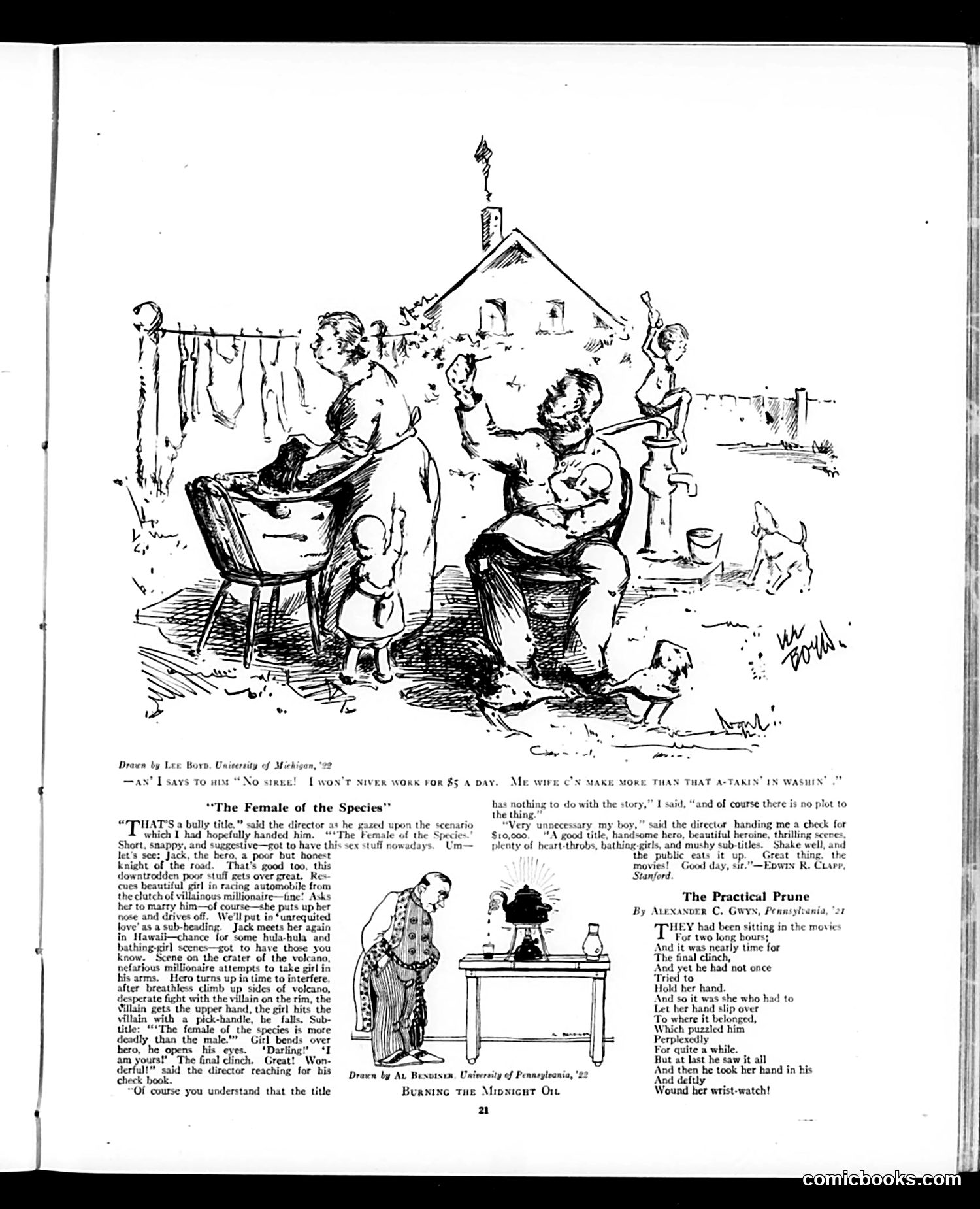
This page contains two satirical pieces about early cinema: **"The Female of the Species"** (top) mocks Hollywood's formulaic filmmaking. A director describes a plot combining every trendy element: poor honest hero, rich villain, racing cars, Hawaiian scenes, volcano drama, and bathing girls—all tied together with a dramatic title borrowed from Kipling's poem about female lethality. The satire's point: the title has *nothing to do with the actual story*, yet the director doesn't care. He prioritizes spectacle, romance, and audience manipulation over coherent narrative. **"The Practical Prune"** (bottom) is a humorous poem about a couple at the movies. The woman must initiate hand-holding since the man is too timid, but when she finally gets his attention, he uses the moment to steal her wristwatch—a joke about male dishonesty disguised as romance. Both pieces critique early cinema's vapidity and the gap between artistic pretense and commercial cynicism.
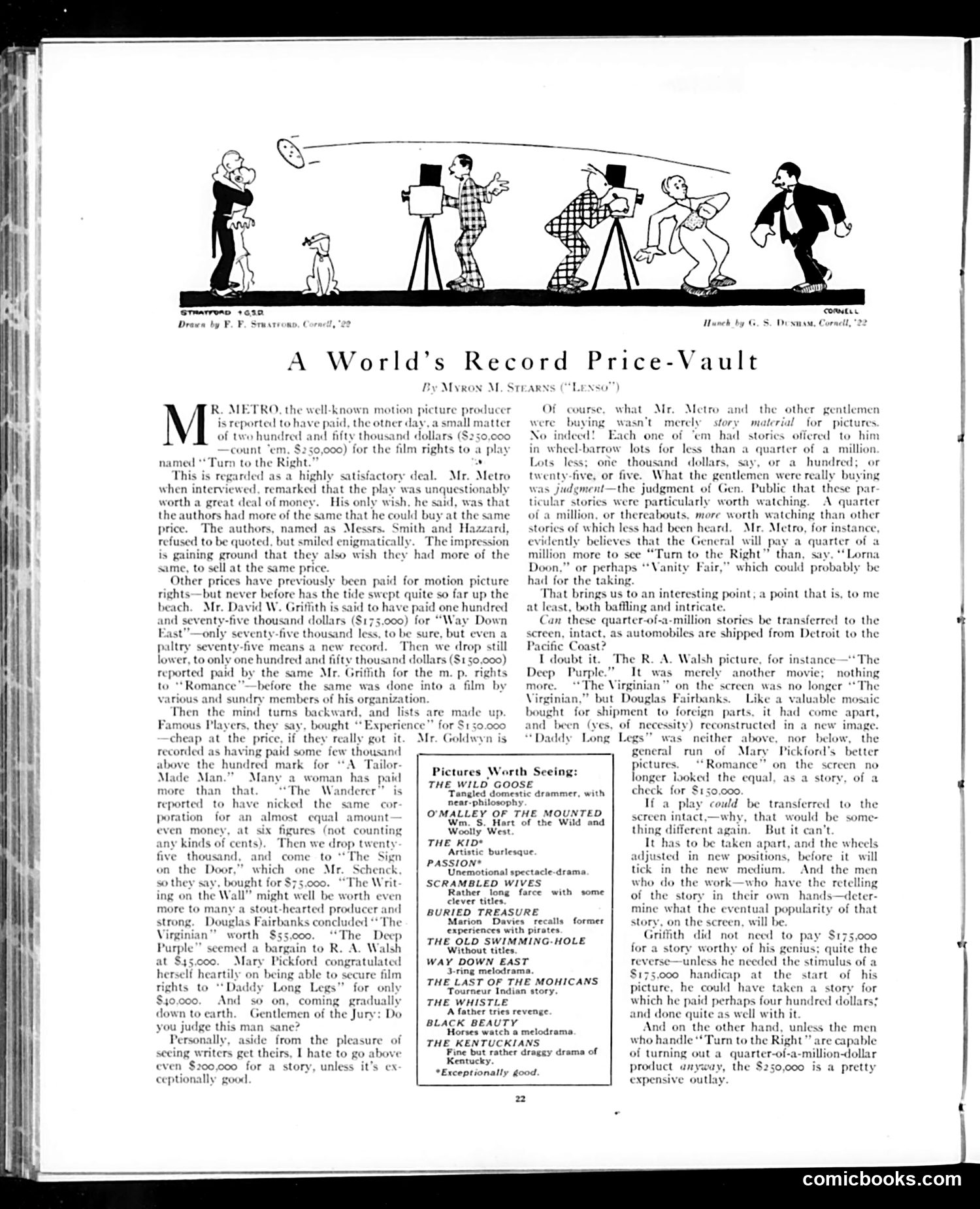
This satirical article mocks the motion picture industry's escalating prices for film rights. The cartoon illustration shows film producers, directors, and cameramen in exaggerated poses—suggesting the theatrical absurdity of their business dealings. The article's central joke: Metro Studios paid $250,000 for rights to the play "Turn to the Right"—an astronomical sum. The author notes that while studios claim they're buying the story's proven appeal ("judgment" of the General Public), the actual transfer to screen rarely preserves the original work intact. Stars and filmmakers necessarily reconstruct the material, transforming it entirely. The satire cuts two ways: studios overpay for "prestige" material while ironically destroying what made it valuable through adaptation. The cartoon's film crew members acting out theatrical poses underscore how cinema reduces intellectual property to mere spectacle—worth quarter-millions despite inevitable artistic compromise.
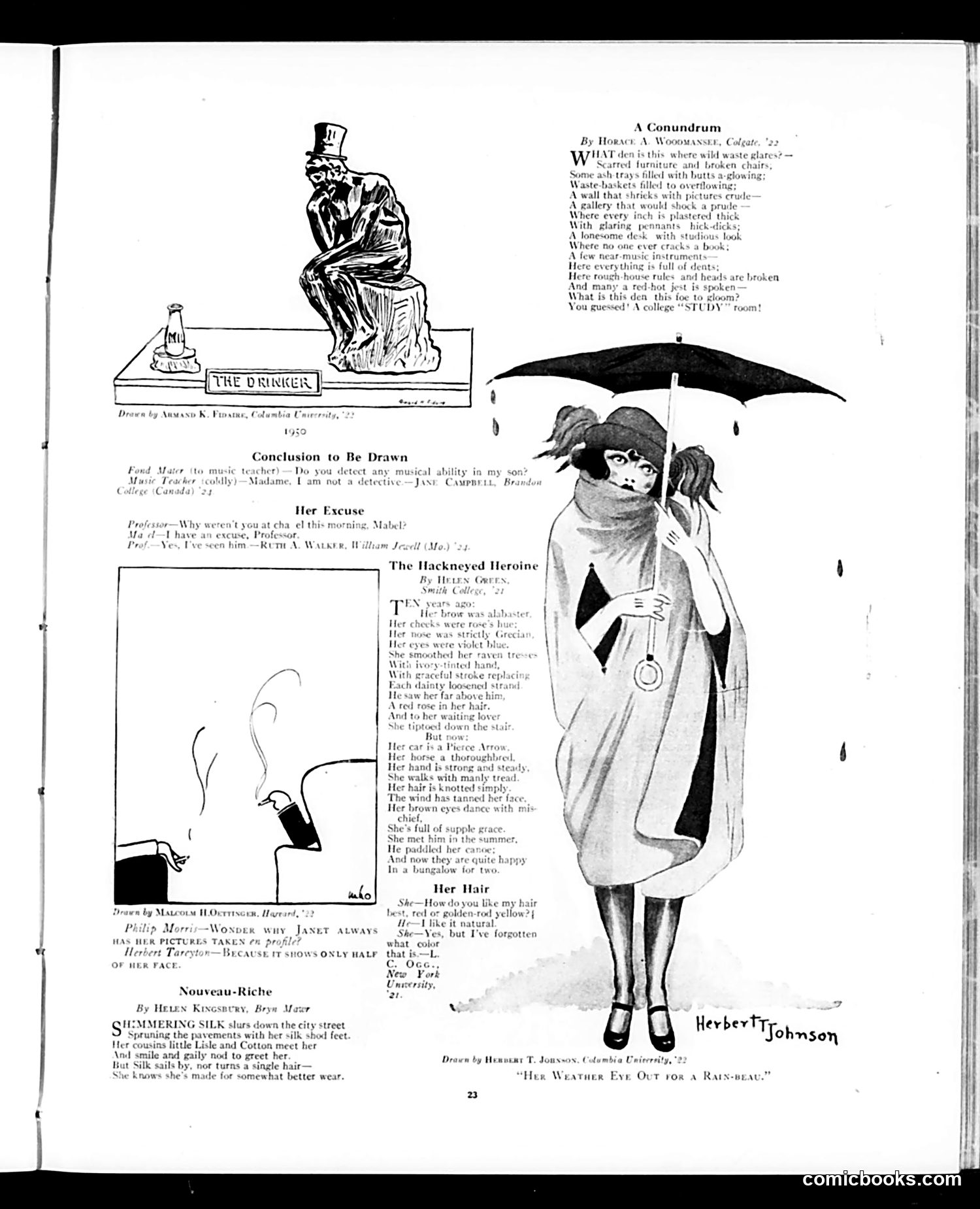
This page from Judge (a satirical weekly) contains several standalone humorous pieces from around 1920, rather than a unified political cartoon. **"A Conundrum"** presents a riddle describing a cluttered college dorm room filled with aesthetic pretensions—ash trays, waste baskets, gallery prints—mocking students' affected intellectualism. **"Conclusion to Be Drawn"** is a brief joke about a music teacher unable to detect musical ability, satirizing either the teacher's incompetence or students' lack of talent. **"The Hackneyed Heroine"** parodies sentimental Victorian romance literature, mocking the stock "beautiful maiden corrupted by heartbreak" trope popular in period novels. **"Her Excuse,"** "Her Hair," and other brief jokes use workplace/domestic scenarios for gentle humor. **The Herbert Johnson illustration** shows a fashionable woman with an umbrella in rain—likely advertising the Johnson hat brand. Overall, these pieces target contemporary social pretension, outdated literary conventions, and collegiate affectation typical of Judge's satirical approach to 1920s American life.
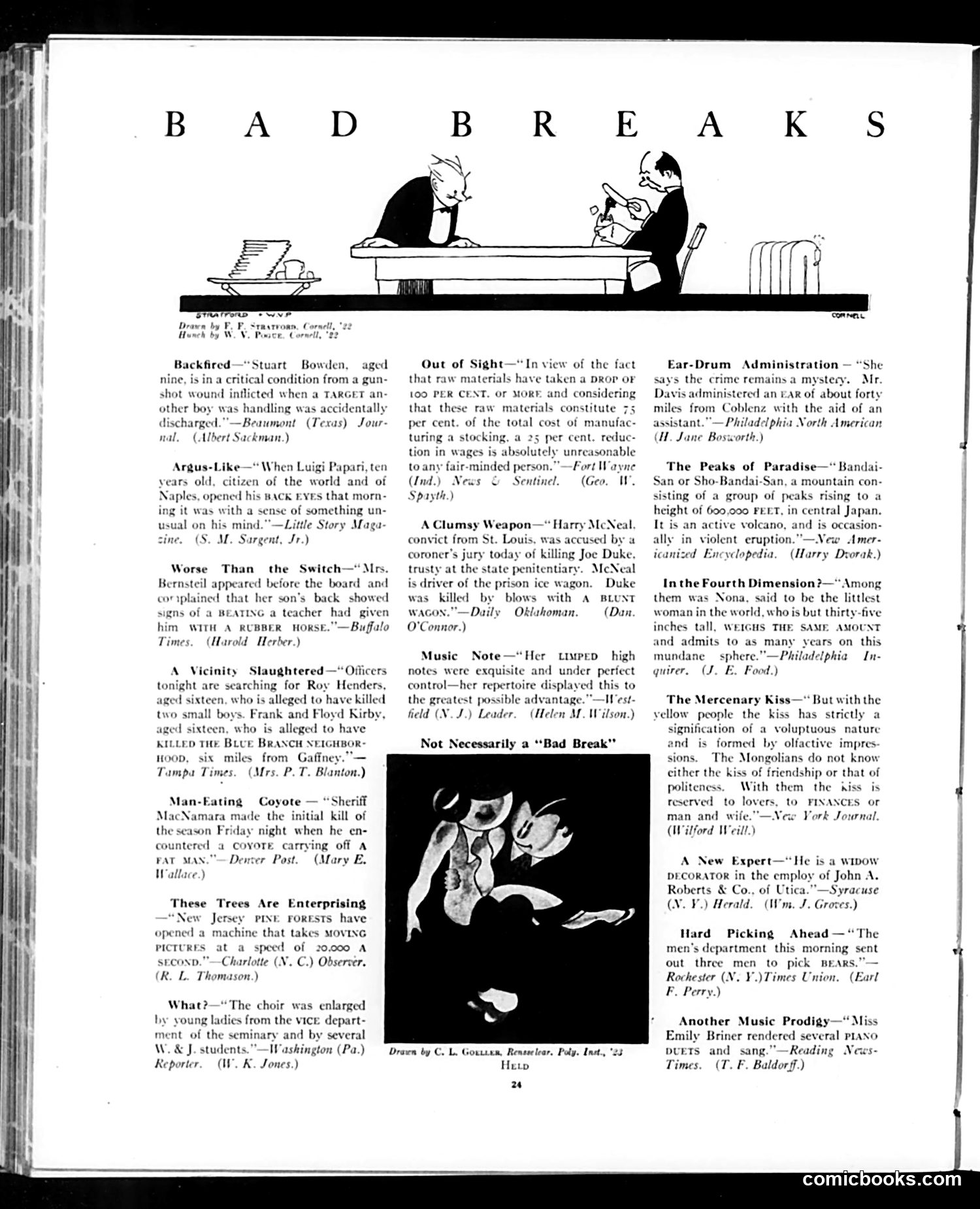
This page from Judge magazine presents "Bad Breaks"—humorous newspaper clippings showing absurd or ridiculous sentences from actual published reports. The cartoon at top shows two men at a desk, likely depicting editors reviewing these garbled excerpts. The jokes rely on OCR-like errors and ambiguous phrasing in source materials. Examples include: a machine taking photographs at "20,000 a second" (instead of "frames"), a woman weighing "the same amount" as a 35-inch-tall dwarf despite different ages, pine forests "opening a machine," and an official administering "an ear of about forty miles" (likely "a beating"). The satire mocks careless newspaper writing and editing of the early 20th century. By extracting these absurd phrases literally, Judge highlights how poor proofreading and clumsy language can create unintentionally ridiculous statements—a form of editorial humor common in the era.
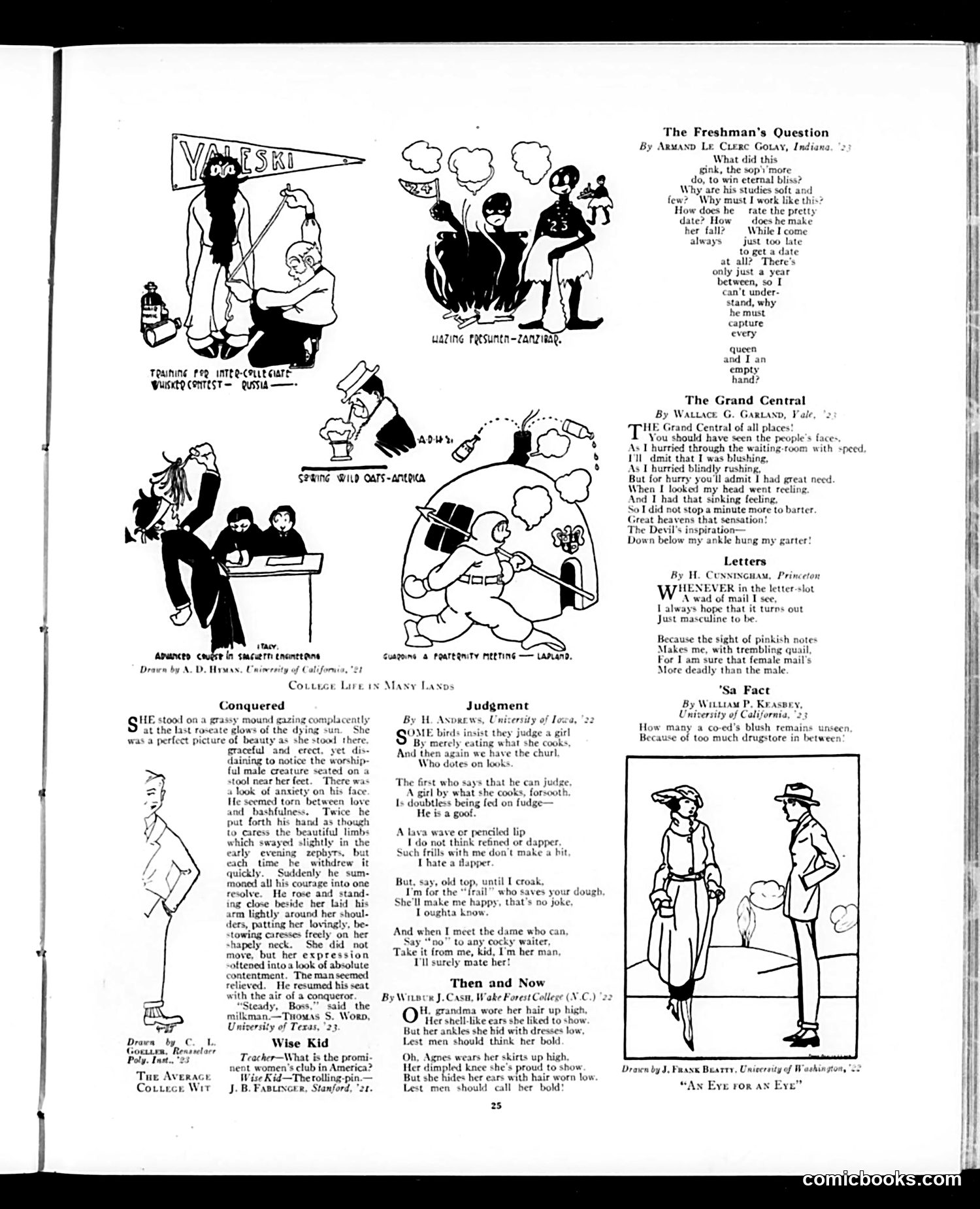
This page from Judge (circa 1922-23, based on university attributions) contains humor pieces targeting college life and social customs of the early 1920s. **"Conquered"** depicts a man petting what appears to be a dog or similar animal—the "conquest" is domesticated, not romantic, providing ironic commentary on masculine pride. **"Wise Kid"** is a school joke: when asked about prominent women's clubs, the student answers "rolling pin"—mocking both women's organizations and traditional gender roles. **"Judgment"** argues a man shouldn't judge women by cooking ability or appearance ("lava wave or penciled lip"), ending with the pragmatic conclusion he'll marry whoever accepts him. **"Then and Now"** contrasts Victorian modesty (high hair, hidden ankles) with 1920s fashion (bobbed hair, visible legs), satirizing how each era policed female appearance differently. Other pieces humorously address freshman confusion, Grand Central Station mishaps, and mailroom preferences—typical collegiate humor. The cartoons throughout employ exaggerated line-drawing style typical of Judge's satirical approach.
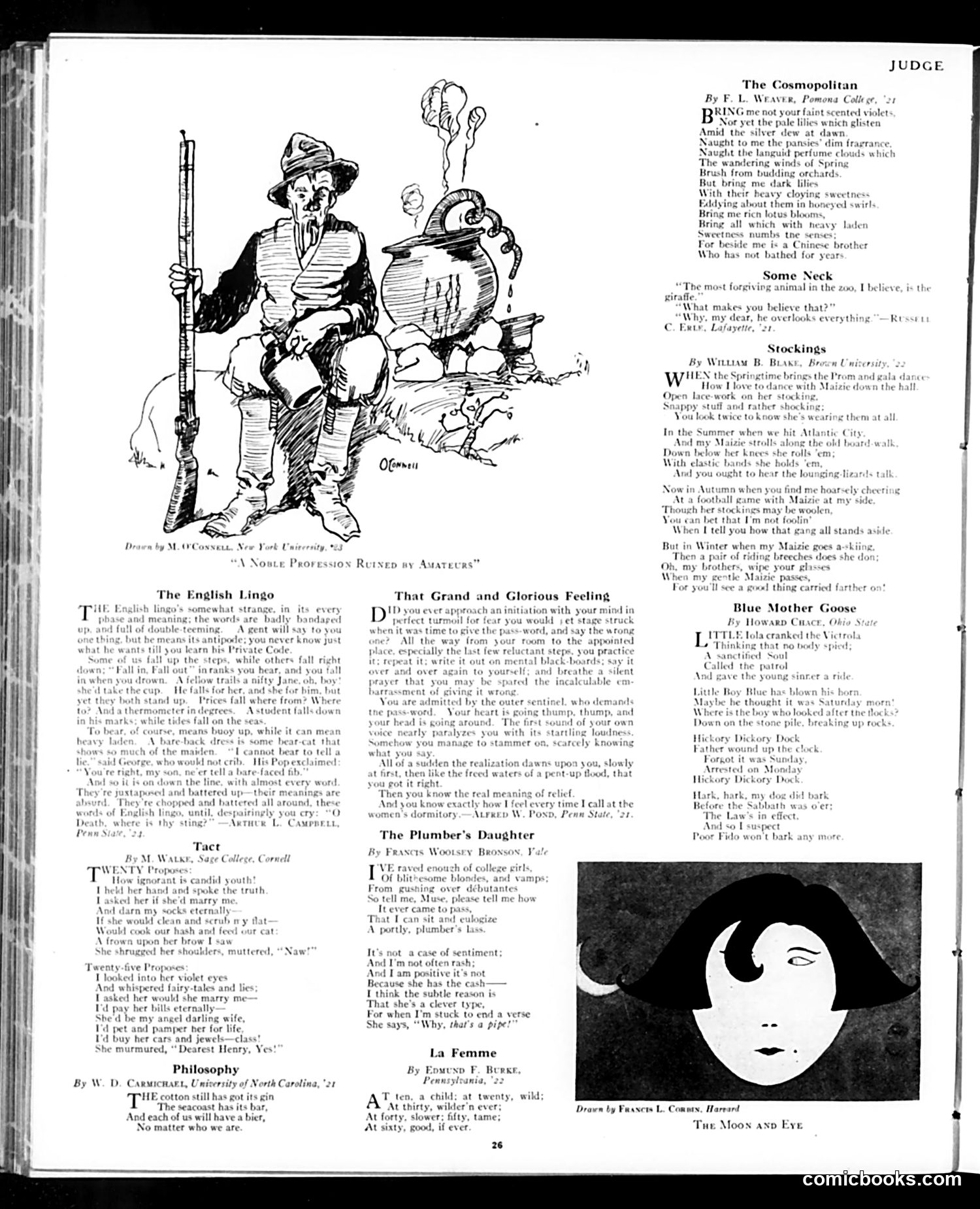
This cartoon satirizes how amateur actors are degrading the theatrical profession. The caricature depicts an exaggerated, poorly-trained performer—skeletal, wild-eyed, costumed absurdly—holding theatrical props. The caption's title suggests that non-professionals are damaging what should be an elevated art form. The accompanying poems and articles on this Judge magazine page are student literary submissions from various universities (Cornell, Yale, Ohio State, etc.), suggesting the page satirizes amateur writers and performers generally. The cartoonist mocks both theatrical amateurs and the university dilettantes attempting serious art. The satire reflects early 20th-century anxieties about professionalism—that untrained enthusiasts were flooding traditionally skilled fields, lowering standards through sheer incompetence. The grotesque drawing style emphasizes how ridiculous these "ruined" professionals appear.
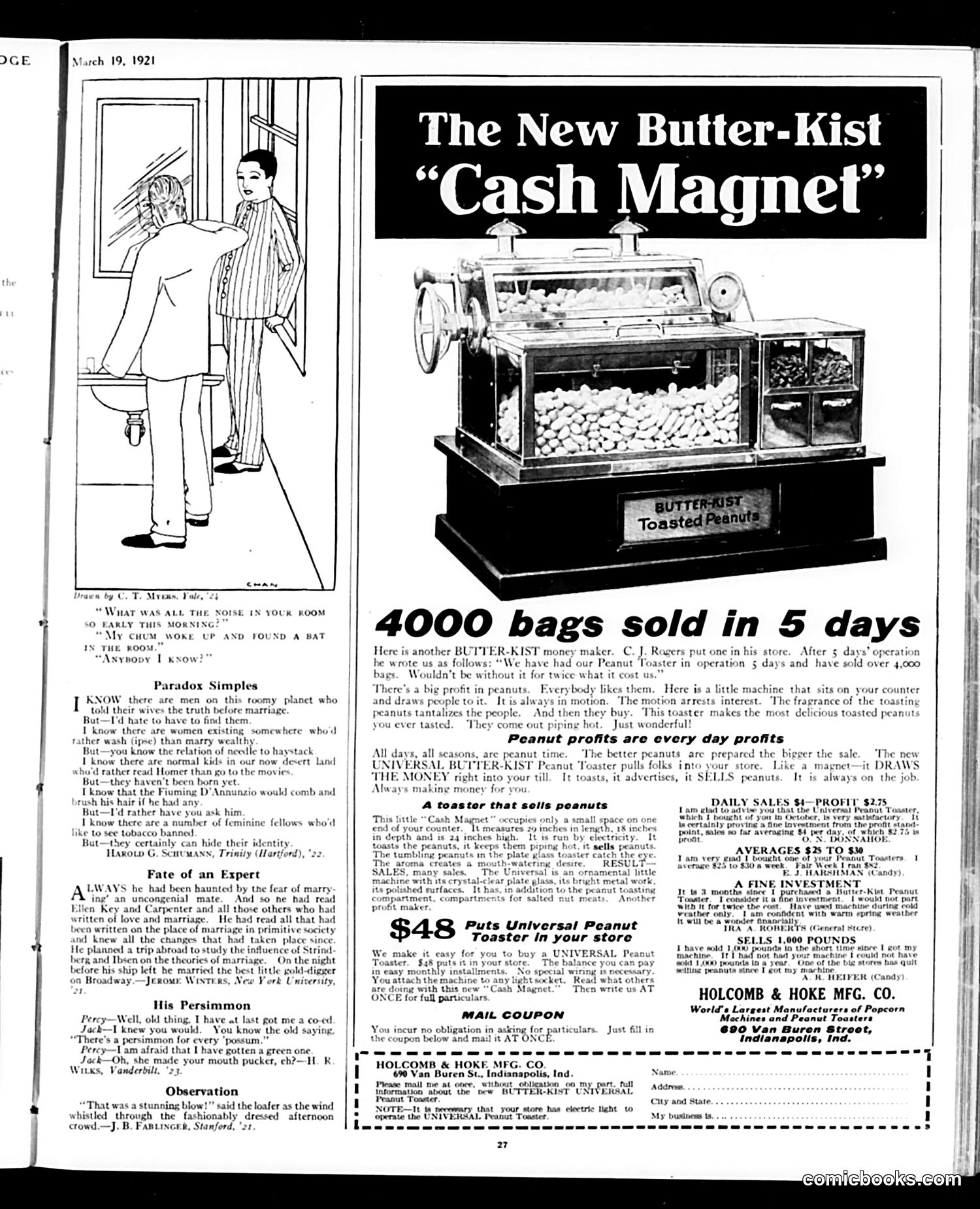
**The Cartoon:** The upper left cartoon depicts a domestic scene where a man is being questioned about noise from his room. His flippant response—that his roommate found a bat—leaves the questioner bewildered. The humor relies on the double meaning: the questioner likely expects a scandalous explanation (perhaps involving a woman), but the mundane answer (an actual bat) subverts this expectation. It's gentle comedy about mismatched assumptions. **The Rest of the Page:** This is primarily **advertising**, not editorial content. The dominant feature is a large advertisement for the Butter-Kist "Cash Magnet," a motorized peanut roasting machine marketed to store owners. The ad emphasizes profits (claiming $2.75 daily profit, $25-$30 average sales) and includes testimonials from satisfied customers. Below are lighter humor pieces ("Paradox Simples," "Fate of an Expert") typical of Judge's collegiate joke submissions. The page is essentially a vehicle for advertising revenue disguised within satirical magazine content.
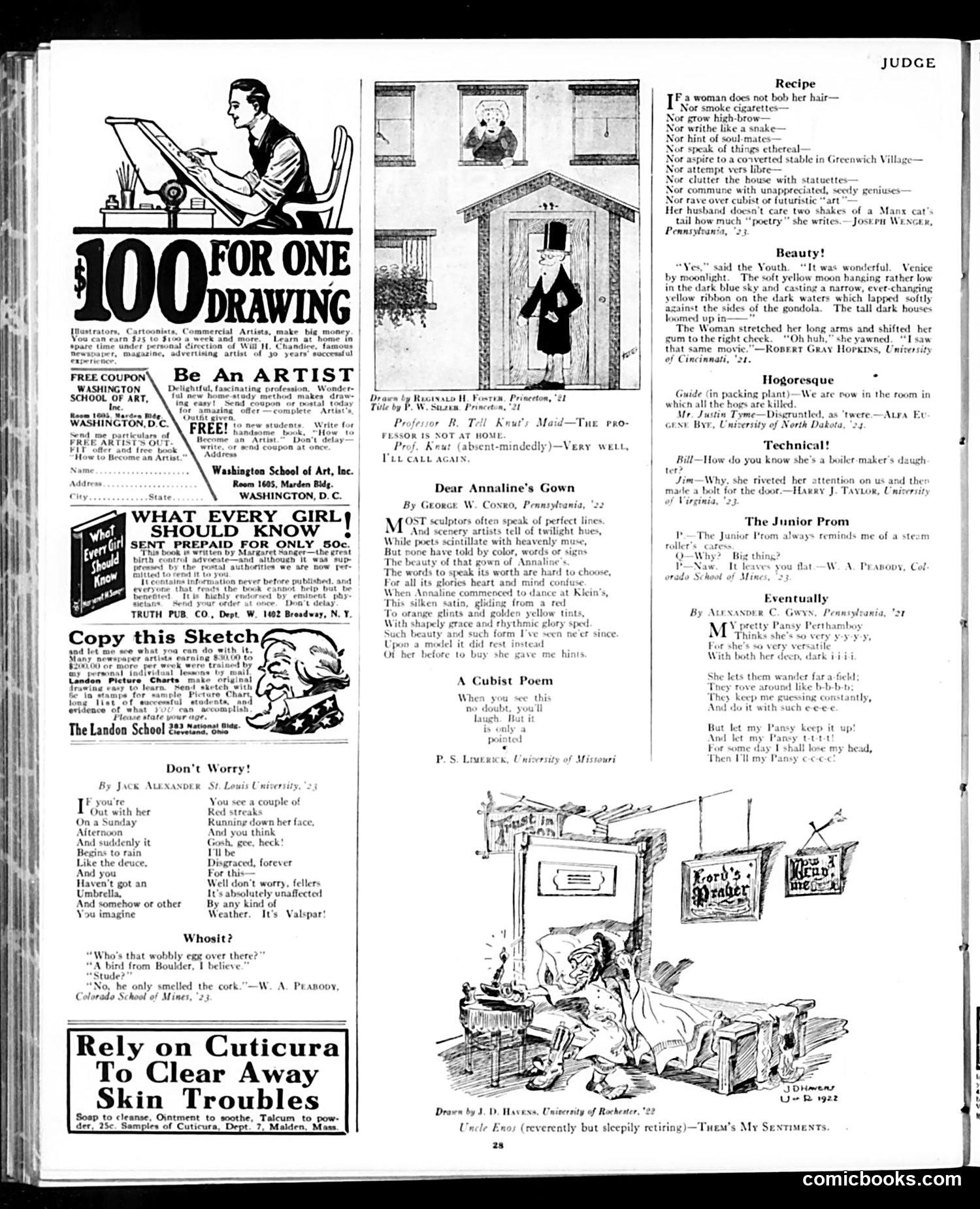
This page from Judge (circa 1922-1924, based on class year attributions) is primarily **advertisements and student humor** rather than political satire. **Key Content:** The advertisements promote art schools and self-improvement products (Cuticura skin remedy, books on etiquette). The instructional ad "$100 for One Drawing" targets aspiring commercial artists. **Student Humor Sections:** The bulk consists of brief poems and jokes contributed by college students (credited to universities like Princeton, University of Missouri, etc.). Topics include: - Romance and dating mishaps ("Don't Worry!" about getting caught in rain without an umbrella) - Campus life observations (the "Hogoresque" joke about touring a livestock facility) - Mild flirtation and courtship ("Eventually," "The Junior Prom") - A "Recipe" for the modern woman that gently satirizes 1920s flappers (bobbing hair, smoking, modern poetry) The cartoons illustrate these college-life scenarios. The page reflects *Judge's* practice of publishing student contributions—humor about everyday college experiences rather than political commentary. The tone is lighthearted, reflecting post-WWI youth culture and changing social norms around women's independence.
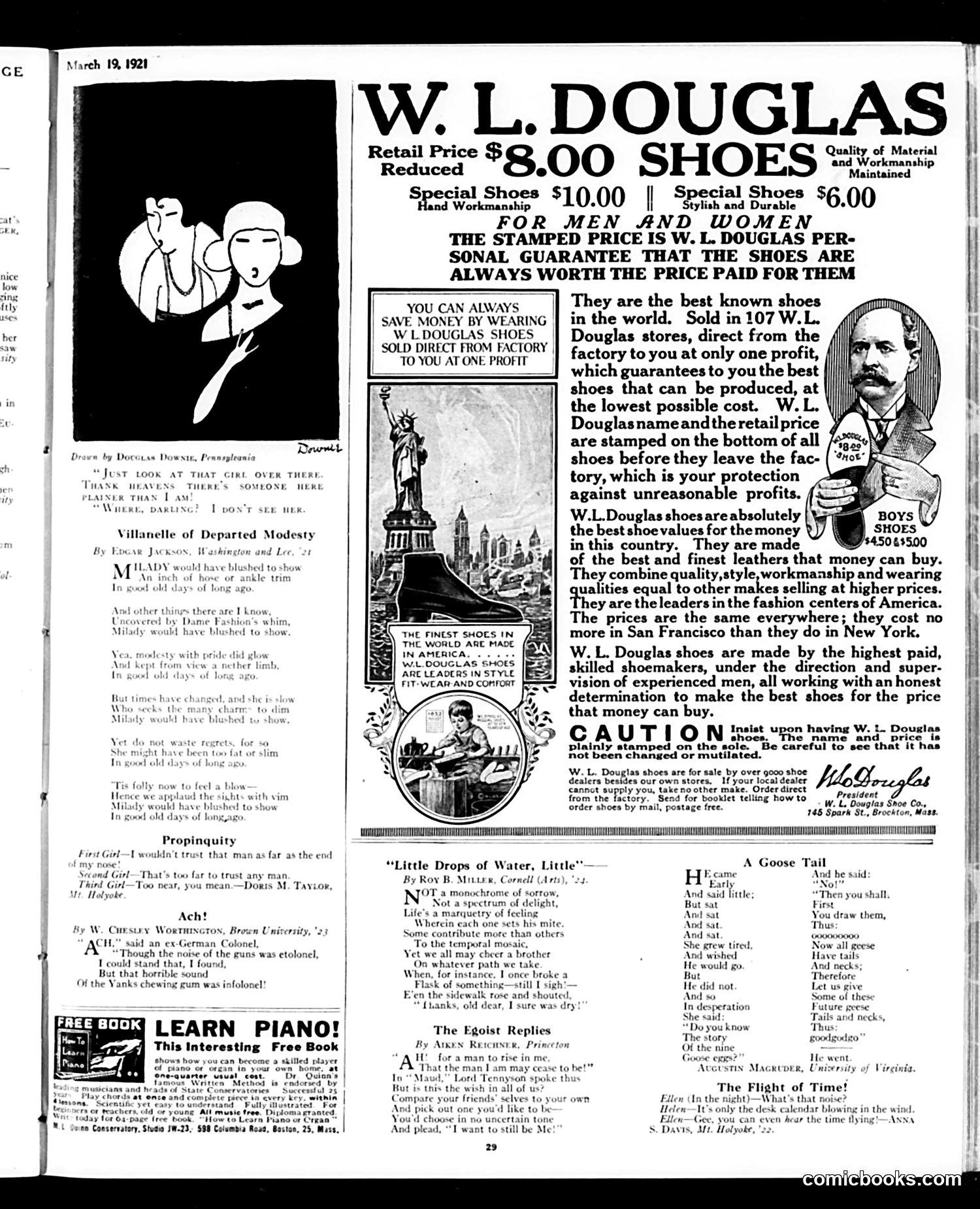
This page is primarily a **W.L. Douglas shoe advertisement** dominating the right side, with satirical poetry and cartoons on the left—typical of Judge magazine's mixed-content format. **The main cartoon** (upper left) shows a flapper-era woman in fashionable dress, captioned "Villanelle of Departed Modesty." The accompanying poem by Eve Jackson laments how modern women have abandoned modesty—she'd "blush" to show "an inch of limb" in earlier times, but now displays herself freely. This reflects 1920s anxiety about changing female behavior: shorter skirts, looser morals, and rejection of Victorian propriety were shocking to conservative readers. **The smaller jokes below** mock romantic and social dynamics of the era—women's wariness of untrustworthy men, ego in relationships. **The shoe ad** uses period marketing language: direct-from-factory pricing, quality guarantees, and patriotic appeals ("finest shoes in America"). The portrait of W.L. Douglas himself presents corporate credibility—common advertising strategy of the era. Together, the page reflects Jazz Age cultural anxieties alongside consumer capitalism.
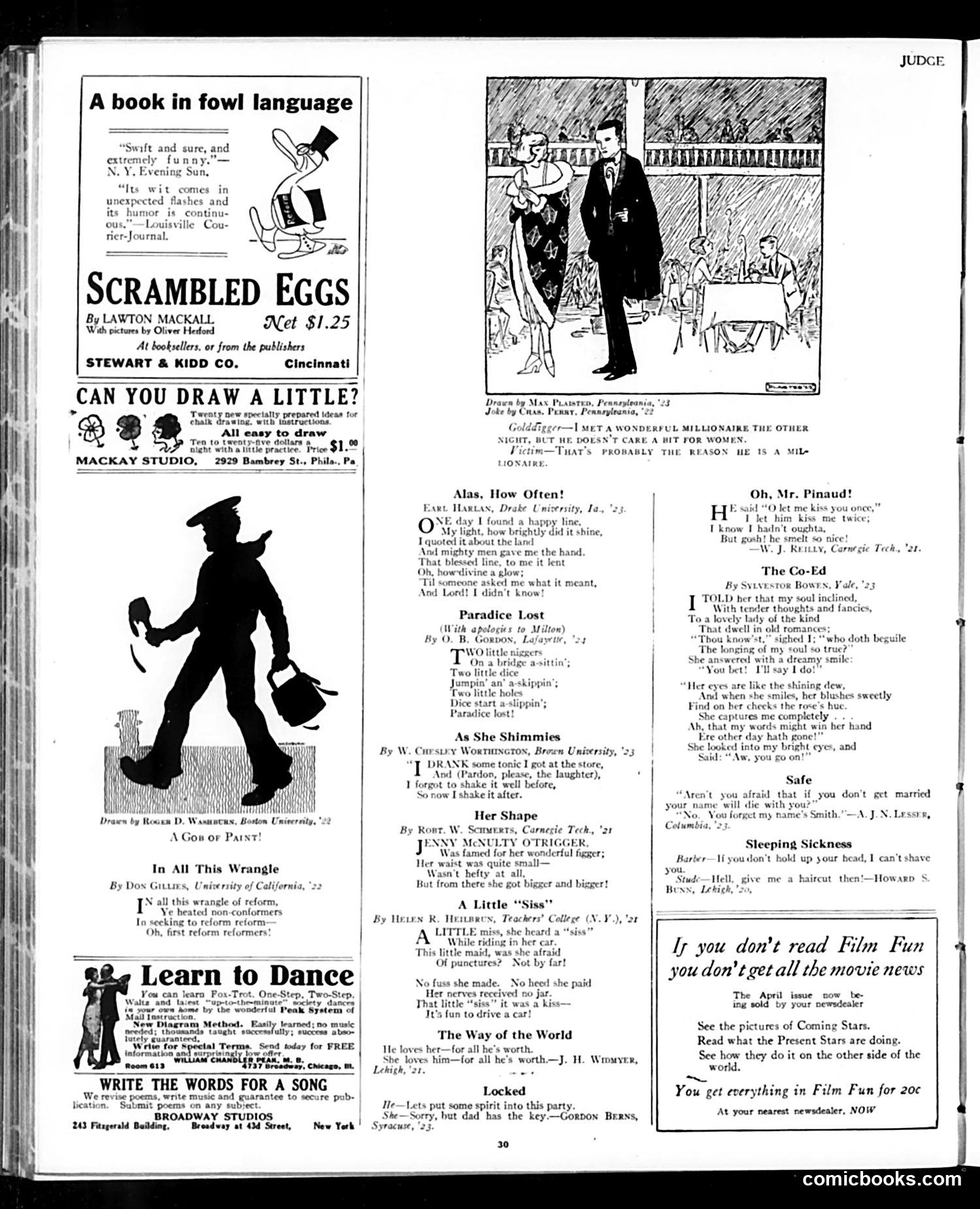
This page is primarily **advertisements and light humor** rather than political satire. The content includes: **Book/Product Ads:** "Scrambled Eggs" by Lawton Mackall, drawing instruction courses, and dance lessons dominate the left side. **Student Humor Poems:** The right side features short, comedic verses from university contributors (Drake, Brown, Carnegie Tech, Yale, Lehigh). These are largely **romantic and domestic humor** typical of 1920s college culture—jokes about courtship, shimmy dancing, female drivers, and marriage prospects. **The Main Cartoon:** Shows a wealthy man ("Golddigger") meeting a woman at what appears to be a social event. The caption jokes that he won't marry because he's absorbed in wealth-accumulation, implying he's the real "golddigger." **Overall Context:** This reflects **1920s social preoccupations**: courtship rituals, women's new freedoms (driving, dancing), and satirizing both wealth-obsession and gender dynamics of the era. It's light college humor rather than hard-hitting political commentary.
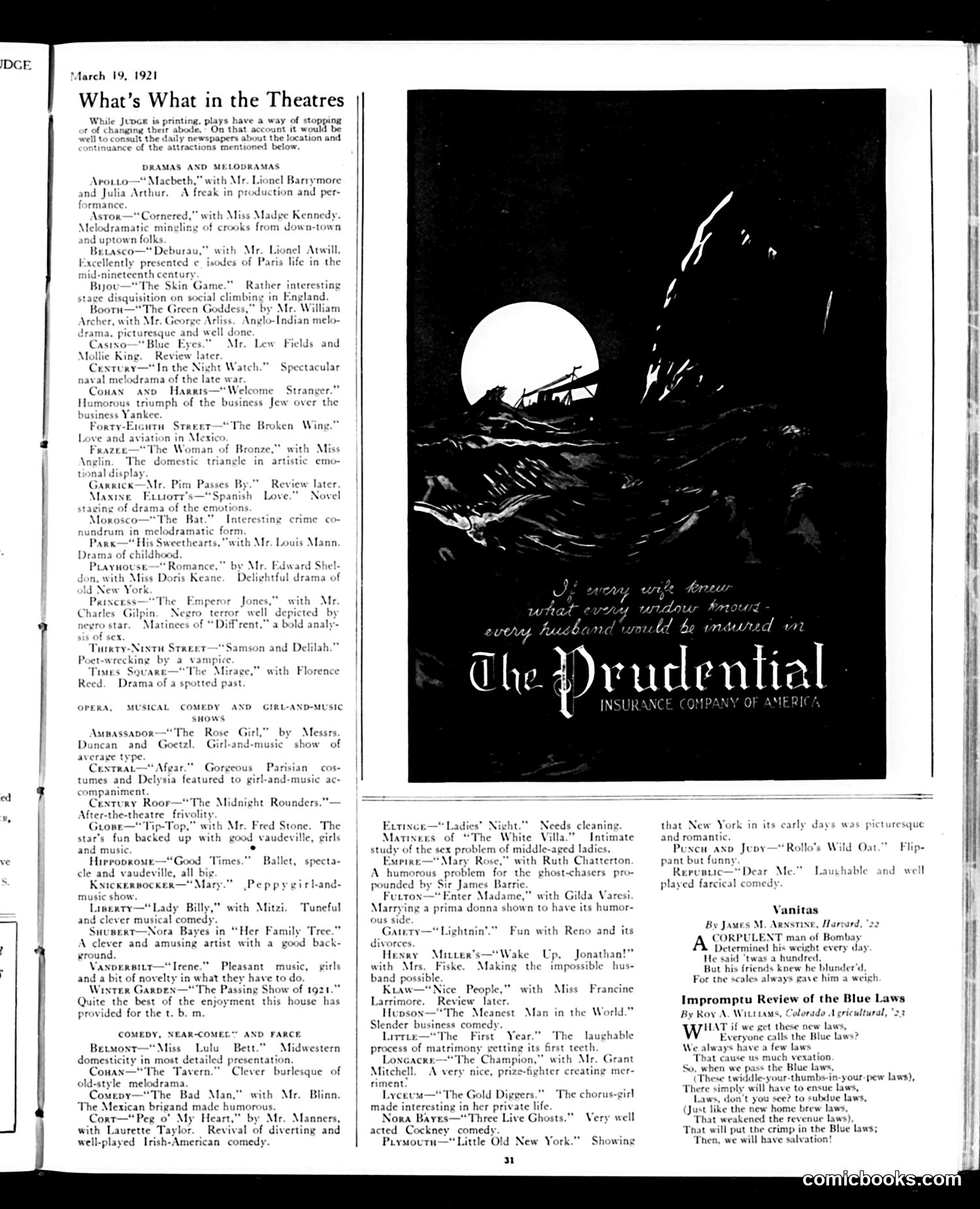
This is a theatre review section from *Judge* magazine (March 19, 1921) listing current Broadway productions with brief critical notes. The main visual element is a **Prudential Insurance advertisement** featuring a dramatic silhouette scene of a ship in distress against a moon, with the tagline about insuring husbands. Below the ads are two humorous poems: "Vanitas" (a joke about a man obsessed with his weight) and "Impromptu Review of the Blue Laws" (satirizing Prohibition-era restrictions). The latter mocks the new liquor laws by suggesting they're so strict that only stricter laws could replace them—social commentary on the unpopular Prohibition amendment (ratified 1919, enacted 1920). The page is primarily **entertainment listings and advertising rather than political satire**, though the Blue Laws poem reflects contemporary irritation with alcohol prohibition, a major 1920s cultural conflict.
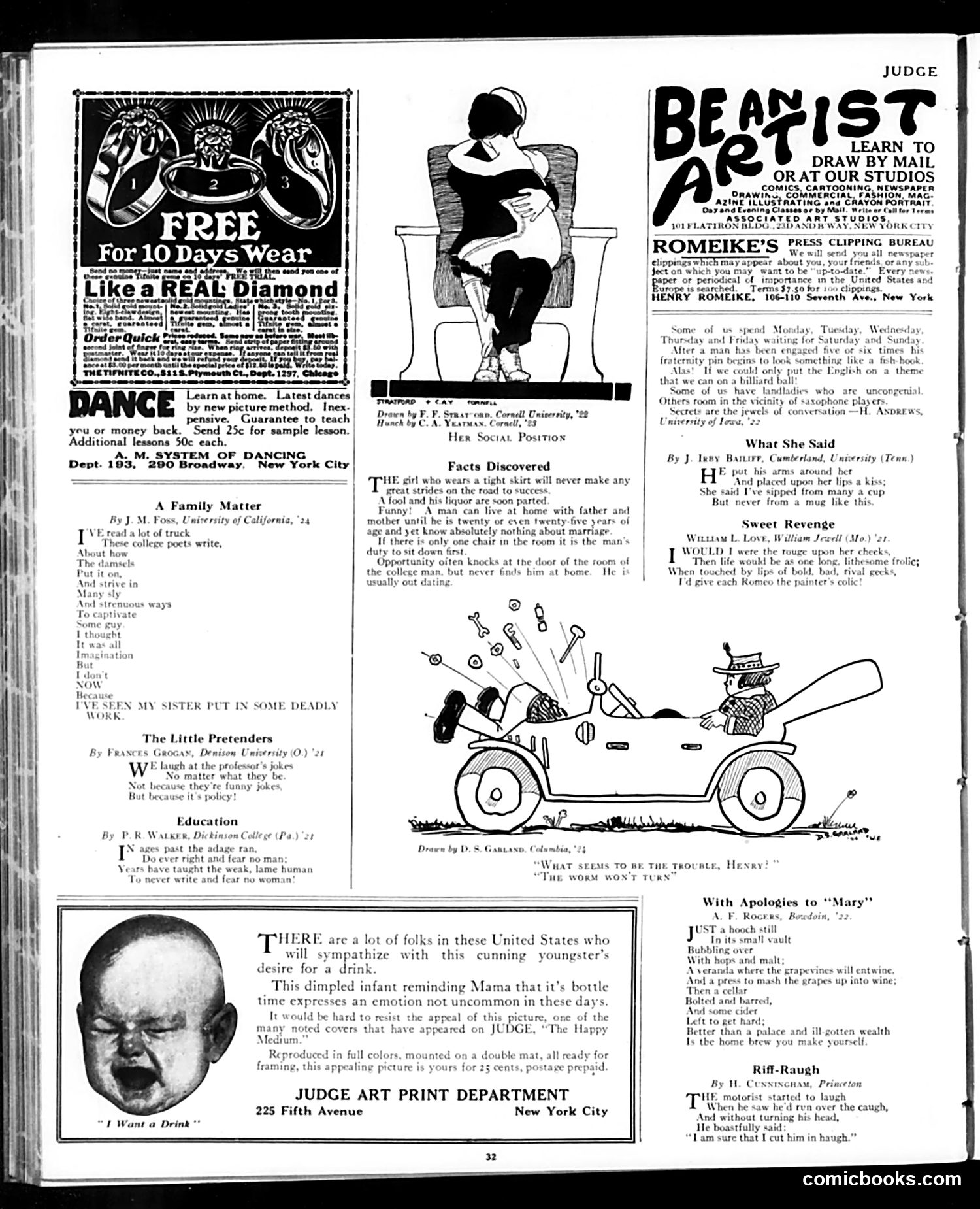
This is primarily a **humor and advertising page** from Judge magazine (date unclear from visible text, but likely 1920s based on Cornell/Denison university attributions marked "'22-'24"). **Main Content:** The page features student-written humorous poems and brief jokes on common themes: dating, family dynamics, and social etiquette. Examples include observations that tight skirts limit success, that professors' jokes aren't funny as policy, and romantic mishaps. **Key Visual Satire:** A large cartoon shows a baby demanding a bottle, captioned to reference **Prohibition-era drinking**—the infant's desire for "a drink" mirrors adult longing for alcohol during the dry years. The accompanying text explicitly notes this emotion was "not uncommon in these days," making it a jab at Prohibition's unpopularity. **Advertisements:** The page includes typical period ads: art/cartooning correspondence courses, dance lessons, and notably Romeike's Press Clipping Bureau (a newspaper monitoring service). The overall tone is lighthearted campus humor mixed with social commentary on Prohibition.
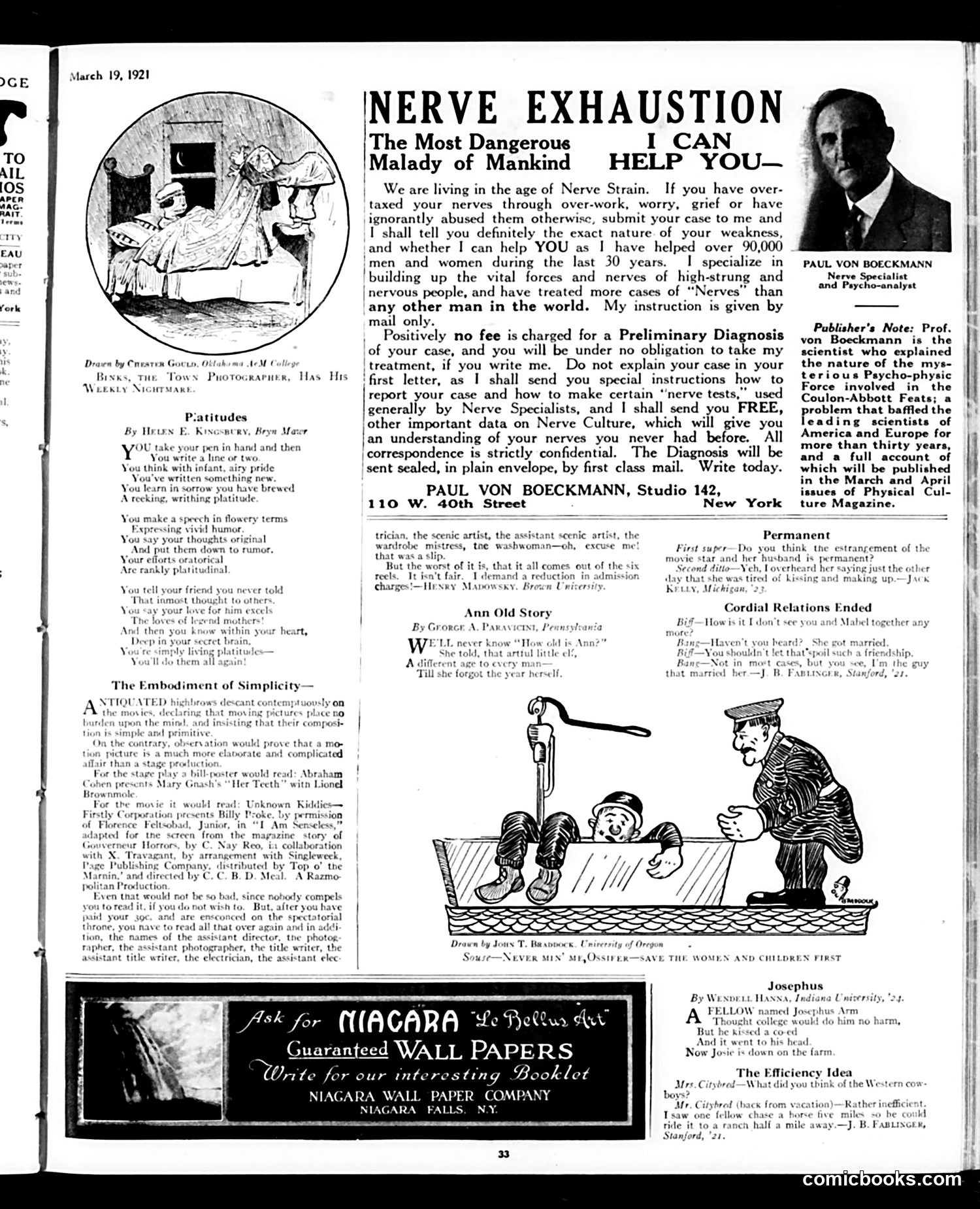
This page blends satire with commercial advertising. The dominant feature is a full-page advertisement for **Paul von Boeckmann**, a "Nerve Specialist and Psycho-analyst" offering mail-order diagnosis for "Nerve Exhaustion"—a pseudo-medical condition popular in early 20th-century America. The ad promises free preliminary diagnosis, claiming Boeckmann has treated 90,000 patients over 30 years for "over-work, worry, grief." The satire is implicit: Judge ridicules this dubious mail-order medicine by presenting it as legitimate, complete with a stern photograph of Boeckmann and pseudo-scientific language about "nerve tests" and "Nerve Culture." A publisher's note adds false credibility by linking him to the "Coulon-Abbott Feats"—mystical feats that had baffled scientists. The page also includes brief satirical poems and short comic pieces mocking theatrical pretension and social conventions, but these are minor compared to the featured nerve-exhaustion scam advertisement, which Judge presents as an object of satirical examination.
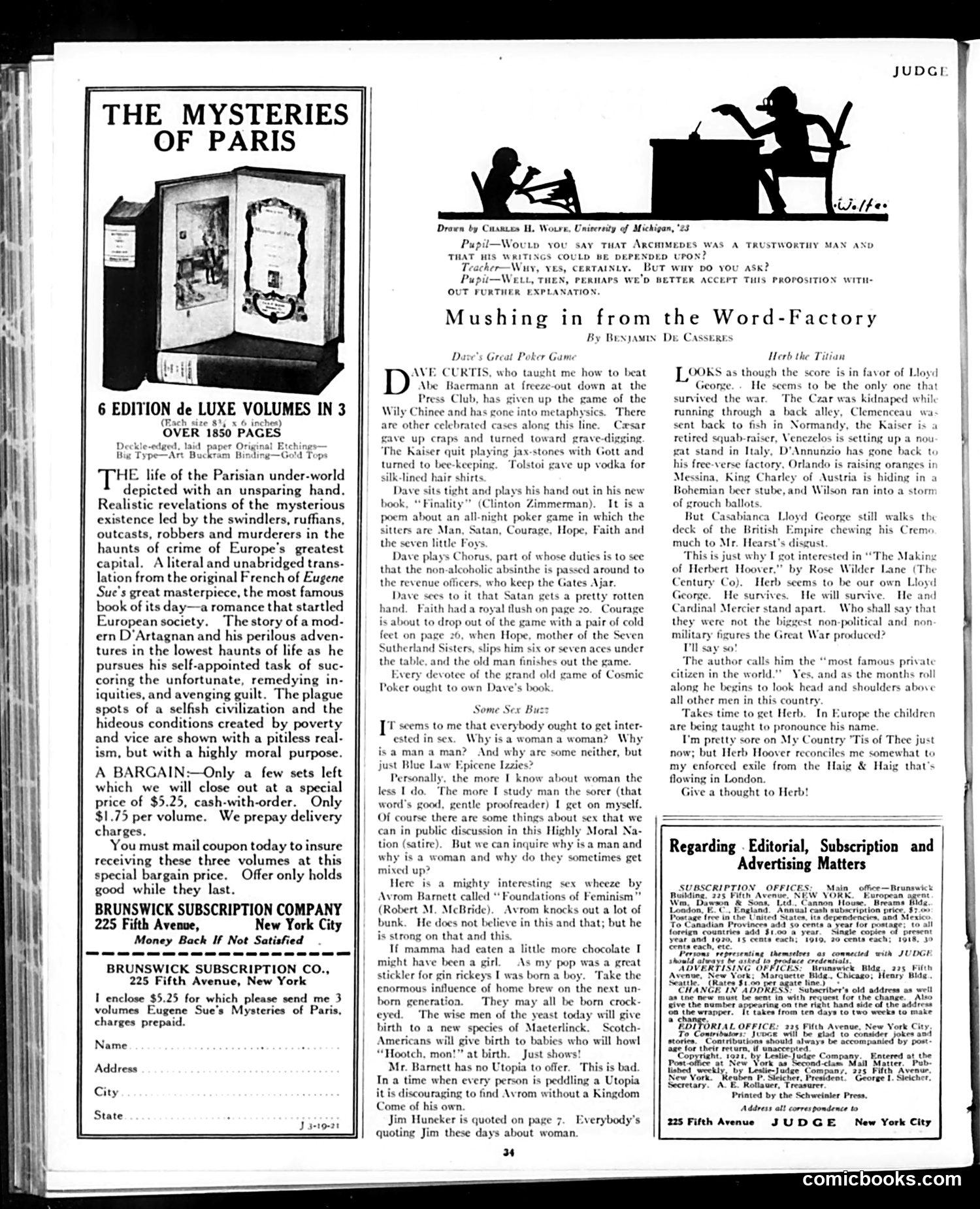
This page is primarily **advertising and editorial content** rather than political satire. The dominant feature is a full-page advertisement for "The Mysteries of Paris," a serialized French novel by Eugène Sue, promoted as exposing Parisian underworld crime and vice. The publisher Brunswick Subscription Company uses sensational language—promising "realistic revelations" of "swindlers, ruffians, outcasts, robbers and murderers"—to market the work as both thrilling entertainment and moral instruction. The small cartoon at top depicts a schoolroom scene about **Archimedes**, illustrating a logic joke: the student reasons that since Archimedes was trustworthy, the teacher's claims about him should be accepted without further explanation. Below are two satirical essays: "Dave's Great Poker Game" uses metaphorical poker to discuss philosophy, and "Some Sex Buzz" employs crude wordplay to question gender and sexuality in a mocking tone typical of period humor. The page reflects Judge's mix of **sensationalism, light philosophy, and period-appropriate sexual innuendo**.
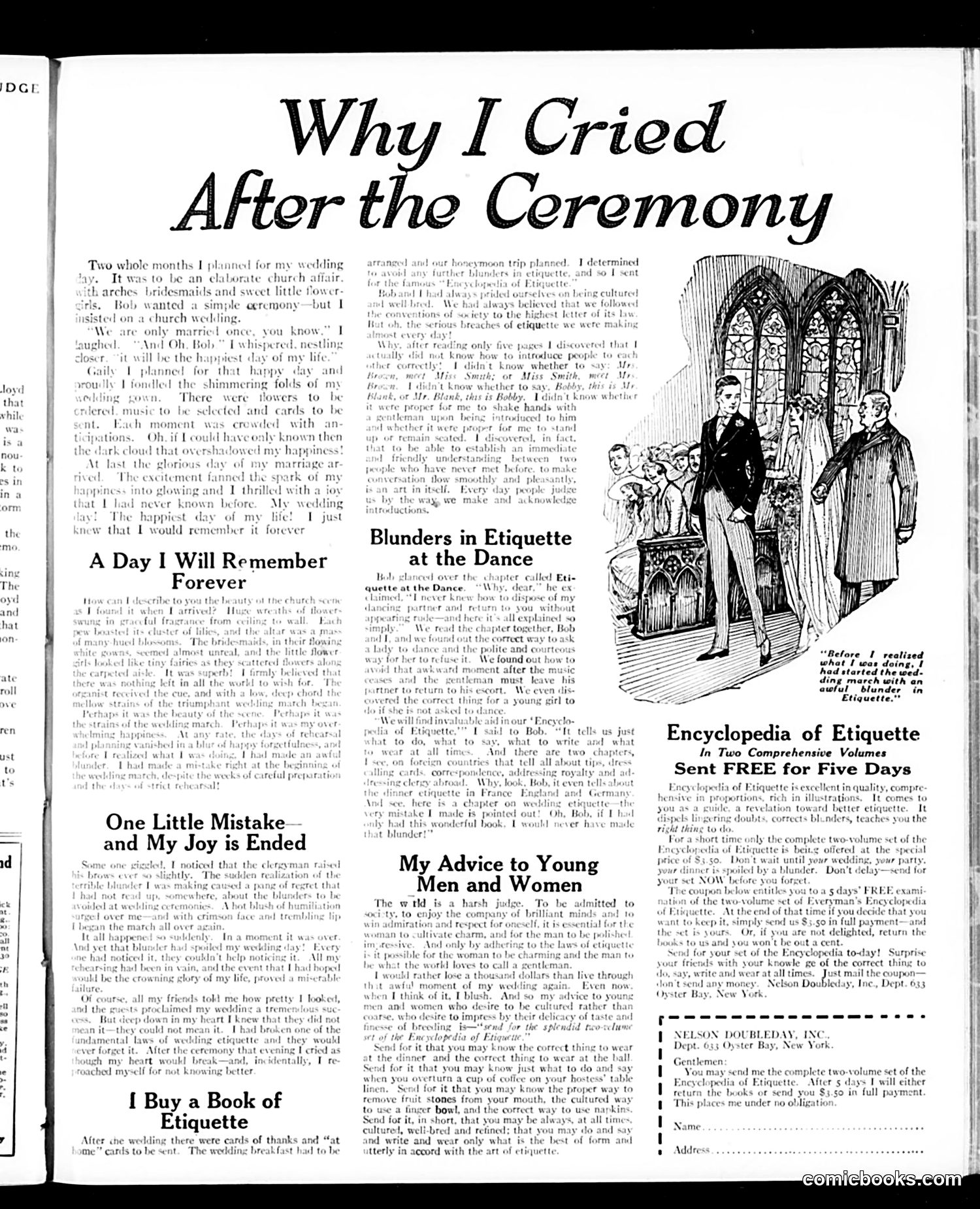
This page satirizes early 20th-century anxiety about social propriety through interconnected stories about a bride whose wedding is marred by etiquette blunders. The bride describes meticulous wedding planning, only to realize—mid-ceremony—that she violated some rule of decorum, causing her distress. The satire targets several things: the *obsessive* concern with proper behavior in polite society, the proliferation of etiquette guides as commercial products, and the paralyzing fear that minor mistakes could ruin important social occasions. The accompanying advertisement (bottom half) for Nelson Doubleday's "Encyclopedia of Etiquette" is itself part of the joke—the editorial content essentially advertises the very book that might have "prevented" the bride's anxiety, playing on readers' insecurities about social missteps. This reflects genuine 1920s-era preoccupation with etiquette manuals as status markers and anxiety management tools for a changing, increasingly mobile society.
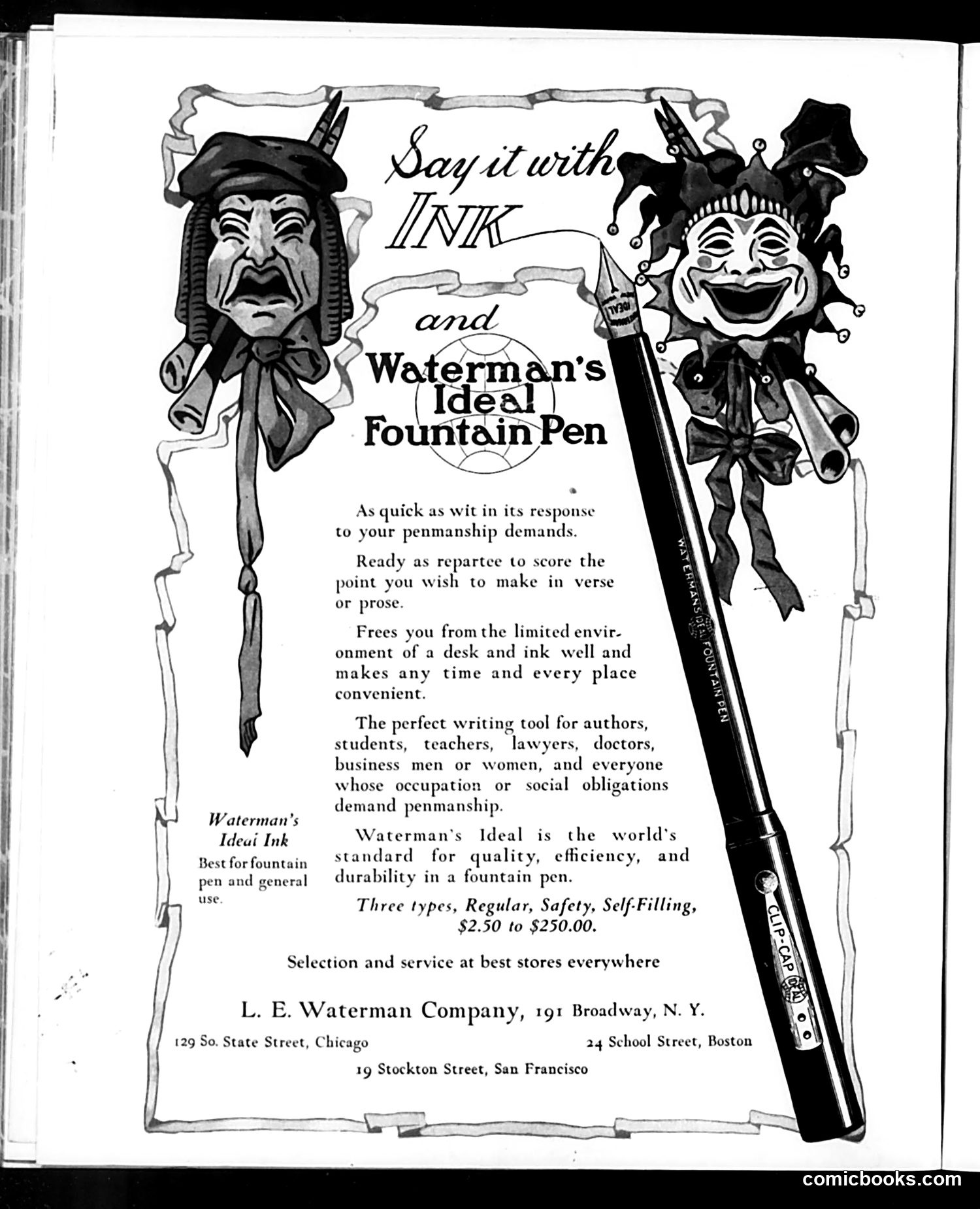
This is a **commercial advertisement**, not political satire. It promotes Waterman's Ideal fountain pens with the tagline "Say it with INK and Waterman's Ideal Fountain Pen." The two theatrical caricatures flanking the pen appear to represent **Comedy and Tragedy** (or similar theatrical archetypes)—figures commonly used in advertising to suggest the pen's versatility for all types of writing: serious legal documents, creative verse, business correspondence, etc. The ad emphasizes the pen's portability and reliability for professionals (lawyers, doctors, teachers, authors). The price range ($2.50 to $250.00) suggests models for every budget. Multiple office locations are listed, indicating this was a major manufacturer competing in the early 20th-century fountain pen market—before ballpoint pens became standard. The theatrical imagery cleverly suggests that writing with their pen allows users to express themselves with dramatic flair and eloquence.