
Judge, 1921-03-19 · page 20 of 36
Judge — March 19, 1921 — page 20: what you’re looking at
What you’re looking at
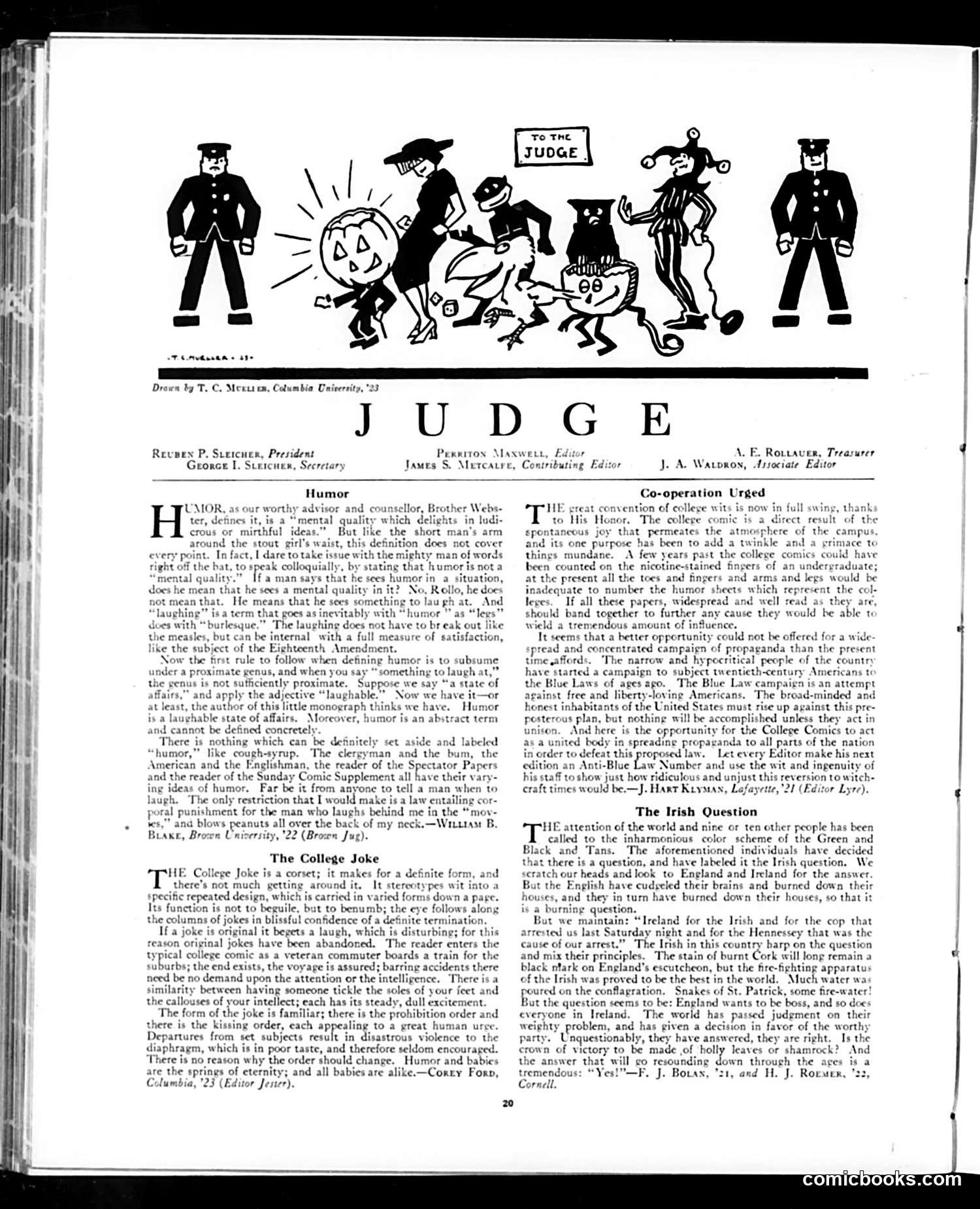
This page from *Judge* magazine presents editorial commentary on humor and comedy, with a satirical cartoon header showing various figures being brought "TO THE JUDGE." **The Main Content:** The page contains three editorial essays about humor: 1. **"Humor"** — A philosophical discussion defining humor as "a laughable state of affairs" rather than a fixed quality. It notes that different social classes and nationalities find different things funny, and humorously complains about people laughing loudly in movie theaters. 2. **"The College Joke"** — A critique of formulaic college humor, comparing it to a "corset" that constrains wit into predictable patterns (prohibition jokes, kissing jokes). The author argues original jokes disturb readers because they're accustomed to safe, standardized humor. 3. **"The Irish Question"** and **"Co-operation Urged"** — Discussing contemporary tensions regarding Irish independence and calling for unified college publication efforts. **The Cartoon:** The header illustration appears to show various caricatured figures (possibly representing different humor styles or publications) being judged, reinforcing the page's theme of evaluating comedic standards.
📄 Transcribed text from this page (OCR, searchable)
Machine-transcribed from the original scan — historical spelling and the odd misread are preserved.
Meeu em, Columbia On Revaen P. Sreicuer, President Grorce I. Stercuen, Secretary Perniron Maxwett, Editor Janes S. Mercatre, Contributing Editor G E \. E. Routaver, Treasurer J. A. Watpros, Associate Editor Humor cllor, Brother Webs- UMOR, as our worthy advisor and cou: E ter, defines it, is a “mental quality which delights in ludi- crous or mirthful ideas.” But like the short man's arm around the stout girl's waist, this definition does not cover every point. In fact, I dare to take issue with the mighty man of words right off the bat, to speak colloquially, by stating that humor is not a ality.” [fa man says that he see rin a situation, No, Rollo, he does not mean that. He means that he sees something to lau gh at. And “laughing” isa term that goes as inevitably with “humor ” as “legs” does with “burlesque.” ‘The laughing does not have to br eak out like the measles, but can be internal with a full measure of satisfaction, like the subject of the Eighteenth Amendment. Now the first rule to follow when defining hu is to subsume genus is not suticiently proximate. Suppo y “a state of airs, apply the adjective “laughable.” © have it—or at least, thea of this little monograph thinks we have. Humor is a laughable state of affairs. Moreover, humor is an aby and cannot be defined concretely. There is nothing which can be definitely set aside and labeled “humor,” like cough-syrup. The clergyman and the bum, the American and the Englishman, the reader of the Spectator Papers and the reader of the Sunday Comic Supplement all have their vary- ing ideas of humor. Far be it from anyone to tell a man when to laugh. ‘The only restriction that I would make is a law entailing cor- I punishment for the man who laughs behind me in the “mov- .”’ and blows peanuts all over the back of my neck.—Wriutast B. Buaxe, Brox y, 22 (Brozen Jug). ct term The College Joke HE College Joke is a corset; it makes for a definite form, and there’s not much getting around it. It stereotypes wit into a specific repeated design, which is carried in varied forms down a page. Its function is not to beguile, but to benumb; the eye follows along the columns of jokes in blissful confidence of a definite termination. If a joke is original it begets a laugh, which is disturbing; for this reason original jokes have been abandoned. The reader enters the typical college comic as a veteran commuter boards a train for the suburbs; the end exists, the voyage is assured; barring accidents there nced be no demand upon the attention or the intelligence. ‘There is a similarity between having someone tickle the soles of your feet and the callouses of your intellect; each has its steady, dull excitement. The form of the joke is familiar; there is the prohibition order and here is the kissing order, each appealing to a great human urre. Departures from set subjects result in disastrous violence to the Jiaphragm, which is in poor taste, and therefore seldom encouraged. There is no reason why the order should change. Humor and babies re the springs of eternity; and all babies are alike—Corty Foro, Columbia, '23 (Editor Jester). Co-operation Urged HI ention of college wi to His Honor. The college com spontaneous joy that permeates the atmosphere of the campus, and its one purpose has been to add a twinkle and a grimace t things mundane. A few years past the college comics could have been counted on the nicotine-stained fingers of an undergraduate; at the present all the toes and fingers and arms and legs would be Jequate to number the humor sheets which the col- leges. If all these papers, widespread and well read as they are, should band together to further any cause they would be able t wield a tremendous amount of influence. It seems that a better opportunity could not be offered for a wide spread and concentrated campaign of propaganda than the present time affords. ‘The narrow and hypocritical people of the country have started a campaign to subject twentieth-century Americans ti the Blue Laws of ages ago. The Blue mpaign is an attempt st free and liberty-loving Americans. The broad-minded and t inhabitants of the United States must rise up against this pre- posterous plan, but nothing will be accomplished unless they act in on. And here is the opportunity for the College Comics to act as a united body in spreadine propaganda to all parts of the nation in order to defeat this proposed law. Let every Editor make his next edition an Anti-Blue Law Number and use the wit and ingenuity of his staff to show just how ridiculous and unjust this reversion to witch craft times would be.—J. Hart Kryaas, L ,'21 (Editor Lyre). is n thanks is a direct result of the hones The Irish Question HE attention of the world and nine or ten other people has been called to the inharmonious color scheme of the Green and Black and Tans. The aforementioned individuals have decided that there is a question, and have labeled it the Irish question. We itch our heads and look to England and Ireland for the answer. But the English have cudgeled their brains and burned down thei houses, and they in turn have burned down their houses, so that i is a burning question. But we maintain: “Ireland for the Irish and for the cop that arrested us last Saturday night and for the Hennessey that was the cause of our arrest.” The Irish in this country harp on the question and mix their principles. The stain of burnt Cork will long remain a black ntark on England’s escutcheon, but the fire-fighting apparatus of the Irish was proved to be the best in the world. Much water wa | seapte on the conflagration. Snakes of St. Patrick, some fire-water But the question seems to be: England wants to be boss, and so does everyone in Ireland. The world has passed judgment on their weighty problem, and has given a decision in favor of the worthy party. Unquestionably, they have answered, they are right. Is the crown of victory to be made ,of holly leaves or shamrock? And the answer that will co resounding down through the ages a tremendous: “Yes! » J. Botax, 21, and H. J. Roemer, Cornell. Be