
A complete issue · 32 pages · 1921
Judge — March 5, 1921
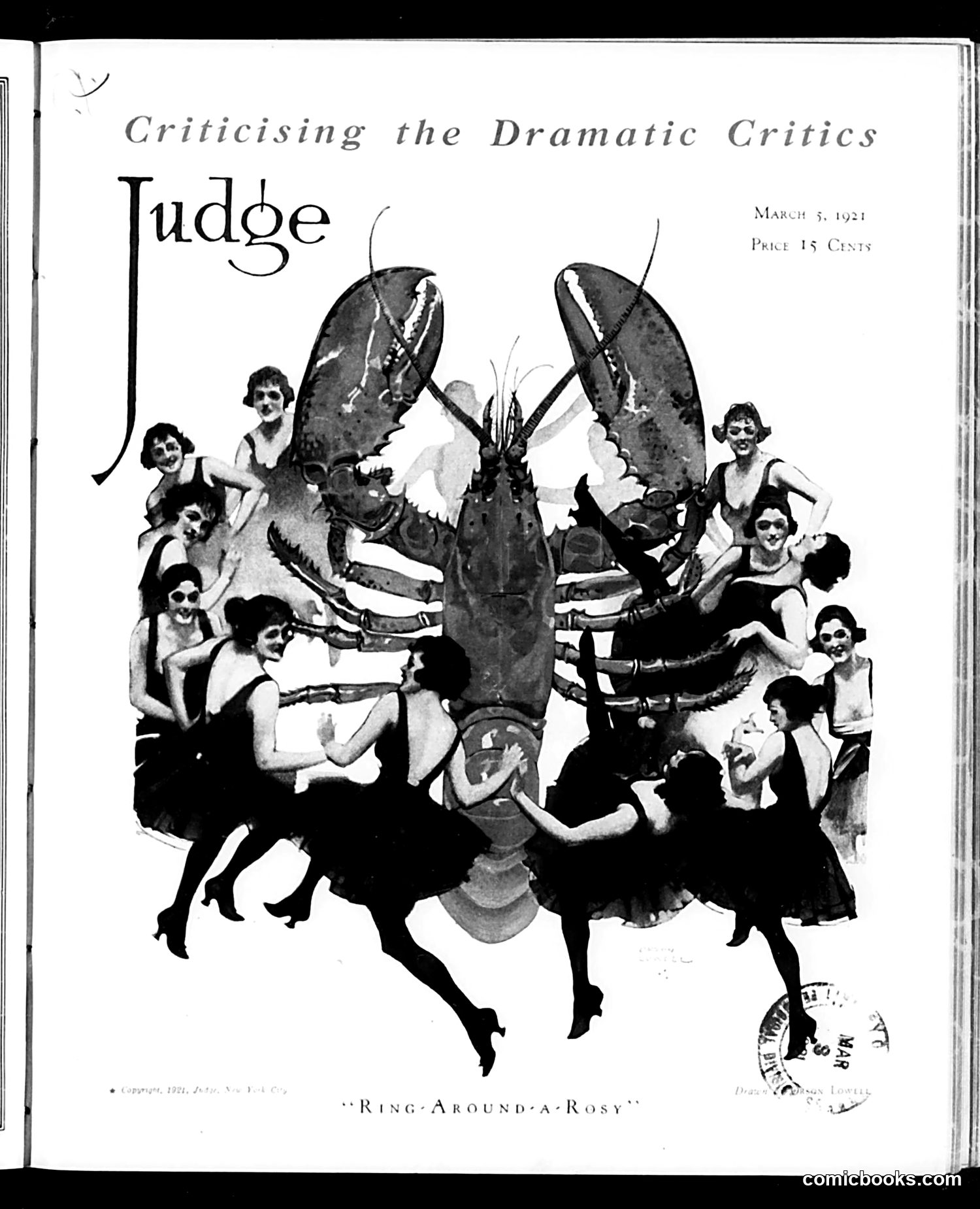
This satirical illustration, titled "Ring-Around-a-Rosy," depicts dramatic critics as a giant lobster surrounded by dancing women. The header "Criticising the Dramatic Critics" indicates the satire targets theater reviewers rather than actual critics themselves. The lobster—a creature known for its claws and aggressive behavior—likely represents dramatic critics as destructive forces in theater. The women dancing around it appear to represent actresses or theatrical performers, suggesting critics "circle" around and potentially harm theatrical productions. The nursery-rhyme reference in the title implies critics are playing childish games with serious art. This 1921 cartoon criticizes how theatrical reviewers wielded disproportionate power over performers and productions during the early twentieth-century American theater scene.
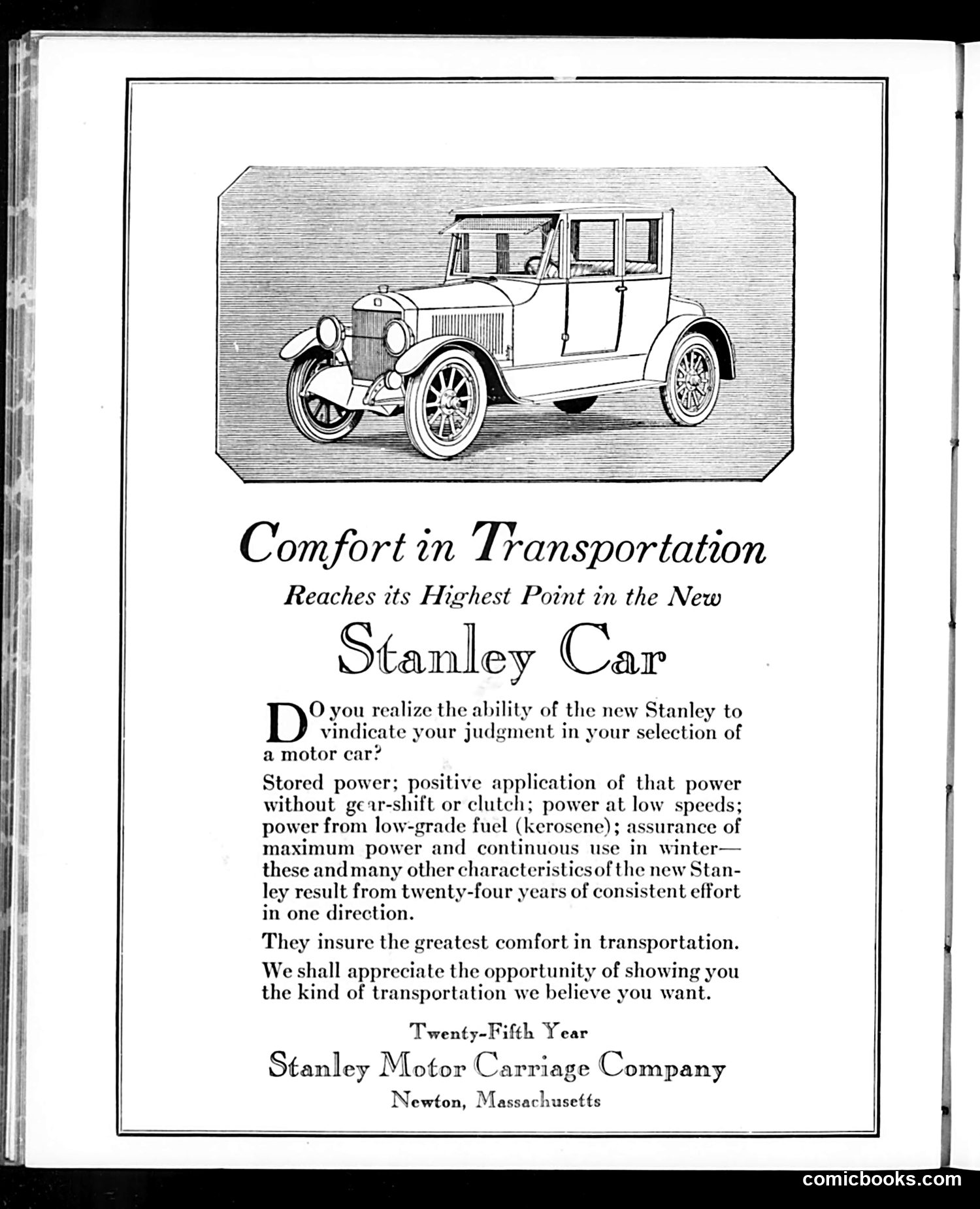
This page is **not satire or a political cartoon**—it's a straightforward advertisement for the Stanley Motor Carriage Company of Newton, Massachusetts, celebrating their "Twenty-Fifth Year" in business. The ad promotes the Stanley Car as offering superior "comfort in transportation." The marketing emphasizes technical advantages: stored power, low-speed capability, kerosene fuel efficiency, and winter reliability. These selling points reflect the era's competitive automotive market, where different propulsion systems (steam, gasoline, electric) competed for dominance. The illustration depicts a early 1900s steam-powered automobile—a luxury vehicle of that period. The ad's formal, confident tone reflects Stanley's established reputation in the emerging automobile industry before gasoline engines became standard.
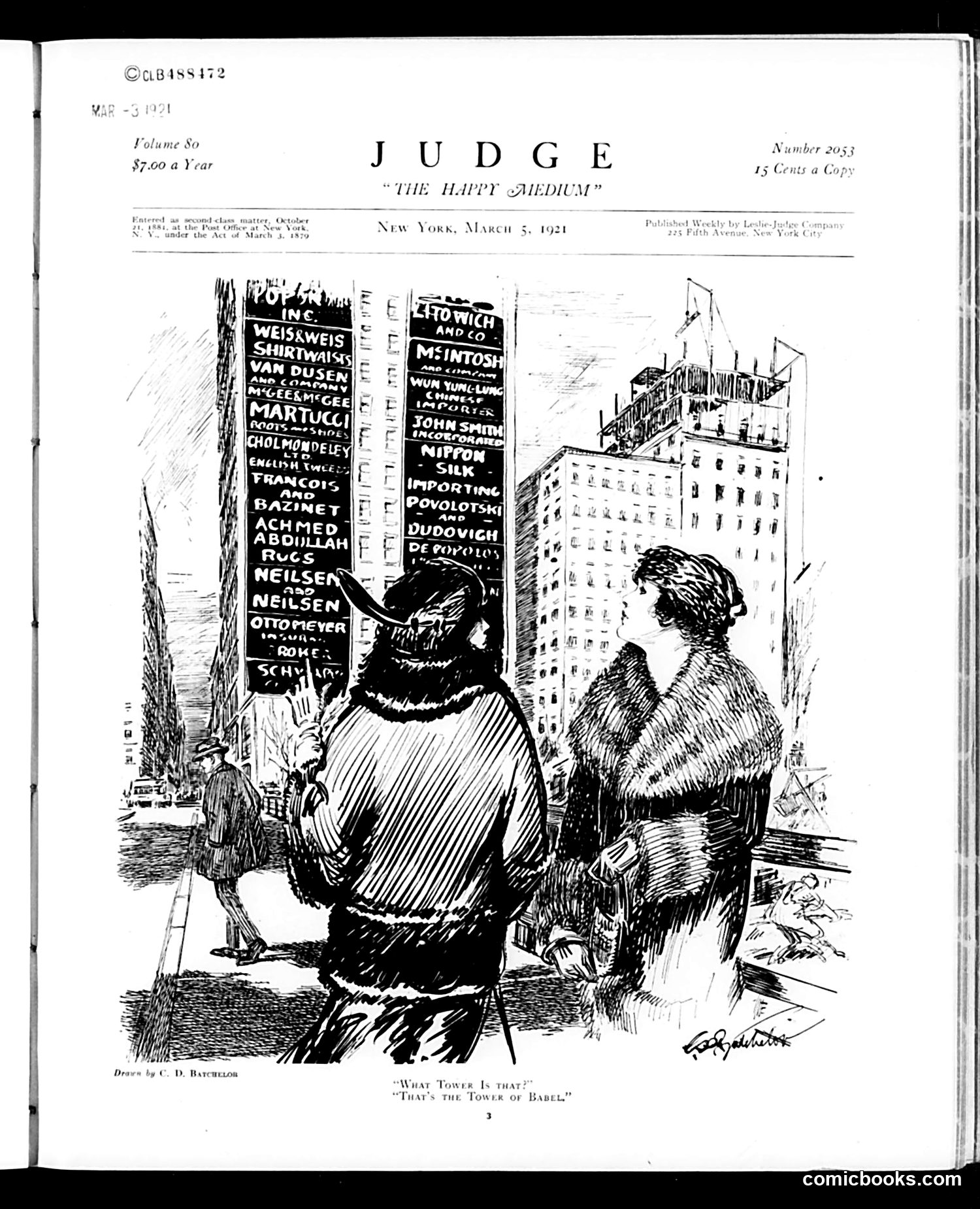
This cartoon satirizes New York City's immigrant business community. Two figures—likely representing established American businessmen or society—stand before a tall building covered entirely with nameplates of foreign merchants and importers (Weiskweis, Van Dusen, Povoloski, Dudovich, etc.). The caption "What Tower Is That?" / "That's the Tower of Babel" makes the biblical reference explicit: the Tower of Babel symbolizes linguistic confusion and cultural disorder resulting from multiple languages. The satire critiques the dominance of immigrant entrepreneurs in NYC commerce during the early 1920s, implying their presence creates incomprehensible chaos. This reflects period anti-immigrant sentiment and xenophobic anxieties about foreign business interests displacing established American commerce.
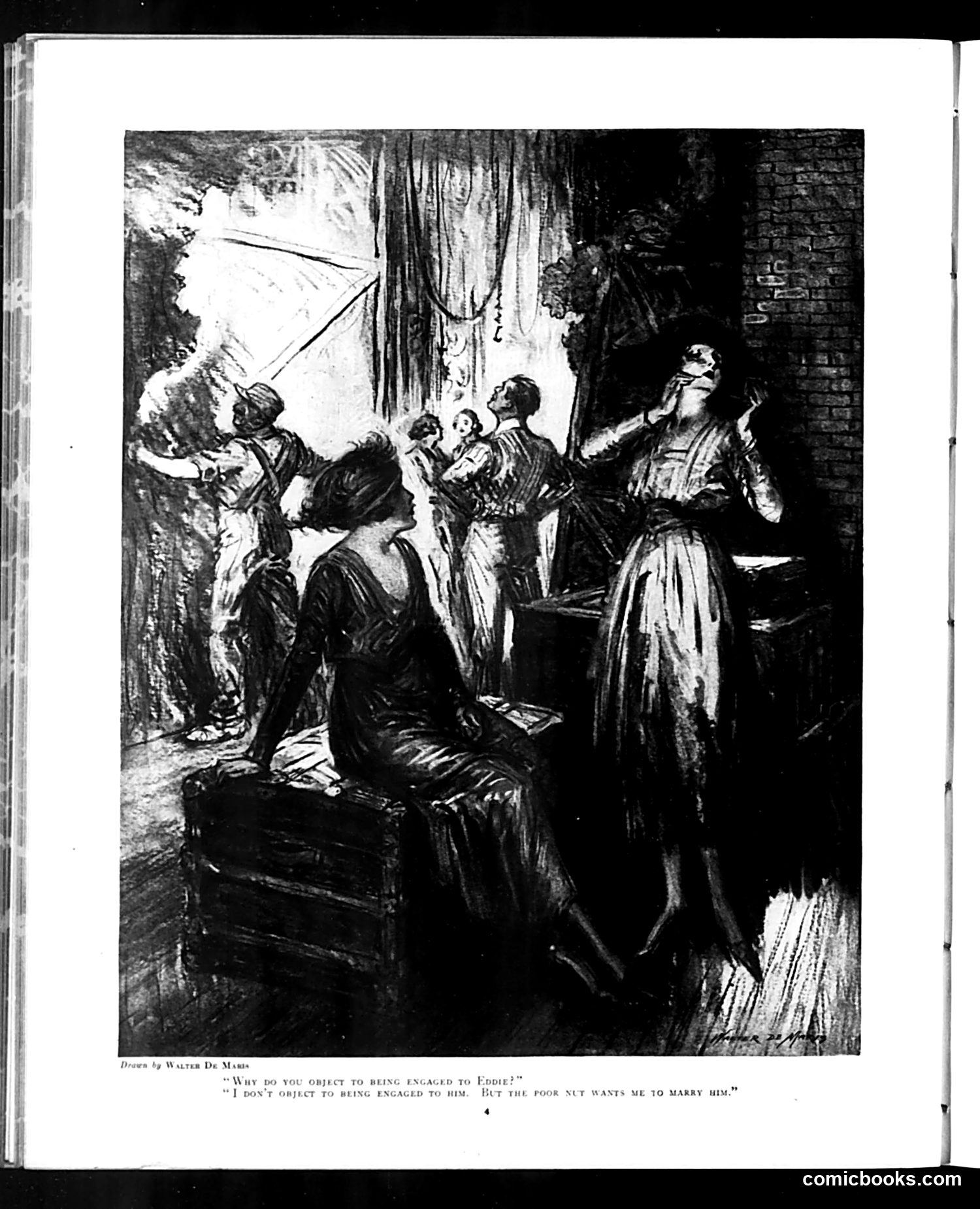
This illustration by Walter De Maris depicts a domestic dispute scene. The caption reads: "Why do you object to being engaged to Eddie?" "I don't object to being engaged to him. But the poor nut wants me to marry him." The satire targets early 20th-century attitudes about marriage and courtship. The joke centers on a woman distinguishing between being "engaged" (a long, potentially indefinite state) and actually marrying. She's willing to accept the engagement's social benefits and attention but refuses the commitment of marriage itself—suggesting either reluctance about the specific suitor or skepticism toward marriage generally. The man ("Eddie," dismissively called a "nut") apparently expects engagement to lead naturally to matrimony, highlighting period tensions between romantic expectation and female autonomy.
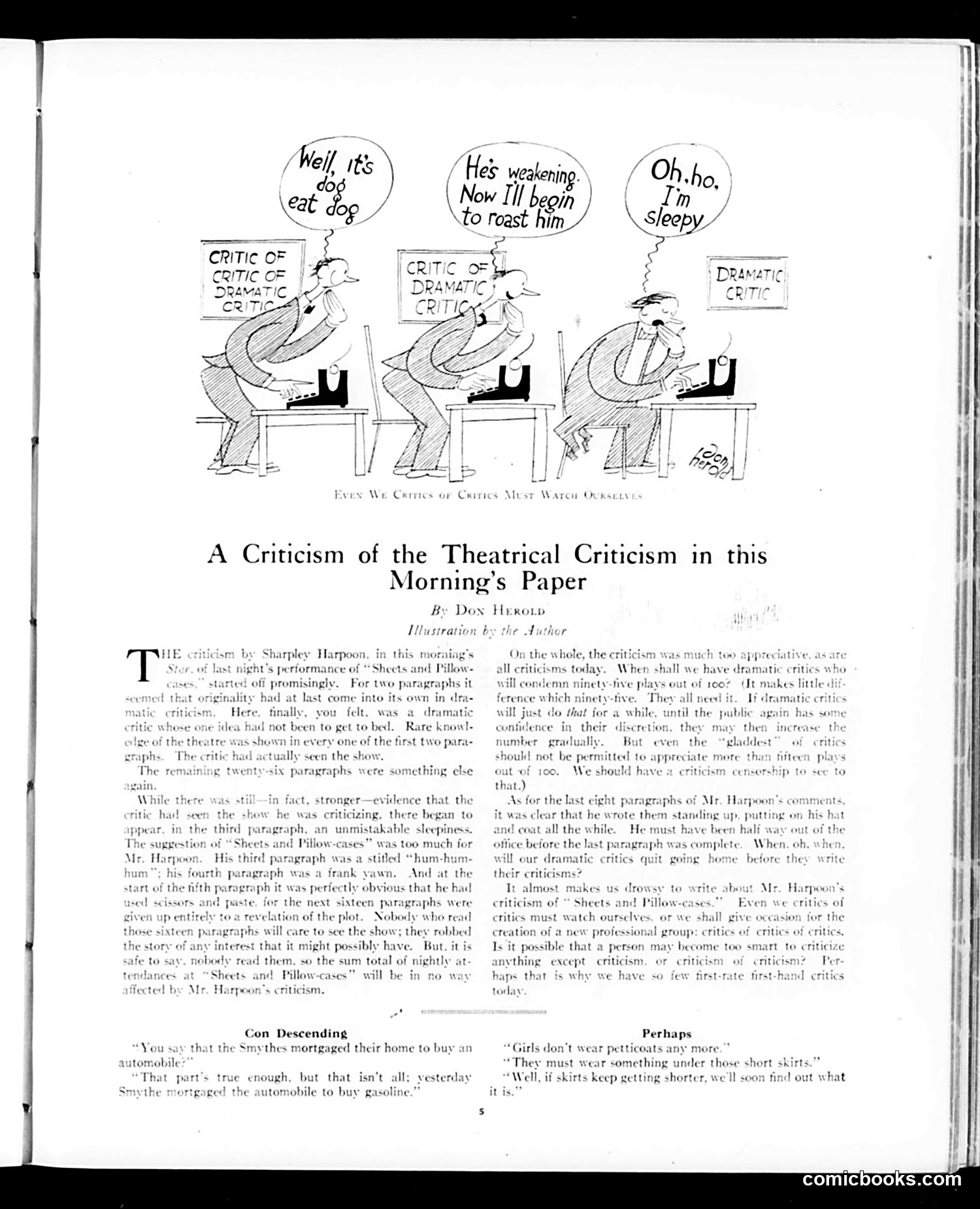
This cartoon satirizes theatrical critics, specifically responding to Sharpley Harpoon's review of "Sheets and Pillow-cases" in that morning's paper. The three-panel comic shows the same critic at his desk in progressive states of exhaustion and disinterest—first eating a hot dog while reviewing, then weakening as he prepares to "roast" the play, finally falling asleep mid-criticism. The accompanying article by Dos Harpoon defends critics against this mockery, arguing that critics serve a legitimate professional function. The satire targets the critic's apparent lack of engagement with the theatrical work itself, suggesting reviewers may be too tired, jaded, or inattentive to fairly judge performances. It's a commentary on critical credibility and professional standards in theater reviewing.
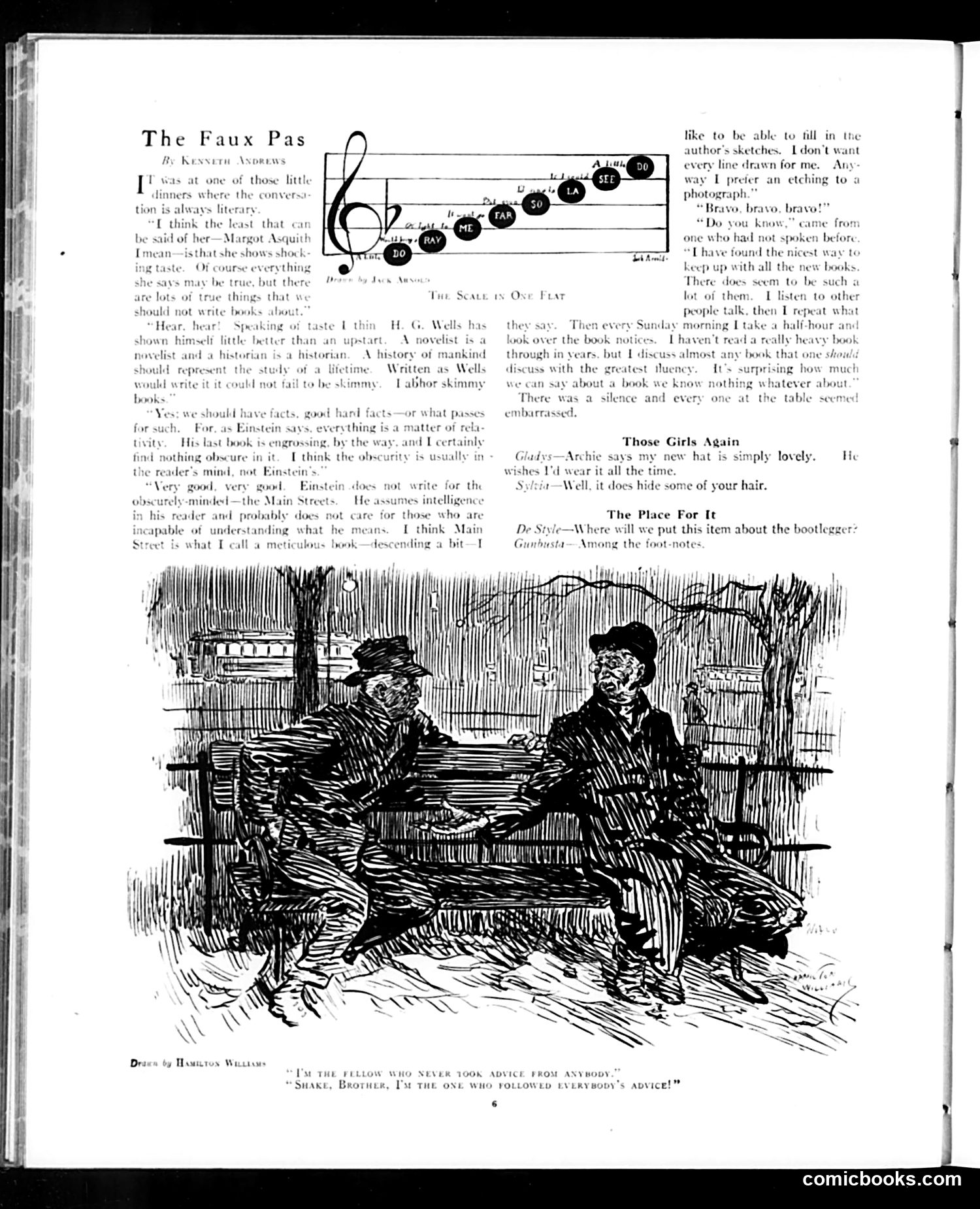
This page contains three distinct sections: **"The Faux Pas"** (top): A humorous essay by Knut Andrews discussing literary criticism and H.G. Wells, with a musical staff illustration showing note positions. **"Those Girls Again"** (middle): A brief comedic dialogue between characters named Gladys and Sylvia about a hat, followed by "The Place For It"—a joke about where to place an item about a bootlegger. **Main Cartoon** (bottom): Drawn by Hamilton Williams, depicting two men on a park bench. One says: "I'm the fellow who never took advice from anybody." The other responds: "Shake, brother, I'm the one who followed everybody's advice!" This satirizes the paradox of conformity versus independence—the joke being that following everyone's advice is itself a form of foolish consistency, mirroring the contrarian's stubbornness.
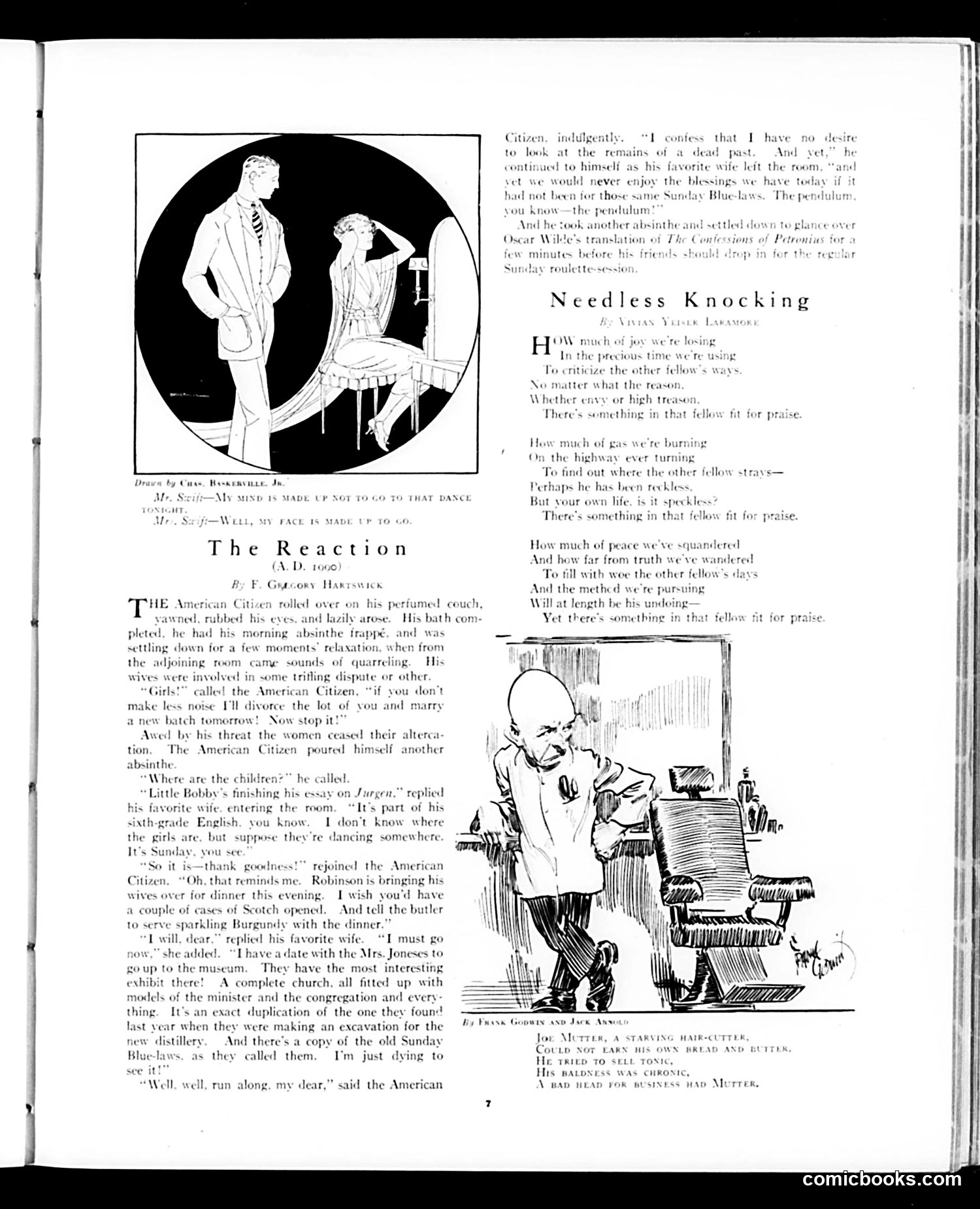
This page contains two satirical pieces mocking American excess and moral hypocrisy in the early 20th century. **"The Reaction"** depicts an "American Citizen" who embodies contradiction: he complains about noise from his multiple wives quarreling, casually plans to divorce and remarry them, orders expensive alcohol (absinthe, Scotch, Burgundy), and hosts dinner parties—all while his son writes essays on *Jurgen* (a sexually scandalous novel by James Branch Cabell that faced censorship). The satire targets wealthy Americans' simultaneous indulgence in vice and moral outrage. **"Needless Knocking"** critiques modern society's tendency to criticize others while ignoring one's own failures—"gas we're burning," "peace we've squandered," "truth we've wandered"—yet always finding "something in that fellow fit for praise." It's a commentary on hypocrisy and pointless gossip. Both pieces exemplify *Judge* magazine's social satire aimed at upper-class American behavior and contradictions.
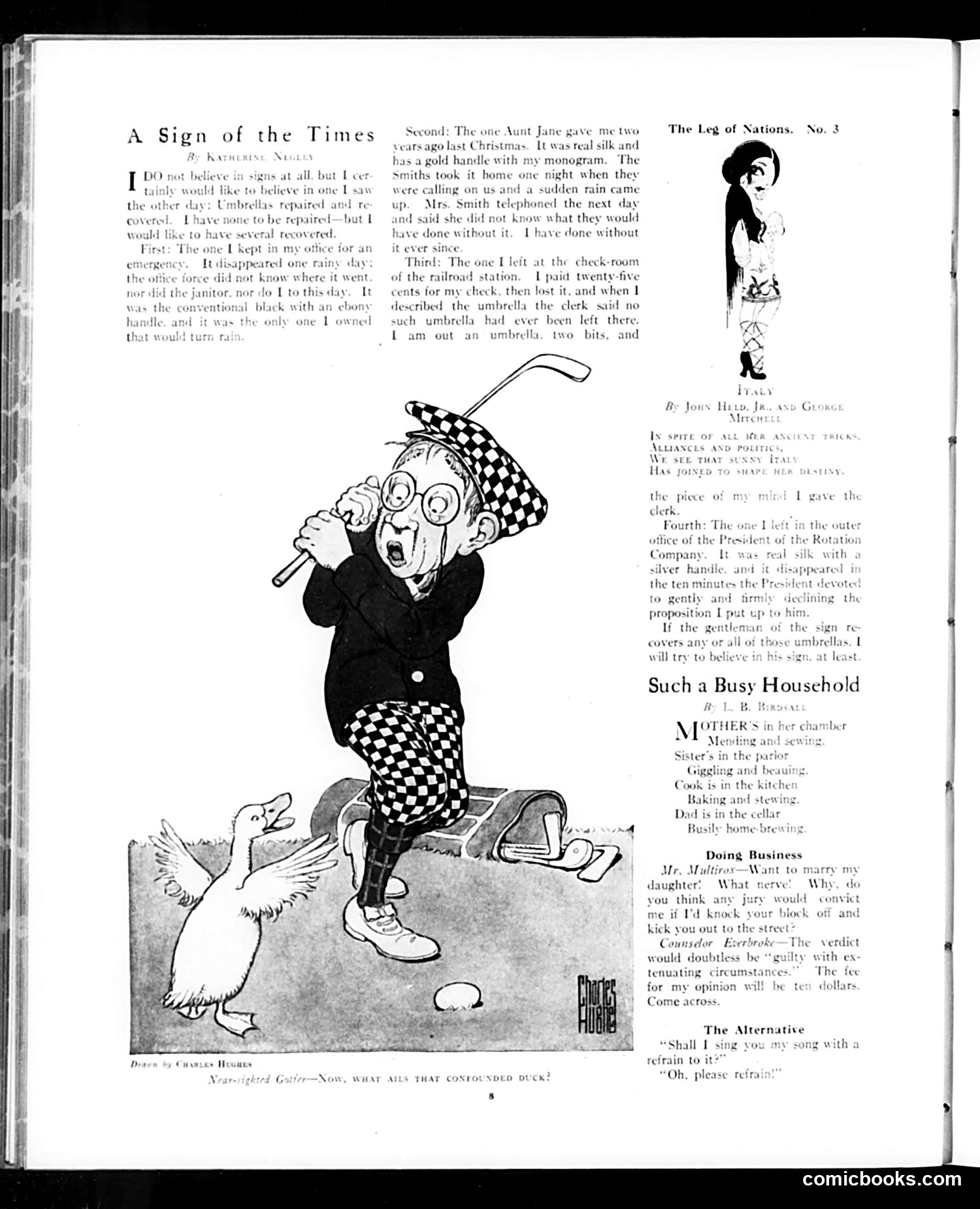
This page satirizes the epidemic loss and disappearance of umbrellas in early 20th-century urban life. The author humorously catalogs four umbrellas lost in different circumstances—one stolen from an office, one borrowed and never returned by the Smiths, one left at a railroad station checkroom (despite paying for a claim ticket), and one abandoned at a business office. The cartoon illustration depicts an exasperated figure chasing after a duck, captioned "Now, what ails that confounded duck?"—suggesting the absurdity and frustration of these everyday losses. The satire mocks both the prevalence of umbrella theft/loss in city life and people's casual indifference to others' property. It's a gentle commentary on urban carelessness and petty dishonesty among the middle class, presented as a widespread social problem worthy of satirical attention.
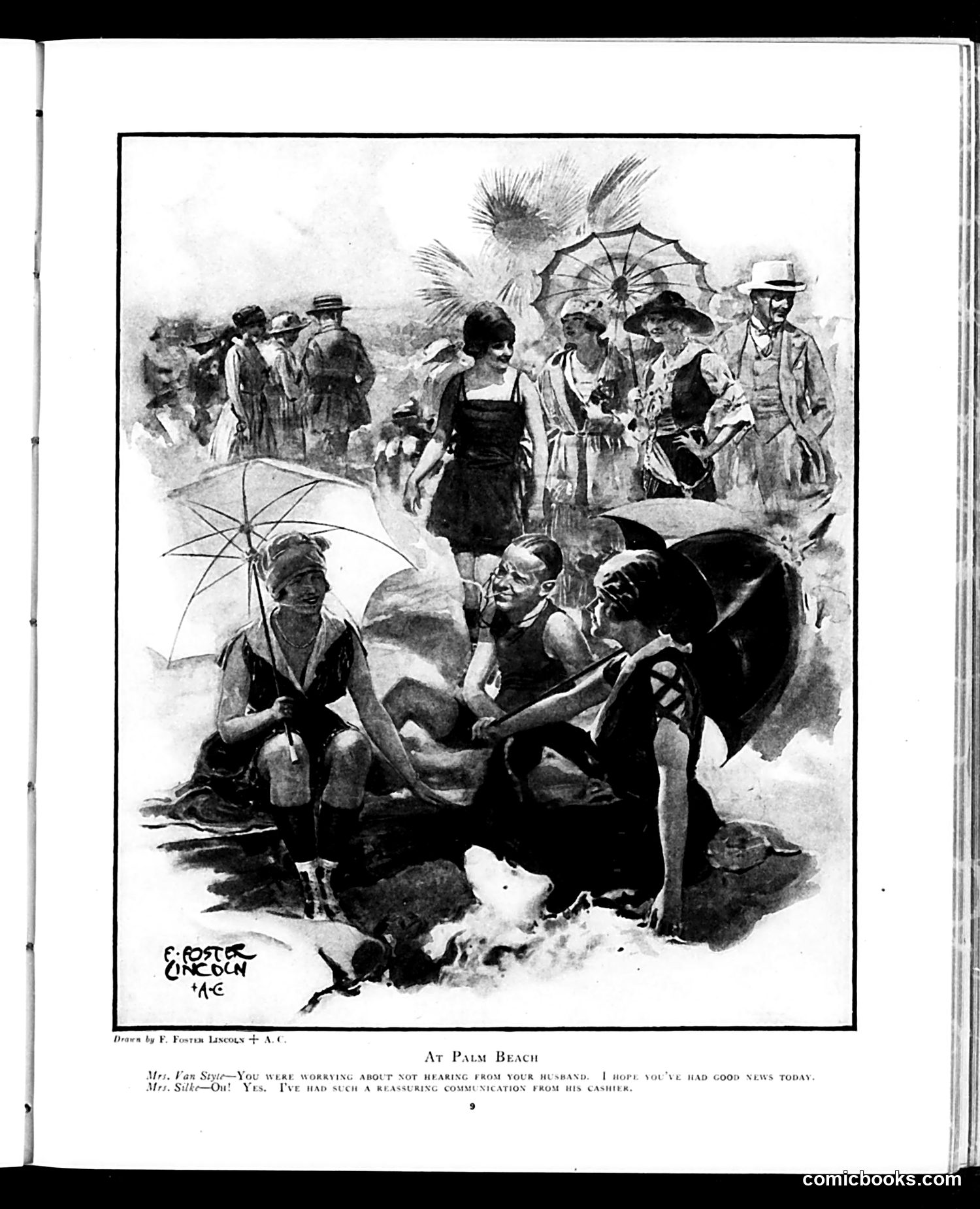
This satirical cartoon depicts two wealthy women at Palm Beach (a fashionable resort destination). Mrs. Van Style reassures Mrs. Silke about receiving news from her absent husband. The joke's punchline reveals Mrs. Silke's priorities: she's relieved not to hear directly from her husband, but instead from "his cashier"—meaning she only cares about receiving money. The satire targets wealthy wives' materialism and the era's social dynamics where husbands and wives maintained separate lives. The irony is sharp: rather than missing her husband personally, Mrs. Silke values financial reassurance more. The fashionable setting and parasols emphasize the leisure-class context, making the women's mercenary attitudes the cartoon's central joke about gilded-age marriage and wealth-based relationships.
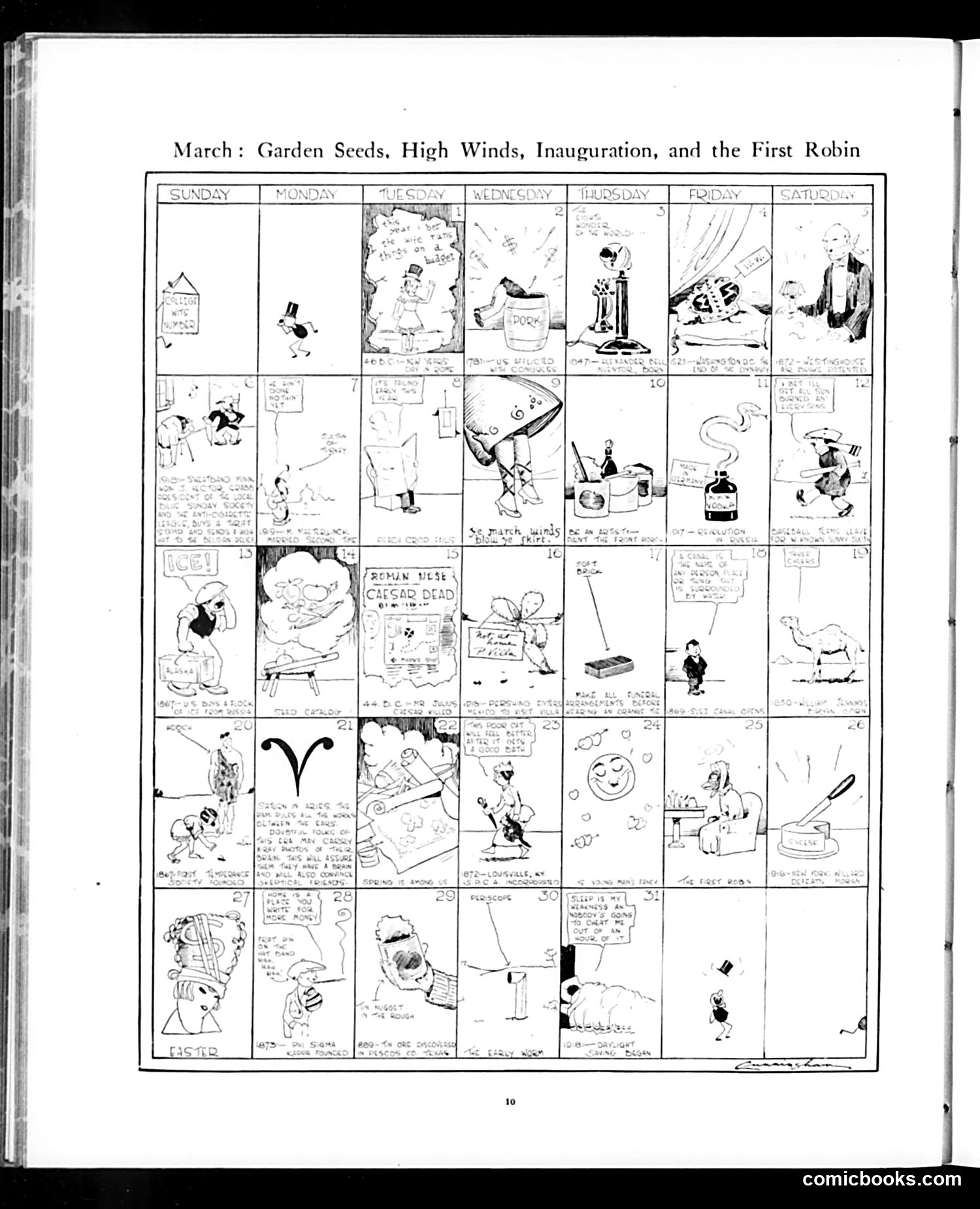
This is a satirical calendar page for March, organized as a seven-panel weekly comic strip repeated across five weeks. The header identifies March's themes: "Garden Seeds, High Winds, Inauguration, and the First Robin"—traditional March activities and seasonal markers in American life. The comic appears to depict various domestic and social situations typical of early spring, likely from the early-to-mid 20th century based on the art style. References to "Inauguration" suggest this may coincide with a presidential inauguration (possibly Franklin D. Roosevelt's in 1933 or another March inauguration). The strips use visual humor around spring preparations, weather conditions, and seasonal activities rather than specific political satire, making this primarily observational humor about American life during this transitional month.
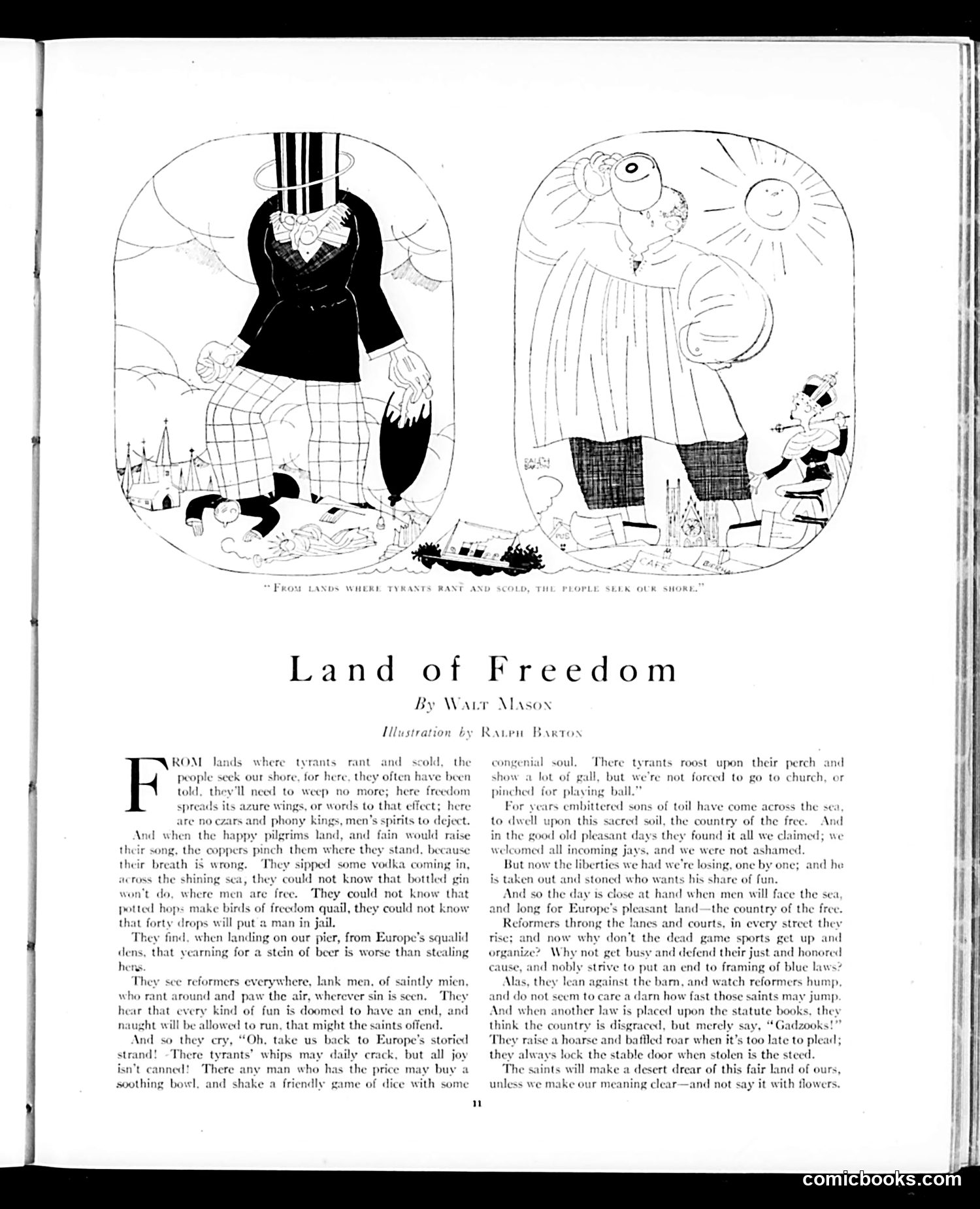
This satirical poem, illustrated by Ralph Barton, critiques American reformers and Prohibition-era restrictions through the perspective of European immigrants. **The satire:** Immigrants arrive expecting American freedom but find it's being systematically eliminated by "reformers"—temperance advocates and moral crusaders who criminalize drinking, gambling, and entertainment. The cartoon contrasts two figures: left shows an immigrant arriving with hopes; right depicts disillusionment. **The joke:** America promises liberty while actually imposing stricter moral controls than European tyrannies. Ironically, immigrants can legally buy alcohol in Europe but face jail time in "free" America for the same behavior. **Political context:** This attacks Prohibition advocates and the broader Progressive Era reform movement that Mason saw as tyrannical busybodies. The poem's final plea urges citizens to actively oppose these "saints" before America becomes a "desert drear"—expressing anti-Prohibition sentiment common in Judge's pages during this period.
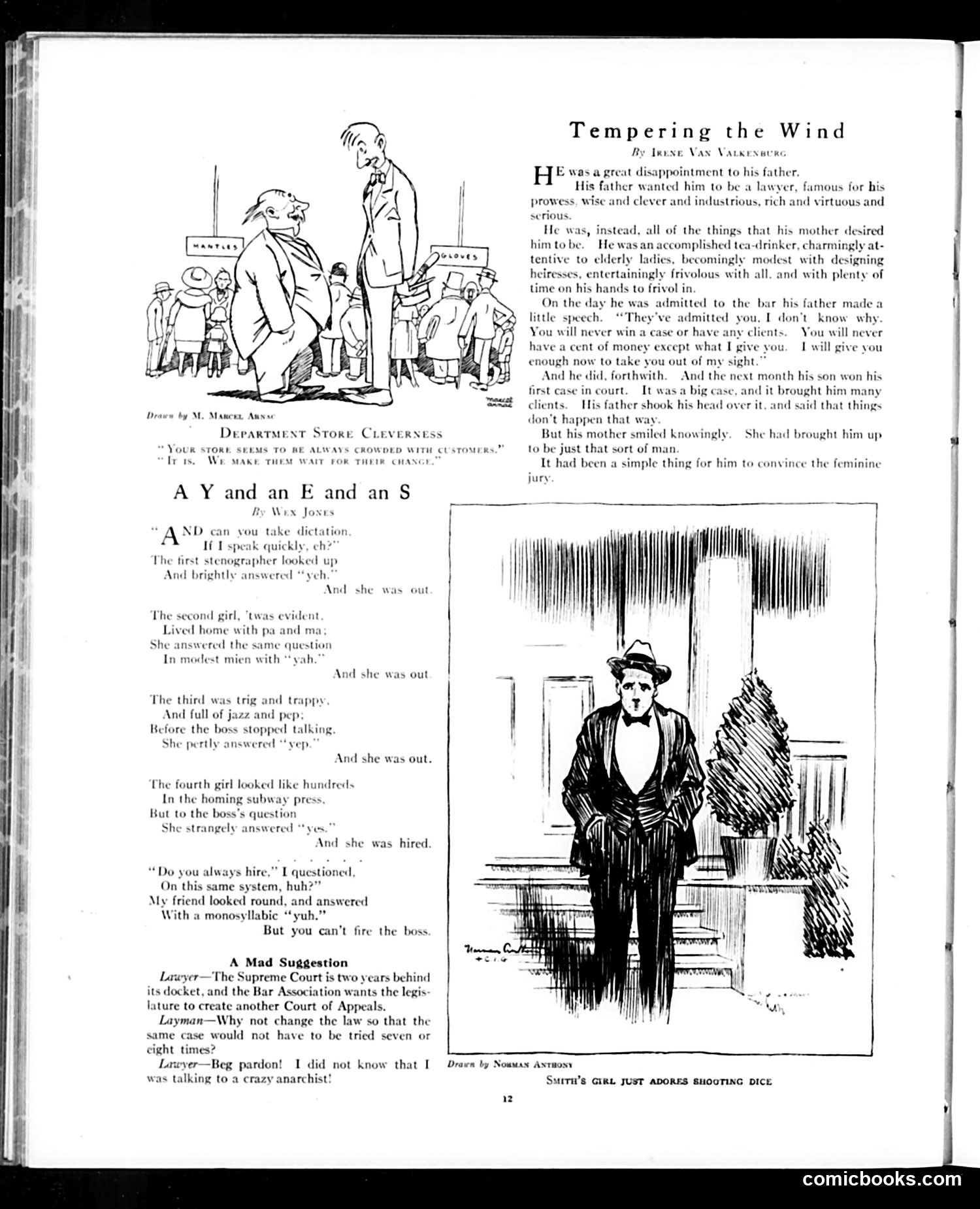
**"Tempering the Wind"** satirizes class expectations and parental disappointment. A father wants his son to be a serious, wealthy lawyer; instead, the mother raises him to be charming, attentive to women, and frivolous. The irony: the "useless" son wins his first major court case, proving social charm trumps ambition. The satire mocks both rigid paternal expectations and the assumption that genteel, people-pleasing traits are career liabilities. **"A Y and an E and an S"** jokes about stenographer hiring practices. Four women answer a boss's dictation test with different regional pronunciations ("yeh," "yah," "yep," "yes"). Only the woman who answers "yes"—suggesting deference or compliance—gets hired, despite being unremarkable. The final joke: "you can't fire the boss" mocks workplace power dynamics and arbitrary hiring favoring subservience over competence. **"A Mad Suggestion"** criticizes legal inefficiency. A lawyer proposes creating more courts to clear backlogs; a layman suggests simply preventing cases from being tried repeatedly. The lawyer calls him an "anarchist," satirizing lawyers' resistance to sensible reforms that might reduce their billable hours.
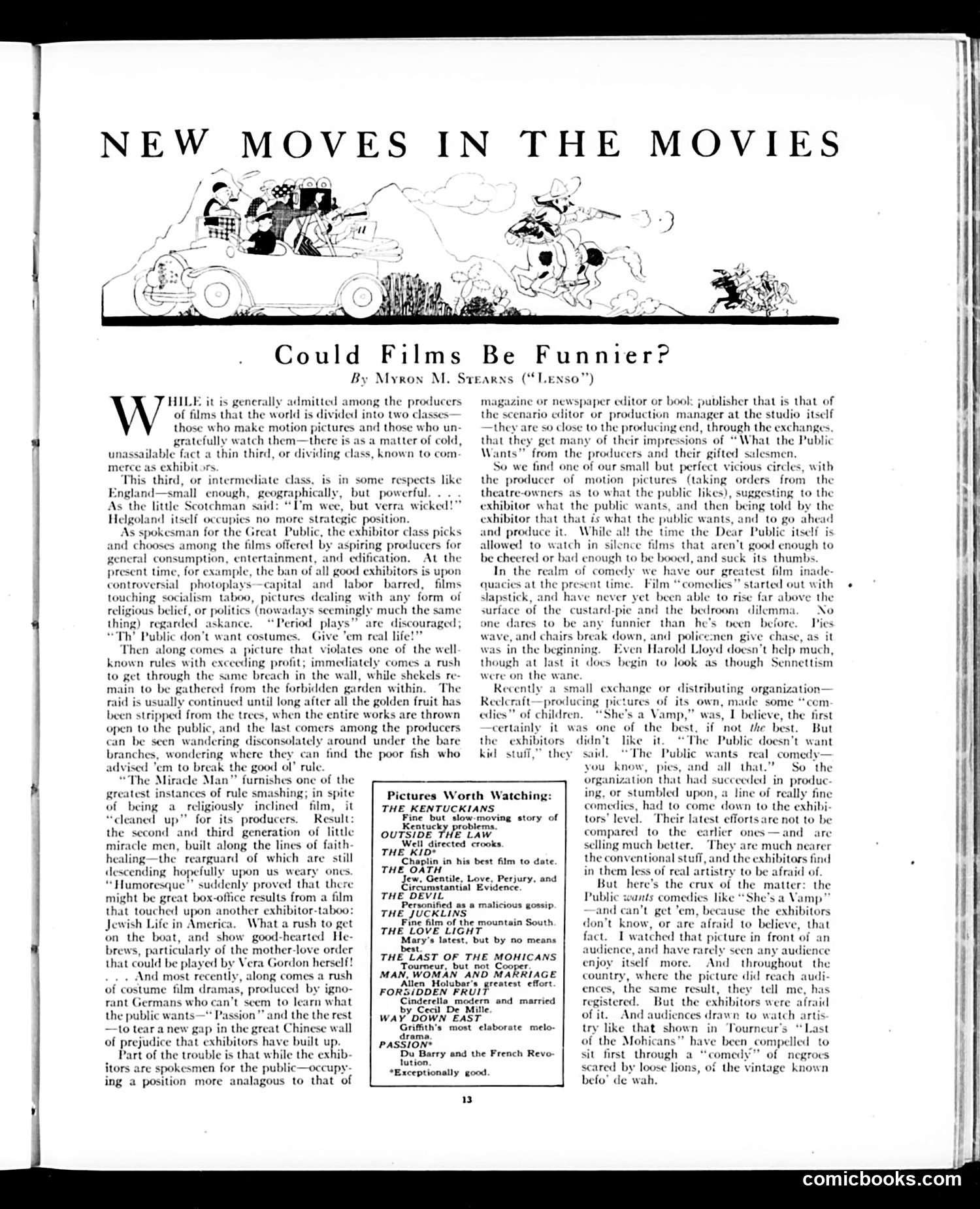
This article satirizes the film industry's structural problem: **exhibitors (theater owners) act as gatekeepers, claiming to represent "the Great Public," but they actually control what producers make.** The author, Myron M. Stearns, identifies a circular absurdity—producers ask exhibitors what audiences want; exhibitors tell producers what audiences want; then exhibitors claim they're merely giving the public what it desires. Meanwhile, the actual public sits passively consuming whatever results. Stearns illustrates his point with recent films that *broke* exhibitor "rules" (avoiding controversial topics, period pieces, etc.) yet succeeded commercially: *The Miracle Man* (religious content), *Humoresque* (Jewish themes), and *Passion* (German costume drama). These rule-breaking hits then spawned imitators, proving exhibitors' assumptions wrong. The satire's bite: the exhibitor class maintains power through claimed public knowledge they don't actually possess, stifling creativity while pretending to serve audience interests.
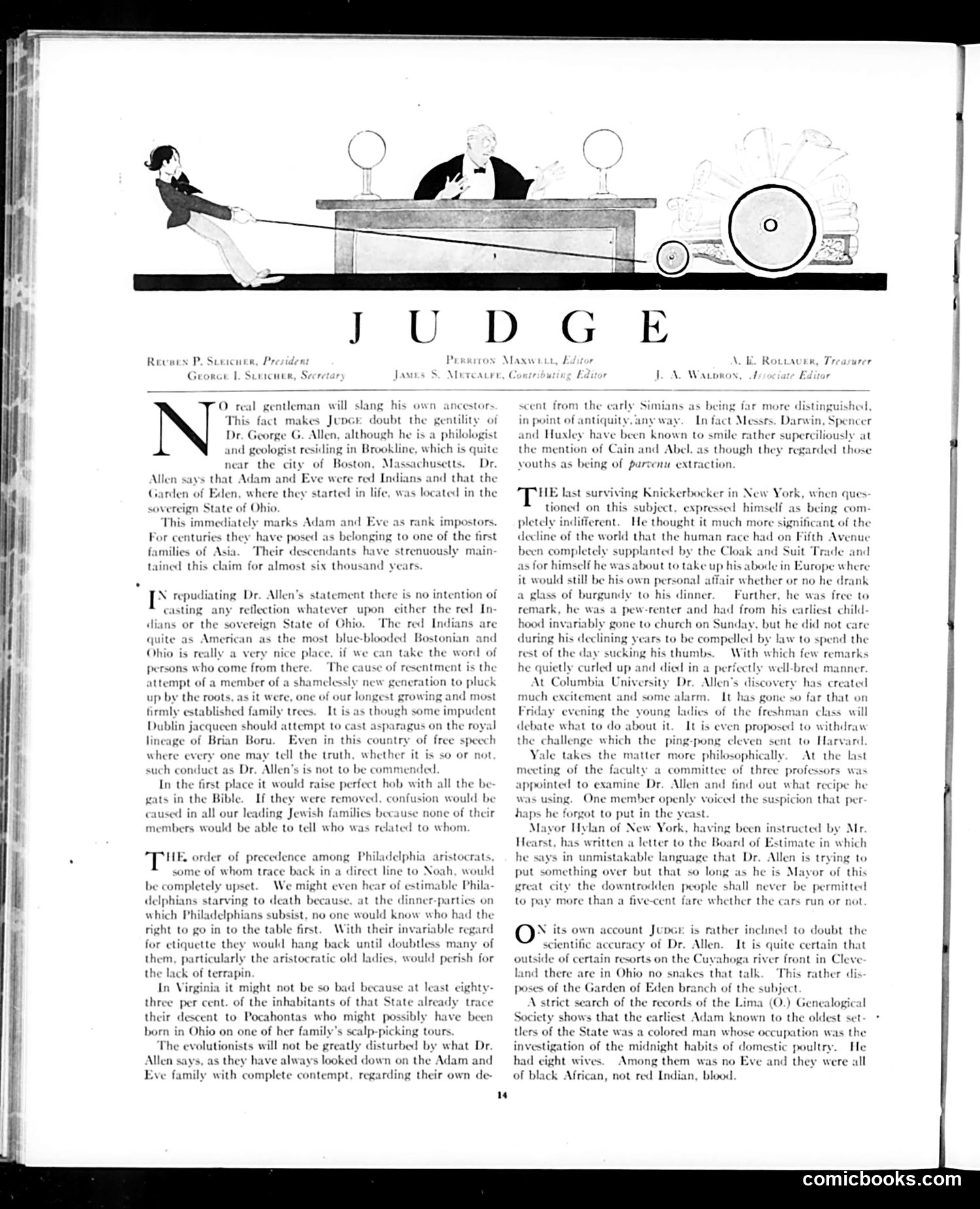
This page satirizes Dr. George G. Allen, a Brookline philologist and geologist who claimed Adam and Eve were Native Americans and Eden was located in Ohio. The cartoon shows a man being pulled backward by a rope—likely Allen—being dragged before a judge, visually representing his "outrageous" claims disrupting social order. The satire mocks Boston Brahmin anxiety about genealogy and social hierarchy. Judge ridicules how Allen's theory threatens the carefully maintained ancestry claims of Philadelphia aristocrats and other Eastern elites who traced their lineage to founding families. The article humorously catalogs the chaos his claims would cause: confusion in Jewish families, disrupted dinner-party seating protocols, and the collapse of Virginia society's Pocahontas-connection claims. The joke targets snobbish genealogical pretension itself—how absurd that established families fear any challenge to their ancestry, whether Allen's theory is true or not.
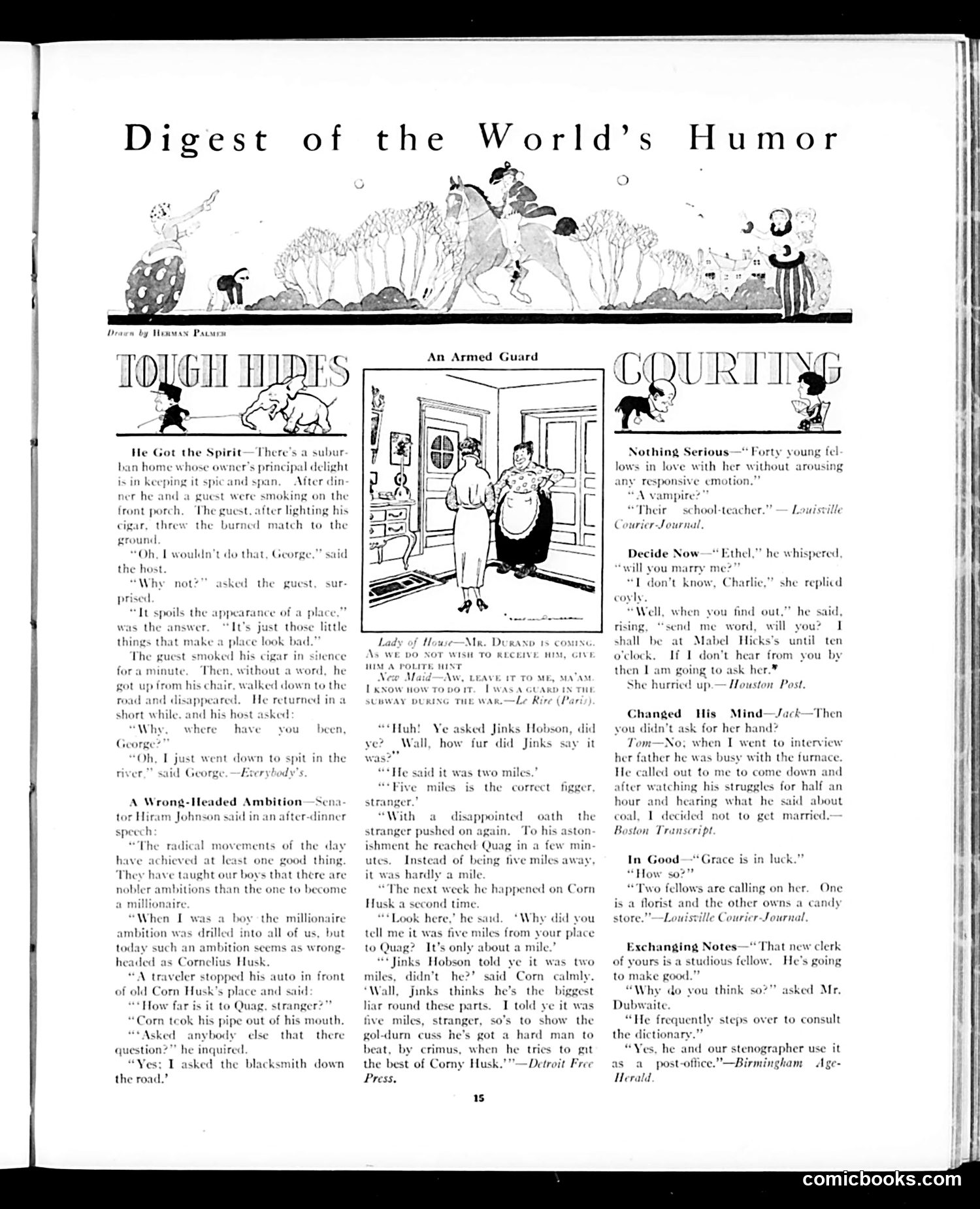
This page from Judge magazine collects brief humorous anecdotes organized under thematic headings. The cartoons and jokes satirize American social pretensions and rural shrewdness: **"Tough Hides"** mocks suburban obsession with appearances—a fastidious host objects to a guest dropping a match, revealing hypocrisy when the guest later spits in a river. **"A Wrong-Headed Ambition"** features Senator Hiram Johnson criticizing millionaire-worship, illustrated by "Corn Husk," a folksy character who outwits travelers by lying about distances to Quag. The joke celebrates rural cunning over city sophistication. **"Courting"** and **"Decide Now"** present dating humor showing male fickleness and female manipulation—a suitor threatens to propose to another woman if rejected. **"An Armed Guard"** references WWI military service with a subway guard anecdote. The remaining items ("Changed His Mind," "In Good Graces," "Exchanging Notes") offer lightweight romantic and workplace humor. Overall, the page blends anti-urban sentiment with gentle mockery of courtship conventions and social pretension typical of 1920s-era American humor magazines.
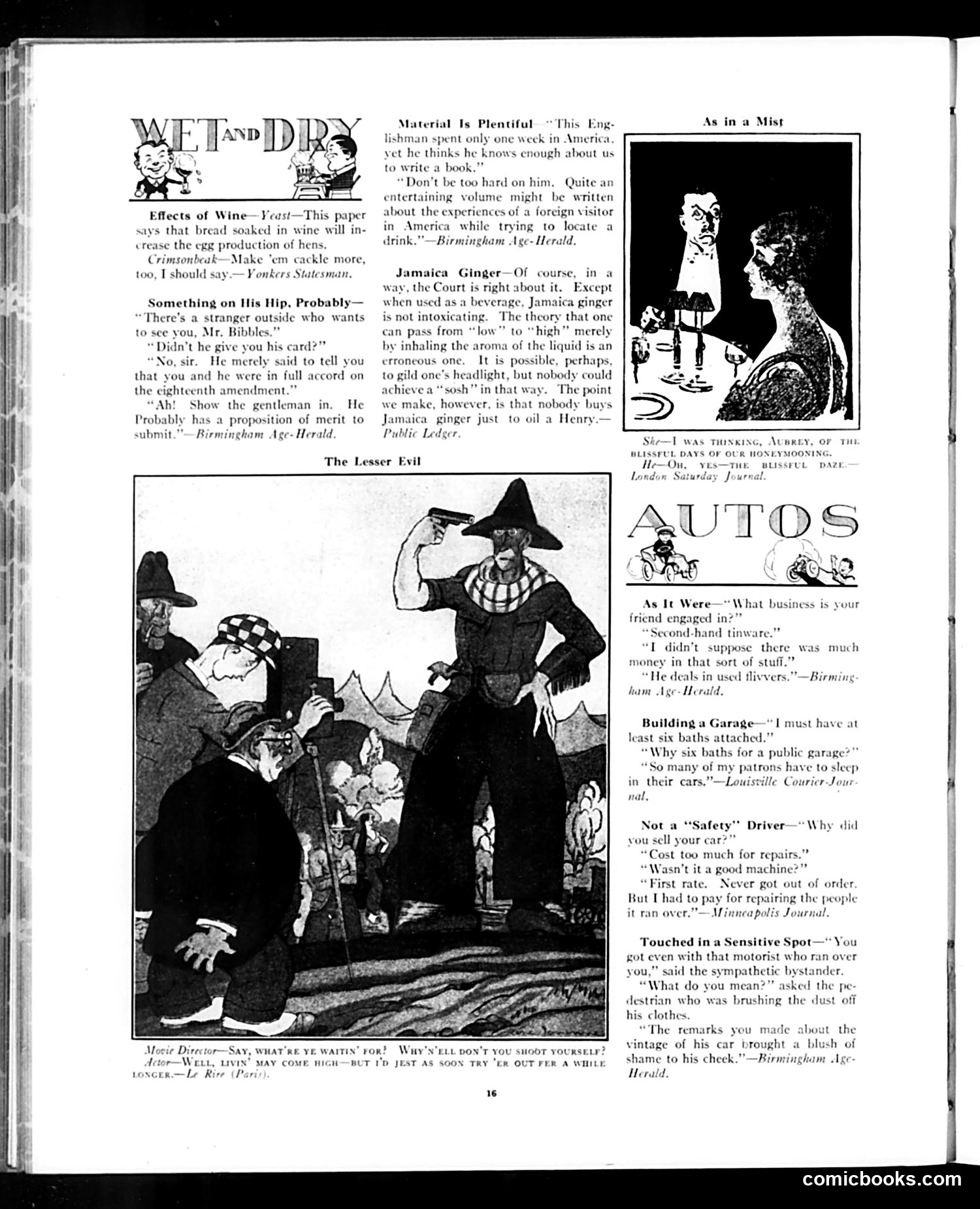
This page from *Judge* magazine contains several satirical commentaries on 1920s American life, primarily focused on Prohibition-era themes and automobiles. **"The Lesser Evil"** cartoon depicts two figures—likely a bootlegger (left) and a wealthy patron (right)—in a transaction involving illegal alcohol. The caption jokes about preferring crime to suicide, satirizing how Prohibition drove respectable citizens to break the law. **"Autos" section** contains several car-related jokes mocking the era's automobile culture: the "second-hand tinware" reference ridicules used cars; the garage joke suggests poor people sleep in vehicles (Depression-era commentary); the "Safety Driver" bit satirizes repair costs and pedestrian accidents from reckless driving; and the final anecdote mocks a motorist's shame when insulted about his old car. The page also includes brief items on bread/wine, Jamaica ginger (used as Prohibition-era alcohol substitute), and American tourism—all reflecting concerns of the 1920s-30s period.
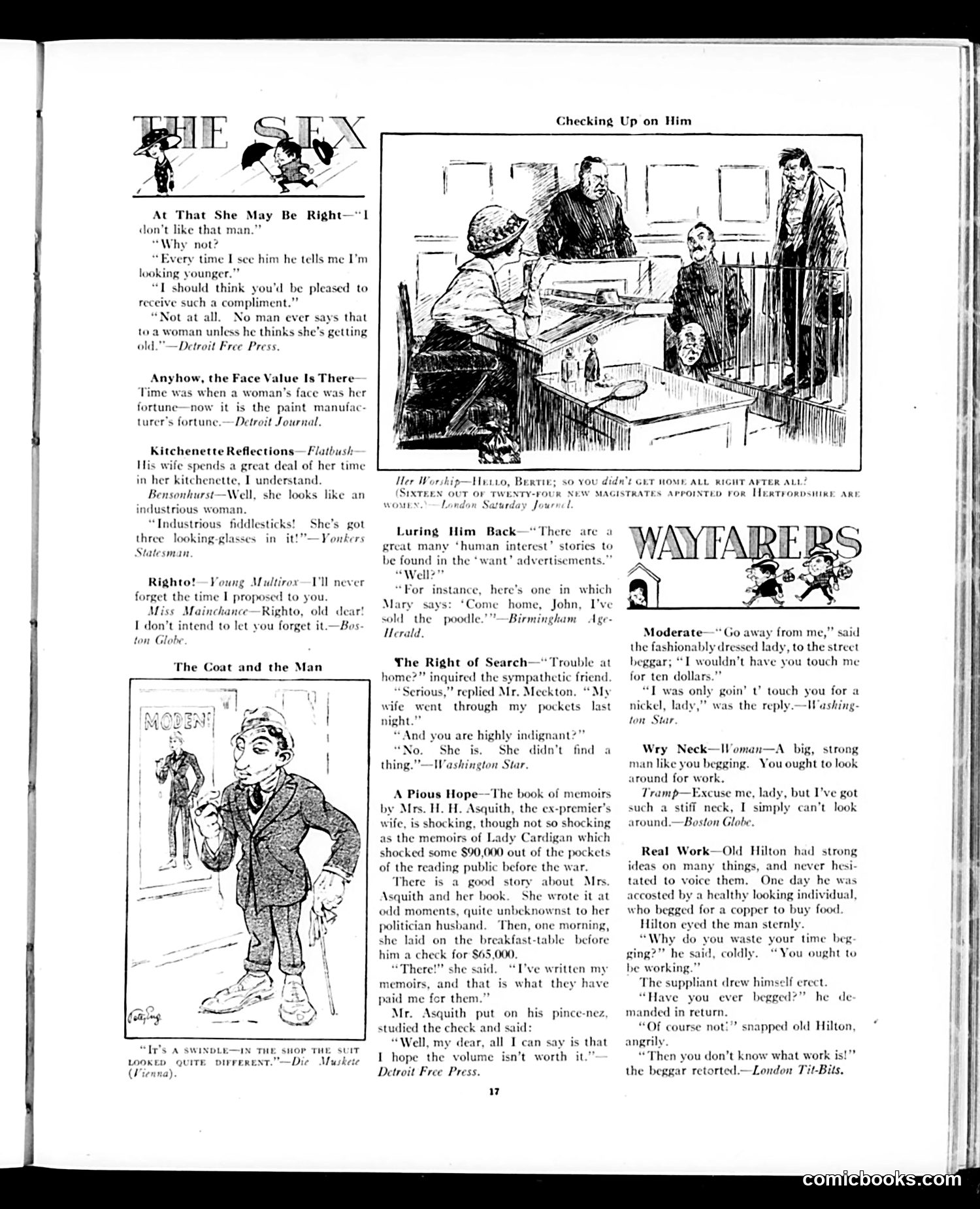
This page contains satirical humor pieces typical of early 20th-century American magazines, focusing on gender relations and social commentary. **Main Content:** The pieces mock contemporary attitudes toward women and courtship. "At That She May Be Right" satirizes insincere male flattery—men tell women they look "younger" not as genuine compliments but as backhanded admissions of aging. "Kitchenette Reflections" ridicules a woman obsessed with mirrors in her tiny apartment, equating domesticity with vanity. **Notable References:** "A Pious Hope" references H.H. Asquith's wife publishing profitable memoirs ($65,000), with Asquith dismissively hoping the volume "isn't worth it"—mocking both women's literary ambitions and spousal tensions over finances. The cartoon "Checking Up on Him" depicts a domestic scene of surveillance, likely about wives monitoring husbands' activities. **Overall Tone:** The page reflects early-1900s attitudes: women are vain, deceptive, and preoccupied with appearance; men are reluctant to acknowledge aging or female financial independence. The humor assumes reader agreement with these stereotypes.
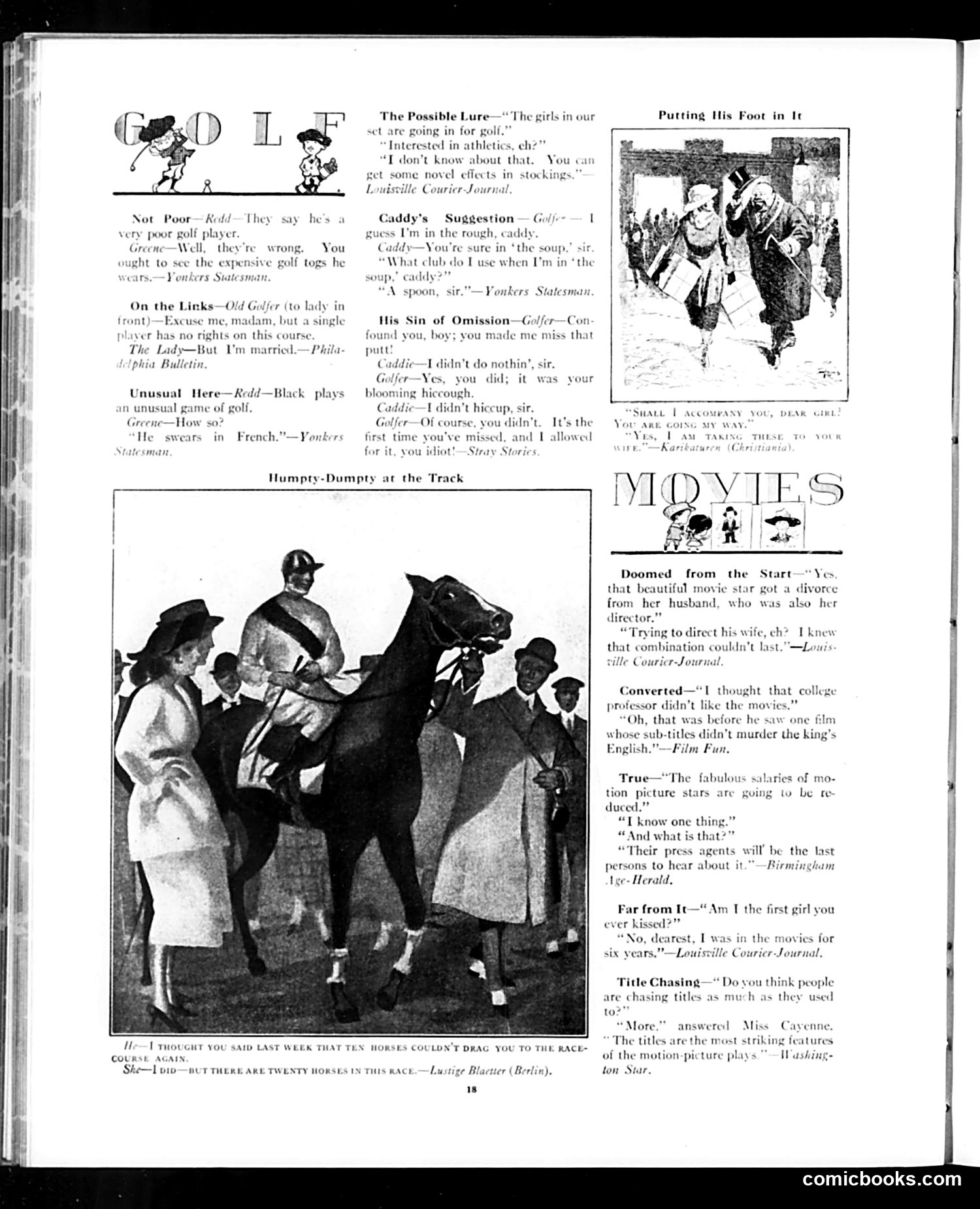
This page from Judge magazine collects golf jokes and movie industry gossip—two popular 1920s topics. The golf section features several brief comedic exchanges about the sport's culture: a "poor" player who actually owns expensive equipment, a caddy's wordplay about being "in the rough," and a golfer blaming his caddie for a missed putt caused by the caddie's hiccup. The "Movies" section satirizes early Hollywood's emerging celebrity culture and commercial pressures. Jokes mock the instability of movie marriages (a director divorcing his actress-wife), professors' changing attitudes toward cinema, the dubious quality of subtitle translations, and stars' inflated salaries facing cuts. One item jokes that a woman who previously refused to attend horse races will go when more horses are racing—implying superficial attraction to spectacle. The humor relies on recognizing contemporary anxieties: golf as status symbol, cinema's questionable artistic merit, and Hollywood's commercial excess and personal drama.
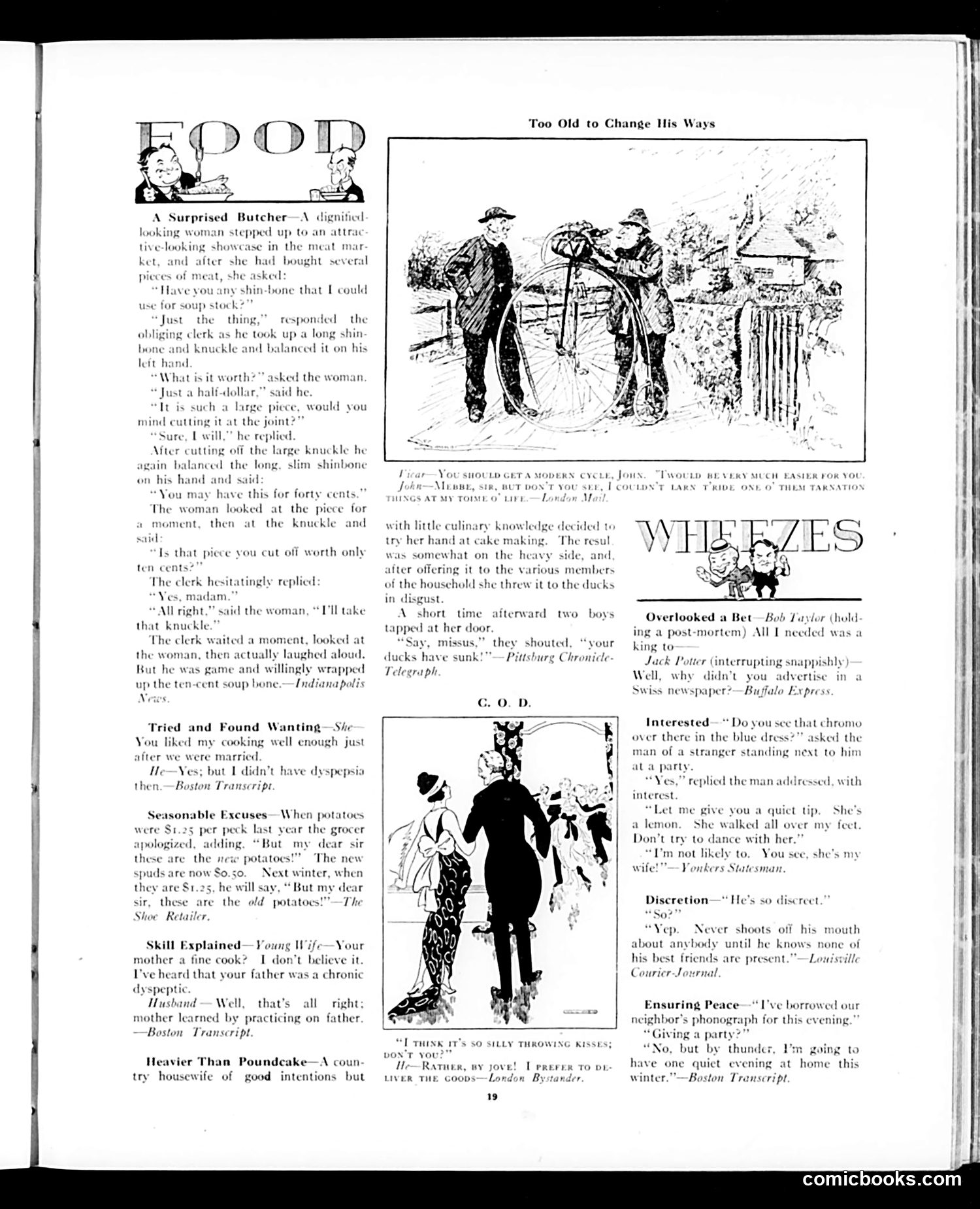
This page from the satirical magazine *Judge* contains multiple short humorous anecdotes and jokes typical of early 20th-century American humor. **"A Surprised Butcher"** satirizes customer shrewdness: a woman buys a shinbone for 50 cents, then asks the butcher to cut off the knuckle. When he offers to sell her the remaining bone for 40 cents, she points out the removed piece would only be worth 10 cents—exposing the butcher's illogical pricing. She refuses the inflated price, and the butcher, amused by her logic, sells her the original knuckle for 10 cents anyway. The other brief anecdotes mock domestic life: wives' cooking causing husbands indigestion; grocer excuses for potato prices; a homemade cake so dense it sinks ducks; and marital awkwardness. **"G.O.D."** appears to be an illustrated joke about social situations, though details are unclear from the image. The **"Wittzes"** section contains short quips about advertising, dancing, discretion, and phonographs—typical period humor targeting middle-class social conventions and relationships. The overall tone reflects turn-of-the-century American magazine humor: domestic comedies, consumer mockery, and gender-based jokes.
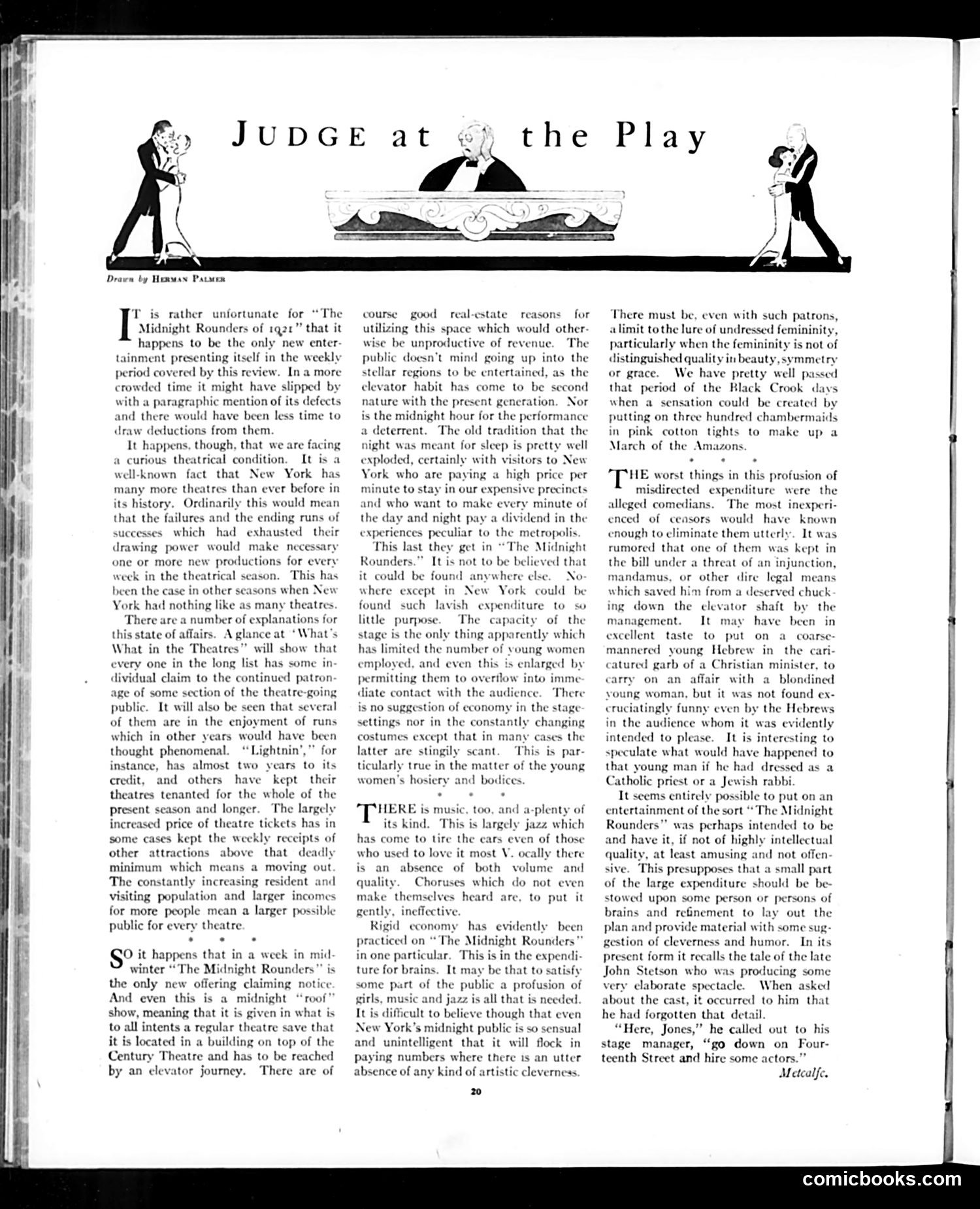
This is a theater review column (not a political cartoon) critiquing "The Midnight Rounders of 1921," a rooftop revue at the Century Theatre. The illustration shows a formal "Judge" presiding over theatrical evaluation. The satire targets the show's excessive expenditure on spectacle—particularly abundant chorus girls in scanty costumes—while delivering poor artistic quality. The reviewer notes the irony that New York's oversupply of theaters forces producers to mount expensive productions even for mediocre shows. The piece mocks the lavish staging ("no suggestion of economy"), weak vocal performance, and reliance on jazz music and barely-clothed dancers rather than genuine entertainment value. The underlying criticism: post-WWI New York's entertainment industry prioritizes visual excess and titillation over talent, encouraged by wealthy audiences willing to pay premium prices for "experiences" rather than actual artistic merit.
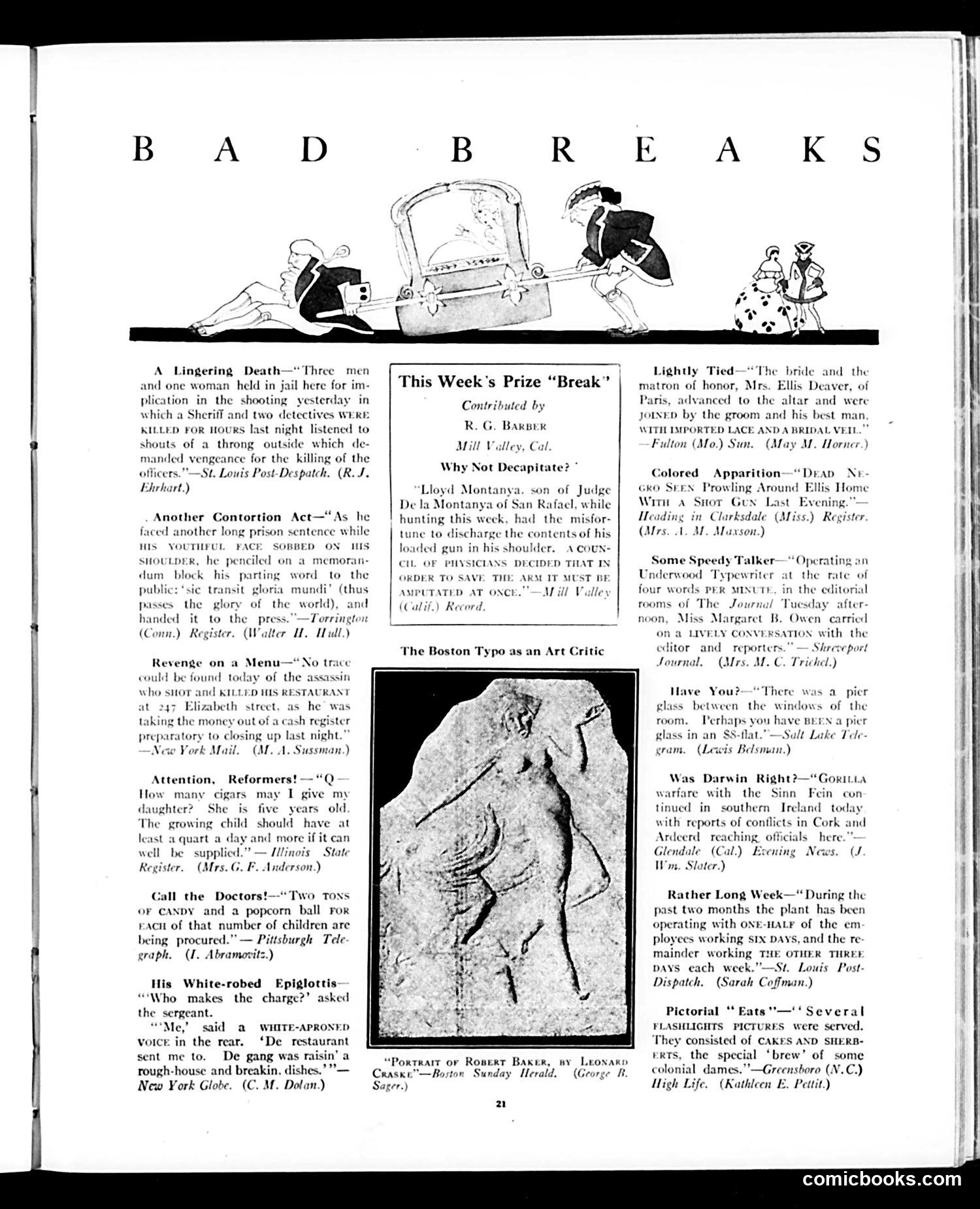
This page from *Judge* magazine collects humorous newspaper "breaks"—embarrassing typos and unintentionally absurd phrasings clipped from real newspapers. The cartoon at top satirizes journalistic mishaps through visual comedy. The central image shows a broken-down car labeled "BAD BREAKS," with figures struggling around it—a visual metaphor for journalism gone wrong. The "breaks" themselves are modest by modern standards: a physician deciding to amputate an arm "at once" (awkward phrasing about urgency), a typewriter operator working "four words per minute" (typo for speed records), and a "pier glass" mistakenly capitalized as if a person's name. The appeal lay in *Judge's* regular mockery of small-town and provincial newspapers' embarrassing errors—a form of urban intellectual humor targeting less-sophisticated regional press. The page also includes crime briefs and social notes, typical of the magazine's satirical commentary on contemporary life and journalism standards of the era.
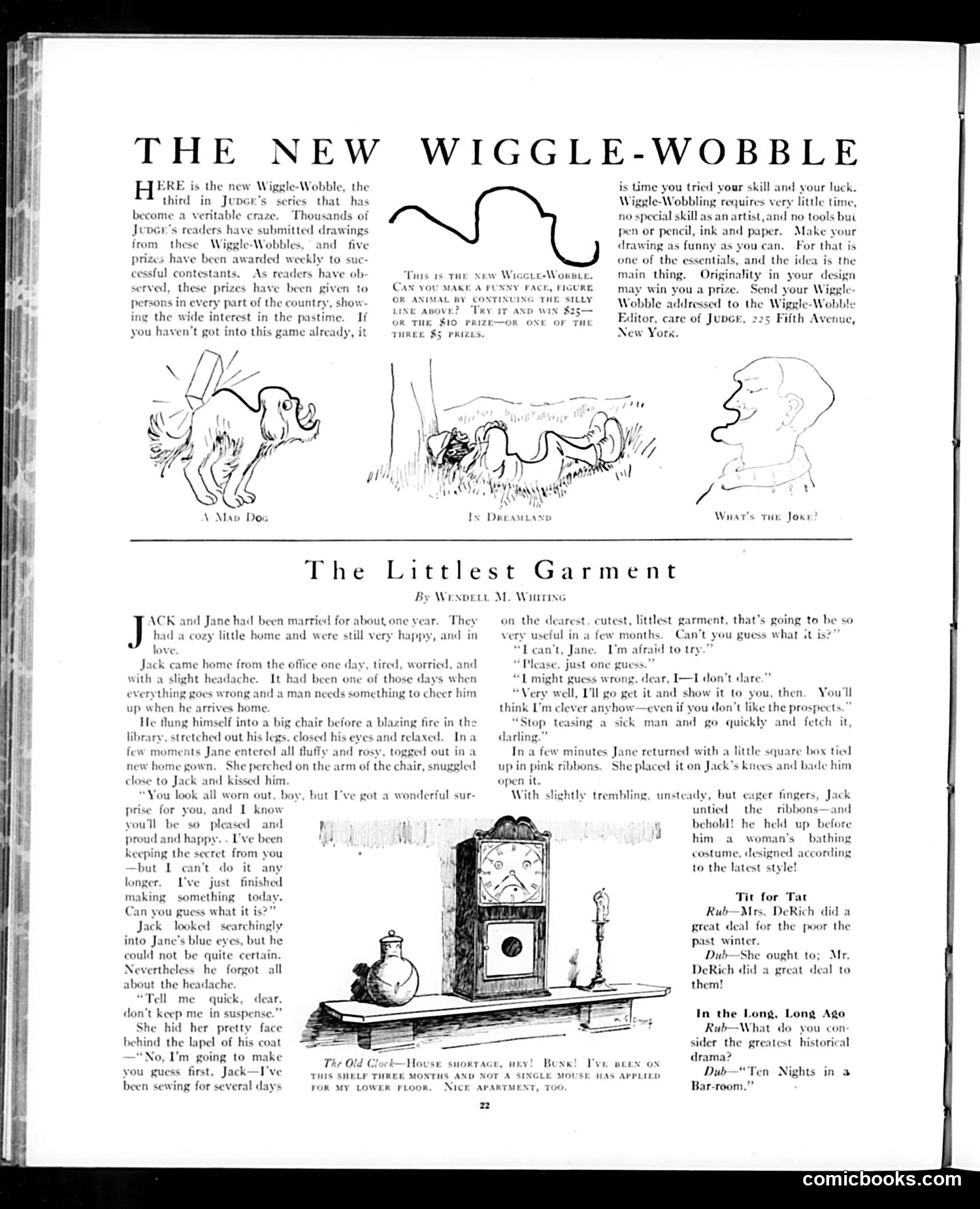
This page showcases two distinct Judge features: **The Wiggle-Wobble Contest** (top): A reader-participation drawing game where contestants complete a squiggly line into funny faces or animals. Judge offered cash prizes ($5-$10) weekly to encourage submissions. The three example sketches show simple continuations: a mad dog, a dreaming figure, and a man's face. This was a popular early 20th-century parlor game that Judge commercialized to boost reader engagement and submissions. **"The Littlest Garment"** (below): A domestic humor story about a young married couple. Jack expects his wife Jane to announce a pregnancy, but she instead reveals she's sewn him a fashionable women's bathing costume—a joke playing on his anxious anticipation and the unexpected nature of her "surprise." The humor relies on readers' assumptions about what a wife's mysterious gift might signify. The page also includes brief joke exchanges ("Tit for Tat," "In the Long, Long Ago") typical of Judge's satirical format.
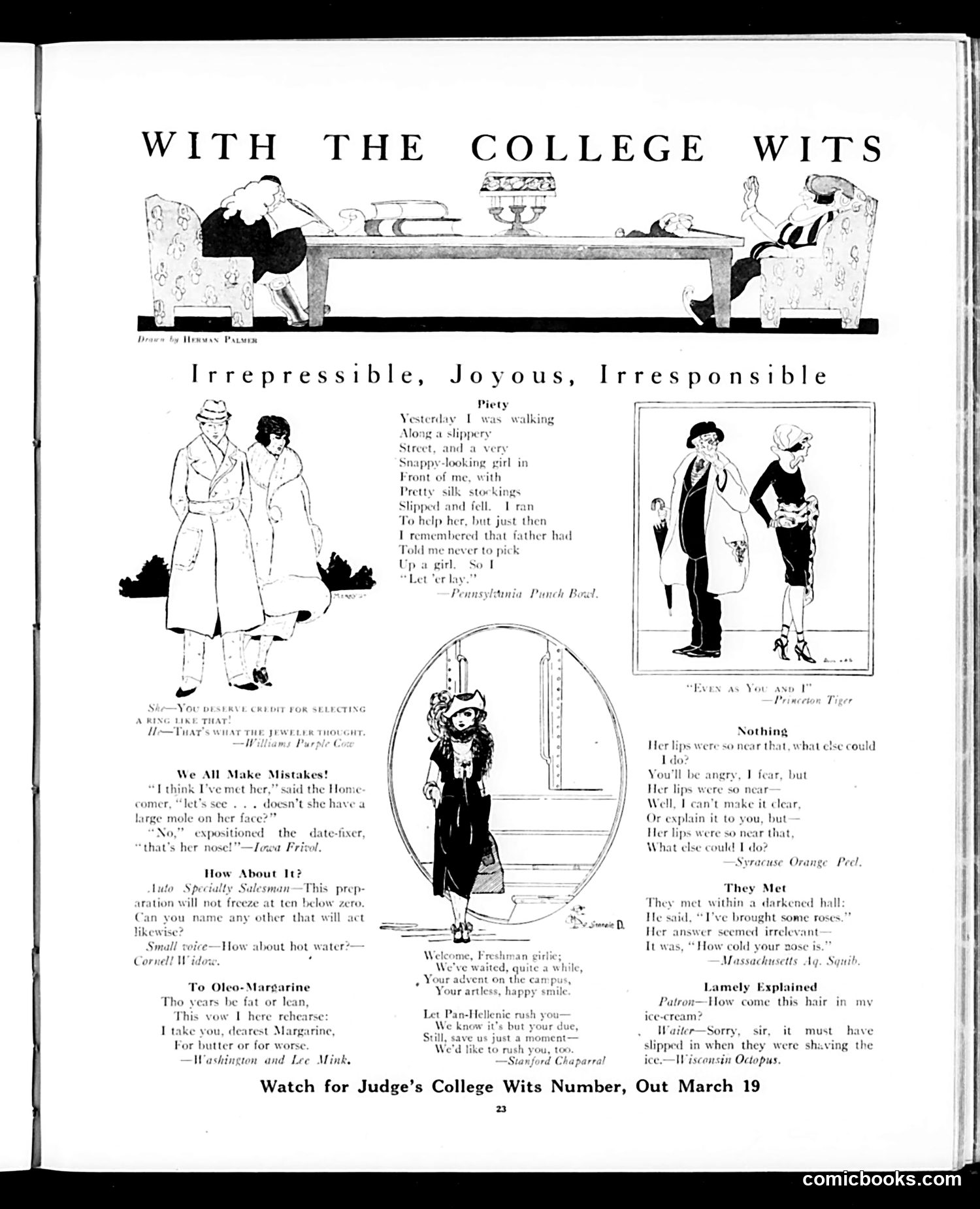
This page collects humorous short pieces and cartoons submitted by college newspapers, typical of Judge's "College Wits" feature. The content targets college-age audiences with lighthearted jokes about dating, social mishaps, and everyday frustrations. The cartoons illustrate common scenarios: a man helping a fallen girl and being reminded of paternal warnings against "picking up" women; awkward romantic encounters in darkened hallways; a waiter's absurd excuse for hair in ice cream. The humor relies on gentle sexual innuendo (the girl's "lips so near"), social propriety violations, and surreal logic. The tone is wholesome yet mildly risqué for the era—poking fun at young people's romantic nervousness, parental restrictions on courtship, and absurd explanations. Rather than political satire, this represents Judge's lighter content aimed at college readers, showcasing wit from student publications nationwide.
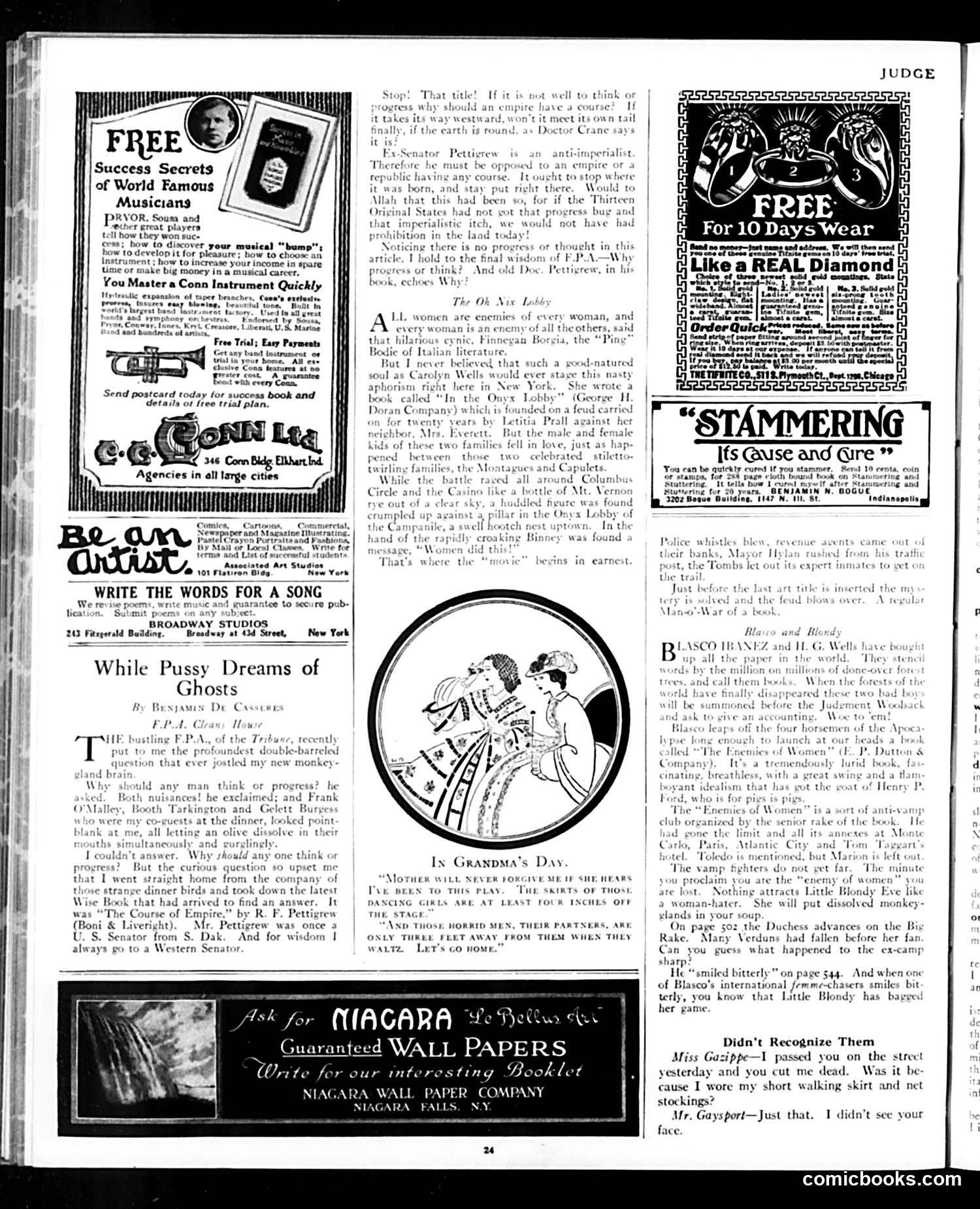
This page is primarily **advertising and satirical commentary** rather than a cohesive cartoon narrative. The main satirical content appears in **"While Pussy Dreams of Ghosts"** by Benjamin De Casseres, which critiques the **F.P.A. (Federal Poets Association, likely)** for proposing a "double-barrel" question. The piece mocks what Pettigrew calls "progress"—specifically Senator Pettigrew's imperialistic views. The satire suggests Pettigrew represents old-guard politics opposing modern advancement. Below is a small cartoon titled **"Is Grandma's Day"** depicting generational conflict over women's fashion and morality. An older woman expresses shock at dancers' exposed legs ("four inches off the stage"), while younger attendees dismiss her prudishness. This reflects 1920s debates over changing social norms. The remaining content consists of **advertisements** for music instruction, songwriting lessons, and wallpaper—typical Judge filler material. The page satirizes political hypocrisy and generational cultural clashes common to the era.
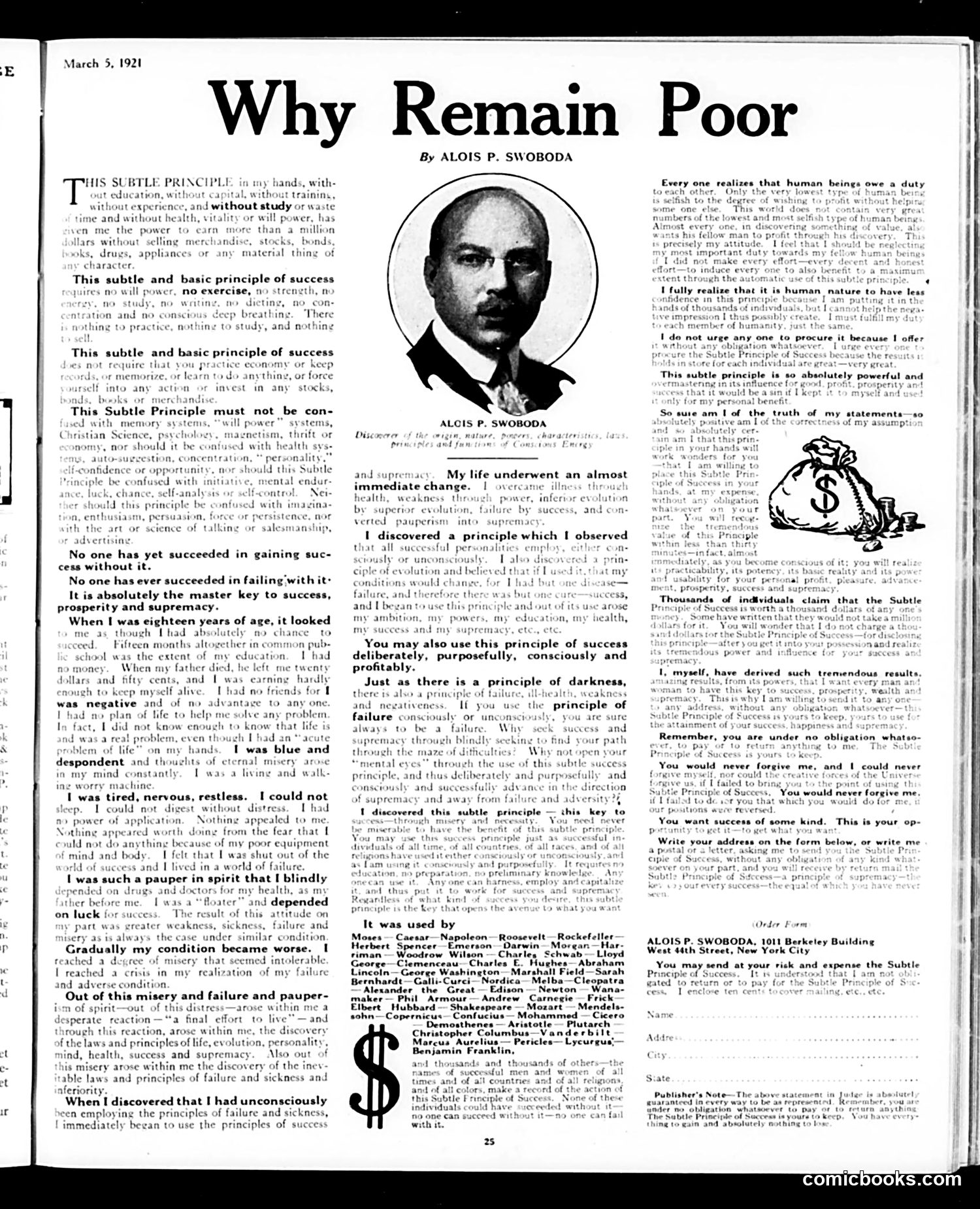
This page presents Alois P. Swoboda's self-help philosophy from 1921, not primarily a political cartoon. The image shows Swoboda himself promoting his "Subtle Principle of Success"—a vague, universalist claim that success requires only willpower and proper mental attitude, needing no study, capital, or special effort. The text is Swoboda's autobiographical pitch: he claims poverty and illness led him to discover this principle, which supposedly transformed his life. He lists famous figures (Roosevelt, Napoleon, Rockefeller) as users, though provides no evidence. The satire—if intentional—lies in the grandiose vagueness: a self-made motivational speaker selling an undefined "principle" that requires buying his materials. The money-bag illustration reinforces the irony: Swoboda becomes wealthy promoting success secrets while claiming to offer them freely. This typifies early 20th-century "new thought" self-help marketing that exploited Depression-era desperation with feel-good platitudes.
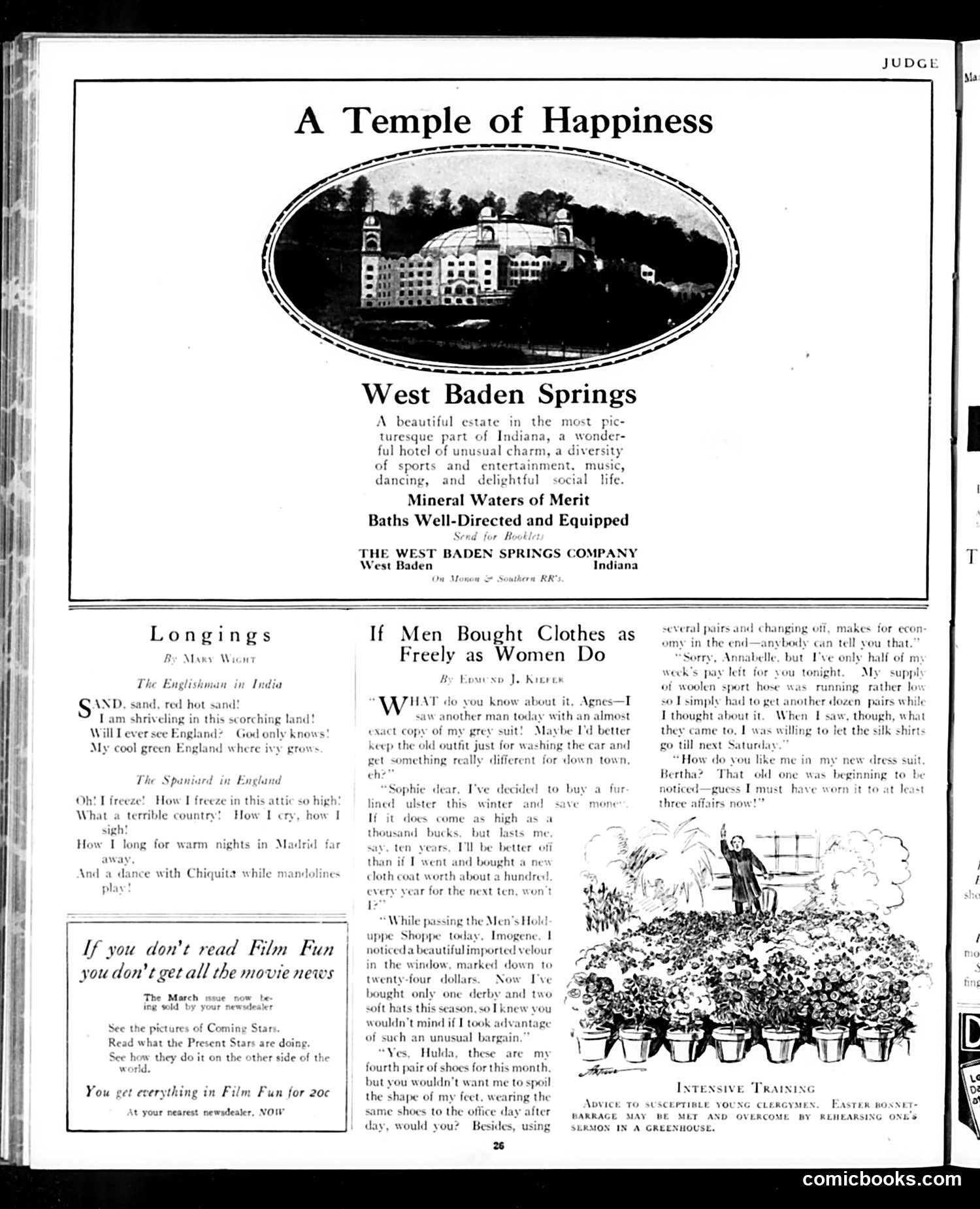
This page contains two main elements: a resort advertisement and a satirical article about gender differences in consumer spending. **The Advertisement** (top) promotes West Baden Springs, an Indiana resort with mineral baths and entertainment—typical leisure advertising of the era. **The Main Satire** ("If Men Bought Clothes as Freely as Women Do") presents a conversation between women discussing their husbands' and boyfriends' clothing purchases. The joke targets the perceived double standard in 1920s gender norms: women are depicted as freely buying multiple items (shoes, hats, dresses) without guilt, while simultaneously criticizing men for similar behavior. The satire reveals the hypocrisy—women rationalize constant purchases with practical excuses ("different styles," "wear rotation"), yet their tone suggests they're unaware of their own excessive spending. The cartoon illustration (right) shows women examining clothes, reinforcing this consumption focus. The piece gently mocks both genders: women for their spending habits disguised as necessity, and the broader societal acceptance of female shopping versus male restraint—inverting typical expectations of the time.
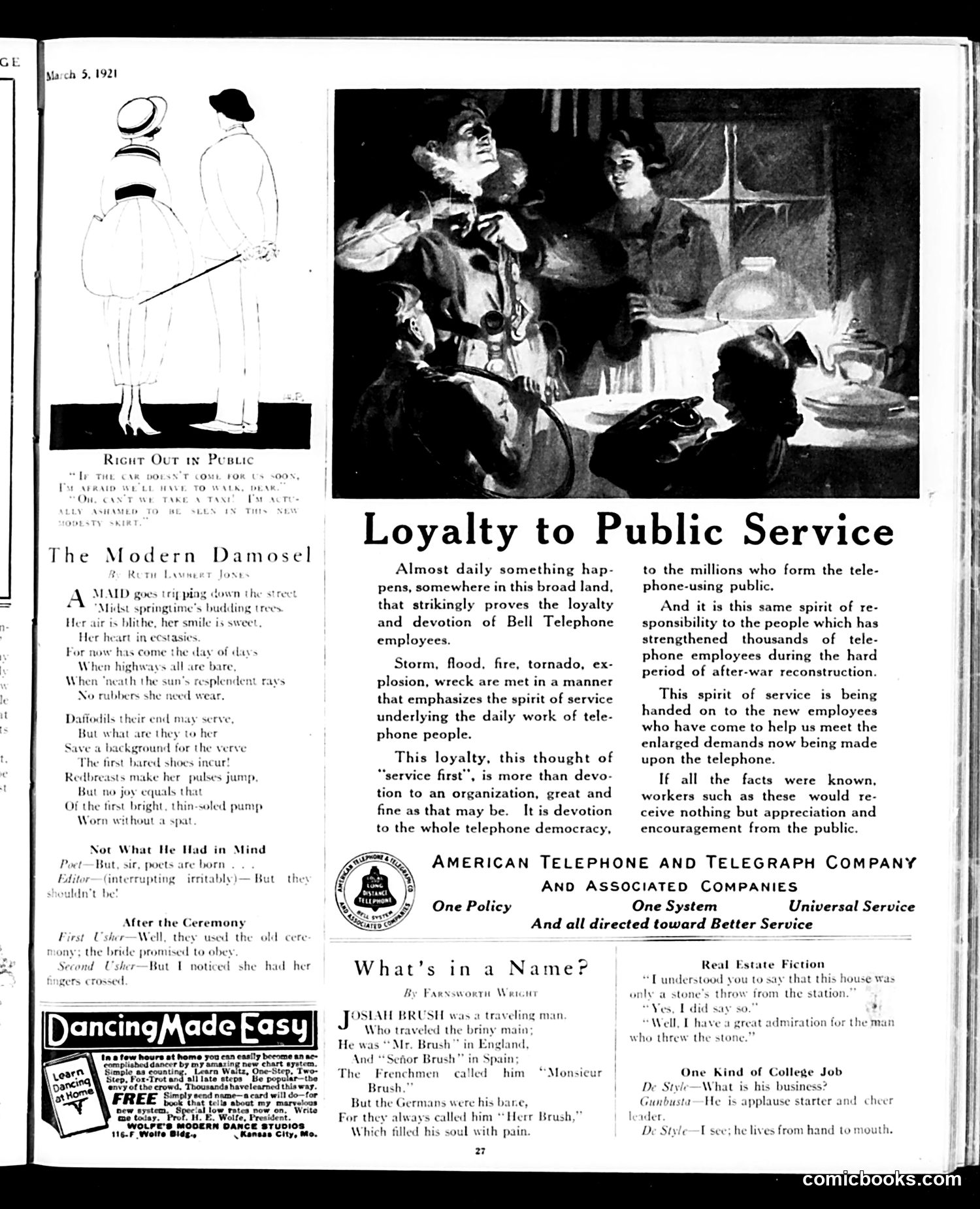
This page combines light social satire with corporate advertising. The top cartoons mock post-WWI social conventions: "The Modern Damsel" satirizes young women's newfound freedom—showing a flapper eager to display bare legs and ankles (scandalous for 1921); "Not What He Had in Mind" jokes about a bride crossing her fingers during marriage vows, suggesting reluctance despite outward compliance. The dominant content is an AT&T advertisement titled "Loyalty to Public Service," praising telephone employees' dedication during emergencies and post-war reconstruction. This appears designed to rebuild public confidence in the corporation. Lower sections include minor humor pieces: "What's in a Name?" plays on a traveling salesman named Brush encountering different linguistic versions of his name across countries; "Real Estate Fiction" mocks misleading property descriptions; "One Kind of College Job" briefly jokes about a paid applause-starter. The page reflects 1921's cultural anxieties about changing gender roles alongside corporate image-management through feel-good messaging about worker devotion.
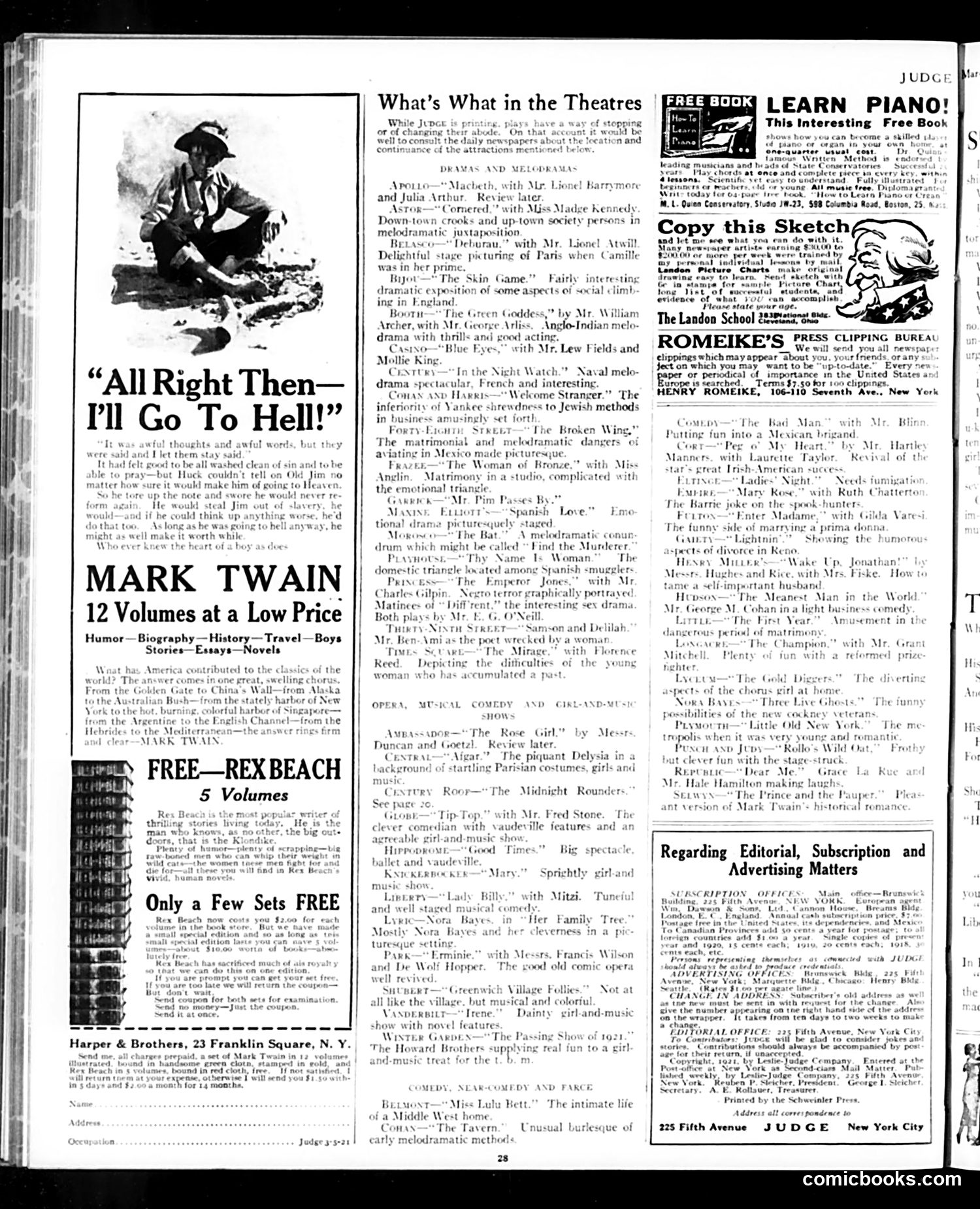
This page is primarily **advertising and theater listings**, not a political cartoon. The main content includes: **"All Right Then—I'll Go To Hell!"** appears to be a Mark Twain book advertisement, likely referencing one of his works or a humorous Twain quote repurposed for marketing. **Theater Reviews Section** ("What's What in the Theatres") lists contemporary Broadway productions with brief descriptions—dramas, melodramas, comedies, and operas playing in New York. These appear to be standard theatrical announcements of the era. **Notable advertisements** include: - Free piano lesson books - Press clipping services (Romeike's Bureau) - Sketch copying competitions - Various book offers from Harper & Brothers The page exemplifies a typical Judge magazine format: satire-focused publication filled with commercial advertisements and entertainment notices. Without a clear political cartoon visible or identifiable satirical content, this reads as a standard entertainment/advertising section rather than social commentary.
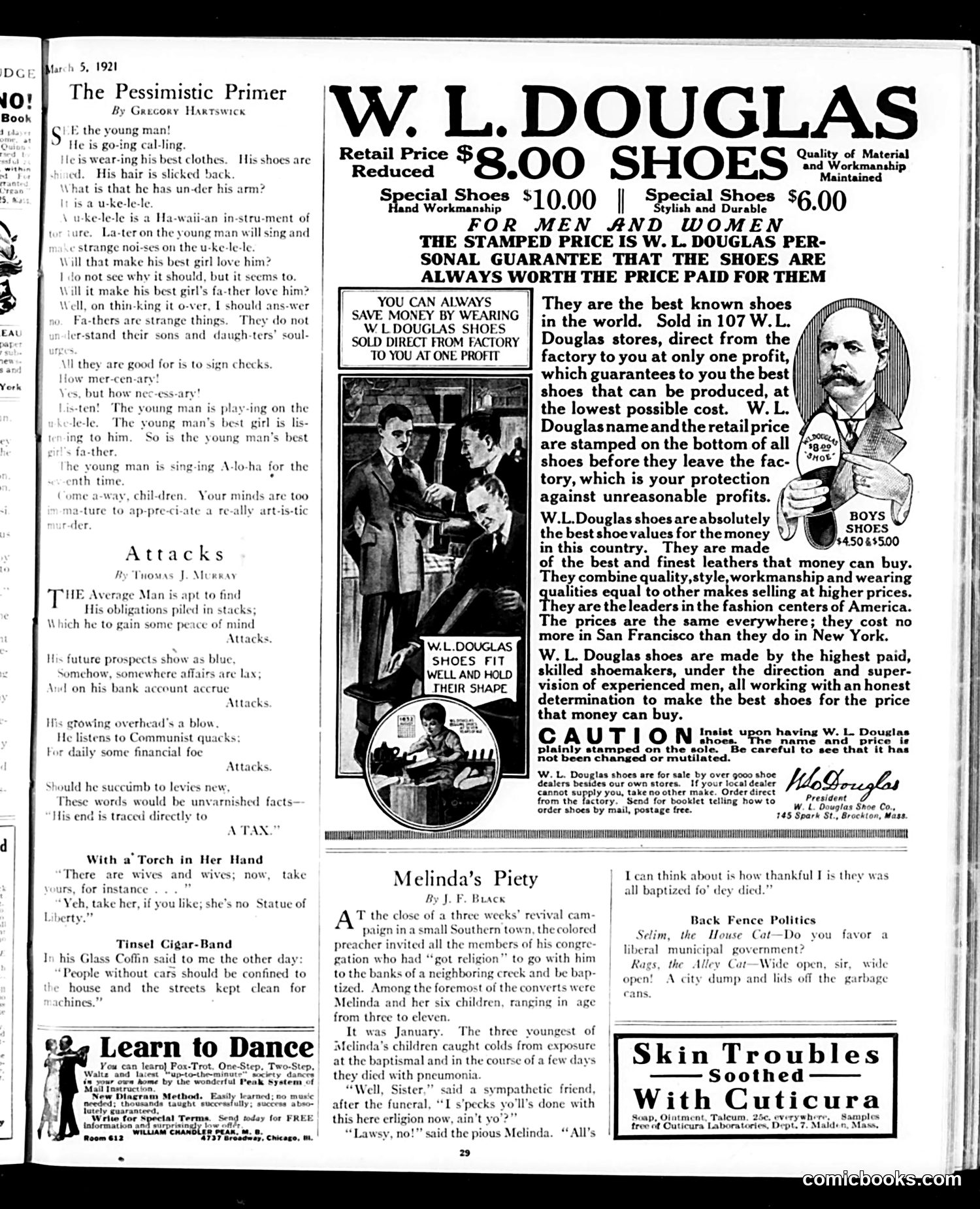
This page is primarily **advertising** rather than editorial satire. The dominant content is a W.L. Douglas shoes advertisement promising direct-factory pricing and guaranteed value. The smaller editorial content includes: **"The Pessimistic Primer"** — A satirical poem mocking young men of the era who play ukuleles to impress women. The joke: despite being well-dressed and musical, these men lack substance (fathers judge them by their ability to "sign checks"). This reflects post-WWI anxiety about youth materialism and superficiality. **"Attacks"** — A cynical poem listing modern financial hardships: mounting bills, poor prospects, inflation, and taxes. The repeated refrain captures the period's economic anxieties following WWI. **Minor pieces** ("With a Torch in Her Hand," "Tinsel Cigar-Band") contain brief social observations about wives and automobile culture. The page reflects 1921 concerns: economic instability, generational tension, and consumerism—wrapped in Judge's characteristic sardonic humor. The extensive shoe advertisement dominates the layout, typical of this magazine's commercial-editorial hybrid format.
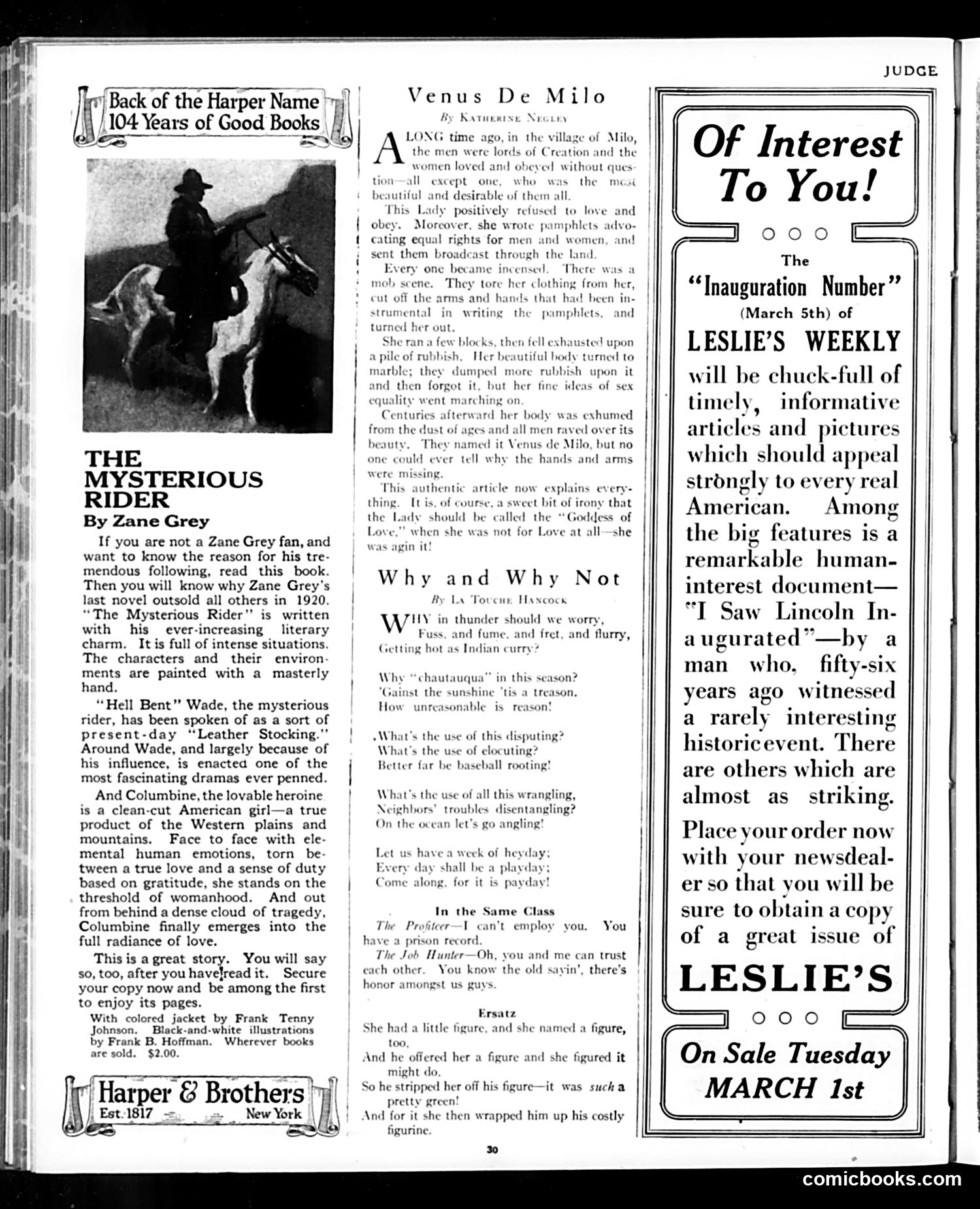
This page is primarily **advertising and literary promotion** rather than political satire. The main content includes: **Book Reviews:** "The Mysterious Rider" by Zane Grey and a short story titled "Venus De Milo" by Katherine Newlin Burt—a satirical piece explaining why the classical statue lacks arms. The story uses dark irony: a woman advocating for equal rights has her arms cut off by an angry mob, her body becomes marble and is later celebrated as beautiful, yet no one remembers *why* the limbs are missing. This is **feminist satire** criticizing how society ignores the violent suppression of women's rights advocacy while aestheticizing women's bodies. **Light Verse:** "Why and Why Not" contains whimsical poetry questioning everyday concerns. **The Profiteer Joke:** A brief satirical exchange mocking a job applicant with a prison record and the ironic "honor among thieves" philosophy. **Right Column:** An advertisement for Leslie's Weekly magazine's "Inauguration Number" (March 1st), featuring an article about Lincoln's inauguration witnessed fifty years prior.
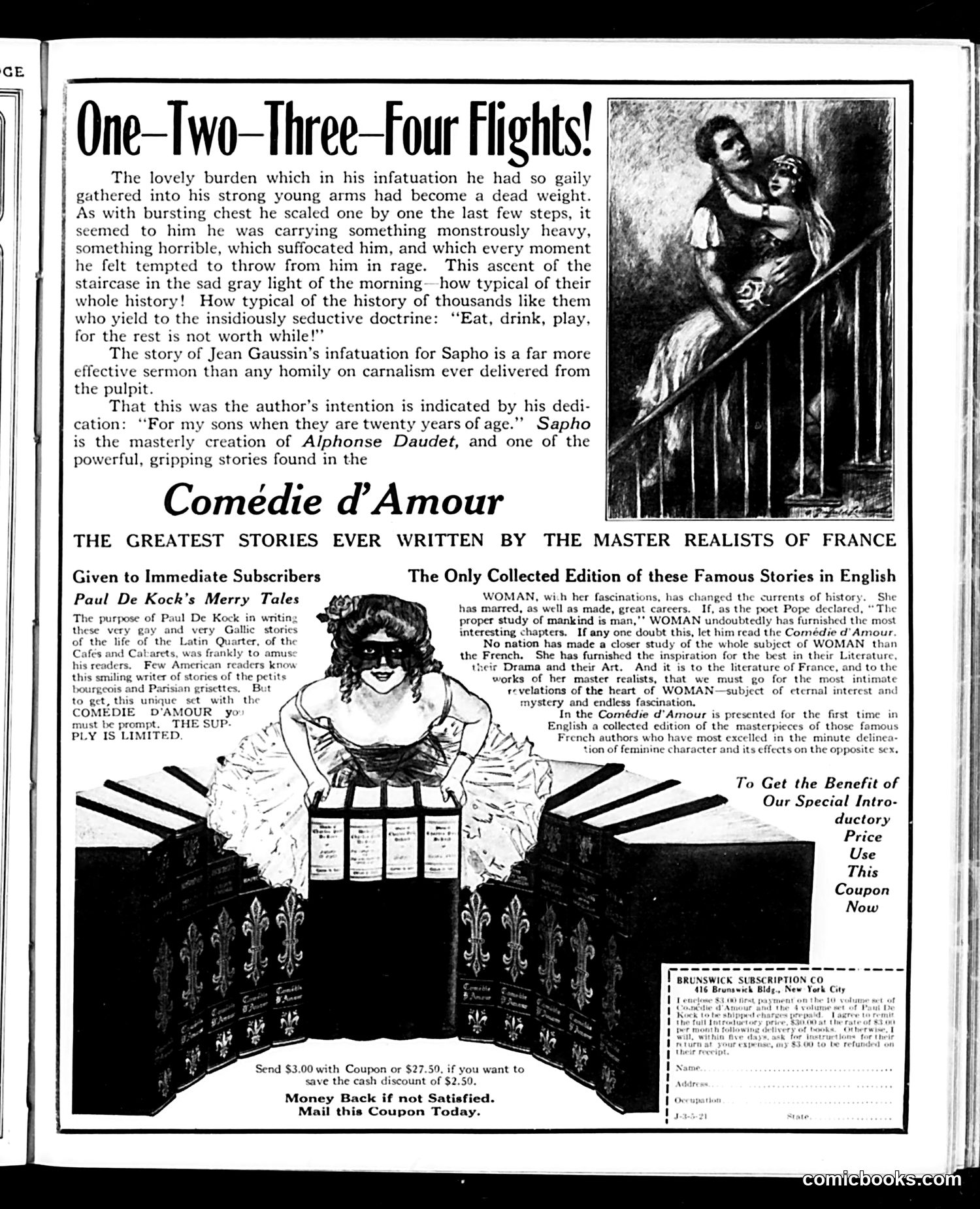
This page is primarily a **book advertisement** for a collected edition of French literature called *Comédie d'Amour*, presented as an upscale subscription offer. The satirical content is minimal—this appears to be a genuine literary promotion rather than political satire. The page promotes classic French realist works, particularly Alphonse Daudet's *Sapho* (illustrated in the photograph at top right showing a man carrying a woman up stairs). The lengthy text passage describes the moral lesson of *Sapho*—a cautionary tale about seduction and its consequences, framed as appropriate reading for young men. The advertisement emphasizes France's literary mastery of depicting women and romantic relationships, marketing these stories as sophisticated adult reading material. The inclusion of Paul De Kock's lighter comedies alongside weightier works suggests the collection spans from bawdy entertainment to serious moral instruction. This reflects early 20th-century American attitudes toward French literature as both culturally refined and morally suspect—simultaneously desirable and slightly scandalous.
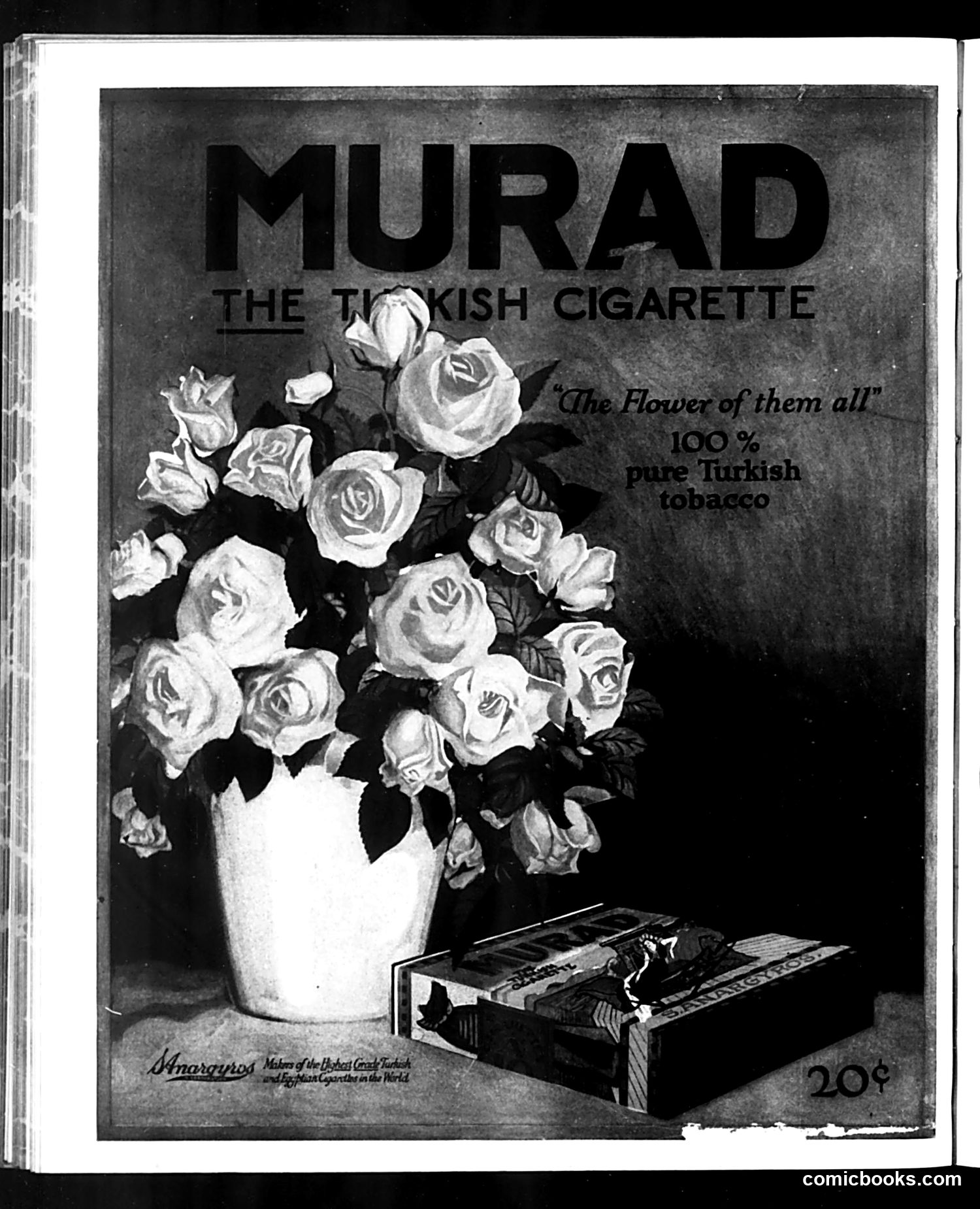
This is a commercial advertisement, not political satire. It promotes Murad brand Turkish cigarettes, marketed as "The Flower of them all" made from "100% pure Turkish tobacco." The ad uses a still-life composition—roses in a white vase beside an open cigarette package—to associate the product with elegance and natural beauty. The tagline "The Flower of them all" creates a visual pun linking flowers to the floral aesthetic. The 20¢ price point dates this to the early 20th century. The advertisement reflects period marketing strategies that emphasized luxury and purity, common in cigarette advertising before health warnings became standard. There is no political or satirical content—this appears in *Judge* magazine simply as a paid advertisement among editorial content.