
Judge, 1921-03-05 · page 13 of 32
Judge — March 5, 1921 — page 13: what you’re looking at
What you’re looking at
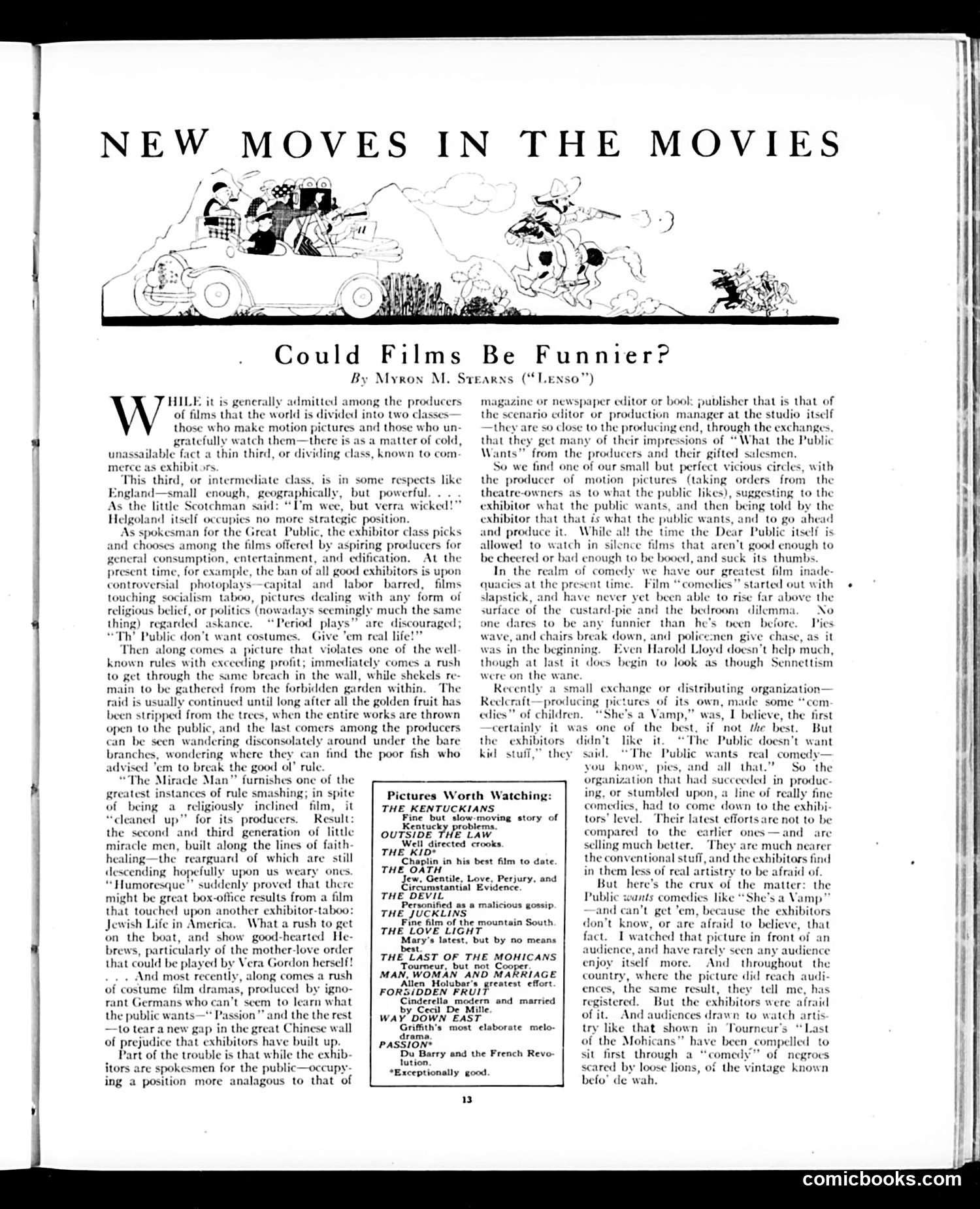
This article satirizes the film industry's structural problem: **exhibitors (theater owners) act as gatekeepers, claiming to represent "the Great Public," but they actually control what producers make.** The author, Myron M. Stearns, identifies a circular absurdity—producers ask exhibitors what audiences want; exhibitors tell producers what audiences want; then exhibitors claim they're merely giving the public what it desires. Meanwhile, the actual public sits passively consuming whatever results. Stearns illustrates his point with recent films that *broke* exhibitor "rules" (avoiding controversial topics, period pieces, etc.) yet succeeded commercially: *The Miracle Man* (religious content), *Humoresque* (Jewish themes), and *Passion* (German costume drama). These rule-breaking hits then spawned imitators, proving exhibitors' assumptions wrong. The satire's bite: the exhibitor class maintains power through claimed public knowledge they don't actually possess, stifling creativity while pretending to serve audience interests.
📄 Transcribed text from this page (OCR, searchable)
Machine-transcribed from the original scan — historical spelling and the odd misread are preserved.
of films that the world is divi Could Films Be Funnier? By Myron M. HILE it is generally admitted among the producers Jed into two classes those who make motion pictures and those who un- TEARY magazine or newspaper editor or be the scenario editor or production manager at the studio itself —they are so close to the producing end, through the exchanges, s (“Lenso”) |; publisher that is that of gratefully watch them—there is as a matter of cold, — that they get many of their impressions of “What the Public unassailable fact a thin third, or dividing class, known to com merce as exhibitors. This third, or intermediate class, is in some respects like aphically, but powerful... . , but verra wicked!” Helgoland itself occupies no more strategic position. As spokesman for the Great Public, the exhibitor class picks and chooses among the films offered by aspiring producers for England—small enough, geog As the little Scotchman said Wants” from the producers and their gifted salesmen. So we find one of our small but perfect vicious circles, with and produce it. the producer of motion pictures (taking orders from the theatre-owners as to what the public likes), suggesting to the exhibitor what the public wants, and then being told by the exhibitor that that is what the public wants, and to gi While al! the time the Dear Public itself is allowed to watch in silence films that aren't good enough to ahead general consumption, entertainment, and edification. At the be cheered or bad enough to be booed, and suck its thumbs. present time, for example, the ban of all good exhibitors is upon controversial photoplays—capital and labor alism taboo, pictures dealing with any form of ays scemingly much the same are disco “ Th’ Public don’t want costumes. Give ’em real life Then along comes a picture that violates one of the well known rules with exceeding profit; immediately comes a rush — though at last it does begin to look to get through the same breach in the wall, while shekels re- to be gathered from the forbidden garden within. The raid is usually continued until long after all the golden fruit has — Reeleraft—producing pic been stripped from the trees, when the entire works are thrown touching soci religious belief, or politics (nowa thing) regarded askance. “Period plays main way open to the public, and the last comers among the producers certainly it can be seen wandering disconsolately around under the bare — the exh' branches, wondering where they can find the poor fish who — kid stuff,” they ed "em to break the good ol’ rule. The Miracle Man” furnishes one of the greatest instances of rule smashing; in spite of being a religiously inclined film, it “cleaned up” for its producers. Result: the second and third generation of little miracle men, built along the lines of faith healing—the rearguard of which are still descending hopefully upon us weary ones “Humoresque’’ suddenly proved that there might be great box-office results from a film that touched upon another exhibitor-taboo: Jewish Life in America. What a rush to get on the boat, and show good-hearted He- brews, particularly of the mother-love order that could be played by Vera Gordon herself! . And most recently, along comes a rush of costume film dramas, produced by igno- rant Germans who can’t seem to learn what the public wants—“ Passion” and the the rest —to tear a new gap in the great Chinese wall of prejudice that exhibitors have built up. Part of the trouble is that while the exhib: itors are spokesmen for the public—occupy- ing a position more analagous to that of advi Pictures Worth Watching: THE _KENTUCKIANS Fine but slow-moving story of Kentucky problems. OUTSIDE THE LAW Well directed crooks. THE_KID* Chaplin in THE OATH Jew, Gentile, Love, Perjury, and Circumstantial Evidence THE DEVIL Personified as a malicious gossip THE_JUCKLINS Fine film of the mountain South. THE LOVE LIGHT Mary's latest, but by no means best. THE_LAST OF THE MOHICANS Tourneur, but not Cooper MAN, WOMAN AND MARRIAGE Allen Holubar's greatest effort FORSIDDEN FRUIT Cinderella modern and married by Cecil De Mille. WAY DOWN EAST Griffith's. most elaborate melo- drama. PASSION* Du Barry and the French Revo- lution. *Exceptionally good. is best film to date 13 were on the wane. Recently a small exchange or distributing organization- bitors In the realm of comedy we have our greatest film inade barred, films — quacies at the present time. Film slapstick, and have never yet been able to rise far above the surface of the custard-pie and the bedroom dilemma. No di; me dares to be any funnier than he’s been before. und chairs break down, and_ pol. was in the beginning. E: comedies” started out with Ties nen give chase, as it en Harold Lloyd doesn’t help much, s though Sennettism ures of its own, made some “com edies” of children. “She's a Vamp,” was, I believe, the first was one of the best, if not the best. But didn’t like it. “The Public doesn’t want said, “The Public wants real comedy— you knew, pies, and all that.” So the organization that had succeeded in produc ing, or stumbled upon, a line of really fine comedies, had to come down to the exhibi- tors’ level. Their latest efforts are not to be compared to the earlier ones —and selling much better. They are much nearer the conventional stuff, and the exhibitors find in them less of real artistry to be afraid of But here's the crux of the matter: the Public wants comedies like “She's a Vamp” —and can’t get ‘em, because the exhibitors don’t know, or are afraid to believe, that fact. I watched that picture in front of an audience, and have rarely seen any audience enjoy itself more. And throughout the country, where the picture did reach audi ences, the same result, they tell me, has registered. But the exhibitors were afraid of it. And audiences drawn to watch artis try like that shown in Tourncur’s “Last of the Mohicans” have been compelled to sit first through a “comedy” of negroes scared by loose lions, of the vintage known befo’ de wah. ee oe comicbooks.com