
Judge, 1921-03-05 · page 17 of 32
Judge — March 5, 1921 — page 17: what you’re looking at
What you’re looking at
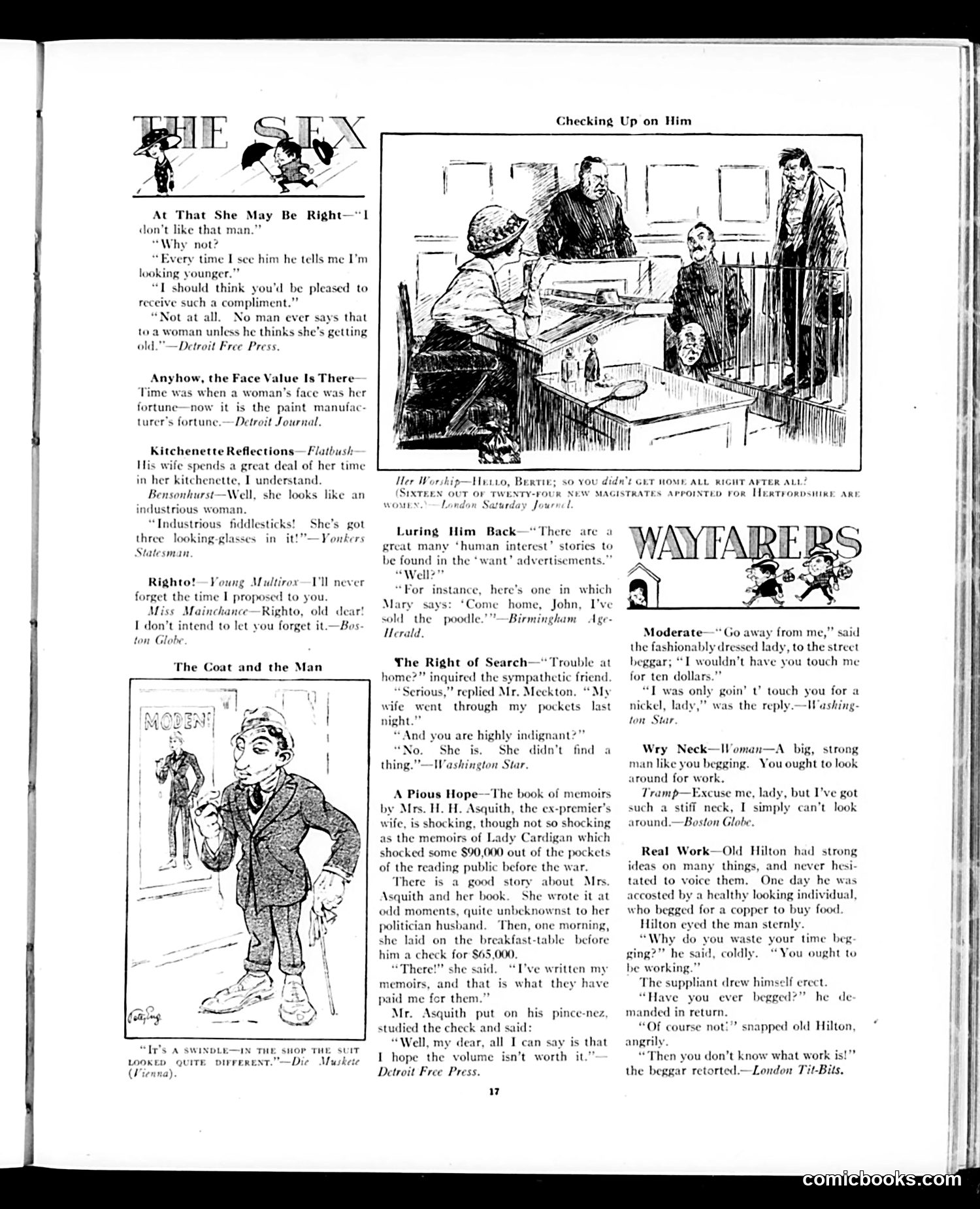
This page contains satirical humor pieces typical of early 20th-century American magazines, focusing on gender relations and social commentary. **Main Content:** The pieces mock contemporary attitudes toward women and courtship. "At That She May Be Right" satirizes insincere male flattery—men tell women they look "younger" not as genuine compliments but as backhanded admissions of aging. "Kitchenette Reflections" ridicules a woman obsessed with mirrors in her tiny apartment, equating domesticity with vanity. **Notable References:** "A Pious Hope" references H.H. Asquith's wife publishing profitable memoirs ($65,000), with Asquith dismissively hoping the volume "isn't worth it"—mocking both women's literary ambitions and spousal tensions over finances. The cartoon "Checking Up on Him" depicts a domestic scene of surveillance, likely about wives monitoring husbands' activities. **Overall Tone:** The page reflects early-1900s attitudes: women are vain, deceptive, and preoccupied with appearance; men are reluctant to acknowledge aging or female financial independence. The humor assumes reader agreement with these stereotypes.
📄 Transcribed text from this page (OCR, searchable)
Machine-transcribed from the original scan — historical spelling and the odd misread are preserved.
> At That She May Be Right—"1 don’t like that man.” “Why not? avery time I sce him he tells me I'm looking younger.” “I should think you'd be pleased to receive such a compliment.” Not at all. No man ever says that woman unless he thinks she’s getting old.”’—Detroit Free Press Anyhow, the Face Value Is There Time was when a woman’s face was her fortune—now it is the paint manufac- turer's fortune.— Detroit Journal. Kitchenette Reflections— Flatbush His wife spends a great deal of her time in her kitchenette, I understand. Bensonhurst—Well, she looks like an industrious woman. “Industrious fiddlesticks! She's got three looking-glasses in it!”"—Yonkers Statesman Righto!— Young Multirox Vl never forget the time I proposed to you. Miss Mainchance—Righto, old dear! I don’t intend to let you forget it.—Bos- ton Globe The Coat and the Man It’s A SWINDLE—IN THE sHOP THE SUIT Lookep QuITE pirrereNt.”—Die Mu (Vienna) VA cca Her Worsk Checking Up on Him SIXTEEN OUT OF TWENTY-FOUR NEW MAGISTRATES APPOINTED FOR HerTPORDSIIKE ARE Luring Him Back—*There are a great many ‘human interest’ stories to be found in the ‘want’ advertisements.” “Well?” “For instance, here’s one in which Mary says: ‘Come home, John, I’ve sold’ the poodle.’"—Birmingham Age- Herald. The Right of Search—* Trouble at home?” inquired the sympathetic friend “Serious,” replied Mr. Meckton. “My wife went through my pockets last night.” “And you are highly indignant?” “No. She is. She didn’t find a thing.” —Washington Star, A Pious Hope—The book of memoirs by Mrs. H. H. Asquith, the ex-premier’s wife, is shocking, though not so shocking as the memoirs of Lady Cardigan which shocked some $90,000 out of the pockets of the reading public before the war. There is a good story about Mrs. Asquith and her book. She wrote it at odd moments, quite unbeknownst to her politician husband. Then, one morning, she laid on the breakfast-table before him a check for $65,000. “There!” she said. “I’ve written my memoirs, and that is what they have paid me fer them.” Mr. Asquith put on his pince-nez studied the check and said: “Well, my dear, all I can say is I hope the volume isn’t worth it,” Detroit Free Press. at Ww Moderate—* Go away from me,” said the fashionably dressed lady, to the strect beggar; “I wouldn’t have you touch me for ten dollars.” “T was only goin’ U touch you for a nickel, lady,” was the reply.—Washing- ton Star Wry Neck—IVoman—A big, strong man like you begging. You ought to look around for work. Tramp—Excuse me, lady, but I’ve got such a stiff neck, I simply can’t look around.—Boston Globe. Real Work—Old Hilton had strong ideas on many’ things, and never hesi- tated to voice them. One day he was accosted by a healthy looking individual, who begged for a copper to buy food Hilton eyed the man sternly. “Why do you waste your time beg ging?” he said, coldly. “You ought to be working.” ‘The suppliant drew himself erect. “Have you ever begged?” he de manded in return. “OF course not! angrily. “Then you don’t know what work i: the beggar retorted.—London Tit-Bits. snapped old Hilton,