
A complete issue · 32 pages · 1921
Judge — January 22, 1921
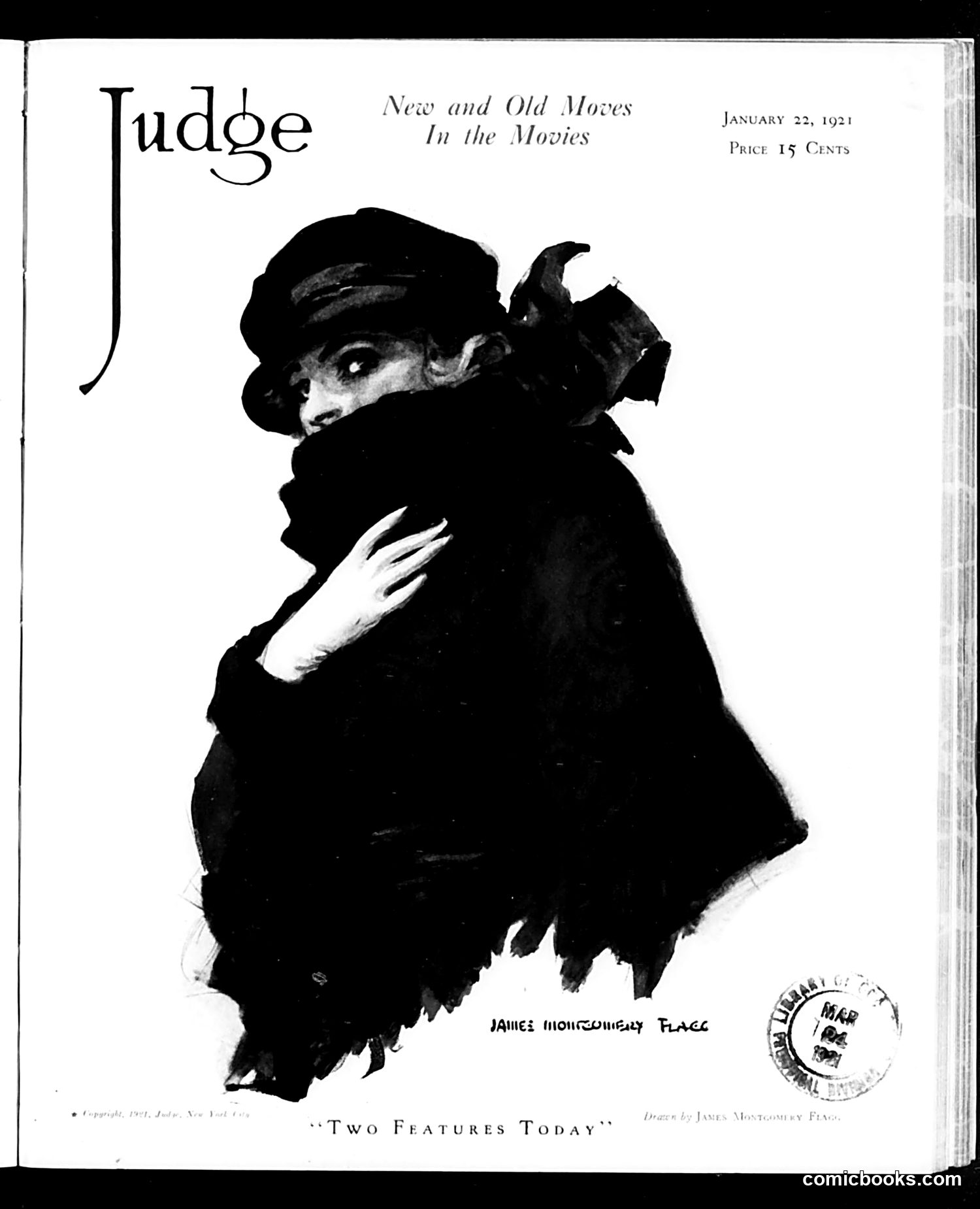
This cover advertises "Two Features Today" and appears to be a movie review section titled "New and Old Moves in the Movies." The illustration shows a figure in dark winter clothing (heavy coat, hat, scarf) drawn by James Montgomery Flagg, a prominent illustrator of the era. The caption credits "James Montgomery Flagg," suggesting this is either reviewing a film featuring Flagg or promoting his work. The stylized silhouette and theatrical pose suggest this relates to silent film entertainment of the period. Without additional context, the specific film or actor being referenced remains unclear, though the dramatic presentation indicates this was notable enough for Judge's cover feature.
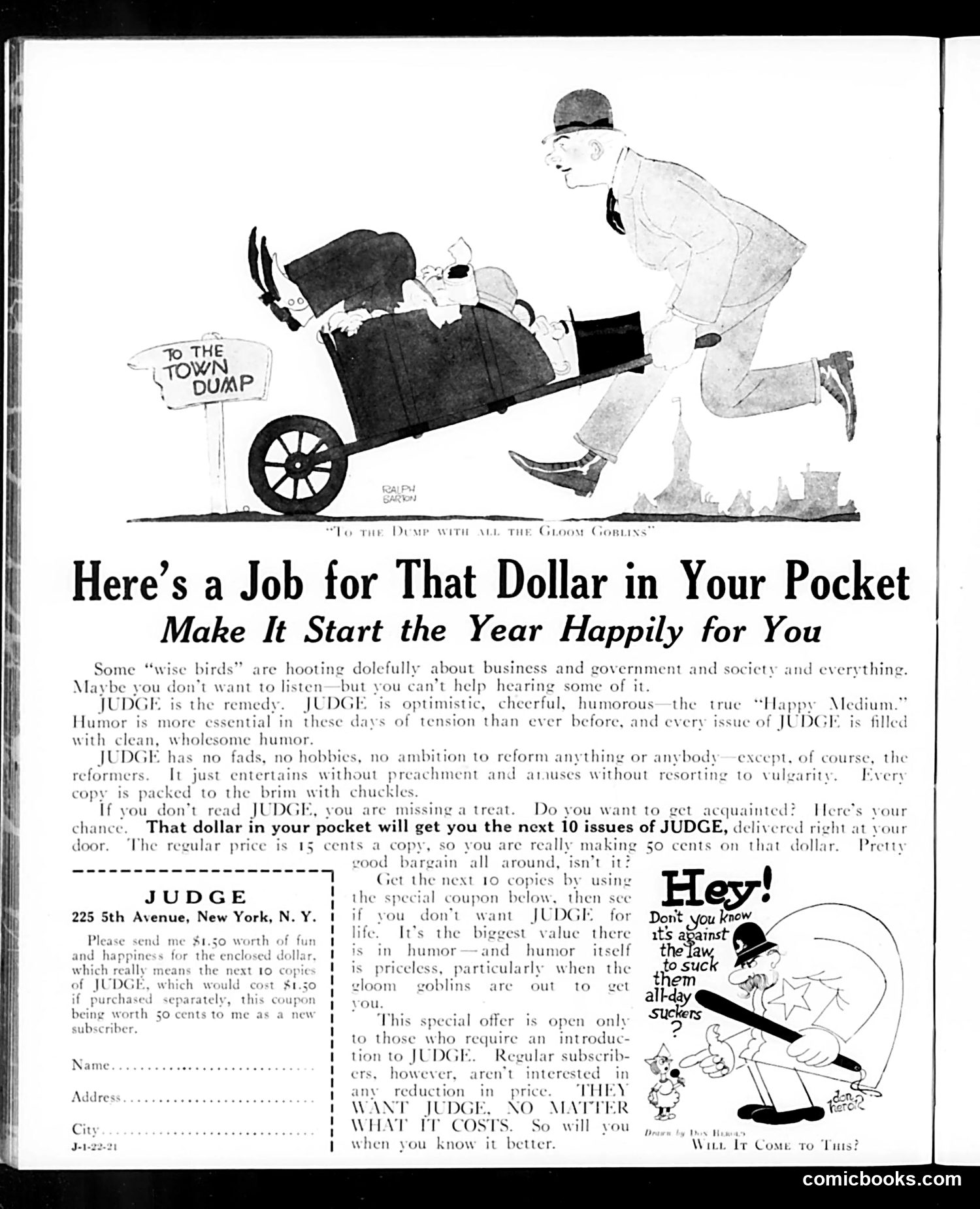
This page is primarily **advertising for Judge magazine itself**, not political satire. The main cartoon shows a man frantically wheeling a cartload labeled "To the Dump" with the caption "To the Dump with All the Gloom Goblins." This illustrates Judge's sales pitch: the magazine promises humor and cheerfulness to counteract societal pessimism and tension. The accompanying text emphasizes Judge's appeal as "optimistic, cheerful, humorous—the true 'Happy Medium.'" It's positioned as antidote to "wise birds" complaining about business, government, and society. The offer: $1 gets 10 copies of Judge (normally 15 cents each), allowing readers to introduce others to the magazine. A secondary cartoon on the right promotes Judge's anti-establishment humor, showing figures labeled "Stickers." This is fundamentally a **subscription recruitment advertisement**, not political commentary.
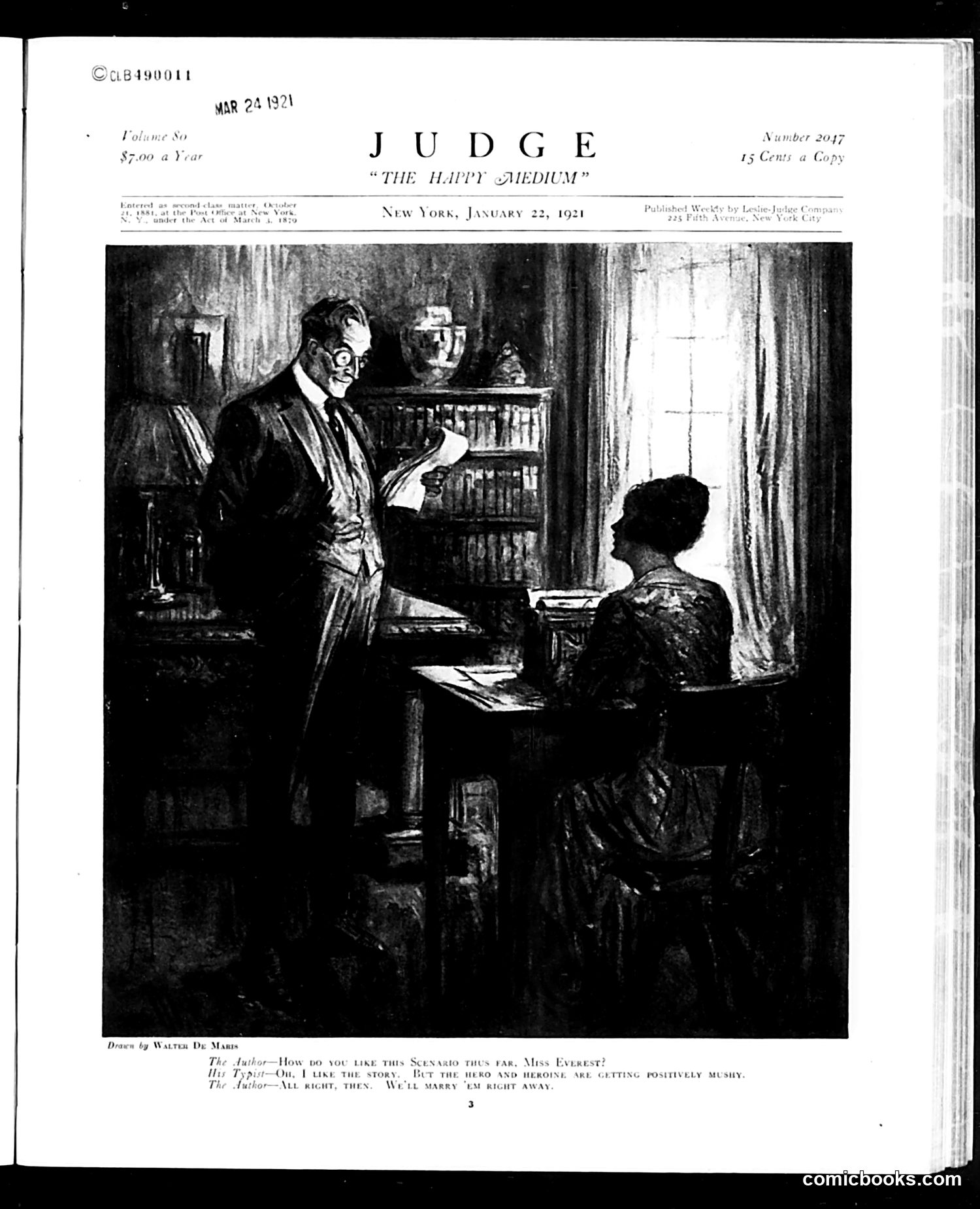
This illustration by Walter de Maris depicts a domestic scene with satirical dialogue. A bespectacled man in a suit addresses a woman seated at a desk. The conversation concerns a story about a hero and heroine "getting positively mushy"—the man approves of the narrative but objects to the sentimental tone. The woman (likely representing editorial judgment or a reader) counters that they'll "marry 'em right away," suggesting she wants to resolve the romance quickly rather than dwell on sentimentality. The satire targets popular fiction's treatment of romance—mocking both excessive sentimentality and the rushed resolution typical of pulp stories. This reflects 1920s cultural debates about literary taste and changing attitudes toward romance in modern fiction.
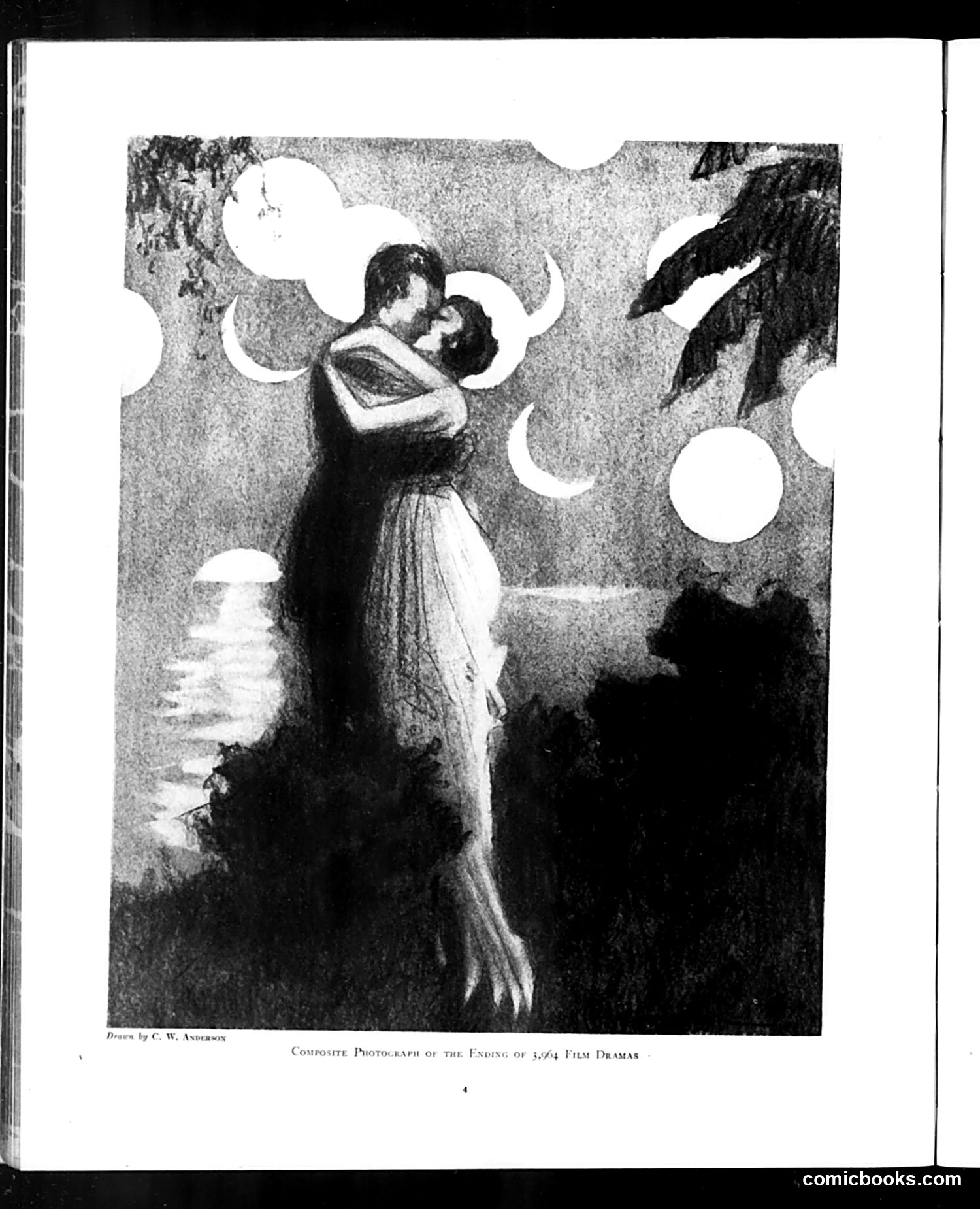
This page appears to be from *Judge* magazine and features a "Composite Photograph of the Ending of 1904 Film Dramas," drawn by C.W. Anderson. The image shows a romantic couple embracing beneath a night sky with moons and foliage. The composite photograph technique references the artistic photo-montage methods popular in early 1900s illustrated magazines. The satire likely mocks the predictable, formulaic endings of early cinema—specifically that 1904 film dramas invariably concluded with romantic embraces under moonlight. By presenting this as a "composite" of multiple film endings, *Judge* satirizes how standardized and repetitive these sentimental conclusions had become, suggesting filmmakers lacked originality and simply recycled the same romantic finale regardless of plot.
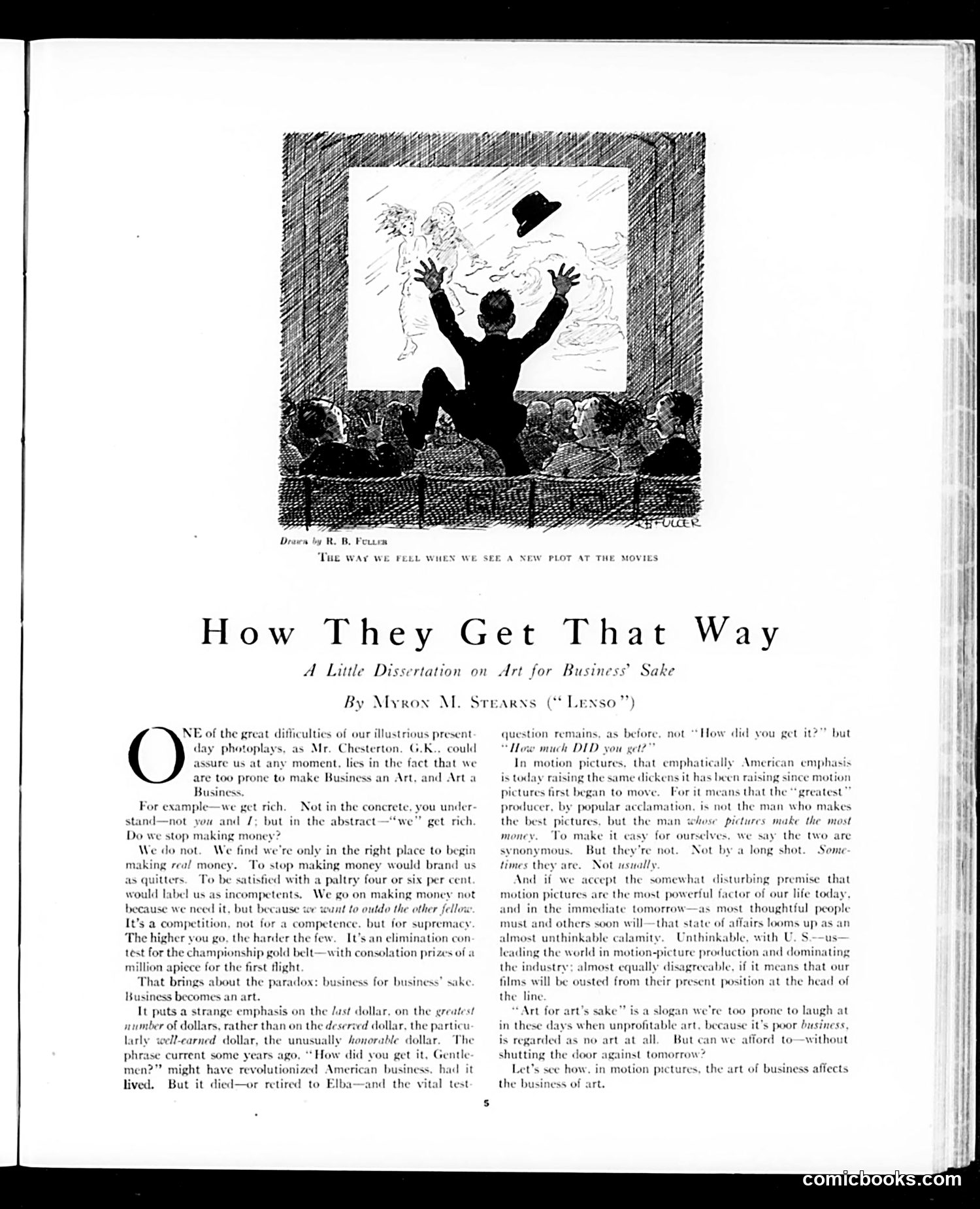
The illustration shows a silhouetted man at a movie theater, arms raised excitedly, watching a silent film. The caption reads: "The way we feel when we see a new plot at the movies." The accompanying article by Myron M. Stearns ("Lenso") satirizes the film industry's commercialism versus artistic merit. Stearns argues that motion pictures prioritize profit ("the *last* dollar") over genuine artistry, using colorful language like "self-earned dollar" and "honorable dollar." The satire's point: American film producers chase money rather than create meaningful art, yet the public enthusiastically consumes whatever plot they're served—hence the exaggerated excitement in the cartoon despite the industry's artistic bankruptcy. The piece critiques both Hollywood's mercenary values and audiences' uncritical consumption of entertainment.
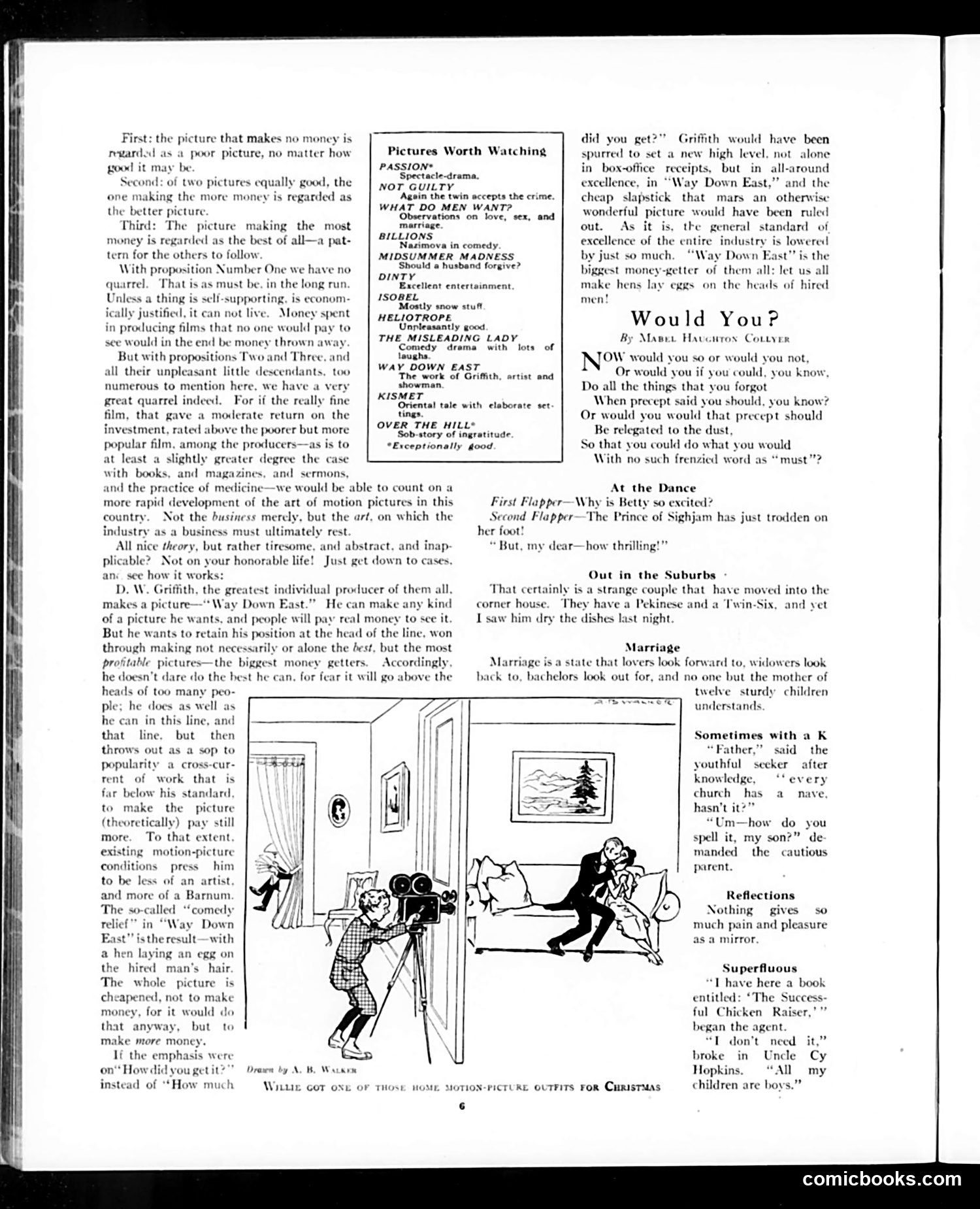
This page contains editorial content and humor pieces rather than political cartoons. The main illustration shows a domestic scene where a man lounges on a sofa while a woman operates a film camera, captioned as "Willie got one of those home motion-picture outfits for Christmas." The satire targets the early home movie trend—the humor lies in the absurd reversal of roles: the husband passively poses while the wife actively films, subverting traditional gender expectations of the era. The caption's dry tone emphasizes how this novelty Christmas gift disrupts domestic normalcy. The surrounding text discusses film industry economics and includes various short humorous pieces, reflecting Judge's general satirical approach to contemporary life and social customs rather than focused political commentary.
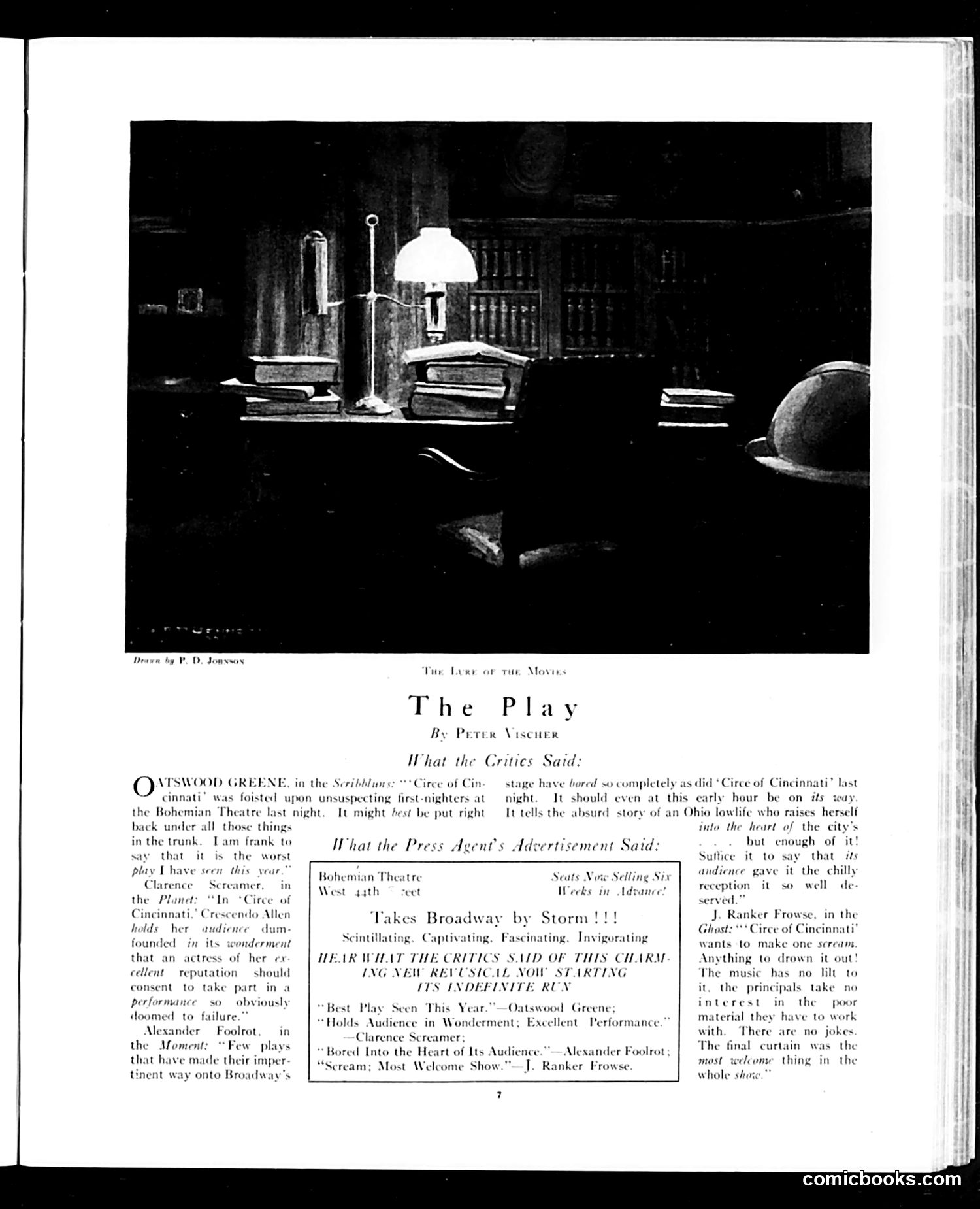
This page satirizes the disconnect between theater critics and Broadway press agents. The play "Circe of Cincinnati" is universally panned by actual critics (Oatswood Greene calls it "the worst play I have seen this year"), yet the press agent's advertisement shamelessly quotes those *same critics* as offering praise—presenting "Bored Into the Heart of Its Audience" and negative reviews as glowing testimonials. The satire exposes how press releases manipulate language: a critic's damning assessment becomes promotional copy through selective quotation and spin. The stark contrast between honest critical assessment (the show is tedious, poorly performed, tuneless) and fraudulent advertising highlights the cynicism of early 20th-century theater marketing and media manipulation—a practice that persists today but is now more recognizable to audiences.
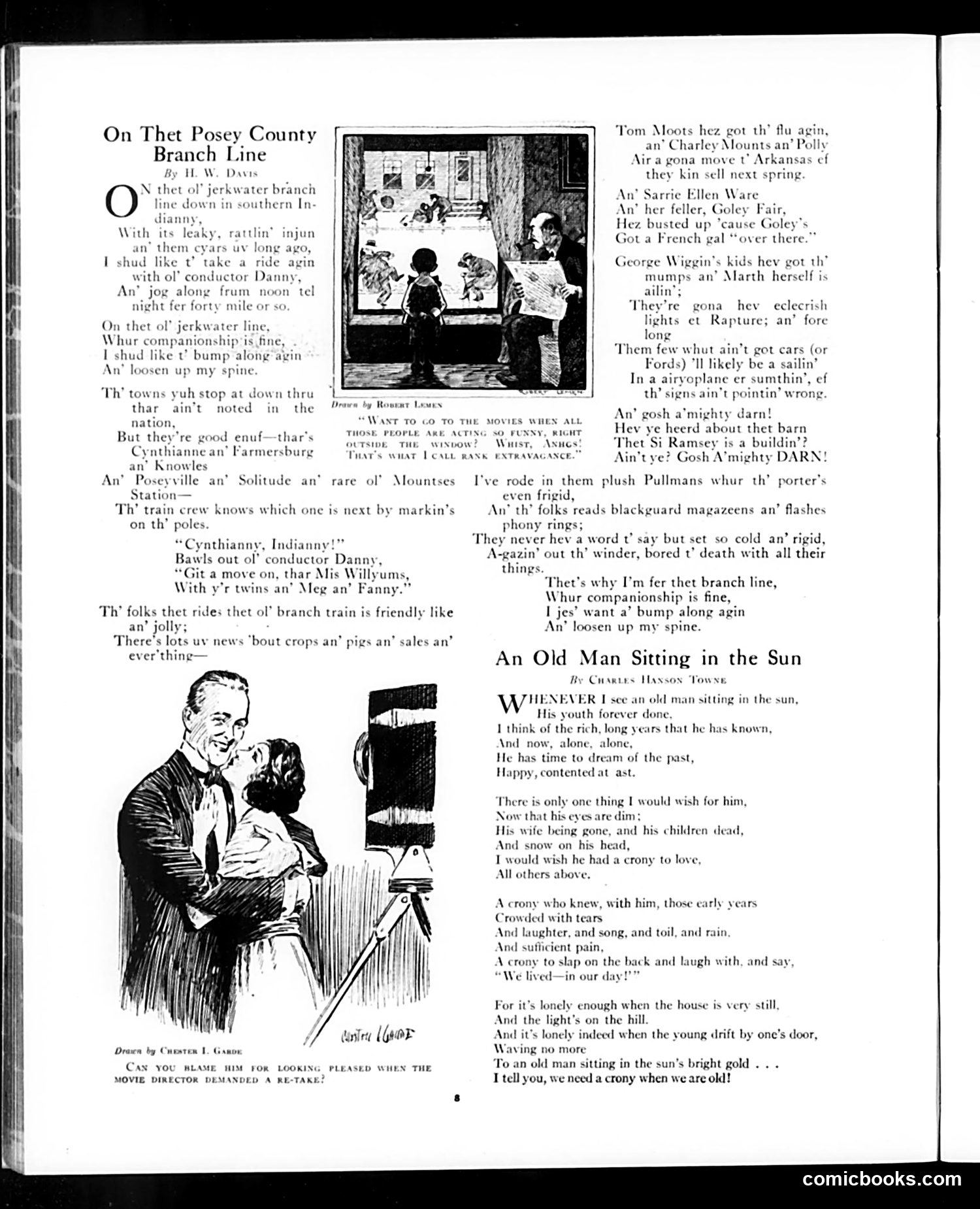
This page contains two nostalgic rural pieces—a poem celebrating small-town branch-line train travel and another on aging. The main cartoon (by H.W. Davis) humorously contrasts the "jerkwater" branch line in southern Indiana—serving tiny towns like Cynthianne and Poseyville—with modern luxury travel. The poet misses the friendly, gossipy atmosphere of the old train and its conductor Danny, where passengers discuss local crops, romances, and barn-building. A sidebar cartoon (by Chetsen I. Ganoe) satirizes movie-making excess: a director demands a re-take despite an actor's obvious exhaustion holding a baby—commenting on Hollywood's extravagance versus ordinary people's simpler concerns. The accompanying poem by Charles Hanson Towne sentimentally mourns an elderly man's isolation, wishing he had a companion from his youth to reminisce with. Together, these pieces romanticize pre-modern, pre-Hollywood simplicity and community while lamenting progress's loneliness.
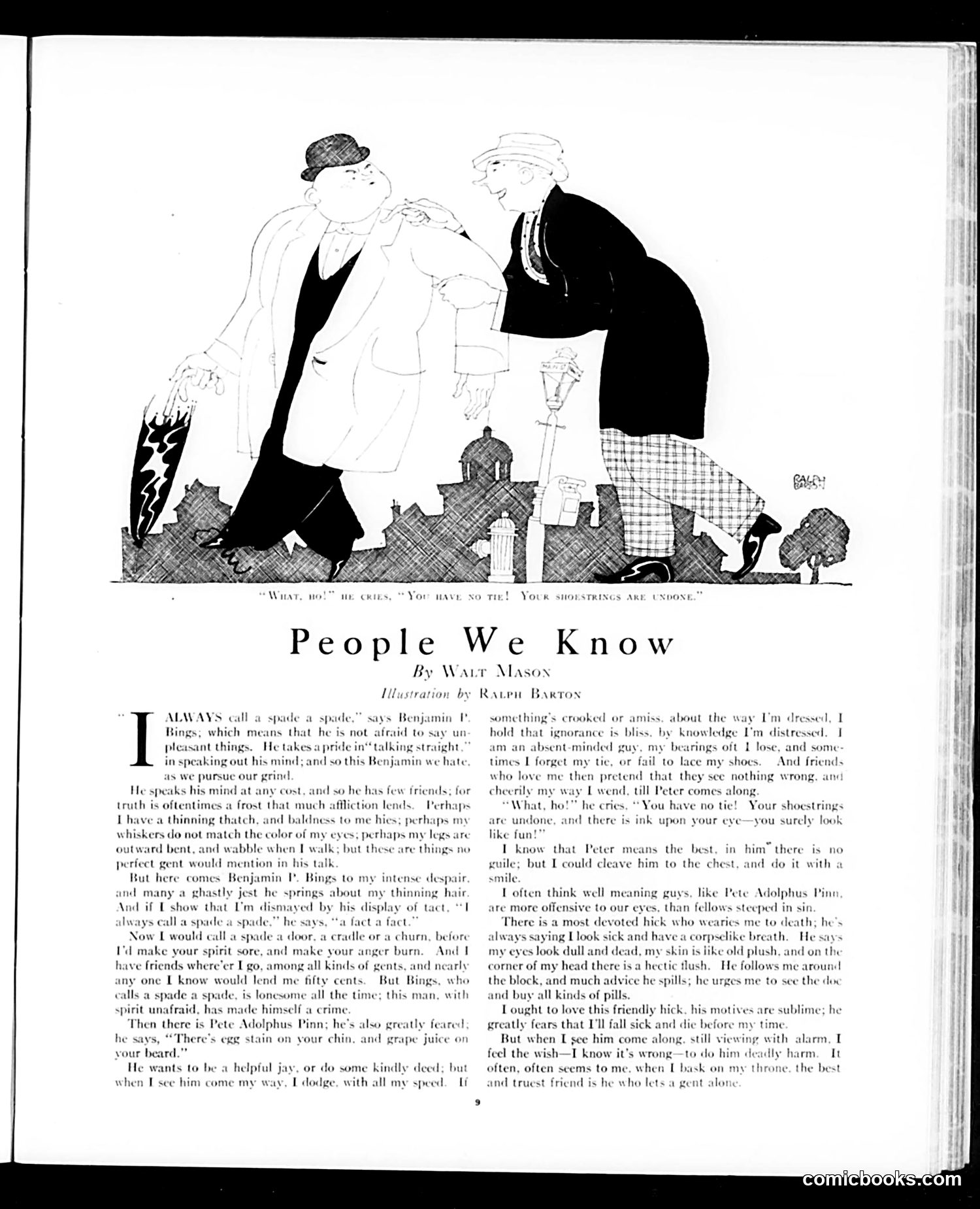
This is a humorous essay by Walt Mason (illustrated by Ralph Barton) satirizing three types of socially irritating men defined by their different failures of tact. **Benjamin P. Bings** represents the brutally honest man who "always calls a spade a spade"—he relentlessly points out others' physical flaws (thinning hair, shabby appearance) under the guise of truthfulness. The author argues that Bings has made "a crime" of his unsympathetic candor. **Pete Adolphus Pinn** is the well-meaning busybody who constantly points out the narrator's dishevelment (missing tie, ink on his eye) while claiming to help. The author finds such "helpful" criticism more offensive than actual vice. **The unnamed "hick"** is the hypochondriac friend who constantly warns the narrator he looks deathly ill, offering unwanted medical advice. The satire's point: tactless honesty, unsolicited concern, and intrusive "help" are more annoying than actual character flaws. True friendship means leaving people alone.
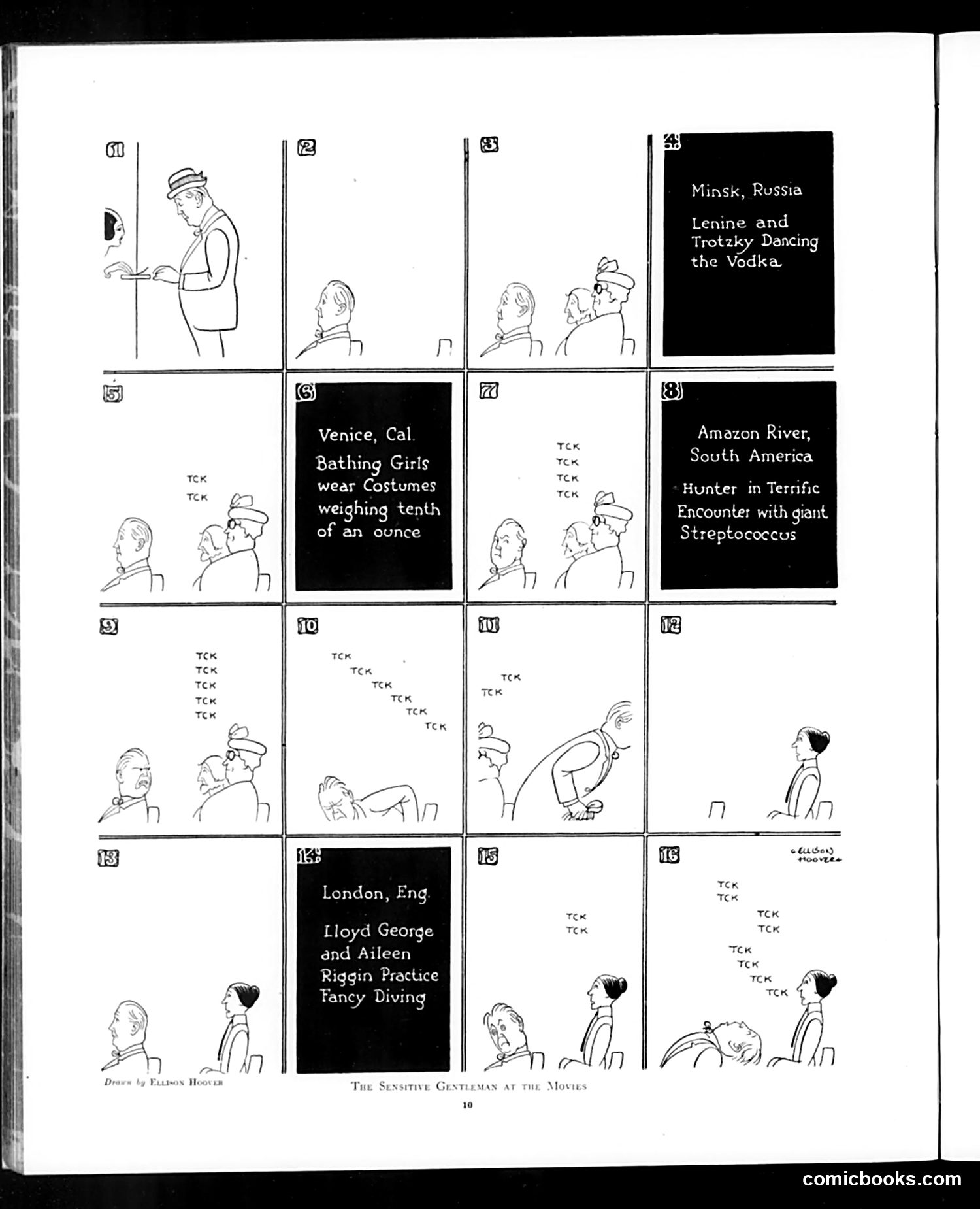
This is a sequential comic strip satirizing a prudish moviegoer reacting to newsreel footage of different world events. The man (likely representing Victorian sensibilities) becomes increasingly distressed by what he witnesses: 1. **Lenin and Trotsky dancing** in Soviet Russia 2. **Scantily-clad Venice bathing girls** in California 3. **Lloyd George and Aileen Riggin diving** in London (Riggin was a famous American Olympic swimmer) 4. **An Amazon hunter encountering a giant bacterium** The repeated "TCK" sound effects indicate his shocked tutting/disapproval. The joke satirizes how certain Americans viewed both Communist Russia and modern leisure activities (women in swimwear, diving) as equally scandalous and un-genteel. The absurd inclusion of the bacterium encounter suggests the comedian's exasperation with such prudishness—even a preposterous scientific scenario gets the same disapproving reaction.
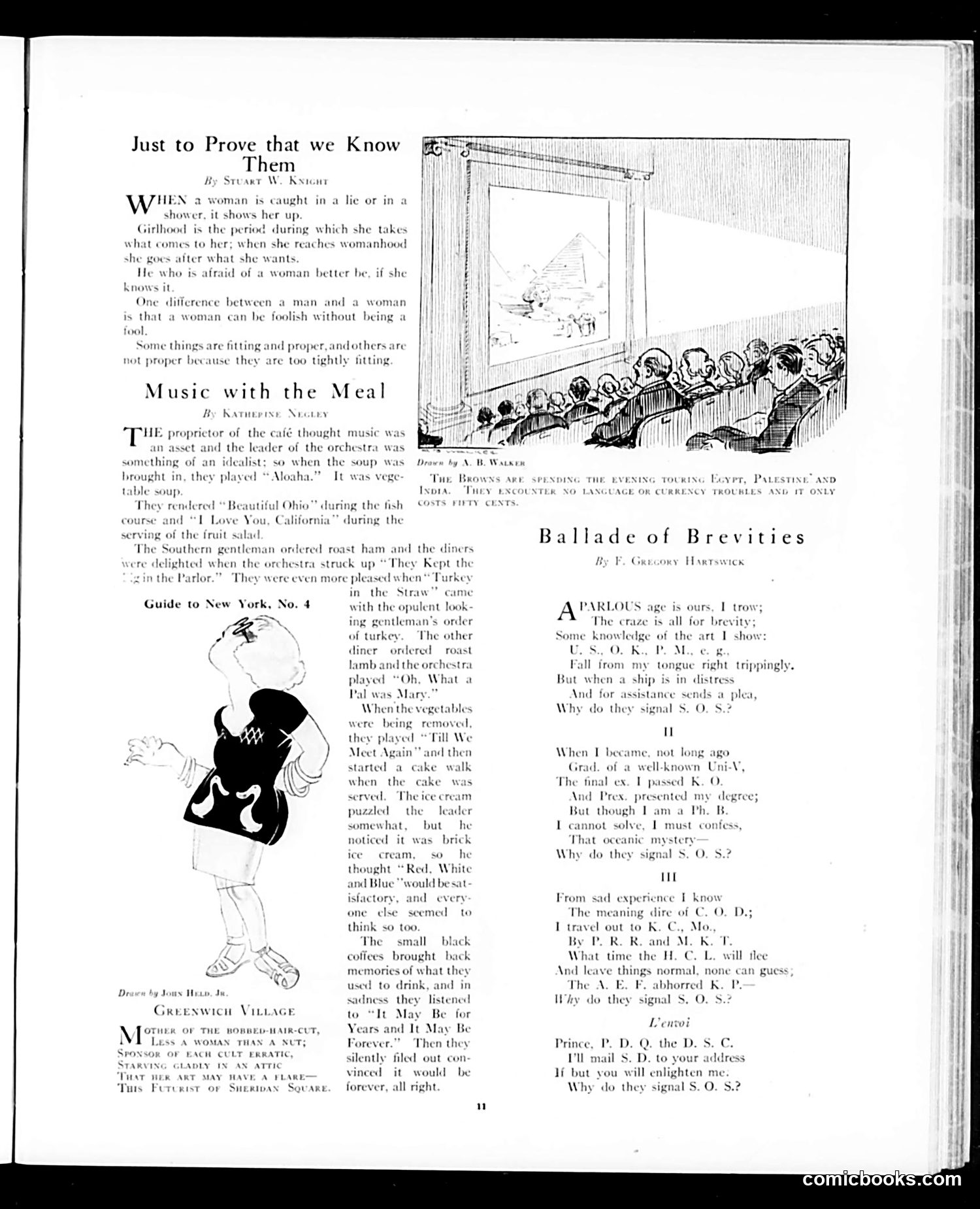
This page contains three unrelated satirical pieces typical of Judge's humor: **"Just to Prove that we Know Them"** offers sardonic observations about gender differences—suggesting women are less naturally foolish than men, and that what properly fits one person may not fit another (likely a double entendre about clothing). **"Music with the Meal"** satirizes a café proprietor who pairs orchestral selections with dinner courses based on song titles rather than appropriateness. Playing "Turkey in the Straw" when serving roast ham, or "They Kept the Parrot in the Parlor" during another course, creates absurdist humor from this literal-minded matching. **"Ballade of Brevities"** is a poem mocking 1920s-era abbreviations and acronyms (U.S., O.K., Ph.B., K.O., S.O.S., C.O.D., K.C., M.K.T., H.C.L., A.E.F., K.P., P.D.Q., D.S.C.)—suggesting modern life has become incomprehensibly abbreviated. A small illustration labeled "Guide to New York, No. 4" shows a fashionable woman, likely satirizing Greenwich Village's artistic pretensions.
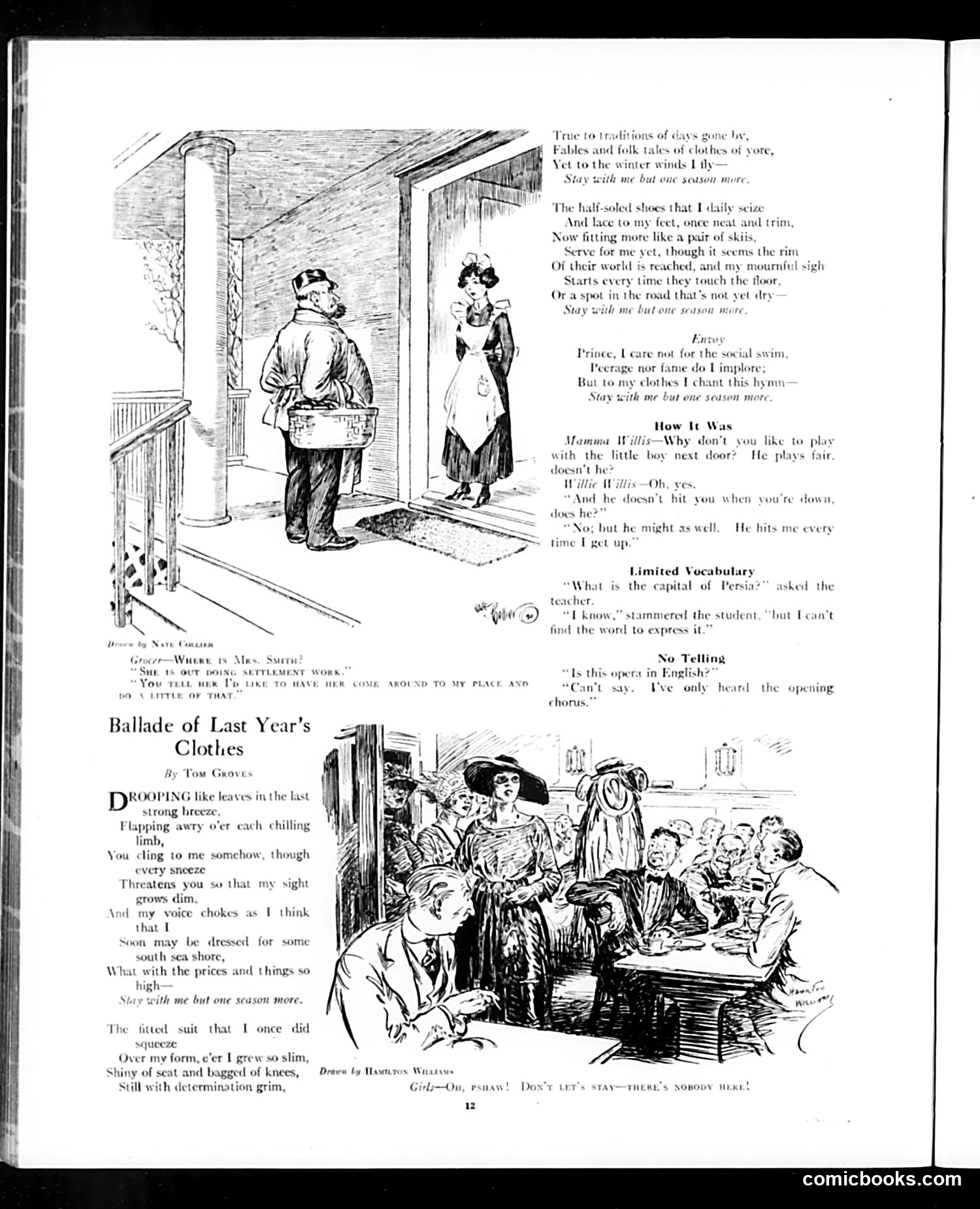
This page contains several brief humorous pieces satirizing early 20th-century American life: **"Ballade of Last Year's Clothes"** (Tom Groves): A poem lamenting worn-out garments that no longer fit properly—shoes with worn soles, ill-fitting suits with shiny seats and baggy knees. The satire targets economic hardship, implying even middle-class readers must make do with shabby clothing rather than afford new wardrobes. The repeated refrain "Stay with me but one season more" suggests financial struggle during uncertain times. **The small comic sketches** mock everyday situations: a child's brutal honesty about a playmate (he hits after you fall), a student unable to articulate knowledge due to limited vocabulary, and operagoers unable to understand English-language opera. **The bottom illustration** appears to show a domestic scene with multiple figures, captioned about "settlement work"—likely referencing Progressive Era social welfare efforts. The overall tone is gently self-deprecating humor about economic constraint, poor education, and social awkwardness among ordinary Americans.
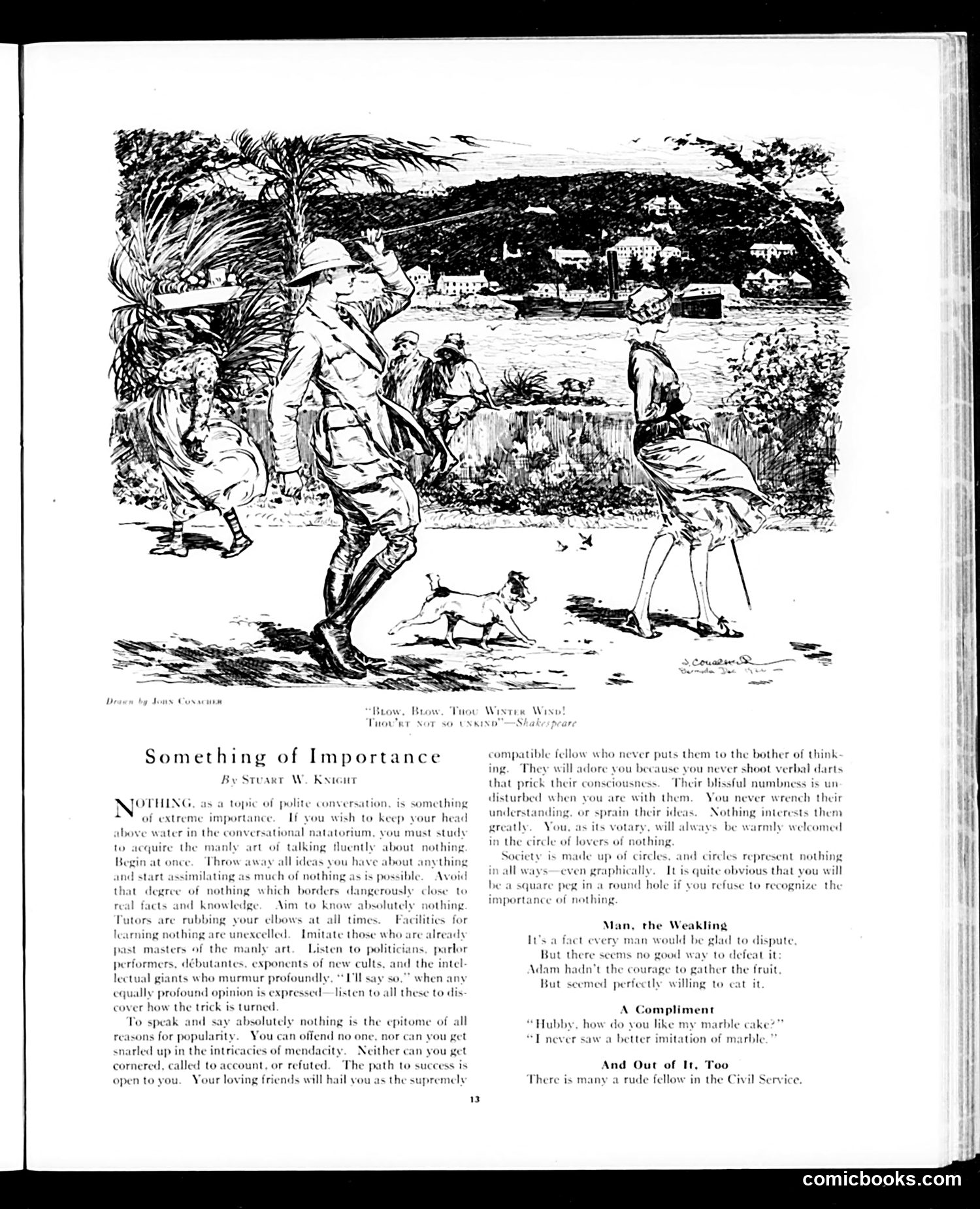
The main illustration depicts a social scene at what appears to be a seaside resort, with figures in early 20th-century dress (soldiers or officials in uniform, and women in long skirts). The caption "Blow, Blow, Thou Winter Wind! Thou'rt not so Unkind" references Shakespeare's *As You Like It*. The accompanying essay, titled "Something of Importance," satirizes polite society's obsession with discussing trivialities. The author argues that social success comes from mastering the "art of talking fluently about nothing"—avoiding facts, knowledge, and substantive opinions to never offend anyone or provoke intellectual disagreement. The satirical point: modern society prizes empty pleasantries over genuine conversation. By excelling at meaningless discourse, one becomes popular and avoids the complications of actual thinking or debate. Several short humorous pieces below reinforce themes of social conformity and superficiality. The cartoon likely illustrates this social observation about leisure-class interaction and empty socializing at fashionable venues.
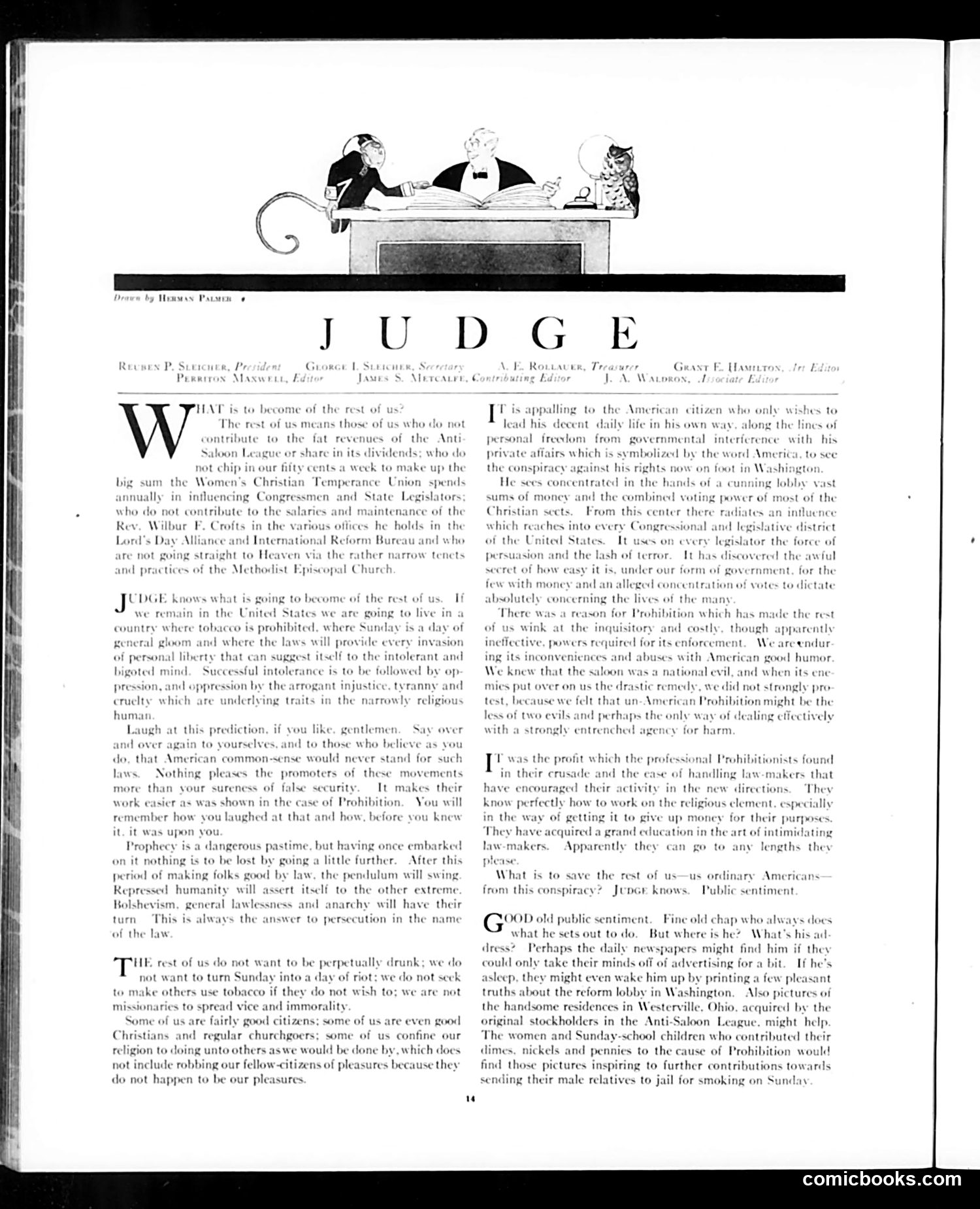
This editorial cartoon and accompanying article satirize the **Women's Christian Temperance Union (WCTU)** and Prohibition advocates who seek to impose moral legislation on American citizens. The three-judge illustration above the text represents authority figure scrutiny of personal liberty. The article argues that Prohibition—despite its stated moral purpose—represents dangerous government overreach by a "cunning lobby" using "vast sums of money" to control Congress and legislatures. The author warns that well-meaning reformers pursuing legal morality will provoke backlash: "when the pendulum swings," repressed humanity will swing to "Bolshevism, general lawlessness and anarchy." The satire's core point: forcing citizens to be "good by law" violates American principles of personal freedom. The author acknowledges Prohibition's underlying concerns (the saloon was genuinely destructive) but argues the cure—governmental intrusion into private affairs—is worse than the disease, and will ultimately discredit reform movements entirely.
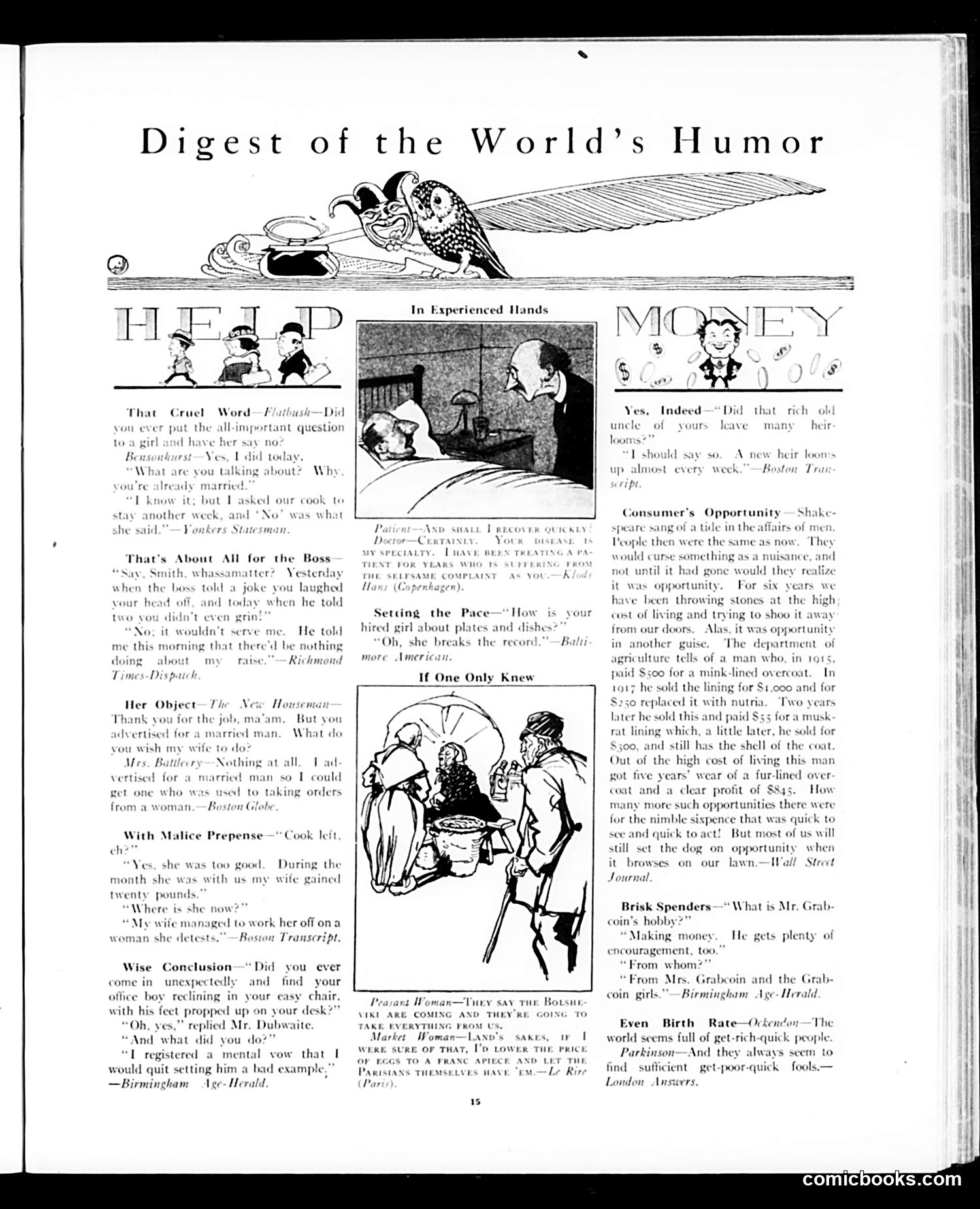
This is a humor digest page from Judge, containing multiple brief comedic anecdotes rather than political cartoons. The jokes center on domestic life and social commentary typical of early 20th-century American humor. Key themes include: **"That Cruel Word"** — A man rejected by a girl jokes that even his cook said "no" to his request. **"Her Object"** — A woman advertises for a married man to hire because she wants someone already trained to take orders from women. **"Consumer's Opportunity"** — A satirical piece about how people fail to recognize opportunities until they're gone, illustrated with an anecdote of a man who profited from wartime inflation by buying and reselling fur linings. **"If One Only Knew"** — A French market woman (referencing WWI anxieties about German invasion) jokes she'd lower egg prices if invasion were certain, letting Germans pay inflated prices. The humor reflects early 1900s concerns: domestic friction, economic anxiety, and wartime tensions. The cartoons feature simple line drawings accompanying the text-heavy jokes.
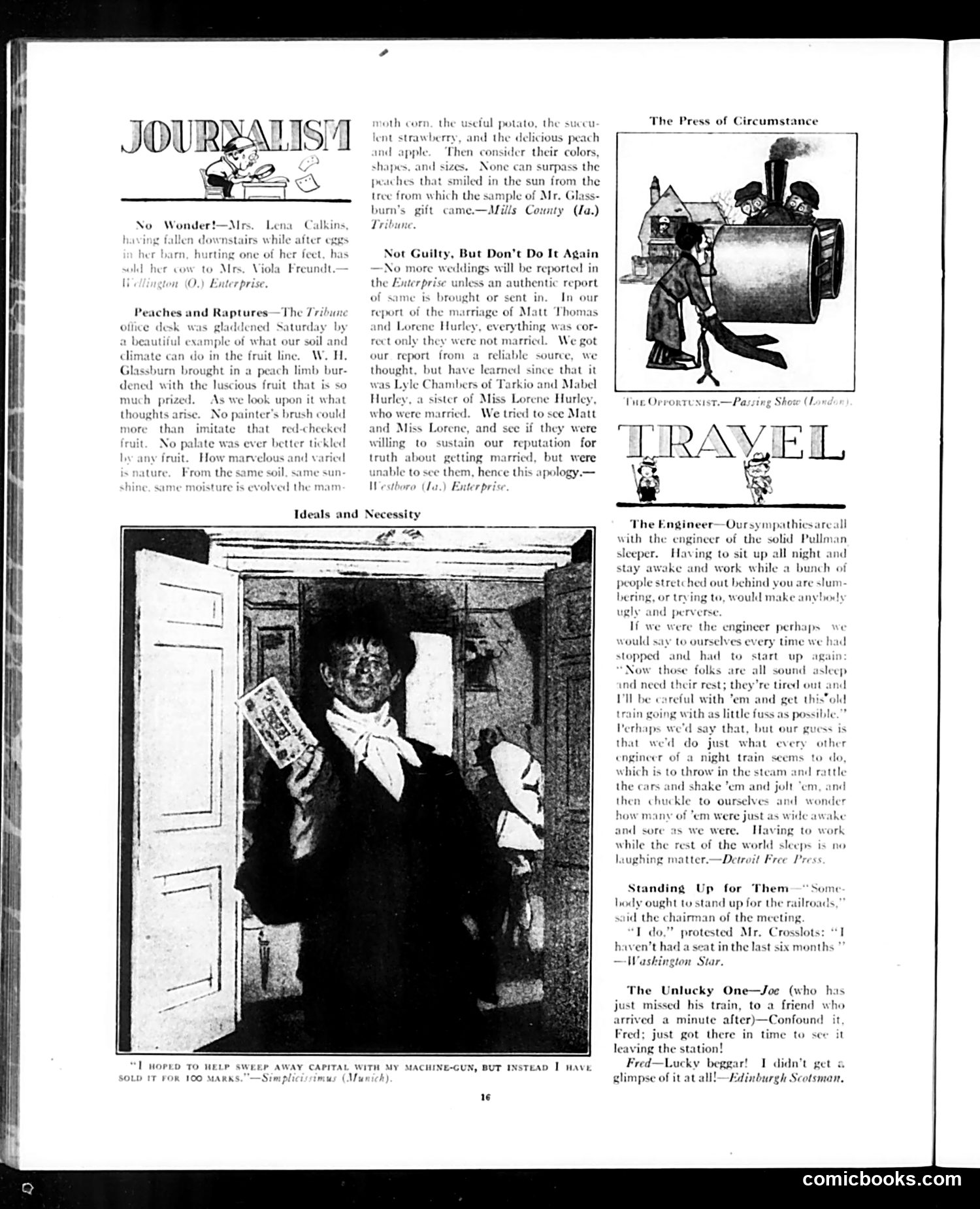
This page contains several satirical pieces typical of early 20th-century American humor journalism: **Main Content:** - **"Journalism" section**: Various anecdotes mocking small-town newspaper errors, including a retraction about a falsely reported wedding between Matt Thomas and Lorene Hurley (they were actually different people). - **"The Engineer" cartoon/text**: Sympathizes with Pullman train engineers who must stay awake all night while passengers sleep, then complain about rough rides. The satire suggests engineers deliberately jostle cars as petty revenge. - **"Standing Up for Them"**: A railroad chairman's claim to support railways is contradicted by Mr. Crosslots, who hasn't had a seat in six months—satirizing both railroad service quality and corporate hypocrisy. - **"The Unlucky One"**: A brief joke about missing a train by one minute. The page satirizes journalistic incompetence, railroad working conditions, and corporate indifference to passenger comfort—common progressive-era Judge targets.
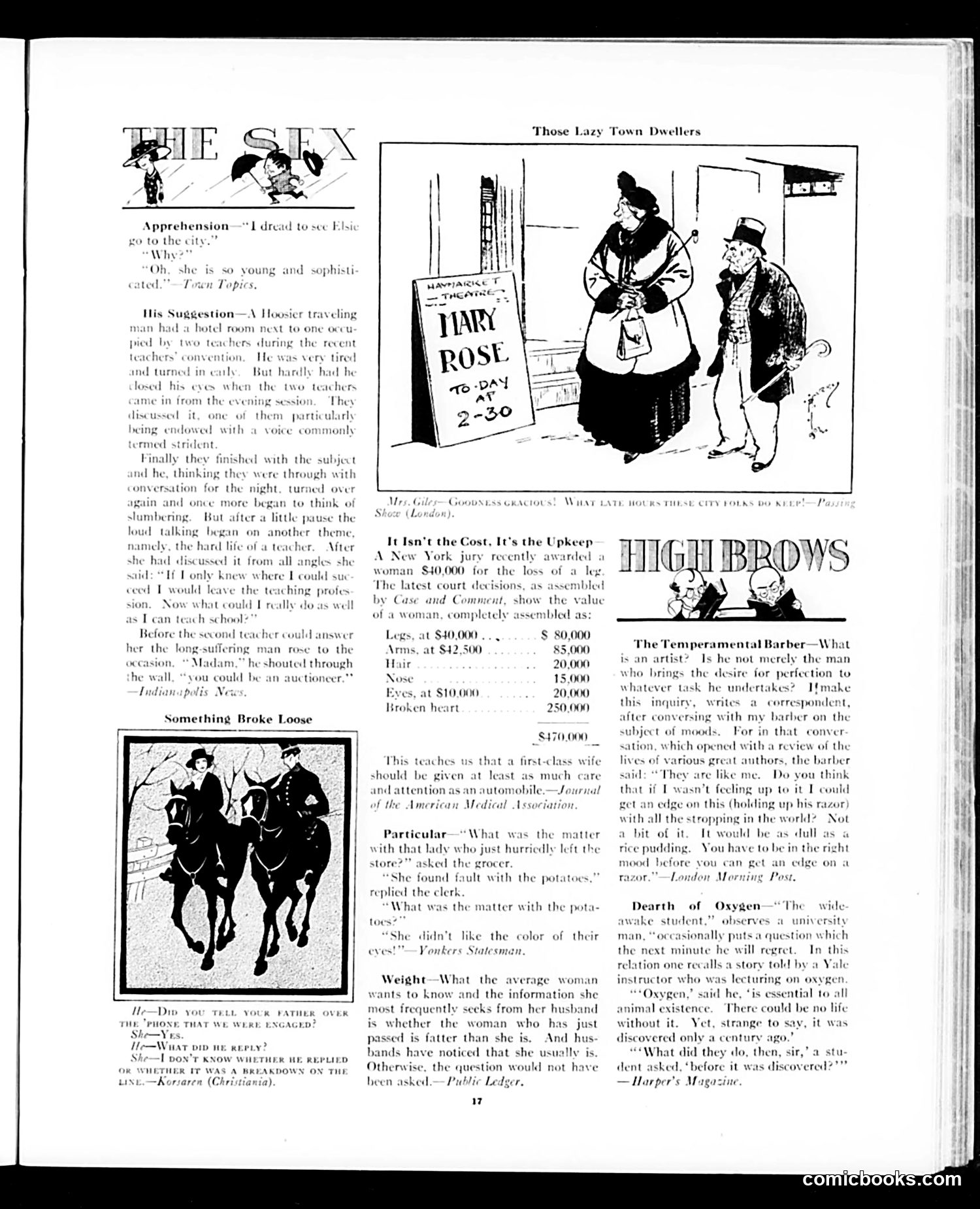
The main cartoon depicts a well-dressed woman and a shabby man outside a theater advertising "Harry Rose To-Day at 2-30." The caption sarcastically asks what "city folks" do with their leisure time, suggesting that town dwellers are idle and wasteful. The surrounding content satirizes urban life and modern attitudes. "It Isn't the Cost, It's the Upkeep" mocks a court case awarding a woman $40,000 for a lost leg, then catalogs the financial "value" of a woman's body parts (totaling $470,000), implying that marriage is treated as a commodity. Other brief humor pieces ridicule women's vanity, marital concerns, and impractical attitudes. The overall page presents a rural or conservative perspective criticizing city dwellers for frivolity, materialism, and foolish priorities—a common Judge magazine theme contrasting "simple" country values against urban sophistication and excess.
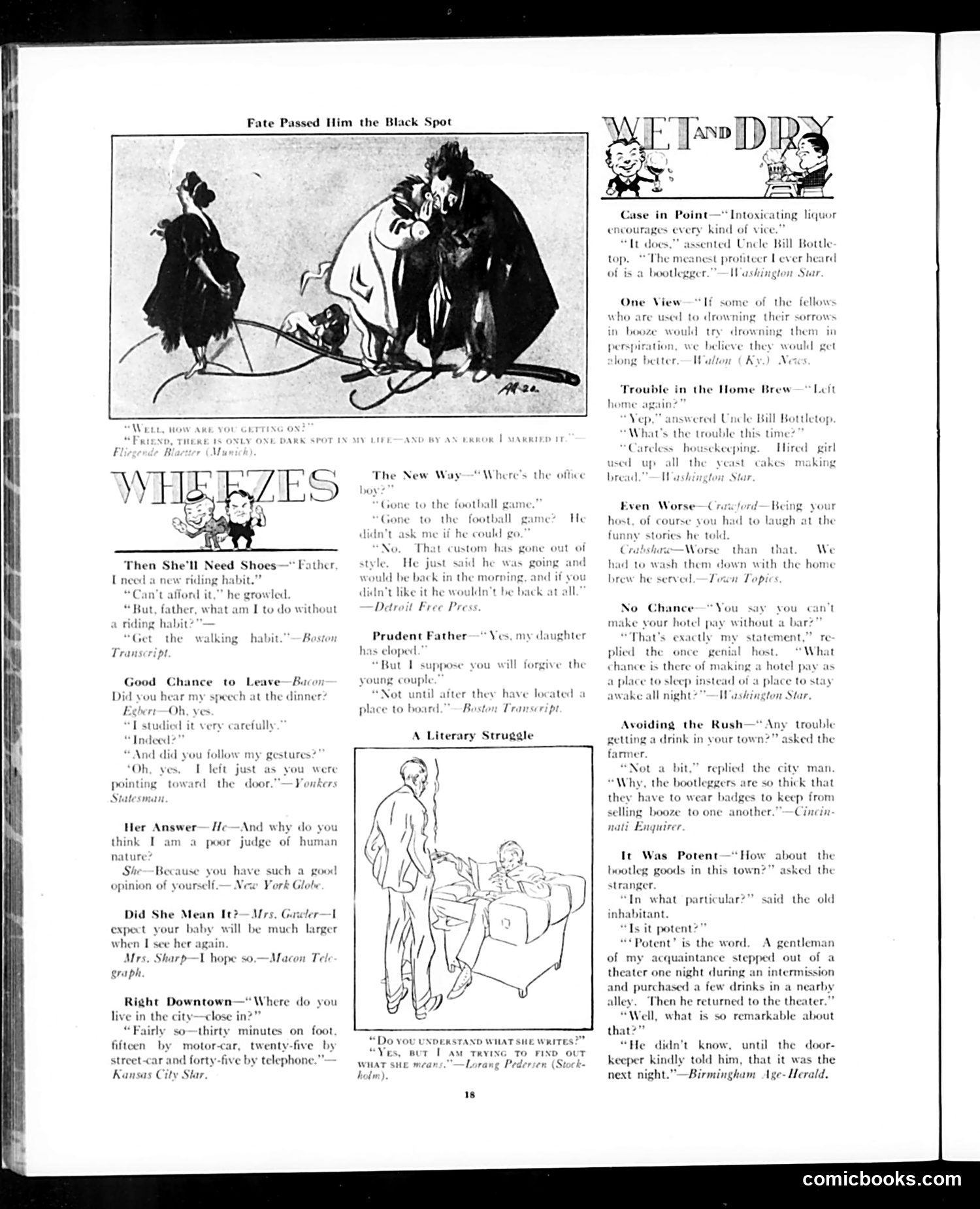
This page satirizes Prohibition-era America (likely 1920s), when alcohol was illegal. The cartoons mock both the law and those who circumvent it. **Main themes:** The top cartoon "Fate Passed Him the Black Spot" depicts a man encountering the "black spot"—a death omen—represented by bootleggers and their illegal trade. **Recurring jokes throughout:** - "Uncle Bill Bottletop" ironically admits bootleggers are "the meanest profiteer" - Multiple pieces mock "home brew" (illegal homemade alcohol), with one husband forced to "wash them down" to stomach his wife's terrible batch - "Bootleggers are so thick" they wear badges to avoid selling to each other - A theater patron buys bootleg alcohol during intermission and doesn't realize he spent the entire night drunk—it's "the next night" when he leaves The satire targets both Prohibition's ineffectiveness (bootlegging thrived) and the poor quality/danger of illegal alcohol. The humor assumes readers understood that despite the law, drinking remained rampant and widely available.
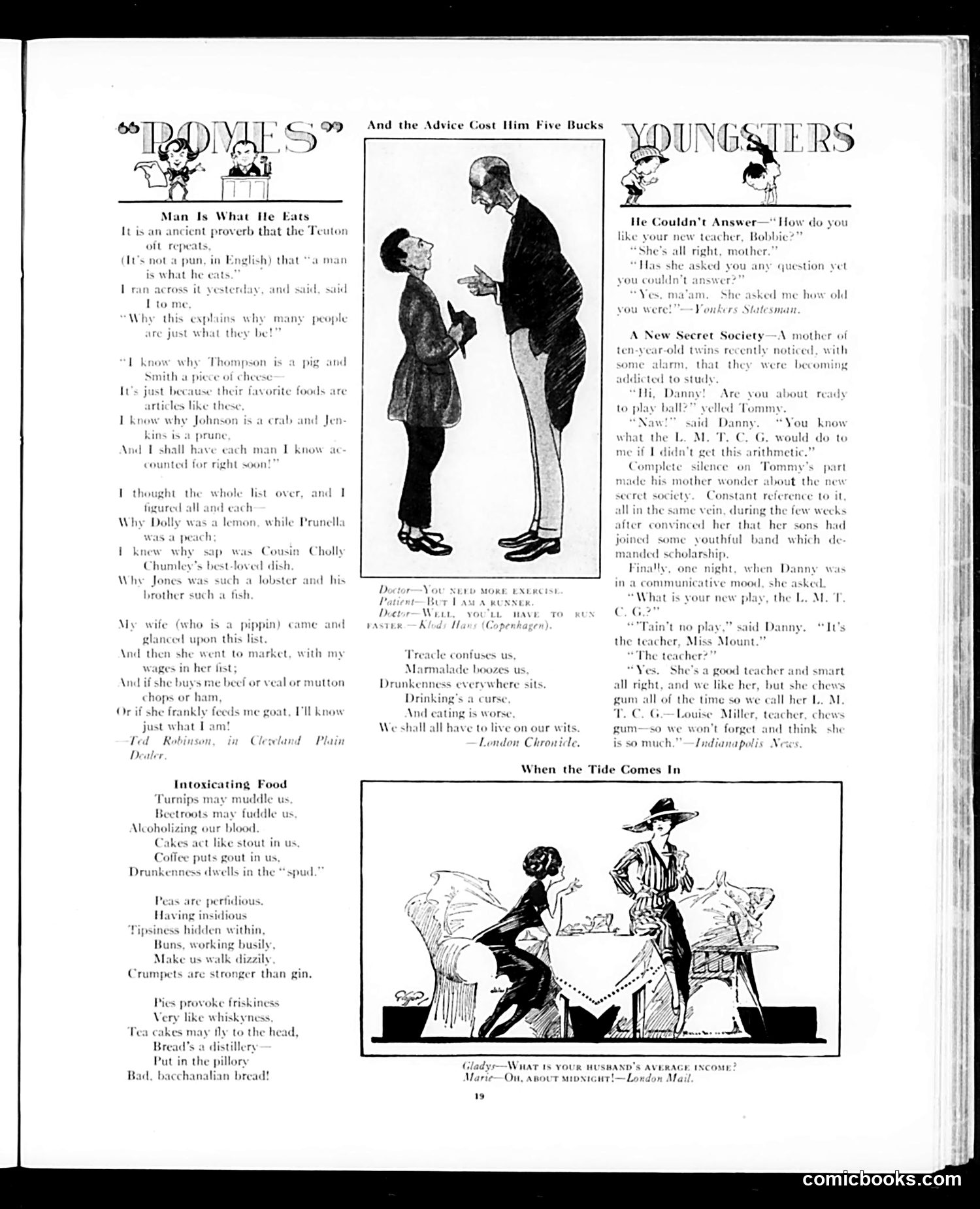
This page contains two main pieces of humor satire: **"Man Is What He Eats"** (left): A humorous essay applying the proverb literally to social commentary. The author claims to deduce people's character from their eating habits—Thomson is a "pig" because he eats like one, Johnson a "crab" because of his diet, etc. The satire mocks both the absurdity of the proverb and contemporary pseudo-scientific personality theories popular in the early 20th century. **"Youngsters" (right)**: A brief anecdote about a boy named Danny joining a "secret society" focused on studying, which causes maternal concern. The joke hinges on the reveal that the "secret society" is simply his new teacher's class—satirizing mothers' overreaction to youth organizations and trends. **"When the Tide Comes In" (bottom)**: A cartoon showing a couple by the seaside; the wife asks the husband's average income, satirizing financial anxiety and marital money discussions. All three pieces gently mock everyday social anxieties and behavioral assumptions of the era.
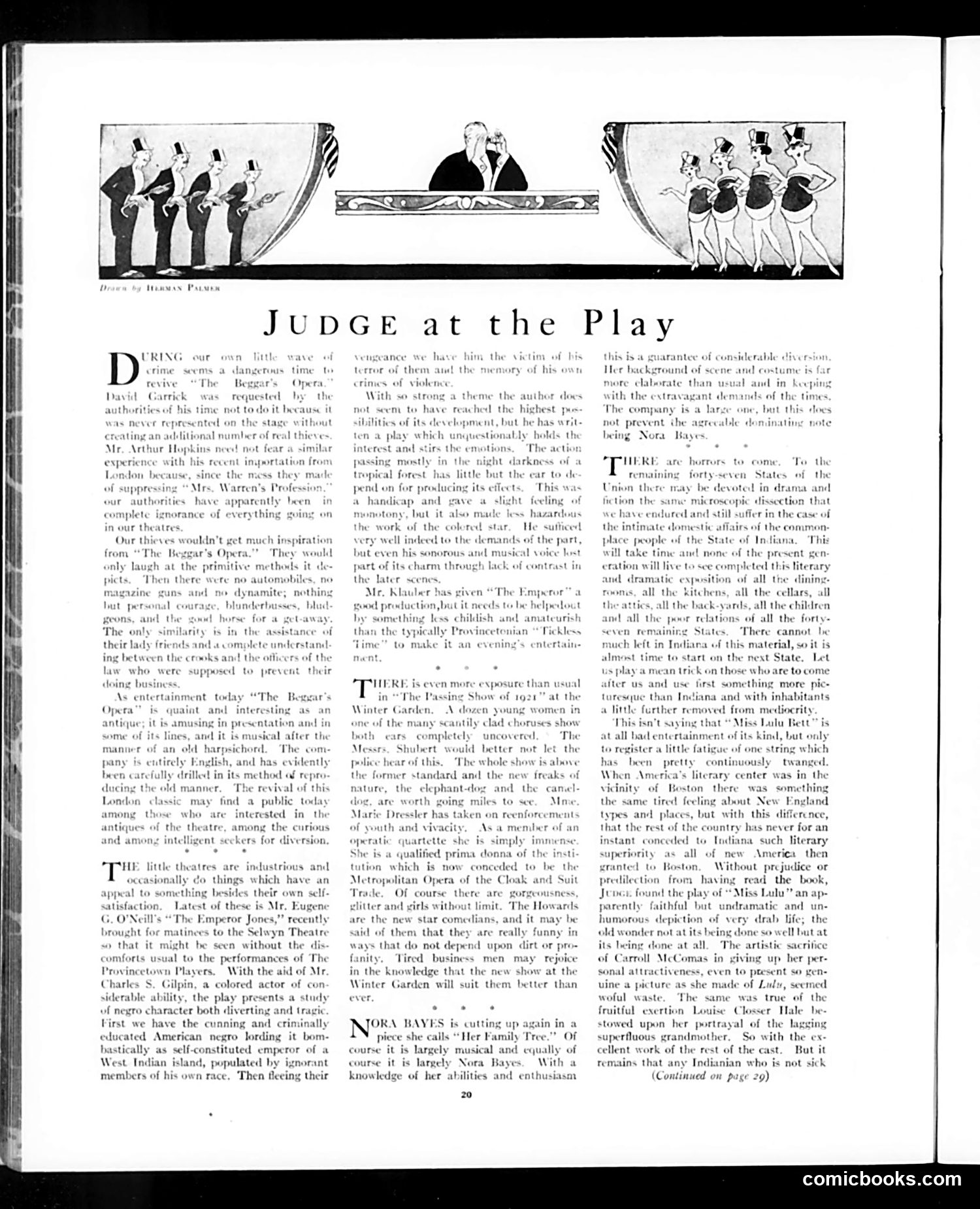
This page contains theater reviews from Judge magazine, focusing on several Broadway productions of the early 1920s. The header illustration shows a judge figure flanked by formally-dressed men (left) and chorus girls in short skirts (right)—establishing the "judge at the play" conceit: evaluating theatrical productions. **Key reviews discussed:** - **"The Beggar's Opera"**: The critic notes the irony that actual criminals wouldn't learn theft methods from this classical work, only laughing at its outdated techniques. - **"The Emperor Jones"** by Eugene O'Neill: Praised for presenting serious study of character, featuring a "colored actor" of "considerable ability" portraying an ambitious American Black man who becomes a self-proclaimed emperor on a Caribbean island. The review acknowledges both its dramatic power and technical limitations. - **"The Ziegfeld Follies of 1921"** and **Winter Garden shows**: Critiques focus on scantily-clad chorus girls and entertainment value for "tired business men," with mixed assessments of production quality and performers like Marie Dressler and Nora Bayes. The overall tone is sophisticated, treating theater as worthy of serious critical analysis.
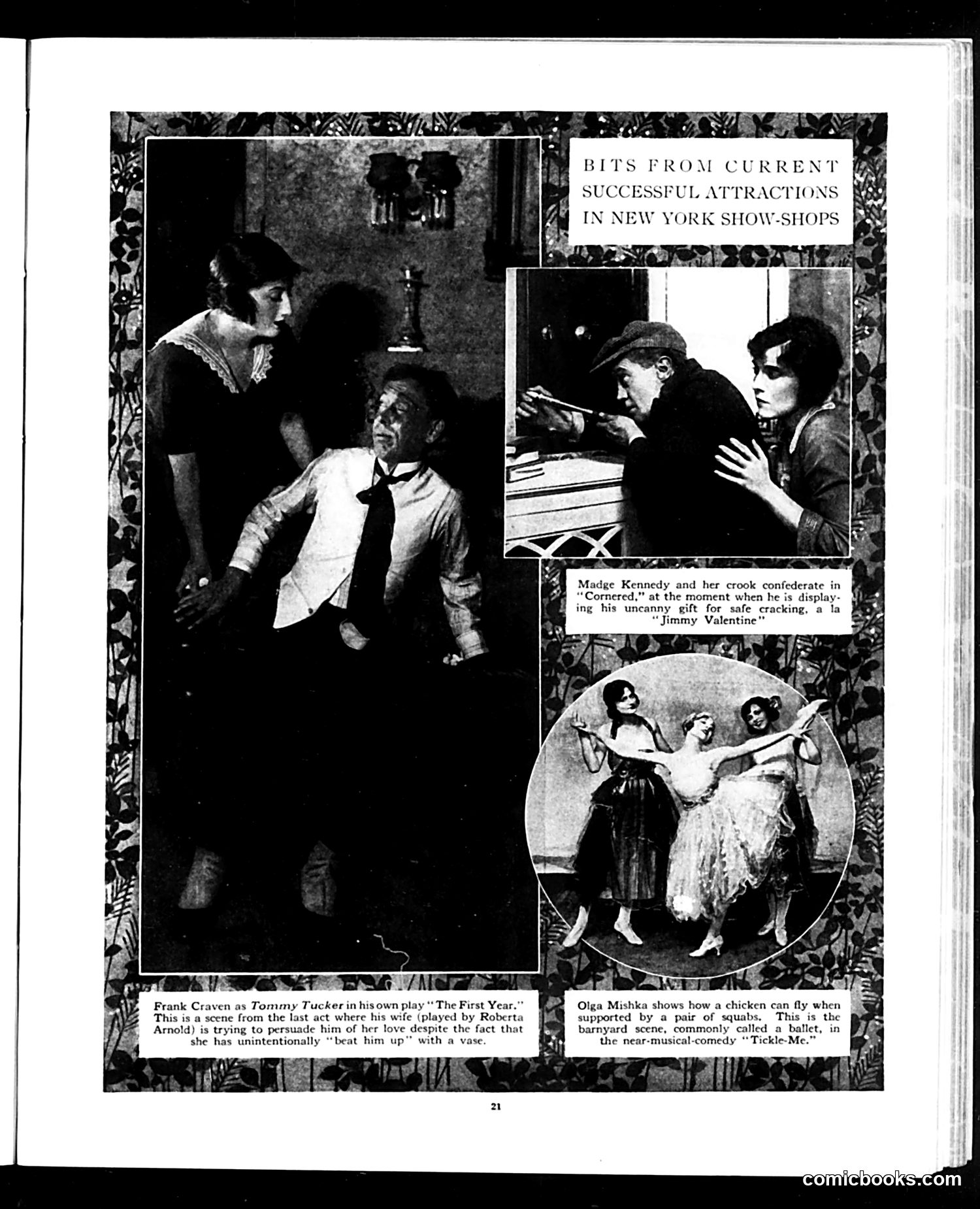
This page showcases "bits from current successful attractions in New York show-shops"—essentially theater reviews or promotional stills from Broadway productions. The page features four scenes from different plays: 1. **"Cornered"** with Madge Kennedy: Shows a scene referencing "Jimmy Valentine," a famous 1910 play about a safecracker. The joke involves a character displaying safecracking skills. 2. **Frank Craven's play**: Depicts a domestic comedy scene where a wife has accidentally "beat him up" with a vase while trying to convince him of her love—playing on marital discord for laughs. 3. **"Tickle-Me"**: Described as a "near-musical-comedy" featuring acrobatic staging where a chicken appears to "fly" when supported by dancers called "squabs" (young pigeons)—absurdist theatrical spectacle. These snippets represent early 20th-century Broadway's mix of crime dramas, domestic comedies, and vaudeville-influenced musical farces that appealed to Judge's urban readership.
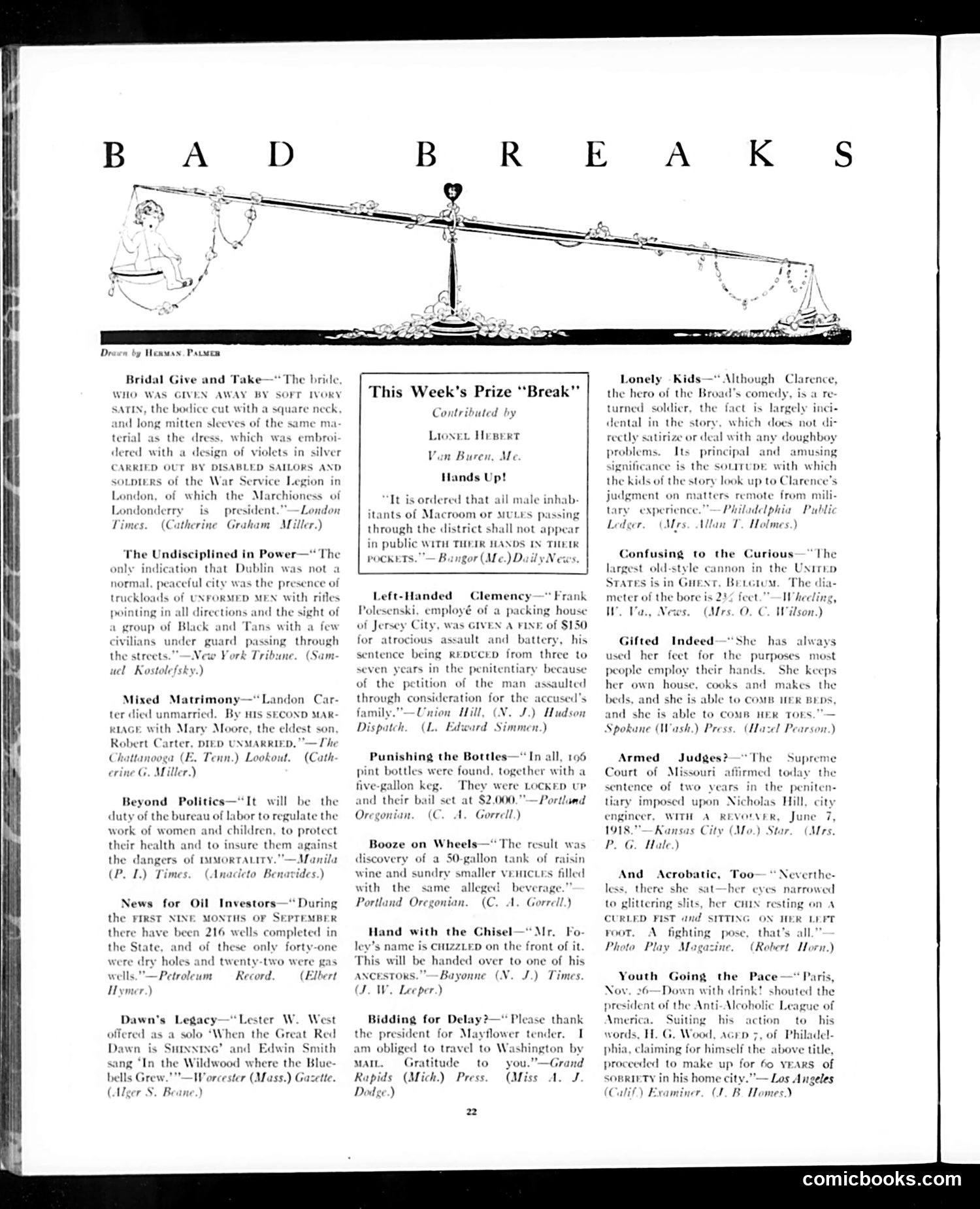
This is a humor page from *Judge* magazine featuring "breaks" — embarrassing newspaper errors and absurd local news items. The cartoon at top (by Herman Palmer) illustrates the "Bridal Give and Take" break about a wedding where disabled soldiers carried the bride, satirizing awkward wedding logistics. The page collects comedic newspaper mistakes and unintentionally funny quotes from real papers. Examples include: Irish police ordering men not to keep hands in pockets; a court reducing an assault sentence from 7 to 3 years; newspapers reporting 106 beer bottles being "locked up" with bail set at $2,000 (treating bottles as if they were criminals); and confusion about a cannon's bore measurement. The humor relies on literal interpretations of poorly-written journalism, logical absurdities in local laws and court decisions, and the gap between official language and common sense — classic satirical targets for *Judge*'s educated, urbane 1920s readership.
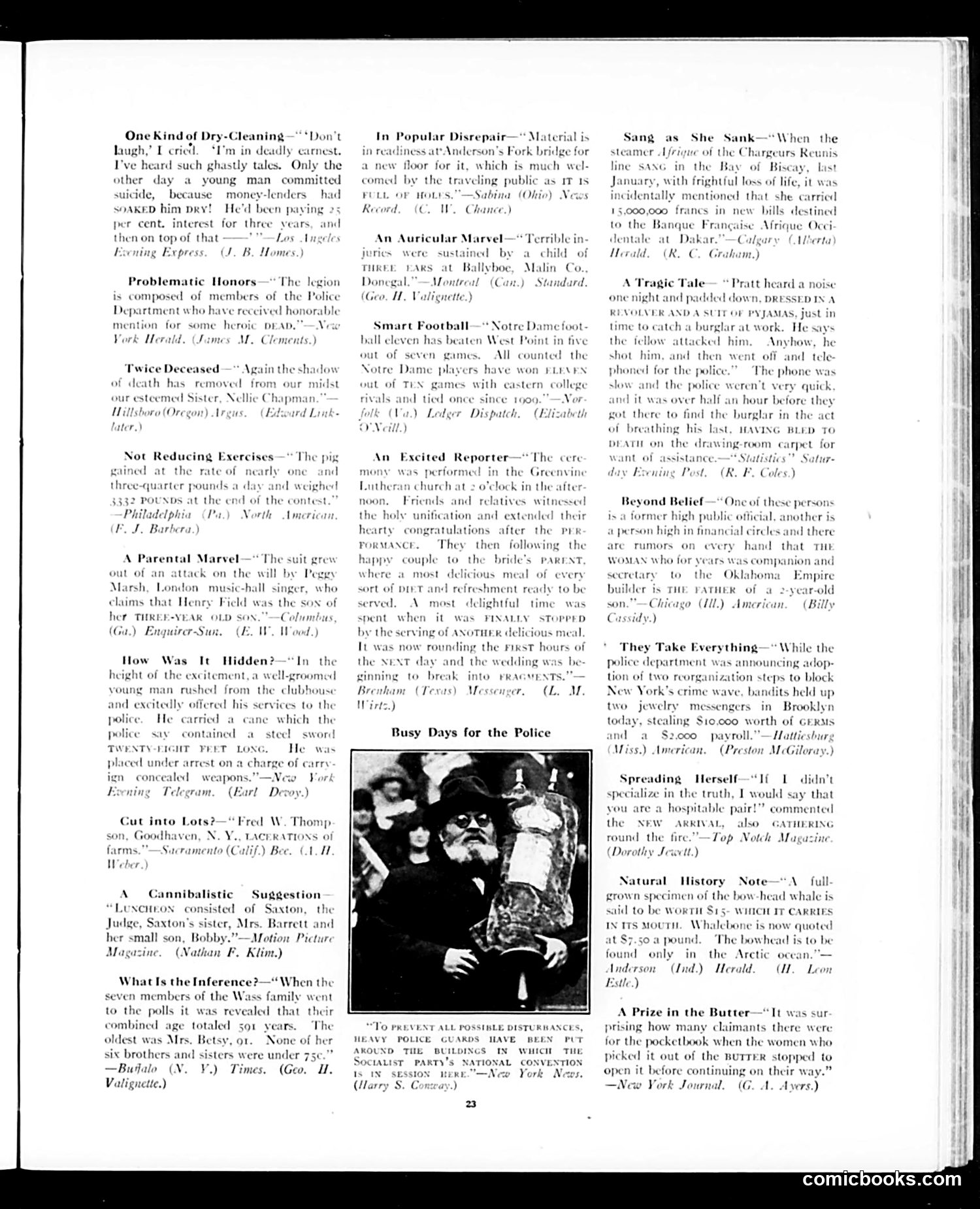
This page contains brief humorous newspaper excerpts rather than traditional political cartoons. The satire works through ironic juxtaposition of absurd details from real news stories. The one photograph shows police guards surrounding a building, captioned to reference the Socialist Party's National Convention requiring heavy security "to prevent all possible disturbances"—likely mocking either socialist political activity or perceived threats to public order during this convention. The textual items mock various absurdities: a moneylender charging 2% interest monthly (usurious practices); a pig gaining 3,332 pounds; a man claiming to be someone's three-year-old son; and a wedding reception interrupted so many times by additional meals that it extends over hours. The ship reference mentions a vessel sinking while carrying 15 million francs in new bills—perhaps commenting on the juxtaposition of tragedy and financial loss. **Without a visible date, the specific political context remains unclear**, but the Socialist convention reference suggests early 20th-century American anxieties about radical political organizing.
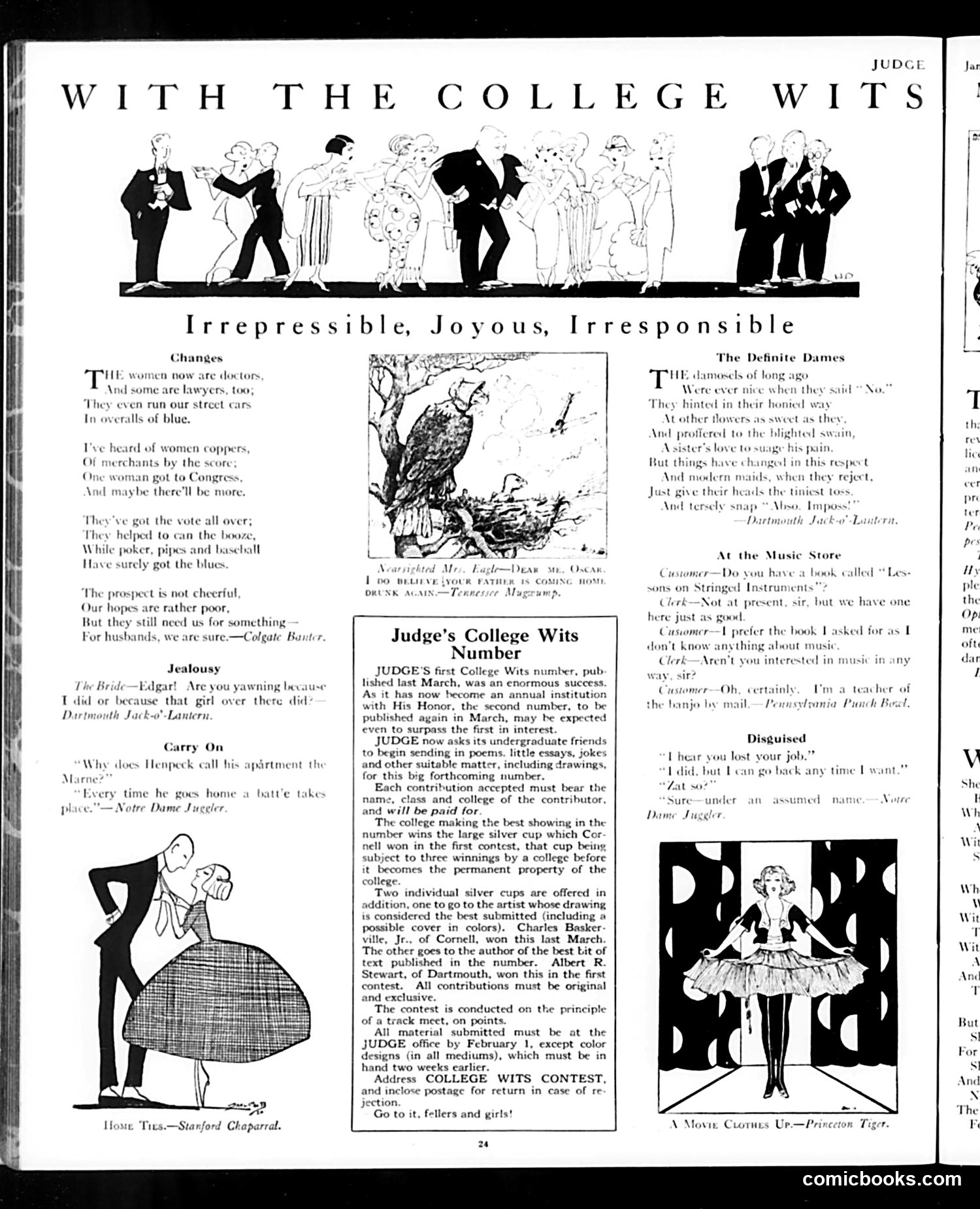
This page showcases **humor about women's changing social roles** in early 20th-century America. The main poem, "Changes," sarcastically laments that women have become doctors, lawyers, street car operators, police officers, and congresspeople—and worse, they got the vote and helped prohibit alcohol ("can the booze"). The joke's bitter punchline: men are still "needed" as husbands. The page then advertises **Judge's annual College Wits contest**, inviting undergraduate contributions (poems, essays, jokes, drawings) with a silver cup awarded to the college with the best submissions. Cornell won the previous year's contest. The scattered jokes mock college life: jealous brides, henpecked husbands, and confused music store customers. These appear to be reprinted submissions from other college humor publications (Notre Dame, Dartmouth, Stanford, etc.). The **satire targets anxious masculinity**—the anxiety that women's emancipation threatens male relevance and dominance, despite remaining domestic dependence.
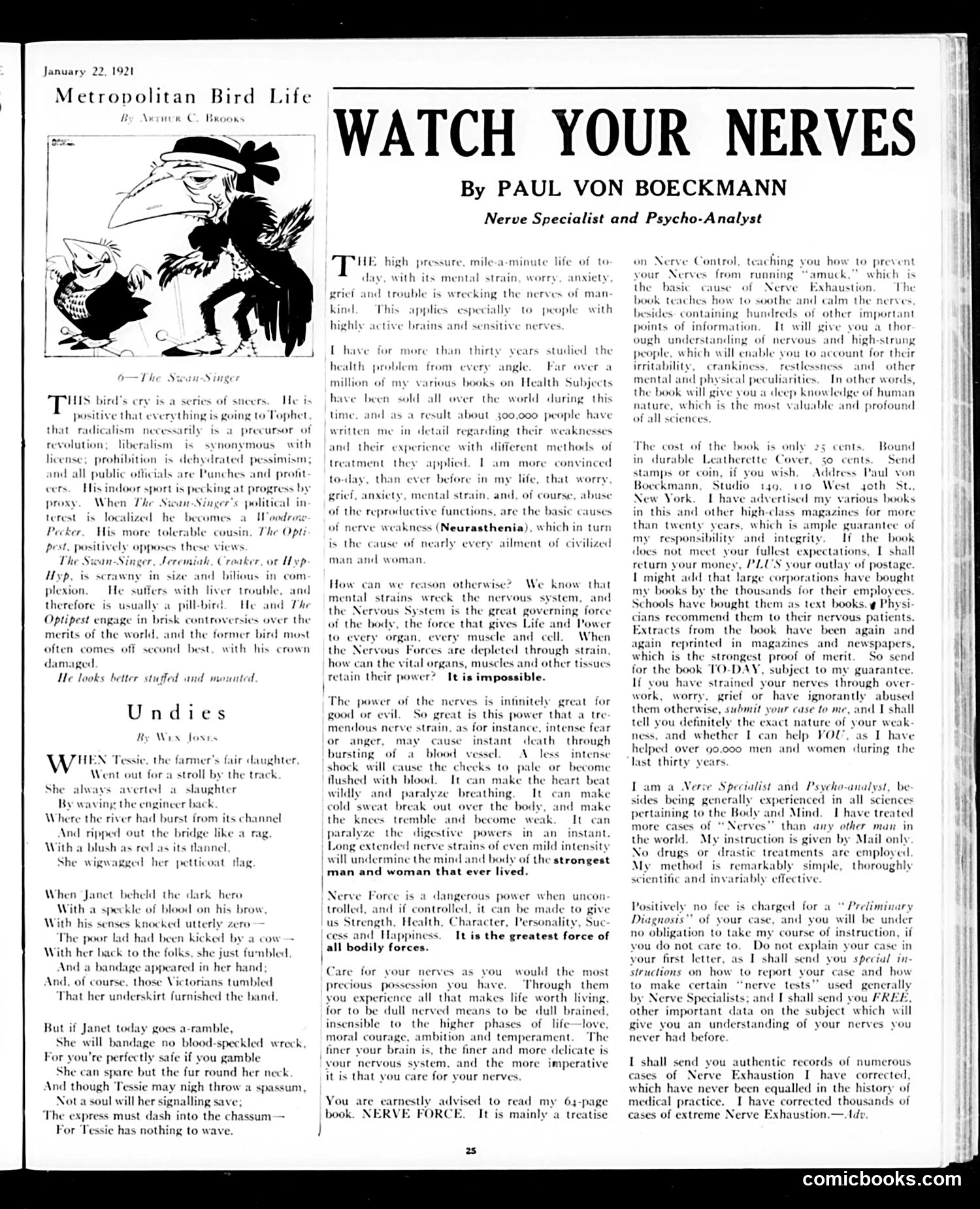
This January 1921 *Judge* page contains two distinct sections: **"Metropolitan Bird Life"** (left): A satirical column using bird characters to mock political types. "The Sican-Singer" represents an angry radical figure spreading pessimism about prohibition, liberalism, and progress. His opposite, "The Hyp" (the pessimist), is a sickly, complaining bird who ironically "wins" arguments—satire mocking both extremes of 1920s political discourse. **"Undies"** (center): Humorous verse contrasting past and present female modesty. It nostalgically depicts 1800s women (Tessie, Janet) using petticoats and undergarments as emergency bandages or signal flags, implying their clothing was voluminous. Modern women (early 1920s) wear so little that they couldn't perform these feats—satirizing the dramatic shift in women's fashion and social norms during the post-WWI era. **"Watch Your Nerves"** (right): An advertisement disguised as health advice from "Nerve Specialist" Paul von Boeckmann, promoting his book on treating "nerve exhaustion" through understanding nervous system control—typical early 20th-century pseudo-scientific wellness marketing.
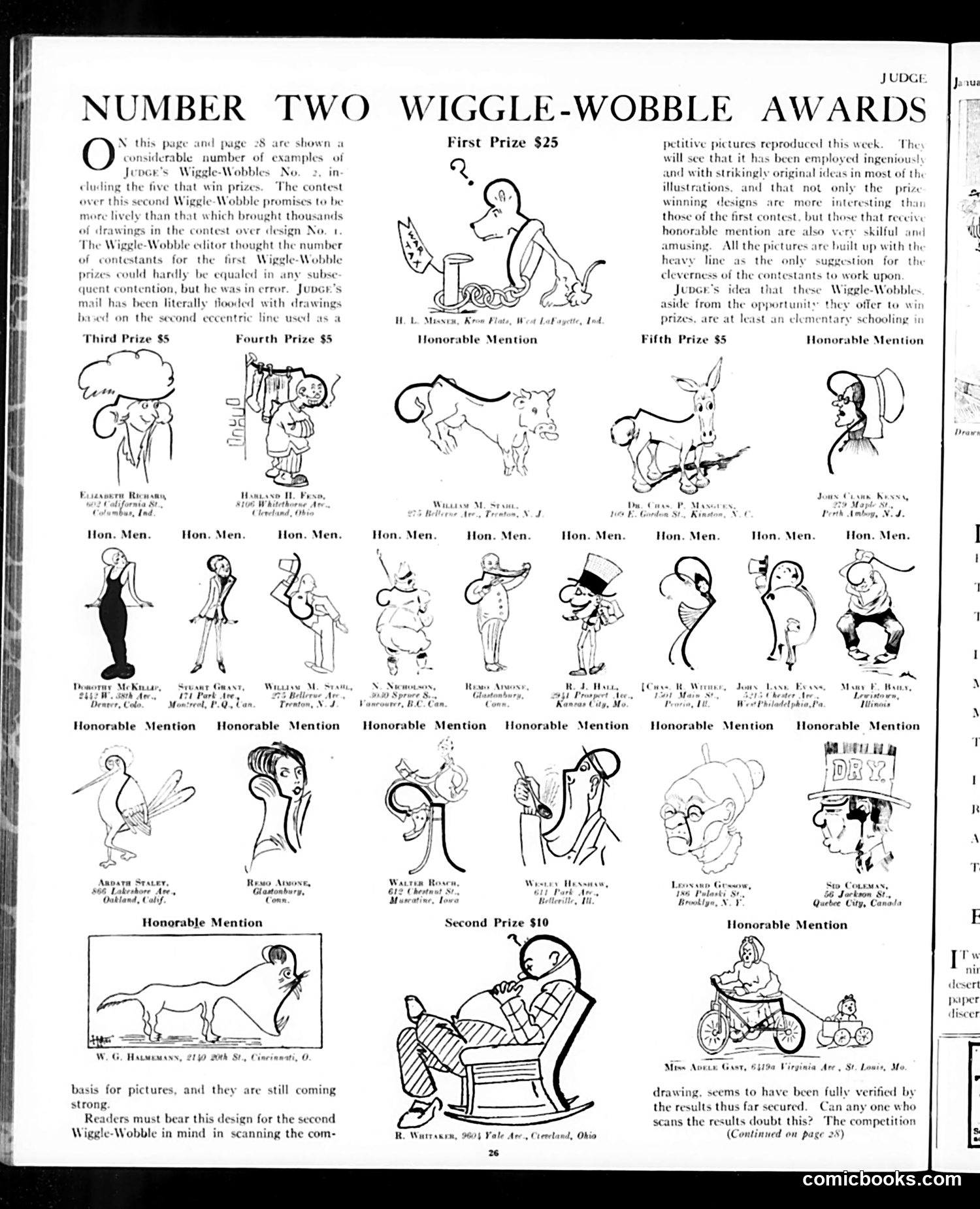
This page announces winners of Judge magazine's "Number Two Wiggle-Wobbles" drawing contest. "Wiggle-Wobbles" appears to be a cartooning exercise where artists draw figures using curved, wobbly lines as compositional guides—visible in the constrained, exaggerated forms throughout. The page displays prize-winners and honorable mentions with their submitted cartoon drawings. Judge's editors note the contest exceeded expectations for entries, with artists demonstrating "strikingly original ideas" within the formal constraints. The emphasis on "heavy line" technique and the editor's claim that this exercise provides "elementary schooling" suggests Judge used such contests to promote drawing skills among readers and aspiring cartoonists. The drawings themselves are broadly humorous character sketches—animals, people in various poses—typical of early 20th-century American comic illustration. This represents Judge's function as both satirical magazine and instructional resource for visual humor.
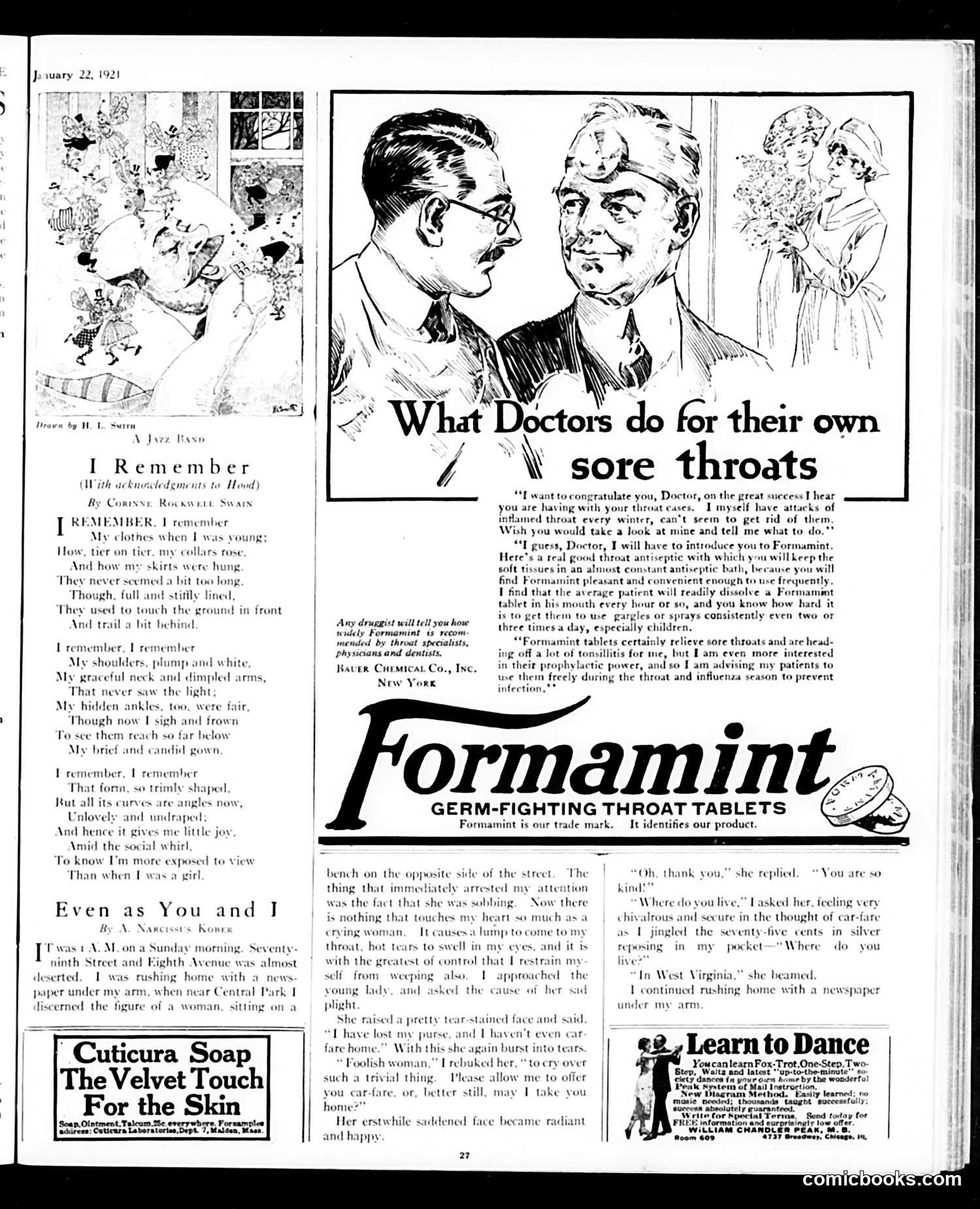
This page contains several distinct pieces of content: **Main Advertisement**: The large Formamint ad features two male doctors in conversation. The satire appears to mock doctors' endorsement of proprietary remedies—one doctor recommends Formamint throat tablets to another, claiming patients will use them consistently (unlike gargles or sprays). The humor lies in doctors promoting a commercial product to each other as if it's professional medical advice, likely critiquing the blurry line between genuine medicine and marketing in the 1920s. **Poetry**: "I Remember" nostalgically contrasts women's modest fashion of the speaker's youth (long skirts, covered arms and ankles) with current 1920s styles that expose far more skin. This reflects anxiety about changing women's fashion and social roles—a common theme in period satire. **Short Story**: "Even as You and I" is a melodramatic tale of a charitable man helping a weeping woman, apparently a stock sentimental narrative typical of magazine fiction. The page reflects 1920s concerns: modern advertising practices, changing gender norms, and popular entertainment conventions.
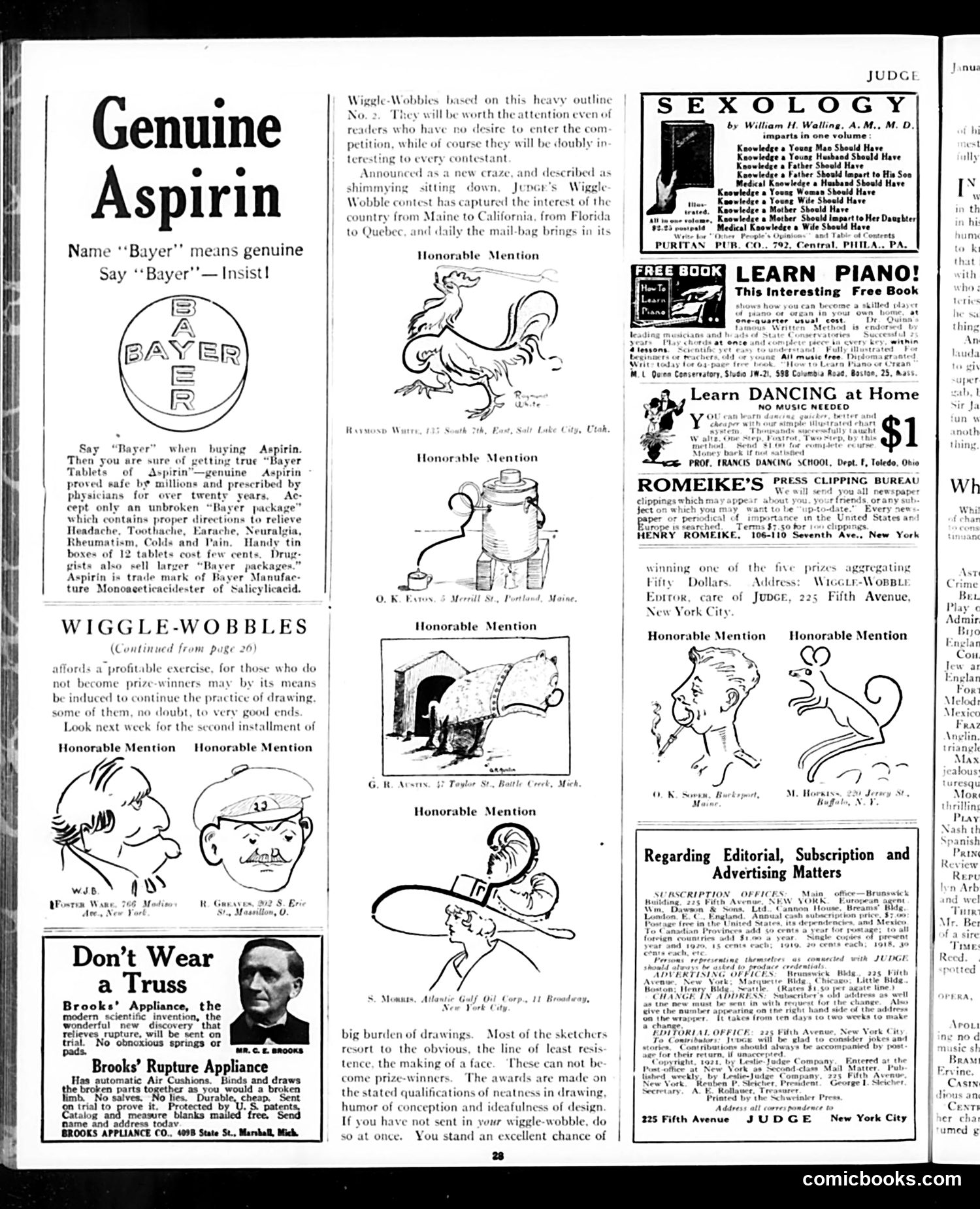
This page combines satirical content with period advertisements. The main editorial feature is the **"Wiggle-Wobbles" contest**—Judge magazine's drawing competition inviting readers to submit cartoons based on a "shimmying sitting down" theme, announced as a fashionable new craze. The contest has apparently captured national interest from Maine to Quebec. The page showcases "Honorable Mention" entries: crude caricatured faces and figures, mostly profile heads and simple body sketches. The editorial note criticizes most contestants for taking the easy route—drawing obvious faces rather than demonstrating genuine artistic merit. Awards, it states, go to work showing "neatness in drawing" and "ideafulness of design." The surrounding advertisements reflect early 20th-century concerns: Bayer Aspirin (emphasizing the trademark name), Brooks' Rupture Appliance, dancing lessons, and sex education books—typical of Judge's commercial pages. These ads reveal period anxieties about health, propriety, and self-improvement. The "Wiggle-Wobbles" itself satirizes popular crazes and amateur artistic pretension.
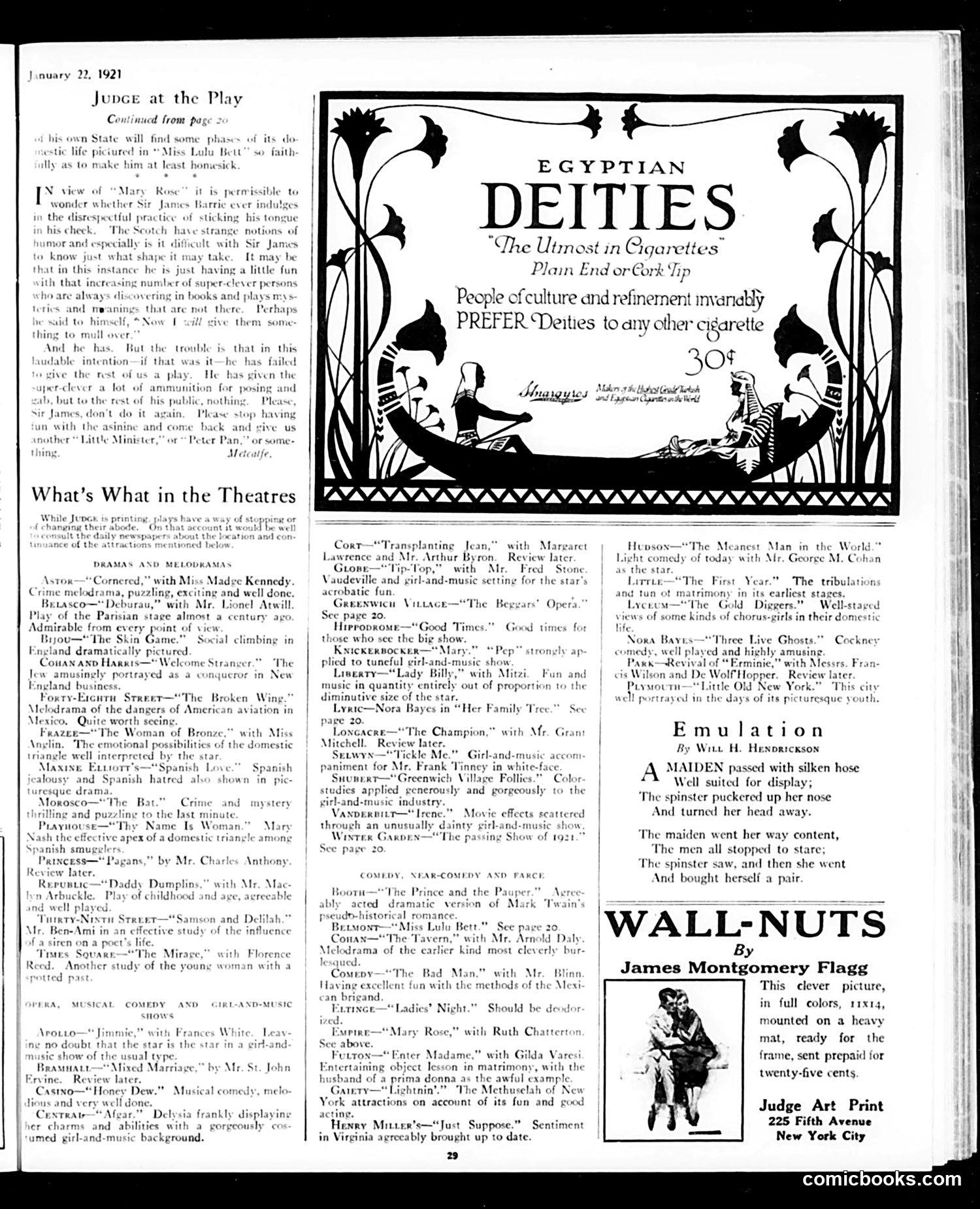
This is primarily a theater listings and entertainment page from *Judge* magazine (January 22, 1921), not a political cartoon. The main visual content is a **cigarette advertisement for "Egyptian Deities"** brand, featuring Egyptian-themed imagery (lotus flowers, figures in a boat). The ad claims "People of culture and refinement invariably PREFER 'Deities to any other cigarette" — a common advertising appeal of the 1920s associating products with sophistication and taste. The text consists of theater reviews and show listings typical of entertainment coverage. The opening section discusses playwright Sir James Barrie and theater criticism. "What's What in the Theatres" reviews various Broadway productions (melodramas, comedies, musicals) with brief critiques. At bottom right is a brief poem called "Emulation" about a maiden in silk stockings. **No satire or political content is evident.** This is straightforward entertainment journalism and advertising from 1920s America, notable mainly for the period advertising style and theater landscape of that era.
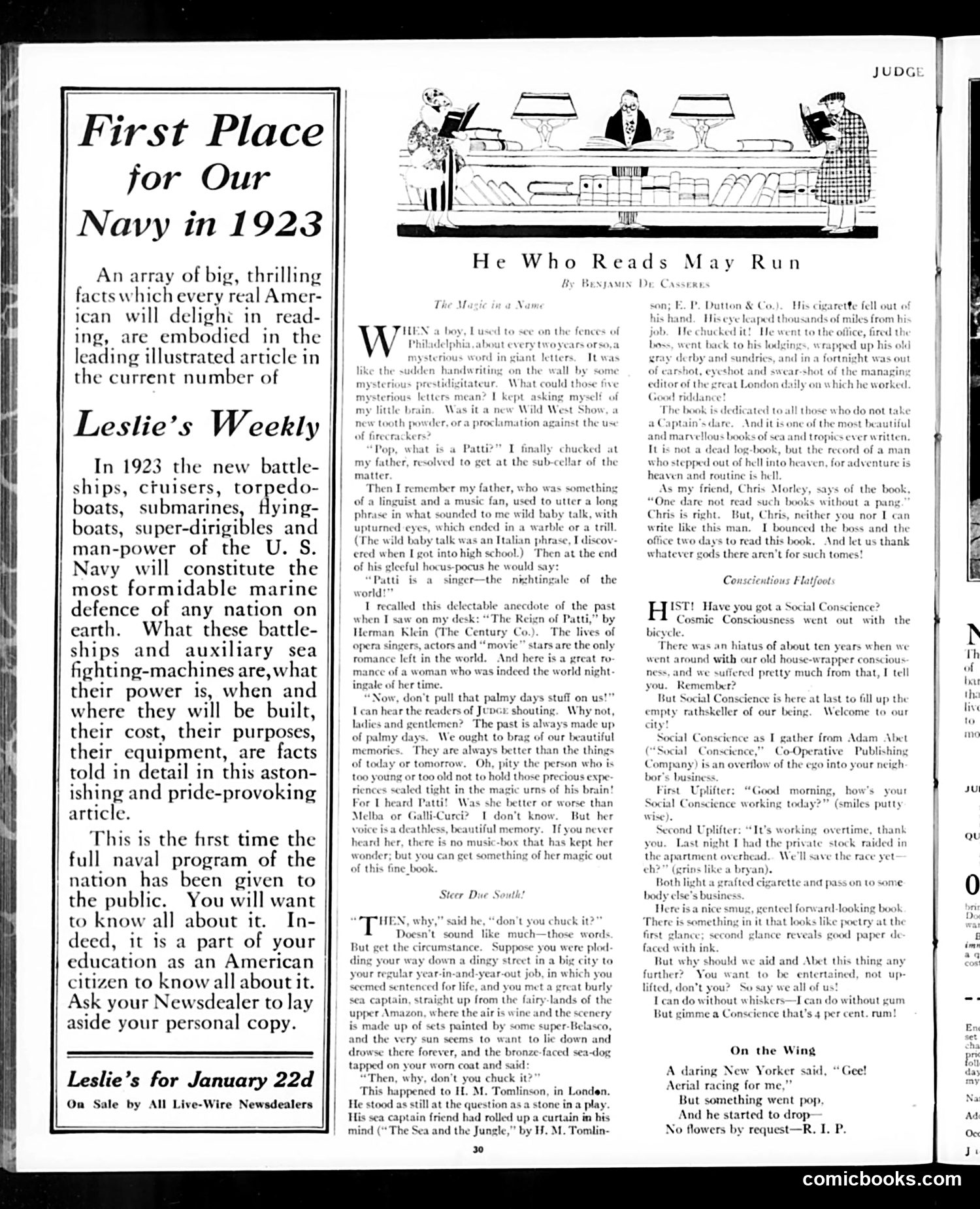
This page is primarily **advertising for Leslie's Weekly magazine**, promoting their January 22nd issue featuring a major article on the U.S. Navy's 1923 military buildup—new battleships, submarines, and aircraft. The ad emphasizes this as patriotic education for Americans, reflecting post-WWI naval anxieties and competition (likely with Britain and Japan). The right side contains **three separate literary pieces**: 1. **"He Who Reads May Run"** discusses opera singer Adelina Patti, reflecting on a childhood memory about her name and fame. 2. **"Conscientious Halfwits"** satirizes superficial "social conscience"—mocking those who adopt trendy causes without real commitment. 3. **"On the Wing"** is a brief humorous poem about aerial racing. These are typical Judge magazine content: light satirical commentary on contemporary culture and manners. No political cartoons appear on this page—it's primarily advertising and feature articles reflecting 1923 American concerns about naval power and social pretension.
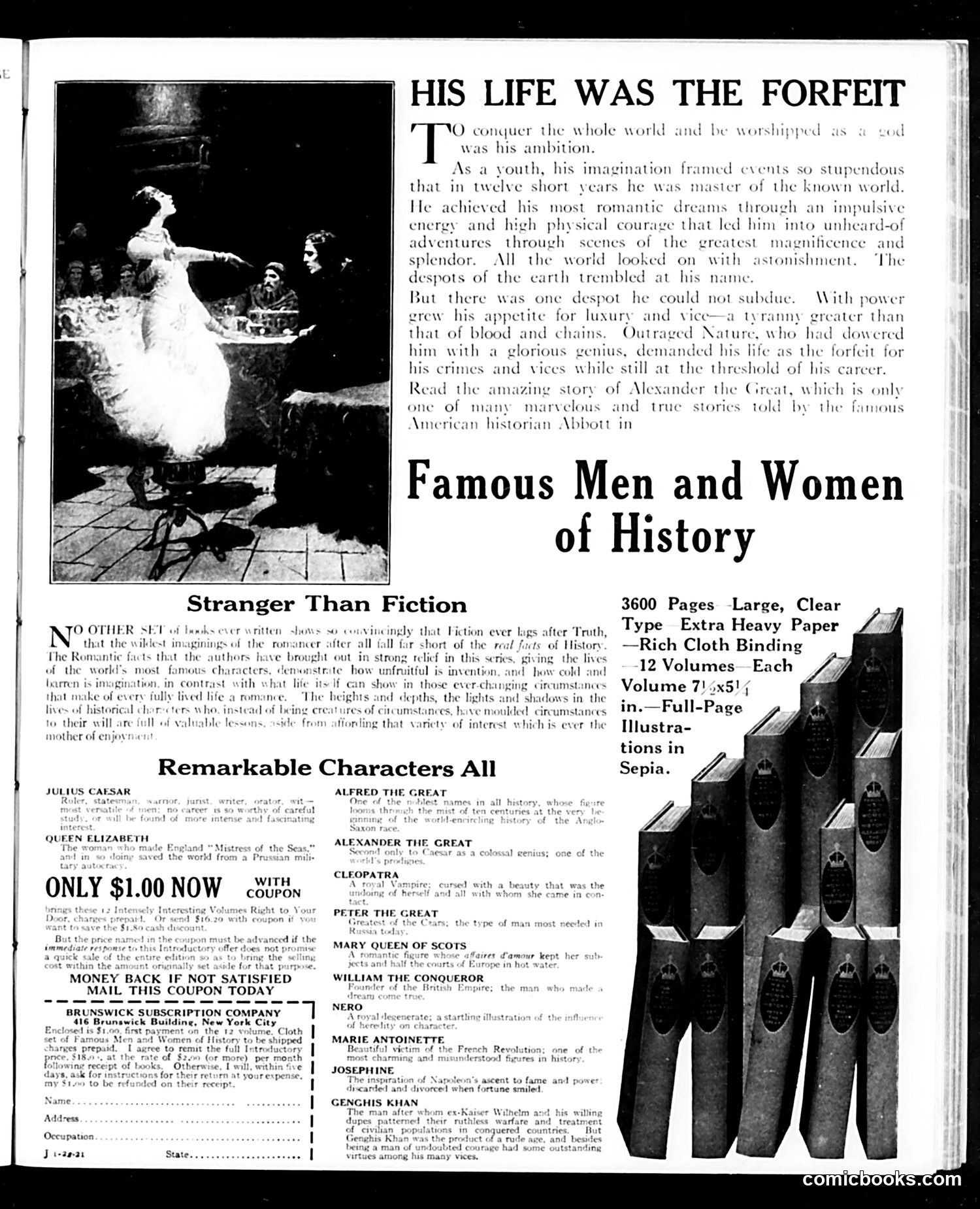
This is primarily a **book advertisement**, not a political cartoon. It promotes "Famous Men and Women of History," a 12-volume encyclopedia-style set published by Brunswick Subscription Company. The page features a dramatic illustration (left) depicting what appears to be **Alexander the Great** in a classical scene with attendants, accompanying the advertisement's headline "His Life Was the Forfeit." The text emphasizes Alexander's meteoric rise to world conquest in twelve years, but moralizes that his appetites for luxury and vice ultimately destroyed him—a cautionary tale about unchecked ambition. The advertisement lists other "Remarkable Characters" covered in the set, including Julius Caesar, Queen Elizabeth, Alfred the Great, Cleopatra, Peter the Great, Mary Queen of Scots, William the Conqueror, Nero, Marie Antoinette, Josephine, Genghis Khan, and others. This represents early 20th-century educational publishing, marketing historical biography as both inspiring and morally instructive to readers. The "$1.00 now with coupon" offer and money-back guarantee were standard direct-mail tactics of the era.
This is an advertisement for *Film Fun* magazine, positioned as editorial content in *Judge*. It promotes a fictional holiday called "Funday"—the day each month when *Film Fun* is released. The piece uses gentle domestic satire, depicting an idealized American family passing around the magazine in order: Mother escapes housework drudgery, Sister admires fashionable actresses (Constance Talmadge, Doris May), Brother wants to see Harold Lloyd comedy stills, and Father—dignified despite responsibilities—secretly enjoys it too. The humor relies on the era's gender stereotypes: women interested in fashion and gossip, men in comedic action sequences. The satire is affectionate rather than biting, suggesting that even serious, hardworking fathers secretly crave entertainment. This reflects 1920s American culture where film magazines and movie stars dominated popular entertainment, and "Funday" serves as marketing that positions *Film Fun* as essential family amusement—worth the twenty-cent cover price.