
Judge, 1921-01-22 · page 5 of 32
Judge — January 22, 1921 — page 5: what you’re looking at
What you’re looking at
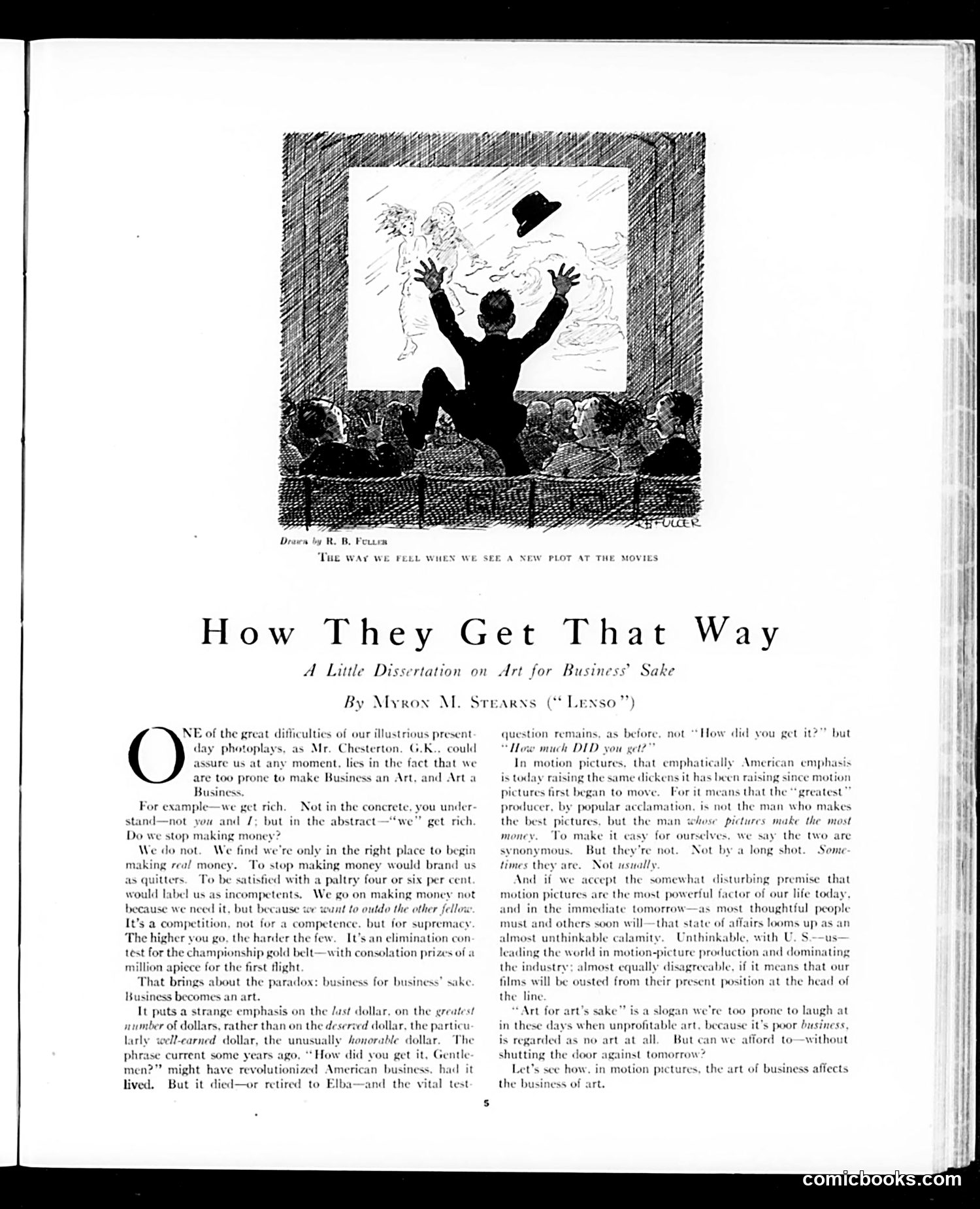
The illustration shows a silhouetted man at a movie theater, arms raised excitedly, watching a silent film. The caption reads: "The way we feel when we see a new plot at the movies." The accompanying article by Myron M. Stearns ("Lenso") satirizes the film industry's commercialism versus artistic merit. Stearns argues that motion pictures prioritize profit ("the *last* dollar") over genuine artistry, using colorful language like "self-earned dollar" and "honorable dollar." The satire's point: American film producers chase money rather than create meaningful art, yet the public enthusiastically consumes whatever plot they're served—hence the exaggerated excitement in the cartoon despite the industry's artistic bankruptcy. The piece critiques both Hollywood's mercenary values and audiences' uncritical consumption of entertainment.
📄 Transcribed text from this page (OCR, searchable)
Machine-transcribed from the original scan — historical spelling and the odd misread are preserved.
by R. B, Feunen ‘The Way we Fee. WuEN We SEE A NEW PLOT AT THE Movies How They Get That Way A Little Dis By Myron M. Stearsxs (Le NE of the great difficulties of our illustrious present day photor as Mr. Chesterton. G.K.. assure us at any moment, lies in the fact that we » make Business an Art, and Art a AVS, could are too prone Business. For example—we get rich stand—not yeu and /; but in the abstract Do we stop making money? We do not. We find we're only in the right place to begin making rea! money. To stop making money would brand us as quitters. To be satisfied with a paltry four or six per cent would label us as incompetents. We go on making money not because we need it, but because we want to outdo the other fellow a competence. but for supremacy The higher vou go, the harder the few. It’s an elimination con test for the championship gold belt—with consolation prizes of a n apiece for the first fight T brings about the paradox: business for business’ sake Business becomes an art. It puts a strange emphasis on the /ast dollar, on the grea! number of dollars, rather than on the deserved dollar, the particu larly well-earned dollar, the unusually honorable dollar. The phrase current some rs ago, “*How did vou get it, Gentle men?” might have revolutionized American business, had it lived. But it died—or retired to Elba—and the vital test you under get rich Not in the concrete “we It’s a competition, not fe srtation on Art for Business’ Sake so’) question remains, as before, not “How did you get it?” but “How much DID you get?” In motion pictures, that emphatically American emp! thas been raising sin rit means that the “greatest” is the man who makes hose pictures make the most for ourselves, we the two are Not by a long shot. Sone is today raising the same dicke © motion pictures first began to move. f producer, by popular acclamati the best pictures. but the man To make it easy But they're not times they are. Not usually. And if we accept the somewhat disturbing premise that money say synonymous. motion pictures are the most powerful factor of our life today, tomorrow—as most thoughtful people must and others soon will—that state of affairs looms up as an almost unthinkable calamity. Unthinkable, with U.S. leading the world in motion-picture product yminating the industry: almost equally disagreeable, if it means that our films will be ousted from their present position at the head of the line Art for art’s sake”’ is a slo; in these days when unprofitable art, because it’s poor business no art at all, But can we atford to—without inst tomorrow? and in the immediate us— nand An we're too prone to laugh at is regardec shutting the door a ’s see how. in motion pic cts es, the art of business 4 the business of art.