
A complete issue · 32 pages · 1918
Judge — November 2, 1918
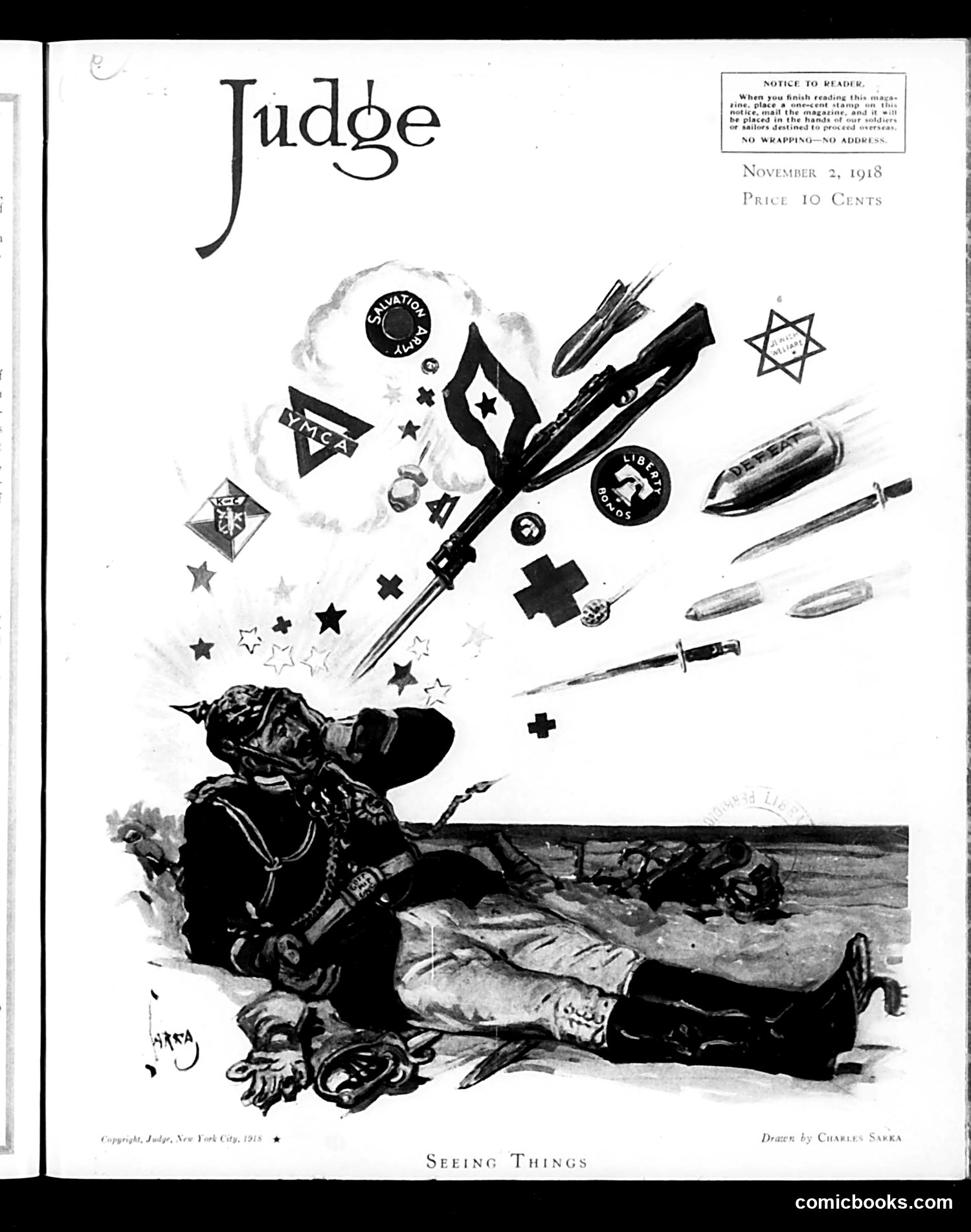
This political cartoon by Charles Sarka depicts a soldier experiencing what appears to be a hallucinatory or delirious vision. The prone figure sees military symbols and weaponry floating above—including rifles, bayonets, bullets, bombs, and various national emblems (YMCA, Salvation Army, Liberty Bonds insignia). Published just days before WWI's armistice (November 11, 1918), the cartoon likely satirizes the psychological toll of combat on soldiers returning from the front. The "seeing things" title suggests shell shock or war trauma—a condition soldiers experienced but society wasn't yet equipped to acknowledge or treat. The surreal imagery of floating weapons and patriotic symbols reflects the disconnect between civilian wartime propaganda and soldiers' lived horror.
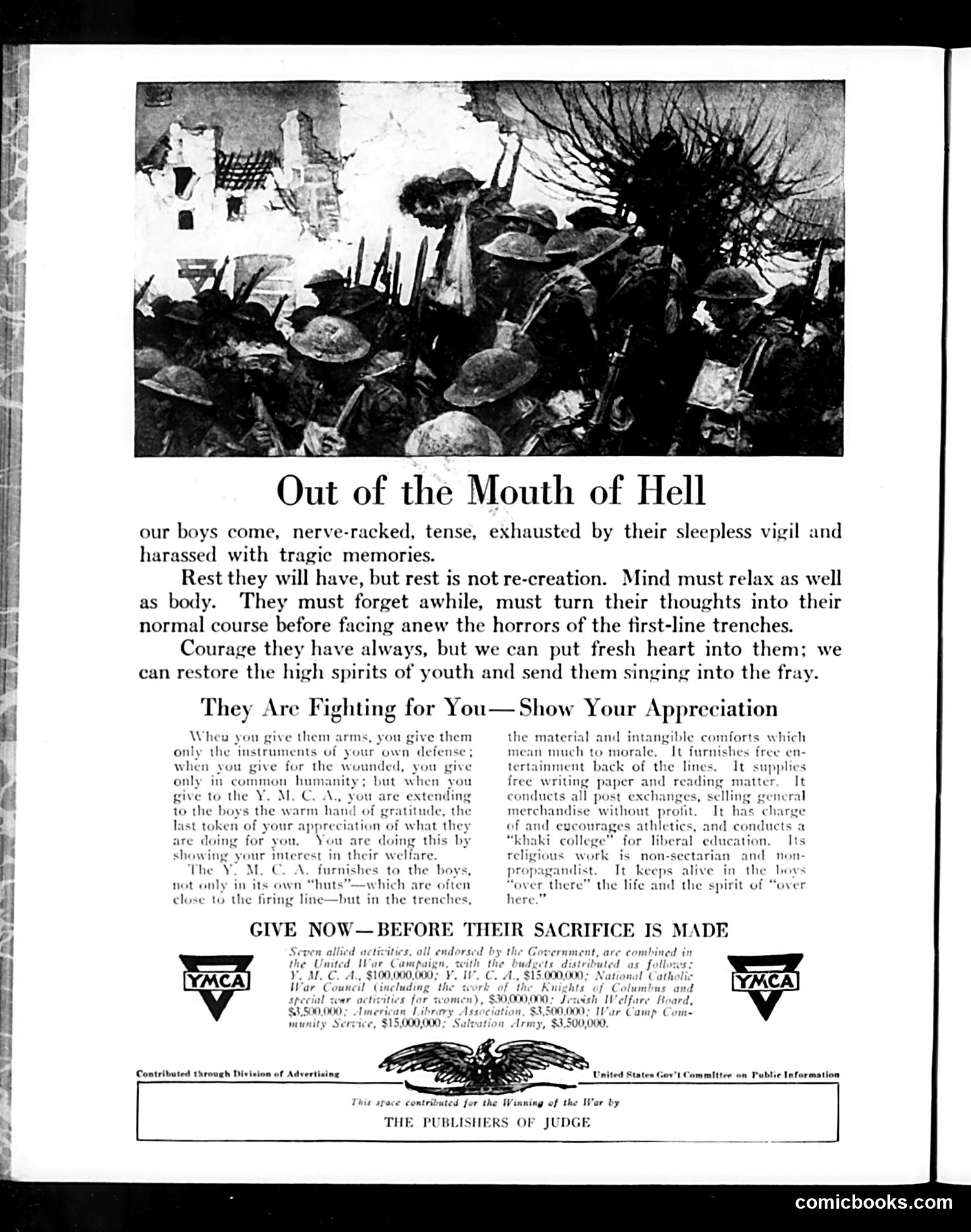
This appears to be a WWI-era fundraising appeal rather than satire or political cartoon. The dramatic photograph shows exhausted soldiers emerging from trenches—"out of the mouth of hell"—depicting the brutal reality of trench warfare. The text argues that soldiers need rest and morale support, and urges Americans to donate to the YMCA (Young Men's Christian Association), which provided recreational facilities and supplies to troops. The page lists various charitable organizations seeking funds, with YMCA prominently featured. Rather than satirizing these causes, Judge magazine donated this space to support the war effort and encourage public donations. The "Winning of the War" credit at the bottom confirms this was government-approved propaganda material promoting American charitable giving during World War I.
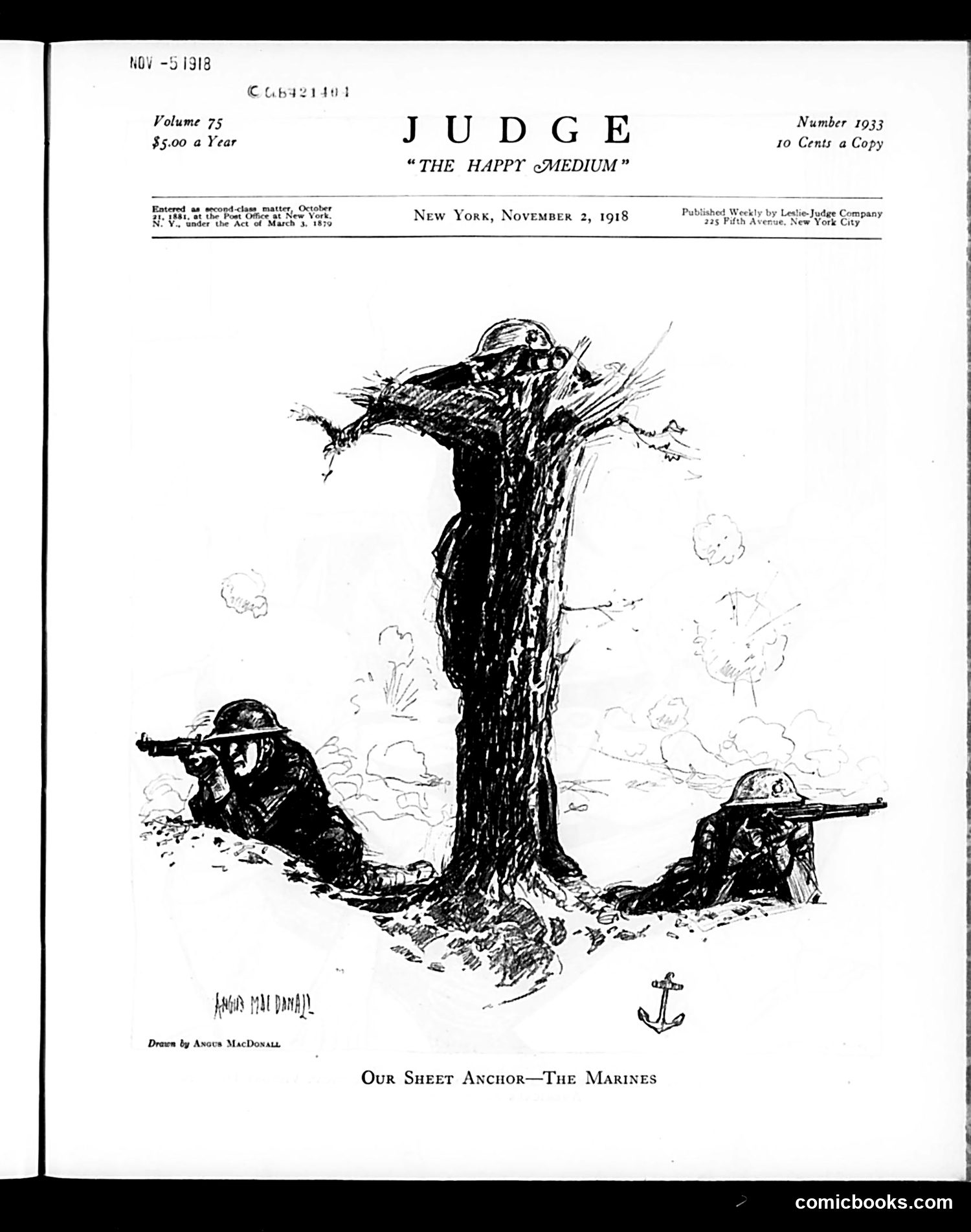
This November 2, 1918 Judge cartoon appeared just as World War I was ending (Armistice came November 11). The image shows three Marines in combat positions around a tree, with one figure perched atop it—likely representing either a German soldier or a strategic position being captured. The title "Our Sheet Anchor" (a nautical term for a ship's most reliable anchor) suggests the Marines are America's steadfast military foundation. The cartoon celebrates the Marines' combat effectiveness and reliability during the war's final days. Drawn by Amos MacDonald, it's patriotic propaganda emphasizing the Marines' vital role in securing American victory, presented as the nation's most dependable military asset.
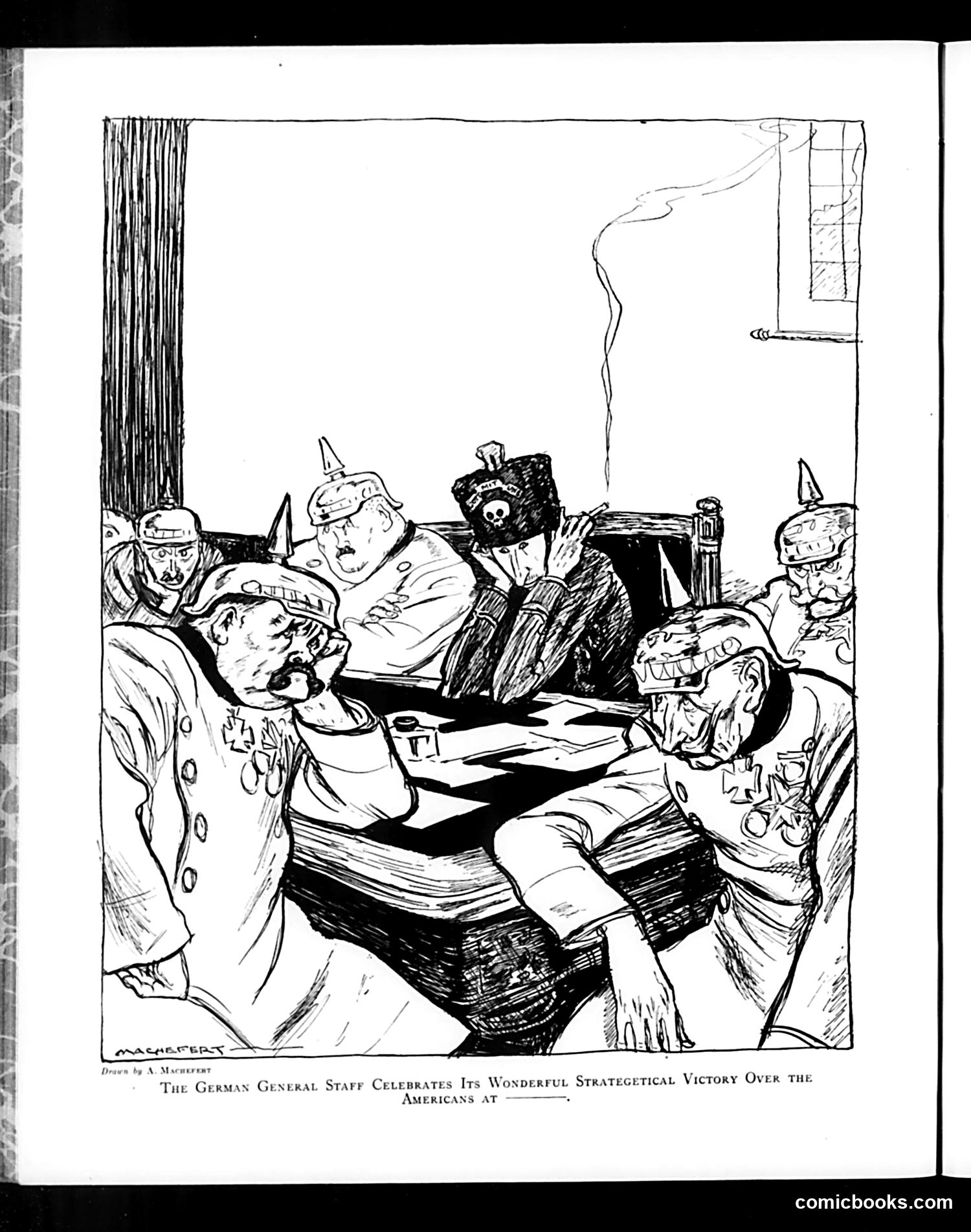
This cartoon from *Judge* magazine satirizes German military leadership during World War I. The caption reads: "The German General Staff Celebrates Its Wonderful Strategical Victory Over the Americans at ___" (the location is deliberately left blank). The image depicts caricatured German officers wearing spiked Prussian helmets, gathered around a table in what appears to be a celebratory meeting. The satire mocks German claims of military success against American forces by depicting an absurdly premature or false celebration—the blank location suggests the Germans were making unfounded boasts about victories that hadn't actually occurred. The exaggerated facial features and body language emphasize the cartoonist's mockery of German military arrogance and propaganda during the war.
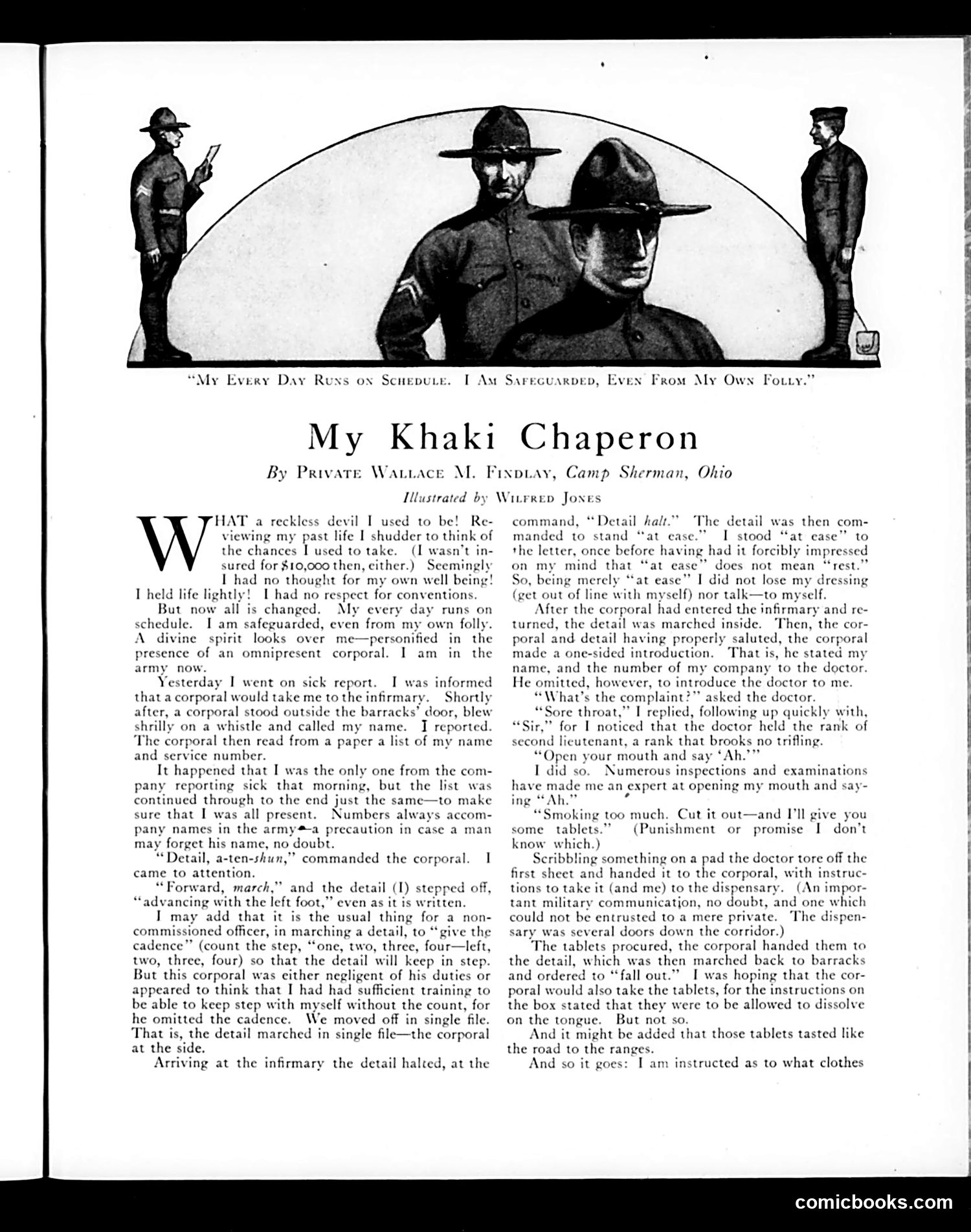
This is a humorous article by Private Wallace M. Findlay from Camp Sherman, Ohio, illustrated by Wilfred Jones. It satirizes the rigid military discipline and absurd regulations soldiers endured during World War I. The article recounts how a formerly reckless civilian became obsessed with military protocol after enlisting. The satire centers on the soldier's transformation into someone so regimented that he follows rules even when they make no sense—like a "detail halt" that taught him to stand "at ease" means standing rigidly, not actually resting. The joke mocks both military bureaucracy's inflexibility and the soldier's internalization of pointless authority. The title suggests military discipline has become his constant "chaperon," monitoring his every action. This reflects broader WWI-era satirical commentary on how military life constrains individual freedom.
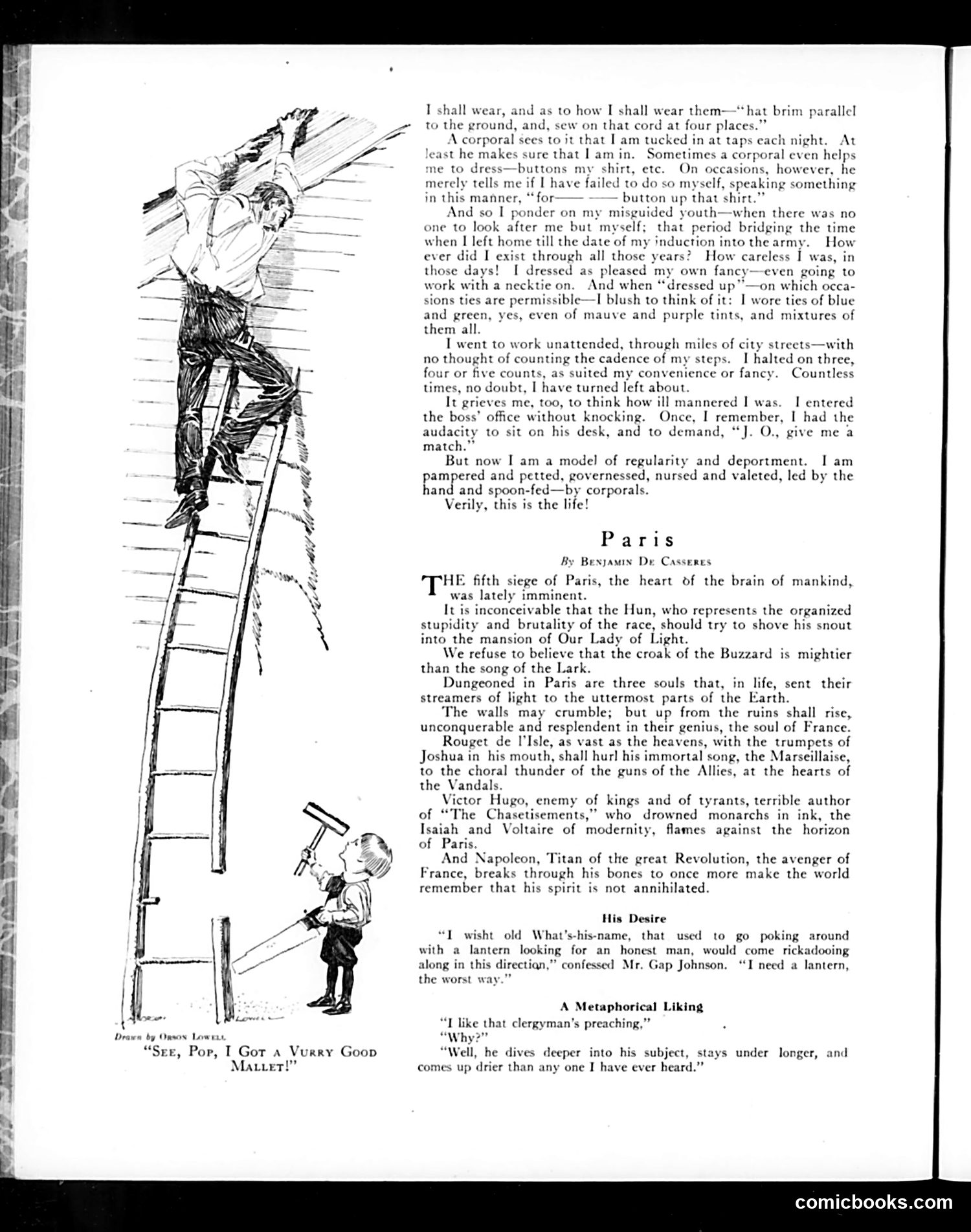
The left illustration, captioned "See, Pop, I Got a Very Good Mallet!" by Oscar Cesare, depicts a small figure climbing a tall ladder toward a larger figure at the top. This appears to be political satire about class struggle or social climbing during a period of labor unrest—the "mallet" likely symbolizes working-class tools or revolutionary action. The right section contains "Paris" by Benjamin De Casseres, a prose piece celebrating French cultural figures (Hugo, Napoleon, Voltaire) as defenses against German expansion during WWI. The text frames these intellectuals as spiritual weapons against enemy "brutality." The page mixes visual satire with patriotic literary commentary typical of Judge's wartime content, likely from the 1910s.
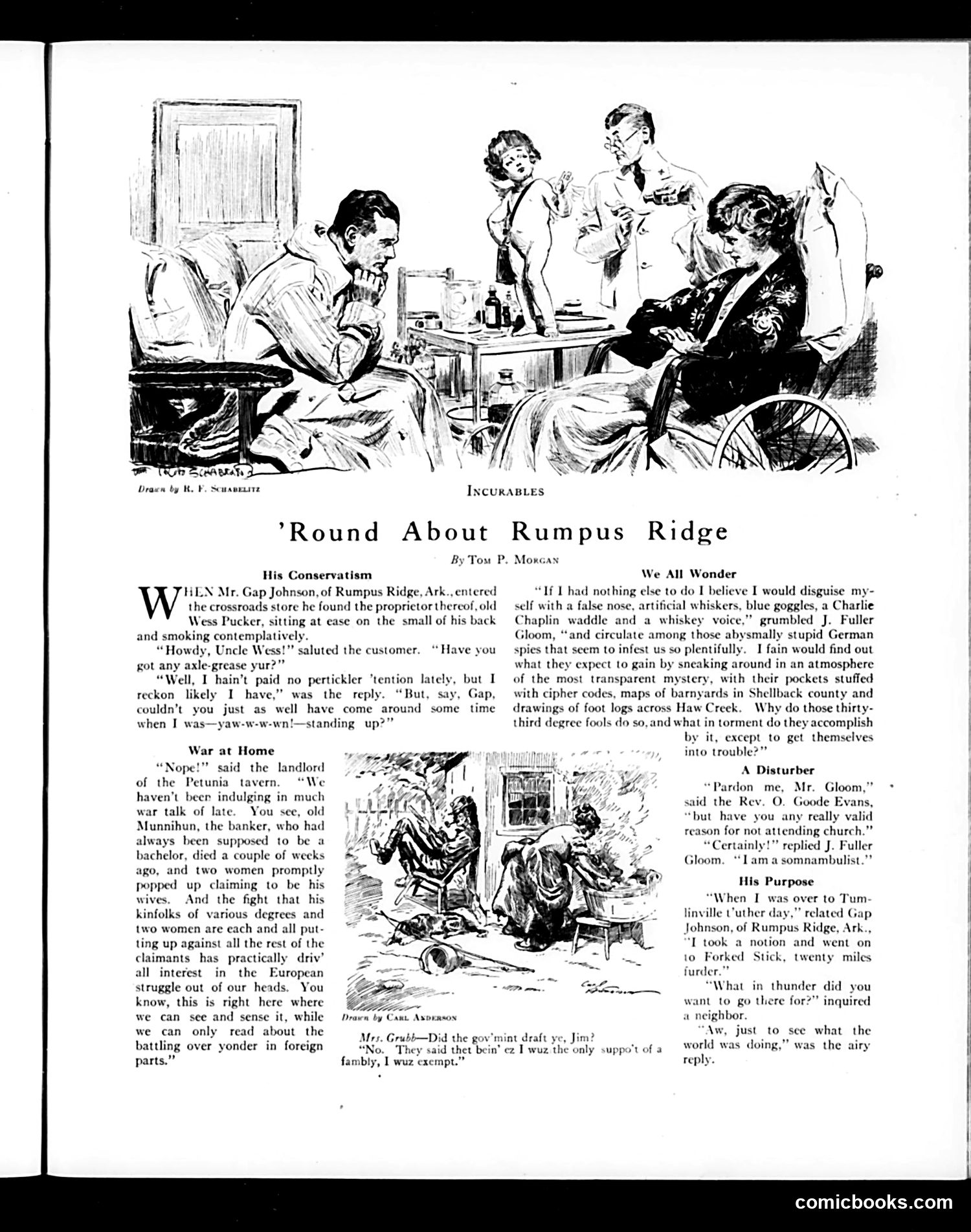
This page presents three humorous rural sketches satirizing small-town American life, likely from the WWI era (references to "European struggle" and draft). **The sketches mock:** 1. **Rural conservatism**: A store proprietor resists change, preferring customers visit during inconvenient times rather than adapt. 2. **Misplaced priorities**: A tavern owner reveals that local gossip about a dead bachelor's two wives has completely displaced interest in actual war—suggesting rural America's detachment from serious events. 3. **Urban pretension and German spies**: J. Fuller Gloom fantasizes about infiltrating German spies who supposedly hide in rural areas with absurd intelligence (maps of barnyards, foot logs), mocking both spy hysteria and rural vulnerability to outsiders. The humor targets rural isolation, resistance to modernity, and the gap between small-town concerns and national events. The setting of "Rumpus Ridge, Ark." emphasizes backwoods provincialism.
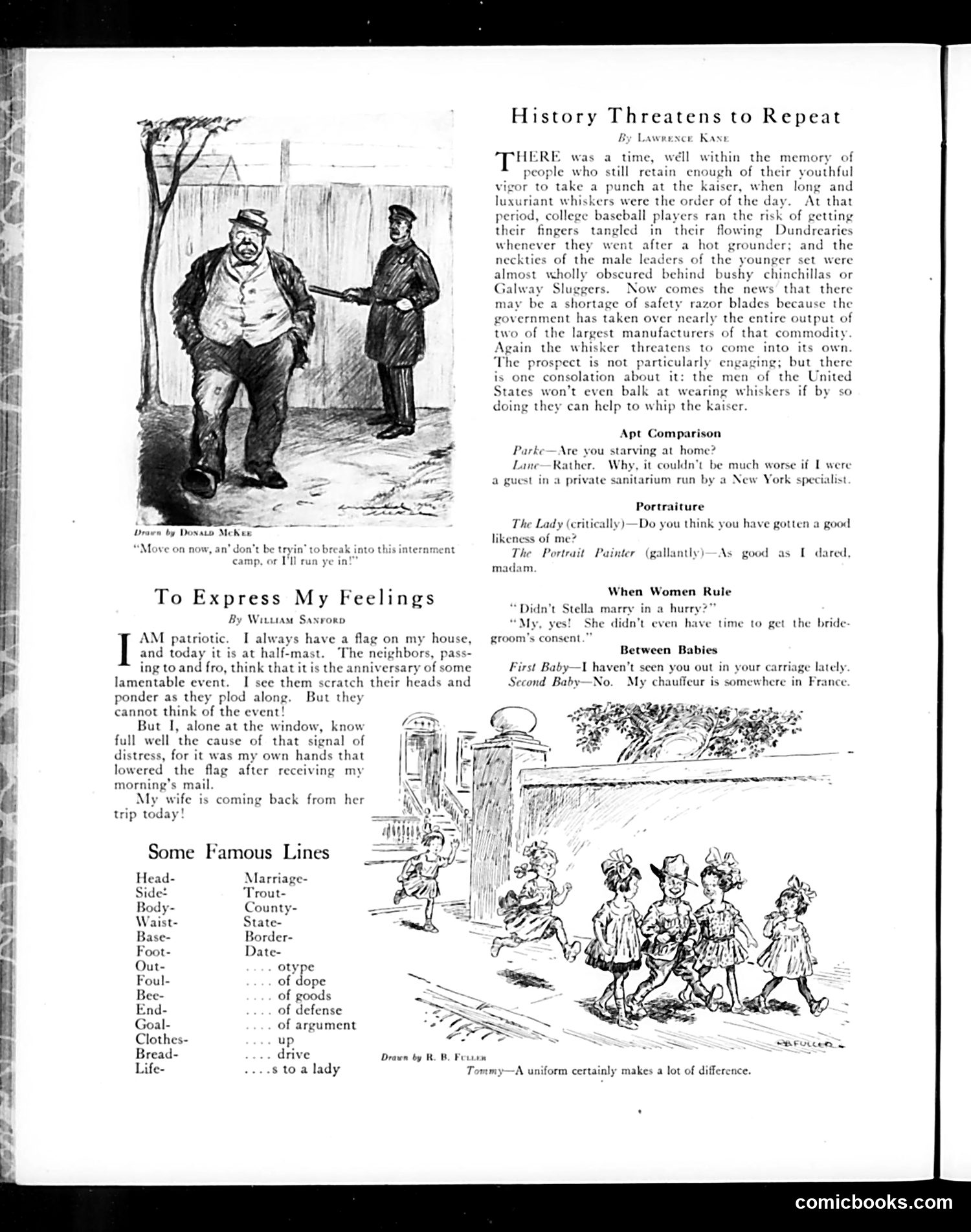
This page contains several satirical pieces reflecting WWI-era American concerns: **"History Threatens to Repeat"** warns that a safety razor blade shortage (due to government commandeering manufacturers' output for the war effort) may revive the fashion of large beards and whiskers popular before the Civil War era. The satire: Americans won't mind looking ridiculous if it helps "whip the kaiser." **"To Express My Feelings"** jokes that a husband lowers his flag to half-mast upon learning his wife is returning from a trip—treating her homecoming as a tragedy. This reflects common misogynistic humor about nagging wives. **"Between Babies"** references WWI: one baby hasn't seen another because "my chauffeur is somewhere in France"—a dark joke about war separations and class status. Other jokes mock women's suffrage, sanitariums, and portraiture. The cartoon showing a child in uniform includes the caption "A uniform certainly makes a lot of difference"—likely commenting on how military dress affected social perception during wartime. The page reflects 1910s-20s American attitudes: patriotic anxiety about the war effort, domestic gender conflicts, and class consciousness.
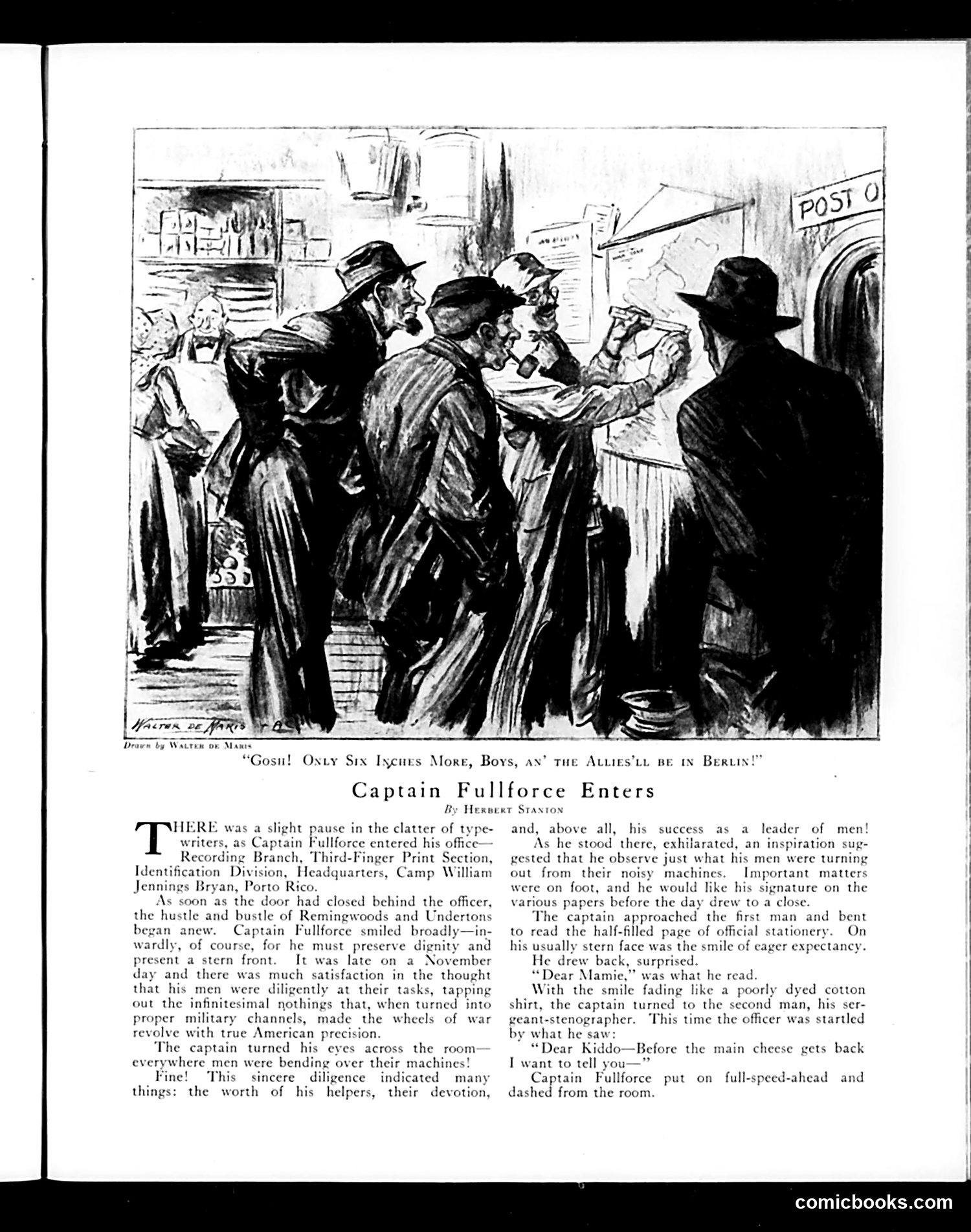
This story satirizes military bureaucracy during World War I. Captain Fullforce oversees a typing pool at a stateside military office (Camp William Jennings Bryan, Porto Rico) where soldiers are supposedly processing important war documents. The humor turns on discovering that the men are actually using government typewriters and time to write personal love letters instead. The opening dialogue joke—"Only six inches more, boys, and the Allies'll be in Berlin!"—suggests soldiers anticipating war's end through official channels, but the reality is their indifference to actual military work. The satire targets: lazy military personnel neglecting duties, the gap between military efficiency and actual practice, and the contrast between the captain's pride in his men's "diligence" and their actual activities. It's a gentle critique of wartime administrative waste and soldier morale problems.
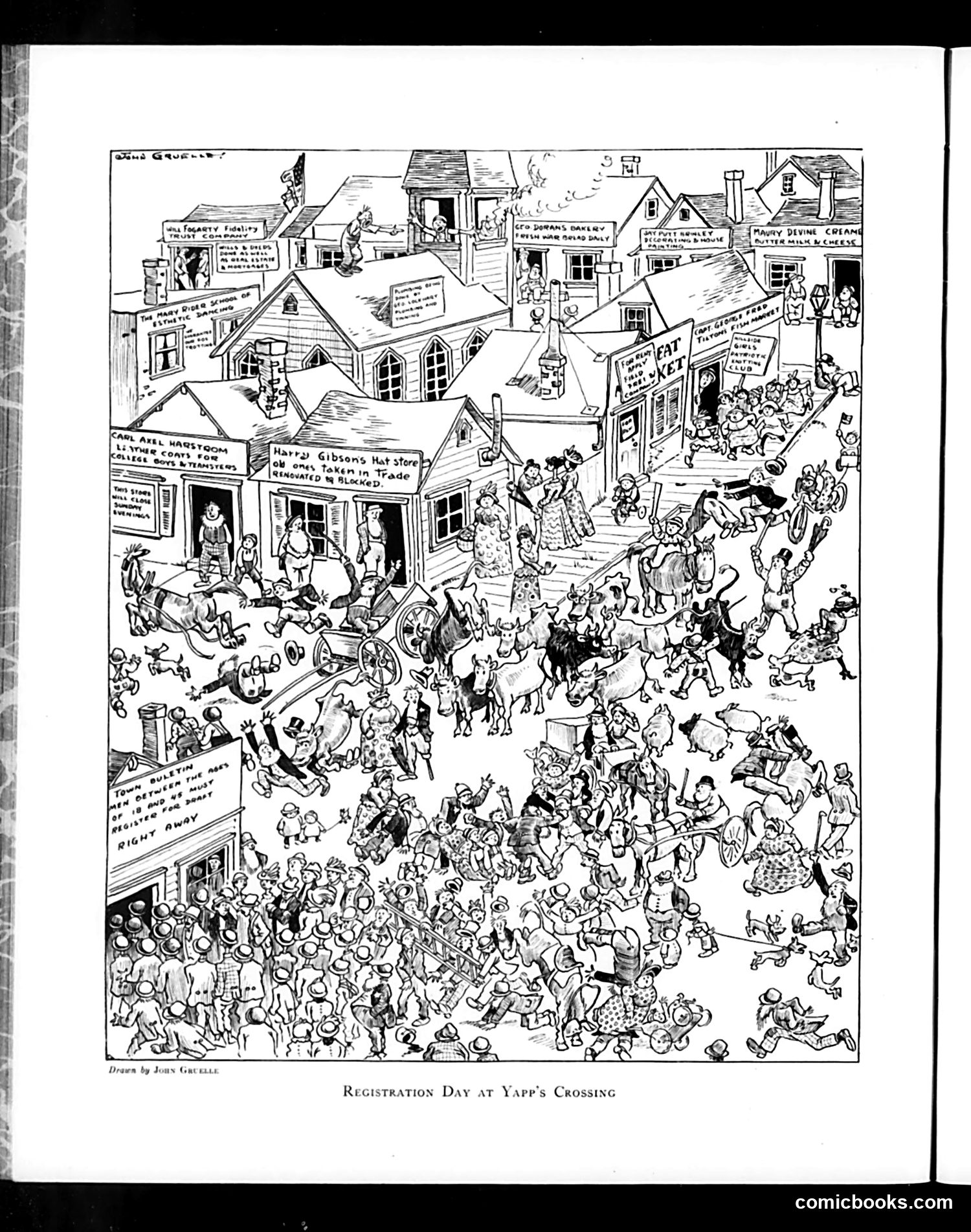
This is a satirical illustration drawn by John Guncella depicting chaotic scenes at a small-town crossroads during what appears to be voter registration day. The cartoon shows numerous townspeople, animals, and comical figures in a deliberately crowded, disorderly scene—suggesting the confusion and pandemonium surrounding registration efforts. Various shop signs and labels visible in the buildings reference local businesses (Harry Gibson's Hat Store, a creamery, and others). The satire appears to mock the disorder of registration processes or possibly critiques participation levels in civic duties. The exaggerated chaos—with people, livestock, and general mayhem filling the street—suggests Judge magazine's skeptical or humorous take on American voting procedures or public administration during the registration period referenced.
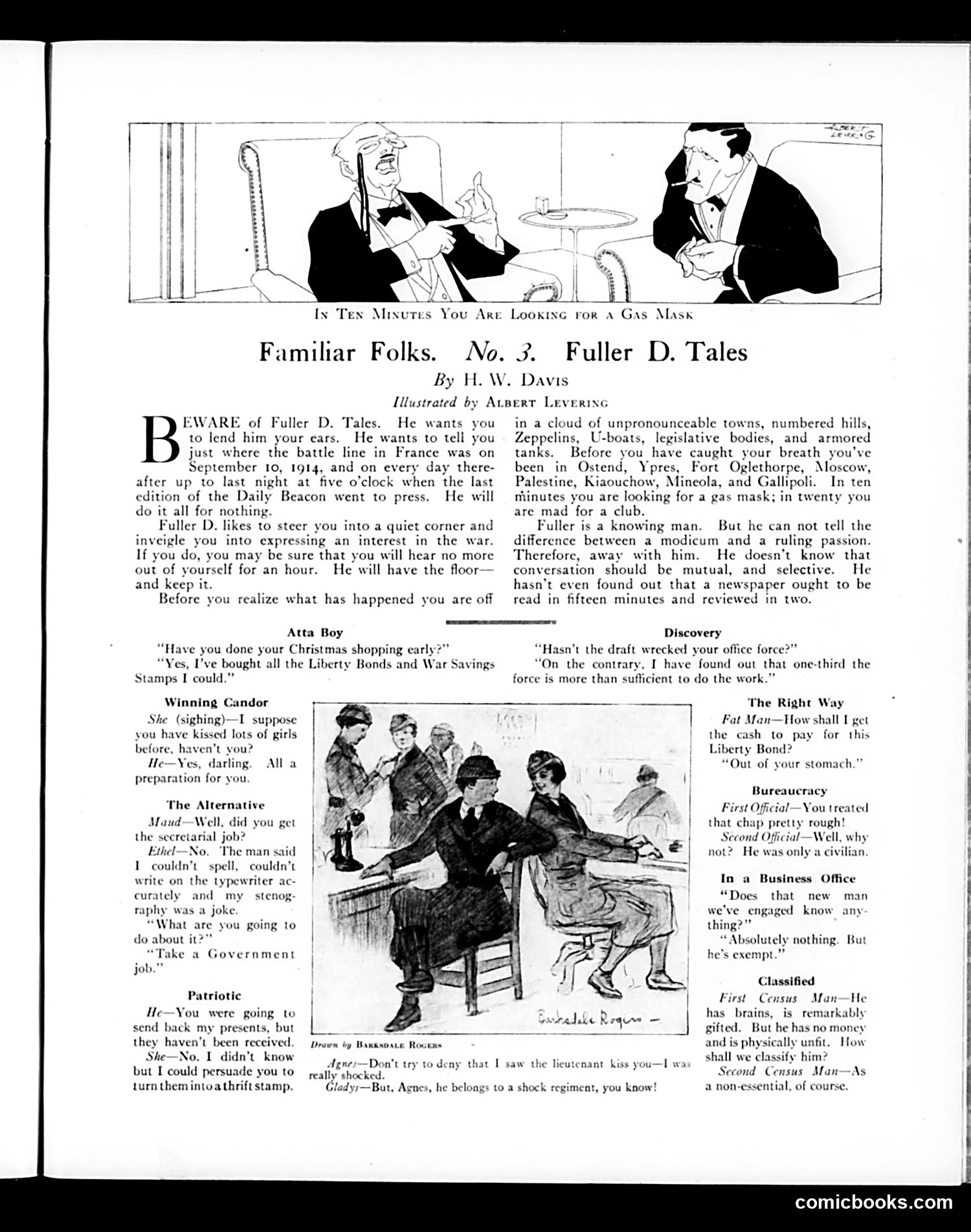
This page from *Judge* magazine satirizes "Fuller D. Tales," a stock character representing the tiresome war bore—someone obsessed with WWI details who monopolizes conversation about the conflict. The main cartoon shows him buttonholing a reluctant listener with geographic references (Ostend, Ypres, Gallipoli, etc.) and military details, boring his victim so thoroughly he'd "look for a gas mask" to escape. The surrounding vignettes mock various WWI-related attitudes and wartime absurdities: patriotic citizens buying Liberty Bonds, bureaucratic incompetence, draft exemptions allowing useless men to stay employed, and the gap between idealistic rhetoric and practical reality. The cartoon's central joke: Fuller represents Americans who became obsessed with war minutiae through newspaper coverage, inadvertently becoming social nuisances. The "gas mask" reference plays on both suffocation from boredom and the literal horrors of trench warfare being discussed.
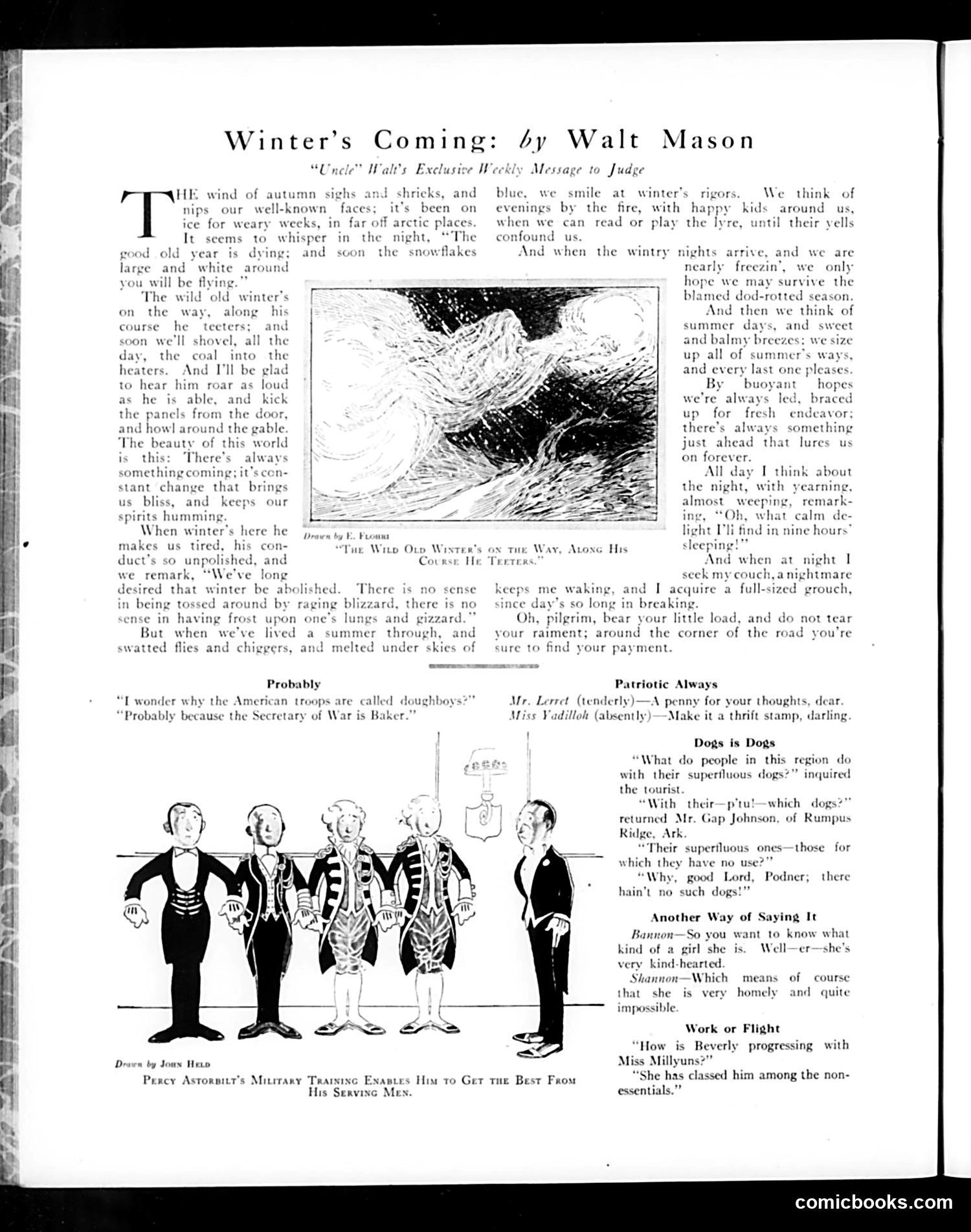
This page contains several satirical pieces typical of Judge magazine's content: **"Winter's Coming" by Walt Mason** is the main feature—a nostalgic essay about anticipating winter's arrival, illustrated with a dramatic landscape drawing. It romanticizes winter's hardships while acknowledging the hope that sustains people through harsh seasons. **"Probably"** is a brief joke about why American troops are called "doughboys," attributing it to Secretary of War Baker (likely Newton Baker, WWI-era Secretary of War). The cartoon shows five uniformed military figures, with the humor being a pun on Baker's name. **Other brief jokes** include: - "Patriotic Always"—a quip about donating war bonds - "Dogs is Dogs"—a rural dialect joke about superfluous farm dogs - "Another Way of Saying It"—wordplay about describing a girl as "kind-hearted" (implying homely) - "Work or Flight"—a joke about a woman classifying a suitor as "non-essential" The page reflects Judge's typical mix of sentimental Americana, gentle political references (Baker), and brief comedic exchanges relying on wordplay and social observation rather than sharp satire.
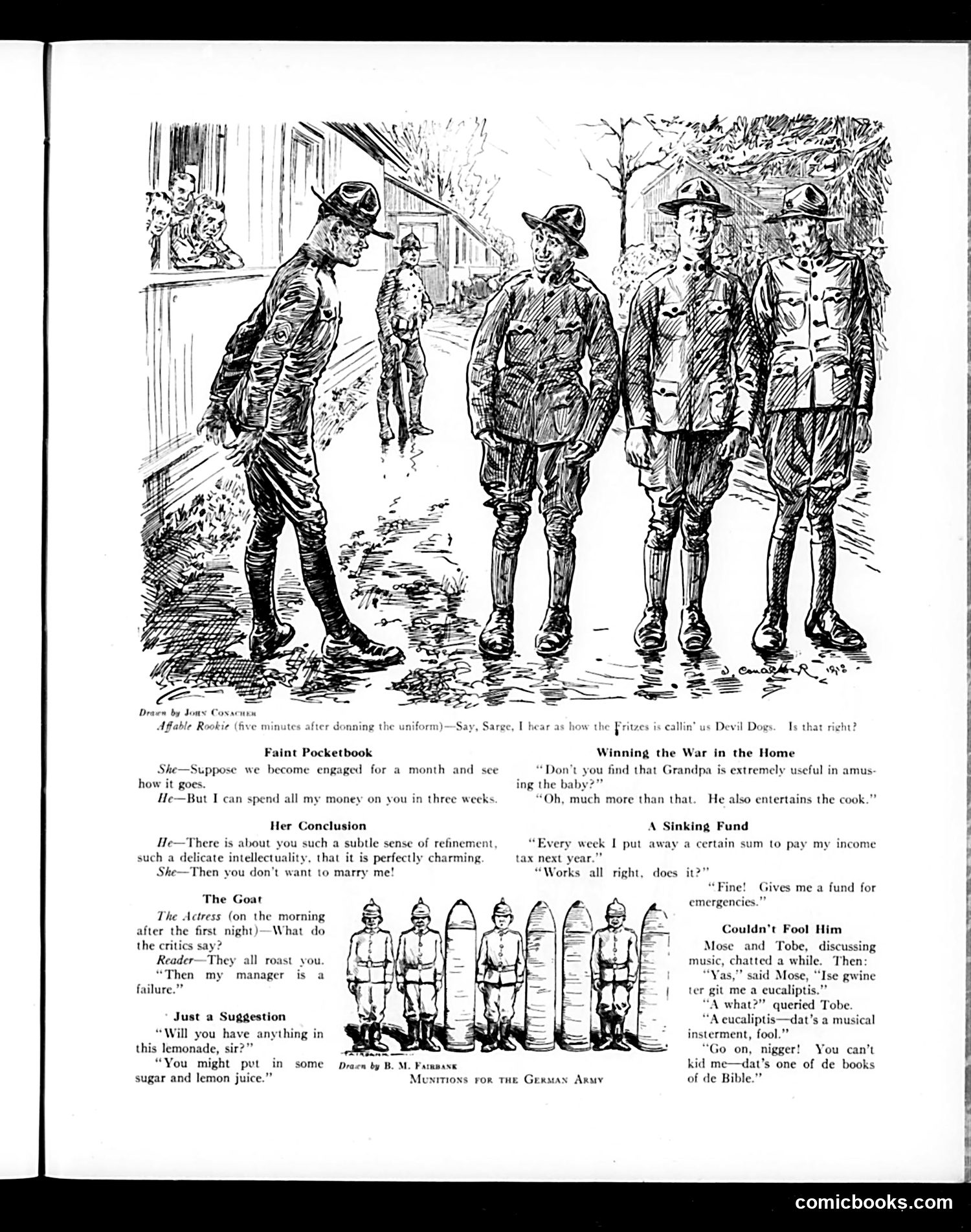
This page contains multiple short humor pieces and two illustrations, likely from WWI era (references to "Devil Dogs"—Marine recruits—and German Army). **Top illustration**: A newly uniformed soldier ("Affable Rookie") asks officers if "Fritzies" calling them "Devil Dogs" is accurate—gentle satire on military slang and recruit naïveté. **Text pieces**: Brief comedic dialogues about engagement/money, wartime home economics, theatrical criticism, and musical misunderstanding. The final piece features racist dialect humor typical of early 20th-century American publications, depicting two Black characters ("Mose and Tobe") where one mistakes "eucalyptus" for a musical instrument—humor dependent on minstrelsy stereotypes. **Bottom illustration**: Ammunition ("Munitions for the German Army")—likely WWI propaganda satire. The page reflects Judge's satirical approach to contemporary issues: relationships, war preparation, and entertainment, though much of the humor—particularly the racial stereotyping—reflects deeply problematic editorial standards of that era.
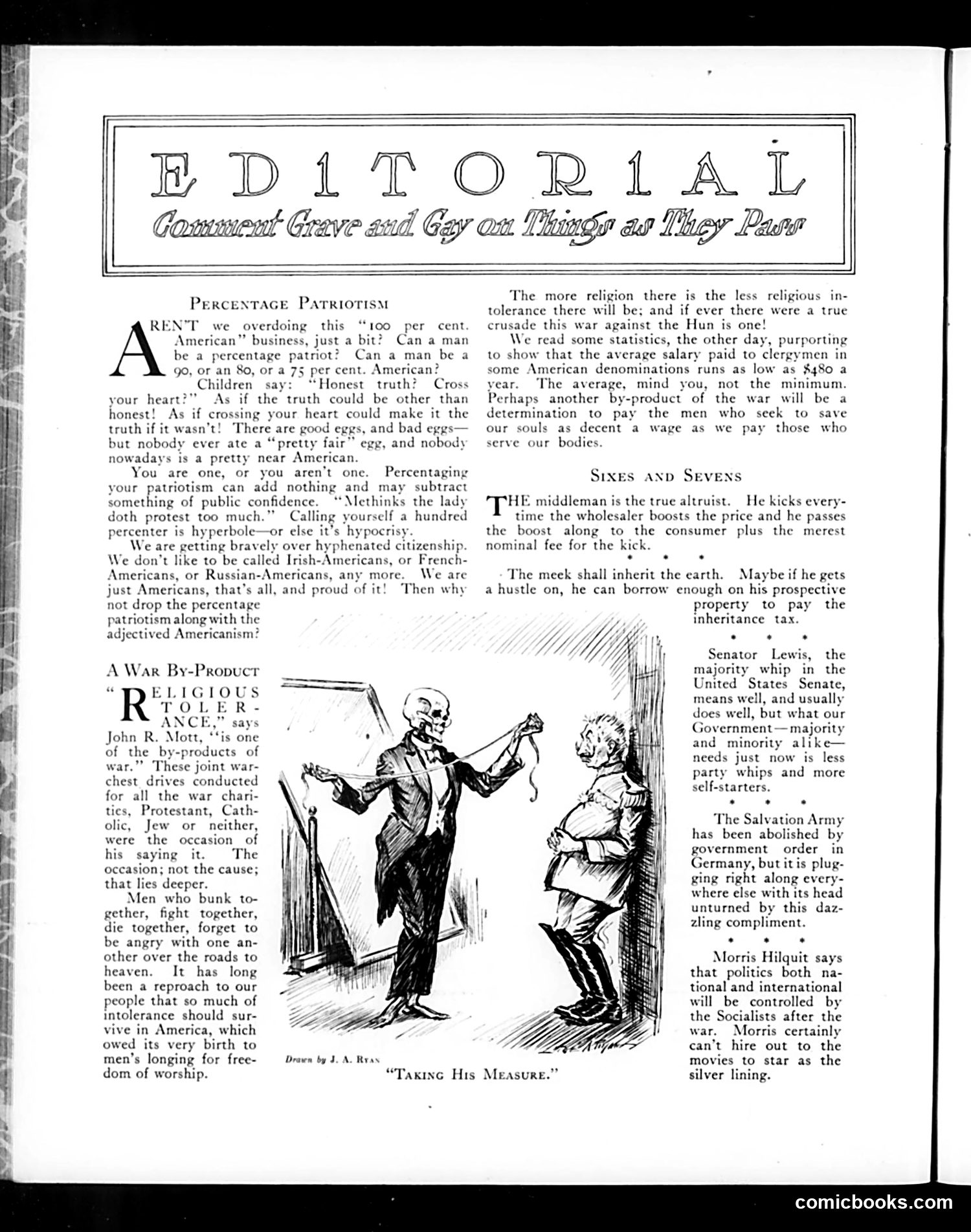
This editorial page presents WWI-era American satirical commentary on patriotism and social issues. **"Percentage Patriotism"** criticizes Americans claiming "100% Americanism" while retaining ethnic hyphenations (Irish-American, Russian-American). The author argues patriotism cannot be measured in percentages—one either is American or isn't—and that emphasizing such distinctions undermines national unity. **"Taking His Measure"** (the cartoon) depicts a skeletal figure, likely representing Death or the consequences of war, being measured by a uniformed official. This likely comments on wartime casualties or the human cost of conflict. **"A War By-Product"** discusses religious tolerance emerging from joint WWI charitable drives uniting different faiths. It notes that soldiers who fight together transcend religious prejudices, and suggests America should pay clergy better wages—matching what soldiers receive. The remaining short items satirize middlemen profiting during commerce, inheritance taxes, Senator Lewis's political leadership, Germany's suppression of the Salvation Army, and socialist Morris Hilquit's predictions about post-war politics. The tone is typically acerbic Judge humor, mixing patriotic concerns with class criticism.
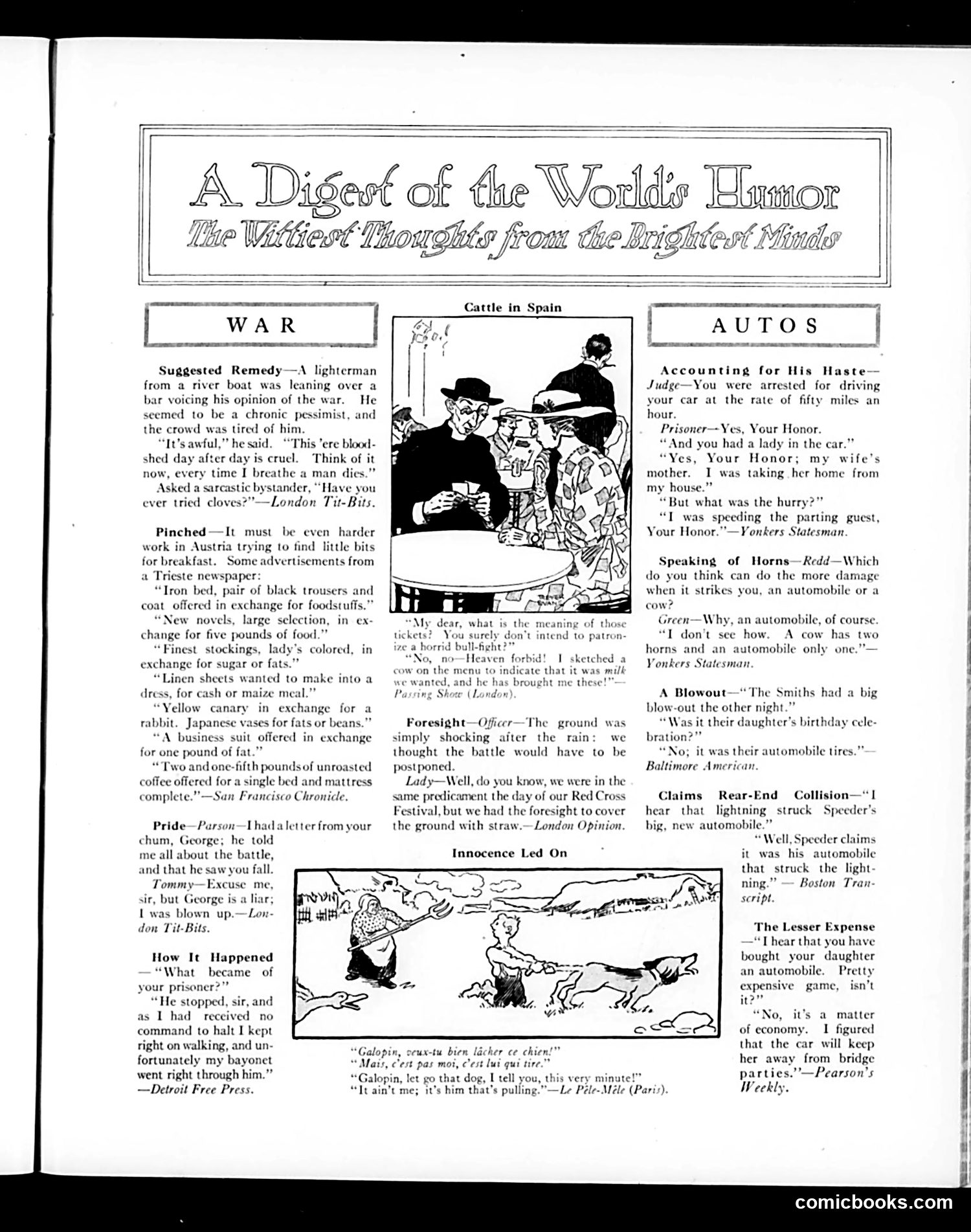
This satirical page collects wartime and modern jokes from 1910s-era publications. The humor reflects World War I anxieties and the novelty of automobiles. **War section** mocks military incompetence and wartime hardship: a pessimistic soldier is told to try cloves to stop breathing (and thus stop witnessing deaths), and Austria's desperate food shortages are shown through absurd barter ads (trading furniture for meals). One joke portrays a soldier casually killing a prisoner through negligence. **"Cattle in Spain"** depicts a dinner misunderstanding where a sketch of a cow is mistaken for a bullfighting ticket request. **Autos section** satirizes early automobile culture: speeding drivers, insurance claims, and horn dangers. The final joke suggests cars are economical because they keep daughters away from social gatherings—implying both the car's expense and parents' desire to limit daughters' independence. The humor is gentle, domestic, and reflects anxieties about modern technology and wartime disruption.
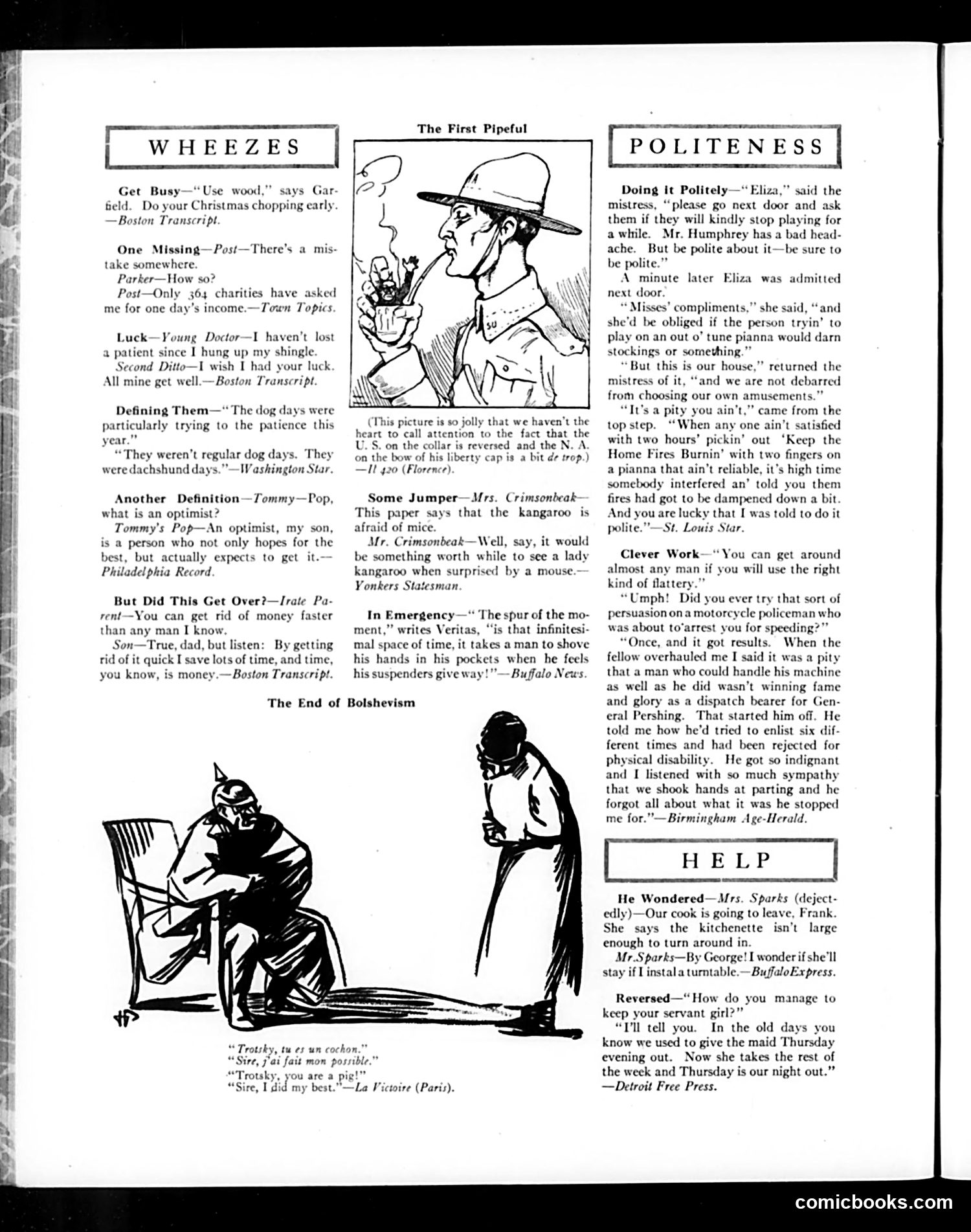
This page from Judge contains satirical short humor pieces and cartoons reflecting early 20th-century American life. **"The First Pipeful"** cartoon depicts a figure smoking a pipe with reversed patriotic symbols (U.S. and N.A. backward on his collar and liberty cap)—likely mockery of careless patriotism or bungled Americanism during a period of heightened nationalism. **"The End of Bolshevism"** cartoon shows two figures in conversation, with French dialogue mocking Leon Trotsky as a pig ("cochon"). This references post-WWI anti-Bolshevik sentiment, satirizing communist leadership during the Russian Revolution period. The humor pieces mock everyday frustrations: servants lacking discretion, optimists, wealthy people donating carelessly, and marital domestic disputes about servants and kitchens. One piece references General Pershing (WWI commander), dating this likely to 1917-1920. Overall, the page satirizes contemporary social anxieties: class relations, patriotism, and emerging socialism—typical of Judge's middle-class perspective.
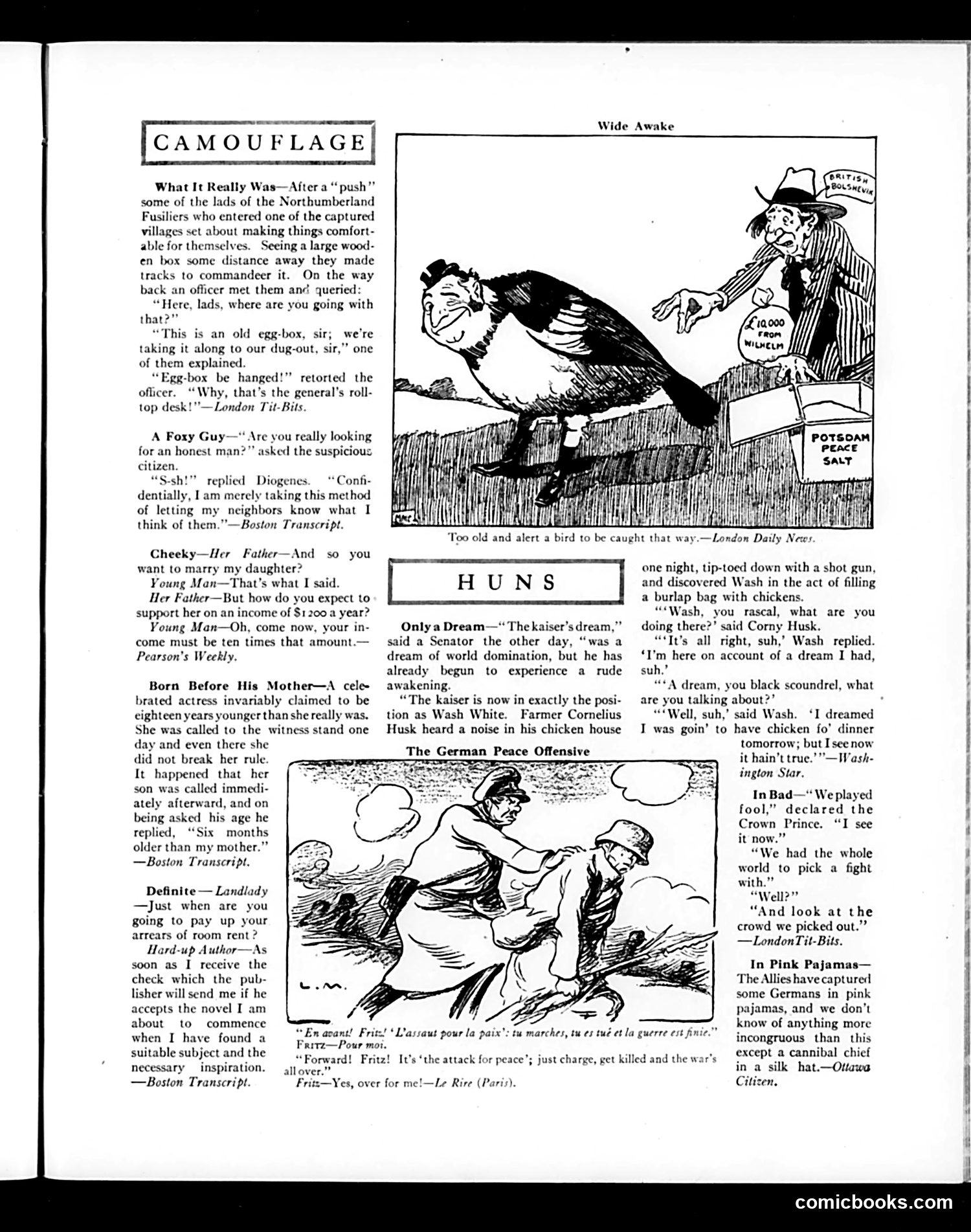
This Judge magazine page from World War I satirizes German military leadership and the war effort through multiple cartoons and humor pieces. **Main Cartoon (top right):** An elderly, predatory figure (likely representing Kaiser Wilhelm II or German militarism) attempts to catch a bird labeled "Peace" near a sign reading "Potsdam Peace Bait." The caption notes the bird is "too old and alert" to be caught—mocking Germany's failed peace overtures as transparent traps. **"The German Peace Offensive":** A French cartoon shows German soldiers being ordered to charge while told it's a "peace attack"—dark satire suggesting Germany's peace proposals were actually military deceptions. **Other pieces** mock German military incompetence and the Kaiser's failed ambitions for world domination. The page reflects American/Allied wartime propaganda portraying Germany as deceptive and aggressive, using humor to boost morale and ridicule the enemy. The satirical tone was typical of Judge's editorial stance during WWI.
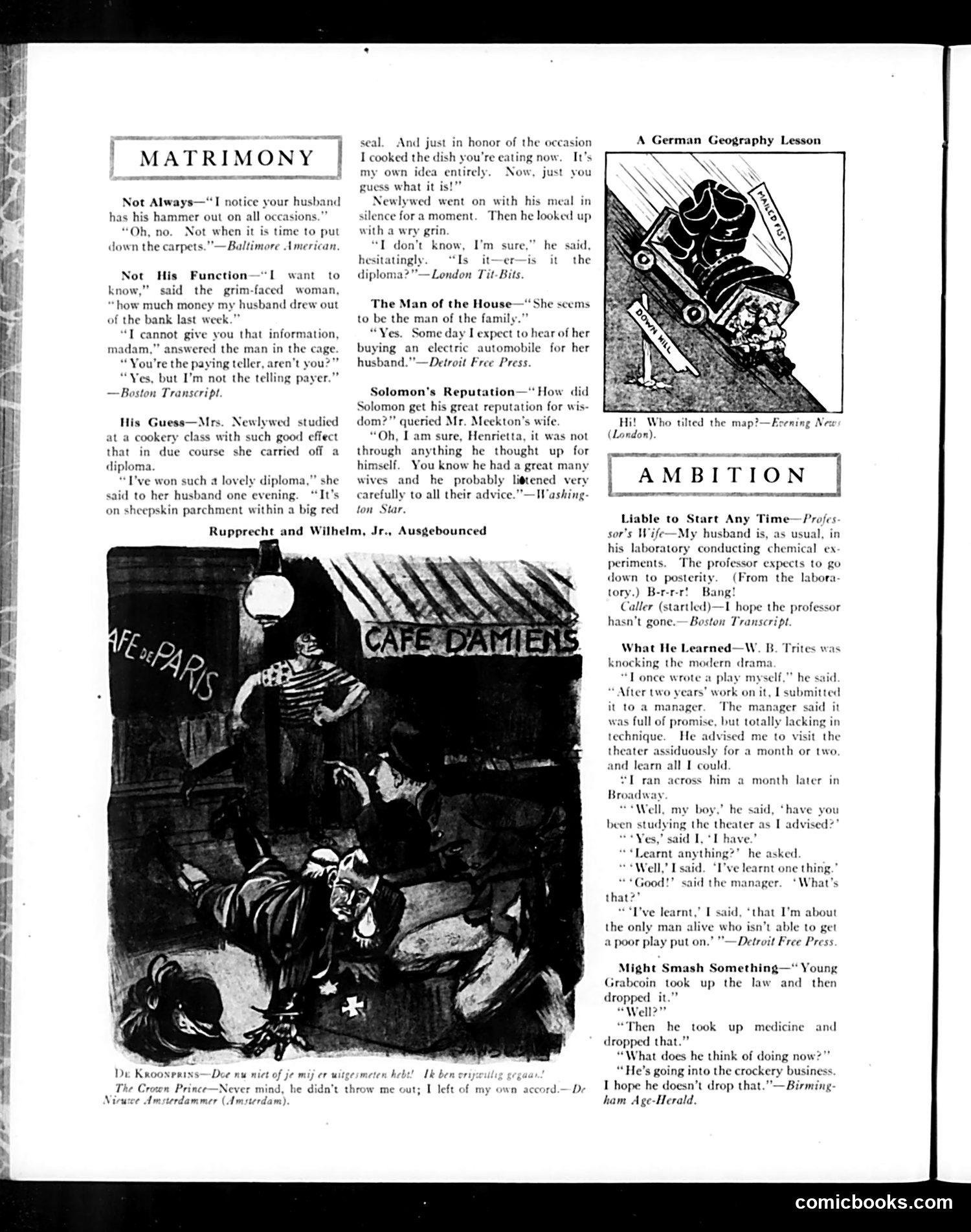
This page contains several humorous short anecdotes satirizing early 20th-century American marriage and social ambition, plus one WWI-era political cartoon. **"Matrimony" section:** Five brief jokes mock married life—husbands avoiding domestic tasks, wives outearning husbands, newlyweds' cooking disasters, and the irony of wives controlling finances despite banks' male hierarchy. **Lower illustration "Rupprecht and Wilhelm, Jr., Ausgebounced":** This appears to be a WWI political cartoon. The German caption and the phrase "Ausgebounced" (a play on "announced") suggest satire of German military figures—likely Crown Prince Rupprecht of Bavaria and another Wilhelm (possibly Wilhelm II or a general). The image depicts what appears to be a chaotic scene at a Paris café, likely mocking German military ambitions or retreat. **"Ambition" section:** Three anecdotes continue the satirical theme: a chemistry professor's absent-mindedness, a playwright's harsh lessons about theatrical failure, and a young man serially abandoning professions. The overall tone is lighthearted domestic satire typical of Judge magazine's humor, mixed with contemporary WWI commentary.
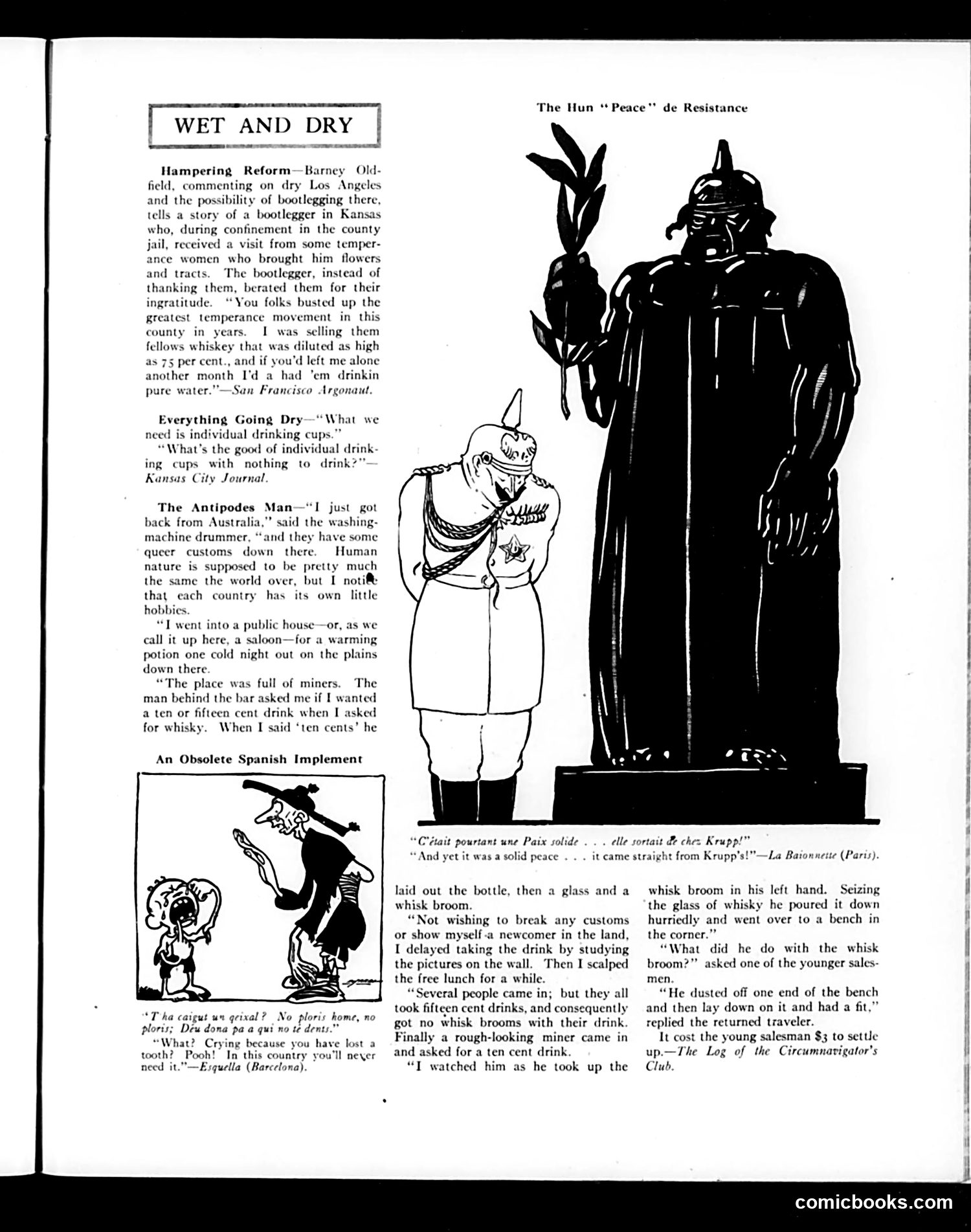
This page contains three distinct satirical pieces commenting on Prohibition and international affairs: **"Wet and Dry"** section mocks Prohibition reform through anecdotes. A Kansas bootlegger complains that temperance activists ruined his business by forcing customers toward sobriety—ironic commentary suggesting Prohibition advocates are counterproductive. **"The Antipodes Man"** is a humorous travel story where an American salesman in Australia encounters a peculiar custom: cheap whisky comes with a complimentary whisk broom. The joke culminates when a miner uses the broom to sweep a bench before having an alcohol-induced seizure—absurdist humor typical of early 20th-century Judge satire. **"The Hun 'Peace' de Resistance"** (right) shows a sinister German military figure holding what appears to be a plant or weapon, likely referencing German militarism and the munitions manufacturer Krupp. The French and Spanish captions suggest this critiques Germany's military-industrial complex as a threat to peace—relevant to pre-WWI tensions. The overall theme addresses American social reform (Prohibition) and European geopolitical anxieties.
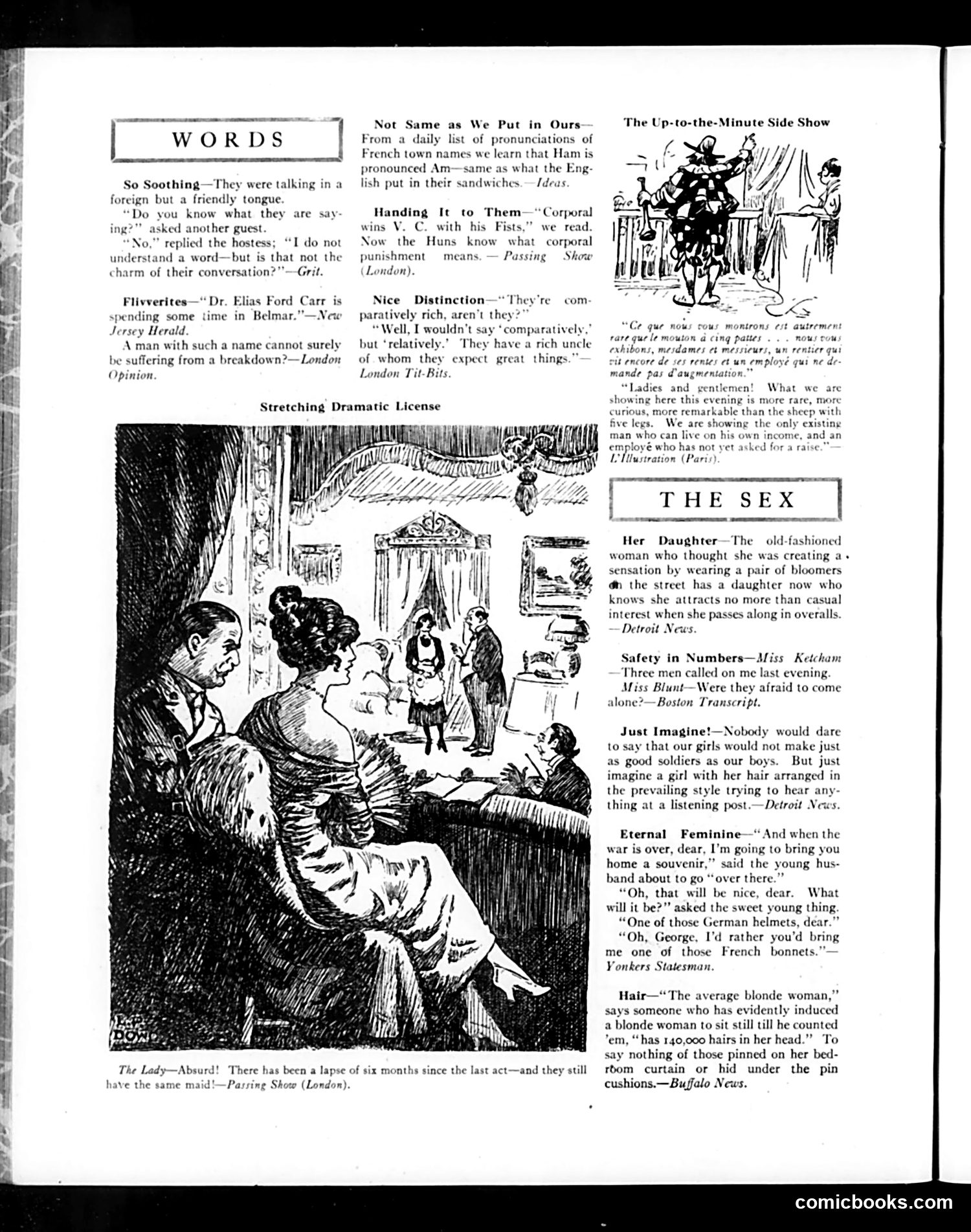
This page from Judge (a pre-WWI American satirical magazine) collects brief humorous items and one cartoon about social observations and wartime themes. **The Main Cartoon** depicts a domestic theater scene where a couple watches a stage performance. The caption references "six months" passing with "the same maid," satirizing theatrical improbability—audiences accepting absurd plot continuity. **The Content:** The items mock contemporary social pretensions: French pronunciation confusion, wealth distinctions, and women's evolving roles. Several reference World War I ("the Huns," soldiers, "over there"), reflecting America's engagement with the conflict. **"The Sex" Section** (a regular feature) makes light observations about gender dynamics: an older woman's bloomers causing no sensation compared to younger women in overalls, women's safety in numbers with suitors, and whether female soldiers could maintain fashionable hairstyles—reflecting changing women's freedoms during wartime. The humor relies on assumed class consciousness and traditional gender expectations—what audiences of 1917-1918 would find amusing about social pretension and wartime disruption of norms.
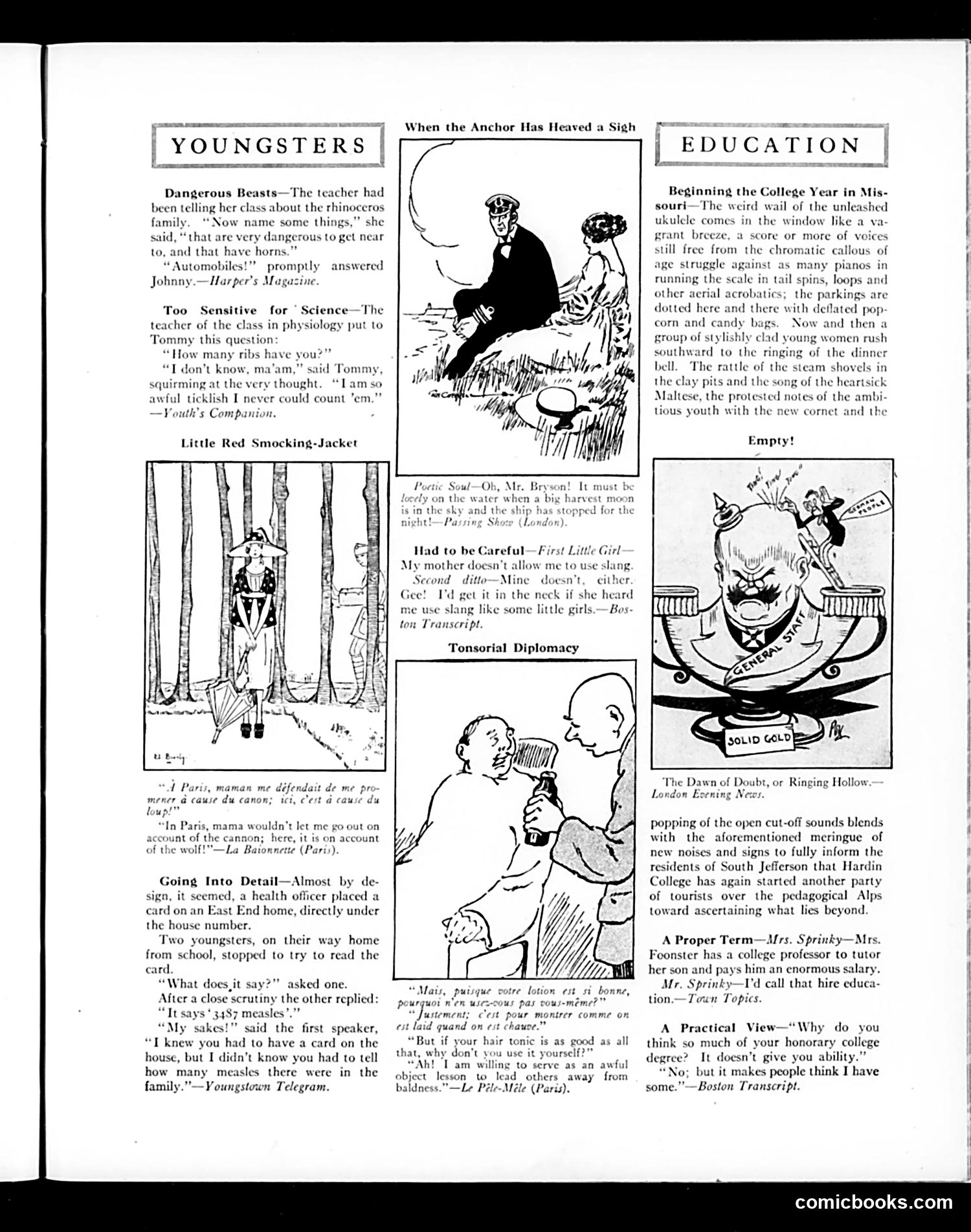
This page contains humorous anecdotes about children and education, typical of early 20th-century American satirical magazines. **The "Youngsters" section** features brief comedic stories about children's innocent misunderstandings: - A boy answers "automobiles" when asked about dangerous things with horns (satirizing the then-new automobile as a hazard) - A boy too embarrassed to count his ribs in physiology class - Children misreading a health department card about measles as listing a specific number of cases in a home **The "Education" section** depicts college life, likely at a Missouri institution, using vivid sensory details—ukuleles, pianos, steam shovels—to humorously capture campus chaos during the opening term. **Other cartoons** mock social pretensions: children avoiding slang to seem proper, discussions about hiring expensive tutors, and a man valuing a fake "honorary college degree" primarily for its social impression rather than actual knowledge. The overall tone is gentle satire of American middle-class anxieties about propriety, education, and status symbols.
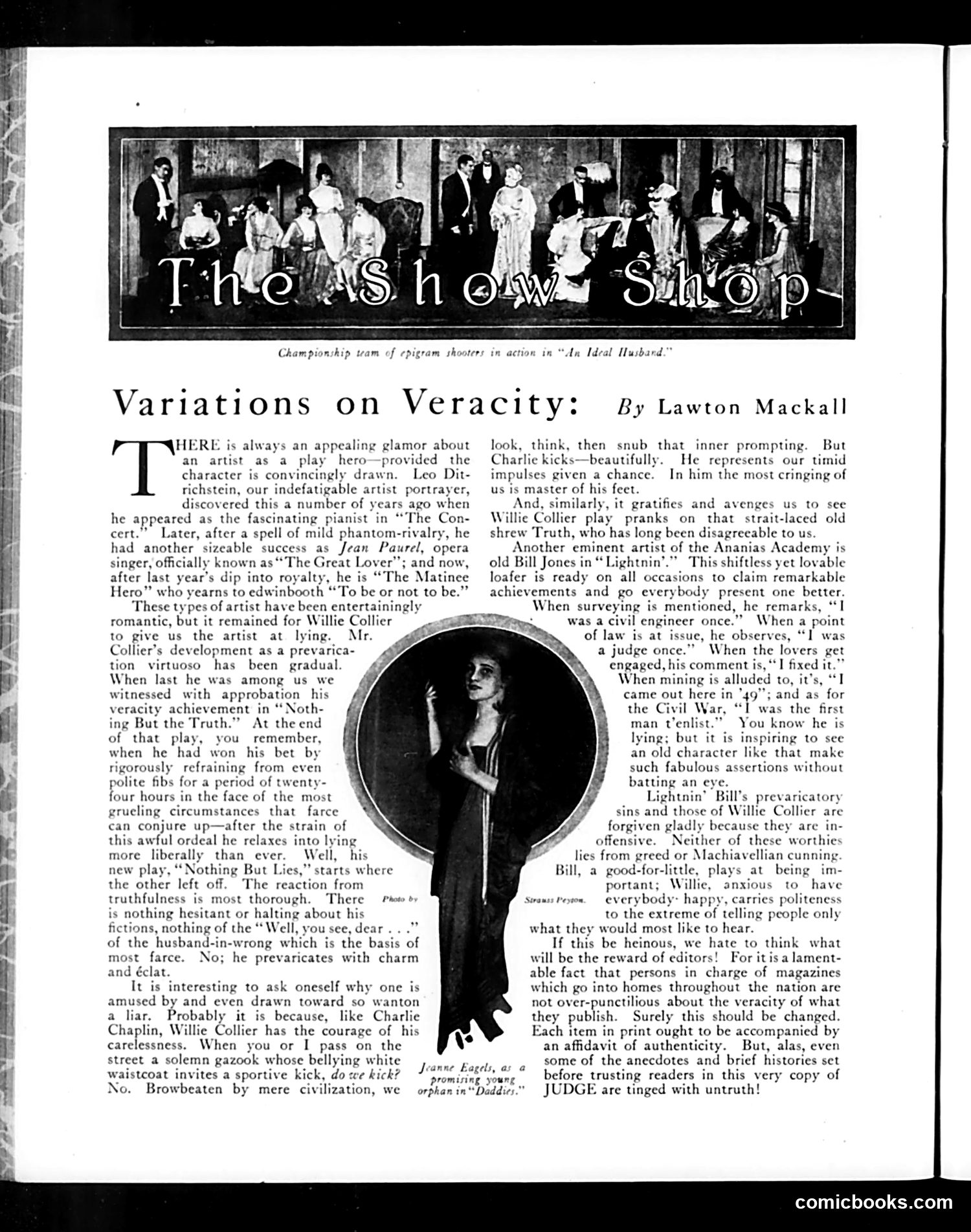
This is a theater criticism piece by Lawton Mackall praising actors who play charming liars on stage. The article focuses on **Willie Collier**, a popular stage comedian, and compares his portrayal of likeable deceivers (in plays like "Nothing But Lies" and "Lightnin'") to other entertainers like **Leo Ditrichstein** and **Charlie Chaplin**. Mackall argues that audiences enjoy watching these characters because they represent our repressed desires—we admire their uninhibited boldness. Collier's charm lies in his "prevarication with éclat"; he lies not from malice but to please others or seem important, making his deceptions forgivable and entertaining. The article concludes with a satirical jab at magazine editors, suggesting they similarly bend truth to readers' preferences—implying they too deserve scrutiny for their own "veracity" failings.
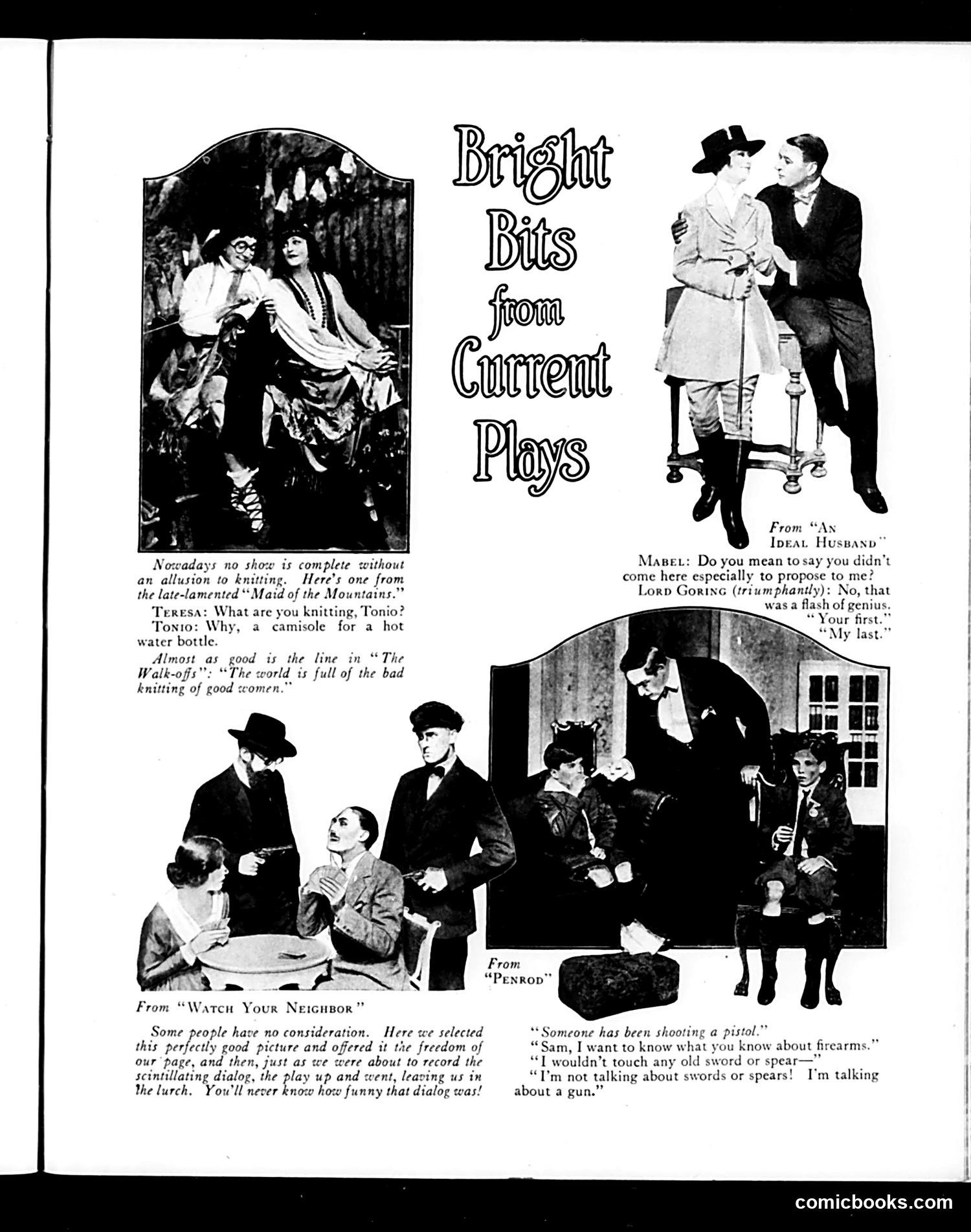
This page collects humorous dialogue excerpts from theatrical productions, a common Judge feature. The satire operates on multiple levels: **The knitting references** mock wartime anxieties—knitting was heavily promoted as women's patriotic duty during WWI, making a camisole for a hot water bottle an absurdly domestic take on this cultural imperative. **"The World is Full of Bad Knitting of Good Women"** satirizes both women's domestic labor and moralistic commentary about female virtue. **The "Watch Your Neighbor" section** jokes about theatrical incompetence—the editor selected a scene but the play closed before they could record its dialogue, leaving the page incomplete. **The firearm exchange** appears to mock either martial dialogue confusion or possibly period attitudes about weapons versus swords, though the context remains unclear. The page essentially uses theater snippets to satirize contemporary social expectations, wartime culture, and entertainment industry mishaps, offering readers light commentary on daily life through dramatic examples.
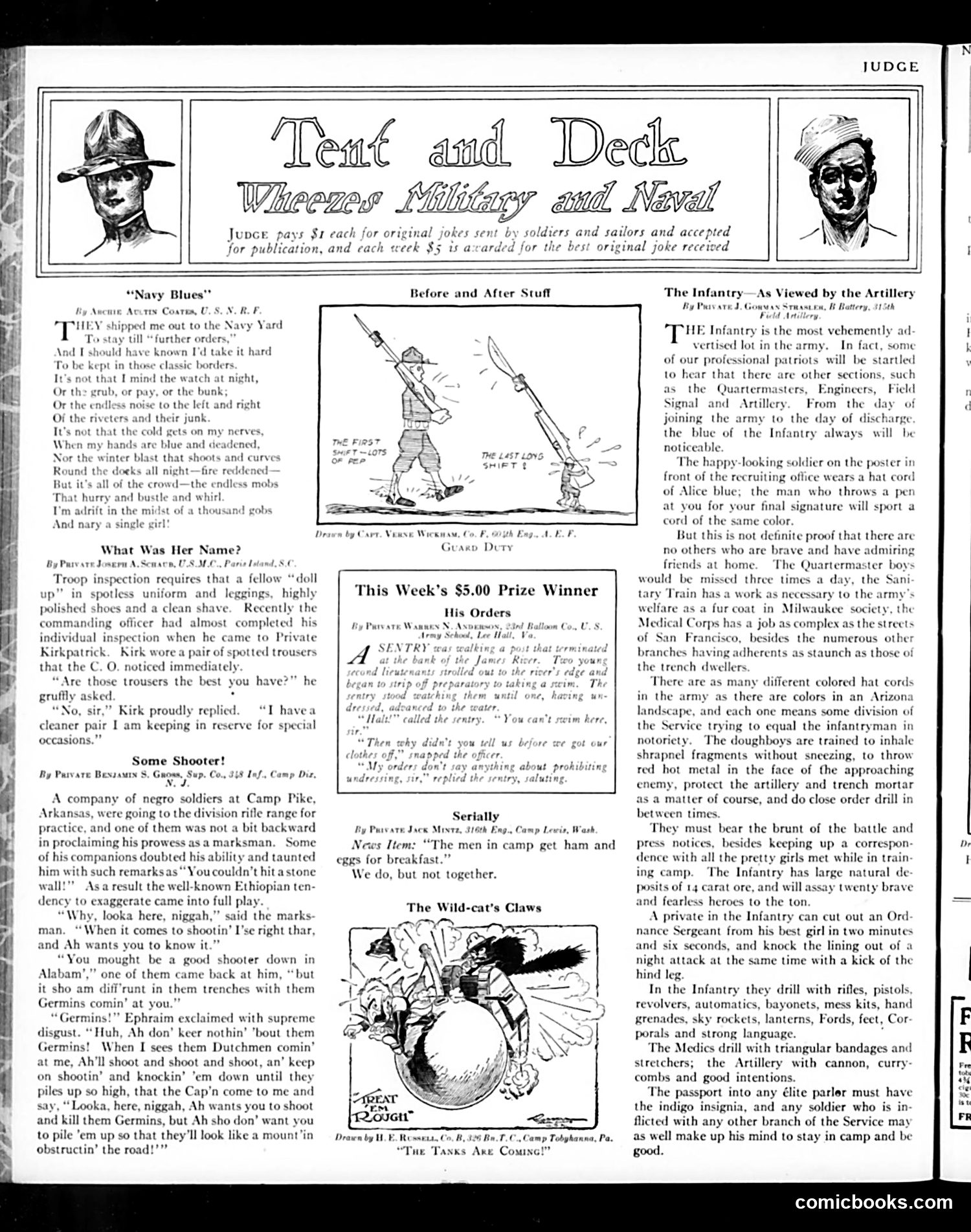
This page from Judge presents humor aimed at soldiers and sailors during what appears to be World War I. The content includes: **"Navy Blues"** — A poem mocking naval life's discomforts (noise, cold, crowding). **"Before and After Stuff"** — A cartoon showing a soldier's uniform transformation, illustrating military dress requirements. **"The Infantry—As Viewed by the Artillery"** — Satirical commentary noting that infantry receives all the recruitment attention and prestige (blue hat cords, posters) while other crucial army branches—quartermasters, engineers, medical corps—go unrecognized despite their essential work. **Additional sketches** mock military absurdities: uniform inspections, marksmanship boasting, and camp food complaints. The magazine's masthead notes it pays soldiers $1 per joke accepted for publication, encouraging servicemen to contribute humor. The satire gently critiques military hierarchy and inter-service rivalries while celebrating the common soldier's perspective.
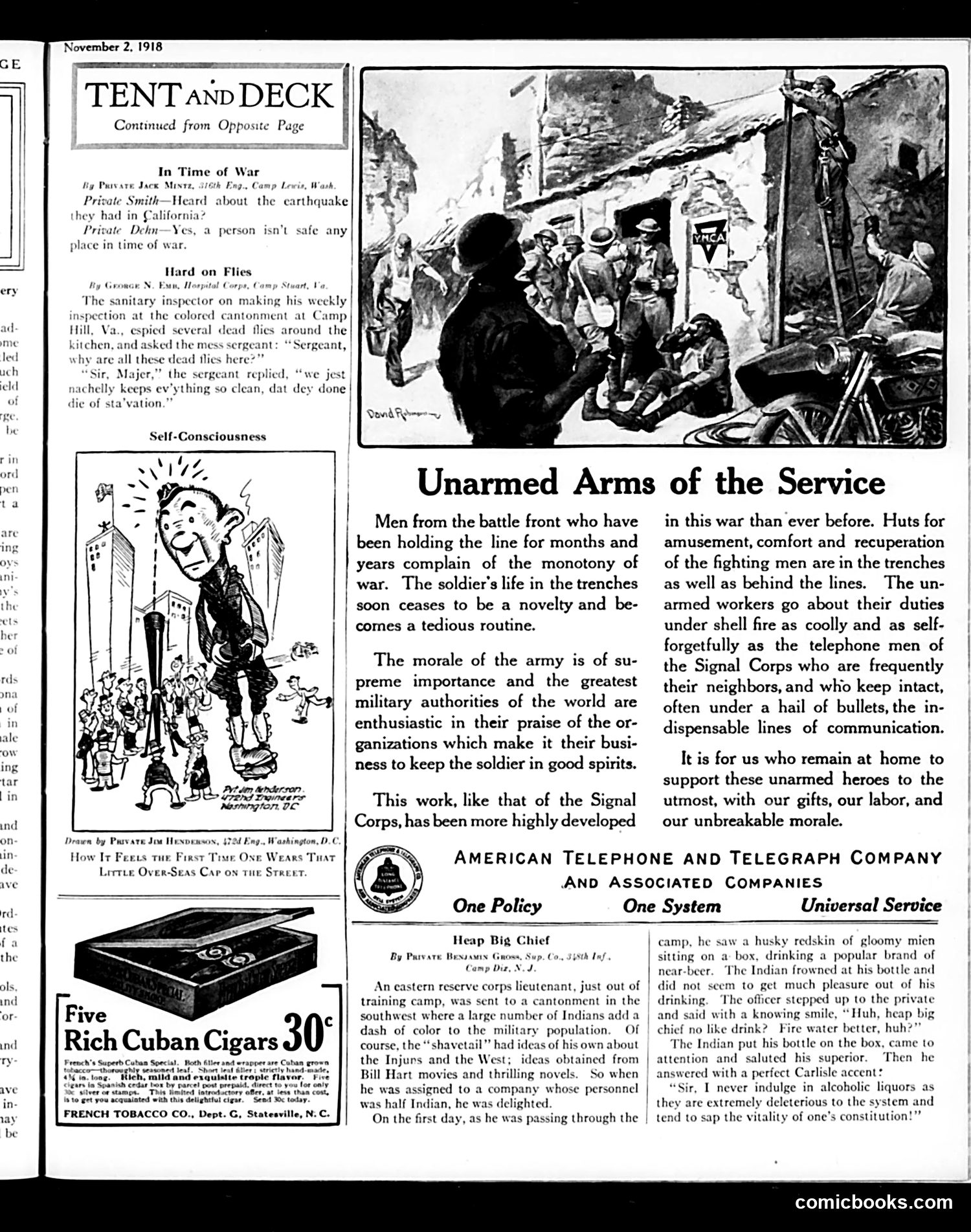
This November 2, 1918 *Judge* page contains several brief military anecdotes and advertisements. **"Hard on Flies"** satirizes racial segregation: a white sanitary inspector visits a "colored cantonment" and is told by a Black mess sergeant that flies die from starvation because everything is kept so clean—the joke being a backhanded compliment that undercuts stereotype. **"Self-Consciousness"** (cartoon by Jim Henderson) depicts a soldier in uniform drawing stares from civilians on the street—mocking self-aware soldiers proud or uncomfortable wearing their new overseas uniform. **"Heap Big Chief"** mocks an inexperienced white officer's racial stereotyping of Native American soldiers. The officer speaks in fake "Indian" dialect ("Fire water better, huh?"), but the educated Indian soldier responds in perfect English, educated at Carlisle Indian Industrial School, deflating the officer's ignorant assumptions. The large AT&T advertisement celebrates telephone operators and Signal Corps workers as "unarmed arms"—essential non-combatant military workers under fire.
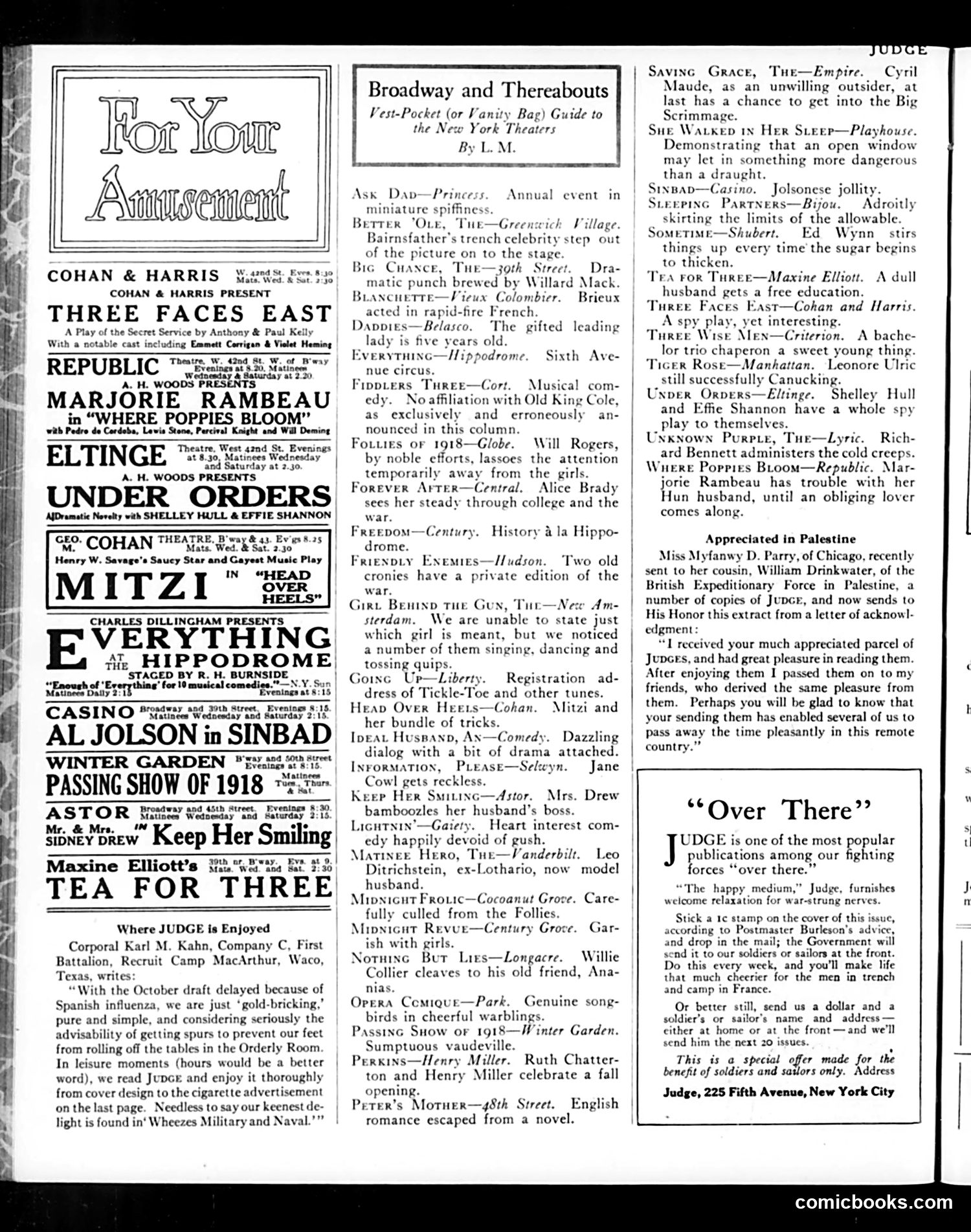
This is primarily a **theater advertisement and review page** from Judge magazine, likely from 1918 (based on "Passing Show of 1918" and WWI references). The left side features Broadway theater ads for popular productions including Al Jolson in "Sinbad" and various comedies and musicals typical of the era. The center column provides brief, witty capsule reviews of current New York theatrical productions—typical Judge satirical commentary on entertainment. The reviews mock plots, performances, and theatrical conventions with sardonic brevity (e.g., "Dappies—Belasco. The gifted leading lady is five years old"). The right side includes a reader letter praising Judge's content among soldiers at a training camp, and an advertisement for Judge magazine itself as "relaxation for war-stung nerves." **The satire is mild and entertainment-focused** rather than political—mocking contemporary theater rather than addressing major social issues. This reflects Judge's role as a popular, general-audience humor magazine during the WWI era.
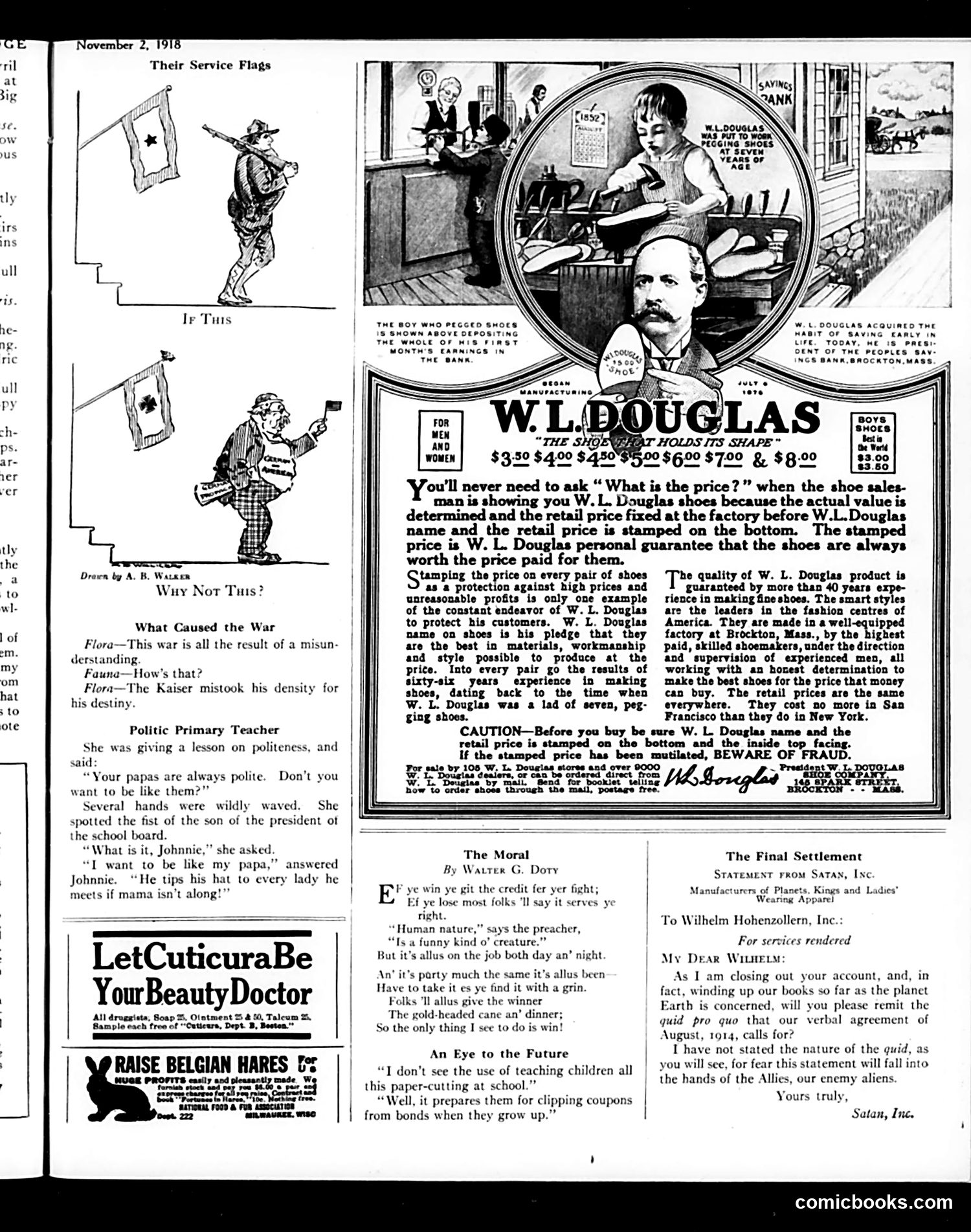
This page contains several satirical pieces reflecting World War I's conclusion (the armistice was signed November 11, 1918): **"Why Not This?" cartoons** (top left): Service flags displayed one star for a soldier serving, two for those who died. The joke appears to mock Kaiser Wilhelm II's military ambitions—suggesting his "density" (stupidity) rather than destiny caused the war. **"Politic Primary Teacher"**: A child says he wants to be like his father "the president of the school board," who "tips his hat to every lady he meets if mama isn't along"—satirizing male hypocrisy and infidelity disguised as politeness. **"An Eye to the Future"**: Dark humor about post-war profiteering—children learning paper-cutting prepares them for "clipping coupons from bonds," mocking financial speculation. **"The Final Settlement"**: A billing statement addressed to "Wilhelm Hohenzollern, Inc." (Kaiser Wilhelm II) from "Satan, Inc.," demanding payment for World War I damages—treating the defeated kaiser as a debtor to the forces of evil. The page is primarily advertising (W.L. Douglas shoes, Cuticura).
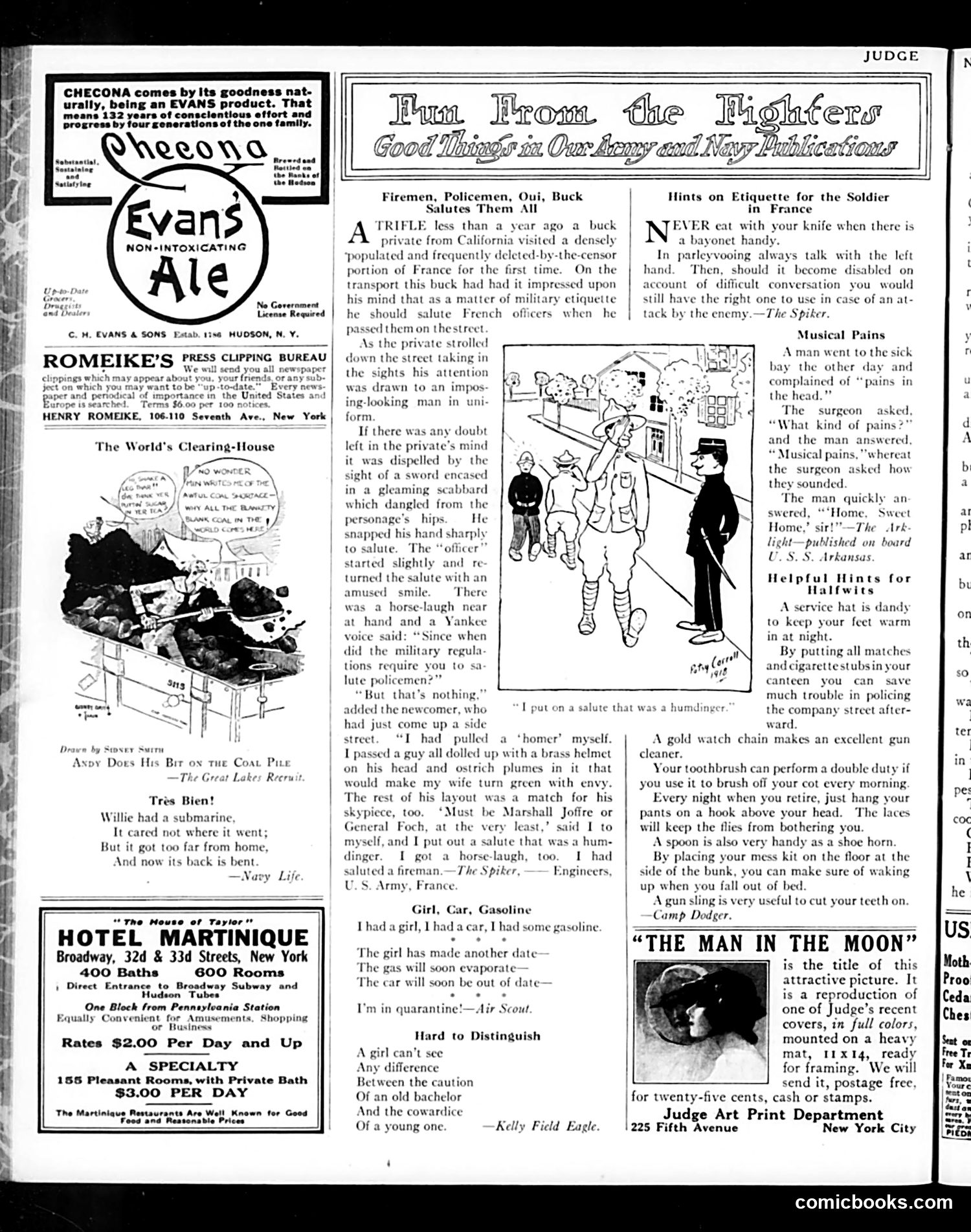
This Judge magazine page contains satirical military humor aimed at American soldiers serving in France during World War I. **"The World's Clearing-House" cartoon** (lower left): A satirical piece about spying and intelligence gathering, showing a figure amid newspapers and documents—reflecting wartime concerns about espionage and information control. **Main story "I put on a salute that was a humdinger"**: An American soldier recounts mistakenly saluting French civilians—a police officer and a fireman—because their impressive uniforms made him think they were high-ranking officers like Marshal Joffre or General Foch. The humor lies in the soldier's embarrassment and the comical misidentification, satirizing American soldiers' unfamiliarity with French military hierarchy and civilian dress customs. **"Helpful Hints for Halfwits" section**: Tongue-in-cheek "advice" mocking soldiers' practical ingenuity—using military equipment for unintended purposes (shoe horns as spoons, service hats as foot warmers). It's gentle ribbing of enlisted men's resourcefulness. The page targets military life's absurdities and cross-cultural confusion, presenting American servicemen as well-meaning but sometimes bumbling.
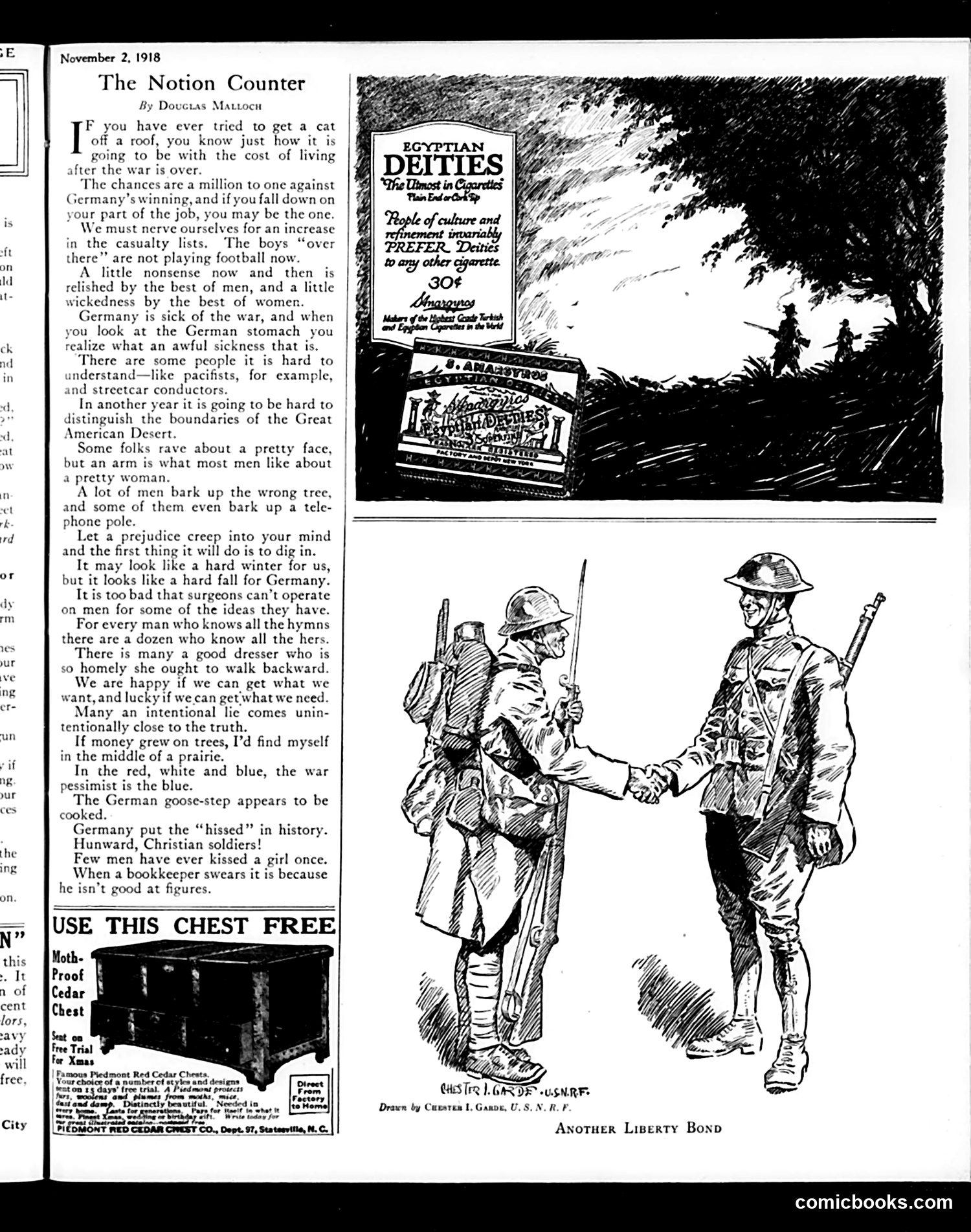
This page contains a humorous essay by Douglas Malloch ("The Notion Counter") alongside a Liberty Bond recruitment cartoon. **The essay** consists of witty, disconnected observations about everyday life and the war. Written as WWI nears its end, it includes jibes at Germany ("Germany put the 'hissed' in history"), pacifists, and various human foibles. The tone is light wartime commentary—reassuring Americans that Germany will lose while poking fun at social types. **The cartoon** depicts two American soldiers shaking hands, captioned "Another Liberty Bond." It's propaganda encouraging Americans to purchase war bonds to finance the military effort. The soldiers represent the fighting men who depend on civilian financial support. Both elements served Judge's wartime function: maintaining public morale and supporting the war effort through satire and patriotic appeals. The magazine mixed humor with persuasion to keep American spirits up in the final months before the November 1918 armistice.
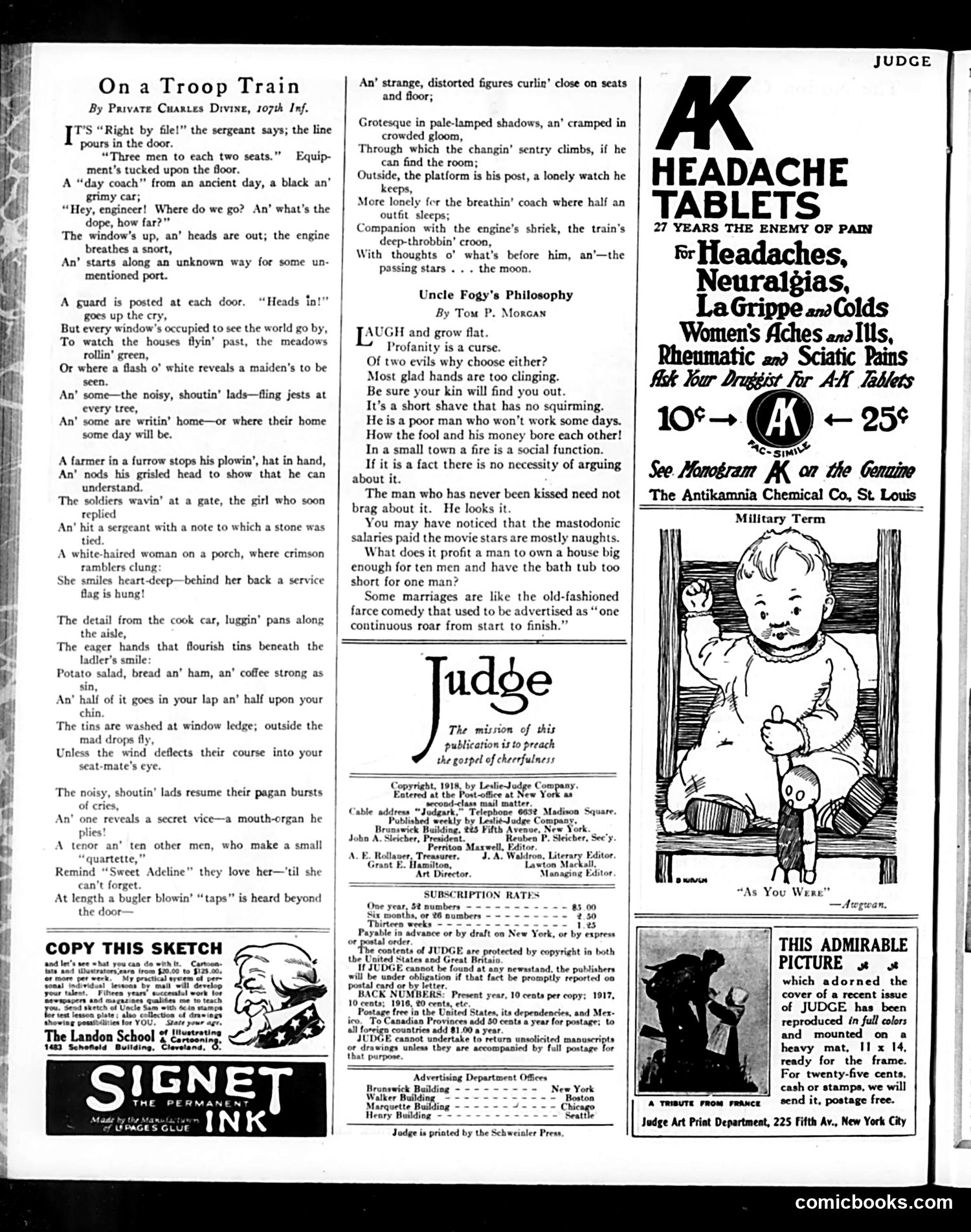
This poem, credited to "Private Charles Divine, 207th Inf.," depicts American soldiers departing by train—likely during World War I (the page is dated 1918). The piece captures the emotional experience of troops heading to an unknown destination: soldiers waving from windows at civilians, writing home, eating field rations messily, singing songs like "Sweet Adeline," and keeping lonely watch as sentries. The romantic elements—glimpses of maidens, an elderly woman displaying a service flag (indicating a son in military service)—convey the civilian population's awareness of the war effort. The contrast between the soldiers' youthful boisterousness and the solemn reality of their departure ("with thoughts o' what's before him") creates poignant tension. This is nostalgia-tinged reportage rather than satire—documenting American mobilization and the emotional stakes of troop movement during the Great War.
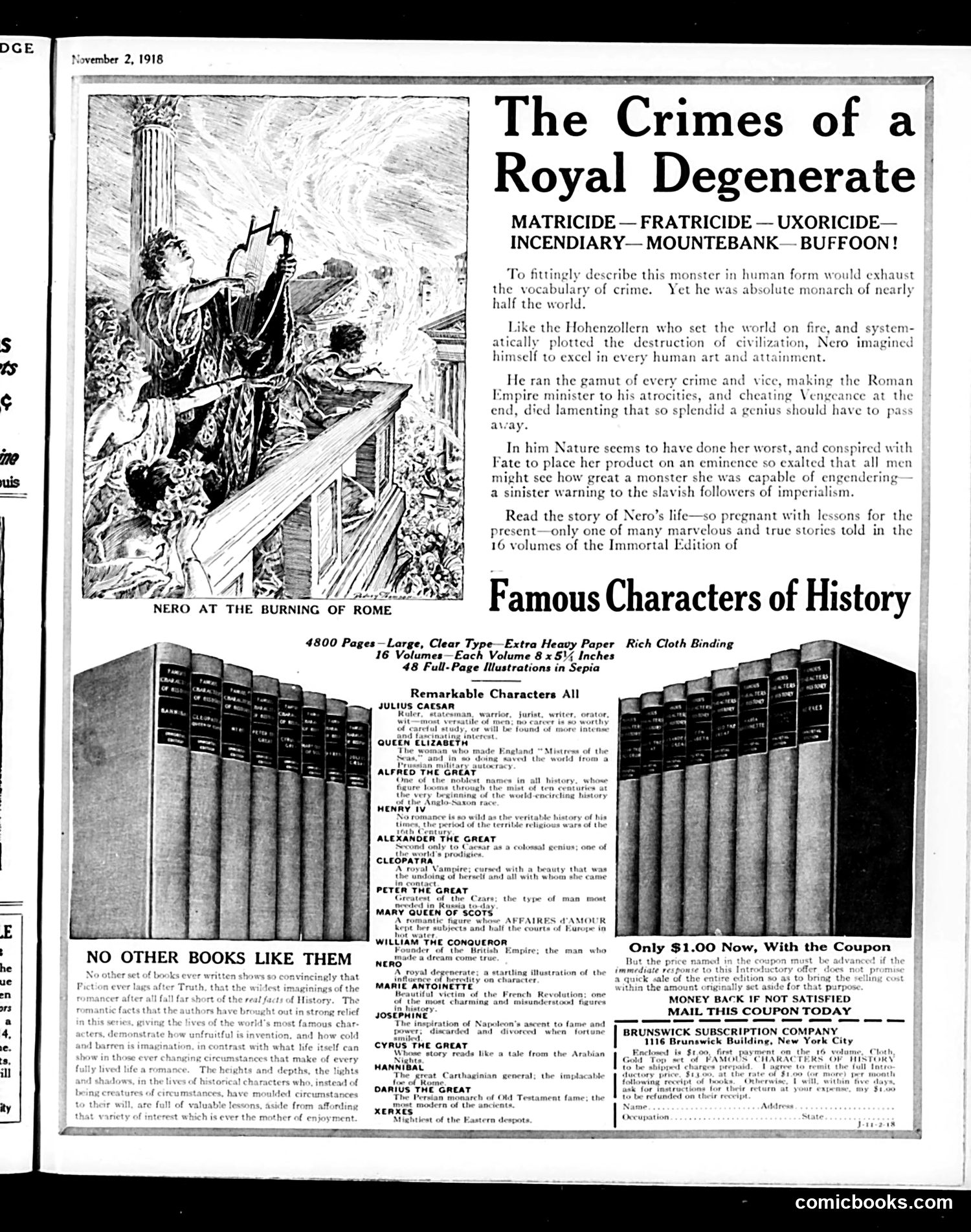
This page combines political satire with book advertising. The main article and illustration attack **Nero**, the Roman emperor, but the real target is **Kaiser Wilhelm II of Germany**. Published just days before WWI's end (November 11, 1918), the piece uses historical parallel to condemn the German monarch: both are compared as despots who set civilization on fire through systematic destruction. The crimes listed—matricide, fratricide, uxoricide (wife-murder), arson, buffoonery—frame Nero as a cautionary tale about absolute monarchy's dangers. The implicit message: Wilhelm, like Nero, represents imperial degeneracy and should serve as "a sinister warning to the slavish followers of imperialism." The page then pivots to advertising a 16-volume "Famous Characters of History" encyclopedia, capitalizing on readers' newfound interest in historical tyrants and moral lessons—marketing the book as timely educational material for post-war reflection on imperialism's failures.
This page is primarily **advertising disguised as editorial content**—a common early-20th-century magazine practice called "advertorial." The narrative frames Dr. Katherine M. H. Blackford's "Character Analysis" course as a remarkable discovery. Carlton Steele meets her on a ship, witnesses her allegedly identify two strangers (a Boston Symphony Orchestra leader and corporate owner) by appearance alone, and invests five dollars in her correspondence course on "Reading Character at Sight." **The satire/pitch**: The story presents character-reading as a scientific method based on physical appearance and gestures—essentially **physiognomy**, a pseudoscience popular in that era claiming you could judge someone's profession, morality, and abilities by facial features and body type. **For modern readers**: This reflects an era when such pseudoscientific personality assessment was taken seriously, before we understood its racist and classist implications. The advertisement exploits readers' desire for self-improvement and social advantage through a "simple method" requiring only observation. The Independent Corporation marketed this course nationally, suggesting it was a genuine commercial product, not satire of the product itself—though Judge's publication of it may contain implicit mockery of such claims.