
Judge, 1918-11-02 · page 5 of 32
Judge — November 2, 1918 — page 5: what you’re looking at
What you’re looking at
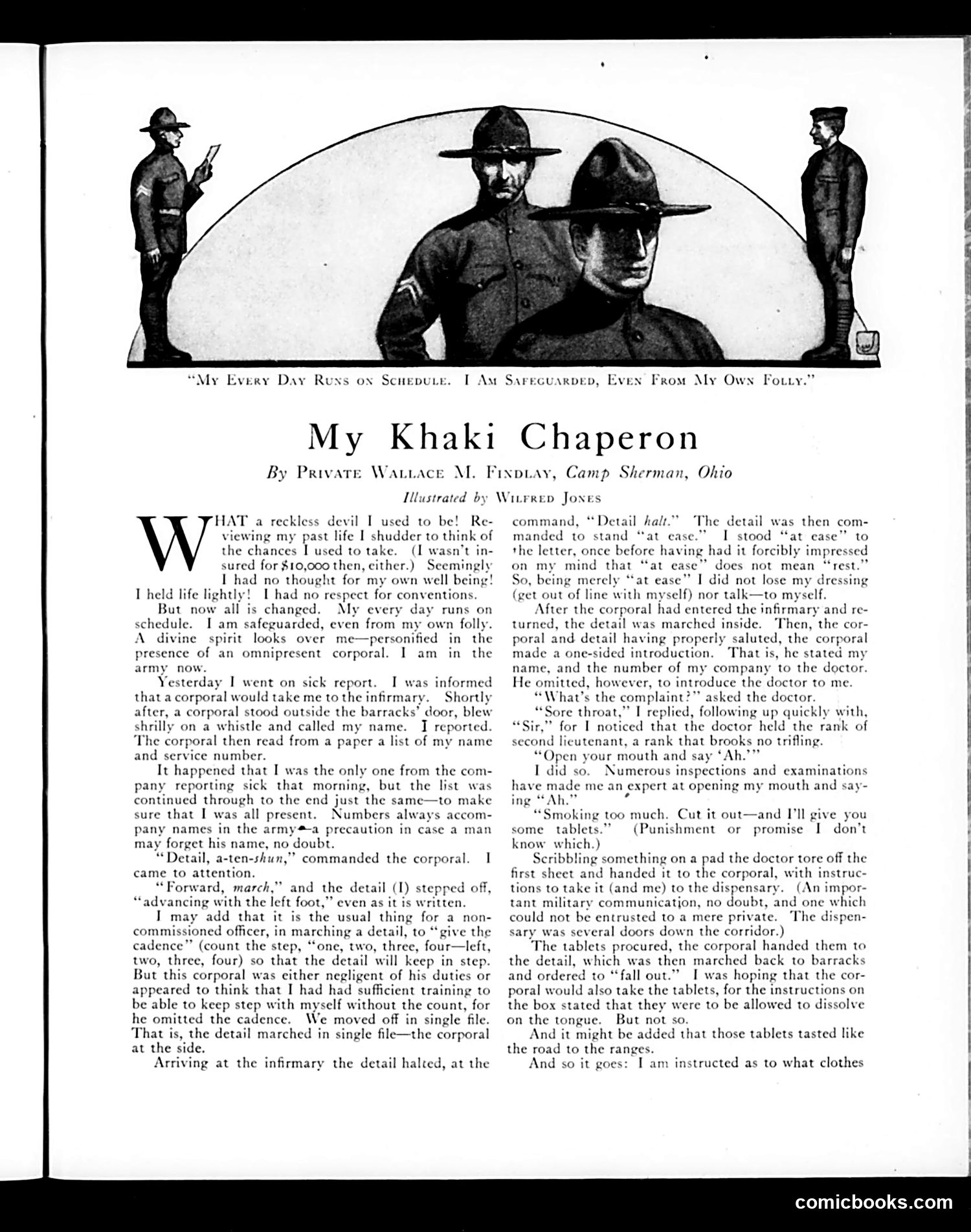
This is a humorous article by Private Wallace M. Findlay from Camp Sherman, Ohio, illustrated by Wilfred Jones. It satirizes the rigid military discipline and absurd regulations soldiers endured during World War I. The article recounts how a formerly reckless civilian became obsessed with military protocol after enlisting. The satire centers on the soldier's transformation into someone so regimented that he follows rules even when they make no sense—like a "detail halt" that taught him to stand "at ease" means standing rigidly, not actually resting. The joke mocks both military bureaucracy's inflexibility and the soldier's internalization of pointless authority. The title suggests military discipline has become his constant "chaperon," monitoring his every action. This reflects broader WWI-era satirical commentary on how military life constrains individual freedom.
📄 Transcribed text from this page (OCR, searchable)
Machine-transcribed from the original scan — historical spelling and the odd misread are preserved.
“My Every Day Runs on Scnepuce. My Khaki By Priv: T Am Sarecuarpep, Even From My Own Fotty.” Chaperon Watiace M. Fixptay, Camp Sherman, Ohio Illustrated by Witrreo Jones HAT a reckless devil I used to be! Re- viewing my past life I shudder to think of the chances I used to take. (I wasn’t in- sured for $10,000 then, cither.) Seemingly I had no thought for my own well being! I held life lightly! I had no respect for conventions. But now all is changed. My every day runs on schedule. I am safeguarded, even from my own folly. A divine spirit looks over me—personified in the presence of an omnipresent corporal. I am in the army now. Yesterday I went on sick report. I was informed that a corporal would take me tothe infirmary. Shortly after, a corporal stood outside the barracks’ door, blew shrilly on a whistle and called my name. I reported. The corporal then read from a paper a list of my name and service number. It happened that I was the only one from the com- pany reporting sick that morning, but the list was continued through to the end just the same—to make sure that I was all present. Numbers always accom- pany names in the army#a precaution in case a man may forget his name, no doubt. “Detail, a-ten-shun,”” commanded the corporal. I came to attention. “Forward, march,” and the detail (I) stepped off, “advancing with the left foot,” even as it is written. I may add that it is the usual thing for a non- commissioned officer, in marching a detail, to “give the cadence” (count the step, “‘one, two, three, four—left, two, three, four) so that the detail will keep in step. But this corporal was cither negligent of his duties or appeared to think that I had had sufficient training to be able to keep step with myself without the count, for he omitted the cadence. We moved off in single fil That is, the detail marched in single file—the corporal at the side. Arriving at the infirmary the detail halted, at the command, “Detail halt.” The detail was then com- manded to stand t case.” I stood “at ease” to the letter, once before having had it forcibly impressed on my mind that “at ease” does not mean “rest.” So, being merely ‘tat ease’ I did not lose my dressing (get out of line with myself) nor talk—to myself. After the corporal had entered the infirmary and re- turned, the detail was marched inside. Then, the cor- poral and detail having properly saluted, the corporal made a one-sided introduction. That is, he stated my name, and the number of my company to the doctor. He omitted, however, to introduce the doctor to me. “What's the complaint?” asked the doctor. ore throat,” I replied, following up quickly with, “Sir,” for I noticed that the doctor held the rank of second lieutenant, a rank that brooks no trifling. “Open your mouth and say ‘Ah.’” I did so. Numerous inspections and examinations have made me an expert at opening my mouth and say- ing “Ah,” . “Smoking too much. Cut it out—and I'll give you some tablets.” (Punishment or promise I don’t know which.) Scribbling something on a pad the doctor tore off the first sheet and handed it to the corporal, with instruc- tions to take it (and me) to the dispensary. (An impor- tant military communicatjon, no doubt, and one which could not be entrusted to a mere private. The dispen- sary was several doors down the corridor.) The tablets procured, the corporal handed them to the detail, which was then marched back to barracks and ordered to “fall out.” I was hoping that the cor- poral would also take the tablets, for the instructions on the box stated that they were to be allowed to dissolve on the tongue. But not so. And it might be added that those tablets tasted like the road to the ranges. And so it goes: I 3 1 instructed as to what clothes comicbooks.com | | | | | |