
A complete issue · 28 pages · 1917
Judge — June 16, 1917
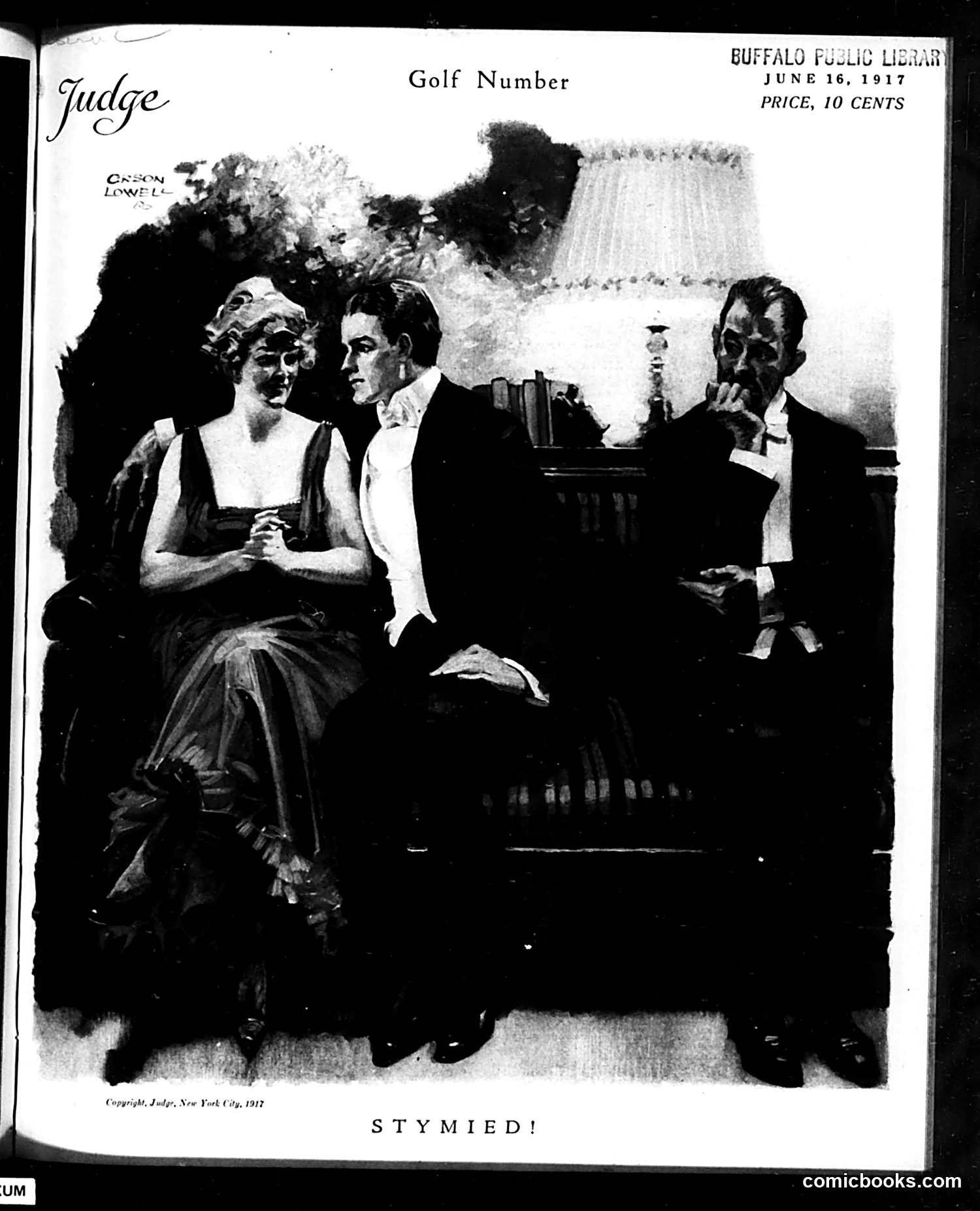
This cartoon depicts a social scene where a well-dressed couple appears uncomfortable or awkward in conversation with two other men in formal attire. The setting suggests an elegant interior with what appears to be a fireplace in the background. The title "Stymied!" (a golf term meaning blocked or obstructed) suggests the cartoon comments on some form of social or romantic obstruction. The woman's formal dress and the men's tuxedos indicate this involves upper-class society. Without clearer identification of the specific figures, the exact political or social reference remains unclear. However, the composition suggests satire about social interactions, possibly romantic rivalry, social climbing, or interpersonal awkwardness among the affluent—common Judge magazine themes from this WWI-era period.
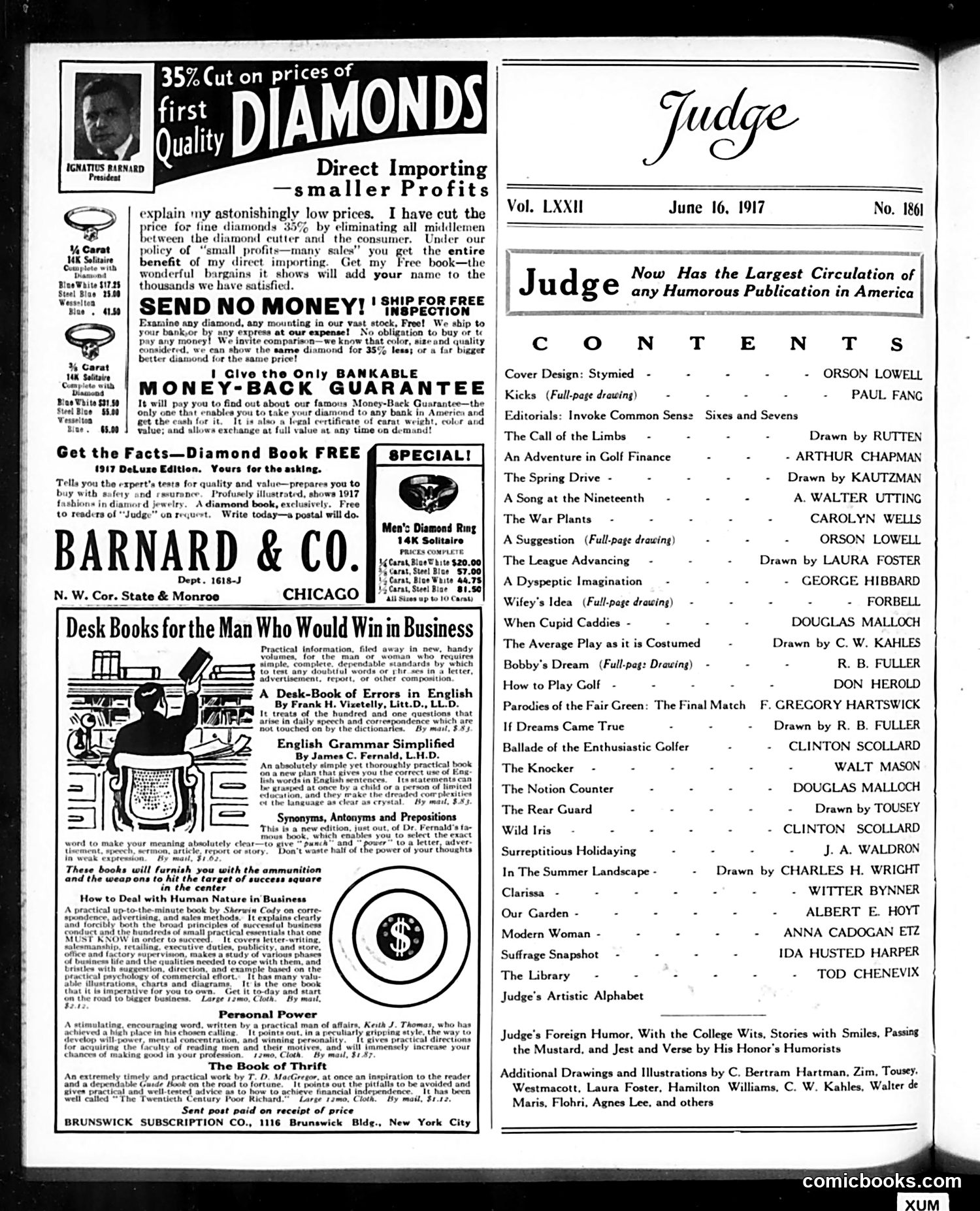
This is primarily a **contents page** listing articles and illustrations rather than displaying political cartoons. The page shows Judge's claim to have "the Largest Circulation of any Humorous Publication in America." The contents reveal typical satirical fare: golf humor ("An Adventure in Golf Finance," "How to Play Golf"), romantic comedy ("When Cupid Caddies," "Wifey's Idea"), and social observation pieces. Artists credited include Orson Lowell and Paul Fang. The **left side features advertisements** for diamonds, business books, and office supplies—typical commercial content of the era. Published **June 16, 1917** (during U.S. involvement in World War I), the magazine appears focused on domestic humor rather than wartime satire on this particular contents page.
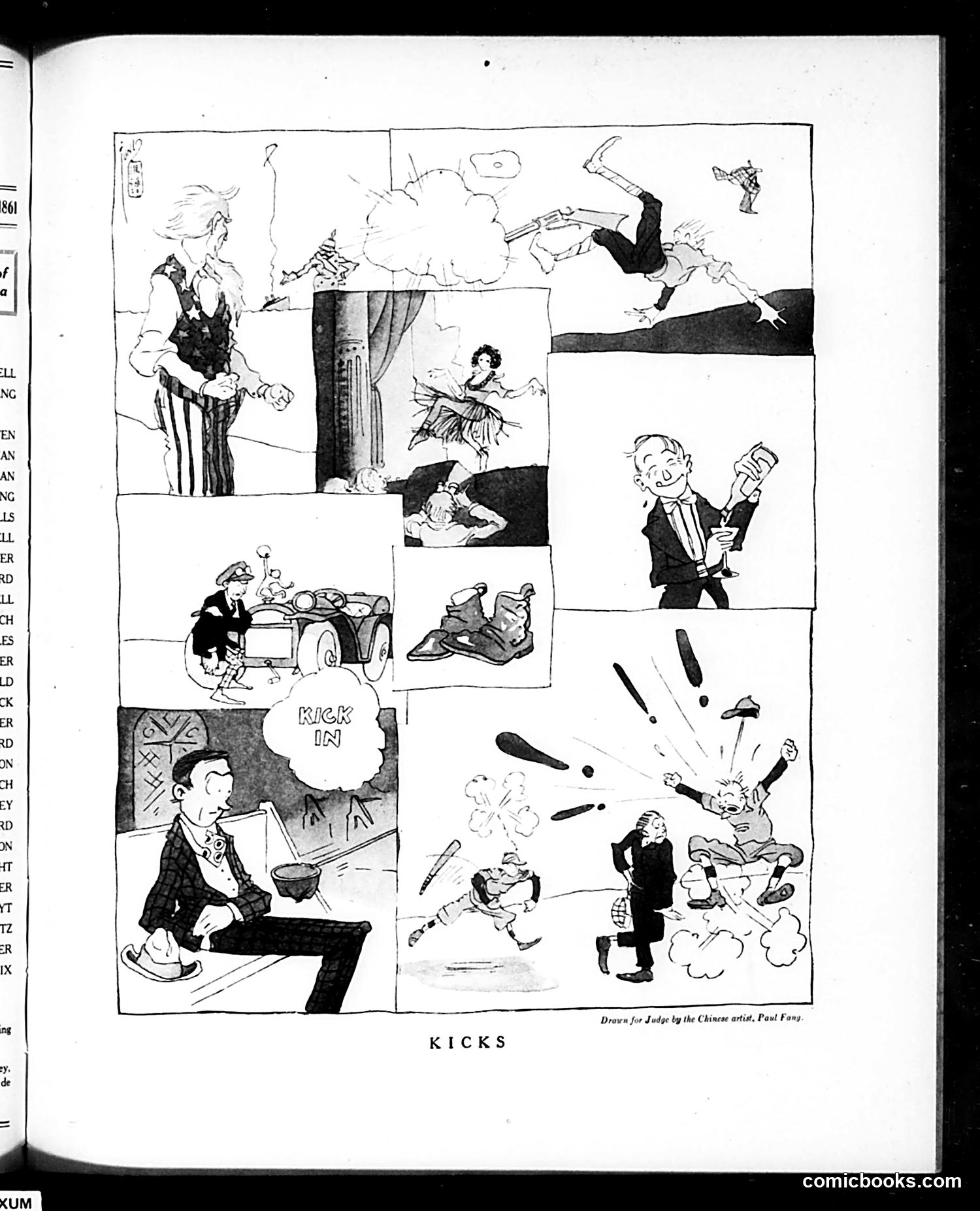
This multi-panel comic by Paul Fung depicts various characters experiencing physical consequences—being kicked, hit, or violently ejected. The panels show: - A woman in striped dress kicking someone - A man being thrown through the air - Domestic and professional scenes involving violent collisions - The final panel shows an explosion of chaos with multiple figures The title "KICKS" and the repetitive slapstick violence suggest this is satirizing either: 1. A contemporary social trend or fad 2. Consequences of a political policy or action 3. General absurdist humor about cause-and-effect Without additional context or visible date, the specific target remains unclear, though the exaggerated physical comedy and Fung's distinctive caricature style are typical of Judge's satirical approach to social commentary during the early-to-mid 20th century.
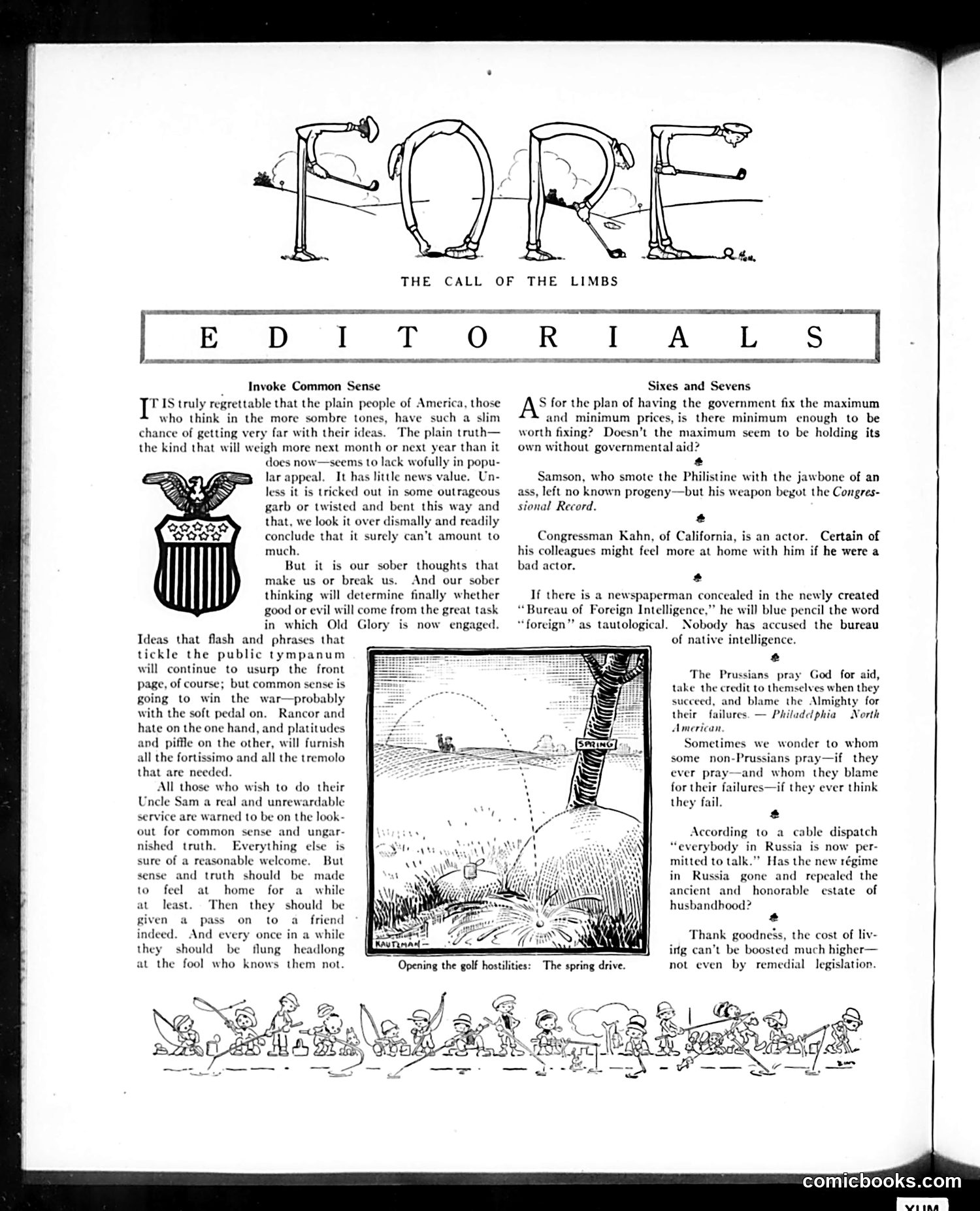
This page contains two editorial pieces critiquing American politics and governance. The left column ("Invoke Common Sense") warns against "plain people of America" accepting half-baked ideas, cautioning that winning public support doesn't guarantee merit. It advocates for careful reasoning before supporting major causes, implying some contemporary political movements lack substance. The right column ("Sixes and Sevens") satirizes government price-fixing, questioning whether maximum/minimum pricing controls can work without subsidy. It mocks Congressman Kahn of California as a poor actor, and includes barbed comments about a new "Bureau of Foreign Intelligence" lacking actual competence. The golf cartoon depicts government overreach humorously, while the final illustration shows people celebrating, likely related to the editorial themes. The tone suggests early 20th-century skepticism toward progressive interventionism.
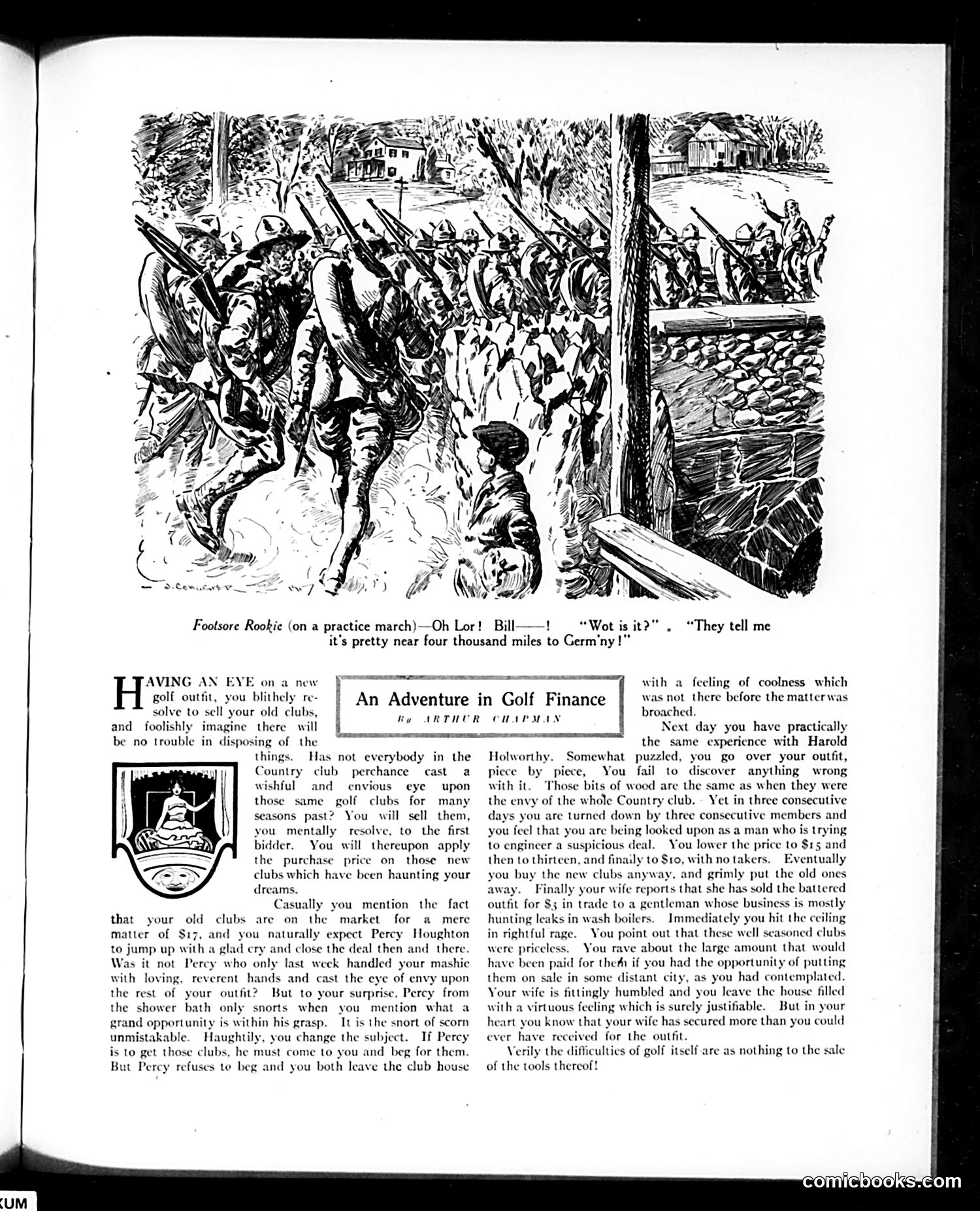
This page contains two distinct elements: a humorous illustration and an article titled "An Adventure in Golf Finance" by Arthur Chapman. **The Cartoon:** depicts soldiers marching through mud during what appears to be WWI ("four thousand miles to Germany"), with the caption playing on the phrase "Footsore Rookie" — a newcomer soldier complaining about the arduous march. The humor derives from the soldier's exasperation about distance. **The Article:** satirizes the social dynamics of golf club economics. Chapman humorously describes how golfers engage in competitive acquisition of equipment and clubs, experiencing buyer's remorse and suspicious deals. The satire targets the pretentiousness and financial folly of Country Club members who obsess over status symbols while justifying purchases through various rationalizations to their spouses. The broader satirical aim critiques American middle-class materialism and conspicuous consumption during the early 20th century.
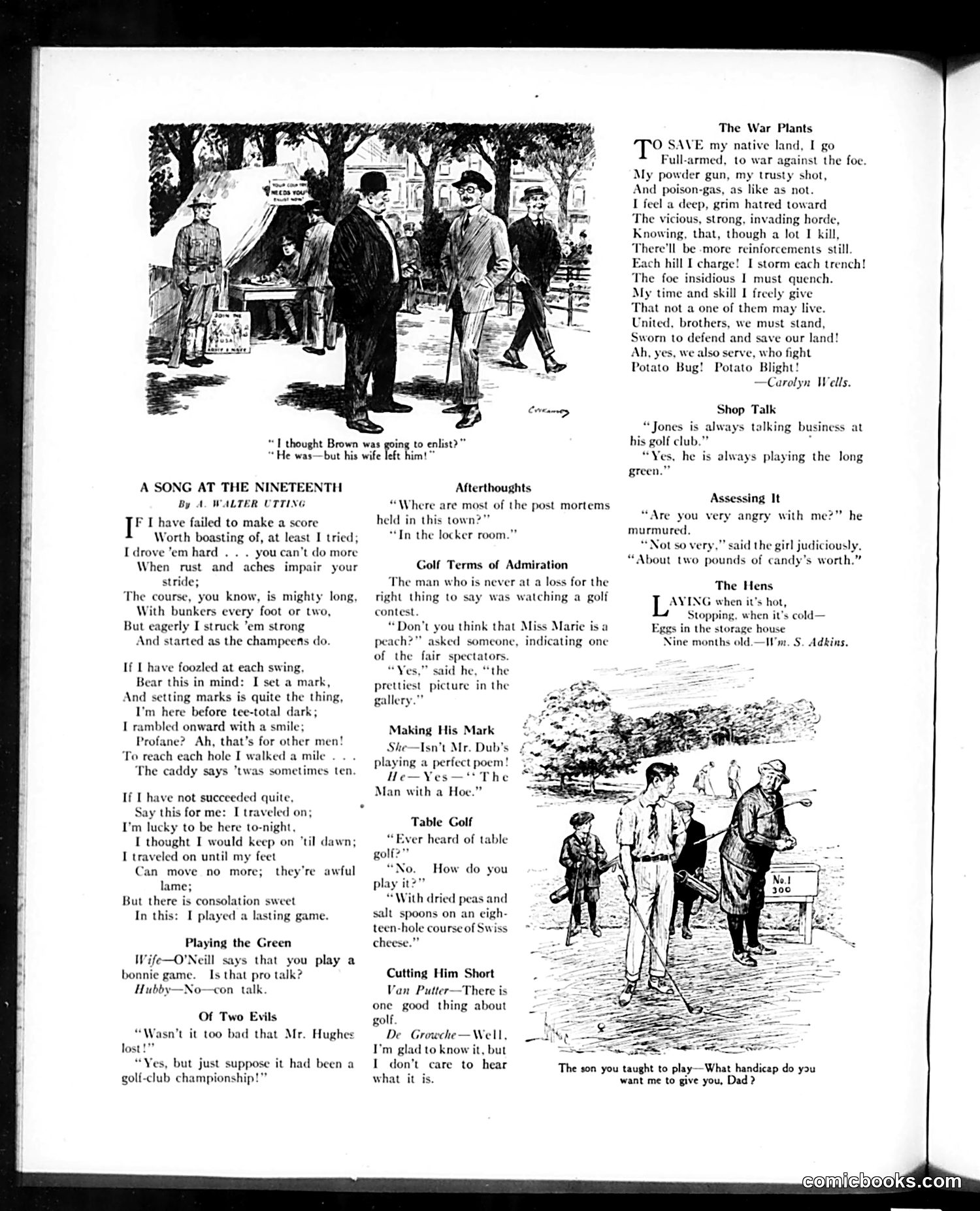
This page from *Judge* magazine contains wartime humor and commentary, likely from WWI era based on "The War Plants" poem's reference to fighting invading forces and potato bugs as enemies. The main cartoon depicts men in suits and hats discussing business at what appears to be a public gathering. The caption reads: "I thought Brown was going to enlist!" / "He was—but his wife left him!"—a joke about domestic upheaval preventing enlistment. The surrounding content includes golf-themed humor ("Shop Talk," "Table Golf," "Cutting Him Short") and poems like "A Song at the Nineteenth" by Walter Cutting, which uses golf metaphors to discuss perseverance and achievement. The page mixes patriotic sentiment with satirical commentary on civilian life, business concerns, and social priorities during wartime, using golf as a recurring metaphor for life's challenges.
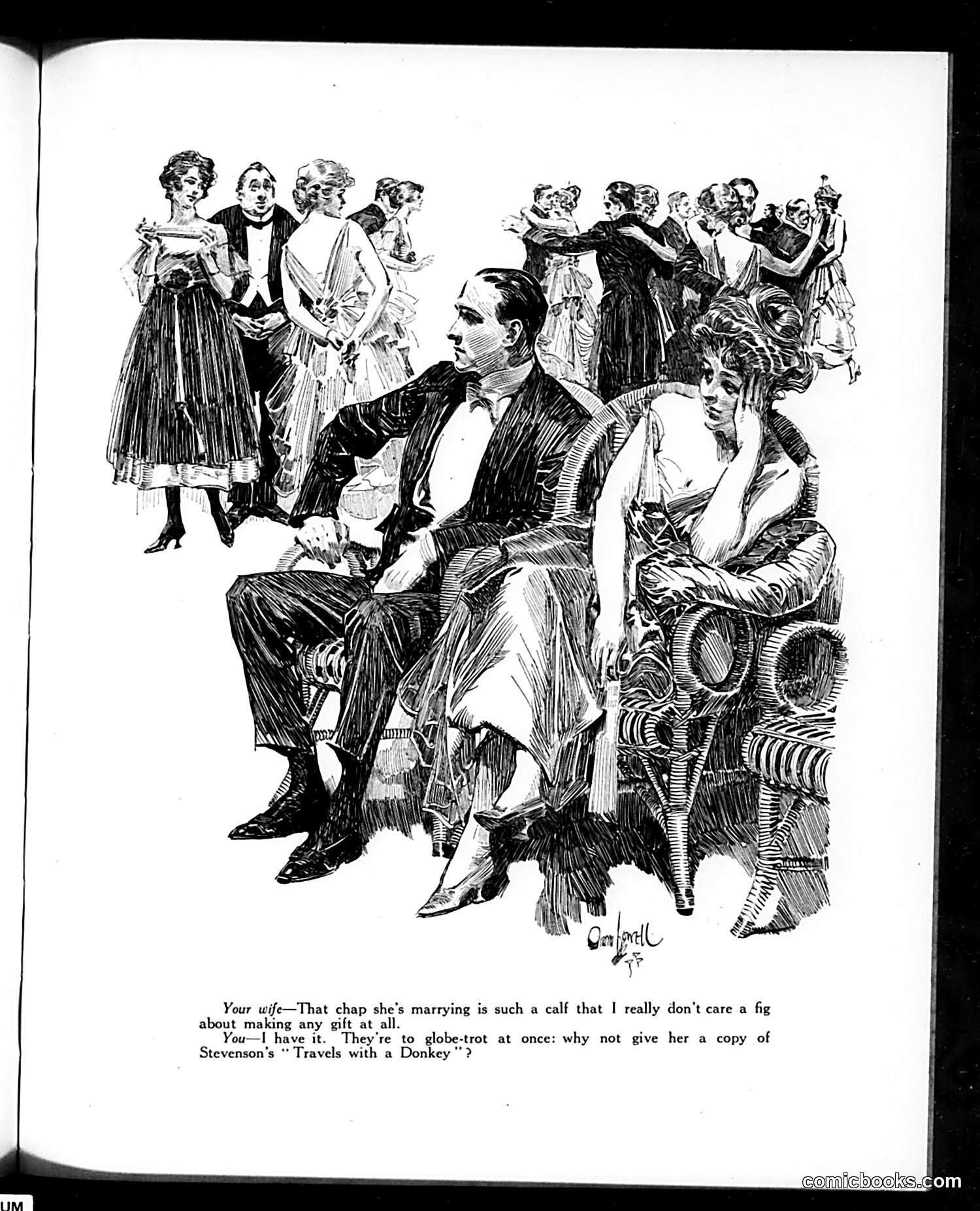
This is a social satire about wedding gifts. A man dismisses the groom as a fool ("calf") and initially doesn't want to give a gift. His companion suggests giving Robert Louis Stevenson's *Travels with a Donkey*—a real travel memoir published in 1879. The joke is a double insult: the gift is sarcastically "appropriate" because (1) it's a budget-friendly travel book for the honeymoon couple, but more pointedly, (2) it's a subtle dig calling the groom a "donkey" to match the earlier "calf" insult. The humor relies on the book's title working as a coded insult. This reflects upper-class Victorian anxiety about unsuitable marriages and the social obligation of gift-giving, while mocking both the groom and the gift-giver's passive-aggressive wit.
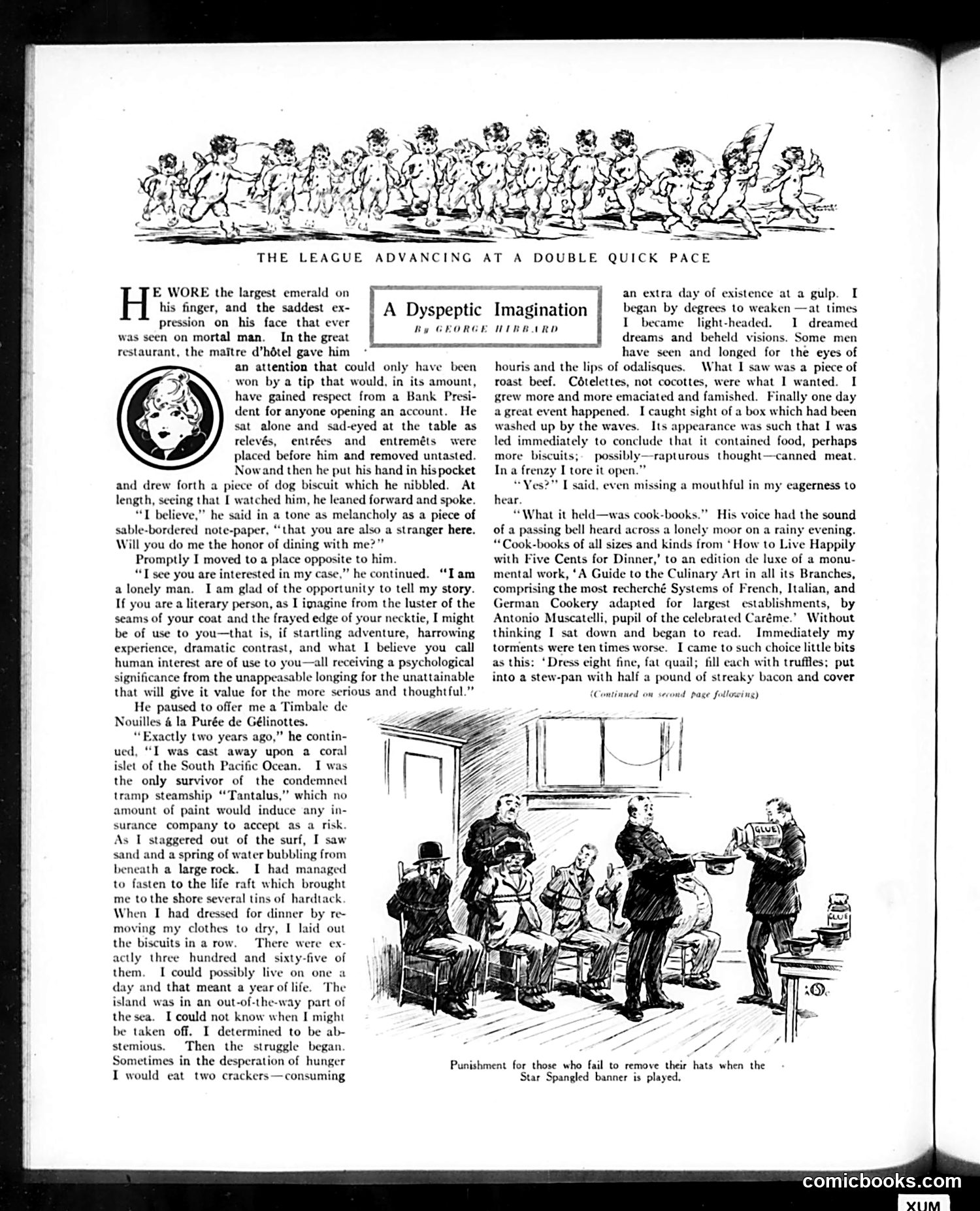
This page presents a short story (not a political cartoon) satirizing wealthy, melancholic men of leisure. The narrative features an unnamed wealthy man—identifiable by his large emerald ring and fine dining habits—who tells of surviving a shipwreck on hardtack biscuits rationed to one daily. The satire's punchline: after enduring starvation and hallucinating luxurious foods, he discovers a washed-up box containing only cook-books—a cruel irony that compounds his suffering. The joke targets the dyspeptic (dysfunctional digestion/"difficult mood") sensibilities of wealthy men obsessed with refined cuisine, unable to enjoy actual sustenance. The small illustration at page bottom appears unrelated to this story, showing figures removing hats during the national anthem—likely satirizing a separate social custom or controversy.
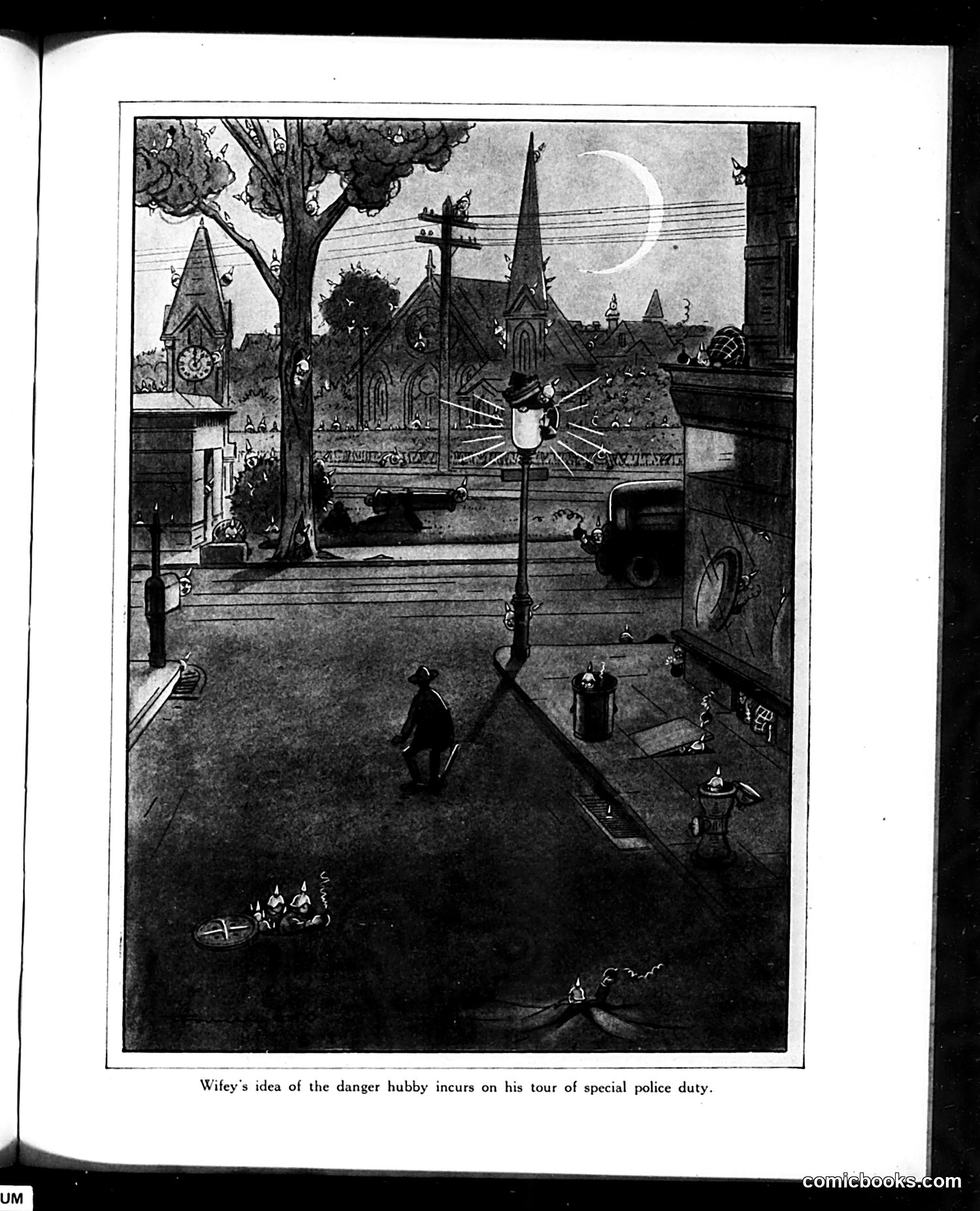
This illustration depicts a nighttime urban street scene with a police officer on patrol. The caption reads: "Wifey's idea of the danger hubby incurs on his tour of special police duty." The satire appears to mock wives' exaggerated fears about their husbands' safety while performing police work. The image shows a relatively quiet, ordinary street scene with a lone officer and minor activity—hardly the dangerous scenario the caption suggests a wife might imagine. The full moon and Gothic church architecture create atmospheric drama, but the actual scene is mundane. The joke targets domestic anxiety and the gap between realistic police work (routine patrols) and spouses' anxious perceptions of danger. It's satirizing both wives' worry and, by extension, the relatively safe nature of "special police duty" during this era.
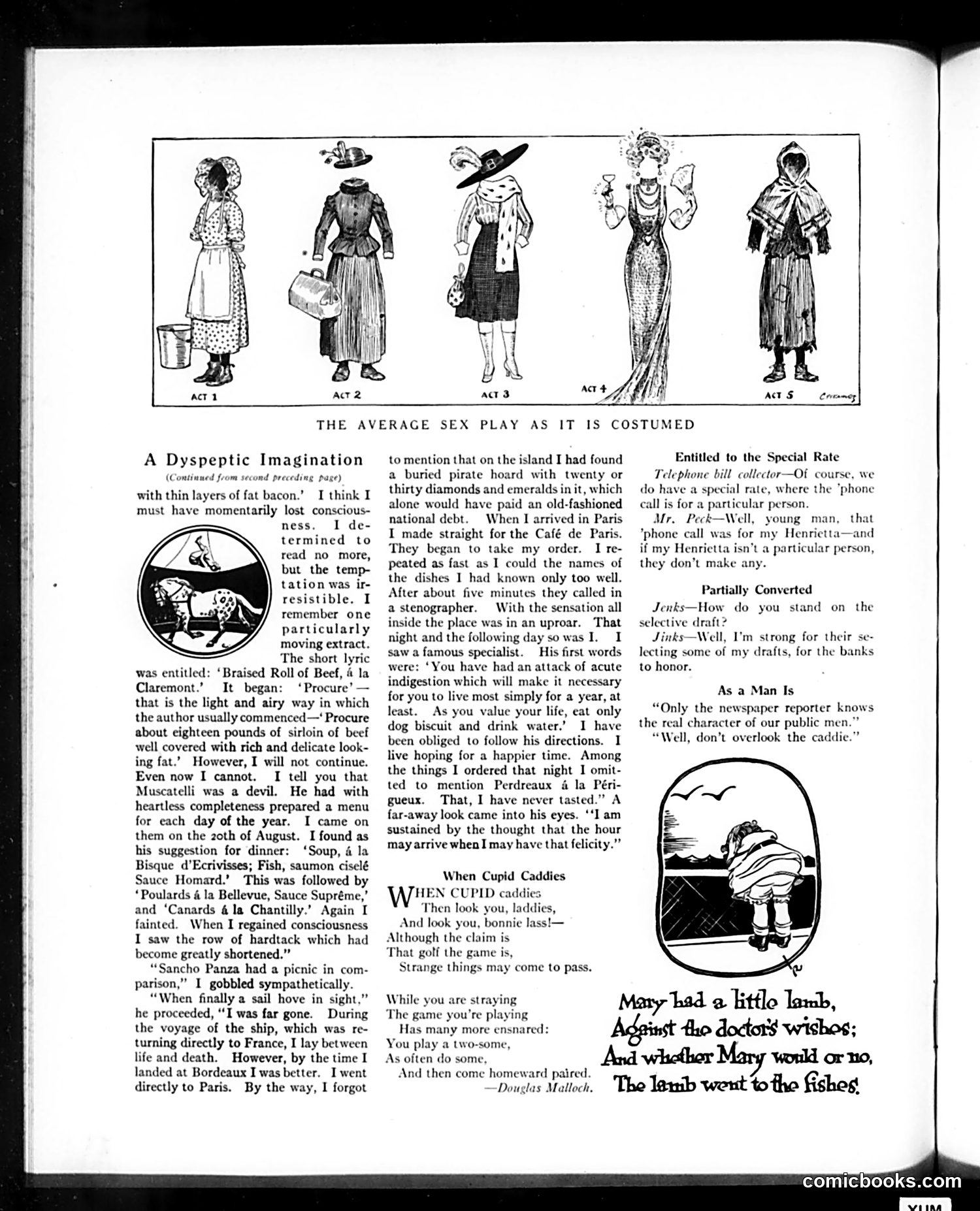
This page contains three distinct satirical pieces: **Top: "The Average Sex Play as It is Costumed"** shows five costume designs for theatrical acts, lampooning women's fashion evolution across different "acts." **"A Dyspeptic Imagination"** is a humorous narrative where a shipwrecked man, sustained only by hardtack, obsesses over an elaborate French cookbook ("Muscatelli"). Upon rescue and arrival in Paris, he gorges himself on the rich dishes he'd fantasized about, causing severe indigestion. A doctor forces him onto a bland diet. The satire mocks both culinary excess and the gap between fantasy and reality's consequences. **Smaller pieces include:** - "When Cupid Caddies" (a poem about golf as romantic opportunity) - A telephone bill collector joke about "particular persons" - A quip about newspaper reporters and caddies revealing character The page exemplifies Judge's characteristic humor: wordplay, domestic comedy, and gentle social observation rather than sharp political commentary. The World War I-era reference to "selective draft" suggests this is from 1917-1918.
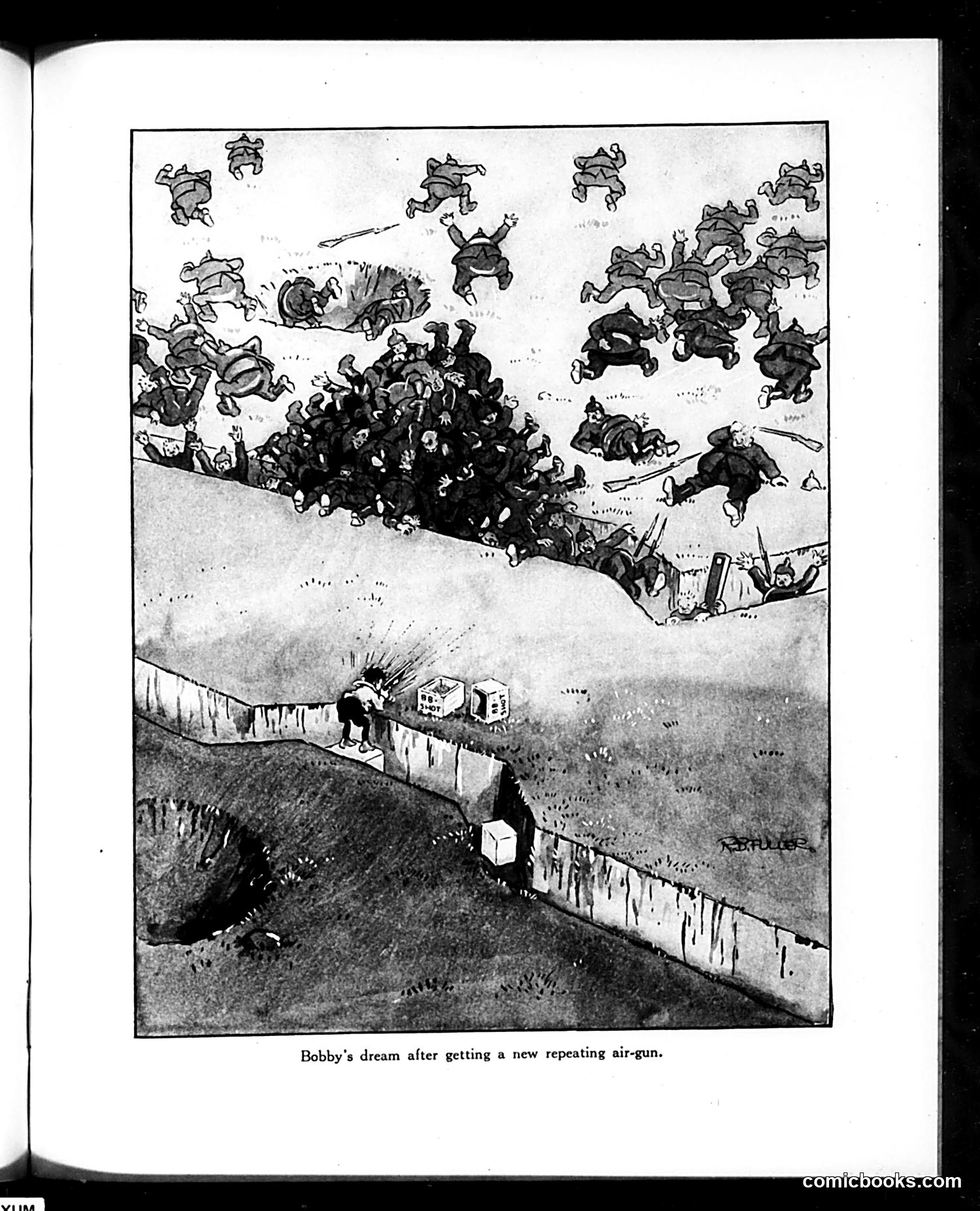
This is a satirical cartoon depicting a child's fantasy after receiving a repeating air-gun as a gift. The caption "Bobby's dream after getting a new repeating air-gun" indicates the image shows the boy's imagined scenario. The cartoon portrays a military trench warfare scene where a lone figure (Bobby) stands armed in a fortified position, while numerous enemy soldiers advance across open ground above. The exaggerated scale—with dozens of toy soldiers appearing to attack—visualizes the boy's inflated sense of power and importance. The satire mocks both childhood gun enthusiasm and, likely, contemporary anxieties about militarism or war preparation. The "repeating air-gun" (a toy gun with rapid-fire capability) becomes the vehicle for satirizing how children fantasize about military dominance and combat. It's commentary on how toys and weaponry fuel imaginative warfare among youth.
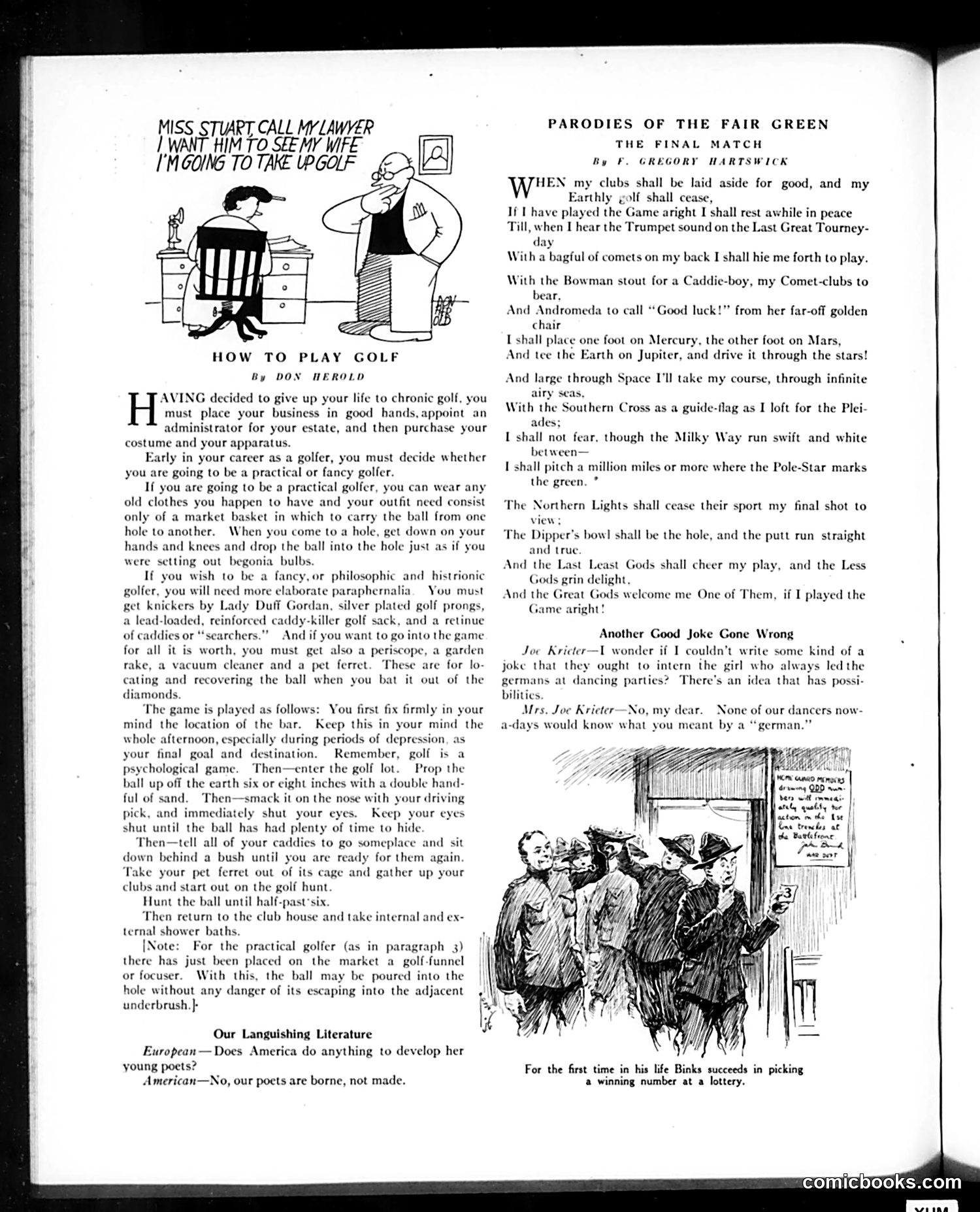
This page contains three humorous pieces satirizing golf culture in early 20th-century America: **"How to Play Golf"** (top left cartoon and article by Don Herold): Mocks the obsessive dedication golfers devote to the sport. The cartoon shows a man telling his lawyer he's abandoning his wife for golf. Herold's article absurdly elaborates this devotion, describing golf as requiring you to appoint an estate administrator before playing—joking that the sport essentially consumes one's entire life. The elaborate equipment descriptions ("caddy-killer golf sack," "periscope") parody the pretentious, excessive gear wealthy golfers accumulated. **"Parodies of the Fair Green"** (right side): A mock-religious poem parodying golf's quasi-spiritual importance to its devotees, imagining playing golf in the afterlife across celestial bodies—further satirizing how Americans elevated the sport to religious significance. **"Another Good Joke Gone Wrong"** (bottom): A brief exchange about German dancing and humor, unrelated to golf. The overall message: Golf was consuming American leisure time and resources to absurd degrees.
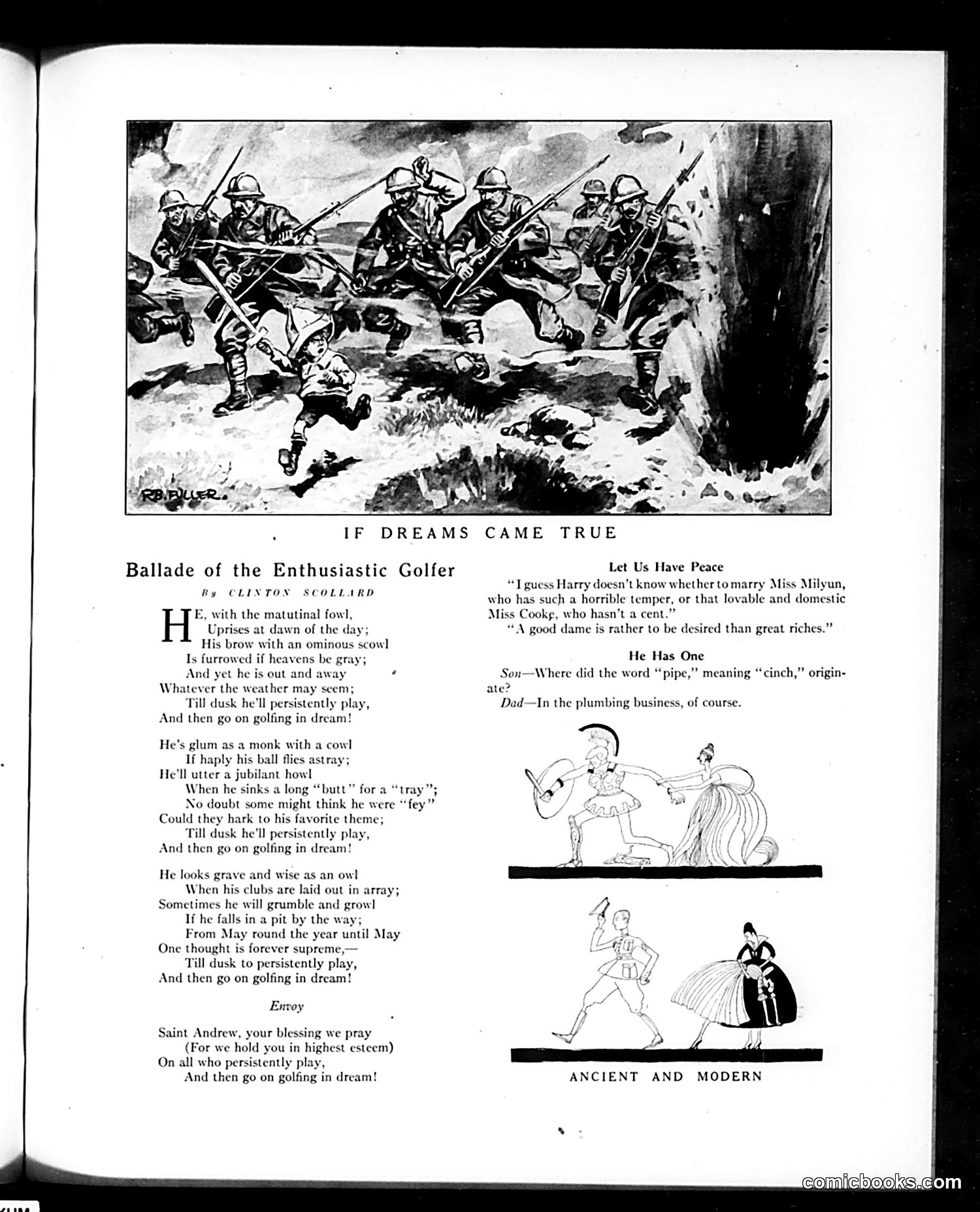
The page contains a romantic poem about golf obsession by Clinton Scollard, satirizing the fanatical golfer who thinks about the sport constantly—from dawn until he "goes on golfing in dream." The repeated refrain mocks how completely golf dominates this character's waking and sleeping life. The top illustration depicts a World War I battle scene, contrasting sharply with the page's title "If Dreams Came True"—likely suggesting the ironic gap between soldiers' brutal reality and civilians' trivial preoccupations with leisure activities like golf. The bottom cartoons show gender dynamics: one depicts courtship rituals, the other a dialogue between father and son about etymology. The "He Has One" joke plays on the saying "a good dame is rather to be desired than great riches," with the son learning that "pipe" (slang for an easy accomplishment) originated in plumbing—deflating romantic idealism with working-class practicality. The satire targets both obsessive hobbyists and the contrast between wartime sacrifice and peacetime frivolity.
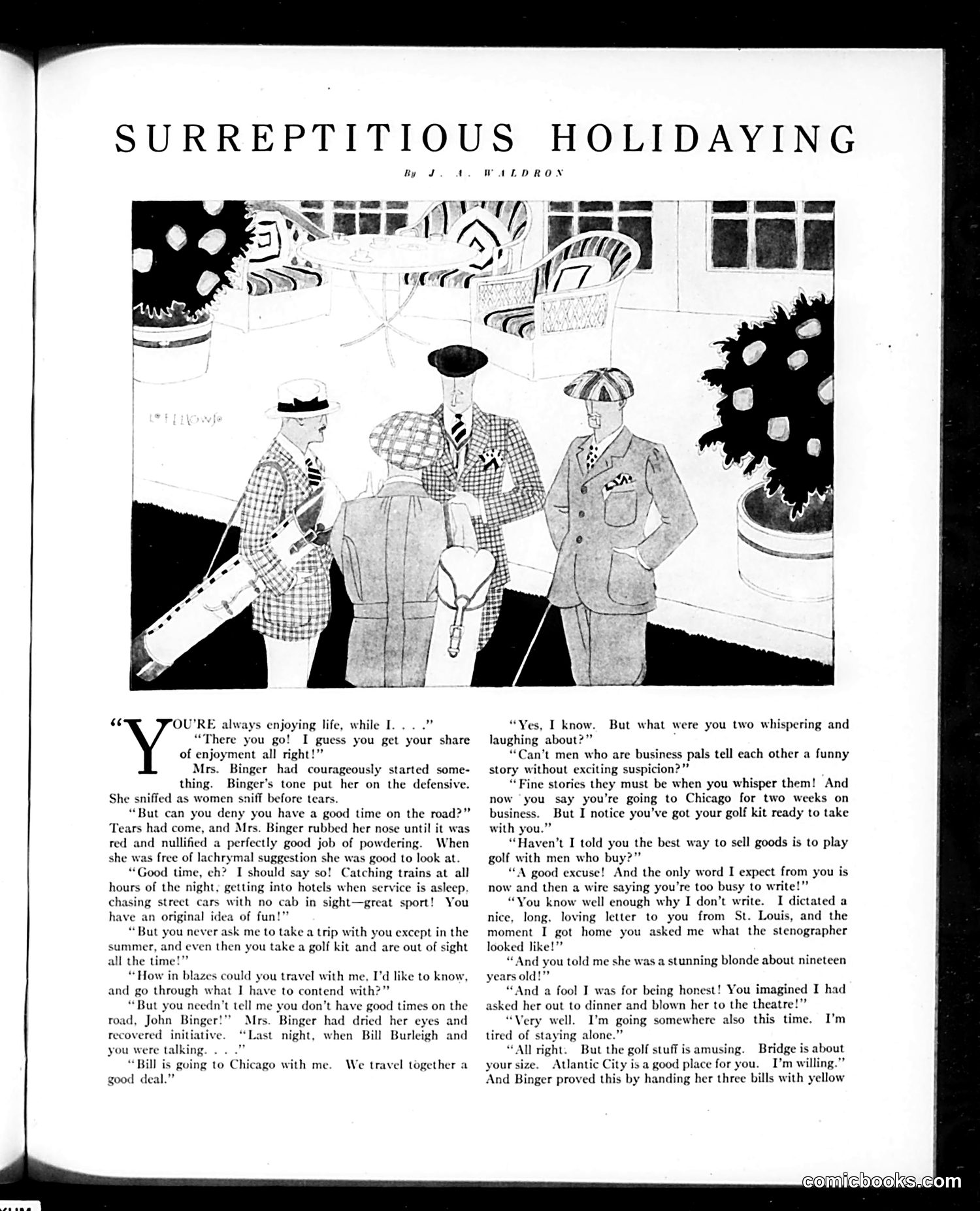
This domestic comedy depicts a marital argument between Mr. and Mrs. Binger over his frequent business travel. Mrs. Binger resents that her husband claims to work while actually playing golf, and that he only invites her on summer trips. She suspects his travels are leisure disguised as business. The satire targets early 20th-century marital tensions around gender roles: wives confined to home life while husbands enjoy freedom under the guise of professional duty. Mrs. Binger's threat to take her own Atlantic City trip—and Mr. Binger's quick capitulation with cash—mocks both spouses' superficial compromise. The title's "surreptitious" suggests their mutual deceptions: his hidden golf trips and her concealed resentment. The cartoon ridicules the hypocrisy of an era where respectability masked leisure pursuits.
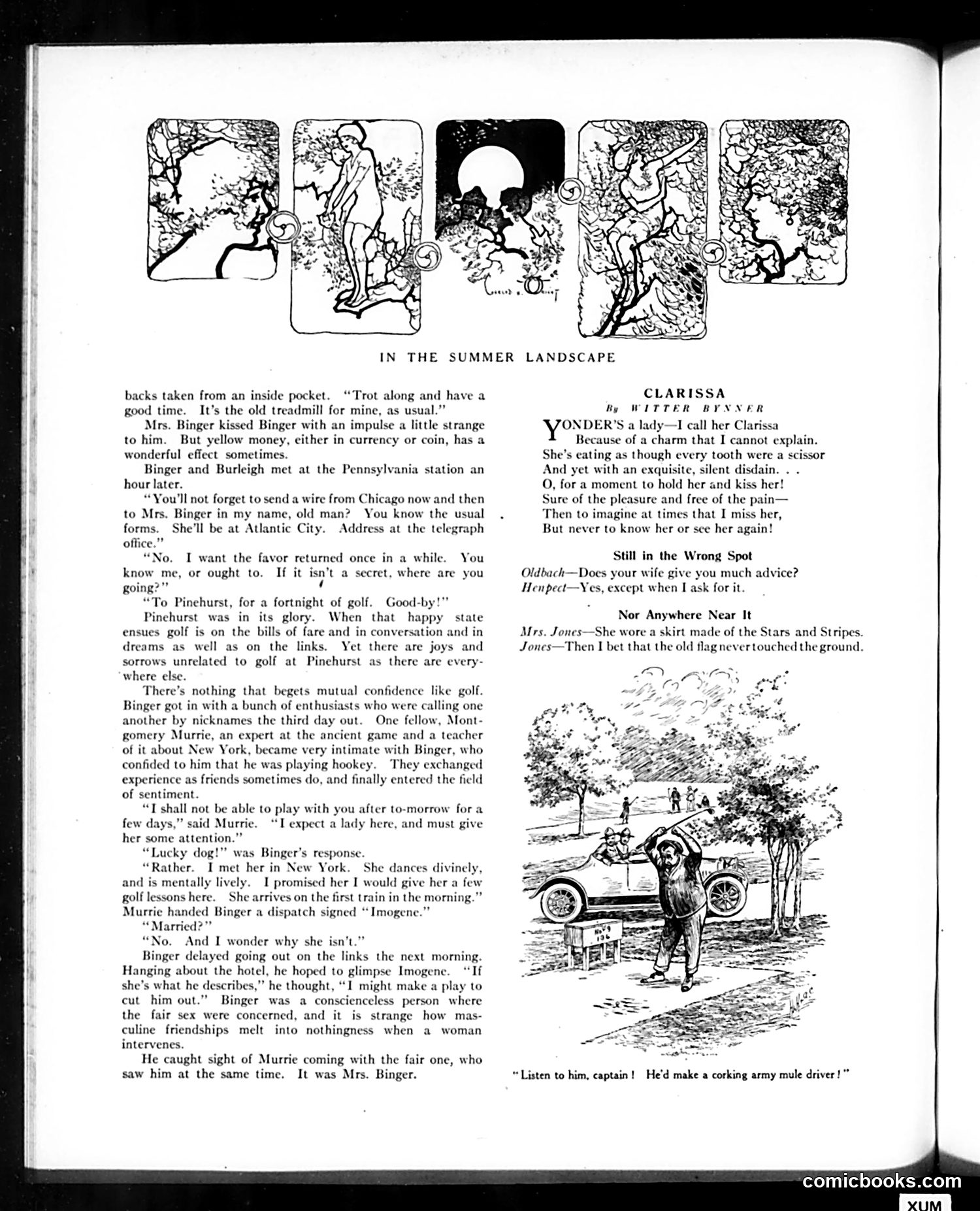
This Judge magazine page contains a short story and several brief jokes typical of early 20th-century humor. **Main Story**: "In the Summer Landscape" depicts a man (Binger) whose wife gives him money for a golf vacation while she goes to Atlantic City. At the golf resort, his new friend Murrie expects an attractive woman named Imogene to arrive. Binger, described as "conscienceless" regarding women, plans to seduce her. The twist: the arriving woman is Mrs. Binger—his own wife. **Jokes**: Three brief quips mock marriage dynamics: a husband's wife gives advice only when uninvited; a woman wore a patriotic Stars-and-Stripes skirt (implying it dragged on the ground, disrespecting the flag); and a mule driver comment. **Context**: The satire targets male infidelity and the hypocrisy of married men pursuing women while their wives are elsewhere. The humor assumes readers found such behavior comedic rather than condemnable—reflecting period attitudes about gender and marital fidelity.
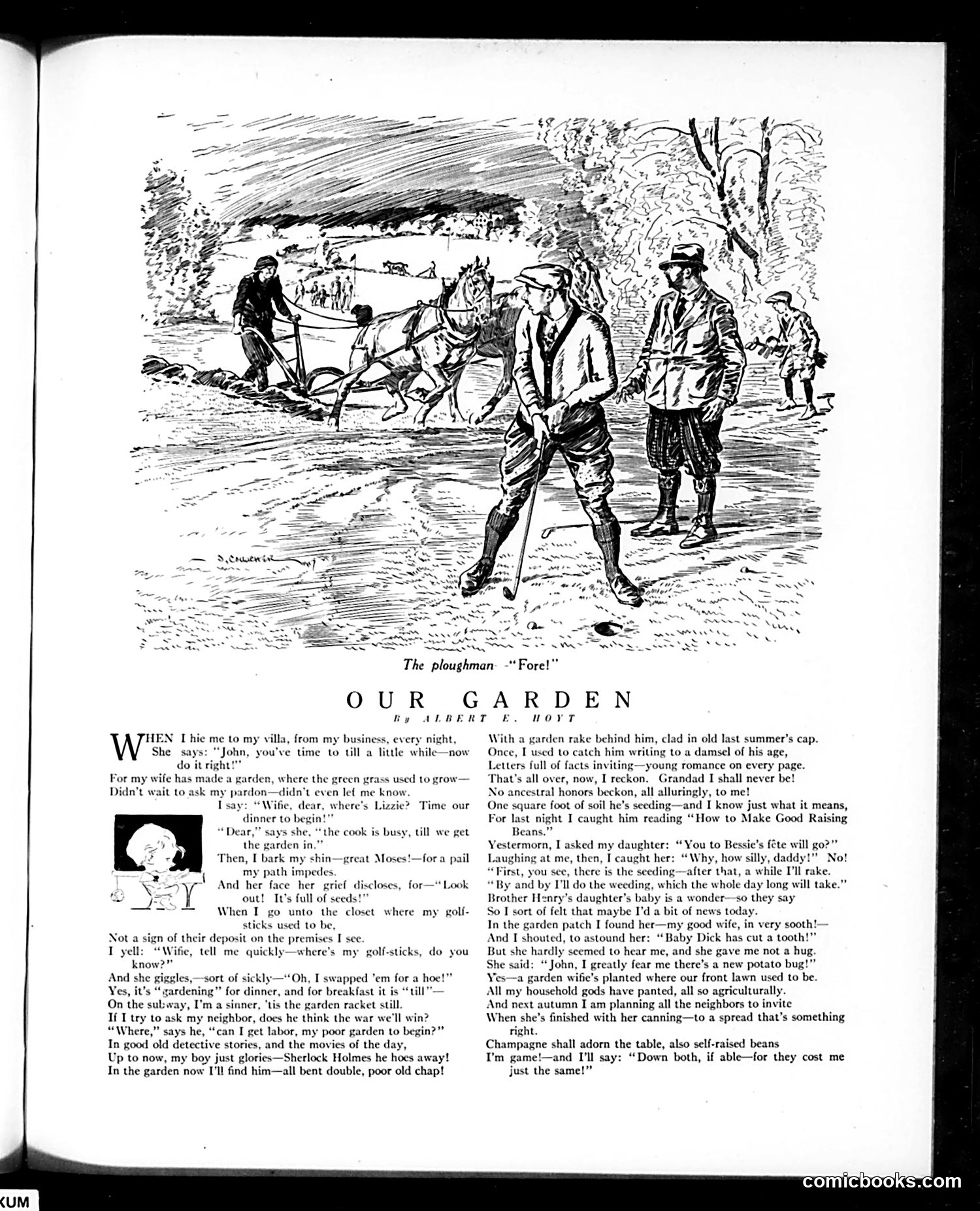
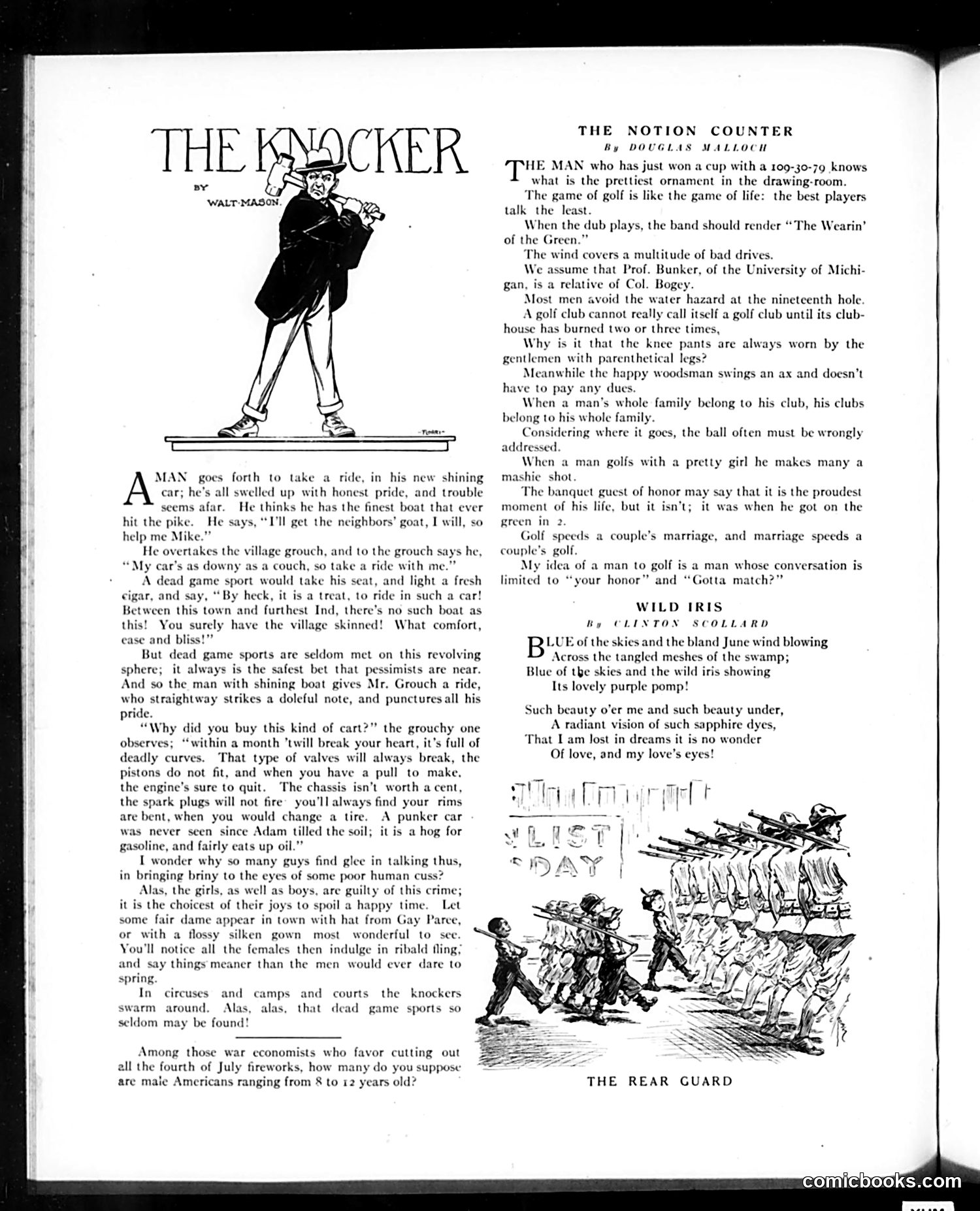
This humorous domestic satire depicts the wartime "victory garden" craze—likely WWI era—where Americans, especially women, converted ornamental lawns into vegetable plots for food self-sufficiency. **The Joke:** The narrator's wife unilaterally transforms their property into a garden without permission, disrupting his leisure (golf clubs replaced by hoes, his son now reads bean-cultivation guides instead of romance). The broader point mocks how gardening fervor has consumed the entire household and neighborhood—even neighbors abandon hopes of wartime labor for their own gardens. **Key Satire:** - Wife's domestic authority supersedes husband's property claims - The garden obsession invades every family activity (dinner conversations, children's education, visiting) - Even personal milestones (baby's tooth) are overshadowed by agricultural concerns - The narrator's attempt to turn canned vegetables into social capital ("Champagne shall adorn the table") suggests both patriotic participation and his resigned acceptance of domestic upheaval. The cartoon above shows laborers literally working the soil—emphasizing the physical reality behind the poem's comedy.
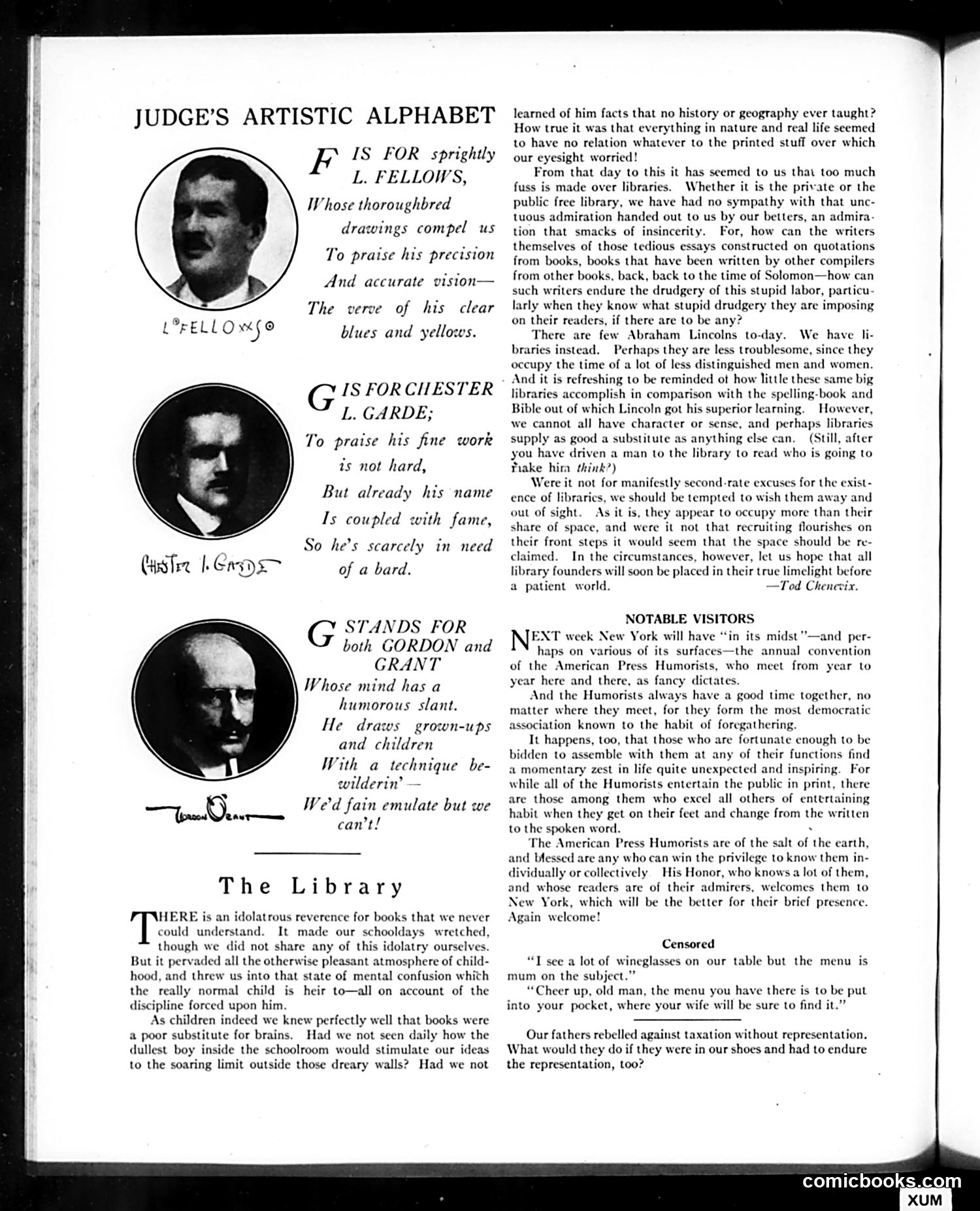
This page features **"Judge's Artistic Alphabet,"** celebrating three prominent illustrators of the era: **F is for L. Fellowes** — praised for precise, detailed drawings with vibrant color work. **G is for Chester L. Garde** — noted as already famous despite his youth, needing no introduction. **G is for Gordon and Grant** — artists with humorous sensibilities who draw both adults and children with distinctive, playful technique. The accompanying essay, **"The Library,"** is a satirical attack on excessive reverence for books and libraries. The author mocks the notion that books are superior to real-world experience, arguing that "dullest" schoolchildren often possessed practical knowledge that books couldn't teach. The piece criticizes libraries as overrated institutions, suggesting they're poor substitutes for actual intelligence or character—comparing them unfavorably to Lincoln's self-education through basic texts like the Bible and spelling books. The satire targets intellectual pretension and bookish snobbery of the period.
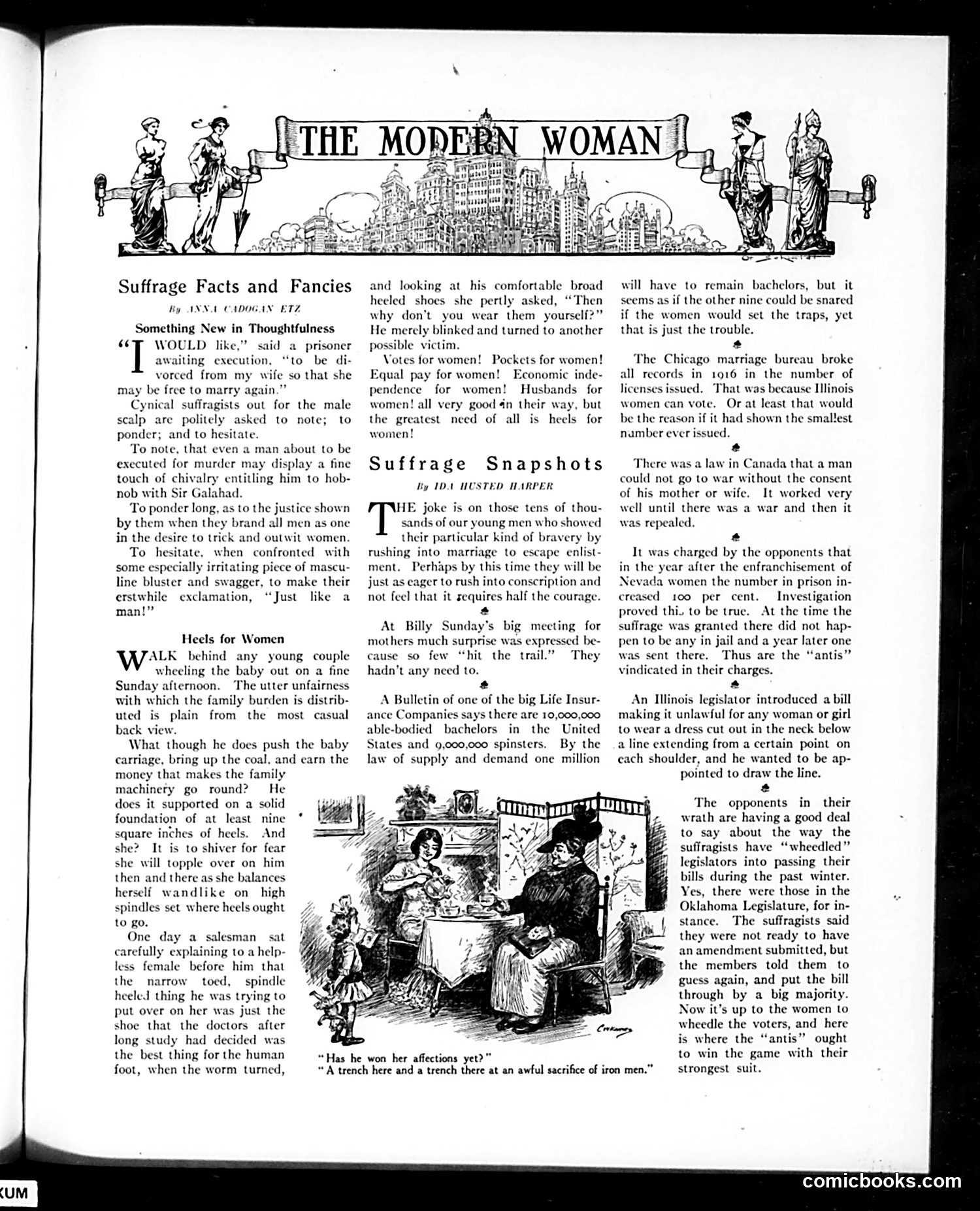
This Judge magazine page satirizes both women's suffrage advocates and opponents through multiple pieces. The main cartoon depicts a woman at a table with a soldier, captioned with her asking "Has he won her affections yet?" while commenting on "trenches" and "sacrifice of iron men"—a WWI reference mocking women's supposed obsession with romance during wartime. The surrounding articles by Anna Cadogan Etz and Ida Husted Harper use mock-serious tone to argue *for* suffrage by highlighting absurdities: a column on impractical high heels satirizes women's physical disadvantages; another ridicules anti-suffrage arguments (like the claim Nevada's female imprisonment rate increased 100% when it actually went from zero to one woman). The piece mocks both anti-suffragists' flawed logic and traditional gender roles, ultimately supporting women's voting rights and economic independence through humorous exposure of the status quo's illogic.
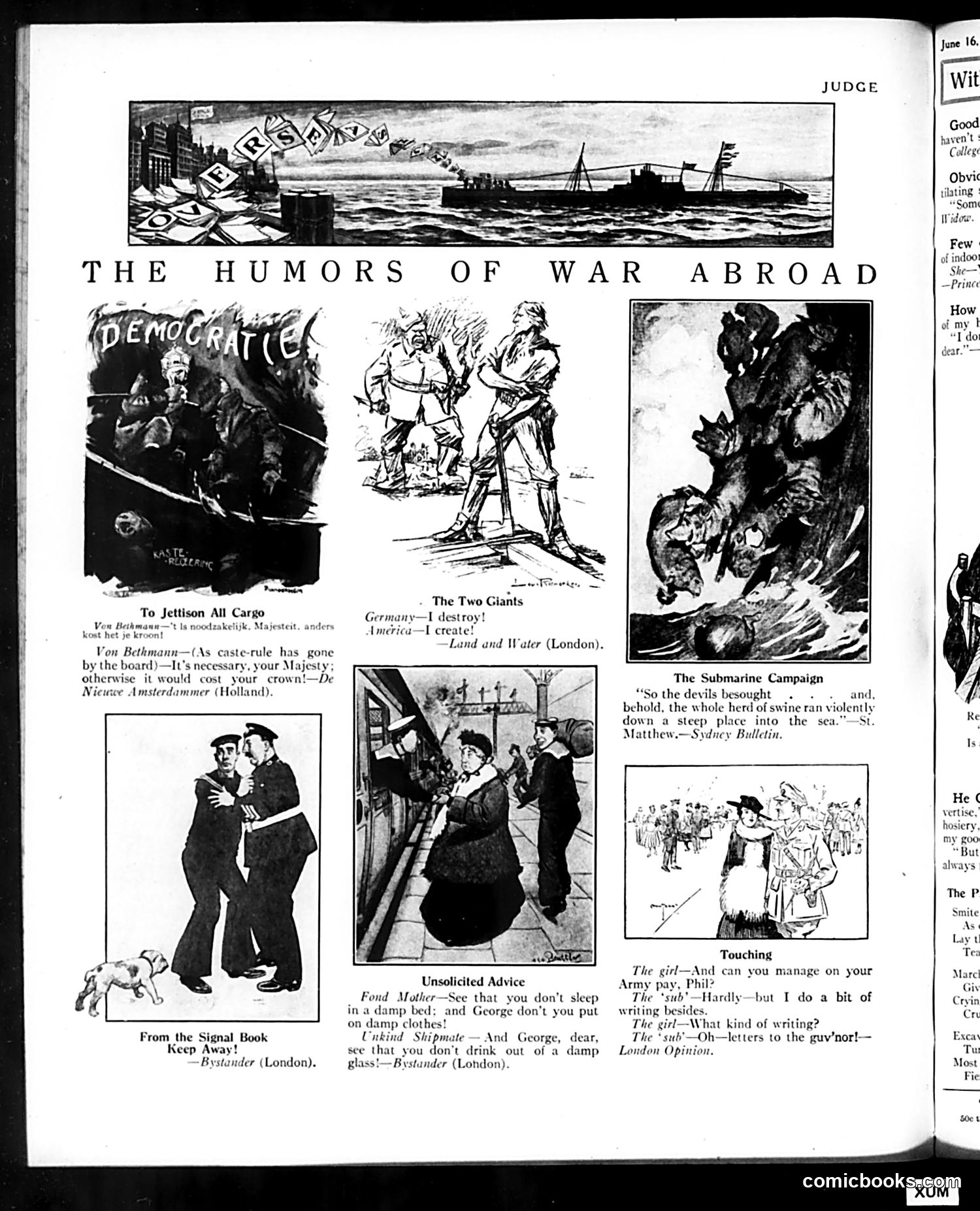
This Judge page uses satirical cartoons to mock World War I combatants and military life. The top cartoon shows German Chancellor von Bethmann-Hollweg advising the Kaiser to abandon democratic principles to preserve his crown—mocking Germany's authoritarian government. "The Two Giants" contrasts Germany's destructive warfare with America's creative capacity, reflecting Allied propaganda that characterized Germany as militaristic and America as civilized. "The Submarine Campaign" darkly compares German U-boat attacks to Biblical swine possessed by demons, invoking scripture to condemn submarine warfare as demonic. The remaining cartoons joke about soldiers' discomforts (damp conditions, meager pay) and military humor about writing letters to officers rather than loved ones—gentle domestic humor amid serious war commentary. The page reflects American attitudes during WWI, criticizing German militarism while maintaining confidence in American virtue.
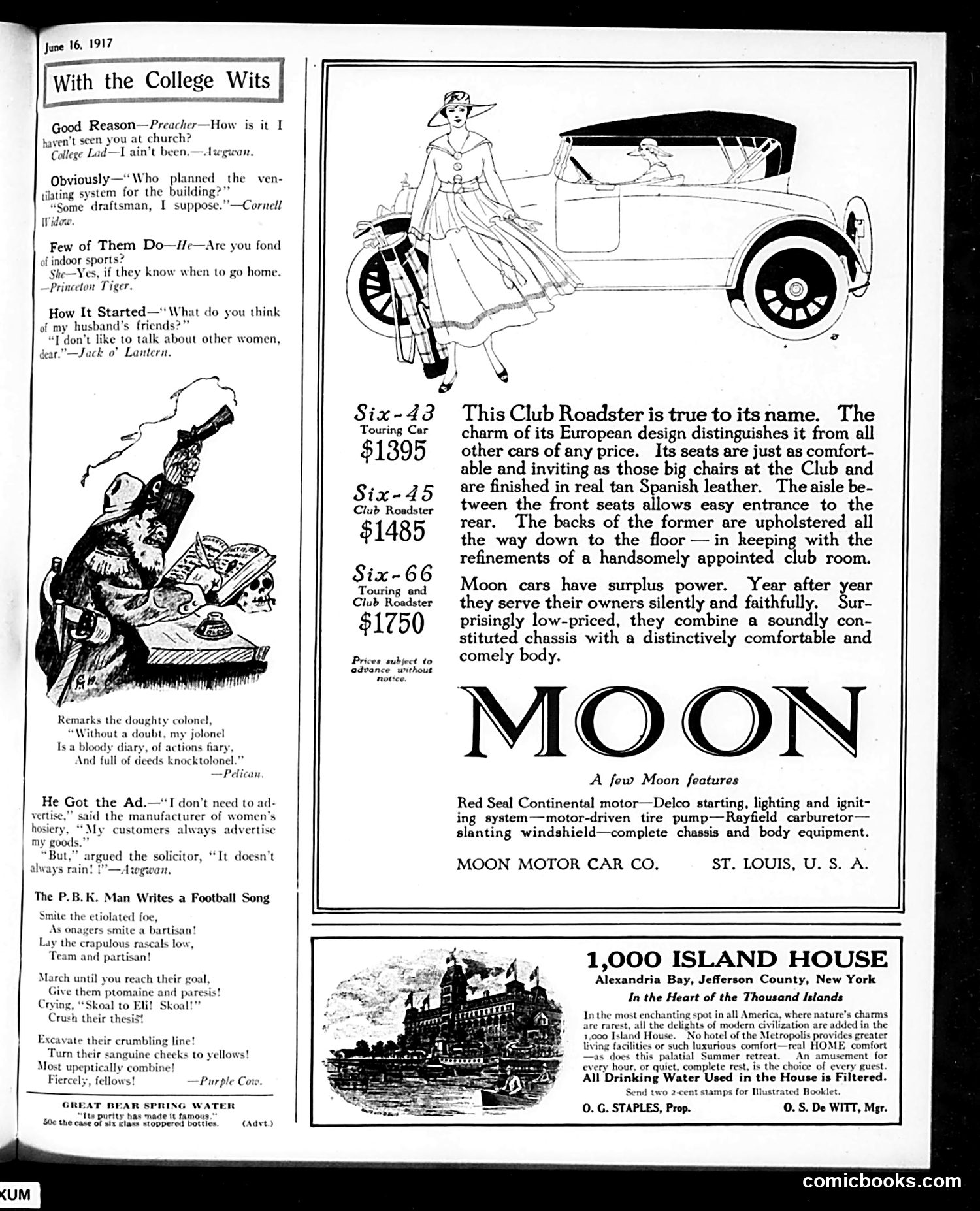
This page contains **humor columns and advertisements** rather than political cartoons. **"With the College Wits"** features brief jokes from various college humor magazines (Cornell, Princeton, Jack o' Lantern, etc.), poking fun at common college-era scenarios: religious hypocrisy, romantic relationships, and advertising. The "doughty colonel" verse appears to be mock-heroic doggerel. **The advertisements** dominate the right side: Moon Motor Cars emphasize luxury and European refinement (appealing to wealthy readers), and the "1,000 Island House" resort advertises upscale leisure accommodations in New York. The page reflects **1917 American middle/upper-class concerns**: courtship rituals, consumer goods as status symbols, and leisure pursuits. There are no identifiable political figures or historical events referenced—this is primarily commercial entertainment for college-educated readers with disposable income.
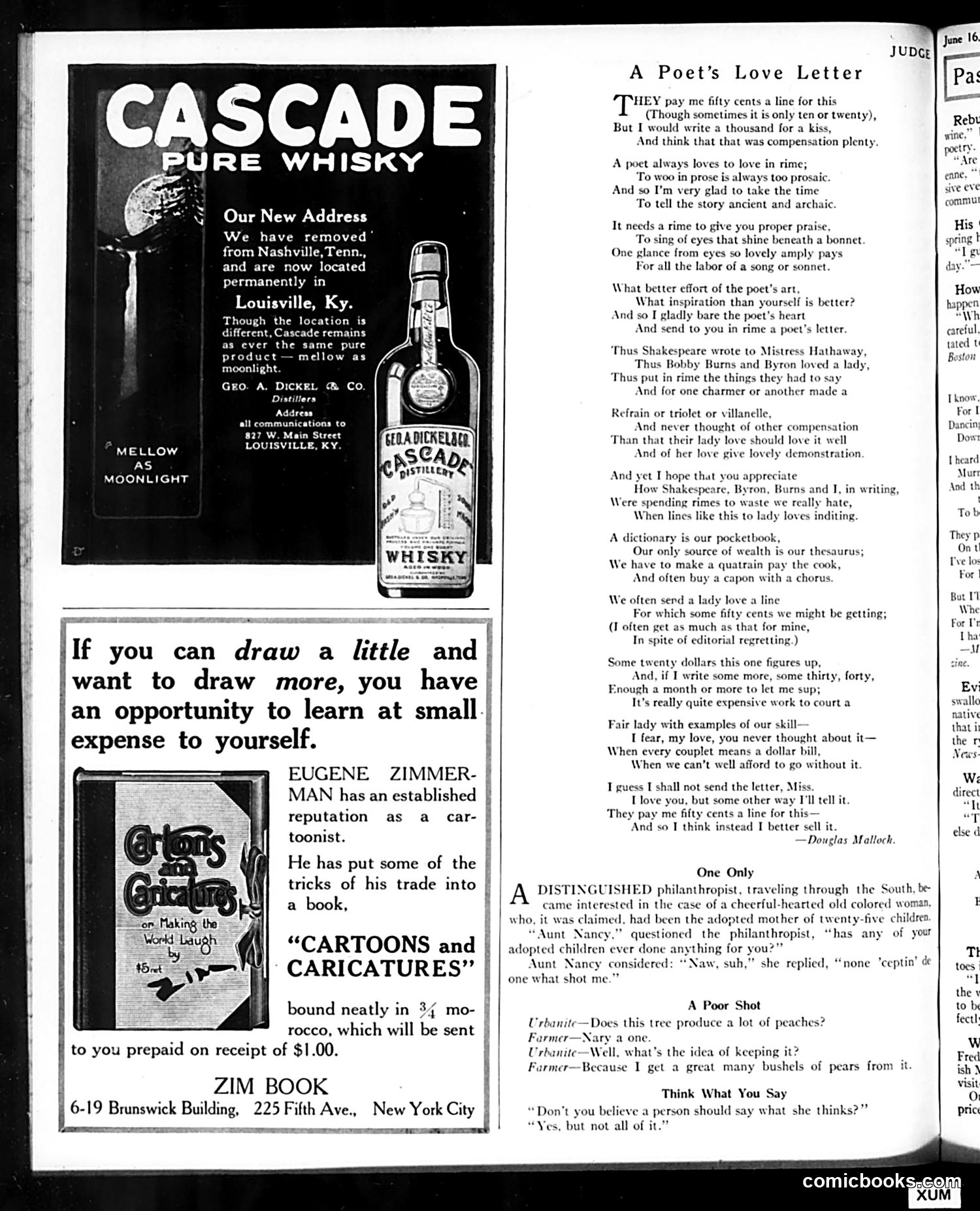
This page is primarily **advertising and literary content** rather than political cartoons. The main elements: **Advertisements:** - Cascade Pure Whisky announces relocation from Nashville to Louisville - Eugene Zimmerman's cartooning instruction book ("Cartoons and Caricatures") **Literary Content:** The bulk of the page features "A Poet's Love Letter" by Douglas Malloch—a humorous poem about struggling poets who write romantic verses for pittance (fifty cents per line). The satire targets the economics of poetry: poets spend intellectual labor on romantic compositions for pittance while claiming such work is laborious drudgery they "really hate." The irony is explicit—the poet calculates his earnings (twenty to forty dollars monthly) while romanticizing artistic suffering. **Brief Humorous Anecdotes:** - "One Only": A philanthropist questions an elderly Black woman about adopted children; she mentions one "shot me" (dark humor about ingratitude) - "A Poor Shot" / "Think What You Say": Simple rural jokes about tree productivity The page reflects early 20th-century Judge magazine's mix of advertising, verse, and light humor targeting educated, middle-class readers.
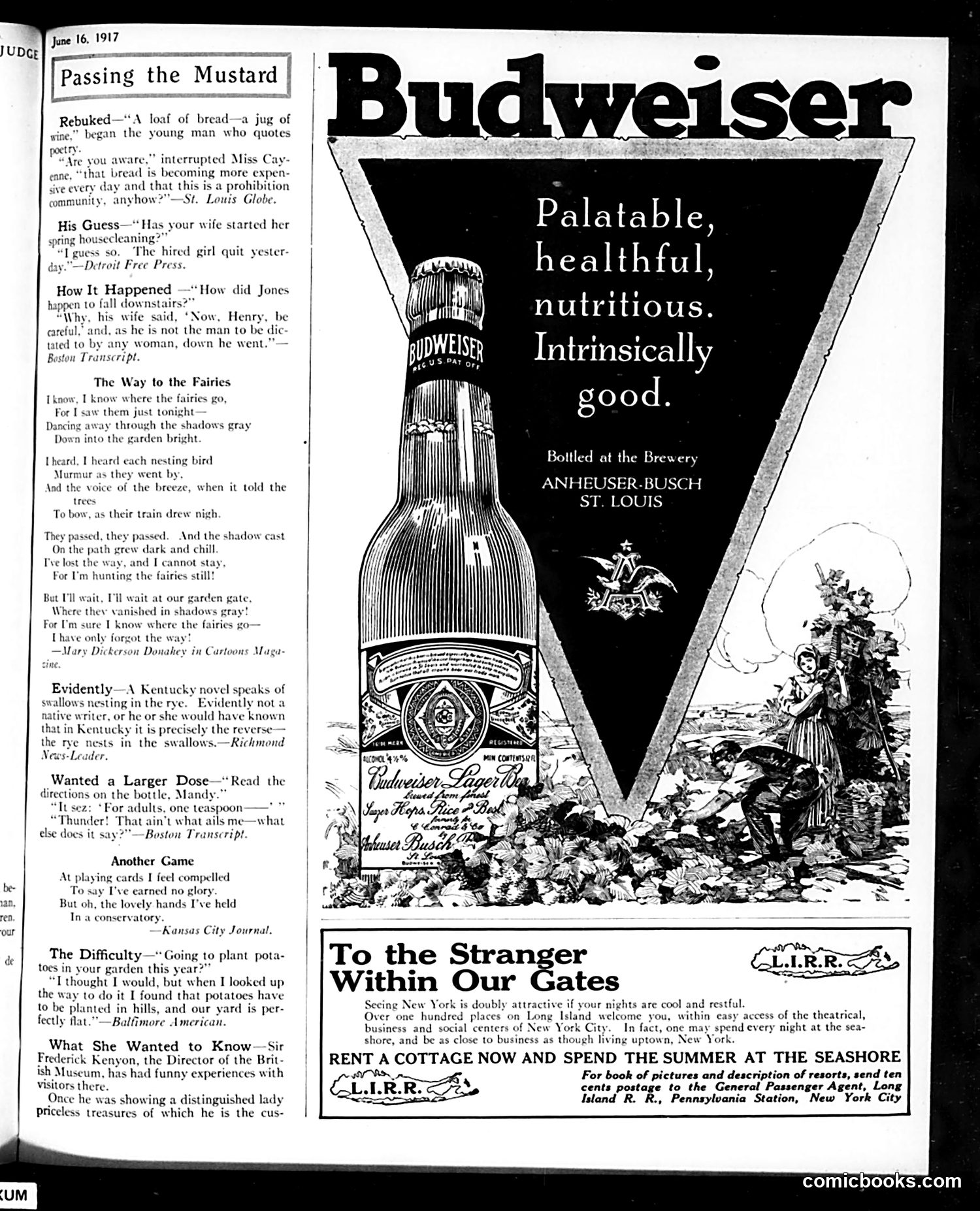
This page is primarily **advertising and filler content** rather than political satire. The dominant feature is a large Budweiser advertisement claiming the beer is "Palatable, healthful, nutritious. Intrinsically good"—language that appears ironic given the historical context of 1917, when Prohibition sentiment was rising and the U.S. was about to enter World War I. The left column contains miscellaneous jokes and humorous observations, most apolitical. One item references bread and wine becoming expensive due to "prohibition"—a contemporary concern as wartime rationing and anti-alcohol sentiment grew. The bottom features a Long Island Railroad tourism advertisement. **For modern readers:** The Budweiser ad's emphatic health claims read as darkly comedic given that Prohibition would begin in 1920, just three years later. The beer industry's defensive marketing suggests awareness of the coming threat to their business.
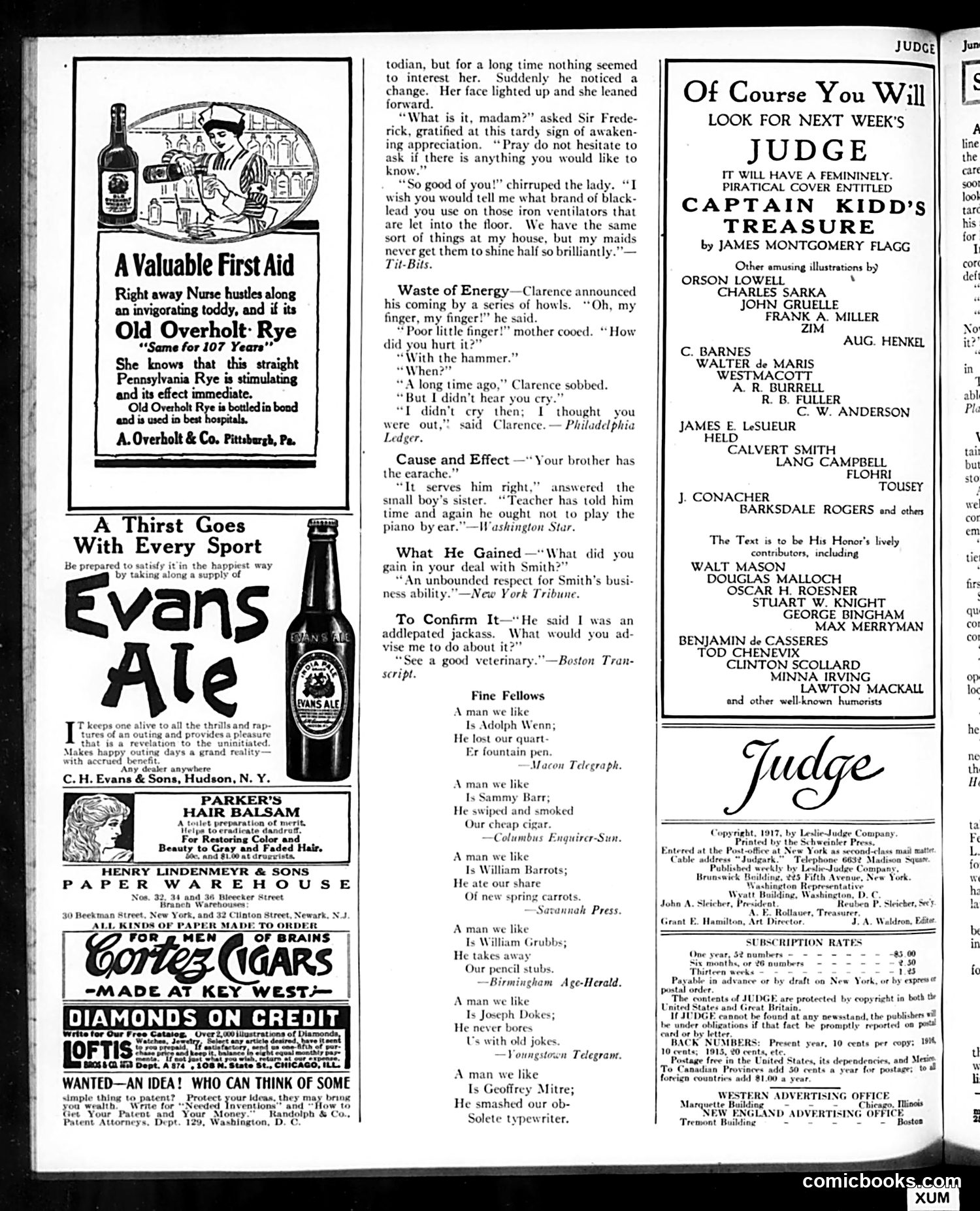
This page is primarily **advertisements and promotional content** rather than editorial cartoons. The satirical content is minimal. The visible advertisements promote products typical of 1917: Overholt Rye whiskey (marketed as a "first aid" remedy), Evans Ale, Parker's Hair Balsam, and other commercial goods. These ads reflect early 20th-century marketing that freely associated alcohol with health benefits—a pre-Prohibition mindset. The humor pieces are brief **anecdotes** rather than political satire: absurdist vignettes about wasted energy (a child crying over a hammer-smashed finger), social observation ("A man we like / Is Adolph Wenn; / He lost our quart- / Er fountain pen"), and wordplay. The page primarily **promotes next week's Judge issue**, featuring a "Captain Kidd's Treasure" cover by James Montgomery Flagg, with contributions from various humorists and illustrators listed. There are **no identifiable political figures or satirical targets** visible on this page—it's mainly commercial advertising with filler humor.
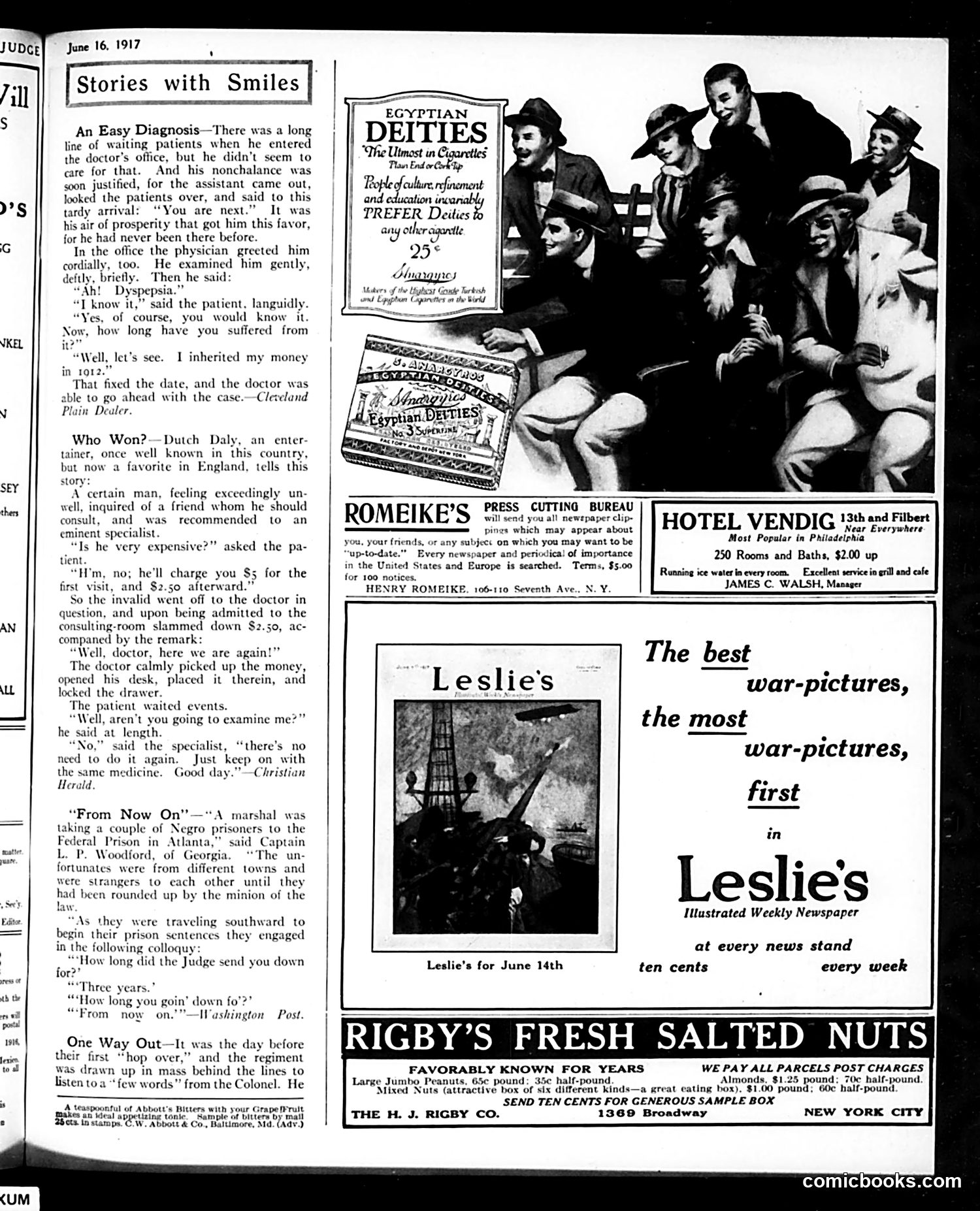
This June 1917 *Judge* page contains satirical stories about American life, mostly focused on doctors and medical practitioners. The jokes mock: (1) a physician's ability to diagnose illness based purely on a patient's wealth (inferring "dyspepsia" from the patient inheriting money in 1912); (2) a dishonest specialist who charges $5 for first visits but only $2.50 thereafter, then refuses to examine a repeat patient, pocketing the fee; and (3) a dark joke about African American prisoners being sent to federal prison. The humor relies on cynicism about class exploitation and medical fraud. The page is dated June 16, 1917—roughly two months after America entered World War I—so the Leslie's advertisement promoting "war-pictures" reflects contemporary wartime interest. The remaining content is mostly advertisements for hotels, cigarettes, and nuts.
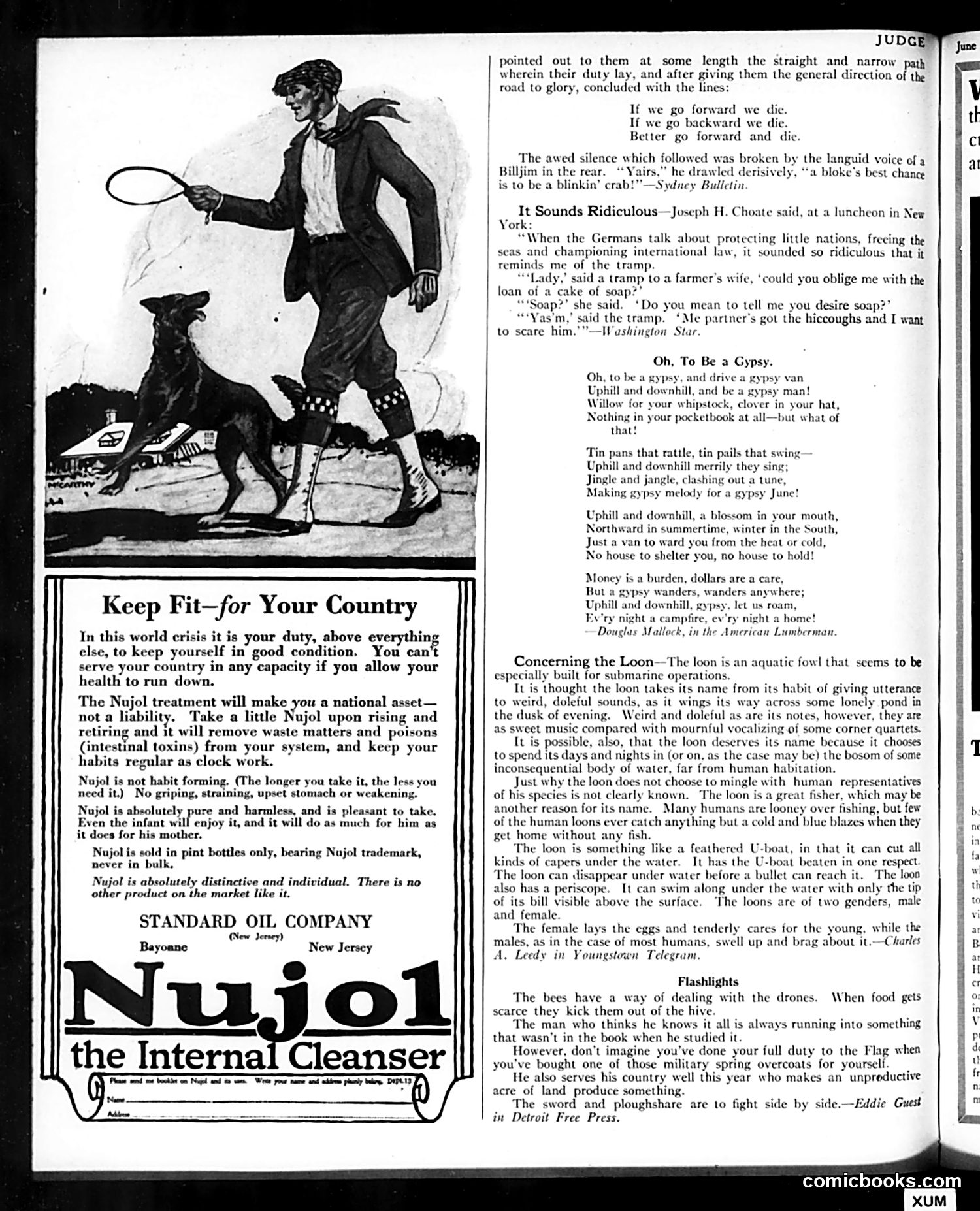
This page is primarily **advertising and entertainment content**, not political satire. The dominant feature is a **Nujol laxative advertisement** with patriotic framing. The illustration shows a man energetically wielding a tennis racket, accompanying text urging readers to "Keep Fit—for Your Country" during wartime. The ad frames bowel regularity as a patriotic duty, claiming Nujol makes one "a national asset." The remainder contains light humor pieces: anecdotes mocking German war rhetoric as absurd (comparing it to a tramp asking to borrow soap), a whimsical poem romanticizing gypsy life, and a naturalist essay about loons. The patriotic tone throughout suggests publication during **World War I** (when America was involved 1917-1918), as evidenced by references to German propaganda and the "world crisis." There is **no direct political cartoon** on this page—the Nujol illustration is commercial art, not editorial satire.
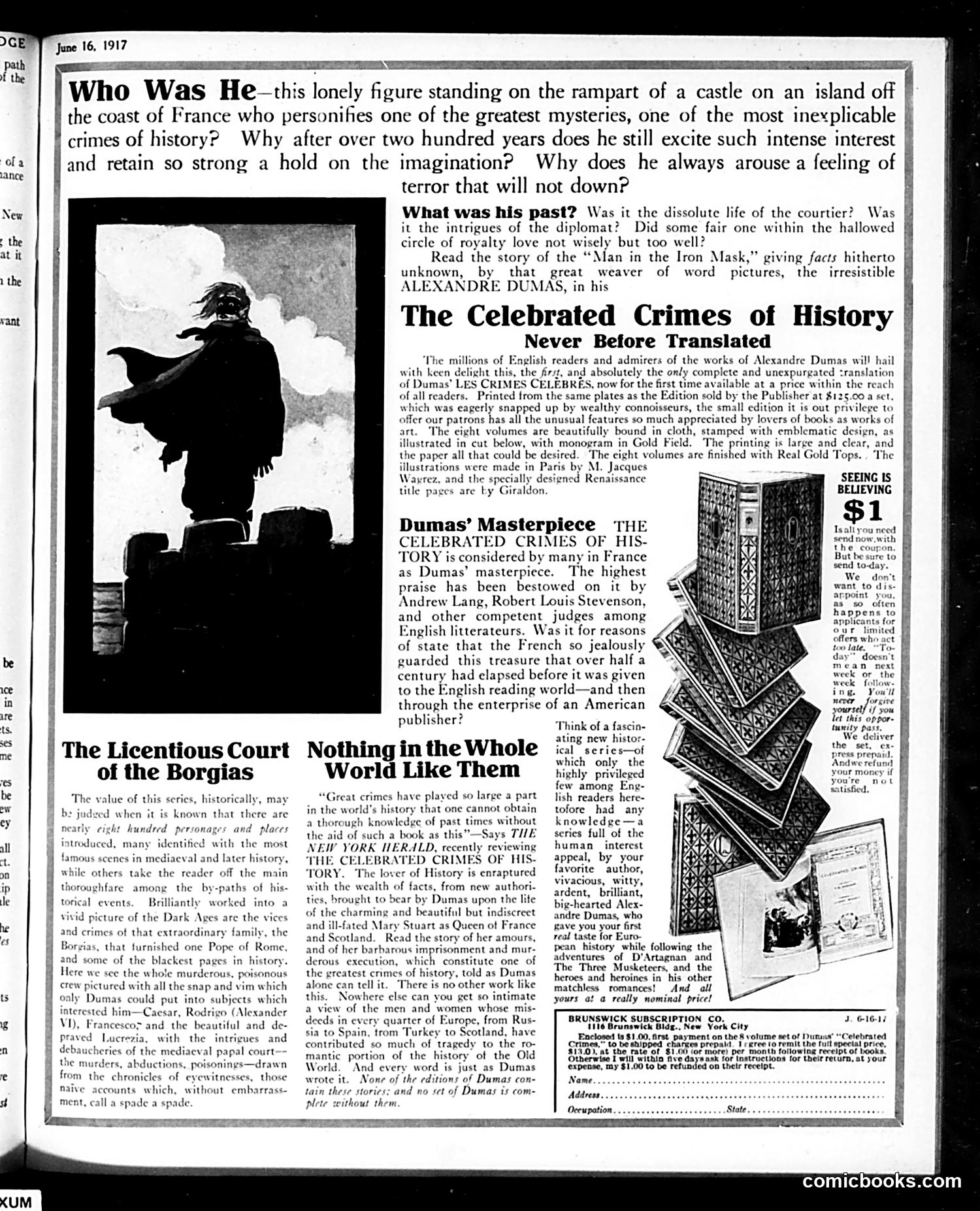
This June 1917 *Judge* magazine page is primarily **advertising for Alexandre Dumas' "The Celebrated Crimes of History,"** marketed as a newly available English translation of his *Crimes Célèbres*. The silhouetted figure of a man in a cape on a castle rampart references **the Man in the Iron Mask**—Dumas' famous mysterious prisoner. The advertisement teases this historical mystery to hook readers, asking provocative questions about his identity and past. The text emphasizes that this complete translation was previously unavailable to English readers at affordable prices (the publisher's edition cost $125). The ad highlights endorsements from respected literary figures like Robert Louis Stevenson, positioning Dumas as a serious historical author, not mere entertainment. The subscription offer at bottom-right shows this is a book club promotion, promising leather-bound volumes with gold tops and ornate design—targeting affluent collectors valuing both content and aesthetic presentation.

This is a full-page advertisement for Grape-Nuts cereal, not a political cartoon. The ad makes health claims typical of early 20th-century food marketing, asserting the product is "known the world over" for flavor and "strength-building qualities." It recommends Grape-Nuts become a daily household staple ("every table should have its daily ration"). The phrase "There's a Reason" was Grape-Nuts' actual advertising slogan from that era. The decorative border and bold typography are characteristic of Judge magazine's advertising style. This represents the period when breakfast cereals were marketed with pseudoscientific wellness claims before modern food regulation existed.