
Judge, 1917-06-16 · page 18 of 28
Judge — June 16, 1917 — page 18: what you’re looking at
What you’re looking at
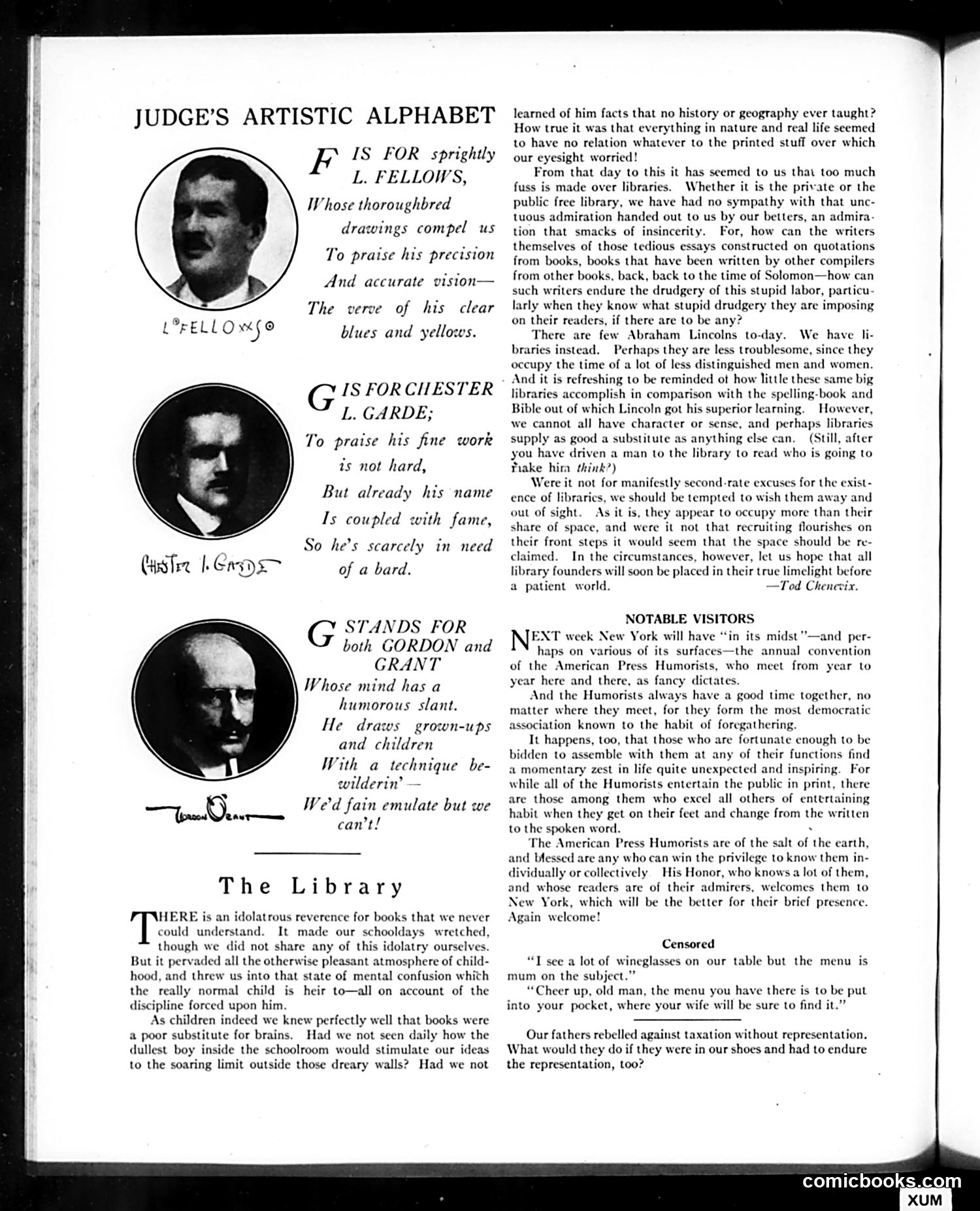
This page features **"Judge's Artistic Alphabet,"** celebrating three prominent illustrators of the era: **F is for L. Fellowes** — praised for precise, detailed drawings with vibrant color work. **G is for Chester L. Garde** — noted as already famous despite his youth, needing no introduction. **G is for Gordon and Grant** — artists with humorous sensibilities who draw both adults and children with distinctive, playful technique. The accompanying essay, **"The Library,"** is a satirical attack on excessive reverence for books and libraries. The author mocks the notion that books are superior to real-world experience, arguing that "dullest" schoolchildren often possessed practical knowledge that books couldn't teach. The piece criticizes libraries as overrated institutions, suggesting they're poor substitutes for actual intelligence or character—comparing them unfavorably to Lincoln's self-education through basic texts like the Bible and spelling books. The satire targets intellectual pretension and bookish snobbery of the period.
📄 Transcribed text from this page (OCR, searchable)
Machine-transcribed from the original scan — historical spelling and the odd misread are preserved.
JUDGE’S ARTISTIC ALPHABET F IS FOR sprightly L. FELLOWS, Whose thoroughbred drawings compel us To praise his precision And accurate vision— The verve of his clear L°rFELLO i ic) blues and yellows. 8 Castro b Cass IS FORCHESTER L. GARDE; To praise his fine work is not hard, But already his name Ts coupled with fame, So he’s scarcely in need of a bard. STANDS FOR both GORDON and GRANT Whose mind has a humorous slant. He draws grown-ups and children With a technique be- wilderin’ — We'd fain emulate but we G The Library HERE is an idolatrous reverence for books that we never could understand. It made our schooldays wretch though we did not share any of this idolatry ourselv But it pervaded all the otherwise pleasant atmosphere of child- hood, and threw us into that state of mental confusion whith the really normal child is heir to—all on account of the discipline forced upon him. As children indeed we knew perfectly well that books were a poor substitute for brains. Had we not seen daily how the dullest boy inside the schoolroom would stimulate our ideas to the soaring limit outside those dreary walls? Had we not learned of him facts that no history or geography ever taught? How true it was that e hing in nature and real life seemed to have no relation whatever to the printed stuff over which our eyesight worried! From that day to this it has seemed to us that too much fuss made over libraries. Whether it is the private or the public free library, we have had no sympathy with that unc- tuous admiration handed out to us by our betters, an admira tion that smacks of insincerity. For, how can the writers themselves of those tedious essays constructed on quotations from books, books that have been written by other compilers from other books, back, back to the time of Solomon—how can such writers endure the drudgery of this stupid labor, particu larly when they know what stupid drudgery they are imposing on their readers, if there are to be any? There are few Abraham Lincolns to-day. We have li- braries instead. Perhaps they are less troublesome, since they occupy the time of a lot of less distinguished men and women. And it is refreshing to be reminded ot how little these same big libraries accomplish in comparison with the spelling-book Bible out of which Lincoln got his superior learning. Howe: we cannot all have character or sense, and per! supply as good a substitute as anything else can. (Still, after you have driven a man to the library to read who is going to Tiake him think?) Were it not for manifestly second-rate excuses for the exist- ence of libraries, we should be tempted to w' out of sight. it is, they appear to occupy more than their share of space, and were it not that recruiting flourishes on their front steps it would seem that the space should be re- claimed. In the circumstances, however, let us hope that all library founders will soon be placed in their true limelight before a patient world. —Tod Chenevix. NOTABLE VISITORS NEXT week New York will have “in its midst'’—and_per- haps on various of its surfaces—the annual convention of the American Press Humorists, who meet from year to year here and there, as fancy dictates. And the Humorists alw have a good time together, no matter where they meet, for they form the most democratic association known to the habit of foregathering. It happens, too, that those who are fortunate enough to be bidden to assemble with them at any of their functions find a momentary zest in life quite unexpected and inspiring. For while all of the Humorists entertain the public in print, there are those among them who excel all others of entertaining habit when they get on their feet and change from the written to the spoken word. a“ The American Press Humorists are of the salt of the earth, and bfessed are any who can win the privilege to know them in- dividually or collectiv His Honor, who knows a lot of them, and whose readers are of their admirers, welcomes them to New York, which will be the better for their brief presence. Again welcome! Censored “T see a lot of wineglasses on our table but the menu is mum on the subject.” “Cheer up, old man, the menu you have there is to be put into your pocket, where your wife will be sure to find it.” Our fathers rebelled against taxation without representation. What would they do if they were in our shoes and had to endure the representation, too? comicbooks.com