
A complete issue · 28 pages · 1916
Judge — November 18, 1916
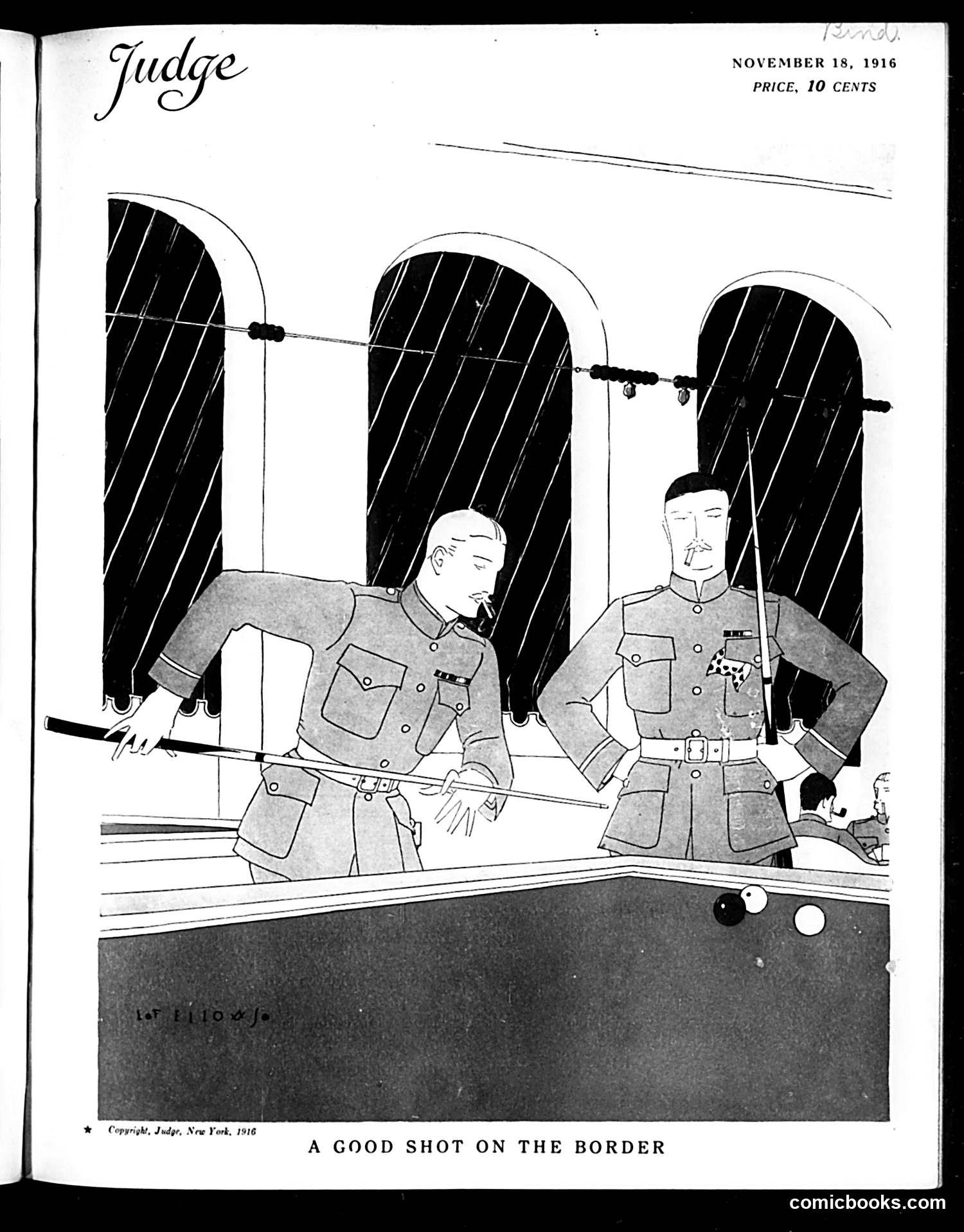
This November 1916 cartoon satirizes military posturing during the Mexican Border Campaign. Two uniformed officers play billiards while three large cannons loom behind them, pointed outward through window-like openings suggesting fortifications. The title's "good shot" creates a double meaning: it refers both to their billiards game and to military firepower. The satire critiques the apparent disconnect between leisurely, comfortable military life and the serious border tensions with Mexico that had prompted U.S. military deployment. This reflects the context of Pancho Villa's 1916 raid into New Mexico and the subsequent U.S. military response. Judge magazine, a humorous publication, uses this juxtaposition to mock either the readiness of border forces or the casual attitude toward potential conflict.
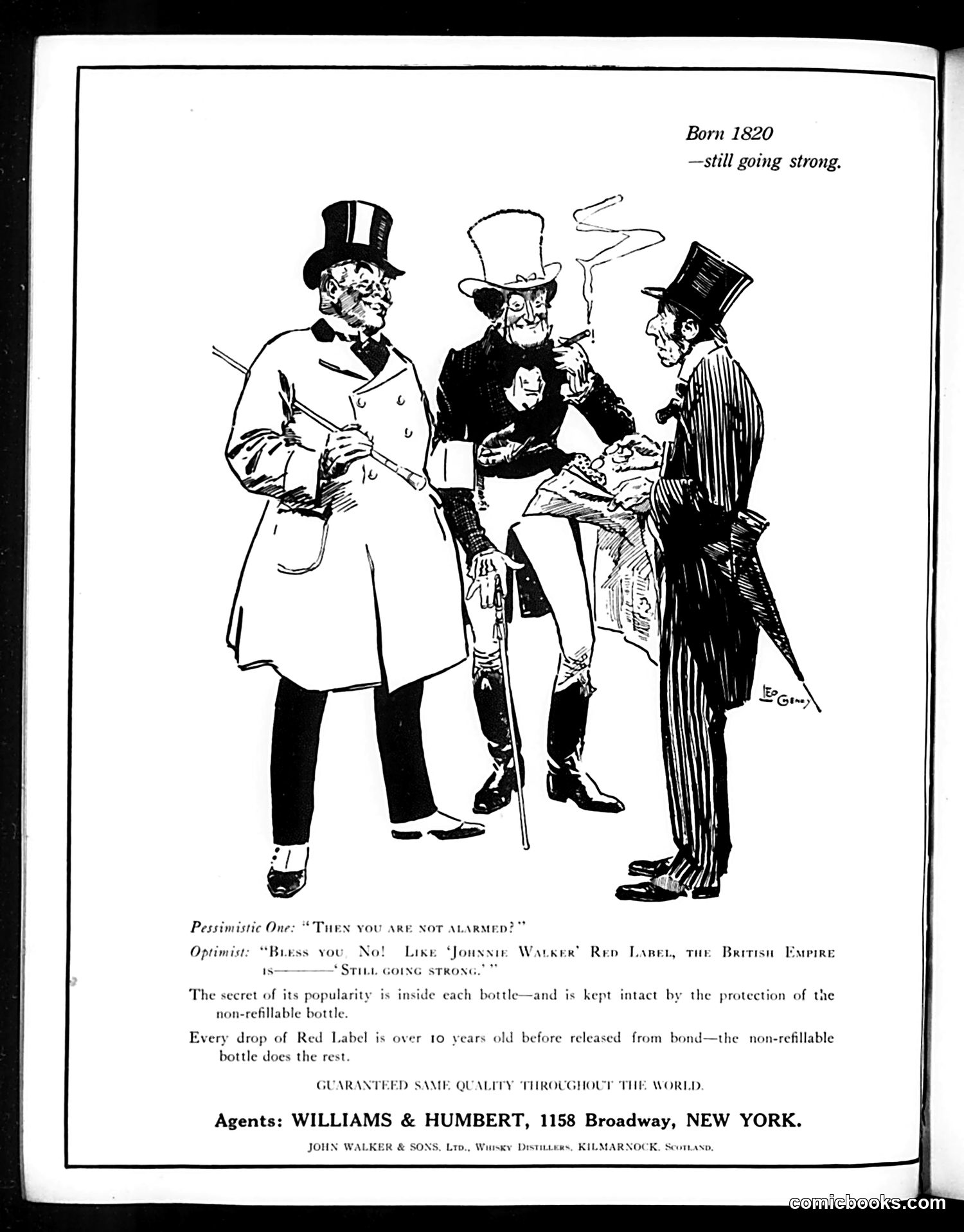
This is primarily a **Johnnie Walker Red Label whisky advertisement** disguised as editorial cartoon commentary. The image shows three caricatured figures in formal Victorian dress (top hats) engaged in conversation about the product. The "joke" compares the whisky's longevity to Britain's imperial endurance. The pessimist character expresses alarm at aging (born 1820, "still going strong"), while the optimist praises the product's durability, explicitly likening it to "the British Empire" which is also "still going strong." The advertisement's core claim emphasizes the product's stability through non-refillable bottles preventing tampering, and that Red Label whisky is aged 10+ years before sale. This reflects early-1900s advertising's common practice of wrapping product pitches in satirical editorial cartoons to appear as legitimate magazine content rather than paid advertising.
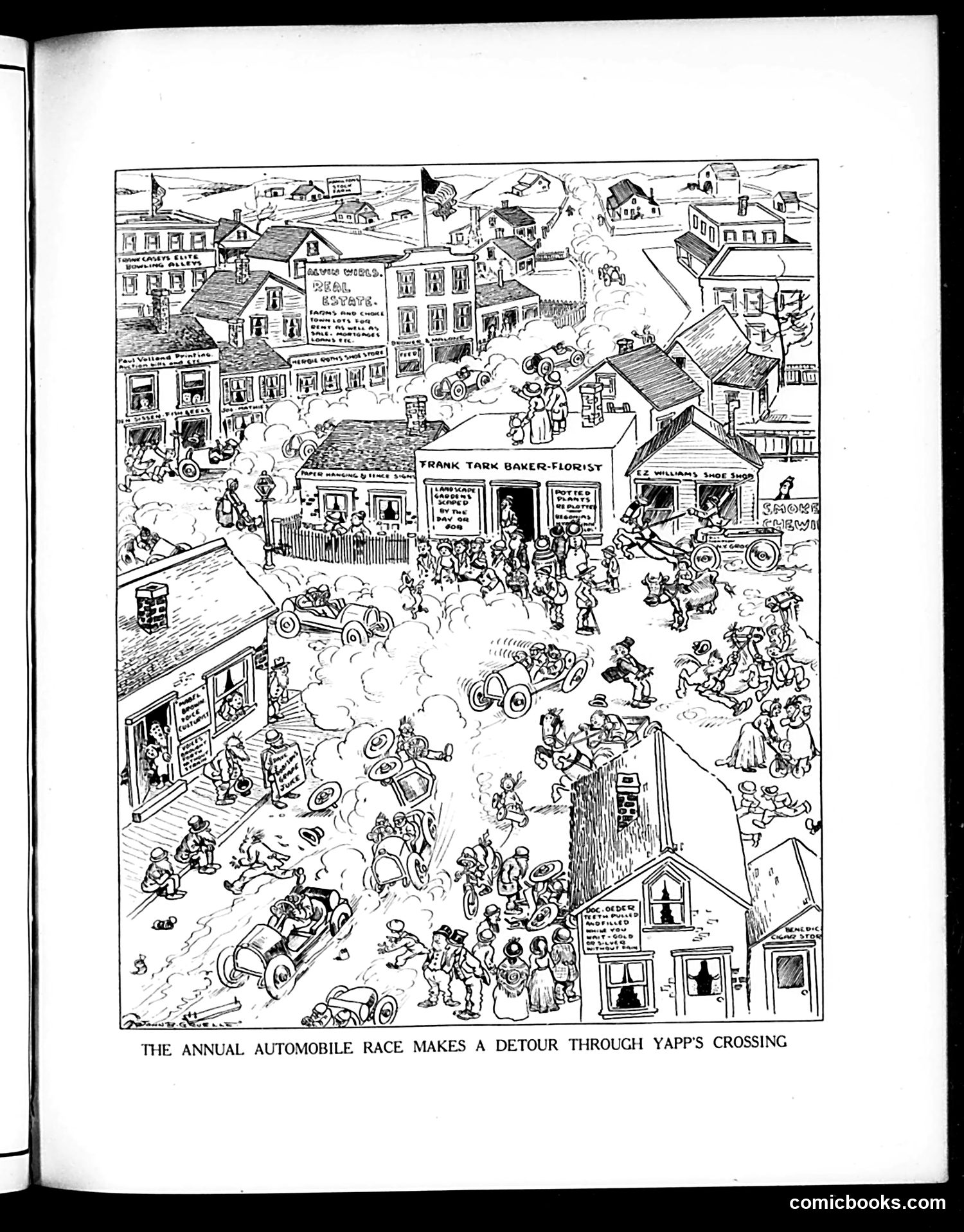
This Judge magazine cartoon satirizes the chaos caused by an annual automobile race passing through "Yapp's Crossing," a small town. The image shows a bustling street scene where racing cars create havoc—kicking up massive dust clouds that engulf pedestrians, buildings, and local businesses. The humor derives from the contrast between the townspeople's ordinary daily activities (shopping at "Frank Task Baker-Florist," conducting business) and the disruption caused by the race. Signs advertising local shops are visible amid the mayhem. The cartoon mocks both the dangerous, disruptive nature of early automobile racing and small-town vulnerability to such modern intrusions. This likely reflects early 1900s anxieties about automobiles as chaotic, polluting forces that invaded peaceful communities, treating public streets as racetracks regardless of civilian consequences.
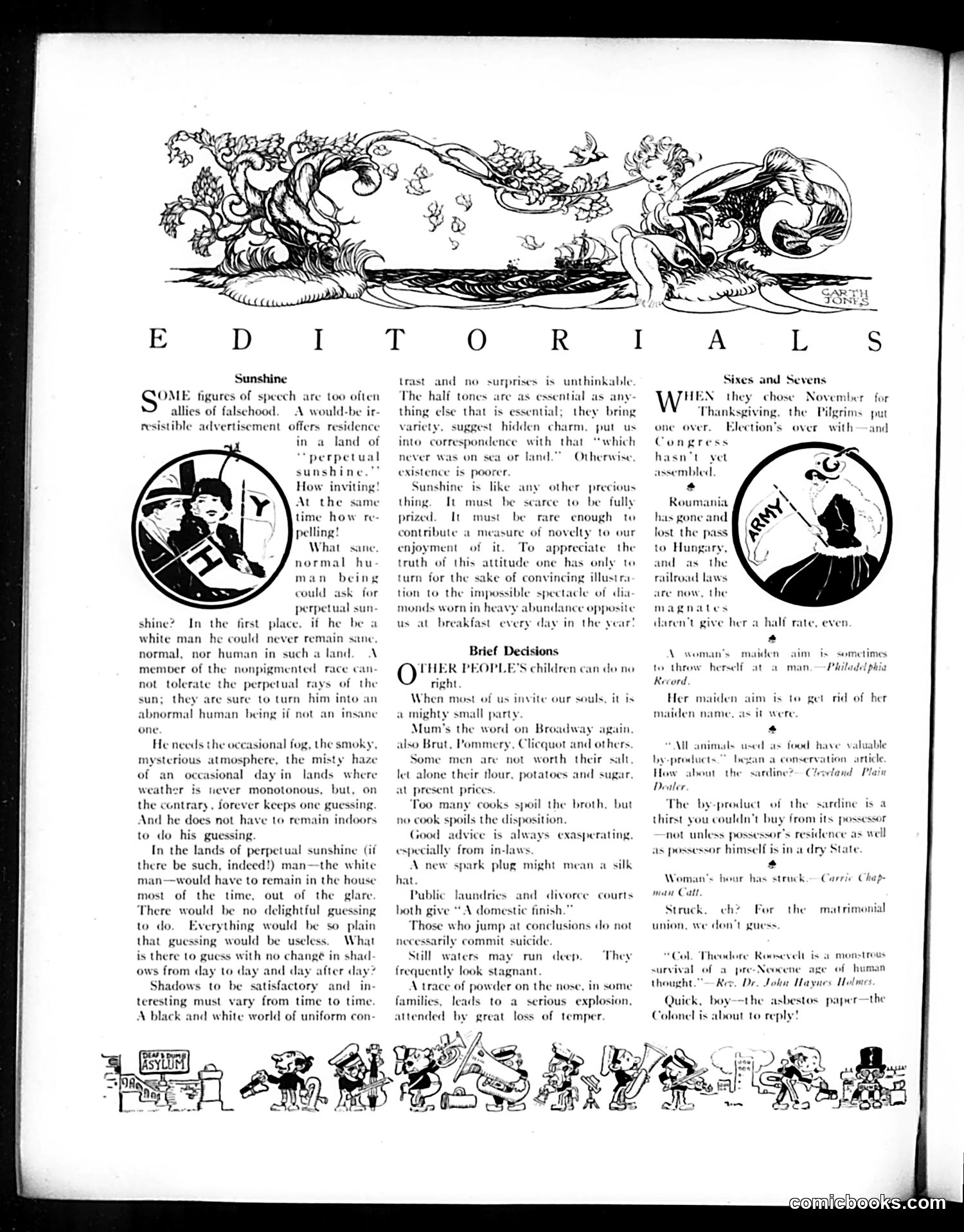
This Judge magazine editorial page contains three main sections: **Top Illustration ("Sunshine")**: A whimsical decorative header featuring cherubs and nature elements—likely a seasonal or thematic flourish rather than political commentary. **Left Column ("Sunshine")**: Satirizes people who complain about weather and monotony. The circular vignette shows what appears to be ordinary citizens. The piece mocks those seeking "perpetual sunshine" and argues that variety in weather is necessary and desirable—a lighthearted social critique about human nature and complaint. **Right Column ("Sixes and Sevens")**: References the 1920 U.S. presidential election and Romania's political situation, mentioning lost mountain passes to Hungary and railway rates. This appears to address post-WWI geopolitical concerns. **Bottom**: "Brief Decisions" offers short satirical commentary on various social topics (domestic life, cooking, divorce courts, etc.). The page emphasizes social humor over sharp political satire.
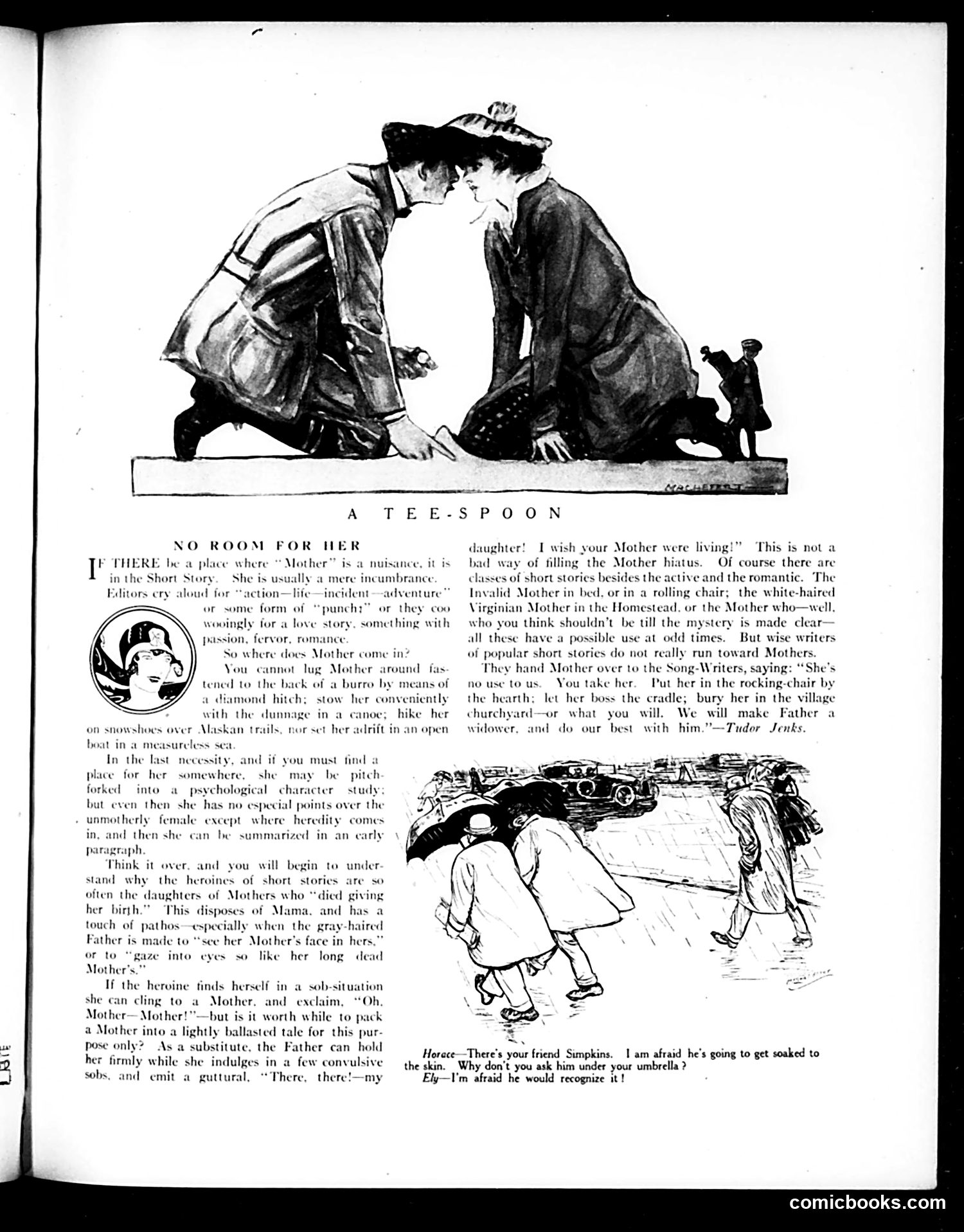
This satirical article critiques the common literary trope of the "Mother" character in short stories. The author argues that editors favor stories featuring mothers as plot devices—particularly tragic or inconvenient ones (bedridden, elderly, etc.)—rather than as meaningful characters. The top illustration shows two men in conversation, likely representing a writer pitching to an editor. The lower illustration depicts people in rain, with dialogue about an umbrella and a friend getting soaked—a mundane scene typical of the formulaic stories being mocked. The piece satirizes how publishers exploit sentimental maternal themes for commercial appeal while relegating mothers to peripheral roles rather than developing them as complex characters. The author advocates for more substantive maternal representation in fiction.
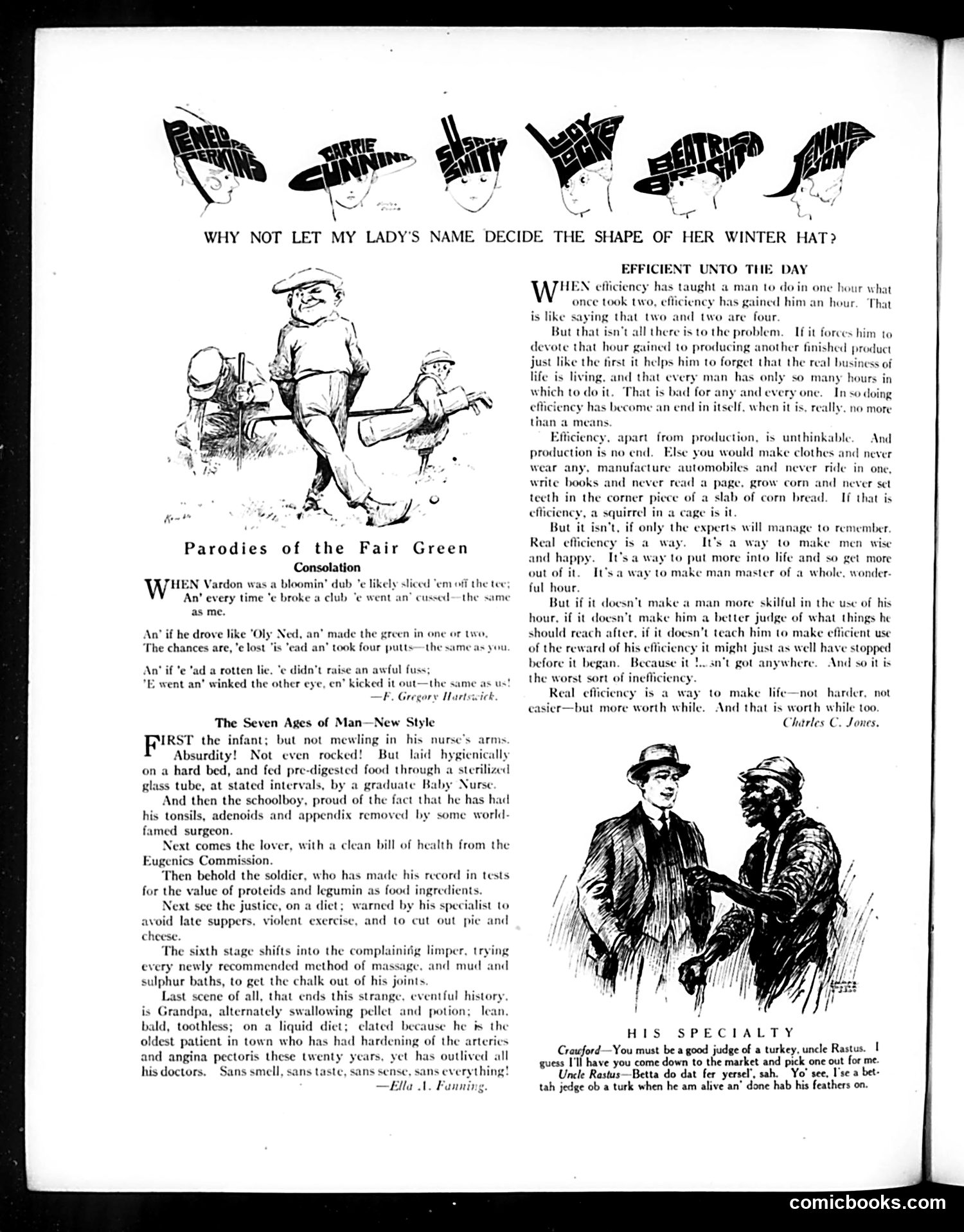
This page from Judge satirizes early-20th-century American obsessions with **efficiency and scientific management**—the era's dominant productivity ideology. The central essay "Efficient Unto the Day" by Charles C. Jones critiques excessive efficiency culture. It argues that modern efficiency experts, by obsessively maximizing production, have perverted efficiency's purpose. The author warns that if efficiency merely drives people to produce more products endlessly (clothes never worn, books never read, corn never eaten), it becomes meaningless—"a squirrel in a cage." The supporting content reinforces this theme through mockery: "The Seven Ages of Man—New Style" satirizes hyper-medicalized, scientifically-managed modern life, where people are sterilized, tested, and optimized from infancy onward, yet still decay into elderly pill-poppers. The hat cartoon at top appears to joke about women's fashion being equally absurd and trend-driven. The golf parody mocks British golfer Harry Vardon, suggesting even champions struggle with the same frustrations as ordinary players—deflating efficiency's promise of perfection. Together, the page warns readers that blind pursuit of scientific optimization threatens genuine living.
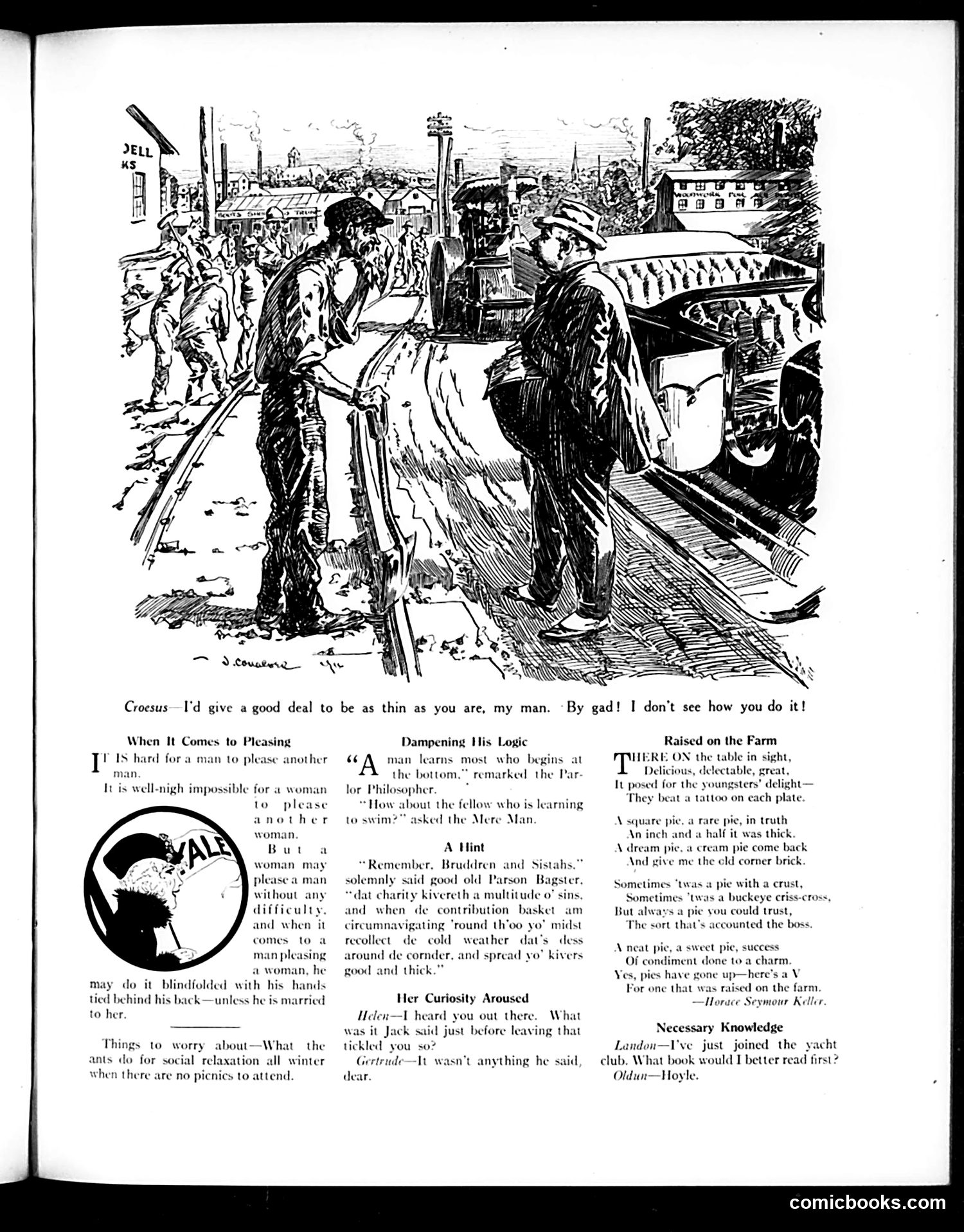
This page contains several short humor pieces typical of Judge magazine's satirical style: **Main Cartoon (Top)**: A wealthy man (Croesus, referencing the ancient king of riches) compliments a thin man on his physique. The joke plays on class contrast—Croesus represents excessive wealth and presumably overindulgence, so his admiration of thinness is ironic. **Short Pieces Below**: - "When It Comes to Pleasing": Gender satire suggesting women are hardest to please, especially wives - "Dampening His Logic": A parson's hypocrisy about charity while asking for donations - "Her Curiosity Aroused": Marital humor—a wife assumes her husband's laughter meant something flattering - "Raised on the Farm": Nostalgic poem praising homemade farm pies - "Necessary Knowledge": A yacht-club joke where "Hoyle" (a book of card game rules) is recommended for wealthy social clubs The overall tone reflects early 20th-century American middle-class humor: gentle domestic satire, gender stereotypes, and nostalgia for rural life versus modern affluence.
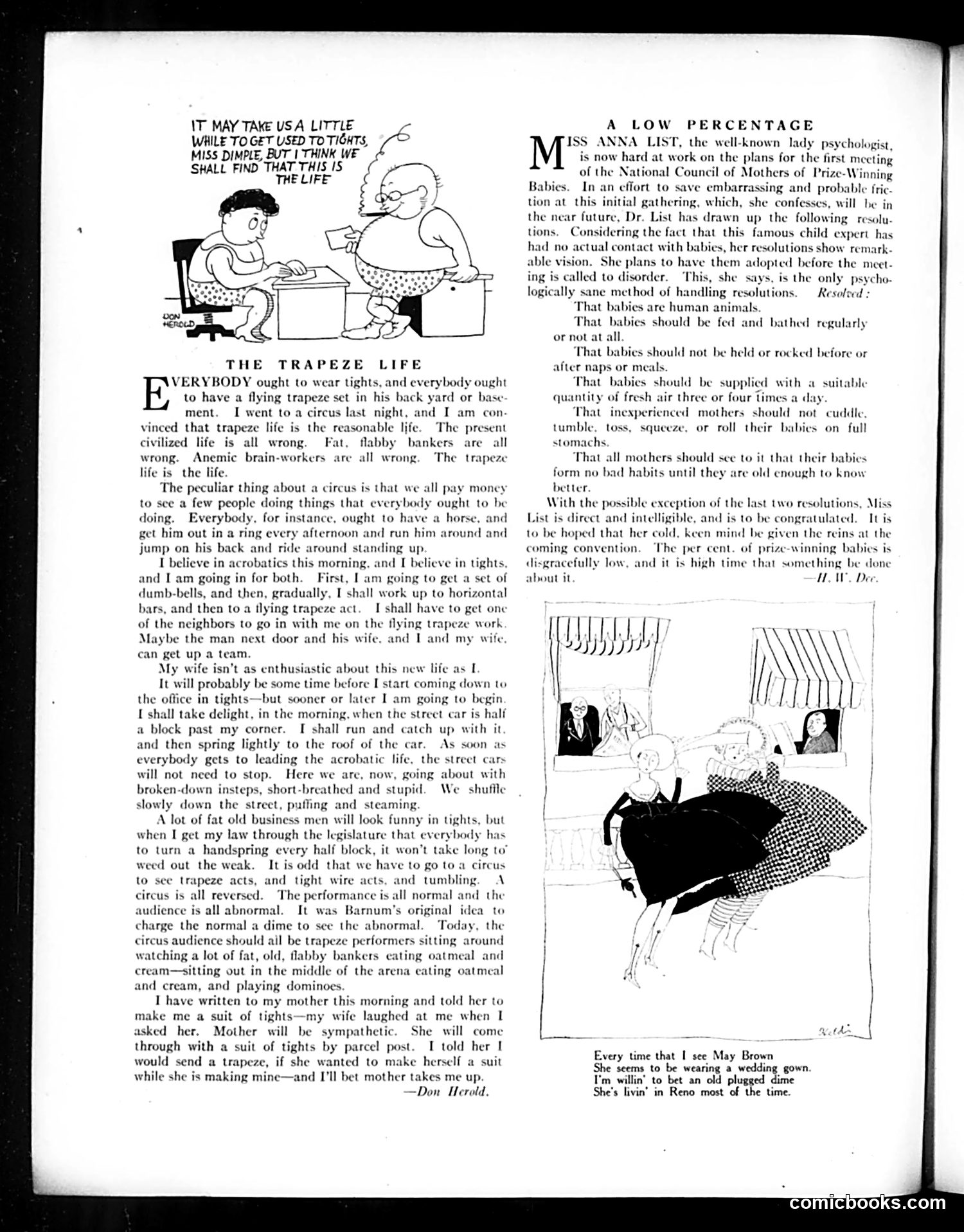
**"The Trapeze Life"** is a satirical essay by Don Herold mocking the early 20th-century obsession with physical fitness and "natural living." The author proposes that modern civilized life—with its sedentary office workers and fat businessmen—is wrong, and that everyone should instead wear tights, perform acrobatics, and install trapeze sets in their backyards. The humor lies in the absurdity: he imagines catching moving streetcars by doing handsprings and enacting laws requiring acrobatic feats every half-block. The cartoon shows a woman in tights on a trapeze, apparently his reluctant wife. The satire targets the era's faddish health crazes and fitness obsessions, suggesting their advocates are impractical idealists disconnected from reality. **"A Low Percentage"** presents "Dr. Anna List," a child psychologist with no actual baby experience, drafting resolutions for a mothers' organization. The joke critiques experts who theorize about subjects they've never actually encountered—a common target of satirical magazines.
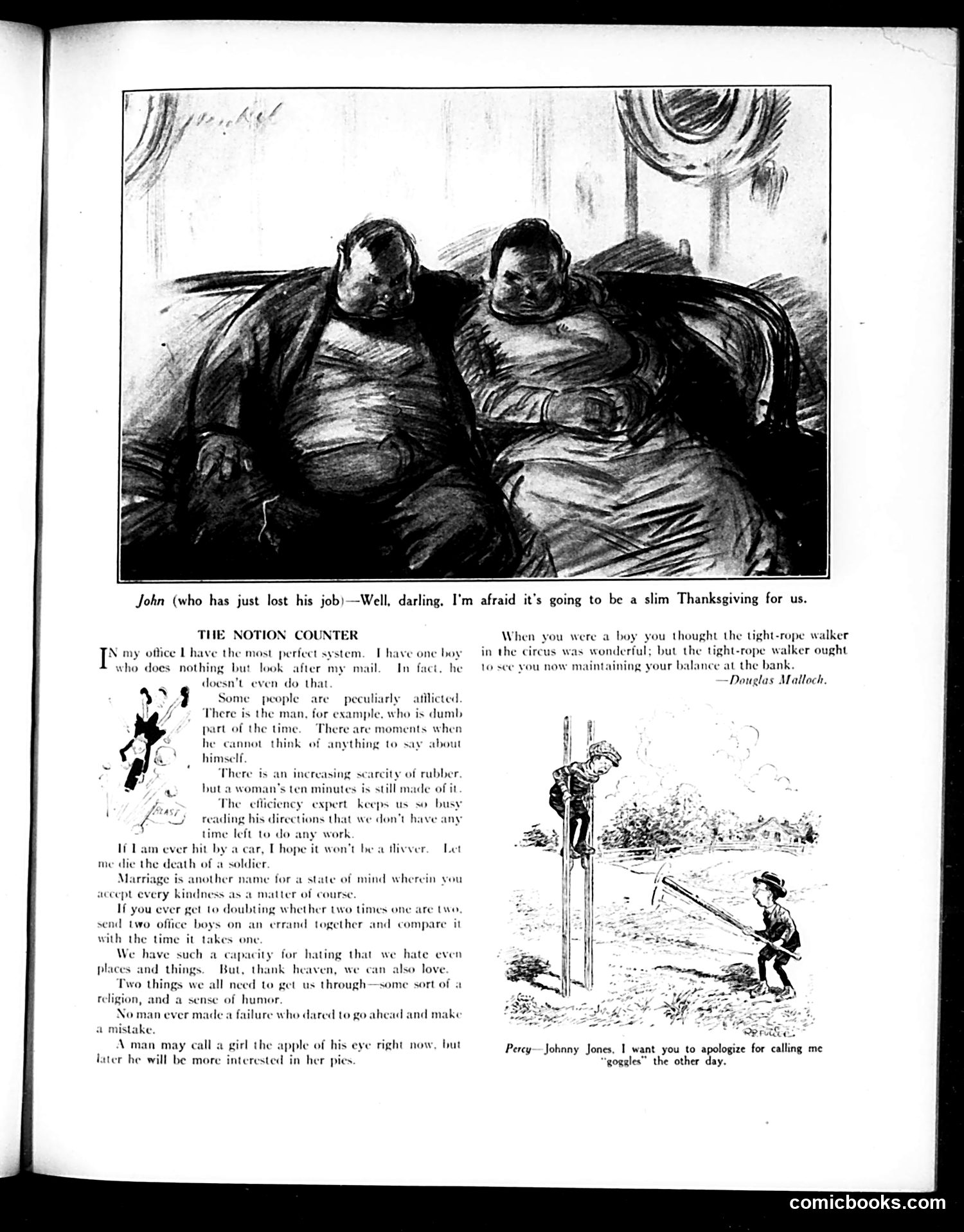
**Top Cartoon:** A couple sits on a couch. The husband has just lost his job and tells his wife their Thanksgiving dinner will be meager. This satirizes the economic anxiety of job loss and its immediate domestic consequences—the fear of not providing for family during holidays. **"The Notion Counter" Column:** A philosophical essay by Douglas Malloch offering wry observations on life's absurdities: inefficient office workers, the elasticity of women's time, marriage as accepting kindness without reciprocity, the unreliability of office boys, and humanity's capacity for both hate and love. It advocates humor and religion as survival tools. **Bottom Cartoon:** A boy named Johnny (appearing to be on a tall pole or structure) is confronted by Percy, who demands an apology for being called "goggles"—likely a nickname referencing his appearance. This depicts childhood social conflict and the sting of playground insults. The page reflects *Judge* magazine's mix of topical humor (job loss), life philosophy, and gentle mockery of ordinary social interactions.
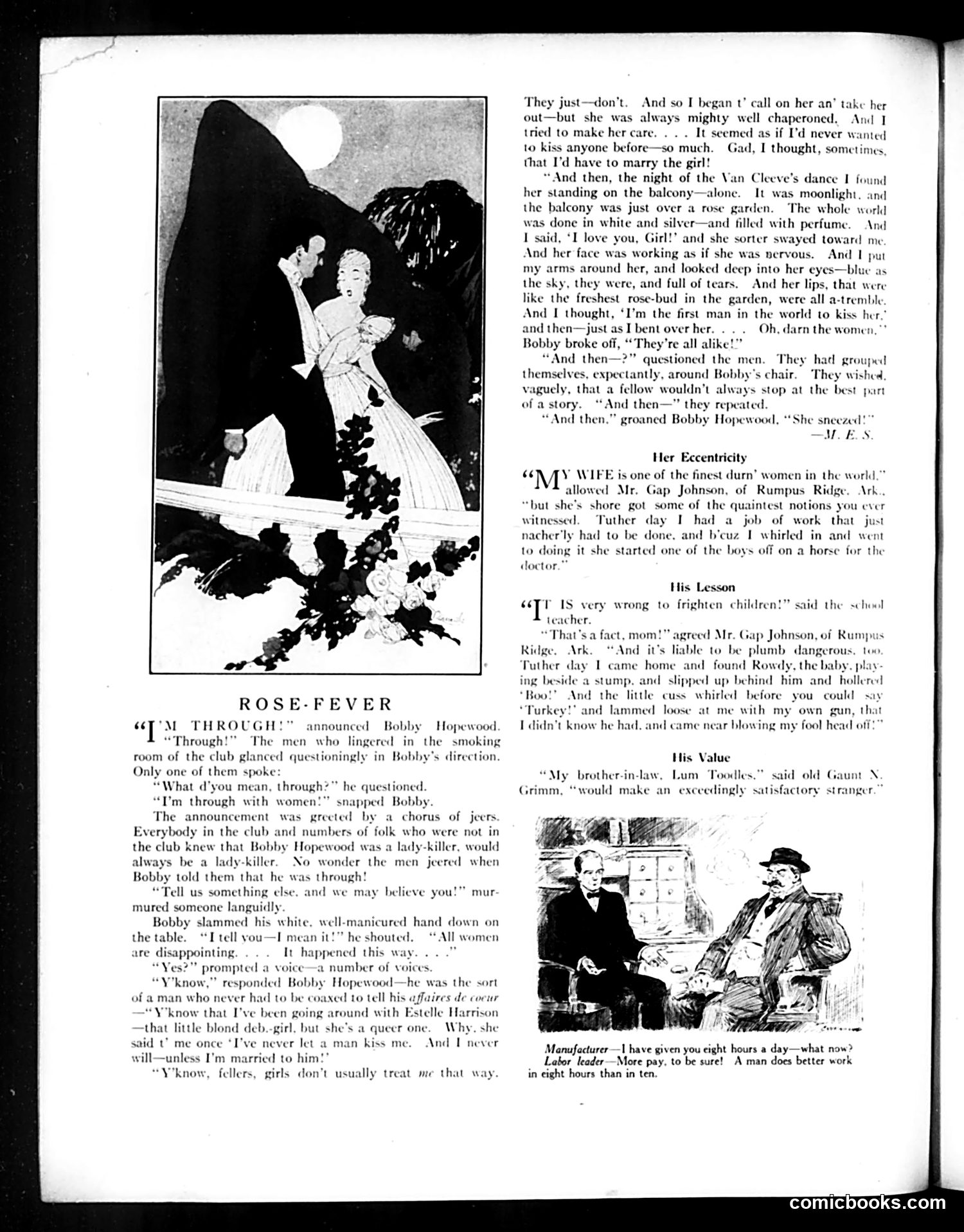
This page from *Judge* contains three separate comic anecdotes featuring rural or unsophisticated male characters. **"Rose-Fever"** presents a romantic reversal: Bobby Hopewood, a habitual ladies' man ("lady-killer"), pursues a young woman (Estelle Harrison) who maintains strict propriety and refuses intimacy outside marriage. After persistent courtship, Bobby finally gets his romantic moment on a moonlit balcony overlooking a rose garden—only to have the woman **sneeze** at the climactic kiss. The joke satirizes romantic pretension: the elaborate setting and emotional buildup are deflated by an unglamorous bodily function. **"Her Eccentricity" and "His Lesson"** feature Gap Johnson of "Rumpus Ridge, Ark."—a backwoods character whose wife and child behave erratically (the wife sends a boy for a doctor over minor incidents; the child shoots at the father). **"His Value"** presents a brief labor dispute joke where a worker demands higher pay for eight-hour days because men work more efficiently in shorter hours. The humor relies on absurdity, social class contrast, and physical comedy rather than topical satire.
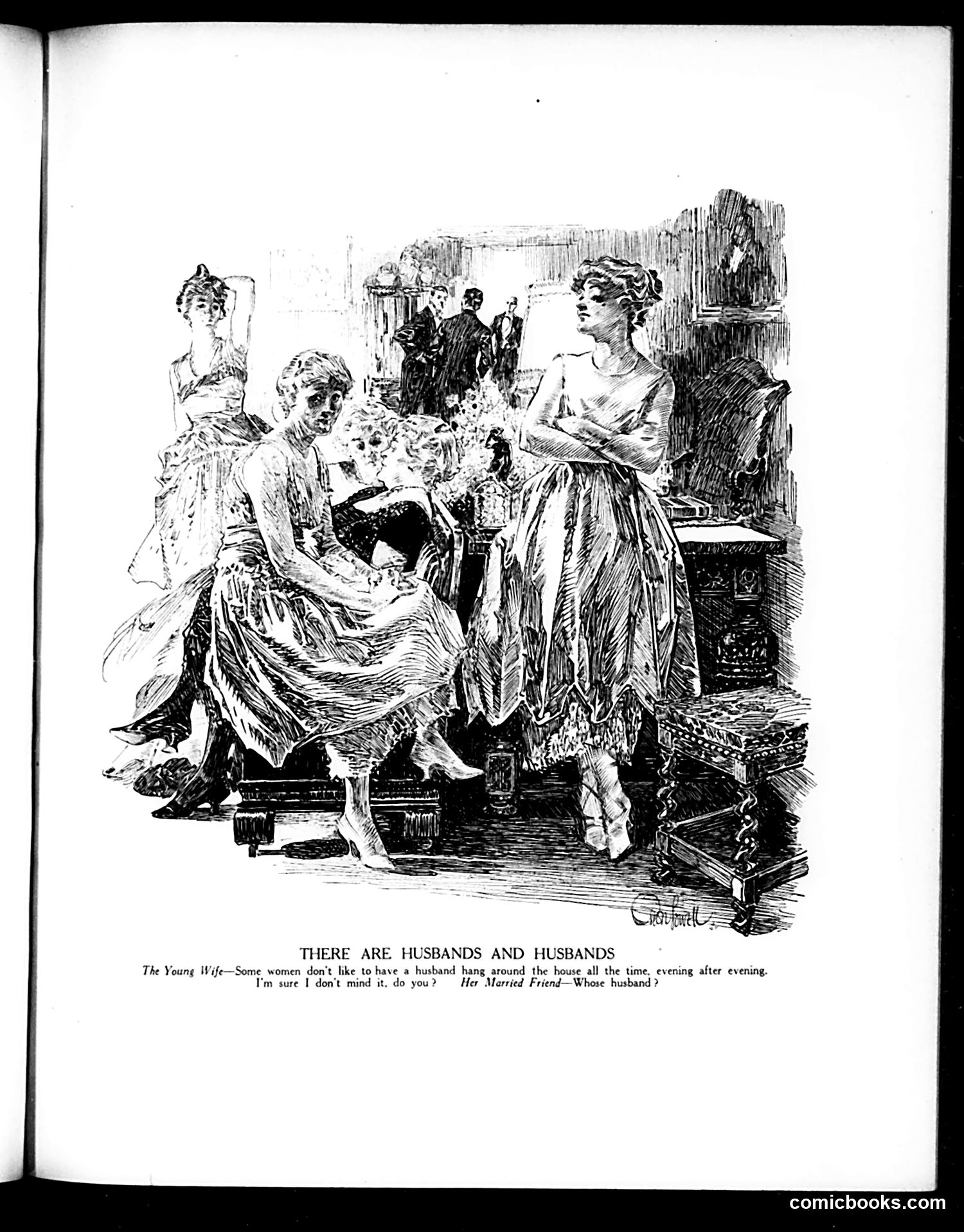
This cartoon satirizes marital dynamics through a social conversation. A young wife tells her married friend she doesn't mind her husband being home constantly. The friend's reply—"Whose husband?"—delivers the joke's punch line, implying the young wife is flirting with or involved with someone else's husband rather than her own. The satire targets the social pretense of respectability in early-20th-century marriage while suggesting infidelity or romantic impropriety among upper-class women. The elegantly dressed figures and domestic interior setting emphasize that this transgression occurs within supposedly proper society. The joke mocks both the young wife's transparent deception and the social conventions that allowed such behavior to be discussed obliquely among friends.
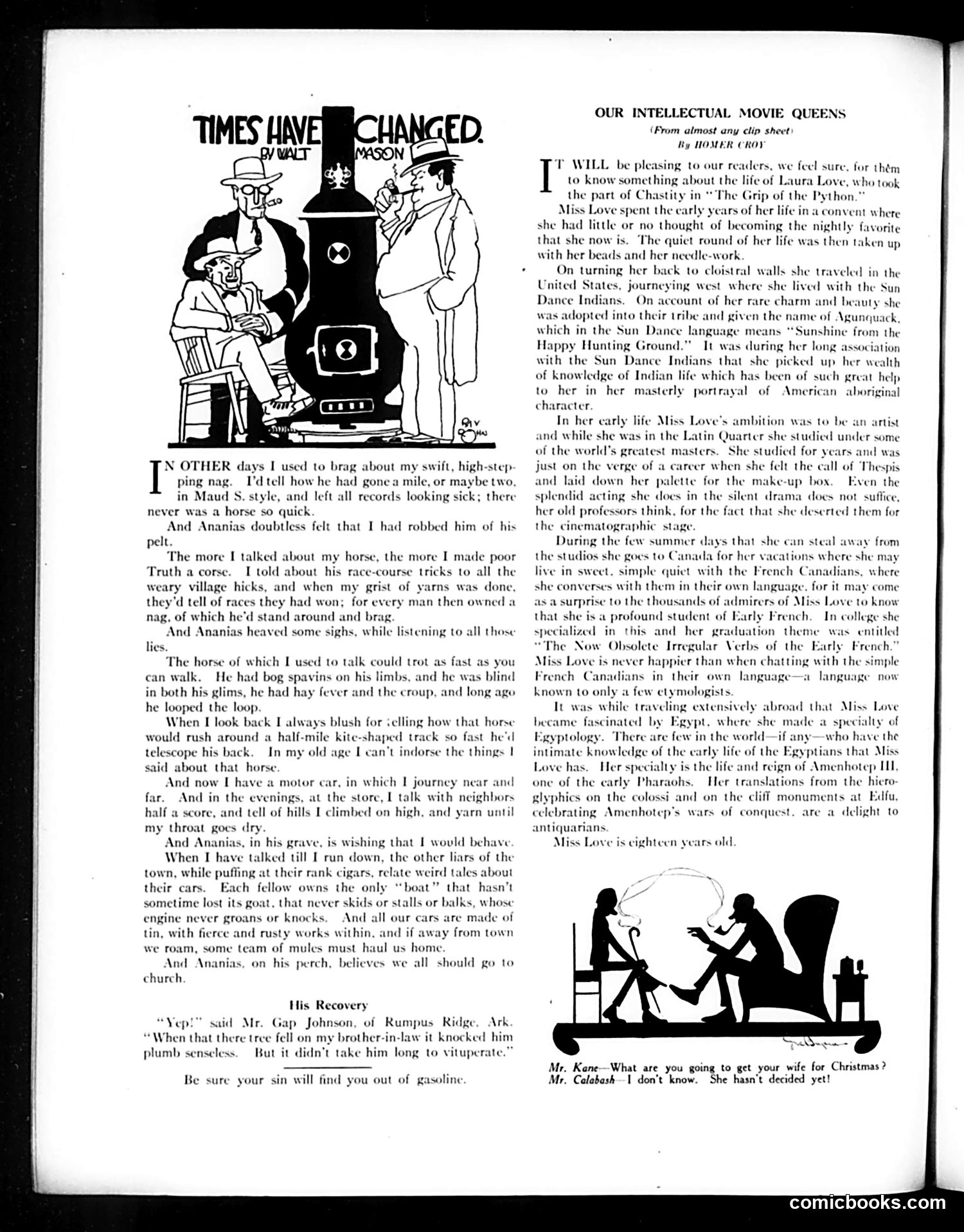
**Left Side - "Times Have Changed" by Walt Mason:** This is a humorous essay contrasting the narrator's past with the present. The cartoon shows three men in old-fashioned attire around a large gear labeled "X." The essay satirizes how people lie about their possessions: formerly about fast horses (referencing Ananias, the biblical liar), now about automobiles. The joke is that boasting behavior hasn't changed—only the object of exaggeration. The "His Recovery" section at bottom makes a pun about gasoline ("sin will find you out of gasoline"). **Right Side - "Our Intellectual Movie Queens":** This profiles actress Laura Love, appearing to mock celebrity biographical puffery common in silent-film promotion materials. The silhouette illustration shows two figures in a parlor. The text parodies the fabricated life-stories studios created for actresses, describing improbable details (convent upbringing, adoption by Sun Dance Indians, Egyptology expertise) to create exotic mystique. The satire targets how studios manufactured glamorous, implausible narratives for public consumption.
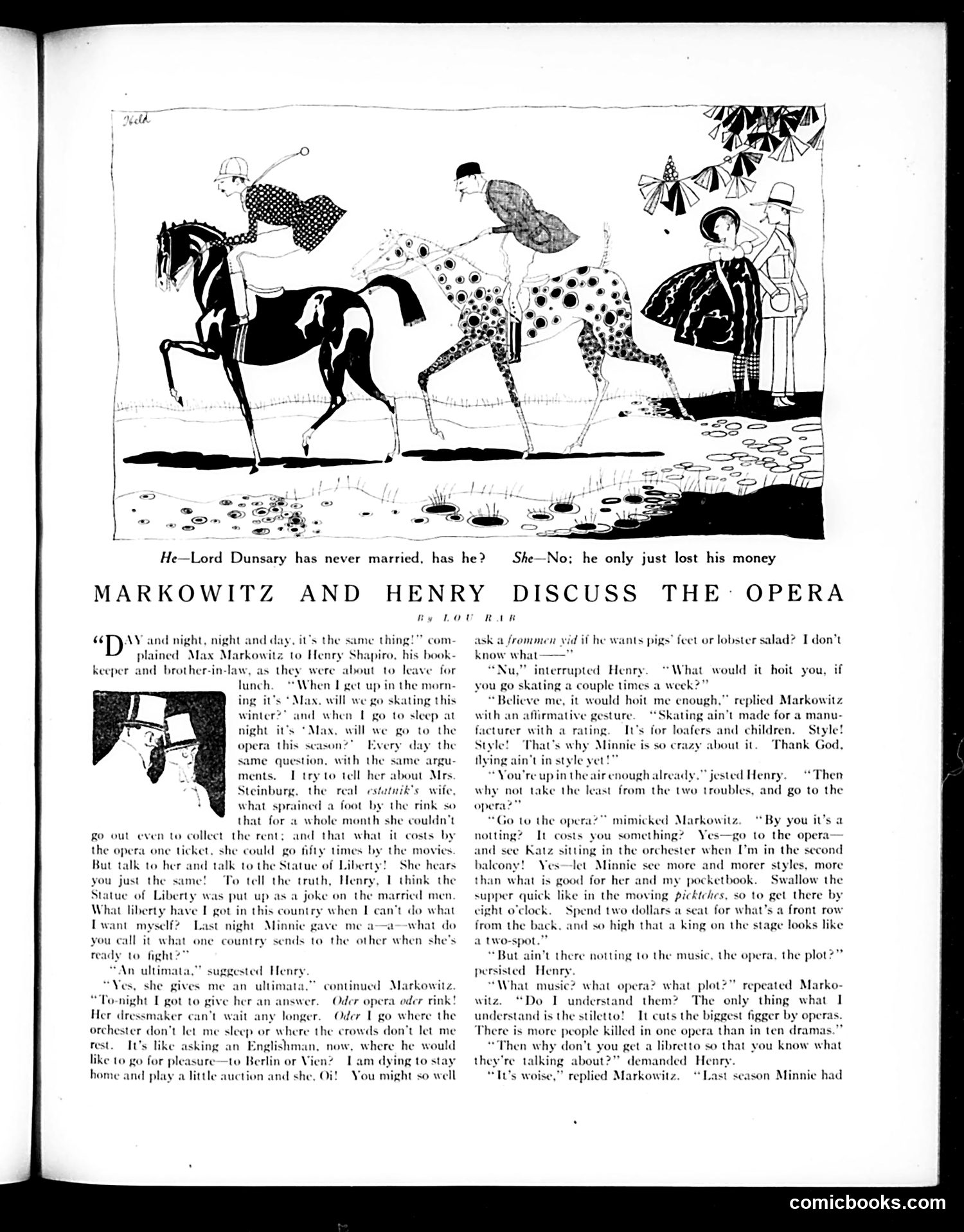
This is a humorous dialogue between two Jewish immigrant characters—Max Markowitz (a manufacturer) and Henry Shapiro (his bookkeeper)—debating whether to attend the opera or go ice skating. The cartoon satirizes early 20th-century immigrant life and class aspirations. Markowitz complains his wife Minnie constantly pressures him to take her to the opera, framing it as a status symbol ("Style! Style!"). He objects on practical grounds: it's expensive, he can't understand it, and he'd rather relax at home playing cards. The humor derives from his malapropisms ("ultimata" for ultimatum), Yiddish-inflected English ("Oder opera oder rink!"), and his befuddled resistance to cultural pretension. The satire targets both the nouveaux-riche immigrant desire for "high culture" respectability and the working-class husband's resistance to his wife's social climbing. The opera represents aspirational Americanization among immigrant communities of the era.
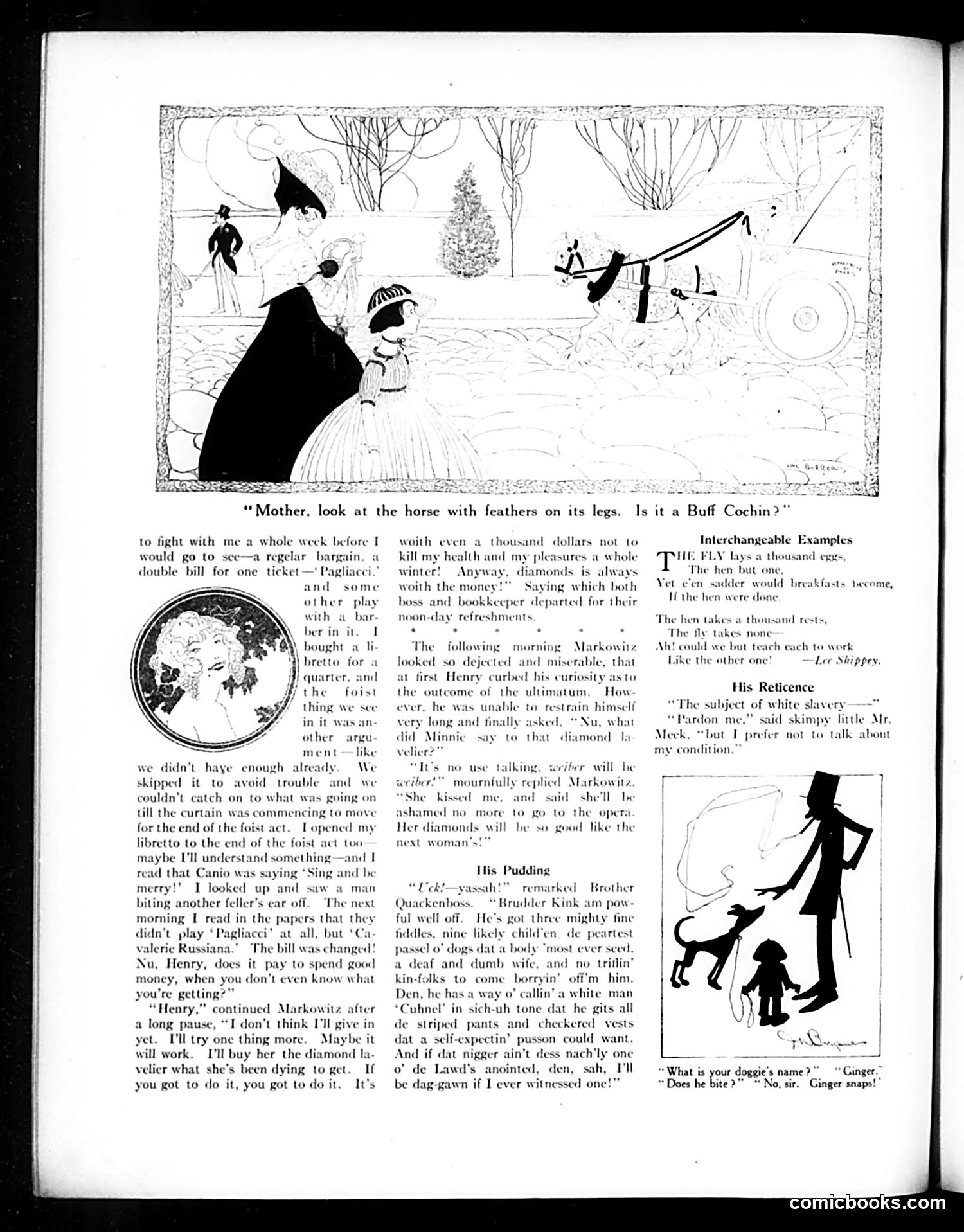
This page contains **multiple unrelated satirical pieces** typical of Judge's format: **Top cartoon**: A child asks mother about a horse with feathers on its legs, asking if it's a "Buff Cochin" (a chicken breed). The joke plays on the child's confusion between animals—absurdist humor about mistaken identity. **Main story ("His Pudding")**: A Yiddish-dialect monologue by "Markowitz" about buying his wife "Minnie" a diamond chandelier to end marital discord. The satire targets immigrant Jewish life and materialistic marriage—stereotyping working-class immigrants as prone to domestic conflict resolved through expensive purchases. The phrase "weiber will be weiber" (women will be women) reduces female agency to stereotype. **"His Reticence"**: Brief joke where a man refuses to discuss "white slavery" (human trafficking), deflecting with euphemism about his "condition." **Bottom right**: Dialect humor about a Black man ("Brother Quackenboss") praising another Black man for his possessions and deferential behavior toward white men—racist caricature portraying Black subservience as admirable. The page reflects Judge's era: immigrant stereotyping, racist caricature, and treatment of social issues as punchlines.
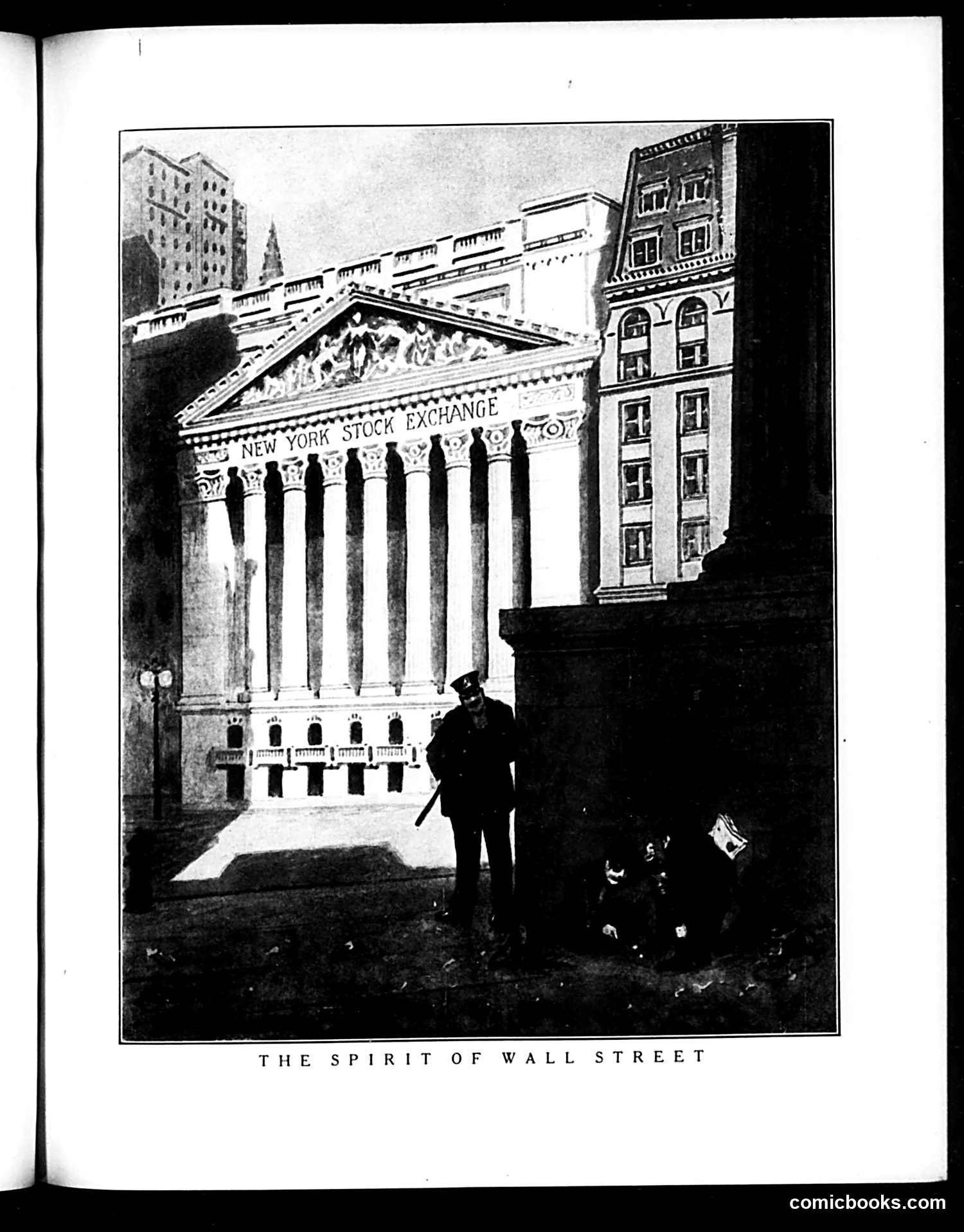
This image depicts the New York Stock Exchange building with its classical columns and Greek revival architecture. In the foreground, a solitary policeman stands guard over what appears to be a pile of debris or rubble—possibly representing financial wreckage or collapsed investments. The caption "The Spirit of Wall Street" suggests satirical commentary on the financial district itself. The contrast between the imposing, dignified building and the disorder at its base likely critiques the disconnect between Wall Street's grand appearance and the actual financial chaos or suffering it may cause. Without a specific date visible, the exact historical event referenced is unclear, though Judge magazine frequently satirized financial crises and market speculation throughout its history.
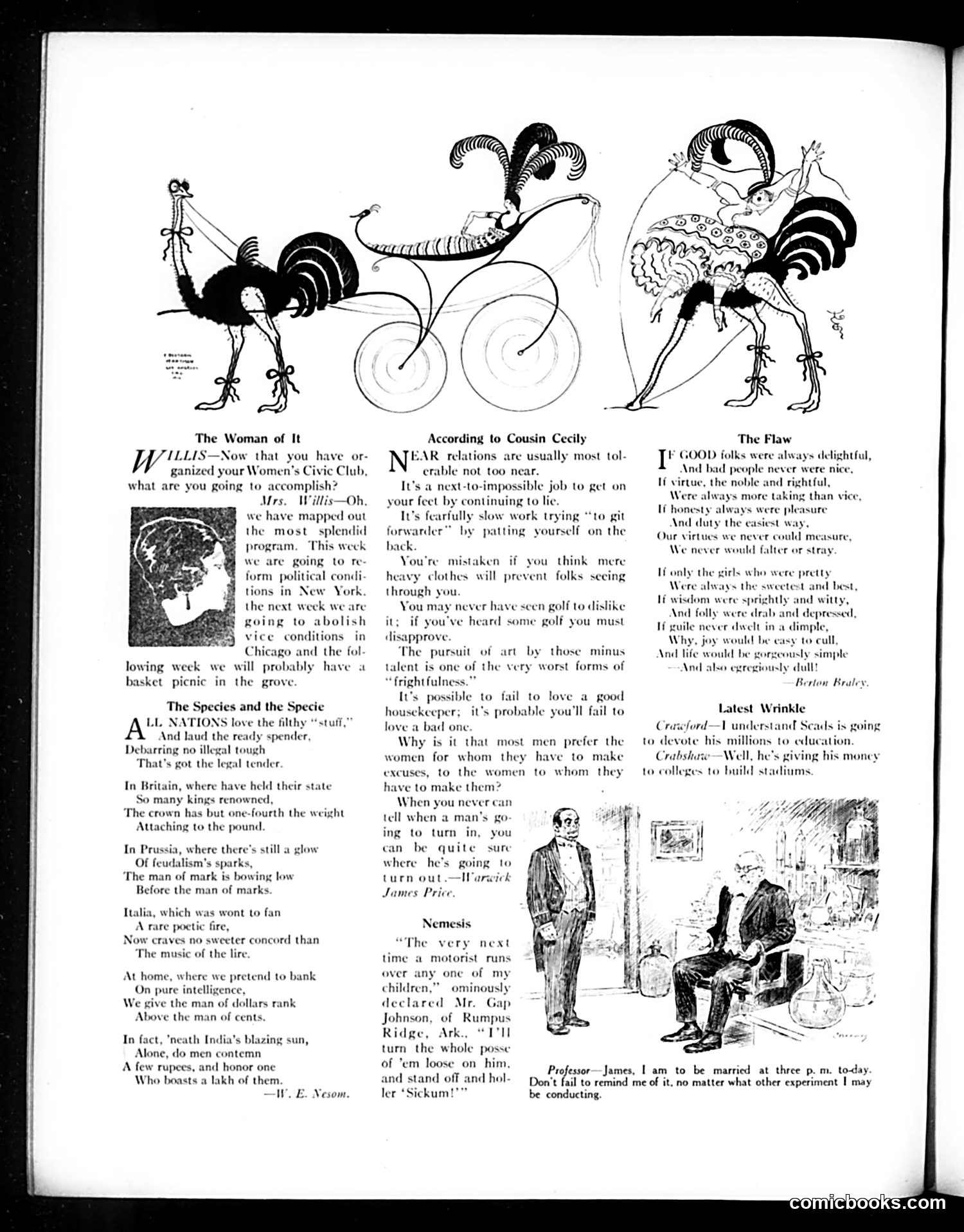
**Top cartoons:** These absurdist illustrations mock women's civic activism. "The Woman of It" satirizes the ambitious Mrs. Willis, whose Women's Civic Club plans to reform New York politics, abolish vice in Chicago, then—anticlimactically—have a picnic. The joke: women's reform efforts are portrayed as grandiose yet frivolous, undermined by their own lack of seriousness. **"The Species and the Specie":** A poem mocking universal materialism across nations. It argues that everywhere—Britain, Prussia, Italy, India, America—money matters more than merit or character. The satire targets hypocrisy: America "pretends to bank on pure intelligence" while actually elevating wealthy men above others. **Other items:** "According to Cousin Cecily" offers cynical social observations; "The Flaw" is a moralistic poem suggesting virtue would be tedious if always rewarded; "Nemesis" jokes darkly about a father threatening revenge on motorists; the final panel humorously shows a professor asking his assistant to remind him of his own wedding. The page reflects early 20th-century skepticism toward reform movements, materialism, and social pretense.
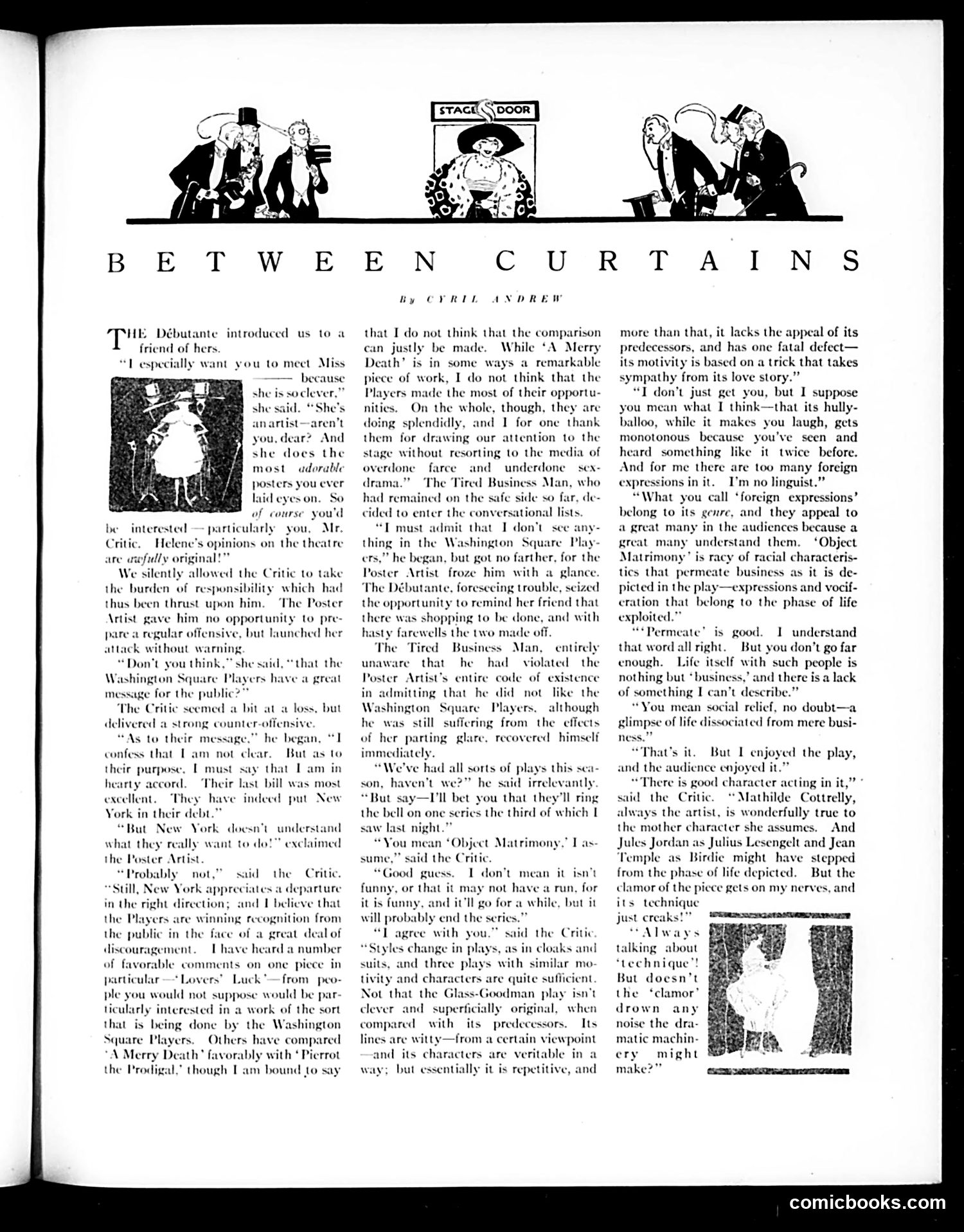
This page presents a satirical dialogue about the Washington Square Players, an experimental theater group. The cartoon at the top shows theater-goers and a stage door, setting the scene. The article mocks the pretentious social dynamics around avant-garde theater. A "Poster Artist" (representing artistic snobbery) aggressively defends the Players' experimental work, freezing out a "Tired Business Man" with a disapproving glare when he admits not liking their productions. The Critic and Businessman later discuss "Object Matrimony," a play they believe will have brief success before the series ends, arguing that while clever and original-seeming, it's essentially repetitive—a common problem with experimental theater of the era. The satire targets both pretentious artists who demand uncritical praise and the theatrical establishment's reliance on formulaic productions dressed up as innovation. The humor lies in exposing the social embarrassment of questioning avant-garde art in mixed company.
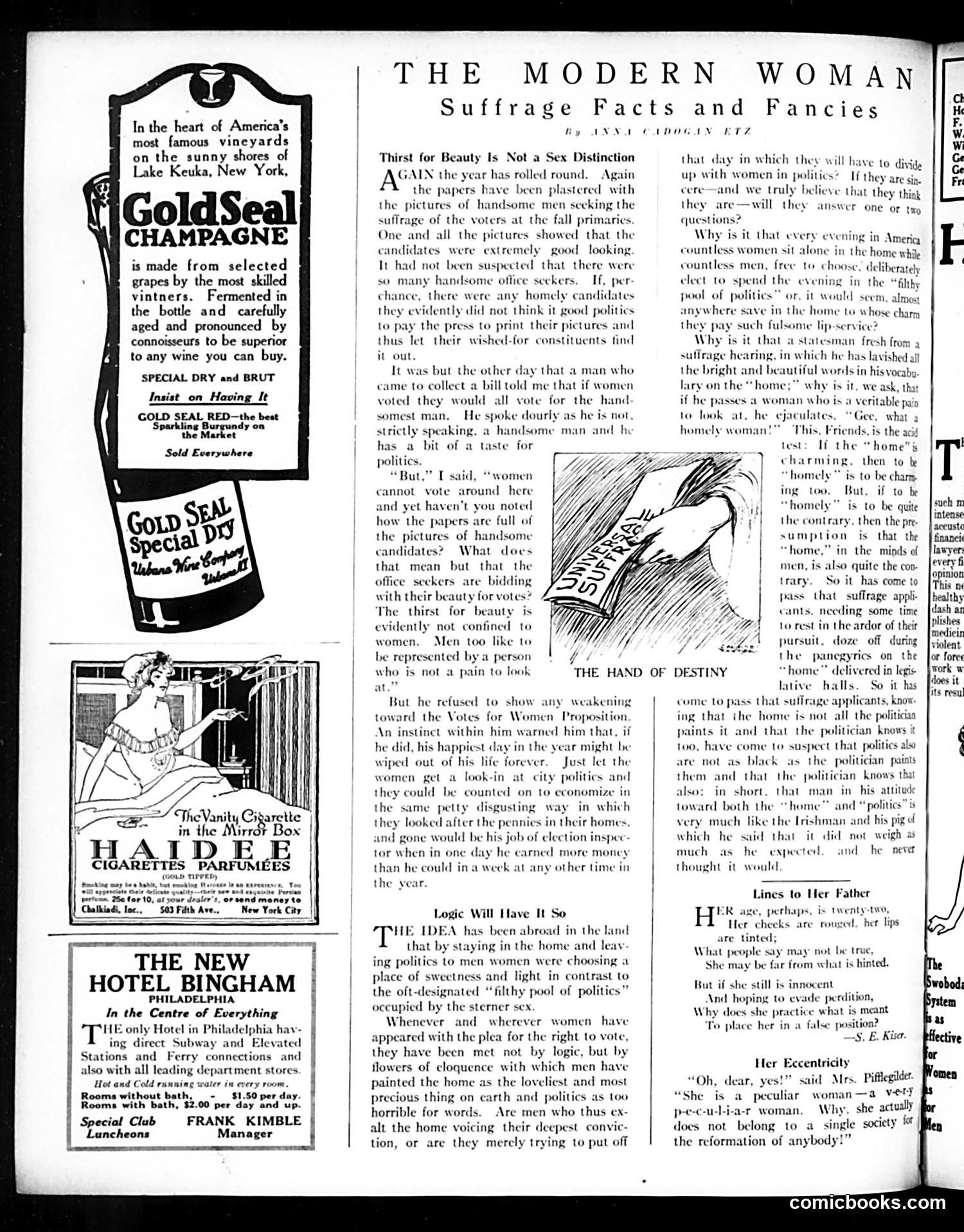
This page satirizes anti-suffrage arguments from the women's voting rights debate (early 20th century). The main article, by Anna Lodge Ketz, mocks men's contradictory positions on women and politics. **The satire:** The author notes that male political candidates eagerly plaster newspapers with their handsome photographs to attract votes—proving men *do* appeal to vanity in politics. Yet these same men argue women shouldn't vote because politics is a "filthy pool" unsuitable for the delicate home-centered sex. The cartoon "The Hand of Destiny" (center) shows a woman's hand holding a newspaper with candidates' pictures, literalizing the article's point: women seeing these attractive male politicians obviously proves beauty matters in elections. **The logic:** If men use physical appearance to win votes, they cannot simultaneously claim women are too pure for politics. The author exposes this as self-serving hypocrisy designed to keep women excluded from power. The page includes period advertisements (Gold Seal Champagne, Hotel Bingham) typical of *Judge* magazine's format.
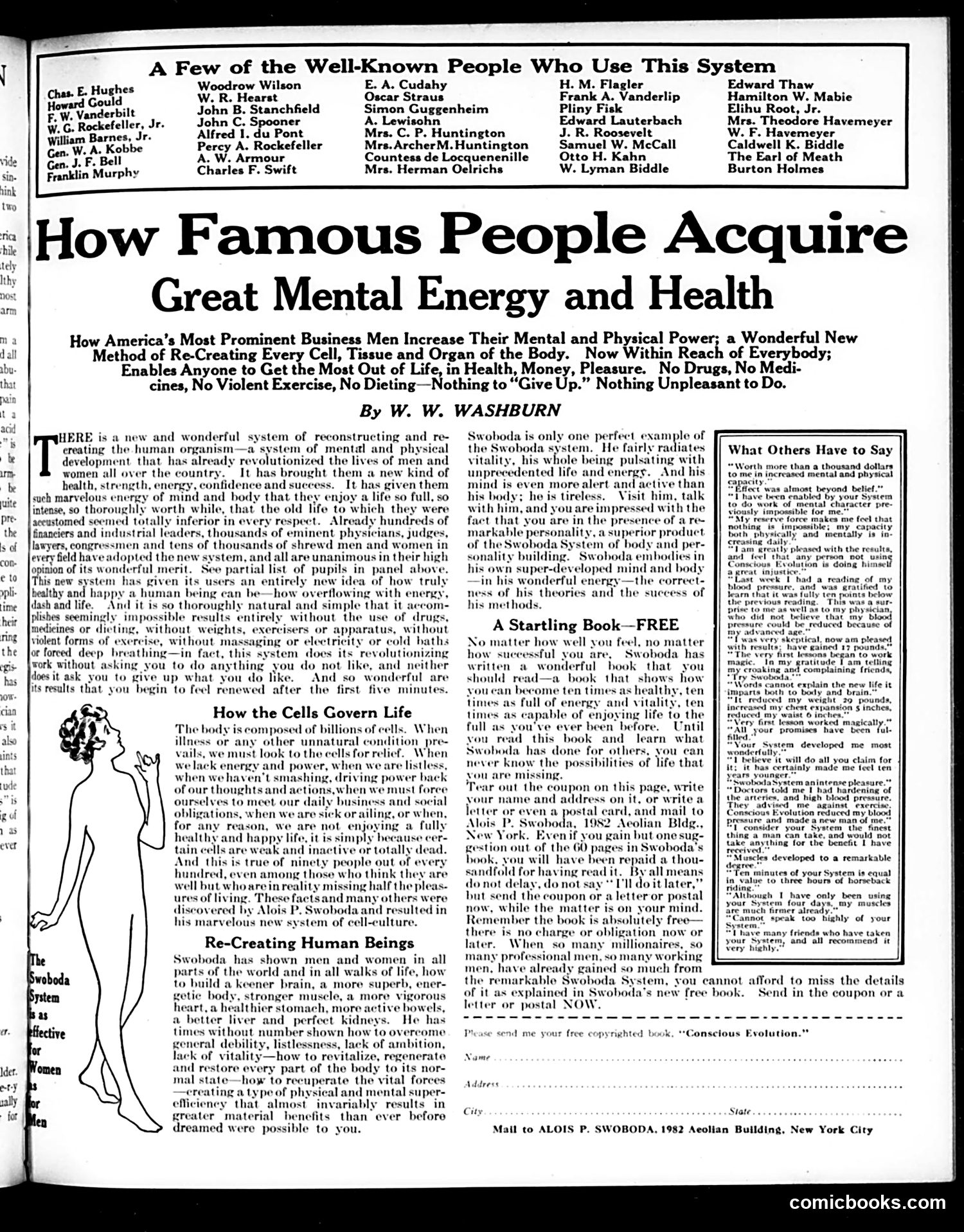
This page is primarily **advertising disguised as editorial content**—a common practice in early 20th-century magazines. It promotes the "Swoboda System," a pseudoscientific health method claiming to rebuild human cells and increase mental/physical energy without drugs, exercise, or dieting. The satirical element lies in the **list of prominent names** at the top—wealthy industrialists (Rockefeller, du Pont, Vanderbilt), politicians (Woodrow Wilson), and business titans. Judge is implicitly mocking the gullibility of America's richest and most powerful men, suggesting they've fallen for obvious quackery. The irony: if these supposedly brilliant captains of industry believe in this system, what does that say about their actual intelligence? The detailed testimonials in the sidebar reinforce the satire—earnest endorsements from the wealthy, each attributing near-miraculous results to cell-regeneration theories that lack any scientific basis. The accompanying illustration of a thin, rejuvenated human figure completes the joke: promising transformation through pseudoscience to vain wealthy readers.
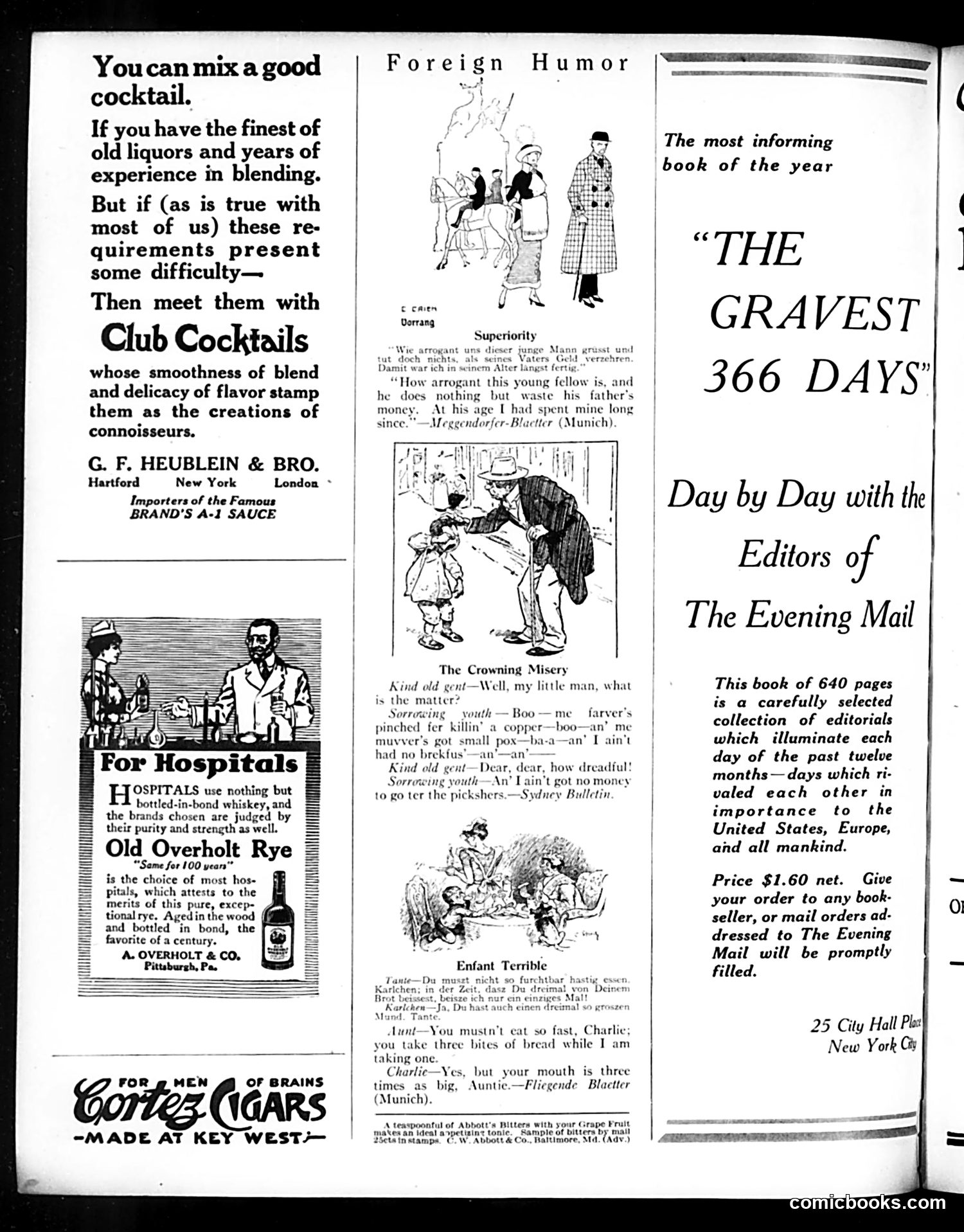
This page is primarily **advertising and book promotion** with minimal cartoon content. The three "Foreign Humor" items are brief, captioned comic anecdotes translated from European publications (Munich's *Meggendorfer-Blactter* and *Fliegende Blaetter*, Sydney's *Bulletin*). The jokes reflect early 20th-century working-class sensibilities: one depicts a snobbish young man wasting his father's money; another shows a poor boy recounting cascading miseries (father arrested, mother diseased, no breakfast, no money for movies)—dark humor about urban poverty; the third is a simple children's joke about mouth size during rationing. The dominant content is liquor and tobacco advertising (Club Cocktails, Old Overholt Rye whiskey, Cortez cigars) alongside a book promotion for *"The Gravest 366 Days,"* a collection of editorials from *The Evening Mail* covering important 1915-1916 events. The page reflects Judge's typical mix: light satire and imported humor alongside commercial advertisements.
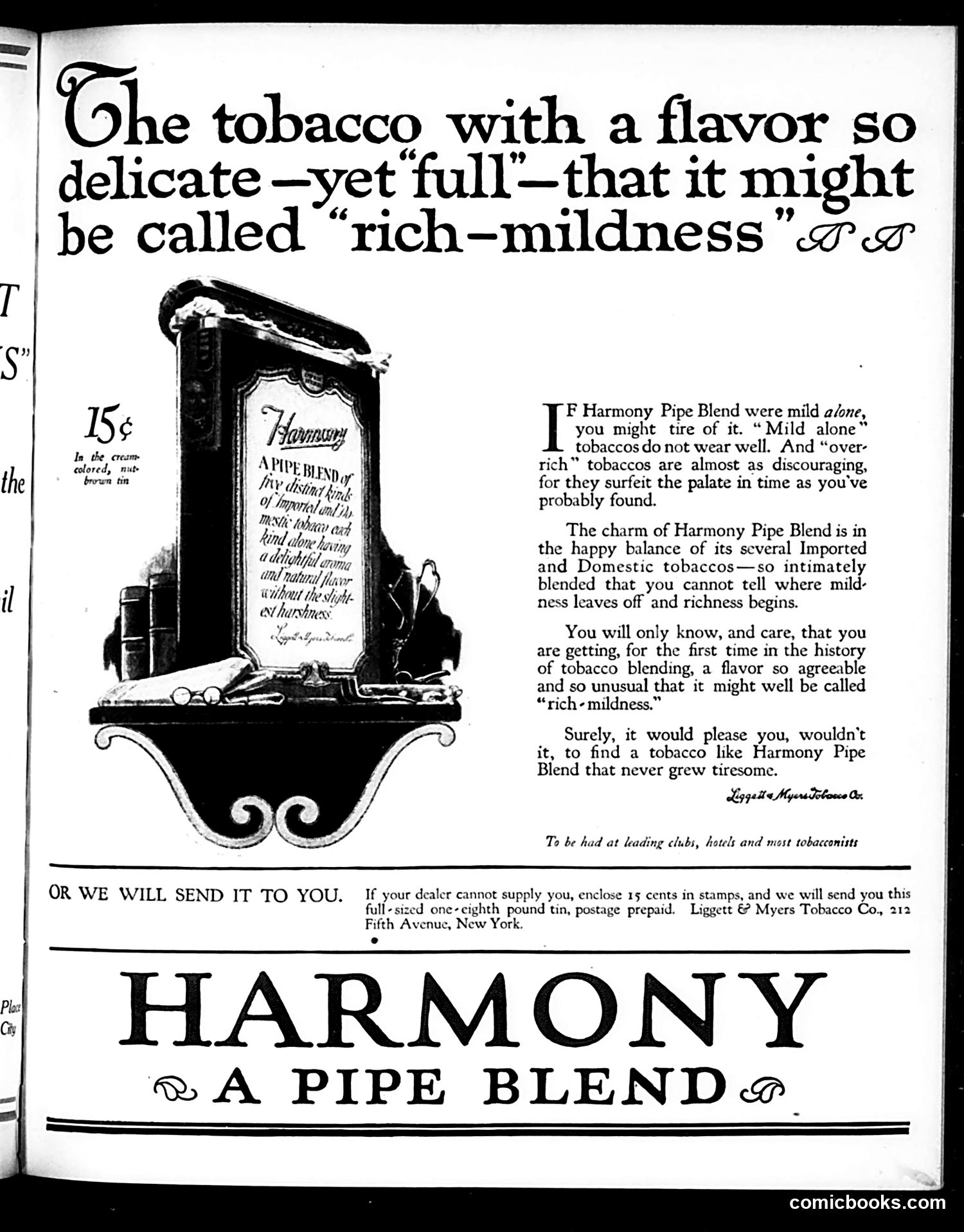
This is primarily a **tobacco advertisement**, not satire. It appears in Judge magazine and promotes Harmony Pipe Blend by Liggett & Myers Tobacco Co. The ad's central marketing concept is the paradoxical term **"rich-mildness"**—positioning the product as uniquely balanced between mild and full-flavored tobacco. The text argues that purely "mild" blends become boring, while overly "rich" ones overwhelm the palate. Harmony supposedly achieves an unprecedented middle ground. The decorative illustration shows an ornamental display of the product tin, meant to convey sophistication and quality. The headline's italic script emphasizes gentility. **For modern readers**: This reflects early 20th-century advertising that emphasized tobacco refinement and taste gradations—concepts now quaint given tobacco's health dangers. The "mail-order option" (15 cents in stamps) was typical for period consumer marketing. There is no political satire visible; this is straightforward product promotion exploiting Judge's prestige platform to reach affluent readers.
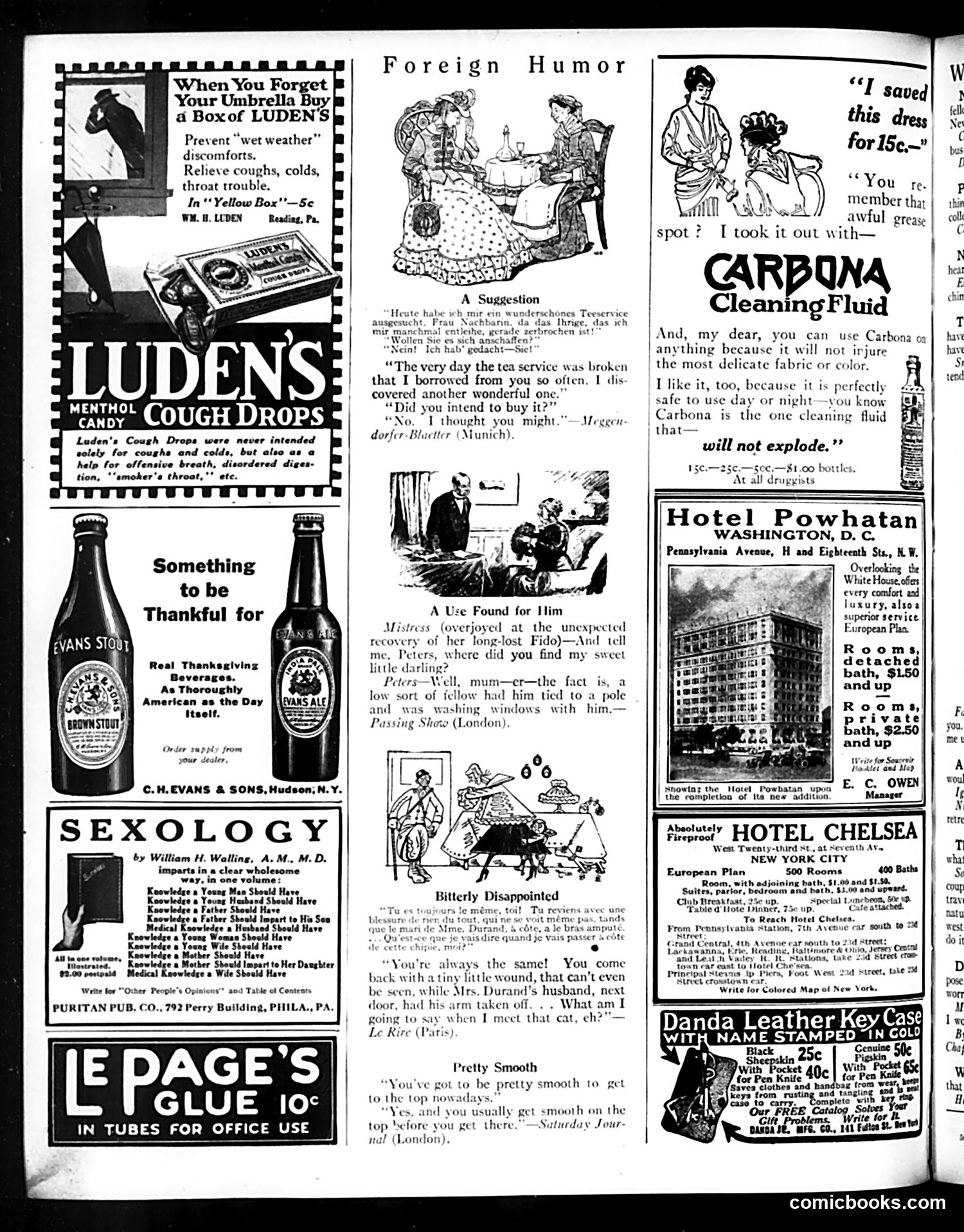
This page consists primarily of **advertisements and reprinted foreign humor cartoons** rather than original political satire. The humor selections are captioned jokes from European publications (Meggen-dorfer-Blactter, Passing Show, Le Rire, Saturday Journal) depicting everyday domestic situations: a woman's transparent attempt to get a friend to buy her a replacement tea service, a servant's dubious explanation of where he found a lost dog (tied to a pole while washing windows), and marital tension over minor injuries. The jokes rely on universal human foibles—social climbing, convenient excuses, and domestic complaints—rather than topical political references. They're lighthearted observations of middle-class life, typical of early 20th-century magazine humor. The page is dominated by product advertisements (cough drops, cleaning fluid, hotels, glue, leather goods), indicating this was standard filler content for Judge magazine's revenue model rather than editorial satire.
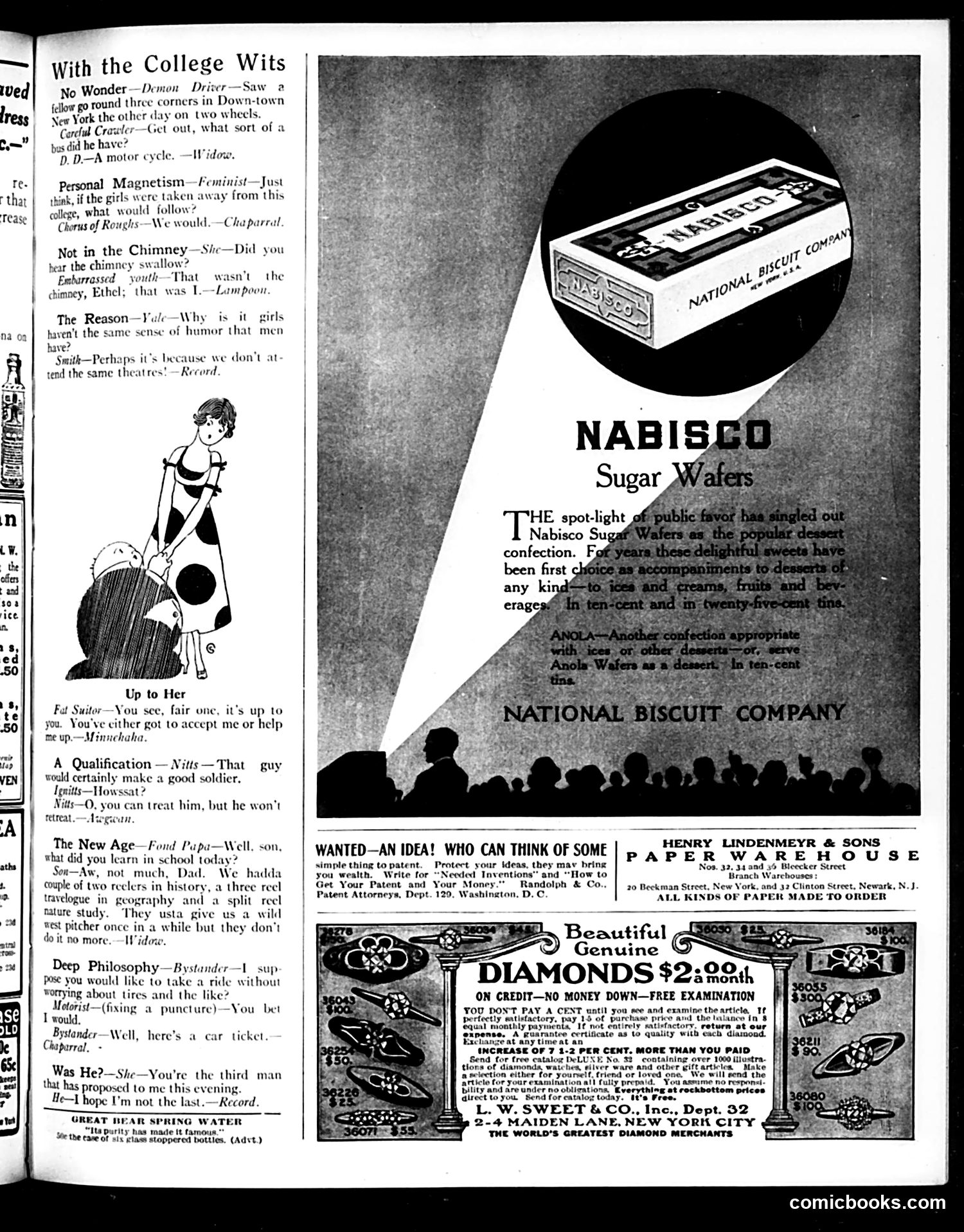
This page from Judge magazine consists primarily of **humor columns and advertisements** rather than political cartoons. ## "With the College Wits" Section The left side features brief jokes attributed to college humor publications (Widow, Chaparral, Lampoon, Record). These are lightweight gags about contemporary early-20th-century concerns: motorcycles, gender relations ("Personal Magnetism"), and the emerging technology of cinema ("The New Age" jokes about schoolchildren watching film reels instead of live entertainment). The single cartoon shows a woman in 1920s attire lifting a large man—illustrating the "Fat Suiter" joke about romantic pressure. ## Advertisements The right side contains period ads: Nabisco Sugar Wafers, a patent attorney service, Henry Lindenmeyer & Sons paper supplier, and notably a **diamond credit scheme** ($2 monthly payments, "no money down"). ## Satirical Content The page gently satirizes modern life—automobiles, cinema's displacement of traditional entertainment, gender dynamics—but offers no sharp political critique. It's consumer-oriented humor typical of 1920s collegiate magazines.
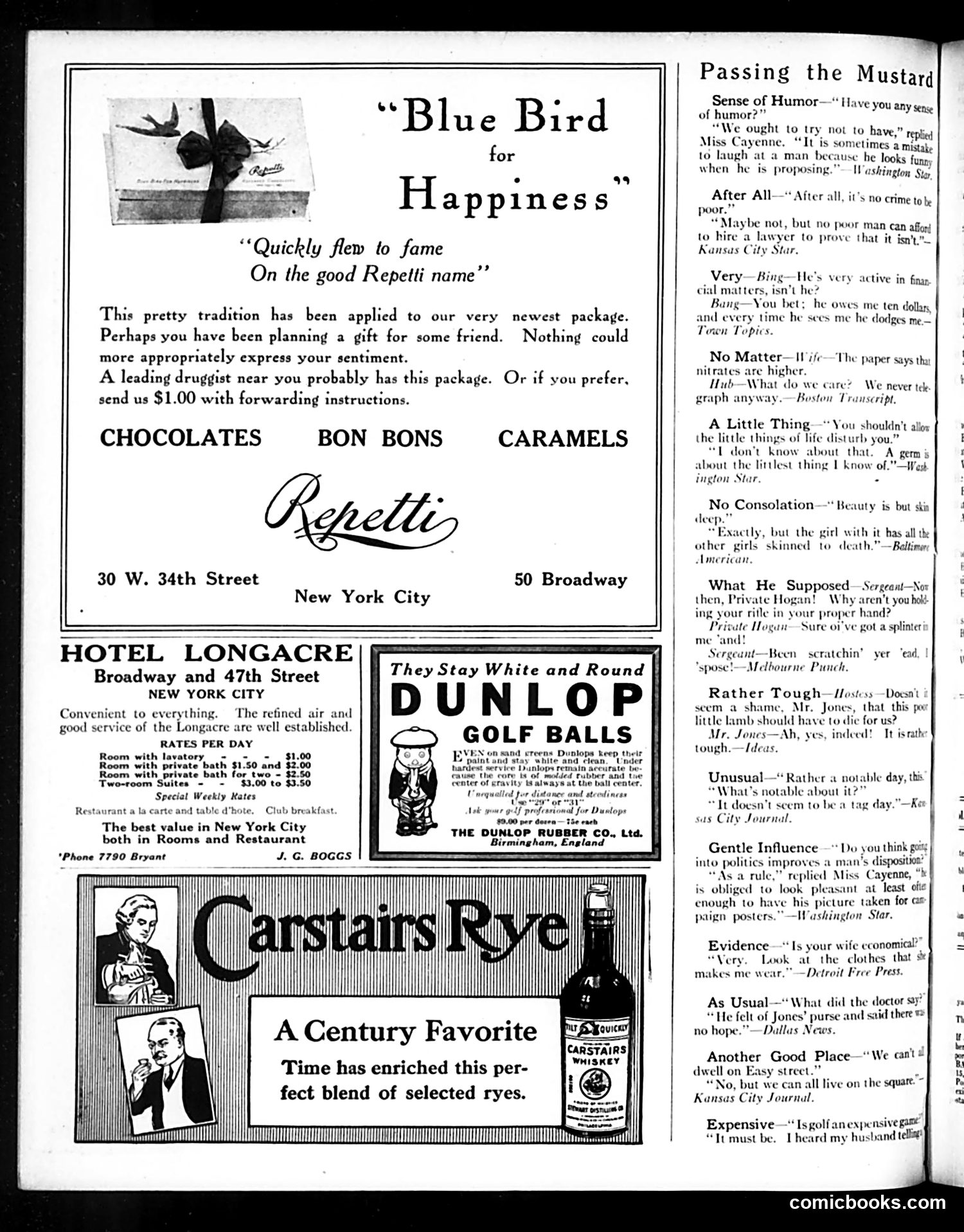
This is primarily an **advertising page** with some humorous filler content typical of early 20th-century magazines. ## Main Advertisements: - **Repetti chocolates**: References "The Bluebird of Happiness," a popular theatrical work, to market gift candy - **Hotel Longacre, Dunlop golf balls, Carstairs whiskey**: Standard period ads ## Humor Section ("Passing the Mustard"): The right column contains brief joke exchanges with minimal setup—typical of Judge's style. These are *not* political cartoons but rather social commentary through short dialogues: - **"Sense of Humor"**: Jokes about men proposing while looking funny - **"Rather Tough"**: A wealthy man callously accepting a lamb's slaughter - **Military humor**: An exchange between a sergeant and Irish private ("Hogan") about holding a rifle improperly—likely playing on anti-Irish stereotypes common to the era The jokes reflect early 1900s attitudes: wealth indifference, ethnic caricature, and domestic/romantic humor. This is **period advertising and filler**, not satirical commentary on current events.
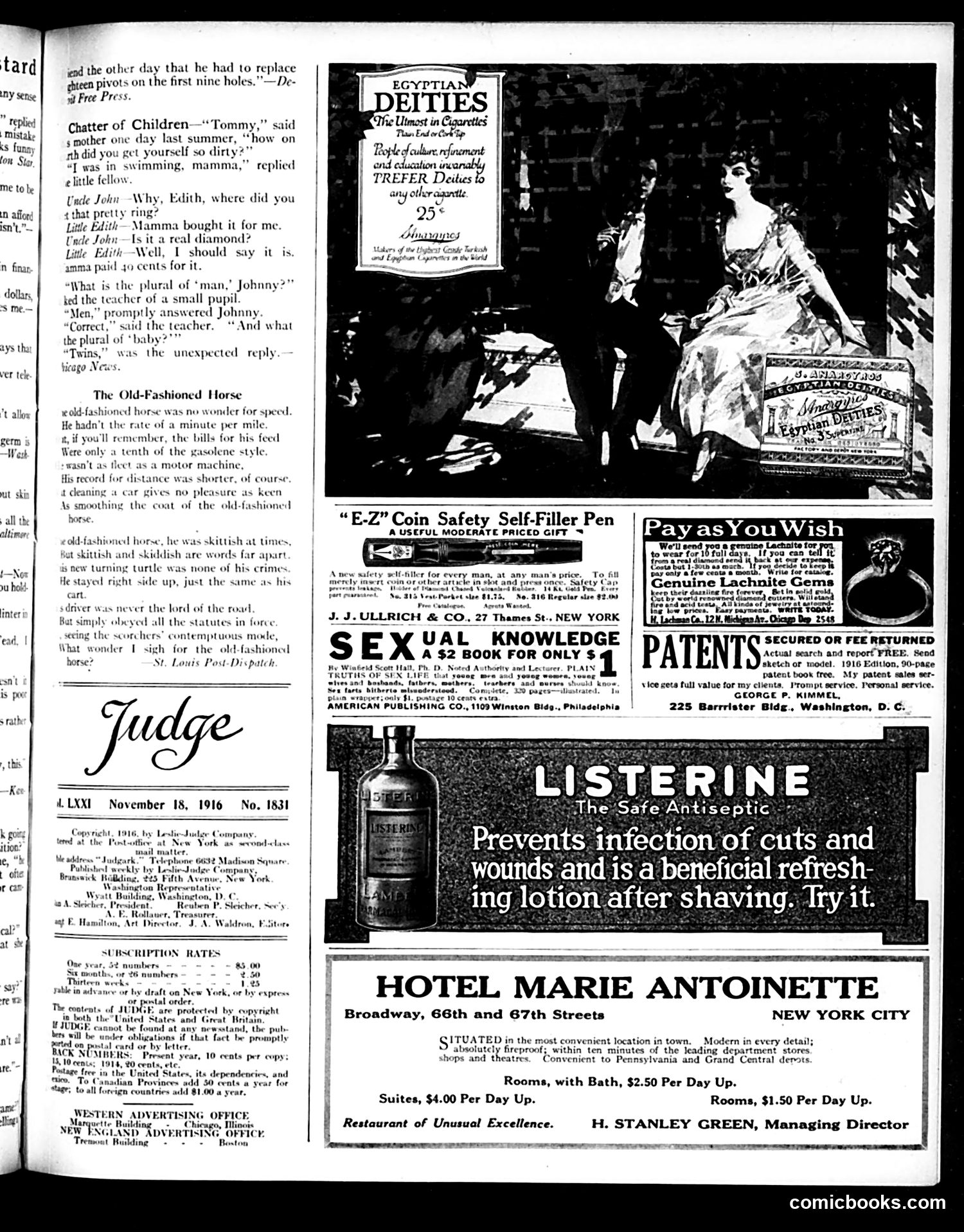
This page is primarily **advertising and filler content** rather than political cartoons. The main elements include: **"Chatter of Children"** — Light humor columns featuring innocent jokes about children's logic (e.g., a child defining "twins" as the plural of "baby"). **"The Old-Fashioned Horse"** — A nostalgic poem contrasting old horses favorably to modern automobiles. It reflects early-20th-century anxiety about rapid industrialization, suggesting horses were slower but more reliable, obedient, and less prone to accidents than "scorchers" (reckless drivers) in new motor cars. **Advertisements** dominate the right side: Egyptian Deities cigarettes, a patent book, Listerine antiseptic, and the Hotel Marie Antoinette. **No significant political satire** is present. The content reflects typical 1916 concerns—technology versus tradition—but remains apolitical entertainment aimed at middle-class readers.
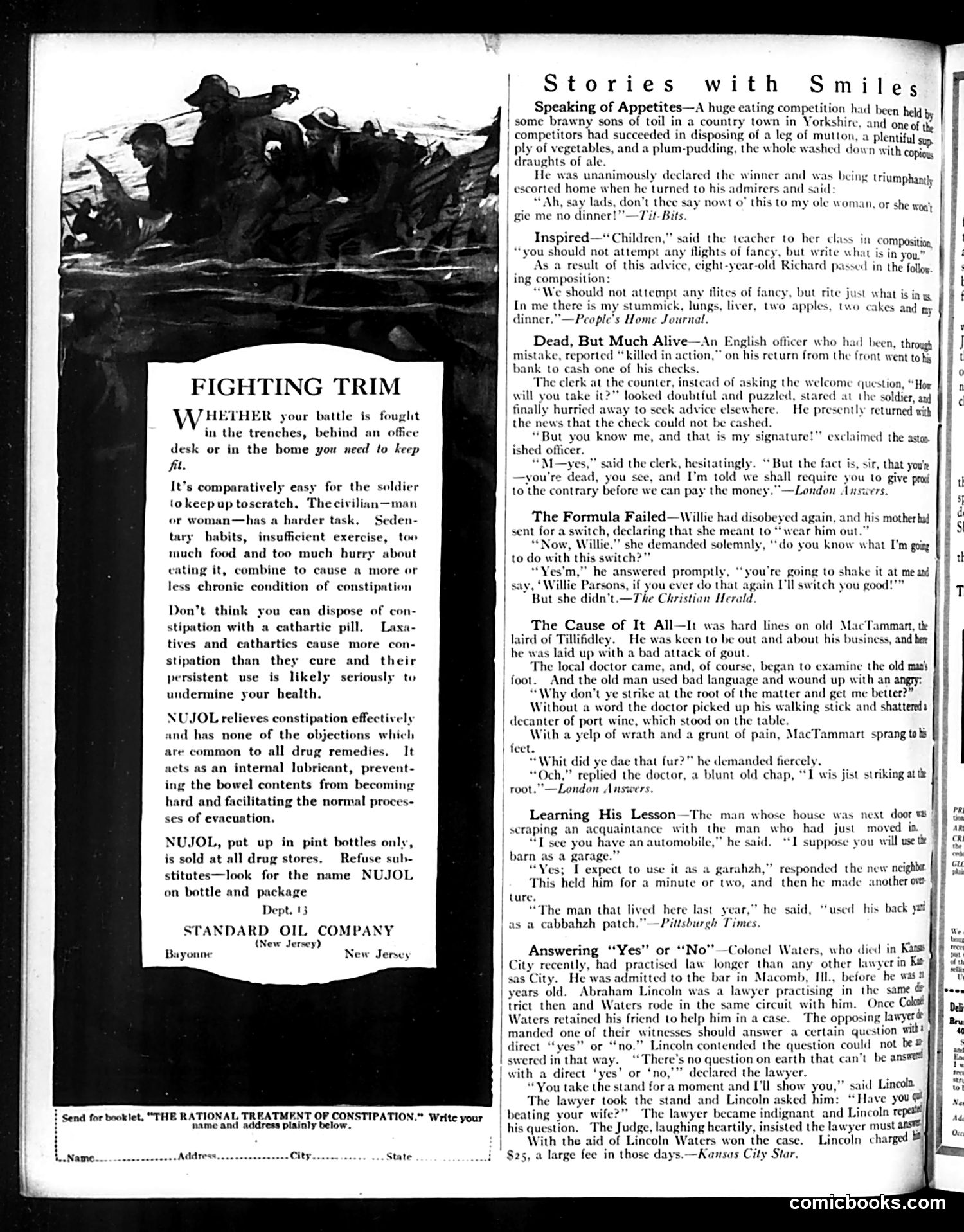
This page from *Judge* magazine combines **advertising and humor content**. The large left advertisement promotes **NUJOL**, a laxative oil made by Standard Oil Company. It targets civilians (office workers, homemakers) struggling with constipation from sedentary lifestyles—a common concern during the WWI era when the ad emphasizes staying "Fighting Trim." The pitch contrasts NUJOL favorably against harsh cathartic pills. The right column contains **"Stories with Smiles,"** brief humorous anecdotes with period dialect and domestic/military themes. These include: a Yorkshire workman winning an eating contest; a schoolchild's literal interpretation of a composition assignment; a soldier officially reported dead attempting to cash a check; and a mother's failed threat to switch her disobedient son. The humor relies on **wordplay, literalism, and social observation**—typical *Judge* fare mocking everyday life, obedience, bureaucracy, and human nature. The military references reflect WWI-era concerns.
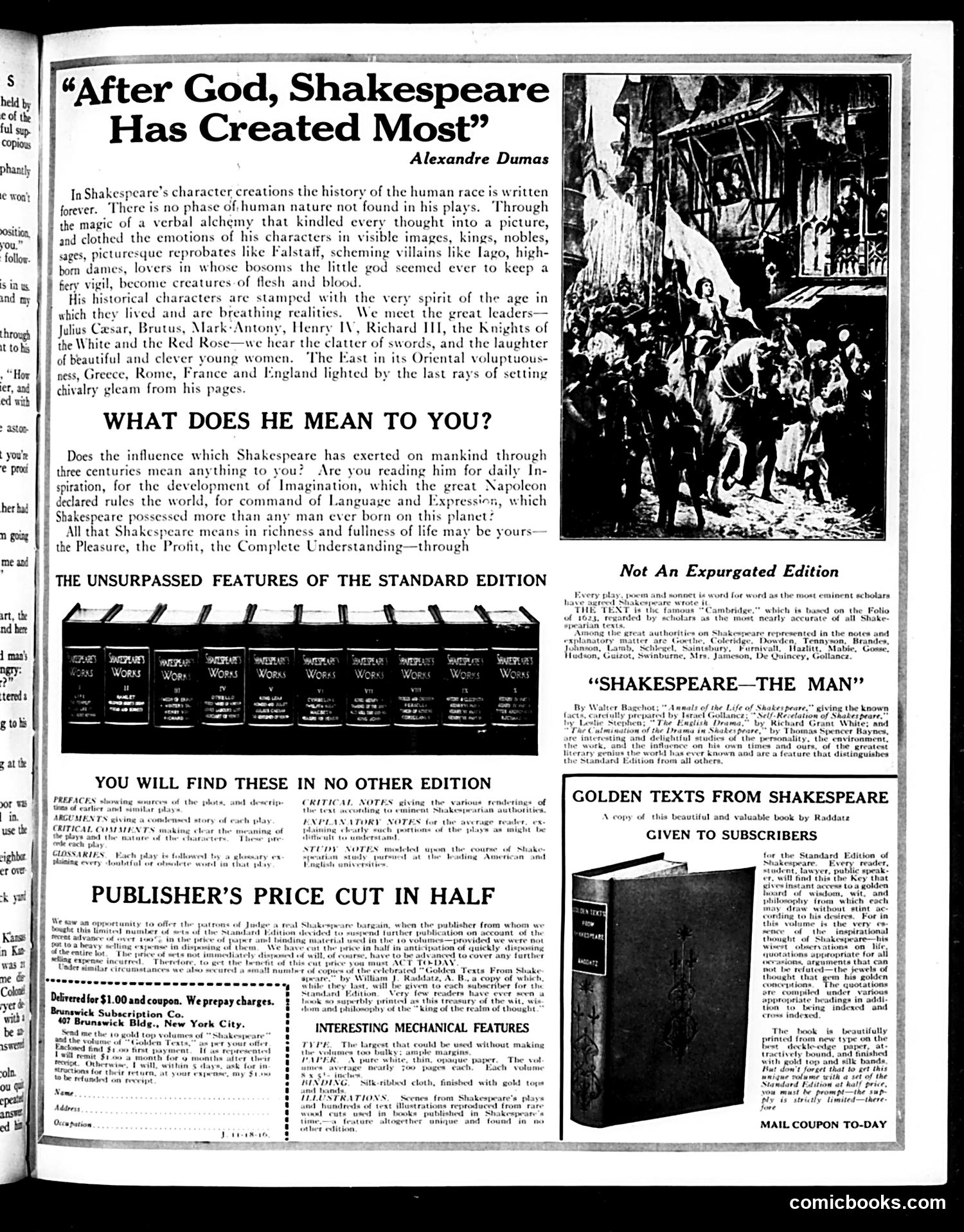
This is primarily **advertising content**, not a political cartoon. The page promotes the "Standard Edition" of Shakespeare's complete works through the Brunswick Subscription Company. The opening quote—attributed to Alexandre Dumas—uses flowery Victorian language to praise Shakespeare as the greatest chronicler of human nature, claiming his characters represent all of history and emotion. The **sales pitch** frames Shakespeare as essential for personal development: reading him provides "daily inspiration," develops imagination (invoking Napoleon as authority), and commands of language. This appeals to early 20th-century aspirations toward self-improvement and cultural refinement. The advertisement emphasizes exclusive features ("unsurpassed," "in no other edition"): prefaces, explanatory notes, illustrations, and a bonus book of "Golden Texts." A **mail coupon** at bottom completes the classic subscription model. This reflects the period's reverence for Shakespeare as a marker of education and civilization—positioning the complete works as an achievable luxury item for middle-class readers.
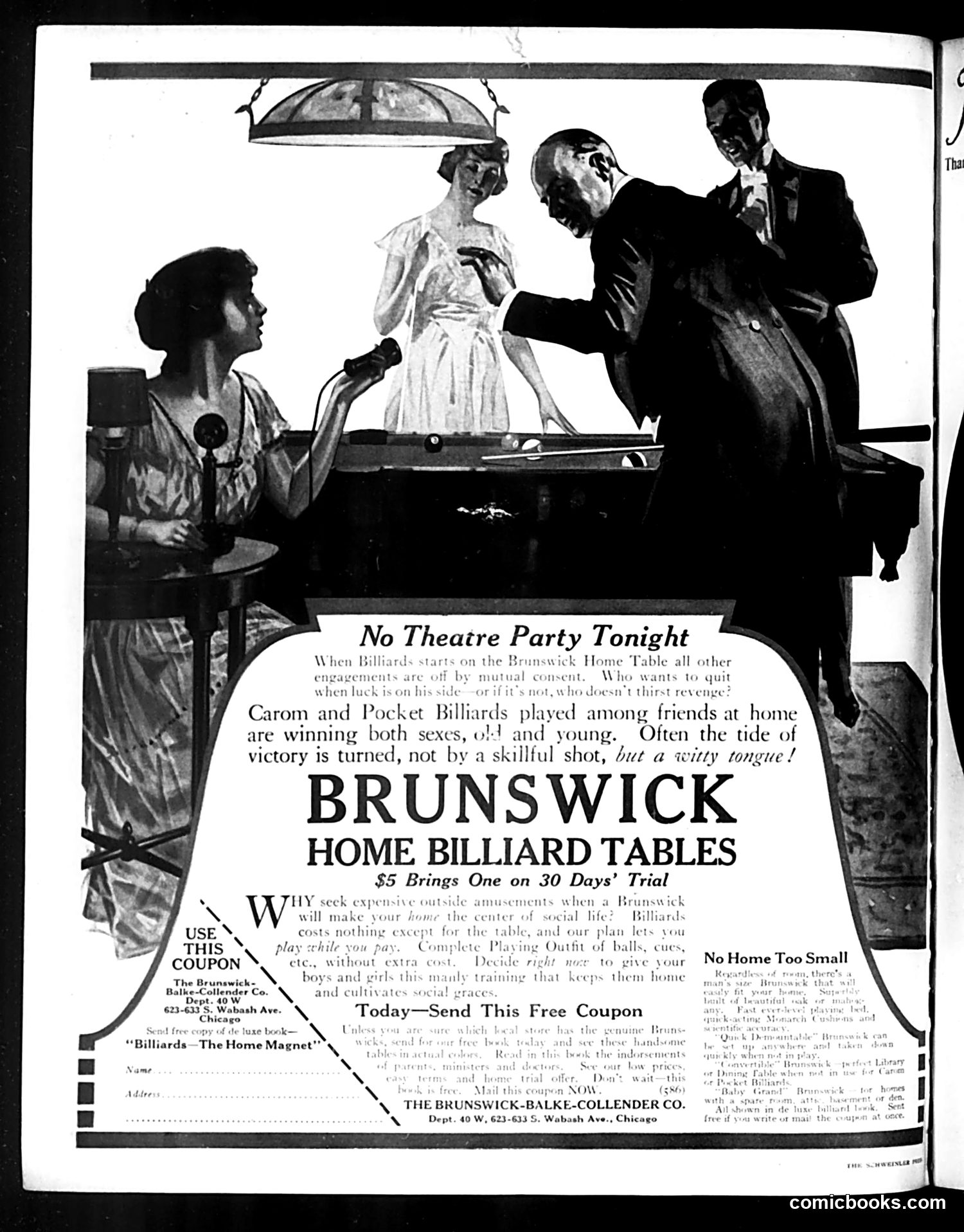
This is primarily a **product advertisement** rather than political satire. It promotes Brunswick home billiard tables to middle-class consumers. The ad's humor centers on a social scenario: a couple planning an evening out to a theater party must cancel when the husband discovers their new billiards table at home. The advertisement's logic is that the game proves so engaging—especially the witty banter between players—that no one wants to leave for expensive outside entertainment. The implicit social message targets 1920s anxieties about keeping families entertained at home and maintaining "social graces" among youth. By purchasing a billiards table, parents could provide wholesome home-based amusement that supposedly develops character and keeps children engaged constructively indoors. The staged photograph shows well-dressed adults and a woman holding an umbrella indoors, depicting the leisure-class lifestyle the product promised to enable.