
Judge, 1916-11-18 · page 17 of 28
Judge — November 18, 1916 — page 17: what you’re looking at
What you’re looking at
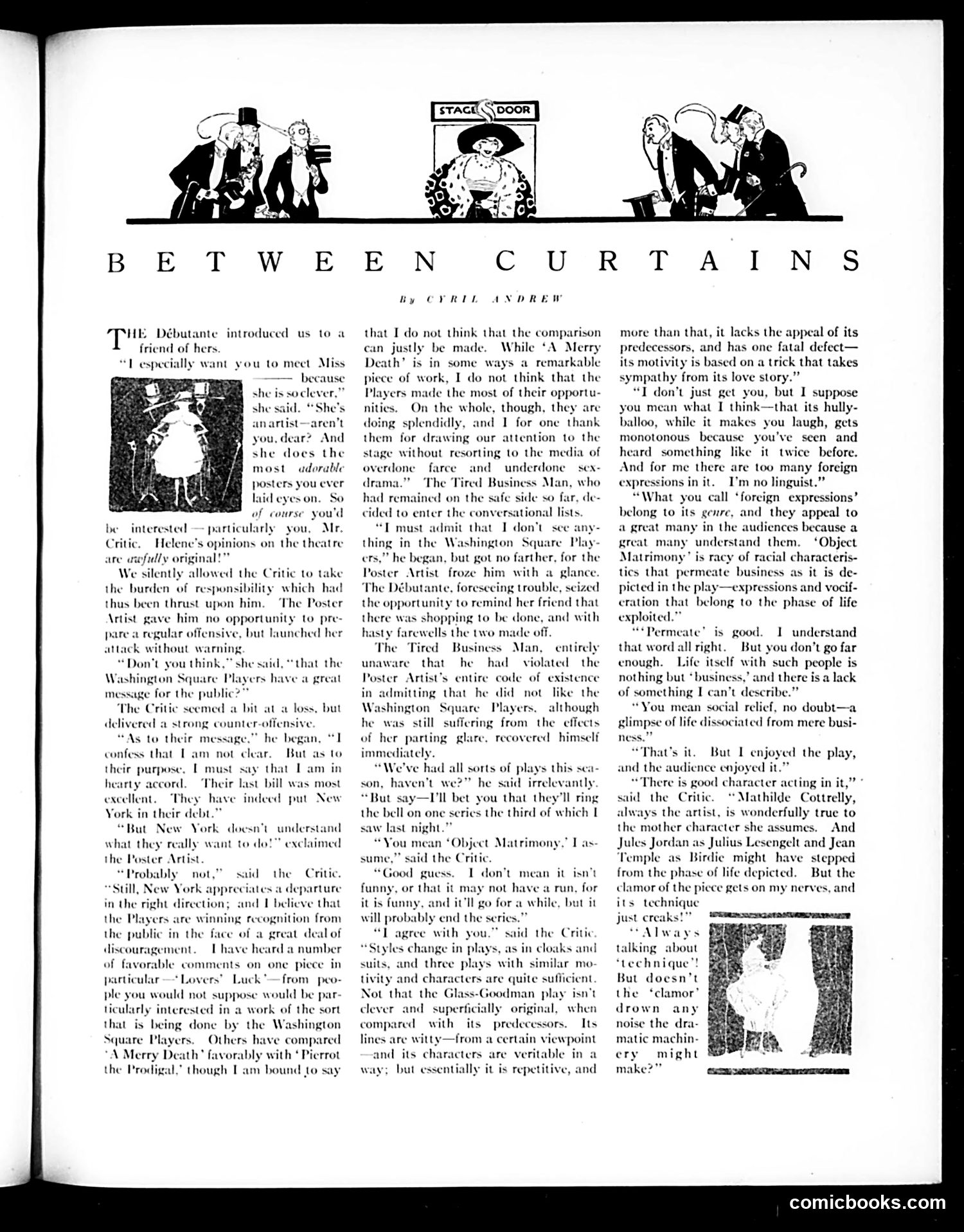
This page presents a satirical dialogue about the Washington Square Players, an experimental theater group. The cartoon at the top shows theater-goers and a stage door, setting the scene. The article mocks the pretentious social dynamics around avant-garde theater. A "Poster Artist" (representing artistic snobbery) aggressively defends the Players' experimental work, freezing out a "Tired Business Man" with a disapproving glare when he admits not liking their productions. The Critic and Businessman later discuss "Object Matrimony," a play they believe will have brief success before the series ends, arguing that while clever and original-seeming, it's essentially repetitive—a common problem with experimental theater of the era. The satire targets both pretentious artists who demand uncritical praise and the theatrical establishment's reliance on formulaic productions dressed up as innovation. The humor lies in exposing the social embarrassment of questioning avant-garde art in mixed company.
📄 Transcribed text from this page (OCR, searchable)
Machine-transcribed from the original scan — historical spelling and the odd misread are preserved.
HE Débutante introduced us to a friend of hers “1 especially want you to meet Miss because she is so clever, she said. “She anartist—aren’t you, dear? And she does the adorable posters you ever laid eyes on. So of course you'd be interested — particularly Mr. Critic. Helene’s opinions on the theatre are awfully original!” We silently allowed the Critic to take the burden of responsibility which had thus been thrust upon him. The Poster Artist gave him no opportunity to pre- pare a regular offensive, but launched her attack without warning. “Don't you think,” she said, “that the Washington Square Players have a great message for the public? The Critic seemed a bit at a loss, but delivered a strong counter-offensive. “As to their message.” he began, “1 confess that Lam not clear. But as to their purpose, [ must sty that Tam in hearty accord. Their last bill was most excellent. “They have indeed put New York in their debt.” “But New York what they really want to ¢ the Poster Artist. “Probably not,” said the — Critic. “Still, New York appreciates a departure in the right direction; and I believe that the Players are winning recognition from the public in the face of a great deal of T have heard a number most you, understand “exclaimed doesn’t discouragement. of favorable comments on one piece in particular —L Luck *—from ple you would not suppose would be par ticularly interested in a work of the sort that is being done by the Washington Square Players. Others have compared “A Merry Death’ favorably with ‘ Pierrot the Prodigal,” though [am bound to say overs” peo- By YRIL ANDREW that I do not think that the comparison can justly be made. While ‘A: Merry Death’ is in some ways a remarkable piece of work, I do not think that the Players made the most of their opportu- nities. On the whole, though, they are doing splendidly, and I for one thank them for drawing our attention to the stage without resorting to the media of overdone farce and underdone — sex- drama.” The Tired Business Man, who had remained on the safe side so far, de- cided to enter the conversational lists. “T must admit that I don’t se thing in the Washington Square Play ers,” he began, but got no farther, for the Poster Artist. froze him with a glance. The Débutante, foresecing trouble, seized the opportunity to remind her friend that there was shopping to be done, and with hasty farewells the two made off. The Tired Business Man, entirely unaware that he had violated the Poster Artist's entire code of existence in admitting that he did not like the Washington Square Players, although he was still suffering from the effects of her parting glare, recovered himself immediately “We've had all sorts of plays this s« son, haven't we?” he said irrelevantly “But say—I'll bet you that they'll ring the bell on one serics the third of which 1 saw last night. “You mean ‘Object Matrimony,” 1 as sume,” said the Critic. “Good guess. don’t mean it funny, or that it may not have a run, for it is funny, and itll go for a while, but it will probably end the series. “LT agree with you.” said the Critic “Styles change in plays, as in cloaks and suits, and three plays with similar mo tivity and characters are quite sufficient Not that the Glass-Goodman play isn’t clever and superficially original, when compared with its predecessors. Its lines are witty—from a certain viewpoint and its characters are veritable in a way; but essentially it is repetitive, and isn’t more than that, it lacks the appeal of its predecessors, and has one fatal defect— its motivity is based on a trick that takes sympathy from its love story.” “IT don’t just get you, but I suppose you mean what I think—that its hully. balloo, while it makes you laugh, gets monotonous because you've seen and heard something like it twice before. And for me there are too many foreign expressions in it. I’m no linguist. “What you call ‘foreign expressions’ belong to its gexre, and they appeal to a great many in the audiences because a great many understand them. ‘Object Matrimony’ is racy of racial characteris- tics that permeate business as it is de: picted in the play—expressions and vocif- cration that belong to the phase of life exploited.” “*Permeate’ is good. I understand that word all right. But you don’t go far enough. Life itself with such people is nothing but ‘business,’ and there is a lack of something I can’t describe.” “You mean social relief, no doubt—a glimpse of life dissociated from mere busi- ness.” “That's it. But 1 enjoyed the play, and the audience enjoyed it.” “There is good character acting in it,” stid the Critic. “Mathilde Cottrelly, always the artist, is wonderfully true to the mother character she assum And Jules Jordan as Julius Lesengelt and Jean Temple as Birdie might: have stepped from the phase of life depicted. But the clamor of the piece gets on my nerves, and its technique just creaks! “Always talking about ‘technique’! But doesn’t the ‘clamor drown any noise the dra- matic machin- ery might make?" comicbooks.com