
Judge, 1916-11-18 · page 6 of 28
Judge — November 18, 1916 — page 6: what you’re looking at
What you’re looking at
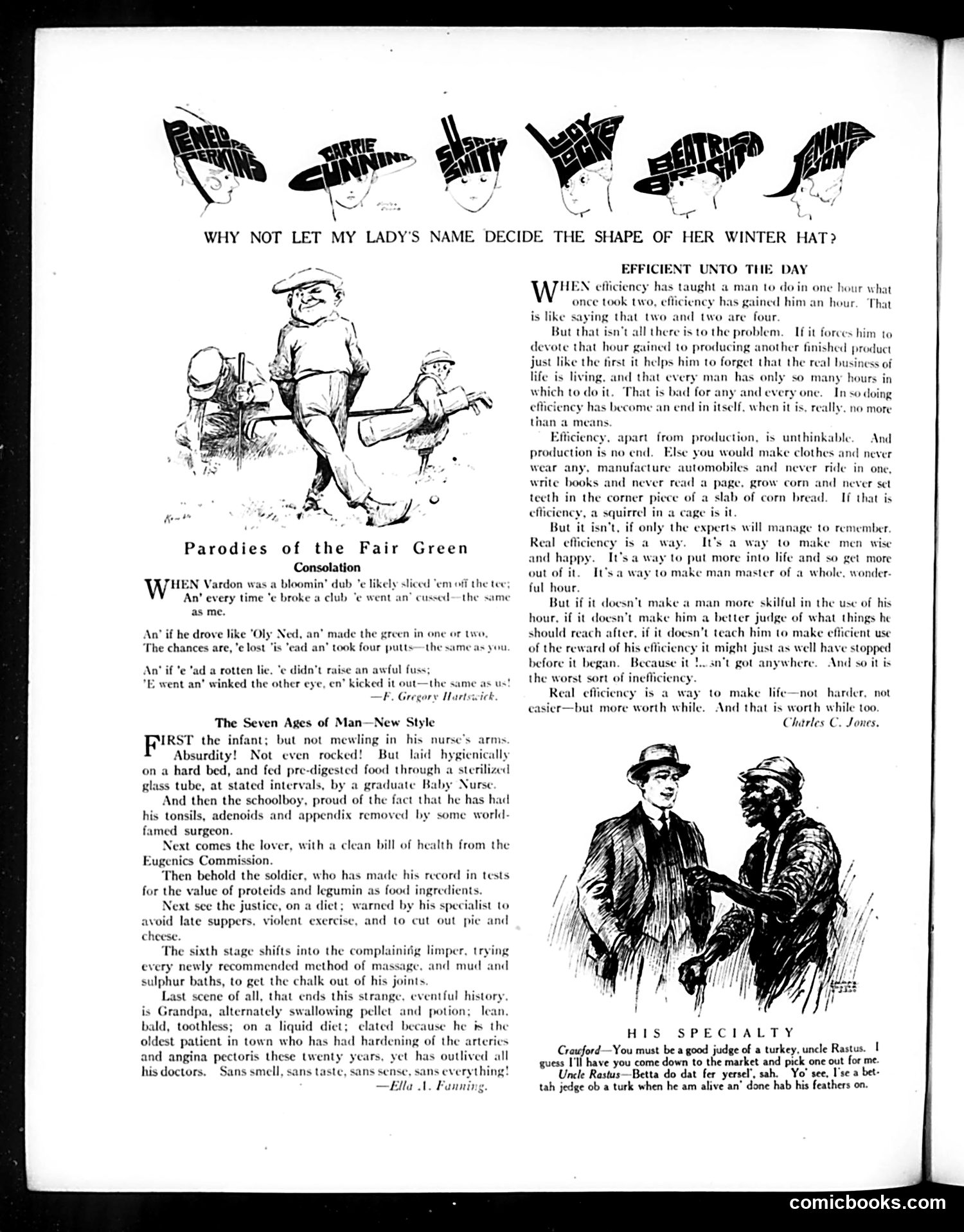
This page from Judge satirizes early-20th-century American obsessions with **efficiency and scientific management**—the era's dominant productivity ideology. The central essay "Efficient Unto the Day" by Charles C. Jones critiques excessive efficiency culture. It argues that modern efficiency experts, by obsessively maximizing production, have perverted efficiency's purpose. The author warns that if efficiency merely drives people to produce more products endlessly (clothes never worn, books never read, corn never eaten), it becomes meaningless—"a squirrel in a cage." The supporting content reinforces this theme through mockery: "The Seven Ages of Man—New Style" satirizes hyper-medicalized, scientifically-managed modern life, where people are sterilized, tested, and optimized from infancy onward, yet still decay into elderly pill-poppers. The hat cartoon at top appears to joke about women's fashion being equally absurd and trend-driven. The golf parody mocks British golfer Harry Vardon, suggesting even champions struggle with the same frustrations as ordinary players—deflating efficiency's promise of perfection. Together, the page warns readers that blind pursuit of scientific optimization threatens genuine living.
📄 Transcribed text from this page (OCR, searchable)
Machine-transcribed from the original scan — historical spelling and the odd misread are preserved.
( WHY NOT LET MY LADY'S NAME DECIDE THE SHAPE OF HER WINTER HAT? Parodies of the Fair Green Consolation HEN Vardon was a bloomin’ dub ‘e likely sliced ‘em off the tee; An’ every time 'e broke a club ‘e went an’ cussed—the sime as me. An’ if he drove like ‘Oly Ned, an’ made the green in one or wo, ‘The chances are, ‘e lost ‘is ‘cad an’ took four putts—the same as you An’ if 'e ‘ad a rotten lic, ‘e didn’t raise an awful fuss; : went an’ winked the other eye, en’ kicked it out—the same as us! —F. Gregory Martsicick The Seven Ages of Man—New Style HIRST the infant; but not mewling in his nurse’s arms. Absurdity! Not even rocked! But laid hygienically on a hard bed, and fed pre-digested food through a sterilized glass tube, at stated intervals, by a graduate Baby Nurse And then the schoolboy, proud of the fact that he has had his tonsils, adenoids and appendix removed by some world famed surgeon. Next comes the lover, with a clean bill of health from the Eugenics Commission. Then behold the soldier, who has made his record in tests for the value of proteids and legumin as food ingredients. Next see the justice, on a diet; warned by his specialist to avoid late suppers. violent exercise, and to cut out pie and chi The sixth stage shifts into the complainifig limper, trying every newly recommended method of massa and mud and sulphur baths, to get the chalk out of his joints. Last scene of all, that ends this strange, eventful history is Grandpa, alternately swallowing pellet and potion; lean, bald, toothless; on a liquid diet; elated because he is the oldest patient in town who has had hardening of the arteries and angina pectoris these twenty years, yet has outlived all his doctors. Sans smell, sans taste, sans sense, sans everything! Ella A. Fanni EFFICIENT UNTO THE DAY HEN efficiency has taught a man to doin one hour what once took two, efficiency has gained him an hour. That is like saying that two and two are four But that isn’t all there is to the problem. Lf it forces him to devote that hour gained to producing another finished product just like the first it helps him to forget that the real business of life is living, and that every man has only so many hours in which to do it. That is bad for any and every one. In so doing efficiency has become an end in itself, when it is, . no more than a means. Efficiency, apart from production, is unthinkable And production is no end. Else you would make clothes and never wear any, manufacture automobiles and never ride in one, write books and never read a page, grow corn and never set tecth in the corner piece of a slab of corn bread. If that is efficiency, a squirrel in a cage is it But it isn’t, if only the experts will manage to remember Real efficiency is a way. It's a way to make men wise and happy. it’s a way to put more into life and so get more out of it. It’s a way to make man master of a whole, wonder- ful hour. But if it doesn’t make a man more skilful in the use of his hour, if it doesn’t make him a better judge of what things he should reach after, if it doesn’t teach him to make efficient use of the reward of his efficiency it might just as well have stopped before it began. Because it !..an"t got anywhere. And so it is the worst sort of ir R efficiency i y to make life—not harder, not easier—but more worth while. And that is worth while too. Charles C. Jones, HIS SPECIALTY Crauford—You must be a good judge of a turkey, uncle Rastus. | guess I'll have you come down to the market and pick one out for me. Uncle Rastus—Betta do dat fer yersel’, sah. Yo" see, I'se a bet- tah jedge ob a turk when he am alive an’ done hab his feathers on. comicbooks.com