
Judge, 1916-11-18 · page 16 of 28
Judge — November 18, 1916 — page 16: what you’re looking at
What you’re looking at
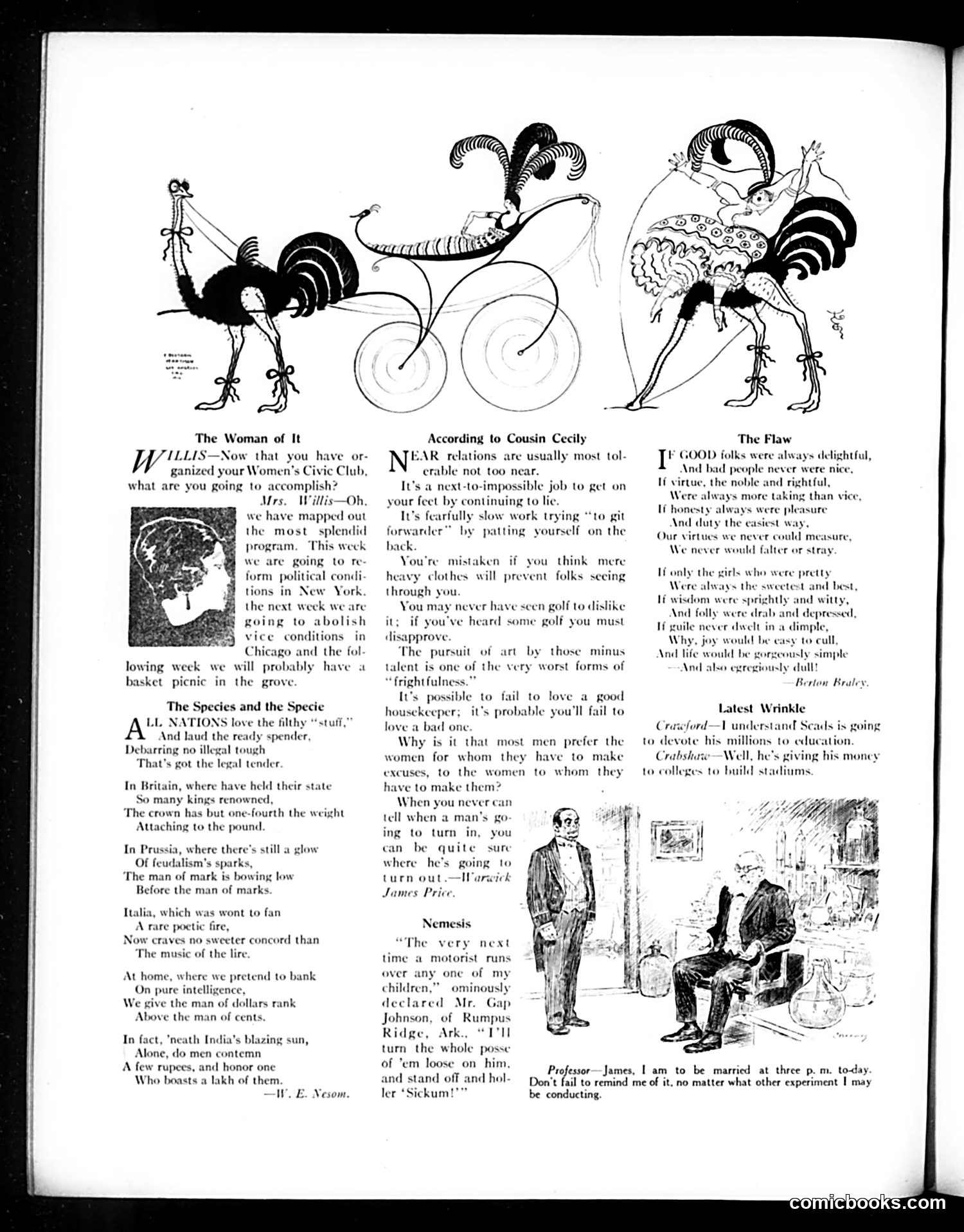
**Top cartoons:** These absurdist illustrations mock women's civic activism. "The Woman of It" satirizes the ambitious Mrs. Willis, whose Women's Civic Club plans to reform New York politics, abolish vice in Chicago, then—anticlimactically—have a picnic. The joke: women's reform efforts are portrayed as grandiose yet frivolous, undermined by their own lack of seriousness. **"The Species and the Specie":** A poem mocking universal materialism across nations. It argues that everywhere—Britain, Prussia, Italy, India, America—money matters more than merit or character. The satire targets hypocrisy: America "pretends to bank on pure intelligence" while actually elevating wealthy men above others. **Other items:** "According to Cousin Cecily" offers cynical social observations; "The Flaw" is a moralistic poem suggesting virtue would be tedious if always rewarded; "Nemesis" jokes darkly about a father threatening revenge on motorists; the final panel humorously shows a professor asking his assistant to remind him of his own wedding. The page reflects early 20th-century skepticism toward reform movements, materialism, and social pretense.
📄 Transcribed text from this page (OCR, searchable)
Machine-transcribed from the original scan — historical spelling and the odd misread are preserved.
The Woman of It h ILLIS—Now that you have or- ganized your Women’s Civic Club, what are you going to accomplish? Mrs, Willis—Oh, we have mapped out the most. splendid program. This week we are going to re- form political condi tions in w York the next week we are going to abolish vice conditions in Chicago and the fol lowing week we will probably have a basket picnic in the grove. The Species and the Specie LL NATIONS love the filthy “stuff,” And laud the ready spender, Debarring no illegal tough That’s got the legal tender In Britain, where have held their state So many kings renowned, The crown has but one-fourth the weight Attaching to the pound. In Prussia, where there's still a glow Of feudalism’s sparks, ‘The man of mark is bowing low Before the man of marks. Italia, which was wont to fan A rare poetic fire, w craves no sweeter concord than The music of the lire. At home, where we pretend to bank On pure intelligence, We give the man of dollars rank Above the man of cents. In fact, ‘neath India's blazing sun, Alone, do men contemn A few rupees, and honor one Who boasts a lakh of them. W. E. Nesom. According to Cousin Cecily EAR relations are usually most tol- crable not too near. It’s a next-to-impossible job to get on your feet continuing to lie. It’s fearfully slow work trying ‘to git forwarder” by patting yourself on the hack. You're mistaken if you think mere heavy clothes will prevent folks seeing through you You may never have seen golf to dislike it; if you've heard some golf you must disapprove The pursuit of art’ by talent is one of the very worst forms of those minus “frightfulness.”” It’s possible to fail to love a good housekeeper; it's probable you'll fail to love a bad one. Why is it that most men prefer the women for whom they have to make excuses, to the women to whom they have to make them? When you never can tell when a man’s go ing to turn in, you can be quite sure where he’s going to turn out.—Warwick James Price Nemesis “The very next time a motorist runs over any one of my children,” ominously declared Mr. Gap Johnson, of Rumpus Ridge, Ark. “I'M turn the whole posse of ’em loose on him, and stand off and hol- ler ‘Sickum!"” Professor The Flaw GOOD folks were always delightful, And bad people never were nice, If virtue, the noble and rightful, Were always more taking than vice, If honesty always were pleasure And duty the easiest way Our virtues we never could measure, We never would falter of stray If only the girls who were pretty Were always the sweetest and best, Ii wisdom were sprightly and witty, And folly were drab and depressed, If guile never dwelt in a dimple, Why, joy would be easy to cull, And life would | usly simple And also egregiously dull! Berton Bralex Latest Wrinkle Crawford—T understand Scaids is going to devote his millions to education. Crabshaw—Well, he’s giving his money to colleges to build stadiums. James, | am to be married at three p.m. to-day. Don't fail to remind me of it, no matter what other experiment | may be conducting.