
Judge, 1916-11-18 · page 5 of 28
Judge — November 18, 1916 — page 5: what you’re looking at
What you’re looking at
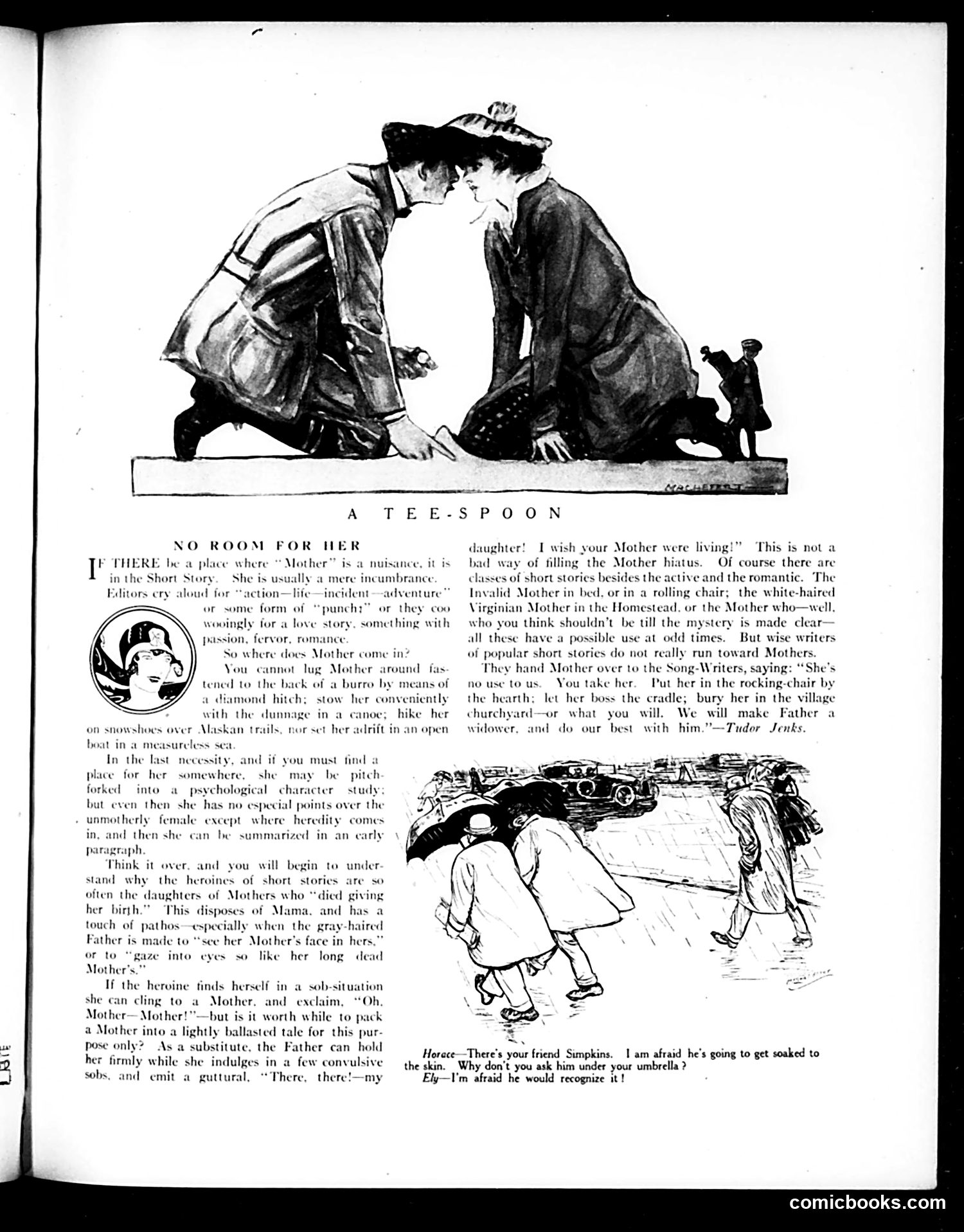
This satirical article critiques the common literary trope of the "Mother" character in short stories. The author argues that editors favor stories featuring mothers as plot devices—particularly tragic or inconvenient ones (bedridden, elderly, etc.)—rather than as meaningful characters. The top illustration shows two men in conversation, likely representing a writer pitching to an editor. The lower illustration depicts people in rain, with dialogue about an umbrella and a friend getting soaked—a mundane scene typical of the formulaic stories being mocked. The piece satirizes how publishers exploit sentimental maternal themes for commercial appeal while relegating mothers to peripheral roles rather than developing them as complex characters. The author advocates for more substantive maternal representation in fiction.
📄 Transcribed text from this page (OCR, searchable)
Machine-transcribed from the original scan — historical spelling and the odd misread are preserved.
A TE NO THERE be in the Short Story Editors ery aloud for “action—life or some form of “punchi” or they coo wooingly for a love story, something with ROOM FOR HER a place where Mother” is a nuisance, it is She is usually a mere incumbrance adventure” I' incident passion, fervor, romance So where You cannot lug Mother around tened to the back of a burro by me: a diamond hiteh; her conven with the dunnage in a canoe; hike Maskan trails, nor set her adrift in an open boat in a measureless sea In the last: necessity, and if you must find a she may be pitch character study: but even then she has no especial points over the female except: where heredity comes summarized in an carly locs Mother come in? fas ns of ently her stow ‘on snowshoes over place for her somewhere, forked into a psychological . unmotherly in, and then she can be paragraph Think it over will begin t stand why the heroines of short stories are often the daughters of Mothers who “died giving her birth.” This disposes of Mama. and has a touch of pathos—especially when the gray-haired fe to “see her Mother's face in hers.” like her long dead and you under Father is ma or to Mother's. If the heroine finds herself in a sob-situation she can cling to a Mother, and exclaim, “Oh, Mother— Mother but is it worth while to pack a Mother into a lightly ballasted tale for this pur- pose only? As a substitute, the Father can hold her firmly while she indulges in a few convulsive sobs, and emit a guttural, “There, there!—my wze into eyes so Horace the skin. E-SPOON I wish your Mother were living!” This is not a bad way of filling the Mother hiatus. Of course there are classes of short stories besides the active and the romantic. The Invalid Mother in bed, or in a rolling chair; the white-haired Virginian Mother in the Homestead, or the Mother who—well, who you think shouldn’t be till the mystery is made clear- all these have a possible use at odd times. But wise writers of popular short stories do not really run toward Mothers. They hand Mother over to the Song-Writers, saying: “She's no use tous. You take her. Put her in the rocking-chair by the hearth; let her boss the cradle; bury her in the village churchyard—or what you will. We will make Father a do our best: with him.”’—Tudor Jenks. daughter! widower, and -There’s your friend Simpkins. | am afraid he's going to get soaked to don’t you ask him under your umbrella ? 'Y. Ely—I'm afraid he would recognize it! comicbooks.com