
A complete issue · 28 pages · 1916
Judge — November 11, 1916
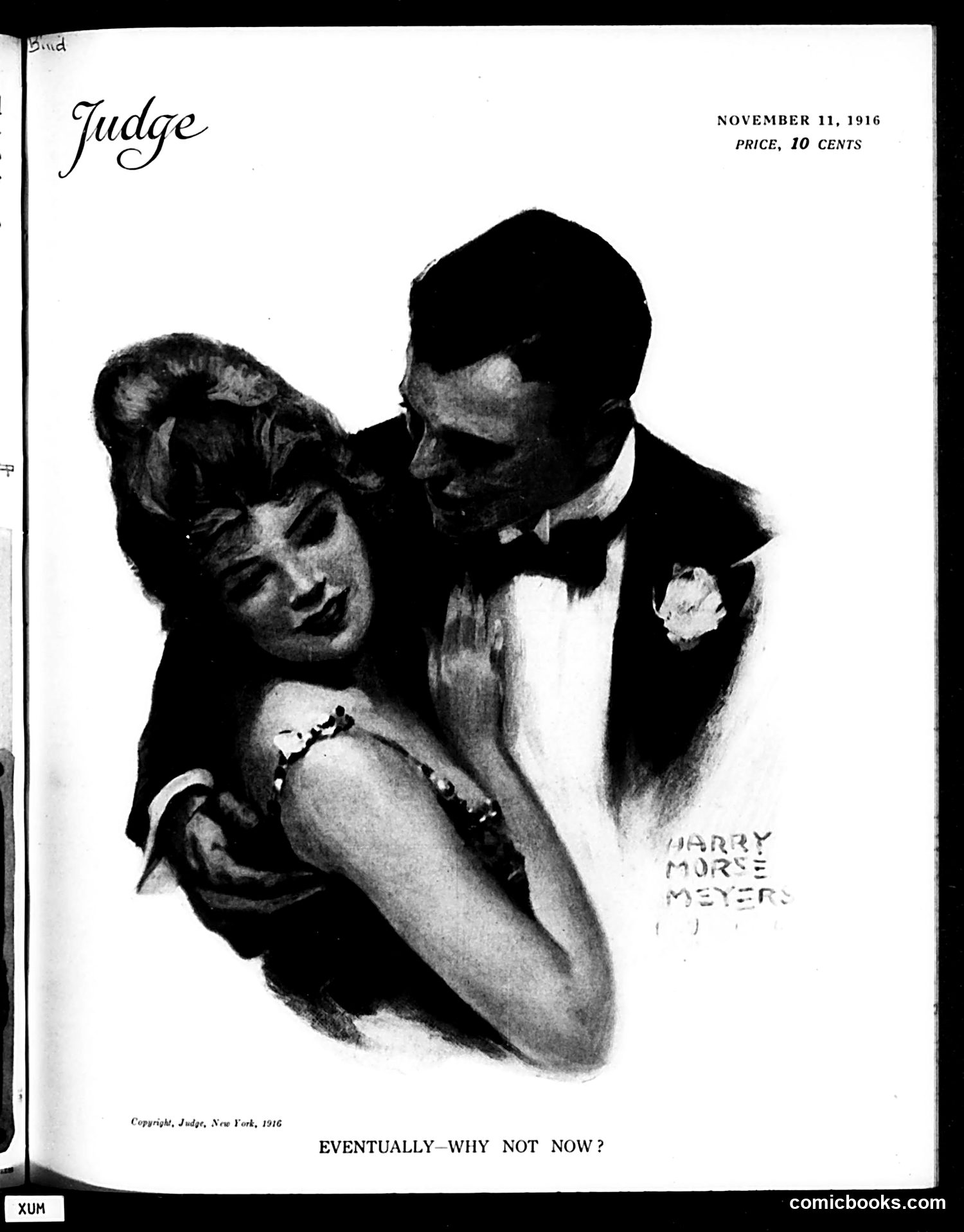
This cover illustration by Henry Morse Meyers depicts a romantic couple in formal attire with the caption "EVENTUALLY—WHY NOT NOW?" The image appears to be a marriage-themed cartoon typical of Judge's humor. The man in tuxedo and woman in an elegant gown suggest an engagement or wedding scenario. The "why not now?" caption implies gentle pressure or encouragement toward matrimony—a common satirical theme in early 20th-century magazines. Published November 11, 1916 (just days after the U.S. presidential election), the cartoon likely reflects post-election social commentary, though the specific political context remains unclear from the image alone. The tone is light romantic comedy rather than sharp political satire.
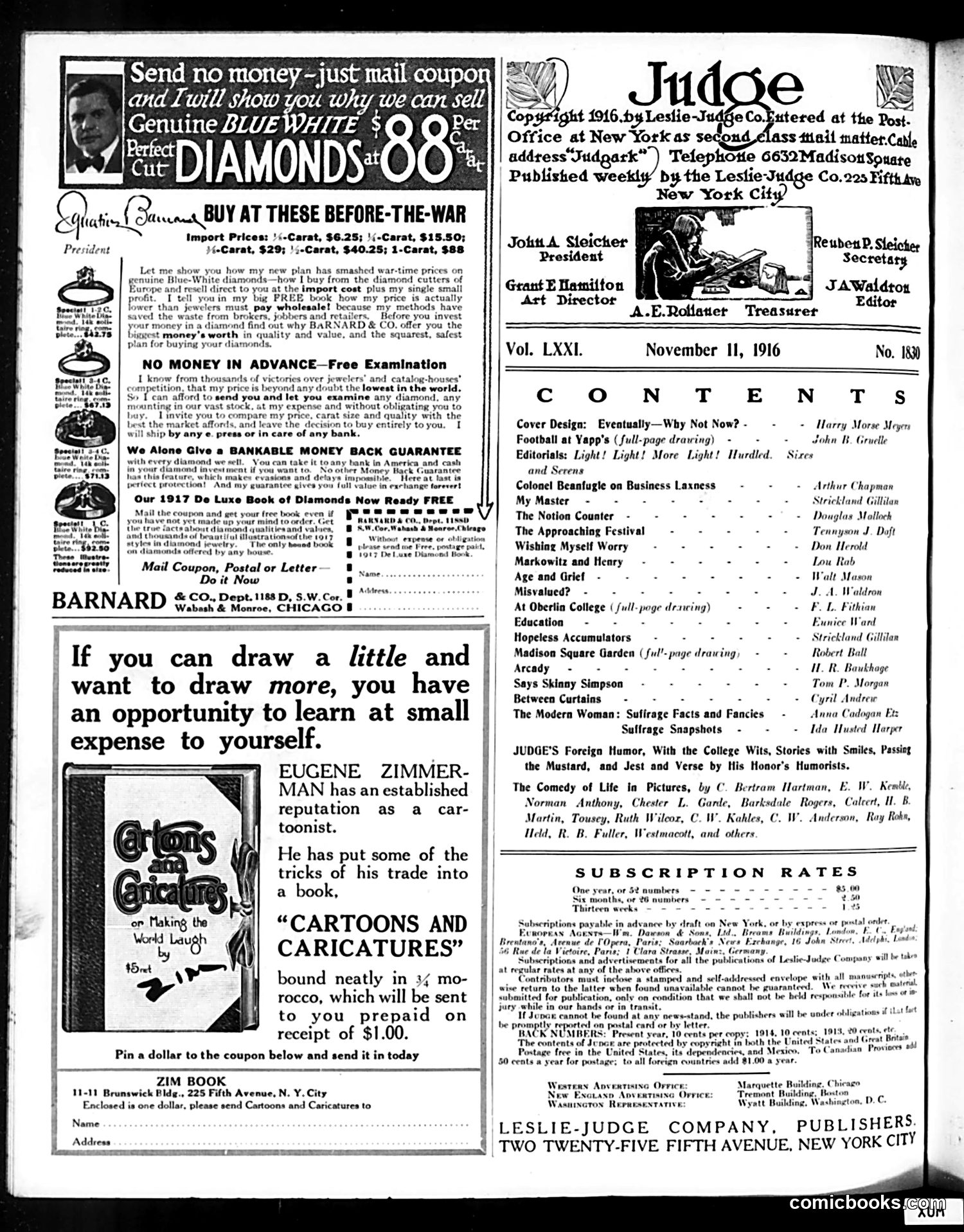
This page is primarily **advertising and editorial content** rather than political cartoons. The dominant features are: 1. **Diamond sales advertisement** from Barnard & Co., promoting "blue-white" diamonds at pre-war prices 2. **Drawing instruction ad** by Eugene Zimmerman featuring his book "Cartoons and Caricatures" 3. **Table of contents** listing articles including "Football at Vassar," "The Approaching Festival," and "Says Skinny Simpson" The magazine's masthead identifies key staff including President John A. Steicher and Art Director Grant B. Hamilton. The publication date—November 11, 1916—places this during WWI's European conflict, which explains the "before-the-war" pricing emphasis in advertisements. No prominent political satire is visible on this particular page; it functions primarily as a contents/advertising section of the weekly satirical periodical.
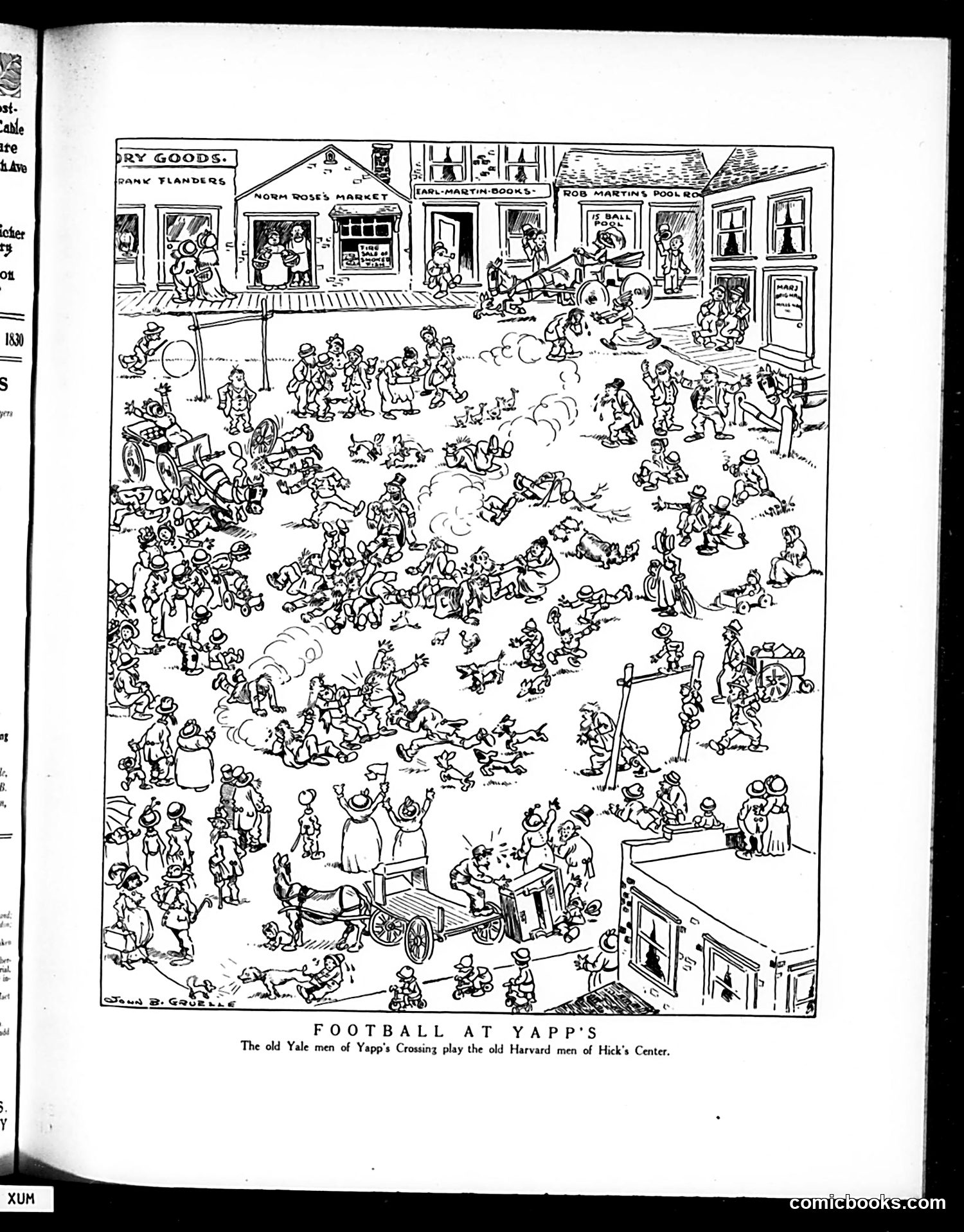
This is a humorous illustration depicting a chaotic street scene labeled "Football at Yapp's." The caption states: "The old Yale men of Yapp's Crossing play the old Harvard men of Hick's Center." The cartoon satirizes the intense rivalry between Yale and Harvard universities through an absurdist scenario where alumni from these prestigious institutions engage in a disorganized "football" match in what appears to be a small-town commercial district. The scene is deliberately crowded and anarchic—figures tumble everywhere, animals participate, and the "game" has devolved into pure mayhem rather than organized sport. The satire mocks both the pretentiousness of Ivy League alumni and their tendency to carry collegiate rivalries into adult life, treating a casual gathering like a serious athletic competition with mock gravitas.
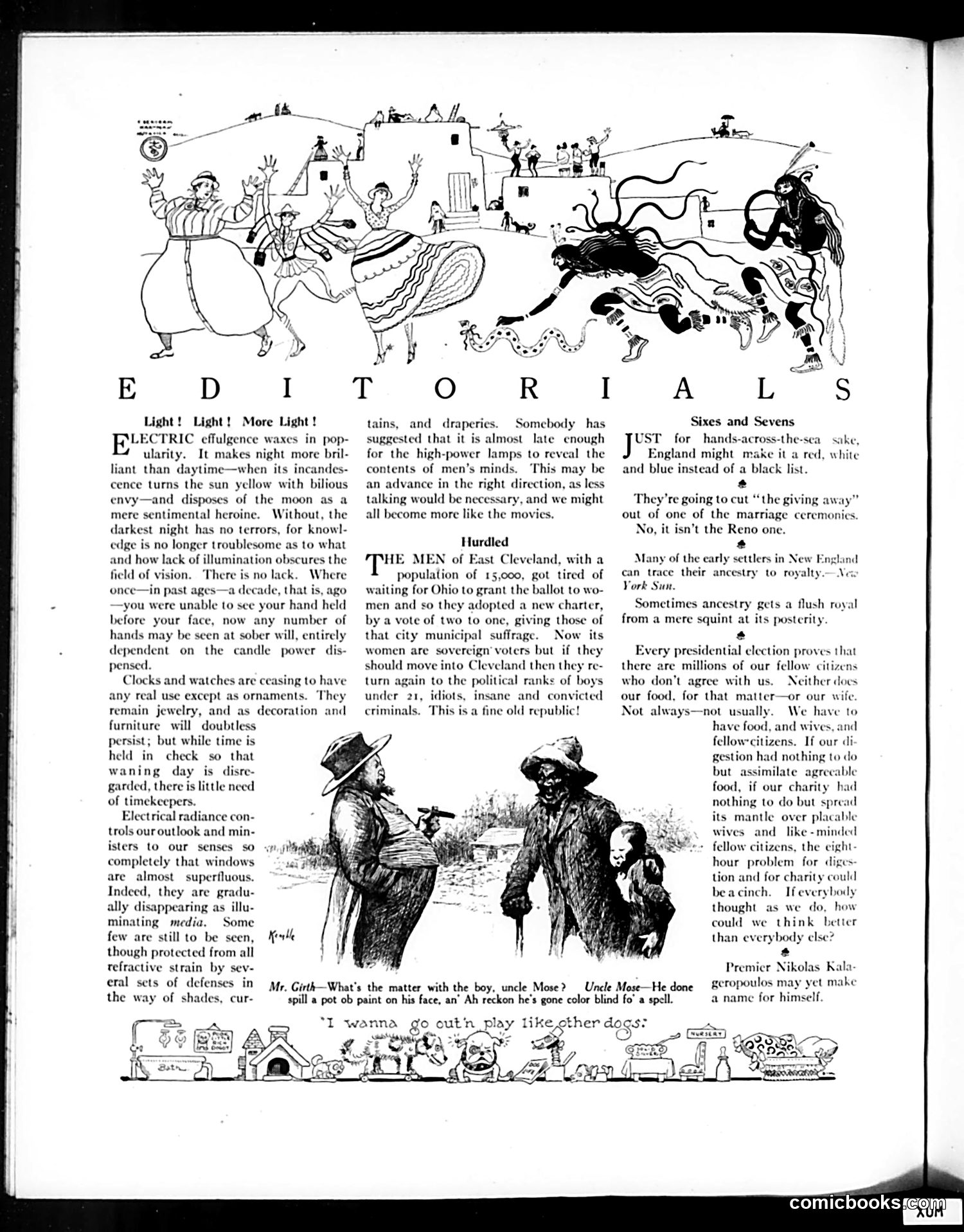
This page contains satirical editorials rather than political cartoons. The "Hurdled" section mocks East Cleveland's municipal governance, referencing a population of 15,000 that recently gained voting rights. The satire criticizes how these new voters—described as "boys under 19, idiots, insane and convicted criminals"—were granted suffrage through a charter change approved by a two-to-one margin. The text uses absurdist humor to attack what it presents as reckless democratic expansion to unsuitable voters. The "Sixes and Sevens" section comments on England potentially granting women's suffrage and discusses American political dysfunction, suggesting citizens lack engagement with governance. The accompanying illustration depicts what appears to be rural characters, likely reinforcing stereotypes about newly enfranchised voters' unsuitability for political participation.
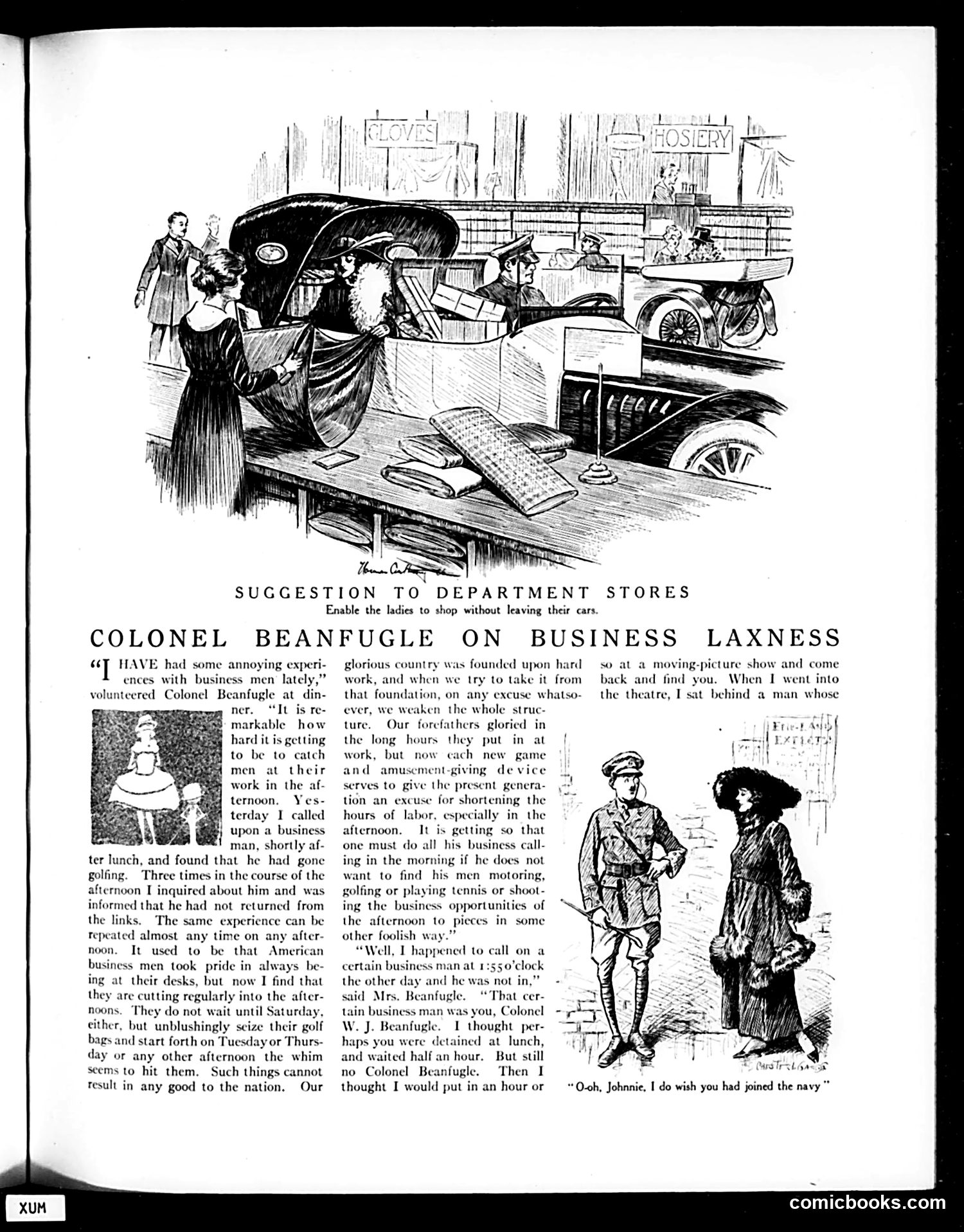
This page contains two distinct elements: **Top cartoon** ("Suggestion to Department Stores"): Depicts women shopping while their cars remain parked outside, suggesting that department stores should enable ladies to shop without abandoning their vehicles—likely a practical suggestion during the early automobile era when women's shopping habits were changing. **Bottom article and illustrations**: Features "Colonel Beanfugle on Business Laxness," where a Colonel criticizes American business practices, particularly men leaving their desks during afternoon hours for leisure activities (golf, tennis, theater). He contrasts this with his own observation that European business culture maintains stricter work discipline. The satire mocks what appears to be perceived American business inefficiency and the afternoon leisure culture of businessmen, positioning it as nationally damaging. Both elements reflect early 20th-century concerns about modernization, gender roles, and work ethic.
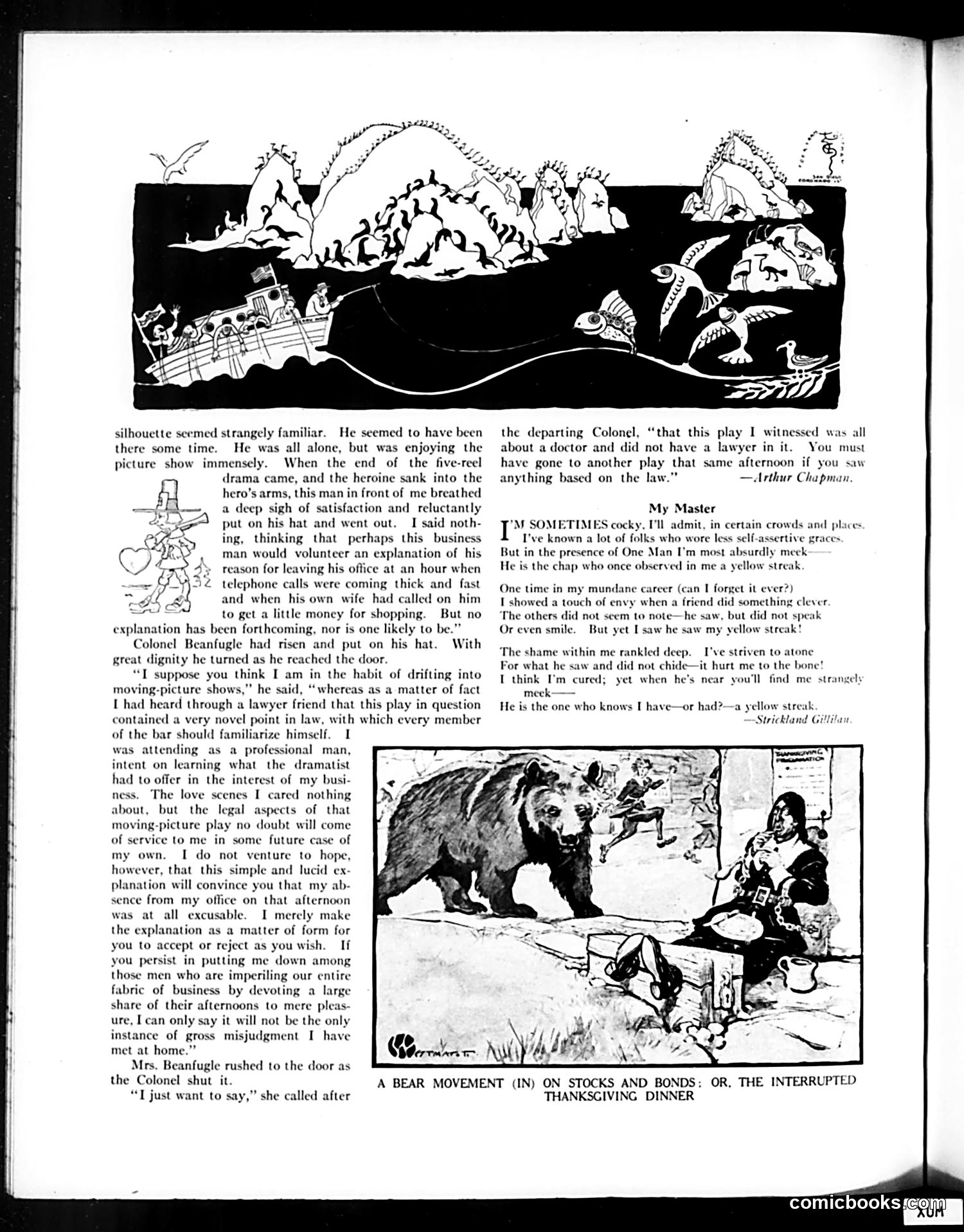
This Judge magazine page contains two separate satirical pieces: **"My Master" (poem):** A narrative about a man humbled by someone who once observed his cowardice ("yellow streak"). The satire mocks how people remain psychologically dominated by those who've witnessed their moral failures, even if never directly confronted about them. **Colonel Beanfugle story (top):** A businessman caught sneaking away to a movie theater invents an absurd professional excuse—claiming he attended to study "legal aspects" for his law practice. His wife immediately exposes the lie: the film was about a doctor with no lawyer in it. The satire ridicules men who abandon work and family responsibilities for leisure while concocting transparent justifications, and their wives who publicly humiliate them by revealing the truth. **"A Bear Movement" (illustration caption):** Appears to reference stock market terminology ("bear" = market downturn), though the specific connection to "interrupted Thanksgiving dinner" is unclear from this excerpt. The page satirizes male pretense, cowardice, and the gap between public excuses and private behavior.
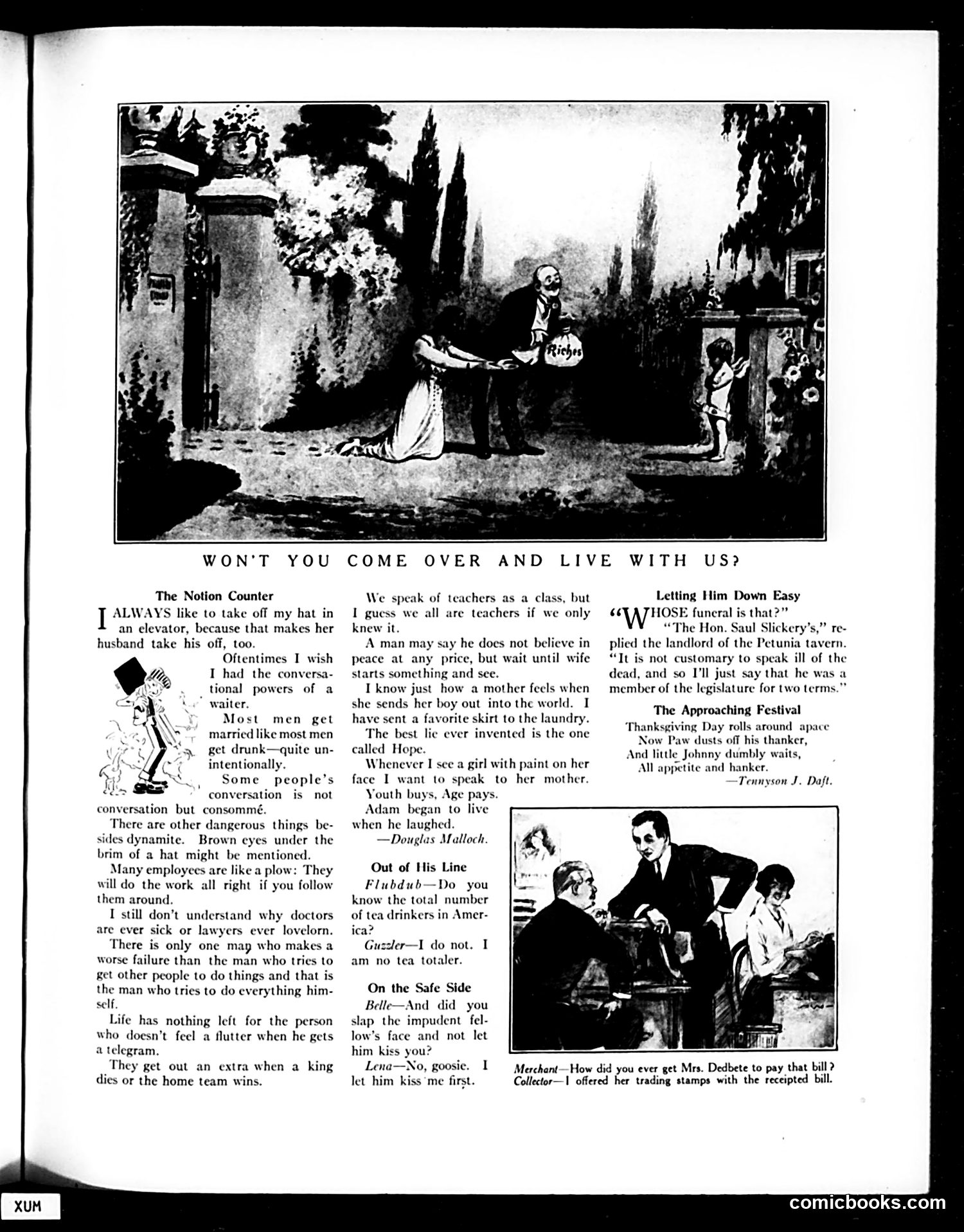
This is a humor and satire page from Judge magazine, primarily consisting of short jokes and observations rather than political cartoons. The top illustration shows a domestic scene with the caption "Won't You Come Over and Live With Us?" — likely depicting a courting or social scenario. The content reflects early 20th-century American social commentary: **"The Notion Counter"** offers witty observations on marriage (men marry "quite unintentionally"), gender dynamics, workplace behavior, and social conventions — typical Judge magazine fare targeting educated urban readers. **"Out of His Line"** is a pun: "Guzler" won't count tea drinkers because he's "no tea totaler" (not a teetotaler). **"On the Safe Side"** plays on courtship propriety — the woman kissed first to avoid appearing improper. **"Letting Him Down Easy"** mocks the hypocritical respectability of politicians, even dishonest ones, after death. **"The Approaching Festival"** is sentimental verse about Thanksgiving. The page reflects pre-WWI American middle-class attitudes toward marriage, propriety, work, and consumption through light satire rather than sharp political critique.
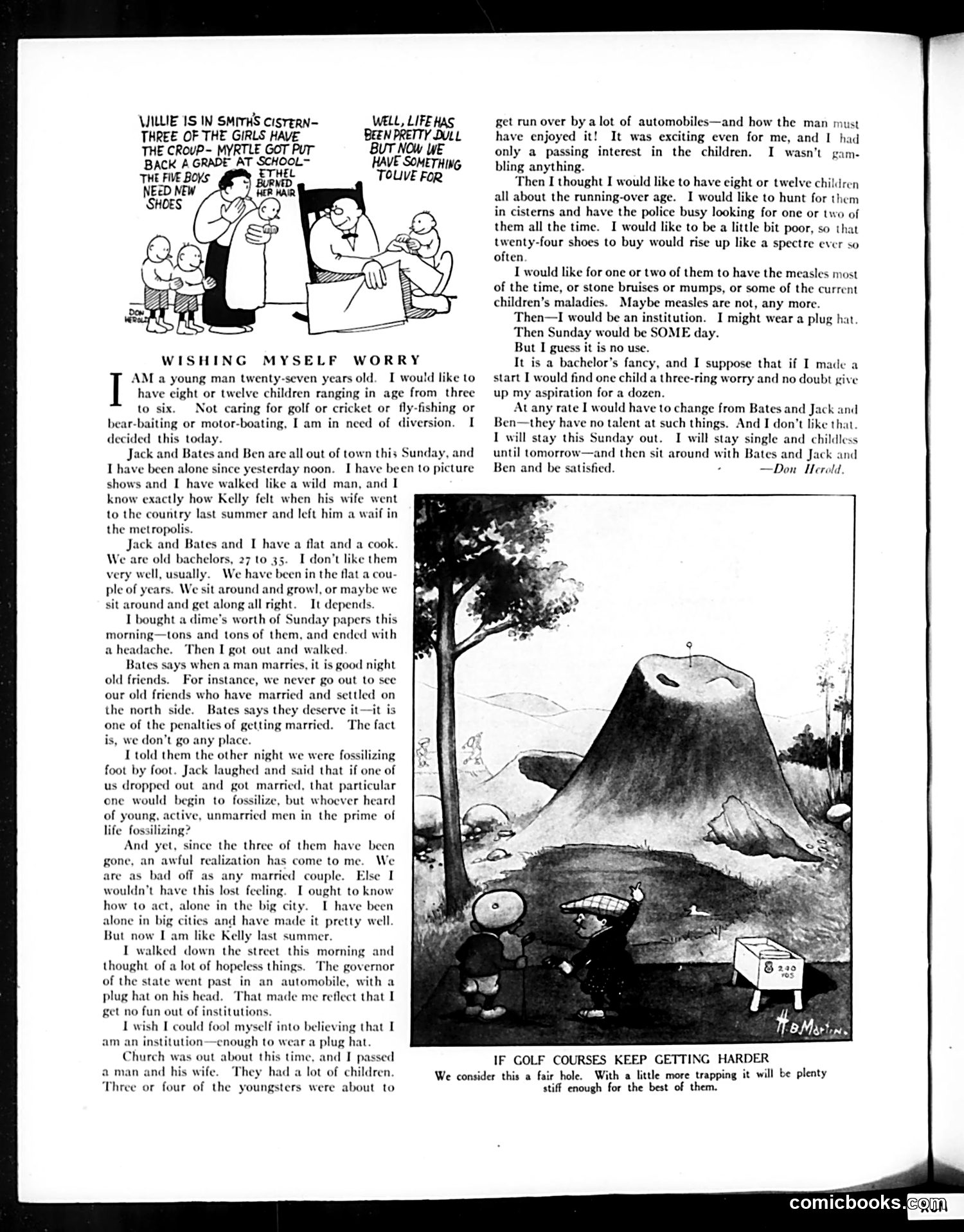
This page contains a humorous essay-cartoon hybrid satirizing urban bachelor life in the early 20th century. The opening comic strip shows a mother listing domestic crises (children's illnesses, school problems) as "something to live for"—implying that worry and chaos equal purpose. The main article develops this theme: a 27-year-old unmarried man, bored and aimless with his bachelor friends, fantasizes about having eight to twelve children. He envies the "diversion" of fatherhood—even imagining children in danger, measles, poverty, and constant supervision as preferable to his empty leisure time. He romanticizes wearing a "plug hat" (a status symbol of institutional respectability) and gaining social standing through parenthood. The satire cuts both ways: mocking both the tedium of unmarried male domesticity and the romanticization of family chaos as meaningful living. The irony is that he'll never actually pursue this—his friends lack "talent" for family life, and one child would defeat him anyway. The cartoon "If Golf Courses Keep Getting Harder" (bottom) jokes about making golf more challenging.
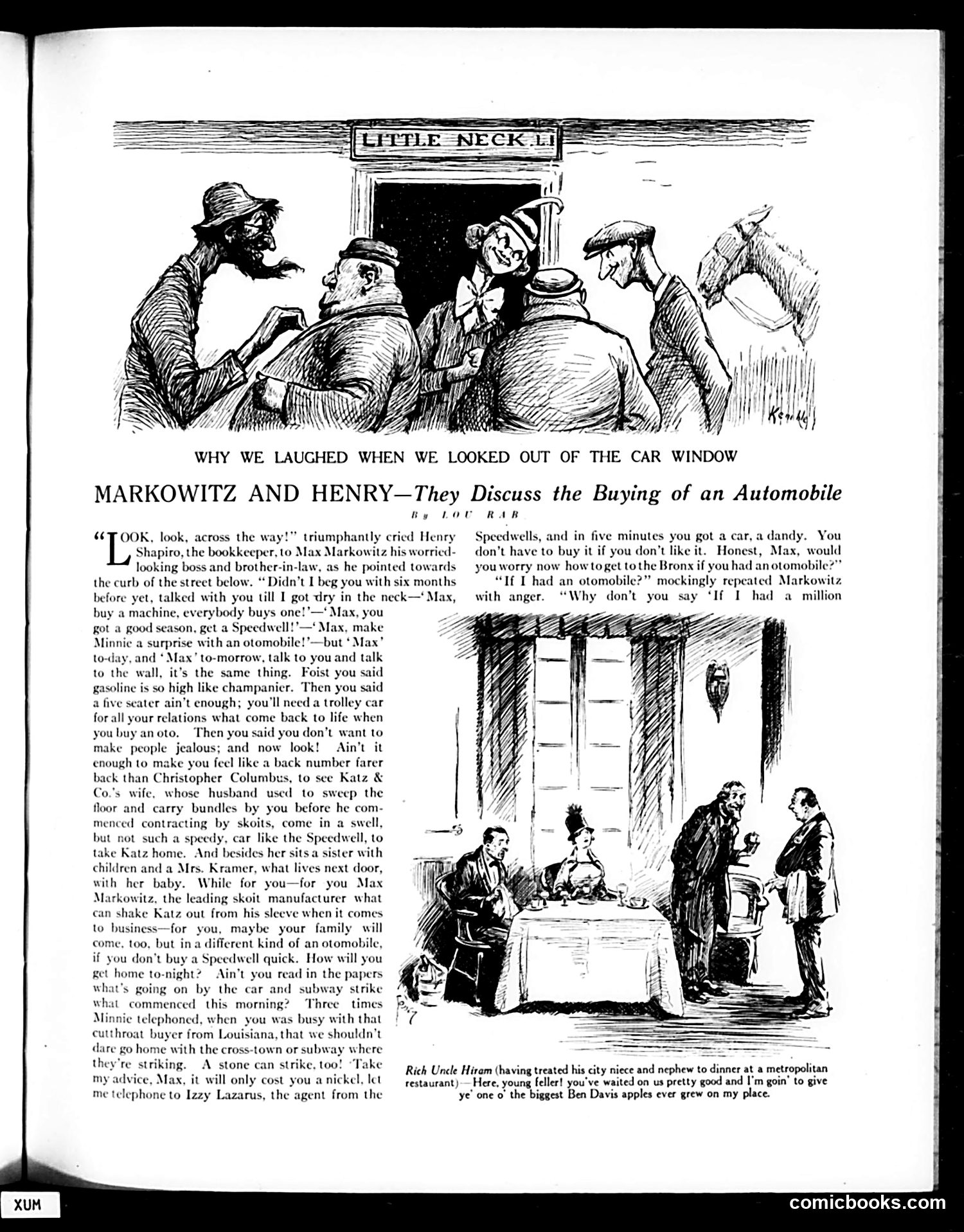
This is a satirical piece about early automobile purchasing among Jewish immigrant businessmen in New York City, circa 1910s-1920s (based on the language and cultural references). **The Main Cartoon:** Two Jewish characters, Markowitz (a successful "skoit manufacturer"—likely garment industry) and Henry Shapiro (a bookkeeper), discuss buying a Speedwell automobile. Henry pressures Max by pointing out that even Katz's wife—whose husband was formerly a lowly floor-sweeper—now owns a car, making Max look behind the times. **The Satire:** The humor mocks: - The competitive consumerism among immigrants climbing the social ladder - Yiddish-inflected English speech patterns ("otomobile," "champanier") - The absurdity of car-buying justifications (wives are jealous, strikes make transit difficult) - Class anxiety: being outdone by social inferiors **The Bottom Cartoon:** Shows "Rich Uncle Hiram" offering a Ben Davis apple as payment to a waiter—mocking rural, old-fashioned immigrants out of touch with city sophistication. The overall point: satirizing immigrant assimilation through conspicuous consumption and status anxiety.
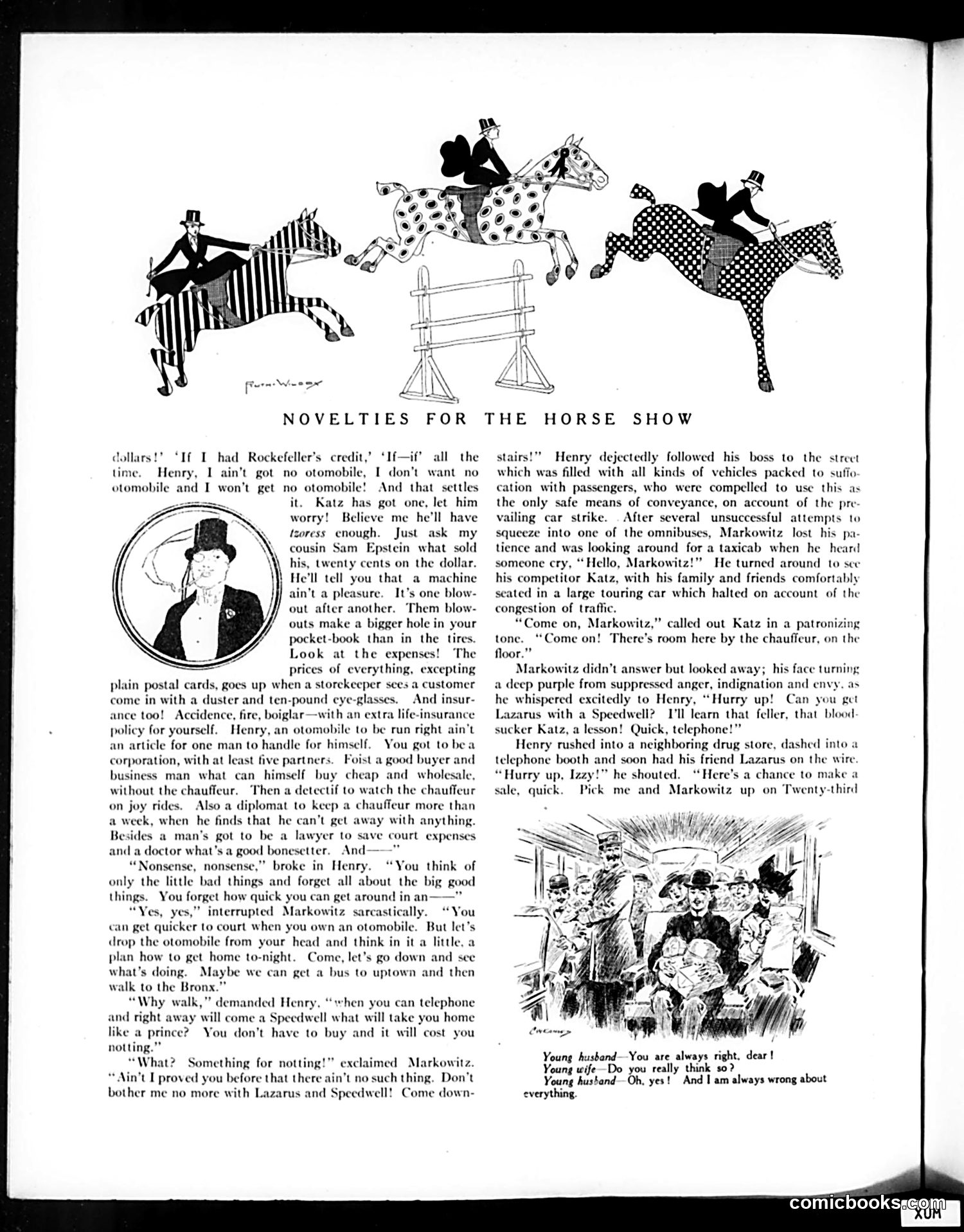
This page satirizes early 1900s automobile enthusiasm among the wealthy. The top illustration shows fanciful "novelties"—horses with decorative patterns jumping obstacles at a fashionable horse show, contrasting old and new transportation. The main story features two Jewish characters, Markowitz and Henry, debating automobiles. Markowitz argues cars are expensive burdens requiring multiple employees (chauffeur, lawyer, detective, doctor). Henry counters that they're convenient—until Markowitz's rival Katz arrives in a luxury touring car during a transit strike, humiliating Markowitz publicly by offering him floor space beside the chauffeur. Enraged, Markowitz immediately calls Lazarus (likely a taxi or car service) to prove he can compete. The satire targets both anti-car skepticism and status-anxious wealth-chasing. The bottom panel mocks domestic dynamics—a husband automatically agreeing with his wife while admitting he's always wrong about everything. The stereotypical Jewish characters and dialect suggest Judge's original audience and editorial perspective on contemporary class and ethnic tensions around new consumer technologies.
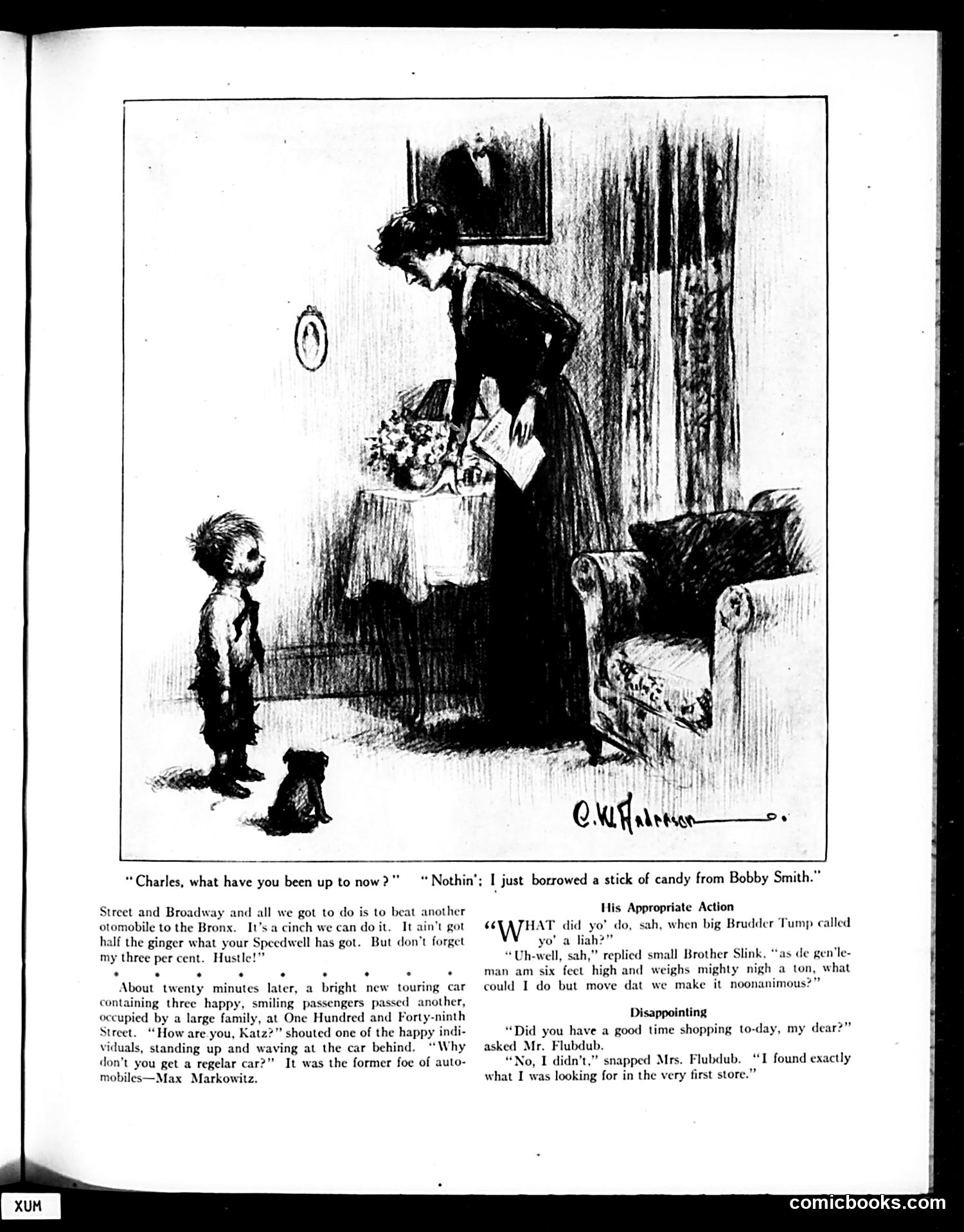
This page contains three separate humorous vignettes typical of early-20th-century satirical humor: 1. **Top cartoon**: A mother confronts a boy about mischief. The joke's setup suggests childhood misbehavior, though the punchline (borrowing candy) is innocent—the humor lies in the anticlimax. 2. **"His Appropriate Action"**: A dialect-based joke featuring "Brother Tump" and "Brother Slink." The humor relies on period stereotypes, with Slink avoiding confrontation with a much larger man by proposing they "make it noonanimous" (unanimous)—suggesting passive acceptance of insult rather than retaliation. The exaggerated dialect reflects attitudes common to early Judge satirical pieces. 3. **"Disappointing"**: A domestic joke where Mrs. Flubdub's complaint about shopping is that she found what she wanted immediately—inverting the expected gripe (that she *couldn't* find anything). The humor targets female shopping habits as excessive or aimless. The page reflects Judge's mix of observational humor, class commentary, and period stereotypes.
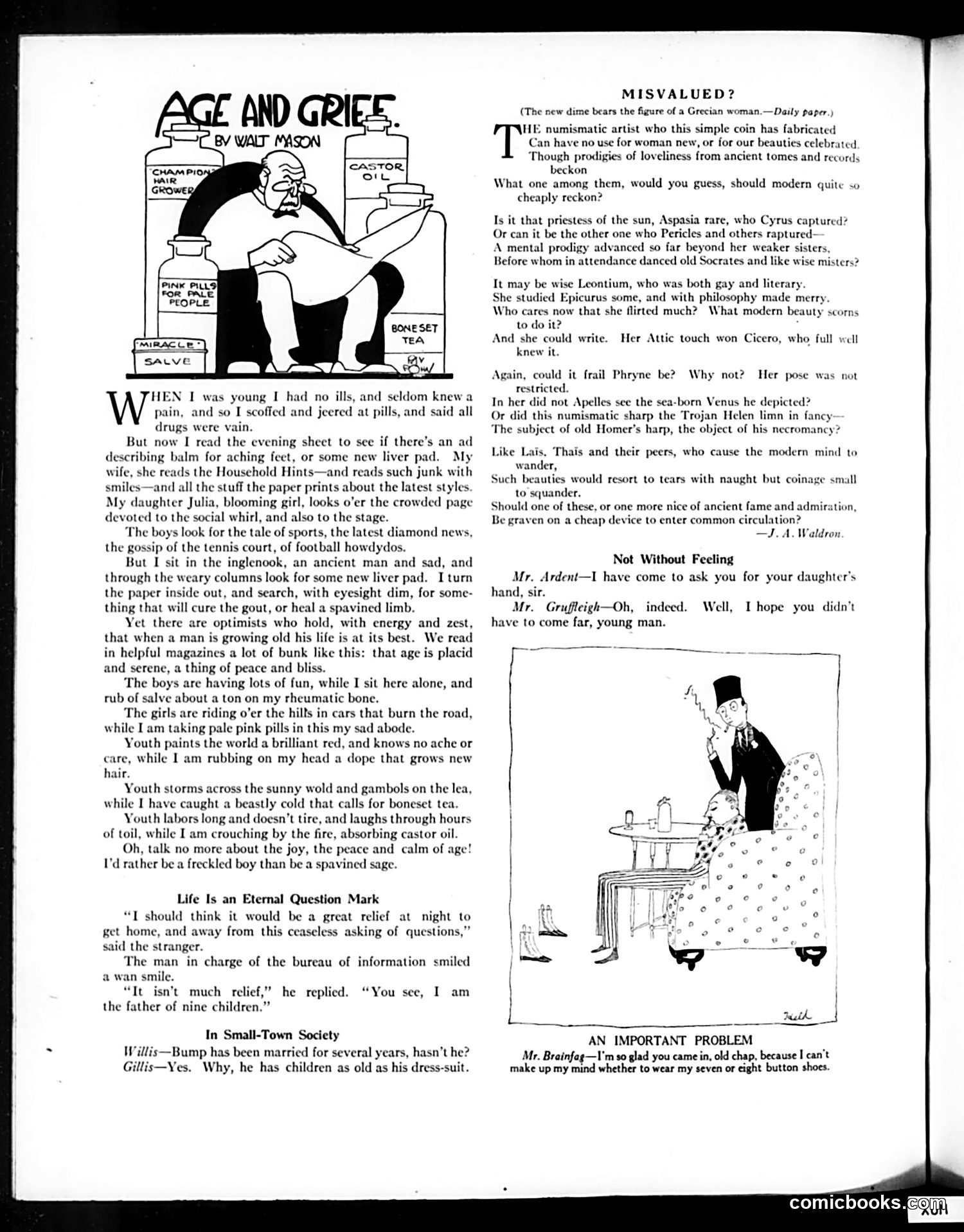
This page contains three distinct pieces of satire: **"Age and Griefs" (top left):** A cartoon by Walt Mason depicts an elderly man surrounded by patent medicines and remedies (pills, salves, liver pads, castor oil). The accompanying poem contrasts youthful vitality with aged decline—young people enjoy cars, sports, and romance while the narrator searches newspapers for cures for gout and rheumatism. The satire mocks both contemporary advertising culture (which aggressively marketed dubious health products to the elderly) and romanticized notions that aging brings peace and contentment. **"Misvalued?" (right column):** A poem critiques a new dime bearing an image of a Greek woman. It argues the designer poorly chose his subject, listing accomplished ancient women (Aspasia, Leontium, Phryne, Helen) whose intelligence and influence far exceeded what a cheap coin represents—satirizing both modern undervaluation of women and the inadequacy of commemorative currency. **Bottom dialogues:** Brief comedic exchanges about information bureaus and small-town gossip, using wordplay and social observation for humor.
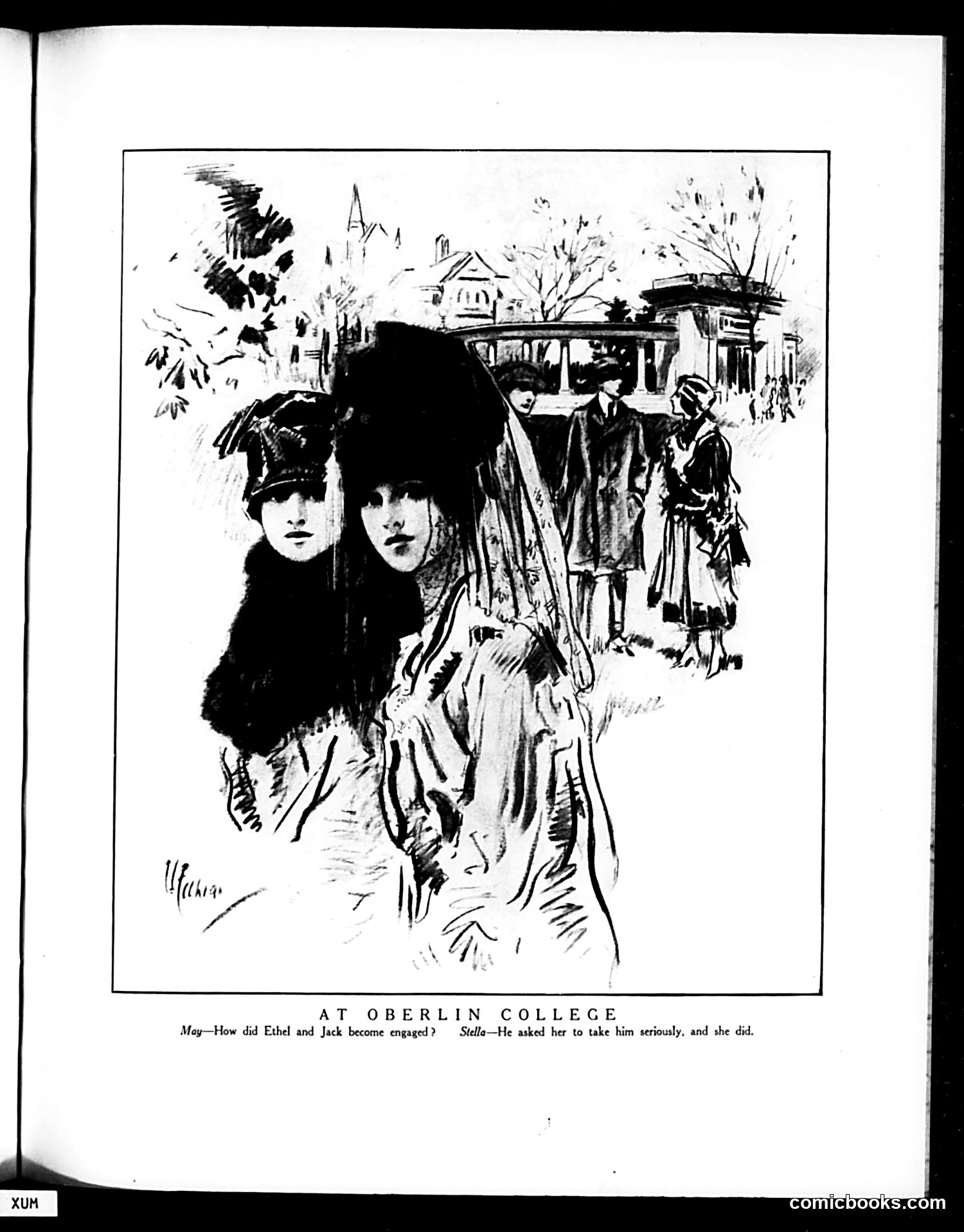
This is a single-panel joke illustrated with an ink sketch showing two young women in the foreground at what appears to be a college social gathering, with other students visible in the background near college buildings. The humor relies on a play on words about "taking someone seriously." The joke suggests that Jack's request for Ethel to "take him seriously" was actually a marriage proposal—and she accepted it literally as such. The comedy derives from the ambiguity: what Jack may have meant as a casual request for respect in conversation was misinterpreted (or perhaps shrewdly interpreted) by Ethel as a proposal of marriage. The setting at Oberlin College, a real American college, grounds this in contemporary campus social life and courtship customs of the era.
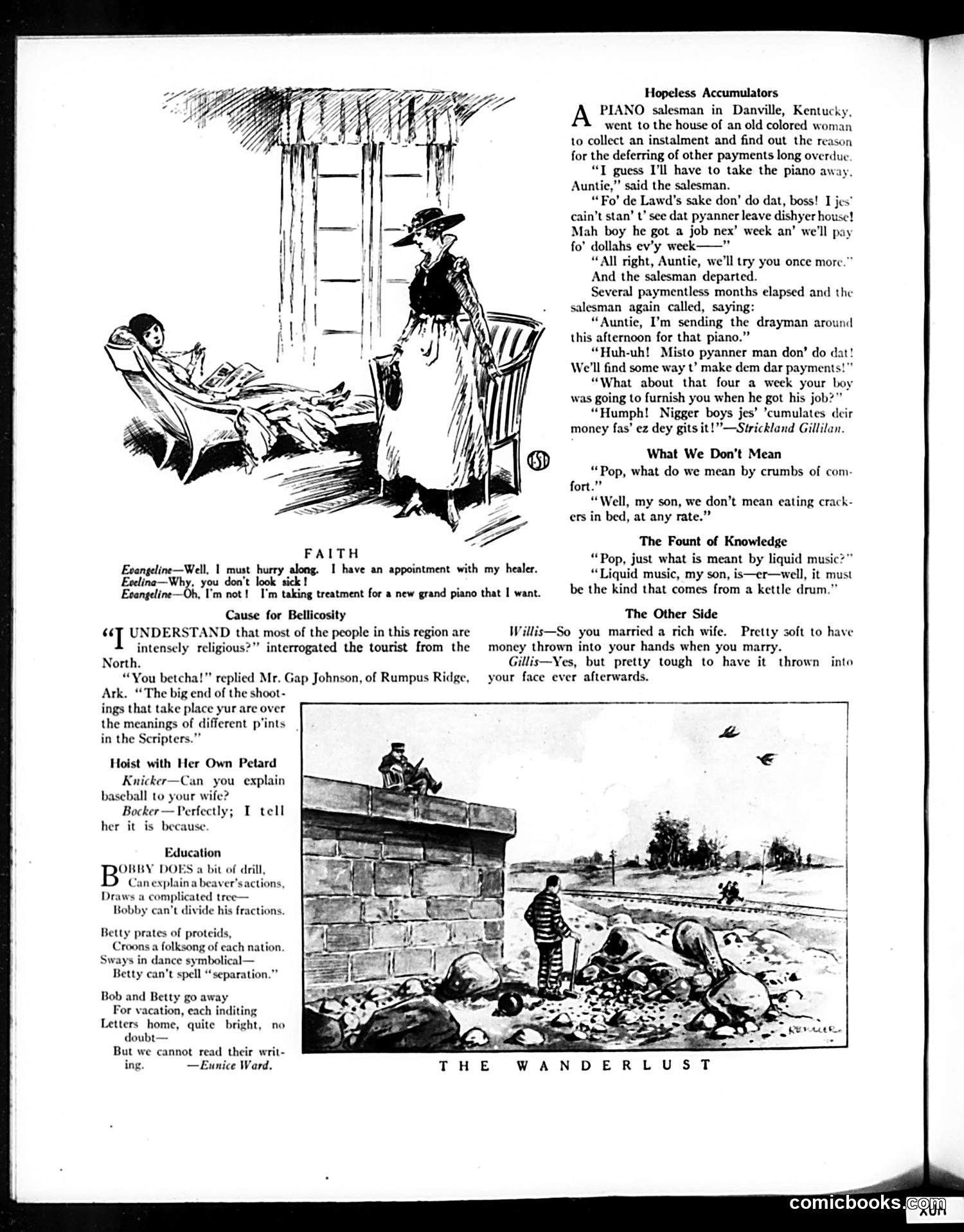
This page contains multiple satirical pieces reflecting early 20th-century American attitudes. **"Hopeless Accumulators"** mocks an African American woman's inability to meet piano installment payments. The humor relies on racial stereotypes—depicted through dialect and the stereotype that Black workers don't accumulate savings ("'cumulates deir money fas' ez dey gits it"). The "joke" critiques both the woman's financial management and, implicitly, systemic economic barriers. **Other brief satirical pieces** address universal themes: marital discord ("The Other Side"), religious disputes in the South ("Cause for Bellicosity"), and educational gaps where children learn impractical subjects but can't master fundamentals or spelling. **"The Wanderlust"** illustration shows children exploring, likely commenting on youthful curiosity versus parental concerns. The page reflects Judge's satirical approach: poking fun at social classes, regional differences (rural Arkansas), gender relations, and education—all expressed through the racial and class attitudes normalized in that era.
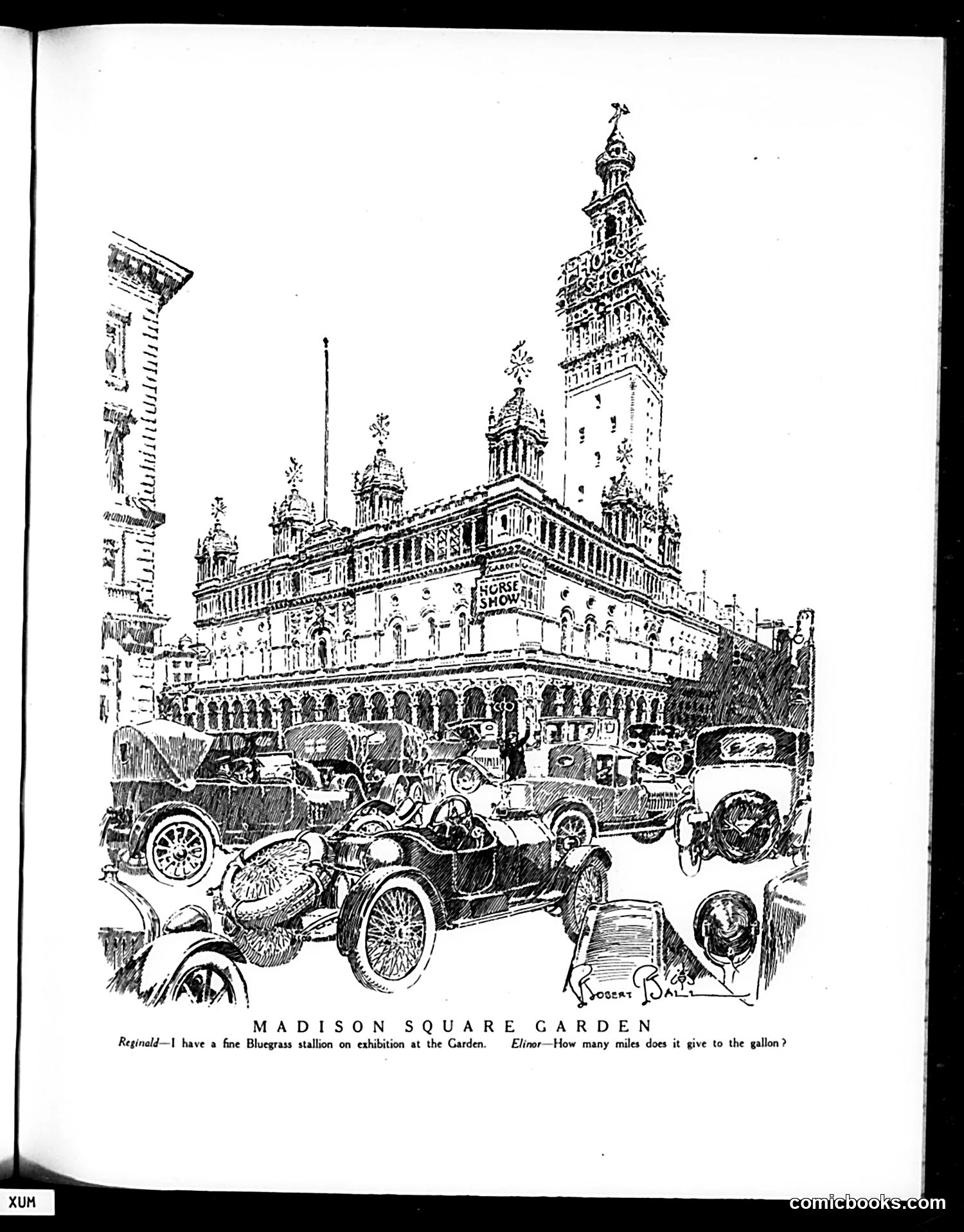
This single-panel cartoon satirizes the early automobile era's obsession with fuel efficiency. Two socialites, Reginald and Elinor, stand amid early motorcars displayed at Madison Square Garden (depicted with its distinctive tower). Reginald brags about his "fine Bluegrass stallion" on exhibition—a valuable thoroughbred horse. Elinor's response treats the horse like a car, asking "how many miles does it give to the gallon?"—a metric used to measure automobile efficiency. The joke mocks how thoroughly automobiles have captured public attention and conversation. Even when discussing a prized horse (representing traditional wealth and status), Elinor reflexively applies automotive terminology, suggesting cars have become so culturally dominant that people evaluate everything through that lens. It's satire on technology's displacement of older values.
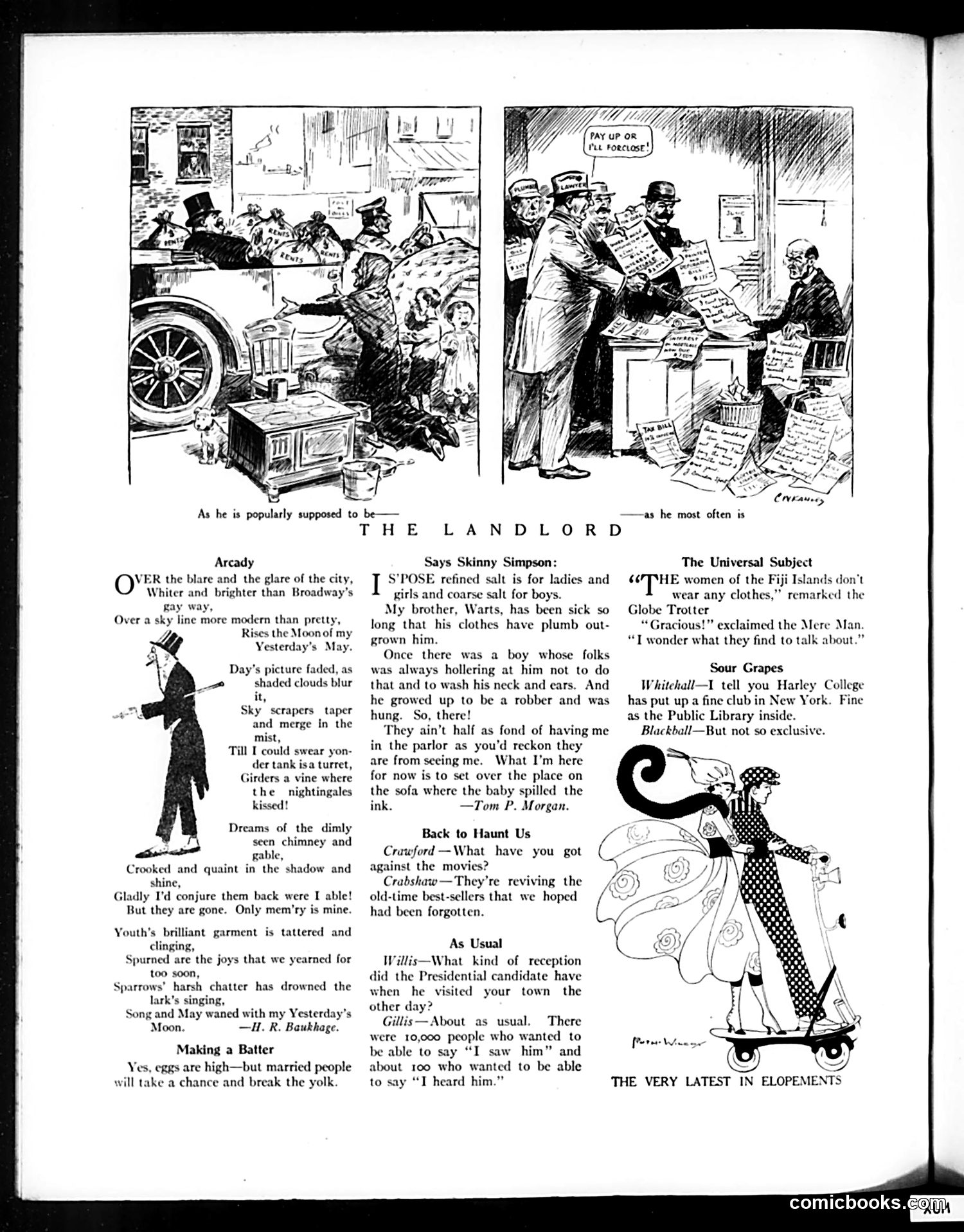
This page contains satirical commentary on early 20th-century American social life. The top cartoons contrast "The Landlord" as imagined (a romanticized figure in an idyllic setting) versus reality (a harried businessman besieged by tenants demanding payment—"Pay up or I'll foreclose!"). Below are several humorous short pieces: "Says Skinny Simpson" mocks a child's naive observations about salt and morality; "Back to Haunt Us" jokes about cinema reviving forgotten literature; "As Usual" satirizes public interest in Presidential visits (10,000 want to claim they *saw* him, only 100 actually *heard* him). Other segments include a nostalgic poem about lost youth, commentary on high egg prices, and social commentary on exclusivity (a college club advertised as fine "as the Public Library" but "not so exclusive"). The right panel shows a woman eloping in a motorcar, captioned "The Very Latest in Elopements"—likely satirizing motorcar culture and changing social attitudes toward romance.
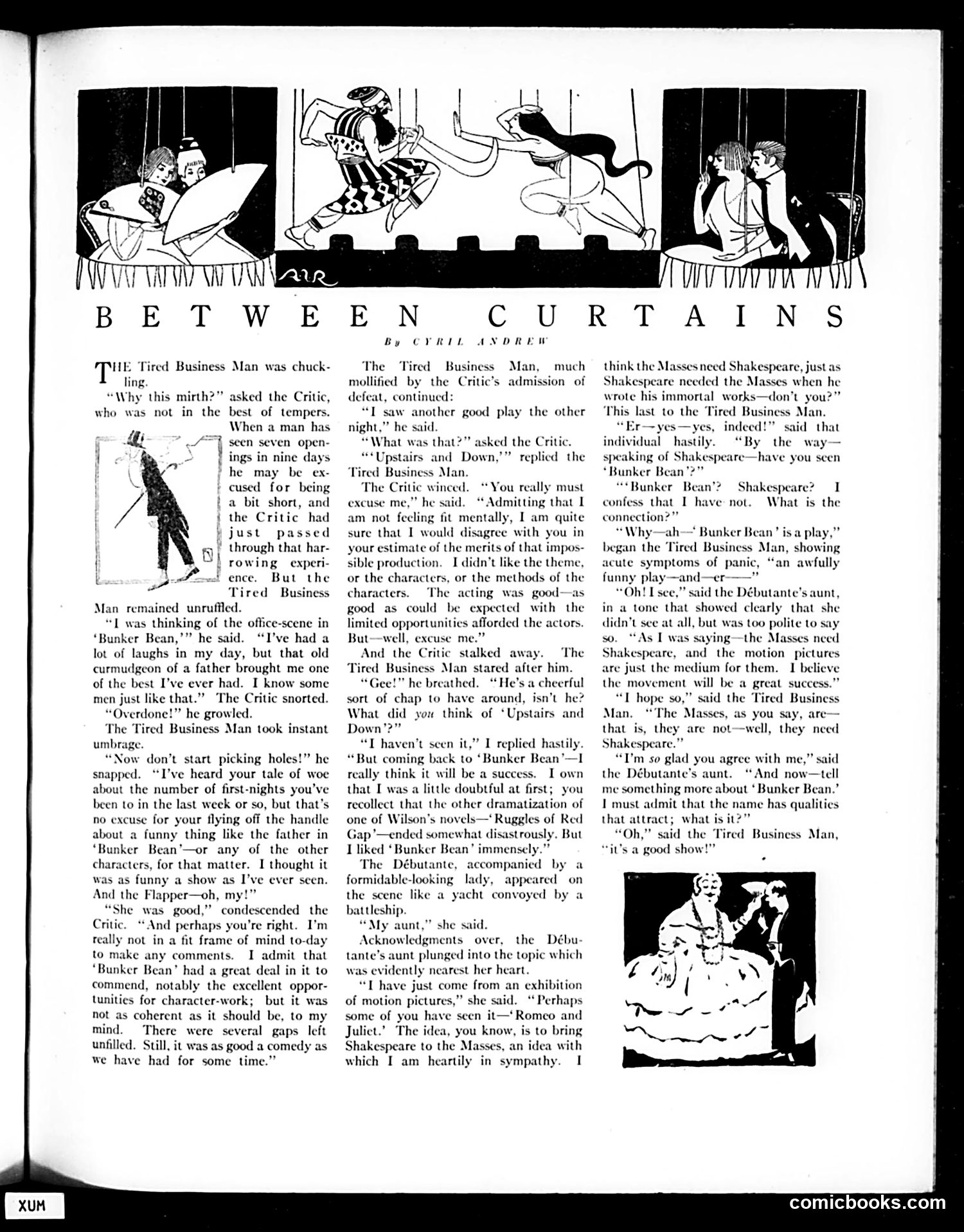
This satirical piece mocks the pretentious theater critic versus the practical "Tired Business Man." The critic is portrayed as an exhausted, perpetually dissatisfied snob who attends countless opening nights but tears apart plays like *Bunker Bean* and *Upstairs and Down* on technical grounds, despite admitting they have merit. The joke centers on the Tired Business Man's genuine enjoyment of theater versus the Critic's affected superiority. When a Débutante's aunt defends showing Shakespeare to "the Masses" as culturally uplifting, the desperate Tired Business Man tries awkwardly redirecting her back to *Bunker Bean*—unable to engage with her pretentious art-world rhetoric. The satire targets cultural gatekeepers who weaponize sophistication to diminish popular entertainment, and the disconnect between professional critics and ordinary audiences who simply want to laugh.
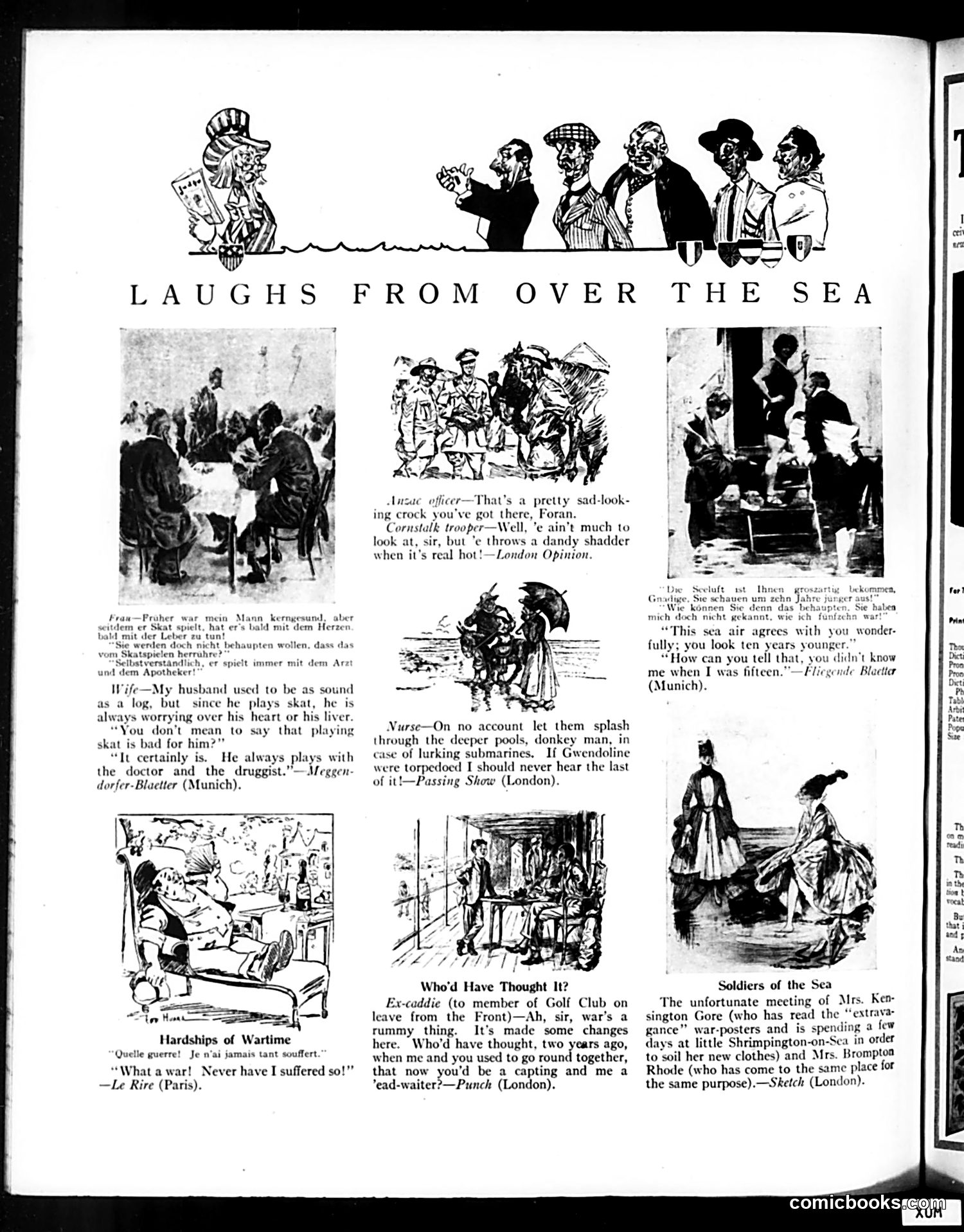
This page compiles humorous shorts from European satirical magazines during World War I. The jokes reflect wartime anxieties and social disruptions: **"Hardships of Wartime"** mocks civilians complaining about suffering while soldiers fight. **"Who'd Have Thought It?"** shows class mobility from war—a golf caddie is now a captain, his former superior now a waiter, inverting peacetime hierarchies. **The submarine joke** satirizes women reading exaggerated war propaganda ("extravagance" posters), leading one to absurdly worry a donkey might be torpedoed at a seaside resort. **"Soldiers of the Sea"** depicts two women meeting at a beach town, each trying to appear younger—likely mocking vanity amid wartime. The page demonstrates how Judge reprinted international humor showing how different nations' civilians coped with or misunderstood the war's realities.
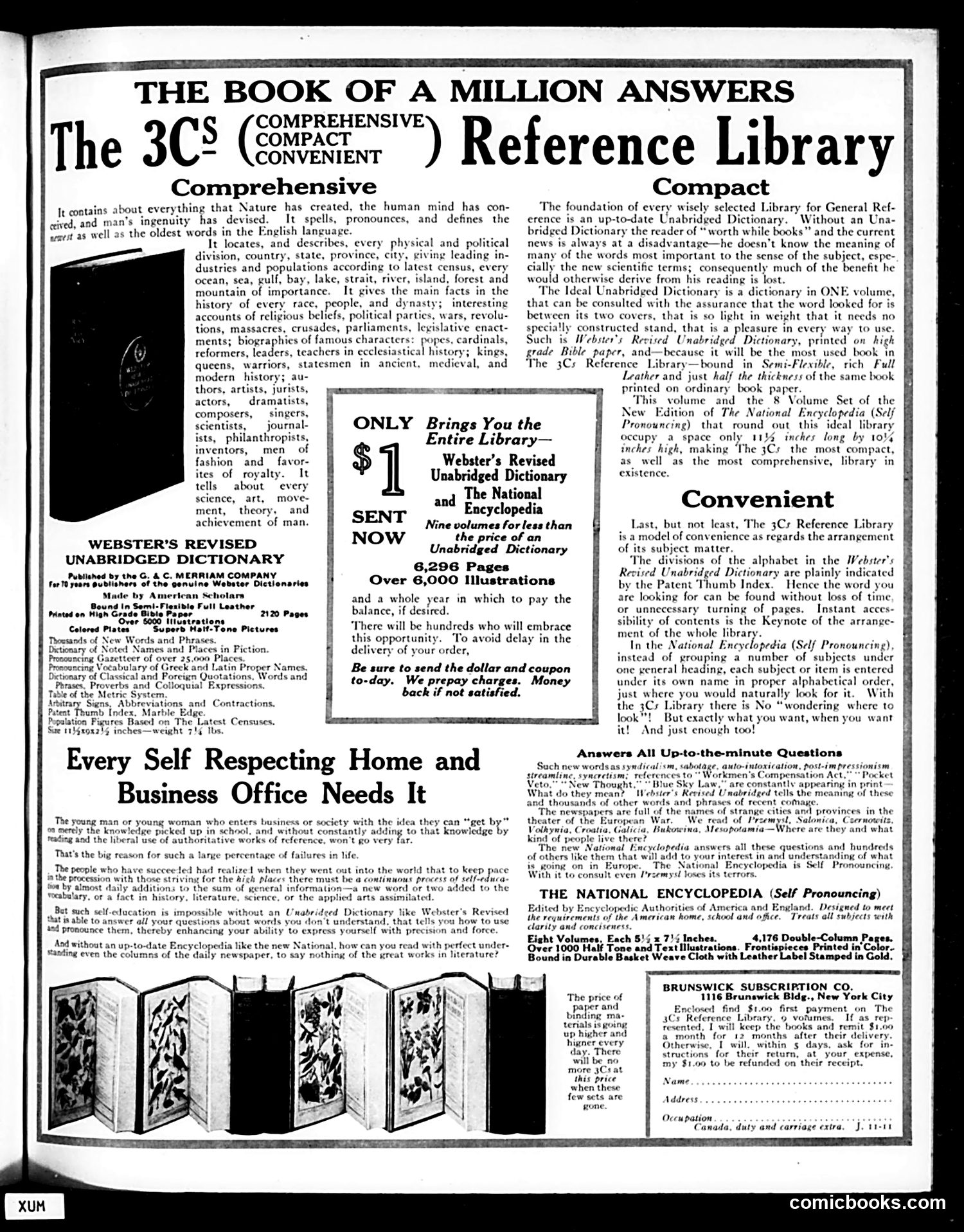
This is primarily a **sales advertisement**, not a political cartoon. The page promotes "The 3C's Reference Library"—a comprehensive home reference set combining Webster's Revised Unabridged Dictionary and The National Encyclopedia. The marketing pitch targets aspirational middle-class readers: young professionals and businesspeople who need authoritative reference materials to succeed socially and professionally. The text emphasizes that lacking access to current definitions and knowledge creates disadvantage—a persuasive appeal to social anxiety. The offer ($1 down, balance over a year) made comprehensive reference affordable to ordinary households. The emphasis on compactness and convenience reflects early 20th-century values: modern, efficient home libraries were status symbols. The small illustrations at bottom appear to show the books themselves, demonstrating their attractive binding. This represents commercial culture and consumer marketing rather than political satire typical of Judge magazine.
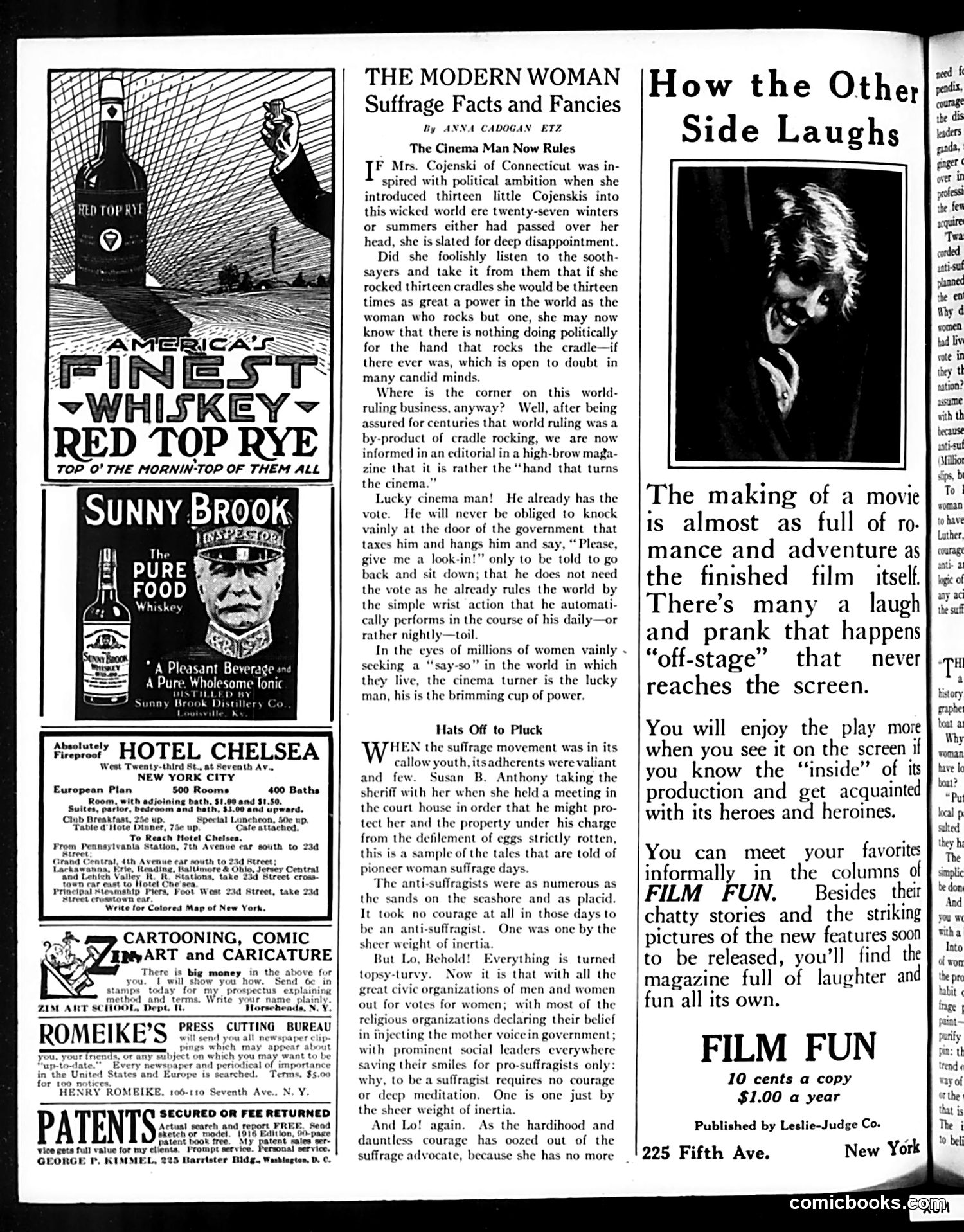
This page satirizes the women's suffrage movement through Anna Cadogan Etz's column "The Modern Woman: Suffrage Facts and Fancies." **The Satire's Main Points:** The article mocks suffragists' claims about women's power by contrasting two arguments: women who bear children supposedly "rule the world," yet cinema projectionists (literally turning a hand-crank) are said to hold real power—and they already have the vote. This exposes the illogic of anti-suffrage rhetoric. **The Secondary Argument:** Etz argues that early suffragists like Susan B. Anthony showed genuine courage facing violent opposition. Today, with mainstream support for women's voting, becoming a suffragist requires no bravery—it's merely "the sheer weight of inertia." She suggests the movement has lost its moral edge as it gains respectability. **The Tone:** Sardonic and cutting. Judge uses Etz's column to both mock anti-suffrage arguments *and* critique how suffragism has become fashionable rather than principled. The page primarily contains advertisements; the suffrage content appears subsidiary.
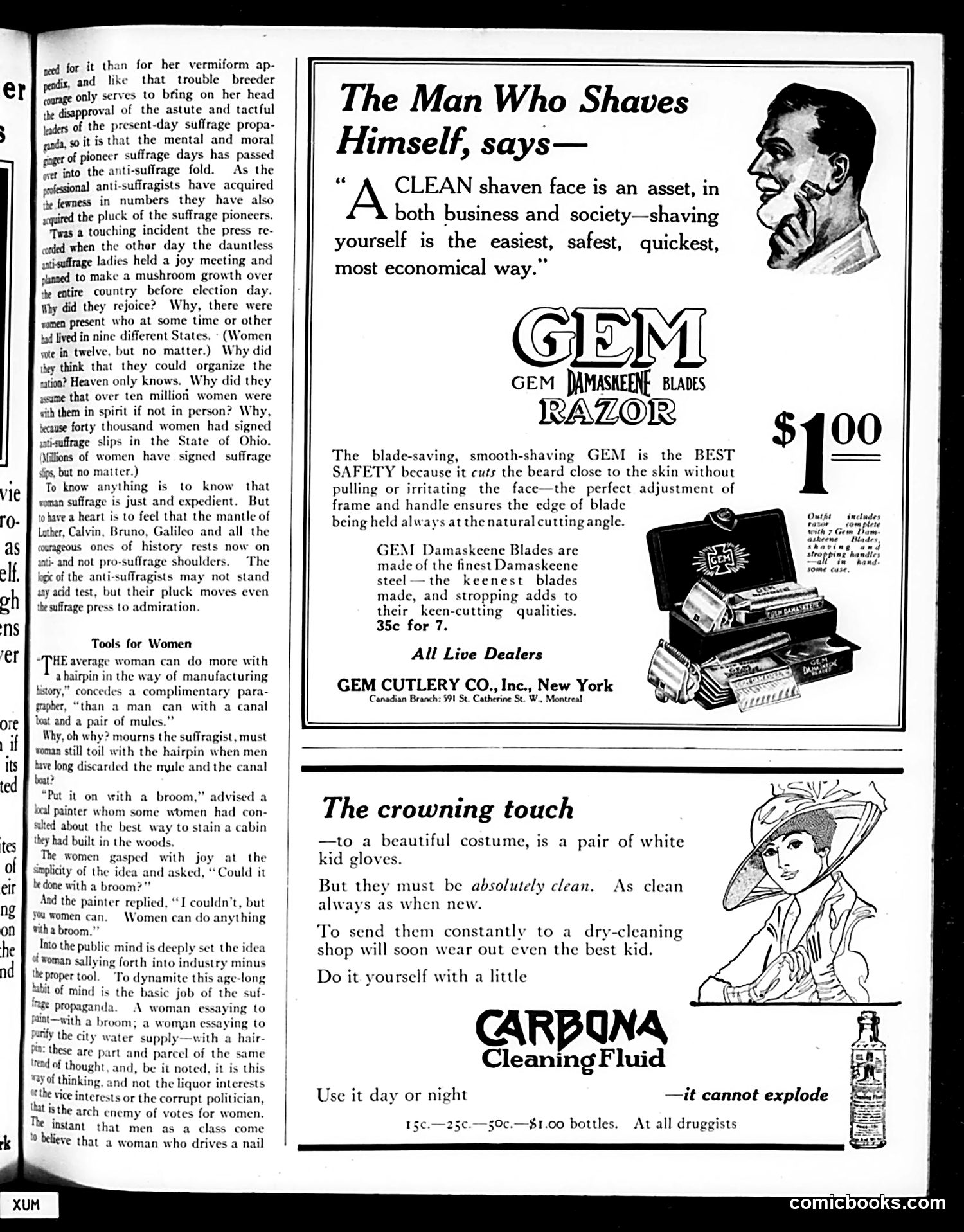
This page contains two distinct elements: **Left side:** A satirical essay mocking women's suffrage activism. The author ridicules suffragists' optimism about organizing nationwide support, sarcastically praising anti-suffrage women's "pluck" while dismissing the significance of petition signatures. A separate section, "Tools for Women," uses condescending anecdotes to suggest women are mentally limited—fit only for hairpins and brooms—and argues this flawed thinking (not corruption or liquor interests) is suffrage's "arch enemy." The satire defends the status quo against women's political equality. **Right side:** Two product advertisements unrelated to the editorial content—a GEM Damaskeene razor ($1.00) and Carbona cleaning fluid. The contrast is striking: while Judge's text argues women lack the capability for serious work, the ads simultaneously market products to women as consumers, revealing the era's contradictory attitudes toward female agency and intelligence.
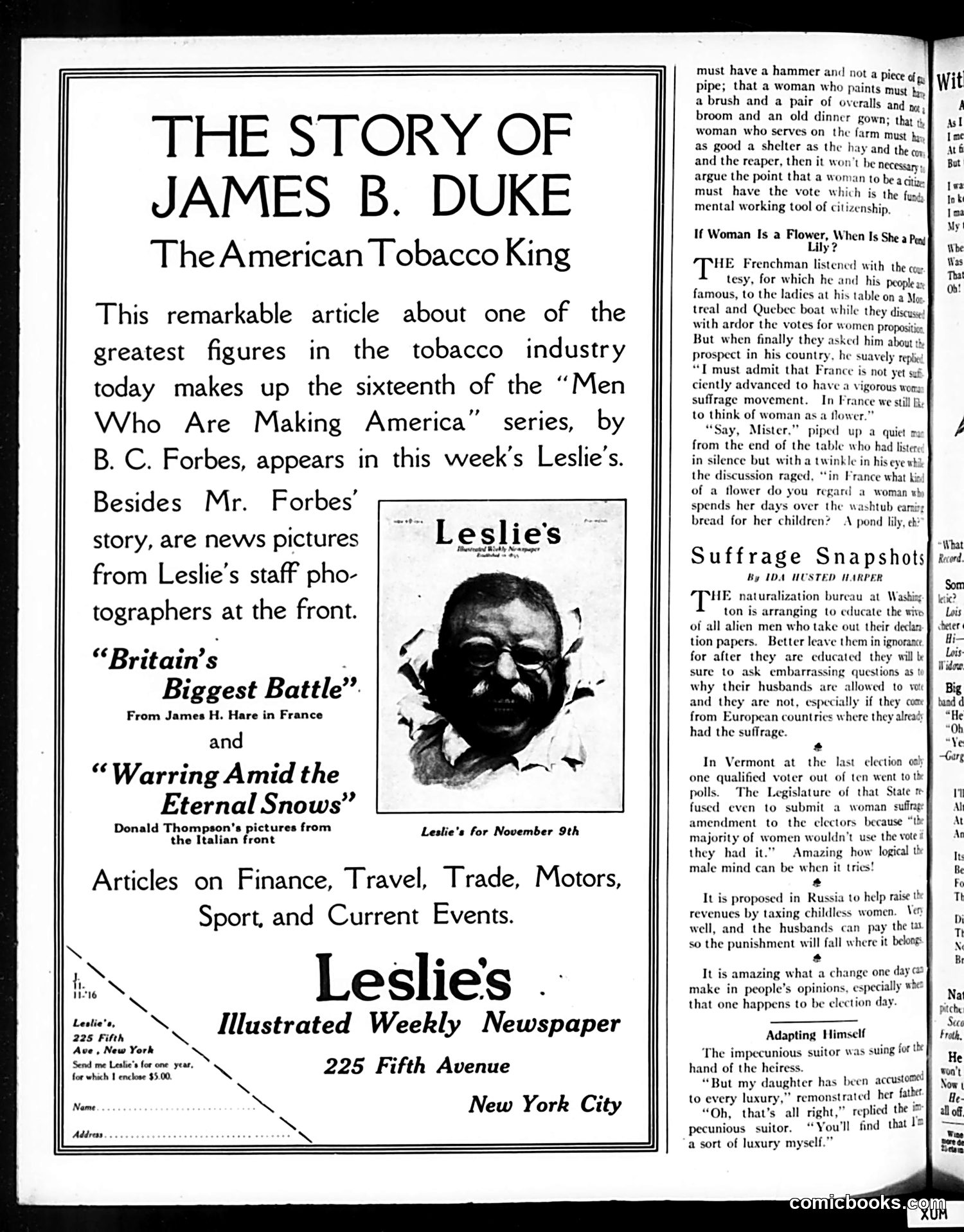
This is primarily an **advertisement for Leslie's Illustrated Weekly Newspaper**, not a satirical cartoon page. The left side promotes an upcoming article by B.C. Forbes on James B. Duke, "The American Tobacco King," as part of their "Men Who Are Making America" series. It also advertises war photography from the front lines. The right side contains **actual editorial content**: several short humor pieces about women's suffrage. These pieces mock anti-suffrage arguments through irony—for example, a Frenchman's claim that French women are "flowers" is undercut by a man noting that women doing domestic labor hardly fit that romantic image. Other items satirize male logic about why women shouldn't vote (if they won't use it anyway) and joke about taxing unmarried women while their husbands escape penalty. The page reflects early 20th-century debate over women's voting rights, presenting pro-suffrage humor aimed at Judge's readers.
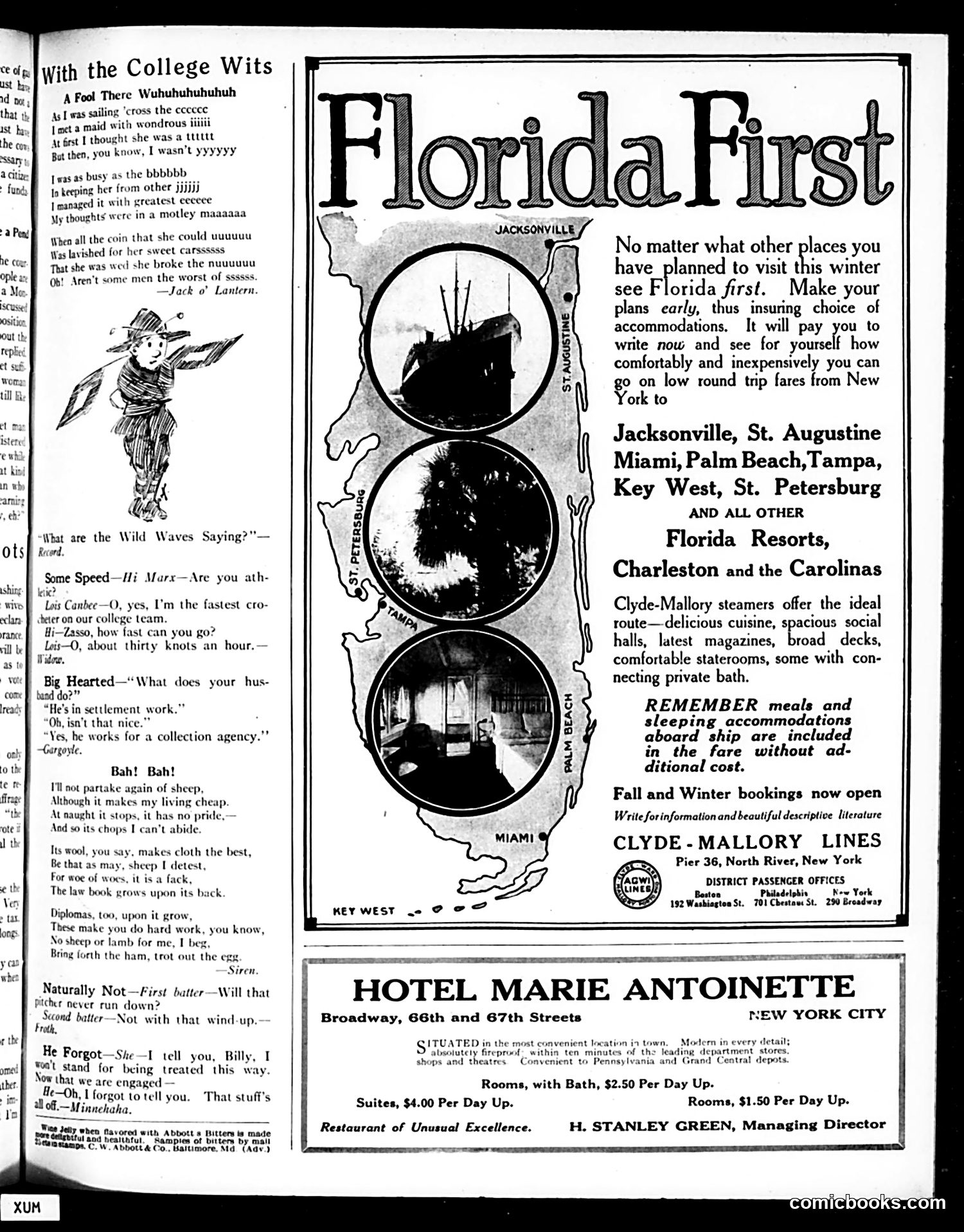
This page contains mostly **college humor** (left side) and **advertising** (right side), with minimal political content. **The College Wits section** features jokes about college life and romance, typical of early 20th-century student humor: a sailor's tale about deception in courtship, quips about athletic prowess, a joke about a husband working for a collection agency, and witty complaints about sheep (likely obscure student reference). **The main advertising** promotes: - **Clyde-Mallory Lines**: A steamship company urging tourists to visit Florida destinations by sea - **Hotel Marie Antoinette**: A New York City hotel offering budget accommodations ($1.50-$4.00/day) The Florida advertisement emphasizes affordable winter travel from New York, listing popular resorts and touting onboard meals and sleeping included in fares. There is **no visible political satire** on this page—it's primarily filler content and commercial promotion typical of Judge magazine's revenue model.
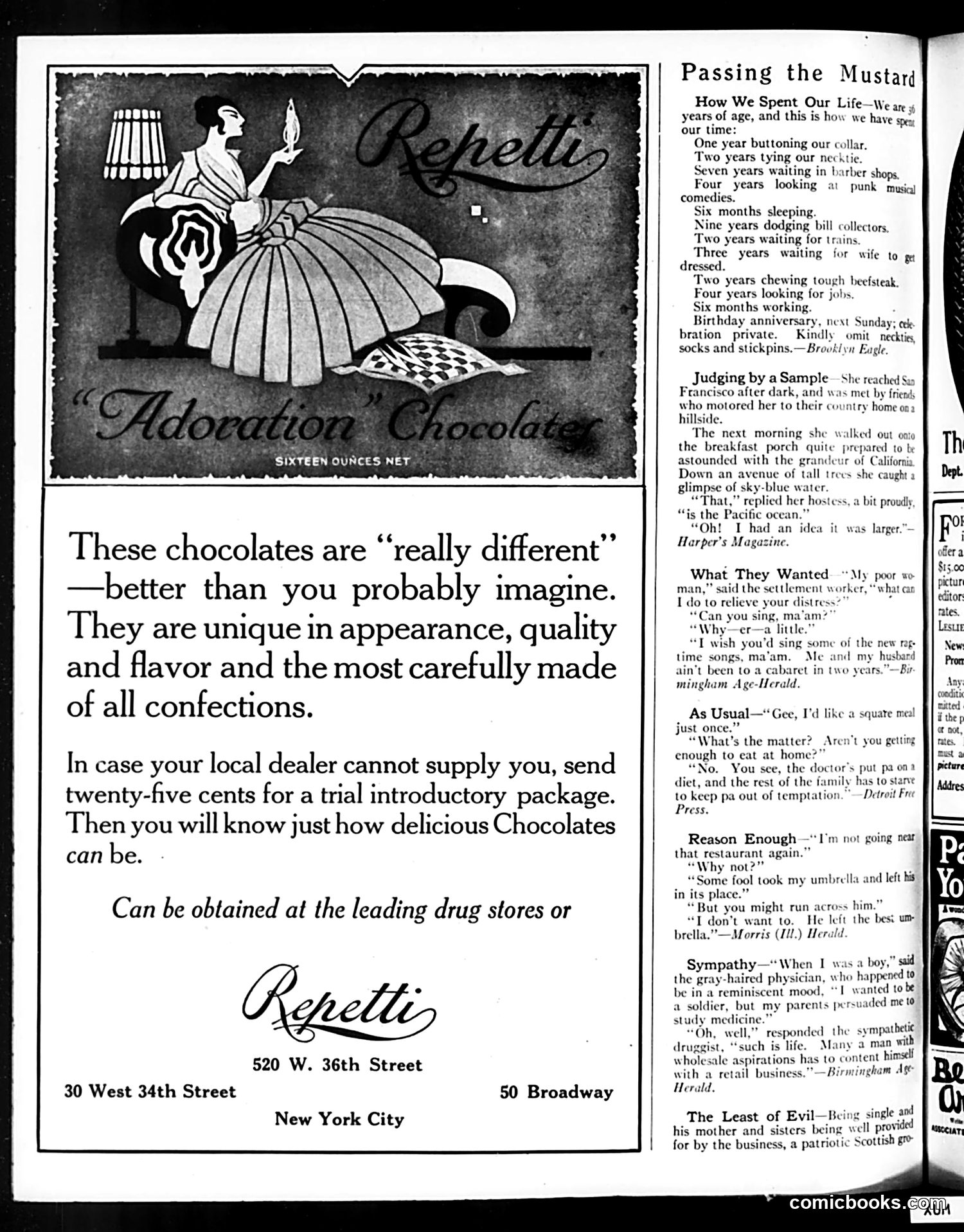
This page is primarily **advertising** for Repetti Adoration Chocolates, with accompanying humor columns on the right side. The chocolate ad features an Art Deco illustration of an elegant woman with a lamp, emphasizing luxury and sophistication. The sales pitch claims the chocolates are uniquely "different" and "carefully made," offering a 25-cent trial package. The right column contains **humorous anecdotes** typical of early 20th-century satirical magazines: - "Passing the Mustard" catalogs a life wasted on mundane activities (waiting in barber shops, dodging bill collectors, watching bad comedies) - Brief jokes mock everyday frustrations: a woman unimpressed by California's Pacific Ocean, poor families struggling under medical diets, someone upset about an umbrella swap - The humor targets middle-class anxieties: poverty, courtship delays, marital dynamics, and social embarrassment These pieces reflect period concerns about economic hardship and domestic tedium, presented with the wry tone characteristic of Judge magazine's satirical voice.
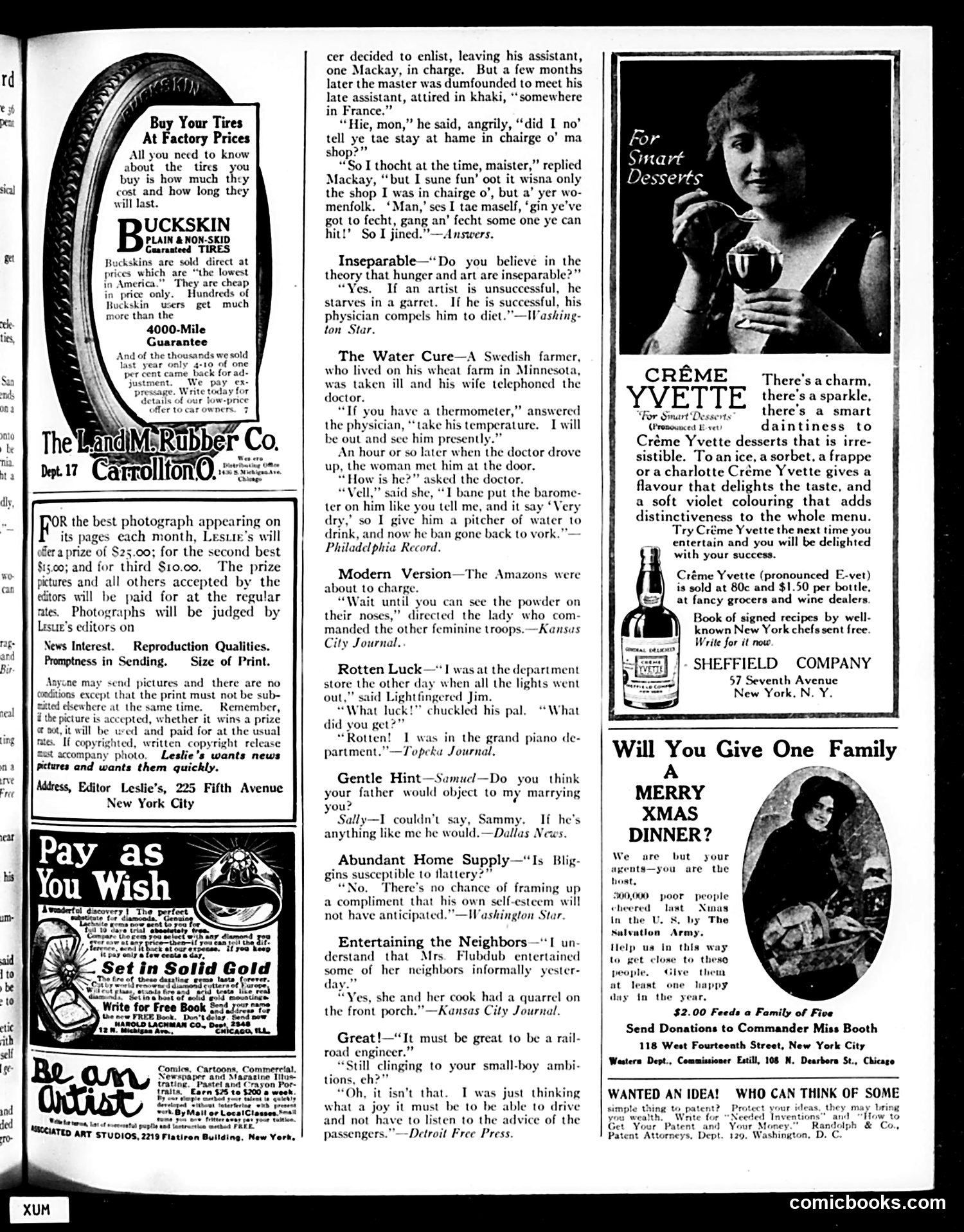
This page consists primarily of **short humorous anecdotes and advertisements** rather than political cartoons. The content reflects early-20th-century American humor and commercial interests. **Notable items:** 1. **Tire advertisement** (Buckskin brand) - typical period marketing emphasizing durability and direct factory pricing 2. **Multiple brief jokes** touching on contemporary life: a Scottish soldier explaining to his wartime-enlisted boss why he enlisted (humor based on dialect and domestic/romantic complications); artistic poverty stereotypes; WWI-era references (soldiers, "somewhere in France") 3. **Advertisement for Crème Yvette** - a liqueur marketed as a sophisticated dessert accompaniment 4. **Salvation Army holiday appeal** - requesting donations for Christmas dinners for the poor The page reflects **pre-/early-WWI America**: gender roles, class commentary (starving artists, poor relief), military service during the war, and consumer capitalism. The dialect humor and domestic comedy were typical of the era's popular entertainment.
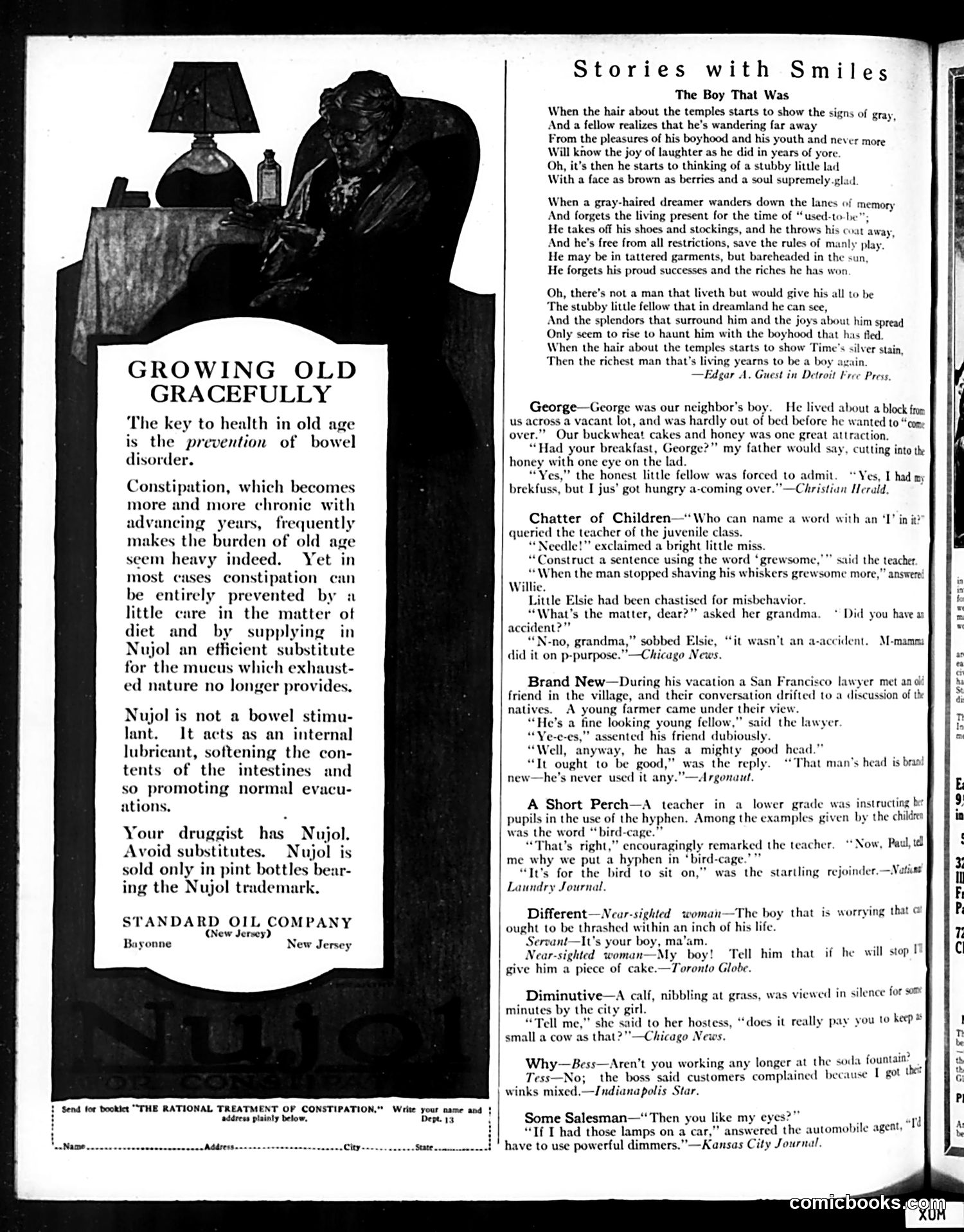
This page mixes **advertising with light humor content**. The dominant left side features a **Standard Oil Company advertisement for Nujol**, a mineral oil laxative. The ad addresses elderly readers' constipation concerns with straightforward medical claims—typical early 20th-century advertising that treats bodily functions directly. The right side contains "Stories with Smiles," a **nostalgia poem and humorous anecdotes**. Edgar A. Guest's poem romanticizes lost childhood, reflecting period sentimentality about aging and simpler times. The brief jokes below satirize children's innocent misunderstandings of language (mispronouncing "gruesome," misusing hyphens) and small-town naivety (the farmer's "brand new" unused head). The humor is gentle and family-oriented—typical Judge magazine fare emphasizing wholesome amusement rather than sharp political satire. Overall, the page reflects early 20th-century American values: pragmatic health concerns, nostalgia, and gentle mockery of childhood innocence and rural simplicity.
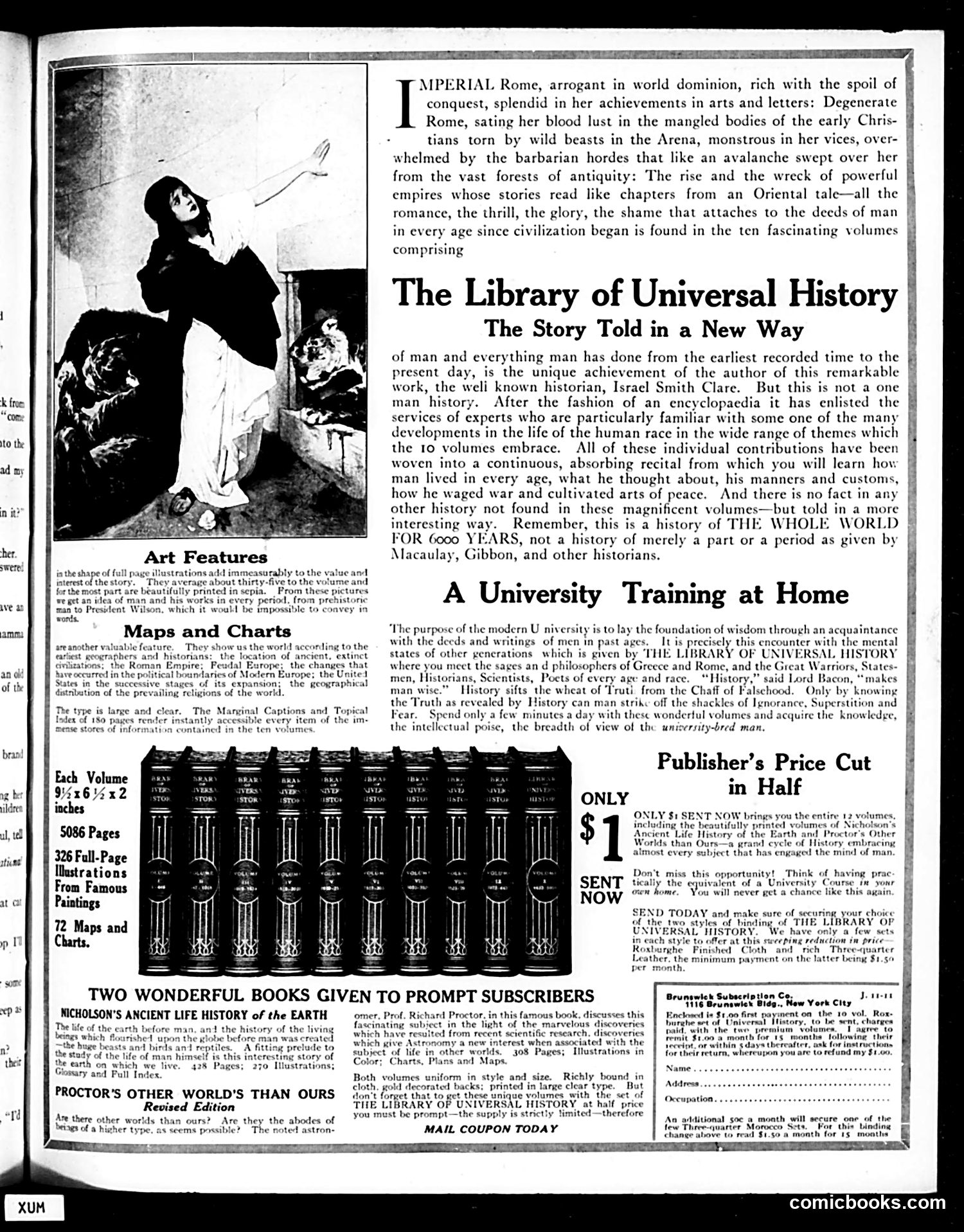
This is primarily a **full-page advertisement**, not a political cartoon. It promotes "The Library of Universal History" — a 10-volume encyclopedia published by Israel Smith Clare. The page uses grandiose language comparing history to Imperial Rome's grandeur and moral decay to sell the product as a "university training at home." The dramatic illustration (left) depicts a classical figure, reinforcing the historical/scholarly theme rather than satirizing anything specific. The marketing pitch emphasizes completeness ("6000 YEARS" of history, not partial accounts) and claims reading this encyclopedia provides intellectual refinement equivalent to university education — appealing to middle-class readers seeking self-improvement and cultural legitimacy. The "Publisher's Price Cut in Half" ($1 per volume) is a sales tactic. Two bonus books are offered to prompt immediate orders. This reflects early-20th-century publishing strategies: packaging knowledge as both educational aspiration and affordable luxury for consumers.
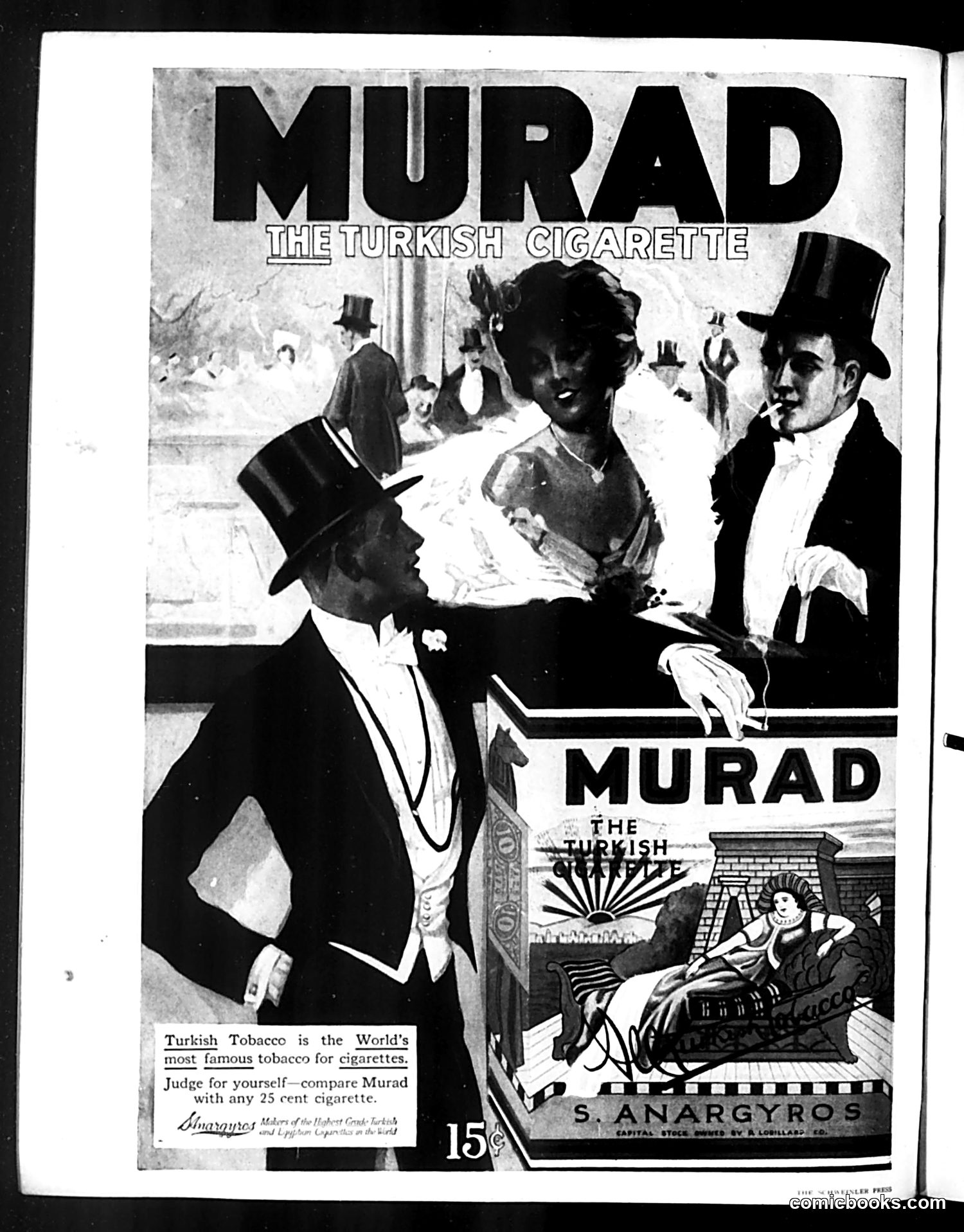
This is a cigarette advertisement masquerading as satirical content, typical of early 20th-century Judge magazine advertising. The page promotes "Murad," a Turkish tobacco cigarette brand, priced at 15 cents. The illustration depicts a glamorous social scene with well-dressed men in top hats attending to an elegant woman, suggesting luxury and sophistication. The accompanying film strip imagery ("Sanaros") implies aspiration and entertainment appeal. The ad's claim that "Turkish Tobacco is the World's most famous tobacco for cigarettes" reflects the period's marketing of Turkish tobacco as premium. The challenge to "Judge for yourself—compare Murad with any 25 cent cigarette" positions the product as superior value. This represents advertising's integration into satirical publications and the normalization of cigarette marketing before health concerns became widespread.