
Judge, 1916-11-11 · page 17 of 28
Judge — November 11, 1916 — page 17: what you’re looking at
What you’re looking at
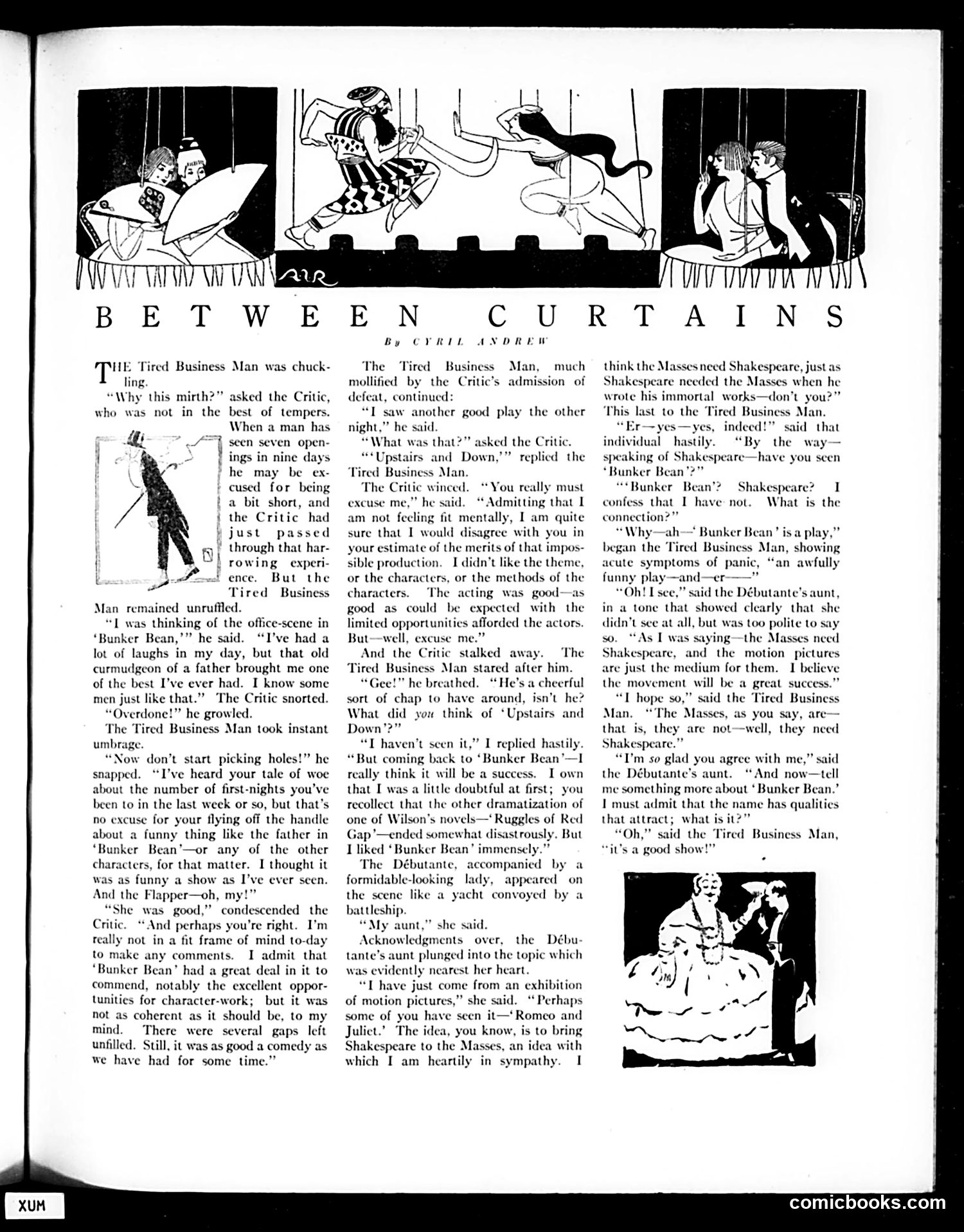
This satirical piece mocks the pretentious theater critic versus the practical "Tired Business Man." The critic is portrayed as an exhausted, perpetually dissatisfied snob who attends countless opening nights but tears apart plays like *Bunker Bean* and *Upstairs and Down* on technical grounds, despite admitting they have merit. The joke centers on the Tired Business Man's genuine enjoyment of theater versus the Critic's affected superiority. When a Débutante's aunt defends showing Shakespeare to "the Masses" as culturally uplifting, the desperate Tired Business Man tries awkwardly redirecting her back to *Bunker Bean*—unable to engage with her pretentious art-world rhetoric. The satire targets cultural gatekeepers who weaponize sophistication to diminish popular entertainment, and the disconnect between professional critics and ordinary audiences who simply want to laugh.
📄 Transcribed text from this page (OCR, searchable)
Machine-transcribed from the original scan — historical spelling and the odd misread are preserved.
BET WE HE Tired Business Man was chuck- ling. “Why this mirth?” who was not in the ked the Critic, best of tempers. When a man has seven open- } ings in nine days he may be e: cused for being { a bit short, and the Critic had just passed through that hai rowing exper ence. But the Tired Business Man remained unruffled. “IL was thinking of the office-scene in ‘Bunker Bean,’” he said. “I’ve had a lot of laughs in my day, but that old curmudgeon of a father brought me one of the best I’ve ever had. I know some men just like that.” The Critic snorted. “Overdone!” he growled. The Tired Business Man took instant umbrage. “Now don’t start picking holes!” he snapped. “I’ve heard your tale of woe about the number of first-nights you’ve been to in the last week or so, but that’s no excuse for your flying off the handle about a funny thing like the father in ‘Bunker Bean’—or any of the other characters, for that matter. I thought it was as funny a show as I’ve ever seen. And the Flapper—oh, my!” She was good,” condescended the Crit “And perhaps you're right. I’m really not in a fit frame of mind to-day to make any comments. I admit that ‘Bunker Bean’ had a great deal in it to commend, notably the excellent oppor- tunities for character-work; but it was hot as coherent as it should be, to my mind. There were several gaps left unfilled. Still, it was as good a comedy as we have had for some time.” seen E N By CYRIL ANDREW The ‘Tired Business Man, much mollified by the Critic’s admission of defeat, continued: “IT saw another good play the other night,” he said “What was that?” asked the Critic. “Upstairs and Down,’” replicd the Tired Business Man. The Critic winced. excuse me,” he said. ‘* Admitting that I am not feeling fit mentally, Iam quite sure that I would disagree with you in your estimate of the merits of that impos- sible produc I didn’t like the theme, or the characters, or the methods of the characters. The acting was good—as good as could be expected with the limited opportunities afforded the actors. But—well, excuse me.” And the Critic stalked away. ‘The ed Business Man stared after him. WC he breathed.“ H. sort of chap to have around, What did you think of ‘Upstairs and Down’?” “T haven't scen it,” I replied hastily. “But coming back to ‘Bunker Bean’—I really think it will be a succe I own that I was a little doubtful at first; you recollect that the other dramatization of one of Wilson’s novels— Ruggles of Red Gap’—ended somewhat disastrously. But I liked ‘Bunker Bean’ immensely. The Débutante, accompanied by a formidable-looking lady, appeared’ on the scene like a yacht convoyed by a battleship. “My aunt,” she said. Acknowledgments over, the Débu- tante’s aunt plunged into the topic which was evidently nearest her heart. “TL have just come from an ¢: of motion pictures,” she said.“ Perhaps some of you have seen it—' Romeo and Julict.’” The idea, you know, is to bring Shakespeare to the Masses, an idea with which I am_heartil ympathy. I “You really must hibition C U RT ATIN S§S think the Masses need Shakespeare, just as Shakespeare needed the Masses when he wrote his immortal works—don’t you?” This last to the Tired Busii ess Man. yes—) indeed!” said that individual hastily. “By the way— speaking of Shakespeare—have you seen ‘Bunker Bean’?” “Bunker Bean’? Shakespeare? 1 confess that I have not. What is the connection?” “Why—ah— Bunker Bean’ isa play,” began the Tired Business Man, showing acute symptoms of panic, “an awfully ay—and !Lsee,” said the Débutante’s : in a tone that showed clearly that she didn’t see at all, but was too polite to say so, “As I was saying—the Masses need Shakespeare, and the motion pictures are just the medium for them. I be the movement will be a great success. “T hope so,” said the Tired Business Man. “The Masses, as you C that is, they are not—well, they need Shakespeare. “Tm so glad you agree with me,” said the Débutante’s aunt. “And now—tell me something more about ‘ Bunker Bean.’ 1 must admit that the name has qualities that attract; what is it?” “Oh,” said the Tired Business Man, “it's a good show!” comicbooks.com