
Judge, 1916-11-11 · page 5 of 28
Judge — November 11, 1916 — page 5: what you’re looking at
What you’re looking at
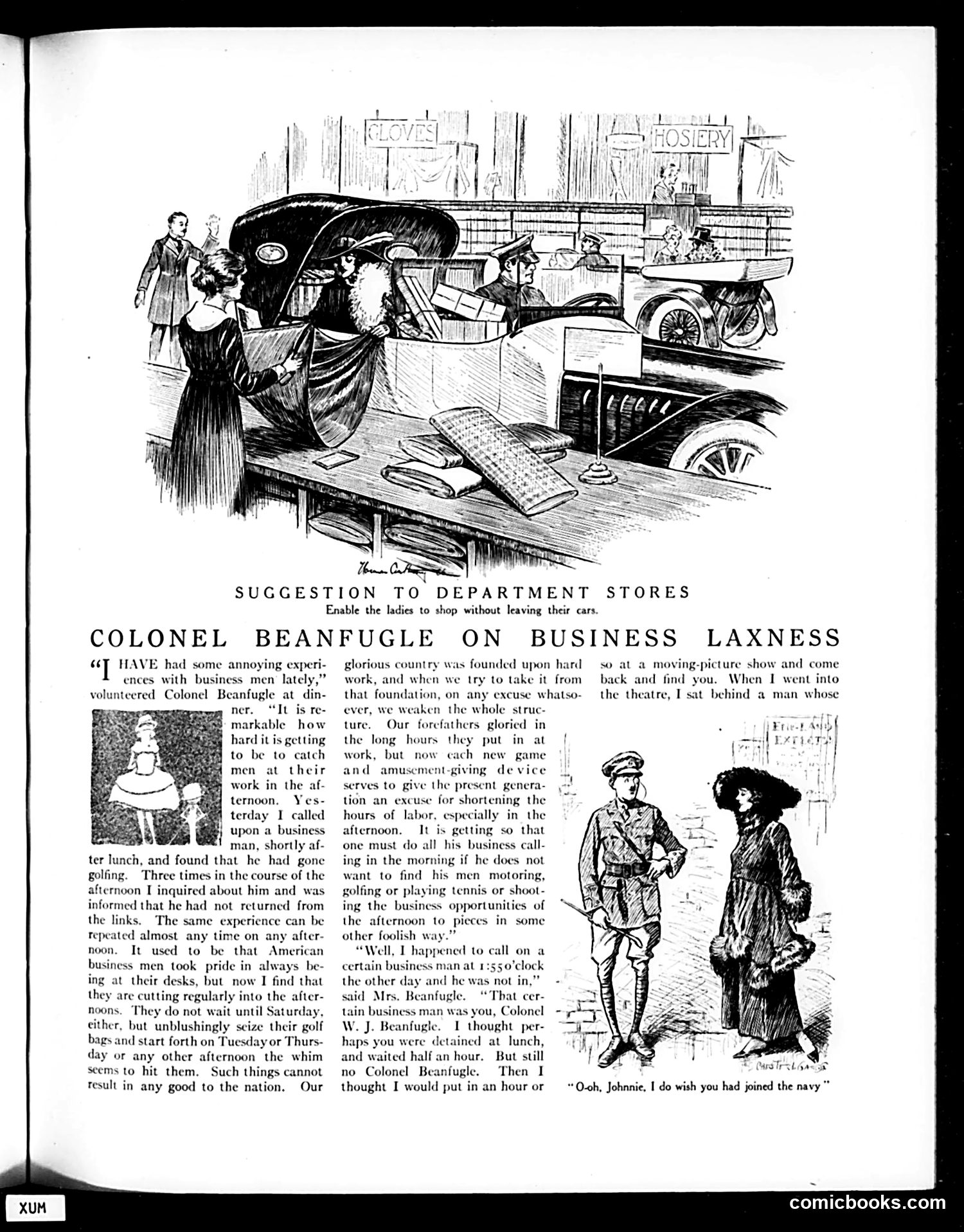
This page contains two distinct elements: **Top cartoon** ("Suggestion to Department Stores"): Depicts women shopping while their cars remain parked outside, suggesting that department stores should enable ladies to shop without abandoning their vehicles—likely a practical suggestion during the early automobile era when women's shopping habits were changing. **Bottom article and illustrations**: Features "Colonel Beanfugle on Business Laxness," where a Colonel criticizes American business practices, particularly men leaving their desks during afternoon hours for leisure activities (golf, tennis, theater). He contrasts this with his own observation that European business culture maintains stricter work discipline. The satire mocks what appears to be perceived American business inefficiency and the afternoon leisure culture of businessmen, positioning it as nationally damaging. Both elements reflect early 20th-century concerns about modernization, gender roles, and work ethic.
📄 Transcribed text from this page (OCR, searchable)
Machine-transcribed from the original scan — historical spelling and the odd misread are preserved.
SUGGESTION TO DEPARTMENT STORES Enable the ladies to shop without leaving their cars. COLONEL BEANFUGLE ON BUSINESS LAXNESS 66] HAVE had some annoying experi- ences with business men lately,” volunteered Colonel Beanfugle at din- ner. “It is re- markable how q hard it is getting to be to catch men at their work in the af- ternoon, Y terday I called upon a business — “=! man, shortly af- ter lunch, and found that he had gone golfing. Three times in the course of the afternoon I inquired about him and was informed that he had not returned from the links. The same experience can be repeated almost any time on any after- noon. It used to be that American business men took pride in always be- ing at their desks, but now I find that they are cutting regularly into the after- noons. They do not wait until Saturday, either, but unblushing! ize their golf bags and start forth on Tuesday or Thurs- day or any other afternoon the whim seems to hit them. Such things cannot result in any good to the nation, Our glorious country was founded upon hard work, and when we try to take it from that foundation, on any excuse whatso- ever, we weaken the whole struc- ture. Our forefathers gloried in the long hours they put in at work, but’ now cach new and amuscment-giving de vice serves to give the present genera- tion an excuse for shortening the hours of labor, especially in the afternoon. It is getting so that one must do all his business call- ing in the morning if he docs not want to find his men motoring, golfing or playing tennis or shoot- ing the business opportunities of the afternoon to pieces in some other foolish way.” “Well, L happened to call on a certain business man at 1:55 0’clock the other day and he was not in,” 1 Mrs. Beanfugle. hat cer- ain business man was you, Colonel W. J. Beanfugle. I thought per- haps you were detained at lunch, and waited half an hour. But still no Colonel Beanfugle. Then I thought I would put in an hour or so at a moving-picture show and come back and find you. When I went into the theatre, I sat behind a man whose *O-oh, Johnnie, | do wish you had joined the navy ” comicbooks.com