
Judge, 1916-11-11 · page 12 of 28
Judge — November 11, 1916 — page 12: what you’re looking at
What you’re looking at
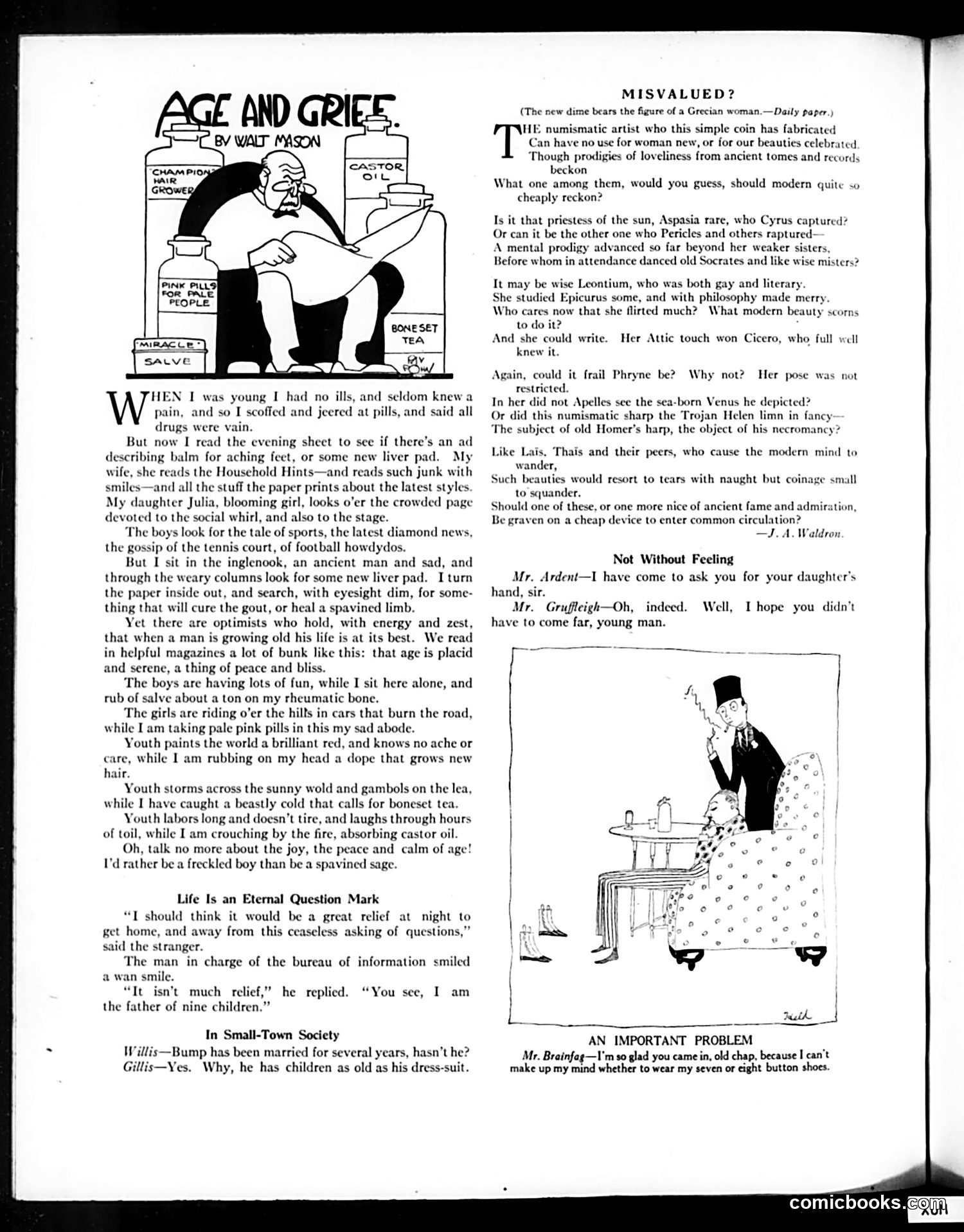
This page contains three distinct pieces of satire: **"Age and Griefs" (top left):** A cartoon by Walt Mason depicts an elderly man surrounded by patent medicines and remedies (pills, salves, liver pads, castor oil). The accompanying poem contrasts youthful vitality with aged decline—young people enjoy cars, sports, and romance while the narrator searches newspapers for cures for gout and rheumatism. The satire mocks both contemporary advertising culture (which aggressively marketed dubious health products to the elderly) and romanticized notions that aging brings peace and contentment. **"Misvalued?" (right column):** A poem critiques a new dime bearing an image of a Greek woman. It argues the designer poorly chose his subject, listing accomplished ancient women (Aspasia, Leontium, Phryne, Helen) whose intelligence and influence far exceeded what a cheap coin represents—satirizing both modern undervaluation of women and the inadequacy of commemorative currency. **Bottom dialogues:** Brief comedic exchanges about information bureaus and small-town gossip, using wordplay and social observation for humor.
📄 Transcribed text from this page (OCR, searchable)
Machine-transcribed from the original scan — historical spelling and the odd misread are preserved.
W pain, and so I scoffed and jeered at pills, and said all drugs were vain. But now I read the evening sheet to see if there’s an ad describing balm for aching feet, or some new liver pad. My she reads the Household Hints—and reads such junk with es—and all the stuff the paper prints about the latest styles. My daughter Julia, blooming girl, looks o’er the crowded page devoted to the social whirl, and also to the stage. The boys look for the tale of sports, the latest diamond news, the gossip of the tennis court, of football howdydos. But I sit in the inglenook, an ancient man and sad, and through the weary columns look for some new liver pad. I turn the paper inside out, and search, with eyesight dim, for some- thing that will cure the gout, or heal a spavined limb. Yet there are optimists who hold, with energy and zest, that when a man is growing old his life is at its best. We read in helpful magazines a lot of bunk like this: that age is placid and serene, a thing of peace and bliss. The boys are having lots of fun, while I sit here alone, and rub of salve about a ton on my rheumatic bone. The girls are riding o’er the hilts in cars that burn the road, while I am taking pale pink pills in this my sad abode. Youth paints the world a brilliant red, and knows no ache or care, while I am rubbing on my head a dope that grows new hair. Youth storms across the sunny wold and gambols on the lea, while I have caught a beastly cold that calls for boneset tea. Youth labors long and doesn’t tire, and laughs through hours of toil, while I am crouching by the fire, absorbing castor oil. Oh, talk no more about the joy, the peace and calm of age! I'd rather be a freckled boy than be a spavined sage. Life Is an Eternal Question Mark “T should think it would be a great relief at night to get home, and away from this ceaseless asking of questions,” said the stranger. The man in charge of the bureau of information smiled a wan smile. “It isn’t much relief,” he replied. “You see, I am the father of nine children.” In Small-Town Society /lis—Bump has been married for several years, hasn’t he? Gillis—Yes. Why, he has children as old as his dress-suit. MISVALUED? (The new dime bears the figure of a Grecian woman.—Daily paper.) HE numismatic artist who this simple coin has fabricated T Can have no use for woman new, or for our beauties celebrated. Though prodigies of loveliness from ancient tomes and records beckon What one among them, would you guess, should modern quite so cheaply reckon? Is it that priestess of the sun, Aspasia rare, who Cyrus captured? Or can it be the other one who Pericles and others raptured- A mental prodigy advanced so far beyond her weaker sisters, Before whom in attendance danced old Socrates and like wise misters? It may be wise Leontium, who was both gay and literary. She studied Epicurus some, and with philosophy made merry. Who cares now that she flirted much? What modern beauty scorns to do it? And she could write. Her Attic touch won Cicero, who full well knew it. Again, could it frail Phryne be? Why not? Her pose was not restricted. In her did not Apelles sce the sea-born Venus he depicted? Or did this numismatic sharp the Trojan Helen limn in fancy The subject of old Homer’s harp, the object of his necromancy? Like Lais, Thais and their peers, who cause the modern mind to wander, Such beauties would resort to tears with naught but coinage small to squander. Should one of these, or one more nice of ancient fame and admiration, Be graven on a cheap device to enter common circulation? —J. A. Waldron Not Without Feeling Mr, Ardent—I have come to ask you for your daughter's hand, sir. Mr. Grufleigh—Oh, indeed. Well, I hope you didn’t have to come far, young man. ok AN IMPORTANT PROBLEM Mr. Brainfag—I'm so glad you came in, old chap, because I can’t make up my mind whether to wear my seven or eight button shoes. comicbooks.