
Judge, 1916-11-11 · page 24 of 28
Judge — November 11, 1916 — page 24: what you’re looking at
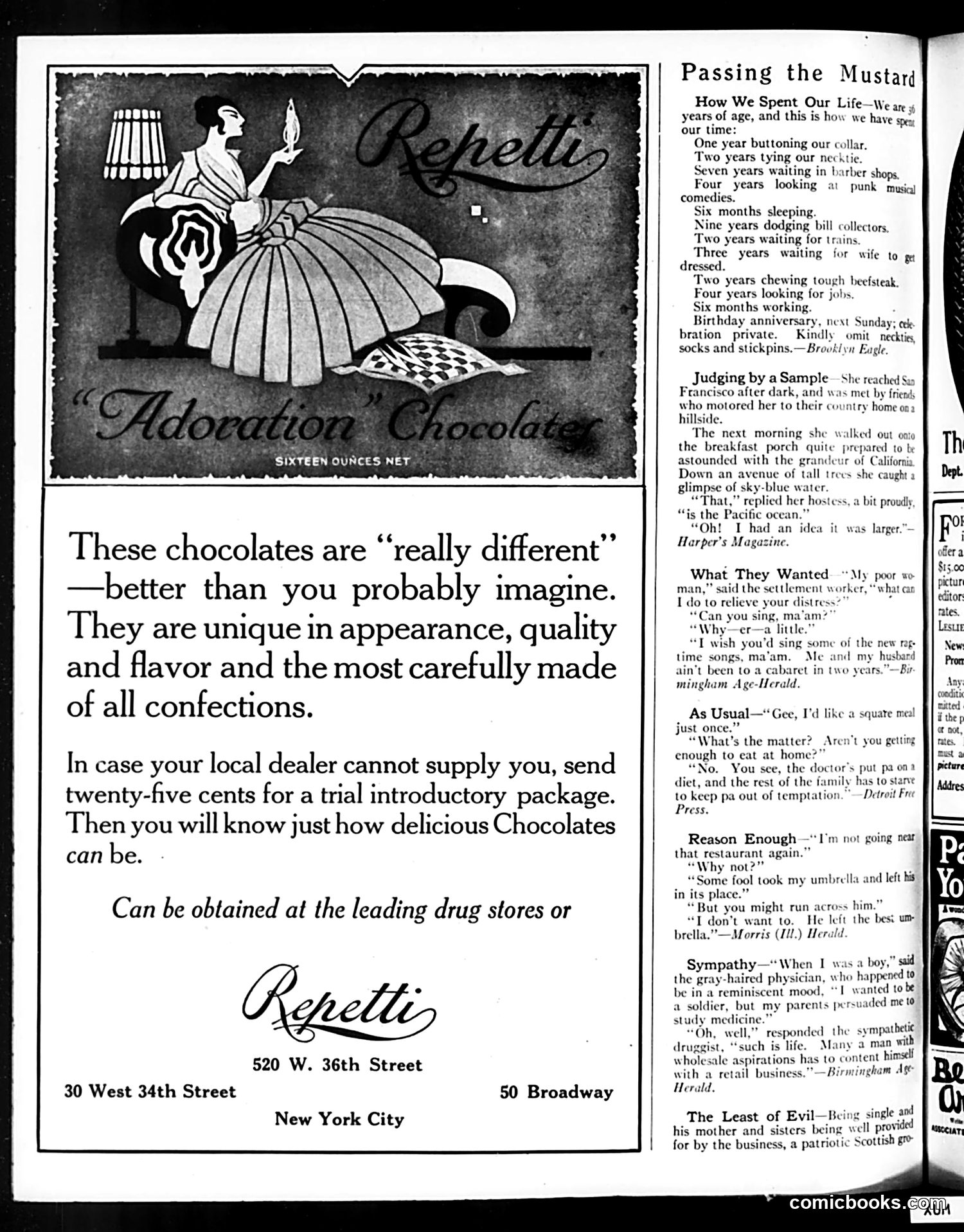
What you’re looking at
This page is primarily **advertising** for Repetti Adoration Chocolates, with accompanying humor columns on the right side. The chocolate ad features an Art Deco illustration of an elegant woman with a lamp, emphasizing luxury and sophistication. The sales pitch claims the chocolates are uniquely "different" and "carefully made," offering a 25-cent trial package. The right column contains **humorous anecdotes** typical of early 20th-century satirical magazines: - "Passing the Mustard" catalogs a life wasted on mundane activities (waiting in barber shops, dodging bill collectors, watching bad comedies) - Brief jokes mock everyday frustrations: a woman unimpressed by California's Pacific Ocean, poor families struggling under medical diets, someone upset about an umbrella swap - The humor targets middle-class anxieties: poverty, courtship delays, marital dynamics, and social embarrassment These pieces reflect period concerns about economic hardship and domestic tedium, presented with the wry tone characteristic of Judge magazine's satirical voice.
📄 Transcribed text from this page (OCR, searchable)
Machine-transcribed from the original scan — historical spelling and the odd misread are preserved.
These chocolates are “really different’’ —better than you probably imagine. They are unique in appearance, quality and flavor and the most carefully made of all confections. In case your local dealer cannot supply you, send twenty-five cents for a trial introductory package. Then you will know just how delicious Chocolates can be. Can be obtained at the leading drug stores or 520 W. 36th Street 30 West 34th Street 50 Broadway New York City Passing the Mustard How We Spent Our Life—We are y years of age, and this is how we have Speat our time: * One year buttoning our collar. Two years tying our neckt Seven years waiting in barber shops. Four years looking at punk musq) comedies. Six months sleeping. Nine years dodging bill collectors, Two years waiting for trains. Three years waiting for wife to fet dressed. Two years chewing tough beefsteak. Four years looking for jobs. Six months working. Birthday anniversary, next Sunday; ee. bration private. Kindly omit neckties, socks and stickpins.—Brookiyn Eugle. Judging by a Sample— She reached & Francisco after dark, and was met by friend who motored her to their country home ona hillside. The next morning she walked out onto the breakfast porch quite prepared to be astounded with the grandeur of California Down an avenue of tall trees she caught a y-blue water. plied her hostess, a bit proudly, “is the Pacific ocean.” “Oh! I had an idea it was larger."- Harper's Magazine. What They Wanted ~My poor wo man,” said the settlement worker, “ what can e your distress . “T wish you'd sing some of the new time songs, ma’am. Me and my h ain't been to a cabaret in two years.”—Bir mingham Age-Herald. As Usual—“Gee, I'd like a square meal just once.” . “What’s the matter? n't you getting cnough to eat at home? “No. You see, the doctor's put pa ont diet, and the rest of the family has to starve to keep pa out of temptat *—Detroi Press. Reason Enough —"I'm not going neat that restaurant again.” “Why not?” 3 “Some fool took my umbrella and left his in its place.” ” “But you might run across him. I don’t want to. He left the bes: um brella.”"—Morris (Ill.) Herald. Sympathy—“When I was & boy,” said the gray-haired physi » happened to be in a reminiscent mood, “1 wanted to be a soldier, but parents persuaded me (0 study medicine ‘ “Oh, well,” responded the sympatheti¢ druggist, “such is life. Many a man uit wholesale aspirations has to content himsel with a retail business.”—Birmingham Age Herald, The Least of Evil—Being single and his mother and sisters being well provid for by the business, a patriotic Scottish gr comicbooks.