
A complete issue · 28 pages · 1916
Judge — August 19, 1916
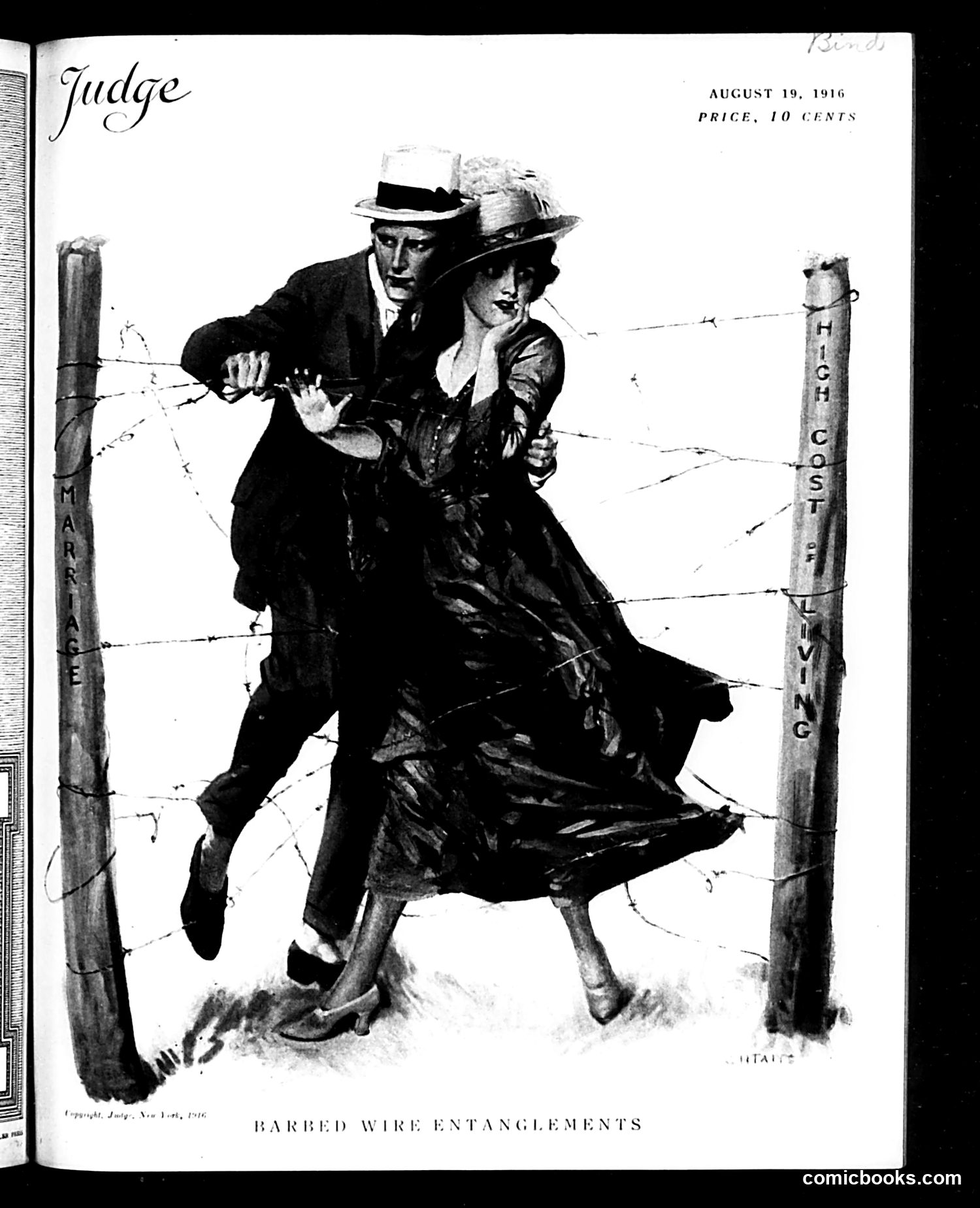
This Judge magazine cover from August 19, 1916 uses a visual pun about World War I. The title "Barbed Wire Entanglements" refers literally to the barbed wire obstacles that defined trench warfare in Europe—but here depicts a couple literally entangled in barbed wire between two fence posts labeled "HIGH COST LIVING." The cartoon satirizes how American couples are trapped by rising prices and economic hardship during the war period. The man and woman's struggle to escape the wire while maintaining dignity reflects the broader public anxiety about wartime inflation and its effects on everyday Americans. The image suggests that economic "entanglement" poses as serious a threat to citizens as actual military obstacles do to soldiers overseas.
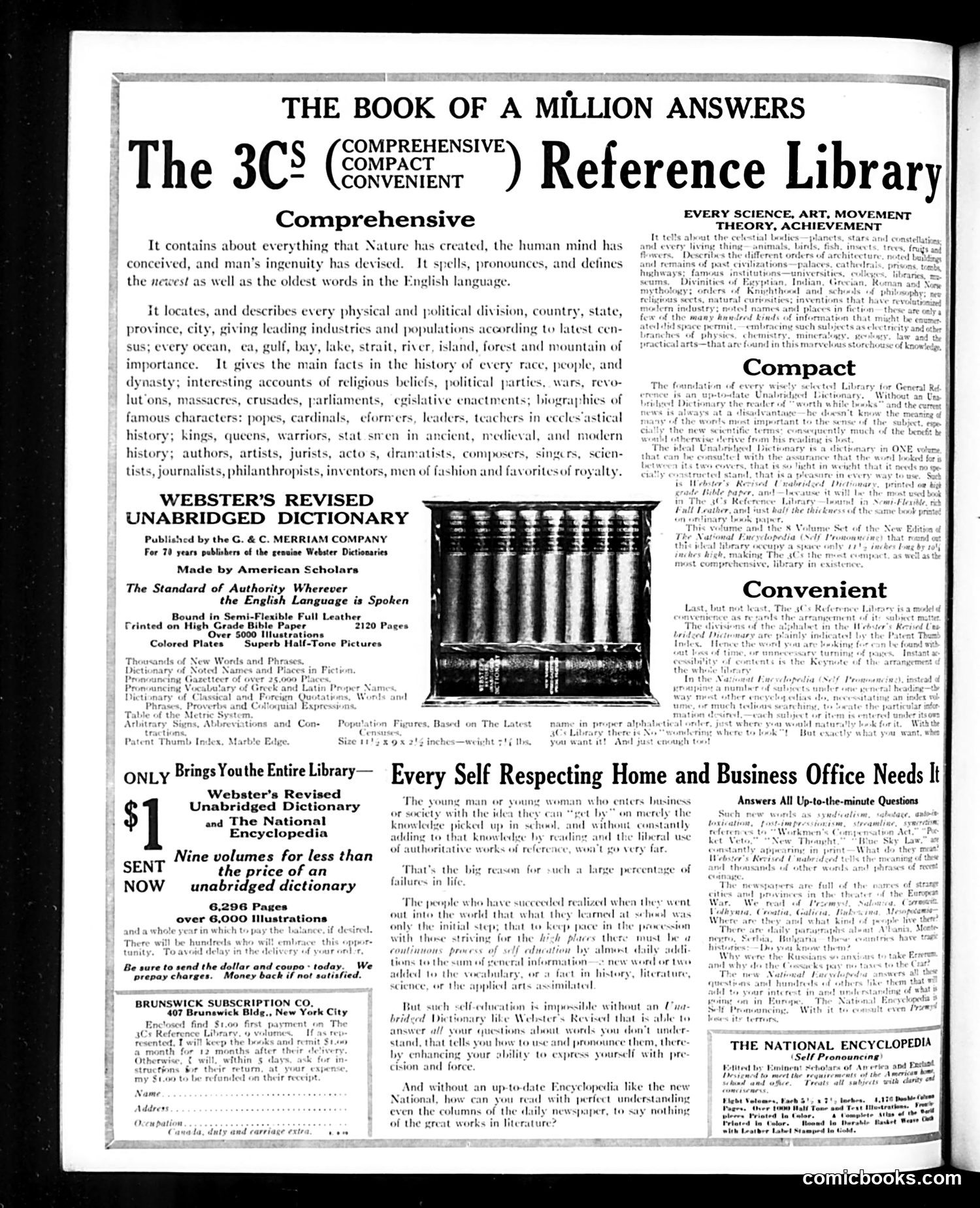
This page is **primarily advertising**, not editorial satire or political commentary. It promotes three reference works: 1. **The 3C's Reference Library** — a comprehensive dictionary and encyclopedia set 2. **Webster's Revised Unabridged Dictionary** — marketed as "The Standard of Authority Wherever the English Language is Spoken" 3. **The National Encyclopedia** — advertised as self-promotional content The central pitch claims these nine-volume sets cost only $1, positioning them as affordable educational resources for "Every Self Respecting Home and Business Office." The text emphasizes utility for businesspeople and students seeking immediate answers to questions across science, history, and current events. There is **no political satire visible** — this is straightforward commercial messaging typical of Judge magazine's revenue model, using the publication's pages to sell reference materials to readers.
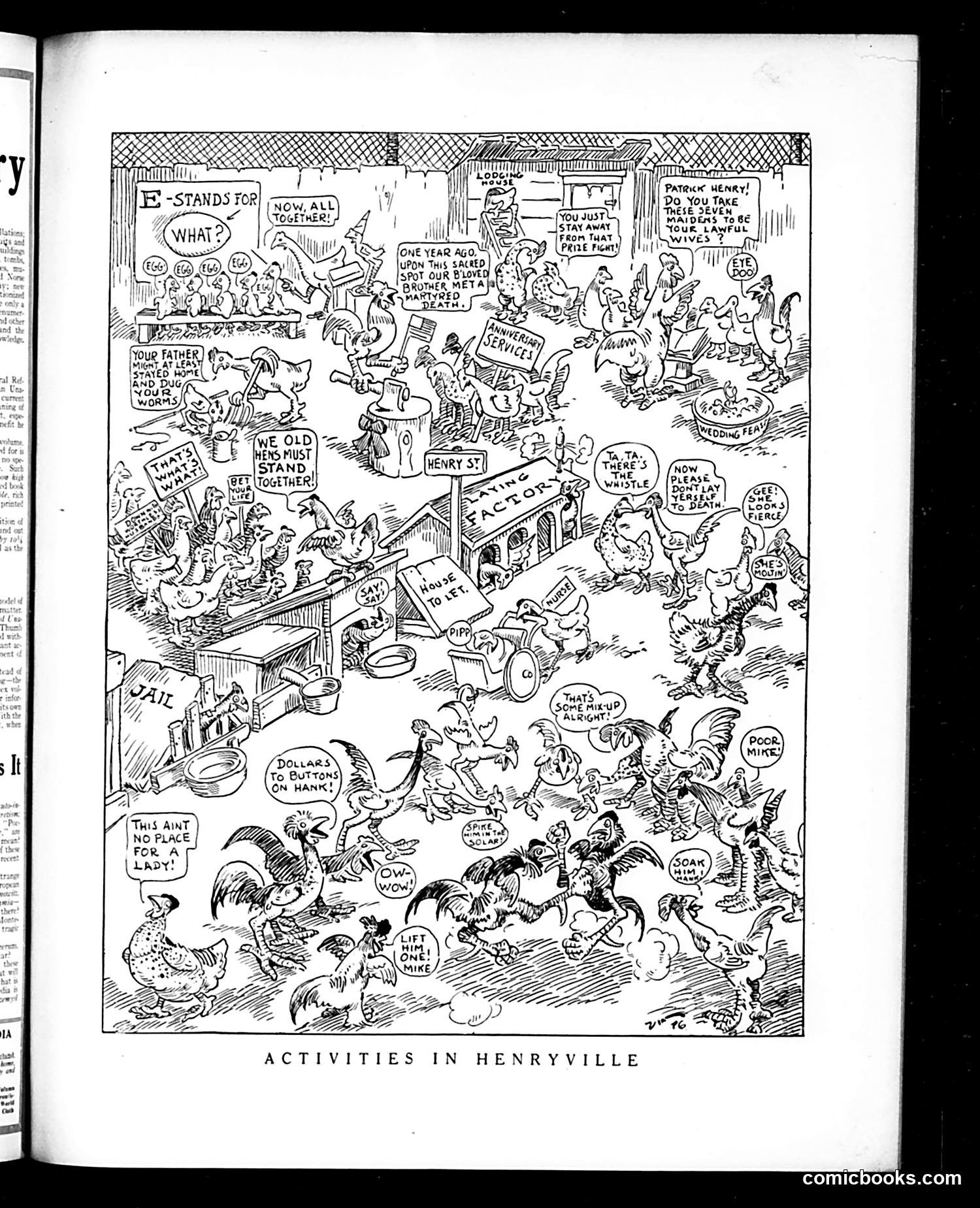
This cartoon satirizes labor organizing and union activity, likely from the early 20th century. The scene depicts a chaotic gathering of chickens in "Henryville"—an anthropomorphic animal town where birds organize for workers' rights. The cartoon mocks union organizers and striking workers through animal caricature. References include discussions of "one year ago...brother Meta martyred," a "striking factory," demands for "service," and various working-class grievances. Signs reading "We old hens must stand together" and "Dollars catch on hank!" suggest satirizing both labor solidarity and financial motivations. The humor targets what the magazine likely viewed as absurd or hypocritical labor activism—portraying organized workers as squabbling, greedy, or foolish rather than sympathetic.
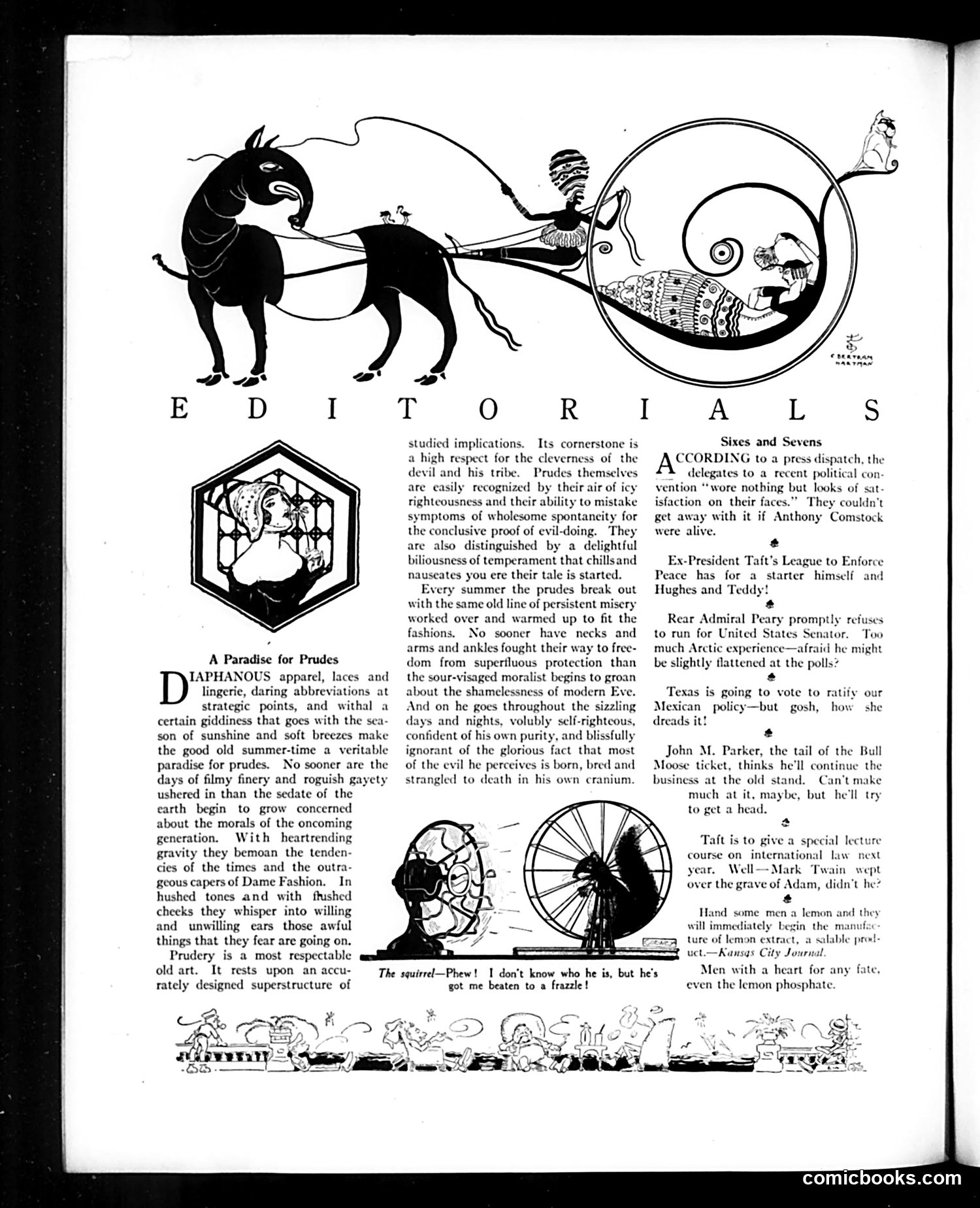
This Judge magazine page contains satirical commentary on contemporary political figures and social issues. **Top cartoon ("Editorials"):** A demon/devil figure pulls a carriage containing what appears to be political operatives, suggesting corrupt forces driving policy. **"A Paradise for Prudes":** A lengthy text section criticizing moralistic figures—likely referencing contemporary debates about censorship and social conservatism. The illustration shows a prudish character, satirizing those enforcing strict moral standards. **News briefs** reference: - Former President Taft's peace efforts - Admiral Peary and Arctic exploration - Mexican policy debates - John M. Parker and presidential politics The page exemplifies Judge's role satirizing American politics and social hypocrisy through caricature and commentary, though specific identifications require additional historical context for full clarity.
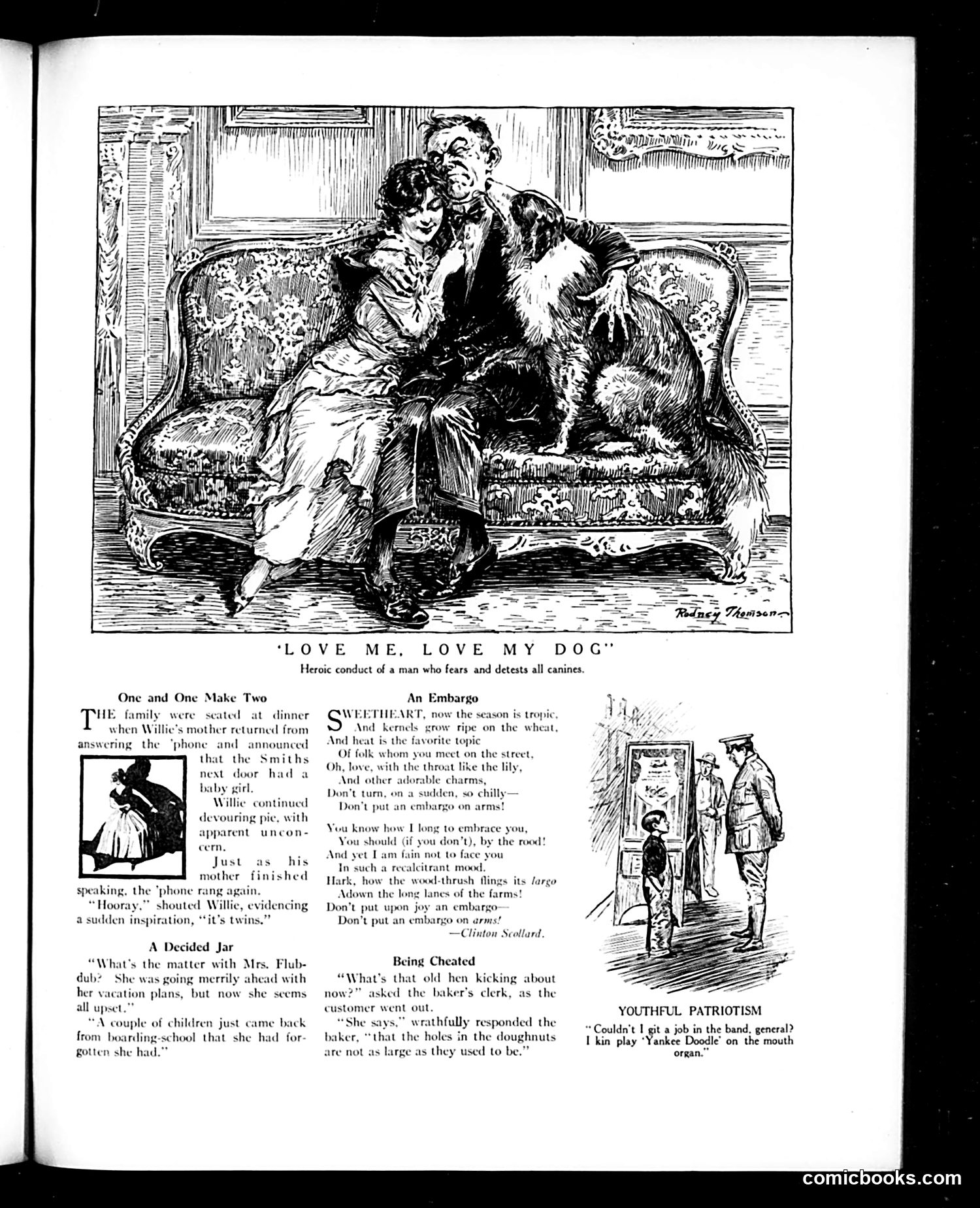
The main cartoon depicts a man and woman on a couch with a large dog between them. The subtitle reads "Heroic conduct of a man who fears and detests all canines," satirizing masculine self-sacrifice in romance—a man tolerating a pet he dislikes to please his girlfriend. Below are three brief comedic anecdotes: "One and One Make Two" (about Willie's mother discovering his romantic interests), "A Decided Jar" (Mrs. Flubbub's vacation disrupted by returning children), and "Being Cheated" (a baker's complaint about doughnut holes). A poem titled "An Embargo" and another section called "Youthful Patriotism" mock wartime sacrifice and patriotic posturing. The overall page uses domestic humor and light social satire typical of early-20th-century Judge magazine, targeting middle-class anxieties and pretensions.
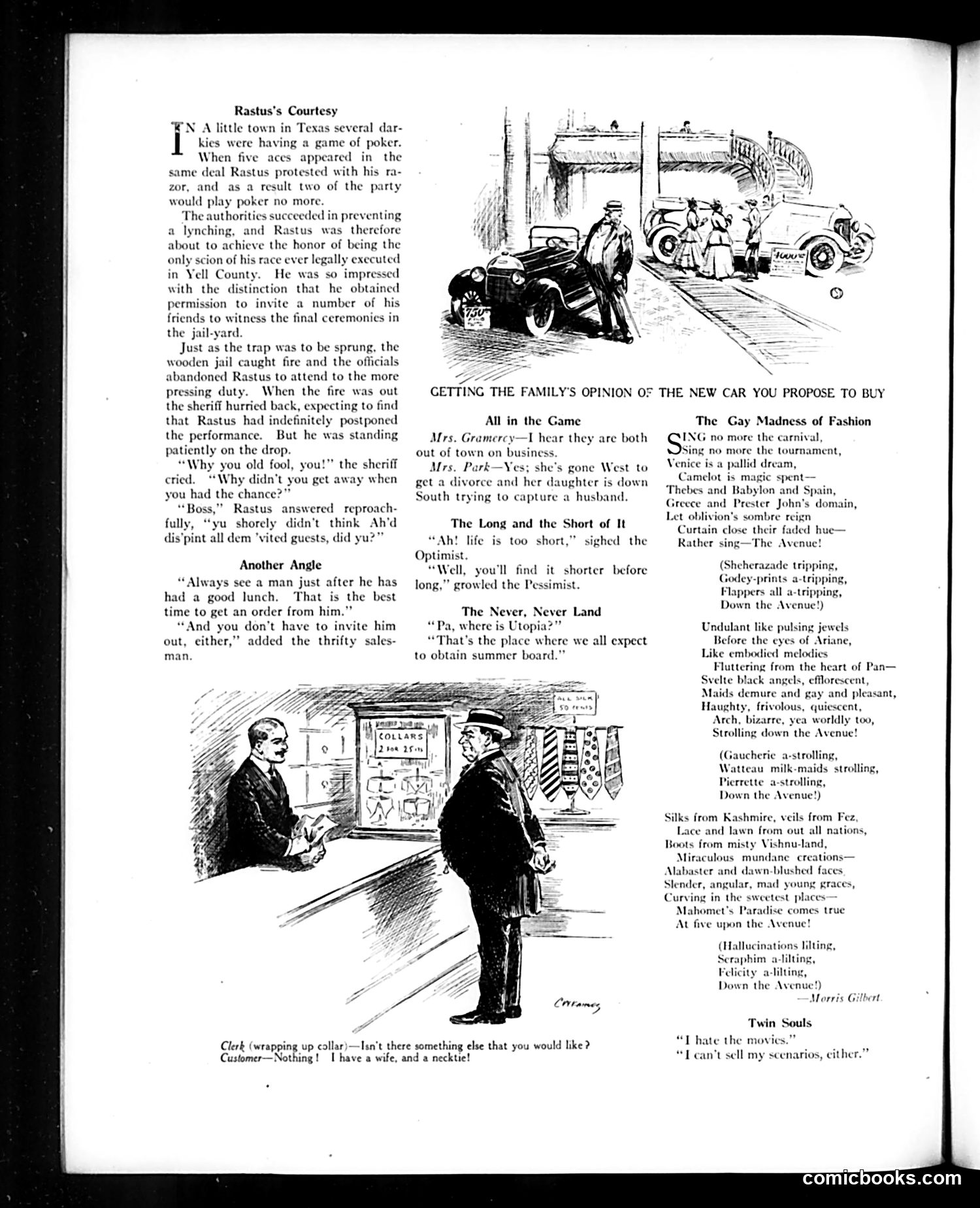
This page contains several satirical pieces typical of early 20th-century American humor: **"Rastus's Courtesy"** employs a racist caricature standard to the era. The story depicts a Black man ("Rastus") scheduled for execution who refuses to escape a jail fire because he doesn't want to disappoint his invited guests—presenting this as charming courtesy. The satire targets the dehumanizing treatment and the stereotype itself, though by modern standards the racist language and characterization are deeply offensive. **Other brief pieces** include business humor ("Another Angle" about sales tactics) and period observations about fashion ("The Gay Madness of Fashion"), automobiles, and Hollywood aspirations ("Twin Souls"). **The car cartoon** satirizes family opinion-seeking before major purchases—a relatable domestic dynamic. The page reflects 1920s-era social commentary, but its humor relies heavily on now-unacceptable racial stereotypes that were normalized in that publication's target audience.
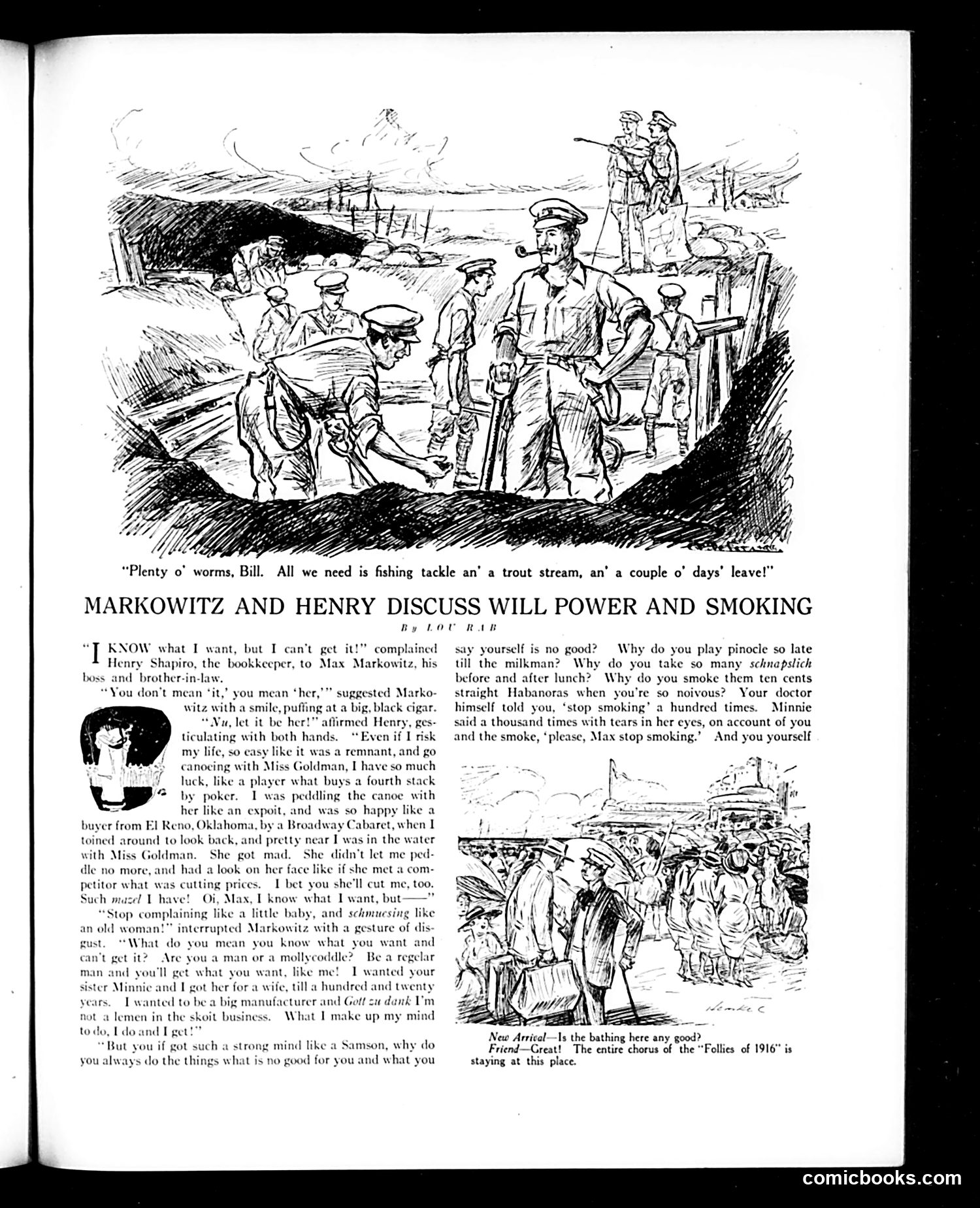
This page contains two separate pieces of humor from Judge magazine, likely from around 1916 based on the "Follies of 1916" reference. **Top cartoon:** Soldiers in a WWI trench discuss going fishing—a escapist fantasy during wartime. **Main story:** "Markowitz and Henry Discuss Will Power and Smoking" is a comedic dialogue between two Jewish immigrant characters (identifiable by their Yiddish-inflected English and names). Henry complains he can't get what he wants—specifically a romantic relationship—while Max counters that Henry lacks willpower, using his own success as evidence. Max boasts of controlling his desires and achieving his goals (marrying Henry's sister, becoming a manufacturer), yet Max admits he *can't* stop smoking despite knowing it's harmful—undermining his entire argument about willpower. The satire mocks masculine self-delusion and the gap between what men claim about self-control and their actual behavior. The ethnic dialect humor was standard for the era's mainstream magazines.
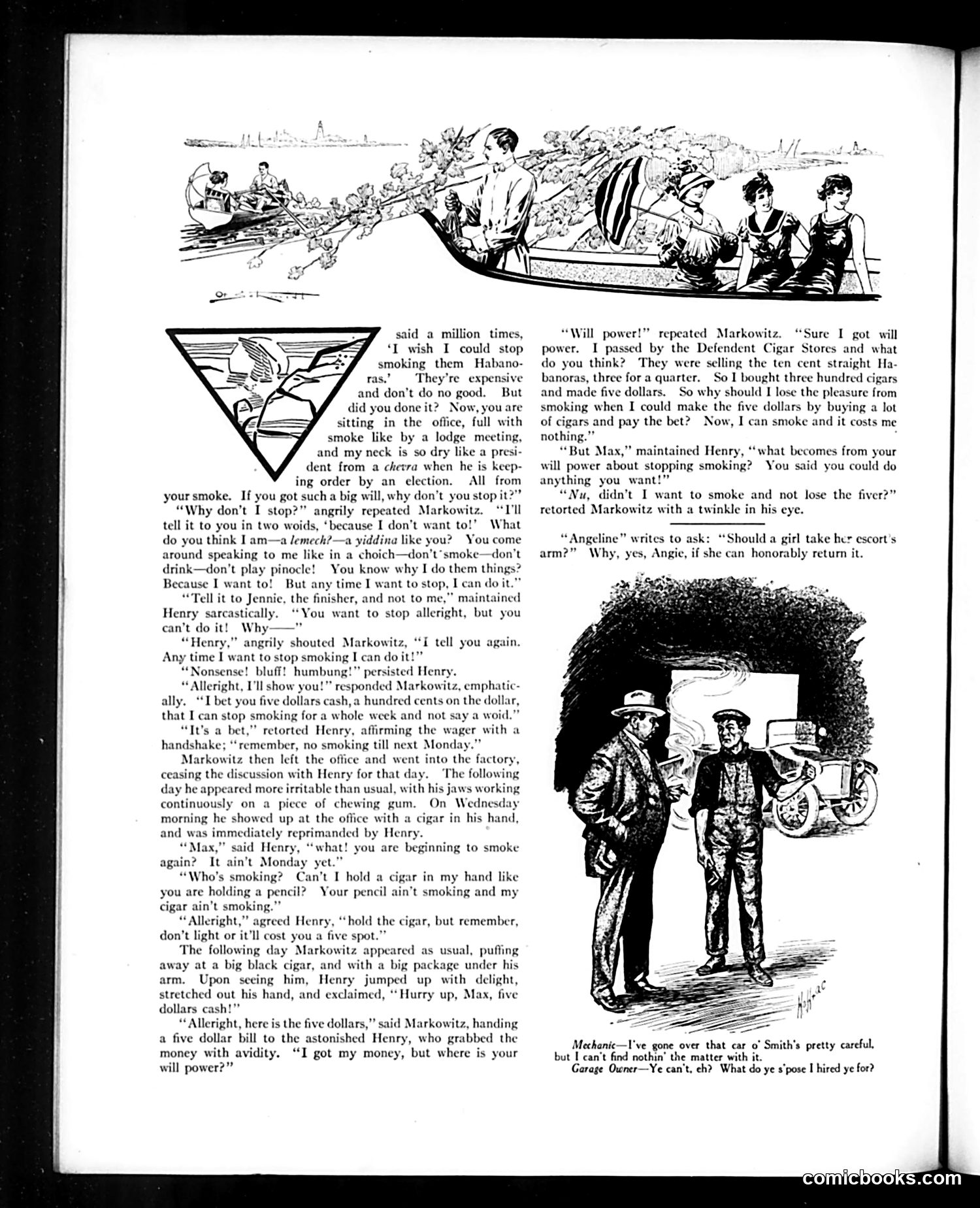
This page contains a humorous dialogue between two factory workers, Markowitz and Henry, depicted as Jewish immigrants (indicated by Yiddish phrases like "lemech" and "Nu"). **The Main Story:** Henry challenges Markowitz to quit smoking expensive Havana cigars for a week, wagering five dollars. Markowitz accepts confidently but struggles—he's shown chewing gum nervously by Wednesday and smoking again shortly after. **The Punchline:** Markowitz claims victory because he bought three hundred cheap cigars at a discount ("three for a quarter"), sold them for five dollars profit, and thus won the bet *while still smoking*—technically keeping both his pleasure and the money through a loophole. **The Satire:** This mocks working-class schemes and self-deceptive rationalization. The humor relies on Markowitz's literal interpretation of the bet's terms and his clever (if dishonest) entrepreneurialism. The dialogue captures period immigrant speech patterns and attitudes. The page also includes unrelated small cartoons and a brief advice column below.
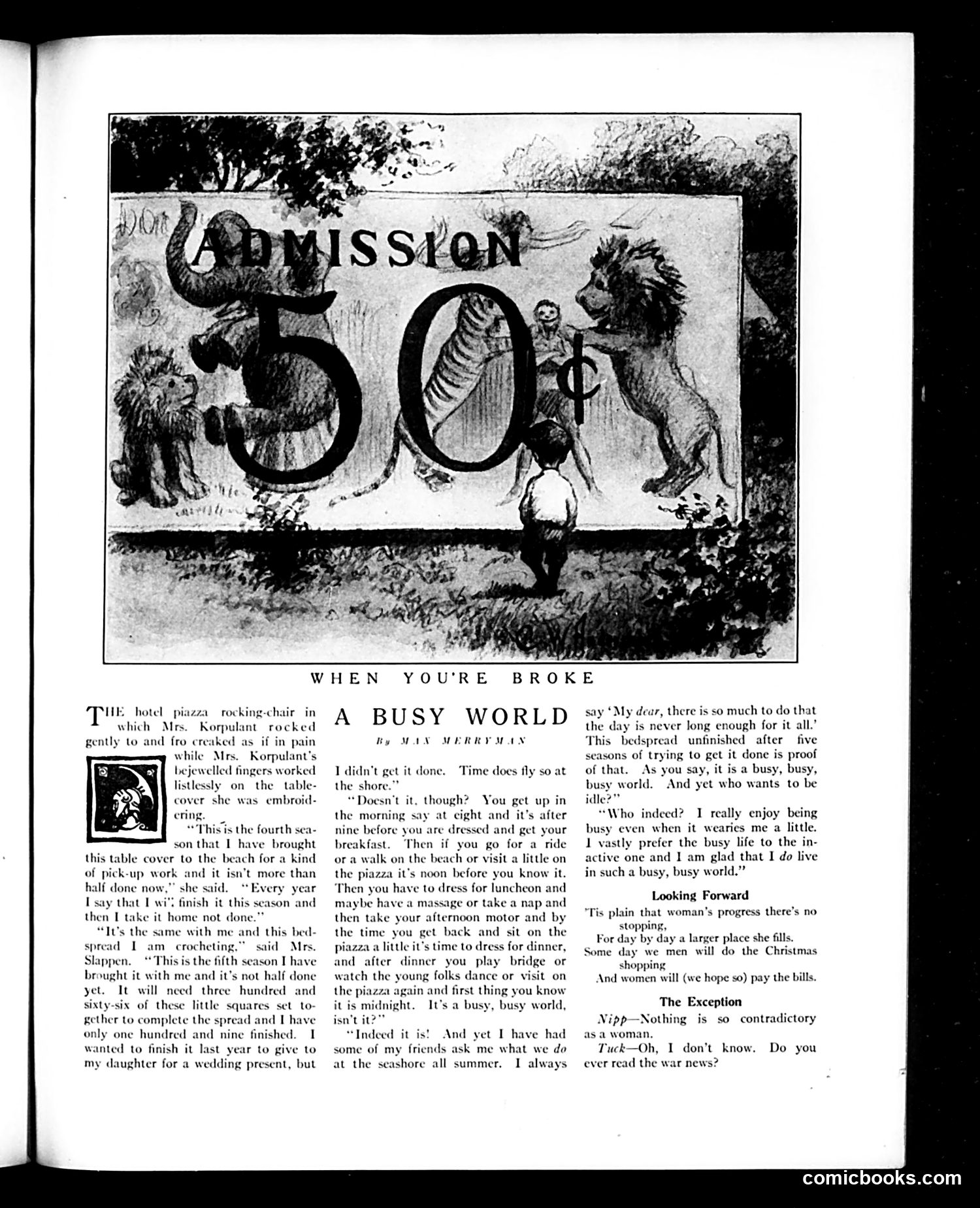
This page satirizes wealthy leisure-class women who spend summers at beach resorts claiming to be perpetually busy, yet accomplish nothing substantive. Two women discuss multi-year needlework projects they continually fail to complete—one's tablecloth in its fourth season, another's bedspread in its fifth. The satire's point: they fill their days with trivial activities (dressing, meals, naps, motor drives, bridge games) that consume all their time, leaving no room for actual work. Yet they paradoxically insist they "enjoy being busy" and wouldn't want idle lives. The accompanying cartoon (top) shows the "50¢ Commission"—likely referencing beach resort services or activities wealthy women purchase. The sidebar jokes mock women's contradictions and hint at emerging social change (women doing Christmas shopping, eventually "paying the bills"), reflecting early 20th-century anxiety about women's changing roles.
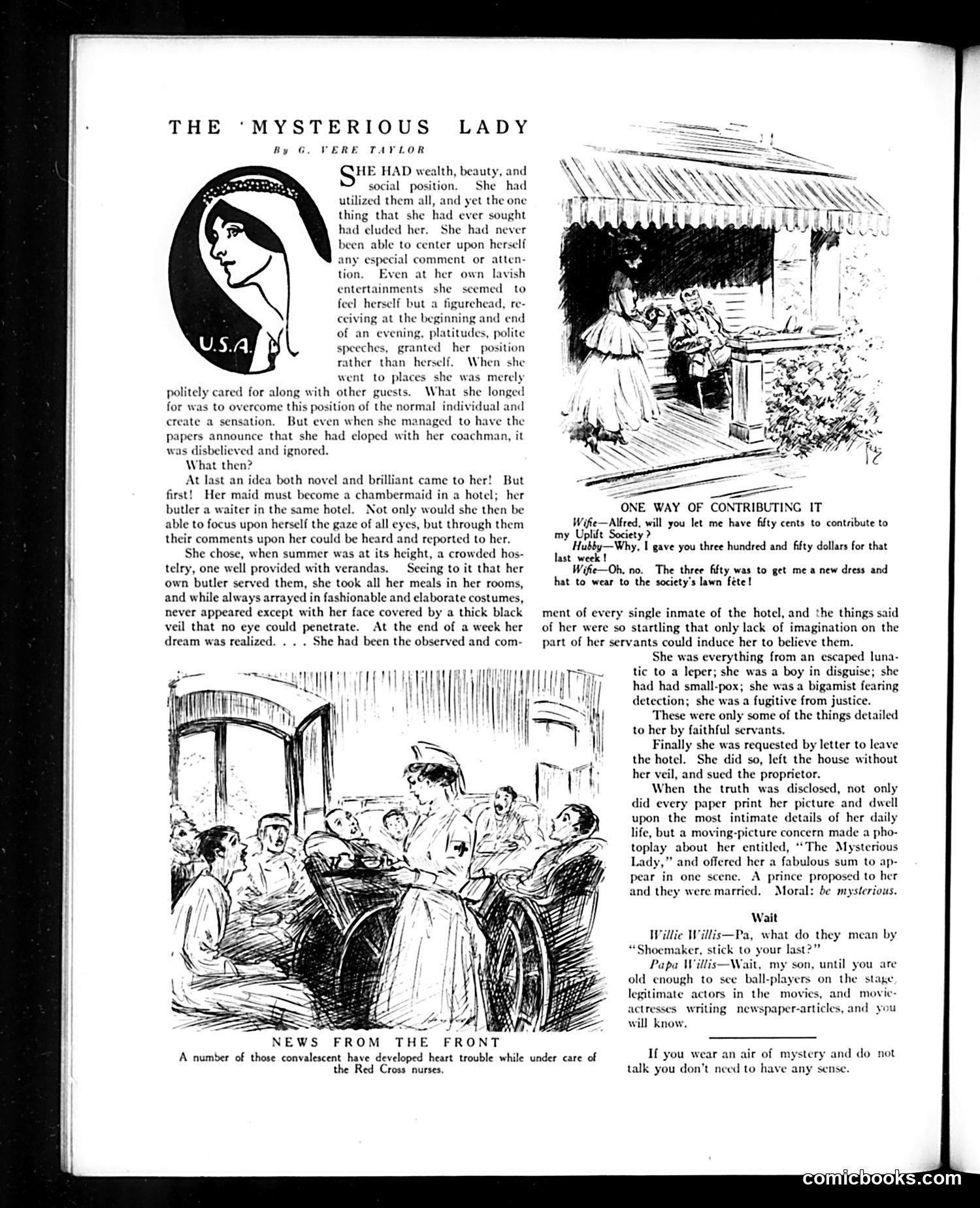
This short story satirizes early 20th-century culture's obsession with mystery and celebrity. The protagonist, a wealthy woman desperate for attention, hires servants to work undercover at a hotel while she wears a black veil, creating wild rumors about her identity—claiming she's a leper, fugitive, or boy in disguise. The satire's point: once the truth emerges, newspapers and moving-picture companies exploit her story anyway, making her famous through exposure rather than mystery. A prince even proposes. The moral explicitly warns that appearing mysterious while saying nothing is sufficient to gain attention and success in society. The accompanying joke about "uplift societies" mocks frivolous charitable causes, while the dialogue at page's end reinforces the theme: **ignorance coupled with an air of mystery requires no actual intelligence to succeed** in modern culture. The satire targets media sensationalism, celebrity culture, and shallow social values of the 1910s era.
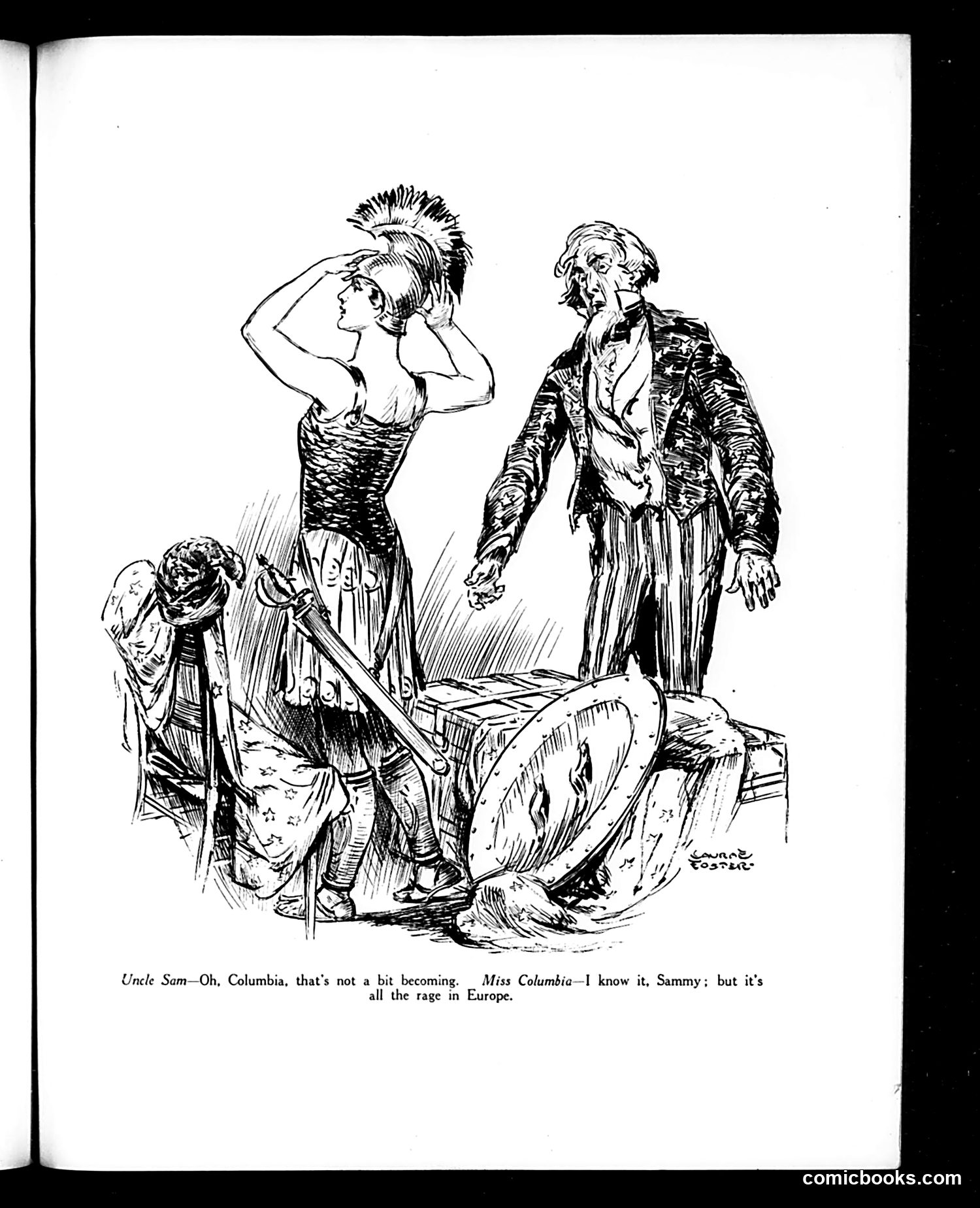
This is a satirical cartoon depicting Uncle Sam (representing the United States) disapproving of Miss Columbia's (the female personification of America) scanty attire. The caption reads: "Uncle Sam—Oh, Columbia, that's not a bit becoming... Miss Columbia—I know it, Sammy; but it's all the rage in Europe." The satire critiques American cultural imitation of European fashion trends, particularly regarding women's increasingly revealing clothing styles. Uncle Sam represents conservative American values objecting to what he views as improper European influences, while Miss Columbia defends the trend as fashionable abroad. The cartoon appears to be mocking both American prudishness and American susceptibility to European cultural fads, a common Judge magazine theme satirizing transatlantic cultural tensions during the early 20th century.
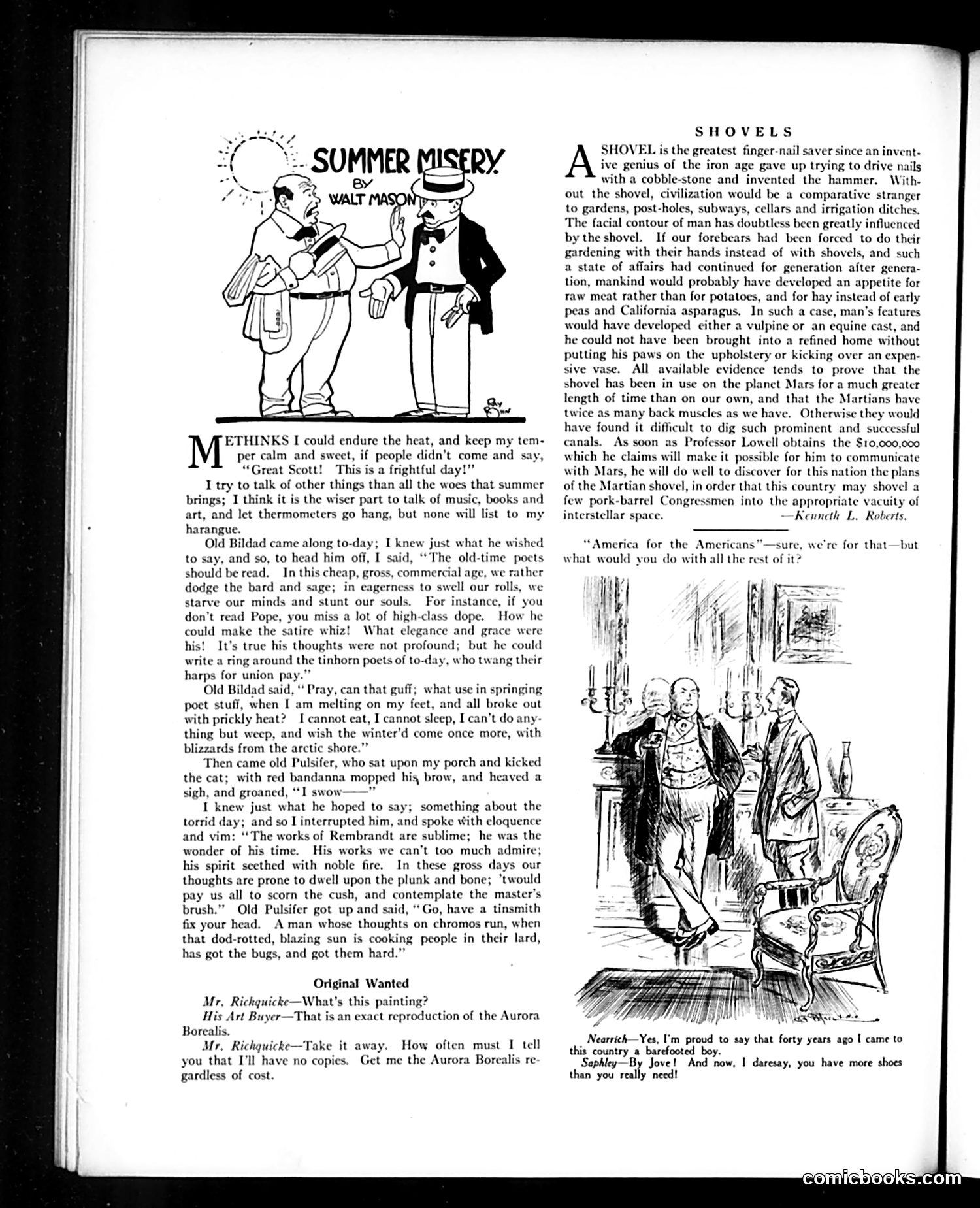
This page contains two satirical pieces from Judge magazine: **"Summer Misery"** (left) depicts a narrator trying to escape summer complaints by discussing classical poetry and art with visiting neighbors—Old Bildad and Pulsifer—who are too hot and miserable to engage. The humor lies in the contrast between highbrow cultural references (Pope, Rembrandt) and the characters' inability to appreciate them while suffering from heat, prickly heat, and exhaustion. It's satire on intellectual pretension meeting practical discomfort. **The right column** includes a brief comic exchange where Mr. Richquicke purchases a painting described as an "exact reproduction of the Aurora Borealis," then demands the artist create no copies—apparently valuing uniqueness over accuracy or logic. **"Shovels"** is an extended humorous advertisement-essay anthropomorphizing the shovel's civilizational importance, including absurdist claims about Martian canal-diggers and Professor Lowell's Mars observations—contemporary pseudoscience presented as fact for comedic effect.
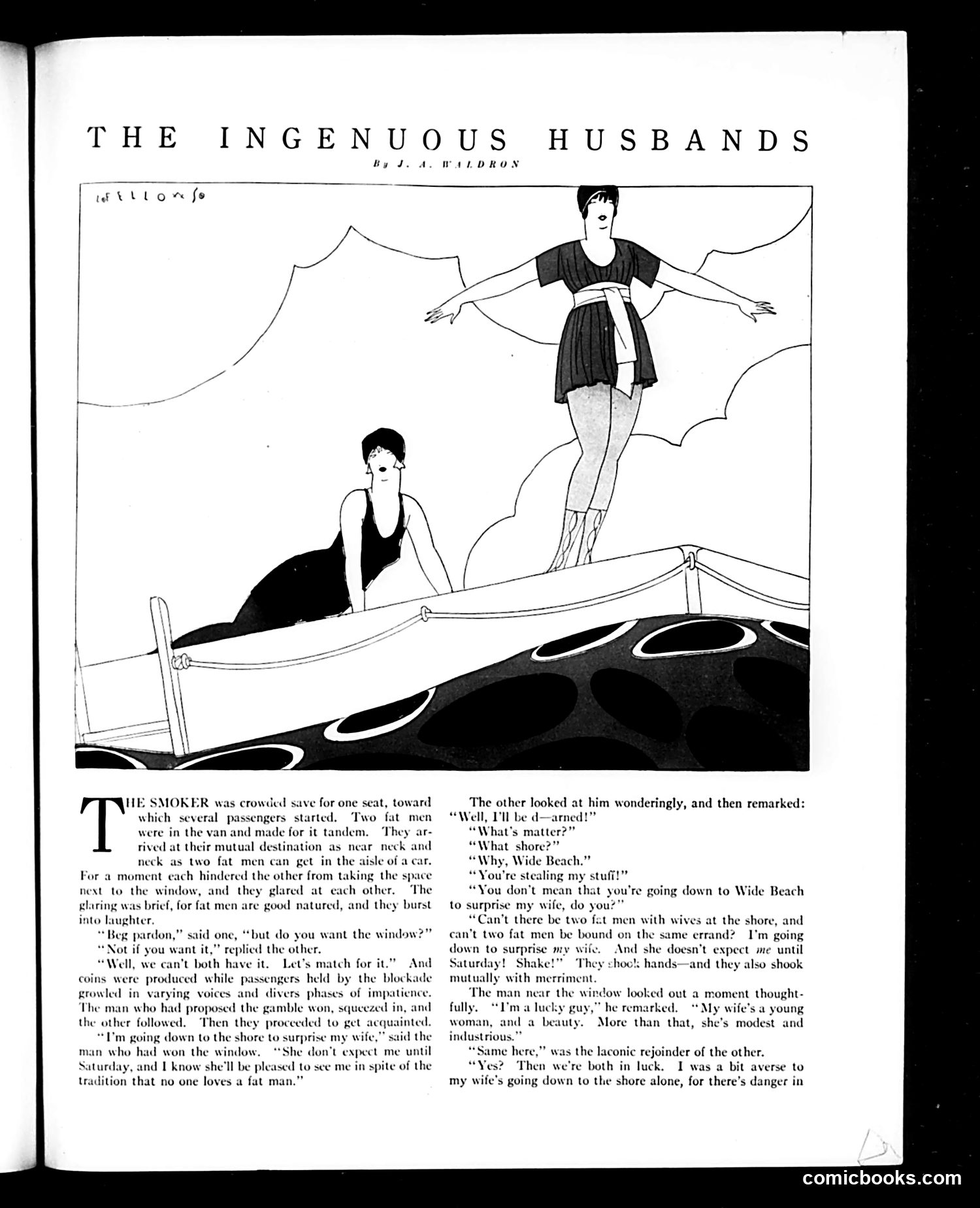
This satirical story jokes about marital naïveté and infidelity. Two portly men meet on a train, each claiming they're traveling to Wide Beach to "surprise" their wives on Saturday. Both boast their wives are beautiful, modest, and industrious—yet both are conveniently making unannounced trips to the same destination. The humor relies on the reader recognizing the obvious implication: both men are likely visiting the *same woman*, unaware of each other's existence. Their cheerful obliviousness—describing themselves as "lucky guys" with wives who wouldn't expect them—satirizes husbands as foolishly blind to potential infidelity. The art shows two rotund men on a crowded train, with elegantly drawn women in the background, emphasizing the contrast between the men's mundane appearance and their confident delusions about their romantic situations. The satire mocks male gullibility and vanity.
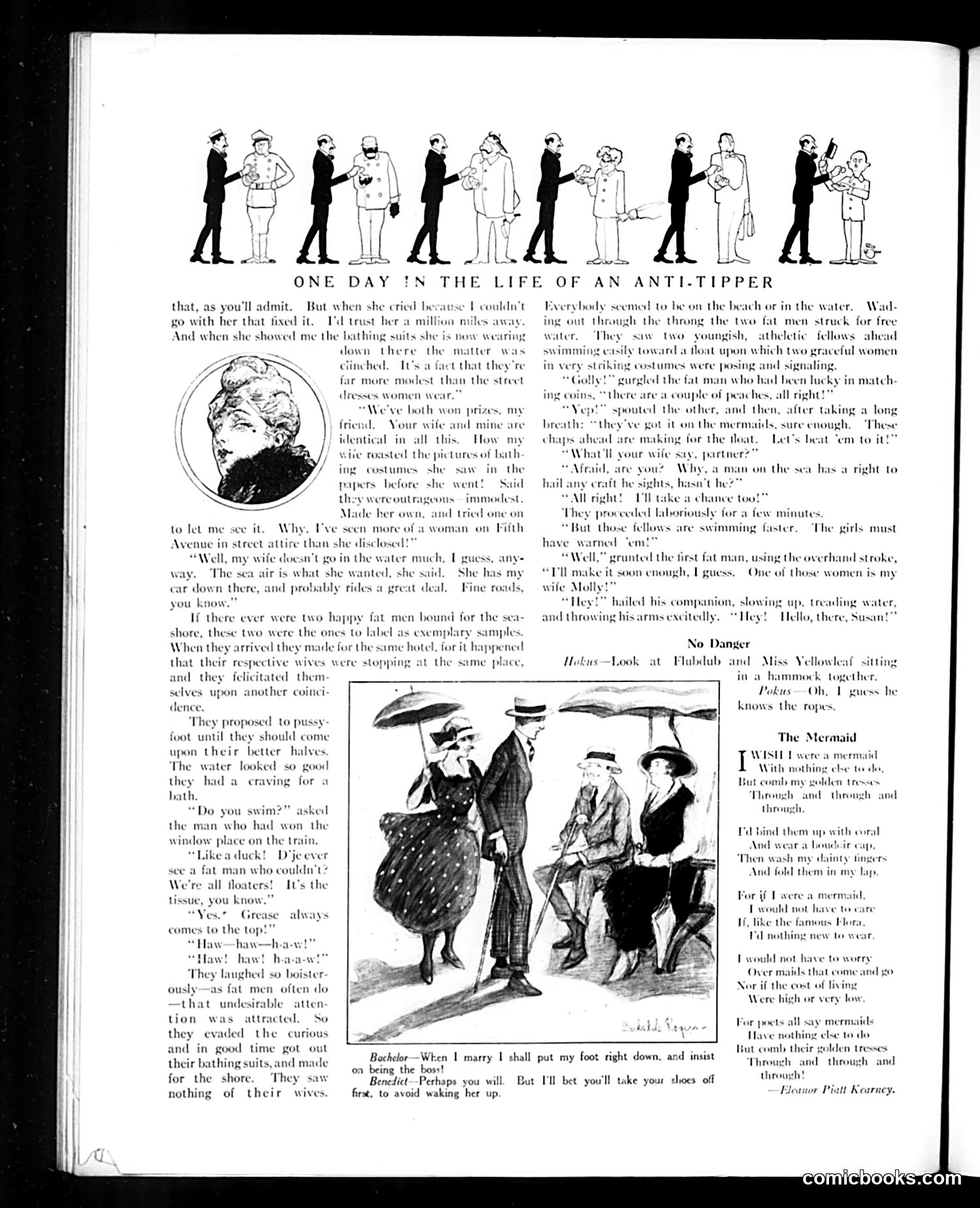
This page satirizes early 20th-century gender dynamics and beach culture. The main cartoon depicts two wealthy, portly men at the seashore who encounter young women in bathing costumes. The "anti-tipper" title suggests men resistant to the tipping custom. The joke centers on the men's wives also being present at the beach—creating comic tension as the men are caught admiring other women while their spouses are nearby. The dialogue reveals period attitudes: men claiming beach privileges ("a man on the sea has a right to hail any craft"), wives as possessions ("your wife and mine"), and women judged primarily on appearance and modesty standards. Secondary pieces mock marriage ("Bachelor" vs. "Benedict") and romanticize mermaids as carefree alternatives to domesticated women. The satire targets male hypocrisy and entitlement regarding women, while also mocking women's restrictive social roles and constant scrutiny of their appearance and conduct.
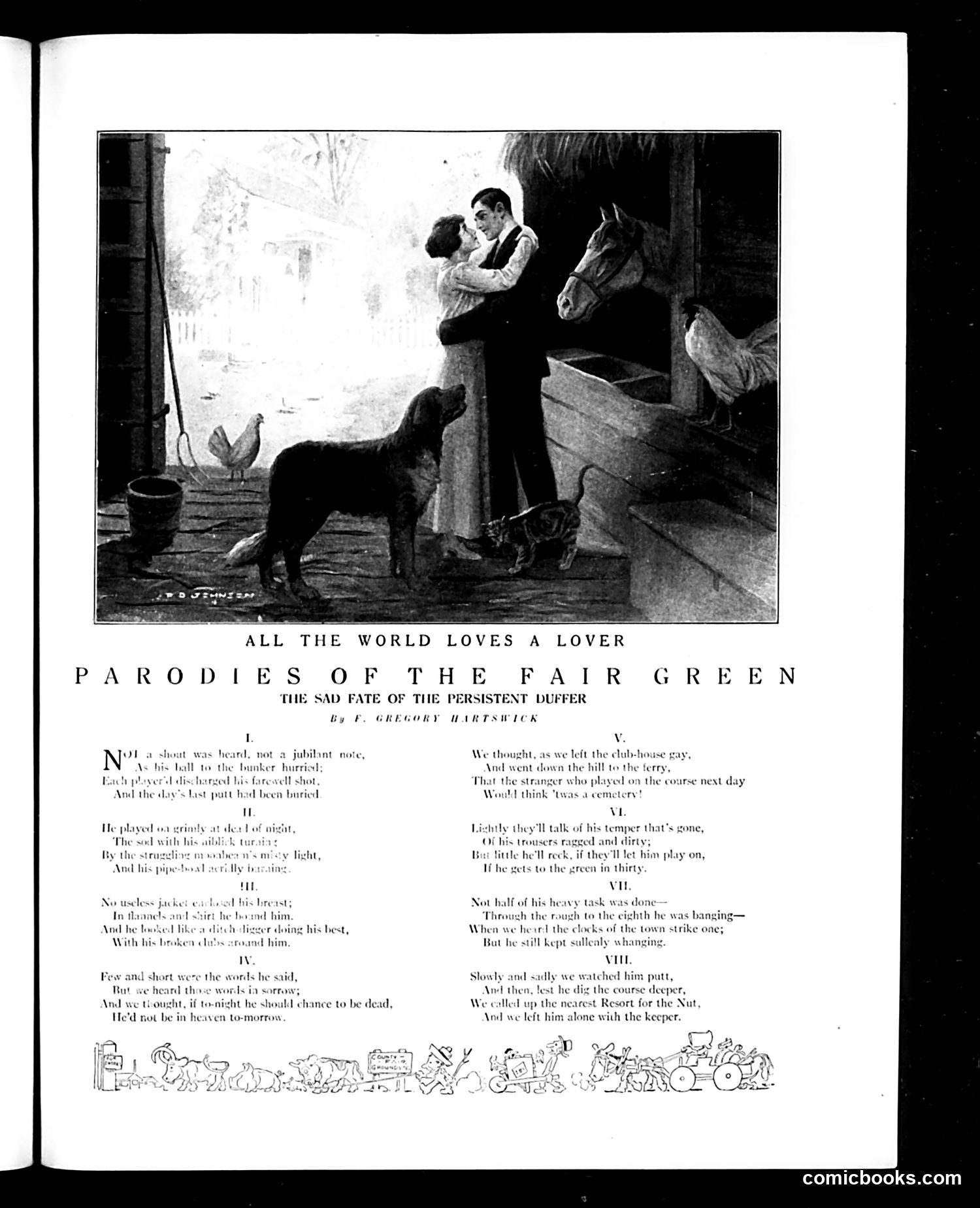
This satirical poem by F. Gregory Hartswick mocks the archetypal "persistent duffer"—a golfer of poor skill who refuses to accept defeat or improve. The accompanying photograph shows a man in formal attire (vest and tie) at a barn or farm setting with animals, establishing the rural, working-class context that contrasts with his golfing pretensions. The eight-stanza narrative follows this stubborn golfer's disastrous day: his ball lands in a bunker, he plays miserably, loses his composure, and ultimately must be removed by a "keeper" (suggesting mental instability). The satire targets not merely bad golf, but masculine pride—his refusal to quit despite clear incompetence, his ragged appearance, and his obsessive determination to "play on" despite being a public embarrassment. The humor lies in the contrast between the gentleman's sport of golf and this man's desperate, futile struggle.
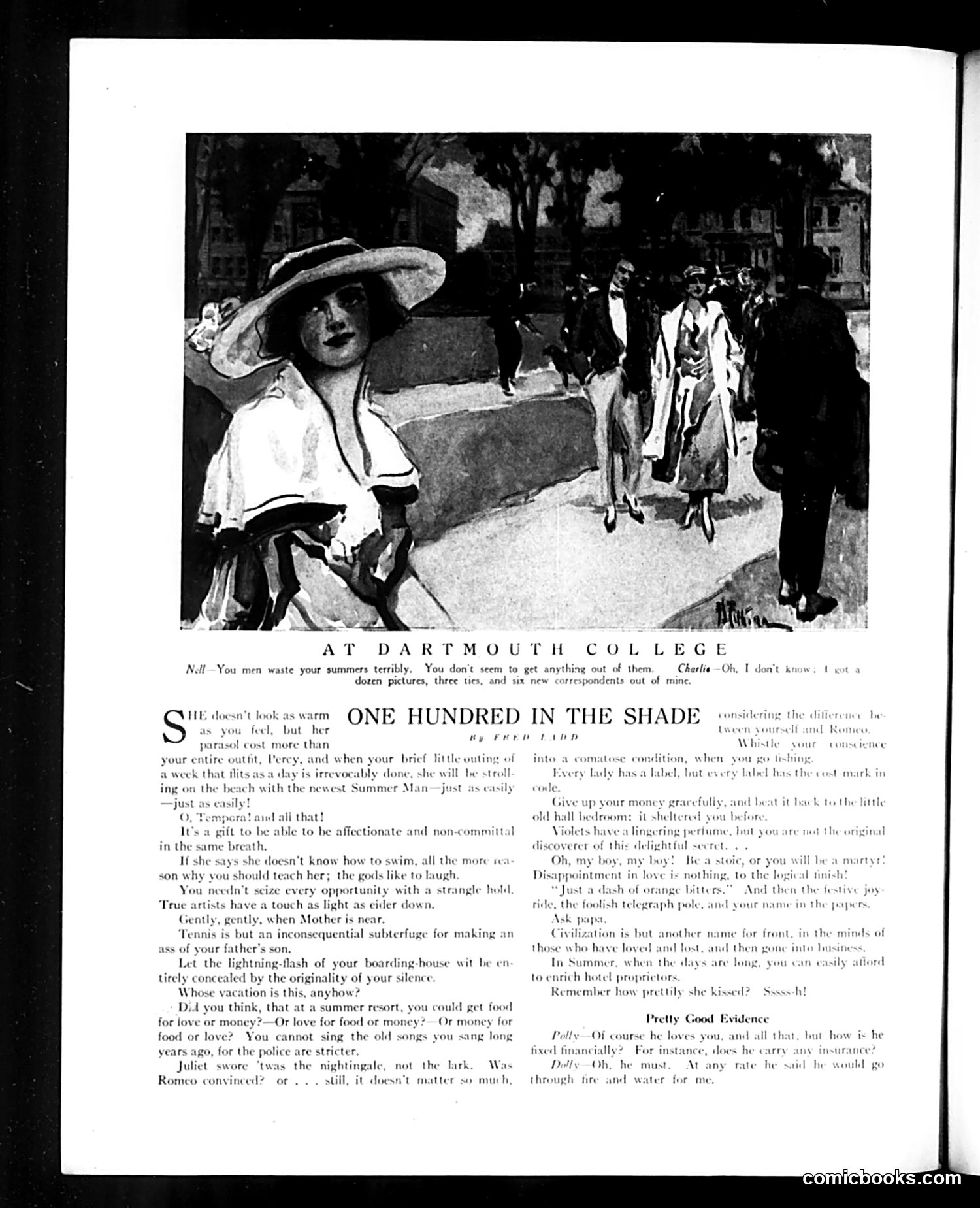
This page from *Judge* satirizes summer romance and courtship at an elite college resort. The photograph shows a woman in an elaborate wide-brimmed hat at what appears to be a fashionable seaside venue, surrounded by formally dressed men and women. The text mocks young men's summer flirtations through fictional dialogues. It ridicules wealthy college boys who pursue romantic dalliances without genuine commitment, spend lavishly on women while claiming poverty, and treat courtship as a casual game rather than serious intention. The satire targets their performative sophistication ("originality of your silence"), their theatrical romanticism (references to Romeo and Juliet), and their cynicism about love. The title "One Hundred in the Shade" likely refers to sweltering summer heat—a metaphor for the intensity and discomfort of romantic entanglement. The overall message critiques privileged youth culture's superficiality and the gap between romantic performance and sincere feeling.
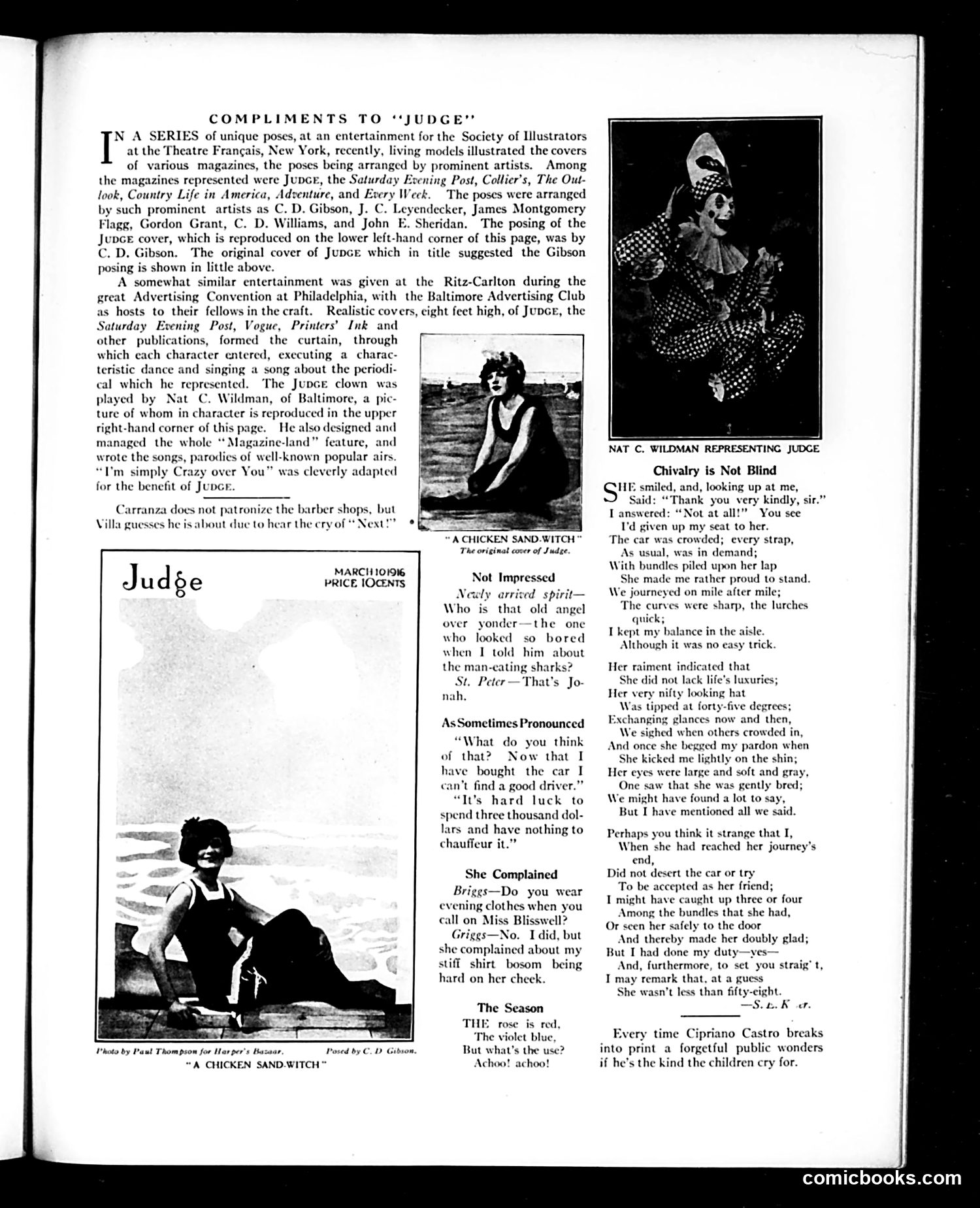
This page celebrates Judge magazine itself through content about a Society of Illustrators entertainment event in New York. The text describes "living models" posing as magazine covers—illustrating covers from Judge, Saturday Evening Post, Collier's, and others—arranged by prominent artists including C.D. Gibson. The main cartoon "A Chicken Sand-Witch" (lower left) appears to be a visual pun on the magazine's cover design. The page includes two humor pieces: one mocking a man who bought an expensive car but can't afford a driver, and another ("Chivalry is Not Blind") about a gentleman giving his streetcar seat to a well-dressed woman. The poem's irony is that despite her obvious wealth and status, he never follows up or offers further assistance—suggesting commentary on performative versus genuine courtesy. The photograph shows Nat C. Wildman, who performed as a "Judge clown" at a Philadelphia advertising convention, dancing and singing parodies.
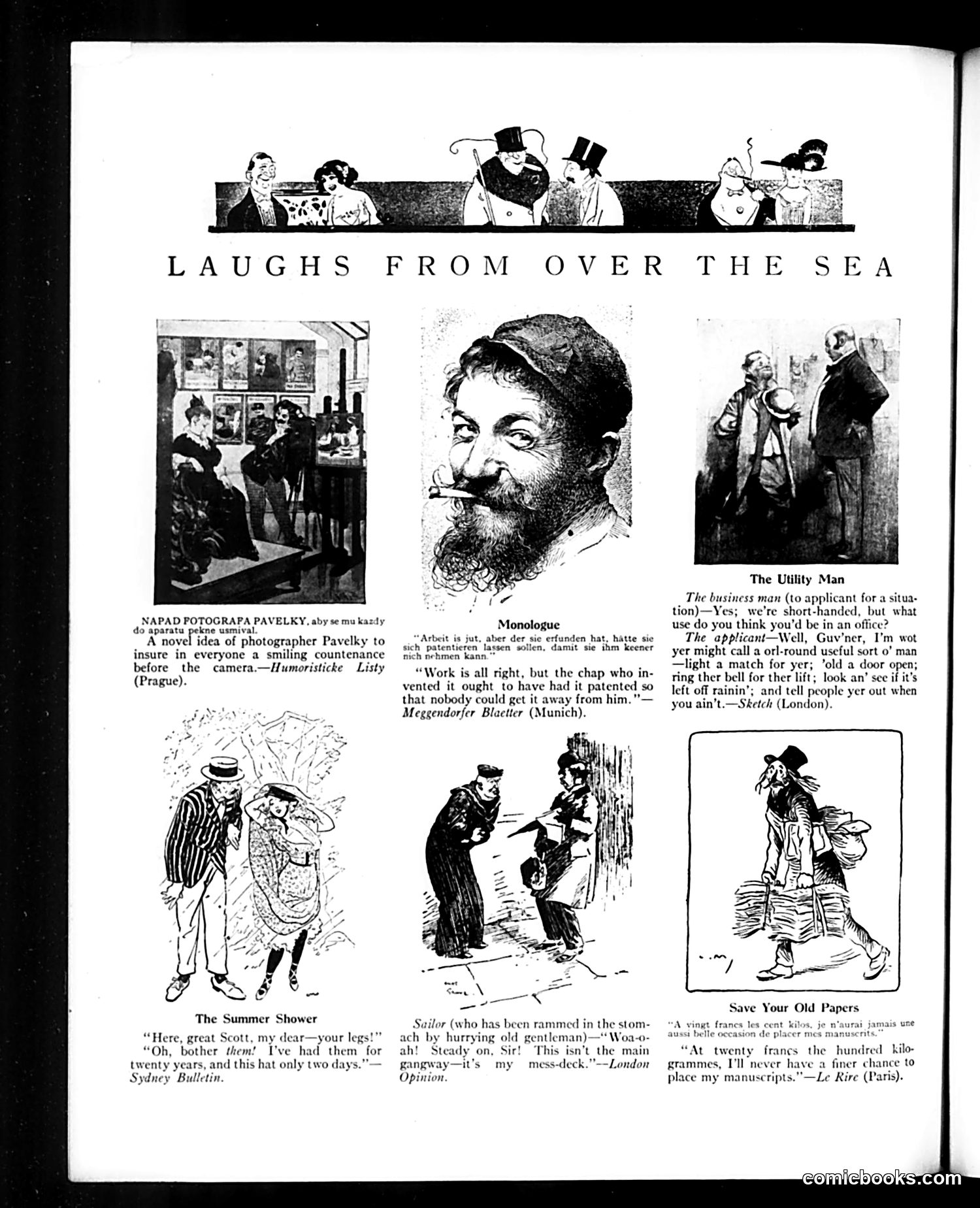
This page collects humorous cartoons and jokes translated from European publications, illustrating early 20th-century working-class and everyday life. **Key content:** - **Pavelky's camera trick** (Prague): A photographer forces subjects to smile by pinching them before photos—satirizing artificial posed portraits. - **Summer Shower** (Sydney): A woman complains about ruining a new hat while a man boasts of keeping his legs for twenty years—mocking vanity about fashion versus body parts. - **The Monologue** (Munich): A German speaker jokes that whoever invented work should have patented it to prevent others from using the concept—lampooning labor complaints. - **Sailor and gentleman** (London): Physical comedy about mistaking a narrow passageway for a main gangway. - **The Utility Man** (London): A desperate job applicant describes himself as useful only for menial tasks—dark humor about unemployment and class desperation. - **Save Old Papers** (Paris): A writer hopes to sell manuscript scraps for twenty francs per kilogram—satire on literary poverty.
This is a **full-page advertisement**, not satire or political commentary. It's a Schlitz beer marketing pitch using a nostalgic, maternal appeal. The ad compares beer preservation to how mothers stored fruit in dark cellars—positioning the brown bottle as protective packaging. The argument: light damages beer's nutritional value through chemical changes, just as it spoils fruit. Schlitz claims its brown bottles uniquely preserve quality "from the brewery to your glass." The tagline—"The Beer That Made Milwaukee Famous"—references Milwaukee's historical dominance in American beer production during Prohibition's end (1930s context likely). For modern readers: This represents vintage advertising's credibility-building through pseudo-scientific explanation and domestic nostalgia, appealing to consumers' trust in traditional preservation methods. The emphasis on "nutritive value" reflects Depression-era health marketing.
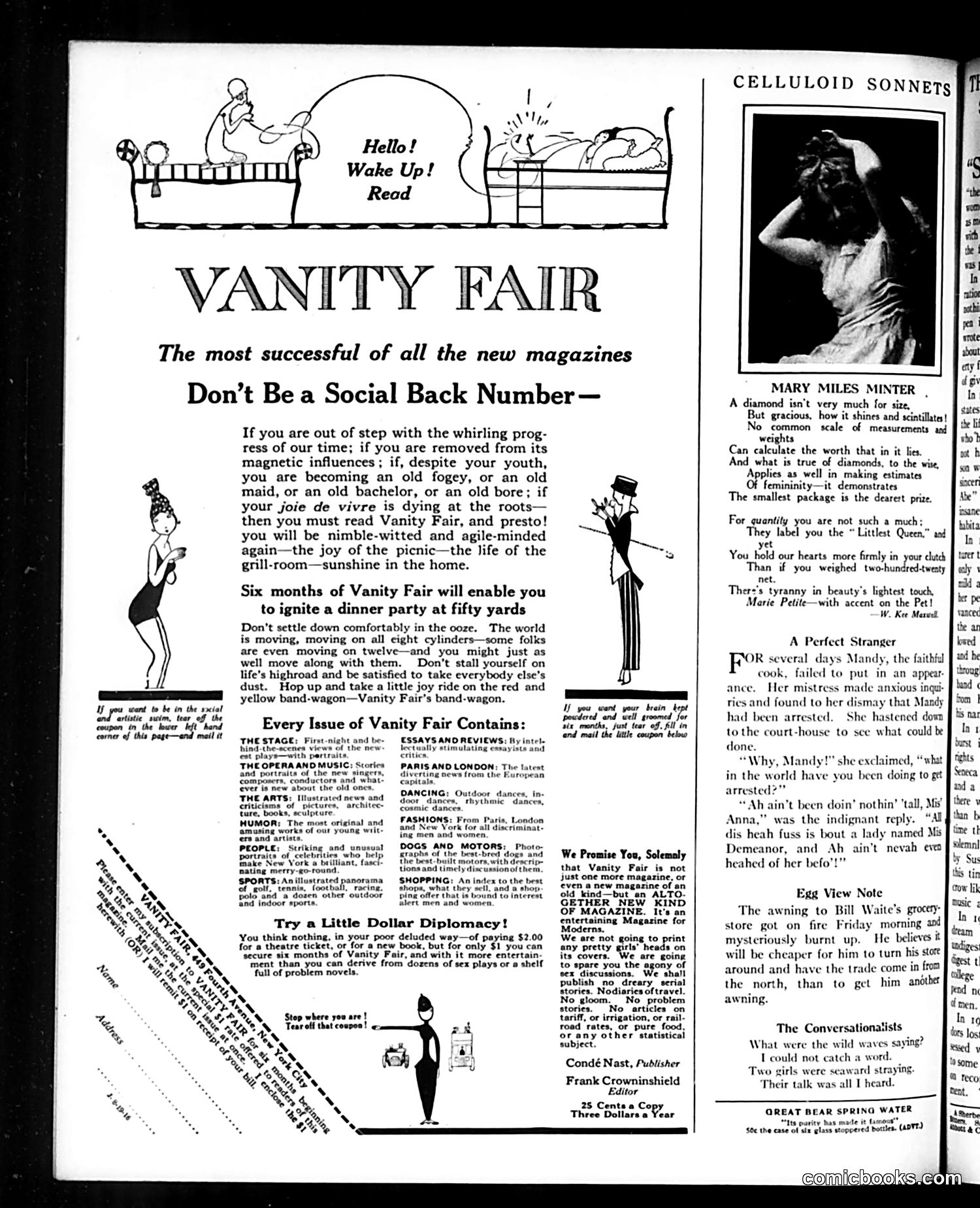
This is primarily a **magazine subscription advertisement**, not a political cartoon. The page promotes *Vanity Fair*, described as "the most successful of all the new magazines." ## Main Message The ad warns readers against becoming "social back numbers"—outdated people left behind by modern progress. It uses playful language about the world "moving on all eight cylinders" to pressure readers into subscribing for six months at one dollar. ## The Satire The humor lies in the exaggeration: Vanity Fair supposedly transforms dull people into witty dinner-party guests and provides the cultural knowledge needed to stay current. This gently mocks both modern anxiety about obsolescence and the magazine industry's marketing tactics. ## Content Promises The ad lists *Vanity Fair*'s features: theater, arts, humor, fashion, sports, dancing, dogs, and motors—positioning it as essential reading for sophisticated, modern people. The page also includes a poem about actress Mary Miles Minter, typical of period magazine content. Overall, this reflects 1920s consumer culture and magazine publishing competition rather than political satire.
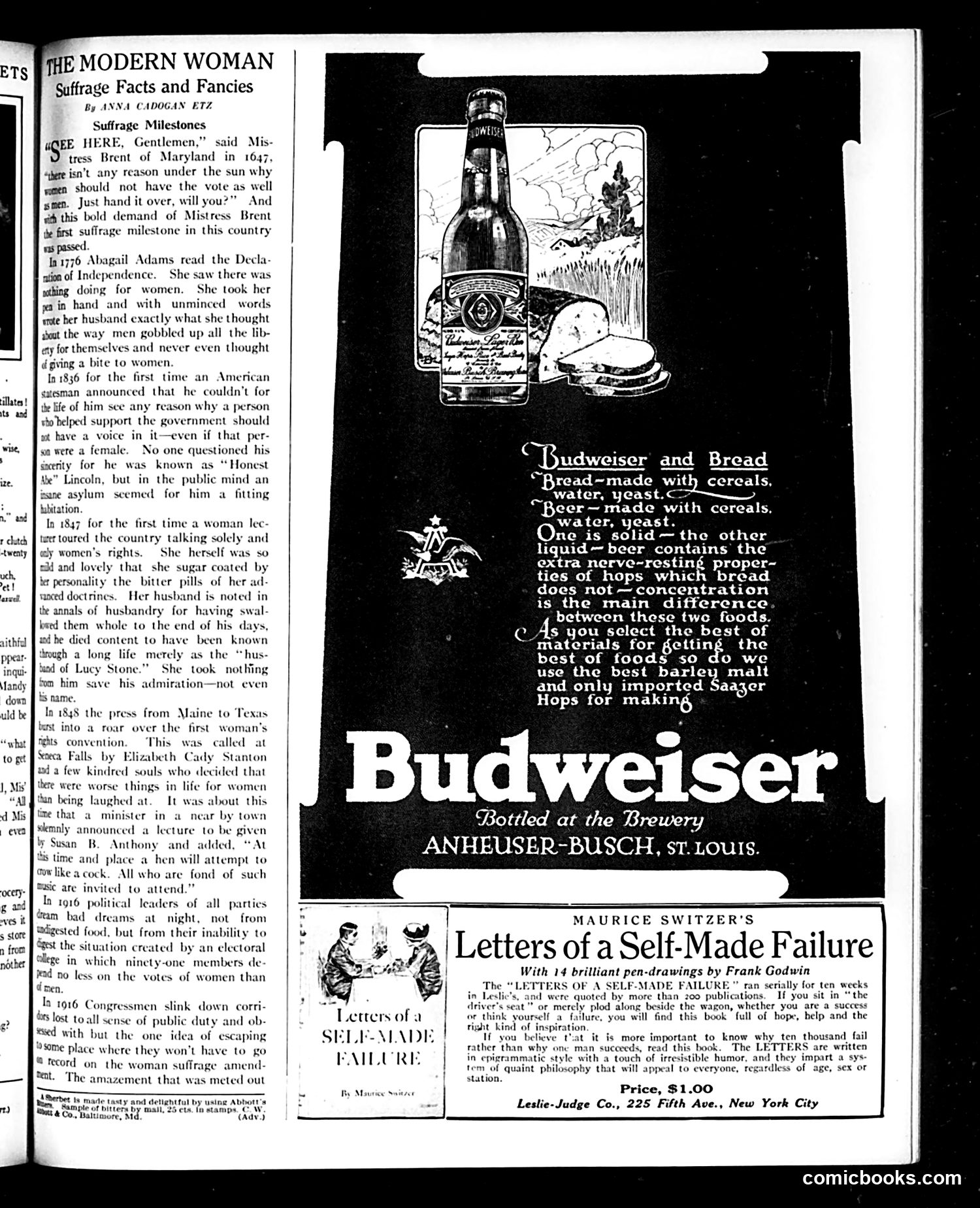
This page combines a serious suffrage history article with period advertising, offering insight into early 20th-century attitudes. **"The Modern Woman" Article**: Anna Cadogan Etz presents a chronological defense of women's suffrage through historical "milestones"—from Mistress Brent's 1647 demand for voting rights through 1847's first woman lecturer on women's rights (likely referring to Frances Wright). The tone is earnest advocacy, culminating in 1916 congressmen "slinking down" to avoid suffrage votes—satirizing male politicians as cowardly obstructionists. **The Advertisements**: Notably, the Budweiser ad emphasizes beer's nutritional parallels to bread, while "Letters of a Self-Made Failure" promises inspirational reading. These appear incongruous with suffrage content, typical of Judge's mixed editorial-commercial format. **Historical Context**: This likely dates near the 19th Amendment's 1920 passage. The article frames suffrage as logical historical progression, while the desperate tone regarding congressional resistance suggests the fight remained contentious even as victory approached.
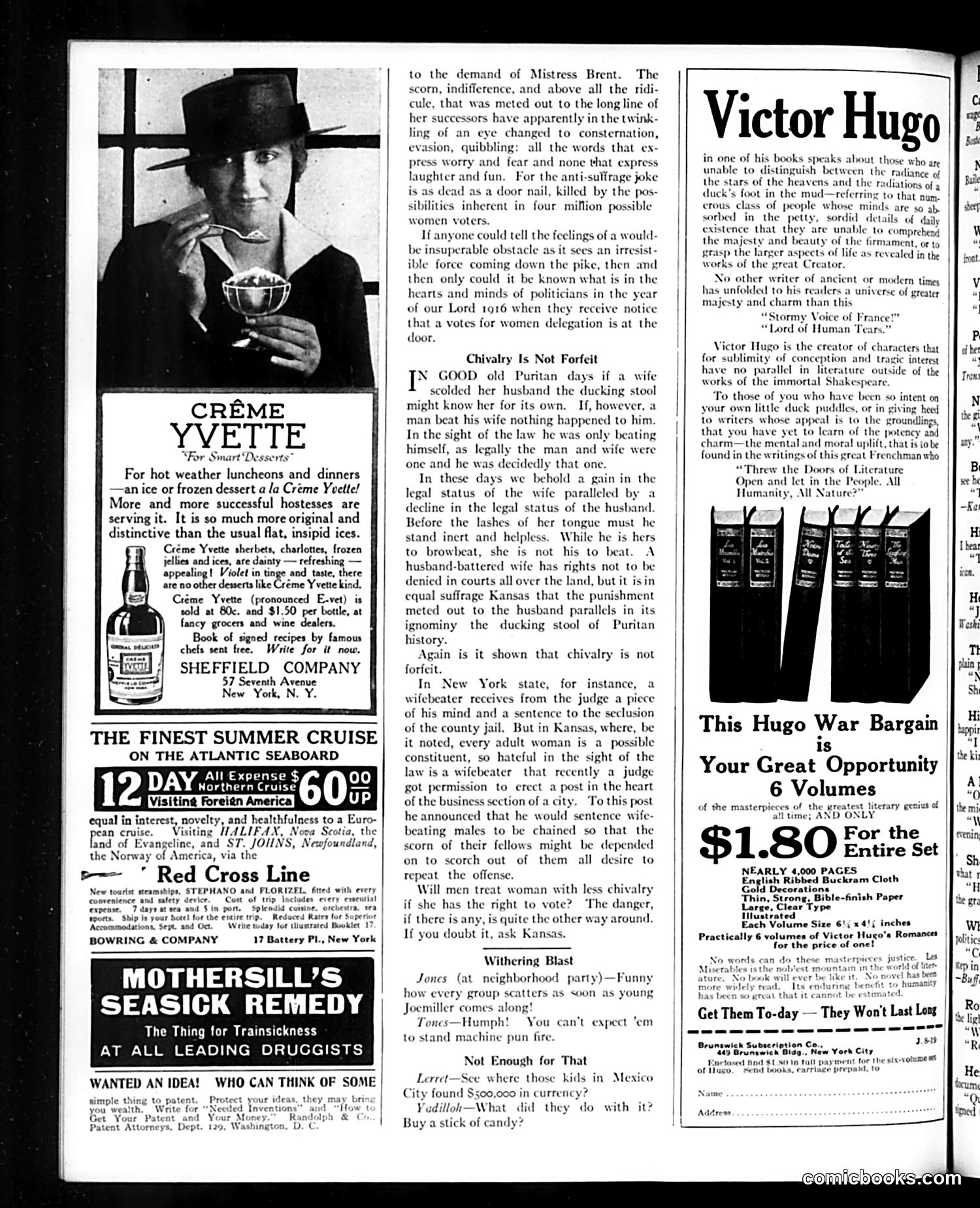
This Judge magazine page contains satirical commentary on women's suffrage (voting rights), a major political issue in 1916. The text argues that politicians' dismissive attitudes toward women voters—previously treated as a joke—have suddenly become serious now that four million women may gain the vote. The piece then pivots to "Chivalry Is Not Forfeit," examining how legal protections for women have advanced while male authority has declined. It contrasts Puritan-era laws (where wives could be publicly punished for nagging) with modern protections against domestic abuse—particularly highlighting Kansas, which had granted women suffrage. The satire suggests that male dominance is eroding: husbands now face legal consequences for beating wives, while wives cannot be beaten in return. The underlying argument critiques the loss of traditional male authority under women's political empowerment, presented with dark irony rather than straightforward advocacy.
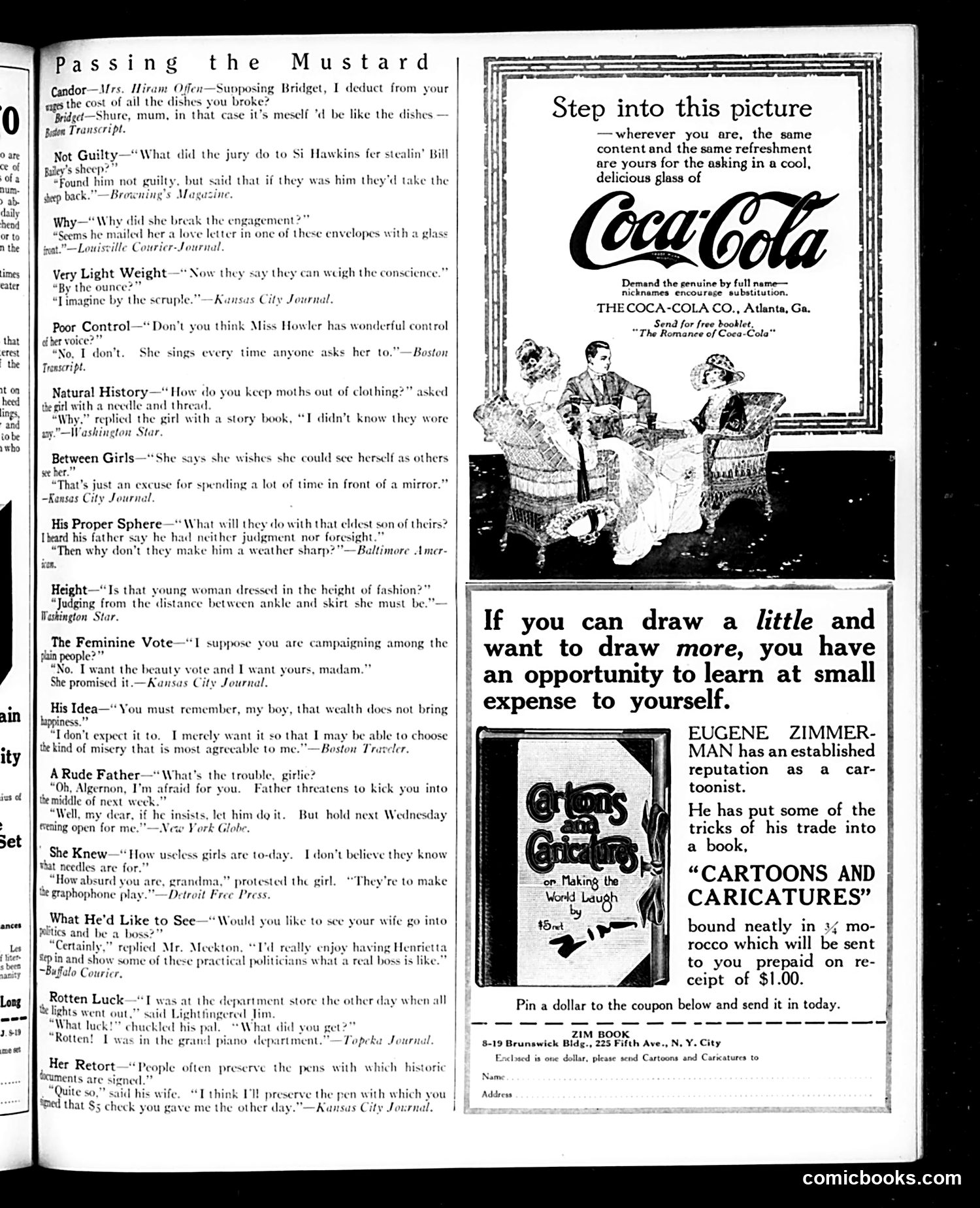
This page contains a collection of brief satirical jokes typical of early 20th-century American humor magazines. The left column features short quips on social topics: servants and household management (the Bridget/Mrs. Offen exchange), legal incompetence, romantic mishaps, women's fashion (the ankle-to-skirt distance joke), and gender roles. The right side contains a **Coca-Cola advertisement** showing socialites enjoying the beverage, and an advertisement for Eugene Zimmerman's instructional cartooning book. The satire targets: working-class Irish servants, judicial foolishness, women's vanity and uselessness ("How useless girls are to-day"), fashion absurdity, and domestic power dynamics. Most jokes assume upper-middle-class readers who would find humor in servants' malapropisms and women's frivolity. The overall tone reflects period prejudices now considered offensive.
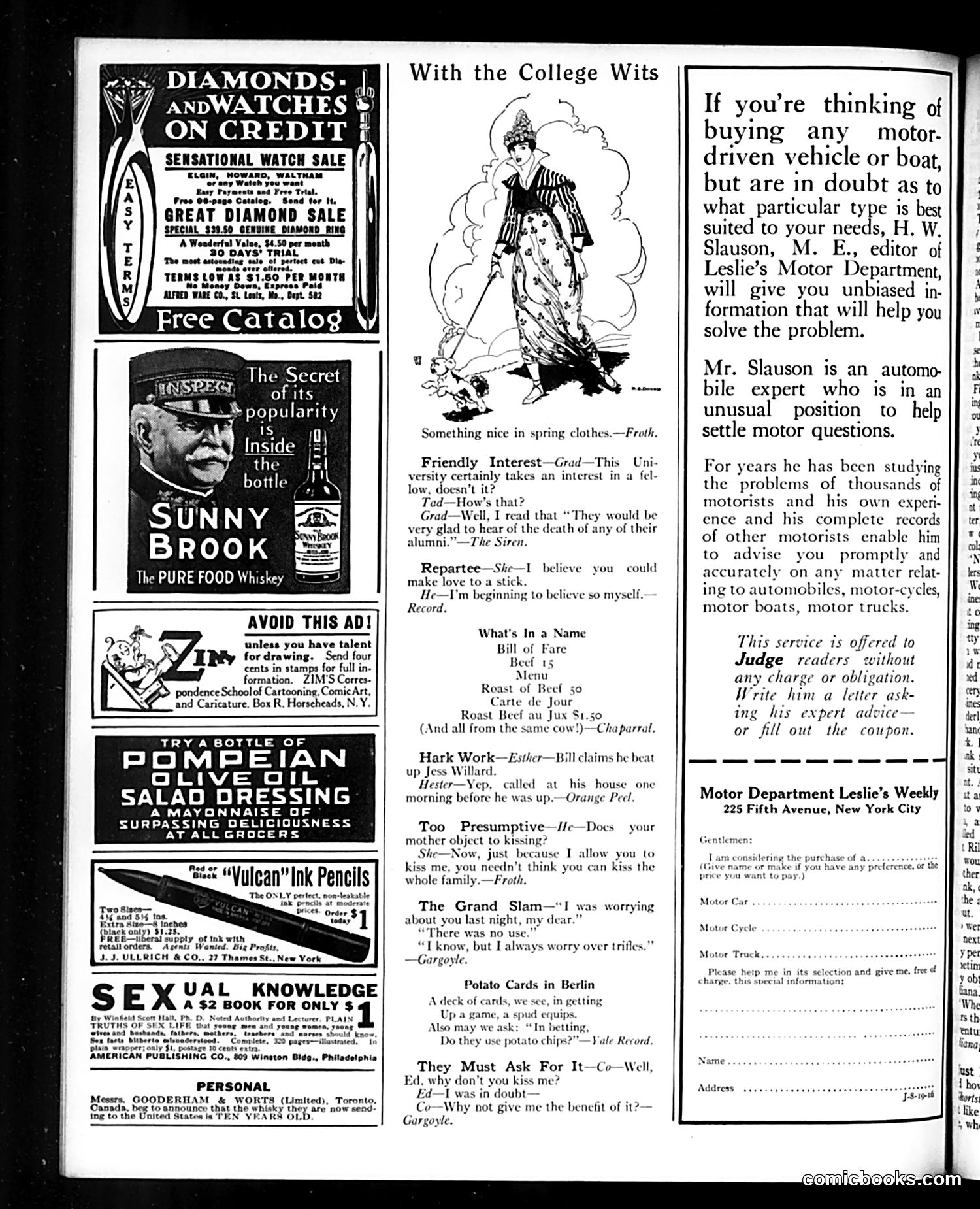
This page from *Judge* is primarily **advertisements and miscellaneous content** rather than coherent satire or editorial cartoons. The ads include diamonds/watches on credit, Sunny Brook whiskey, and Pompeian salad dressing—typical early-20th-century consumer goods targeting middle-class readers. A drawing of a fashionably-dressed woman with the caption "Something nice in spring clothes" appears to be a generic fashion reference. The bulk of the page consists of **"College Wits"** humor—brief, punchy jokes allegedly from university publications like *Froth*, *The Siren*, and *Gargoyle*. These are largely corny one-liners about romance, boxing, family dynamics, and wordplay (e.g., a restaurant's identical dishes with fancy French names). A notable section promotes **H.W. Slauson's motor advice service** from *Leslie's Weekly*, offering unbiased guidance on purchasing vehicles. The page is cluttered, advertising-heavy, and lacks the sharp political or social satire *Judge* occasionally featured. It's largely filler and commercial matter typical of early-20th-century magazine publications.
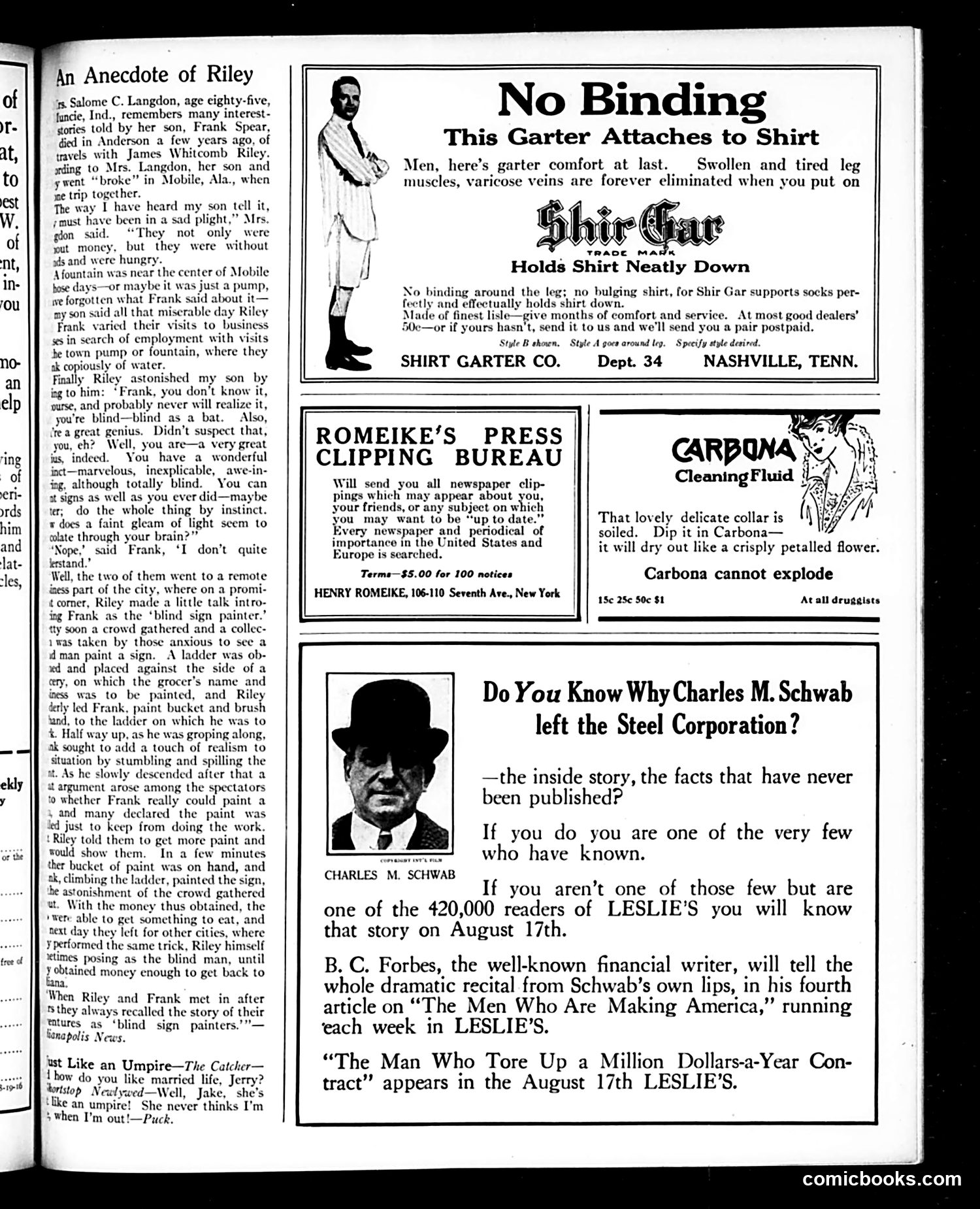
This page consists primarily of **advertisements and a narrative anecdote**, rather than political satire. **Main Content:** The lead article, "An Anecdote of Riley," recounts a story about poet James Whitcomb Riley (a famous American writer of the era). According to the anecdote, Riley and his companion Frank posed as a blind sign painter to solicit donations from crowds in Mobile, Alabama. The "blind" painter would deliberately spill paint and stumble, creating spectacle that drew charitable contributions. They repeated this con in multiple cities to fund their travels. **The Point:** This appears presented as a humorous tale of resourcefulness and Riley's cleverness—essentially celebrating a scam as folk-hero behavior. By modern standards, it reads as exploitative (mocking blindness for profit), but the piece treats it as amusing ingenuity. **Advertisements:** The page also features typical period ads for shirt garters, a press clipping service, and cleaning fluid—standard commercial content with no satirical intent. The Charles M. Schwab advertisement at bottom teases an upcoming article about his departure from U.S. Steel.
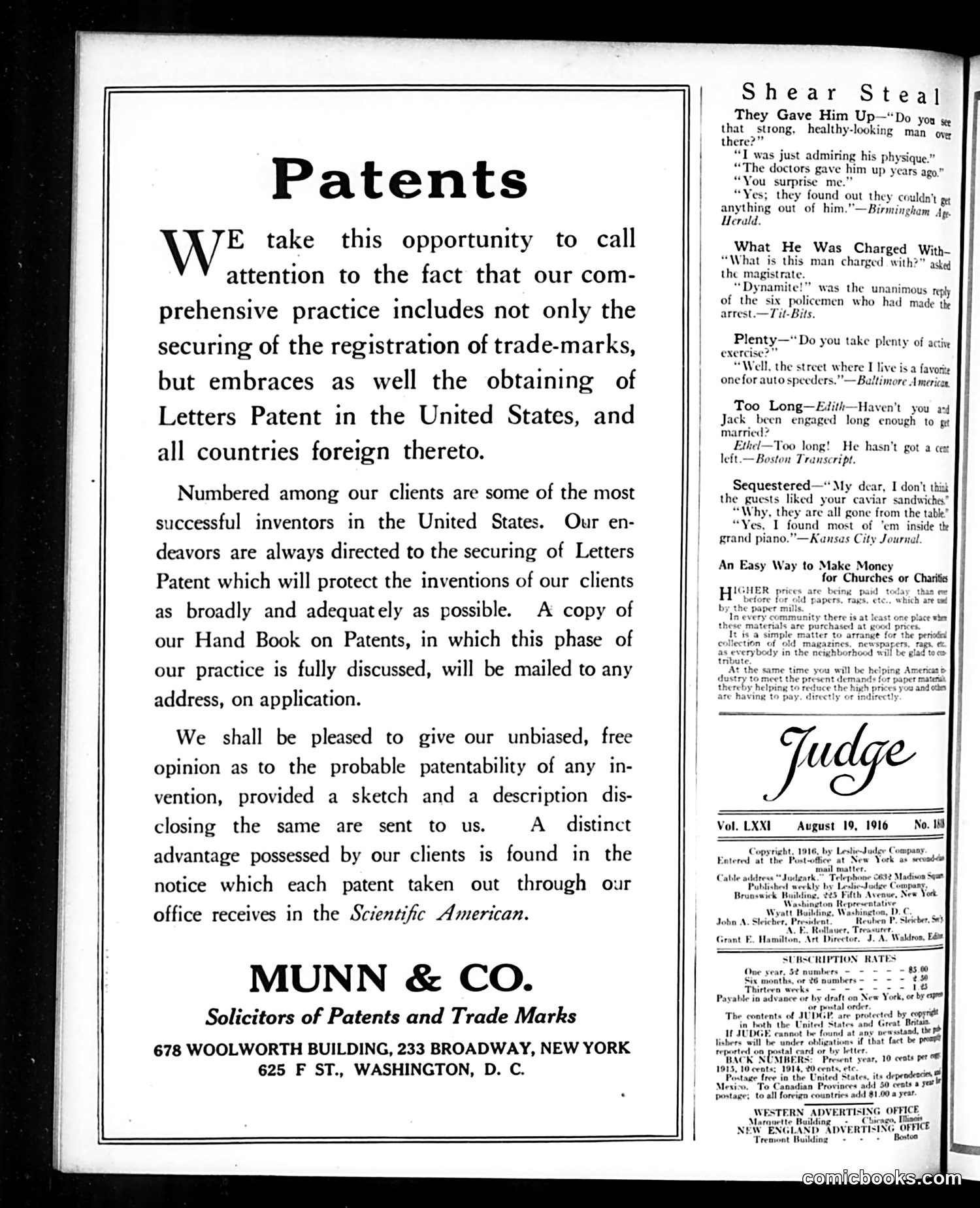
This page is primarily **advertising and humor content**, not political satire requiring historical context. **Left side:** A full-page advertisement for Munn & Co., a patent and trademark law firm. It promotes their services securing Letters Patent and trade-mark registration, claiming successful inventor clients and offering free patentability opinions. This is straightforward commercial advertising. **Right side:** A collection of brief joke fillers typical of *Judge* magazine's humor pages: - **"They Gave Him Up"**: A doctor joke playing on the phrase "gave him up"—doctors abandoned treating a patient who turned out fine, implying he was worthless/unprofitable. - **"What He Was Charged With"**: Wordplay on "dynamite" (the explosive vs. slang for something exciting). - **"Plenty," "Too Long," "Sequestered"**: Domestic/social humor with mild romantic and marital themes. These are lighthearted, throwaway jokes requiring no specific historical knowledge—just period-appropriate humor about doctors, courtship, and social situations.
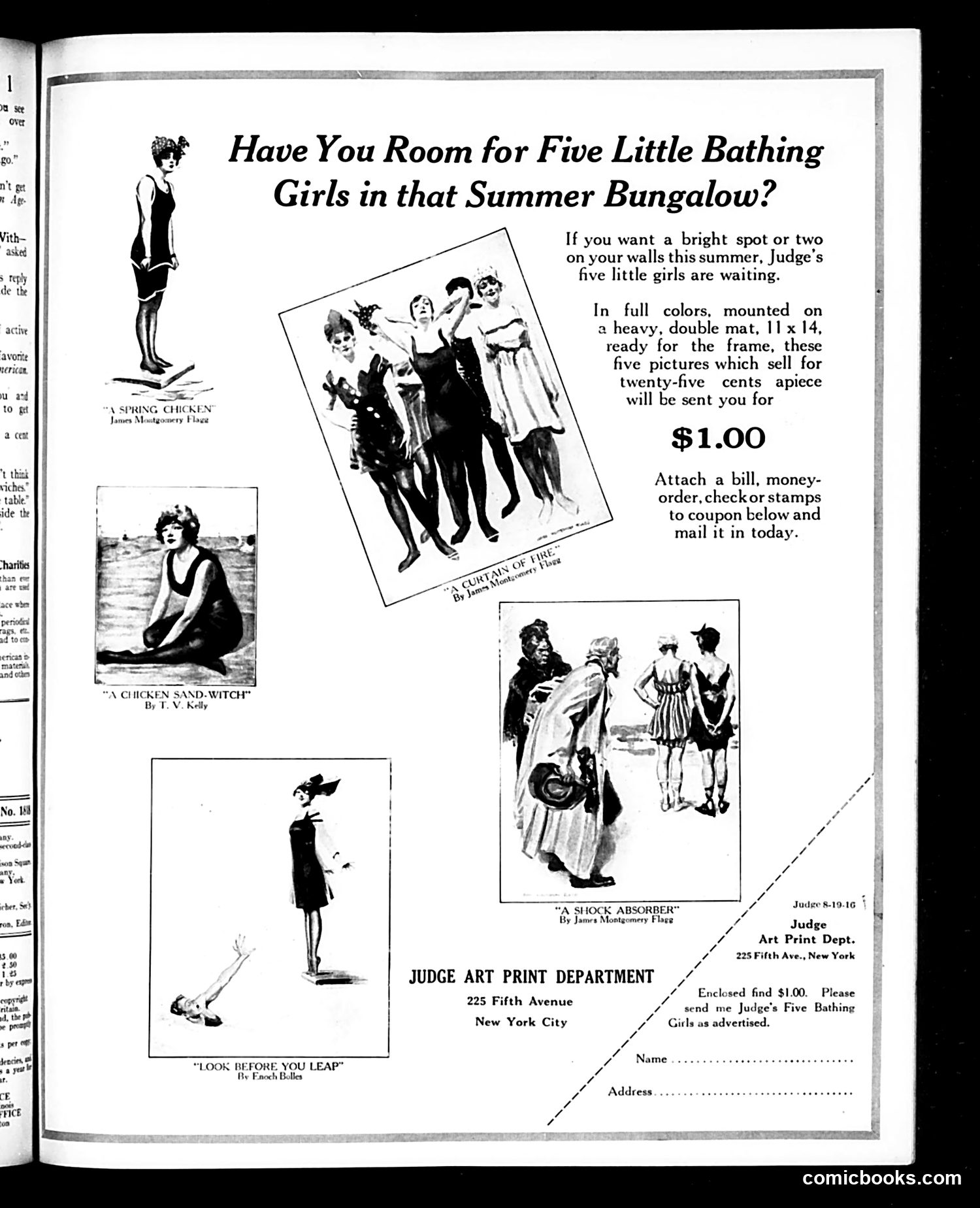
This is primarily **advertising**, not political satire. Judge magazine is selling illustrated prints of "five bathing girls" by prominent illustrator James Montgomery Flagg for $1.00 (five 25-cent pictures bundled as a promotional offer). The page includes three sample illustrations by Flagg: "Spring Chicken," "A Chicken Sand-Witch," and "Look Before You Leap"—all featuring stylized young women in various situations. These showcase Flagg's popular illustration style of the era. The humor is light and social rather than political: the ad uses a gentle double entendre ("Have You Room for Five Little Bathing Girls in that Summer Bungalow?") to pitch wall art to summer homeowners. The "bathing girls" theme reflects 1910s popular culture's fascination with modern, leisure-oriented imagery of young women. This represents how magazines monetized content through mail-order print sales, a common early-20th-century marketing practice.
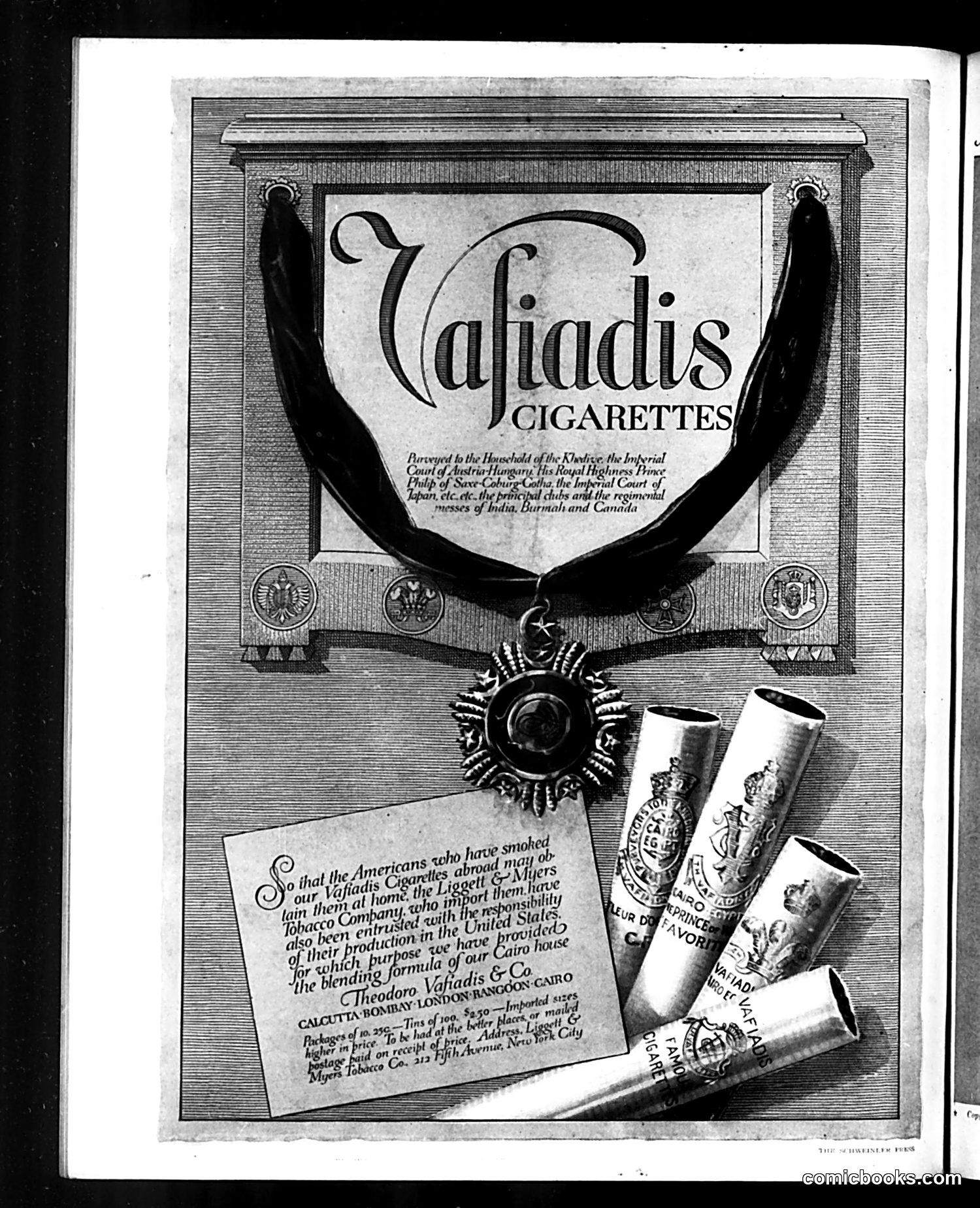
This is a **Valiadis Cigarettes advertisement**, not political satire. The ad features an ornate design with a medal and black ribbon, emphasizing royal patronage—listing approval from various imperial households (Austria-Hungary, Japan, etc.) and institutional endorsements from British colonial territories (India, Burma, Canada). The accompanying text claims American smokers preferred Valiadis cigarettes abroad, and that the company has secured exclusive rights to their "Cairo house blending formula." The displayed cigarette packages show coat-of-arms imagery reinforcing aristocratic prestige. This reflects early 20th-century marketing strategy: selling cigarettes through association with European nobility and imperial authority rather than through health claims. The Judge magazine placement suggests it's targeting affluent, cosmopolitan readers impressed by foreign sophistication and royal approval.