
Judge, 1916-08-19 · page 10 of 28
Judge — August 19, 1916 — page 10: what you’re looking at
What you’re looking at
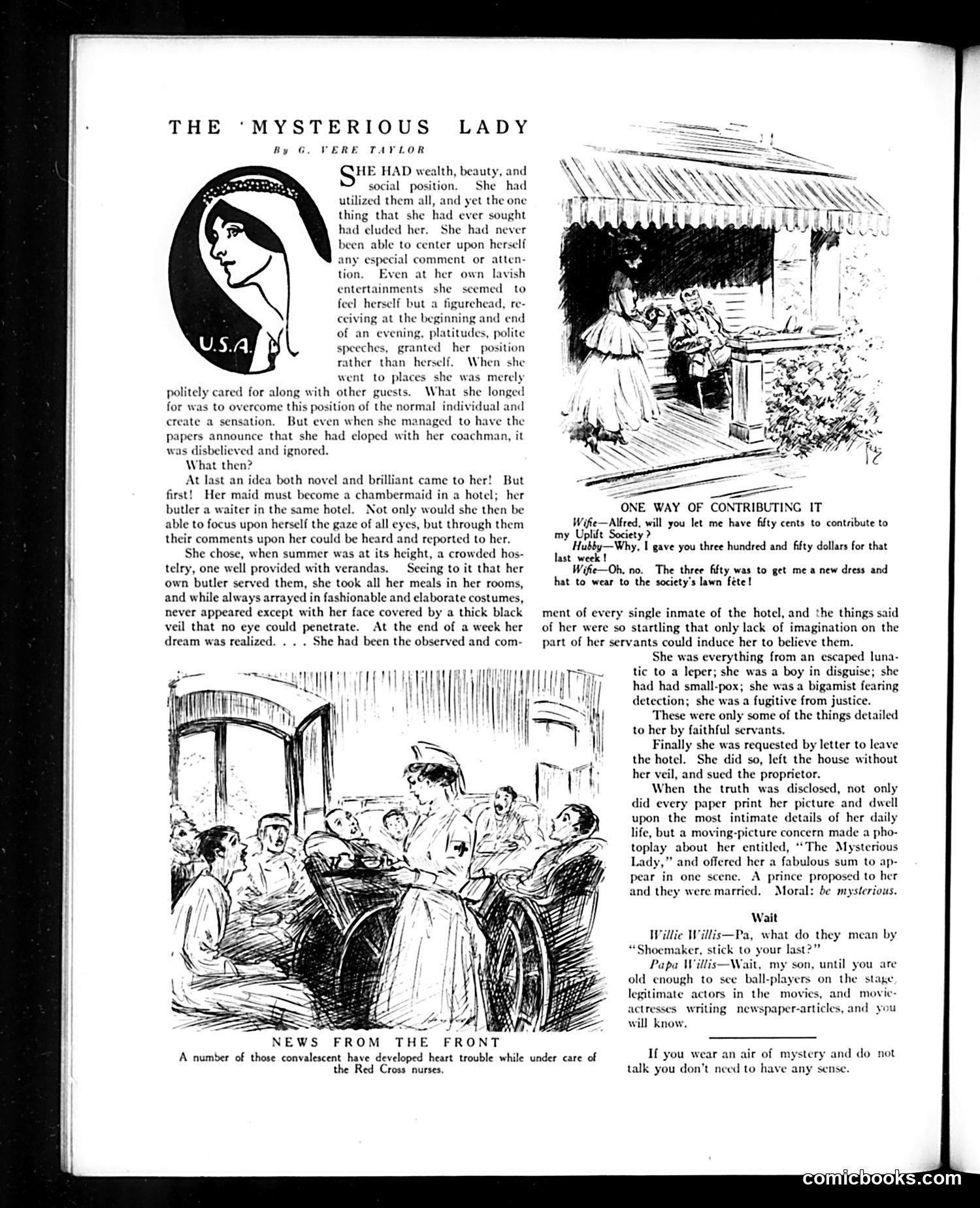
This short story satirizes early 20th-century culture's obsession with mystery and celebrity. The protagonist, a wealthy woman desperate for attention, hires servants to work undercover at a hotel while she wears a black veil, creating wild rumors about her identity—claiming she's a leper, fugitive, or boy in disguise. The satire's point: once the truth emerges, newspapers and moving-picture companies exploit her story anyway, making her famous through exposure rather than mystery. A prince even proposes. The moral explicitly warns that appearing mysterious while saying nothing is sufficient to gain attention and success in society. The accompanying joke about "uplift societies" mocks frivolous charitable causes, while the dialogue at page's end reinforces the theme: **ignorance coupled with an air of mystery requires no actual intelligence to succeed** in modern culture. The satire targets media sensationalism, celebrity culture, and shallow social values of the 1910s era.
📄 Transcribed text from this page (OCR, searchable)
Machine-transcribed from the original scan — historical spelling and the odd misread are preserved.
‘MYSTERIOUS LADY VERE TAYLOR HE HAD wealth, beauty, and social position. She had utilized them all, and yet the one thing that she had ever sought had eluded her. She had never been able to center upon herself any especial comment or atten- tion, Even at her own lavish entertainments she seemed to feel herself but a figurehead, re- ceiving at the beginning and end of an evening, platitudes, polite speeches, granted her position rather than herself. When she went to places she was merely politely cared for along with other guests. What she longed for was to overcome this position of the normal individual and create a sensation. But even when she managed to have the papers announce that she had eloped with her coachman, it was disbelieved and ignored. What then? At last an idea both novel and brilliant came to her! But first! Her maid must become a chambermaid in a hotel; her butler a waiter in the same hotel. Not only would she then be able to focus upon herself the gaze of all eyes, but through them their comments upon her could be heard and reported to her. She chose, when summer was at its height, a crowded hos- telry, one well provided with verandas. Seeing to it that her own butler served them, she took all her meals in her rooms, and while always arrayed in fashionable and elaborate costumes, never appeared except with her face covered by a thick black veil that no eye could penetrate. At the end of a week her dream was realized. . . . She had been the observed and com- THE By G. MATT iis NEWS FROM THE FRONT A number of those convalescent have developed heart trouble while under care of the Red Cross nurses. ONE WAY OF CONTRIBUTING IT Wifte—Alfred, will you let me have fifty cents to contribute to my Uplift Society > Hubby—Why, | gave you three hundred and fifty dollars for that last week ! Wifle—Oh, no. The three fifty was to get mea new dress and hat to wear to the society's lawn fete! ment of every single inmate of the hotel, and the things said of her were so startling that only lack of imagination on the part of her servants could induce her to believe them. She was everything from an escaped luna- {|| nn tic to a leper; she was a boy in disguise; she iN had had small-pox; she was a bigamist fearing detection; she was a fugitive from justice. These were only some of the things detailed to her by faithful servants. Finally she was requested by letter to leave the hotel. She did so, left the house without her veil, and sued the proprietor. When the truth was disclosed, not only did every paper print her picture and dwell upon the most intimate details of her daily life, but a moving-picture concern made a pho- toplay about her entitled, ‘The My: Lady,” and offered her a fabulous sum to ap- pear in one scene. A prince proposed to her and they were married. Moral: be mysterit Wait 'is—Pa, what do they mean by “ Shoemaker, to your last?” Papa Willis—Wait, my son, until you are old cnough to see ball-pla; on the stage legitimate actors in the mo and movie- actresses writing newspaper-articles, and you will know. If you wear an air of mystery and do not talk you don’t need to have any sense.