
A complete issue · 28 pages · 1916
Judge — August 5, 1916
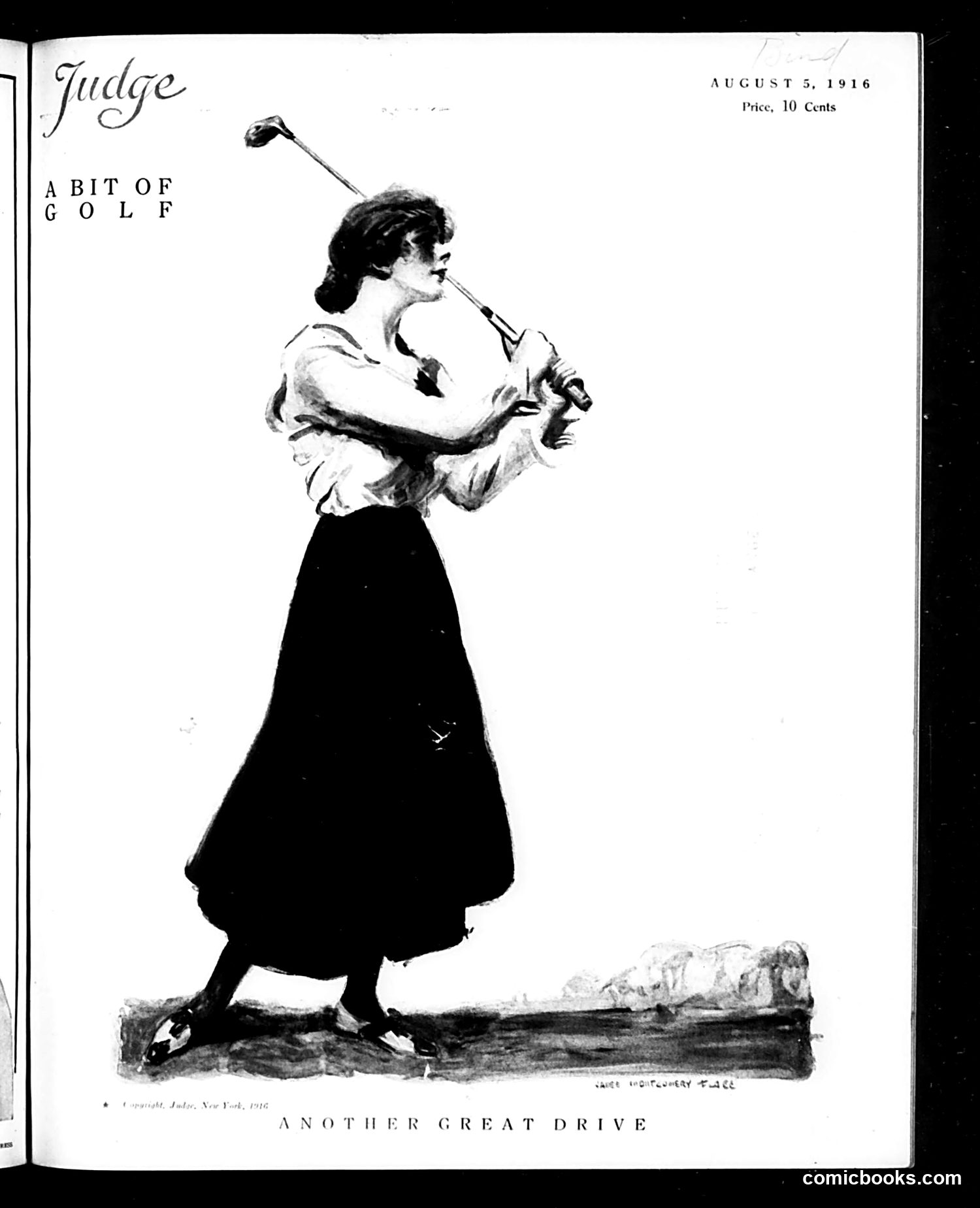
This cover satirizes women's participation in golf, a sport traditionally reserved for men. The illustration shows a fashionably dressed woman in an elegant skirt and blouse, confidently holding a golf club in mid-swing stance. The caption "Another Great Drive" suggests she's successfully executing a golf shot. The satire likely targets either: (1) the novelty of women taking up golf in the early 1900s, which society viewed as unconventional or amusing, or (2) the contrast between women's restrictive formal clothing and the athletic demands of the sport. The title "A Bit of Golf" implies this is presented as a minor, perhaps frivolous female pursuit rather than serious athletic endeavor—typical of how Judge magazine mocked social changes and gender role challenges of the era.
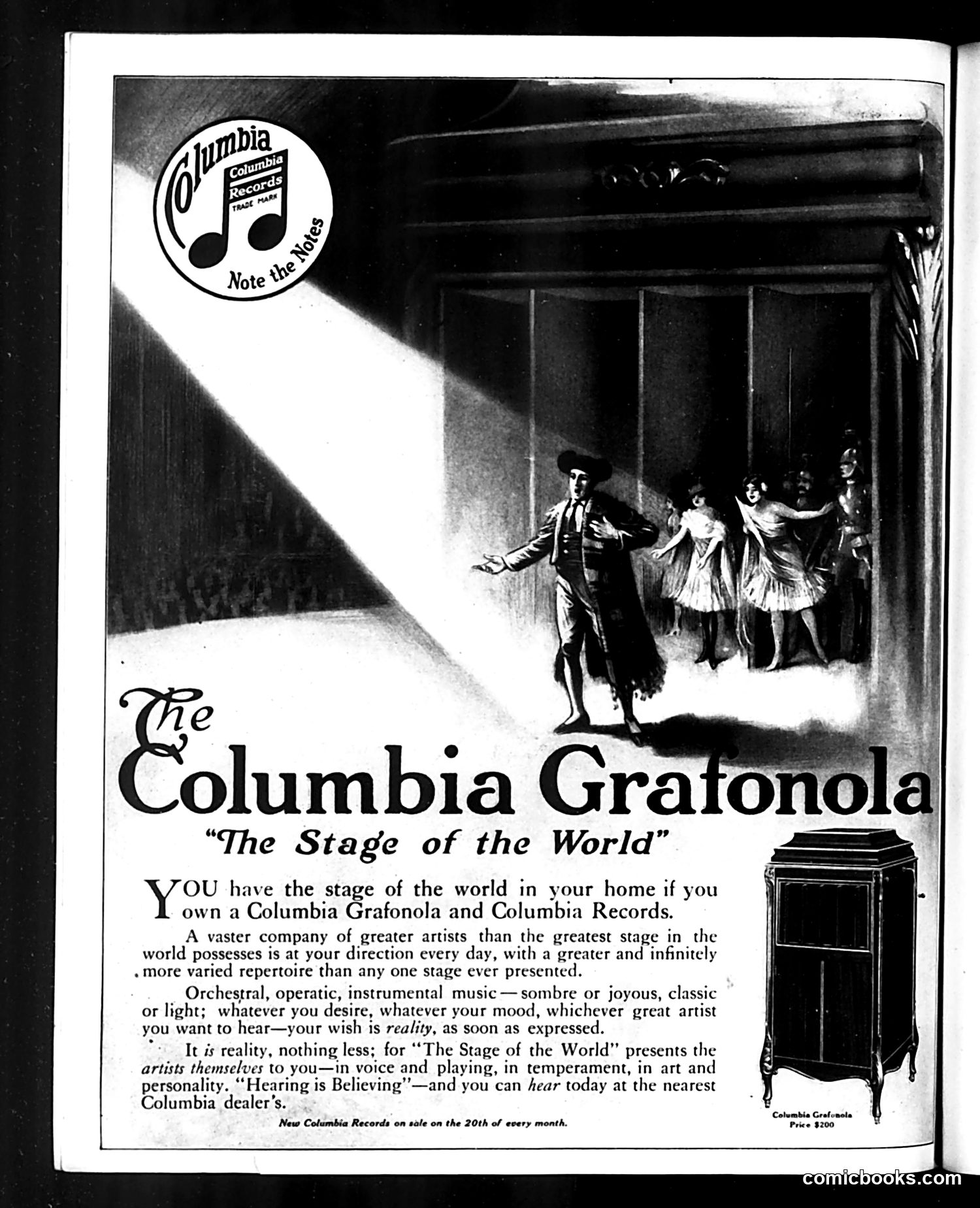
This page is **primarily advertising, not satire or commentary**. It's a full-page advertisement for the Columbia Grafonola phonograph and Columbia Records. The ad features theatrical imagery—a stage scene with performers in spotlight—to pitch the device as "The Stage of the World." The marketing copy claims that owning a grafonola brings concert-hall quality entertainment into the home, offering "a vaster company of greater artists than the greatest stage in the world." The dramatic illustration and language reflect early 20th-century consumer marketing that positioned phonographs as luxury items bringing high culture to middle-class households. The price listed ($200) was substantial for the era. This is commercial content, not political or social satire typical of *Judge* magazine's editorial material.
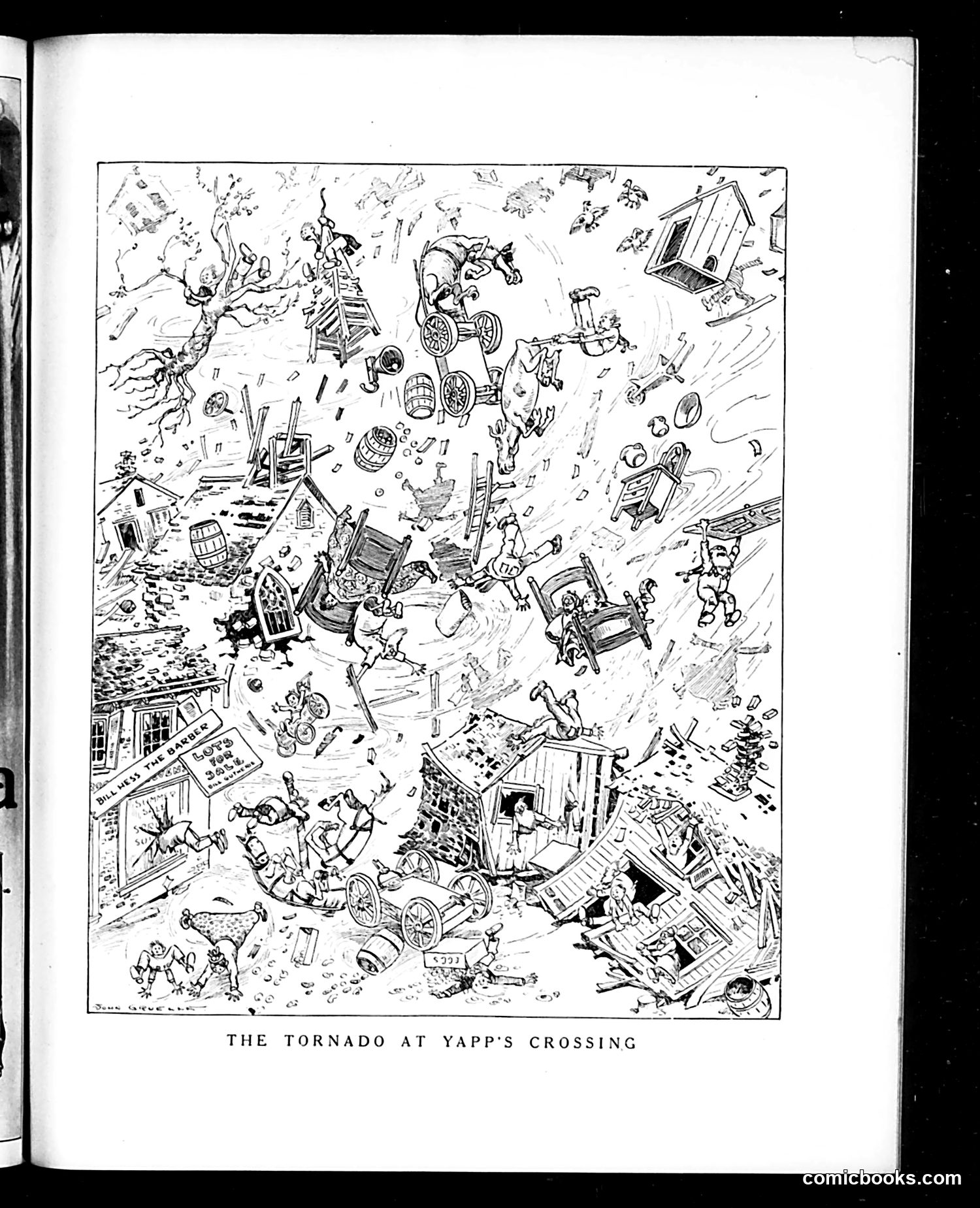
This satirical cartoon depicts complete chaos and destruction at what appears to be a rural crossroads or small town. The illustration shows buildings demolished, vehicles overturned, people scattered and tumbling through the air, household goods flying everywhere, and general pandemonium—all seemingly caused by a tornado. The satire likely comments on either: 1. A specific newsworthy tornado event that occurred at an actual place called "Yapp's Crossing," or 2. The broader theme of unpredictable natural disaster striking an unprepared community The chaotic, densely-packed composition emphasizes the indiscriminate destruction and human helplessness before such forces. Without additional context about when this was published or details about Yapp's Crossing, the precise historical reference remains unclear.
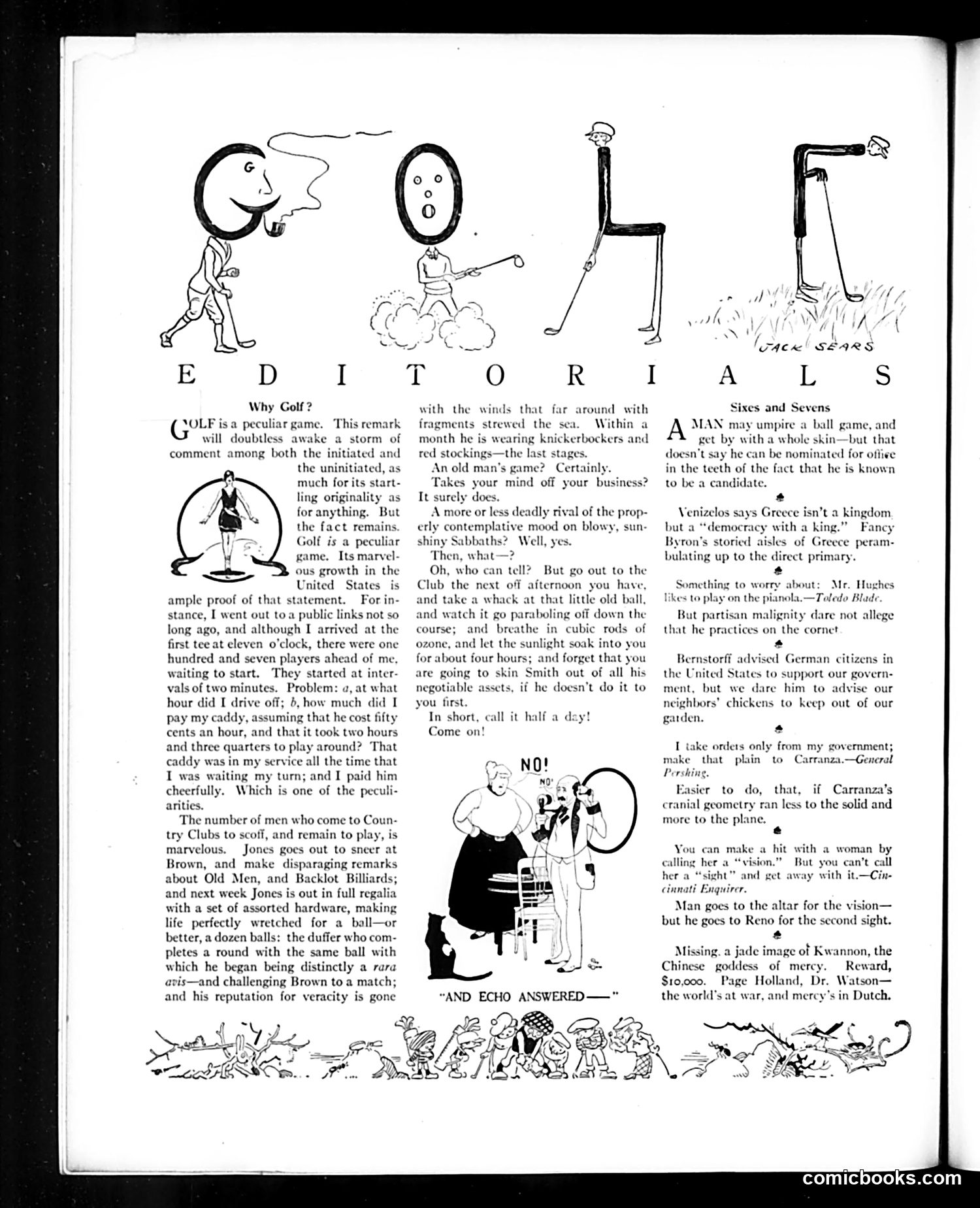
This page combines satirical commentary with humorous editorial observations. The top section spells "EDITORIALS" using stick figures in various poses—a visual pun on the word itself. The main "Why Golf?" article mocks golf as an peculiar American pastime, noting its strange growth in popularity despite being "a peculiar game." The author sarcastically catalogs golf's appeal while criticizing its waste of time and money. The subsequent editorial snippets attack various targets: Greek politics ("democracy isn't a kingdom"), German-American relations (German citizens advised to restrain neighbors), and military/political figures. One quip mocks romantic deception using gendered language typical of the era. The bottom cartoon shows a man refusing a bicycle, labeled "AND ECHO ANSWERED—'NO!'" The reference and specific meaning remain unclear without additional context.
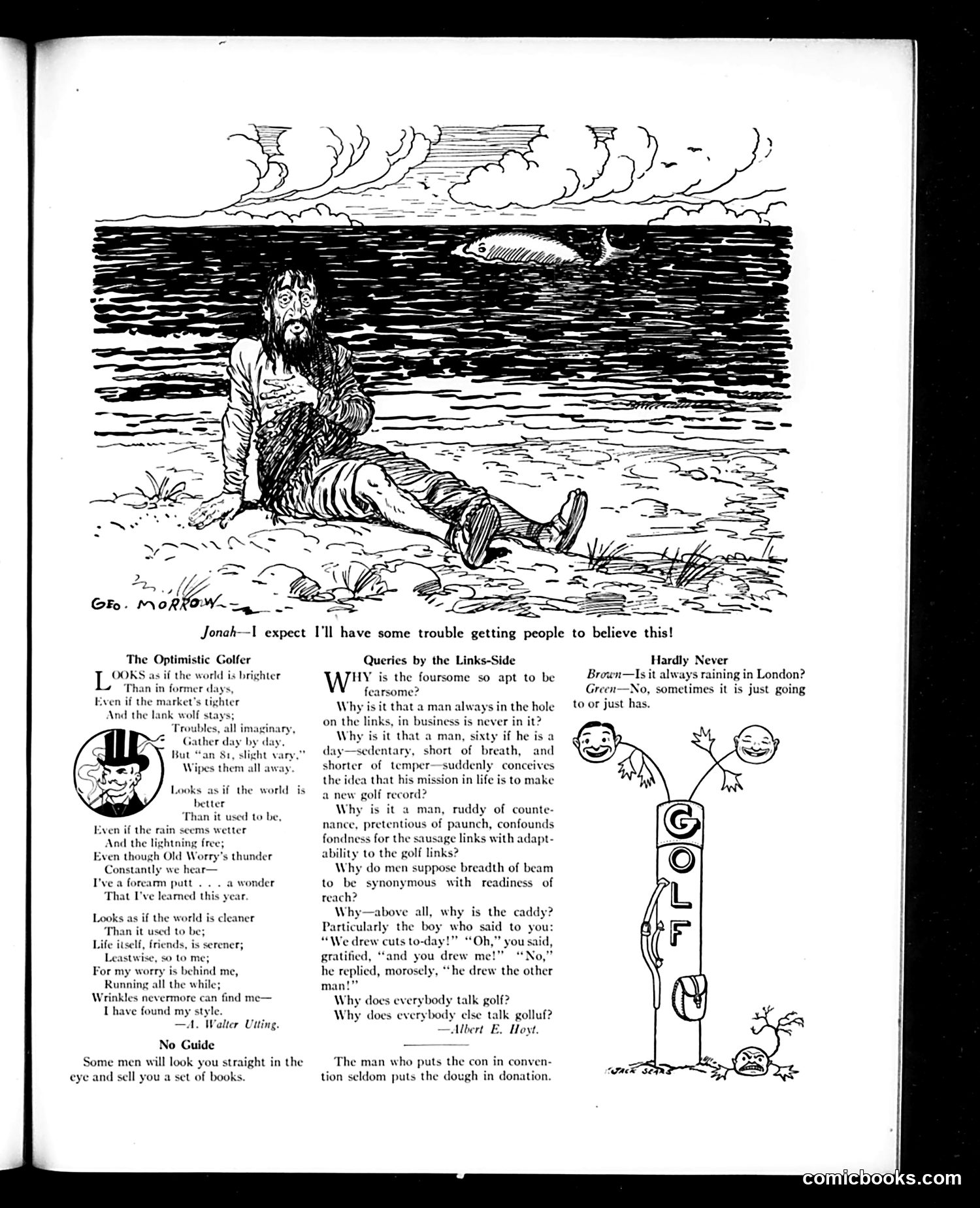
The main illustration shows a bearded man on a beach telling another figure, "Jonah—I expect I'll have some trouble getting people to believe this!" This references the Biblical story of Jonah and the whale, humorously suggesting the teller has experienced something equally improbable. Below are three sections of golf-related humor and philosophy: **"The Optimistic Golfer"** presents upbeat verses about life's brightness despite difficulties. **"Queries by the Links-Side"** contains humorous questions about golf's appeal and golfers' peculiar obsessions, credited to Albert E. Hoyt. **"Hardly Never"** features a simple cartoon with a character named "G. Golf" answering whether it rains in London. The page satirizes both golf culture's absurdity and Victorian-era optimism through lighthearted verse and comic commentary.
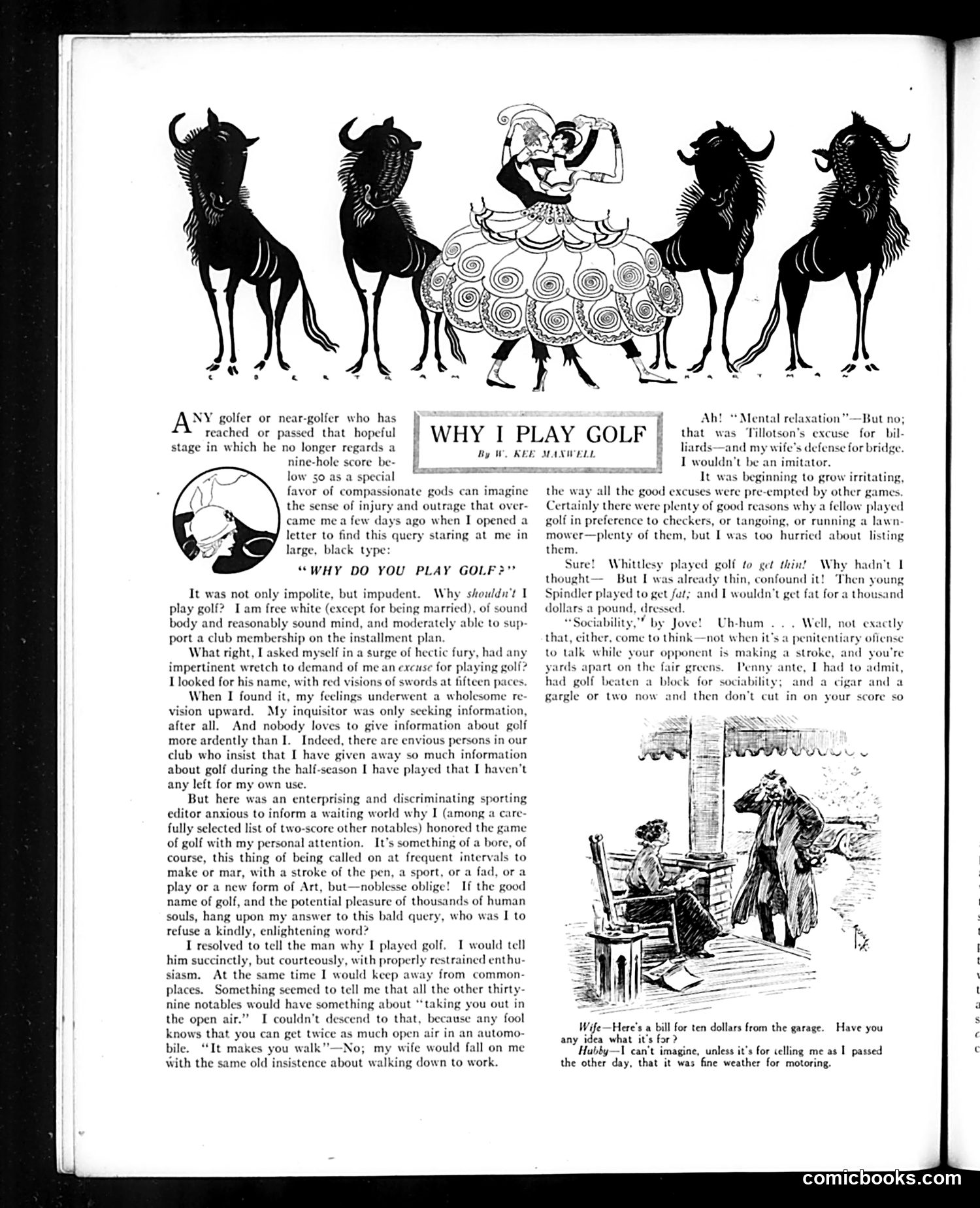
This article humorously explores the excuses people give for playing golf, a leisure activity that was becoming increasingly popular among middle-class Americans in the early 20th century. The author (W. Kee Manwell) receives an impertinent inquiry demanding to know why he plays golf. He resolves to answer seriously but finds all the conventional excuses already claimed by others: "mental relaxation" (Tillotson's excuse), getting thin (Whittlesy), getting fat (Spindler), and sociability. He sarcastically dismisses these, noting that golf is actually isolating and that one gets more fresh air in an automobile. The bottom cartoon shows a wife confronting her husband about a garage bill, suggesting golf leads to unnecessary motoring expenses—implying the sport is an impractical indulgence. The satire mocks how golfers rationalize an essentially frivolous hobby while their wives see through the pretense.
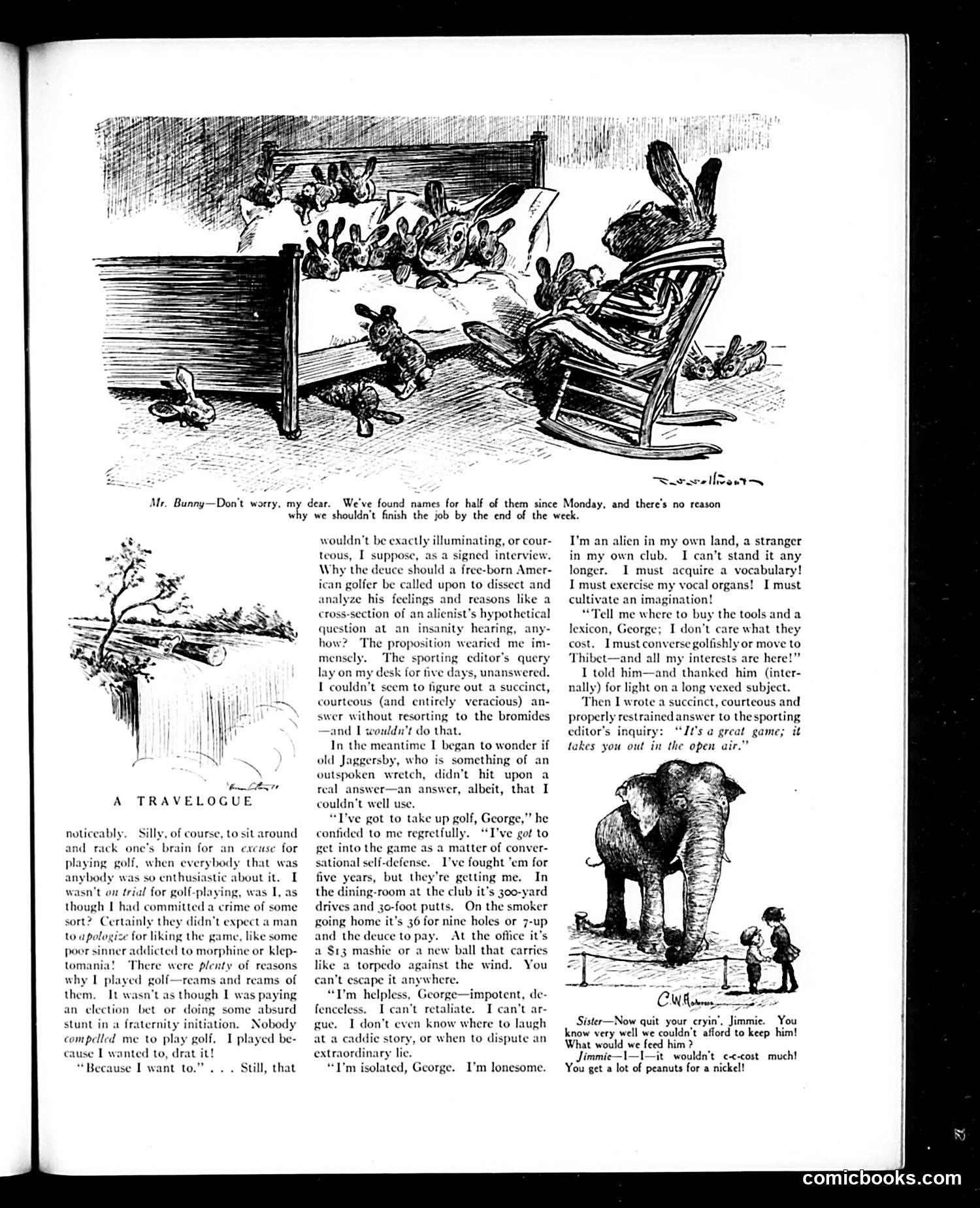
The top cartoon depicts Mr. Bunny reassuring his wife about naming baby rabbits, a gentle domestic joke about rabbit proliferation. The main article satirizes golf's grip on American society, particularly among businessmen and club members. The author mocks how golf has become mandatory for social acceptance—a man cannot participate in office or club conversation without golf knowledge. His character "Jaggersby" articulates the real point: golf discourse has become so pervasive and exclusive that non-golfers feel socially isolated and intellectually inferior in their own communities. The satire targets how golf terminology, handicaps, and anecdotes have invaded everyday male conversation spaces (dining rooms, smokers), forcing men to learn the "vocabulary" simply for social survival, not genuine interest. The bottom cartoon about a child wanting to keep an elephant depicts a separate humorous vignette about childhood logic versus economic reality.
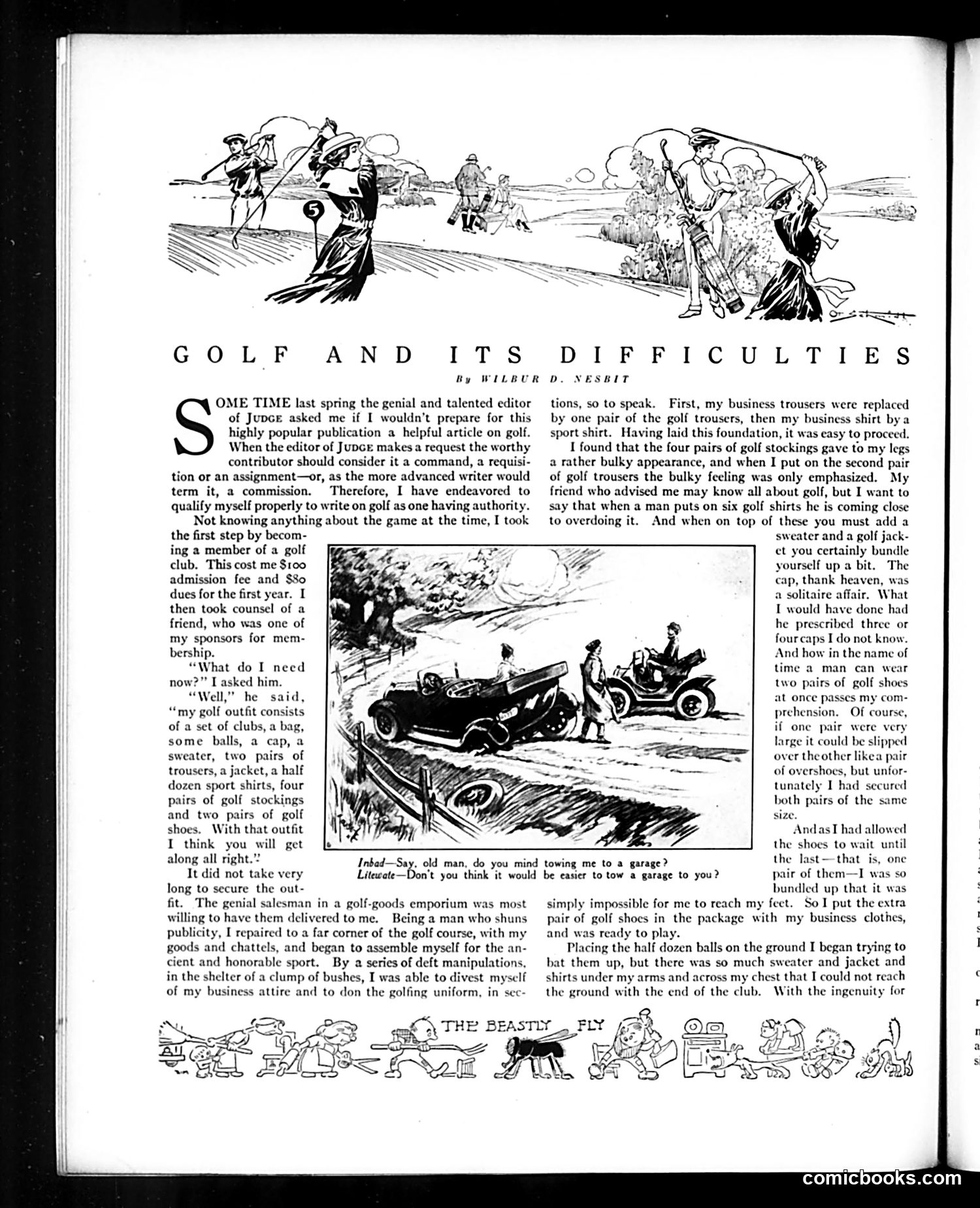
This humorous article satirizes the absurd consumer culture around golf in the 1920s. The author mocks how golf clubs exploit newcomers by selling them excessive, unnecessary equipment—multiple pairs of trousers, shirts, stockings, and shoes—creating an unwieldy costume that actually prevents playing the sport. The embedded cartoon illustrates this absurdity: a golfer so overloaded with gear that he must be towed by car, prompting the joke "don't you think it would be easier to tow a garage to you?"—suggesting he's carrying the entire pro shop. The satire targets both golf's pretentious social status and commercialism: the $100 membership fee, the pushy salesman, and the elaborate "ancient and honorable sport" ritual that paradoxically makes the game unplayable. The author's repeated attempts to don layers of clothing in bushes emphasizes the ridiculousness of the whole enterprise.
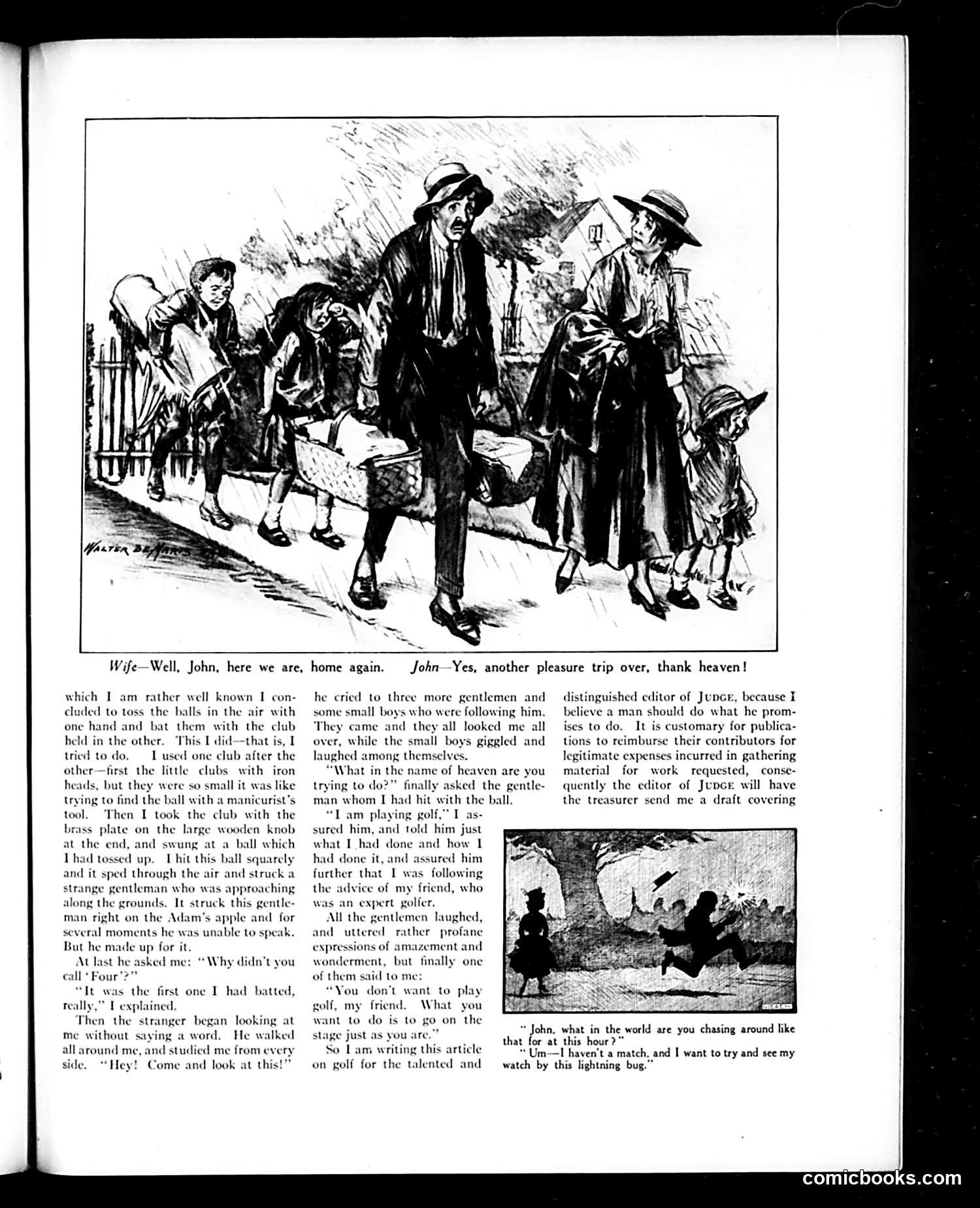
This page contains two separate humorous pieces satirizing early 20th-century leisure activities. **Main Cartoon (top):** A man returns home from a disastrous golf outing. The narrative describes his comical incompetence—he couldn't properly grip or swing a club, instead hitting a stranger in the throat. When he explained he was "playing golf," onlookers found him so naturally entertainingly awful they suggested he perform on stage instead. The satire mocks both amateur golfers' bumbling attempts at this fashionable new sport and the pretension surrounding golf as a gentlemanly pursuit. **Secondary Cartoon (bottom):** A humorous scene where a man chases a lightning bug at night, wanting to use its glow to see his watch. This satirizes the absurdity of relying on nature for practical solutions—a gentler, more whimsical jab at human foolishness. Both pieces employ slapstick humor typical of Judge's satirical approach to American social customs and leisure culture.
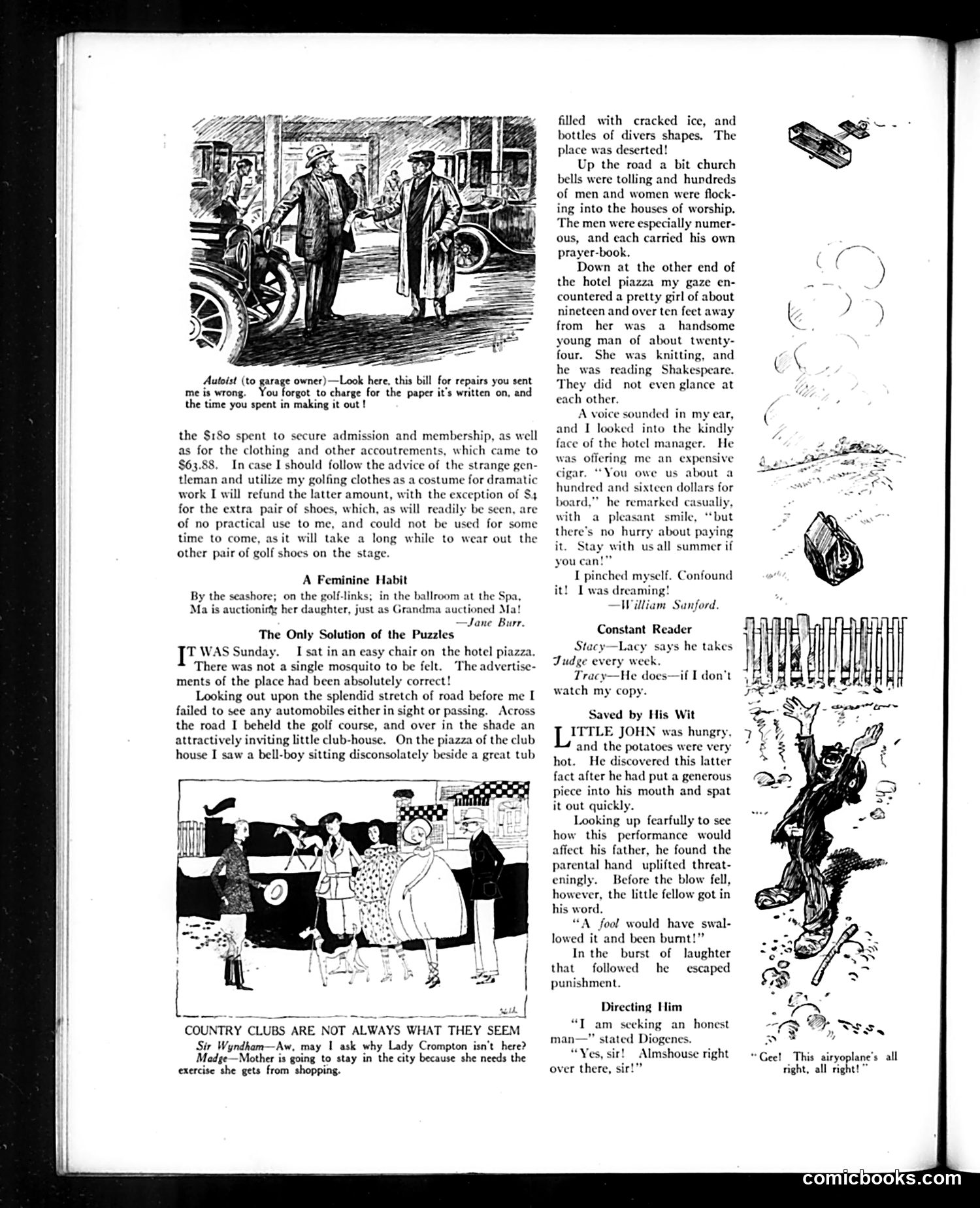
This page from *Judge* contains several satirical pieces targeting early 20th-century social pretensions: **"Country Clubs Are Not Always What They Seem"** mocks wealthy women's priorities. Lady Crompton avoids the country club despite its amenities because city shopping provides more "exercise"—satirizing how upper-class women used shopping as a social activity disguised as practical necessity. **"The Only Solution of the Puzzles"** depicts an absurdly perfect resort—no mosquitoes, no cars, no crowds, young couples ignoring each other (restraint), men attending church, managers offering cheap rates. The narrator realizes he's dreaming, satirizing the gap between resort advertisements and reality. **Minor pieces** include jokes about garage repair bills (overcharging), golf club memberships (expensive), and a child's quick wit saving him from punishment. The recurring theme: contrast between advertised ideals and actual behavior among the leisure class, exposing vanity and hypocrisy in early-century American upper-middle-class society.
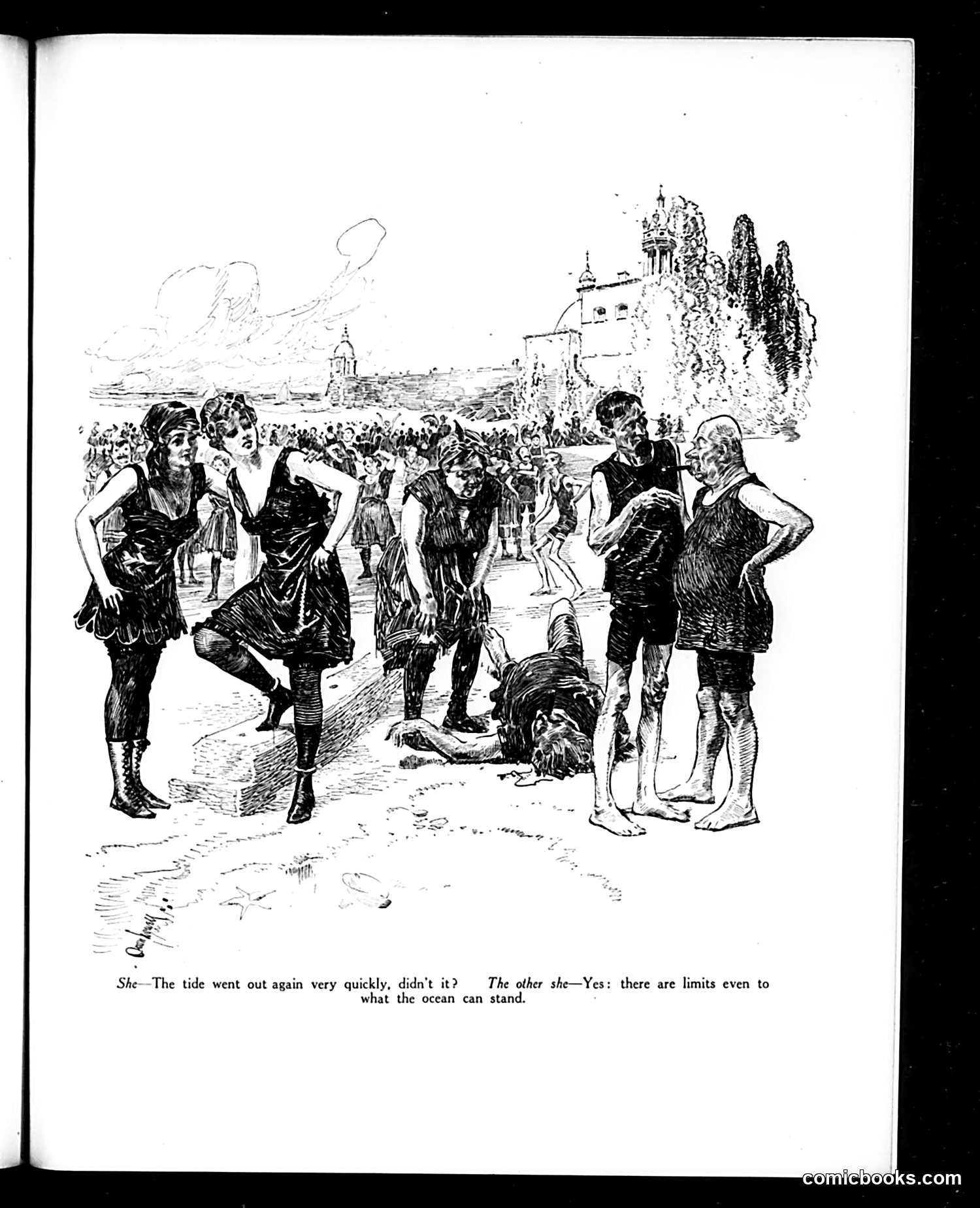
This cartoon depicts a beach scene with a fortified structure (possibly a castle or military installation) in the background. Two female figures in the foreground are conversing about the tide receding quickly. The satire appears to reference a woman or women's presence at the beach in a way the ocean itself finds objectionable—the joke being that even nature has limits to what it will tolerate. The "limits even to what the ocean can stand" suggests the women are unwelcome or undesirable beach-goers. Without the publication date visible, the specific target is unclear, but this likely reflects early 20th-century social commentary about women's changing beach attire, behavior, or presence in public spaces. The joke mocks women by suggesting their very existence drives away nature itself—a form of misogynistic humor common in Judge magazine's satirical content.
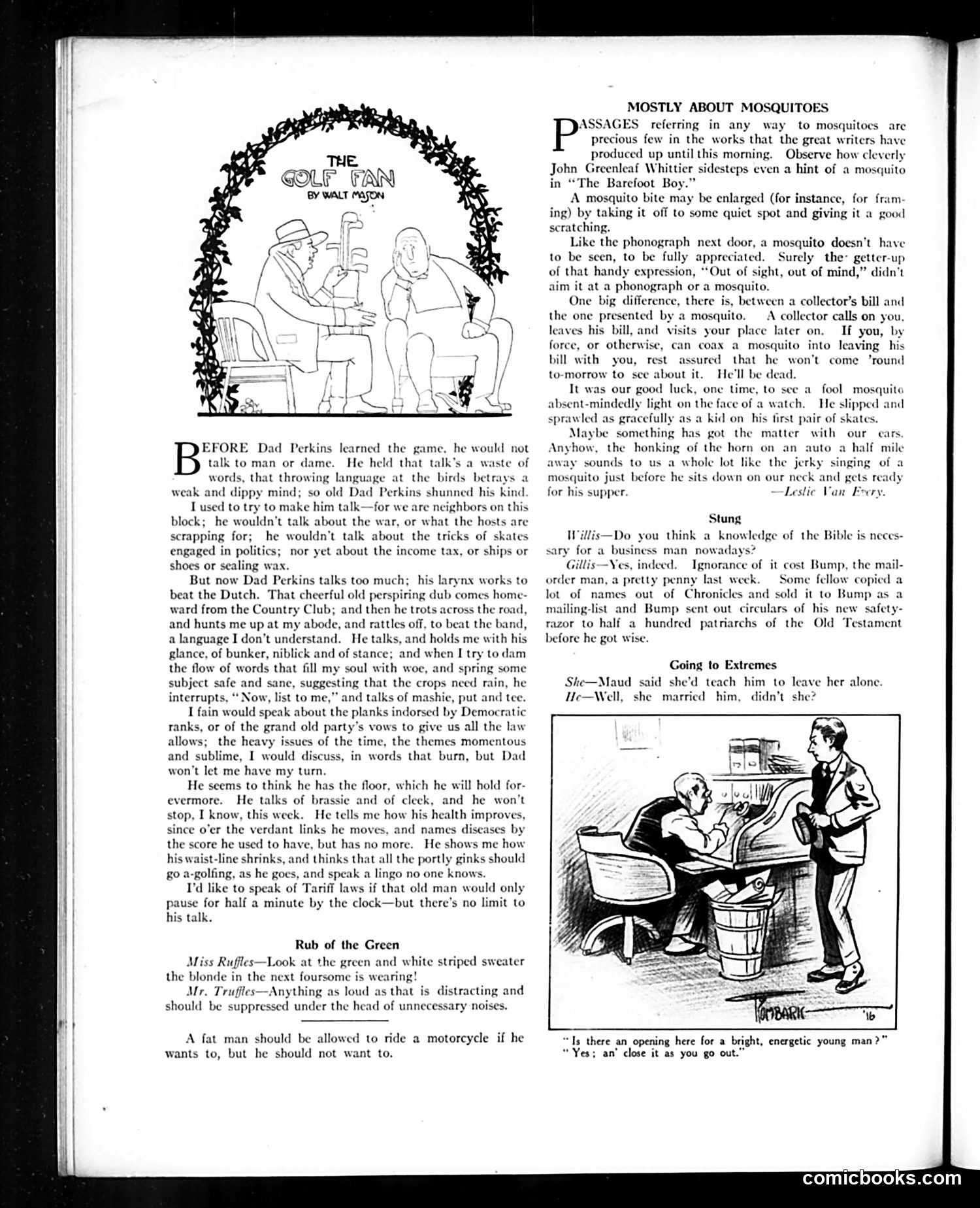
**"The Golf Fan" (by Walt Dotson):** This comic narrative satirizes the recently golf-obsessed middle-class American male. The protagonist, "Dad Perkins," was previously a silent, antisocial neighbor who refused conversation. After taking up golf at the Country Club, he becomes insufferably talkative—monopolizing conversations with incomprehensible golf jargon ("niblick," "mashie," "brassie") while refusing to discuss serious topics like tariffs or politics. The satire mocks both golf's sudden popularity as a leisure activity and the way it transforms men into tedious bores who speak an impenetrable insider language. The accompanying "Rub of the Green" jokes reinforce golf humor and social observation about dress and behavior. **"Mostly About Mosquitoes":** A humorous essay riffing on the mosquito as an understated literary subject and domestic nuisance, contrasting its elusiveness with the permanence of bill collectors. The page reflects early 20th-century American anxieties about leisure culture and changing social habits.
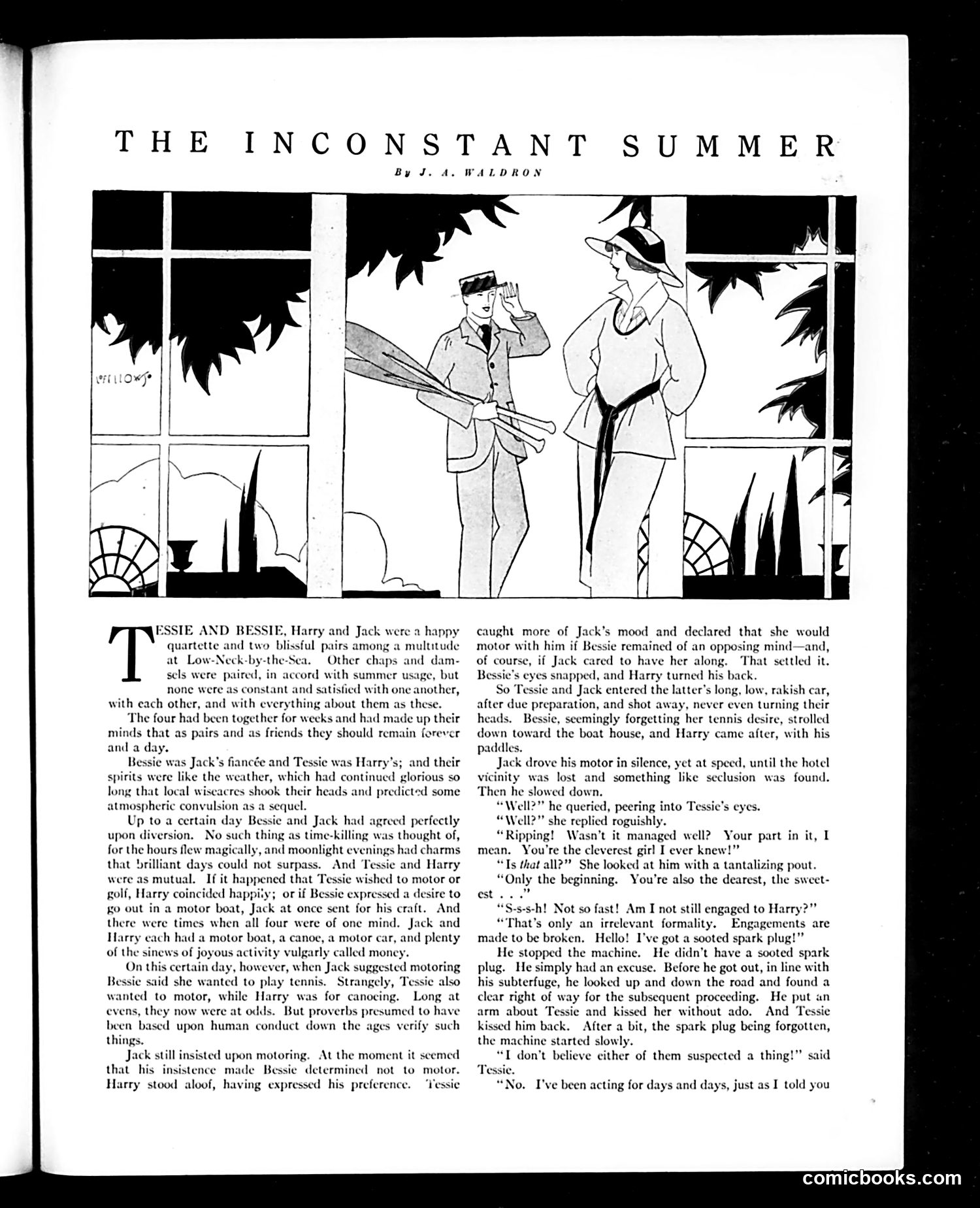
This is a romantic short story rather than a political cartoon. The narrative depicts four young wealthy people at a seaside resort ("Low-Neck-by-the-Sea") in what appears to be the early 20th century. **The Plot:** Two engaged couples—Bessie & Jack, Tessie & Harry—initially seem perfectly matched. When a disagreement arises over activities (Jack wants to motor; Bessie prefers tennis), Tessie opportunistically sides with Jack, and they drive off together. The illustration shows them departing as a motorcar, leaving their original partners behind. **The "Inconstancy":** The title refers to the fickleness of the young people's affections. Jack and Tessie use a fake mechanical excuse to stop the car and kiss, revealing they've been secretly coordinating to cheat on their engaged partners. **Context:** The story satirizes the leisure-class morality and casual infidelity among wealthy young people, playing on anxieties about modern dating, automobiles enabling secret rendezvous, and the superficiality of romantic commitments among the wealthy. The motorcar—a relatively new technology—enables this moral transgression.
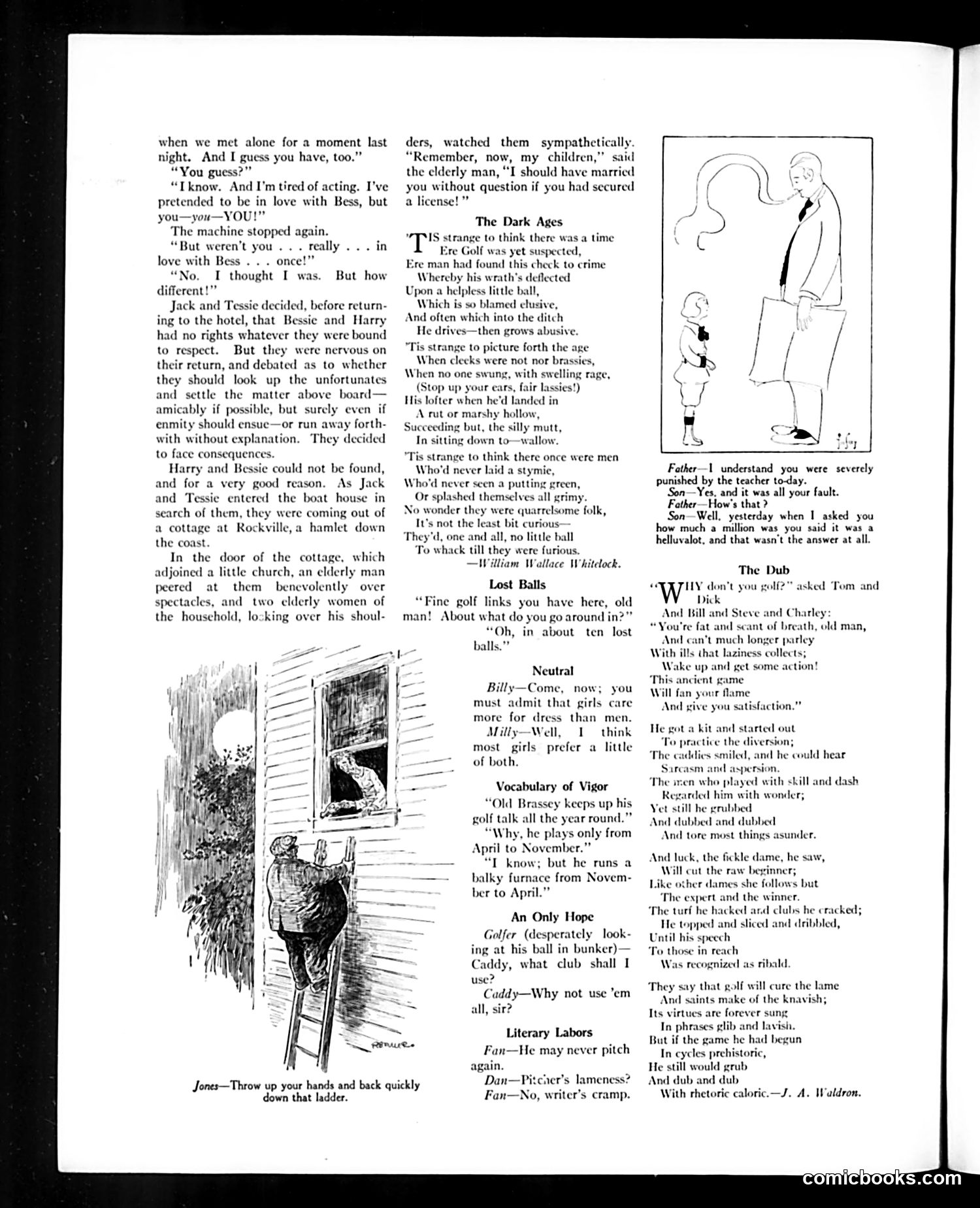
This page contains multiple golf-themed satirical pieces typical of early 20th-century American humor. **"The Dark Ages"** is a humorous poem by William Wallace Whitlock mocking pre-golf society. It suggests golf's invention was civilization's salvation—without the sport, men had no outlet for their aggression and remained quarrelsome. The satire targets the golf obsession of the era by presenting this violent sport as society's necessary pressure valve. **The golf anecdotes and jokes** satirize both amateur golfers and the sport itself: "Lost Balls" mocks poor players who lose ten balls per round; "An Only Hope" ridicules incompetent duffers; "The Dub" tells of an out-of-shape man coaxed into playing, who repeatedly fails despite encouragement. The cartoon shows someone climbing a ladder with the caption "Throw up your hands and back quickly down that ladder"—apparently unrelated to golf content, suggesting a separate domestic or comedic vignette. Overall, the page reflects early 1900s American culture's simultaneous embrace of and mockery toward golf as a leisure activity and character-building pursuit.
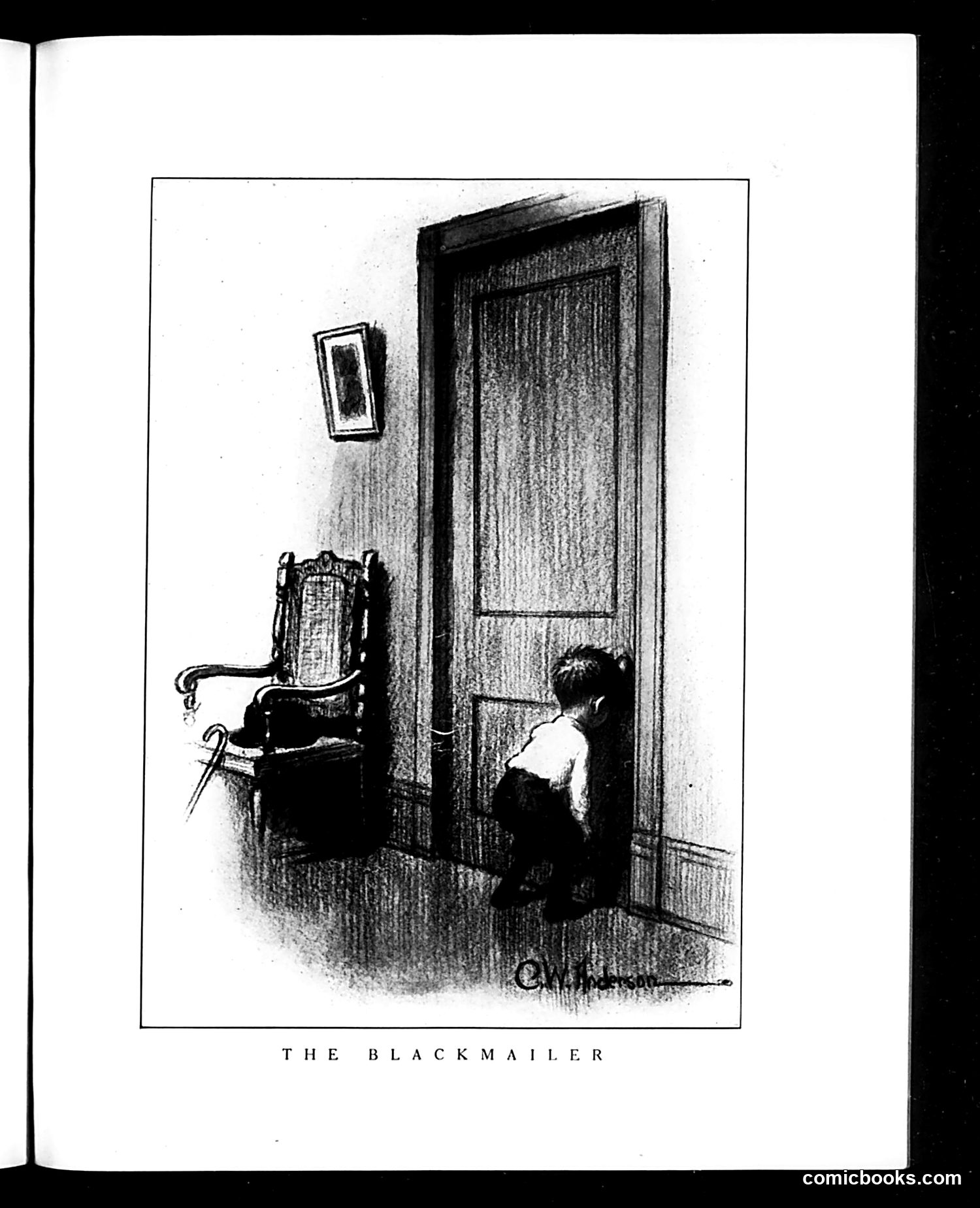
This cartoon depicts a figure entering through a doorway while another figure (shown seated with a cane) waits inside—apparently an illustration of blackmail in action. The title "The Blackmailer" explicitly names the criminal activity being satirized. The sketch suggests a confrontation or threatening situation typical of blackmail schemes: one party has leverage over another and demands something (likely money) in exchange for silence about damaging information. The interior setting and tense body language emphasize the coercive nature of the encounter. Without additional context from the magazine's date or surrounding articles, the specific target of this satire remains unclear—whether it references a particular scandal, criminal case, or broader social commentary on blackmail as a contemporary crime problem in Judge's era.
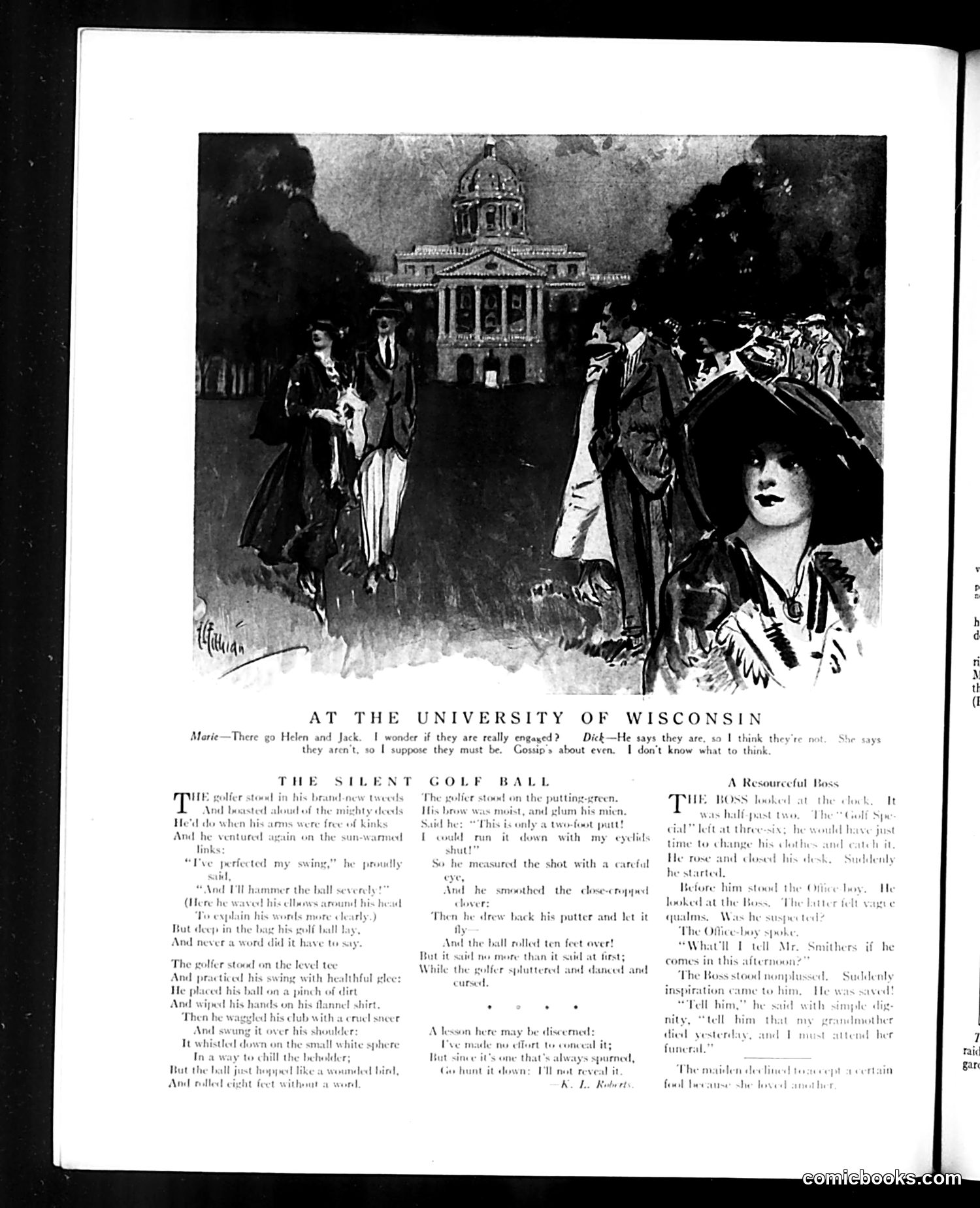
This page contains two distinct pieces of social satire typical of early 20th-century Judge magazine humor. **Top illustration & dialogue:** A scene at the University of Wisconsin showing fashionably dressed young people (Marie and Dick) gossiping about whether two others, Helen and Jack, are "really engaged." The satire mocks college social gossip and romantic uncertainty—Marie wonders if they're engaged, Dick says they claim to be, but neither believes it. The joke captures period anxiety about courtship propriety and the unreliability of young people's declarations. **"The Silent Golf Ball" story:** A humorous narrative poem about a golfer boasting of his improved swing, then repeatedly failing at even simple putts. The satire targets masculine overconfidence and self-delusion—the golfer's technical perfection produces comically poor results, puncturing his pride. **"A Resourceful Boss":** A brief anecdote (partially illegible in OCR) about an office manager devising excuses, likely satirizing workplace dishonesty and managerial incompetence. All three pieces employ gentle mockery of contemporary American social types.
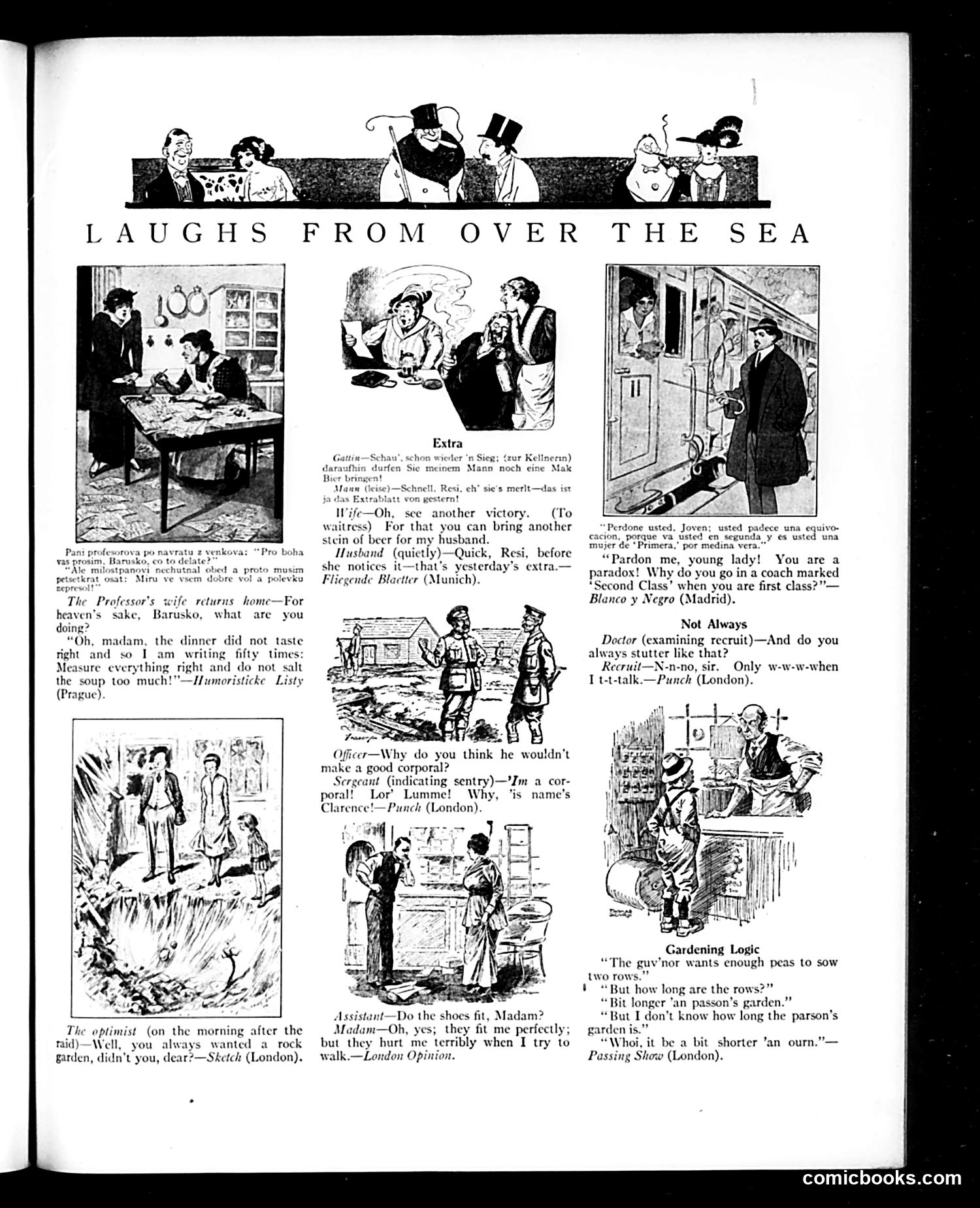
This page collects humorous anecdotes translated from European satirical magazines (Prague, Munich, London, Madrid). The jokes are domestic and workplace comedy with no political content—they satirize everyday absurdities rather than current events. Key themes include marital mishaps (a professor's servant ruining dinner; a wife ordering beer while her husband secretly serves yesterday's leftovers), military bureaucracy (a sergeant rejecting a recruit named "Clarence" as corporal material), retail problems (shoes that fit but hurt), and working-class logic (gardeners unable to measure pea rows without absurd circular reasoning). The page's title emphasizes these are "international" laughs, showcasing humor's universal appeal across European cultures. The modest illustrations accompany brief, punchline-driven gags typical of Judge magazine's light satirical style—social observation through comedy rather than biting political critique.
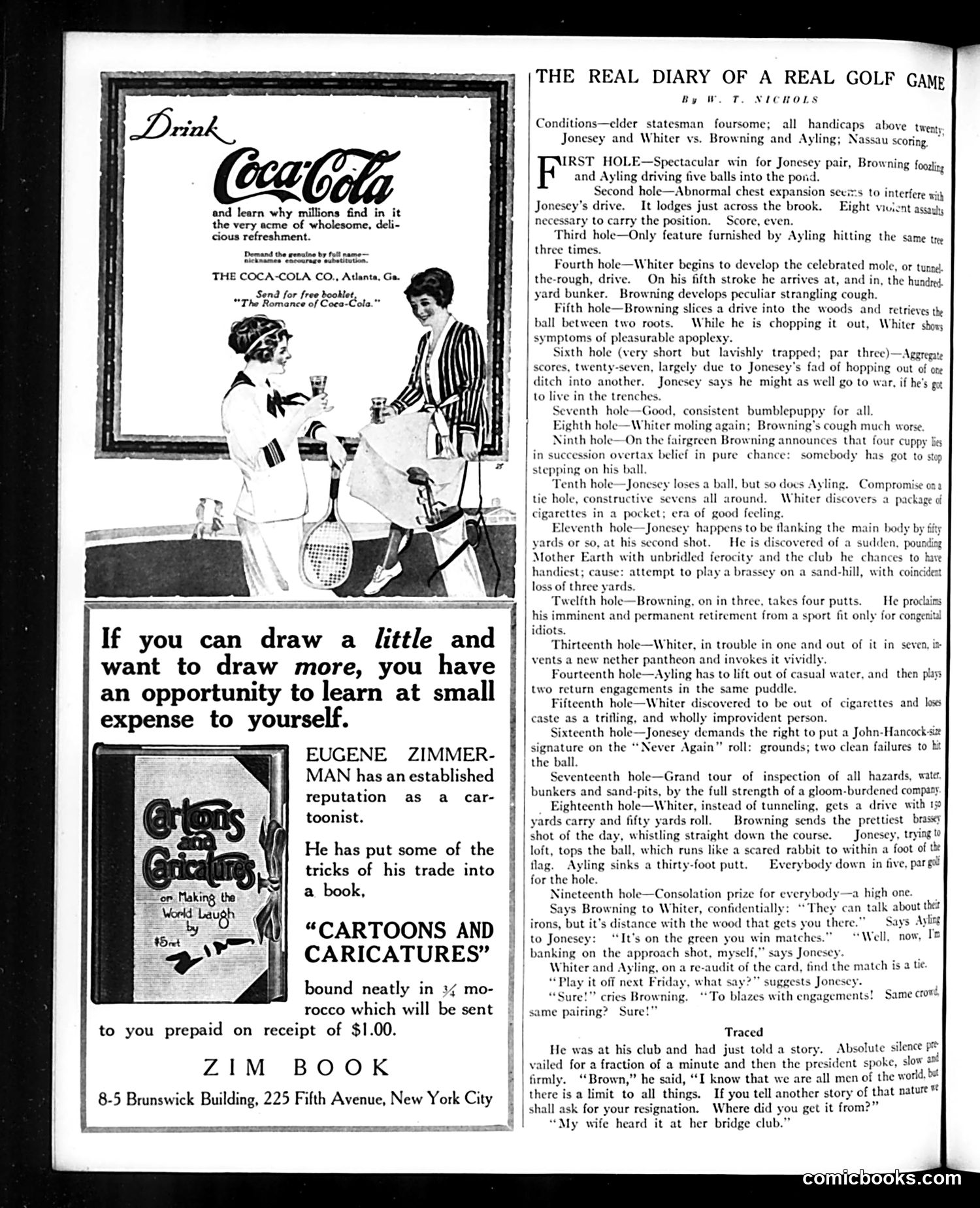
This page contains **advertising and instructional content**, not political satire. **Left side:** A Coca-Cola advertisement encouraging readers to "learn why millions find in it...wholesome, delicious refreshment," with an offer for a free booklet. Below it, Eugene Zimmerman, an established cartoonist, advertises his instructional book "Cartoons and Caricatures" ($1.00). **Right side:** "The Real Diary of a Real Golf Game" by W.T. Nichols is a humorous, hole-by-hole account of an amateur foursome's terrible golf outing. The satire targets **casual golfers' incompetence**—players repeatedly flub shots, lose balls, develop nervous conditions ("strangling cough," "apoplex"), and contemplate quitting. References to WWI trenches ("if he's to live in the trenches") provide period context. The humor derives from relatable golfing frustrations rather than political commentary.

This page is **not a cartoon or satire** — it's a straightforward **beer advertisement** for Schlitz, a major Milwaukee brewery. The ad makes health claims typical of early 20th-century marketing: it argues that Schlitz's brown bottles protect the beer from light damage and that the beer's carbonation inhibits bacterial growth, making it "safe" drinking water. It encourages daily consumption. The tagline "The Beer That Made Milwaukee Famous" references Milwaukee's historical prominence as a brewing center, particularly due to German immigrant breweries. There is **no political satire or social commentary here**. Judge magazine ran such advertisements throughout its issues alongside humorous content. The health claims, while exaggerated by modern standards, reflect common advertising language of the era before strict FDA regulations on beverage claims.
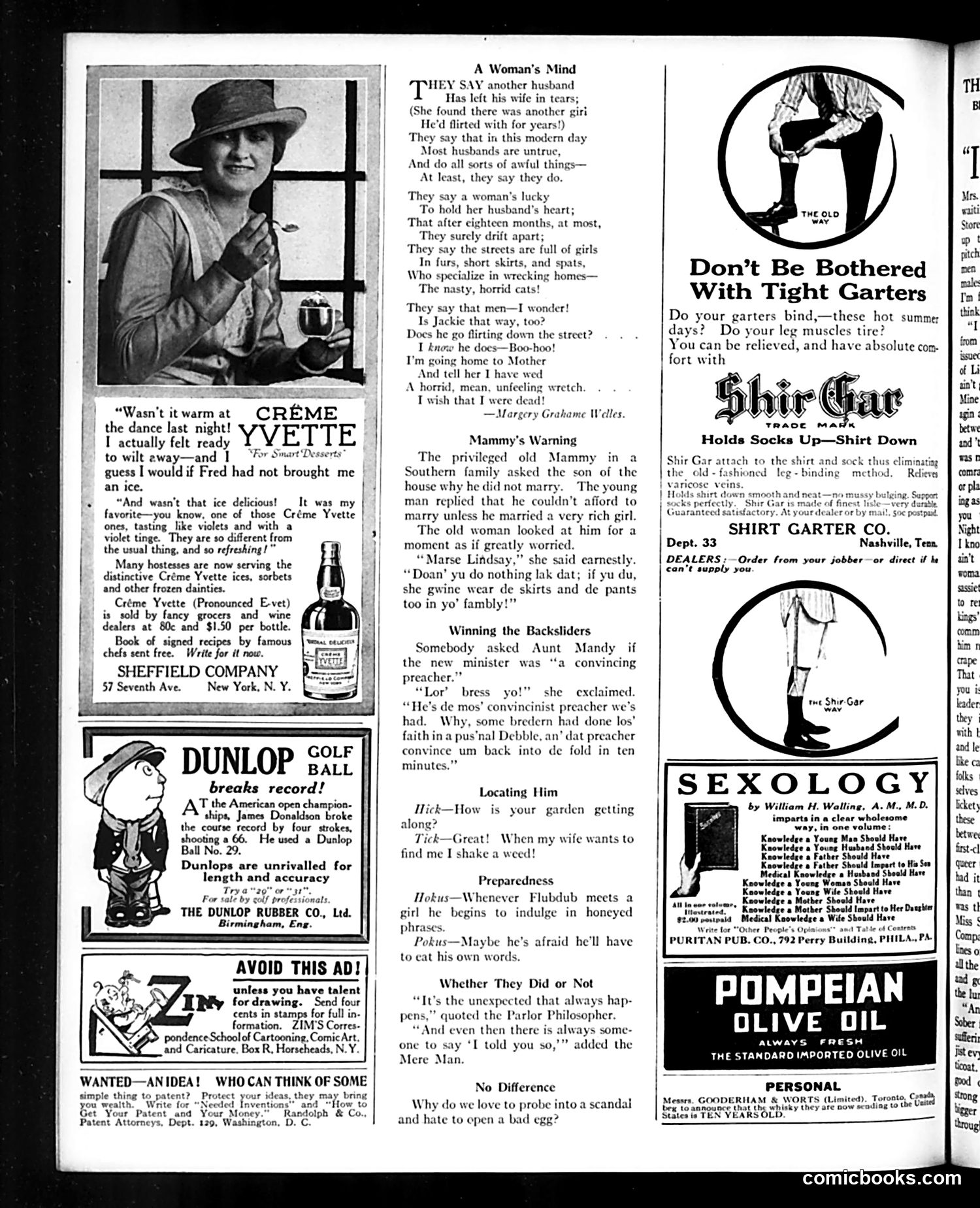
This page combines satirical poetry, humorous anecdotes, and advertisements typical of early 20th-century Judge magazine. **Main feature:** "A Woman's Mind" is a poem satirizing women's anxieties about marital infidelity. It presents a woman obsessing over her husband's potential unfaithfulness—imagining he flirts with other women, then dramatically threatening to leave him for her mother. The satire mocks both the husband's assumed untrustworthiness and the wife's emotional volatility, suggesting women are prone to irrational jealousy. **Supporting pieces** include dialect-heavy anecdotes featuring "Mammy" and "Aunt Mandy" (racist stereotypes of Black women dispensing folksy wisdom) and various brief jokes about marriage and relationships. **Advertisements** for Crème Yvette liqueur, Dunlop golf balls, Shir-Gar garters, and other products occupy significant space, employing period-typical marketing rhetoric about modern convenience and romance. The overall theme critiques contemporary marriage anxieties while reinforcing era-typical gender stereotypes about women's emotional instability.
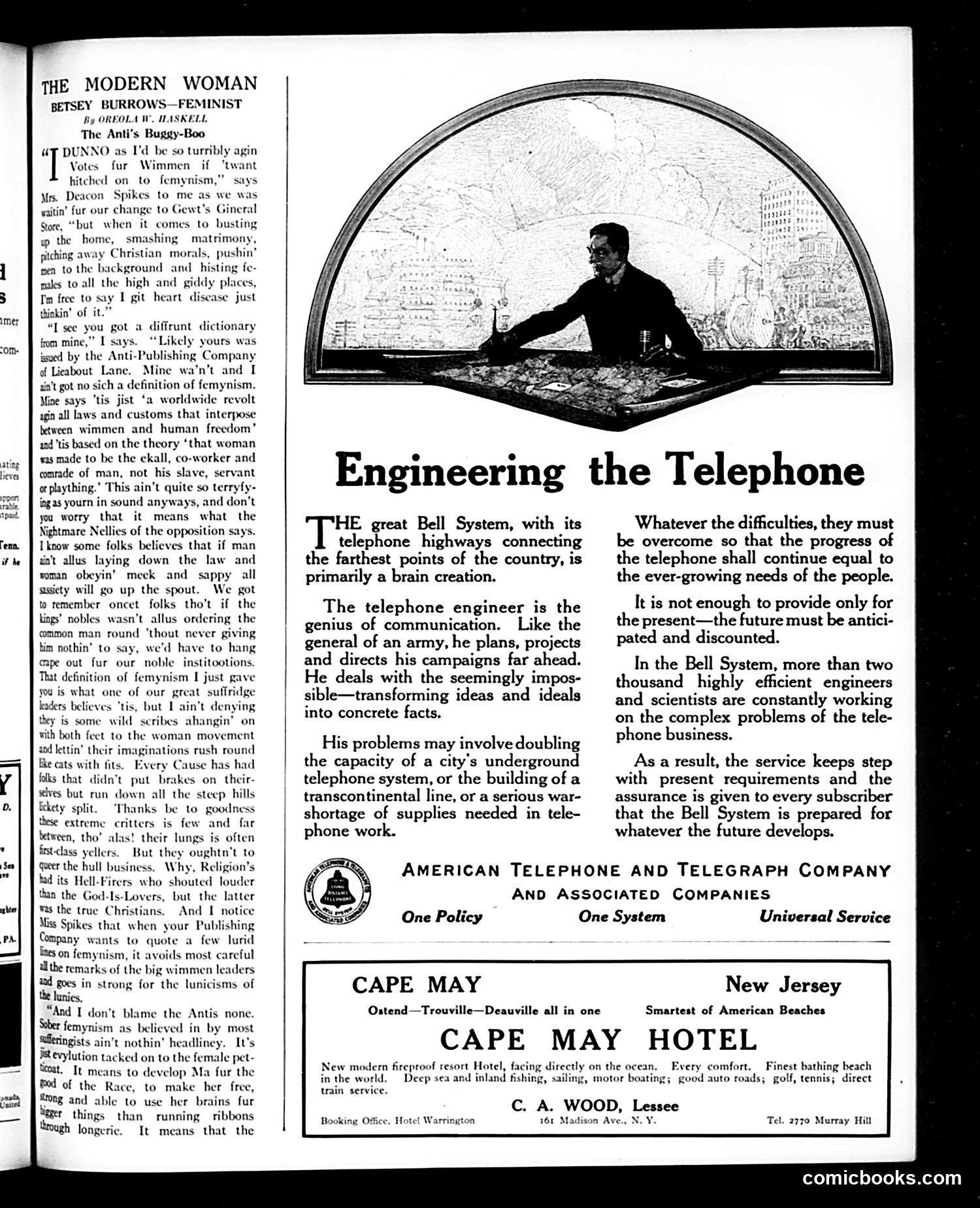
This page contains two distinct elements: **Left side:** A satirical dialect piece titled "The Modern Woman" featuring characters Mrs. Deacon Spikes and a narrator discussing feminism. The satire uses rural/colloquial speech to present both anti-feminist and pro-feminist arguments. The anti-feminist character conflates women's suffrage with the destruction of home and morality, while the narrator defends feminism as simply advocating women's equality and freedom—not the radical extremism opponents claim. The satire gently mocks both extremes: both those who exaggerate feminism's dangers and those few radical feminists whose rhetoric damages the movement's credibility. **Right side:** A full-page advertisement for American Telephone and Telegraph Company featuring an illustration of a telephone engineer at work. This corporate advertisement celebrates the telephone engineer as a visionary problem-solver planning infrastructure for future growth. The juxtaposition is notable: a debate about women's rights and freedoms appears alongside advertising celebrating (implicitly male) professional achievement and technological progress.
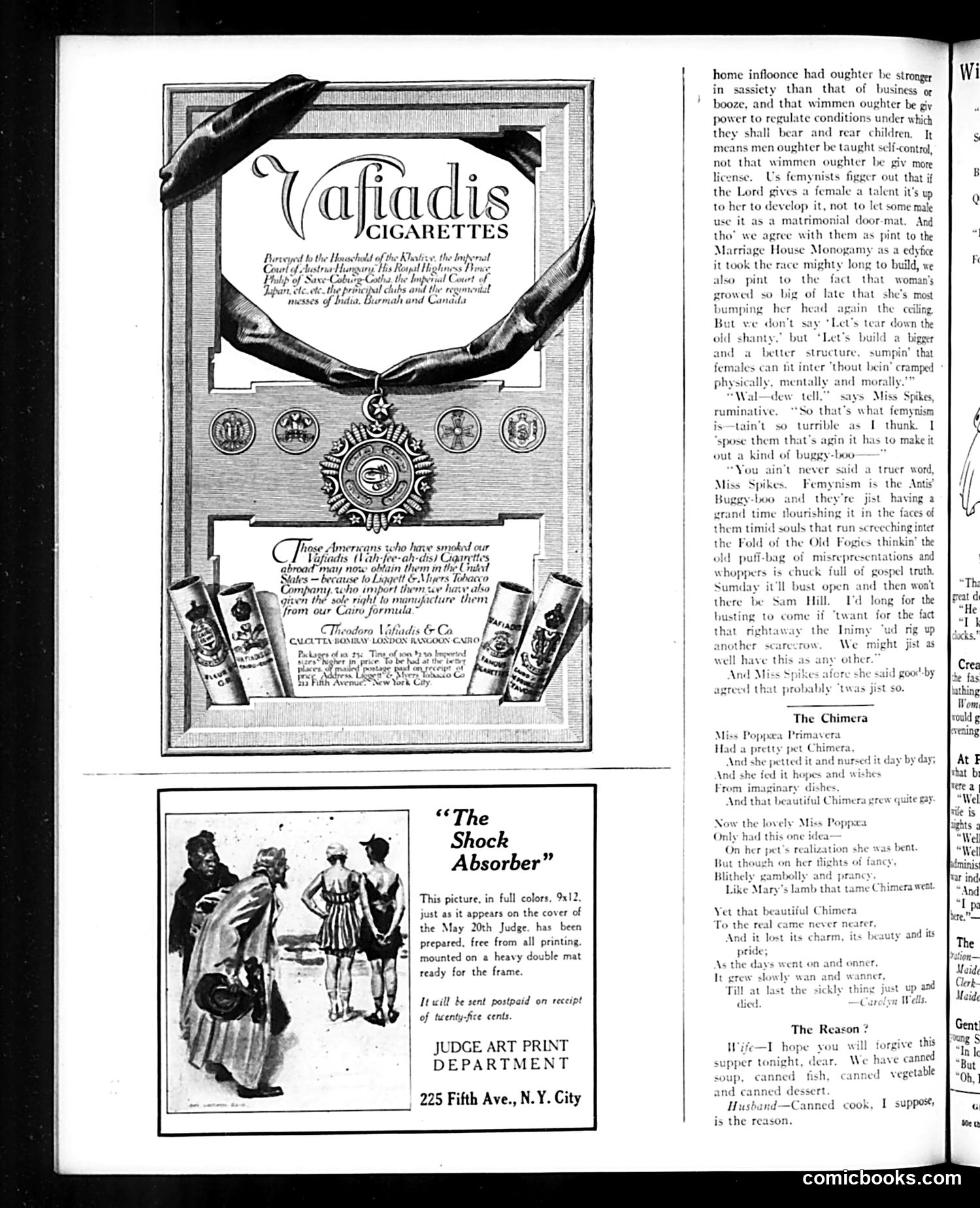
This page contains a **Vafiadis Cigarettes advertisement** (top) and a "Shock Absorber" art print offer (center-left), but the main satirical content is the **dialogue on feminism** (right column). The text features two rural female characters—Miss Spikes and an unnamed companion—discussing feminism in vernacular dialect. Miss Spikes initially fears feminism as a "buggy-boo" (bogeyman), but the other woman explains it's actually about women's power in childrearing, men's self-control, and female talent development—not radical license. The satire targets **anti-feminist opponents** who spread scare tactics about women's rights. The cartoon mocks how "Old Fogies" spread "misrepresentations and whoppers" to frighten "timid souls" away from supporting women's equality. By using plain-spoken rural characters, Judge suggests feminism is sensible common sense, not dangerous radicalism—and that opponents are simply fear-mongering. The page also includes light poems: "The Chimera" (about an imaginary pet) and "The Reason?" (a domestic humor joke about canned food).
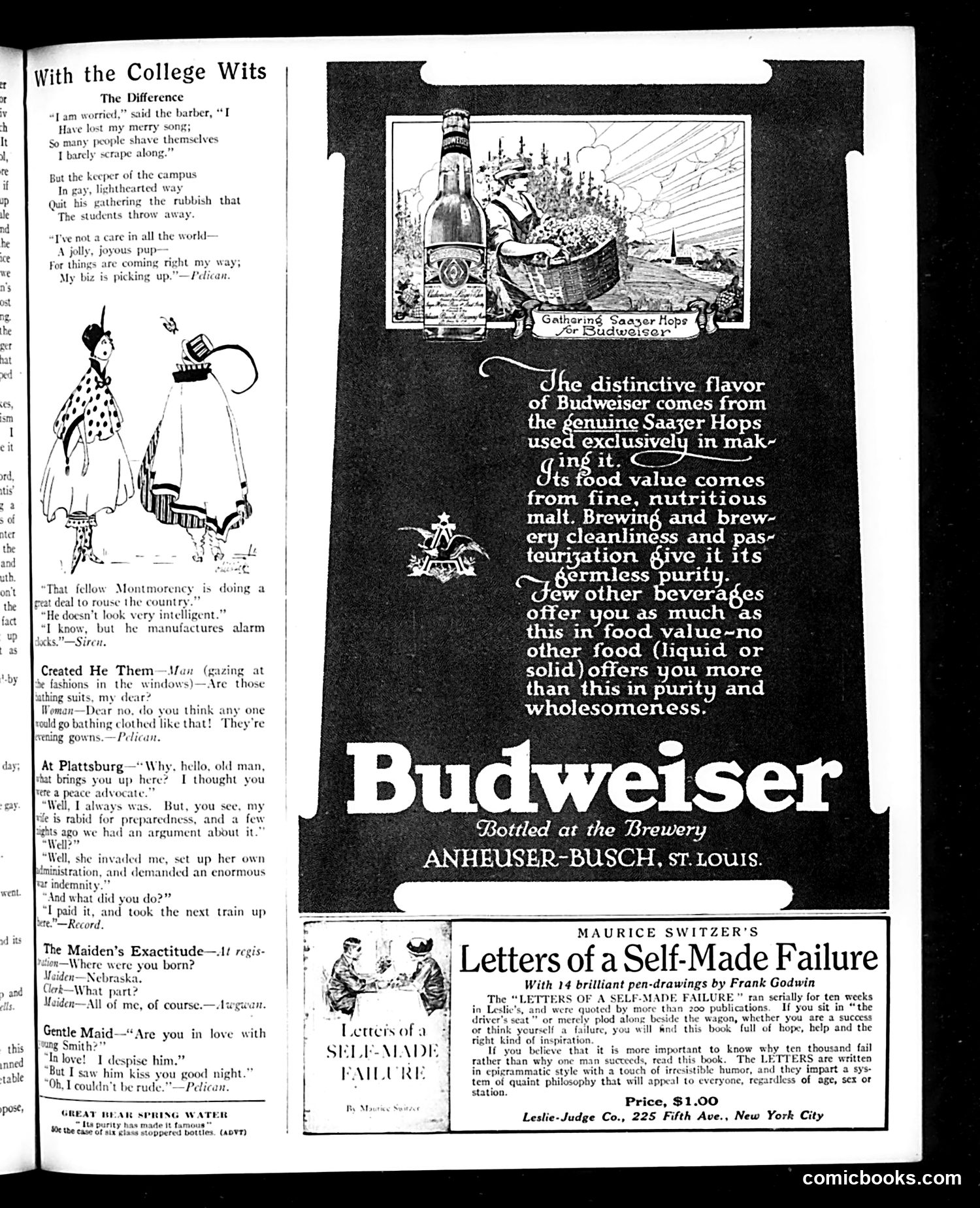
This page contains primarily **humor columns and advertisements** rather than political cartoons. The left side features "With the College Wits"—a collection of brief satirical jokes mocking college students and contemporary social anxieties. One joke ridicules a barber worried about men shaving themselves; another pokes fun at a campus official indifferent to student concerns. Additional quips target Montmorency (unclear who), a woman's "exactitude" about her birthplace, and a young woman claiming she couldn't be "rude" after being kissed—suggesting satirical commentary on changing social behaviors and courtship norms. The right side contains a large **Budweiser advertisement** emphasizing the beer's purity, ingredients (Saazer Hops), and nutritional value—typical early 20th-century marketing claims. Below that is an advertisement for Maurice Switzer's book *Letters of a Self-Made Failure*, illustrated with pen-drawings, promoting it as philosophical humor about success and failure. The page reflects Judge's blend of collegiate humor and consumer advertising from this era.
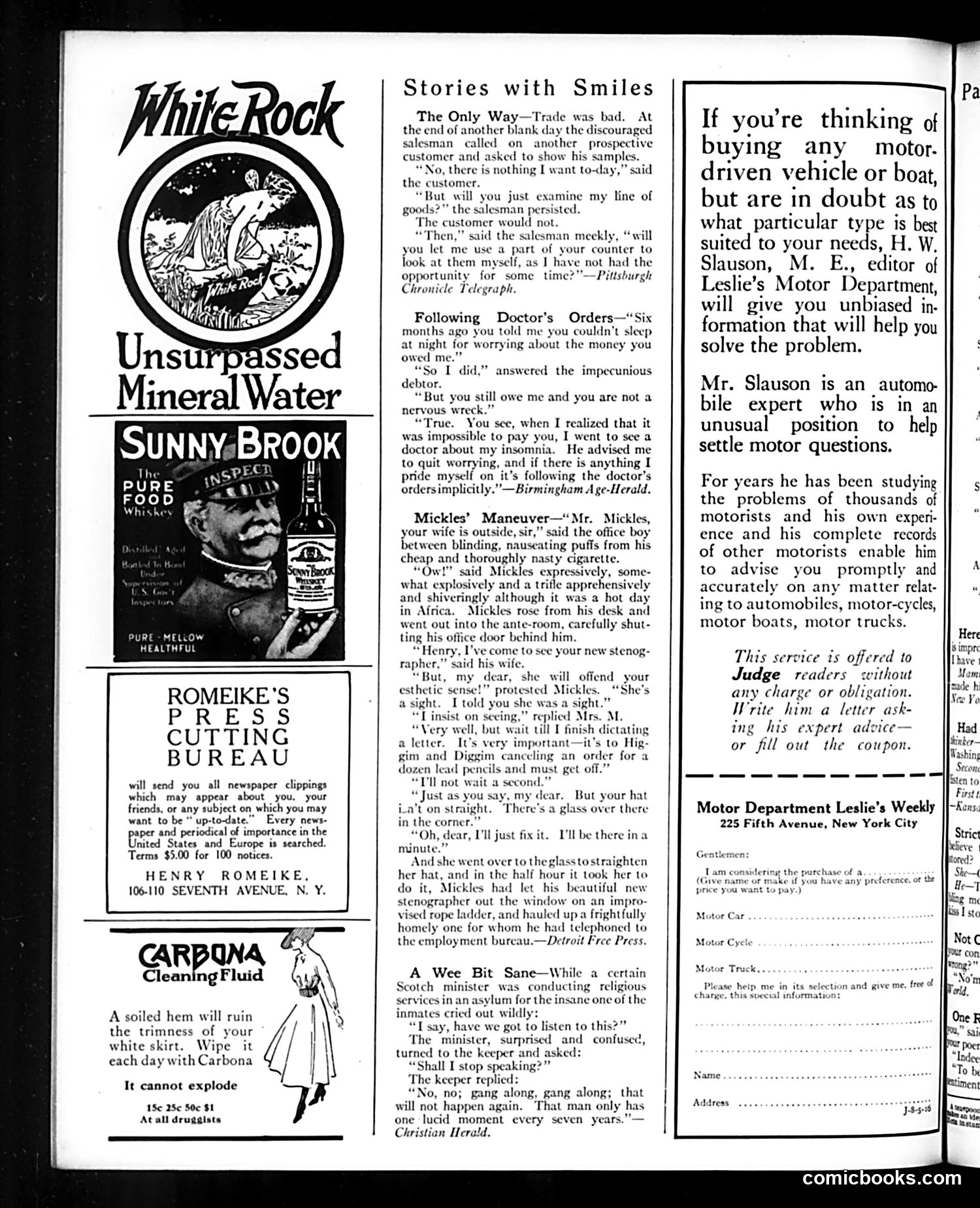
This page consists primarily of **advertisements and humorous short stories**, not political cartoons. The "Stories with Smiles" section contains three brief anecdotes satirizing everyday social situations: 1. **"The Only Way"** mocks persistent salesmanship during economic hardship 2. **"Following Doctor's Orders"** jokes about a debtor who stops worrying about unpaid debts by ignoring the problem—technically following medical advice 3. **"Mickles' Maneuver"** satirizes a husband's elaborate scheme to hide his unattractive secretary from his wife by substituting an uglier one The advertisements include mineral water, whiskey, a press-clipping service, and cleaning fluid—typical early 20th-century consumer products. A notable feature is H.W. Slauson's **Motor Department advertisement**, offering expert automotive advice to Judge readers, reflecting the era's fascination with newly popular automobiles. The humor targets middle-class anxieties: debt, marriage dynamics, workplace awkwardness, and consumer choices—not politics.
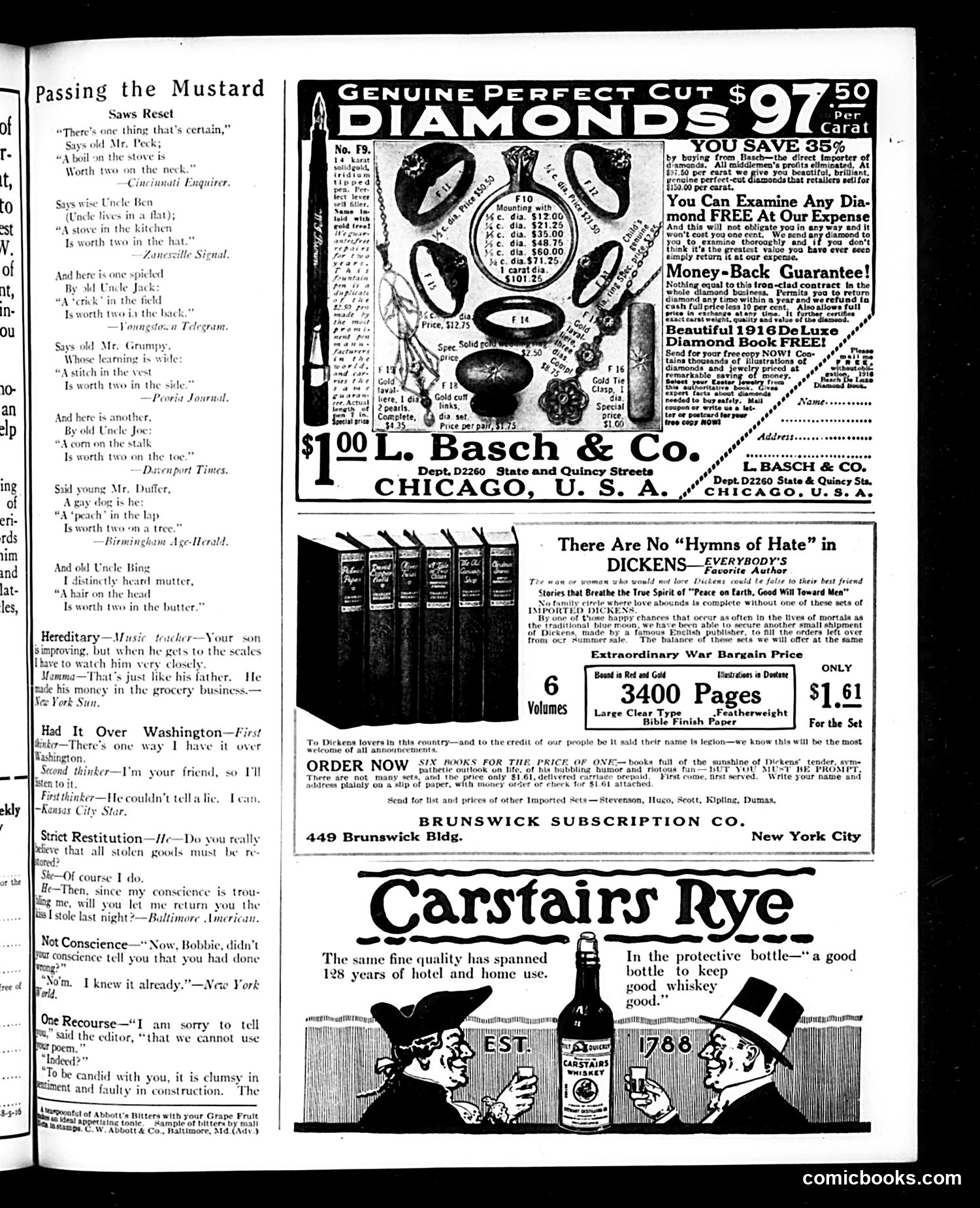
This page is primarily **advertisements and humor columns**, not political cartoons. The left side contains brief humorous sayings attributed to various "Uncle" characters—folk wisdom jokes playing on the structure "A [thing] in the [place] is worth two in the [other place]." These are gentle, domestic humor pieces with no political content. The major advertisements include: - **L. Basch & Co. diamonds** (top right): A mail-order diamond seller using standard early-1900s direct-mail tactics—"Money-Back Guarantee," free examination, "Beautiful 1916 DeLuxe Diamond Book" - **Dickens book sets** (center-right): Promoting complete Dickens collections as "War Bargain Price," likely referencing WWI context - **Carstairs Rye whiskey** (bottom): Period liquor advertisement emphasizing 128-year tradition and quality The humor columns below the diamonds make gentle fun of human nature (stealing, bad conscience, rejected poetry)—social satire rather than political commentary. This is essentially a **magazine back page of light humor and consumer advertising**, typical of Judge's mixed-content format.
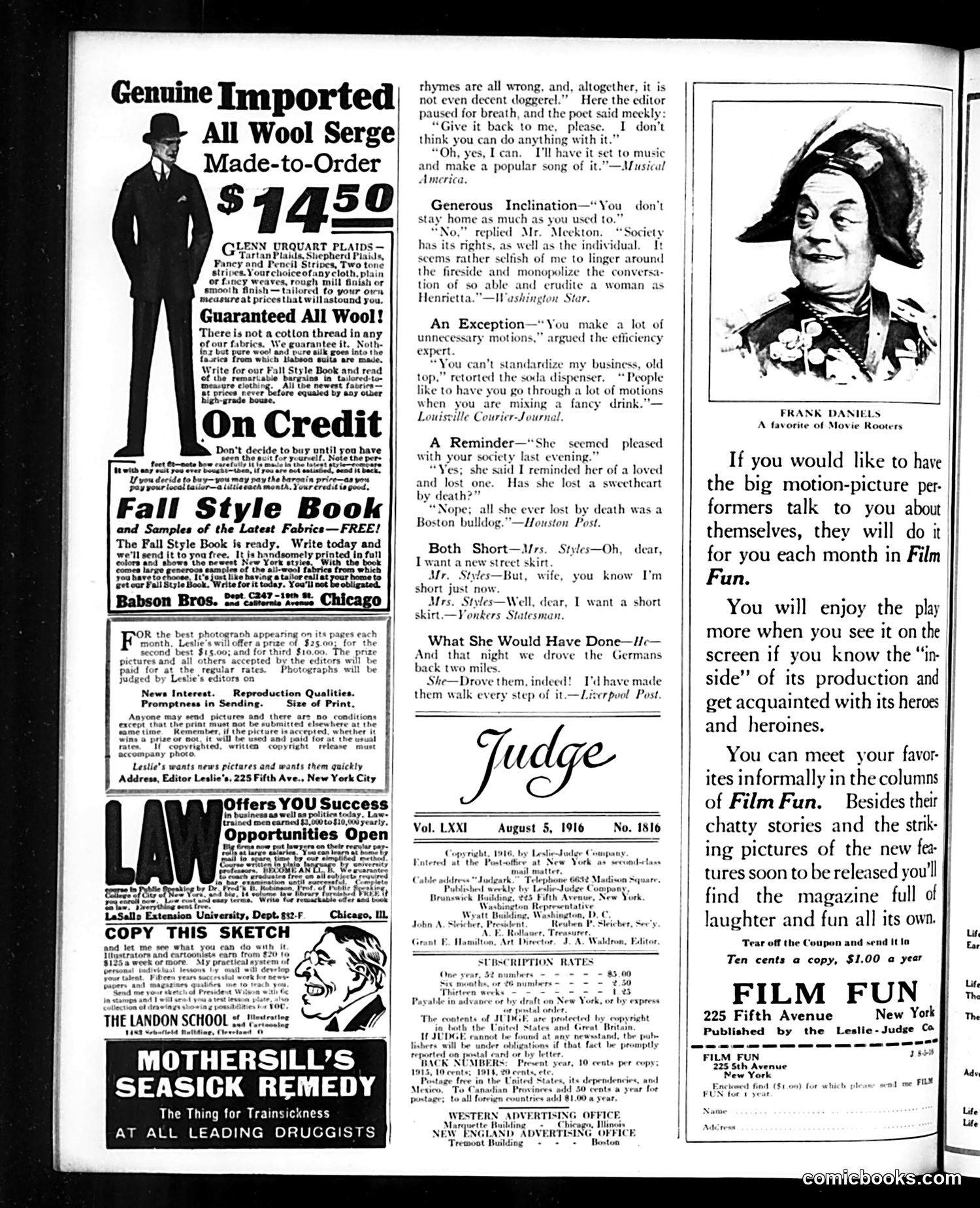
This page is primarily **advertising and filler content** rather than political satire. The dominant feature is a full-page ad for a mail-order tailoring company (Glenn Urquart Plaids) offering wool serge suits for $14.50 on credit—typical early 20th-century direct-mail marketing. The small text sections labeled "Generous Inclination," "An Exception," "Both Short," and "A Reminder" are brief **domestic humor anecdotes**—light social comedy about marriage, efficiency at work, and fashion. They reflect period concerns: women's changing social roles, the efficiency movement, and women's hemlines (notably, one anecdote involves a wife wanting shorter skirts while her husband says they're "short just now," referencing the fashion debates of 1916). The page includes a photo of **Frank Daniels**, identified as "a favorite of Movie Rooters," promoting *Film Fun* magazine. **Overall context**: This appears to be a filler/advertising-heavy page from Judge. The content reflects 1916 consumer culture and mild domestic gender humor rather than sharp political satire.
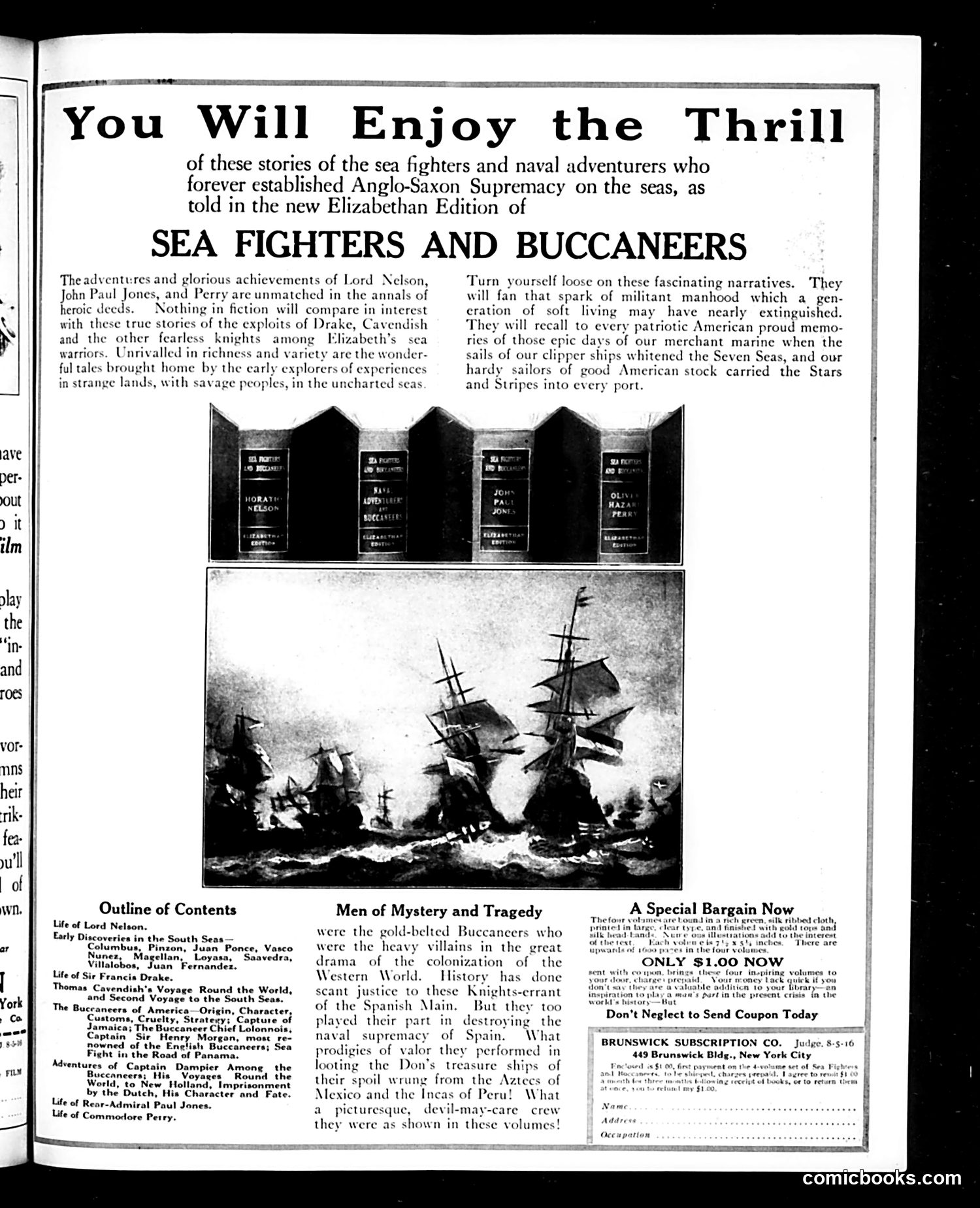
This is primarily a **book advertisement**, not political satire. It promotes an Elizabethan Edition collection of naval adventure stories featuring Lord Nelson, John Paul Jones, Drake, and English buccaneers. The marketing pitch explicitly appeals to **Anglo-Saxon supremacy and militaristic masculinity**—promising narratives will "fan that spark of militant manhood which a generation of soft living may have nearly extinguished." This reflects early 20th-century attitudes valorizing imperial naval power and aggressive expansionism. The wood-engraved illustration shows a naval battle scene with period sailing ships, reinforcing the adventurous tone. The outlined contents list emphasizes colonial exploration and piracy against Spanish territories. The "$1.00 NOW" offer and subscription coupon indicate this was a direct-mail marketing piece. The rhetoric romanticizes historical violence and plunder as patriotic American heritage.
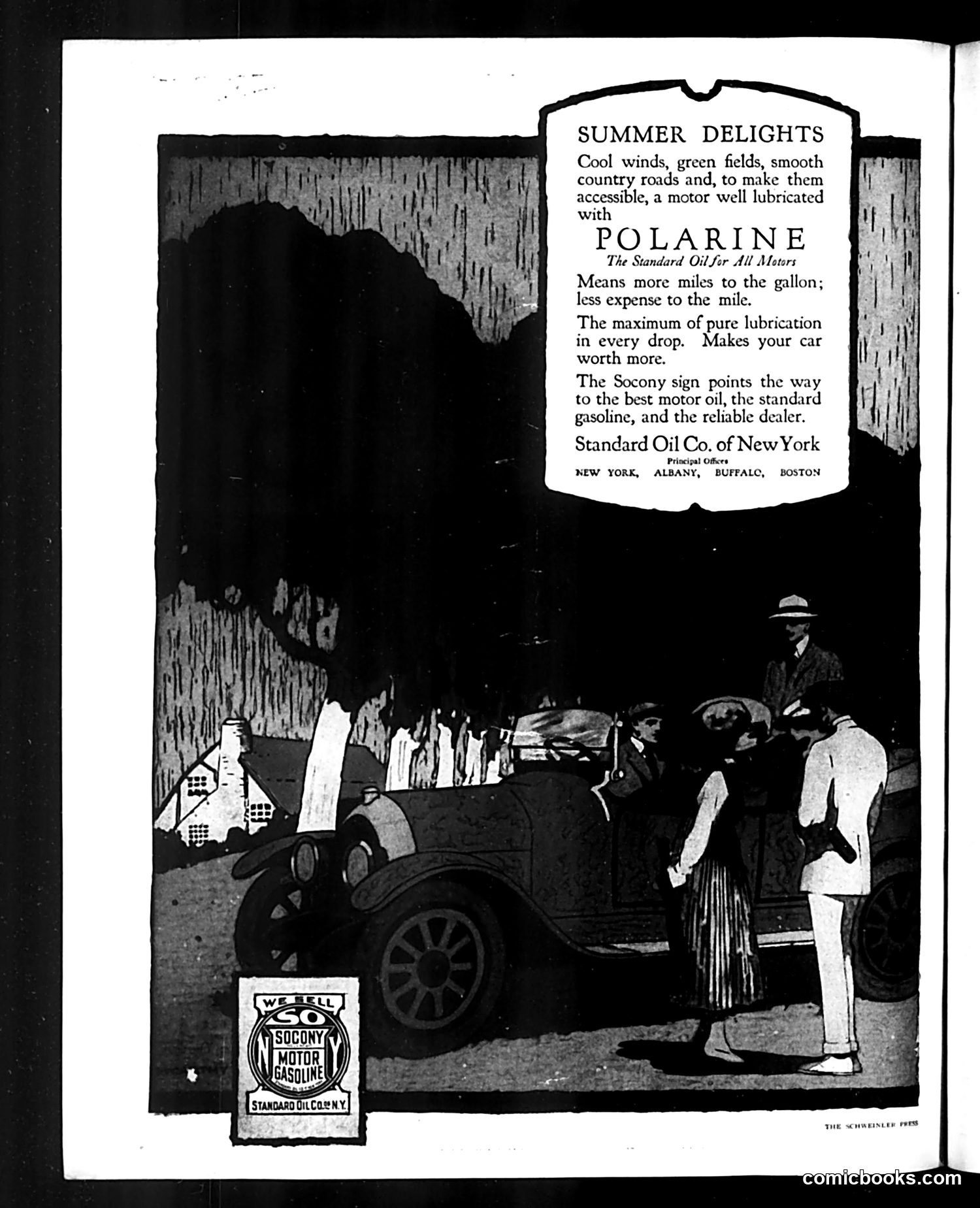
This page is **entirely an advertisement**, not a cartoon or satire. It's a Polarine motor oil ad from Standard Oil Company of New York (Socony). The image shows a vintage automobile with well-dressed people on a country road, promoting summer travel. The text emphasizes practical benefits: better fuel economy ("more miles to the gallon") and engine protection ("maximum pure lubrication in every drop"). There is no political or social satire present. This is straightforward product advertising typical of early 20th-century magazines, using an idyllic pastoral scene to associate the brand with leisure and accessible motoring. The Socony sign mentioned was a real gas station brand marker of that era.