
Judge, 1916-08-05 · page 12 of 28
Judge — August 5, 1916 — page 12: what you’re looking at
What you’re looking at
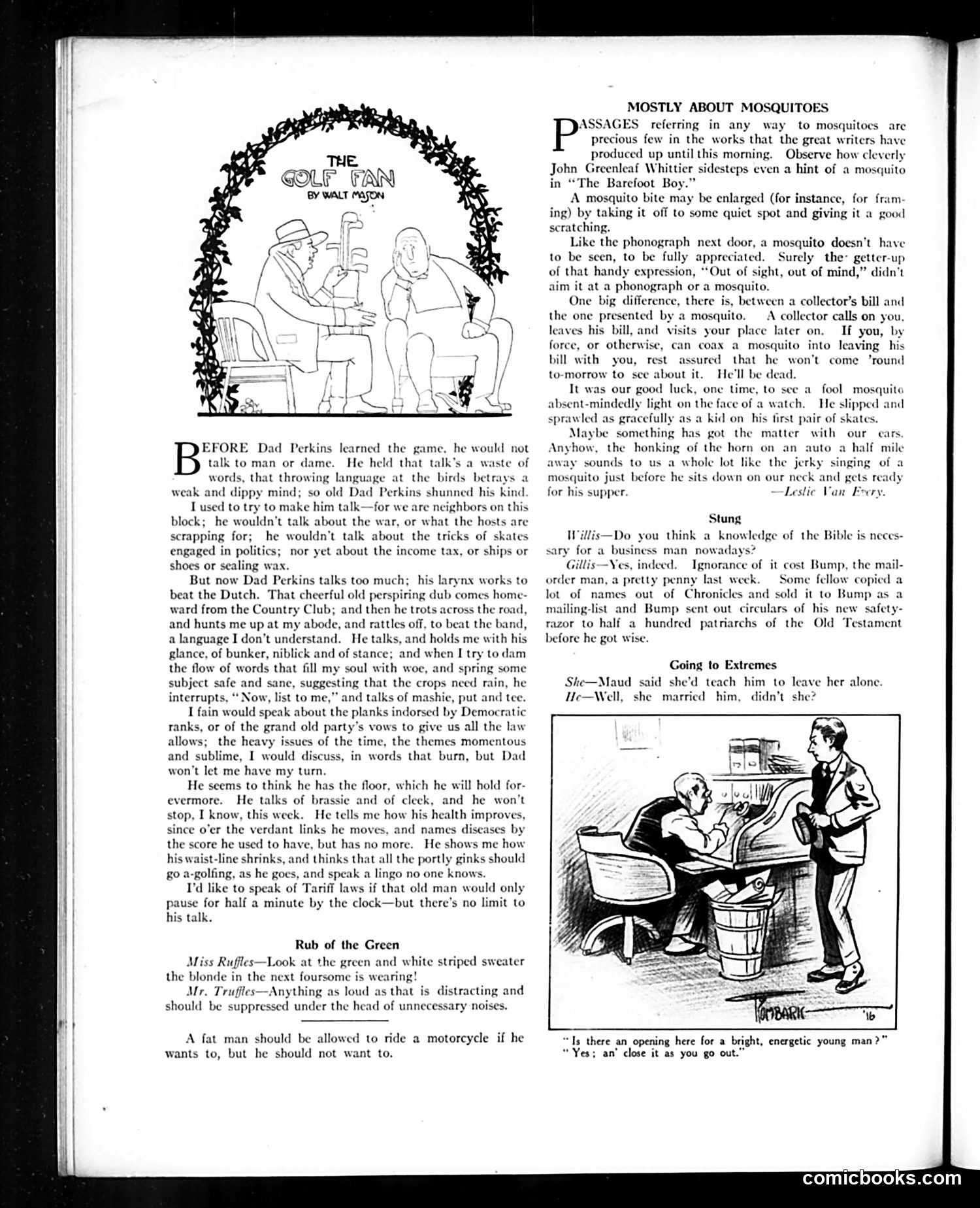
**"The Golf Fan" (by Walt Dotson):** This comic narrative satirizes the recently golf-obsessed middle-class American male. The protagonist, "Dad Perkins," was previously a silent, antisocial neighbor who refused conversation. After taking up golf at the Country Club, he becomes insufferably talkative—monopolizing conversations with incomprehensible golf jargon ("niblick," "mashie," "brassie") while refusing to discuss serious topics like tariffs or politics. The satire mocks both golf's sudden popularity as a leisure activity and the way it transforms men into tedious bores who speak an impenetrable insider language. The accompanying "Rub of the Green" jokes reinforce golf humor and social observation about dress and behavior. **"Mostly About Mosquitoes":** A humorous essay riffing on the mosquito as an understated literary subject and domestic nuisance, contrasting its elusiveness with the permanence of bill collectors. The page reflects early 20th-century American anxieties about leisure culture and changing social habits.
📄 Transcribed text from this page (OCR, searchable)
Machine-transcribed from the original scan — historical spelling and the odd misread are preserved.
SFORE Dad Perkins learned the game, he would not talk to man or dame. He held that talk’s a waste of words, that throwing language at the birds betrays a weak and dippy mind; so old Dad Perkins shunned his kind I used to try to make him talk—for we are neighbors on this block; he wouldn't talk about the war, or what the hosts are he wouldn't talk about the tricks of skates . or ships or scrapping for; engaged in politics; nor yet about the income shoes or sealing wax. But now Dad Perkins talks too much; his larynx works to beat the Dutch. That cheerful old perspiring dub comes home- ward from the Country Club; and then he trots across the road, and hunts me up at my abode, and rattles off, to beat the band, a language I don’t understand. He talks, and holds me with his glance, of bunker, niblick and of stance; and when I try to dam the flow of words that fill my soul with woe, and spring some subject safe and sane, suggesting that the crops need rain, he interrupts, “ Now, list to me,” and talks of mashie, put and t I fain would speak about the planks indorsed by Democratic ranks, or of the grand old party's vows to give us all the law allows; the heavy issues of the time, the themes momentous and sublime, I would discuss, in words that burn, but Dad won't Iet me have my turn. He seems to think he has the floor, which he will hold for- He talks of brassie and of cleck, and he won't He tells me how his health improves, since o'er the verdant links he moves, and names diseases by the score he used to have, but has no more. He shows me how his waist-line shrinks, and thinks that all the portly ginks should go a-golfing, as he goes, and speak a lingo no one knows. I'd like to speak of Tariff laws if that old man would only pause for half a minute by the clock—but there's no limit to his talk. evermore. stop, I know, this week. Rub of the Green Miss Ruffles—Look at the green and white striped sweater the blonde in the next foursome is wearing! Mr. Trufiles—Anything as loud as that is dist should be suppressed under the head of unnecessary noises. acting and A fat man should be allowed to ride a motorcycle if he wants to, but he should not want to. MOSTLY ABOUT MOSQUITOES referring in any way to mosquitoes are precious few in the works that the great writers have produced up until this morning. Observe how cleverly John Greenleaf Whittier sidesteps even a hint of a mosquito in “The Barefoot Boy. A mosquito bite may be enlarged (for instance, for fram- ing) by taking it off to some quiet spot and giving it a good scratching. Like the phonograph next door, a mosquito doesn’t have to be scen, to be fully appreciated. Surely the- getter-up of that handy expression, “Out of sight, out of mind,” didn’t aim it at a phonograph or a mosquito. One big difference, there is, between a collector’s bill and the one presented b; mosquito. A collector calls on you, leaves his bill, and visits your place later on. If you, by force, or otherwise, can coax a mosquito into leaving his bill with you, rest assured that he won't come ‘round to-morrow to sce about it. He'll be dead. It was our good luck, one time, to sce a fool mosquito absent-mindedly light on the face of a watch. He slipped and sprawled as gracefully as a kid on his first pair of skates. Maybe something has got the matter with our ears. Anyhow, the honking of the horn on an auto a half mile away sounds to us a whole lot like the jerky singing of a mosquito just before he sits down on our neck and g for his supper. z Stung Willis—Do you think a knowledge of the Bible is neces- sary for a business man nowadays? Gillis—Yes, indeed. Ignorance of it cost Bump, the mail- order man, a pretty penny last week. Some fellow copied a lot of names out of Chronicles and sold it to Bump as a mailing-list_ and Bump sent out circulars of his new safety- razor to half a hundred patriarchs of the Old Testament before he got wise. Going to Extremes She—Maud said she'd teach him to leave her alone. He—Well, she married him, didn’t she? “Is there an opening here for a bright, energetic young man?” “Yes; an’ close it as you go out.” comicbooks.com