
A complete issue · 24 pages · 1915
Judge — March 27, 1915
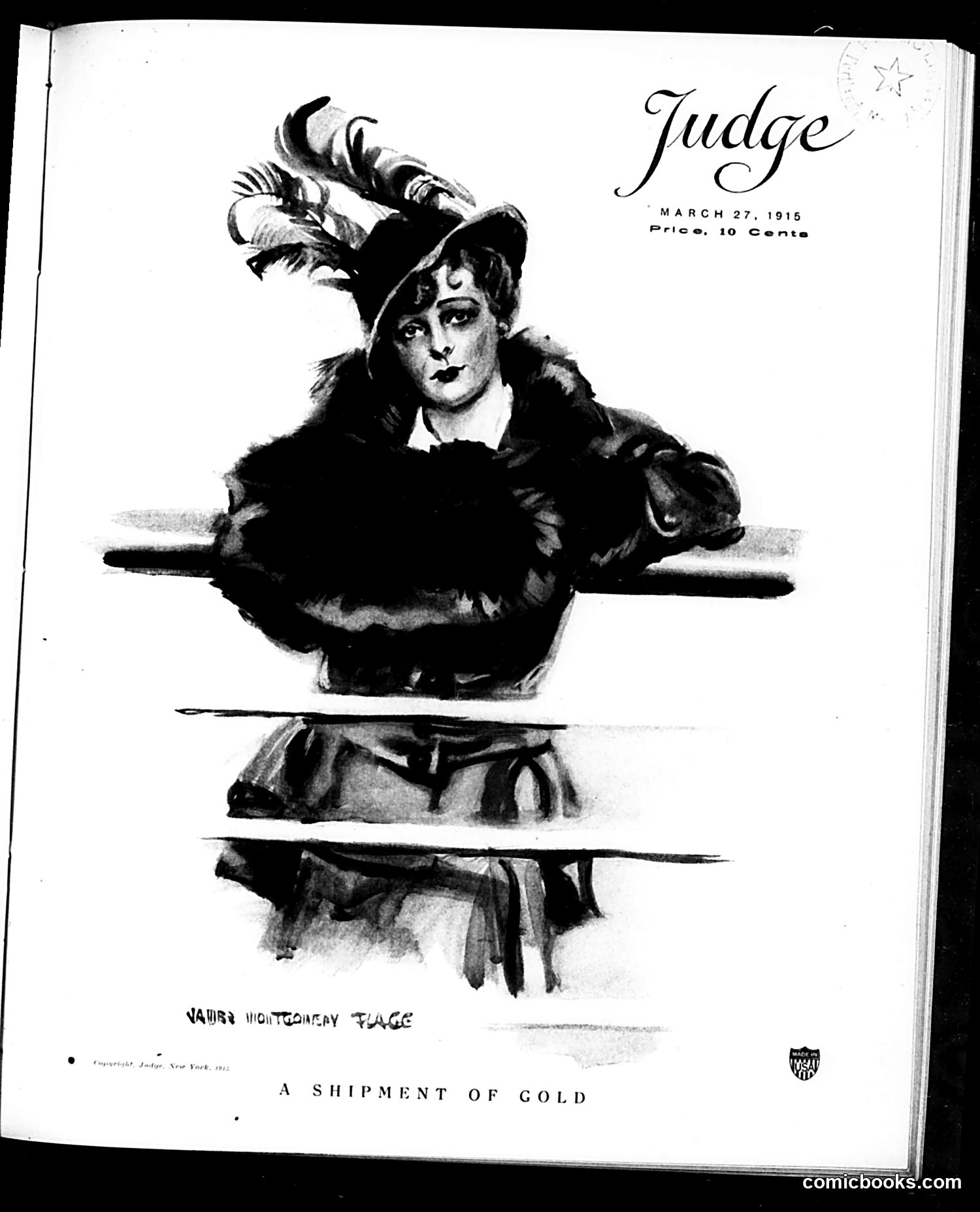
This cover illustrates "A Shipment of Gold"—likely referencing World War I financial matters. The illustration shows a fashionably dressed woman with an elaborate feathered hat, her torso divided by horizontal lines suggesting she's being sectioned or divided up like a commodity being shipped. The satire appears to critique how wealth or resources (the "gold") are being parceled out or distributed during wartime. The woman's sophisticated appearance and the compartmentalization of her figure suggest commentary on how money or resources are being allocated among different interests or nations during the early years of WWI, when the U.S. was still officially neutral but deeply involved in war financing. The artist is credited as "James Montgomery Flagg."
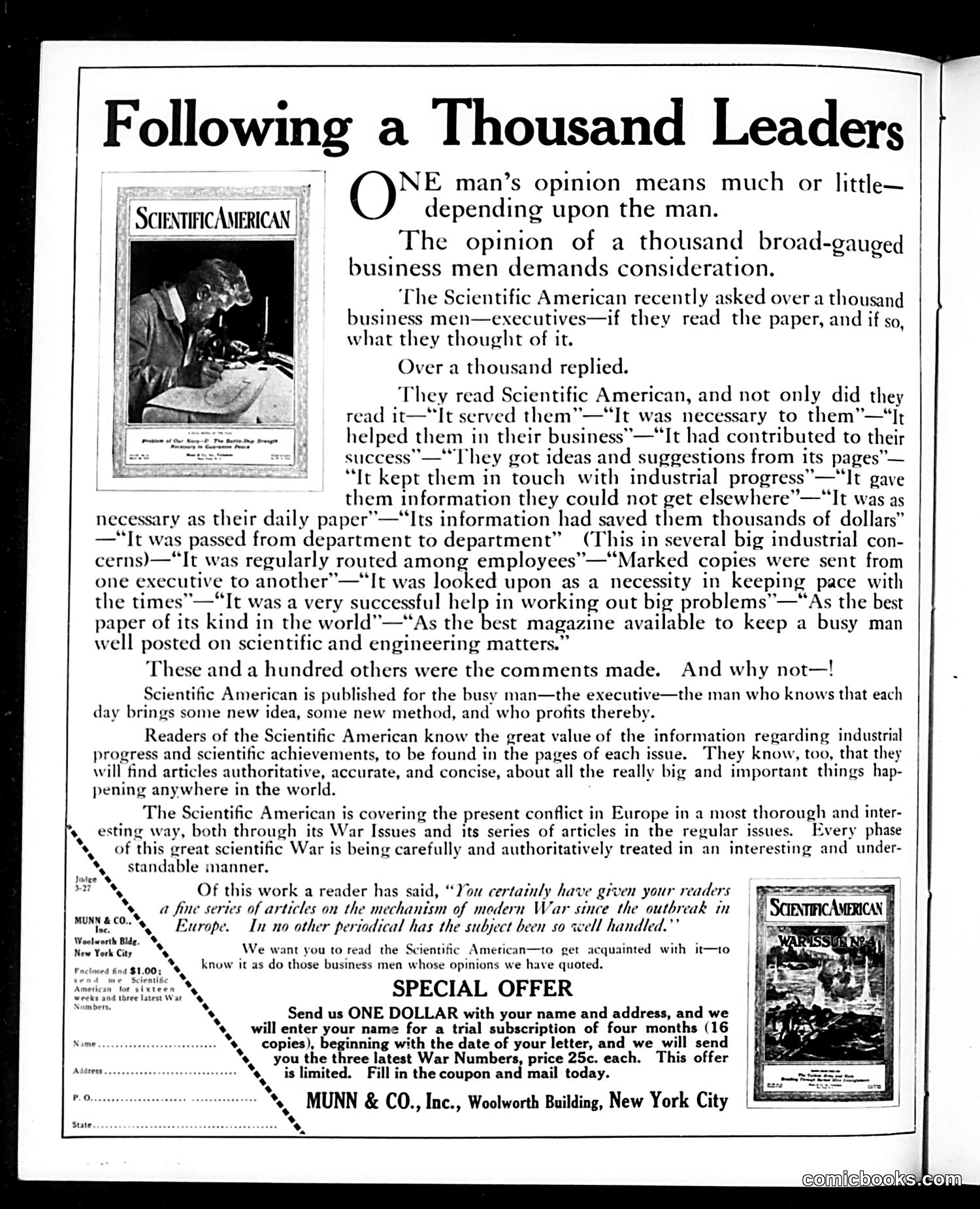
This page is primarily **advertising, not satirical content**. It's a full-page advertisement for *Scientific American* magazine published by Munn & Co., Inc. The ad quotes over a thousand business executives praising the magazine's value for industrial and scientific information. It emphasizes that *Scientific American* covers the "present conflict in Europe" thoroughly—a reference to **World War I**—with articles on "the mechanism of modern War" handled in an "interesting and understandable manner." The "special offer" solicits new subscribers: one dollar for a trial subscription including three "War Numbers" at 25 cents each. There are no political cartoons or satirical figures on this page—it's a straightforward commercial pitch leveraging wartime interest in military-technical content.
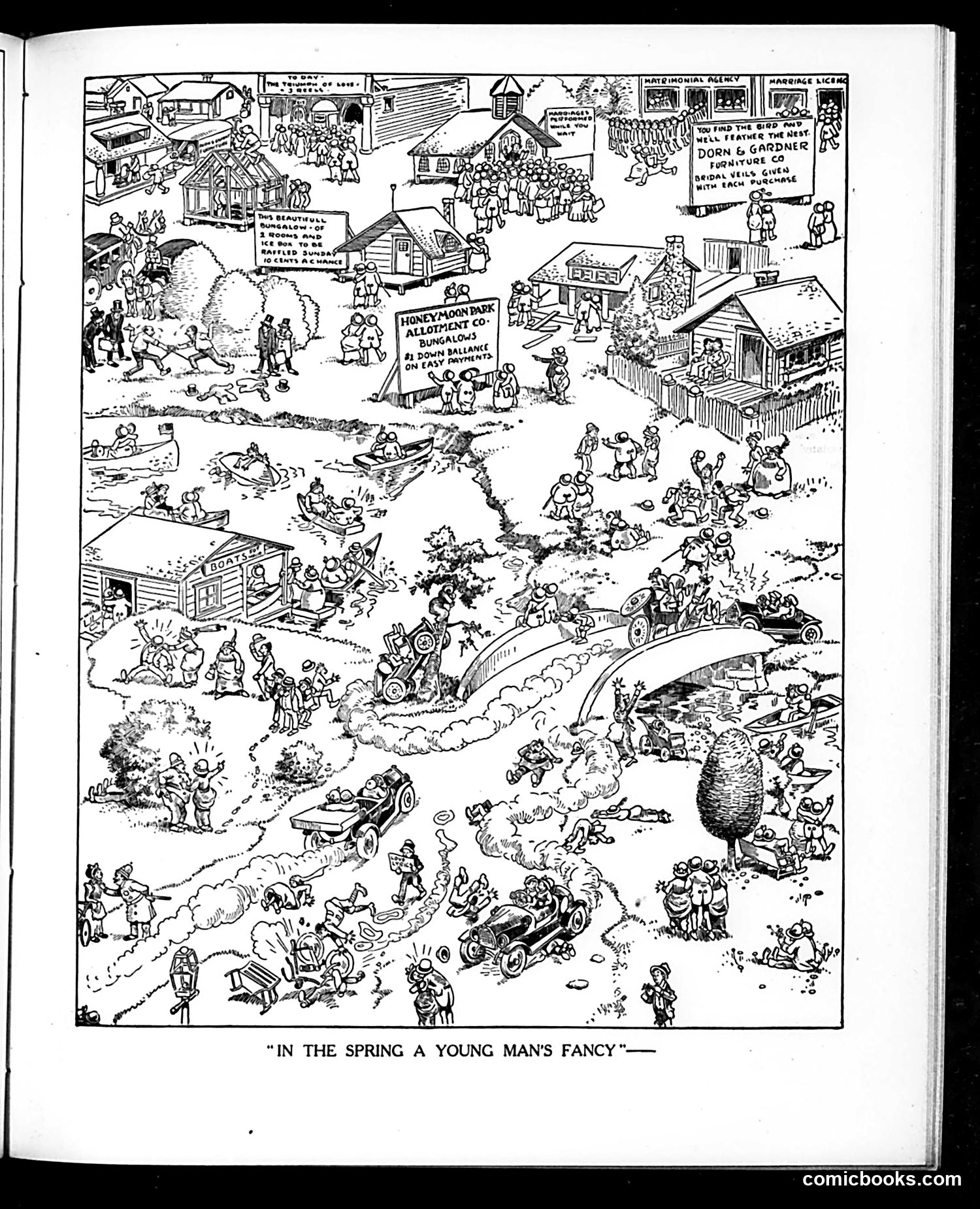
This cartoon satirizes spring recreation and leisure activities in early 20th-century America. The densely packed scene depicts a park or recreational area where various social classes engage in seasonal pastimes: automobile driving, boating, picnicking, and courting. The title references Palgrave's famous poem about springtime romance ("In the spring a young man's fancy lightly turns to thoughts of love"), suggesting the cartoon jokes about springtime attractions—both romantic and recreational. The advertisements visible in boxes (Honeymoon Park Allotment Co., Dorn & Gardner Furniture Co., and others) indicate commercial interests capitalizing on seasonal leisure. The chaotic composition humorously captures the era's emerging car culture, public parks, and consumer entertainment, satirizing both the idealism of spring and commercialized recreation.
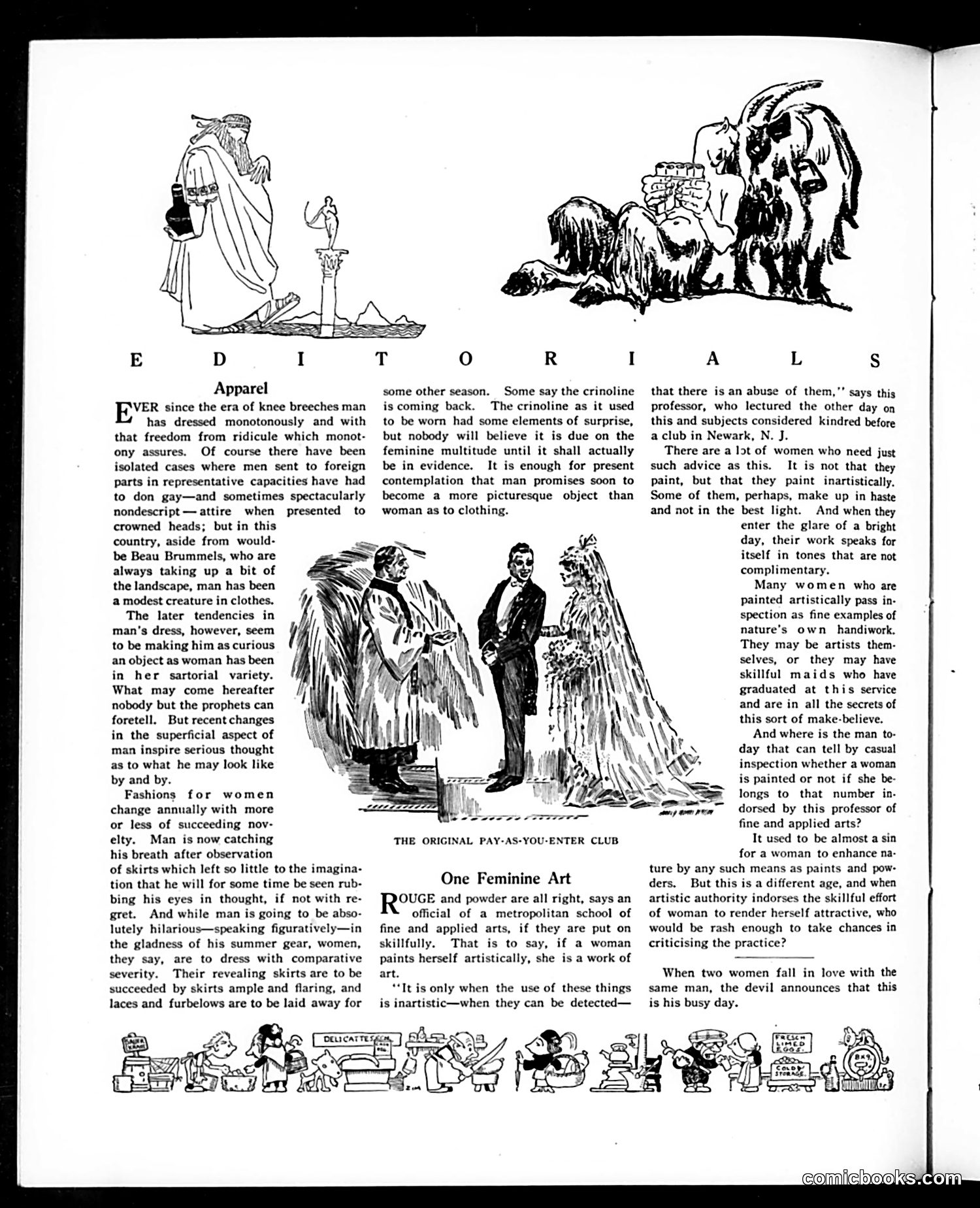
This Judge magazine page satirizes evolving attitudes toward women's appearance and fashion in the early 20th century. The "Editorials" section critiques men's changing views on women's dress, noting that men now scrutinize women's skirts with intense interest—a shift the author finds absurd. The piece sarcastically suggests men are becoming "as curious an object as woman has been in her sartorial variety." The illustrated section "One Feminine Art" debates whether women who paint their faces are artists. It argues that skillfully applied cosmetics constitute legitimate "fine and applied arts," suggesting that women painters deserve recognition as practitioners of a genuine craft, not mere vanity. The satire ultimately mocks both male obsession with female appearance and society's judgment of women who use cosmetics.
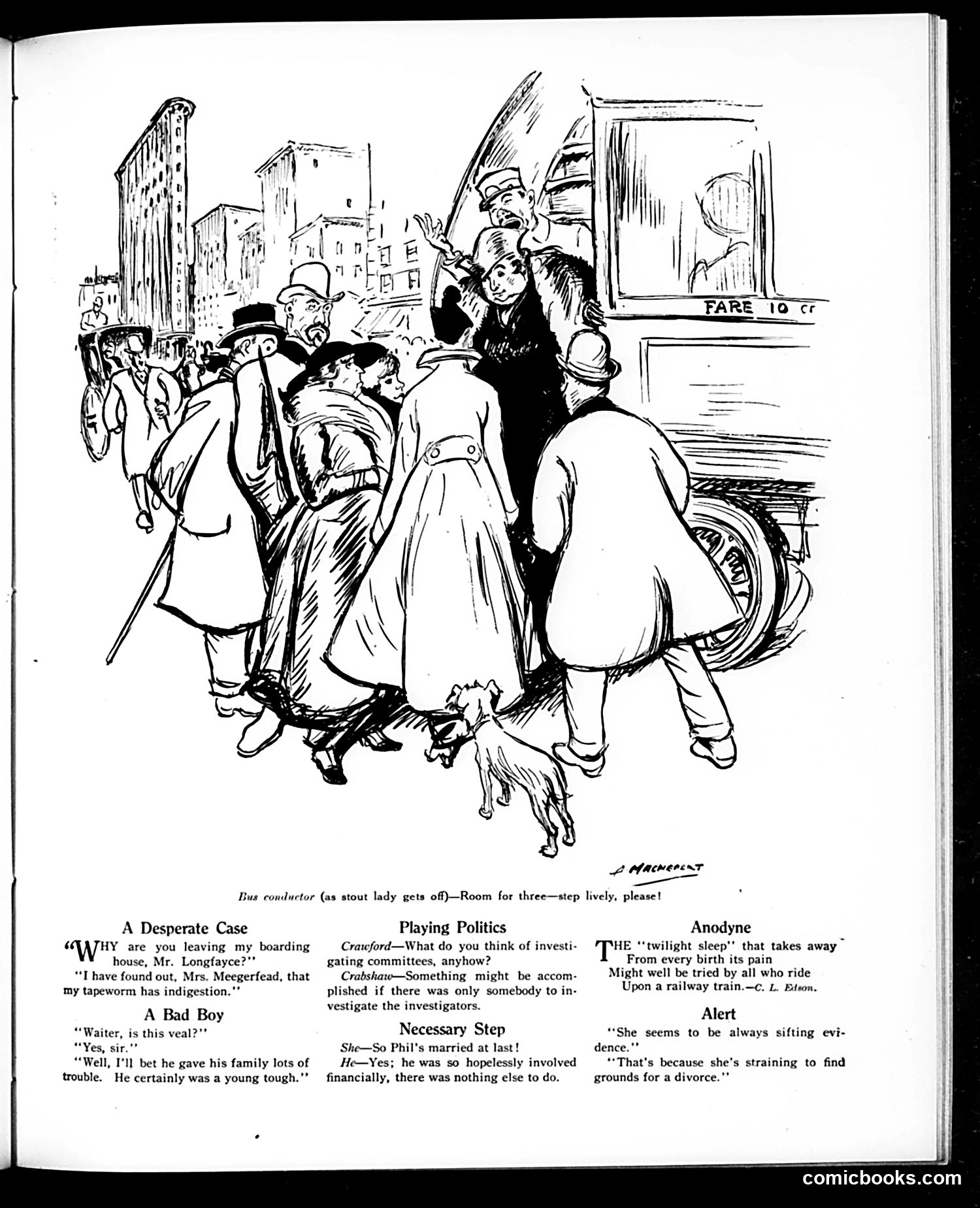
The main cartoon depicts a crowded bus or streetcar scene captioned "Bus conductor (as stout lady gets off)—Room for three—step lively, please!" The humor derives from the visual contrast: the departing woman is substantially built, so her exit creates enough space for multiple passengers—an unkind joke about her size. Below are six brief humorous vignettes typical of Judge's satirical format, offering commentary on domestic life, workplace dynamics, and social behavior. "Playing Politics" jokes about congressional investigation committees. "A Bad Boy" presents typical parent-child banter. The other sections mock divorce-seeking behavior and other contemporary social situations. This represents Judge's accessible, punch-line-driven humor aimed at general readers, focusing on everyday social foibles rather than specific political figures.
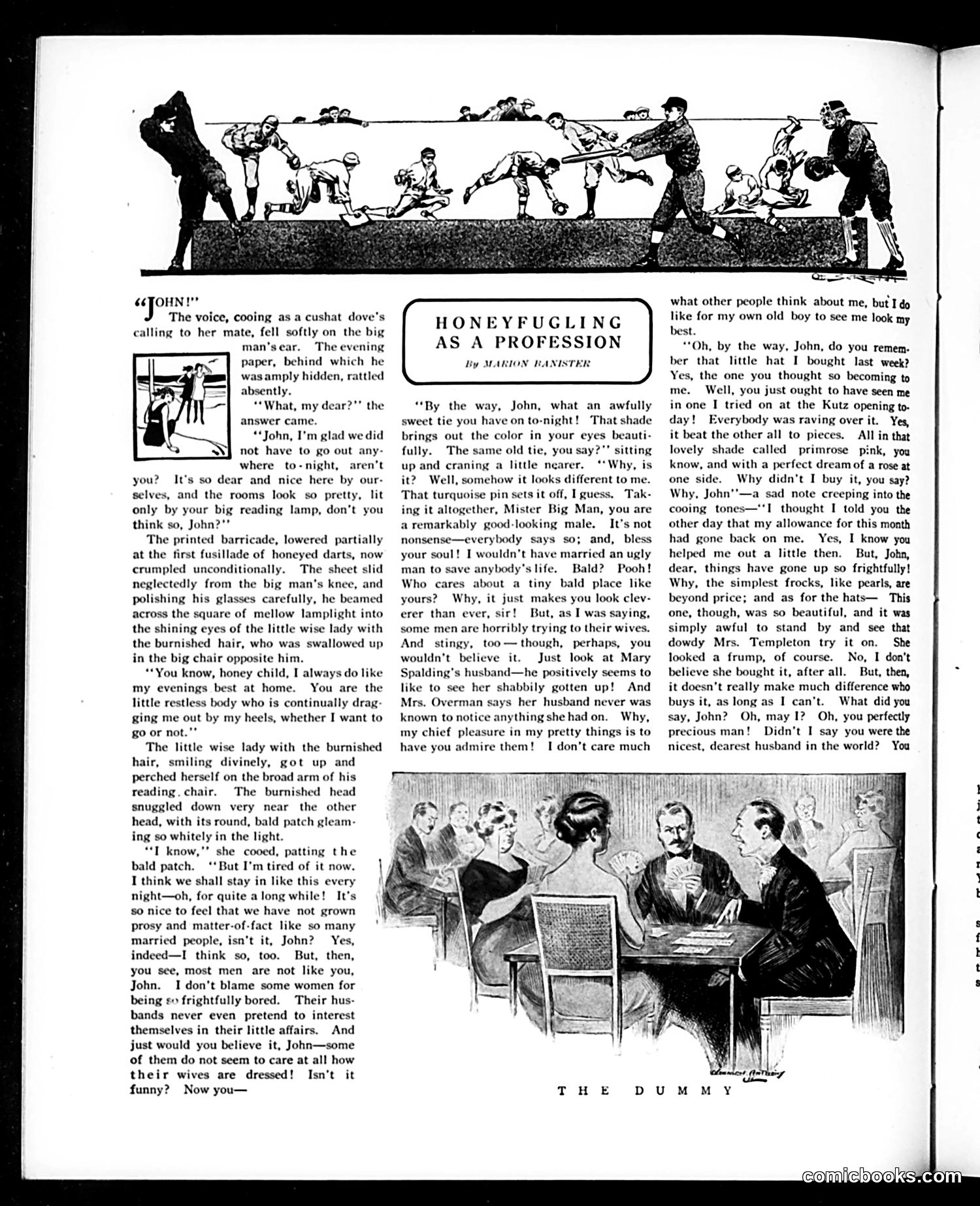
This satirical piece mocks wives who strategically flatter and manipulate their husbands into spending money. The title's term "honeyfuggling" means deceptive sweet-talking. The narrative shows a wife employing transparent flattery—praising her husband's appearance, his tie, his bald spot—while steering conversation toward desired purchases. She compliments other women's husbands' attentiveness to their wives' appearance, implying her own husband should similarly indulge her shopping. The cartoon at top depicts children playing tug-of-war, likely illustrating the domestic power struggle. "The Dummy" illustration below shows men at what appears to be a social gathering, possibly representing husbands as passive victims of such manipulation. The satire targets both the manipulative wife archetype and the gullible husband who falls for obvious flattery. This reflects early 20th-century anxieties about gender dynamics, consumer spending, and marital power, portraying women's financial requests as cunning rather than legitimate household needs.
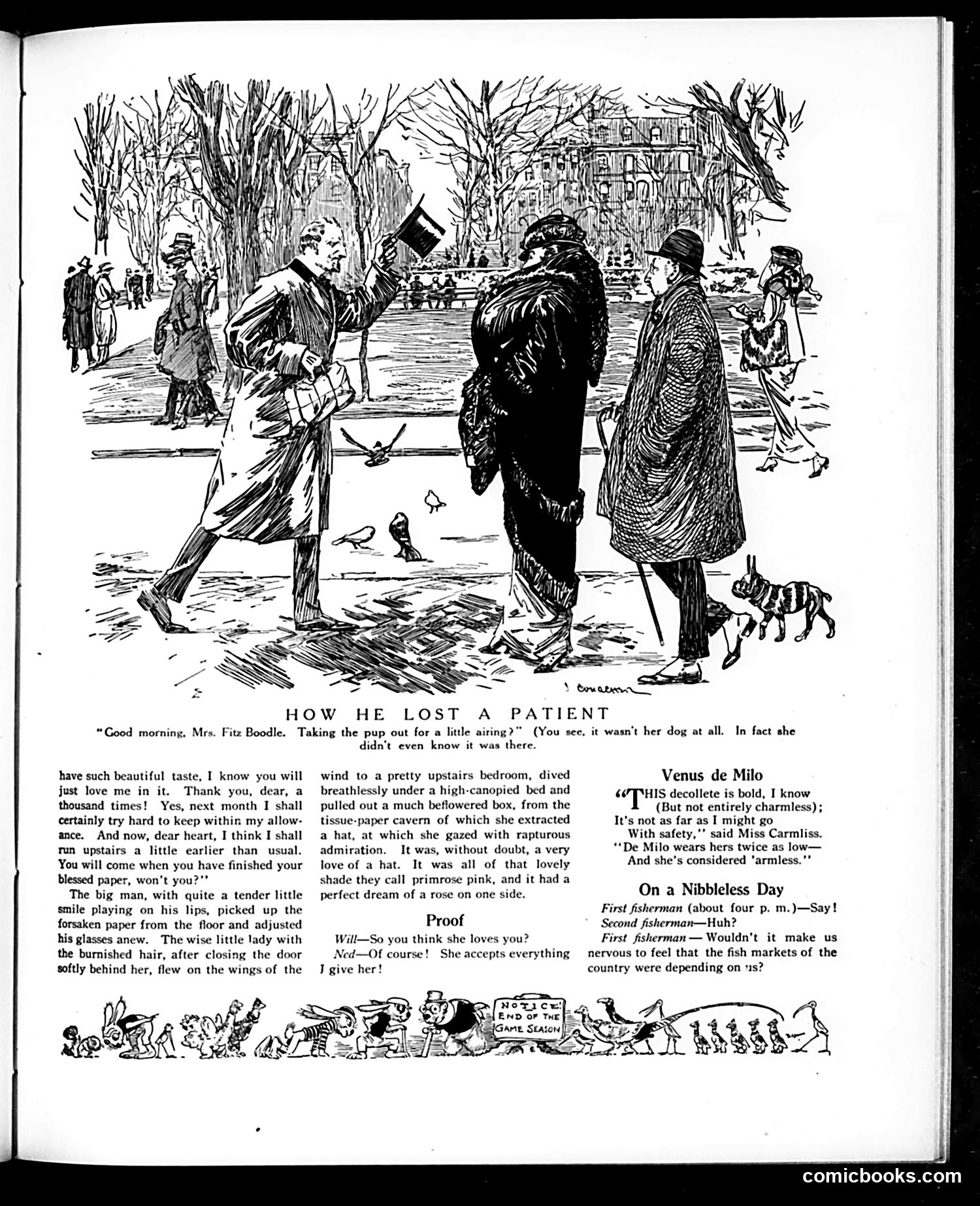
The main cartoon satirizes a doctor's romantic miscalculation. The caption reveals he greeted a woman with her dog, saying "Taking the pup out for a little airing?" — but the dog wasn't hers at all. She was walking someone else's pet, making the doctor's familiar assumption both wrong and inappropriate enough to cost him her as a patient. The humor lies in his embarrassing gaffe from misreading the social situation. The accompanying text snippets offer other comic vignettes: one about a wife's secret hat purchase (satirizing domestic deception), another mocking a suitor who conflates gift-giving with genuine affection, and a classical art joke about Venus de Milo's exposed state versus modern propriety. The "Nibbleless Day" dialogue jokes about fishermen feeling pressure if fish markets depended on their catch.
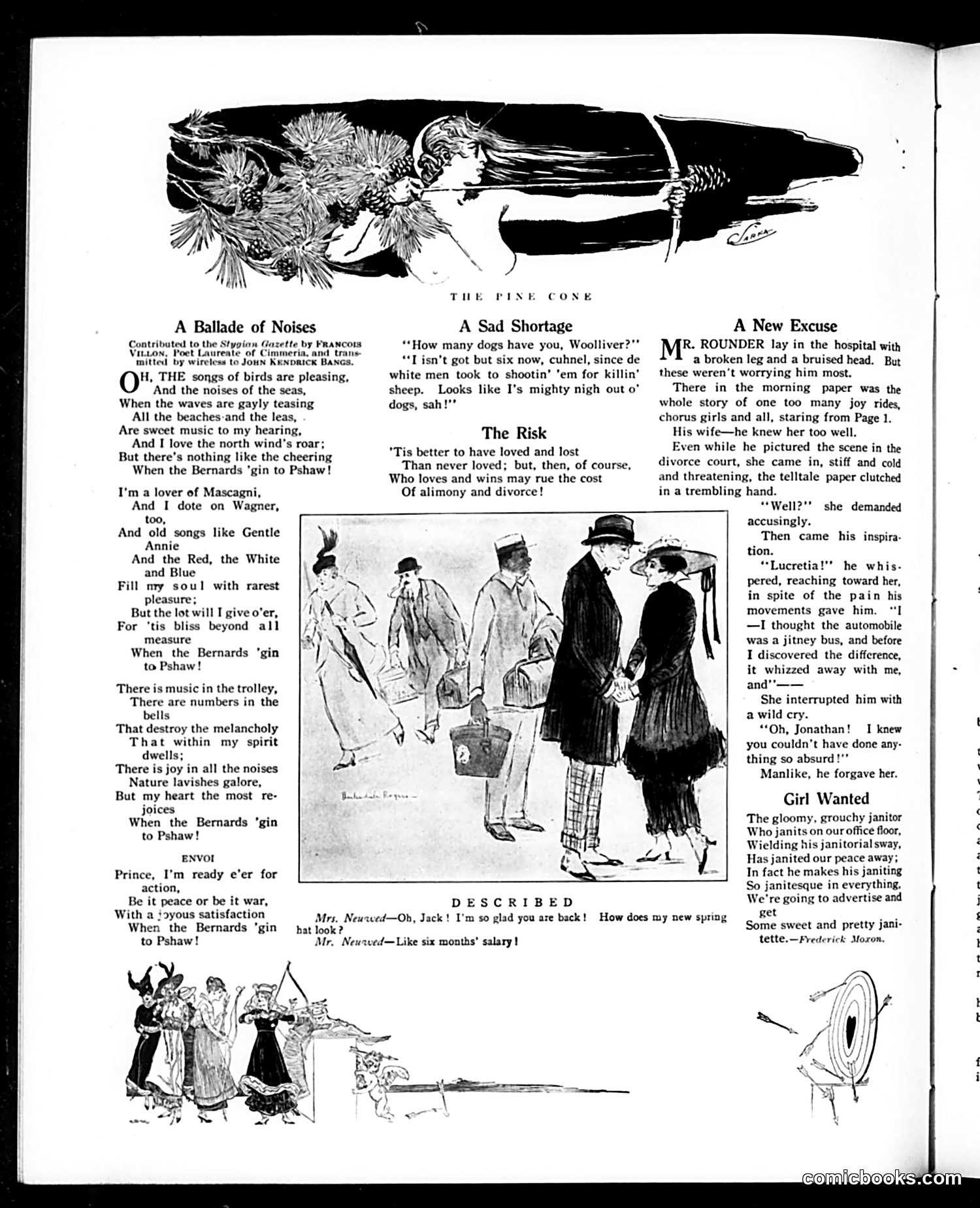
This page contains several humorous pieces satirizing early 20th-century American life: **"A Ballad of Noises"** celebrates the sound of people saying "Pshaw!"—likely mocking the Bernards (possibly a theatrical group or public figures), with the joke being that this dismissive sound is more delightful than music or nature. **"A Sad Shortage"** presents a dialect-speaking character lamenting that white hunters are killing his dogs for attacking sheep, leaving him short of hunting dogs—a rural complaint about resource depletion. **"A New Excuse"** satirizes infidelity and marital deception: a husband caught in a scandal about "joy rides" with chorus girls escapes his wife's anger by claiming he mistook an automobile for a "jitney bus," and she forgives him for this absurd lie because it's "so absurd" it must be true. **"Girl Wanted"** is light wordplay about a janitor whose work is so annoying they want to hire a "janitette" instead—pun-based humor typical of the era. The overall tone is satirical domestic comedy targeting marriage, infidelity, and social pretension.
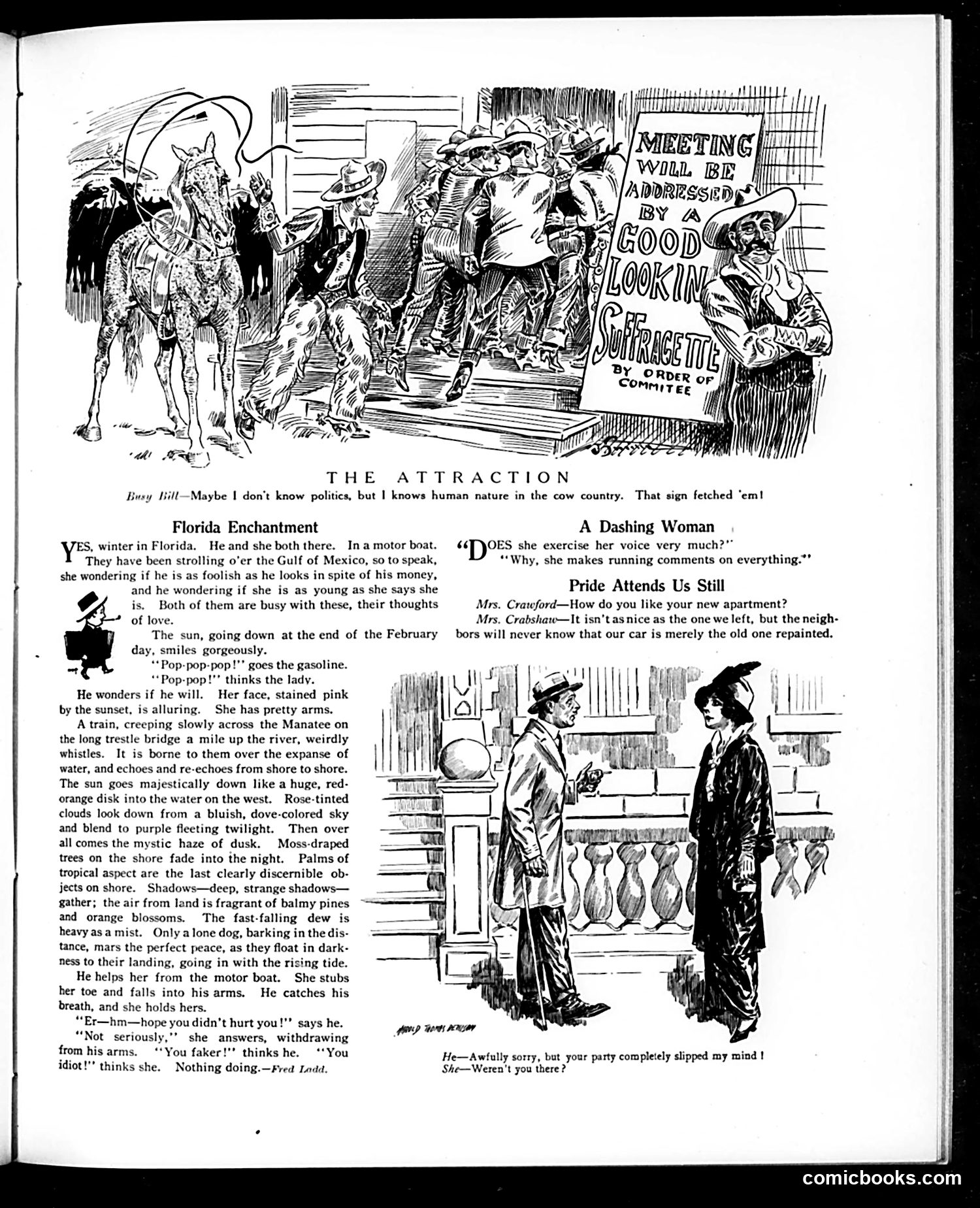
**"The Attraction"** (top): A suffragette meeting is disrupted by a cowboy's horse and dog. The sign promises the meeting will be "addressed by a Good Looking Suffragette"—the joke being that the crowd is attracted by physical appearance rather than the cause itself. The cowboy observes that human nature, even in rural areas, responds to such superficial appeals. This mocks both suffragettes and the public's shallow priorities. **"Florida Enchantment"** and the other brief humor pieces are romantic vignettes poking fun at courtship pretenses and social climbing. "Pride Attends Us Still" satirizes keeping up appearances—the couple repaints their old car so neighbors won't know their financial decline. "A Dashing Woman" jokes about a woman who constantly complains about everything. These pieces reflect early 20th-century satirical humor targeting romance, women's social ambitions, and the gap between public pretense and private reality.
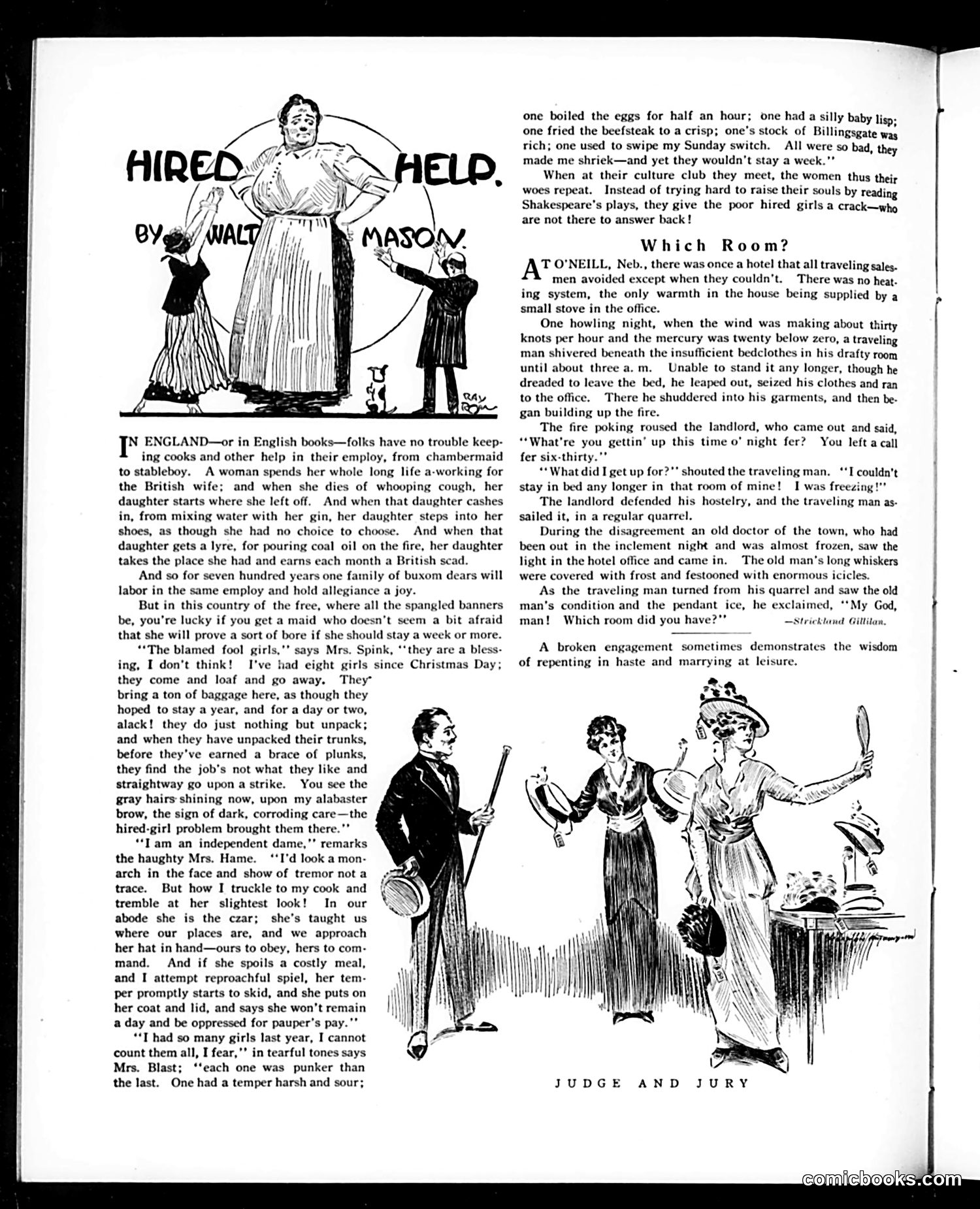
This page satirizes the American domestic servant crisis of the early 20th century. The top cartoon, credited to Walt Mason, depicts a large woman (representing American wives) with two small figures pulling on ropes—illustrating the difficulty of keeping hired help employed. The accompanying text contrasts England, where women serve multi-generational family positions out of tradition and obligation, with America's "free" labor market. American maids are portrayed as independent, demanding, and quick to quit—frustrating their employers (Mrs. Spink, Mrs. Hame, Mrs. Blast) who complain endlessly about their insubordination and brief tenures. The satire's target is ambiguous: it mocks both the entitled attitudes of American employers expecting servile obedience and the maids themselves for being "troublesome." The secondary story, "Which Room?," offers comedic relief about a freezing hotel. The overall message reflects anxieties about American workers' newfound mobility and bargaining power—a sharp departure from Old World class structures.
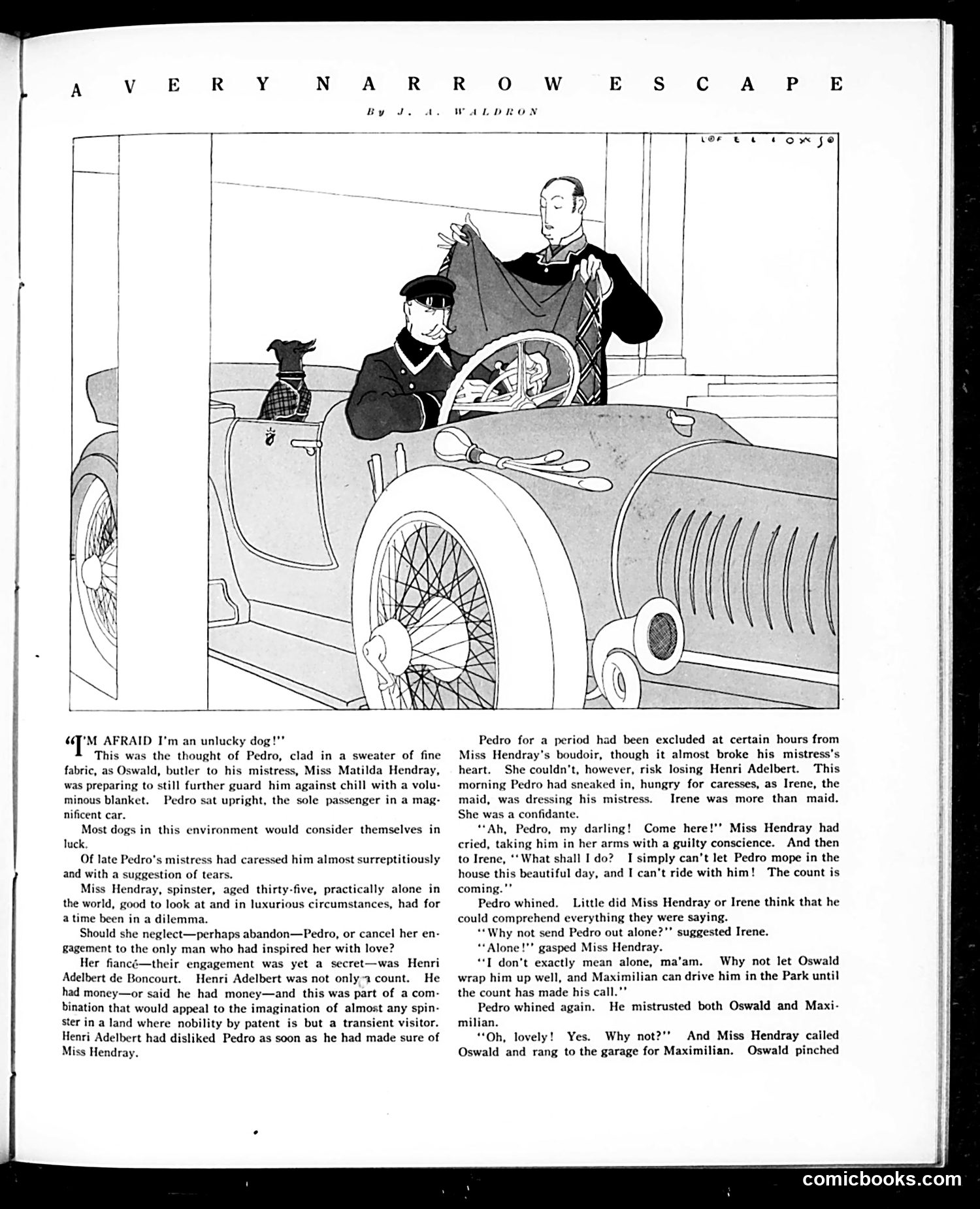
This is a sentimental domestic comedy story, not political satire. It centers on Pedro, a pampered dog belonging to Miss Matilda Hendray, a wealthy 35-year-old spinster. The plot involves a conflict: Miss Hendray is engaged (secretly) to Henri Adelbert de Boncourt, a French count who dislikes Pedro. She's forced to choose between her fiancé and her beloved dog. The servants—butler Oswald and chauffeur Maximilian—arrange to take Pedro out in the car while the count visits. The satire here targets old money and European nobility: Henri Adelbert's appeal relies partly on his title and alleged wealth, suggesting the foolishness of spinsters attracted to foreign aristocrats. The dog's anthropomorphization (understanding human conversation) adds gentle comedy. The story's title—"A Very Narrow Escape"—suggests the outcome remains to be seen, likely in following pages.
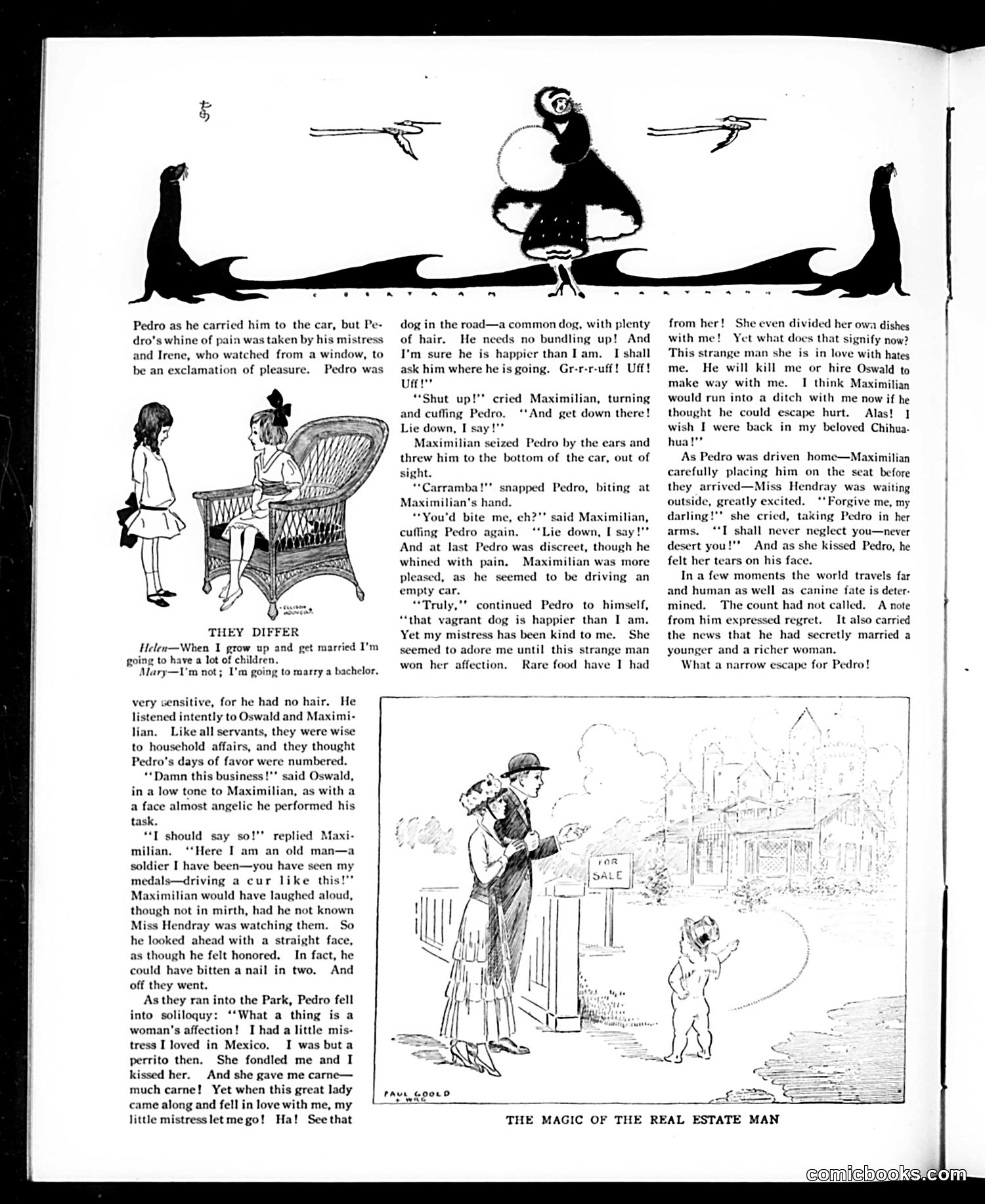
This page contains a serialized story about a dog named Pedro, not political satire. The narrative follows Pedro, a pampered pet caught in domestic drama: his mistress (Miss Hendray) has fallen in love with a man (Maximilian), causing Pedro's status to plummet. The story's central irony is that Pedro, despite receiving affection and fine food from Miss Hendray, becomes anxious about losing favor to this new romantic interest. Maximilian, portrayed as a bitter, aging servant-driver, resents having to care for the dog and mistreats him. The subplot involves a small comedic dialogue ("They Differ") about marriage expectations between two women. The narrative concludes with ironic reversal: the man abandons Miss Hendray to marry someone wealthier, and she reconciles with Pedro—suggesting the dog's anxieties were unfounded. **The cartoon** (bottom right, by Paul Goauld) titled "The Magic of the Real Estate Man" appears unrelated to Pedro's story, depicting a real estate agent showing property.
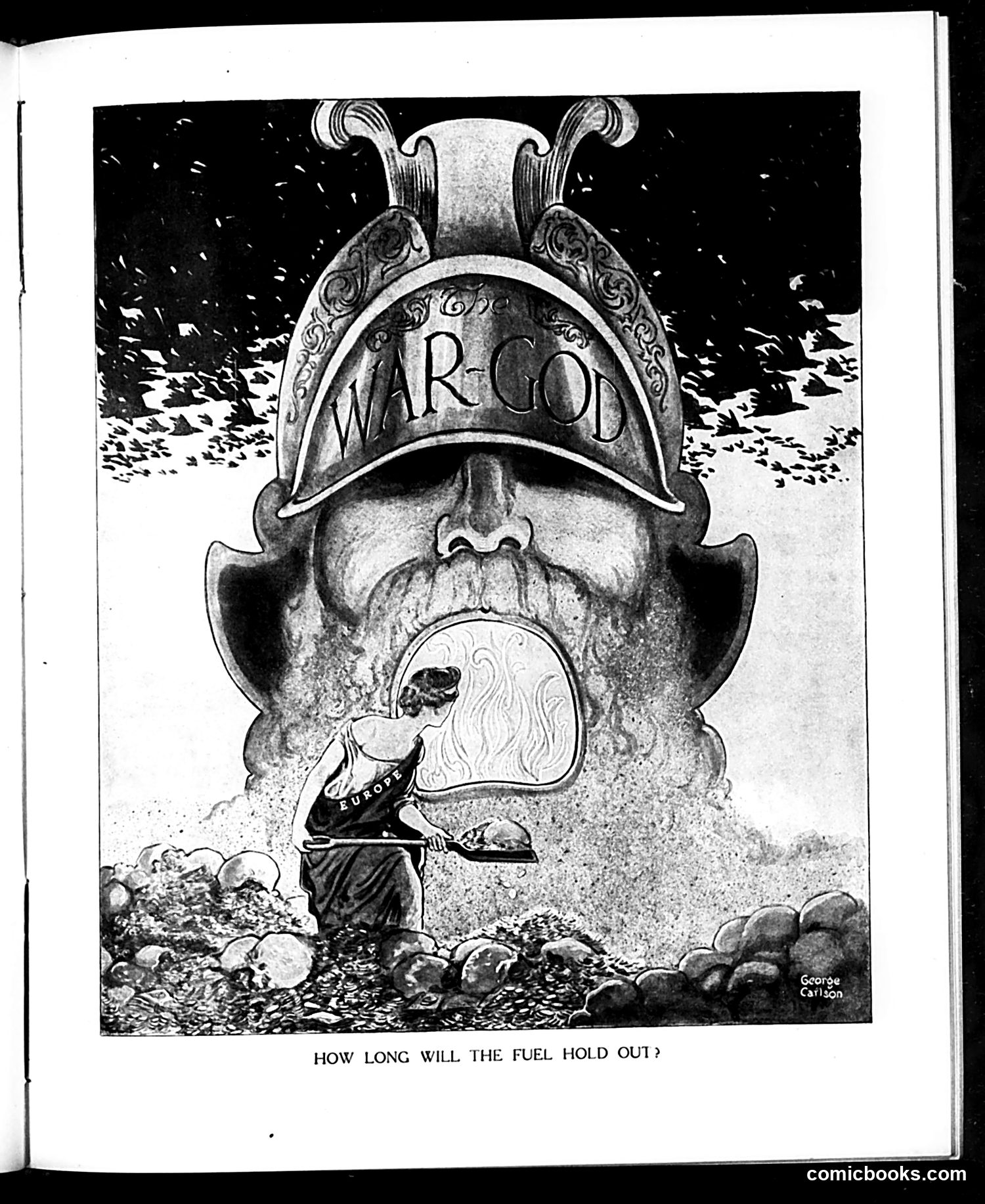
This George Carlson cartoon depicts a massive helmeted military head labeled "WARGOD" looming over a kneeling figure labeled "EUROPA" (personifying Europe). The helmet bears text reading "WARGOD," and Europa holds a torch labeled "EUROPA." The caption asks: "HOW LONG WILL THE FUEL HOLD OUT?" **Context**: This appears to be World War I-era satire, showing Europe as depleted and exhausted by the prolonged conflict, with the personified War God threatening to consume whatever remains. The "fuel" metaphor suggests Europe's dwindling resources—manpower, materials, and will—being consumed by military machinery. The cartoon criticizes how the war continues unsustainably, draining European civilization itself.
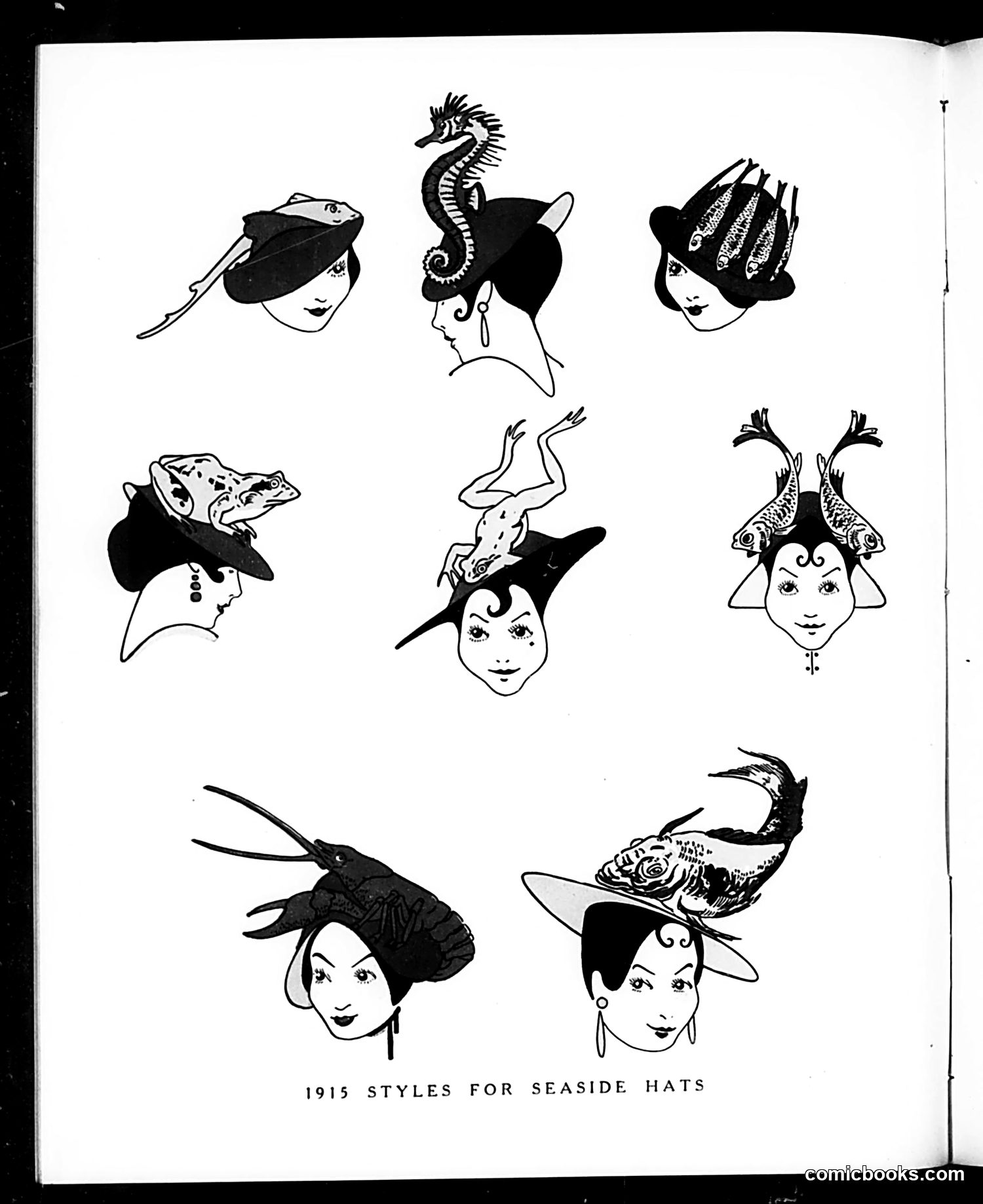
This page presents fashion illustrations rather than political satire. It shows eight women's hat designs labeled "1915 Styles for Seaside Hats," featuring elaborate decorative elements typical of that era's millinery. The designs incorporate whimsical marine motifs: stingrays, seahorses, fish, crustaceans, and birds. Each hat sits atop a stylized female face shown in profile or three-quarter view. The designs range from modest to extravagant—some feature single creatures while others pile multiple sea creatures together. This reflects early 20th-century women's fashion's ornamental excess, where hats served as status symbols and artistic statements. The exaggerated designs mock the impracticality of contemporary high fashion by pushing seaside-themed embellishments to absurd extremes.
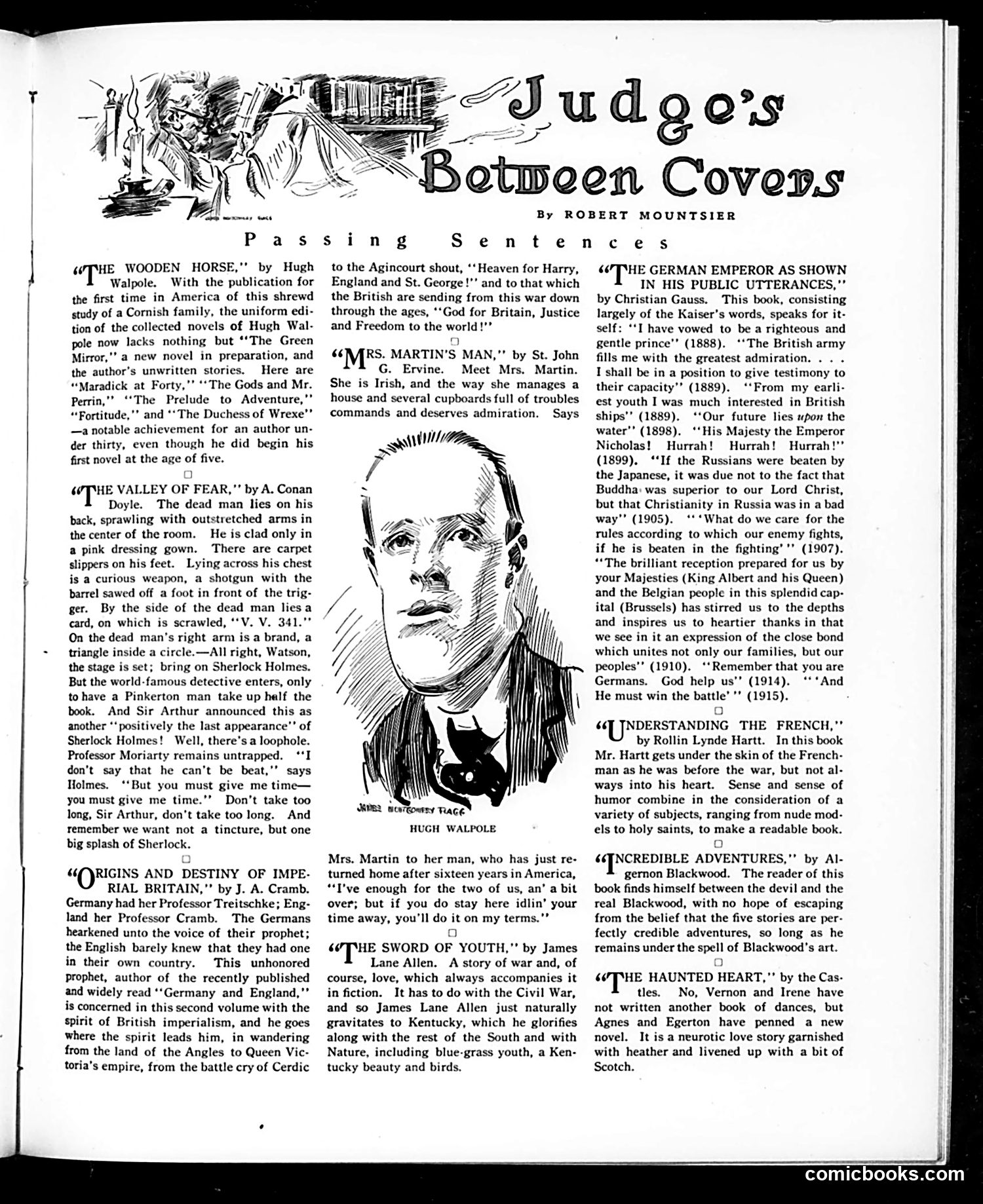
This page from Judge magazine presents literary book reviews by Robert Mountsier. The central illustration is a portrait sketch of **Hugh Walpole**, a prominent British novelist whose collected works are being discussed. The reviews cover contemporary fiction including works by Conan Doyle, James Lane Allen, and others. One notable entry discusses "The German Emperor as Shown in His Public Utterances" by Christian Gauss—a compilation of Kaiser Wilhelm II's quotes. The satirical point appears to be highlighting the contradiction between the Kaiser's stated intentions ("righteous and gentle prince") and Germany's actual aggressive imperial behavior, particularly relevant given this appears to be WWI-era Judge content. The page functions as standard literary criticism rather than political cartoon, though the Kaiser book review carries implicit satire through juxtaposition of his peaceful rhetoric against wartime reality.
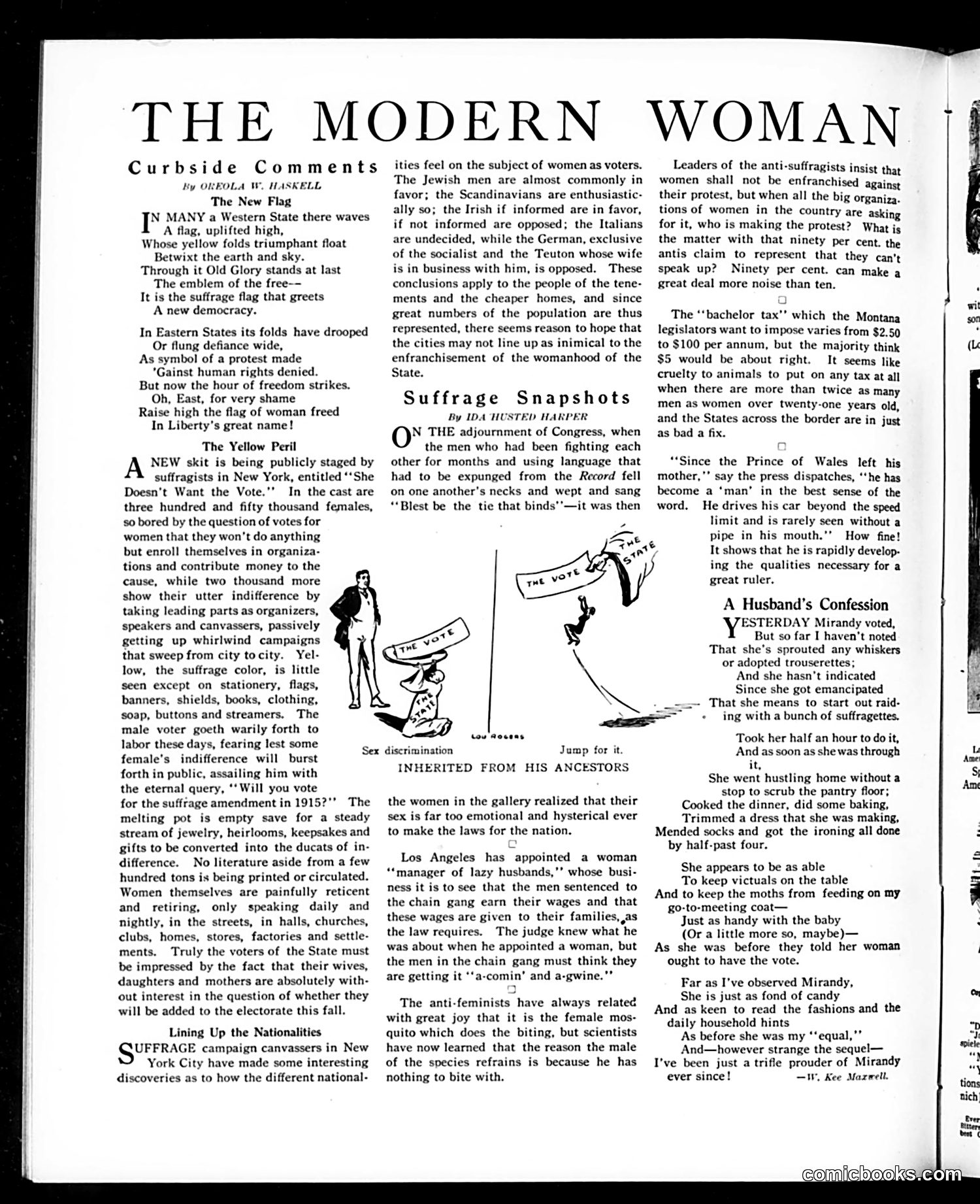
This page satirizes the women's suffrage movement circa 1915. The cartoons and articles employ ironic praise to mock suffragists' efforts: **"The Yellow Peril"** attacks suffragists' claimed indifference, sarcastically describing 350,000 women as so uninterested in voting that they merely organize massive campaigns, print literature, give speeches, and fundraise—a biting commentary on their intense activism despite public claims of passivity. **"Suffrage Snapshots"** ridicules women's supposed emotional unfitness for voting. When congressmen cry during a reconciliation, female gallery-watchers supposedly conclude women are "too emotional and hysterical" to make laws—the joke being that men's emotional display proves women unfit, through absurd logic. **The cartoon** depicts sex discrimination as "inherited from ancestors," showing a man dodging responsibility, sarcastically suggesting discrimination is natural/hereditary rather than socially constructed. The overall tone is anti-suffrage satire: mocking both women's activism and the arguments used to exclude them from voting.
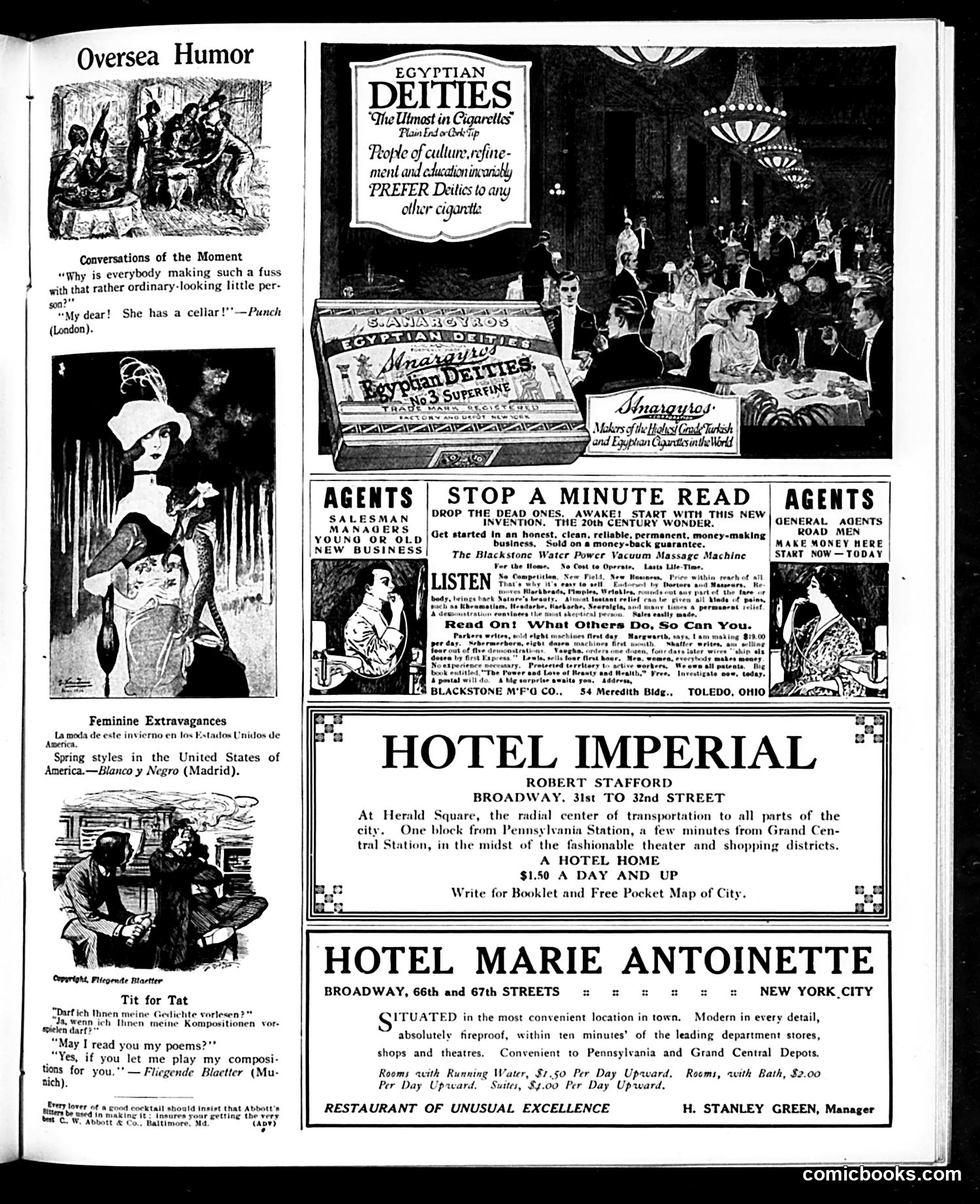
This page collects humorous captions and jokes reprinted from foreign satirical magazines—British *Punch*, Spanish *Blanco y Negro*, and German *Fliegende Blätter*. The jokes target upper-class social pretensions and gender dynamics typical of early 20th-century satire. The opening cartoon mocks a woman's social status being determined by her wine cellar—a dig at wealthy British society's obsession with material possessions. "Feminine Extravagances" ridicules exaggerated women's fashion in America. "Tit for Tat" depicts the tired domestic compromise of couples tolerating each other's hobbies (poetry readings and piano compositions). The cartoons use crude but recognizable caricature styles. The broader message: European magazines found American and British upper-class behavior equally absurd—petty, materialistic, and pretentious. These were reprinted in *Judge* to amuse American readers at foreign perspectives on Western culture. The page is primarily advertising, featuring cigarette and hotel promotions typical of period publications.
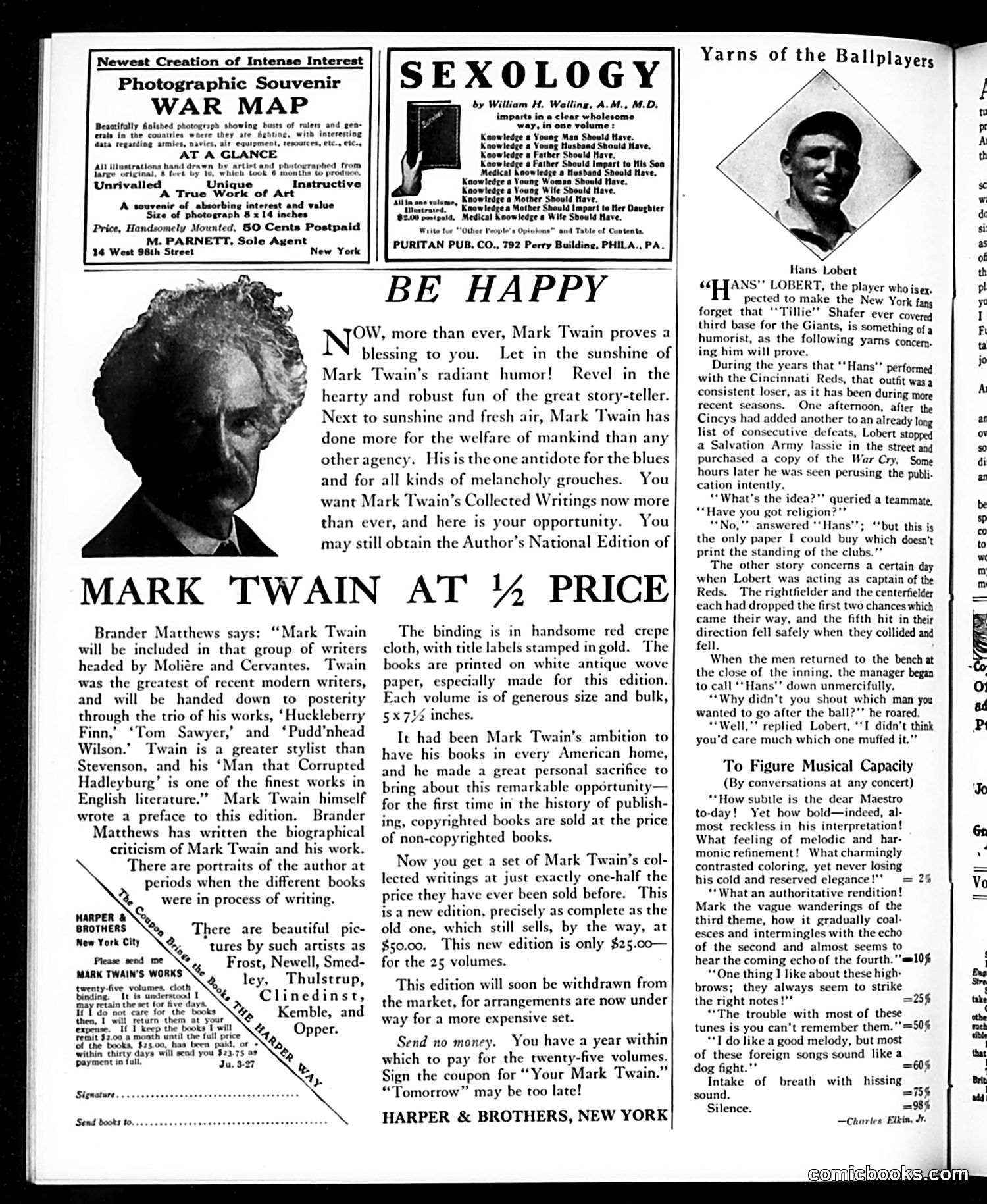
This page is primarily **advertising and editorial content**, not political satire. It contains: 1. **Mark Twain book promotion** (center): An advertisement for discounted collected works of Mark Twain, emphasizing his humor as an antidote to life's troubles. Brander Matthews provides a biographical blurb praising Twain alongside literary giants like Molière and Cervantes. 2. **"Hans" Lobert profile** (right): A sports column about baseball player Hans Lobert of the Cincinnati Reds, recounting anecdotal stories about his personality and reactions to losing games—including a humorous detail about him purchasing a "War Cry" (Salvation Army publication) during a losing streak. 3. **Sidebar advertisements**: For a photographic war map, a "Sexology" medical guide, and other products typical of early 1900s magazines. There is **no political cartoon** visible. The page reflects the magazine's mix of humor, sports coverage, and commercial advertising rather than satirical commentary.
This page contains no political cartoon. Instead, it features: **"From a Sinner's Diary"** — a nostalgic essay by Lynette Freemire reflecting on past romantic interests and deceased friends. The author reminiscences about a woman who disguised acquiring a new suitor, a former schoolmate with many children, and a devout Free Methodist woman she admired. The piece is sentimental rather than satirical. **Black & White Scotch Whisky Advertisement** — a straightforward product endorsement claiming the brand is trusted by those with discriminating taste. The page is primarily literary content and advertising. There is no satirical commentary, political reference, or caricature visible. It represents Judge functioning as a general-interest illustrated magazine mixing humor, personal essays, and commercial content rather than focusing exclusively on political satire.
This page is primarily **advertising and filler content** rather than political satire. The main elements include: **Advertisements:** Player pianos ($110), Evans Ale, All Havana cigars (25¢), and Art Studies prints occupy the left and bottom sections. **"Stories with Smiles" section:** Three brief humorous anecdotes: 1. A husband subtly encourages his wife's physical labor by praising "exercise" 2. A Chinese man pretends not to understand English in court but forgets himself—racist humor based on the "inscrutable Oriental" stereotype 3. An Irishman mishears "Dunn" as "Done," creating a pun **Right column:** An advertisement for H.W. Slauson's automotive advice service through Leslie's Motor Department, offering free guidance to Judge readers. The page reflects early 20th-century commercial magazine layout and contains period ethnic stereotyping typical of the era's "humor."
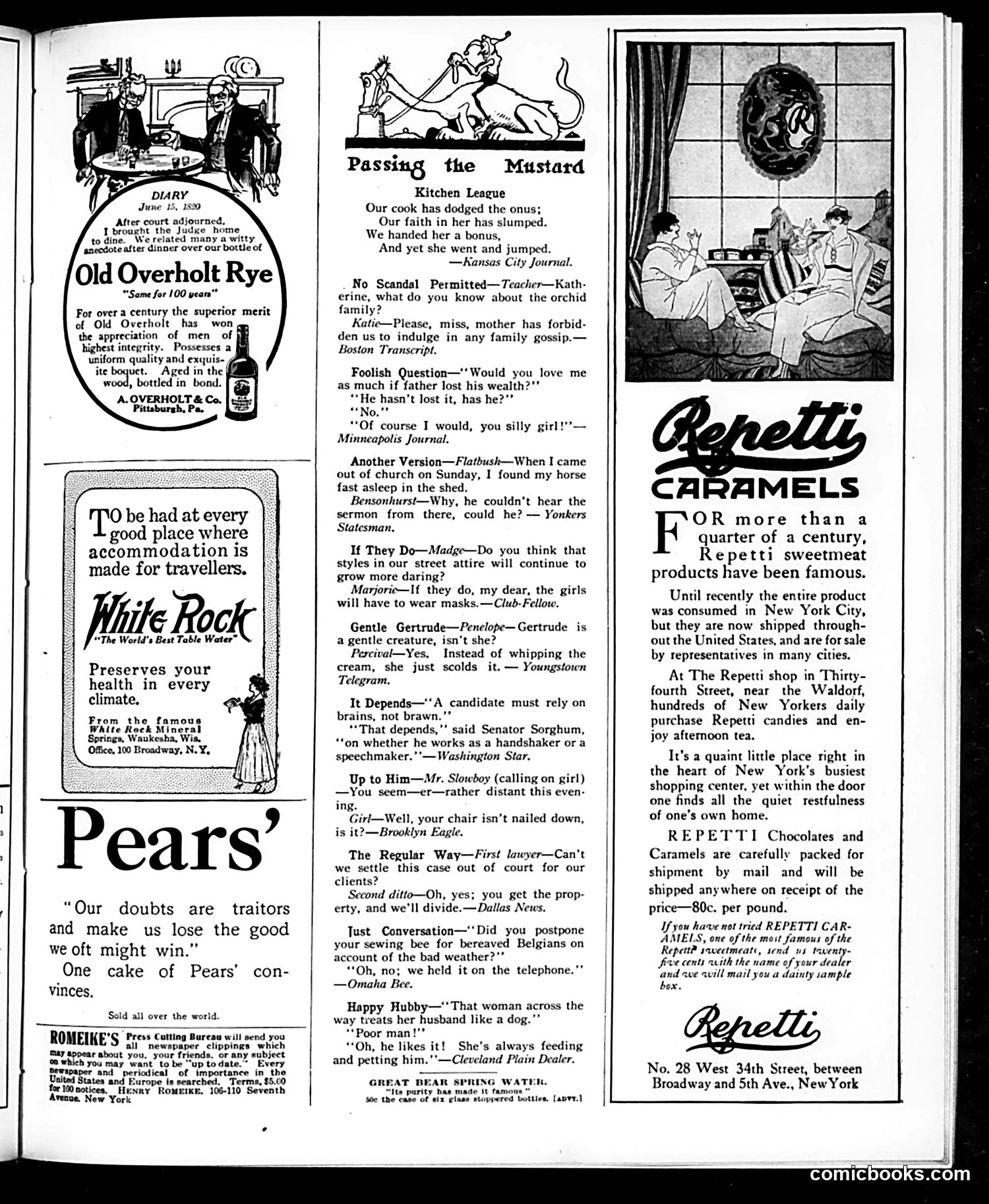
This is primarily an **advertising page** from Judge magazine (June 15, 1890), not a political cartoon. The page contains: **Main Content:** A collection of brief humorous anecdotes under the heading "Passing the Mustard—Kitchen League," sourced from various newspapers. These are short jokes about domestic life, courtship, and social manners—typical of the era's light humor. Examples include jokes about servants, marriages, and fashion. **Advertisements:** The page is dominated by product ads (Old Overholt Rye whiskey, White Rock mineral water, Pears' soap, Repetti candies) using period advertising rhetoric about health and quality. **Historical Context:** The humor relies on now-obsolete social assumptions—servants' unreliability, women's fashion, courtship rituals. The anecdotes reflect turn-of-the-century anxieties about changing gender roles and class dynamics, though presented as gentle comedy rather than satire. The page illustrates how Judge mixed advertising with light domestic humor for middle-class readers.
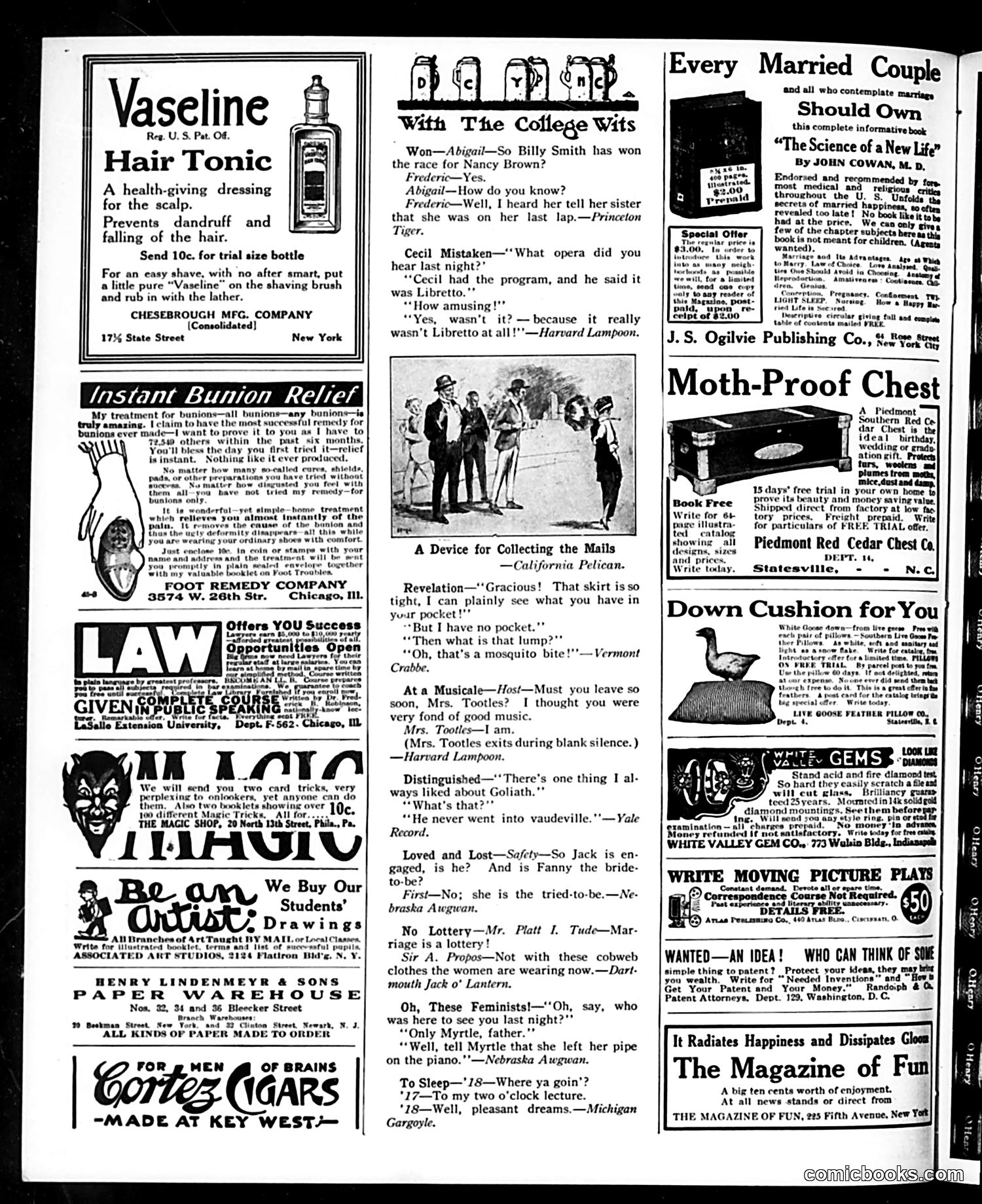
This page is primarily **advertising with some humor columns**, typical of Judge magazine's format. The main satirical content appears in the "With The College Wits" section—a collection of short jokes from university publications (Princeton Tiger, Harvard Lampoon, Yale Record, etc.). These jokes target early 20th-century college social life and gender relations: - **Billy Smith/Nancy Brown joke**: Uses "last lap" as a double entendre about courtship - **Opera/Libretto confusion**: Plays on a character's intellectual pretension - **"Mosquito bite" joke**: Makes light of women's tight-fitting clothing revealing body contours—reflecting contemporary anxieties about changing female fashion - **Feminist jokes**: Mock women's independence and changing gender roles The remaining content is straightforward period advertising for products like Vaseline hair tonic, bunion relief, and—notably—"The Science of a New Life," a marriage advice manual. The ads reflect early-1900s consumer culture and common social concerns (hair loss, foot pain, marital education). **No political cartoons appear on this page.**
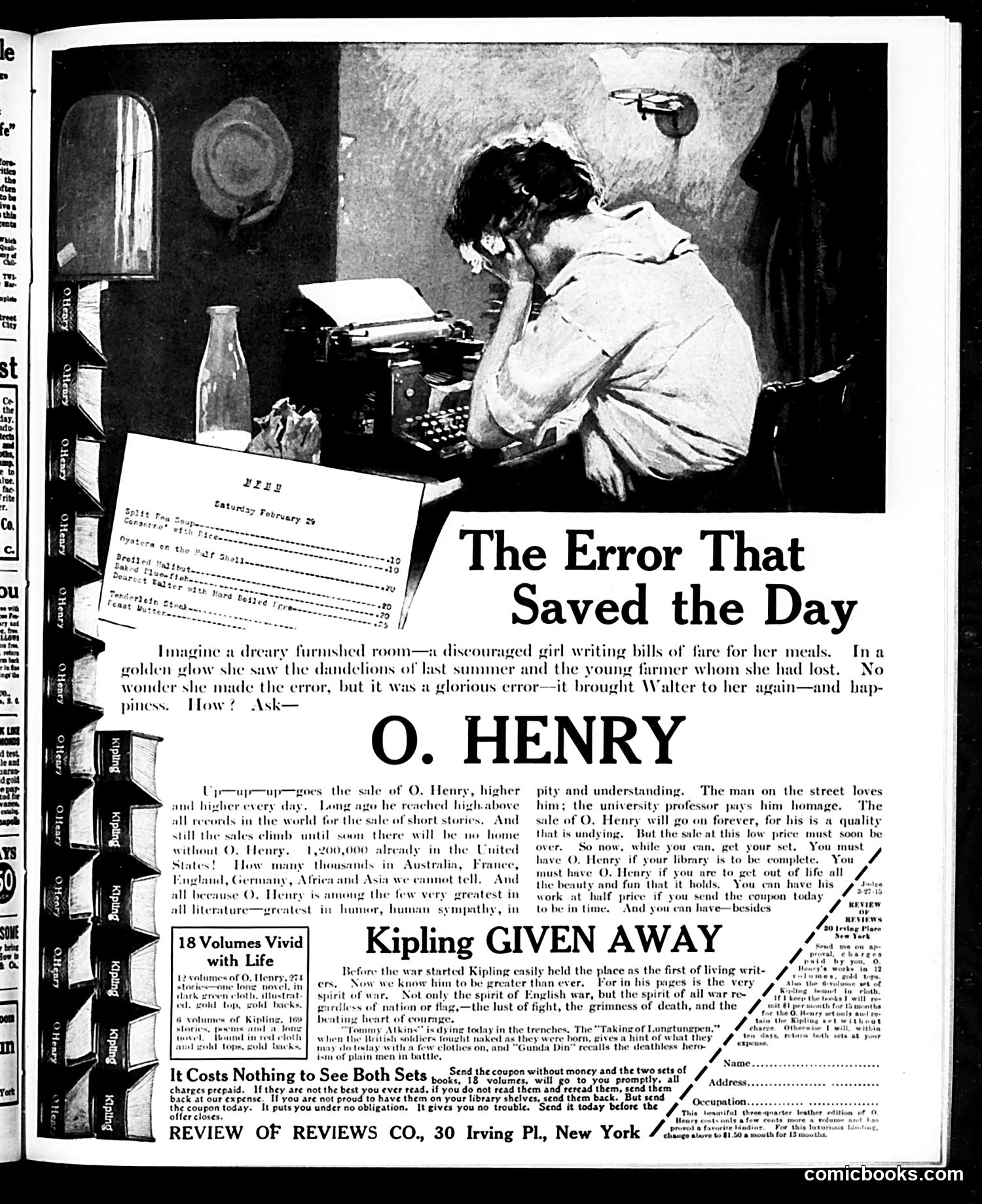
This page is primarily **advertising**, not satire. It promotes two classic authors through sentimental narratives. **The main content** features a short story premise (likely by O. Henry, given the headline): a poor, discouraged woman writing meal bills makes a clerical error that accidentally reunites her with a lost love—a farmer. The story illustrates O. Henry's signature theme of fate and redemption. **Below that** are advertisements for complete collections of both O. Henry and Rudyard Kipling stories, positioned as essential library items. The copy argues that Kipling's wartime relevance has elevated him to "greatest" status, capturing war's true spirit. Both authors are marketed as indispensable to any respectable home library. The page represents early 20th-century **book marketing disguised as editorial content**—a common Judge magazine practice. There is no political cartoon here; it's a sales pitch leveraging sentimental fiction and appeals to cultural aspiration.
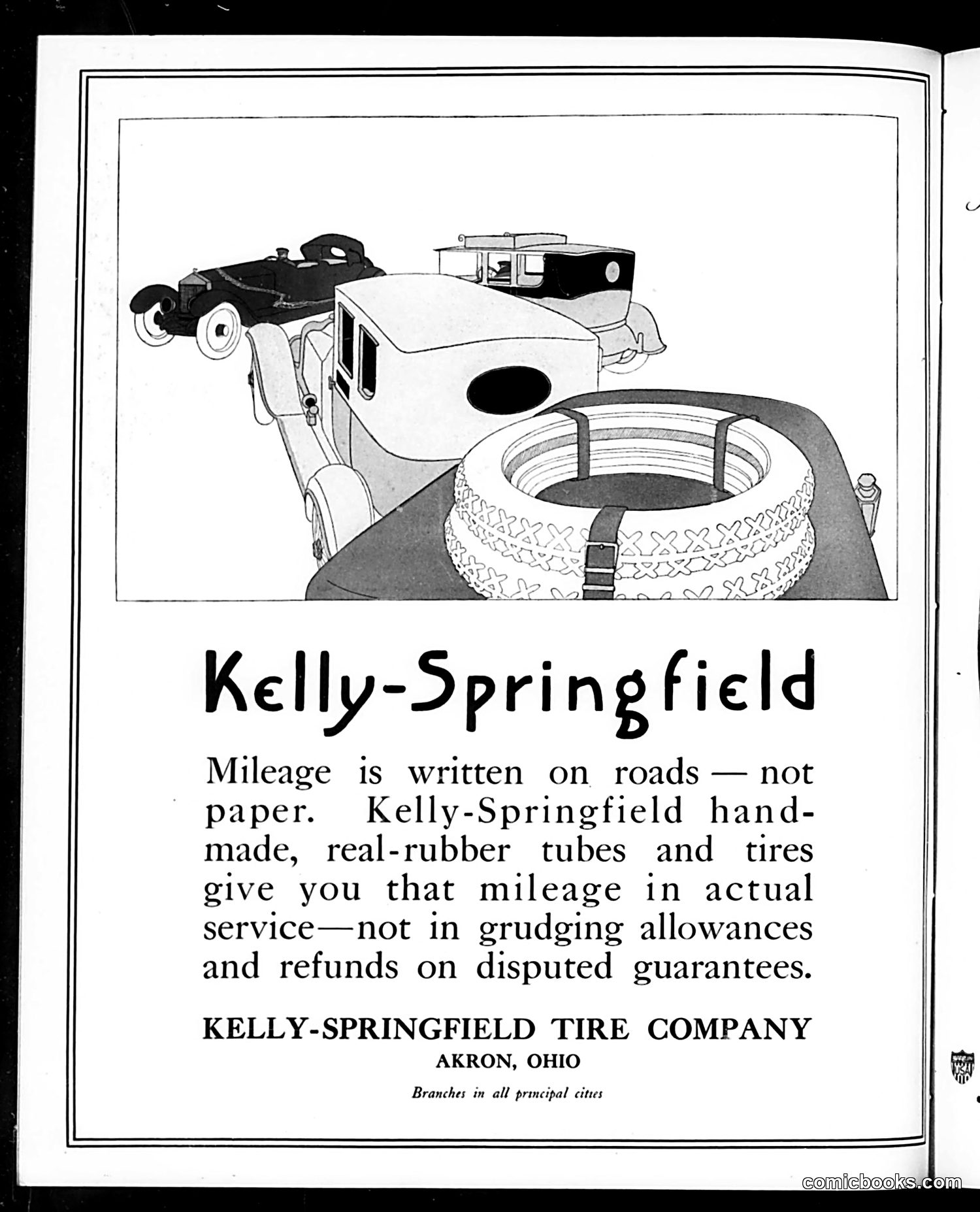
This is a **tire company advertisement**, not satire or political commentary. Kelly-Springfield, based in Akron, Ohio, promotes their handmade rubber tires and tubes by contrasting real-world performance against competitor claims. The ad's central argument: their tires deliver actual mileage through genuine service rather than theoretical guarantees that companies later dispute through refunds or limited "allowances." The illustration shows various vintage automobiles and a large tire, visually emphasizing the product. The message targets consumers frustrated by manufacturer disputes over warranty claims—a common complaint in the early automotive era when tire quality and durability were competitive selling points.