
Judge, 1915-03-27 · page 4 of 24
Judge — March 27, 1915 — page 4: what you’re looking at
What you’re looking at
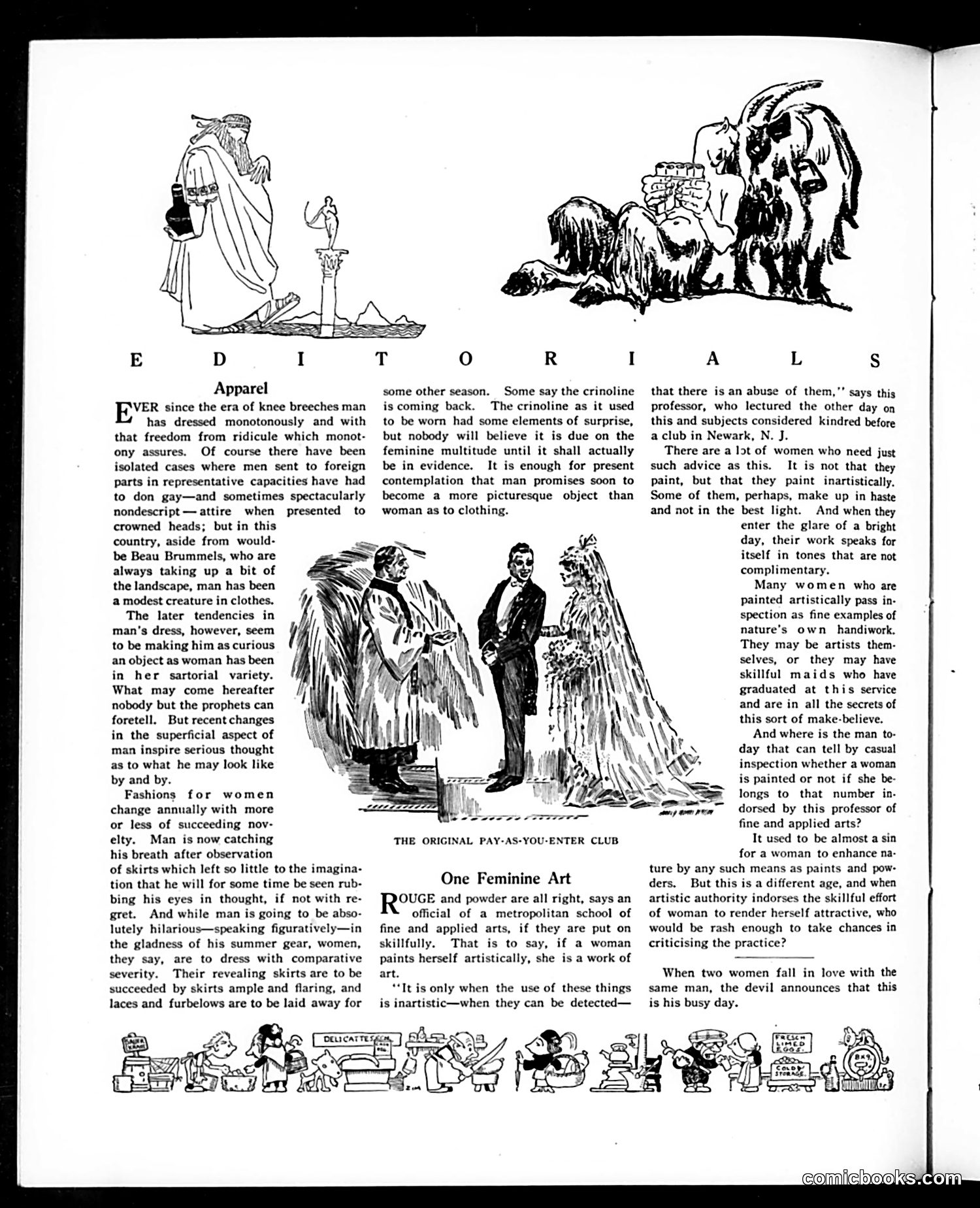
This Judge magazine page satirizes evolving attitudes toward women's appearance and fashion in the early 20th century. The "Editorials" section critiques men's changing views on women's dress, noting that men now scrutinize women's skirts with intense interest—a shift the author finds absurd. The piece sarcastically suggests men are becoming "as curious an object as woman has been in her sartorial variety." The illustrated section "One Feminine Art" debates whether women who paint their faces are artists. It argues that skillfully applied cosmetics constitute legitimate "fine and applied arts," suggesting that women painters deserve recognition as practitioners of a genuine craft, not mere vanity. The satire ultimately mocks both male obsession with female appearance and society's judgment of women who use cosmetics.
📄 Transcribed text from this page (OCR, searchable)
Machine-transcribed from the original scan — historical spelling and the odd misread are preserved.
VER since the era of knee breeches man has dressed monotonously and with that freedom from ridicule which monot- ony assures. Of course there have been isolated cases where men sent to foreign parts in representative capacities have had to don gay—and sometimes spectacularly nondescript — attire when presented to crowned heads; but in this country, aside from would- be Beau Brummels, who are always taking up a bit of the landscape, man has been a modest creature in clothes. The later tendencies in man’s dress, however, seem to be making him as curious an object as woman has been in her sartorial variety. What may come hereafter nobody but the prophets can foretell. But recent changes in the superficial aspect of man inspire serious thought as to what he may look like by and by. Fashions for women change annually with more or less of succeeding nov- elty. Man is now catching his breath after observation of skirts which left so little to the imagina- tion that he will for some time be seen rub- bing his eyes in thought, if not with re- gret. And while man is going to be abso- lutely hilarious—speaking figuratively—in the gladness of his summer gear, women, they say, are to dress with comparative severity. Their revealing skirts are to be succeeded by skirts ample and flaring, and laces and furbelows are to be laid away for some other season. Some say the crinoline is coming back. The crinoline as it used to be worn had some elements of surprise, but nobody will believe it is due on the feminine multitude until it shall actually be in evidence. It is enough for present contemplation that man promises soon to become a more picturesque object than woman as to clothing. THE ORIGINAL PAY-AS-YOU-ENTER CLUB One Feminine Art OUGE and powder are all right, says an official of a metropolitan school of fine and applied arts, if they are put on skillfully. That is to say, if a woman paints herself artistically, she is a work of art. “It is only when the use of these things is inartistic—when they can be detected— DELI CAT TENGE that there is an abuse of them,"’ says this professor, who lectured the other day on this and subjects considered kindred before a club in Newark, N. J. There are a lot of women who need just such advice as this. It is not that they paint, but that they paint inartistically. Some of them, perhaps, make up in haste and not in the best light. And when they enter the glare of a bright day, their work speaks for itself in tones that are not complimentary. Many women who are painted artistically pass in- spection as fine examples of nature’s own_ handiwork. They may be artists them- selves, or they may have skillful maids who have graduated at this service and are in all the secrets of this sort of make-believe. And where is the man to- day that can tell by casual inspection whether a woman is painted or not if she be- longs to that number in- dorsed by this professor of fine and applied arts? It used to be almost a sin for a woman to enhance na- ture by any such means as paints and pow- ders. But this is a different age, and when artistic authority indorses the skillful effort of woman to render herself attractive, who would be rash enough to take chances in criticising the practice? When two women fall in love with the same man, the devil announces that this is his busy day.