
Judge, 1915-03-27 · page 10 of 24
Judge — March 27, 1915 — page 10: what you’re looking at
What you’re looking at
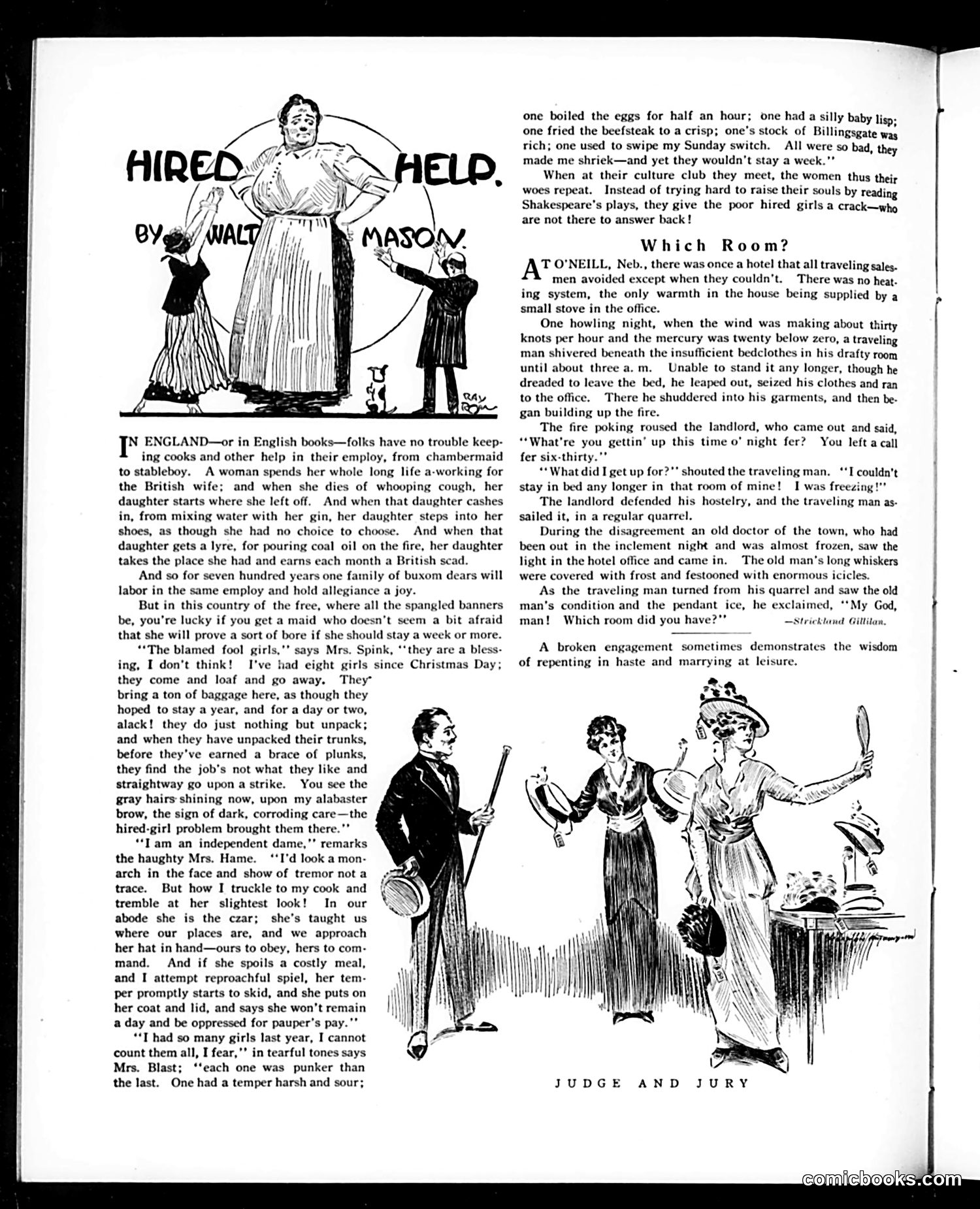
This page satirizes the American domestic servant crisis of the early 20th century. The top cartoon, credited to Walt Mason, depicts a large woman (representing American wives) with two small figures pulling on ropes—illustrating the difficulty of keeping hired help employed. The accompanying text contrasts England, where women serve multi-generational family positions out of tradition and obligation, with America's "free" labor market. American maids are portrayed as independent, demanding, and quick to quit—frustrating their employers (Mrs. Spink, Mrs. Hame, Mrs. Blast) who complain endlessly about their insubordination and brief tenures. The satire's target is ambiguous: it mocks both the entitled attitudes of American employers expecting servile obedience and the maids themselves for being "troublesome." The secondary story, "Which Room?," offers comedic relief about a freezing hotel. The overall message reflects anxieties about American workers' newfound mobility and bargaining power—a sharp departure from Old World class structures.
📄 Transcribed text from this page (OCR, searchable)
Machine-transcribed from the original scan — historical spelling and the odd misread are preserved.
IX ENGLAND—or in English books—folks have no trouble keep- ing cooks and other help in their employ, from chambermaid to stableboy. A woman spends her whole long life a-working for the British wife; and when she dies of whooping cough, her daughter starts where she left off. And when that daughter cashes in, from mixing water with her gin, her daughter steps into her shoes, as though she had no choice to choose. And when that daughter gets a lyre, for pouring coal oil on the fire, her daughter takes the place she had and earns each month a British scad. And so for seven hundred years one family of buxom dears will labor in the same employ and hold allegiance a joy. But in this country of the free, where all the spangled banners be, you're lucky if you get a maid who doesn't seem a bit afraid that she will prove a sort of bore if she should stay a week or mo: “The blamed fool girls,"* says Mrs. Spink, ‘‘they are a bles ing, I don't think! I've had eight girls since Christmas Day; they come and loaf and go away. They” bring a ton of baggage here, as though they hoped to stay a year, and for a day or two, alack! they do just nothing but unpack; and when they have unpacked their trunks, before they’ve earned a brace of plunks, they find the job's not what they like and straightway go upon a strike. You see the gray hairs shining now, upon my alabaster brow, the sign of dark, corroding care—the hired-girl problem brought them there."" “Tam an independent dame,’’ remarks the haughty Mrs. Hame. ‘‘I'd look a mon- arch in the face and show of tremor not a trace. But how I truckle to my cook and tremble at her slightest look! In our abode she is the czar; she’s taught us where our places are, and we approach her hat in hand—ours to obey, hers to com- mand. And if she spoils a costly meal, and I attempt reproachful spiel, her tem- per promptly starts to skid, and she puts on her coat and lid, and says she won't remain a day and be oppressed for pauper’s pay."" “*T had so many girls last year, I cannot count them all, I fear,"’ in tearful tones says Mrs. Blast; ‘teach one was punker than the last. One had a temper harsh and sour; one boiled the eggs for half an hour; one had a silly baby lisp; one fried the beefsteak to a crisp; one’s stock of Billingsgate was rich; one used to swipe my Sunday switch. All were so bad, they made me shriek—and yet they wouldn't stay a week."* When at their culture club they meet, the women thus their woes repeat. Instead of trying hard to raise their souls by Teading Shakespeare's plays, they give the poor hired girls a crack—who are not there to answer back! Which Room? T O'NEILL, Neb., there was once a hotel that all traveling sales. men avoided except when they couldn't. There was no heat. ing system, the only warmth in the house being supplied by a small stove in the office. One howling night, when the wind was making about thirty knots per hour and the mercury was twenty below zero, a traveling man shivered beneath the insufficient bedclothes in his drafty room until about three a.m. Unable to stand it any longer, though he dreaded to leave the bed, he leaped out, seized his clothes and ran to the office. There he shuddered into his garments, and then be- gan building up the fire. The fire poking roused the landlord, who came out and said, “What're you gettin’ up this time o’ night fer? You left a call fer six-thirty.”’ **What did I get up for?" shouted the traveling man. ‘‘I couldn't stay in bed any longer in that room of mine! I was freezing!" The landlord defended his hostelry, and the traveling man as- sailed it, in a regular quarrel. During the disagreement an old doctor of the town, who had been out in the inclement night and was almost frozen, saw the light in the hotel office and came in. The old man’s long whiskers were covered with frost and festooned with enormous icicles. As the traveling man turned from his quarrel and saw the old man’s condition and the pendant ice, he exclaimed, **My God, man! Which room did you have?"’ Strickland Gillitan, A broken engagement sometimes demonstrates the wisdom of repenting in haste and marrying at leisure. Ih il Vi Hin i) Me