
Judge, 1915-03-27 · page 6 of 24
Judge — March 27, 1915 — page 6: what you’re looking at
What you’re looking at
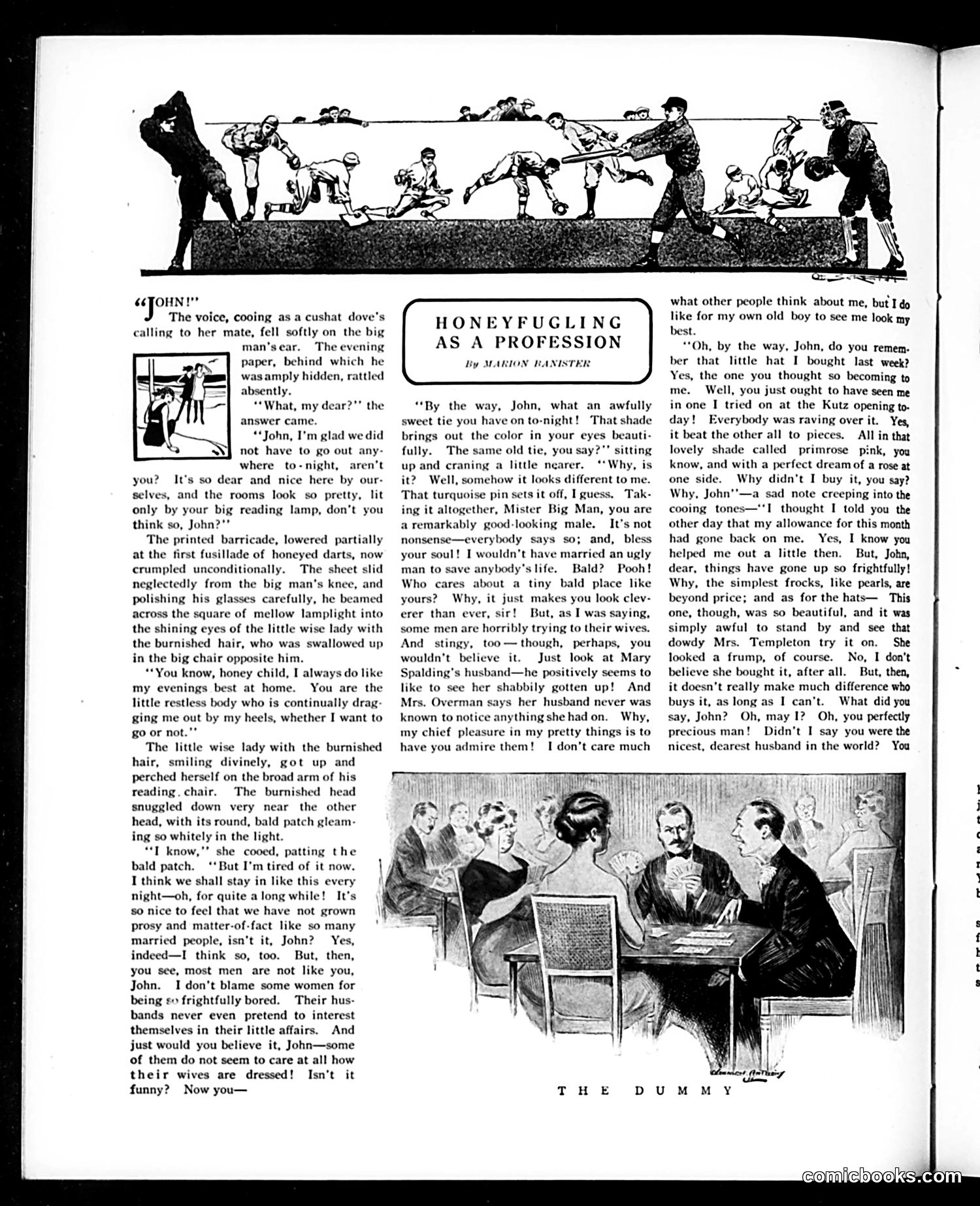
This satirical piece mocks wives who strategically flatter and manipulate their husbands into spending money. The title's term "honeyfuggling" means deceptive sweet-talking. The narrative shows a wife employing transparent flattery—praising her husband's appearance, his tie, his bald spot—while steering conversation toward desired purchases. She compliments other women's husbands' attentiveness to their wives' appearance, implying her own husband should similarly indulge her shopping. The cartoon at top depicts children playing tug-of-war, likely illustrating the domestic power struggle. "The Dummy" illustration below shows men at what appears to be a social gathering, possibly representing husbands as passive victims of such manipulation. The satire targets both the manipulative wife archetype and the gullible husband who falls for obvious flattery. This reflects early 20th-century anxieties about gender dynamics, consumer spending, and marital power, portraying women's financial requests as cunning rather than legitimate household needs.
📄 Transcribed text from this page (OCR, searchable)
Machine-transcribed from the original scan — historical spelling and the odd misread are preserved.
ésJOHN!”" The voice, cooing as a cushat dove's calling to her mate, fell softly on the big man'sear. The evening paper, behind which he was amply hidden, rattled absently. “What, my dear?"’ the answer came. “John, I'm glad we did not have to go out any- where to-night, aren't you? It’s so dear and nice here by our- selves, and the rooms look so pretty, lit only by your big reading lamp, don’t you think so, John?"’ The printed barricade, lowered partially at the first fusillade of honeyed darts, now crumpled unconditionally. The sheet slid neglectedly from the big man's knee, and polishing his glasses carefully, he beamed across the square of mellow lamplight into the shining eyes of the little wise lady with the burnished hair, who was swallowed up in the big chair opposite him. **You know, honey child, I always do like my evenings best at home. You are the little restless body who is continually drag- ging me out by my heels, whether I want to go or not."* The little wise lady with the burnished hair, smiling divinely, got up and perched herself on the broad arm of his reading. chair. The burnished head snuggled down very near the other head, with its round, bald patch gleam- ing so whitely in the light. “I know,"’ she cooed, patting the bald patch. ‘‘But I'm tired of it now. I think we shall stay in like this ever night—oh, for quite a long while! It’s so nice to feel that we have not grown prosy and matter-of-fact like so many married people, isn’t it, John? Yes, indeed—I think so, too. But, then, you see, most men are not like you, John. I don’t blame some women for being sv frightfully bored. Their hus- bands never even pretend to interest themselves in their little affairs. And just would you believe it, John—some of them do not seem to care at all how their wives are dressed! Isn't it funny? Now you— HONEYFUGLING AS A PROFESSION By MARION BANISTER “By the way, John, what an awfully sweet tie you have on to-night! That shade brings out the color in your e beauti- fully. The ne old tie, you say?" sitting up and craning a little nearer. ‘Why, is it? Well, somehow it looks different to me. That turquoise pin sets it off, I guess. Tak- ing it altogether, Mister Big Man, you are aremarkably good-looking male. It's not nonsense—everybody says so; and, bless your soul! I wouldn't have married an ugly man te anybody's life. Bald? Pooh! Who cares about a tiny bald place like yours? Why, it just makes you look clev- erer than ever, sir! But, as I saying, some men are horribly trying to their wives. And_ stingy, too—though, perhaps, you wouldn't believe it. Just look at Mary Spalding’s husband—he positively seems to like to see her shabbily gotten up! And Mrs, Overman says her husband never was known to notice anything she had on. Why, my chief pleasure in my pretty things is to have you admire them! I don’t care much what other people think about me, but I do like for my own old boy to see me look my best. “Oh, by the way, John, do you remem. ber that little hat I bought last week? Yes, the one you thought so becoming to me. Well, you just ought to have seen me in one I tried on at the Kutz opening to- day! Everybody was raving over it. Yes, it beat the other all to pieces. All in that lovely shade called primrose pink, you know, and with a perfect dream of a rose at one side. Why didn't I buy it, you say? Why, John'’—a sad note creeping into the cooing tones—‘‘I thought I told you the other day that my allowance for this month had gone back on me. Yes, I know you helped me out a little then. But, John, dear, things have gone up so frightfully! Why, the simplest frocks, like pearls, are beyond price; and as for the hats— This one, though, was so beautiful, and it was simply awful to stand by and see that dowdy Mrs. Templeton try it on. She looked a frump, of course. No, I don’t believe she bought it, after all. But, then, it doesn’t really make much difference who buys it, as long as I can't. What did you say, John? Oh, may I? Oh, you perfectly precious man! Didn't I say you were the nicest, dearest husband in the world? You