
A complete issue · 24 pages · 1914
Judge — October 24, 1914
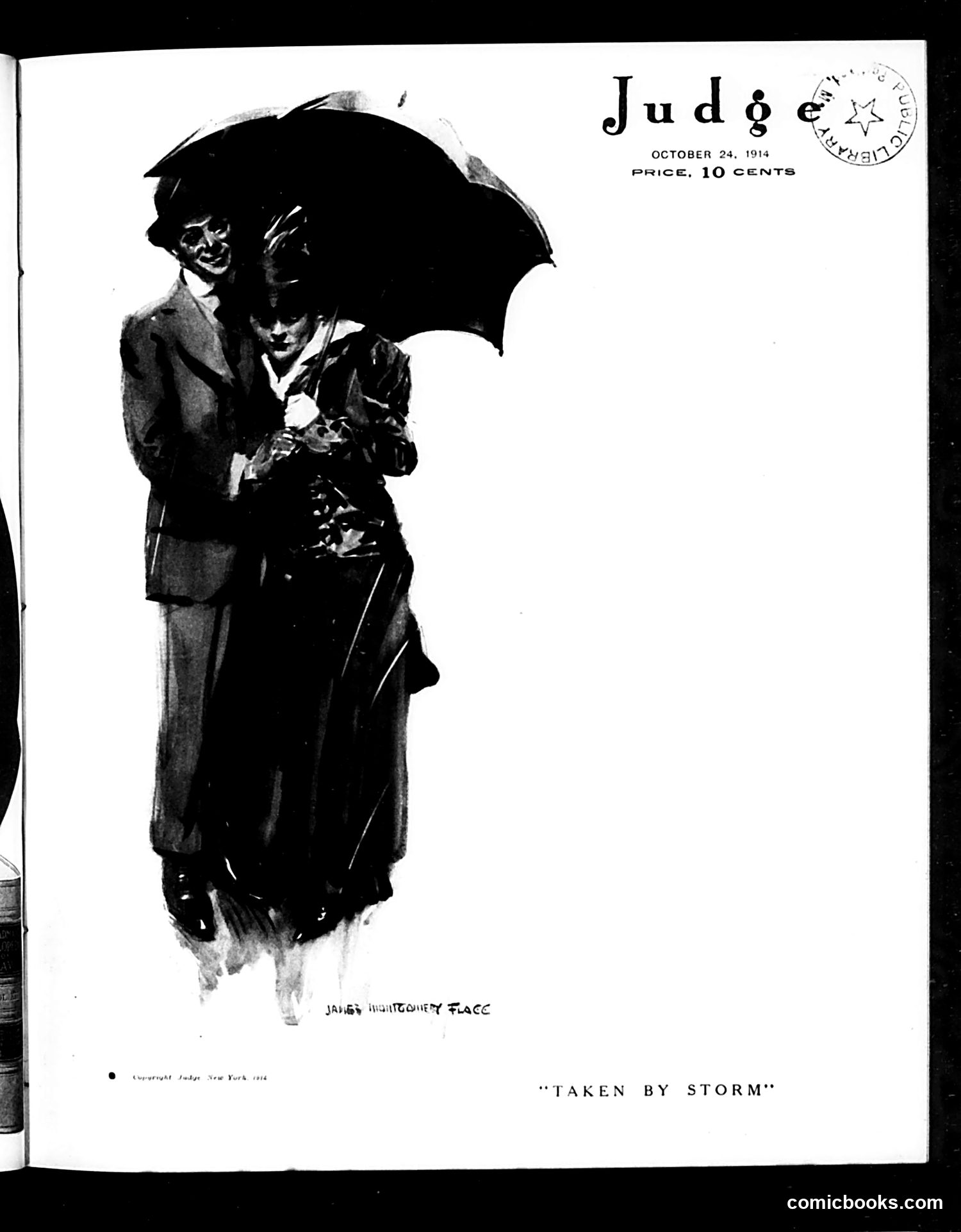
This illustration by James Montgomery Flagg depicts a couple caught in a rainstorm, with the man shielding the woman under an umbrella. The title "Taken by Storm" is a pun—literally showing people caught in bad weather, while also suggesting romantic spontaneity or sudden attraction. The cartoon appears to be a lighthearted commentary on courtship and romance. The man's protective gesture and the woman's apparent enjoyment of the moment satirize or celebrate the idea of romantic adventure, even under adverse circumstances. This reflects early-20th-century attitudes about gender relations and courtship rituals. The specific political or social context for this particular issue remains unclear without additional page context.
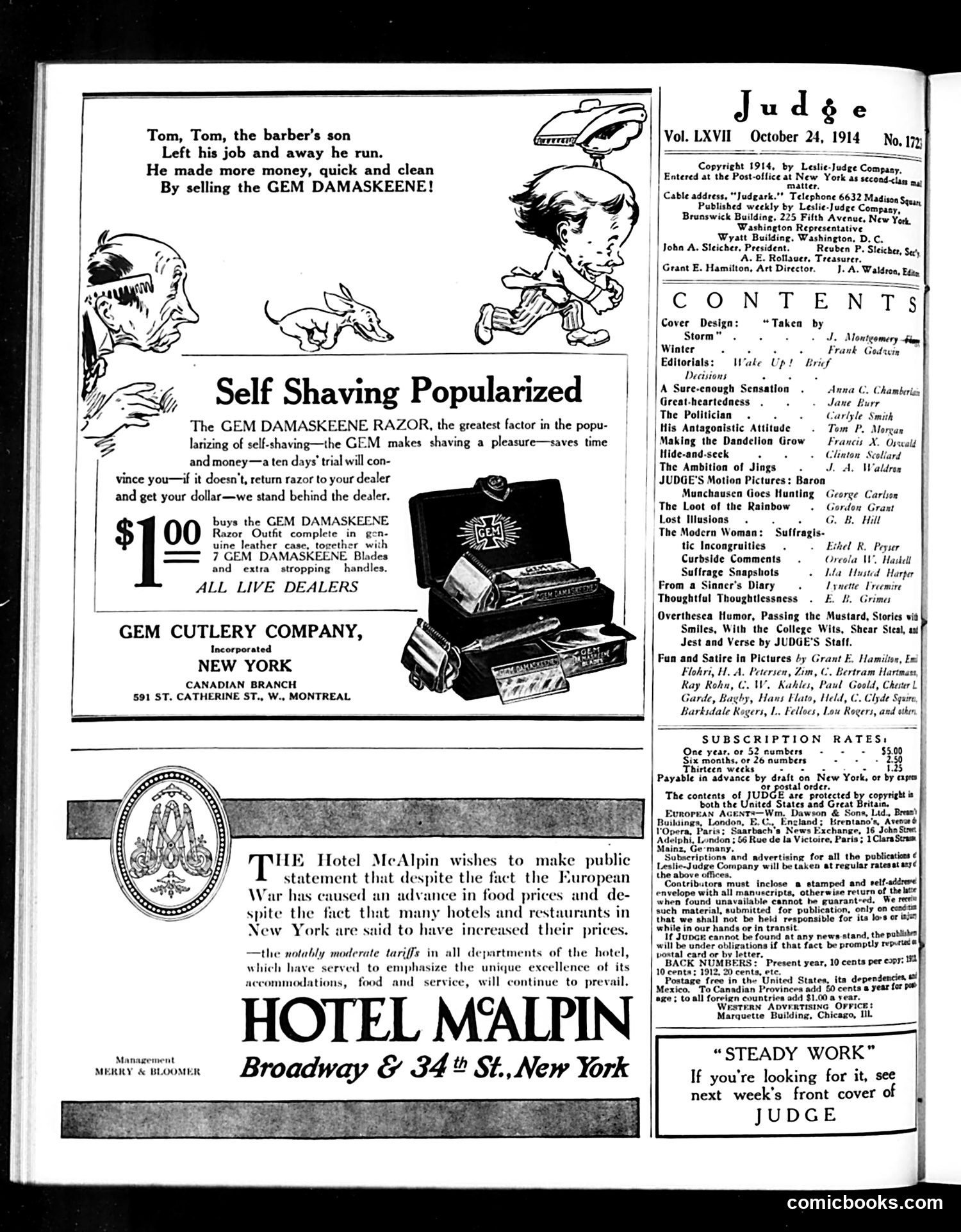
This page is primarily **advertising and editorial content** rather than political satire. The top cartoon advertises the "Gem Damascene Razor" with a simple visual gag: Tom, a barber's son, left his job to sell razors—a more lucrative enterprise. The humor relies on the contrast between traditional barbering work and commercial salesmanship. The bulk of the page features advertisements (a safety razor outfit for $1.00) and promotional text for the Hotel McAlpin in New York, which addresses wartime inflation caused by the European War (World War I, then ongoing). The hotel assures customers of its "notably moderate tariffs" despite rising food costs. The page reflects October 1914 America: commercial capitalism, early WWI economic impacts, and consumer-focused humor rather than political commentary.
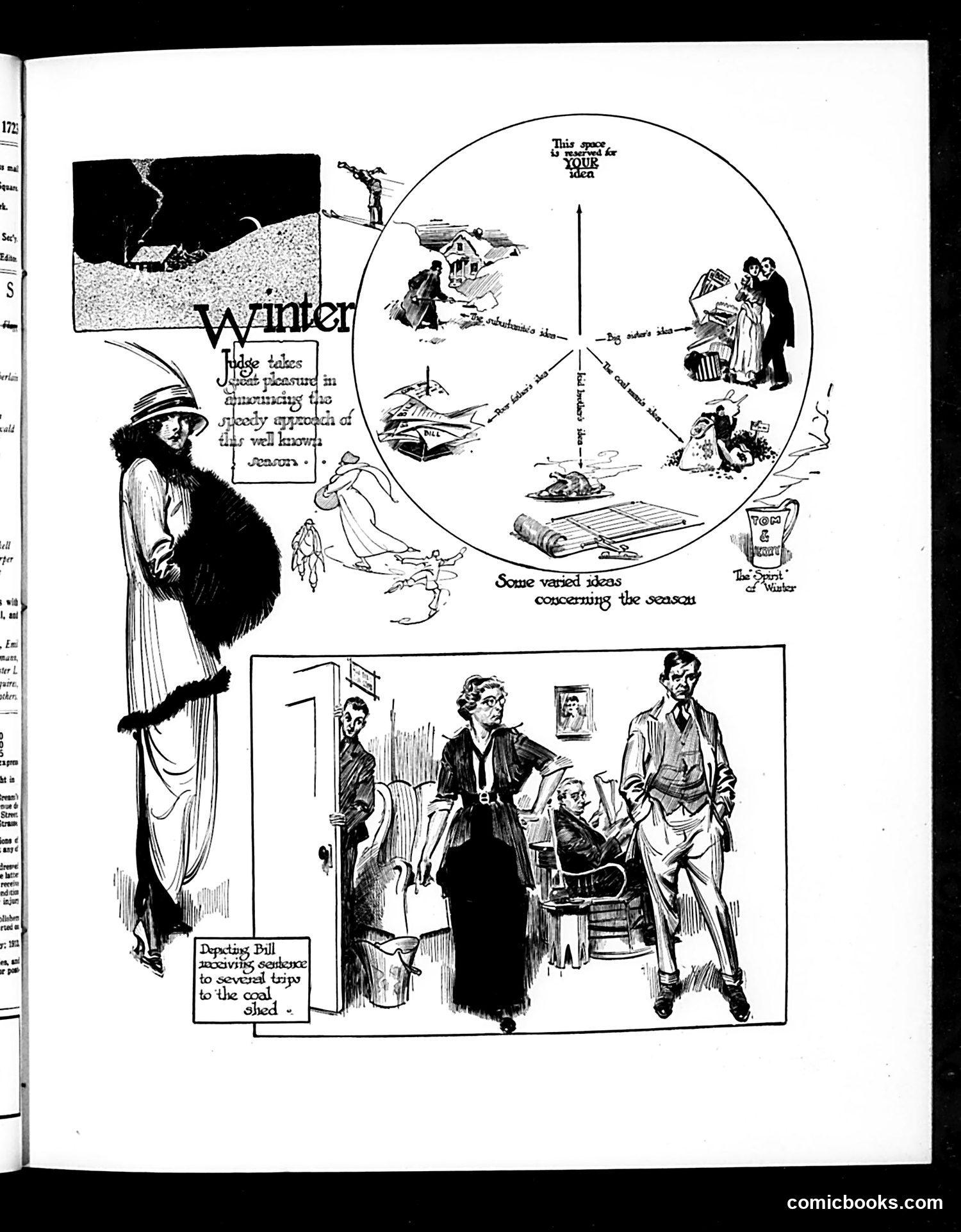
This page from *Judge* magazine satirizes Winter as a season. The top illustration shows "Some varied ideas concerning the season" within a large circle, depicting Winter's effects: frozen landscapes, people bundled against cold, and domestic hardship. The left panel shows a poorly-dressed figure labeled as "Winter" itself—personified as a destitute person in tattered clothes with fur trim, representing the season's harsh, impoverishing effects on ordinary people. The bottom panel shows "Depicting Bill receiving evidence to several trips to the coal shed"—likely referencing fuel costs and heating expenses during winter, a significant household burden. The image shows a family dealing with coal delivery, suggesting Winter's economic impact on working-class households. The overall satire critiques Winter as an unwelcome season that brings poverty and hardship to common people.
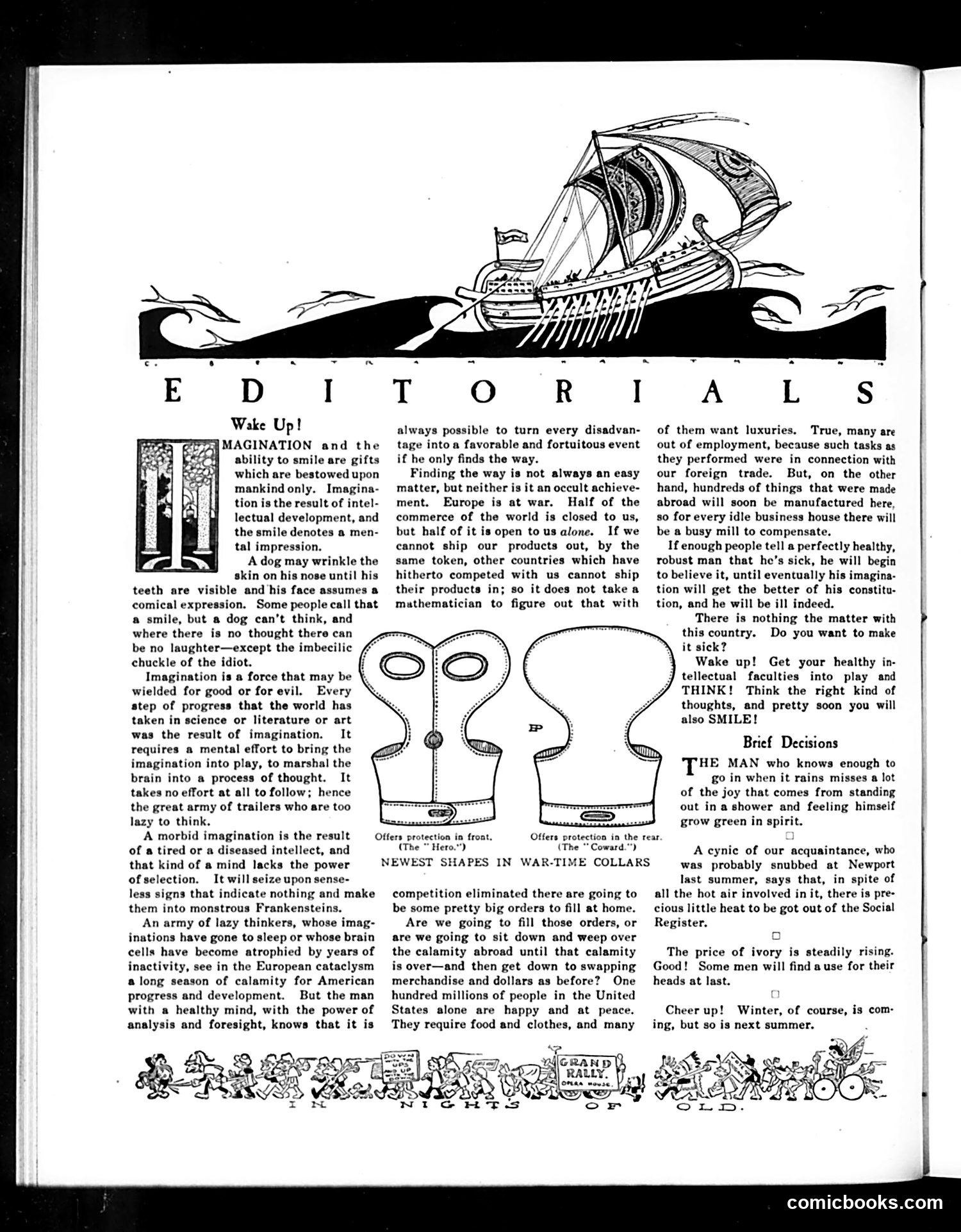
This page features editorial commentary with two illustrated "war-time collar" character types labeled "The Hero" and "The Coward." The visual joke contrasts personality types through head shapes and expressions—one confident with visible teeth in a smile, the other anxious and worried-looking. The editorials address American industrial production and morale during what appears to be World War I ("war-time collars" suggests wartime context). Writers urge Americans to use imagination and intellect to solve production problems, warning that without domestic manufacturing capacity, the nation cannot compete internationally. The satire critiques both defeatist attitudes and those avoiding wartime sacrifice, contrasting productive optimism against cowardly pessimism. The message emphasizes national self-reliance during wartime economic competition.
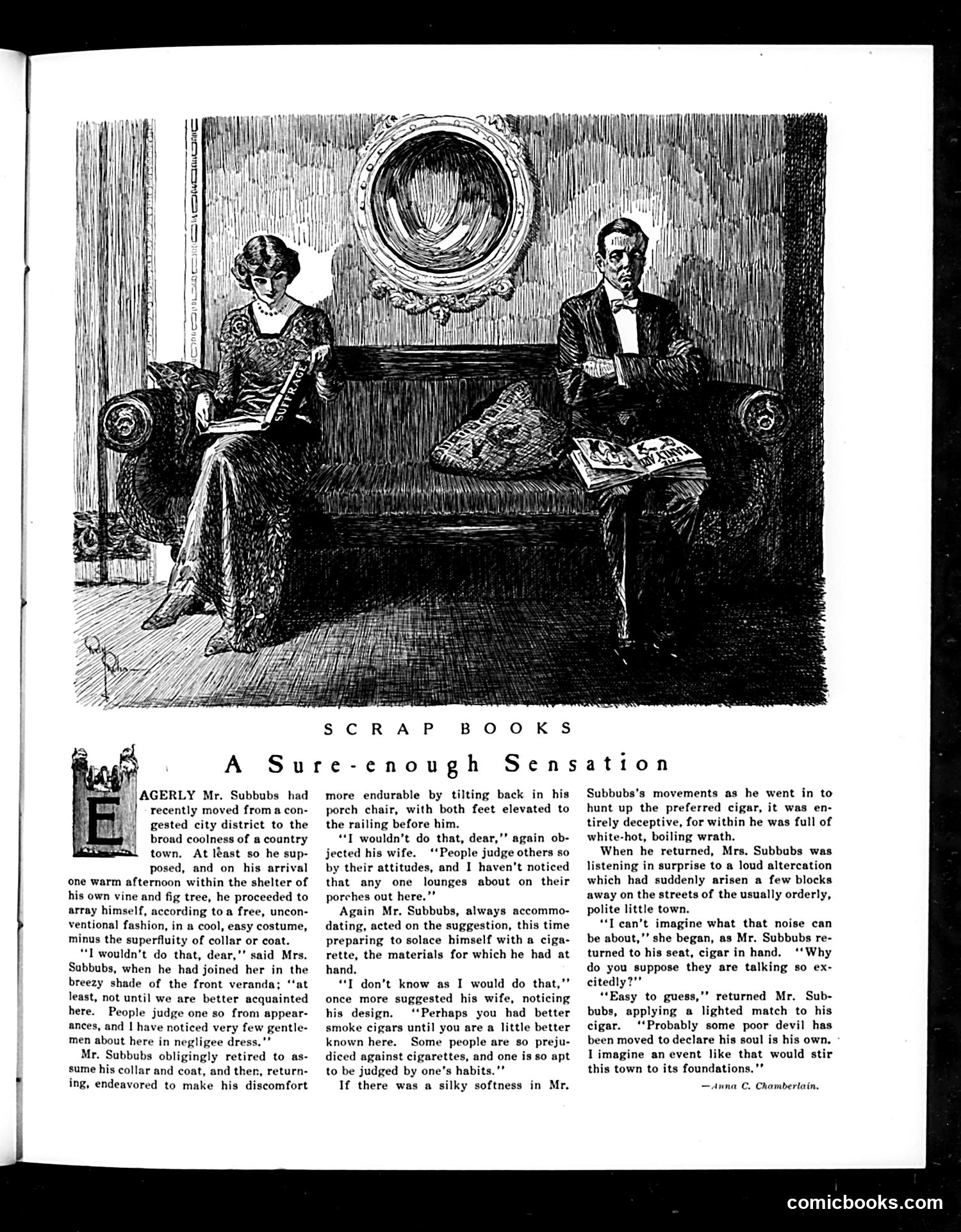
This appears to be a humorous domestic sketch rather than political satire. The illustration shows a couple in their home: Mrs. Subbubs sits knitting while her husband Mr. Subbubs lounges in a chair smoking a cigar. The joke concerns social pretension and class anxiety. Mrs. Subbubs complains that people judge others by appearances and clothing, insisting they shouldn't be "prejudiced against cigarettes." Mr. Subbubs responds that some people prejudge based on habits. The satire targets middle-class anxieties about respectability—the fear that smoking cigars or other personal behaviors might damage one's social standing or reputation in their community. The humor lies in the couple's self-consciousness about how neighbors perceive them.
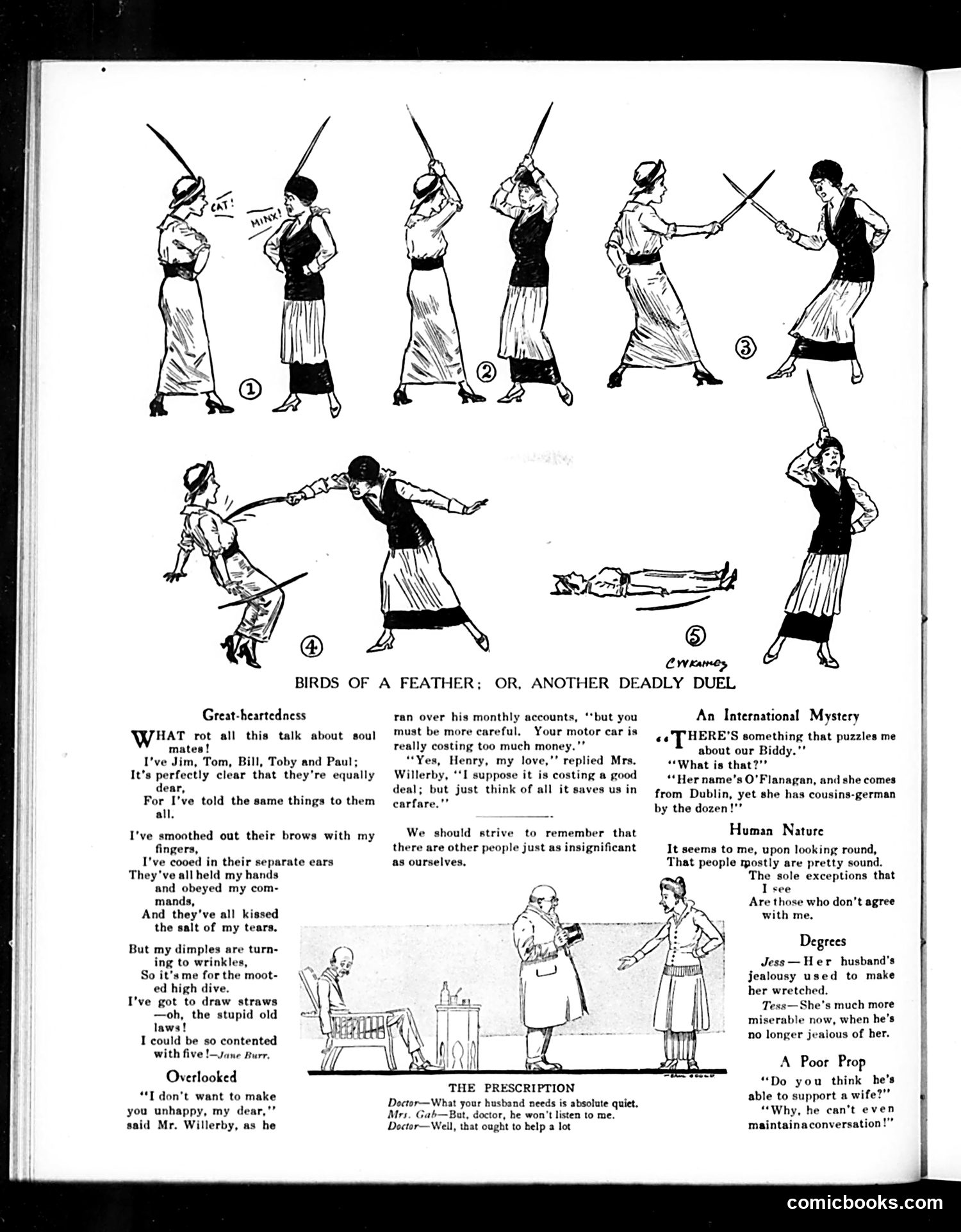
This page contains satirical sketches and verses mocking early-20th-century gender relations and social pretense. The top illustration depicts women engaged in a sword duel—likely satirizing the "deadly duel" of competing for men's affections. The accompanying poem "Great-heartedness" presents a woman juggling five suitors identically, then threatening suicide ("high dive") because she must choose one. The satire targets female fickleness and emotional manipulation. Other pieces mock domestic life: a wife's excessive motor-car spending justified by "carfare savings"; a husband who won't listen to doctors' advice; a woman's jealous husband replaced by an indifferent one (implying both conditions make her miserable). The "International Mystery" jokes about an Irish servant with German cousins—apparently absurd genealogy for humor. Overall, the page satirizes marital discord, female duplicity, male obtuseness, and the gap between what people claim and reality—typical Judge magazine fare targeting middle-class domestic anxieties and gender politics of the era.
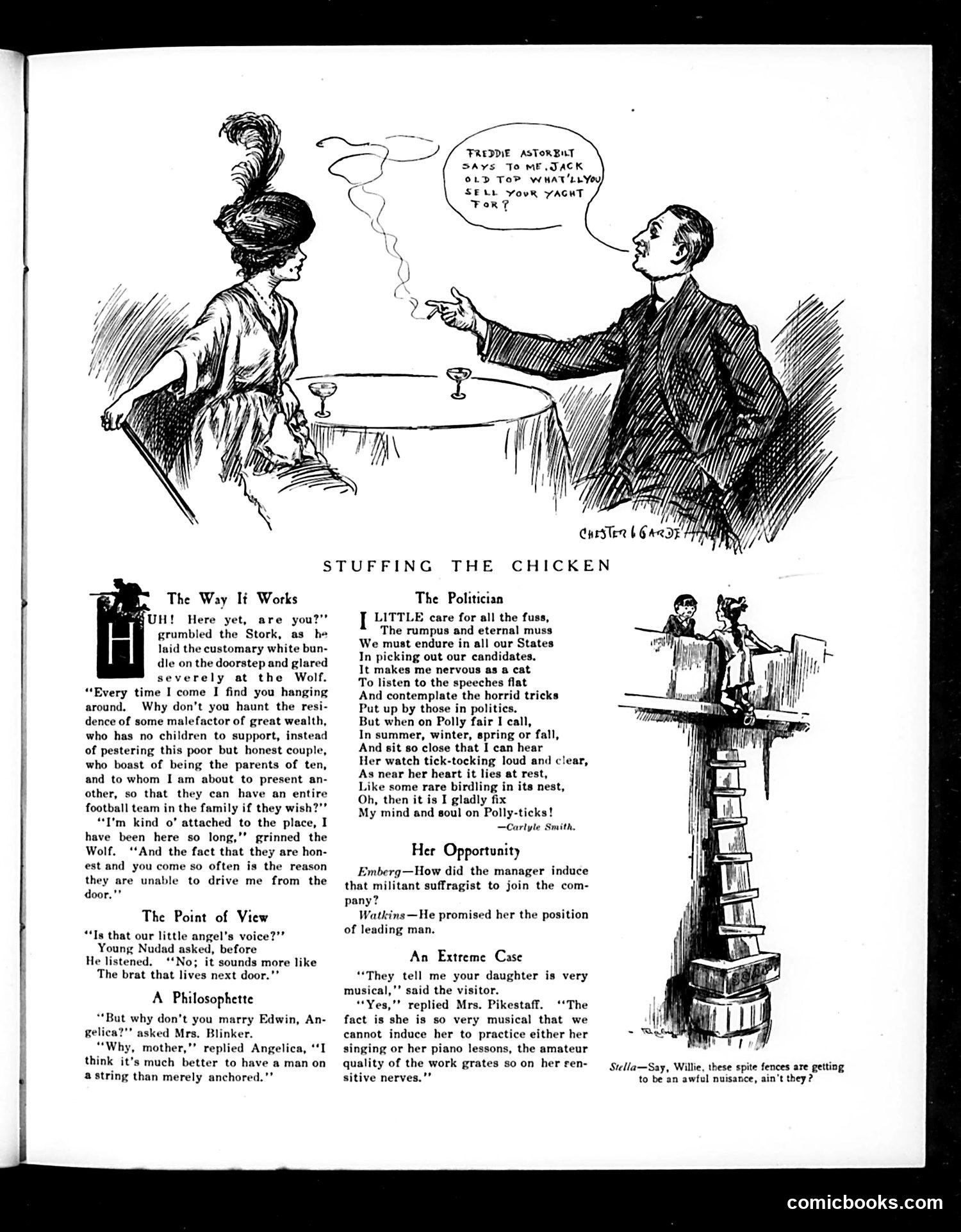
This page contains multiple satirical pieces typical of early 20th-century Judge magazine humor: **Main Cartoon ("Stuffing the Chicken"):** A man at dinner pressures a woman about selling her yacht, likely mocking nouveau riche social climbing and mercenary dating practices among the wealthy. **"The Politician":** A pun-heavy poem criticizing election season chaos. The speaker dismisses political turmoil as tedious, but becomes absorbed when visiting "Polly," pivoting the complaint into a flirtation—"Polly-ticks" being a wordplay joke. **Other Snippets:** Brief jokes about class distinctions ("malefactor of great wealth"), gender roles (a woman preferring to keep suitors "on a string" rather than committed), suffragism (mocking a militant suffragist accepting a "leading man" position), and domestic annoyances. The humor relies on period-specific references to wealth displays, courtship customs, and early feminist activism, reflecting Judge's target audience of educated, upper-middle-class readers amused by social pretension and changing gender dynamics.
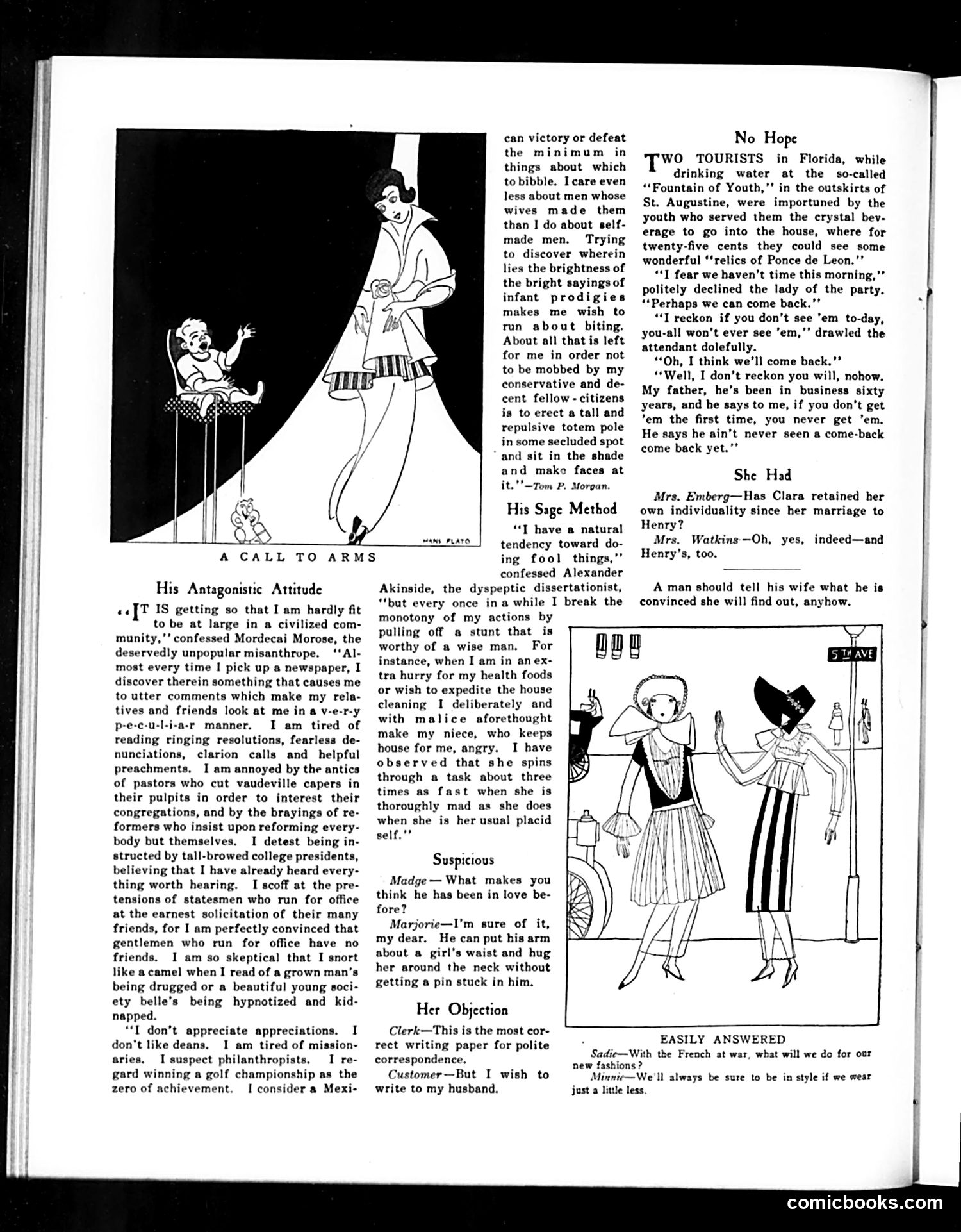
This page contains several satirical pieces mocking different social types: **"His Antagonistic Attitude"** features Mordecai Morose, a misanthrope who sarcastically lists everything he despises about contemporary society: newspaper editorials, reform-minded clergy, college presidents, politicians, and social pretension. The satire targets those who complain endlessly while contributing nothing themselves. **"His Sage Method"** mocks Alexander Akinside, who claims to deliberately anger his niece to make her work faster—presenting deliberate cruelty as wisdom. **"A Call to Arms"** (cartoon) depicts an exaggerated woman in fashionable dress towering over a tiny child, likely satirizing contemporary fashion excess or changing gender dynamics. The remaining anecdotes—"Suspicious," "Her Objection," "No Hope," and "She Had"—are brief humor pieces about romance, tourism, and marriage, typical of Judge's domestic comedy content. Overall, the page satirizes American pretension, social hypocrisy, and changing manners of the 1920s era.
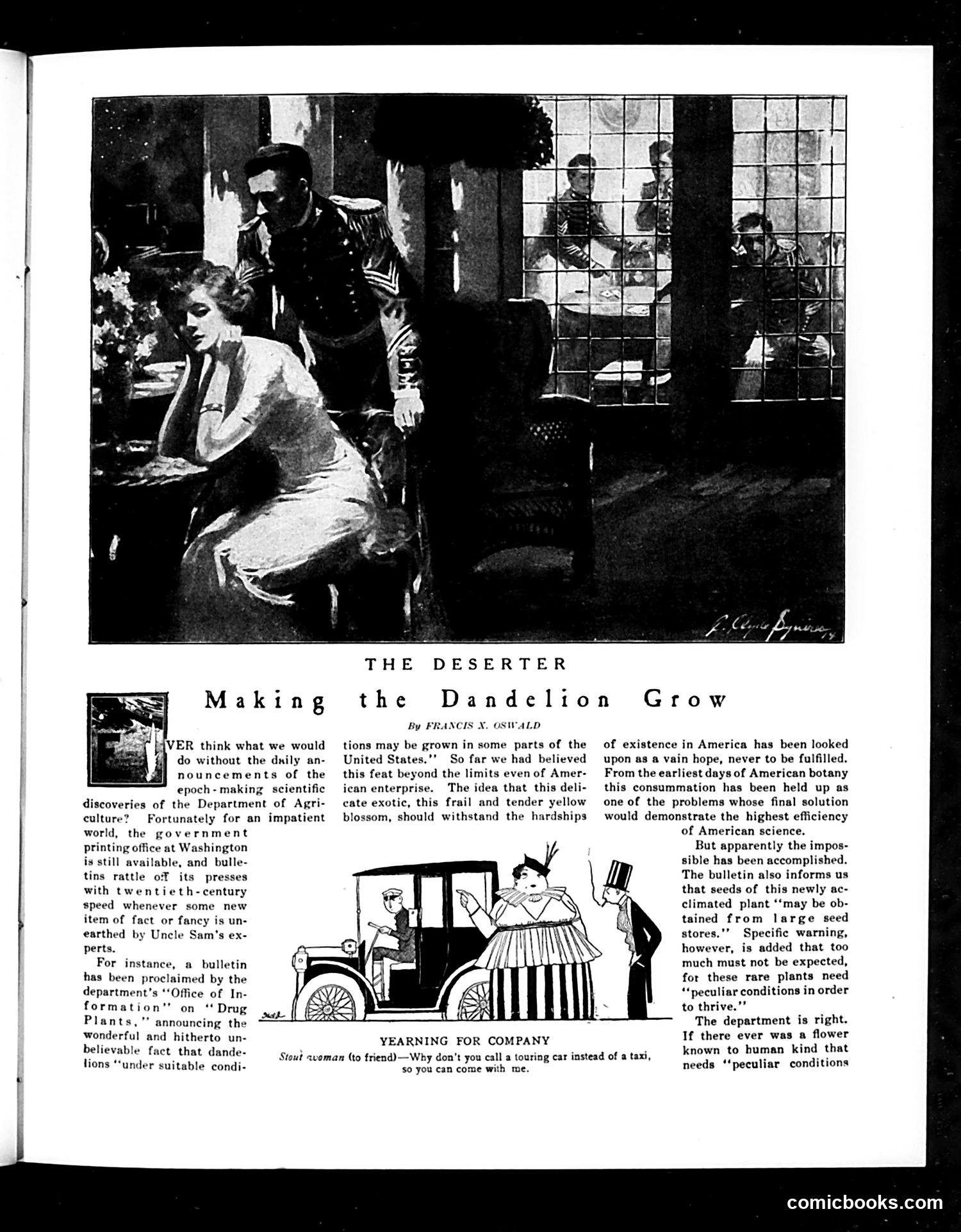
This page satirizes the U.S. Department of Agriculture's tendency to issue grandiose bulletins announcing trivial or obvious "discoveries." The main article mocks a specific bulletin proclaiming that dandelions—common weeds found everywhere in America—can be cultivated in the United States under "suitable conditions." The satire is heavy-handed: the author feigns astonishment that such a "delicate exotic" could possibly survive in America, sarcastically crediting the department with solving what he claims botanists have pursued since colonial times. The small cartoon below ("Yearning for Company") is unrelated—a social joke about a woman inviting her friend to share a taxi or touring car. It appears to be filler content typical of Judge magazine's format. The piece reflects early 20th-century skepticism about government bureaucracy and scientific pretension, mocking the disconnect between official proclamations and practical reality.
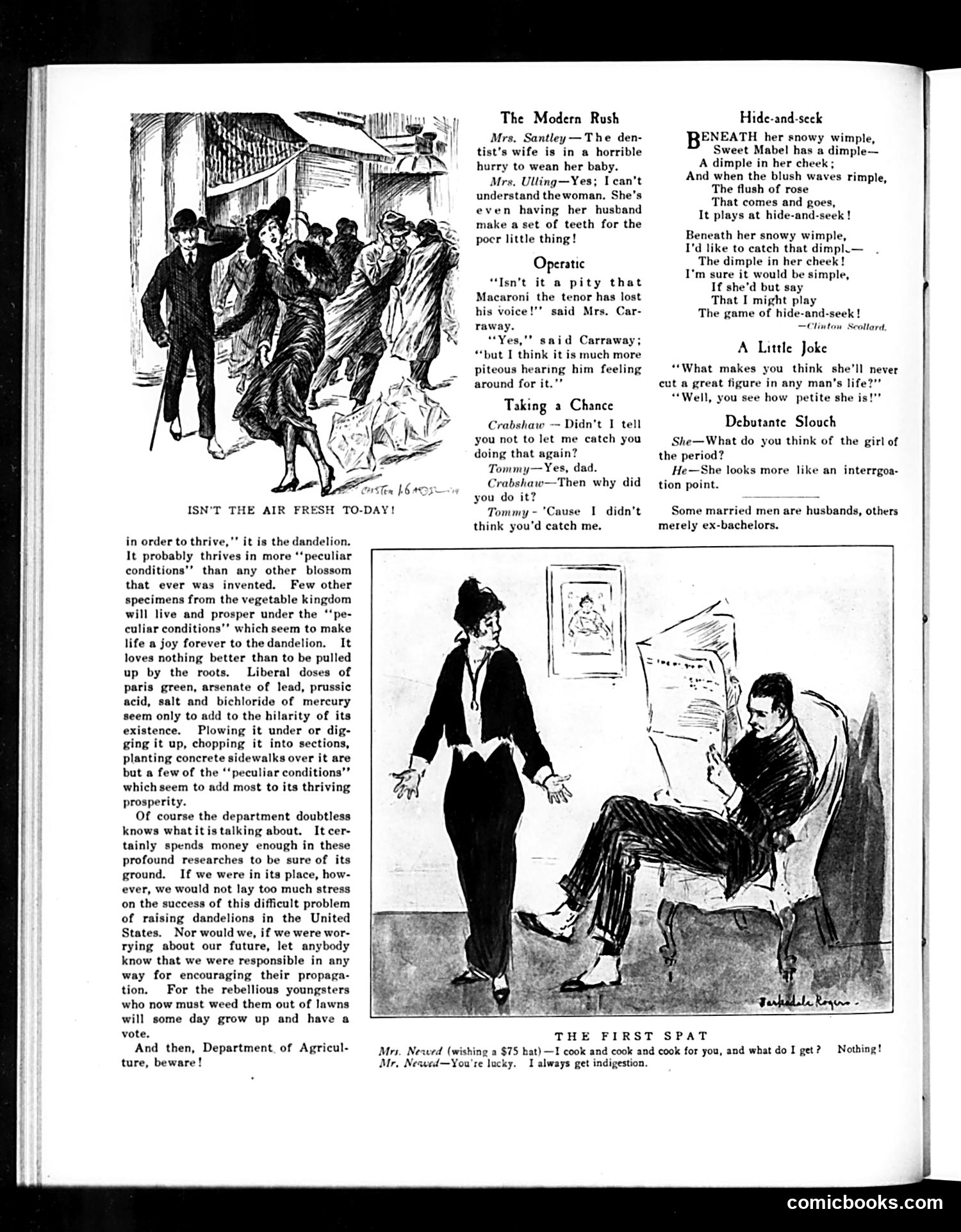
This page contains multiple satirical pieces typical of early 20th-century Judge magazine: **Main Editorial Cartoon** (top left): "Isn't the Air Fresh To-day!" satirizes the Department of Agriculture's research efforts to control dandelions. The joke: the department spends considerable resources studying how dandelions thrive under adverse conditions (poison, plowing, concrete), when the real problem is they already thrive everywhere as weeds. The satirist warns the department faces future political trouble from "rebellious youngsters" forced to weed lawns who'll someday vote. **Comic Vignettes** (middle/bottom): Brief humor pieces including: - A dentist's wife rushing to wean her baby so her dentist husband can make her false teeth - A tenor who lost his voice but still performs badly - A boy who disobeys his father's order because he didn't think he'd be caught **Lower cartoon** "The First Spat": A newlywed wife complains she cooks constantly but receives nothing—only indigestion—a joke about marital disappointment and poor domestic returns on her labor. The page exemplifies Judge's blend of political commentary and domestic humor.
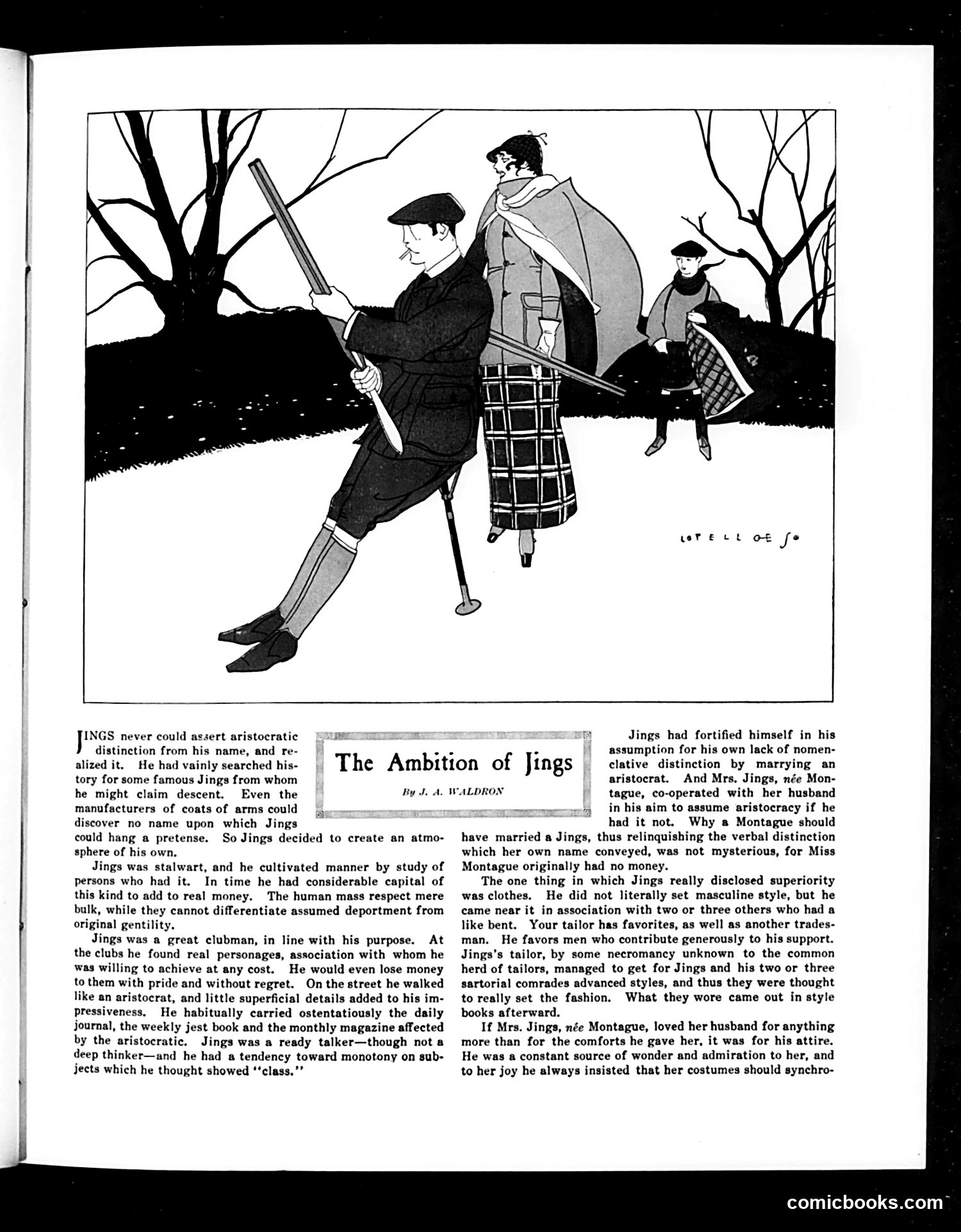
This story satirizes a nouveau riche character named Jings who lacks aristocratic lineage but desperately constructs an artificial upper-class identity. The cartoon shows him ice-skating with his wife (née Montague, a fallen aristocrat who married him for money) and associates. The satire targets Jings's transparent methods: studying "manner," joining exclusive clubs, ostentatiously reading highbrow publications, and—most tellingly—leveraging his tailor's influence to appear a fashion trendsetter. The text mocks how he confuses surface affectation ("class") with genuine refinement, and how the "human mass" respects performative bulk over authentic distinction. His wife, who traded her family name's prestige for his wealth and fashionable wardrobe, embodies the hollow bargain. The piece ridicules early-20th-century American social aspiration: the idea that money, studied behavior, and clever associations could manufacture real status.
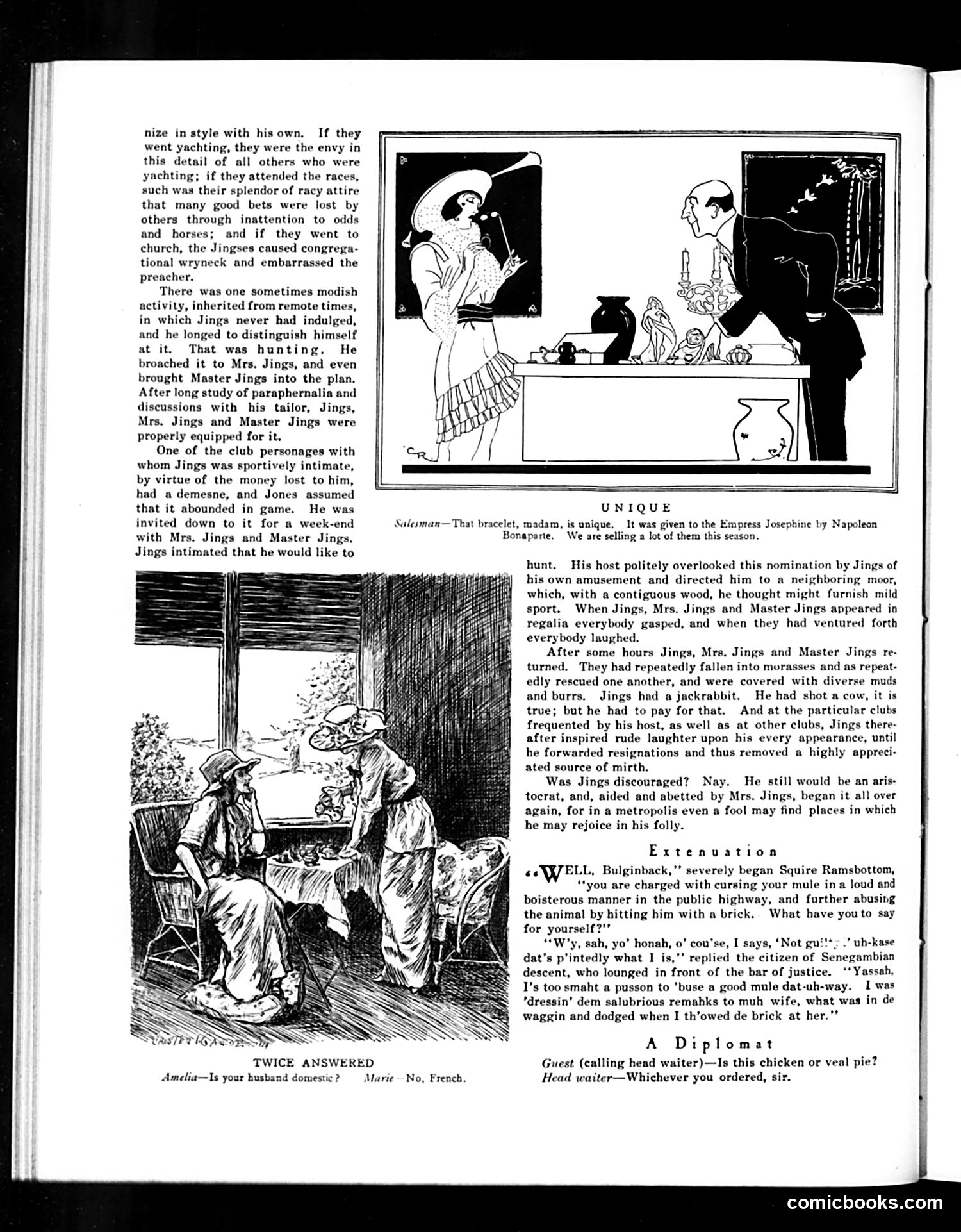
This page contains three distinct satirical pieces: **"Unique" (top cartoon)**: A salesman peddles mass-produced bracelets to a wealthy woman, falsely claiming each was "given to the Empress Josephine by Napoleon Bonaparte." The satire targets both nouveau-riche vanity—the desire to own items with aristocratic provenance—and commercial dishonesty. The joke: these "unique" pieces are being sold in bulk, exposing the contradiction between the claim of exclusivity and the reality of mass production. **"Extenuating" (middle): A Black defendant attempts to evade charges of animal cruelty by claiming his insults were directed at his wife, not the mule. The racist dialect and crude stereotyping reflect the period's offensive comedic conventions, treating the defendant as inherently foolish. **"A Diplomat" (bottom): A head waiter's non-answer joke—he'll serve whichever dish the guest ordered, regardless of what was actually ordered. Light satire of restaurant deception and indifferent service. The dominant theme: exposure of pretense, fraud, and dishonesty in consumer culture and social interactions.
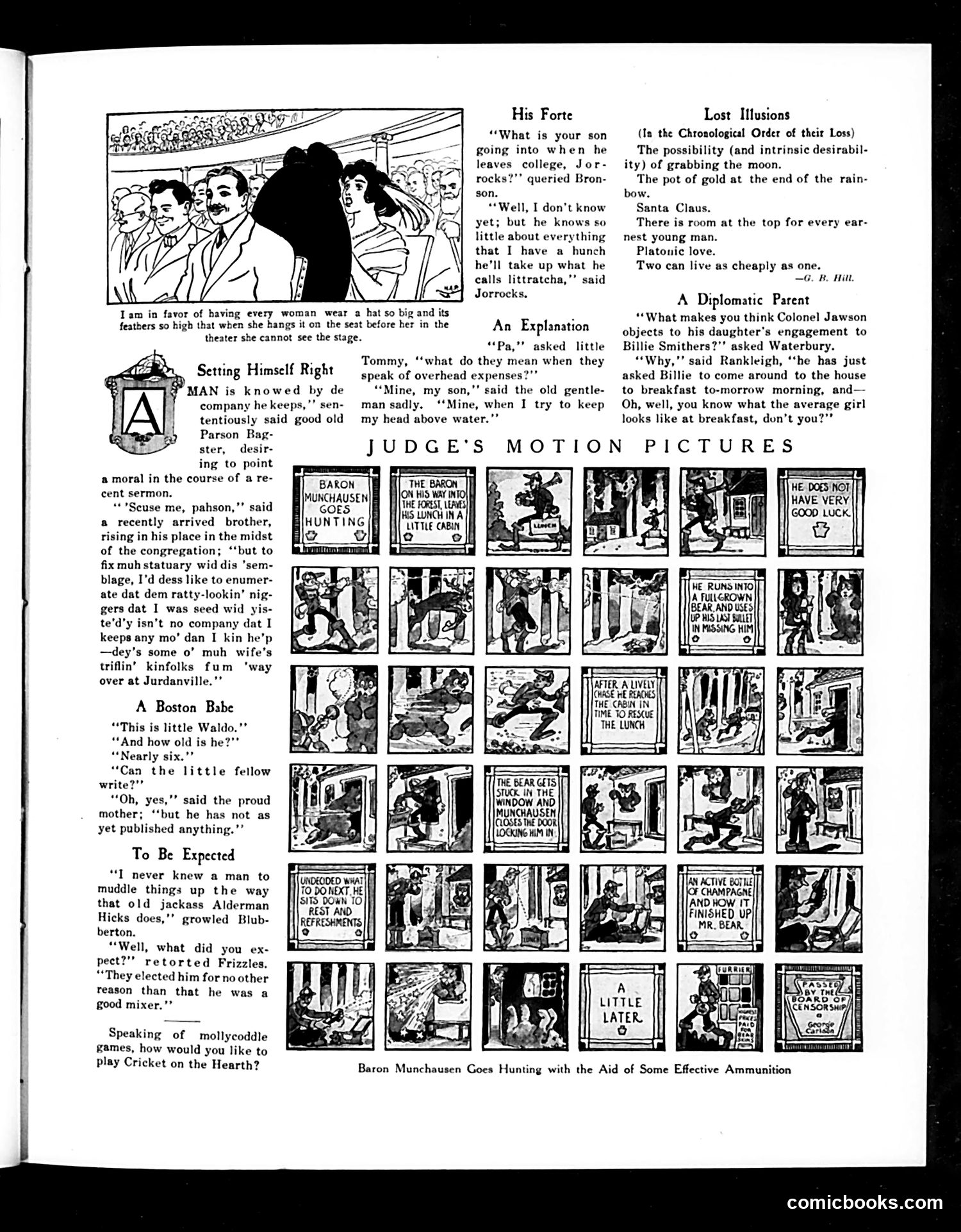
This page contains several short humorous anecdotes and a serial cartoon strip titled "Judge's Motion Pictures: Baron Munchausen Goes Hunting." **The text humor** relies on period stereotypes and social observations: - "His Forte" jokes that a college student ignorant of everything will become a "littratcha" (literature) writer—mocking both pretentious literary types and educational gaps. - "Lost Illusions" lists disenchantments from childhood (Santa, pot of gold) to adulthood (platonic love, cheap living for two). - Other pieces use racist dialect humor and class commentary typical of early 1900s Judge magazine. **The cartoon strip** (36 panels) tells an exaggerated tall tale in the Baron Munchausen tradition—the famous fictional character known for impossibly elaborate hunting adventures. The panels show increasingly absurd hunting scenarios, culminating in "A Little Later," suggesting the baron's characteristic outlandish storytelling continues. The magazine overall targets educated urban readers amused by social pretension, romantic disillusionment, and fantastical humor.
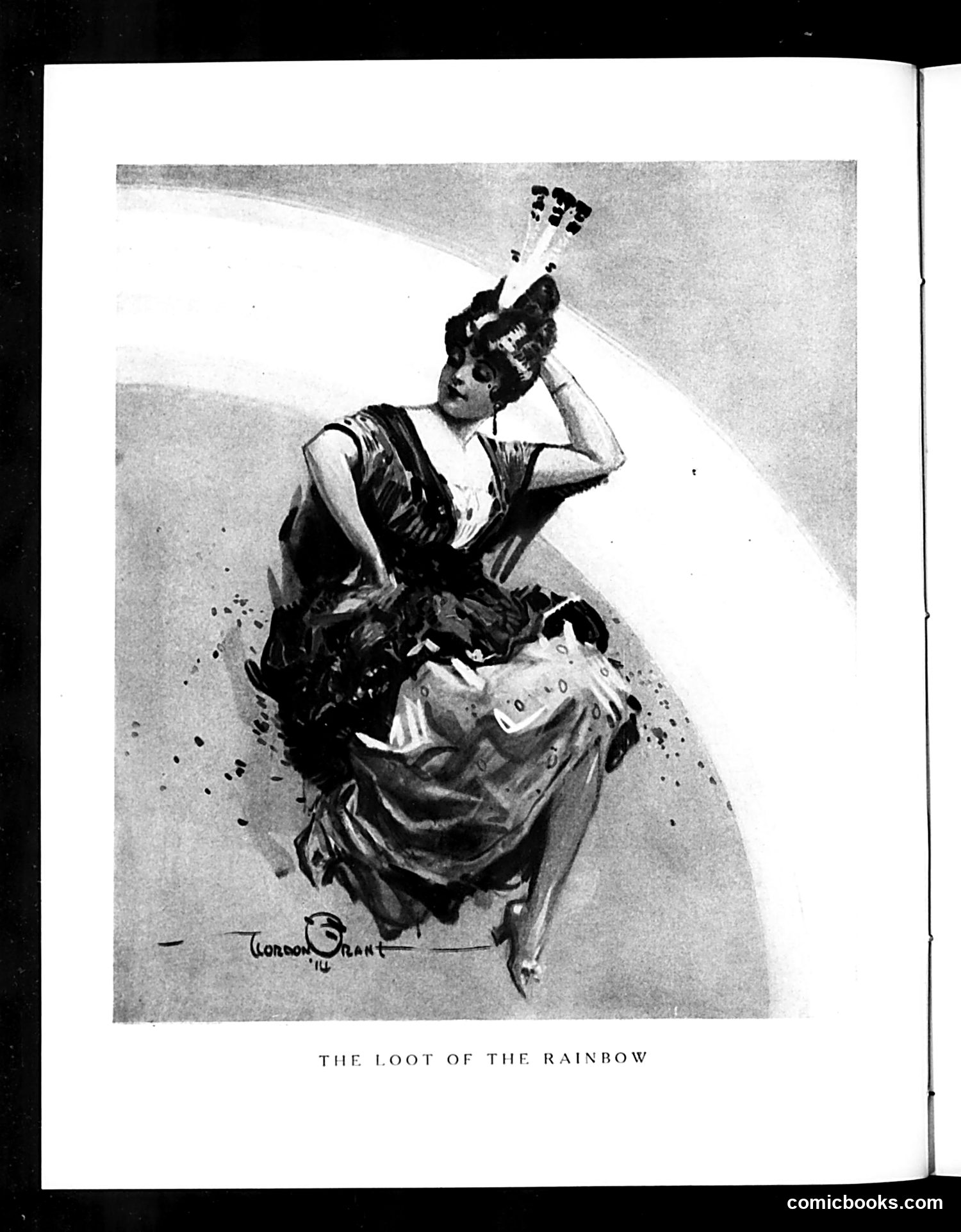
This illustration depicts a woman in elaborate Edwardian dress reaching upward toward a pot of gold, apparently finding treasure at the rainbow's end. The image is signed by what appears to be Conger or similar. The satire likely plays on the folk legend of finding riches at a rainbow's end—presenting the fantasy as literally attainable for this fashionably-dressed woman. Given Judge magazine's tradition of social commentary, the "loot" probably satirizes either: materialism among wealthy women, the allure of luxury goods and fashion, or perhaps the fantastical expectations of wealth. The whimsical, dreamy composition reinforces that this "treasure" is as mythical as the rainbow itself—a commentary on unrealistic desires or aspirations of the era's upper classes.
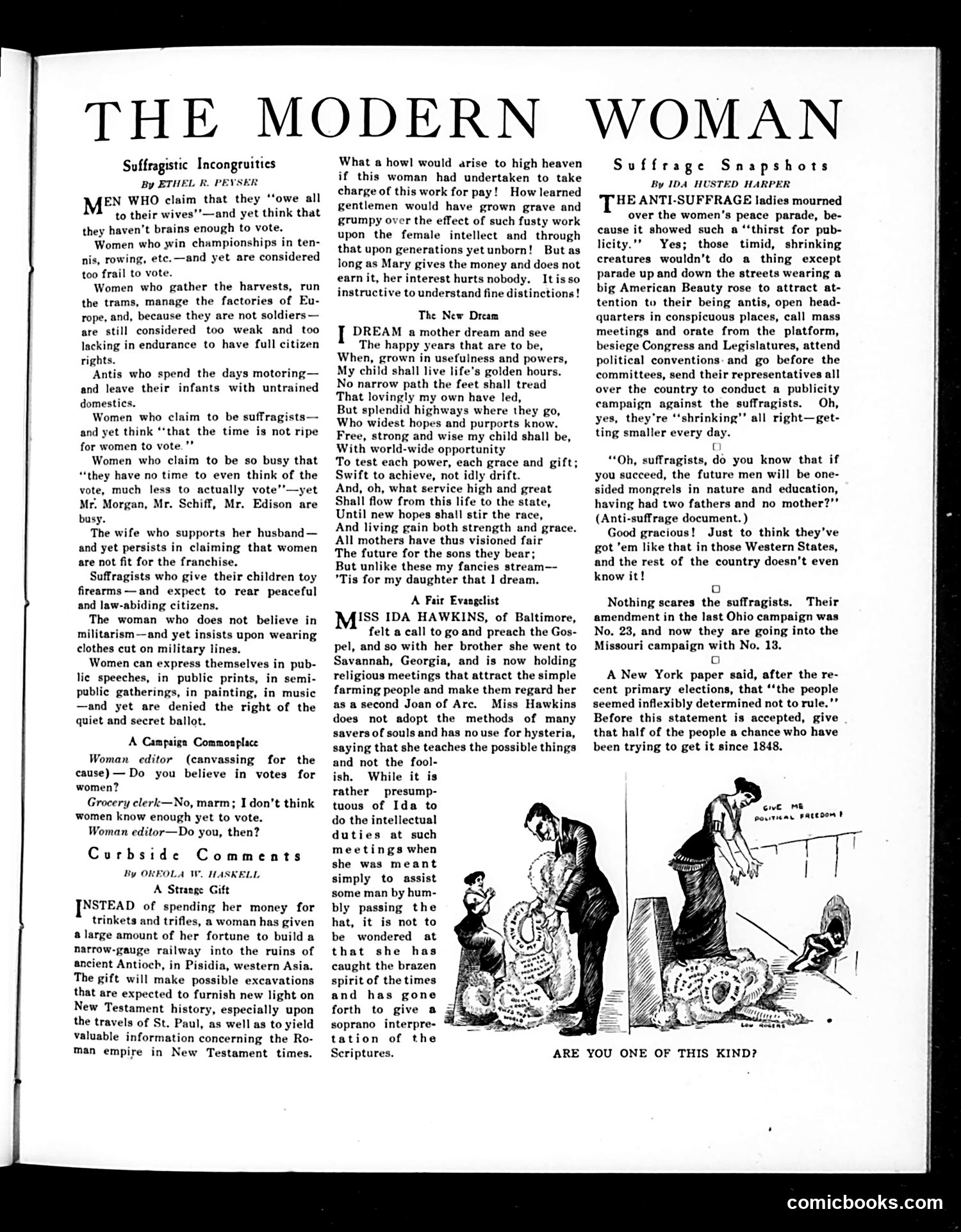
This page satirizes anti-suffrage arguments through ironic juxtaposition. The text lists contradictions: men claim women are "too frail to vote" yet women successfully run factories, manage harvests, and support families. A grocery clerk denies women have brains to vote, yet wealthy men like Morgan and Edison are busy—implying women's intelligence is questioned while their labor is exploited. The cartoon (bottom right, captioned "ARE YOU ONE OF THIS KIND?") depicts suffragists as hypocrites: they oppose militarism yet wear military-cut clothing; they express themselves publicly yet are denied the secret ballot; they give toy guns to children while expecting peaceful citizens. The satire's core point: opponents use circular logic to deny women voting rights despite evidence they possess competence, intelligence, and capability. The page argues the exclusion is arbitrary and absurd, not reasoned.
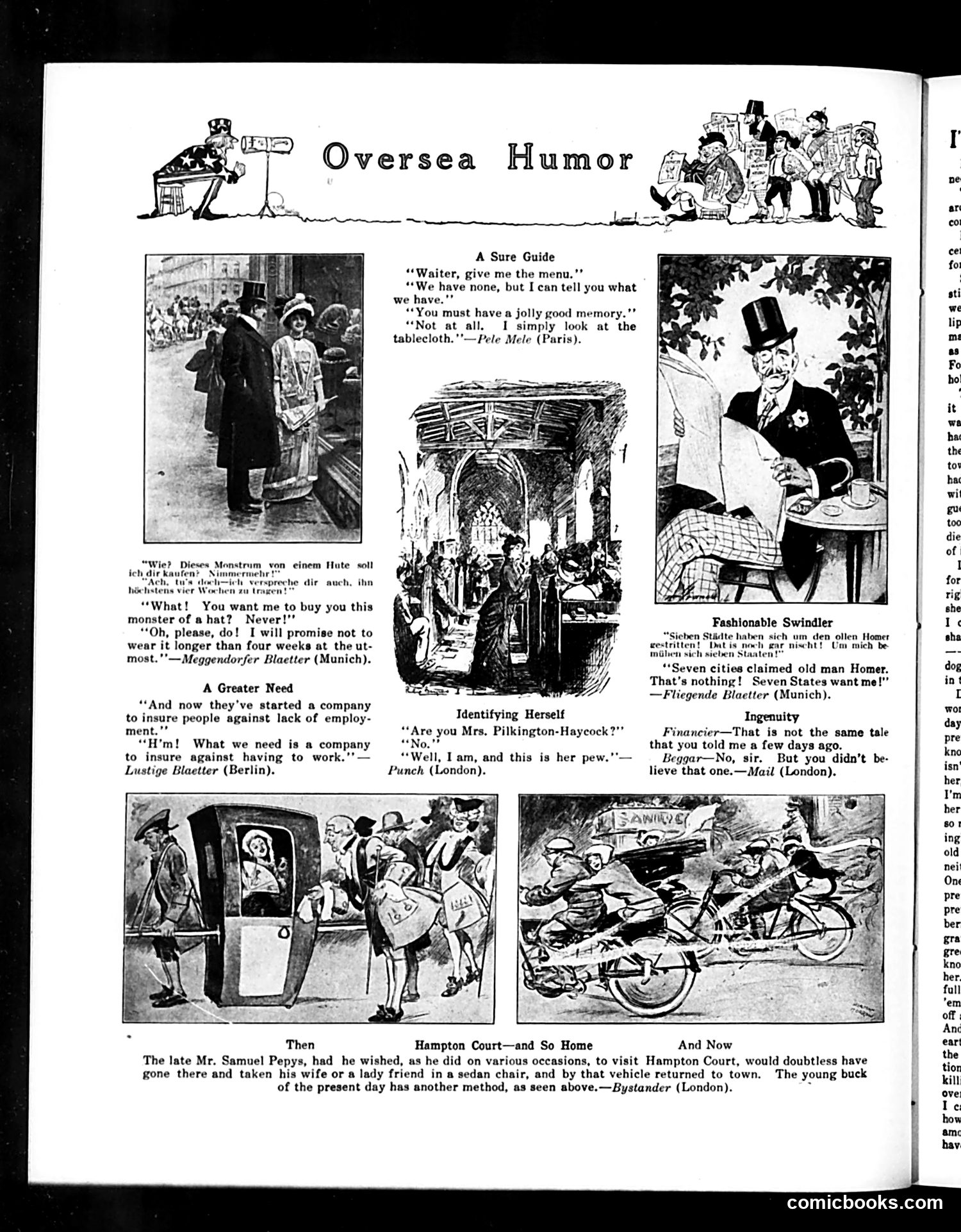
This page collects short humorous anecdotes from European satirical magazines (German, French, and British sources noted). The jokes target everyday frustrations and social absurdities: **Key jokes include:** - A woman demanding an expensive hat, promising brief wear - Unemployment insurance existing, but what's *really* needed is insurance against having to work - A waiter with no menu claiming good memory while eyeing the dirty tablecloth - A church pew mix-up over names - A man (possibly a politician or entertainer) bragging "Seven States want me!"—implying desperation rather than desirability - A beggar adjusting his lies based on what worked before - Transportation evolution: Samuel Pepys used sedan chairs to Hampton Court; modern youth use bicycles The bottom cartoon shows multiple cyclists crashed together, contrasting historical dignified travel with modern chaotic transportation. These are universal workplace, social, and domestic complaints presented as cross-cultural humor.
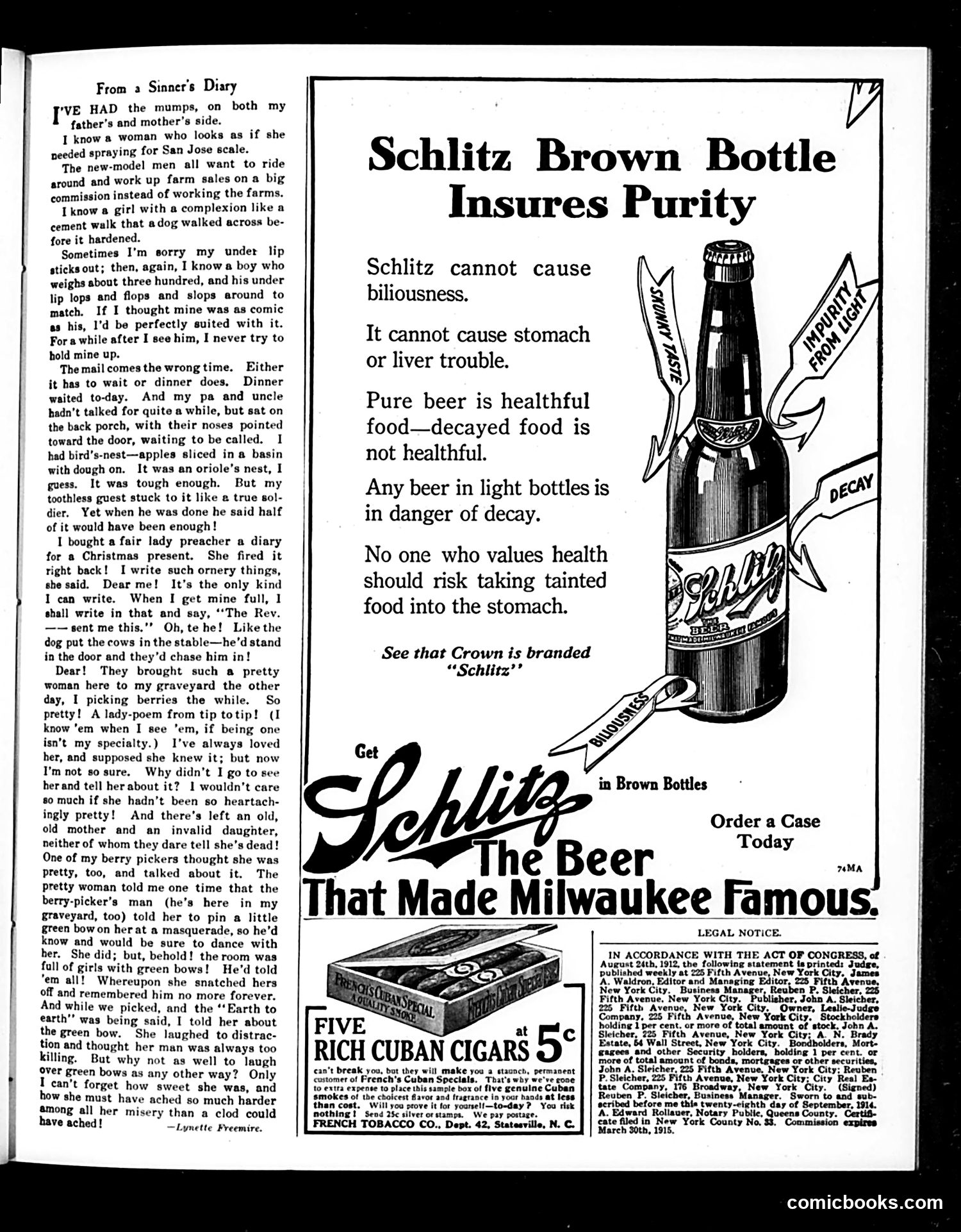
This page from *Judge* magazine contains two unrelated elements: **Left side: "From a Sinner's Diary"** — A humorous essay column using first-person observations about everyday life and minor social embarrassments. The narrator complains about physical features, awkward timing of meals and mail, a gift preacher rejected, and regrets about not confessing feelings to a beautiful woman. It's sentimental social comedy typical of the magazine's humor. **Right side: Schlitz Beer Advertisement** — A commercial promoting brown bottles as superior to light bottles because light bottles allow beer to decay. This appears to be a marketing claim (now understood as dubious) that brown bottles better preserved beer quality. The ad asserts pure beer is "healthful food" while warning against "tainted food." This reflects early 20th-century attitudes treating beer as nutritious rather than alcoholic. The page is primarily advertising, mixing editorial content with commercial promotion.
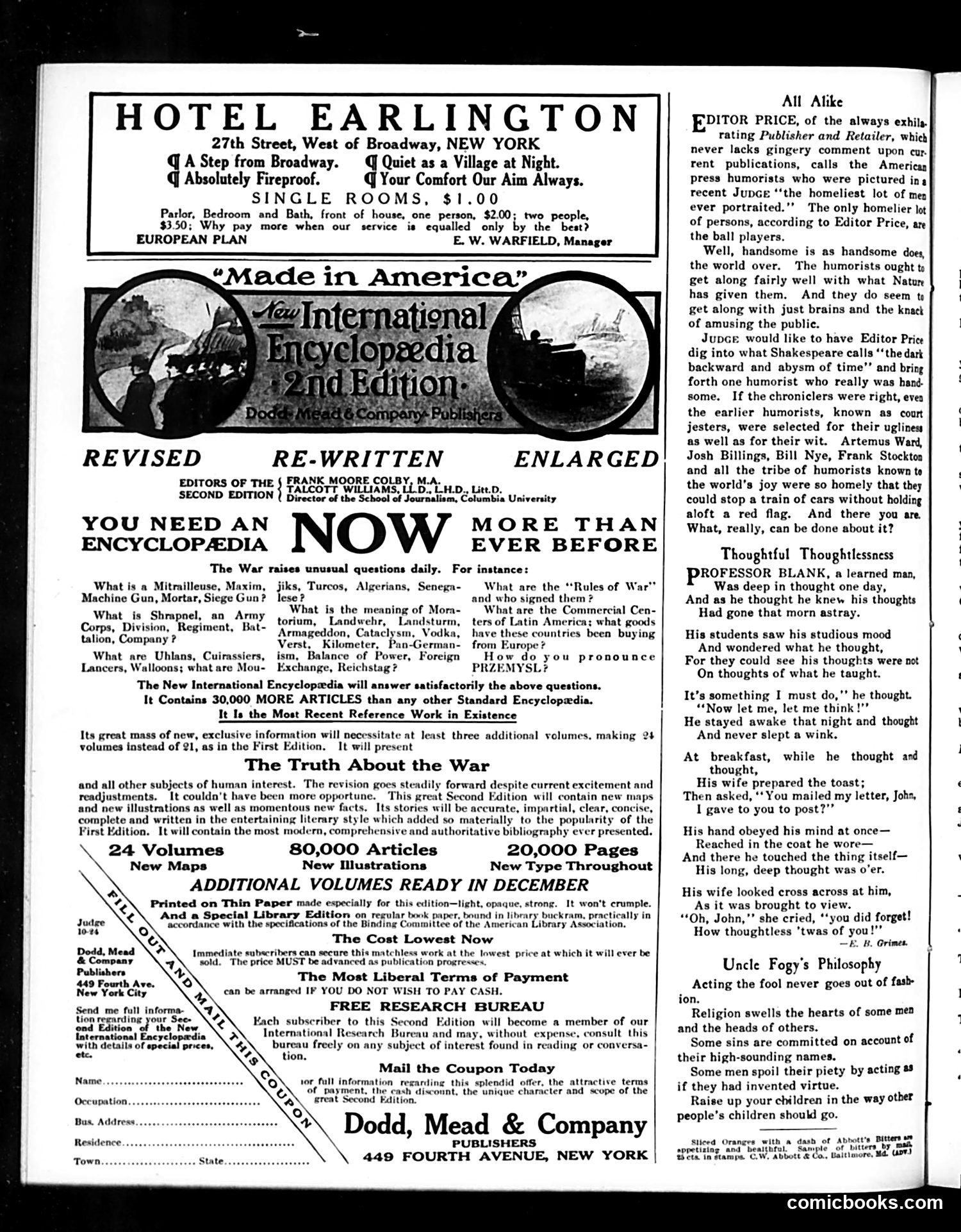
This page is primarily **advertising and editorial content**, not a political cartoon. It consists of: 1. **Hotel advertisement** (top) for the Hotel Earlington in Manhattan 2. **Encyclopedia advertisement** (main content) for the New International Encyclopedia, Second Edition The encyclopedia ad is notable for its **World War I context**. It explicitly markets the work as essential for understanding the war by listing confusing military and foreign terms readers encountered daily—"Mitrailleuse," "Turcos," "Landwehr," "Przemysl"—and diplomatic concepts like "Commercial Centers of Latin America" and "Rules of War." The pitch: modern readers desperately need this reference work to understand "The Truth About the War" and current events. This reflects how WWI generated unprecedented public demand for information about unfamiliar military technology, geography, and international affairs. The page contains editorial content on the right side but no political cartoons visible.
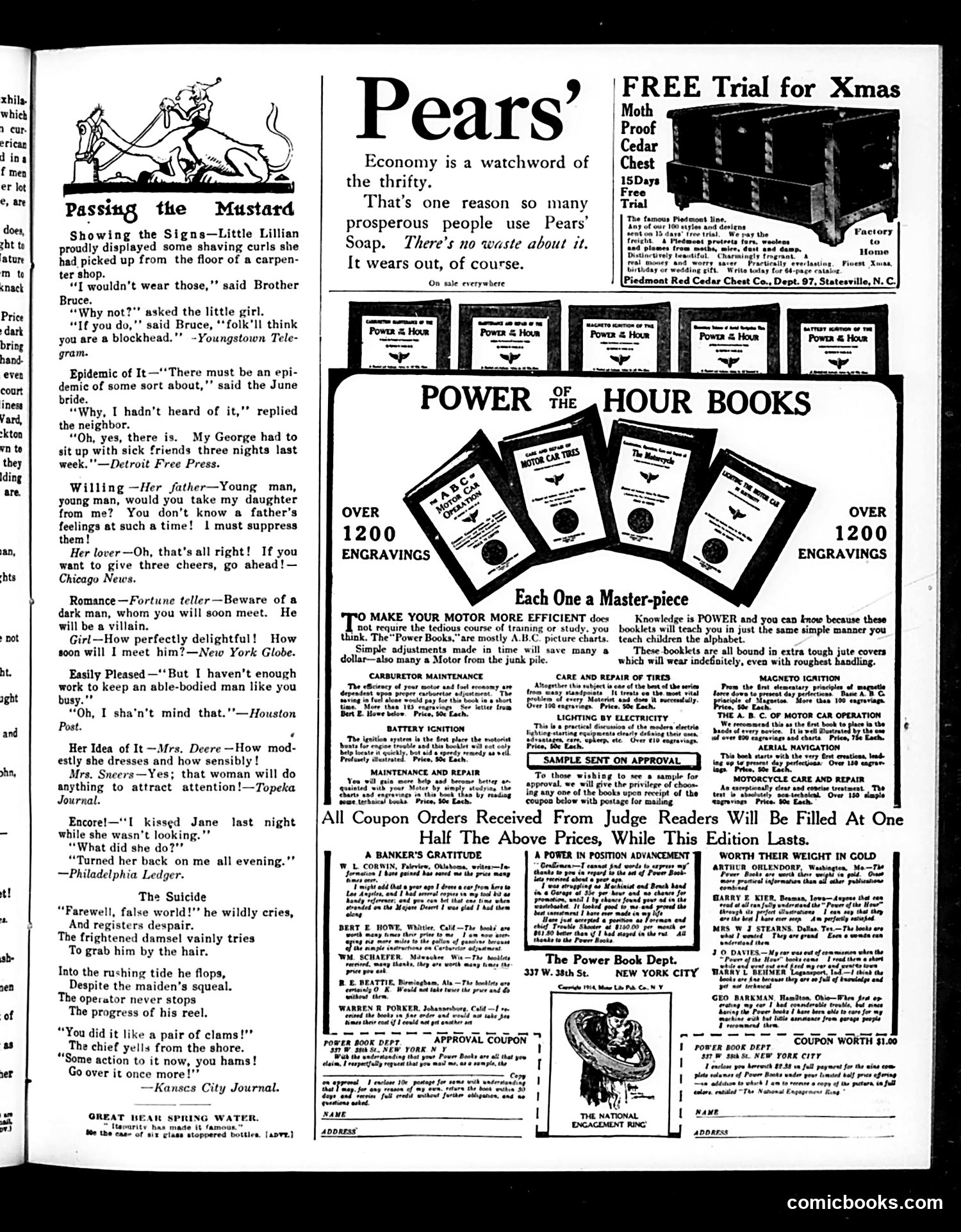
This page is primarily **advertising and short humorous anecdotes** rather than political cartooning. The top features "Passing the Mustard"—a brief joke about a girl showing off carpenter shavings she found, with her brother calling her a "blockhead" for doing so. It's mild social humor about children's behavior. The bulk of the page advertises **"Power of the Hour" instructional booklets** (over 1200 engravings) covering practical motor maintenance: carburetor care, tire repair, magneto ignition, battery ignition, and electrical systems. These appear to be DIY automotive education materials targeting the early automotive era when such knowledge wasn't widespread. Scattered throughout are brief jokes from various newspapers (Detroit Free Press, Chicago News, etc.) about romance, marriage, and domestic life—typical light humor of the period. The page reflects **early 20th-century American concerns**: automobile ownership becoming common, practical self-sufficiency valued by "thrifty" people, and traditional gender/family dynamics treated as comedy material.
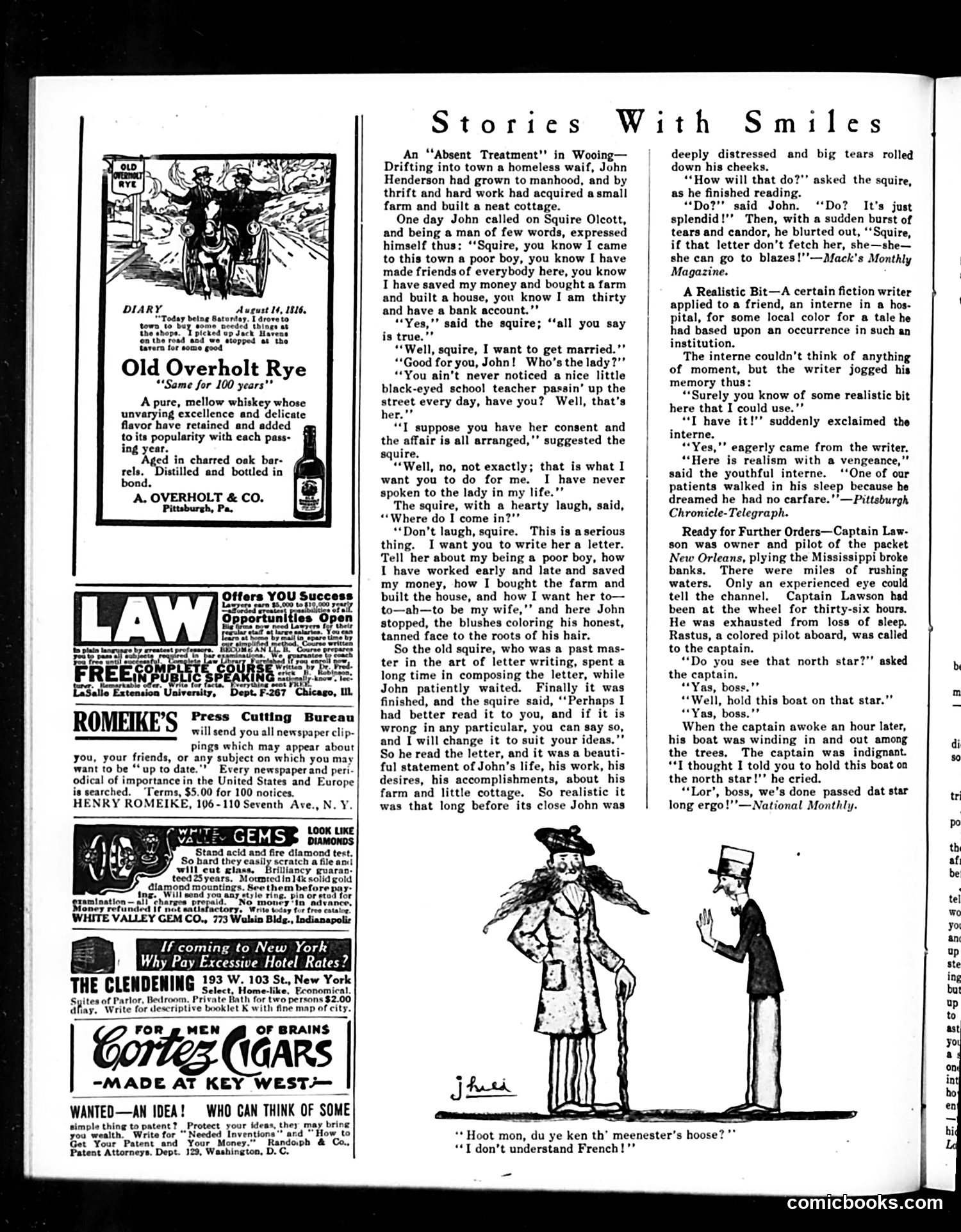
This page from *Judge* magazine contains mostly **advertisements and commercial notices** interspersed with a short story titled "An 'Absent Treatment' in Wooing." The main story depicts a comedic courtship scenario: John Henderson, a shy farmer, asks the local squire to write a love letter to a schoolteacher on his behalf, since John has never spoken to her. The squire's detailed, realistic letter recounting John's rise from poverty to respectability is so touching that John becomes emotionally overcome before it's even finished—the joke being that John is moved to tears by *his own life story* as eloquently described by someone else, rather than by romantic sentiment toward the woman herself. The satire gently mocks rural social awkwardness and the power of eloquent letter-writing in courtship, while poking fun at sentimental Victorian romance conventions. The accompanying illustration shows two figures in old-fashioned dress with French dialogue, likely a separate unrelated joke. The page is primarily filled with period advertising for whiskey, correspondence courses, clipping services, diamonds, and hotels.
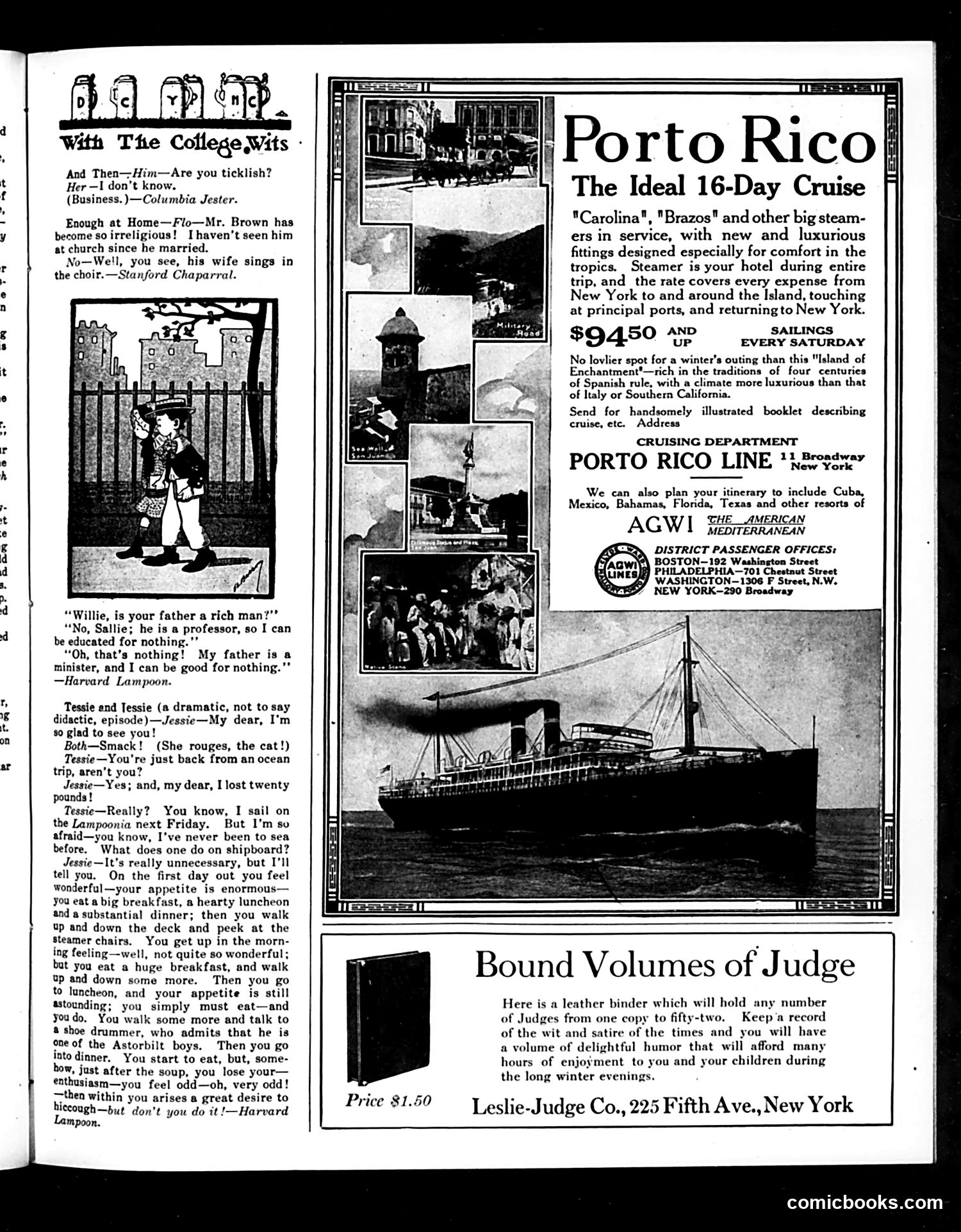
This page contains **college humor reprints** and advertisements rather than original satirical cartoons. ## The Humor Section The left side features reprints of jokes from college publications (Columbia Jester, Stanford Chaparral, Harvard Lampoon). These brief comedic exchanges use common early-20th-century tropes: - A suggestive "ticklish" flirtation joke - Religious hypocrisy humor (a man stops attending church after marrying a choir singer) - Depression-era academic satire (professors and ministers can't afford to support their families) - A extended shipboard joke about seasickness and appetite loss during ocean voyages These jokes target educated audiences familiar with college life and contemporary social anxieties. ## Advertising The right side features two advertisements: a **Porto Rico cruise** ($94.50 for 16 days) marketing tropical leisure travel, and **bound volumes of Judge magazine** itself ($1.50 binders), encouraging readers to collect and preserve the magazine's humor. The page is primarily **light entertainment and commercial**, with no political satire or caricature present.
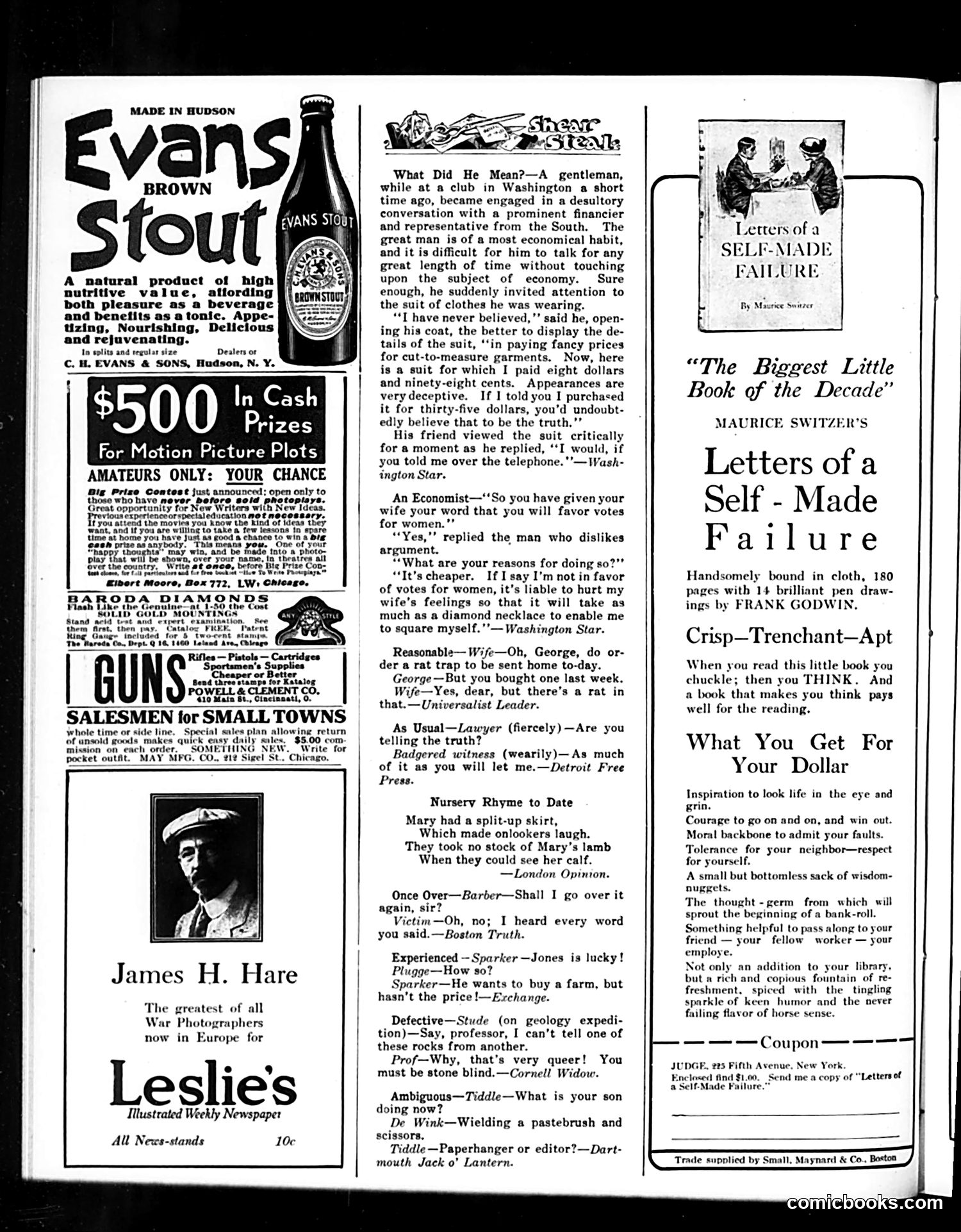
This is primarily an **advertising and humor page** from Judge magazine, featuring short jokes rather than political cartoons. The content includes: **Advertisements**: Evans Stout beer, a motion picture plot contest, diamonds, firearms, and a book titled "Letters of a Self-Made Failure" by Maurice Switzer. **Humor section**: Multiple brief jokes satirizing everyday social situations—a Southern financier bragging about his cheap suit, a husband avoiding supporting women's suffrage to save money on jewelry, marital disputes over rat traps, and various professional encounters (lawyer, barber, geology professor). **Notable context**: The suffrage reference reflects the contemporary women's voting rights debate. The jokes employ mild cynicism about marriage, economy, and professional life typical of early 20th-century American humor magazines. **James H. Hare advertisement**: Promotes a war photographer now covering European conflicts for Leslie's magazine. The page reflects Judge's mixed commercial-editorial model: advertising subsidized satirical content targeting middle-class readers.
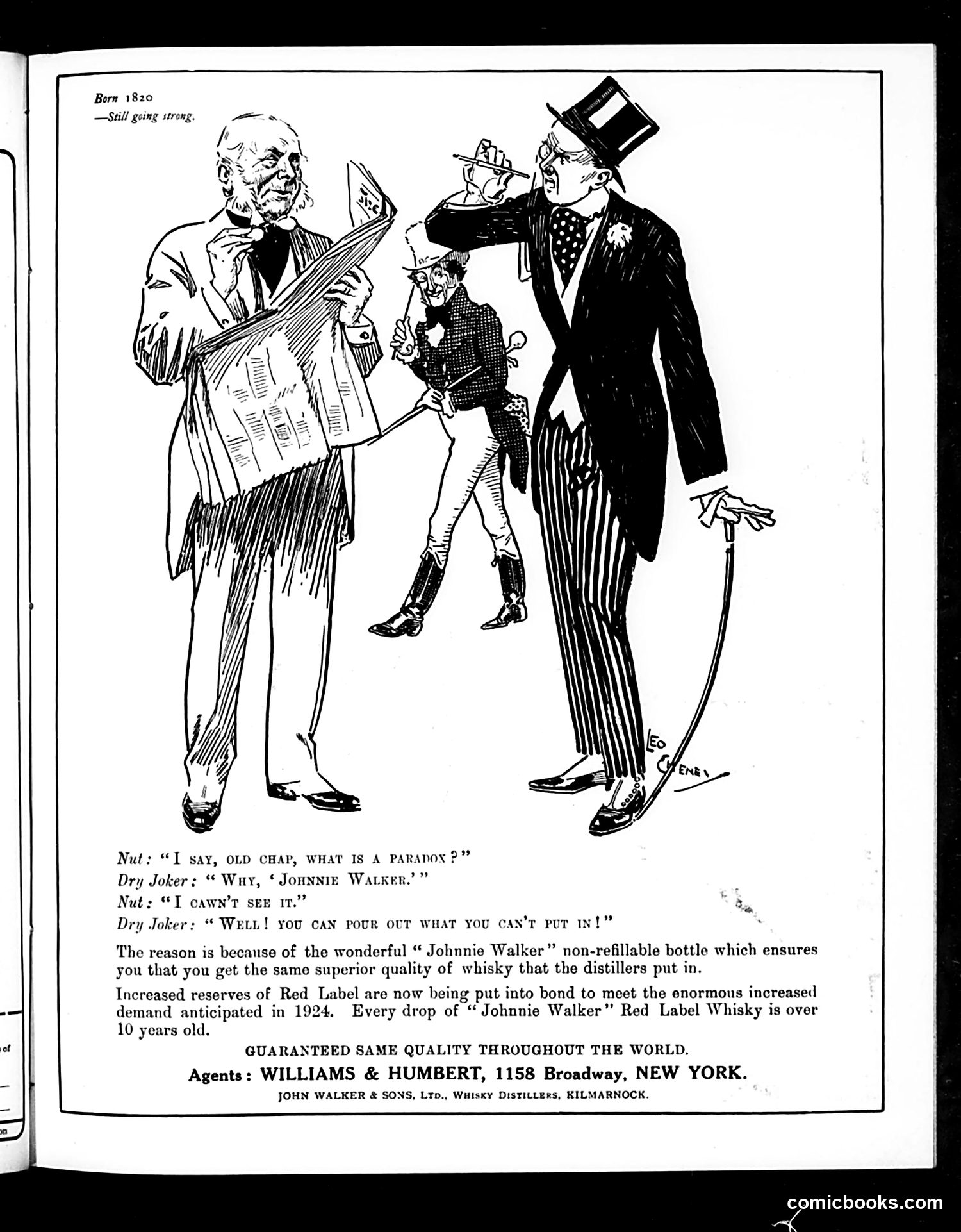
This is a **Johnnie Walker whisky advertisement** disguised as humor, published in Judge magazine around 1920-1924. The cartoon depicts two well-dressed men discussing a paradox: "Born 1820—Still going strong." The "joke" is that Johnnie Walker whisky is over 100 years old yet remains vital. The punchline explains the paradox through the product's non-refillable bottle, which ensures quality control—you can "pour out what you can't put in," meaning no adulteration or refilling with inferior product. The advertisement emphasizes Johnnie Walker Red Label's age (over 10 years old minimum), anticipated high 1924 demand, and worldwide quality consistency. It lists New York agents Williams & Humbert and Scottish distillers John Walker & Sons. This reflects pre-Prohibition advertising (Prohibition ended in 1933), when such product placement in satirical magazines was common. The "paradox" framing attempts to make the advertisement entertaining rather than purely commercial.
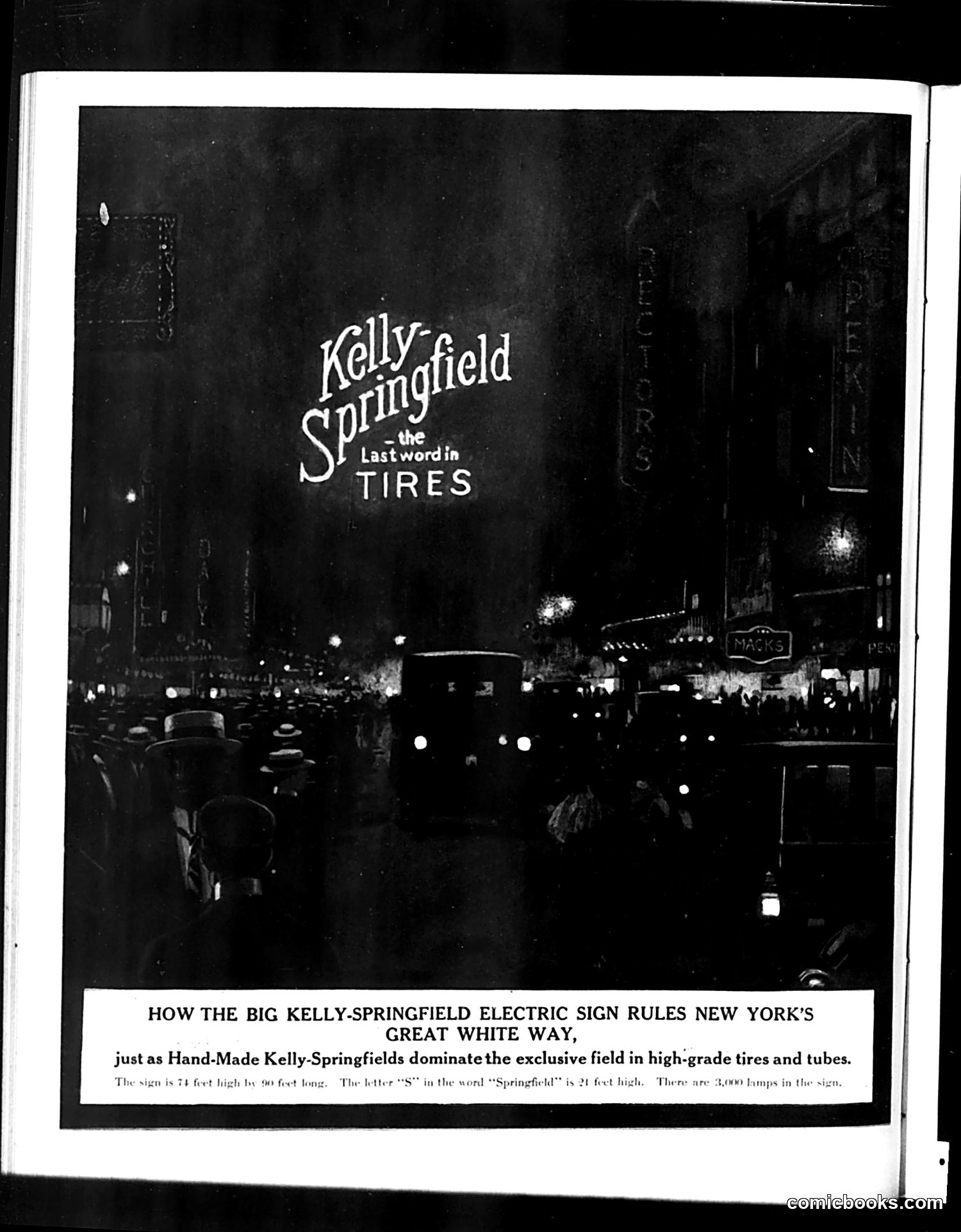
This page is primarily **advertising, not political satire**. It features a photograph of Times Square at night dominated by a massive Kelly-Springfield Tires electric sign. The caption compares the sign's dominance of New York's "Great White Way" (Times Square's theater district) to Kelly-Springfield's market dominance in high-grade tires and tubes. The sign is described as 71 feet high, 90 feet long, with the letter "S" measuring 21 feet high and containing 3,000 lamps. This is straightforward product advertising using the spectacle of modern electric signage to promote tire quality—no political cartoon or satire is present on this page.