
Judge, 1914-10-24 · page 20 of 24
Judge — October 24, 1914 — page 20: what you’re looking at
What you’re looking at
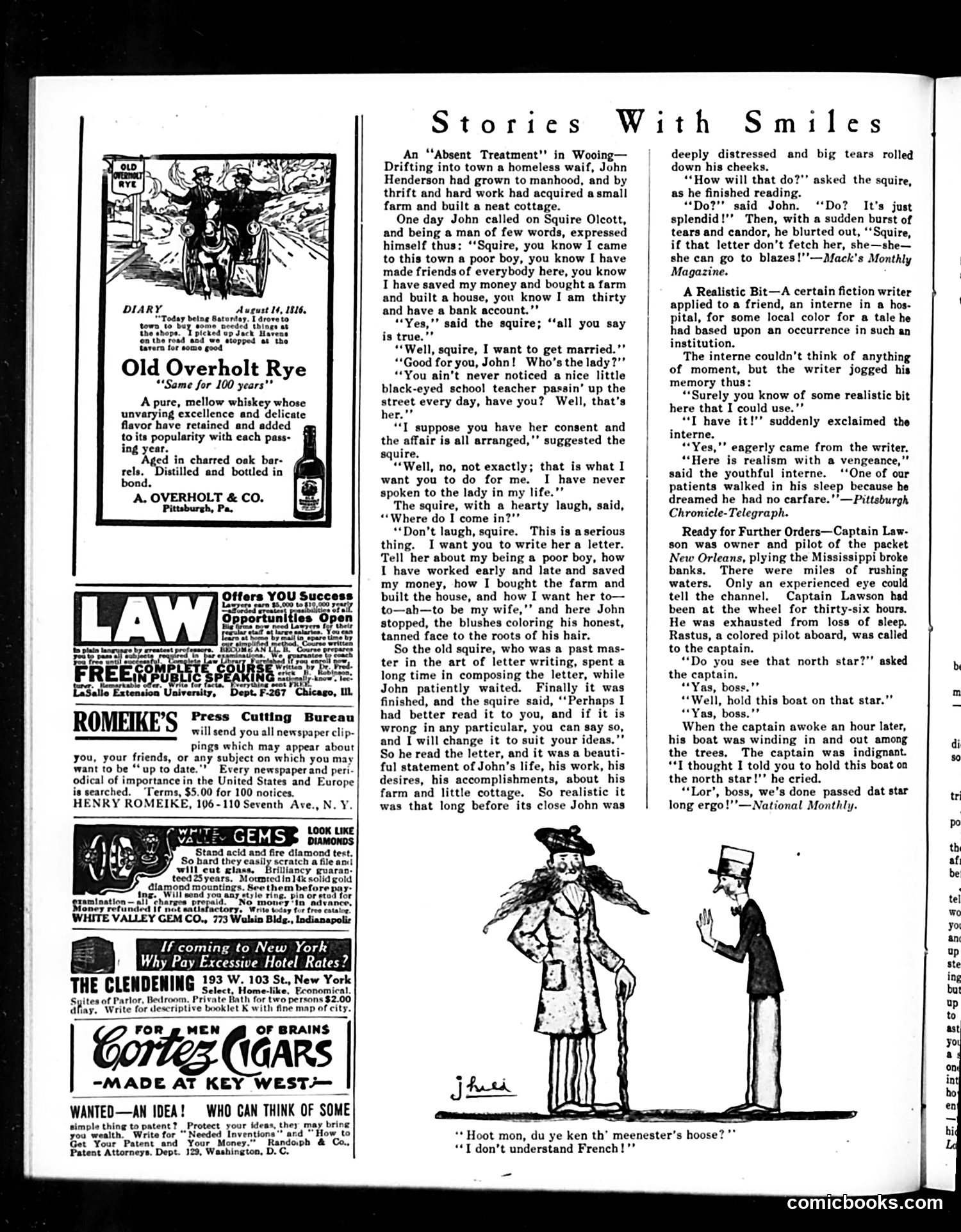
This page from *Judge* magazine contains mostly **advertisements and commercial notices** interspersed with a short story titled "An 'Absent Treatment' in Wooing." The main story depicts a comedic courtship scenario: John Henderson, a shy farmer, asks the local squire to write a love letter to a schoolteacher on his behalf, since John has never spoken to her. The squire's detailed, realistic letter recounting John's rise from poverty to respectability is so touching that John becomes emotionally overcome before it's even finished—the joke being that John is moved to tears by *his own life story* as eloquently described by someone else, rather than by romantic sentiment toward the woman herself. The satire gently mocks rural social awkwardness and the power of eloquent letter-writing in courtship, while poking fun at sentimental Victorian romance conventions. The accompanying illustration shows two figures in old-fashioned dress with French dialogue, likely a separate unrelated joke. The page is primarily filled with period advertising for whiskey, correspondence courses, clipping services, diamonds, and hotels.
📄 Transcribed text from this page (OCR, searchable)
Machine-transcribed from the original scan — historical spelling and the odd misread are preserved.
Old Overholt Rye “Same for 100 years A pure, mellow whiskey whose unvarying excellence and delicat flavor have retained and added to its popularity with each pass- ing year. Aged in charred oak bar- rels. Distilled and bottled in bond. A. OVERHOLT & CO. Pittsburgh, Pa. Offere You Success Opportunities Open Baa Laczers fy, thee af cea Yates sites bea tccees enaae Ee, iBENE AN Te 7 Chicago, Bivona een re S a, fpacnice tf eet FREE RPA SeeutRR SS) = LaSalle Extension U: 7. Dept. F-267 m. ROMEIKE’ Press Cutting Bureau lniversity, will send you all newspaper clip- pings which may appear about you, your friends, or any subject on which you may want to be “‘up to date."” Every newspaper and peri- odical of importance in the United States and Europe is searched. ‘Terms, $5.00 for 100 notices. HENRY ROMEIKE, 106-110 Seventh Ave., N. Y. DIAMONDS: Stand acid and fire diamond test. So hard they easily scratch a file ani witleut glass,” Brilliancy guaras: teed 2years. Moumtedin14k solid gold diamond mountings. See them before pay- ing. Will send you any style ring. pin or etod for Syamination— all charges prepaid. No, mon loney refunded if net satisfactory. Write tosey WHITE VALLEY GEM CO., 773 Wulsin Bidg., Indianapolic If coming to New York Why Pay Excessive Hotel Rates? THE CLENDENING 32° 10 sot: Roroueat Syites of Parlor, Bedroom. Private Bath for two persons $2.00 dbay. Write for descriptive booklet K with fine map of city. OF BRAINS 1GARS “MADE AT KEY WEST— |! WANTED—AN IDEA! WHO CAN THINK OF SOME simple thing to patent? | Protect your ideas, they may bring FOR g MEN Stories An ‘‘Absent Treatment’? in Wooing— Drifting into town a homeless waif, John Henderson had grown to manhood, and by thrift and hard work had acquired a small farm and built a neat cottage. One day John called on Squire Olcott, and being a man of few words, expressed himself thus: ‘‘Squire, you know I came to this town a poor boy, you know I have made friends of everybody here, you know I have saved my money and bought a farm and built a house, you know I am thirty and have a bank account.’? “Yes,’’ said the squire; ‘‘all you say is true.’ “Well, squire, I want to get married.’’ “Good for you, John! Who’s the lady?” “You ain't never noticed a nice little black-eyed school teacher passin’ up the street every day, have you? Well, that’s her."” “T suppose you have her consent and the affair is all arranged,’’ suggested the squire. “Well, no, not exactly; that is what I want you to do for me. I have never spoken to the lady in my life.’’ The squire, with a hearty laugh, said, “Where do I come in?’’ **Don’t laugh, squire. This is aserious thing. I want you to write her a letter. Tell her about my being a poor boy, how I have worked early and late and saved my money, how I bought the farm and built the house, and how I want her to— to—ah—to be my wife,’’ and here John stopped, the blushes coloring his honest, tanned face to the roots of his hair. So the old squire, who was a past mas- ter in the art of letter writing, spent a long time in composing the letter, while John patiently waited. Finally it was finished, and the squire said, ‘Perhaps I had better read it to you, and if it is wrong in any particular, you can say so, and I will change it to suit your ideas.’’ So he read the letter, and it was a beauti- ful statement of John’s life, his work, his desires, his accomplishments, about his farm and little cottage. So realistic it was that long before its close John was With Smiles deeply distressed and big tears rolled down his cheeks. “How will that do?"’ asked the squire, as he finished reading. “Do?’’ said John. ‘‘Do? It’s just splendid!’’ Then, with a sudden burst of tears and candor, he blurted out, ‘‘Squire, if that letter don’t fetch her, she—she— she can go to blazes!'’—Mack's Monthly Magazine. A Realistic Bit—A certain fiction writer applied to a friend, an interne in a hos- pital, for some local color for a tale he had based upon an occurrence in such an institution. The interne couldn’t think of anything of moment, but the writer jogged his memory thus: “Surely you know of some realistic bit here that I could use.’’ “T have it!’’ suddenly exclaimed the interne. “Yes,” eagerly came from the writer. “‘Here is realism with a vengeance,” said the youthful interne. ‘‘One of our patients walked in his sleep because he dreamed he had no carfare.’’—Pittsburgh Chronicle-Telegraph. Ready for Further Orders—Captain Law- son was owner and pilot of the packet New Orleans, plying the Mississippi broke banks. There were miles of rushing waters. Only an experienced eye could tell the channel. Captain Lawson had been at the wheel for thirty-six hours, He was exhausted from loss of sleep. Rastus, a colored pilot aboard, was called to the captain. “Do you see that north star?” asked the captain, “Yas, boss.’’ “‘Well, hold this boat on that star.”” “Yas, boss.’” When the captain awoke an hour later, his boat was winding in and out among the trees, The captain was indignant. “I thought I told you to hold this boat on the north star!’’ he cried. “‘Lor’, boss, we’s done passed dat star long ergo!’’—National Monthly. ** Hoot mon, du ye ken th’ meen: you wealth. Write for “Needed Inventions” ard “How to “*T don’t understand French!"’ Get Your Patent and Your Mone; Randoph & Co., Patent Attorneys, Dept. 129, Washington, D. C. comicbooks.com