
Judge, 1914-10-24 · page 11 of 24
Judge — October 24, 1914 — page 11: what you’re looking at
What you’re looking at
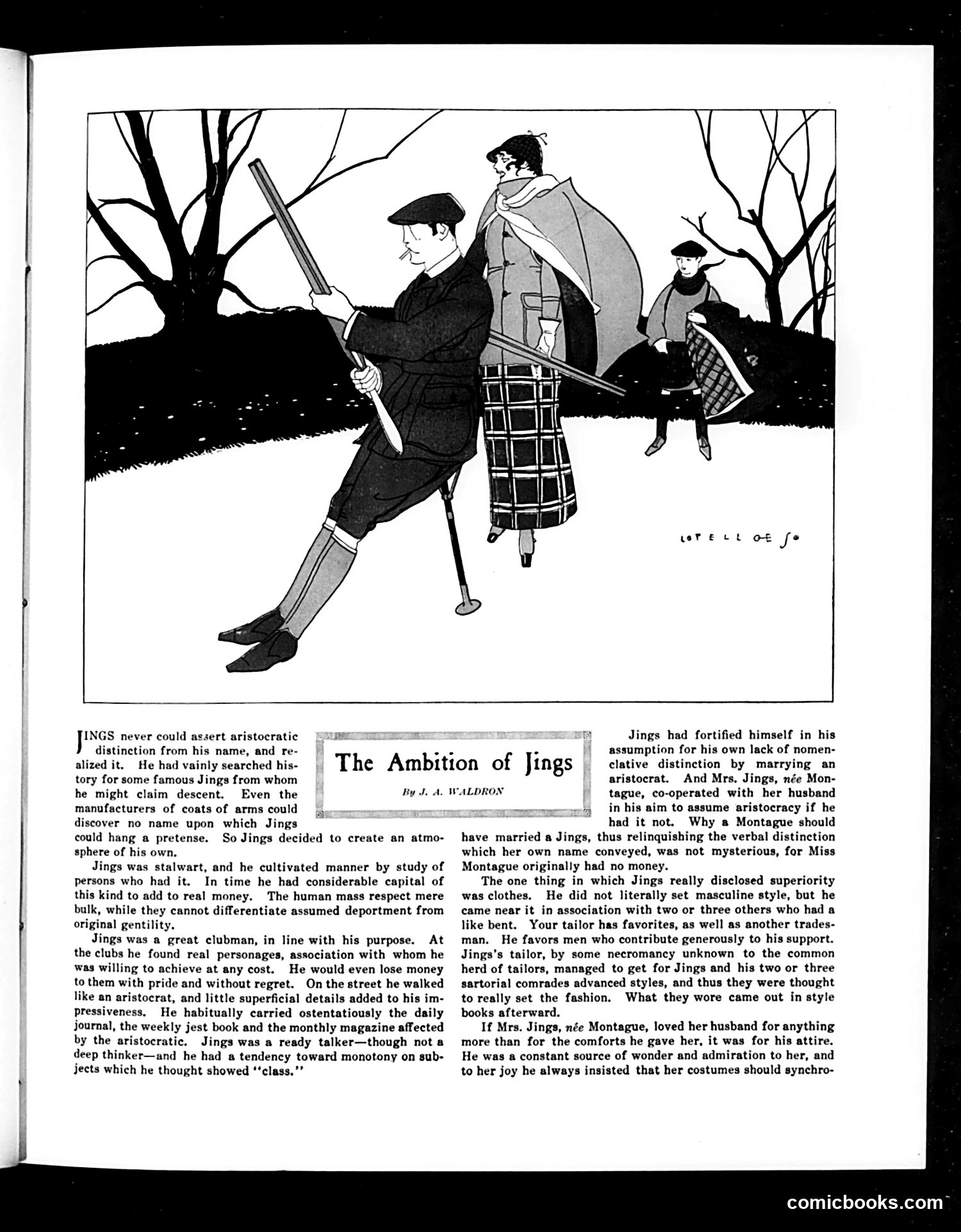
This story satirizes a nouveau riche character named Jings who lacks aristocratic lineage but desperately constructs an artificial upper-class identity. The cartoon shows him ice-skating with his wife (née Montague, a fallen aristocrat who married him for money) and associates. The satire targets Jings's transparent methods: studying "manner," joining exclusive clubs, ostentatiously reading highbrow publications, and—most tellingly—leveraging his tailor's influence to appear a fashion trendsetter. The text mocks how he confuses surface affectation ("class") with genuine refinement, and how the "human mass" respects performative bulk over authentic distinction. His wife, who traded her family name's prestige for his wealth and fashionable wardrobe, embodies the hollow bargain. The piece ridicules early-20th-century American social aspiration: the idea that money, studied behavior, and clever associations could manufacture real status.
📄 Transcribed text from this page (OCR, searchable)
Machine-transcribed from the original scan — historical spelling and the odd misread are preserved.
wrece of fe INGS never could assert aristocratic a distinction from his name, and re- alized it, tory for some famous Jings from whom he might claim descent. Even the manufacturers of coatsof armscould discover no name upon which Jings could hang a pretense. So Jings decided to create an atmo- sphere of his own, Jings was stalwart, and he cultivated manner by study of persons who had it. In time he had considerable capital of this kind to add to real money. The human mass respect mere bulk, while they cannot differentiate assumed deportment from original gentility. Jings was a great clubman, in line with his purpose. At the clubs he found real personages, association with whom he was willing to achieve at any cost. He would even lose money to them with pride and without regret. On the street he walked like an aristocrat, and little superficial details added to his im- Pressiveness, He habitually carried ostentatiously the daily journal, the weekly jest book and the monthly magazine affected by the aristocratic. Jings was a ready talker—though not a deep thinker—and he had a tendency toward monotony on sub- jects which he thought showed ‘‘class,”” He had vainly searched his- The Ambition of Jings By J. A, WALDRON is} Jings had fortified himself in his assumption for his own lack of nomen- clative distinction by marrying an aristocrat. And Mrs. Jings, née Mon- tague, co-operated with her husband in his aim to assume aristocracy if he had it not. Why a Montague should have married a Jings, thus relinquishing the verbal distinction which her own name conveyed, was not mysterious, for Miss Montague originally had no money. The one thing in which Jings really disclosed superiority was clothes. He did not literally set masculine style, but he came near it in association with two or three others who had a like bent. Your tailor has favorites, as well as another trades- man. He favors men who contribute generously to his support. Jings’s tailor, by some necromancy unknown to the common herd of tailors, managed to get for Jings and his two or three sartorial comrades advanced styles, and thus they were thought to really set the fashion. What they wore came out in style books afterward. If Mrs. Jings, née Montague, loved her husband for anything more than for the comforts he gave her, it was for his attire. He was a constant source of wonder and admiration to her, and to her joy he always insisted that her costumes should synchro- ie t comicbooks.com™