
A complete issue · 24 pages · 1914
Judge — October 10, 1914
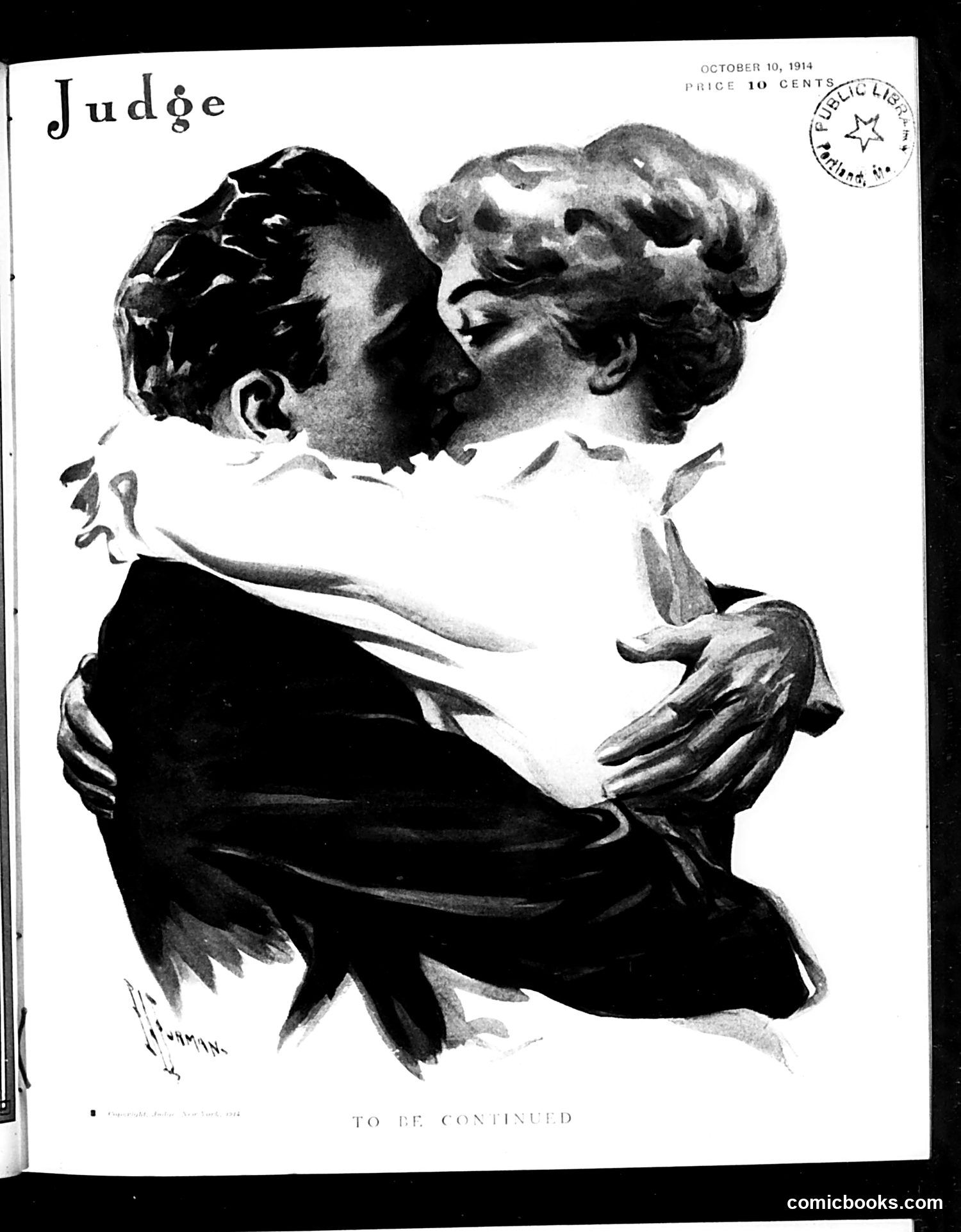
This cover illustration, titled "To Be Continued," depicts two figures in an intimate embrace—a man in dark formal attire and a woman with upswept hair. The phrase "To Be Continued" suggests an ongoing romantic or dramatic narrative. Given the October 1914 date (early World War I), this likely satirizes contemporary romantic or political scandals popular in American media. The artistic style—dramatic lighting and emotional intensity—is typical of Judge's social commentary. However, without additional context or identifying captions on the visible portion, I cannot definitively identify the specific figures or the particular scandal being referenced. The cover appears to be making a point about serialized drama or gossip in contemporary society.
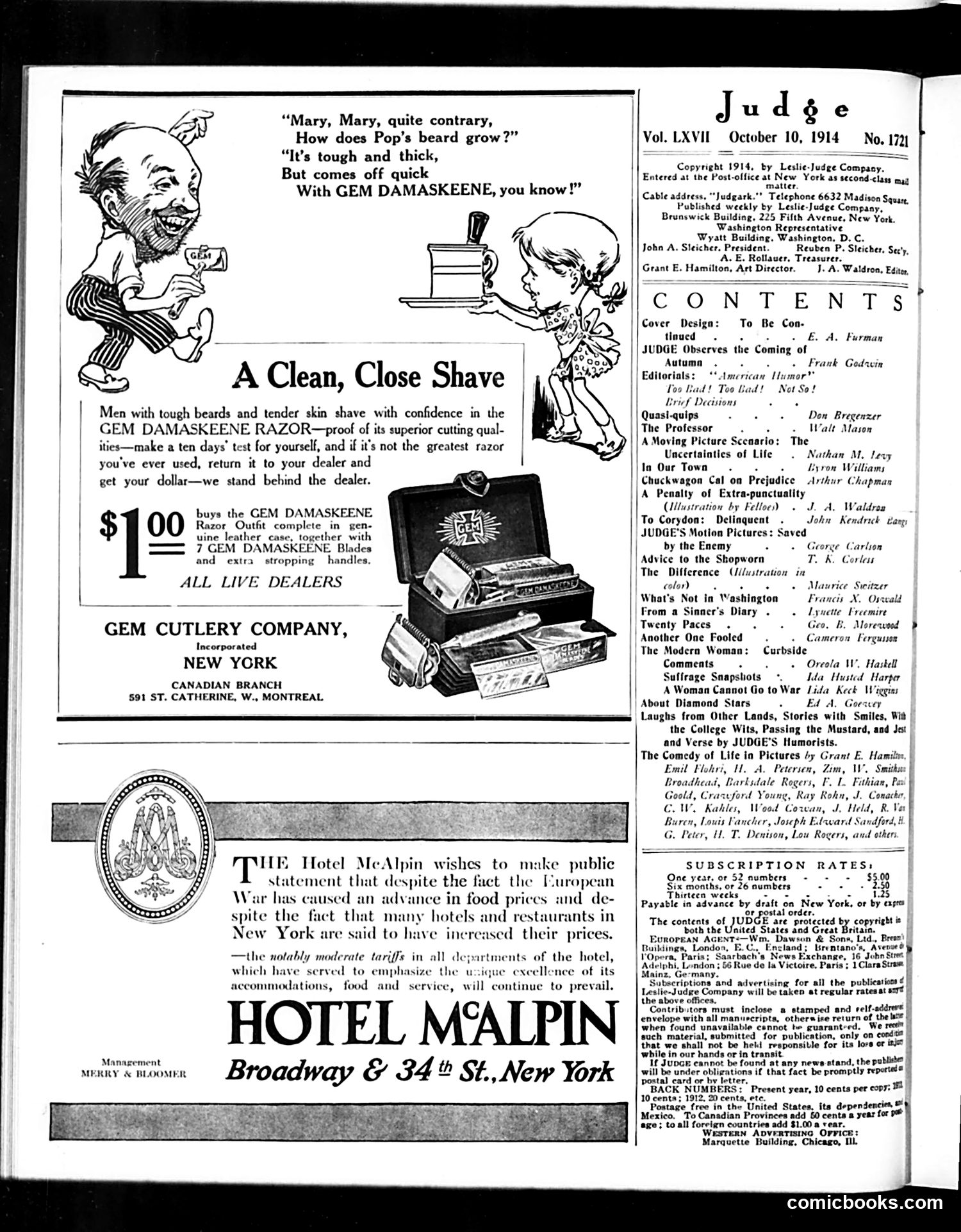
**Main Content:** This page is primarily **advertisements** rather than political satire. The top features a Gem Damaskeene Razor ad using a nursery rhyme format ("Mary, Mary, quite contrary") to sell razors as a solution for tough beards. The cartoon imagery shows exaggerated male and female figures in period dress as visual hook. **Secondary Advertisement:** The Hotel McAlpin ad emphasizes that despite European War food price increases affecting New York hotels and restaurants, *this* hotel has maintained moderate tariffs and quality service. **Historical Context:** Published October 1914, this reflects early WWI impact on American commerce and pricing—the war had recently begun in Europe (August 1914), creating supply and cost concerns visible in contemporary advertising.
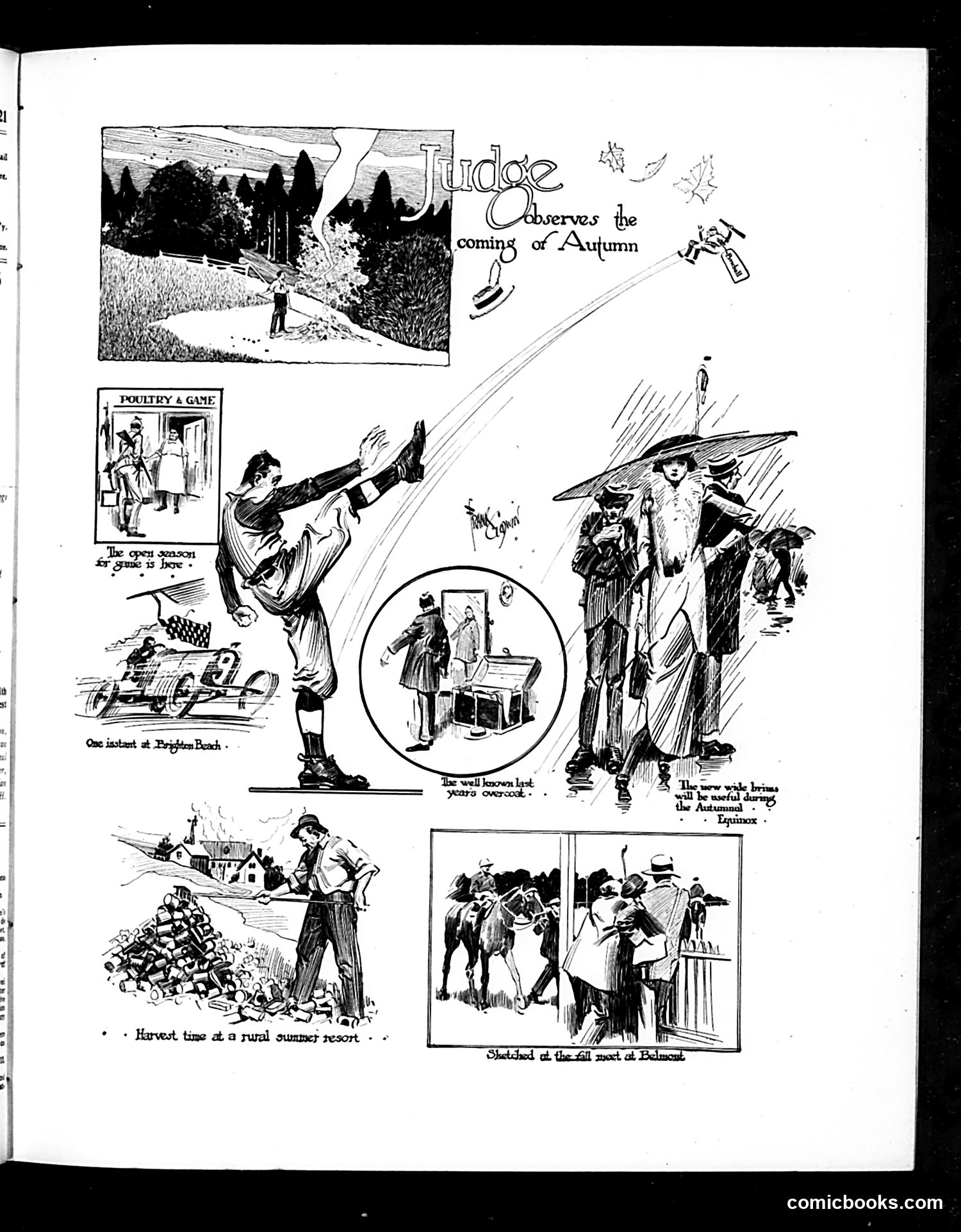
This page from *Judge* magazine presents autumn-themed vignettes satirizing contemporary leisure activities and social customs. The illustrations depict: **Upper panels:** Seasonal pursuits including "Poultry & Game" (the hunting season's opening), a Brighton Beach incident, and people experiencing the autumn equinox. **Central image:** A well-known "last year's overcoat" being retrieved—likely satirizing the practice of bringing out old winter clothing. **Lower panels:** "Harvest time at a rural summer resort" and "Sketched at the fall meet at Belmont"—references to horse racing at Belmont Park, a major autumn sporting event. The overall humor relies on observing how Americans predictably transition their activities and wardrobes with seasonal change, poking gentle fun at established routines and social rituals of the era.
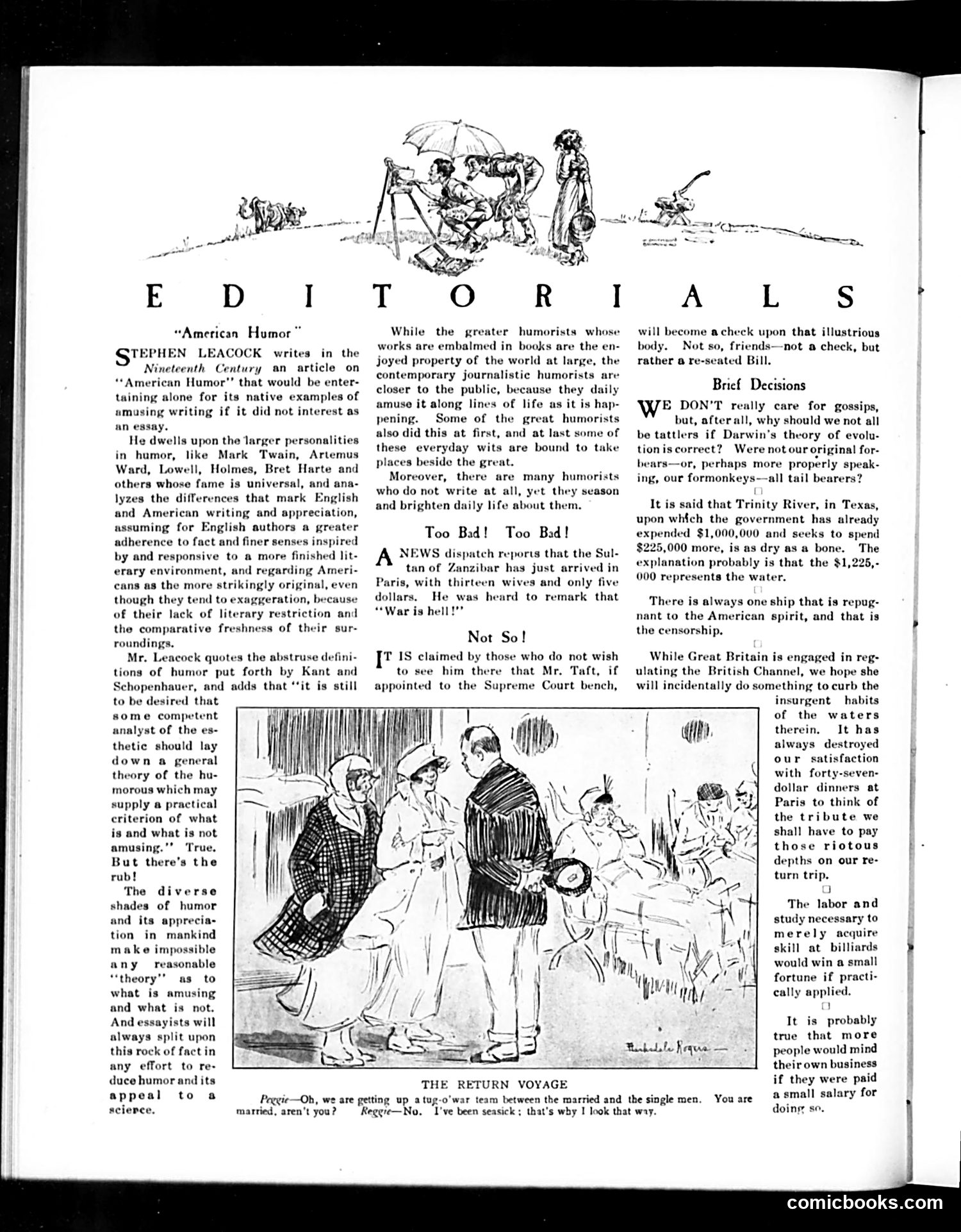
This cartoon depicts a shipboard scene with married and single men in tension. The caption reads: "Officer—Oh, we are getting up a two-o'war team between the married and the single men. You are married, aren't you? Recker—No. I've been seasick; that's why I look that way." The joke relies on the contrast between physical appearance (looking ill from seasickness) and marital status. The officer mistakes the seasick man's pallid, exhausted appearance as evidence of marriage, humorously suggesting that marriage itself makes men look sickly or worn down. This reflects period humor about marriage's supposed negative effects on male health and vitality—a common satirical trope of early 20th-century American magazines.
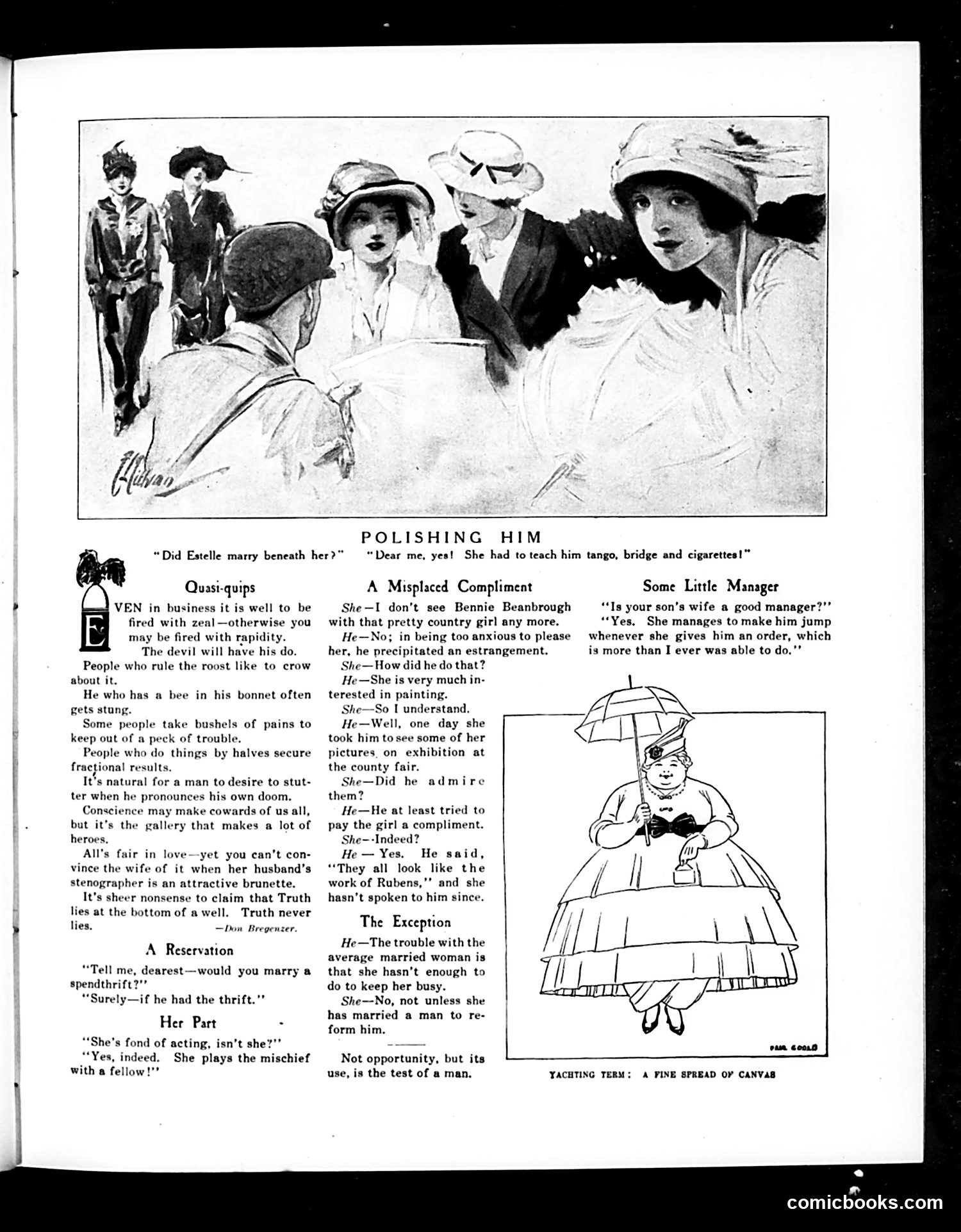
This page contains several satirical vignettes about marriage and gender relations, typical of early 20th-century humor. The main cartoon "Polishing Him" depicts a woman instructing her husband in various social accomplishments—tango dancing, bridge, and cigarette smoking—suggesting wives' efforts to "civilize" or refine their spouses. The accompanying jokes mock conventional marital dynamics: husbands' financial concerns, wives' managing tendencies, and the impossibility of reforming men through marriage. The illustration at bottom right, "Yachting Term," shows a rotund woman in a large dress described as "a fine spread of canvas"—a crude visual pun comparing her physique to sailing equipment. The humor reflects period attitudes about gender roles, wealth, and marital struggle, presenting wives as civilizing forces and husbands as resistant subjects requiring improvement.
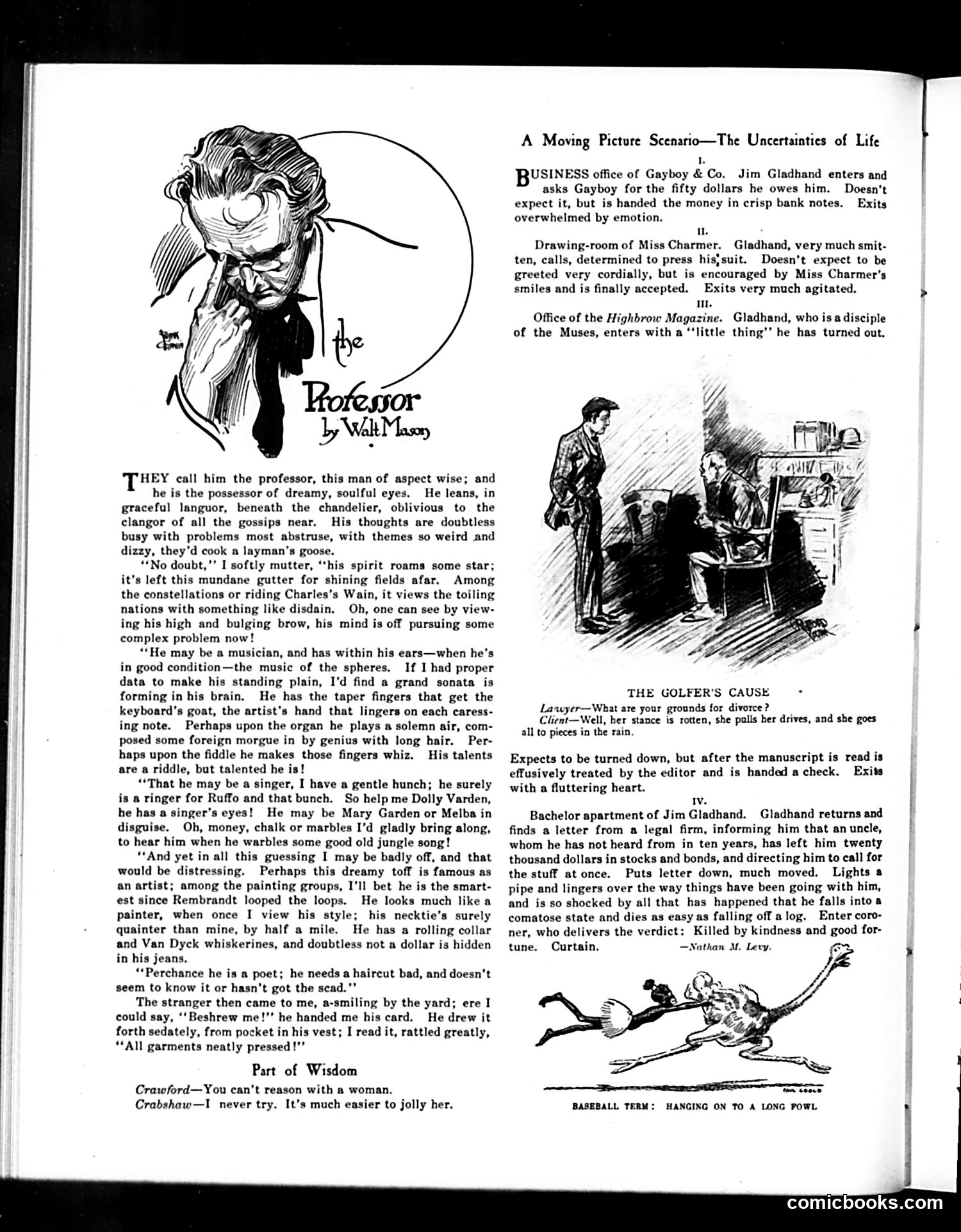
This Judge page satirizes the romantic ideal of the absent-minded intellectual. "The Professor" (illustrated at left) depicts a dreamy, bohemian-type man with soulful eyes and artistic affectations—Van Dyck whiskers, fancy collar, shabby clothes—whom the narrator imagines must be a great musician, artist, or poet. The joke: when approached, he's merely a laundry pressman handing out his card, "All garments neatly pressed!" The piece mocks the era's romantic notion that poverty and artistic pretension signal genius, when reality often masks mundane employment. Below, shorter items include "The Golfer's Cause" (a wife's poor golf swing as divorce grounds—humor based on golf's growing popularity among the wealthy) and a movie scenario following Jim Gladhand's improbable luck: paid money owed, winning over a woman, getting published, and inheriting a fortune. The scenario satirizes film melodrama's absurd coincidences.
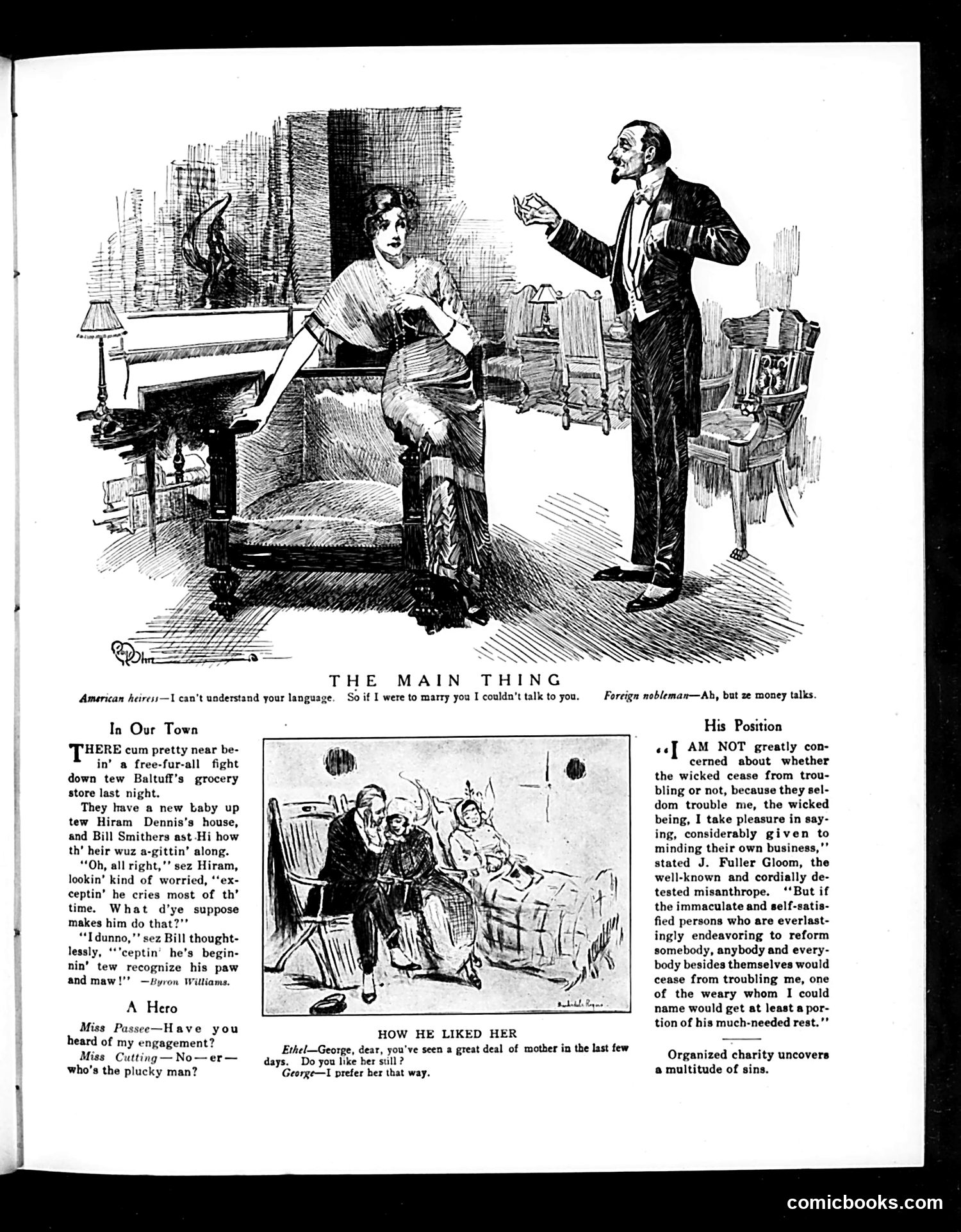
This page lampoons American class anxieties and courtship customs of the Gilded Age. **"The Main Thing"** depicts an American heiress rejecting a foreign nobleman because she cannot understand his language—yet he counters that "money talks," suggesting wealth transcends communication barriers. The satire targets wealthy Americans' marriages to impoverished European aristocrats, a common practice where money bought social status. **"How He Liked Her"** jokes about a suitor's excessive visits to his fiancée's mother, with his preference for seeing her "that way" (presumably stationary or silent) mocking obligatory courtship rituals. The remaining humor pieces—about a crying baby, engagement gossip, and misanthropic "J. Fuller Gloom"—are lighter social observations about small-town life and self-righteous reformers. Overall, the page satirizes class pretensions, transatlantic marriages of convenience, and the hypocrisy of "organized charity."
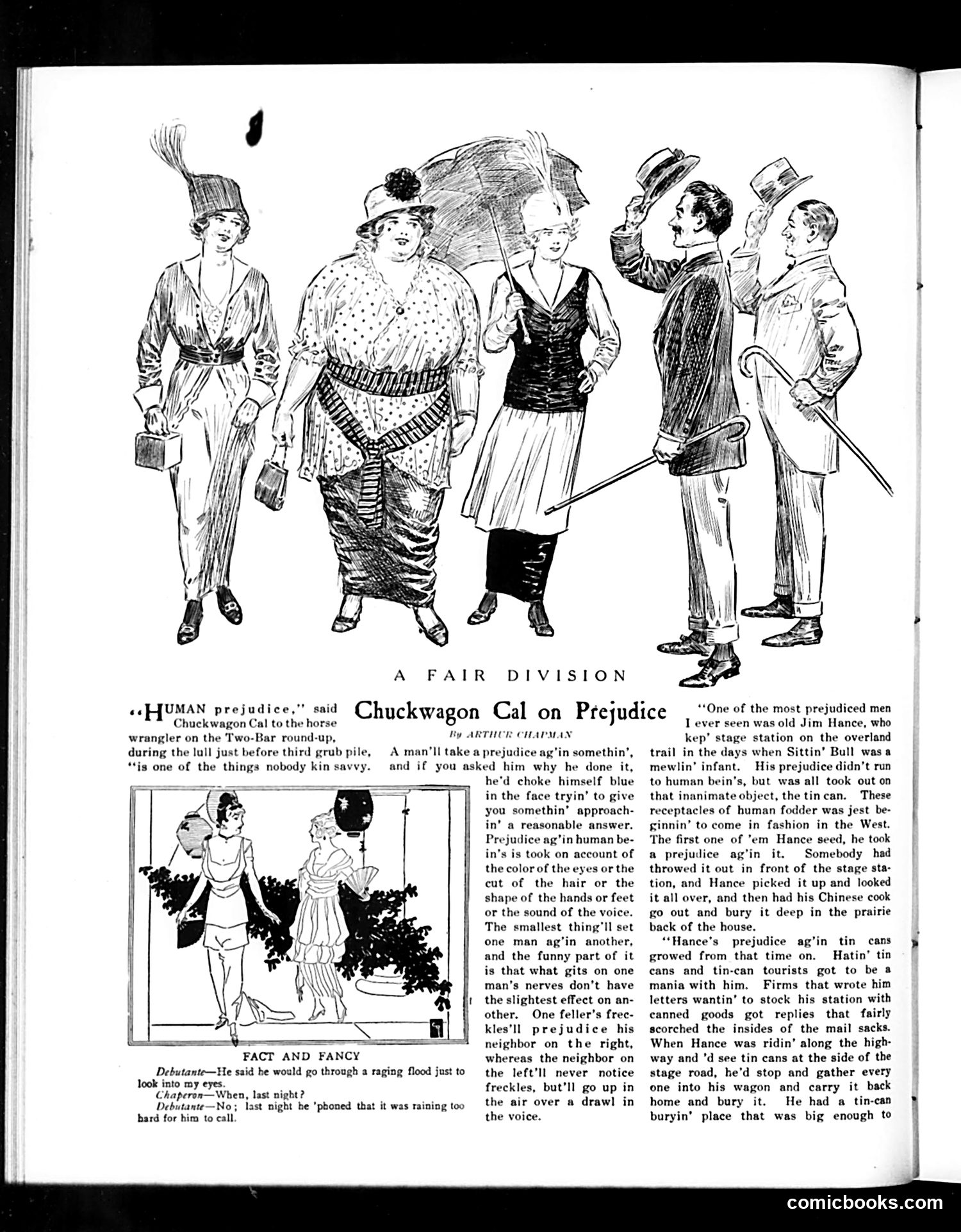
This page from *Judge* presents two humorous pieces about prejudice, both set in the American West. The main cartoon, "Chuckwagon Cal on Prejudice" by Arthur Chapman, illustrates how irrational human prejudices are. The top illustration shows five figures in period Western dress representing different types of people. The accompanying text uses a cowboy character (Chuckwagon Cal) to philosophize about how people develop arbitrary dislikes—whether based on physical traits like freckles or hair color, or vocal characteristics like drawls. The story demonstrates this with Jim Hance, a stagecoach station operator who develops an obsessive hatred of tin cans (a new technology in the era). His prejudice grows so extreme he buries them compulsively. The satire suggests that prejudice is fundamentally absurd and baseless—whether directed at people or objects—and that people cannot rationally explain their biases. "Fact and Fancy" is a brief joke about a debutante's romantic exaggeration. The page satirizes irrational human nature during the early 20th century.
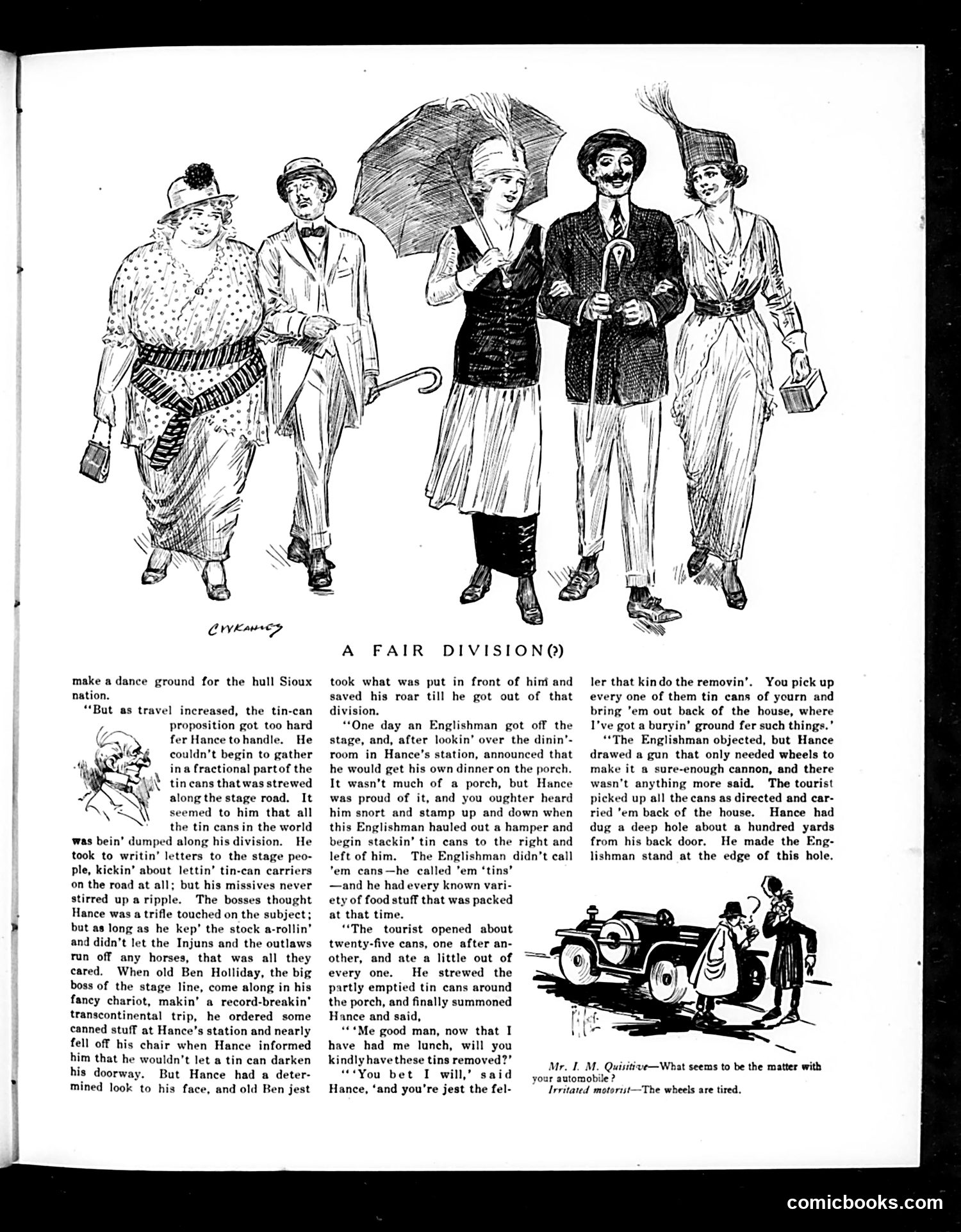
This page satirizes the clash between **Old West practicality and European tourist sensibilities**. The top illustration shows fashionable travelers, while the text describes a stagecoach station manager named Hance who obsessively opposes canned goods littering the landscape. The humor centers on an **English tourist** who, after picnicking, casually leaves opened tin cans scattered on the porch. Hance, fed up with the trash problem plaguing his division, forces the Englishman at gunpoint to bury the cans himself—a darkly comic "fair division" of responsibility. The satire mocks both the **fastidious English visitor** (who says "tins" instead of "cans") and American frontier roughness. The small bottom cartoon about tired automobile wheels provides additional wordplay humor typical of Judge's style. The overall message: Americans won't tolerate careless waste, and tourists should clean up after themselves—delivered with frontier justice.
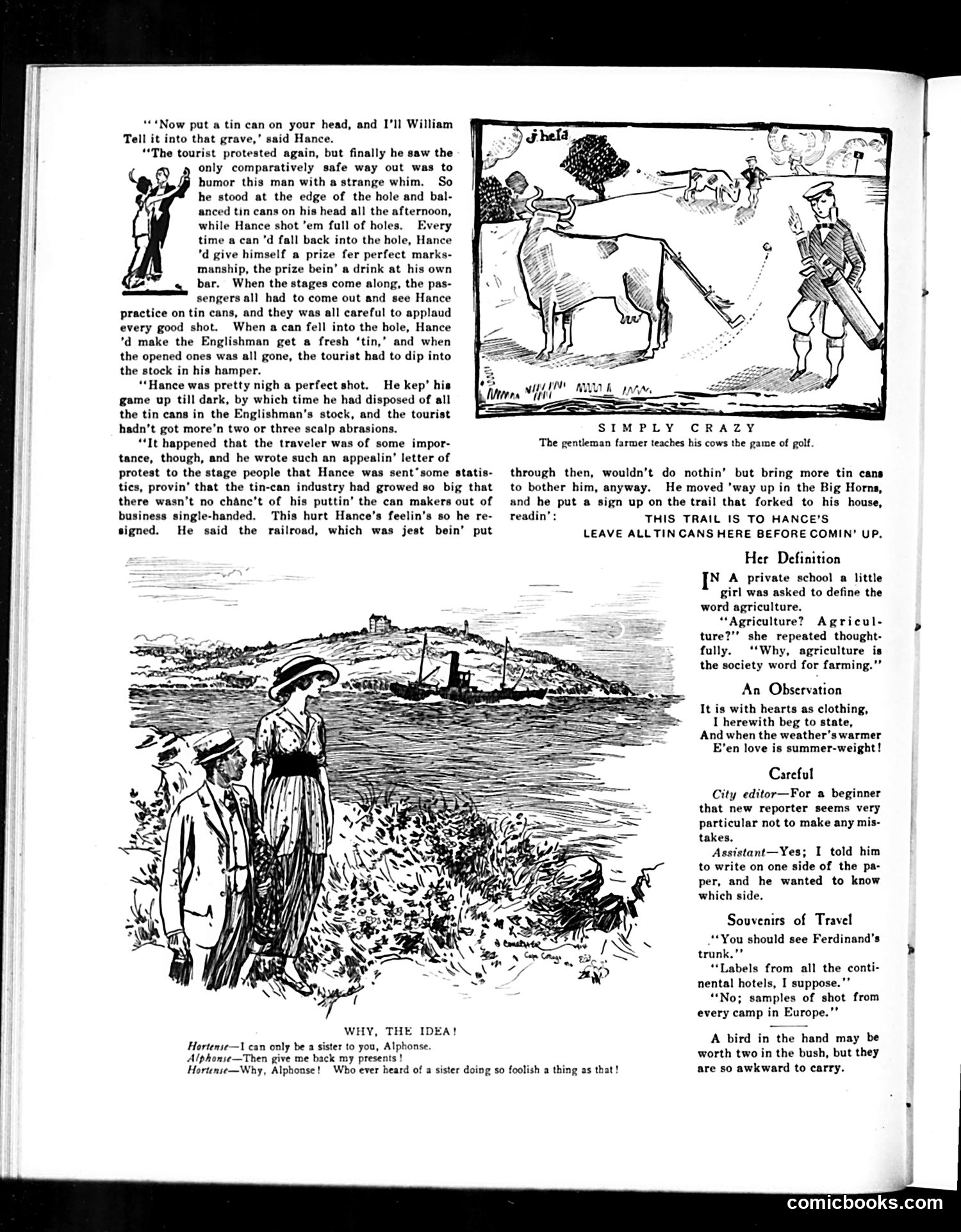
This page contains several satirical pieces typical of early 20th-century American humor: **"Simply Crazy"** (top cartoon): A gentleman farmer absurdly attempts to teach cows to play golf—mocking both the pretensions of wealthy farmers imitating upper-class leisure activities and the era's fad for golf among the affluent. **The main story** about "Hance" describes a frontier character's eccentric practice of shooting tin cans off a tourist's head. When the tourist complains to railroad officials, Hance receives statistics proving the tin-can industry is thriving—making his grievance laughable. The satire targets both frontier eccentricity and the era's faith in statistics to solve any problem. **Shorter pieces** mock various contemporary absurdities: a schoolgirl's definition of agriculture as "the society word for farming" (class pretension), editorial office mishaps, and travelers collecting military ammunition samples as souvenirs (wartime tourism). The overall tone is gentle, slapstick satire of American life, class differences, and period quirks.
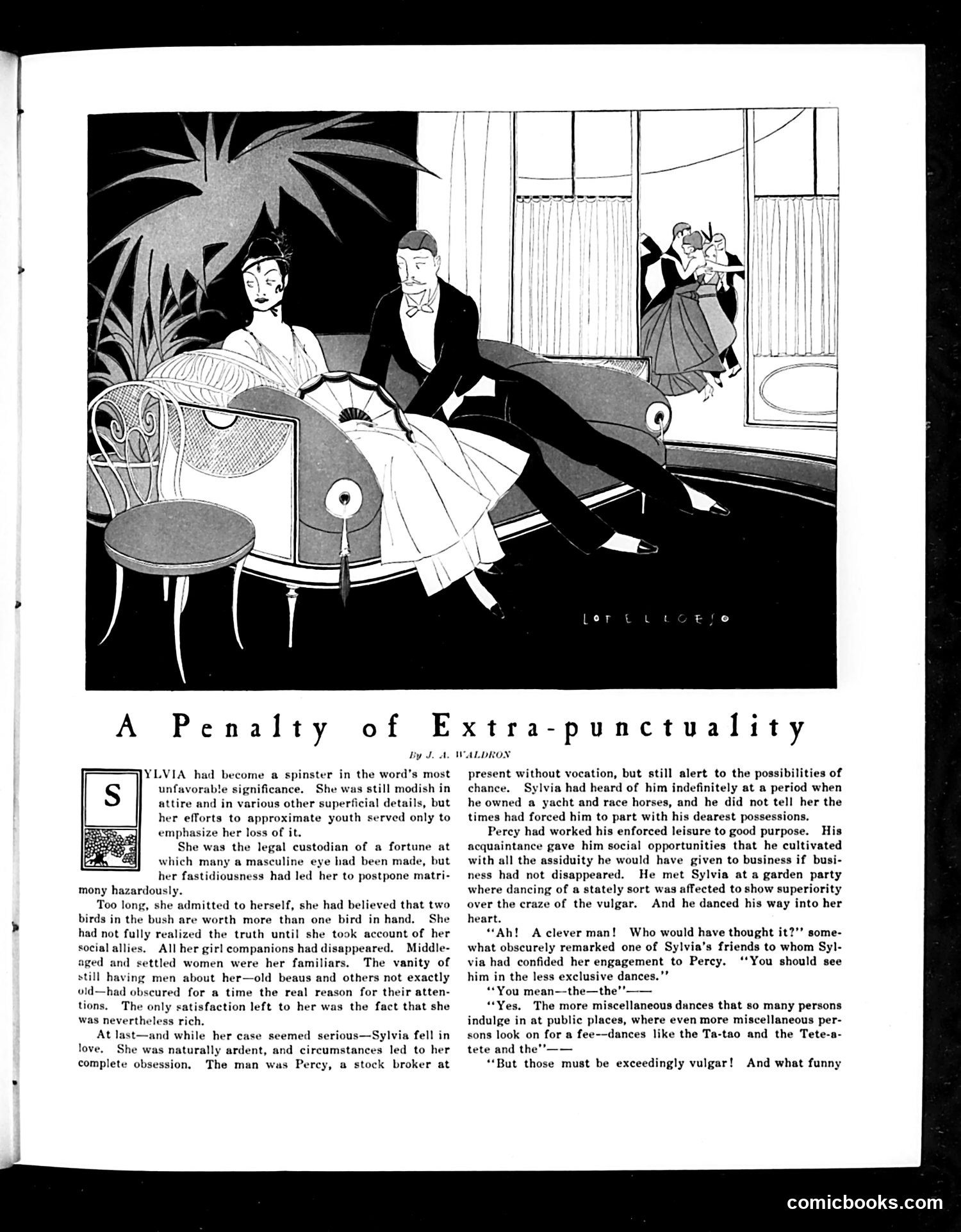
This story satirizes upper-class snobbery and delayed matrimony. Sylvia, a wealthy spinster, has postponed marriage for years due to fastidiousness, believing she could always find a better match. Now aging and isolated (her female companions have all married), she falls for Percy, a stock broker who has lost his wealth but maintains social standing through careful networking. The humor emerges in her friends' cryptic warning: Percy is apparently skilled at dancing the "Ta-tao" and "Tete-a-tete"—lower-class, public dances performed for paying audiences. The implication is that Percy, despite his current respectability, may have compromised himself financially or socially. The satire targets Sylvia's vanity and snobbish class consciousness: her penalty for being "extra-punctual" (overly particular) in choosing a husband is nearly becoming an unmarriageable old maid—and potentially marrying someone beneath her pretensions.
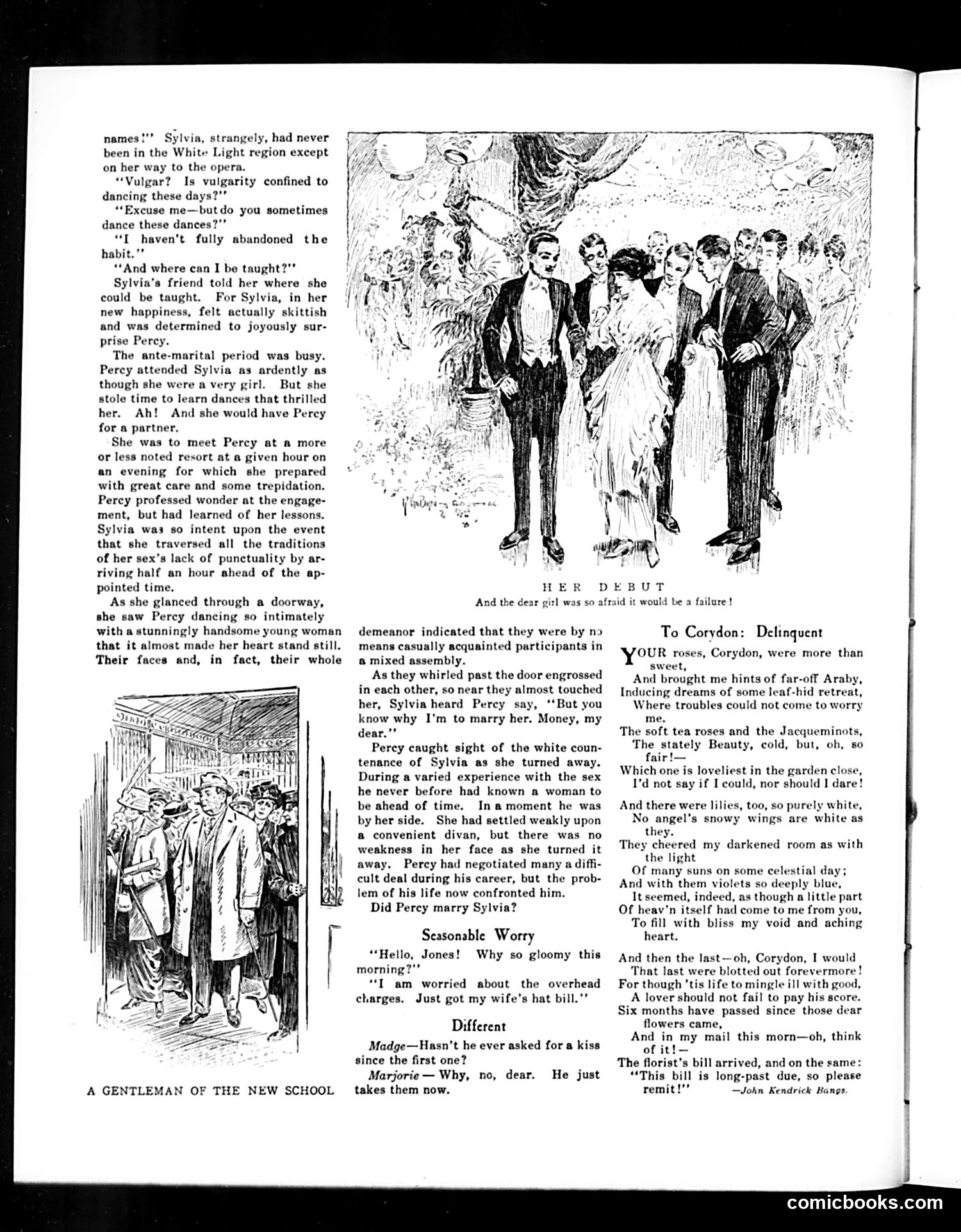
This page contains a serialized romantic story titled "Her Debut" about a woman named Sylvia who learns modern dances to surprise her fiancé Percy. The plot twist: Sylvia discovers Percy dancing intimately with another woman and hears him say he's marrying Sylvia only for her money. The story ends ambiguously, asking "Did Percy marry Sylvia?"—a cliffhanger device. Below are three shorter humor pieces: "Seasonable Worry" jokes about a husband's anxiety over his wife's hat bill (satirizing conspicuous consumption); "Different" presents a brief exchange about a man who now simply takes kisses rather than asking; and "To Corydon: Delinquent" is a poem lamenting beautiful flowers received from a suitor, undercut by an overdue florist's bill—mocking romantic gestures undermined by unpaid debts. The satire targets wealth-obsession, marital mercenary behavior, and the gap between romantic ideals and financial reality.
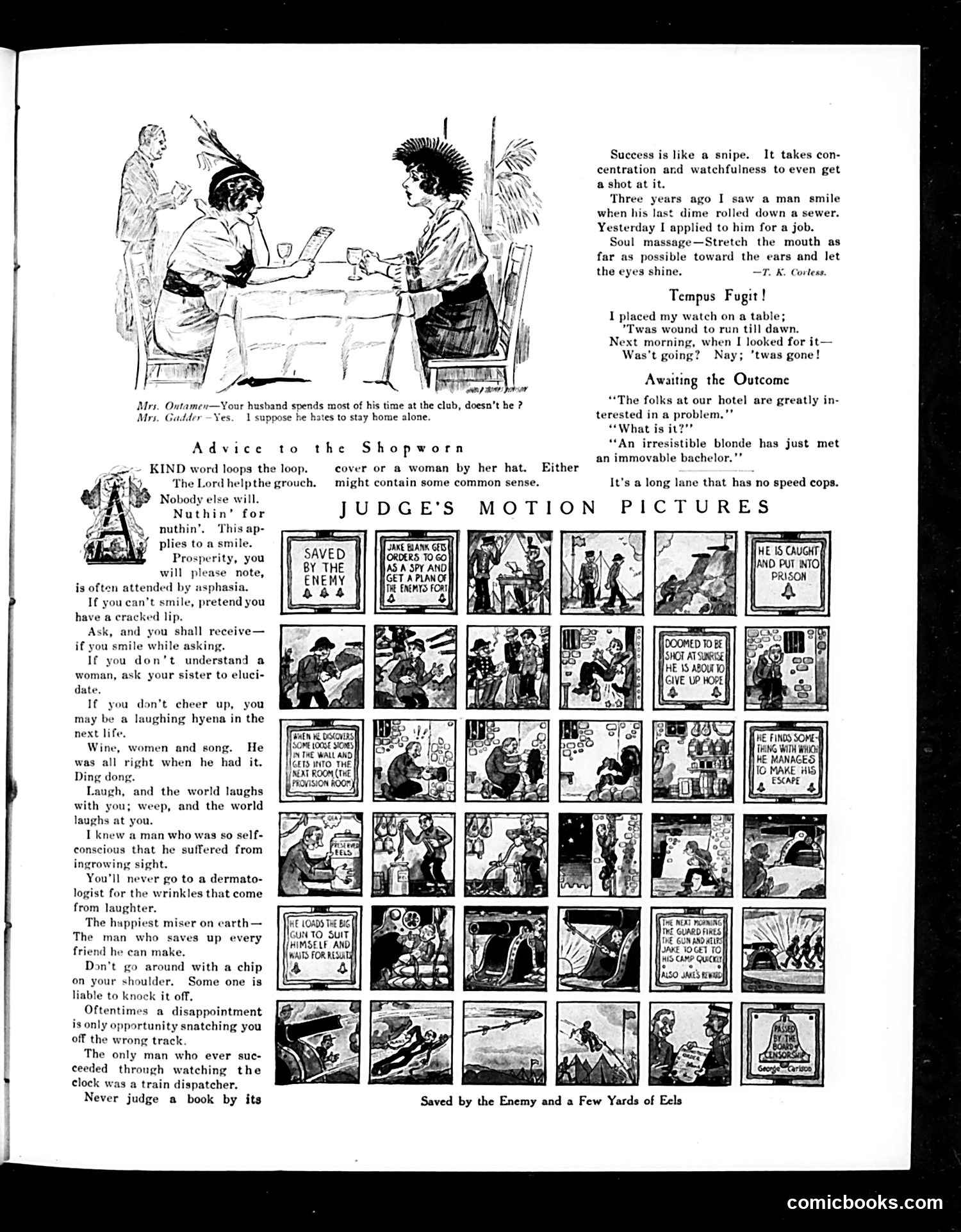
This page from *Judge* magazine combines light satirical commentary with a serialized comic strip titled "Saved by the Enemy and a Few Yards of Eels." **Upper content:** Short humorous observations about success, time, and social situations—typical magazine filler of the era. The dialogue between Mrs. Ontamen and Mrs. Gadder mocks marital discord (husbands preferring clubs to home). "Advice to the Shopworn" offers tongue-in-cheek life wisdom about smiling through hardship and maintaining optimism. **"Judge's Motion Pictures":** This multi-panel narrative comic (bottom half) appears to be a wartime or adventure story. Panel titles suggest espionage ("I'LL BEGUESS DRESSED AS A SPY"), imprisonment, and rescue. The final panel shows "Saved by the Enemy and a Few Yards of Eels"—suggesting the protagonist escapes through unexpected means or allied help. The page reflects early 20th-century American humor: sentimental advice paired with absurdist jokes, domestic comedies about marital tension, and serialized melodramatic comics for entertainment.
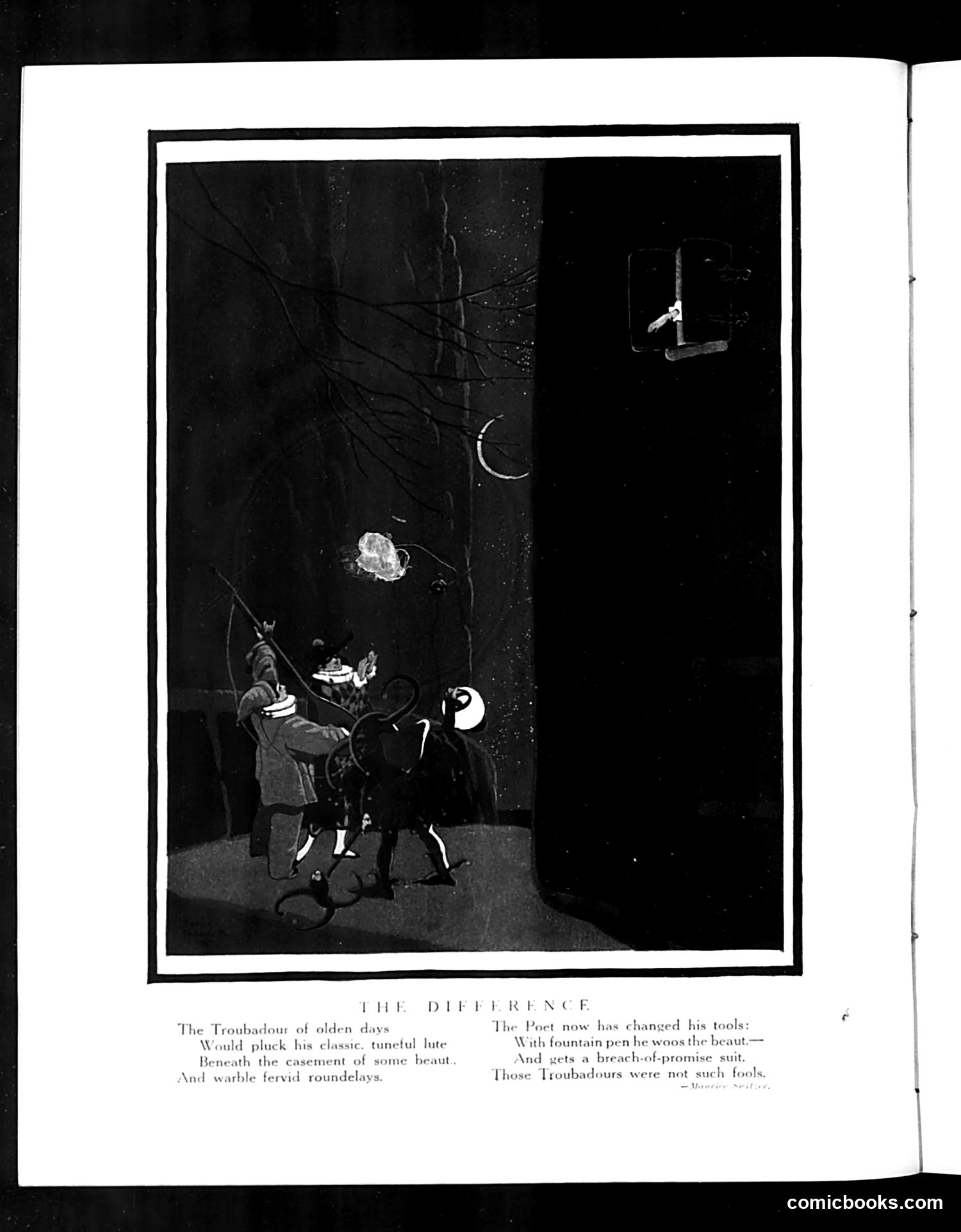
This cartoon contrasts medieval and modern romance. The image shows a poet outside a woman's window at night—a scene evoking the traditional troubadour serenading his love beneath her casement. The satire's point: medieval troubadours used music to court women safely. Modern poets, by contrast, use fountain pens to write—presumably love letters or poems—which can become legal evidence in breach-of-promise lawsuits (a real legal issue of the era when jilted women could sue for damages). The caption's punchline—"Those Troubadours were not such fools"—mocks modern men for creating written documentation of romantic promises they might later break, exposing themselves to litigation. The cartoon criticizes how modern courtship, despite seeming more sophisticated, actually makes men more vulnerable legally.
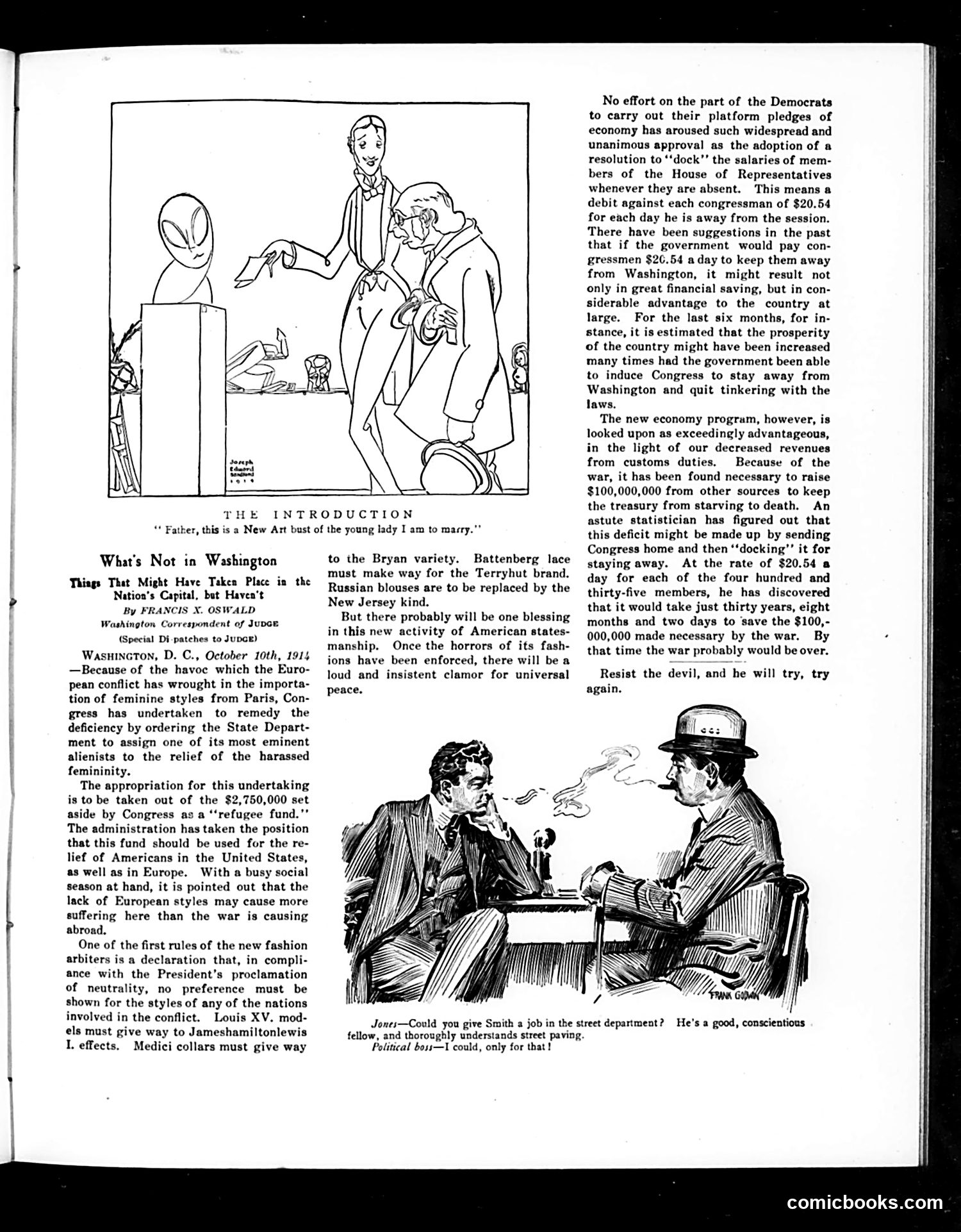
## Top Cartoon The upper cartoon satirizes fashion during WWI. It depicts a young man presenting his fiancée as a "New Art bust"—a grotesque, abstract sculpture—implying that European fashion disruptions have made women's styles absurd and unrecognizable. ## Main Article: "What's Not in Washington" This satirical piece mocks Congressional dysfunction through tongue-in-cheek "proposals": - **Fashion crisis**: Congress supposedly allocates $2.75 million in "refugee funds" to address the shortage of Paris fashions caused by European war, satirizing misplaced priorities. - **Congressional salaries**: The article sarcastically praises Democrats' plan to dock pay for absent representatives ($20.54/day), suggesting Congress causes more harm present than absent. It calculates humorously that paying them to stay away would take thirty years to save the $100 million war-related deficit. - **Political references**: Mentions "Louis XV models," "Bryan variety" (William Jennings Bryan), and "Jameshamiltonlewis I. effects" (likely Senator James Hamilton Lewis), ridiculing political figures through fashion terminology. ## Bottom Cartoon A political boss refuses to hire a qualified worker, implying corruption and patronage rather than merit-based employment in government.
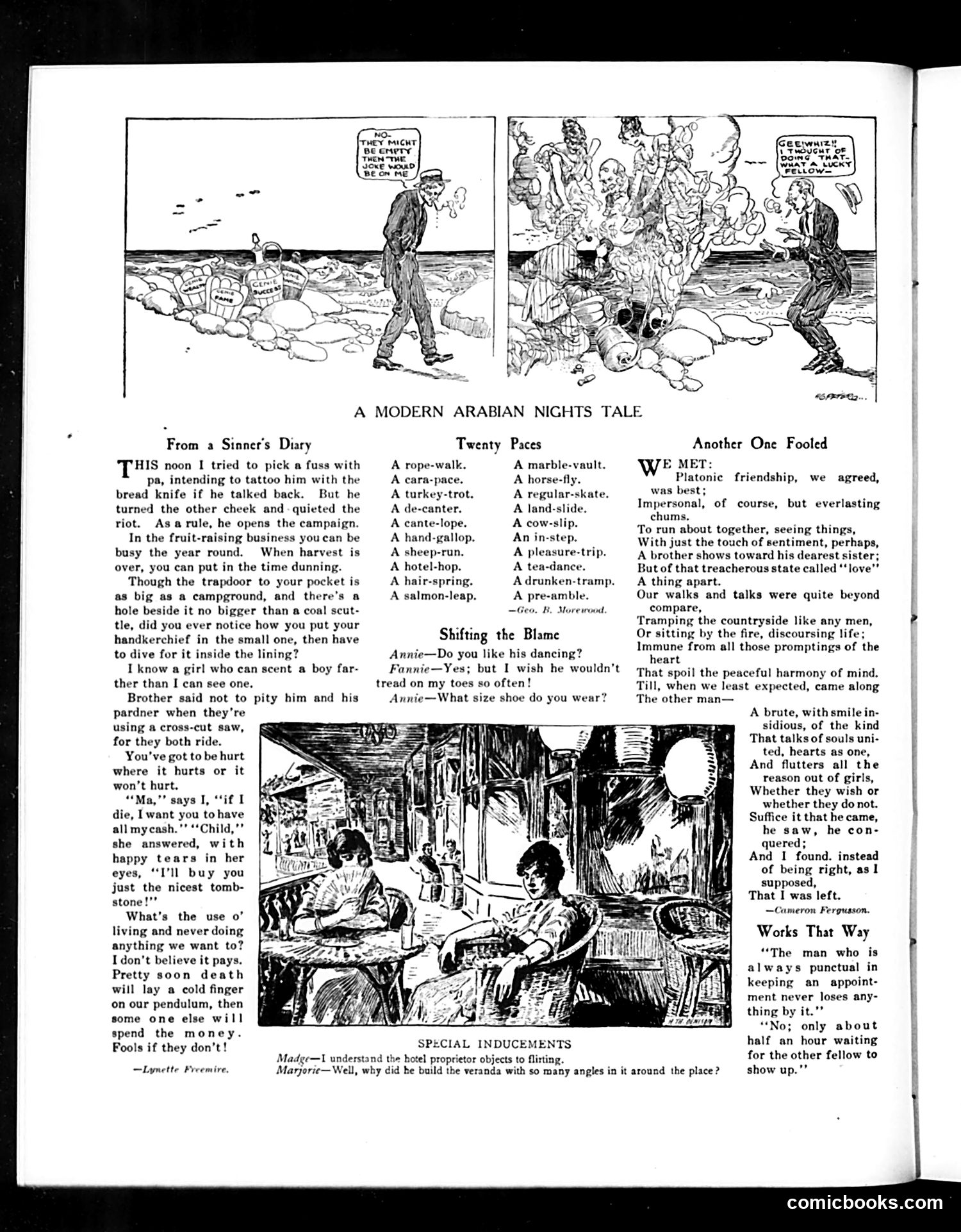
This page from the satirical magazine **Judge** contains several humorous pieces mocking courtship and relationships: **Top Comics:** "A Modern Arabian Nights Tale" presents two panels showing a man approaching a group of people on a beach. The satire appears to mock social awkwardness and failed romantic advances—the figures' reactions suggest his approach is unwelcome. **Text Sections:** Multiple short satirical pieces ridicule dating customs and romantic pretense: - "From a Sinner's Diary" mocks family disputes and financial irresponsibility - "Twenty Paces" uses puns (marble-vault, horse-fly, turkey-trot, hand-gallop) to satirize romantic walks - "Another One Fooled" critiques how couples rationalize shallow relationships as "platonic friendship," only to have an interloper disrupt things - "Shifting the Blame" and other dialogues mock couples' petty quarrels and deceptions **Central Illustration:** Shows an interior scene, likely depicting a romantic encounter or misunderstanding. The overall message targets early 20th-century courtship rituals, highlighting hypocrisy, superficiality, and the gap between stated romantic ideals and actual behavior.
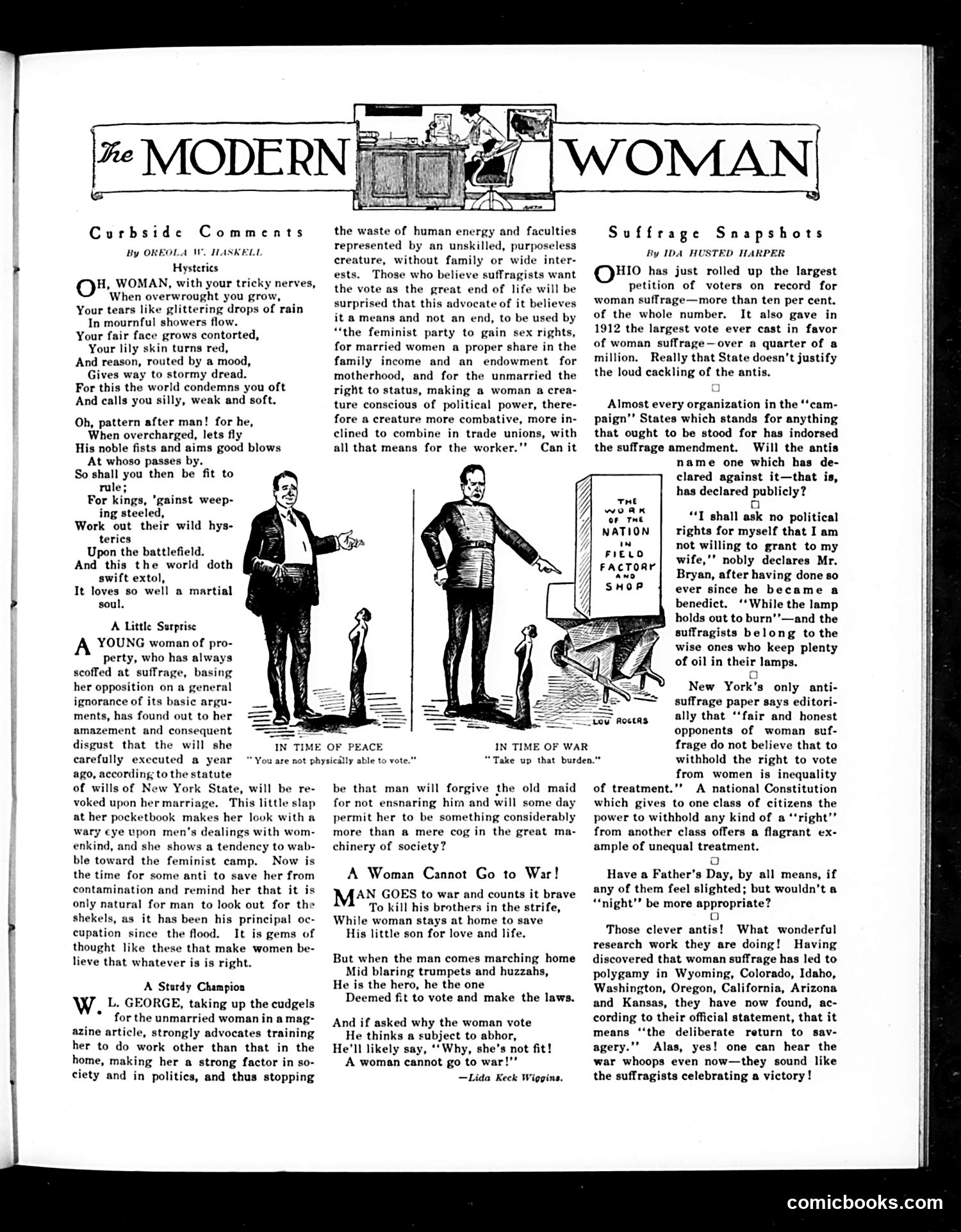
This Judge magazine page satirizes anti-suffrage arguments through multiple pieces. The central cartoon juxtaposes a man in peacetime ("You are not physically able to vote") beside the same man in wartime ("Take up that burden"), highlighting the hypocrisy that women are deemed too physically weak for voting yet expected to shoulder wartime burdens. The poem "A Woman Cannot Go to War!" directly mocks this contradiction: men claim women lack fitness to vote *because* they cannot fight, yet women sustain society while men fight. "Curbside Comments" sarcastically compares women's emotional expression unfavorably to men's violence, implying society wrongly condemns women's tears while praising men's martial aggression. The "Suffrage Snapshots" section counters anti-suffrage claims with concrete evidence: Ohio's massive suffrage petition (over 10% of voters) and strong 1912 vote support (250,000+) demonstrate women's genuine political engagement. Overall, the page uses satire and statistics to expose the logical inconsistencies in denying women voting rights.
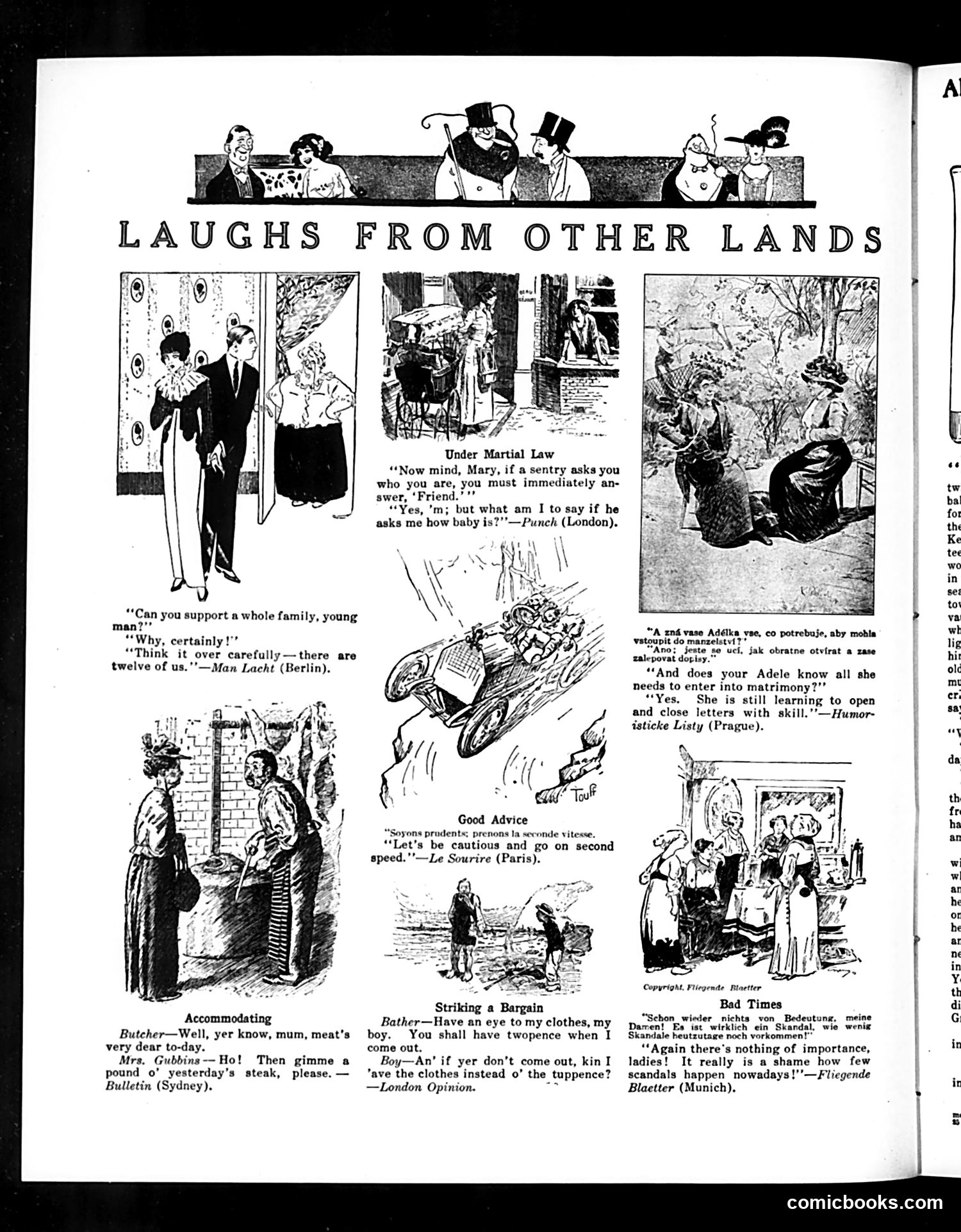
This page collects brief comedic sketches sourced from international publications, representing early 20th-century humor across Europe and the British Commonwealth. The cartoons illustrate everyday social situations: martial law creating communication confusion ("how is baby?"), marriage expectations (women learning only to open letters), driving safety, family economics, and wartime/postwar social commentary. The final sketch satirizes German society's complaint that scandal has become *too rare*. These are primarily domestic humor pieces—workplace banter, class interactions, domestic life—rather than explicitly political satire. The "Under Martial Law" sketch appears WWI-era, referencing wartime security protocols. The page's value lies in showing *international humor circulation*: Judge reprinted foreign comics to demonstrate cosmopolitan sophistication and offer readers comparative cultural perspectives. The humor relies on recognizable social types (butchers, sentries, husbands) and universal domestic situations rather than specific political figures or events.
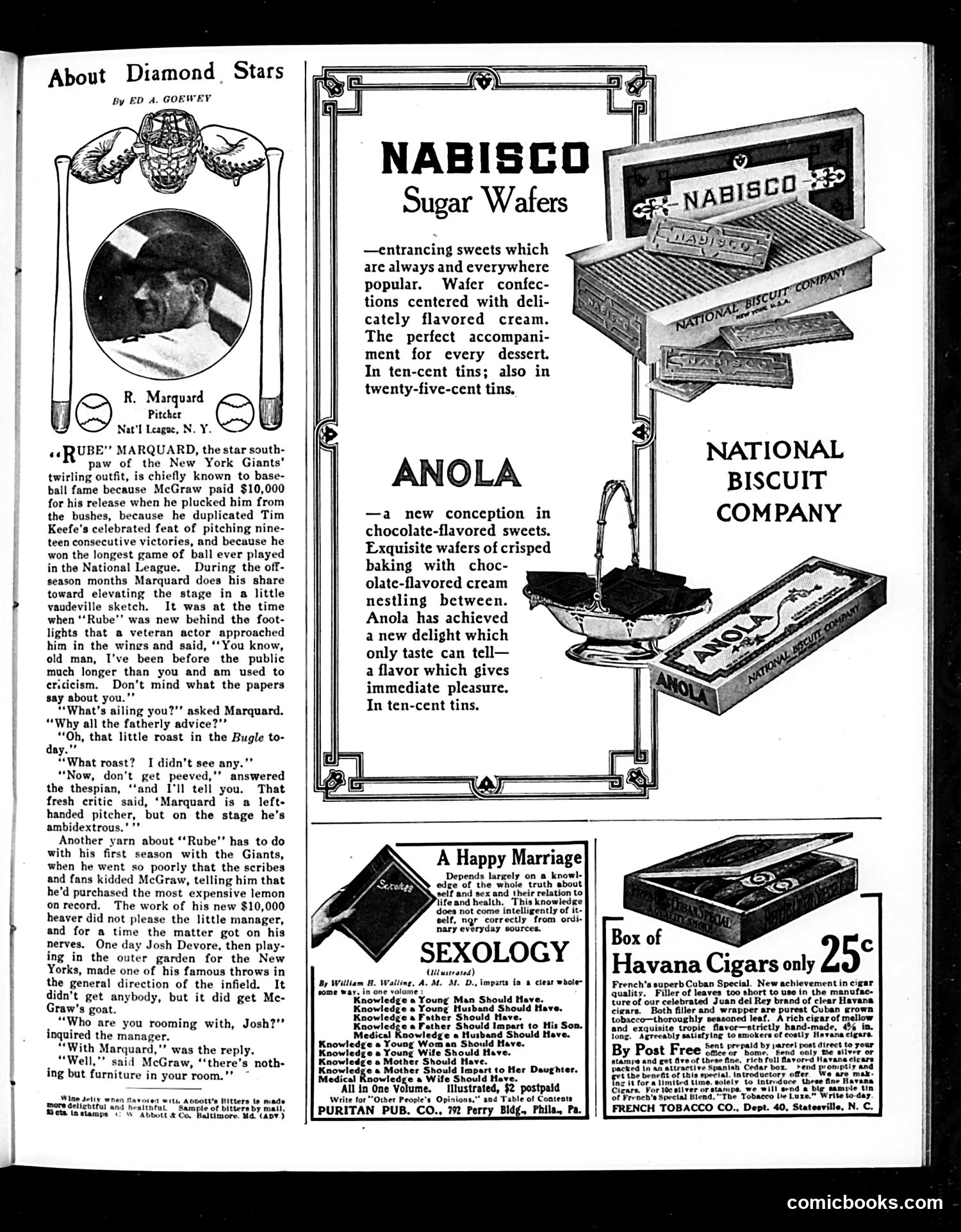
This page is primarily **advertising** for consumer products (Nabisco wafers, cigars, and books), with a sports humor column as secondary content. The main feature, "About Diamond Stars" by Ed A. Goewey, profiles **Rube Marquard**, a baseball pitcher for the New York Giants. The text recounts anecdotes: McGraw paid $10,000 for Marquard's contract; a theater actor advised him not to mind newspaper criticism; and McGraw later joked that Marquard was furniture after a poor season. The satire targets **baseball management's financial risk**—spending heavily on an unproven player who initially underperformed—and pokes fun at Marquard's dual career attempting vaudeville. The page reflects early 1900s American popular culture: celebrity baseball players, vaudeville entertainment, and the emerging sports journalism industry. No political content is present; this is entertainment-focused material typical of Judge magazine's lighter coverage.
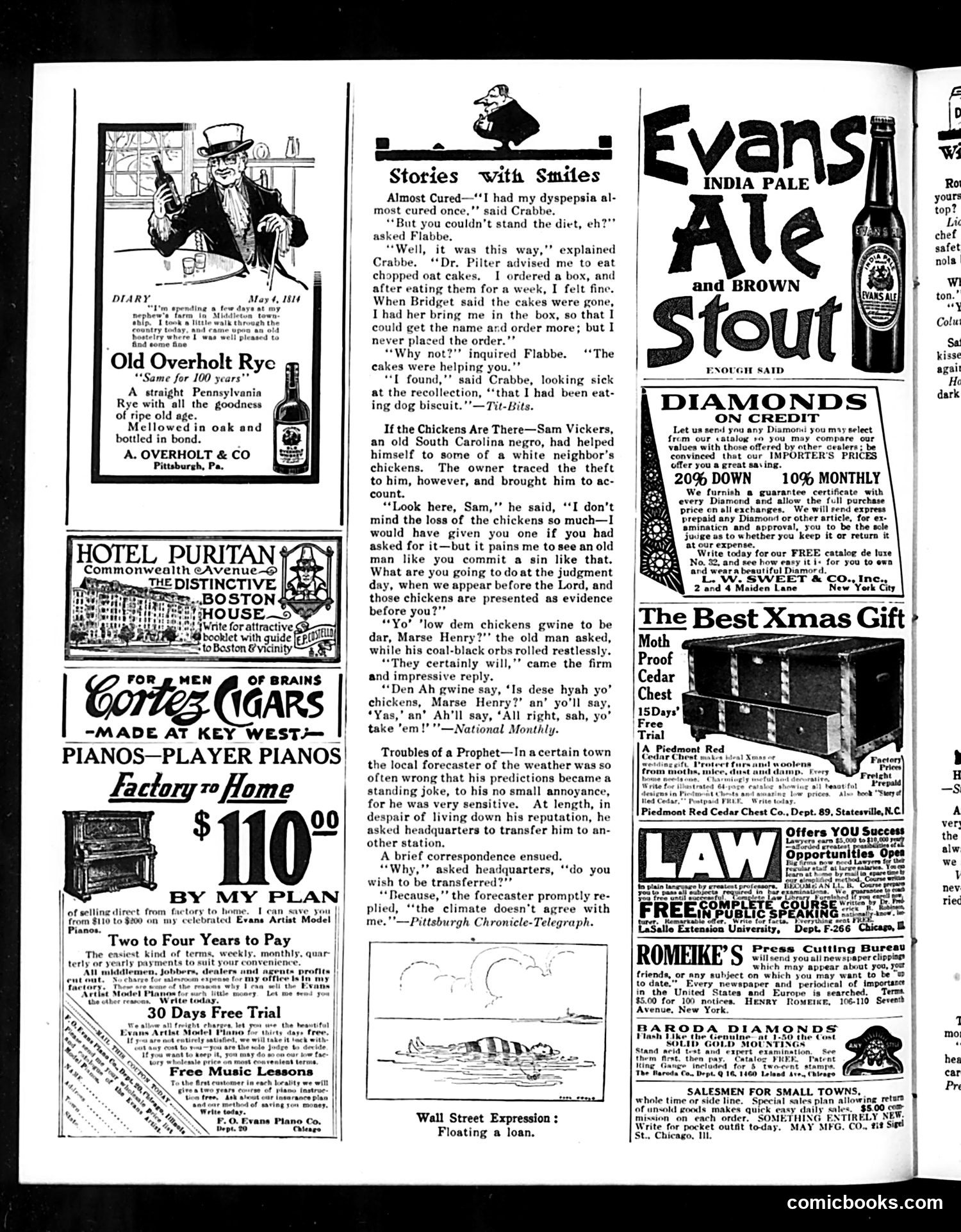
This page is primarily **advertising**, typical of early 20th-century magazines. The main content includes humorous anecdotes in the "Stories with Smiles" section: 1. **"Almost Cured"**: A joke about a man with dyspepsia who accidentally ate dog biscuits thinking they were prescribed oat cakes—the humor relies on the absurdity of the mix-up. 2. **"If the Chickens Are There"**: A dialect-heavy story featuring a Black character (Sam Vickers) who steals chickens. When confronted about facing judgment, Sam cleverly suggests he'll deny ownership to God. The humor turns on Sam's quick wit, though the racial dialect and stereotyping reflect problematic period attitudes. 3. **"Troubles of a Prophet"**: A weather forecaster's complaint about being transferred due to constantly wrong predictions—straightforward workplace humor. The advertisements (pianos, whiskey, cigars, diamonds) are typical period marketing. "Wall Street Expression: Floating a loan" is a brief financial joke playing on corporate language.
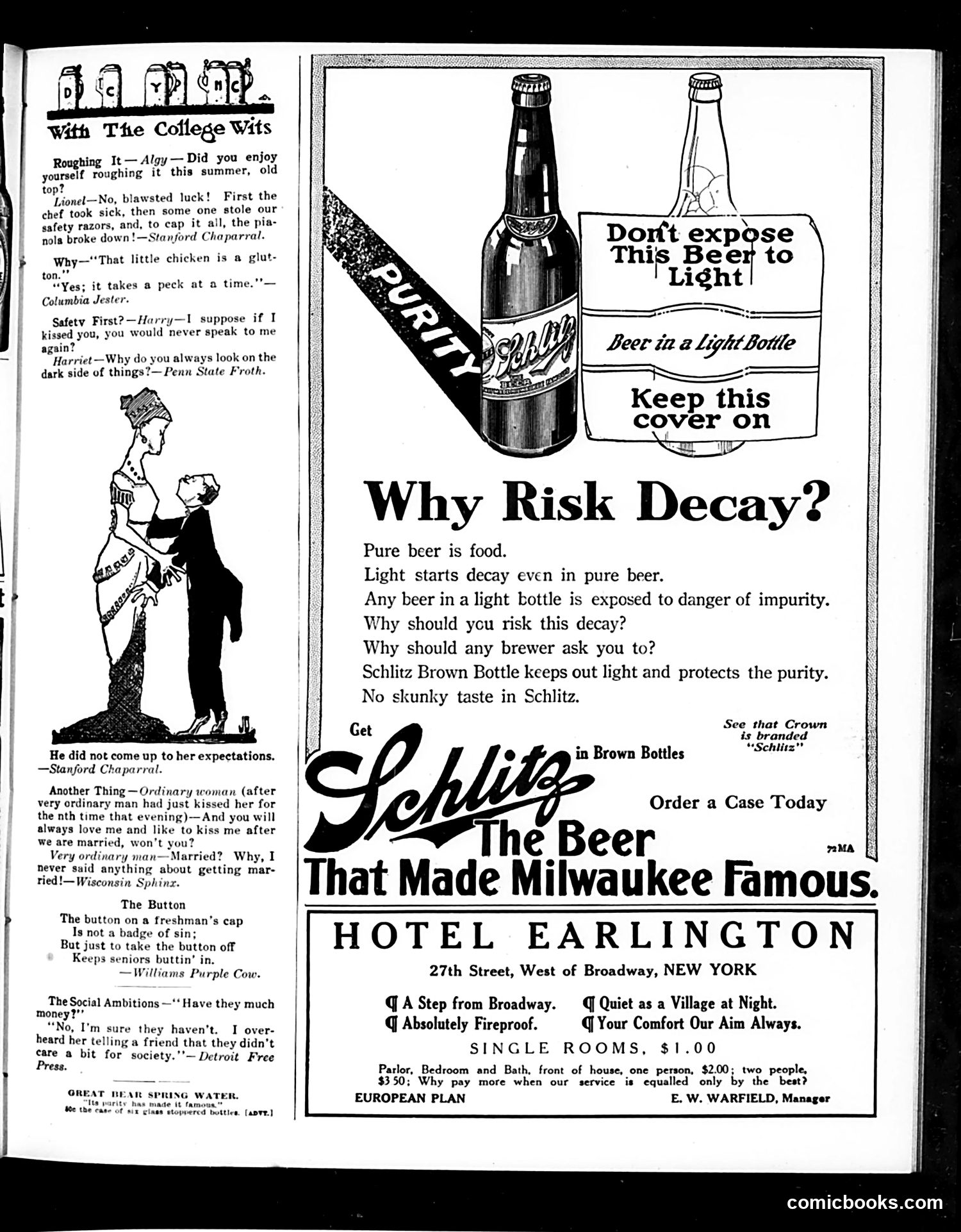
This page contains two distinct sections: **Left side:** A humor column titled "With The College Wits" featuring brief jokes sourced from various college humor magazines (Stanford Chaparral, Columbia Jester, Penn State Froth, etc.). The jokes are genteel comedic quips about college life—a man roughing it but missing luxuries, flirting mishaps, and social pretensions. These reflect early 20th-century college humor standards: mildly risqué but ultimately wholesome observations on courtship, class, and student life. **Right side:** A full-page advertisement for Schlitz beer in brown bottles, accompanied by a hotel ad. The beer ad emphasizes that brown glass protects beer from light-induced decay ("skunky taste"), positioning Schlitz as superior to competitors using clear bottles. This reflects genuine brewing chemistry—light exposure does degrade beer quality—but serves as marketing differentiation during Prohibition's aftermath when breweries competed aggressively. The juxtaposition shows Judge's business model: satirical college humor content alongside paid advertising, typical of early-to-mid 20th-century magazine publishing.
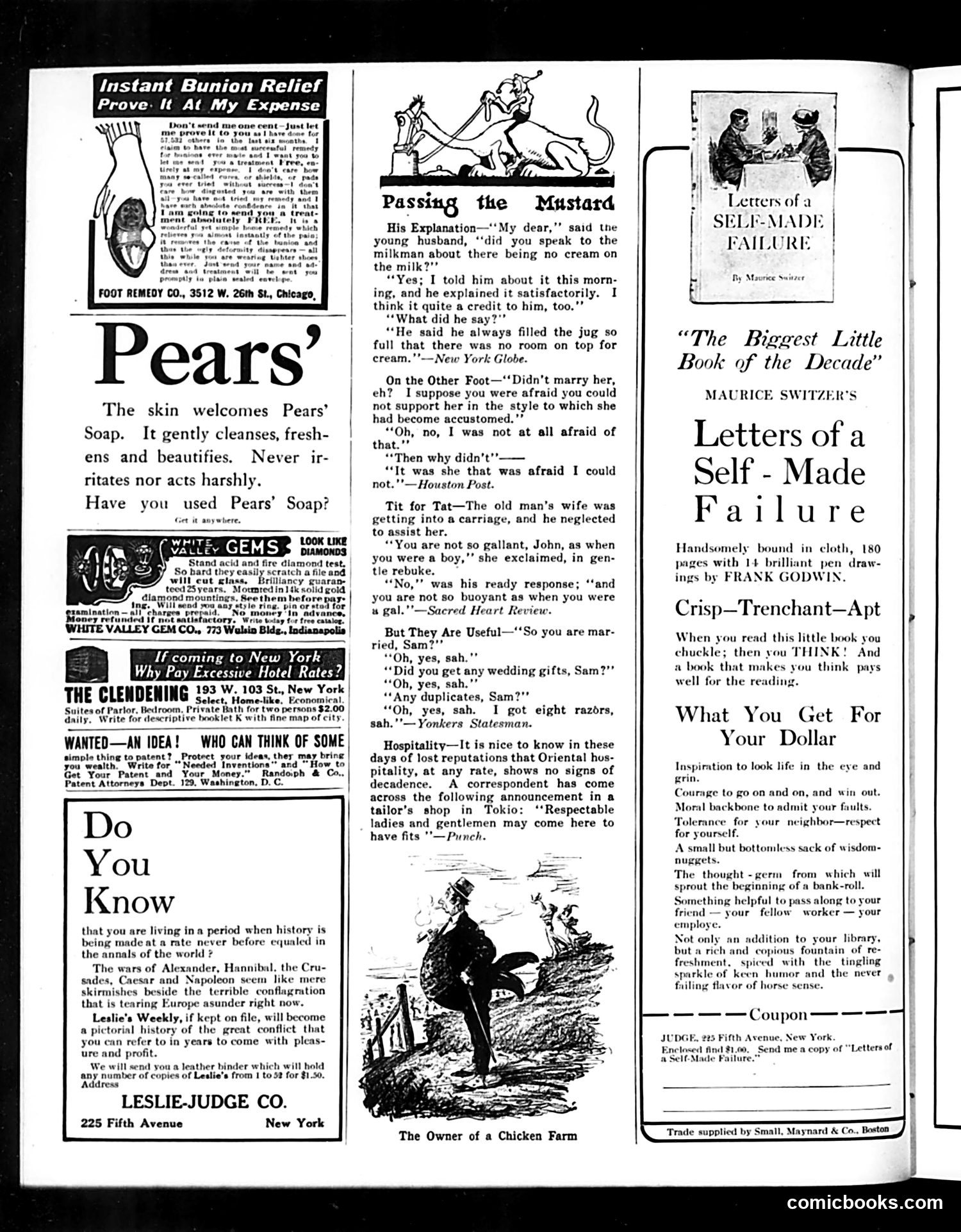
This page is primarily **advertising and light humor**, not political satire. The content includes: **Cartoons/Humor:** - "Passing the Mustard" — A series of domestic humor anecdotes about miscommunication between spouses (a milkman's explanation about cream, a couple's marital expectations, a husband's retort about his wife's age). These reflect early 20th-century gender dynamics and marriage comedy. - "The Owner of a Chicken Farm" — A sketch accompanying a humorous anecdote, likely about rural life. **Advertisements:** Numerous product ads (Pears' Soap, White Gems diamonds, bunion relief) and publishing promotions (Leslie's Weekly history collection, Maurice Switzer's "Letters of a Self-Made Failure" book). **Editorial Content:** A "Do You Know" section promoting Leslie's Weekly as essential wartime documentation, comparing current European conflicts to historical wars — suggesting this is from World War I era. The page reflects **early 1900s consumer culture and gentle domestic humor** rather than pointed political commentary. No specific political figures or events are caricatured.
This is an advertisement, not a cartoon—a full-page plea for patriotic investment during World War I. The U.S. faced a cotton surplus because European warfare disrupted trade. J.S. Bache & Co. (a brokerage firm) urges Americans to buy 500-pound cotton bales at ~$50 each as both investment and patriotic duty. The advertisement claims President Wilson set the example by purchasing cotton himself, appealing to civic duty. It emphasizes the movement will be "profitable as well as patriotic," suggesting financial gain alongside patriotism. The pitch downplays risk (cotton doesn't deteriorate, it's insurable) and enlists other corporations for free storage to reduce costs. The company offers services at no charge, positioning itself as a neutral facilitator—though readers were clearly expected to profit eventually when cotton prices recovered. This reflects early WWI-era economic anxiety and the merging of financial self-interest with nationalist rhetoric.
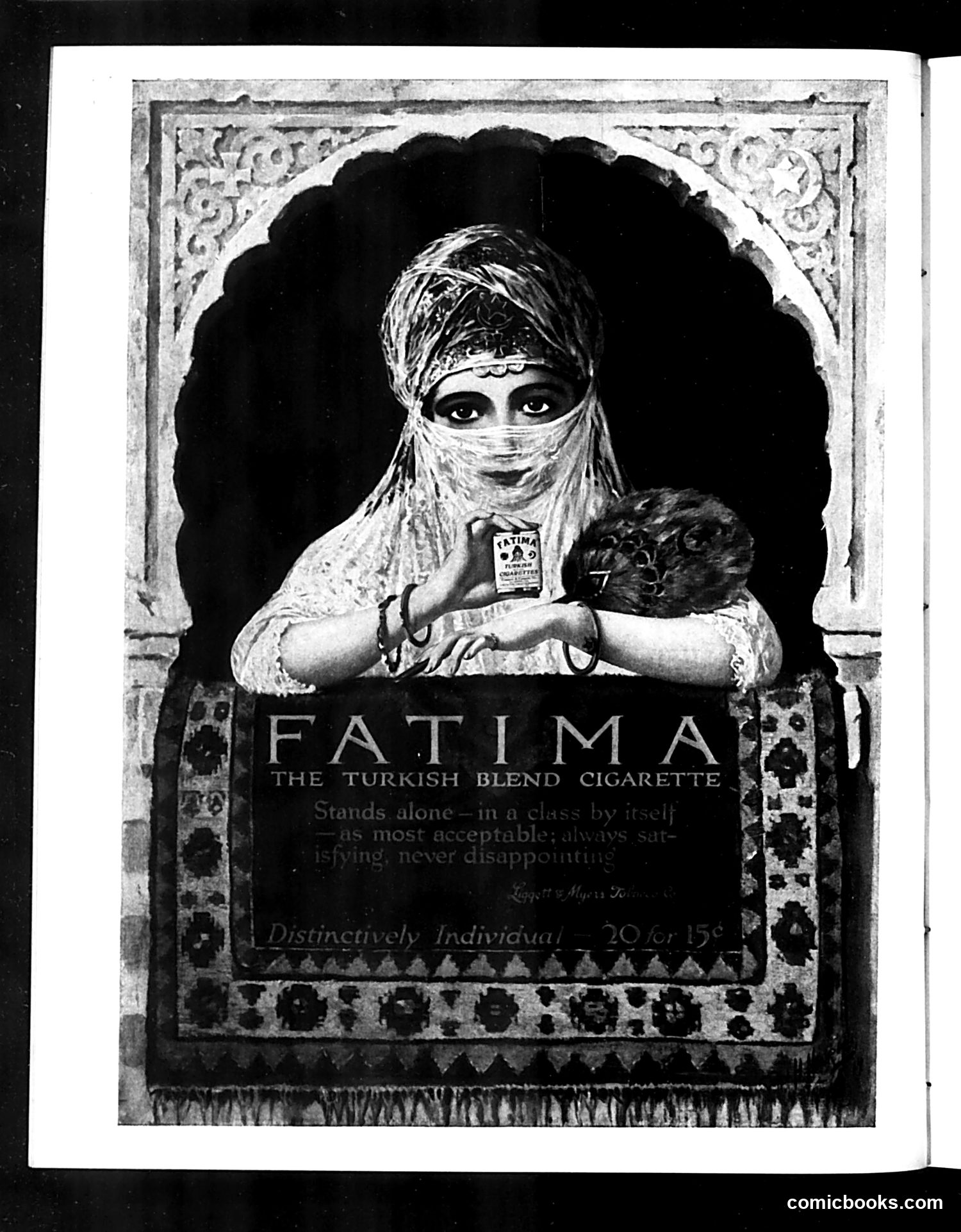
This is a cigarette advertisement rather than political satire. It promotes "Fatima: The Turkish Blend Cigarette," marketed as "Distinctively Individual" at "20 for 15¢." The ad features an Orientalist stereotype: a veiled woman in Turkish dress holding what appears to be a monkey or small animal. This imagery exploited early 20th-century Western fascination with "exotic" Near Eastern cultures to market cigarettes. The text claims the product "stands alone—in a class by itself" and is "most acceptable" and "satisfying, never disappointing." This represents how period advertising casually deployed ethnic caricatures and stereotypes as marketing tools, reflecting era attitudes that would be considered offensive today. The exotic imagery was meant to appeal to American consumers' romantic notions of foreign lands.