
Judge, 1914-10-10 · page 6 of 24
Judge — October 10, 1914 — page 6: what you’re looking at
What you’re looking at
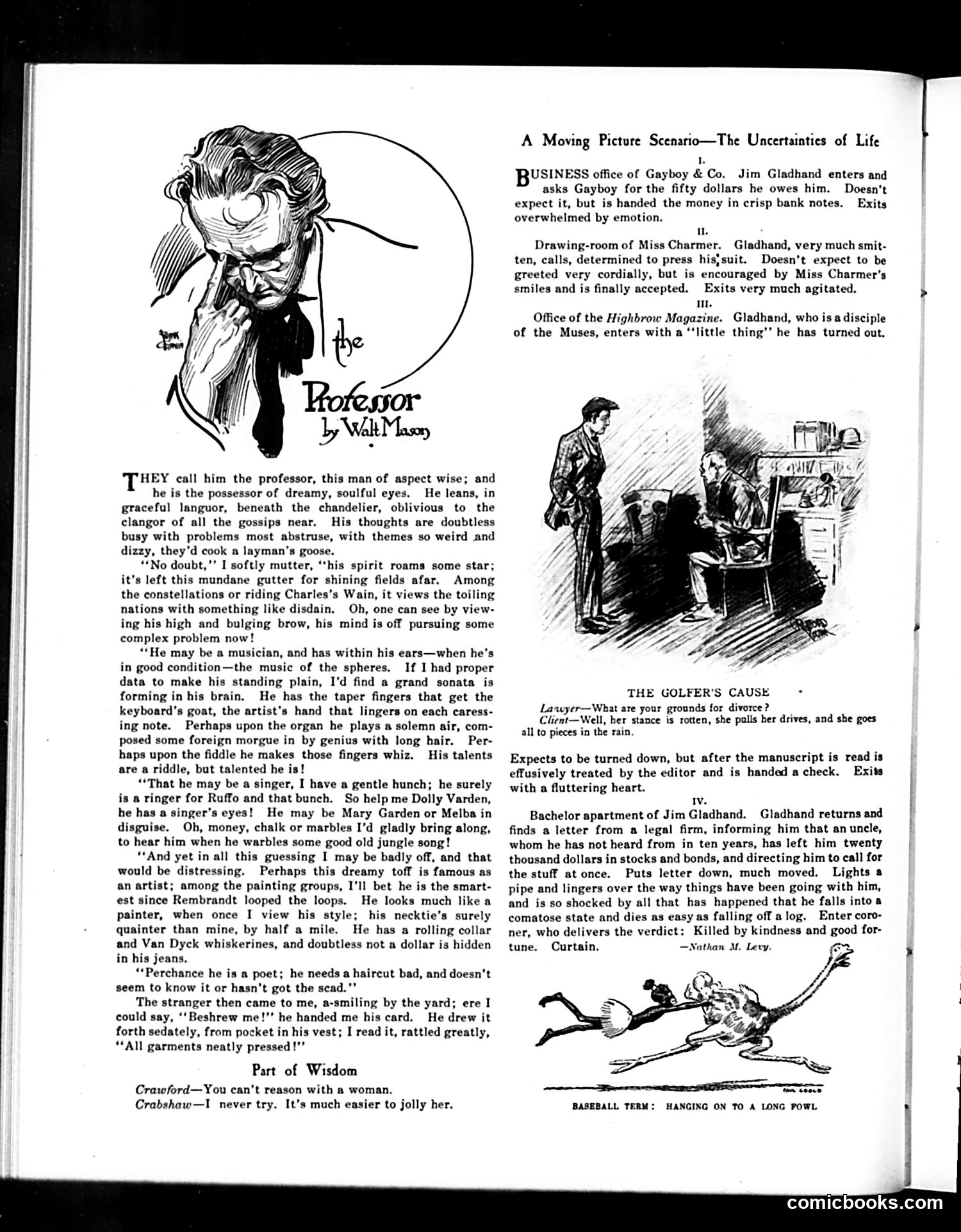
This Judge page satirizes the romantic ideal of the absent-minded intellectual. "The Professor" (illustrated at left) depicts a dreamy, bohemian-type man with soulful eyes and artistic affectations—Van Dyck whiskers, fancy collar, shabby clothes—whom the narrator imagines must be a great musician, artist, or poet. The joke: when approached, he's merely a laundry pressman handing out his card, "All garments neatly pressed!" The piece mocks the era's romantic notion that poverty and artistic pretension signal genius, when reality often masks mundane employment. Below, shorter items include "The Golfer's Cause" (a wife's poor golf swing as divorce grounds—humor based on golf's growing popularity among the wealthy) and a movie scenario following Jim Gladhand's improbable luck: paid money owed, winning over a woman, getting published, and inheriting a fortune. The scenario satirizes film melodrama's absurd coincidences.
📄 Transcribed text from this page (OCR, searchable)
Machine-transcribed from the original scan — historical spelling and the odd misread are preserved.
THEY call him the professor, this man of aspect wise; and he is the possessor of dreamy, soulful eyes. He leans, in graceful languor, beneath the chandelier, oblivious to the clangor of all the gossips near. His thoughts are doubtless busy with problems most abstruse, with themes so weird and dizzy, they’d cook a layman's goose. “No doubt,’’ I softly mutter, ‘*his spirit roams some star; it’s left this mundane gutter for shining fields afar. Among the constellations or riding Charles’s Wain, it views the toiling nations with something like disdain. Oh, one can see by view- ing his high and bulging brow, his mind is off pursuing some complex problem now! “*He may be a musician, and has within his ears—when he’s in good condition—the music of the spheres, If I had proper data to make his standing plain, I'd find a grand sonata is forming in his brain. He has the taper fingers that get the keyboard's goat, the artist's hand that lingers on each caress- ing note. Perhaps upon the organ he plays a solemn air, com- posed some foreign morgue in by genius with long hair. Per- haps upon the fiddle he makes those fingers whiz. His talents are a riddle, but talented he is! “That he may be a singer, I have a gentle hunch; he surely is a ringer for Ruffo and that bunch. So help me Dolly Varden, he has a singer’s eyes! He may be Mary Garden or Melba in disguise. Oh, money, chalk or marbles I’d gladly bring along, to hear him when he warbles some good old jungle song! “And yet in all this guessing I may be badly off, and that would be distressing. Perhaps this dreamy toff is famous as an artist; among the painting groups, I’ll bet he is the smart- est since Rembrandt looped the loops. He looks much like a painter, when once I view his style; his necktie’s surely quainter than mine, by half a mile. He has a rolling collar and Van Dyck whiskerines, and doubtless not a dollar is hidden in his jeans. “*Perchance he is a poet; he needs a haircut bad, and doesn’t seem to know it or hasn’t got the scad.”” The stranger then came to me, a-smiling by the yard; ere I could say, ‘‘Beshrew me!’’ he handed me his card. He drew it forth sedately, from pocket in his vest; I read it, rattled greatly, “All garments neatly pressed !"’ Part of Wisdom Crawford—You can't reason with a woman. Crabshaw—I never try. It’s much easier to jolly her. A Moving Picture Scenario—The Uncertainties of Life 1 BUSINESS office of Gayboy & Co. Jim Gladhand enters and asks Gayboy for the fifty dollars he owes him. Doesn't expect it, but is handed the money in crisp bank notes. Exits overwhelmed by emotion. ie Drawing-room of Miss Charmer. Gladhand, very much smit- ten, calls, determined to press his;suit. Doesn't expect to be greeted very cordially, but is encouraged by Miss Charmer’s smiles and is finally accepted. Exits very much agitated. M1. Office of the Highbrow Magazine. Gladhand, who isa disciple of the Muses, enters with a ‘‘little thing’’ he has turned out. THE GOLFER'S CAUSE - Lawyer—What are your grounds for divorce? Client—Well, her stance is rotten, she palls her drives, and she goes all to pieces in the rain, Expects to be turned down, but after the manuscript is read is effusively treated by the editor and is handed a check. Exits with a fluttering heart. Iv. Bachelor apartment of Jim Gladhand. Gladhand returns and finds a letter from a legal firm, informing him that an uncle, whom he has not heard from in ten years, has left him twenty thousand dollars in stocks and bonds, and directing him to call for the stuff at once. Puts letter down, much moved. Lights a pipe and lingers over the way things have been going with him, and is so shocked by all that has happened that he falls into a comatose state and dies as easy as falling off alog. Enter coro- ner, who delivers the verdict: Killed by kindness and good for- tune. Curtain. —Nathan M. Levy. iE BASEBALL TERM: HANGING ON TO A LONG POWL comicbooks.com