
Judge, 1914-10-10 · page 9 of 24
Judge — October 10, 1914 — page 9: what you’re looking at
What you’re looking at
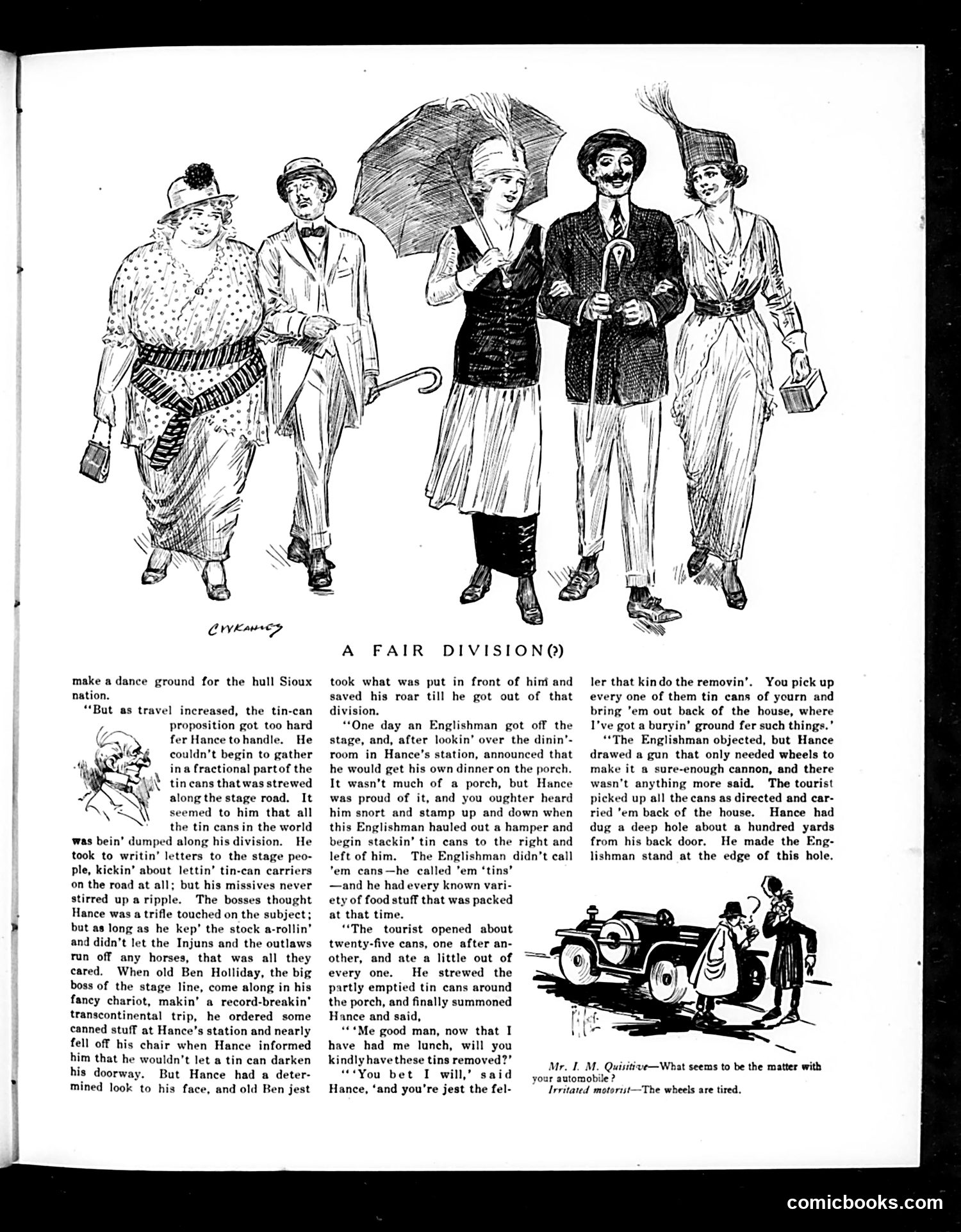
This page satirizes the clash between **Old West practicality and European tourist sensibilities**. The top illustration shows fashionable travelers, while the text describes a stagecoach station manager named Hance who obsessively opposes canned goods littering the landscape. The humor centers on an **English tourist** who, after picnicking, casually leaves opened tin cans scattered on the porch. Hance, fed up with the trash problem plaguing his division, forces the Englishman at gunpoint to bury the cans himself—a darkly comic "fair division" of responsibility. The satire mocks both the **fastidious English visitor** (who says "tins" instead of "cans") and American frontier roughness. The small bottom cartoon about tired automobile wheels provides additional wordplay humor typical of Judge's style. The overall message: Americans won't tolerate careless waste, and tourists should clean up after themselves—delivered with frontier justice.
📄 Transcribed text from this page (OCR, searchable)
Machine-transcribed from the original scan — historical spelling and the odd misread are preserved.
Cwkawcy make a dance ground for the hull Sioux nation. “But as travel increased, the tin-can proposition got too hard fer Hance tohandle. He couldn’t begin to gather ina fractional partof the tin cans that was strewed along the stage road. It seemed to him that all the tin cans in the world was bein’ dumped along his division. He took to writin’ letters to the stage peo- ple, kickin’ about lettin’ tin-can carriers on the road at all; but his missives never stirred up aripple. The bosses thought Hance was a trifle touched on the subject; but as long as he kep’ the stock a-rollin’ and didn’t let the Injuns and the outlaws run off any horses, that was all they cared. When old Ben Holliday, the big boss of the stage line, come along in his fancy chariot, makin’ a record-breakin’ transcontinental trip, he ordered some canned stuff at Hance’s station and nearly fell off his chair when Hance informed him that he wouldn’t let a tin can darken his doorway. But Hance had a deter- mined look to his face, and old Ben jest A FAIR DIVISION() took what was put in front of hin and saved his roar till he got out of that division. “One day an Englishman got off the stage, and, after lookin’ over the dinin’- room in Hance'’s station, announced that he would get his own dinner on the porch. It wasn’t much of a porch, but Hance was proud of it, and you oughter heard him snort and stamp up and down when this Englishman hauled out a hamper and begin stackin’ tin cans to the right and left of him, The Englishman didn’t call ‘em cans—he called 'em ‘tins’ —and he had every known vari- ety of food stuff that was packed at that time. “The tourist opened about twenty-five cans, one after an- other, and ate a little out of every one. He strewed the partly emptied tin cans around the porch, and finally summoned Hance and said, “**Me good man, now that I have had me lunch, will you kindly have these tins removed?’ “*You bet I will,’ said Hance, ‘and you're jest the fel- ler that kindo the removin’. You pick up every one of them tin cans of yourn and bring ’em out back of the house, where I've got a buryin’ ground fer such things.’ ‘The Englishman objected, but Hance drawed a gun that only needed wheels to make it @ sure-enough cannon, and there wasn't anything more said. The tourist picked up all the cans as directed and car- ried 'em back of the house. Hance had dug a deep hole about a hundred yards from his back door. He made the Eng- lishman stand at the edge of this hole. Mr. I. M. Quisitive—What seems to be the matter with your automobile? Irritated motorist—The wheels are tired. comicbooks.com