
Judge, 1914-10-10 · page 7 of 24
Judge — October 10, 1914 — page 7: what you’re looking at
What you’re looking at
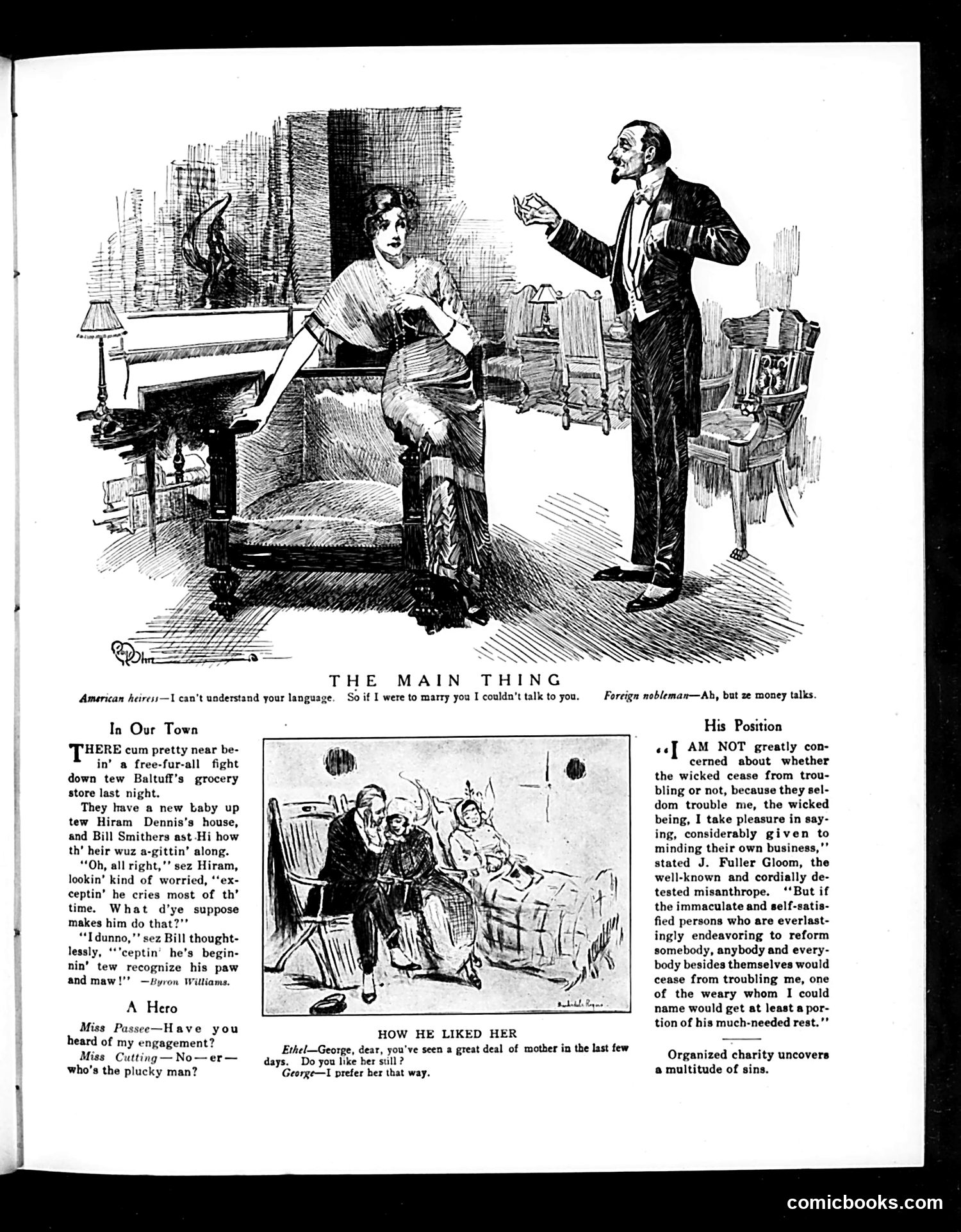
This page lampoons American class anxieties and courtship customs of the Gilded Age. **"The Main Thing"** depicts an American heiress rejecting a foreign nobleman because she cannot understand his language—yet he counters that "money talks," suggesting wealth transcends communication barriers. The satire targets wealthy Americans' marriages to impoverished European aristocrats, a common practice where money bought social status. **"How He Liked Her"** jokes about a suitor's excessive visits to his fiancée's mother, with his preference for seeing her "that way" (presumably stationary or silent) mocking obligatory courtship rituals. The remaining humor pieces—about a crying baby, engagement gossip, and misanthropic "J. Fuller Gloom"—are lighter social observations about small-town life and self-righteous reformers. Overall, the page satirizes class pretensions, transatlantic marriages of convenience, and the hypocrisy of "organized charity."
📄 Transcribed text from this page (OCR, searchable)
Machine-transcribed from the original scan — historical spelling and the odd misread are preserved.
a In Our Town THERE cum pretty near be- in’ a free-fur-all fight down tew Baltuff’s grocery store last night. They have a new baby up tew Hiram Dennis's house, and Bill Smithers ast Hi how th’ heir wuz a-gittin’ along. “Oh, all right,’’ sez Hiram, lookin’ kind of worried, ‘‘ex- ceptin’ he cries most of th’ time. What d’ye suppose makes him do that?’’ “I dunno,’ sez Bill thought- lessly, “’ceptin’ he’s begin- nin’ tew recognize his paw and maw!"" —Byron Williams. A Hero Miss Passee—Have you heard of my engagement? Miss Cutting —No—er— who's the plucky man? THE MAIN American heiress can't understand your language THING So if I were to marry you I couldn't talk to you. HOW HE LIKED HER Ethel—George, dear, you've seen a great deal of mother in the last few days. Do you like her still ? George—I prefer ber that way. Foreign nobleman—Ab, but ze money talks. His Position « J AM NOT greatly con- cerned about whether the wicked cease from trou- bling or not, because they sel- dom trouble me, the wicked being, I take pleasure in say- ing, considerably given to minding their own business,” stated J. Fuller Gloom, the well-known and cordially de- tested misanthrope. ‘‘But if the immaculate and self-satis- fied persons who are everlast- ingly endeavoring to reform somebody, anybody and every- body besides themselves would cease from troubling me, one of the weary whom I could name would get at least a por- tion of his much-needed rest.’" Organized charity uncovers a multitude of sins. comicbooks.com