
Judge, 1914-10-10 · page 8 of 24
Judge — October 10, 1914 — page 8: what you’re looking at
What you’re looking at
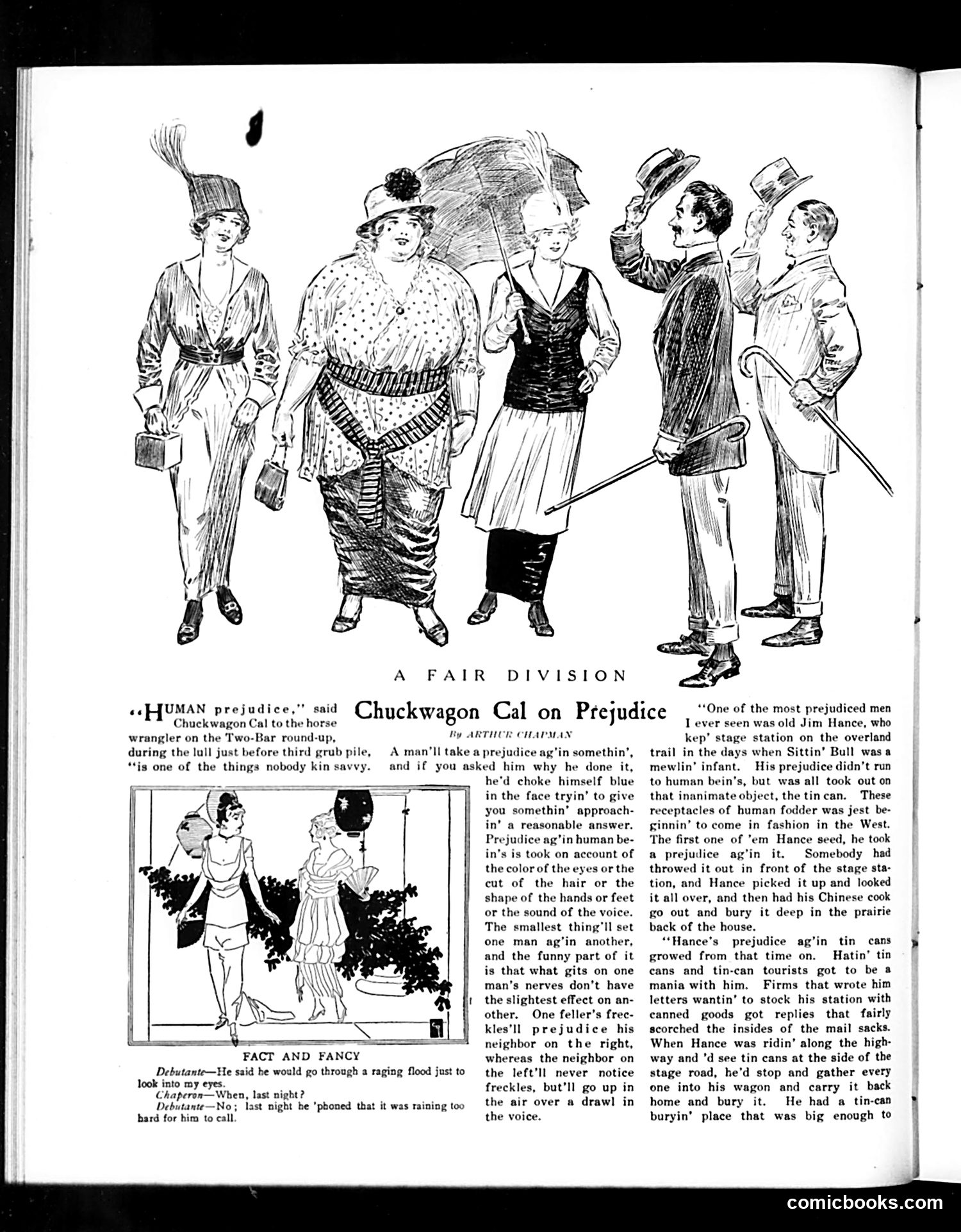
This page from *Judge* presents two humorous pieces about prejudice, both set in the American West. The main cartoon, "Chuckwagon Cal on Prejudice" by Arthur Chapman, illustrates how irrational human prejudices are. The top illustration shows five figures in period Western dress representing different types of people. The accompanying text uses a cowboy character (Chuckwagon Cal) to philosophize about how people develop arbitrary dislikes—whether based on physical traits like freckles or hair color, or vocal characteristics like drawls. The story demonstrates this with Jim Hance, a stagecoach station operator who develops an obsessive hatred of tin cans (a new technology in the era). His prejudice grows so extreme he buries them compulsively. The satire suggests that prejudice is fundamentally absurd and baseless—whether directed at people or objects—and that people cannot rationally explain their biases. "Fact and Fancy" is a brief joke about a debutante's romantic exaggeration. The page satirizes irrational human nature during the early 20th century.
📄 Transcribed text from this page (OCR, searchable)
Machine-transcribed from the original scan — historical spelling and the odd misread are preserved.
«« HUMAN prejudice,” said Chuckwagon Cal to the horse wrangler on the Two-Bar round-up, during the lull just before third grub pile, “is one of the things nobody kin savvy. A FAIR DIVISION Chuckwagon Cal on Prejudice Ry ARTHUR CHAPMAN A man'I| take a prejudice ag'in somethin’, and if you asked him why he done it, he'd choke himself blue in the face tryin’ to give you somethin’ approach- in’ a reasonable answer. Prejudice ag’in human be- in’s is took on account of the color of the eyes or the cut of the hair or the shape of the hands or feet or the sound of the voice. The smallest thing’ll set one man ag’in another, and the funny part of it is that what gits on one man’s nerves don’t have the slightest effect on an- other. One feller’s frec- kles’ll prejudice his FACT AND FANCY Debutante—He said he would go through a raging flood just to look into my eyes. Chaperon—When, last night? Debutante—No ; last night be phoned that it was raining too bard for him to call neighbor on the right, whereas the neighbor on the left’ll never notice freckles, but'll go up in the air over a drawl in the voice. “One of the most prejudiced men I ever seen was old Jim Hance, who kep’ stage station on the overland trail in the days when Sittin’ Bull was a mewlin’ infant. His prejudice didn’t run to human bein's, but was all took out on that inanimate object, the tincan. These receptacles of human fodder was jest be- ginnin’ to come in fashion in the West. The first one of 'em Hance seed, he took a prejudice ag’in it. Somebody had throwed it out in front of the stage sta- tion, and Hance picked it up and looked it all over, and then had his Chinese cook go out and bury it deep in the prairie back of the house. “‘Hance’s prejudice ag’in tin cans growed from that time on. Hatin’ tin cans and tin-can tourists got to be 8 mania with him. Firms that wrote him letters wantin’ to stock his station with canned goods got replies that fairly scorched the insides of the mail sacks. When Hance was ridin’ along the high- way and 'd see tin cans at the side of the stage road, he'd stop and gather every one into his wagon and carry it back home and bury it. He had a tin-can buryin’ place that was big enough to comicbooks.com