
A complete issue · 24 pages · 1914
Judge — October 3, 1914
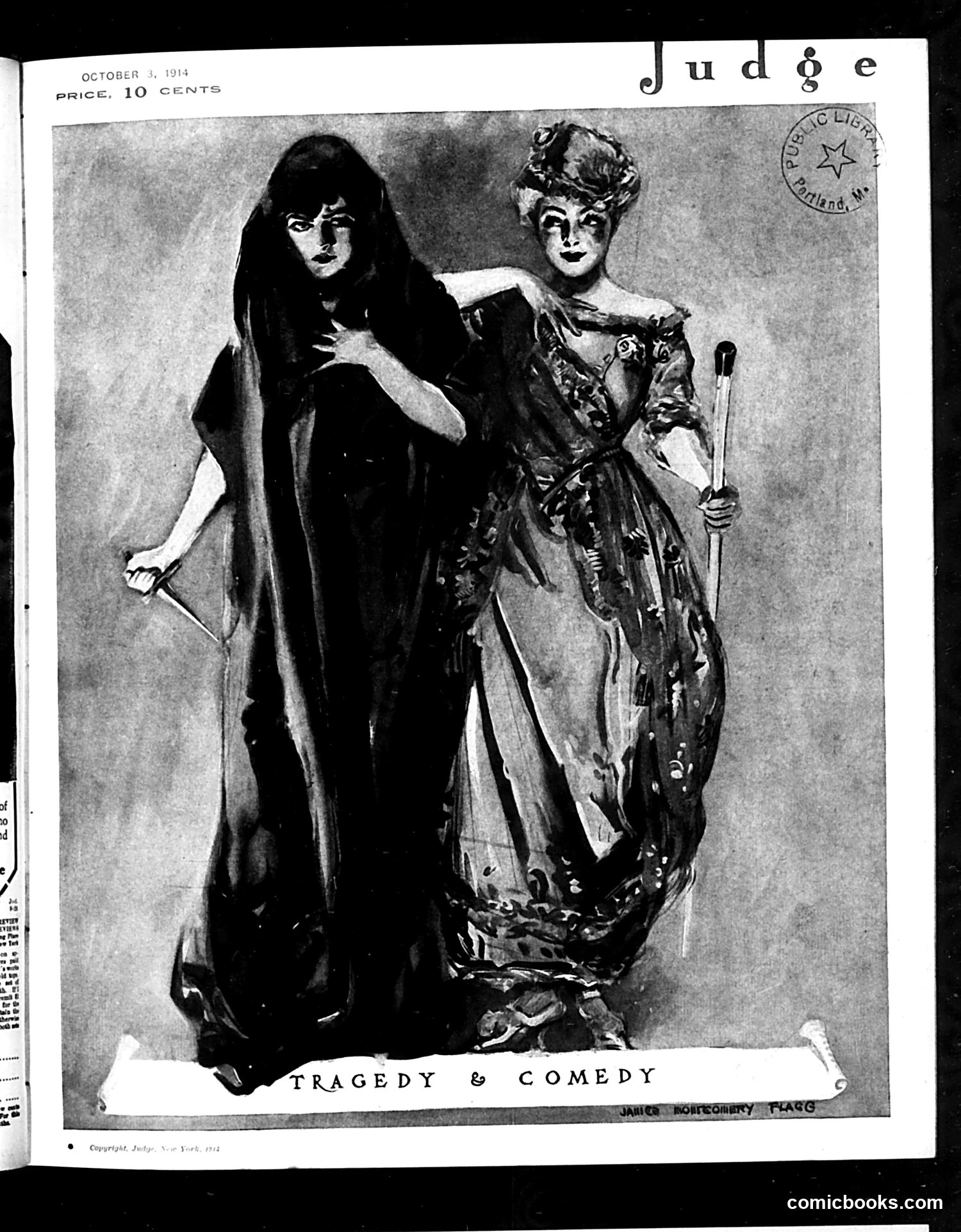
This page illustrates the classical theatrical concepts of "Tragedy & Comedy" through two female figures in elaborate costumes. The left figure wears dark, flowing robes suggesting a tragic character, while the right wears an ornate, decorative costume with an elaborate hat, holding what appears to be a theatrical prop or staff, embodying comic theatrical tradition. The image appears to be primarily theatrical/artistic rather than political satire. It's presented as cover art or editorial illustration for Judge magazine, emphasizing the contrasting dramatic traditions of stage performance. The "PUBLIC LIBRARY" stamp indicates this was a library-circulated copy. No specific political figures or contemporary events appear referenced here—it's a straightforward theatrical allegory.
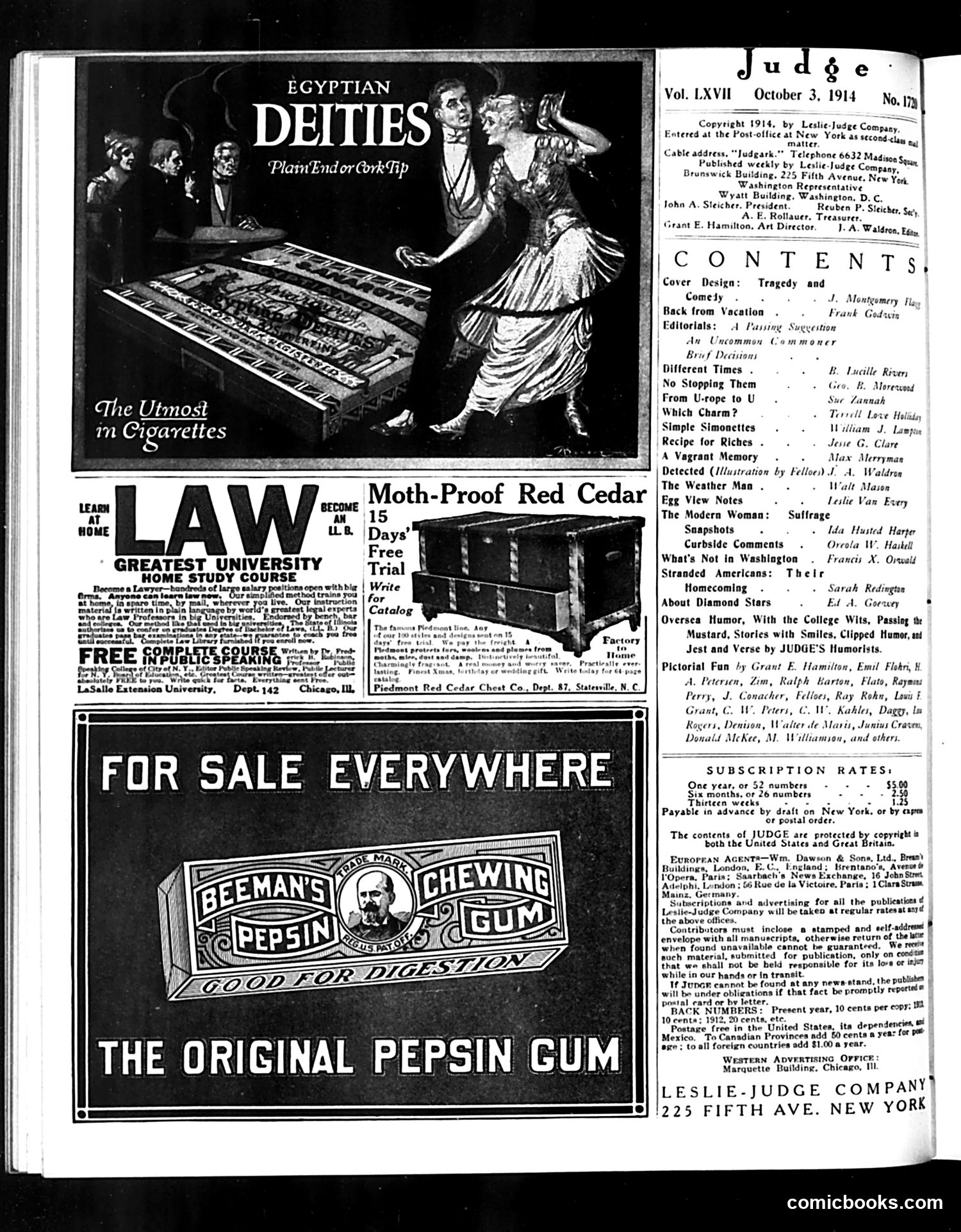
This page is primarily **advertising and contents listing** rather than political satire. The main visual content shows an advertisement for "Egyptian Deities" cigarettes, depicting well-dressed figures examining what appears to be cigarette packaging—a joke about luxury goods marketing. Below that is an advertisement for LaSalle Extension University's law correspondence courses and Beeman's chewing gum. The contents listing indicates this October 1914 issue includes comedy pieces, editorials on current events ("A Passing Succession," "An Uncommon Commoner"), and various humorous articles typical of Judge's satirical format. **No clear political cartoons or identifiable caricatures appear on this particular page.** The issue was published during World War I (note the date), though this specific page focuses on consumer goods advertising rather than topical satire.
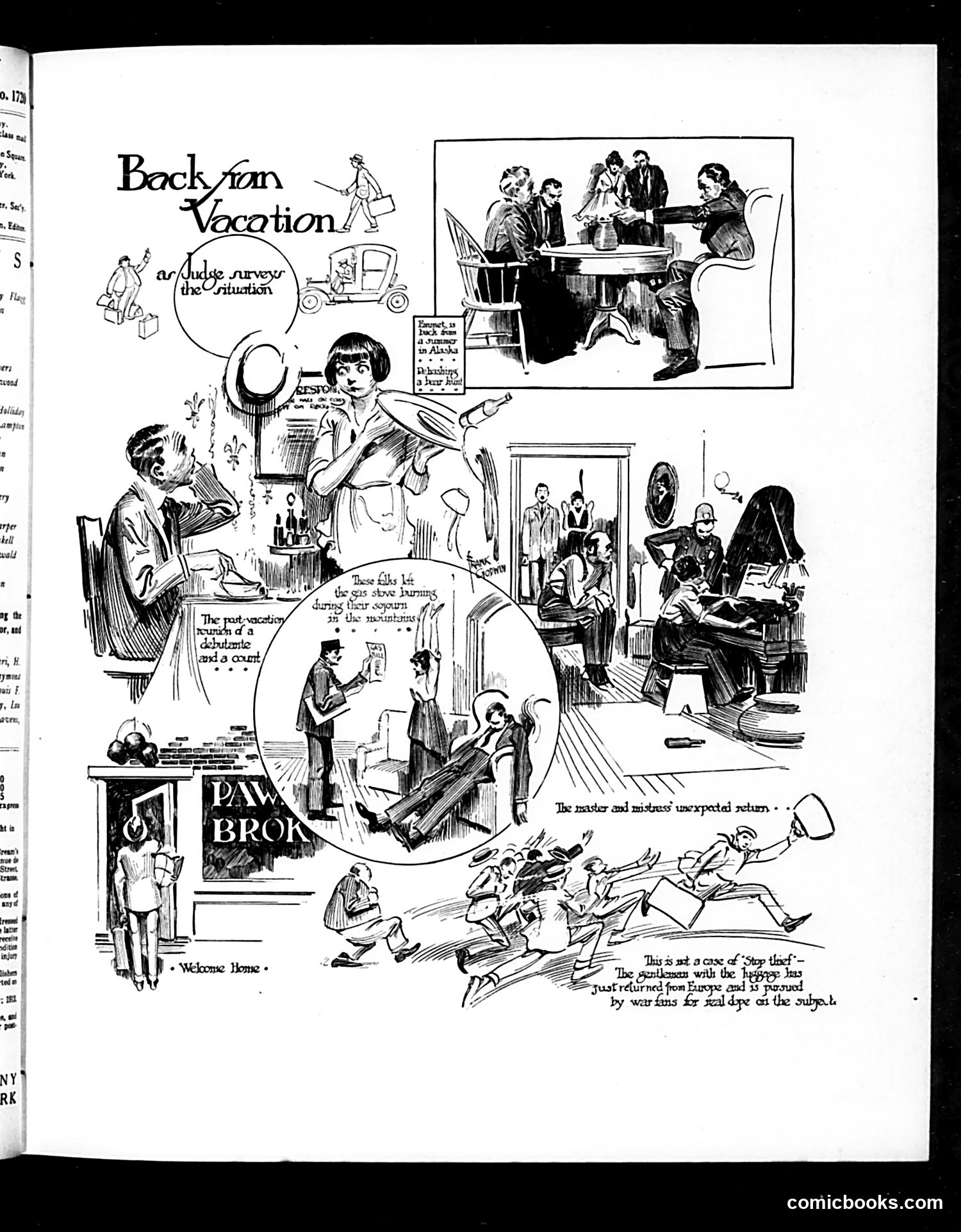
This satirical cartoon depicts the complications of returning home from vacation. The central narrative follows a traveler's chaotic homecoming through multiple scenes: The title panel shows "Judge surveys the situation" as the returning vacationer encounters domestic disorder. Key scenes include: a pawn broker transaction (suggesting financial difficulties during absence), family members in disarray, an unexpected return of the "master and mistress," and a final scene labeled "step theft" where burglars have stolen luggage while the family was away. The satire mocks the notion that leaving home for vacation creates more problems than relaxation provides—highlighting servants' incompetence, household mismanagement, financial strain, and actual theft. The cartoon suggests vacation brings not rest but domestic disaster, a timeless complaint about the costs and complications of travel.
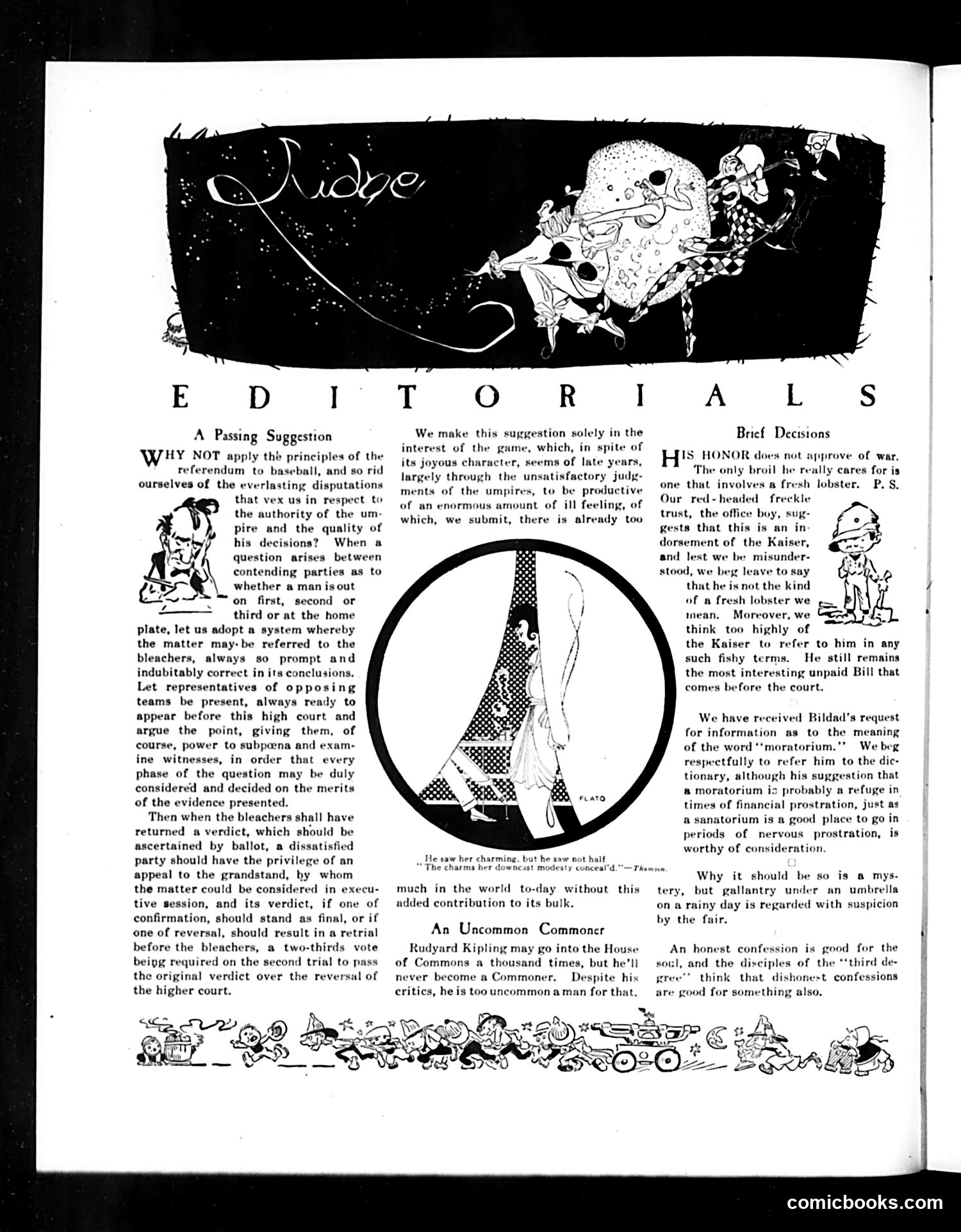
This editorial page contains three sections criticizing baseball umpire decisions and related matters: 1. **"A Passing Suggestion"** (left): Argues for applying referendum principles to baseball disputes, suggesting umpire decisions be subject to review by opposing teams and bleachers, with appeals possible to higher authority. 2. **Central illustration**: Shows a woman's leg, captioned with a Parisian quote about charm and modesty—likely satirizing contemporary debates about women's fashion (hemlines were rising during this era). 3. **"Brief Decisions"** (right): Defends the Kaiser against "fresh lobster" insults, discusses "moratoriums" versus sanitariums, and debates whether dishonest confessions benefit the soul. The page blends sports satire with social commentary typical of Judge's mixed editorial content.
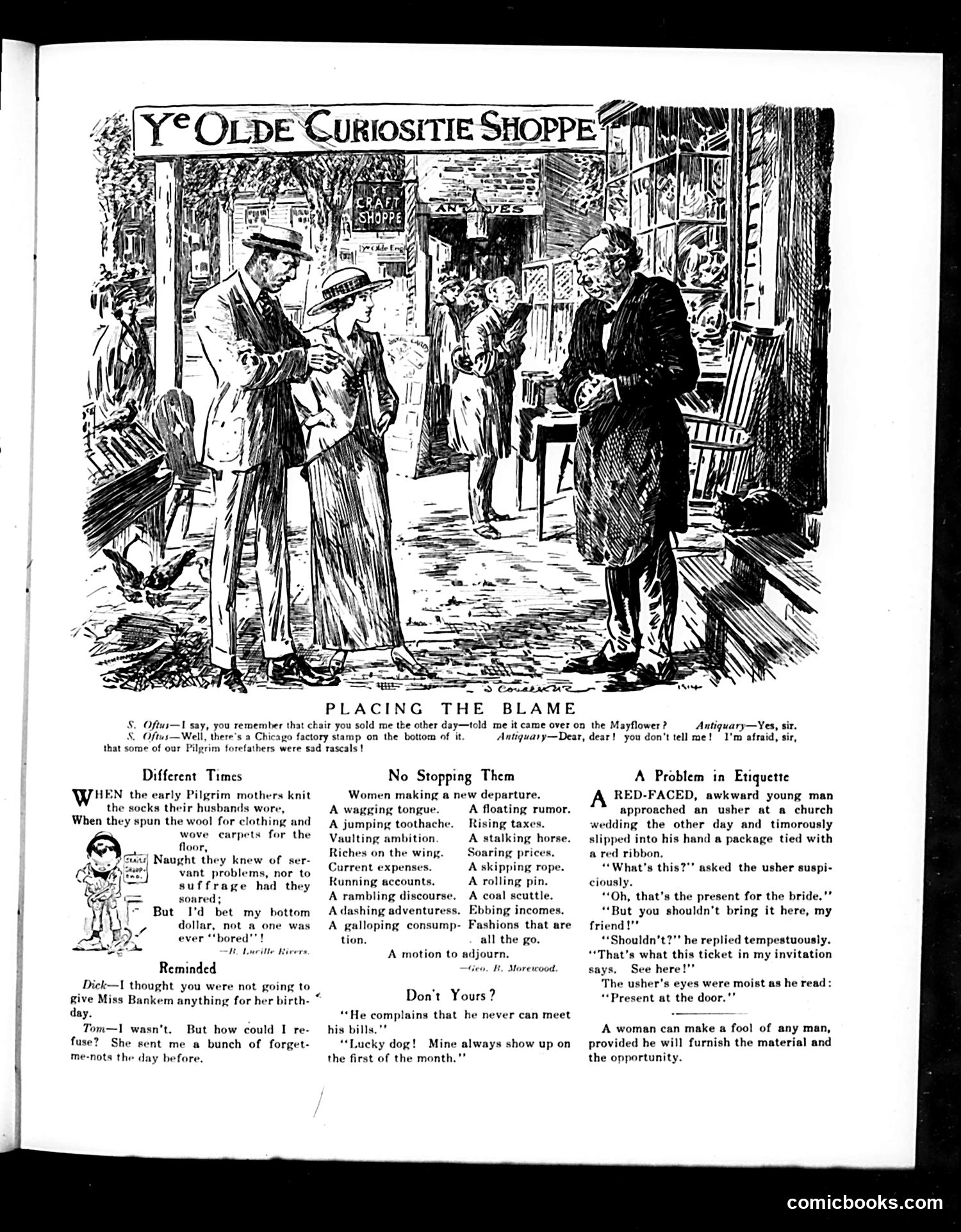
The main cartoon depicts a shop scene with the title "Placing the Blame." A man and woman examine antiques while a shopkeeper gestures defensively. The dialogue suggests the woman purchased an item (possibly Pilgrim-related) that disappointed her, and she's confronting the shop owner about its authenticity or quality. The man beside her appears to be her companion deflecting blame. Below are three separate humor columns: "Different Times" (contrasting Pilgrim-era problems with modern ones), "No Stopping Them" (listing unstoppable social trends), and "A Problem in Etiquette" (about an awkward church wedding gift incident). The page satirizes consumer complaints, changing social customs, and modern social anxieties through light humor rather than sharp political commentary.
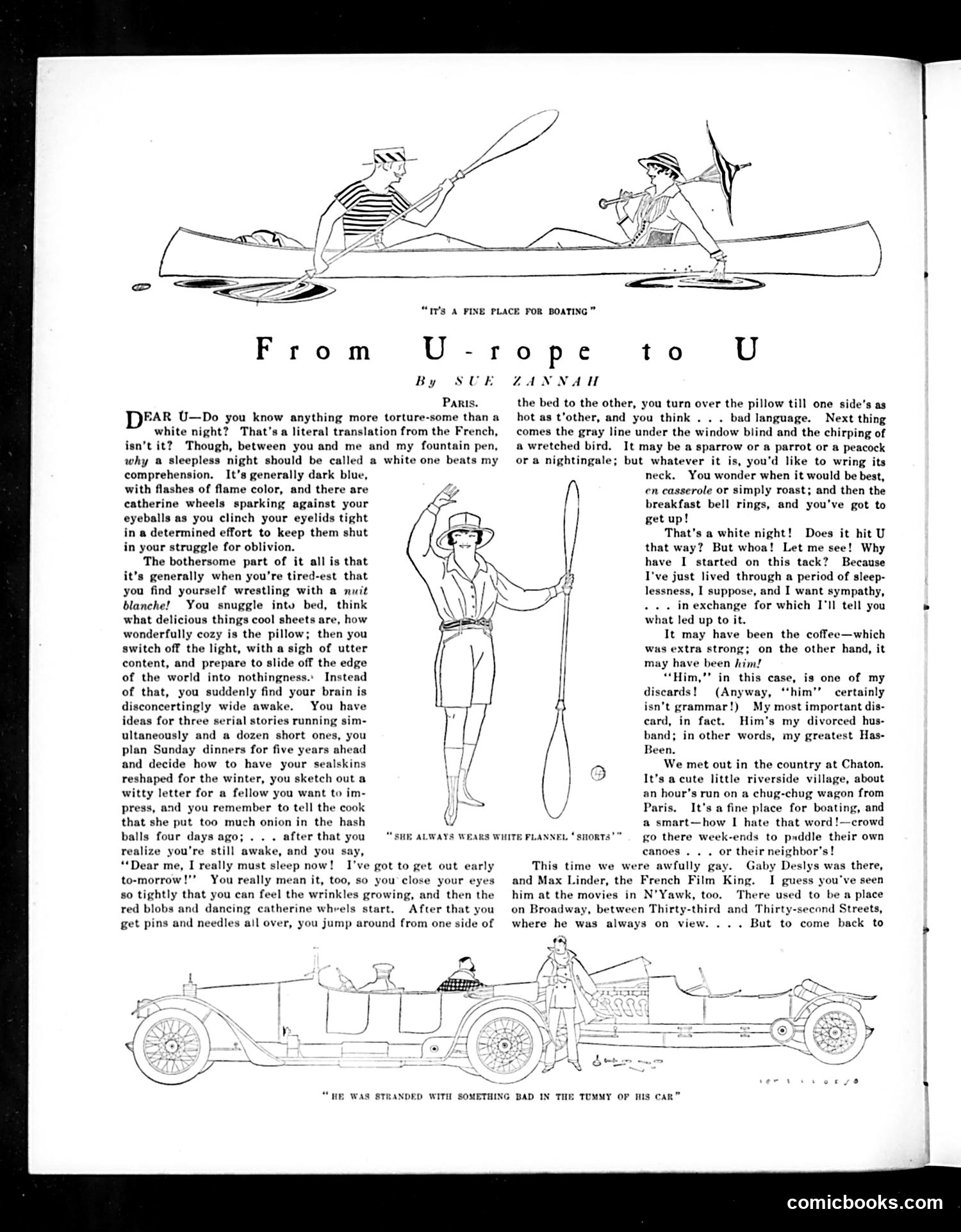
This is a humorous advice column disguised as travel commentary. The author writes to "U" (the magazine's reader) about European social life, specifically French leisure culture. The satire targets leisured American tourists and their pretensions. References to "white nights" (sleepless nights from French *nuit blanche*), boating parties at riverside villages, and mentions of "Max Linder" (a famous French silent-film comedian) establish an upper-class European vacation setting. The cartoon illustrations show period-appropriate leisure activities: couples boating and a fashionable woman in "white flannel shorts." The humor lies in Sue's breathless, gossipy tone about romantic entanglements and her divorced ex-husband, contrasted with weary social observations about insomnia and trivial dinner-party concerns. It satirizes both the aspirational European tourism of wealthy Americans and the shallow romanticism they project onto continental life.
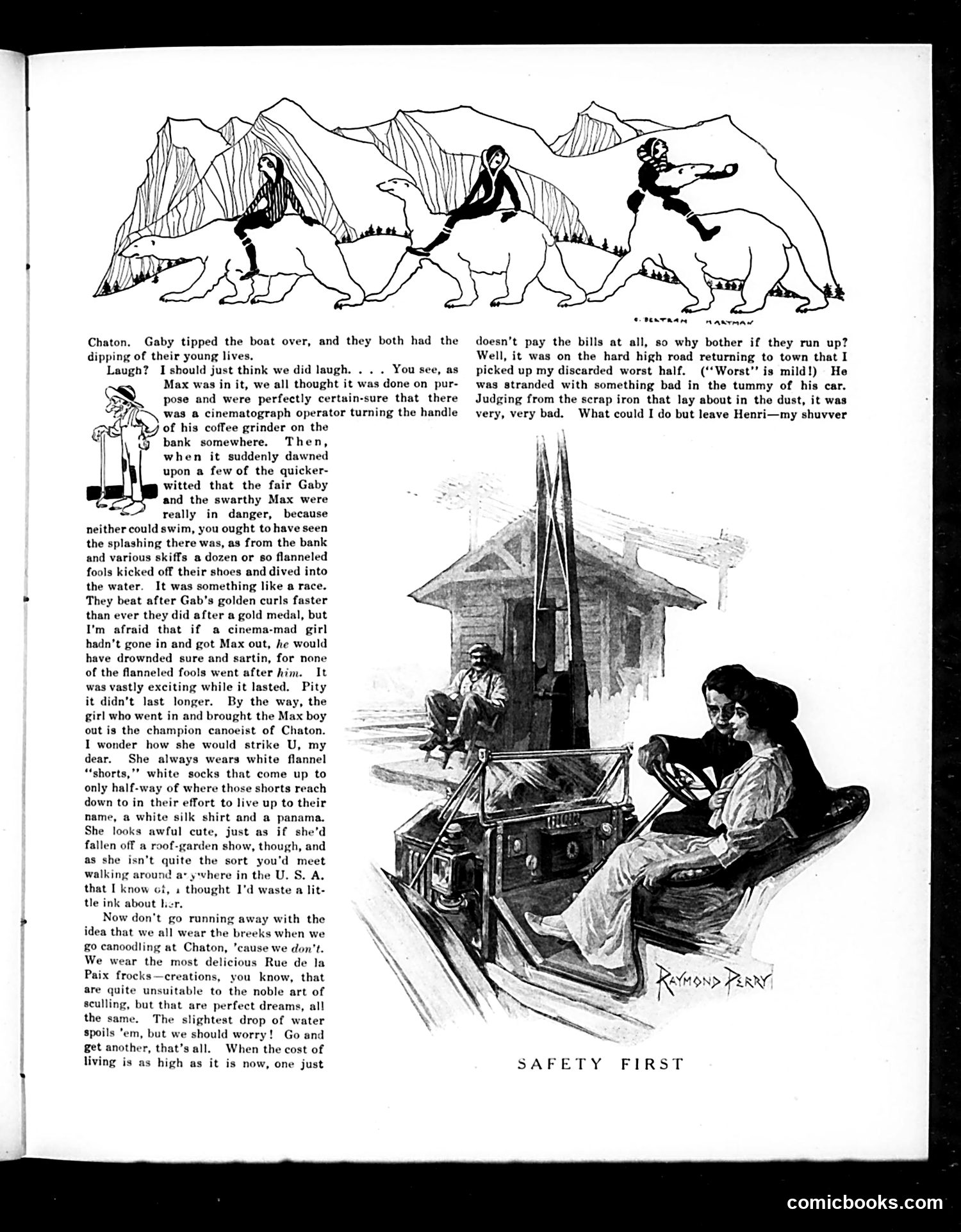
This page from *Judge* magazine contains two satirical pieces about leisure activities and social commentary. **Top illustration**: Shows people riding polar bears, accompanying a narrative about a boating accident at "Chaton" (likely a fashionable resort). The story mocks wealthy, fashionable people—particularly women in expensive Parisian dresses ("Rue de la Paix frocks") who go canoeing despite their impractical clothing. The satire targets their frivolous materialism: they don't worry about ruining expensive garments because they can simply "get another." The narrator notes the irony that during a genuine crisis (people drowning), onlookers prioritized saving the attractive woman over the man. **Bottom illustration** ("Safety First"): Depicts a motorist helping a stranded driver. The caption suggests this illustrates proper safety conduct—a contrast to the carelessness and class-based priorities shown above. The overall theme critiques wealthy leisure culture and conspicuous consumption during an era when "the cost of living is as high as it is now"—likely referencing post-WWI inflation.
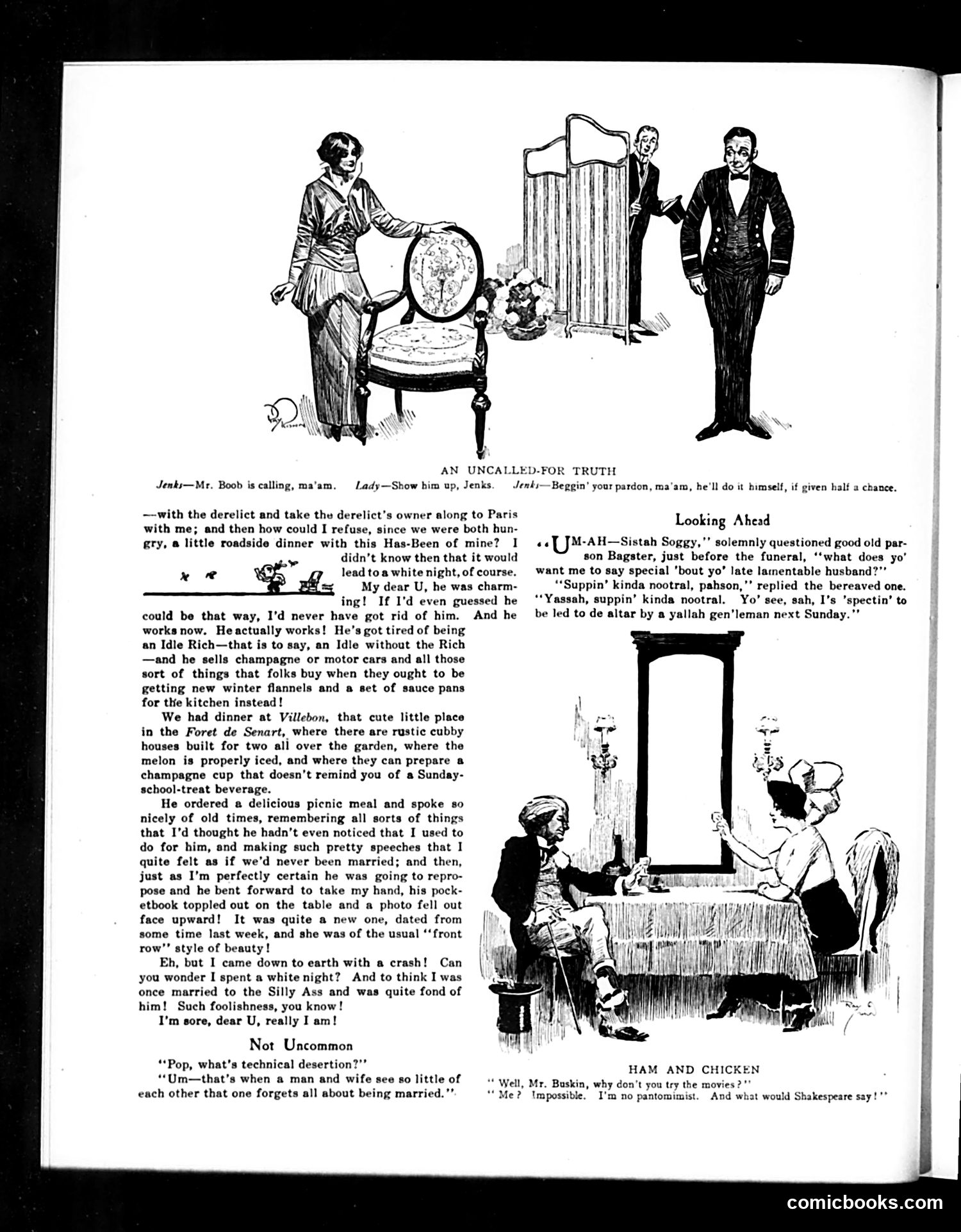
This page contains three separate satirical pieces typical of early-20th-century American humor: **"An Uncalled-for Truth"** mocks the "Idle Rich"—wealthy men without actual wealth or purpose. The narrative follows a woman who briefly reconciles with her ex-husband after he reforms, gets a job selling champagne/cars, and seems genuinely changed. The satire lies in the reveal: he's still fundamentally dishonest, carrying a photo of another woman. The joke: reformed rakes don't truly reform. **"Not Uncommon"** is a one-liner joke about marriage disconnect—couples grow so distant they forget they're married, playing on contemporary anxieties about modern marriage. **"Ham and Chicken"** shows a failed actor (Mr. Buskin) rejecting movies because he's "no pantomimist," then sarcastically wondering what Shakespeare would say. This likely references silent films' reliance on physical acting rather than Shakespeare's dialogue-driven drama—mocking both actors resistant to new media and cinema's perceived limitations. The tone throughout reflects Jazz Age skepticism toward social pretense and changing social institutions.
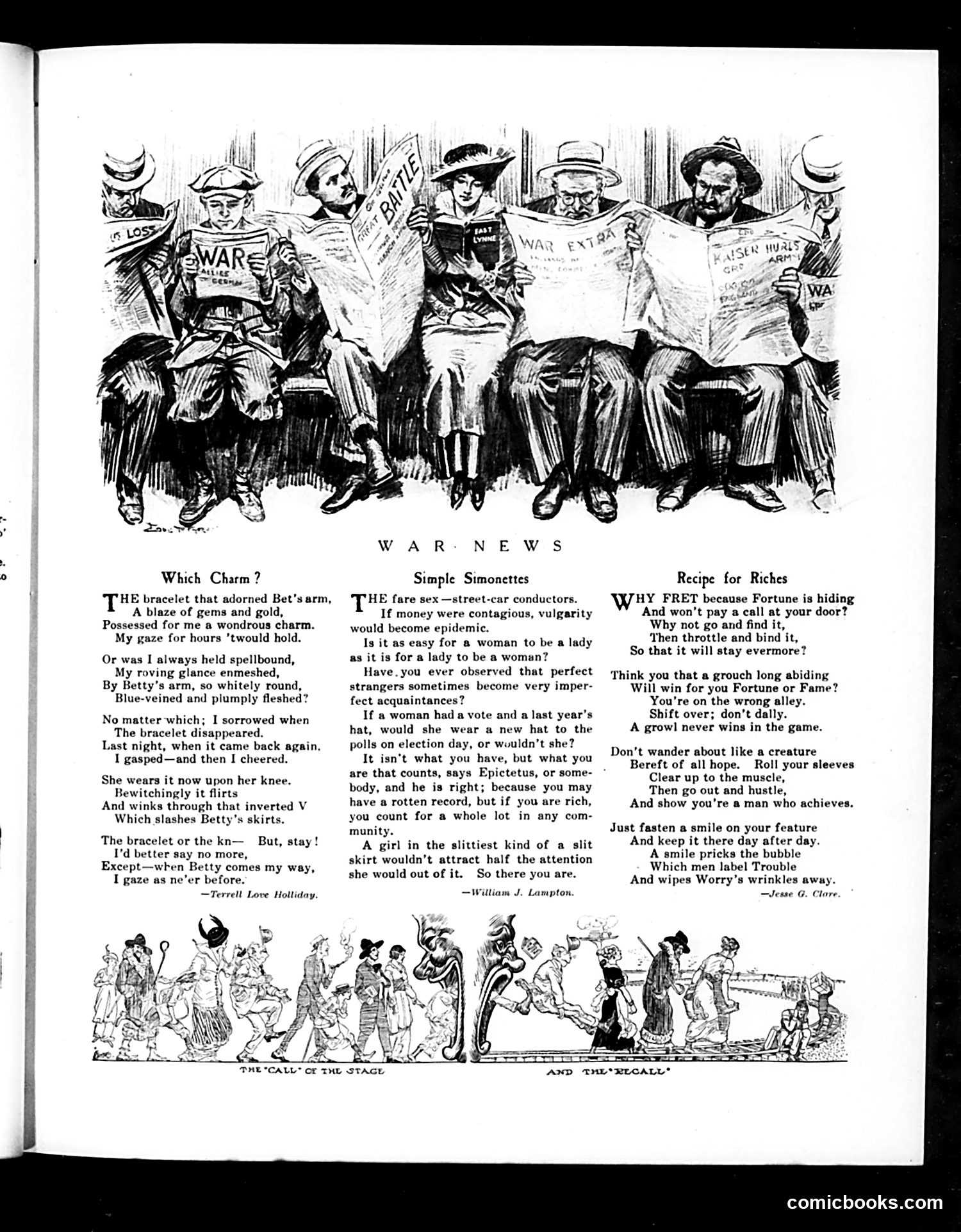
This Judge magazine page satirizes American social attitudes during wartime through three humor columns and illustrations. **Top Cartoon:** Seven figures representing different social types read war news headlines ("War Extra," "Raise Funds," etc.), likely mocking how diverse Americans consumed and reacted to WWI coverage with varying levels of concern or hysteria. **Content:** The three poems—"Which Charm?" (flirtatious verse about a woman's bracelet and leg), "Simple Simonettes" (cynical observations on gender, voting, and wealth), and "Recipe for Riches" (motivational verse)—represent typical Judge humor: mildly risqué observations, class commentary, and platitudes about self-improvement. **Context:** The "war news" framing suggests these pieces offer domestic distraction from serious wartime concerns. "Simple Simonettes" contains pointed social critique: women voting, wealth trumping morality, and fashion absurdities. The overall effect trivializes both women's issues and wartime anxiety through clever but shallow wordplay and illustration.
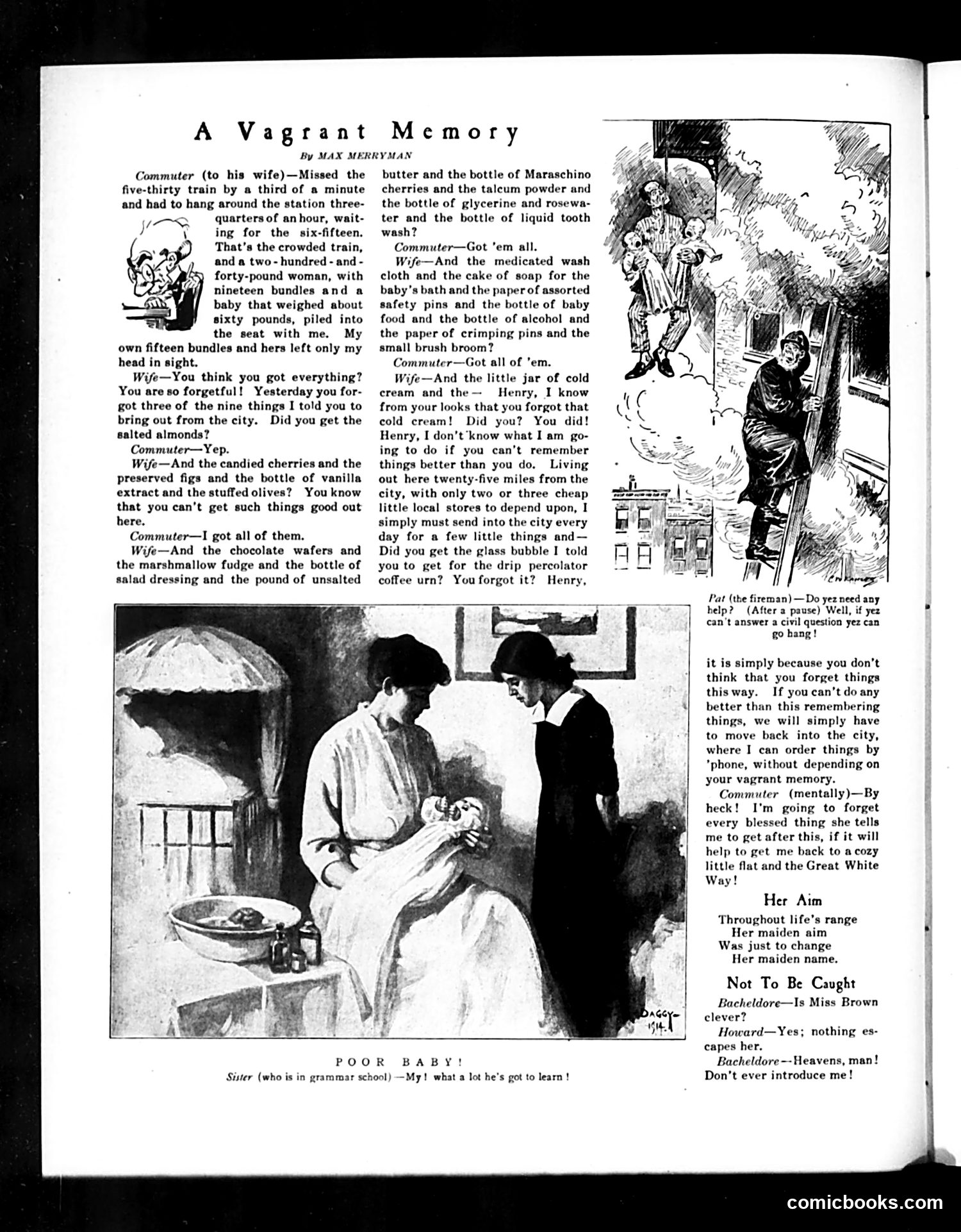
This satirical piece by Max Merryman critiques suburban commuter life in early 20th-century America. A husband commutes 25 miles from the city to a rural home, arriving late after missing his train. His wife then interrogates him about an endless shopping list of items he was supposed to retrieve from the city—candied cherries, vanilla extract, cold cream, soap, safety pins, and more. The satire targets two things: the wife's relentless, nagging demands and the husband's mental exhaustion from trying to remember trivial domestic details. His internal monologue reveals his desperation—he'd *gladly* forget everything just to move back to the city ("the Great White Way"). The joke reflects anxiety about suburban expansion and gender dynamics of the era: wives controlled domestic consumption, while husbands bore the burden of commuting and shopping errands. The sidebar jokes about forgetfulness, maidens, and a fireman reinforce themes of memory and domestic life.
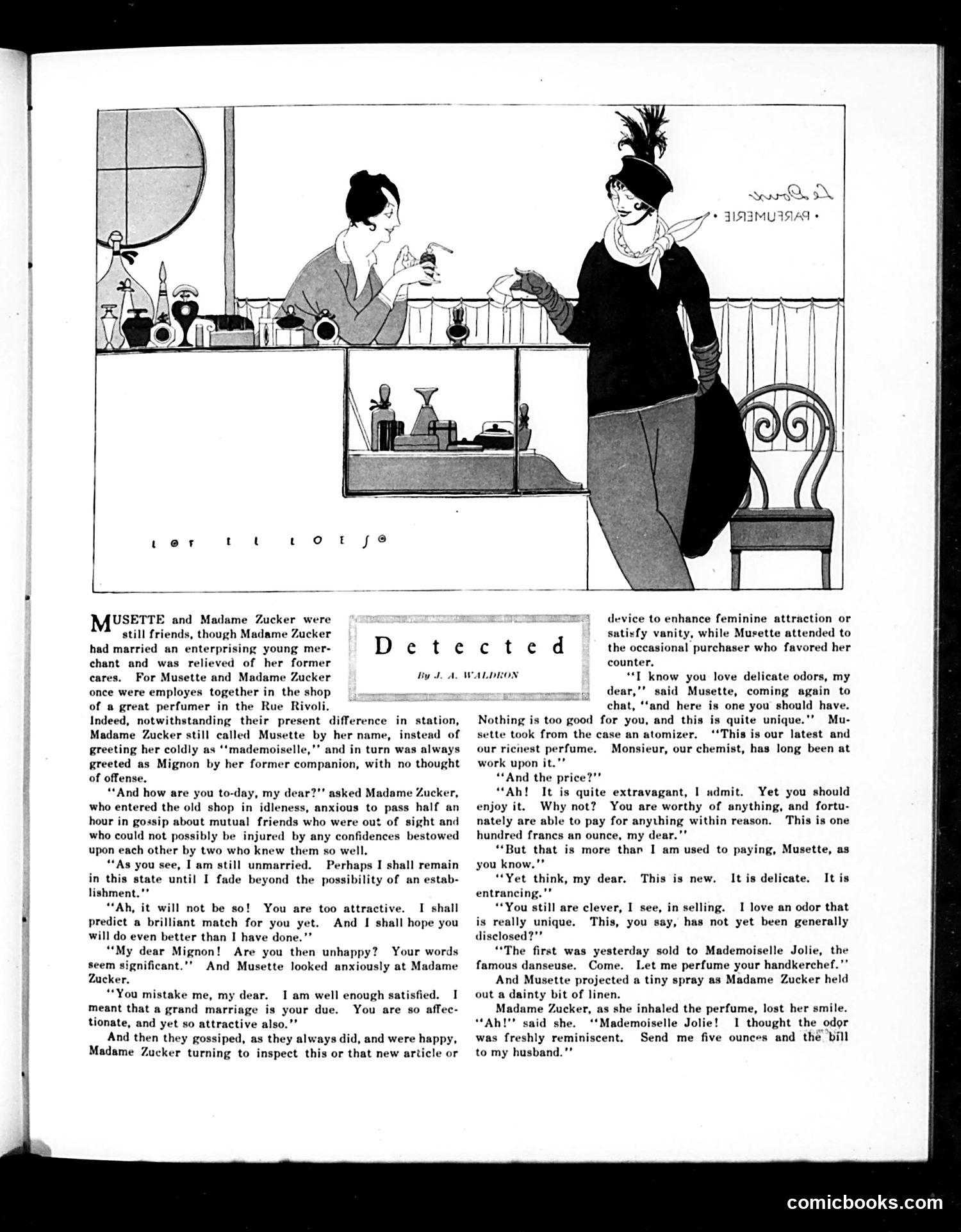
This story-cartoon satirizes vanity and marital jealousy among the upper classes. Two former perfume-shop employees—Musette (still working) and Madame Zucker (now married to a merchant)—reunite. Madame Zucker, seemingly content, visits the shop and is sold an exclusive, expensive new perfume (100 francs per ounce) by Musette. The joke: Musette reveals the perfume was just sold to Mademoiselle Jolie, a famous dancer. Upon smelling it, Madame Zucker recognizes the scent from her husband—implying he's been with the dancer. She immediately buys five ounces and instructs Musette to charge her husband, making her suspicions and displeasure clear. The satire mocks how wealthy women use perfume and luxury goods as status symbols while masking deeper marital anxieties. The "detection" is ironic: the perfume meant to enhance feminine attraction instead reveals infidelity.
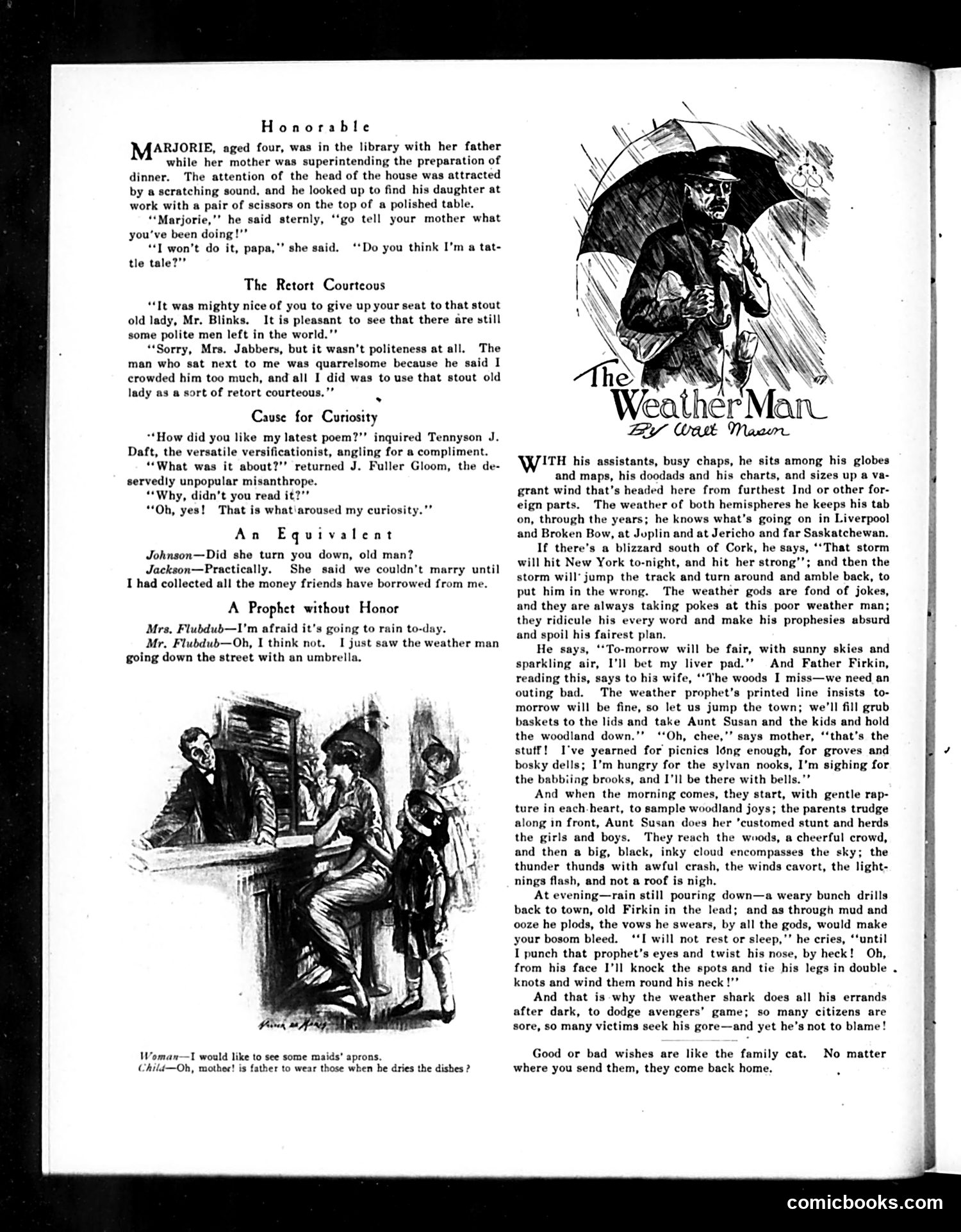
This page contains several brief humorous sketches plus a longer illustrated narrative poem titled "The Weather Man" by Walt Mason. The main illustrated story mocks weather forecasters' unreliability. A weather prophet confidently predicts fair skies, encouraging a family (the Firkins) to plan an outing. When they follow his advice and venture into the woods, a sudden storm drenches them—suggesting the forecaster's predictions are habitually wrong and often have the opposite effect of their intended use. The smaller pieces above satirize social pretense and hypocrisy: a child refusing to be a "tattletale," a man claiming politeness toward a woman while actually using her as a buffer against an aggressive passenger, and a man whose weather prediction fails because he carries an umbrella—implying his pessimism contradicts his stated optimism. The satire targets both professional incompetence and everyday human dishonesty.
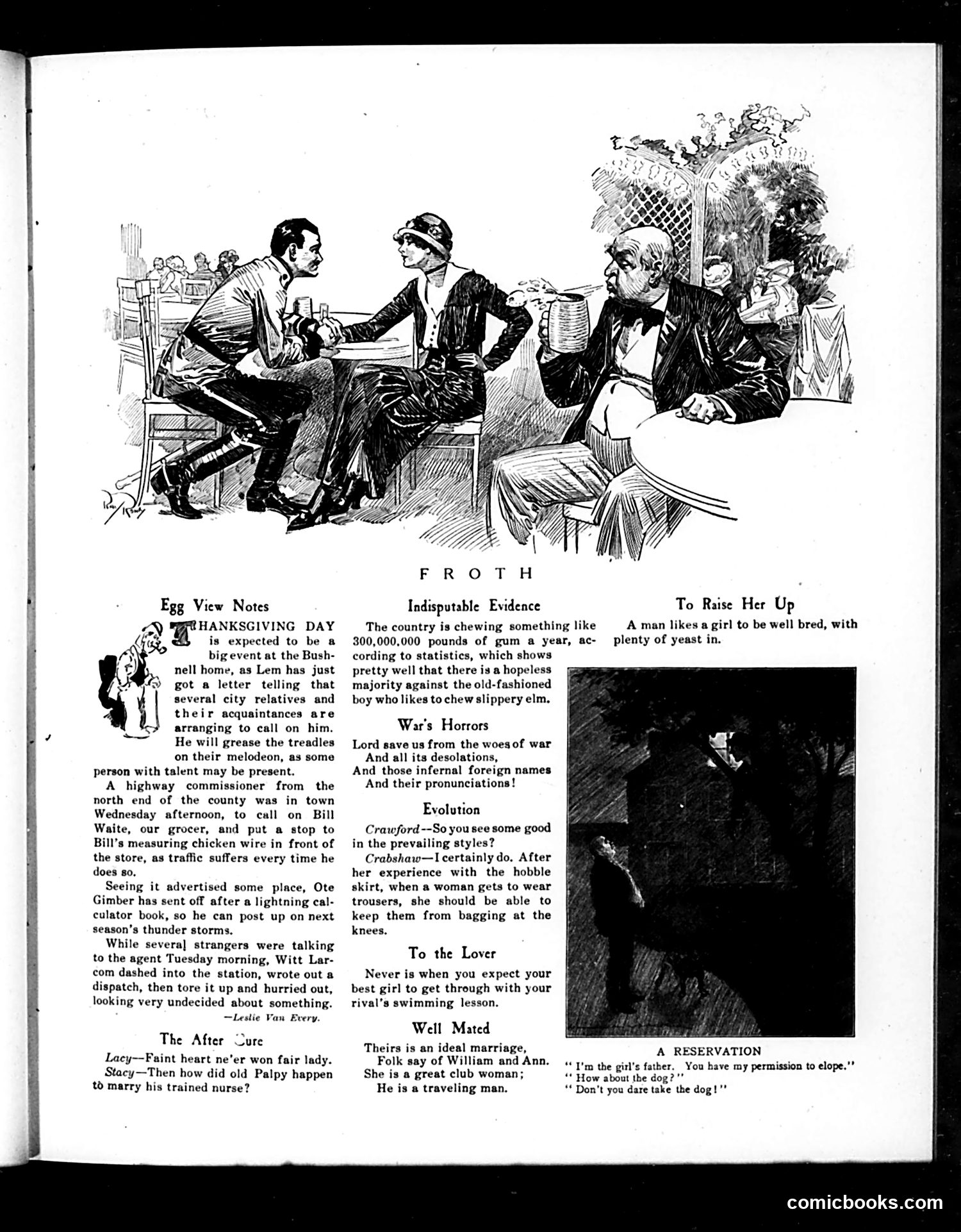
This page from the satirical magazine **Judge** contains various short humorous pieces and cartoons mocking early 20th-century American social customs and gender roles. The central cartoon depicts three men in conversation, illustrating social awkwardness. The surrounding vignettes satirize contemporary concerns: gum-chewing (300 million pounds annually consumed), concerns about women's evolving fashion (hobble skirts transitioning to trousers), and changing courtship dynamics. Notable pieces include "Well Mated," mocking marriages where spouses have incompatible lifestyles; "Evolution," suggesting women's clothing improvements; and "A Reservation," a joke about a father more protective of his dog than his daughter during an elopement. The "Egg View Notes" section contains small-town gossip items, typical of Judge's rural Americana humor. Overall, the page reflects anxieties about modernization, women's changing roles, and shifting social norms in the pre-WWI era. The war reference suggests this dates to around 1914-1918.
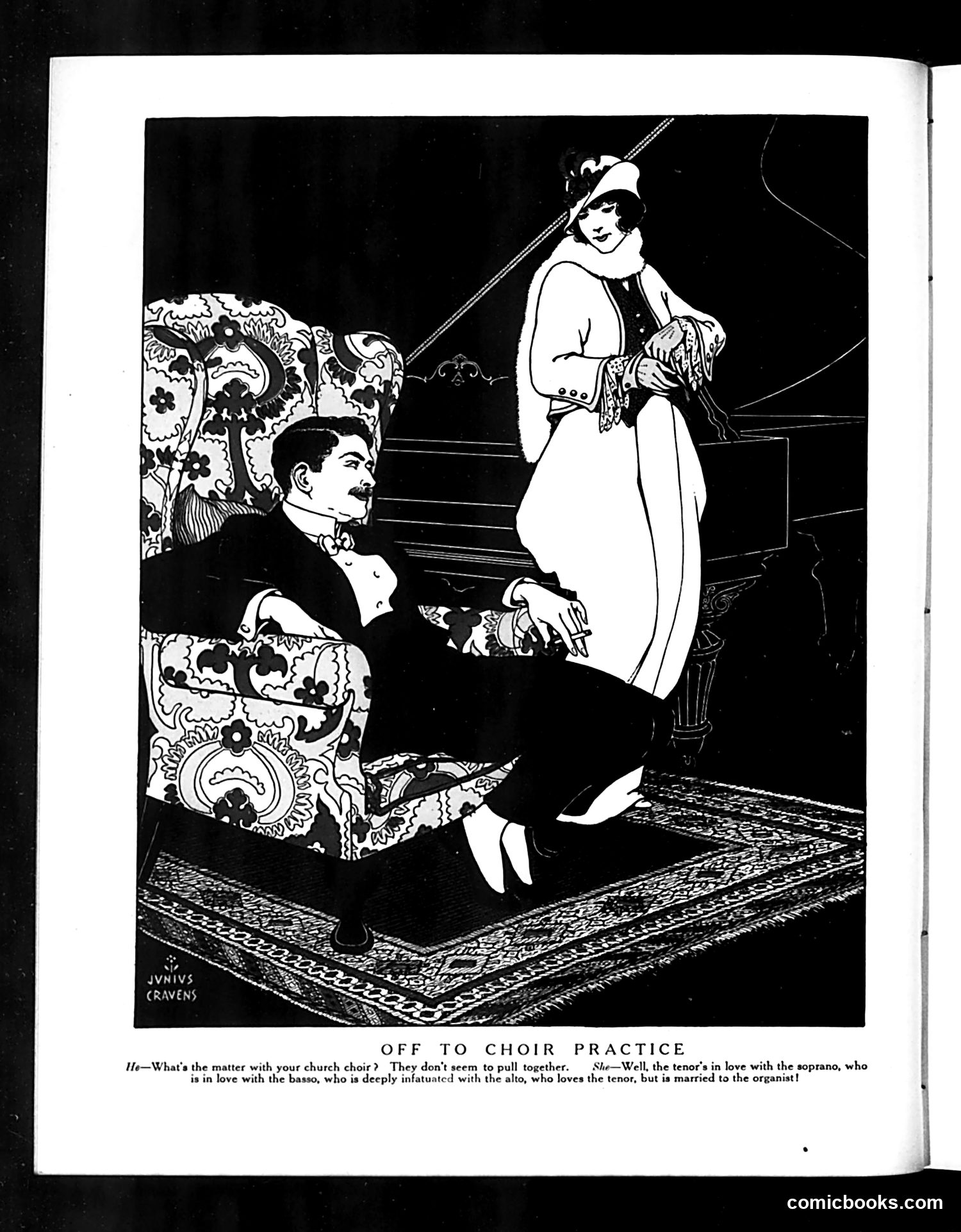
This is a romantic comedy cartoon satirizing the chaos of church choir dynamics. The illustration shows an elegantly dressed couple—he seated, she standing—apparently discussing choir troubles. The joke is a tangled love quadrangle: the tenor loves the soprano, who loves the bass singer, who loves the alto, who loves the tenor back—but the alto is married to the organist, creating an irresolvable mess. The satire mocks how personal romantic entanglements destroy group harmony and cooperation, even in supposedly respectable institutional settings like churches. It's a lighthearted jab at how human passion undermines collective purpose. The sophisticated art style and setting suggest this targets middle-class or upper-class readers familiar with choir culture.
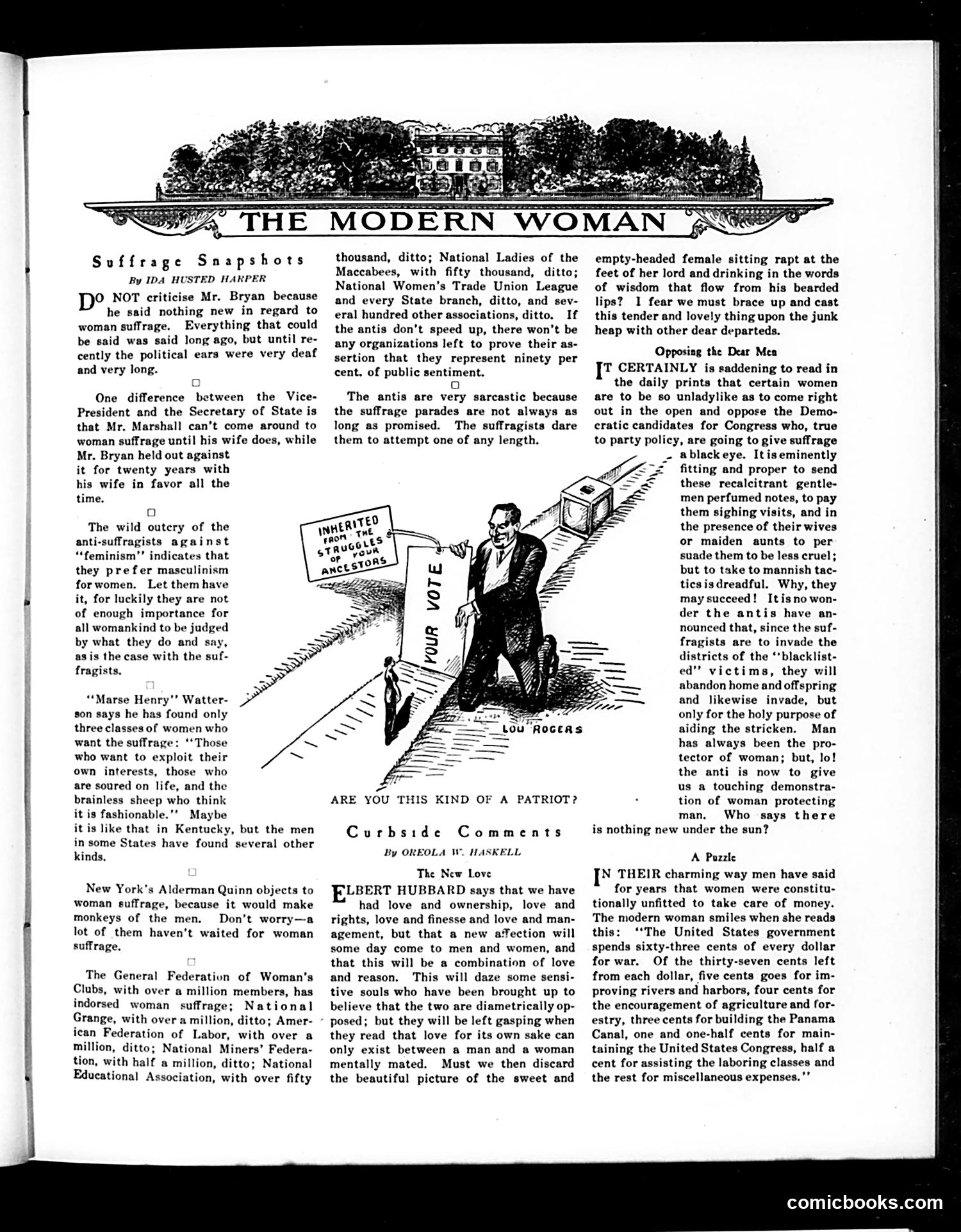
This Judge magazine page presents anti-suffrage and pro-suffrage arguments circa the 1910s women's voting rights debate. The main cartoon, captioned "Are You This Kind of a Patriot?" depicts a man labeled "Inherited from Ancestors" clutching a box marked "Public Vote," while a smaller figure (representing women/suffragists) approaches. The satire mocks male claims to patriotism while refusing to share voting rights. Ida Husted Harper's "Suffrage Snapshots" column supports suffrage, listing major organizations endorsing it (labor unions, women's clubs, educators) to undermine anti-suffragists' claims of representing public opinion. She ridicules anti-suffrage objections as outdated. The "Curbside Comments" section critiques both traditional gender dynamics and anti-suffrage women opposing Democratic candidates—mocking the notion that women should use only "feminine" persuasion rather than direct political action. The overall page presents suffrage advocacy dressed as satire, targeting male privilege and inconsistent female opposition to women's rights.
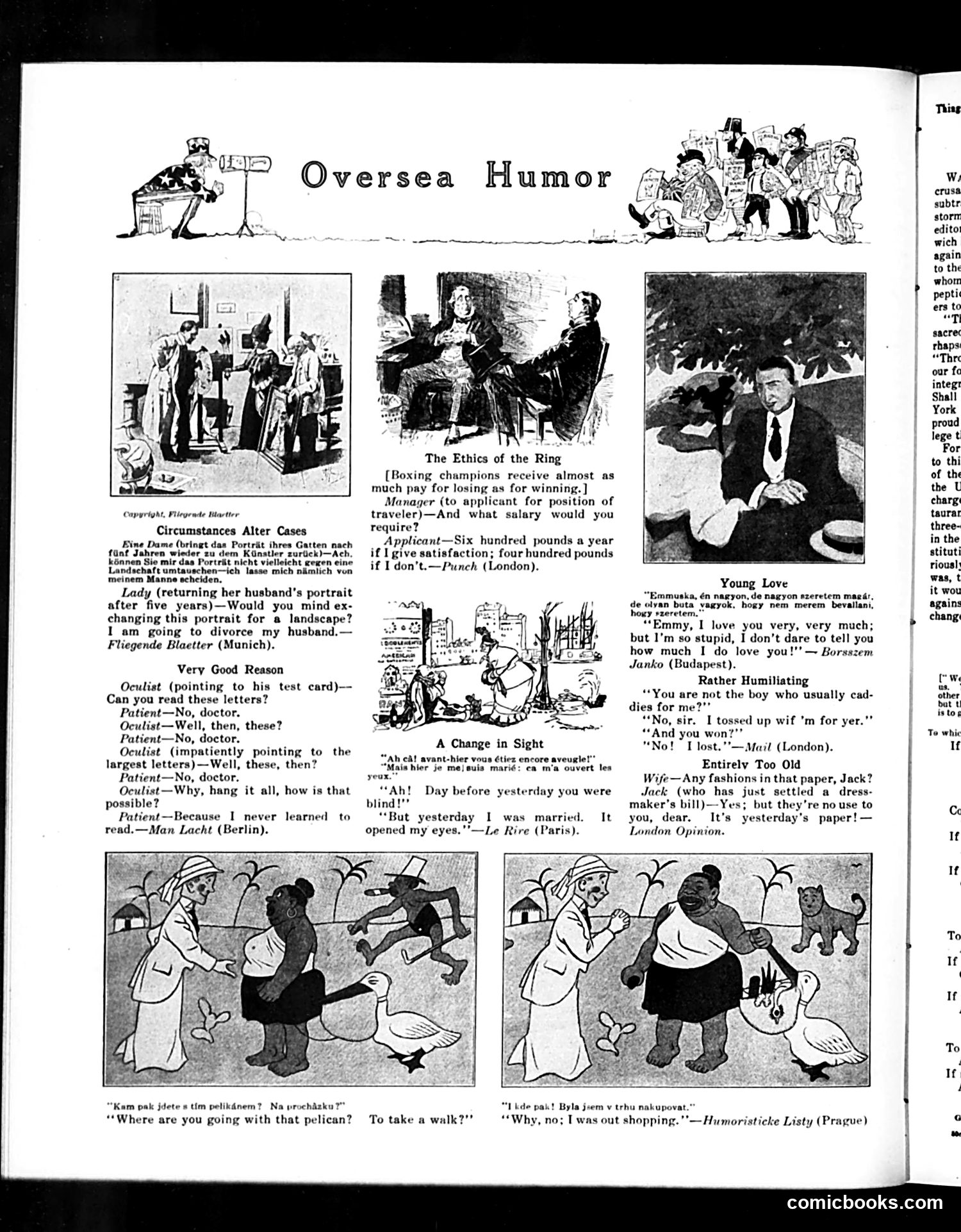
This page collects brief humorous anecdotes from European satirical magazines, translated for American *Judge* readers. The jokes reflect early-20th-century social attitudes: **"Circumstances Alter Cases"**: A wife returns her husband's portrait to an artist, requesting he paint a landscape instead—she's divorcing him. The humor lies in the casual cruelty of erasing her husband from her life. **"The Ethics of the Ring"**: Satirizes professional boxing's pay structure, where fighters earn nearly equal amounts whether winning or losing, encouraging dishonesty. **"A Change in Sight"**: A visual pun—marriage literally "opens the eyes" of a previously blind man. **"Young Love"** and **"Rather Humiliating"**: Showcase romantic timidity and aging anxieties. **"Entirely Too Old"**: A husband dismisses fashion advice as outdated—a jab at wives' fashion obsessions. The page's "international" framing (German, French, Hungarian sources) positions European sophistication against American readers, offering cosmopolitan wit.
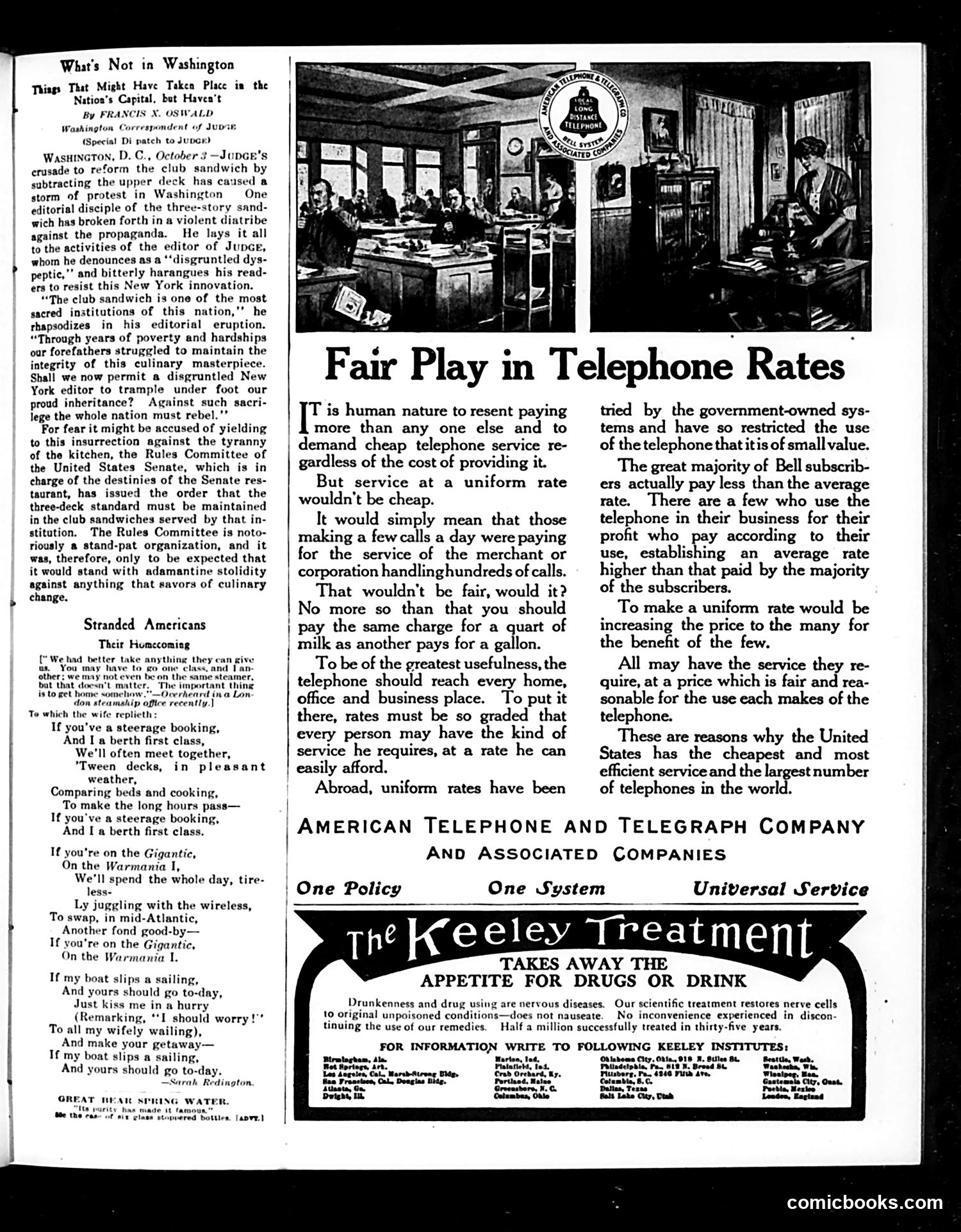
This page contains **satirical commentary and advertising** rather than political cartoons. The main article mocks Washington bureaucrats' resistance to change, using a ridiculous example: Judge magazine proposed reforming the club sandwich by removing its top layer, sparking outrage from a Washington editor who treats the three-deck sandwich as a sacred American institution. The Senate Rules Committee—described as obstinately "stand-pat"—officially mandates maintaining the three-deck standard in the Senate restaurant. The satire ridicules how government institutions cling rigidly to tradition even in trivial matters. A secondary poem humorously depicts couples separated by different ship classes during transatlantic crossings, playing on anxieties about immigration and class separation. The large **AT&T advertisement** defends non-uniform telephone rates as fair, arguing that charging everyone equally would unfairly burden light users to subsidize heavy business users. This appears to address contemporary regulatory debates about telephone pricing fairness.
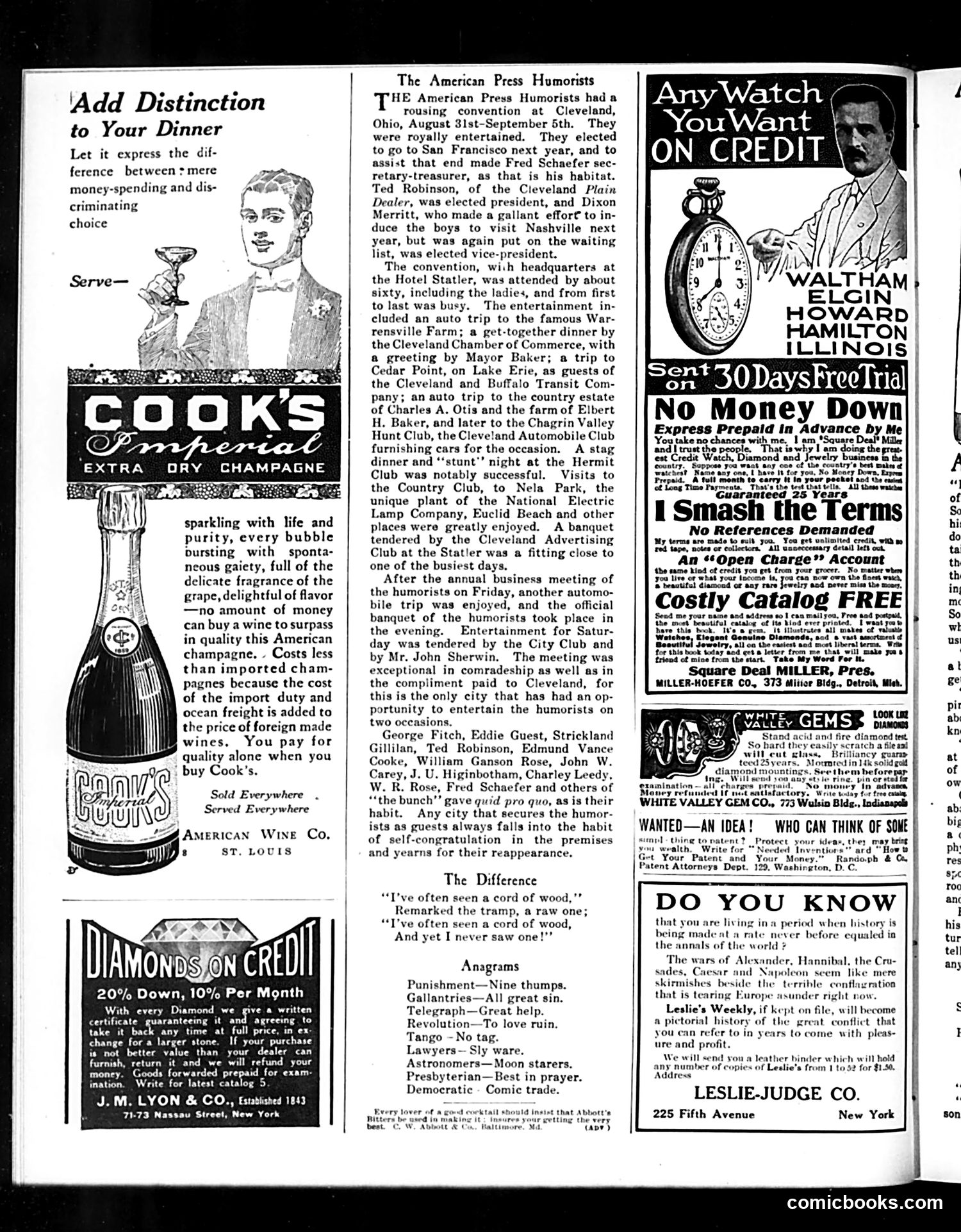
This page is primarily **advertising with one small humor piece**. The main content describes an American Press Humorists convention held in Cleveland, Ohio in late August/early September (year not specified in visible text). The humor section, "The Difference," is a simple wordplay joke: a tramp claims to have seen "a cord of wood" many times but never "saw one"—playing on the homophone "saw/cord" versus "saw one" (a pun on the verb "see"). The advertisements promote luxury goods (Cook's champagne, watches on credit, diamonds on payment plans), reflecting early 20th-century consumer credit marketing. These ads suggest Judge's readership was relatively affluent. The convention article lists prominent humorists and cartoonists of the era (names like Eddie Guest, Ted Robinson) and describes their Cleveland entertainment, emphasizing the social status and camaraderie of the profession.
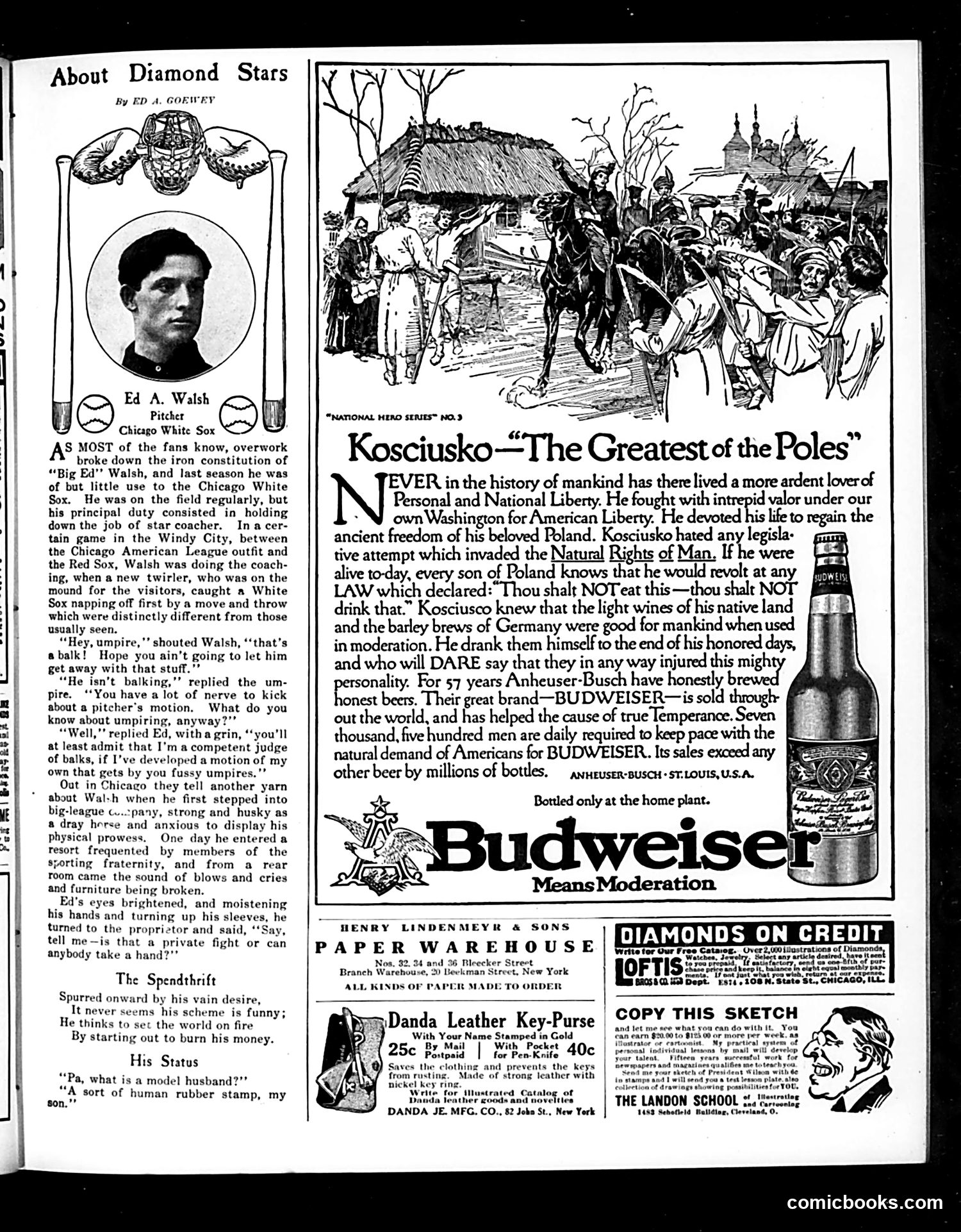
This page combines sports commentary with aggressive beer advertising disguised as patriotic rhetoric. **"About Diamond Stars"** profiles Ed A. Walsh, a Chicago White Sox pitcher whose career was damaged by overwork. The anecdotes illustrate his reputation as a tough, physical personality—the "model husband" joke at bottom suggests masculine ideals of the era. **The Kosciusko advertisement** is the page's most problematic content. It uses Polish Revolutionary War hero Thaddeus Kosciusko—a genuine symbol of liberty—to promote Budweiser beer. The ad falsely claims Kosciusko drank beer "in moderation" and argues that beer consumption represents personal freedom. This exploits immigrant nostalgia while reframing alcohol consumption as patriotic and temperate. The "National Hero Series" marketing strategy weaponizes historical figures to normalize drinking during the Prohibition era (the ad's era is unclear but the rhetoric suggests pre-Prohibition). The remaining advertisements are standard period classifieds for leather goods, paper supplies, and art instruction.
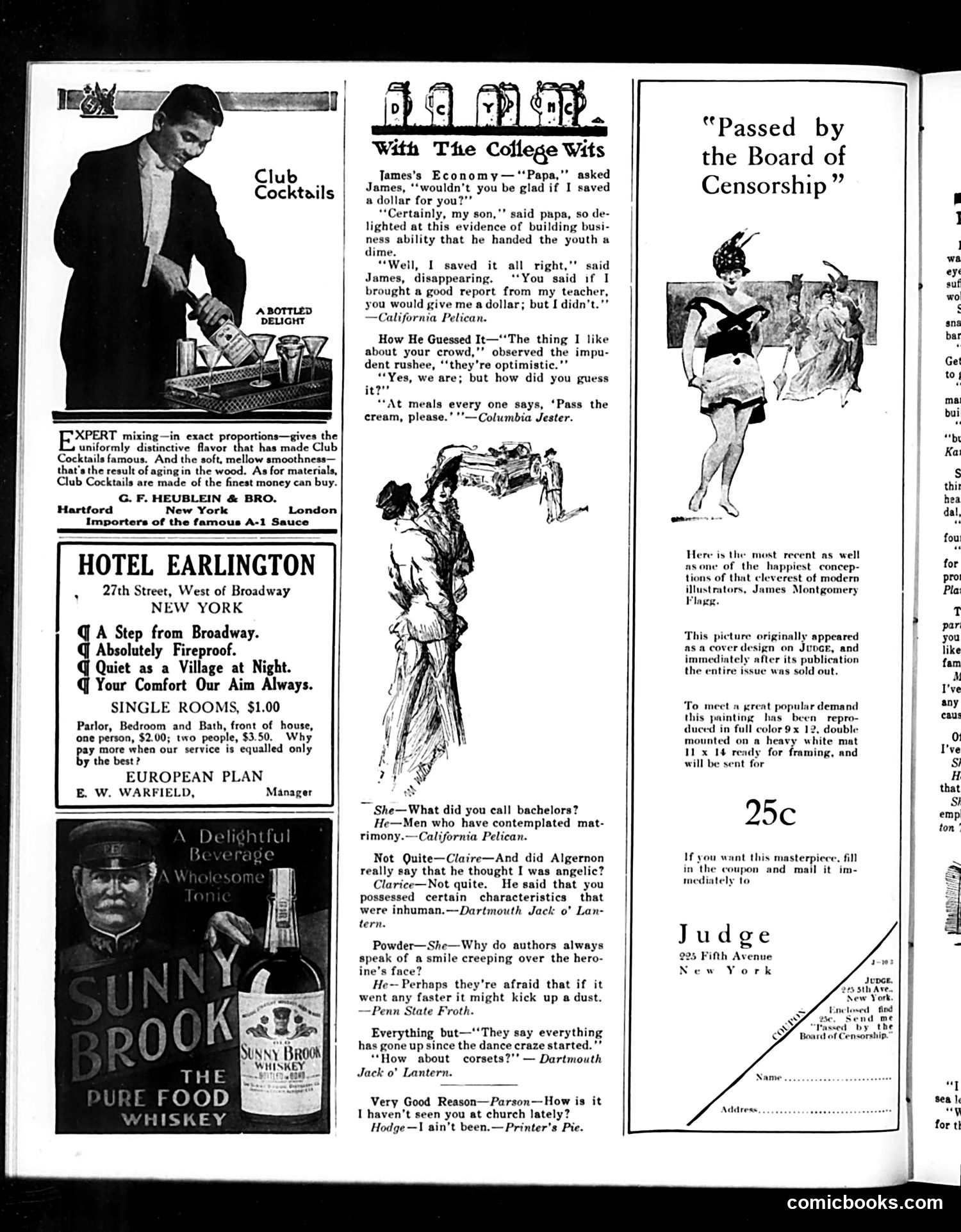
This page from *Judge* contains primarily **college humor and advertisements** rather than political satire. The "With The College Wits" section collects jokes from various college humor magazines (California Pelican, Columbia Jester, Dartmouth Jack o' Lantern, Penn State Froth). The jokes target predictable collegiate subjects: student frugality, optimism, romance, and social awkwardness. The humor is gentle and wholesome—a boy tricks his father into extra money; college students make obvious jokes at meals. The **"Passed by the Board of Censorship"** notice appears ironic. The accompanying James Montgomery Flagg illustration (which caused the issue to sell out) was apparently controversial enough to warrant censorship notification, though the image itself shows only a woman in 1920s attire—likely considered risqué for its time due to hemline length or pose. The advertisements (Club Cocktails, Hotel Earlington, Sunny Brook Whiskey) occupy significant space, reflecting the Prohibition-era magazine's commercial interests.
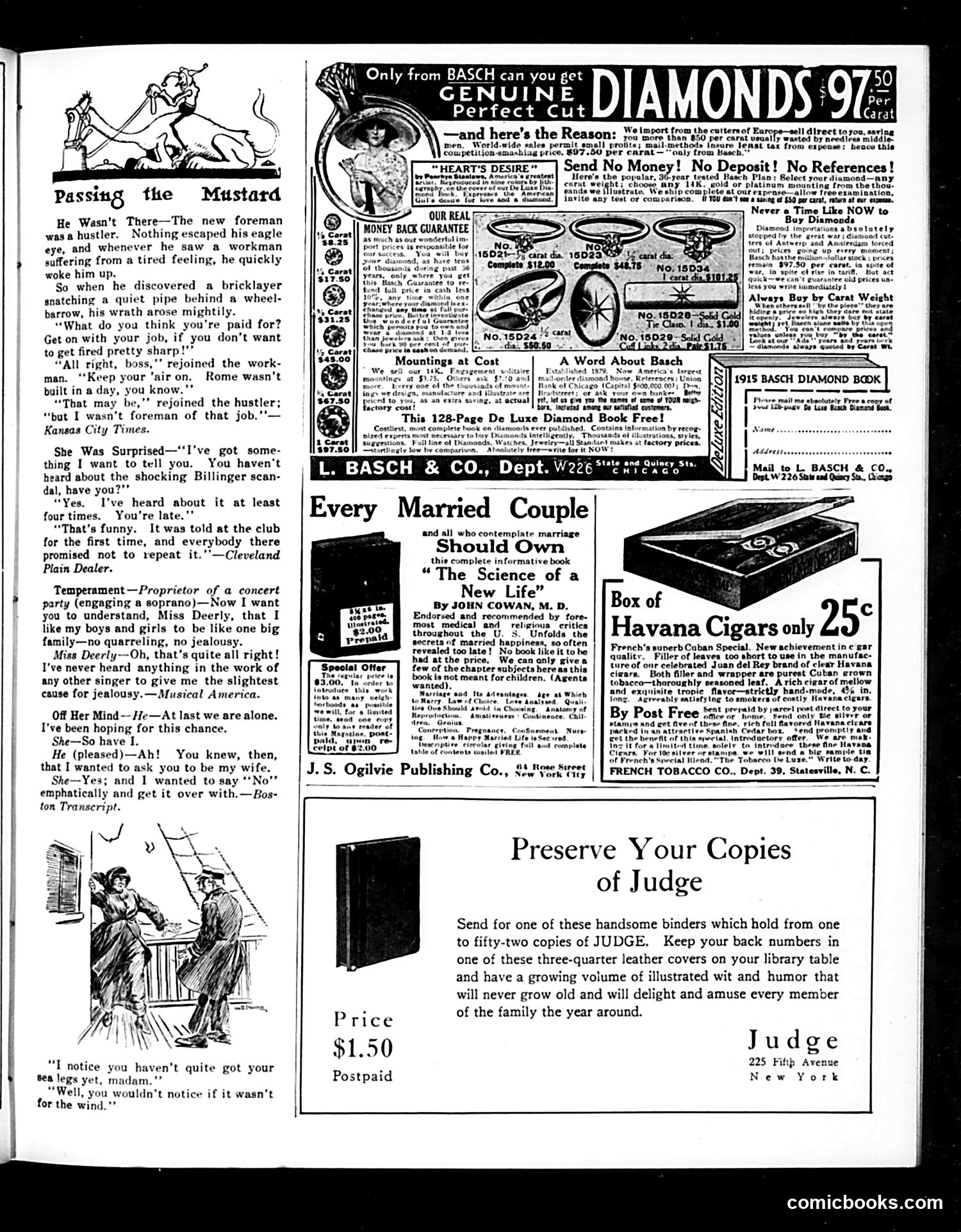
**Main Content & Context:** This is primarily a **page of advertisements** interspersed with short humorous pieces. The central narratives ("Passing the Mustard," "She Was Surprised," "Off Her Mind") are brief comic anecdotes typical of early 1900s humor magazines—workplace and domestic scenarios with twist endings relying on misunderstandings or wordplay. **Notable Advertisements:** - **Basch Diamonds** (top): Mail-order diamonds with payment plans—a response to early consumer credit emerging in 1910s America - **Havana Cigars (25¢)**: Premium tobacco advertising - **"Science of a New Life"**: A medical sex-education book marketed to married couples, revealing social anxiety about intimate knowledge in the era - **Judge preservation binders**: Promoting subscription/collection of the magazine itself **Historical Insight:** These anecdotes reflect labor dynamics (aggressive foreman culture), gossip-driven society, and courtship formality of the period. The advertisements reveal consumer capitalism expanding into working/middle-class markets through installment buying and mail-order services. The page demonstrates Judge's mix of satire, practical humor, and commercial appeal.
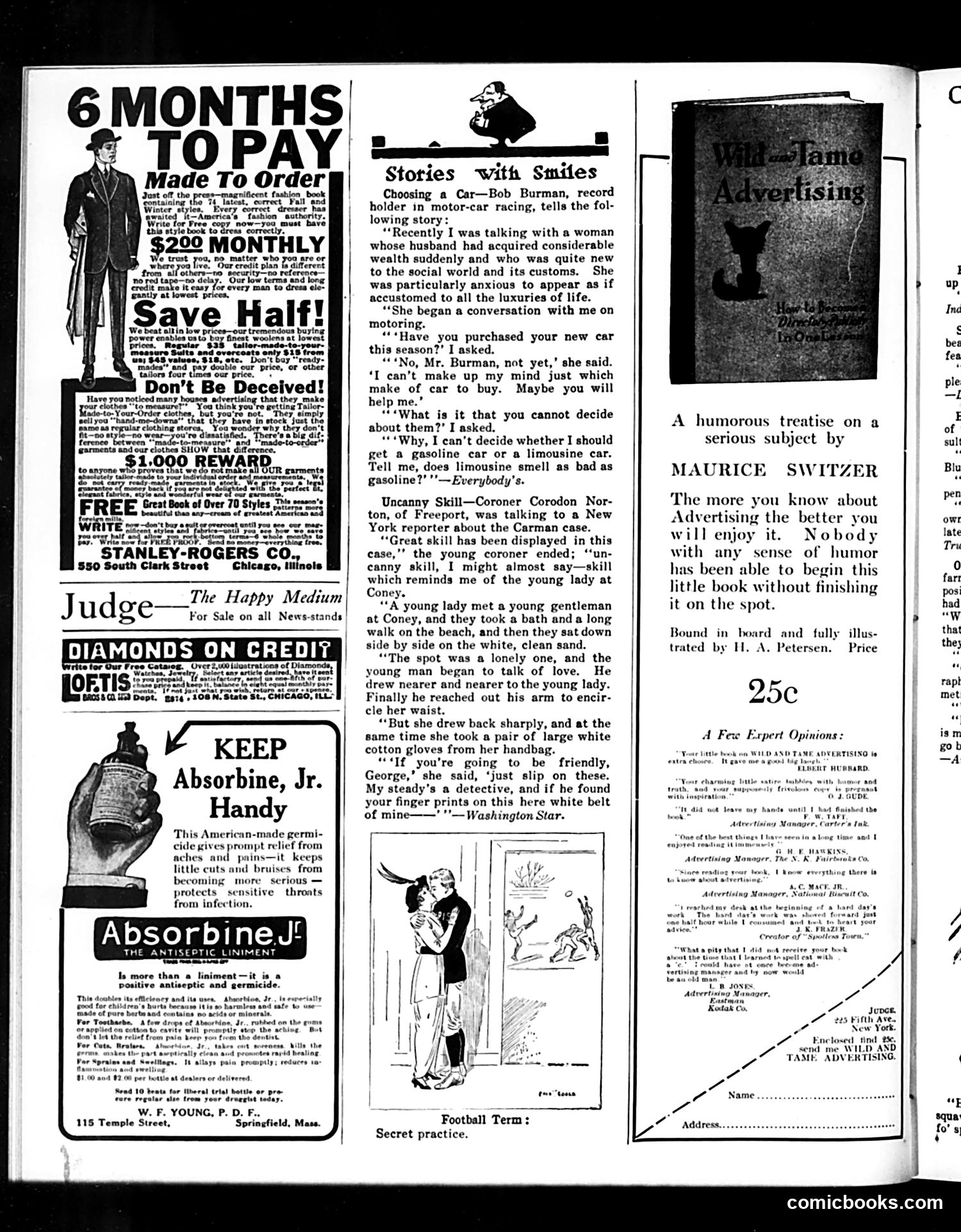
This page contains multiple satirical pieces from *Judge* magazine: **Main Content**: The "Stories with Smiles" section presents humorous anecdotes. The most prominent is Bob Burman's car story, where a newly wealthy woman asks whether a limousine or gasoline car "smells as bad"—satirizing social climbers who lack practical knowledge despite their newfound wealth. The joke mocks her pretense of sophistication while revealing ignorance. The second story about the young couple at Coney Island uses a punchline about "fingerprints"—the woman makes her suitor wear gloves, claiming her detective boyfriend would notice evidence of infidelity. This plays on early-20th-century anxieties about detection technology and courtship propriety. **Surrounding Advertisements**: The page is heavily dominated by period ads (clothing, diamonds on credit, Absorbine liniment) typical of magazines subsidizing content through advertising. The satire targets social pretension and the comedic gap between appearance and reality—core themes of *Judge's* humor.
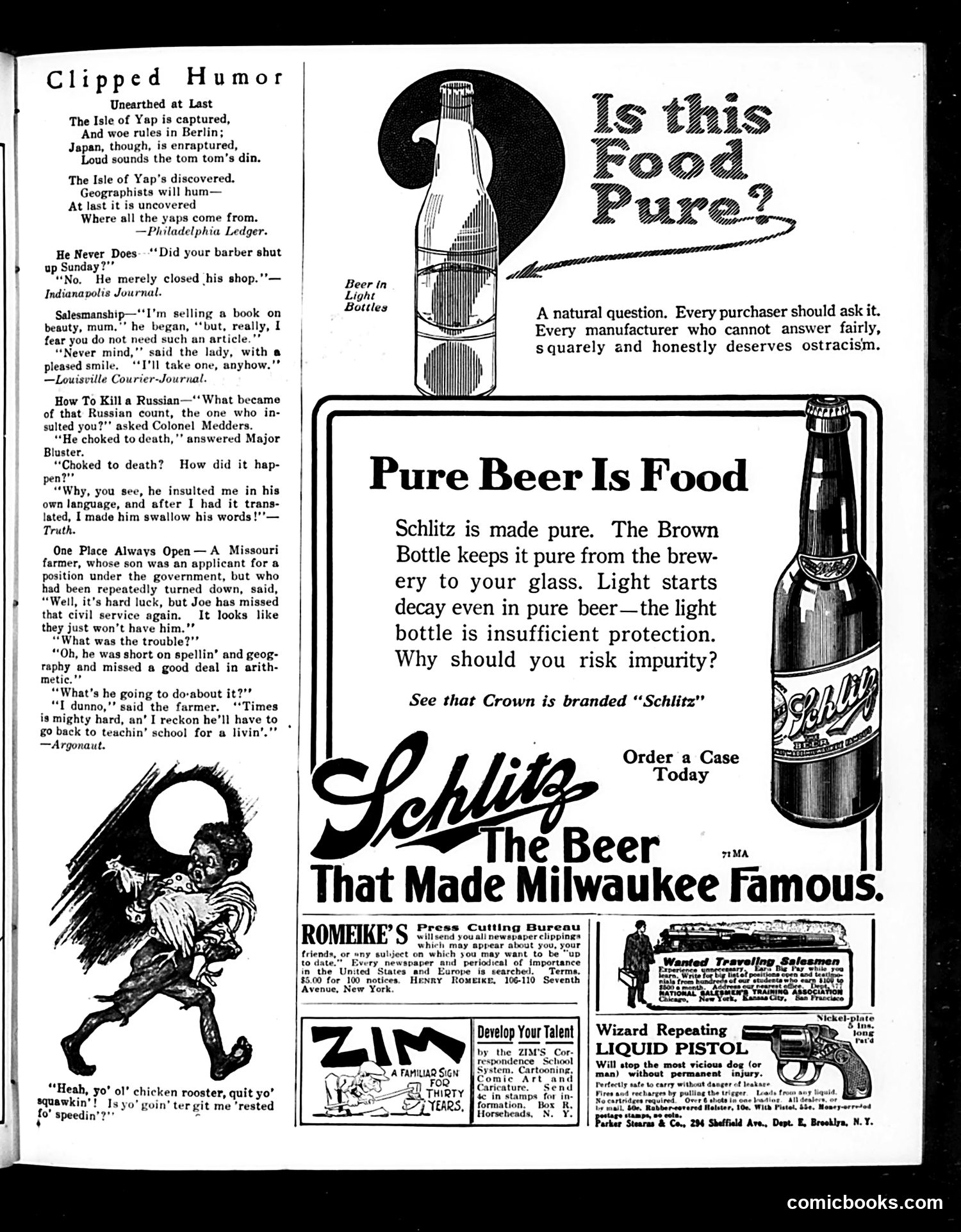
This page combines satirical humor pieces with period advertisements, primarily from around World War I era. **"Clipped Humor" Section:** Brief jokes reprinted from other newspapers. Notable is the "Isle of Yap" reference—Yap was a Pacific island disputed between Germany and Japan during WWI, making the pun about "yaps" (loud people) timely political commentary. **Main Advertisement:** A large Schlitz beer ad claims "Pure Beer Is Food" and emphasizes the brown bottle's protective qualities against light decay—a genuine marketing message about beer preservation. **Other Content:** Includes ads for a press clipping bureau, a "liquid pistol" toy gun, and Zim's cartooning correspondence course. A cartoon caricature appears to depict an African American character in period-stereotypical dialect ("Heah, yo' ol' chicken rooster"), reflecting common but offensive imagery typical of early 20th-century American publications. The page is primarily advertising-driven rather than editorial satire.
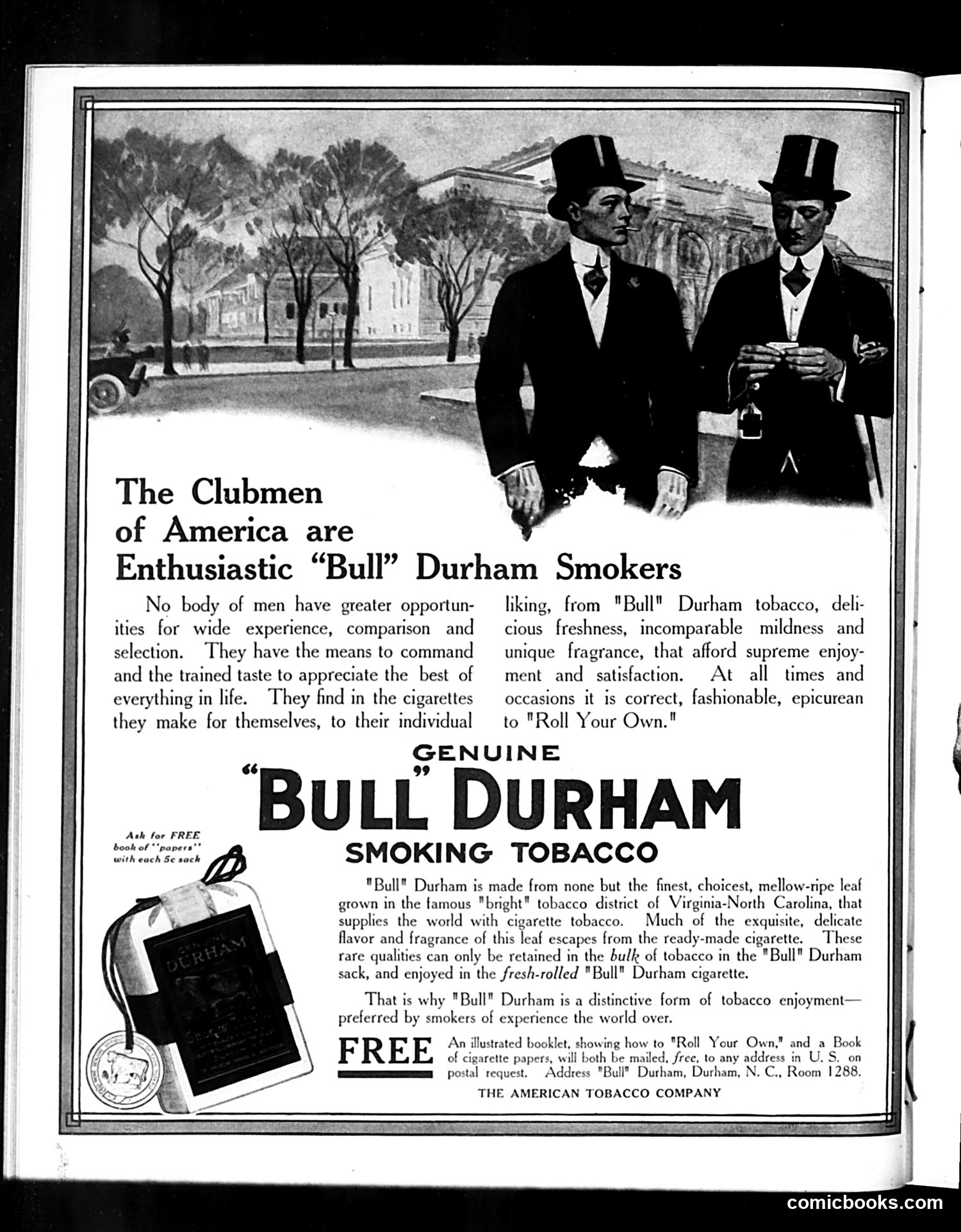
This is primarily a **tobacco advertisement**, not satire. It appears in *Judge*, a humor magazine, but functions as paid advertising for Bull Durham rolling tobacco. The ad targets affluent "clubmen" (upper-class gentlemen), depicting two well-dressed men in top hats near an exclusive club building. The pitch appeals to their sophistication: rolling your own cigarettes from bulk tobacco is positioned as more refined and "epicurean" than factory-made cigarettes, offering superior flavor and freshness. The text emphasizes that discriminating gentlemen with "trained taste" and "means to command" prefer Bull Durham's Virginia-North Carolina leaf. The ad includes an offer for free rolling papers and instructional booklets. This reflects early 20th-century tobacco marketing strategy: associating hand-rolled cigarettes with masculinity, wealth, and refined taste—a stark contrast to modern anti-smoking messaging.