
Judge, 1914-10-03 · page 17 of 24
Judge — October 3, 1914 — page 17: what you’re looking at
What you’re looking at
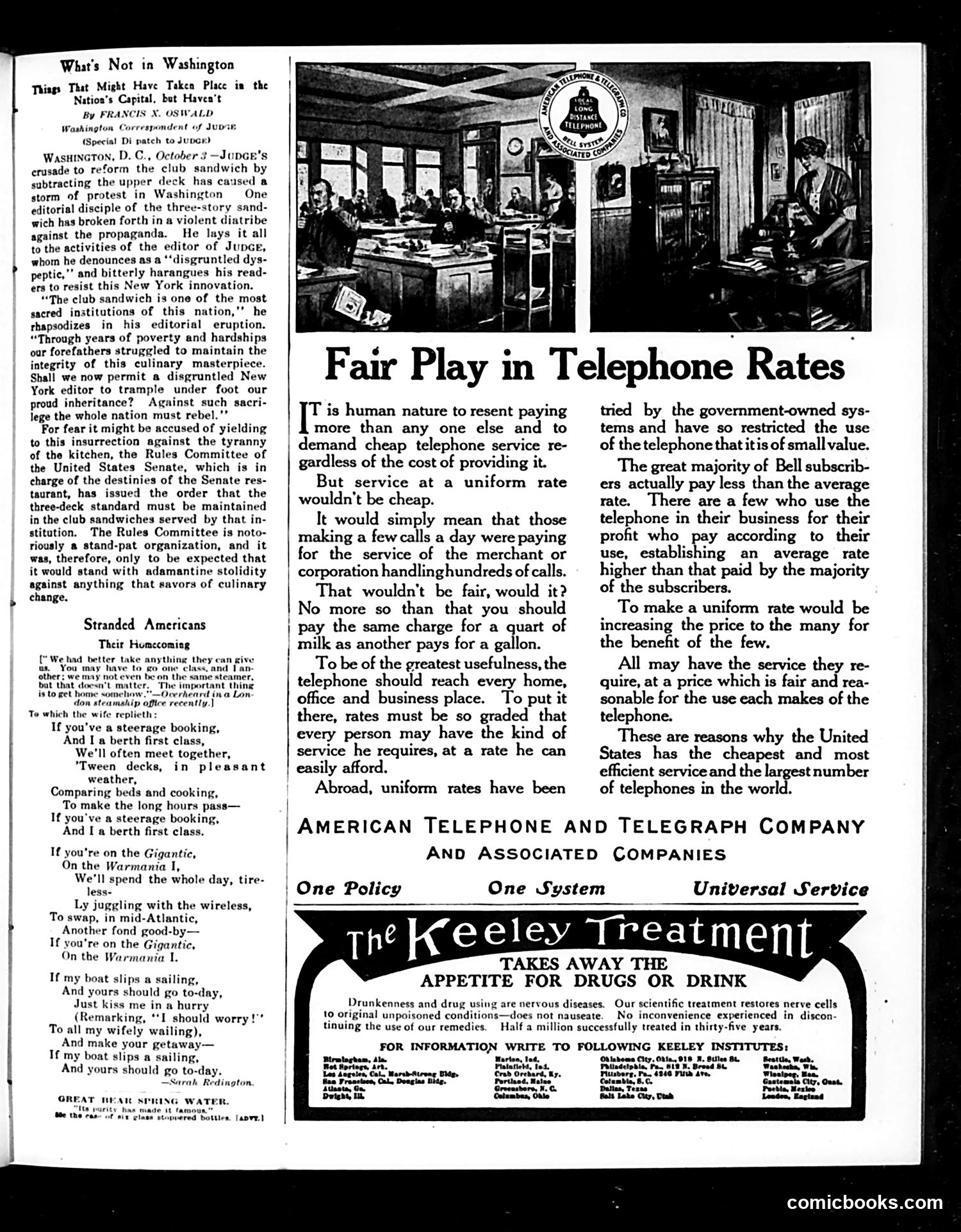
This page contains **satirical commentary and advertising** rather than political cartoons. The main article mocks Washington bureaucrats' resistance to change, using a ridiculous example: Judge magazine proposed reforming the club sandwich by removing its top layer, sparking outrage from a Washington editor who treats the three-deck sandwich as a sacred American institution. The Senate Rules Committee—described as obstinately "stand-pat"—officially mandates maintaining the three-deck standard in the Senate restaurant. The satire ridicules how government institutions cling rigidly to tradition even in trivial matters. A secondary poem humorously depicts couples separated by different ship classes during transatlantic crossings, playing on anxieties about immigration and class separation. The large **AT&T advertisement** defends non-uniform telephone rates as fair, arguing that charging everyone equally would unfairly burden light users to subsidize heavy business users. This appears to address contemporary regulatory debates about telephone pricing fairness.
📄 Transcribed text from this page (OCR, searchable)
Machine-transcribed from the original scan — historical spelling and the odd misread are preserved.
SS What's Not in Washington Things That Might Have Taken Place in the Nation’s Capital, bet Haven't FRANCIS X. OSWALD prrespondent of JUDIE (Special Di patch to Junced WasuincTon, D. C., October 3 —Jupce's crusade to reform the club sandwich by subtracting the upper deck has caused a storm of protest in Washington One editorial disciple of the three-story sand- wich has broken forth in a violent diatribe against the propaganda. He lays it all to the activities of the editor of Jupce, whom he denounces as a ‘disgruntled dys- peptic,”” and bitterly harangues his read- ers to resist this New York innovation. “The club sandwich is one of the most sacred institutions of this nation,’’ he thapsodizes in his editorial eruption. “Through years of poverty and hardships our forefathers struggled to maintain the integrity of this culinary masterpiece. Shall we now permit a disgruntled New York editor to trample under foot our proud inheritance? Against such sacri- lege the whole nation must rebel.’" For fear it might be accused of yielding to this insurrection against the tyranny of the kitchen, the Rules Committee of the United States Senate, which is in charge of the destinies of the Senate res- taurant, has issued the order that the three-deck standard must be maintained in the club sandwiches served by that in- stitution. The Rules Committee is noto- riously a stand-pat organization, and it was, therefore, only to be expected that it would stand with adamantine stolidity against anything that savors of culinary change. Stranded Americans Their Homecoming [" We had better thing they can give a ‘amship office recently.) To which the wife replieth : If you've a steerage booking, And I a berth first class, We'll often meet together, ‘Tween decks, in pleasant weather, Comparing beds and cooking, To make the long hours pass— If you've a steerage booking, And | a berth first class. If you're on the Gigantic, On the Warmania I, We'll spend the whole day, tire- less- Ly juggling with the wireless, To swap, in mid-Atlantic, Another fond good-by— If you're on the Gigantic, On the Warmania I. If my boat slips a sailing, And yours should go to-day, Just kiss me in a hurry (Remarking, ‘1 should worry !* To all my wifely wailing), And make your getaway— If my boat slips a sailing, And yours should go to-day. —Sarah R OREAT neat NG WATE! te the eae [. is human nature to resent paying more than any one else and to demand cheap telephone service re- gardless of the cost of providing it. But service at a uniform rate wouldn't be cheap. It would simply mean that those making a few calls a day were paying for the service of the merchant or corporation handlinghundreds of calls. That wouldn't be fair, would it? No more so than that you should | pay the same charge for a quart of milk as another pays for a sall:. To be of the greatest usefulness, the telephone should reach every home, office and business place. To put it there, rates must be so graded that every person may have the kind of service he requires, at a rate he can easily afford. Abroad, uniform rates have been | One Policy Fair Play in Telephone Rates One System ot tried by the government-owned sys- tems and have so restricted the use of the telephone that itis of small value. The great majority of Bell subscrib- ers actually pay less than the average rate. There are a few who use the telephone in their business for their profit who pay according to their use, establishing an average rate higher than that paid by the majority of the subscribers. To make a uniform rate would be increasing the price to the many for the benefit of the few. All may have the service they re- quire, at a price which is fair and rea- sonable for the use each makes of the telephone. These are reasons why the United States has the cheapest and most efficient service and the i i number of telephones in the world. | AMERICAN TELEPHONE AND TELEGRAPH COMPANY AND ASSOCIATED COMPANIES Universal Service tinuing the use of our remedies. the Weeley Treatment TAKES AWAY THE APPETITE FOR DRUGS OR DRINK Drunkenness and drug using are nervous diseases. Our scientific treatment restores nerve cells to original unpoisoned conditions—does not nauseate Half a million successfully treated in thirty-five years. No inconvenience experienced in discon- FOR INFORMATION WRITE TO FOLLOWING KEELEY INSTITUTES: Odtadome City. Ota. Palledcipains Fe. 81 Fittabarg, Pa. 4546 Filth Ave, Cotambte, 8.6. A, Sulles Bt os comicbooks.com