
Judge, 1914-10-03 · page 12 of 24
Judge — October 3, 1914 — page 12: what you’re looking at
What you’re looking at
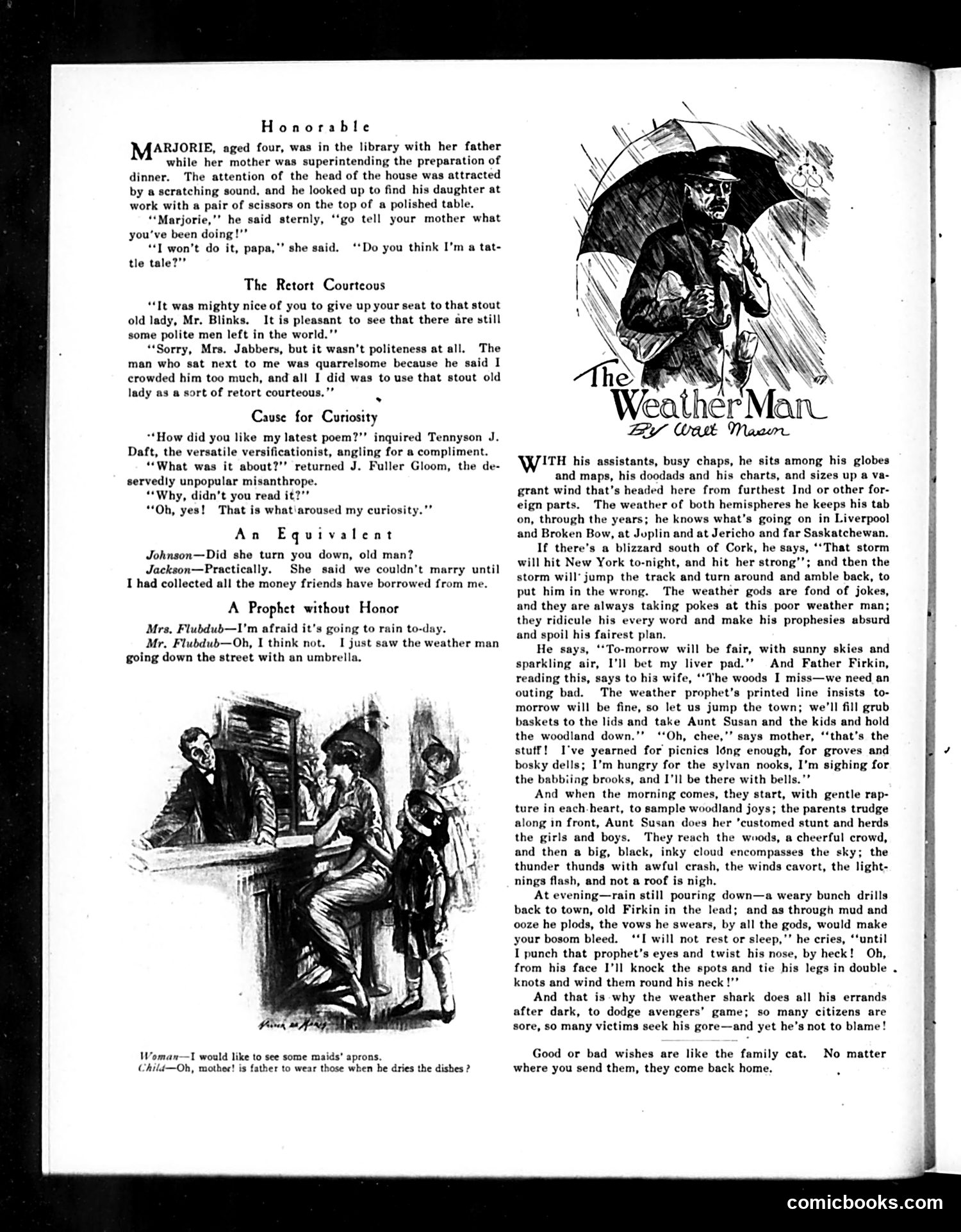
This page contains several brief humorous sketches plus a longer illustrated narrative poem titled "The Weather Man" by Walt Mason. The main illustrated story mocks weather forecasters' unreliability. A weather prophet confidently predicts fair skies, encouraging a family (the Firkins) to plan an outing. When they follow his advice and venture into the woods, a sudden storm drenches them—suggesting the forecaster's predictions are habitually wrong and often have the opposite effect of their intended use. The smaller pieces above satirize social pretense and hypocrisy: a child refusing to be a "tattletale," a man claiming politeness toward a woman while actually using her as a buffer against an aggressive passenger, and a man whose weather prediction fails because he carries an umbrella—implying his pessimism contradicts his stated optimism. The satire targets both professional incompetence and everyday human dishonesty.
📄 Transcribed text from this page (OCR, searchable)
Machine-transcribed from the original scan — historical spelling and the odd misread are preserved.
Honorable MA®0R IE, aged four, was in the library with her father while her mother was superintending the preparation of dinner. The attention of the head of the house was attracted by a scratching sound, and he looked up to find his daughter at work with a pair of scissors on the top of a polished table. “Marjorie,” he said sternly, ‘‘go tell your mother what you've been doing!"" “I won’t do it, papa,’’ she said. tle tale?” “Do you think I'm a tat- The Retort Courteous “It was mighty nice of you to give up your seat to that stout old lady, Mr. Blinks. It is pleasant to see that there are still some polite men left in the world.’’ “Sorry, Mrs. Jabbers, but it wasn’t politeness at all. The man who sat next to me was quarrelsome because he said I crowded him too much, and all I did was to use that stout old lady as a sort of retort courteous.” . Cause for Curiosity -*How did you like my latest poem?”’ inquired Tennyson J. Daft, the versatile versificationist, angling for a compliment. “What was it about?’’ returned J. Fuller Gloom, the de- servedly unpopular misanthrope. ‘Why, didn’t you read it?”’ “Oh, yes! That is whatiaroused my curiosity."’ An Equivalent Johnson—Did she turn you down, old man? Jackson—Practically. She said we couldn't marry until Thad collected all the money friends have borrowed from me. A Prophet without Honor Mrs, Flubdub—I'm afraid it's going to rain to-day. Mr. Flubdub—Oh, I think not. I just saw the weather man going down the street with an umbrella. Woman—I would like to see some maids’ aprons. Chil4—Oh, mother! is father to wear those when be dries the dishes ? By West Mawr WITH his assistants, busy chaps, he sits among his globes and maps, his doodads and his charts, and sizes up a va- grant wind that’s headed here from furthest Ind or other for- eign parts. The weather of both hemispheres he keeps his tab on, through the years; he knows what's going on in Liverpool and Broken Bow, at Juplin and at Jericho and far Saskatchewan. If there’s a blizzard south of Cork, he says, ‘‘That storm will hit New York to-night, and hit her strong’’; and then the storm will’ jump the track and turn around and amble back, to put him in the wrong. The weather gods are fond of jokes, and they are always taking pokes at this poor weather man; they ridicule his every word and make his prophesies absurd and spoil his fairest plan. He says, ‘To-morrow will be fair, with sunny skies and sparkling air, I'll bet my liver pad.’? And Father Firkin, reading this, says to his wife, ‘‘The woods I miss—we need an outing bad. The weather prophet’s printed line insists to- morrow will be fine, so let us jump the town; we'll fill grub baskets to the lids and take Aunt Susan and the kids and hold the woodland down.’’ ‘‘Oh, chee,’’ says mother, ‘‘that’s the stuff! I've yearned for picnics Iéng enough, for groves and bosky dells; I’m hungry for the sylvan nooks, I’m sighing for the babbiing brooks, and I'll be there with bells.” And when the morning comes, they start, with gentle rap- ture in each-heart, to sample woodland joys; the parents trudge along in front, Aunt Susan does her ‘customed stunt and herds the girls and boys. They reach the woods, a cheerful crowd, and then a big, black, inky cloud encompasses the sky; the thunder thunds with awful crash, the winds cavort, the light- nings flash, and not a roof is nigh. At evening—rain still pouring down—a weary bunch drills back to town, old Firkin in the lead; and as through mud and ooze he plods, the vows he swears, by all the gods, would make your bosom bleed. ‘‘I will not rest or sleep,’’ he cries, ‘‘until I punch that prophet’s eyes and twist his nose, by heck! Oh, from his face I'll knock the spots and tie his legs in double knots and wind them round his neck !’’ And that is why the weather shark does all his errands after dark, to dodge avengers’ game; so many citizens are sore, so many victims seek his gore—and yet he’s not to blame! Good or bad wishes are like the family cat. No matter where you send them, they come back home. . LAT TEE comicbooks.com