
A complete issue · 24 pages · 1914
Judge — August 8, 1914
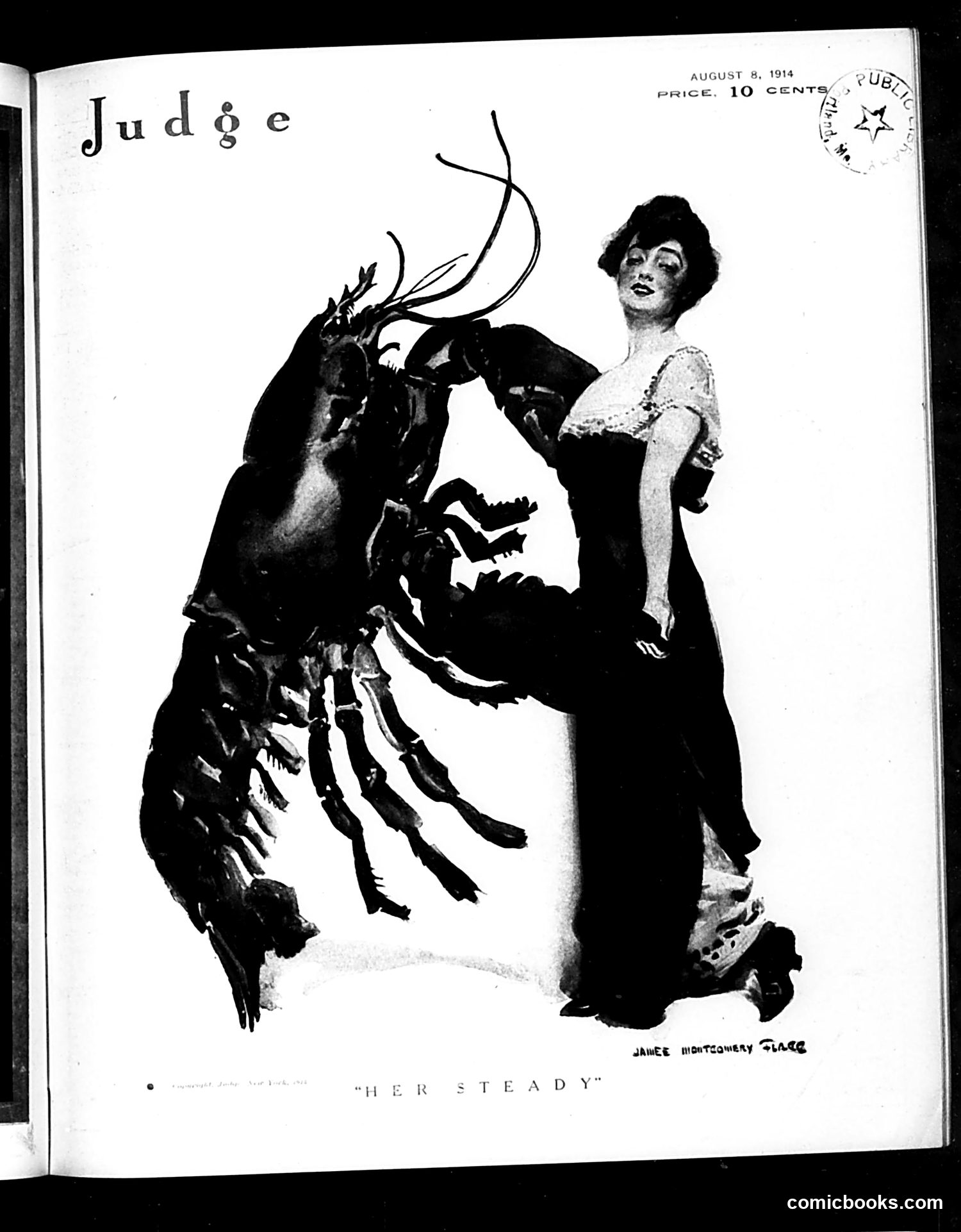
This illustration by James Montgomery Flagg satirizes courtship through a humorous visual metaphor. A woman in Edwardian dress presents a dead game bird (likely a pheasant or similar fowl) to a grotesque, demonic male figure with prominent horns and exaggerated features. The title "Her Steady" suggests this unattractive creature is her boyfriend or suitor. The joke appears to mock either the woman's poor taste in romantic partners or, alternatively, to satirize how women might view their male suitors as monstrous or undesirable—a common theme in early 20th-century humor about courtship anxieties. The image plays on contemporary anxieties about romance and marriage during this era.
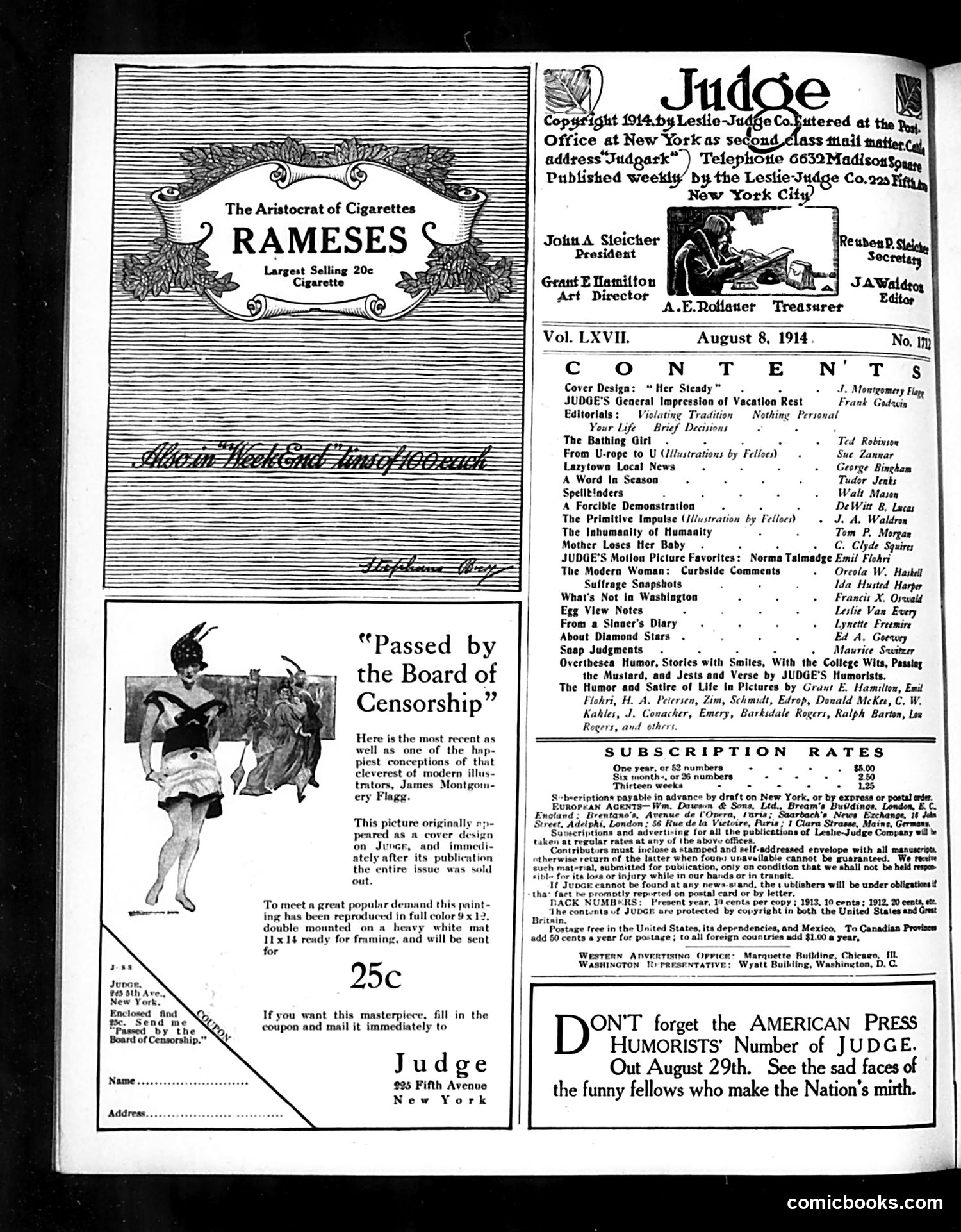
This page is primarily **advertising and masthead information** for Judge magazine. The main visual element is a **Rameses cigarette advertisement** featuring decorative Art Nouveau styling and the slogan "The Aristocrat of Cigarettes." Below that is a censorship-related cartoon showing a figure labeled "Passed by the Board of Censorship," satirizing movie censorship practices. The accompanying text explains this image was originally rejected from Judge but subsequently approved, highlighting the absurdity of censorship boards' inconsistent decisions. The page includes publication details, subscription rates (25 cents), and masthead information listing editors and staff. There's also a promotion for an upcoming "American Press Humorists' Number" launching August 29th. The overall content reflects early 20th-century magazine operations and contemporary debates about artistic freedom versus censorship.
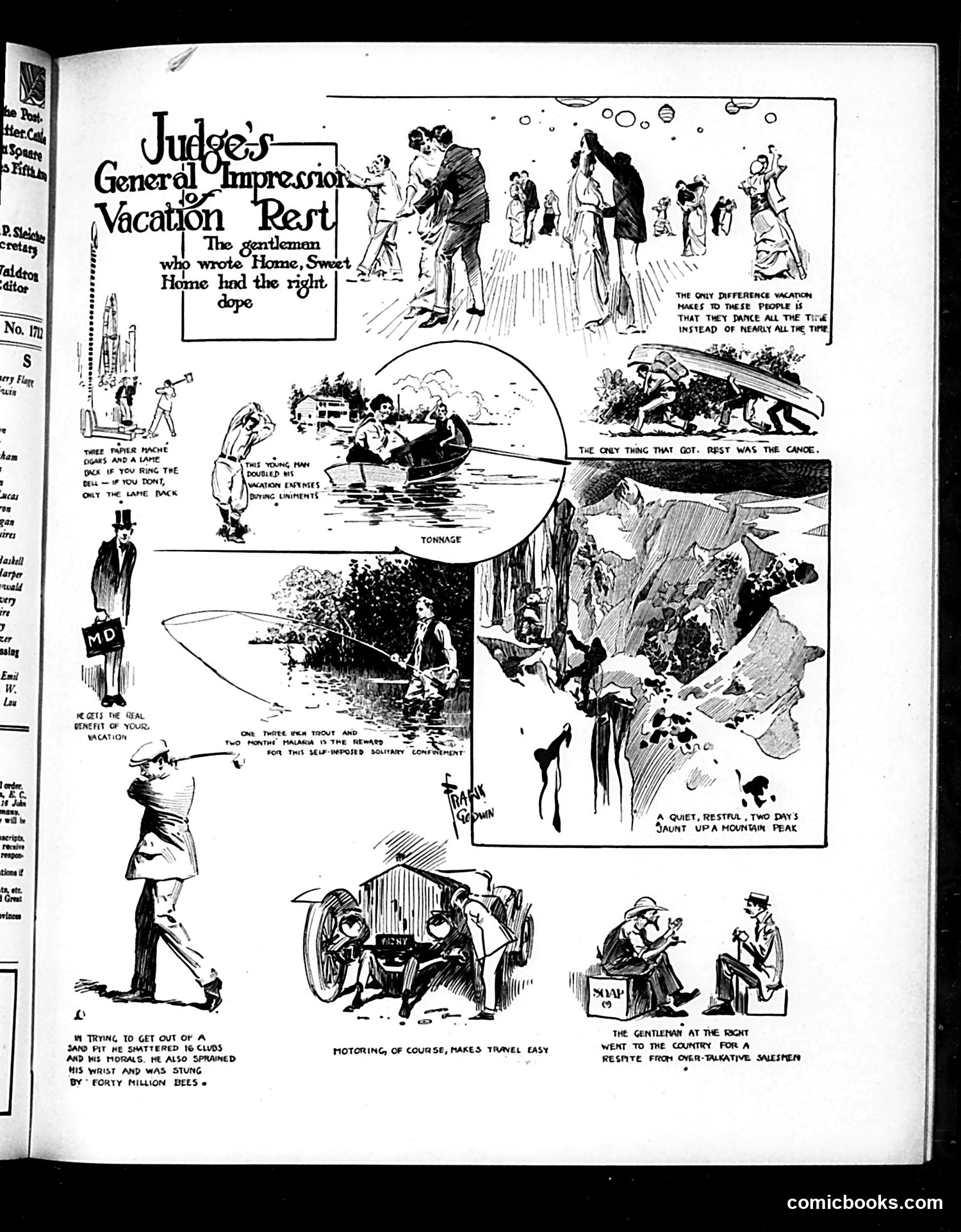
This satirical page mocks the reality versus fantasy of vacation destinations, attributed to a gentleman who wrote "Home, Sweet Home" and "had the right dope." The cartoons depict various vacation activities presented as idyllic but revealing their actual frustrations: crowded beaches, uncomfortable boating, strenuous hiking, and failed fishing. The repeated caption structure emphasizes the gap between promotional promises and disappointing reality. One panel shows a gentleman attempting golf while being "stung by forty million bees"—exaggerating minor vacation annoyances into absurdity. Another satirizes "motoring" as supposedly making travel easy, while illustrations show mechanical breakdowns and travel chaos. The overall message critiques how vacation destinations advertise leisure and relaxation while delivering crowded, uncomfortable, and often frustrating experiences. It's a commentary on commercial hype misleading the public about recreational getaways.
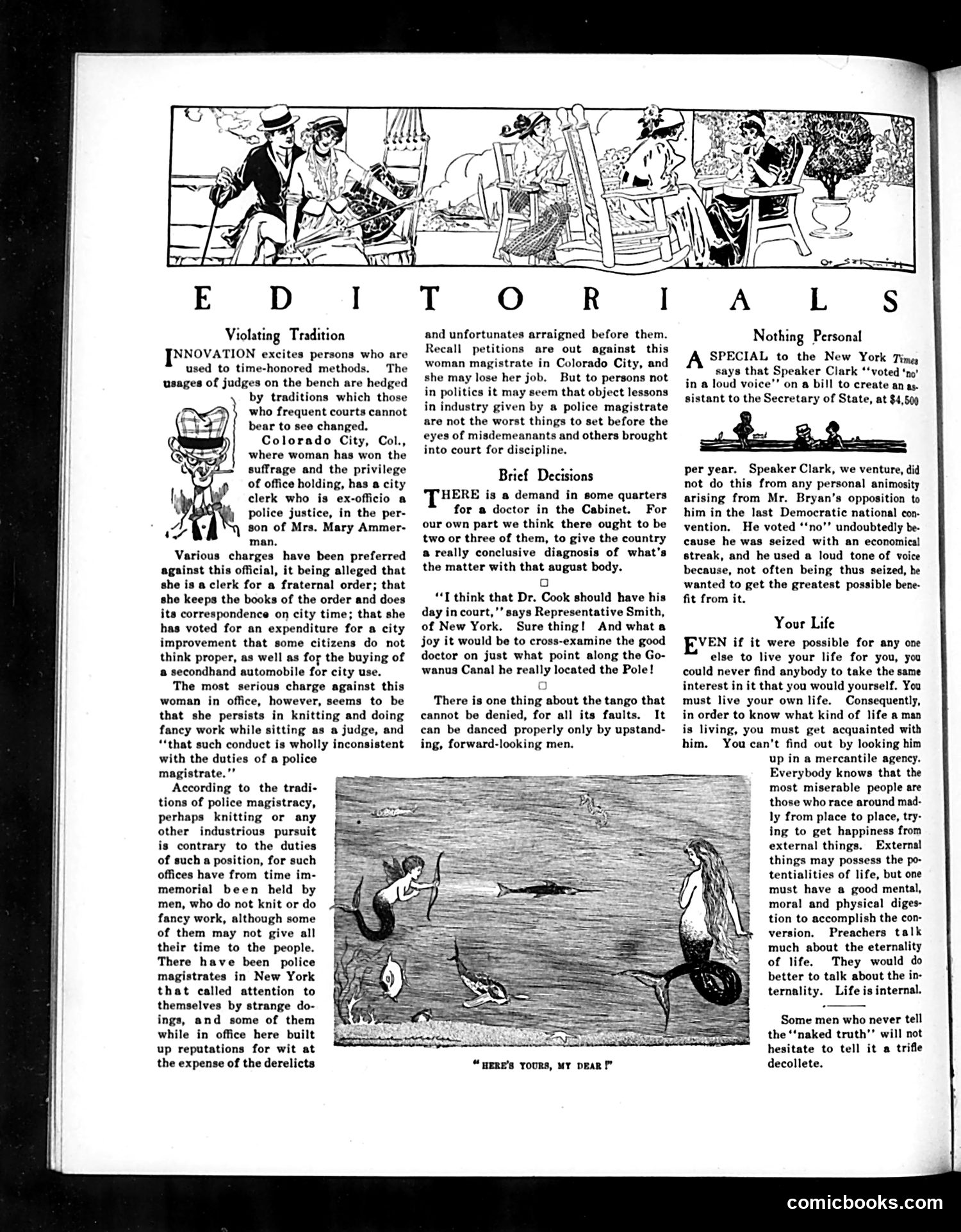
This editorial page from *Judge* magazine contains three distinct sections addressing early 20th-century governance issues. **"Violating Tradition"** critiques a female police official in Colorado City who was fired, arguing that police work traditionally requires full-time dedication—incompatible with "fancy work" like knitting. The accompanying caricature ridicules the notion of women in law enforcement. **"Brief Decisions"** discusses calls for Cabinet-level doctors and comments on Dr. Cook (likely the Arctic explorer) and the Gowanus Canal location controversy. **"Your Life"** (right column) offers philosophical advice about living authentically rather than seeking external validation—a common early-20th-century moral essay. The central illustration, captioned "Here's Yours, My Dear," depicts men at leisure but its specific satirical target is unclear from context alone.
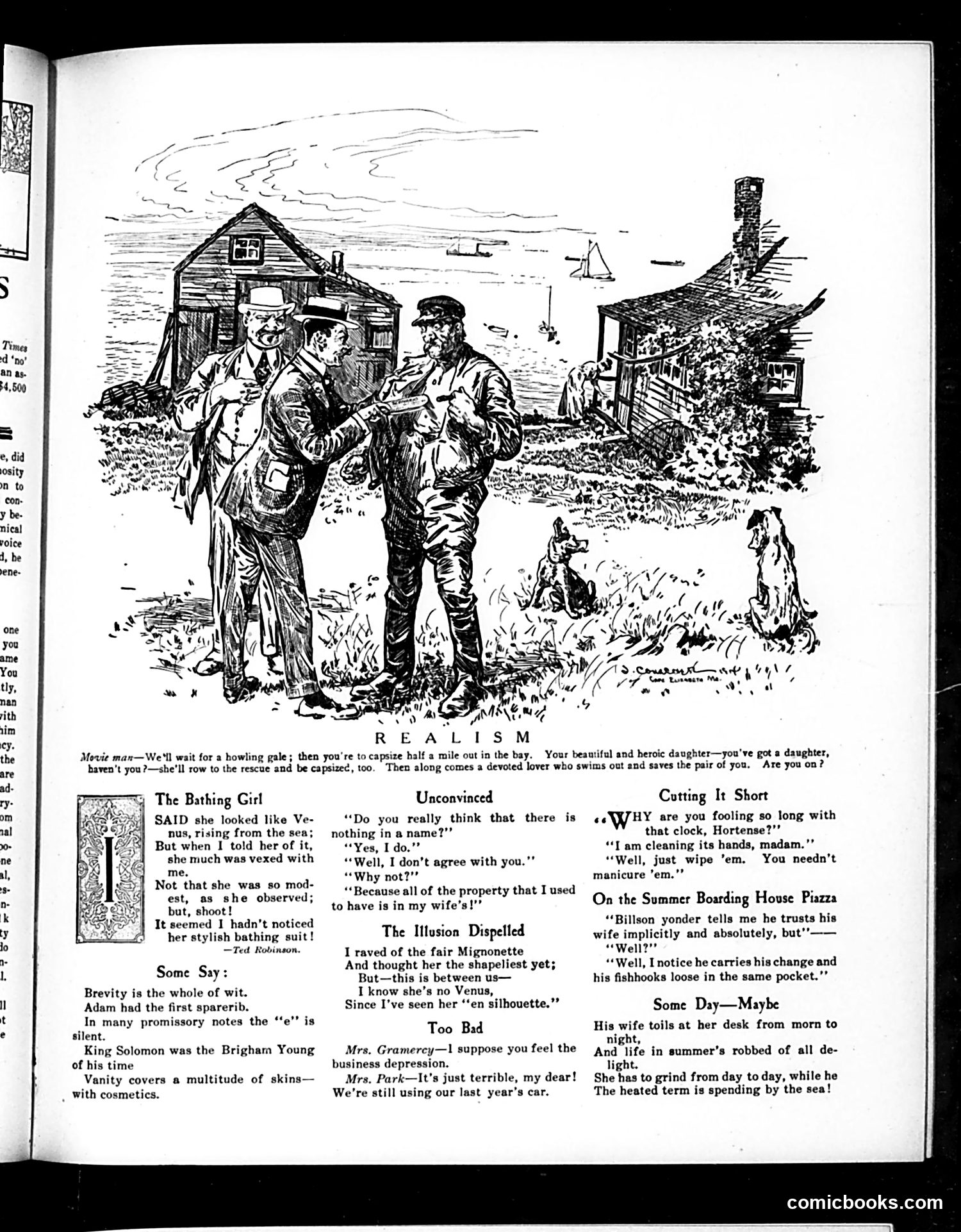
The main cartoon depicts three men in suits examining coastal property with fishing shacks visible behind them. The caption "REALISM" introduces a real-estate transaction joke: a wealthy buyer is being sold waterfront land, told it includes "a beautiful and heroic daughter" who "swims out and saves the pair of you." The humor satirizes deceptive real-estate marketing practices—promising impossible amenities alongside property. The surrounding text pieces ("The Bathing Girl," "The Illusion Dispelled," "Cutting It Short," etc.) are brief comic anecdotes about domestic life, marital misunderstandings, and social situations. These appear designed as filler humor rather than political commentary. The page primarily mocks early 20th-century consumer culture and marketing fraud through everyday scenarios rather than addressing specific political figures or events.
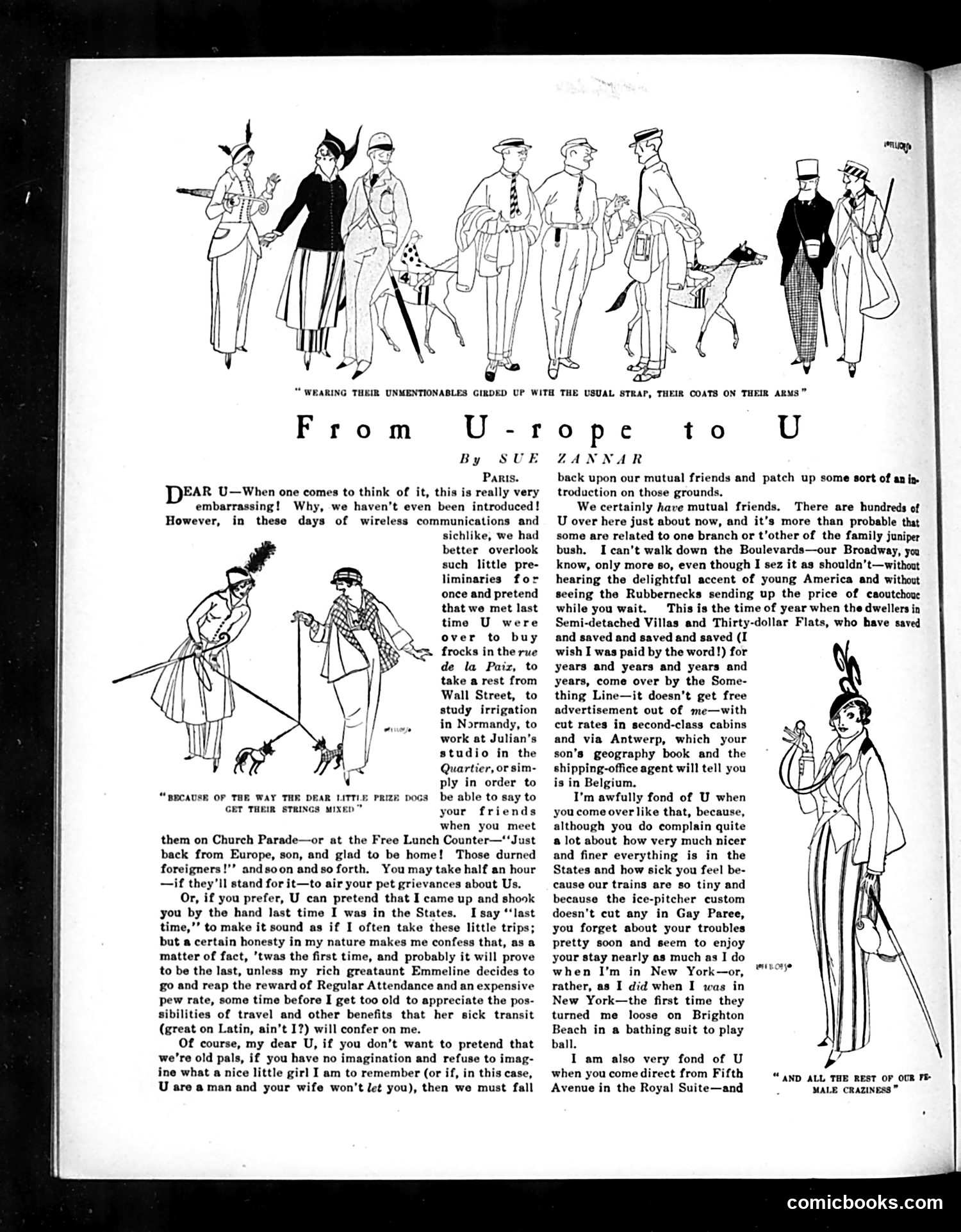
This is a humorous letter-essay by Sue Zannar addressing American tourists visiting Europe (particularly Paris). The cartoon illustrations depict fashionable Americans abroad—recognizable by their distinctive clothing and accessories. The satire targets American tourists' behavior: their tendency to complain that European amenities (trains, ice service, etc.) are inferior to American standards, while simultaneously bragging about their European travels back home as a mark of sophistication. Zannar gently mocks the pretense of these visits—whether for buying fashions on Rue de la Paix, studying art, or simply acquiring stories to impress friends at church. The piece also pokes fun at American ignorance (references to geography errors) and their conspicuous consumption during European travels. The "dear little prize dogs" caption references tangled leashes—a metaphor for the confusion of American tourists abroad. Overall, it's affectionate satire aimed at a Judge readership composed largely of the very tourists being lampooned.
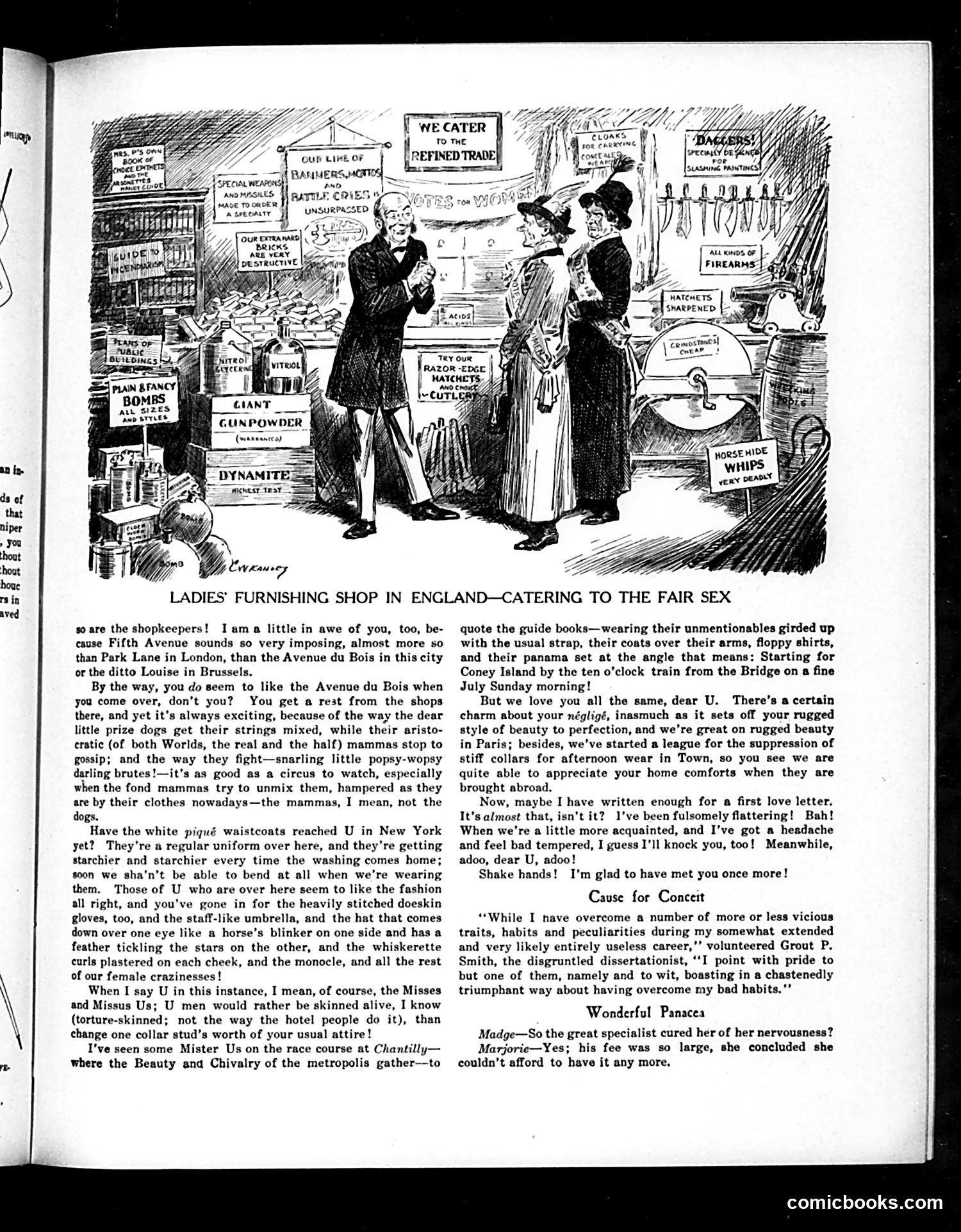
This page contains a satirical cartoon and accompanying humorous essay about gender and consumer culture in the early 20th century. **The Cartoon:** Depicts a ladies' furnishing shop stocked with incongruous items—explosives (dynamite, gunpowder, bombs), fishing equipment, and whips alongside typical women's goods. Three well-dressed female customers browse while a shopkeeper gestures. The joke satirizes the expansion of women's consumer interests and purchasing power beyond traditional "feminine" goods, suggesting women now buy anything men do. **The Essay:** Written as a letter from a correspondent abroad, it humorously catalogs British and Continental fashion affectations among American women visitors—piqué waistcoats, stitched gloves, monocles, and exaggerated styling. The author mockingly admires English shopkeepers while commenting on the absurdity of women's fashion constraints and men's resistance to style changes. **Overall Point:** Early 20th-century satire of women's growing independence, consumer culture, and the gap between rigid social expectations and actual behavior.
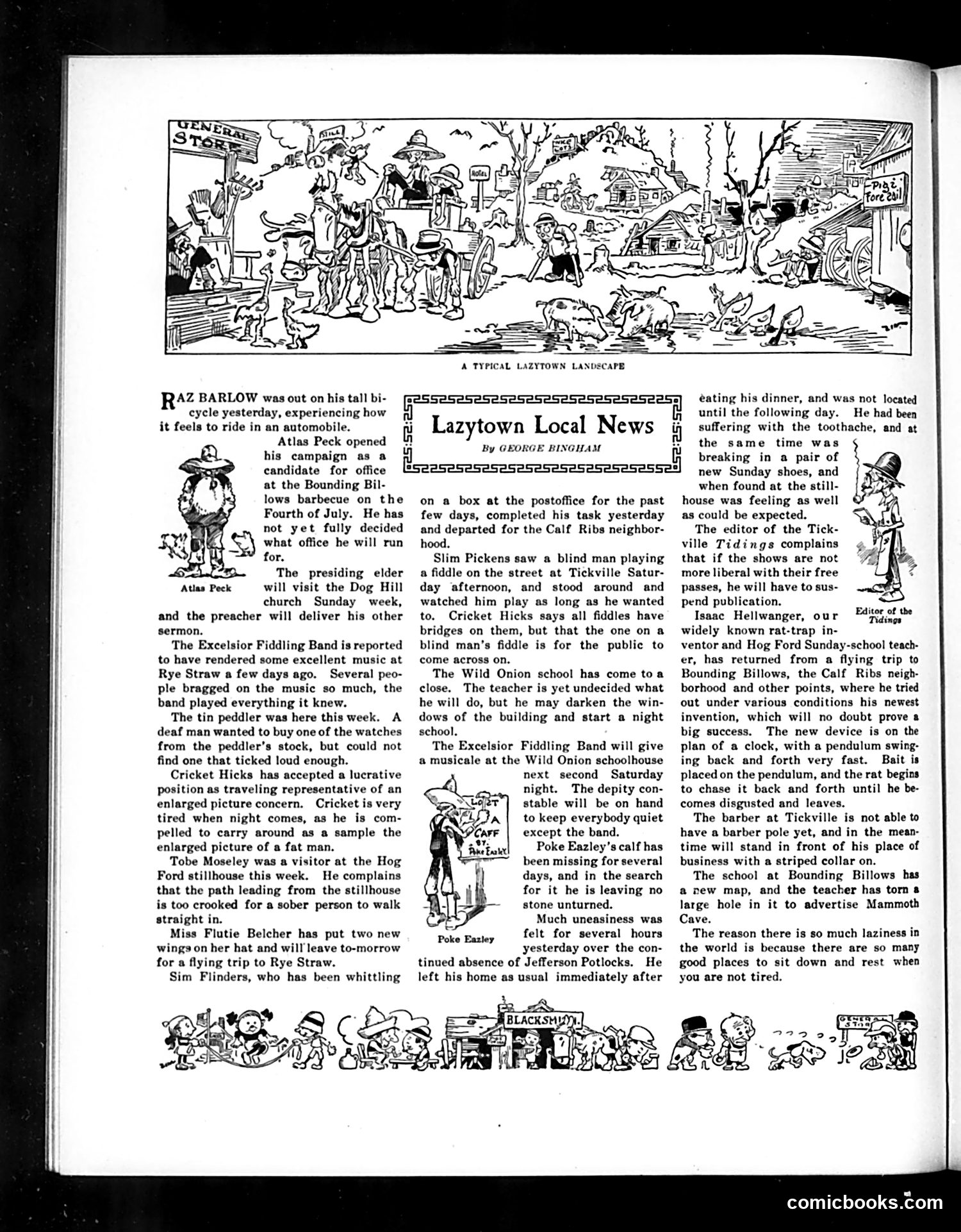
This is a humorous rural gossip column satirizing small-town life through exaggerated anecdotes. By George Bingham, it mocks provincial peculiarities and absurdities: **Key satirical targets:** - Rural inefficiency (the tin peddler selling unwound watches; the stillhouse path "too crooked for a sober person") - Small-town vanity (Atlas Peck's unclear political ambitions; the barber unable to afford a barber pole) - Backwards logic (the bridge on a blind fiddle "for the public to come across on"; a night school in darkened windows) - Petty concerns (the editor threatening to suspend publication over free show passes) **The humor relies on:** Deadpan presentation of nonsensical situations as normal local news. Characters' names (Poke Eazley, Slim Pickens) and invented towns (Tickville, Hog Ford) enhance the rustic caricature. The piece gently ridicules rural American culture—not maliciously, but as quaint and amusingly illogical to urban magazine readers. The top cartoon illustrates this "typical Lazytown landscape" visually.
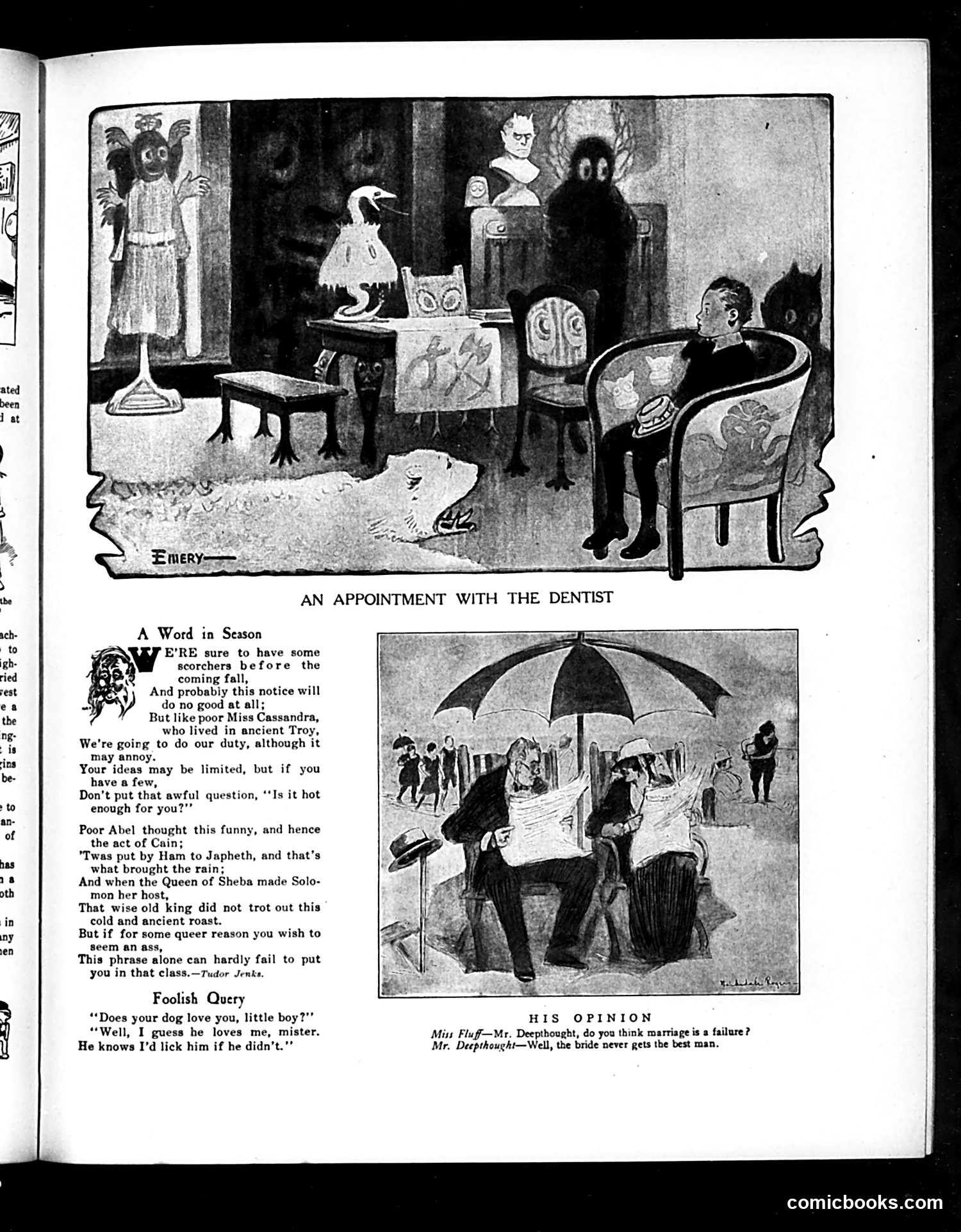
The top cartoon depicts a surreal dentist's office populated by grotesque or demonic figures—shadowy creatures with large eyes and an otherworldly atmosphere. The artist (Emery) uses this nightmarish setting to humorously convey the anxiety many feel about dental visits, rendering the dentist's office as a hellish place. Below are three brief humor pieces: **"A Word in Season"** (by Tudor Jenks) satirizes the tired cliché "Is it hot enough for you?"—a common small-talk opener during heat waves. The author traces this phrase back through biblical and historical figures, arguing it's so old and worn that using it marks one as foolish. **"Foolish Query"** presents a dark joke about a boy's relationship with his dog, implying he maintains obedience through threats of violence. **"His Opinion"** is a wordplay joke: a man asked about marriage's success quips that "the bride never gets the best man"—a pun on wedding terminology. These are light, disconnected humor pieces typical of Judge magazine's format.
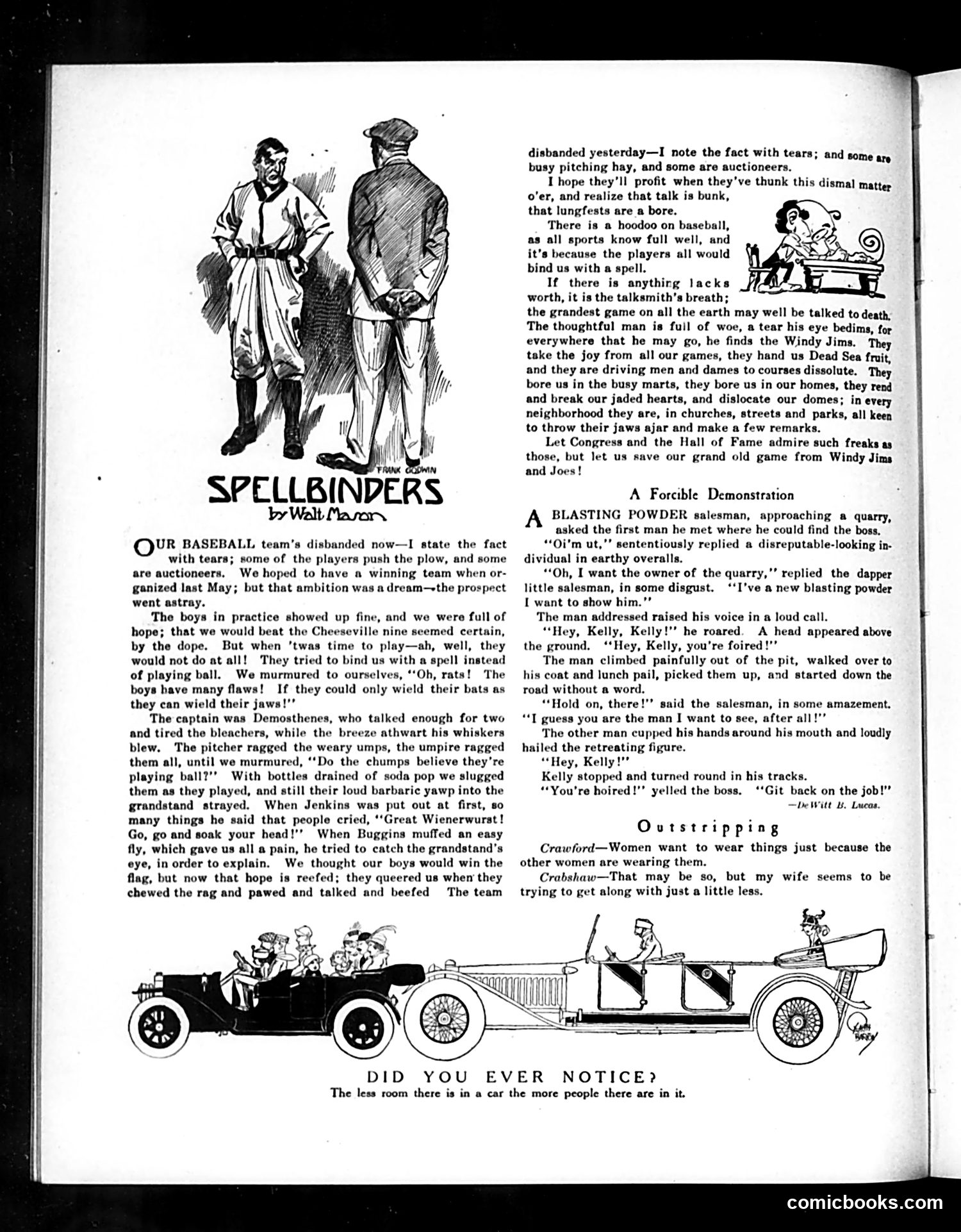
**"Spellbinders" (by Walt Mason):** This satirical poem mocks a local baseball team that disbanded because its players were all talk and no action. The team's captain "Demosthenes" and other players spent their energy arguing, complaining, and making excuses rather than playing. The broader satire targets what the author calls "Windy Jims and Joes"—people everywhere whose excessive talking ("lungfests") ruins activities and corrupts society. The poem laments how talkers undermine genuine pursuits, from sports to civic life. **"A Forcible Demonstration":** This humorous anecdote depicts a blasting powder salesman confused by workplace hierarchy in a quarry. He mistakes a laborer for a random worker, who turns out to be the actual boss—someone so rough and direct he fires an employee mid-conversation, then rehires him. The joke satirizes working-class informality and the unexpected authority of practical men over educated, "dapper" salesmen. Both pieces reflect early 20th-century anxieties about the gap between talk and action, pretense and reality.
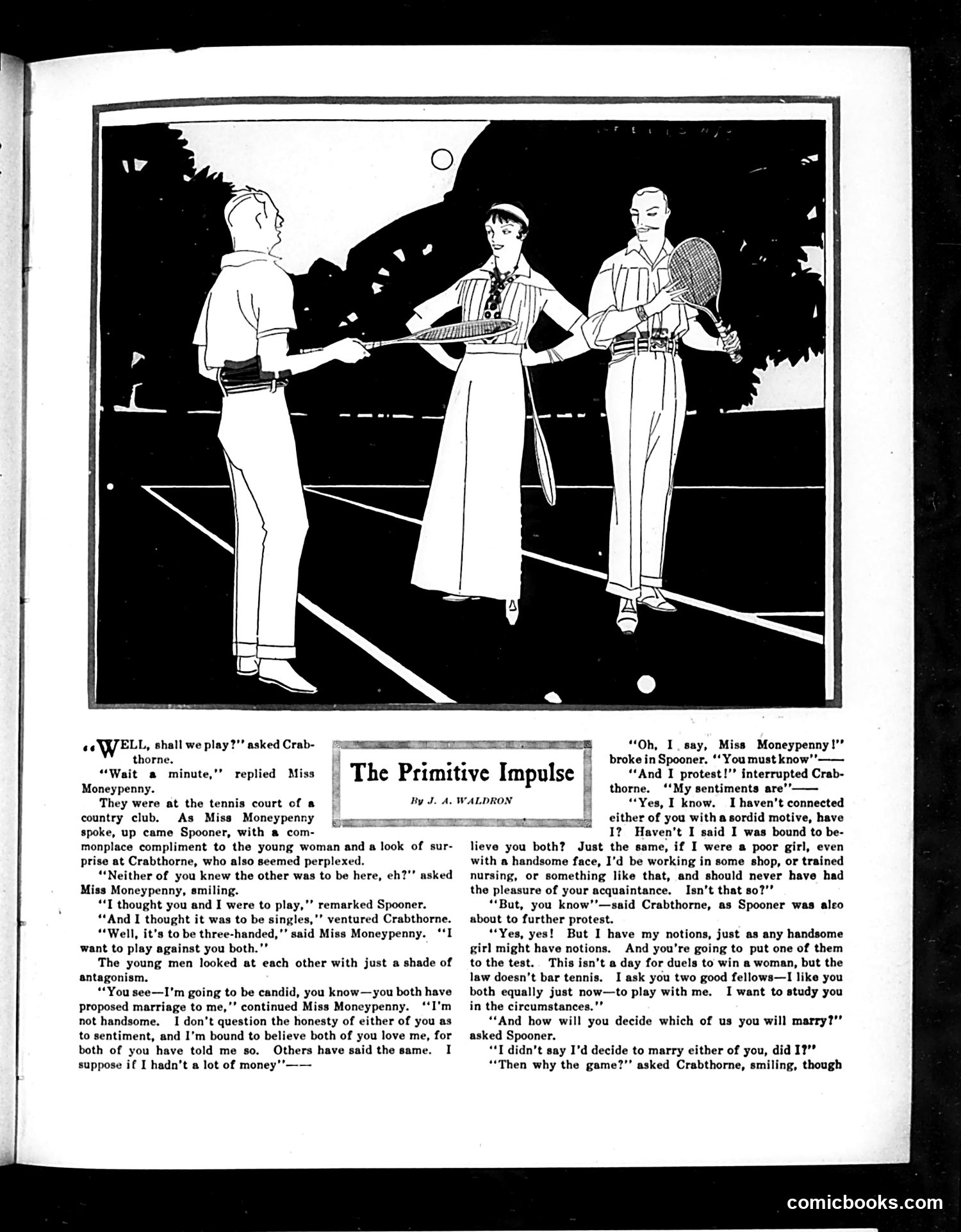
This satirical story from *Judge* magazine depicts a woman (Miss Moneypenny) who has received marriage proposals from two suitors (Spooner and Crabthorne). Rather than decide based on sentiment or character alone, she proposes a tennis match to "study" both men. The satire critiques the "primitive impulse" of male competition: the two men, initially antagonistic upon discovering they're rivals, accept her challenge to prove themselves through sport. Miss Moneypenny shrewdly observes that her wealth likely motivated their proposals—suggesting that without money, she'd be invisible to them. The joke lies in the men's unspoken acceptance that winning a game proves romantic worthiness, and in Miss Moneypenny's pragmatic exposure of their materialistic motivations masked as genuine affection. It satirizes both masculine vanity and the transactional nature of Edwardian courtship among the wealthy.
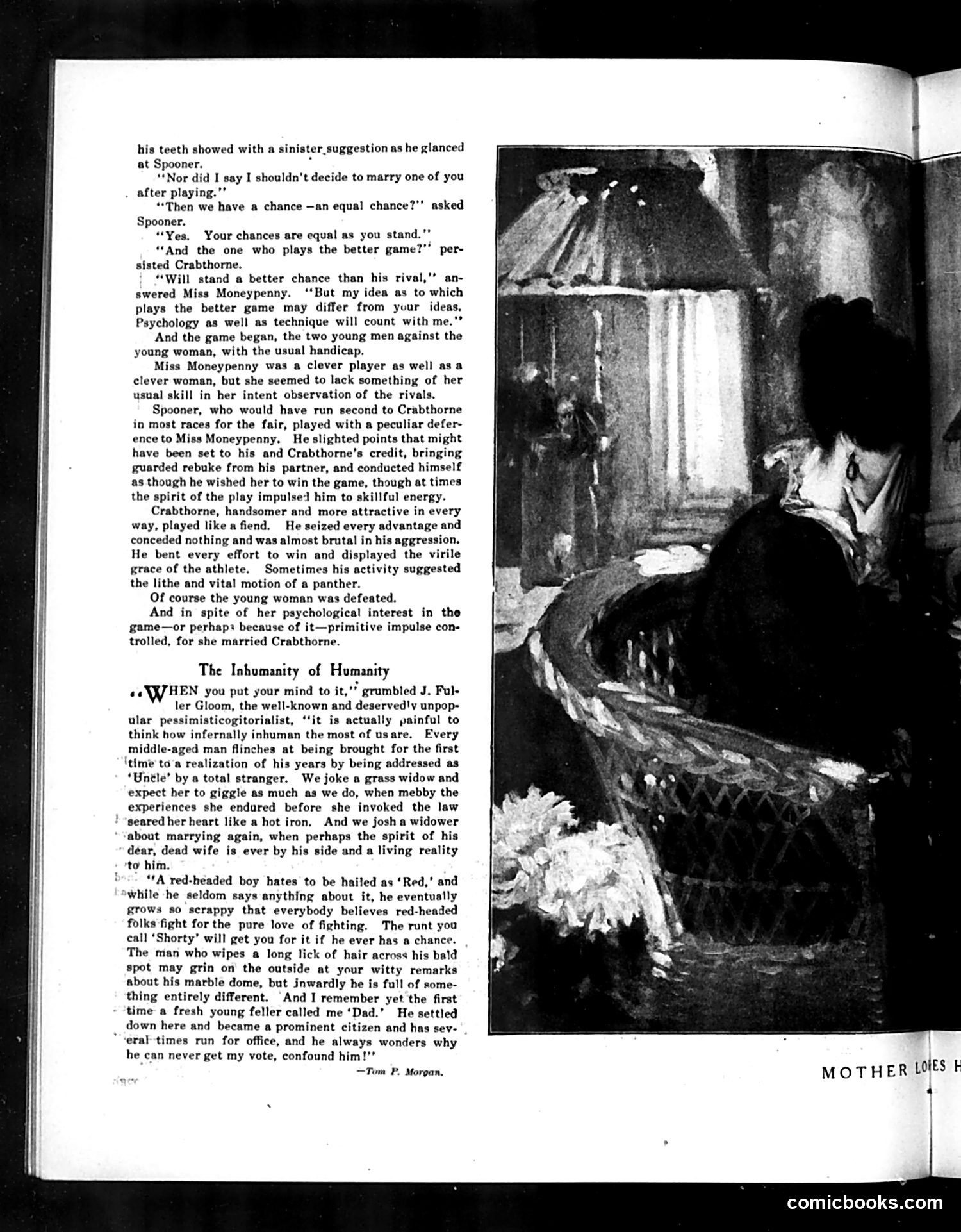
This page contains two distinct pieces of satirical fiction rather than political cartoons. **"The Game" (top section):** A romantic story where Miss Moneypenny agrees to marry whichever of two suitors—Spooner or Crabthorne—plays the better game (likely cards or billiards). The satire mocks courtship conventions: though Spooner plays gallantly by deliberately losing to impress her, she marries the brutally competitive Crabthorne instead. The joke critiques both gender relations and human nature—she chooses the aggressive "fiend" over the considerate gentleman, suggesting primitive instinct trumps rational choice. **"The Inhumanity of Humanity" (bottom section):** J. Fuller Gloom, a "pessimisticogitorialist" (pessimistic thinker), catalogs everyday cruelties disguised as humor: mocking widows, calling red-headed boys "Red," teasing bald men about hair loss. The satire exposes how society inflicts psychological wounds through casual mockery while expecting victims to laugh along—highlighting the disconnect between outward civility and actual human unkindness. Both pieces satirize social hypocrisy and the gap between civilized pretense and brutal reality.
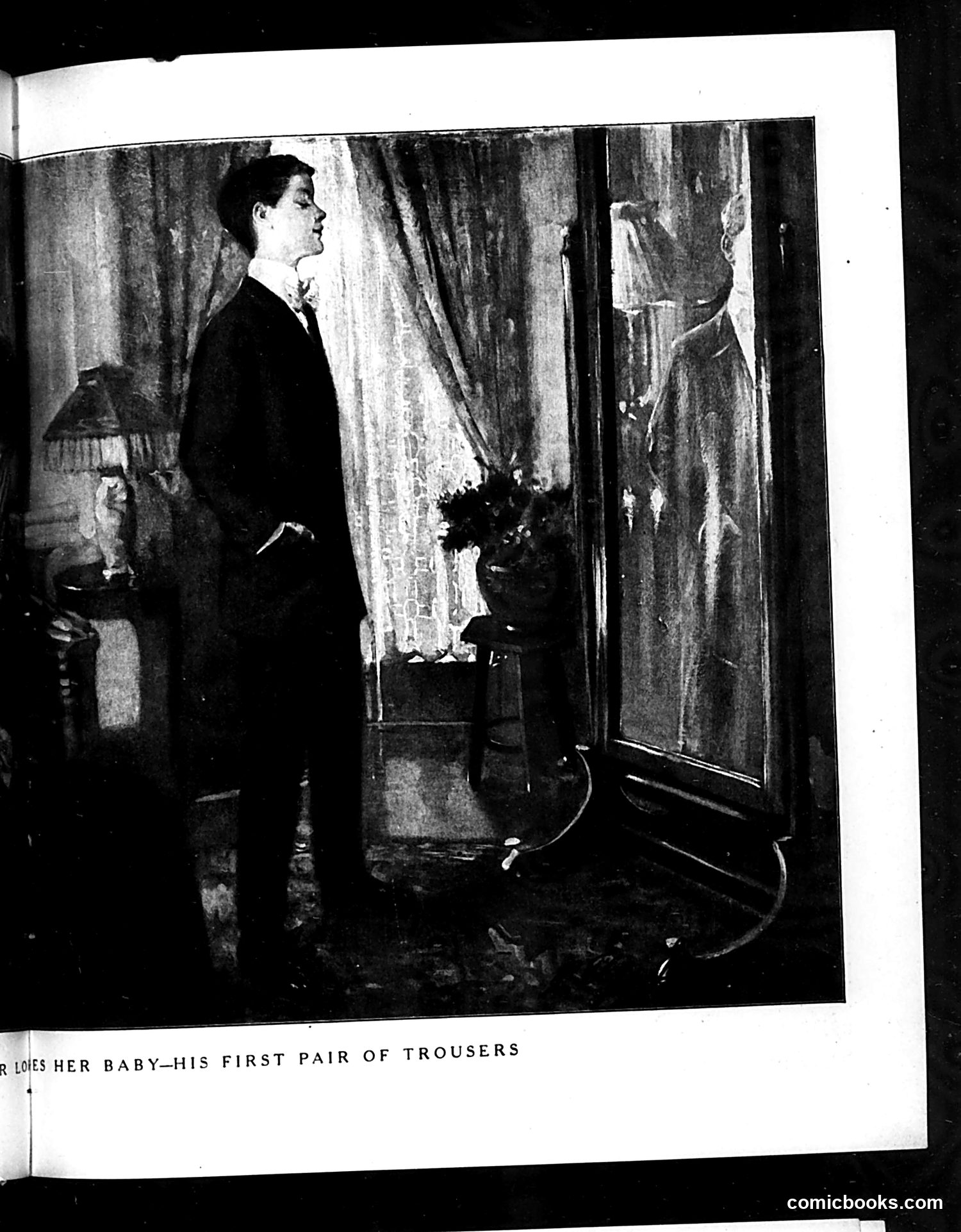
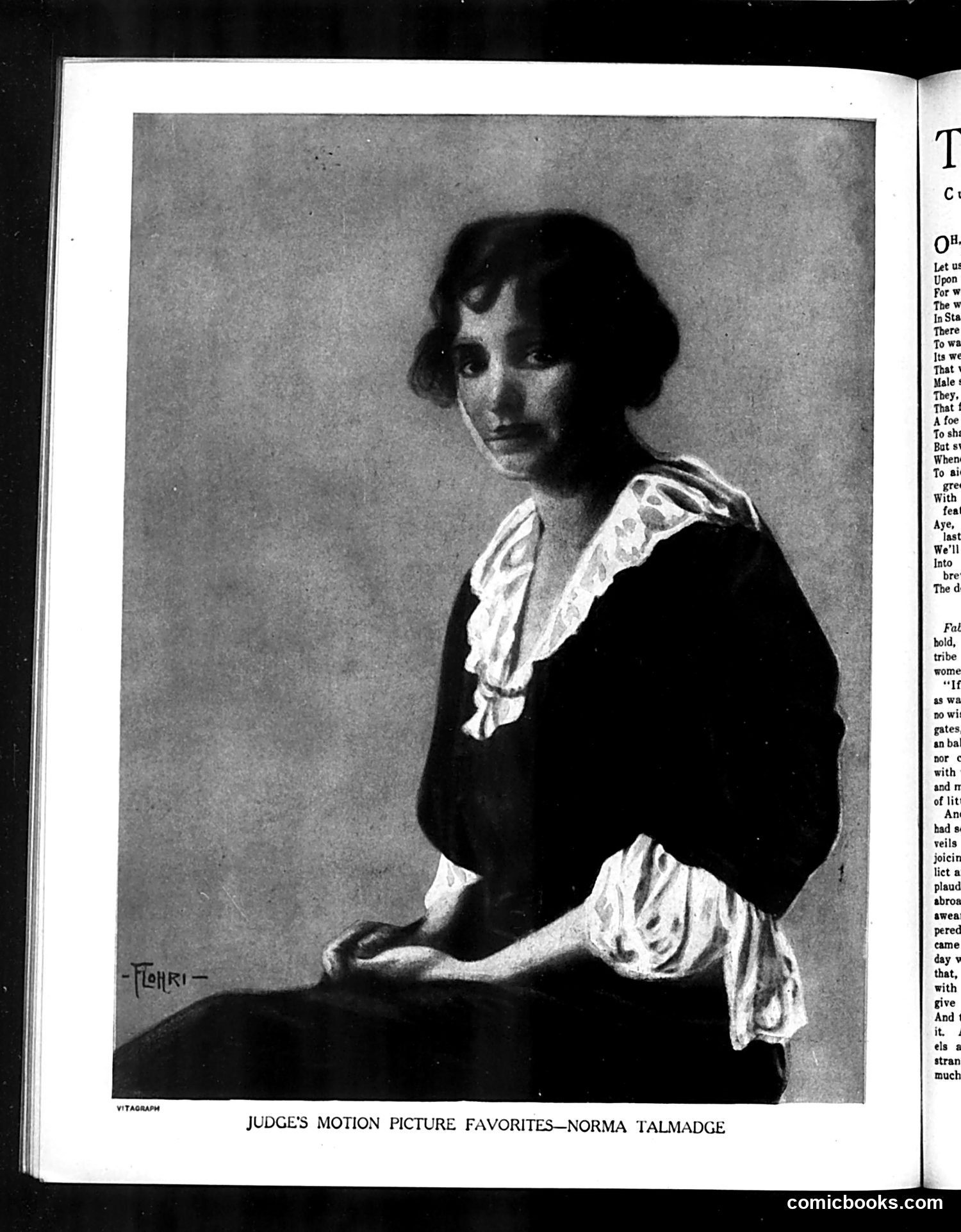
This page features a **portrait photograph of actress Norma Talmadge**, a major silent film star of the 1910s-1920s. The caption identifies her as one of "Judge's Motion Picture Favorites," indicating the magazine's practice of celebrating popular cinema personalities. The image itself is not satirical—it's a straight promotional photograph showing Talmadge in period costume (dark dress with white lace collar and cuffs), signed by the photographer "Tojiri." The surrounding text appears to be OCR'd poetry or prose fragments that don't clearly relate to the photograph; the OCR errors make the text largely illegible. This is essentially a **celebrity feature page** typical of early 20th-century magazines, where Judge mixed satirical commentary with entertainment journalism and celebrity coverage to appeal to readers interested in the growing film industry and its stars.
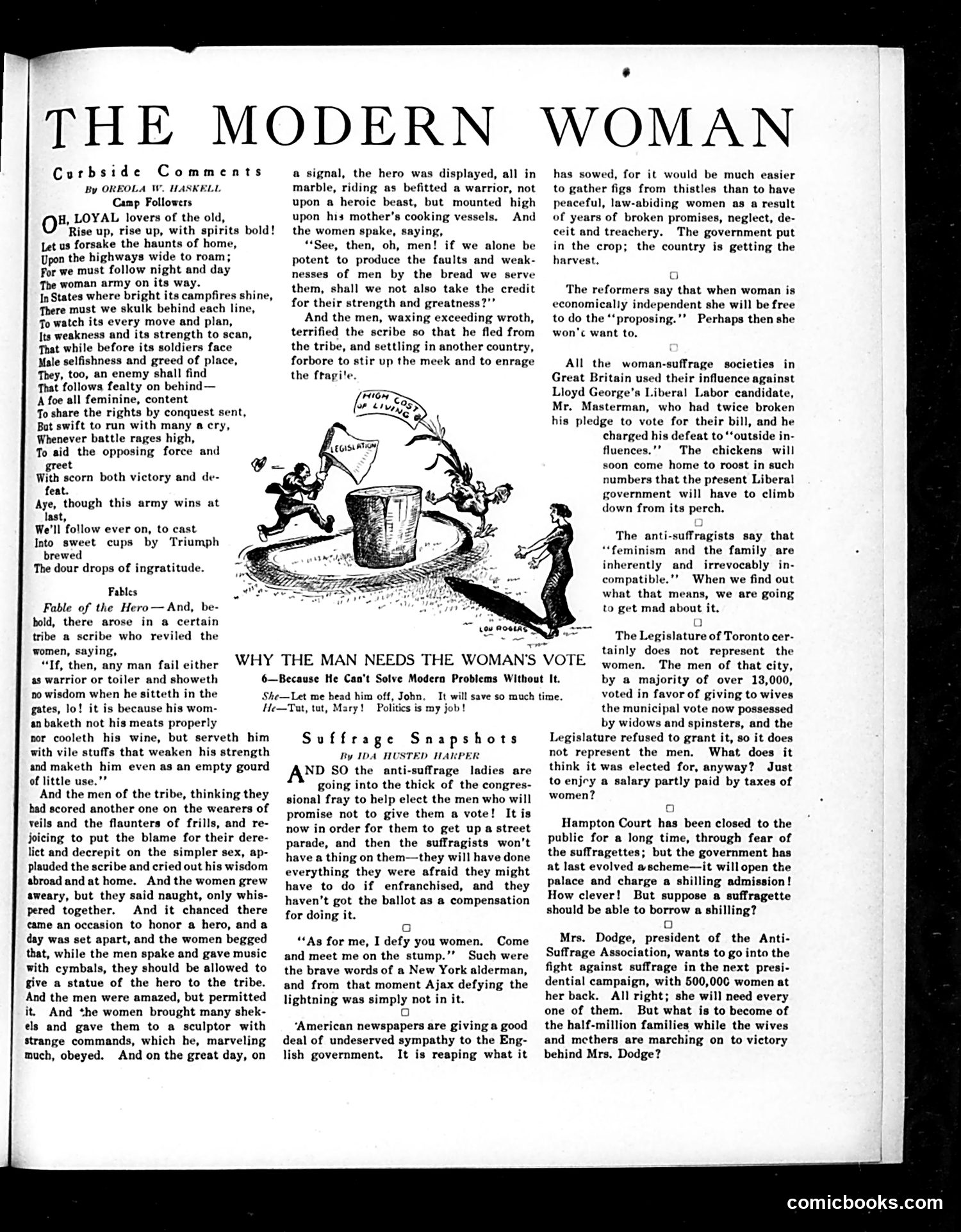
This Judge magazine page presents anti-suffrage satire through multiple pieces attacking women's voting rights. **The cartoons and fables** mock suffragists by inverting their arguments. The central cartoon "Why the Man Needs the Woman's Vote" shows a woman trying to lead while a man insists politics is his domain—illustrating the anti-suffrage claim that women shouldn't vote. **The "Fable of the Hero"** uses biblical-style language to ridicule women's contributions. When women commission a statue depicting their hero standing on cooking vessels (not a beast), they sarcastically claim credit for men's strength through meal preparation. The scribe flees in rage, suggesting women's logic is so dangerous it must be silenced. **"Suffrage Snapshots"** mocks anti-suffrage women organizing politically *against* their own voting rights, noting the irony: they're doing all the campaigning work suffragists feared, yet without gaining the ballot. The page's tone is hostile toward women's political participation, presenting female activism as either logically absurd or a threat to male authority. This represents pre-1920 anti-suffrage propaganda common in mainstream publications.
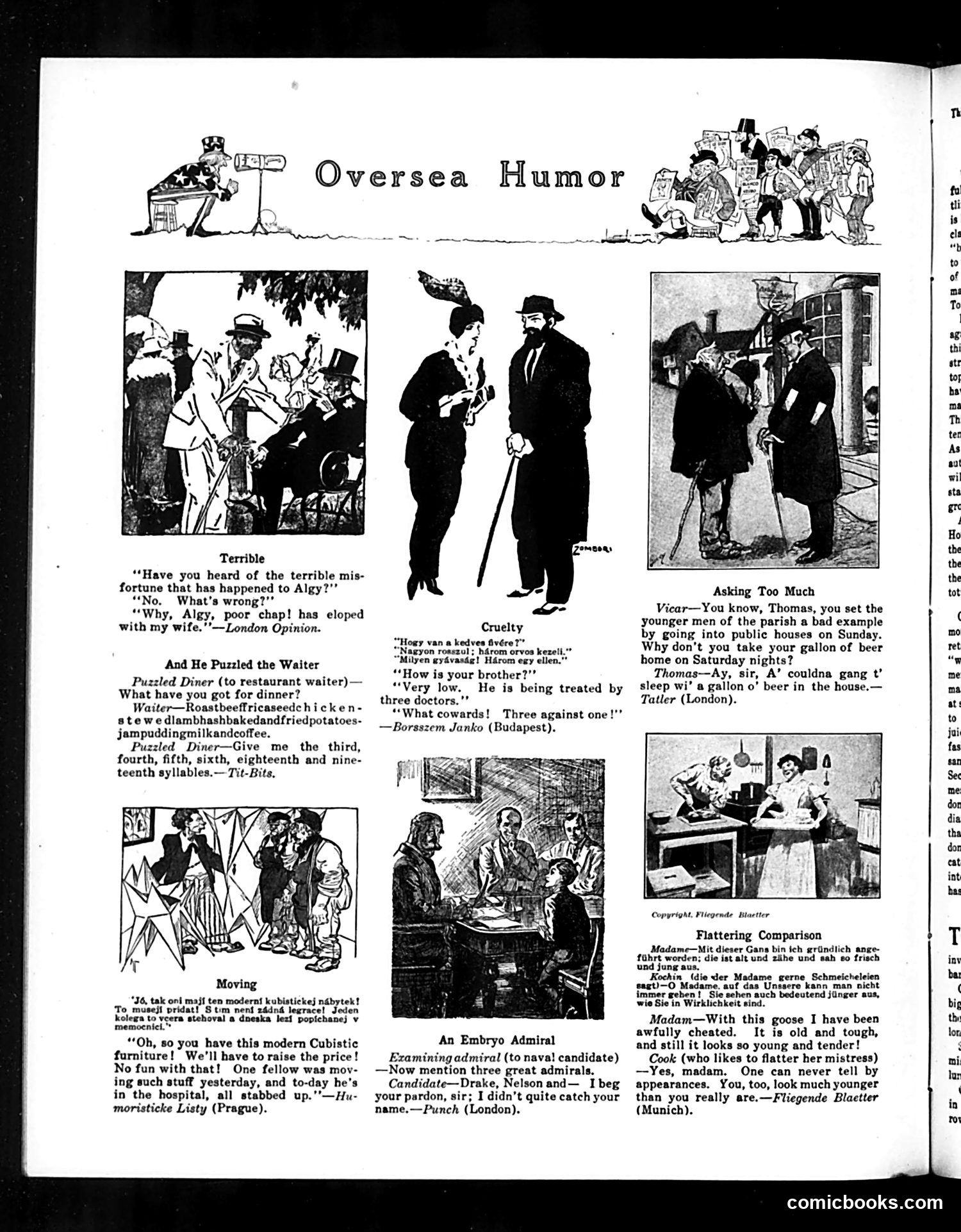
This page collects brief jokes from international satirical publications, showcasing humor across European cultures. Each item is a short, punchy joke translated from foreign sources (London Opinion, Punch, Budapest's *Borsszem Janko*, Prague's *Humoristické Listy*, Munich's *Fliegende Blätter*). The humor centers on wordplay, social absurdities, and class dynamics typical of early 20th-century satire: - **"Algy" joke**: Marital infidelity treated as comedic scandal - **Waiter puzzle**: Absurdist humor about a diner requesting random syllables from a long menu description - **Cubist furniture**: Mocks modern art's impracticality (the furniture injures movers) - **Admiral/brother jokes**: Play on mishearing or misunderstanding - **Vicar/Thomas**: Ironically suggests a working-class man drink beer at home to sleep - **Cook's flattery**: A servant dishonestly flatters her mistress, comparing her favorably to a tough old goose The page demonstrates *Judge* magazine's role in circulating cosmopolitan, sophisticated humor across national borders.
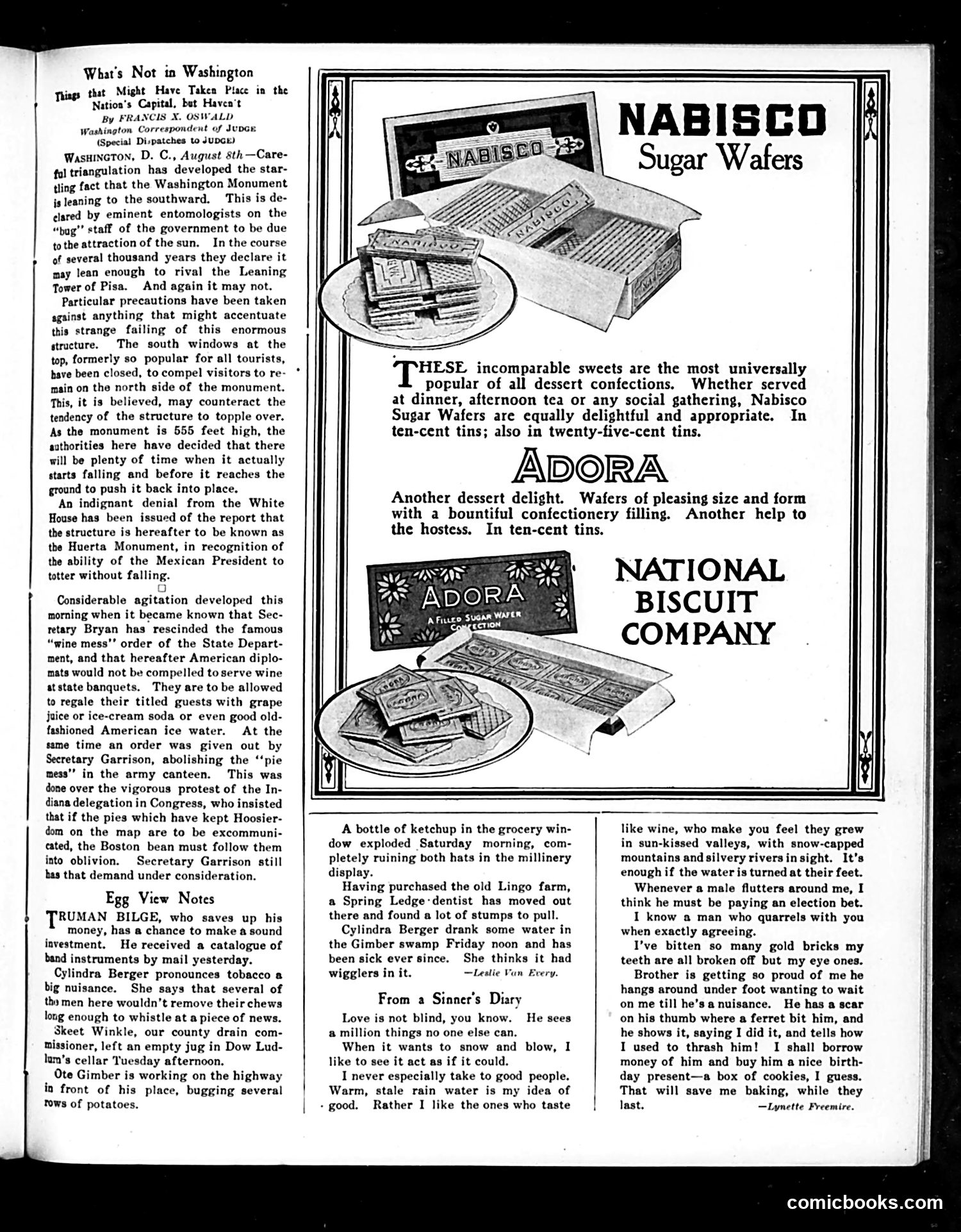
This page from *Judge* magazine contains political satire by Francis X. Oswald mocking Washington bureaucracy and government absurdities. **Main Satire:** The piece ridicules government incompetence through fabricated "reports"—notably that the Washington Monument is inexplicably leaning southward due to "sun attraction" (nonsensical reasoning), with officials planning to simply push it back if it falls. This mocks bureaucratic inertia and illogical decision-making. **Secondary Jokes:** - A denial that the monument might be renamed the "Huerta Monument" after Mexican President Huerta, who "totters without falling"—likely mocking Huerta's political instability - Secretary Bryan rescinding the State Department's "wine mess" order, replacing wine with grape juice/ice-water at diplomatic functions—satirizing progressive temperance-era reforms - Secretary Garrison abolishing the "pie mess" in army canteens, provoking protest from Indiana congressmen The satirical tone suggests frustration with government officials making ridiculous decisions while claiming scientific or administrative justification. The page also contains unrelated advertisements and brief humorous local anecdotes.
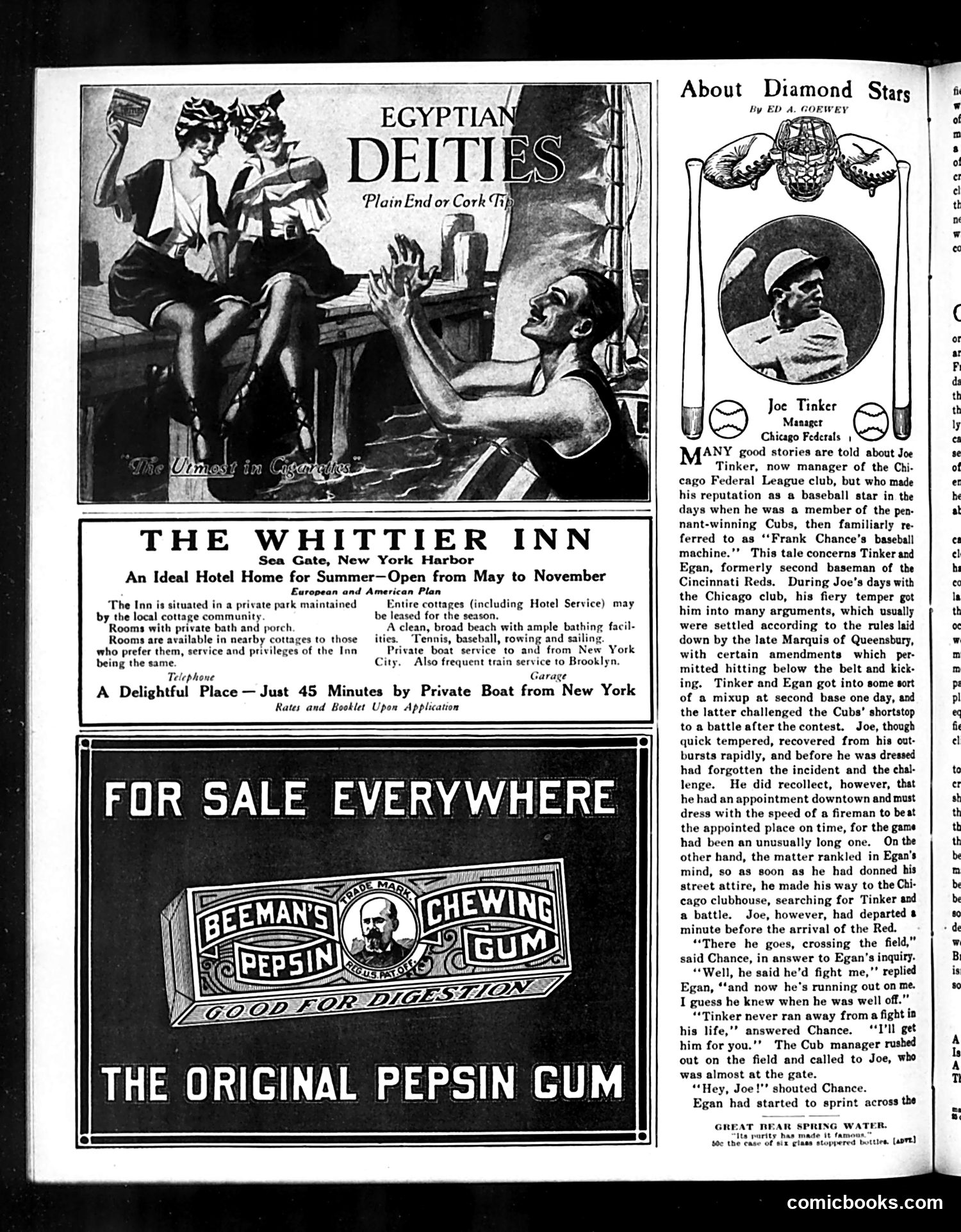
This page is primarily **advertising and sports content**, not political satire. The main cartoon, "Egyptian Deities," appears to be a flirtatious advertisement for cork-tipped cigarettes, depicting two women with a man—typical early 1900s commercial art with no political meaning. The substantive content is an article about **Joe Tinker**, manager of the Chicago Federals baseball team. The text recounts an anecdote about Tinker's fiery temper during his playing days with the Cubs, describing an incident where he had a heated argument with Egan (a Cincinnati Reds player) at second base. Tinker allegedly rushed to keep an appointment rather than fight Egan after the game, leading Tinker's manager Frank Chance to retrieve him—a humorous tale emphasizing Tinker's volatile personality. The page also includes hotel and chewing gum advertisements. There is no political satire present—this is entertainment and commercial content typical of Judge magazine's sports and lifestyle coverage.
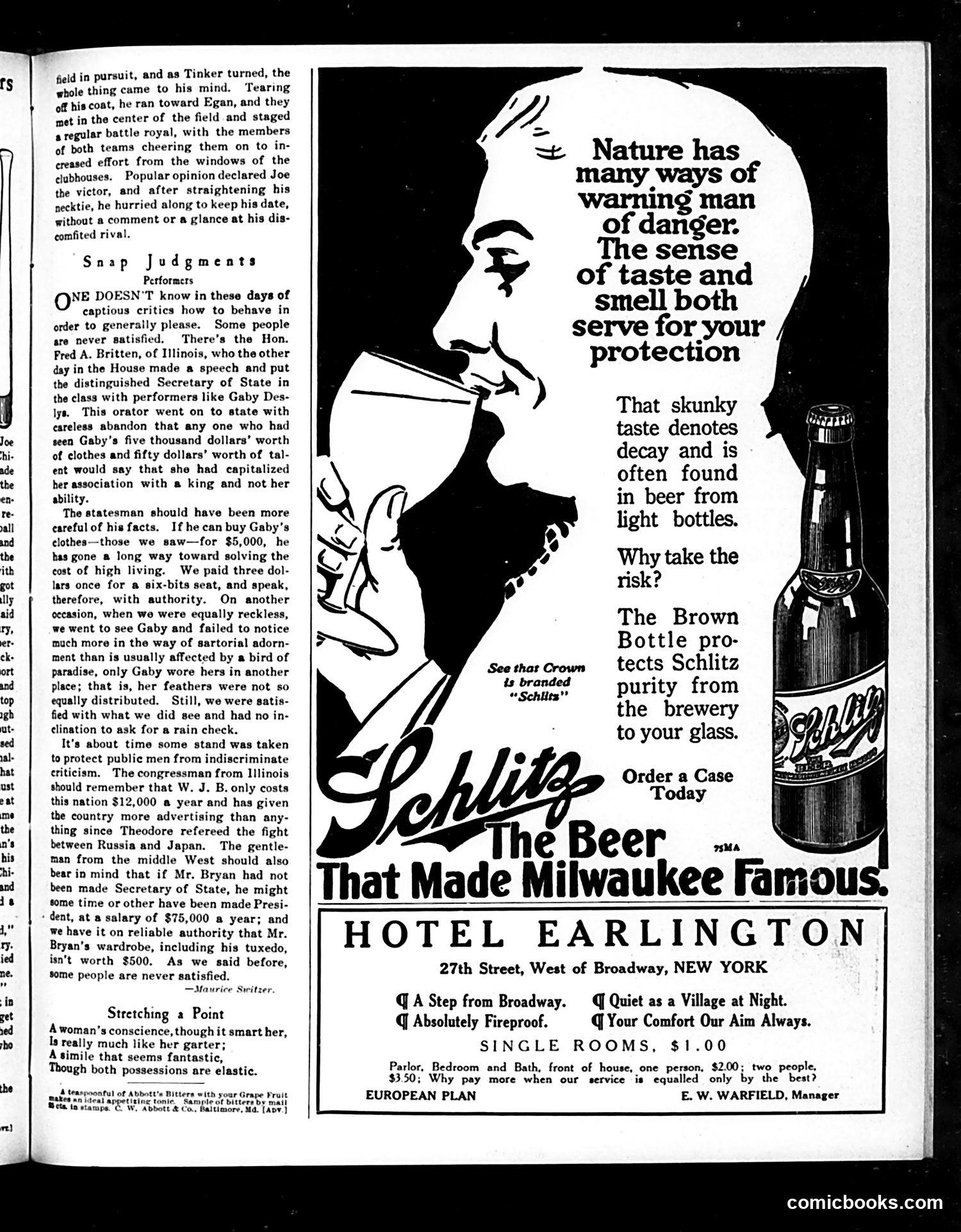
This page contains three distinct elements: **Left column**: A short story excerpt titled "Snap Judgments" about a baseball player named Joe Tinker fighting a rival named Egan. The accompanying satirical commentary by Maurice Switzer criticizes Rep. Fred A. Britten (Illinois) for publicly attacking Secretary of State William Jennings Bryan's wardrobe and abilities, comparing him unfavorably to entertainer Gaby Deslys. Switzer defends Bryan, noting his $12,000 annual salary provides good publicity value and his actual wardrobe costs only $500—arguing politicians deserve protection from "indiscriminate criticism." A brief humorous poem about women's consciences follows. **Right side**: Two full-page advertisements—one for Schlitz beer (emphasizing brown bottles protect quality from decay) and one for Hotel Earlington in New York, advertising budget accommodations ($1 single rooms). The page is primarily **advertising-driven**, with satirical commentary secondary. The political reference concerns early 20th-century Secretary of State Bryan.
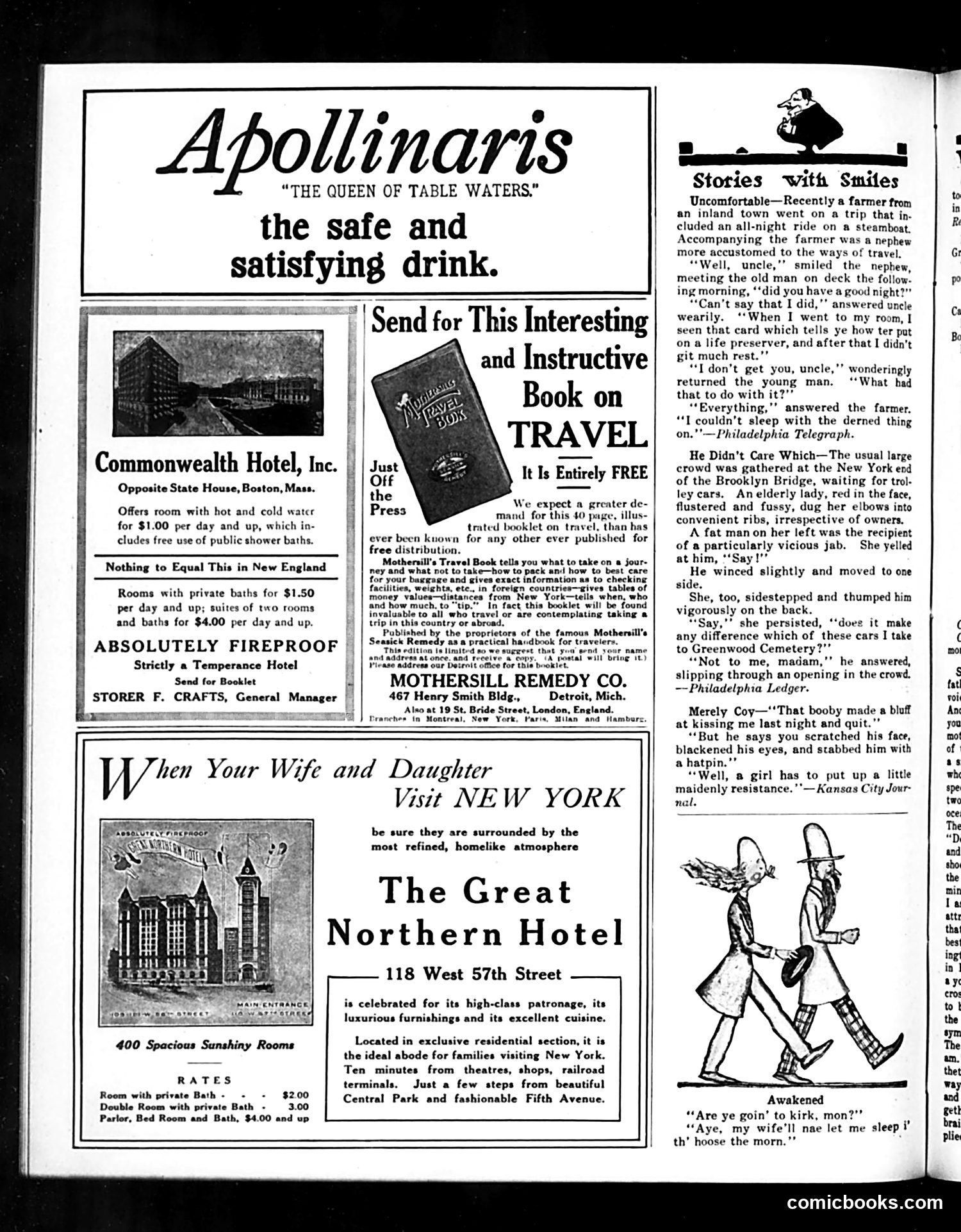
This page is primarily **advertising** for hotels and consumer products, with small satirical comic anecdotes in the right column—typical Judge magazine filler content. The ads feature the Commonwealth Hotel (Boston) and Great Northern Hotel (New York), emphasizing amenities for middle-class travelers. An Apollinaris mineral water ad promotes it as "the safe and satisfying drink." The small illustrated jokes mock travel anxieties and social awkwardness: - A farmer can't sleep after reading life-preserver instructions on a steamboat - An elderly woman elbows strangers on the Brooklyn Bridge, indifferent to which trolley she takes (suggesting urban crowds are chaotic and impersonal) - A woman claims "maidenly resistance" while admitting she stabbed a man who tried to kiss her—mocking contemporary courtship pretense These gentle satires reflect early 20th-century anxieties about modern travel, crowding, and evolving gender relations, presented for middle-class readers' amusement.
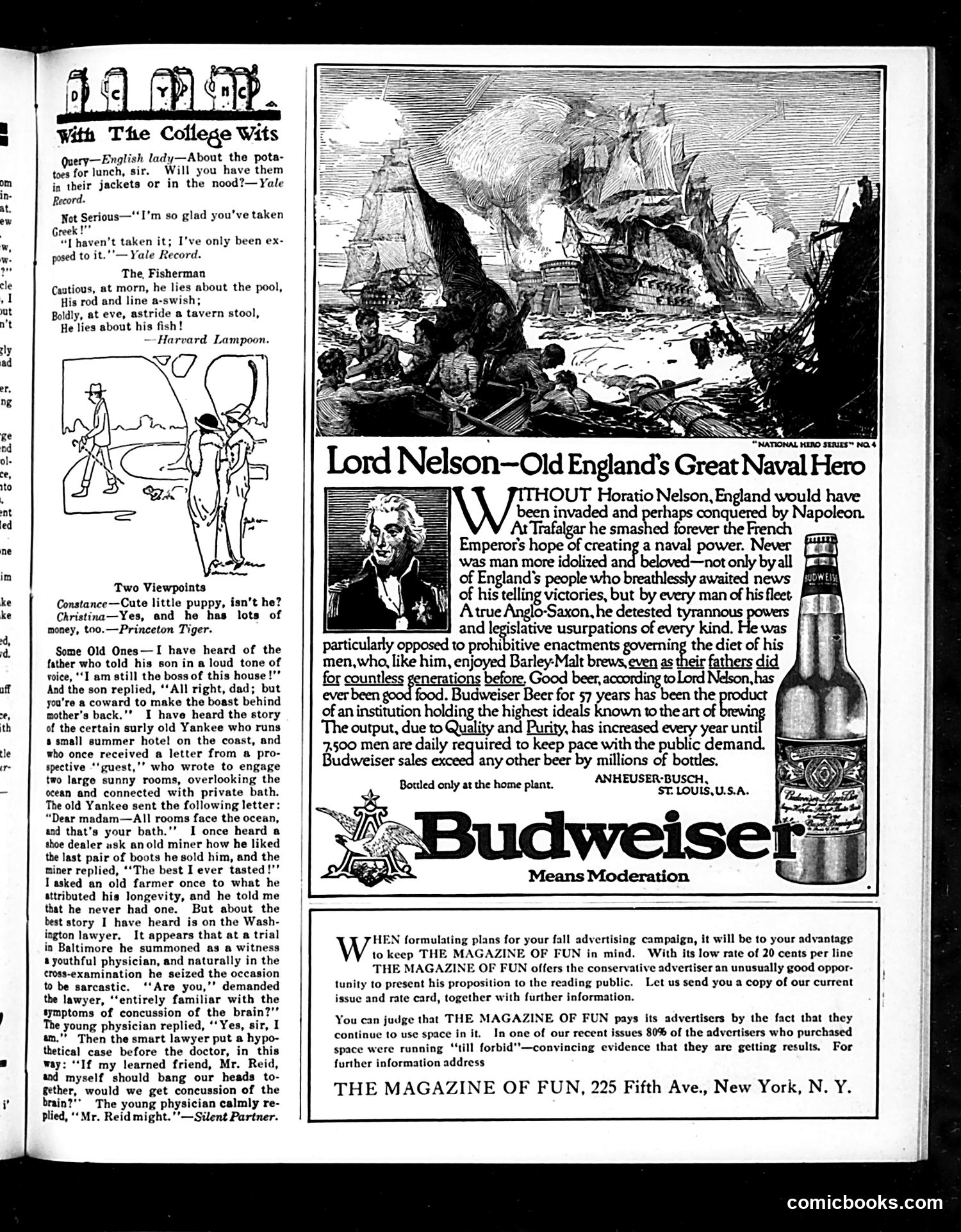
This page mixes college humor with advertising. The left side contains brief jokes from Yale, Harvard, and Princeton student publications—typical period humor about Greek studies, fishing tall tales, and domestic comedy. These reflect early 1900s college wit: gentle mockery of academic pretense and male social dynamics. The dominant content is a Budweiser advertisement disguised as historical commentary. It invokes Admiral Horatio Nelson—England's celebrated naval hero who defeated Napoleon at Trafalgar—to endorse beer consumption. The ad falsely claims Nelson opposed "prohibitive enactments" on soldiers' diet, framing beer as a patriotic tradition and "food" rather than alcohol. This is propaganda against Prohibition (the 18th Amendment, ratified 1919). By associating beer with national heroism and masculine military tradition, Budweiser attempts to legitimize drinking as quintessentially English/American. The ad's placement in a humor magazine maximizes reach among male readers likely sympathetic to anti-Prohibition sentiment. The bottom section advertises The Magazine of Fun itself, offering affordable ad rates.
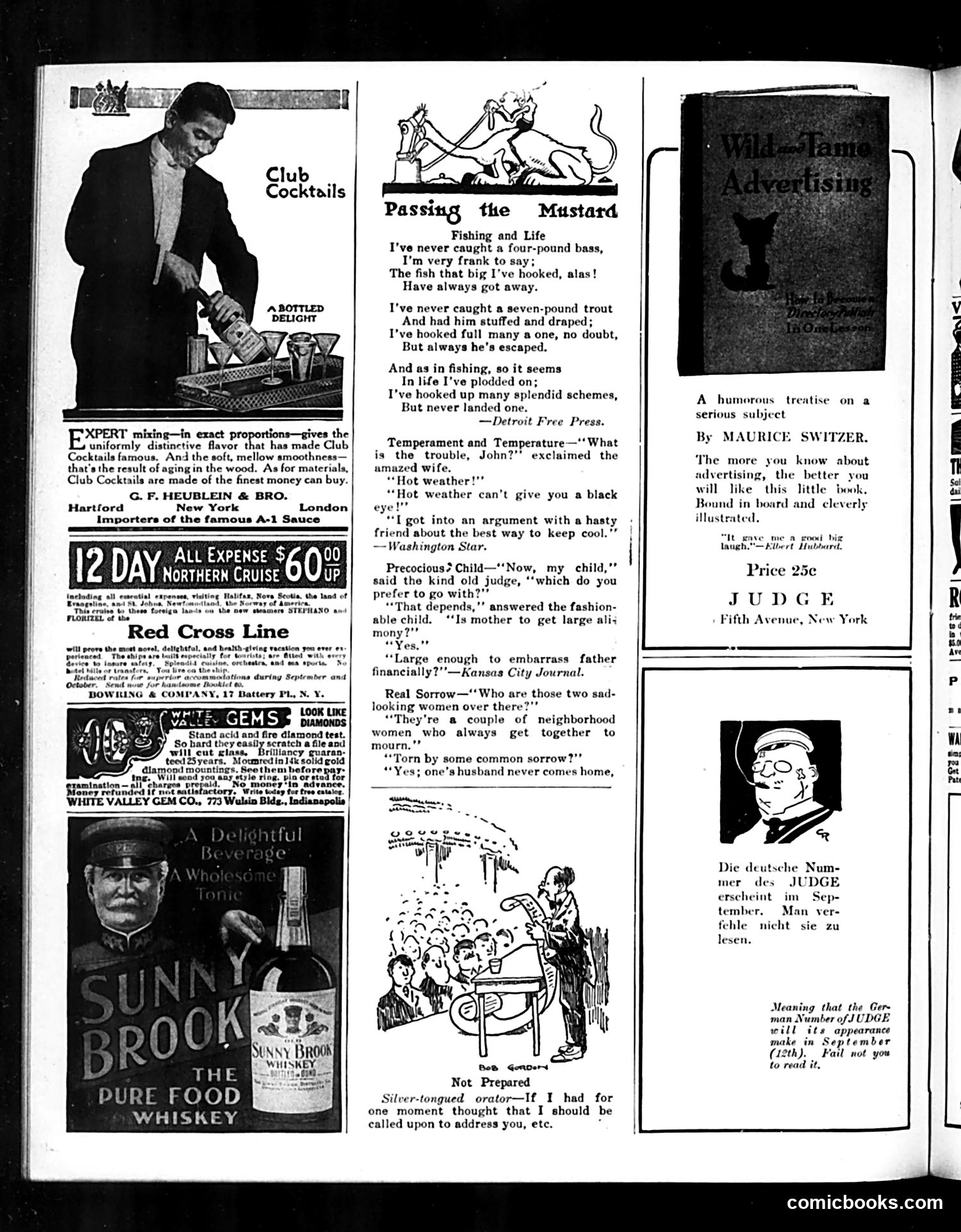
This page is primarily **advertising and filler content** typical of early 20th-century magazines, with minimal political satire. The main comic elements are brief humorous anecdotes: 1. **"Passing the Mustard"** — A poem about fishing mishaps, using angling as metaphor for life's failures ("I've hooked up many splendid schemes, / But never landed one"). This is gentle, non-political humor about universal human disappointment. 2. **"Not Prepared"** — A joke about a silver-tongued orator caught unprepared, poking fun at political speechmakers who claim spontaneous eloquence. 3. Several one-liner jokes about domestic life and social situations (marital disputes about heat, a precocious child, neighborhood gossip). **No specific political figures or events are identifiable.** The page is dominated by period advertisements (whiskey, cocktails, diamonds, cruise lines) with decorative illustrations. The humor reflects typical magazine fare: domestic comedy, fishing tales, and gentle jabs at public speakers—entertainment rather than serious satire.
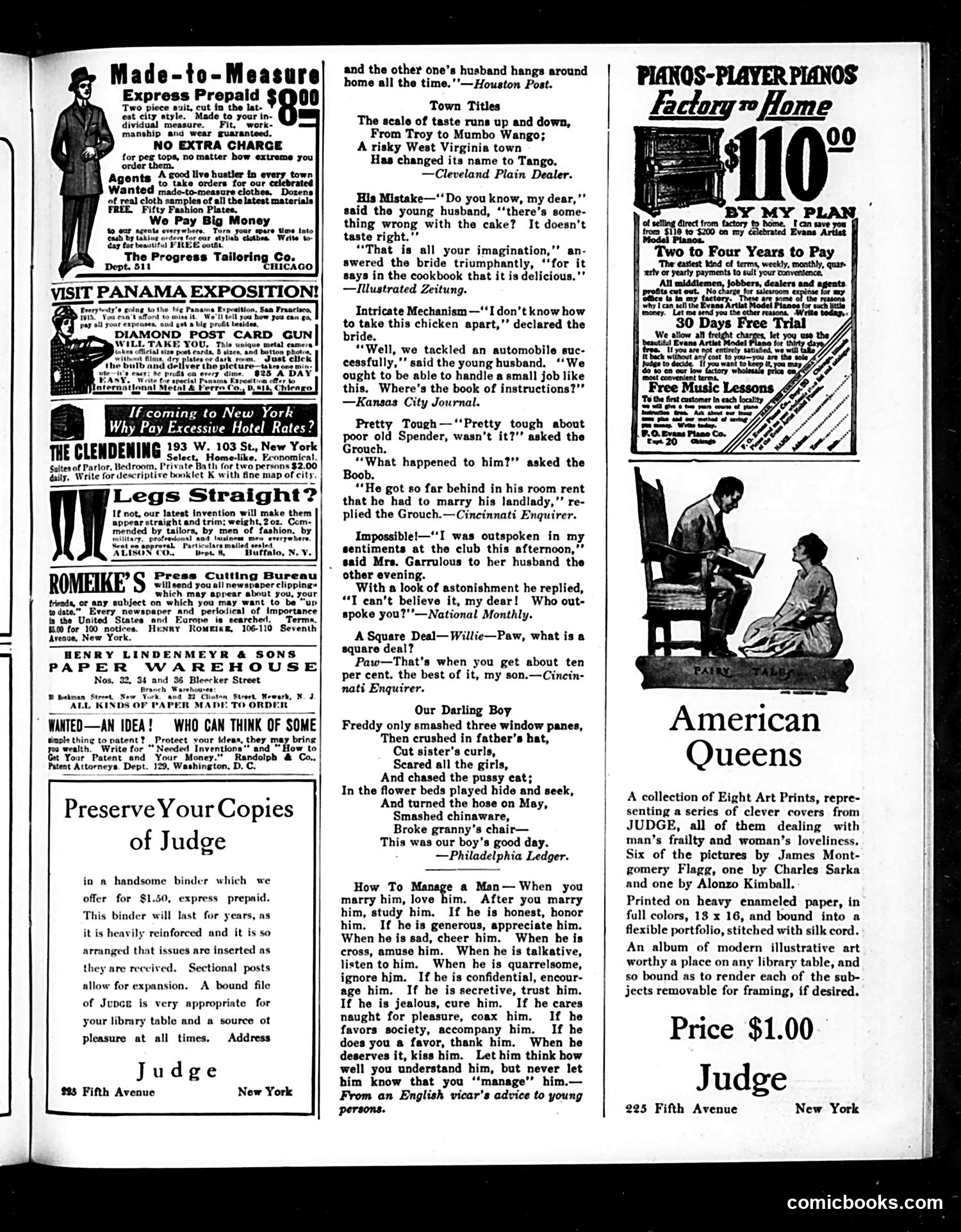
This page is primarily **advertising and humorous filler content**, not political cartoons. The ads promote tailoring, hotels, patent services, and other products typical of early 1900s periodicals. The **textual humor** consists of brief anecdotes mocking domestic life and gender relations: - **"His Mistake"** jokes about a new bride defensively citing a cookbook when her cake tastes bad—satirizing women's domestic incompetence and their reliance on written instructions rather than skill. - **"Intricate Mechanism"** presents a young couple treating a chicken like an automobile—mocking mechanically-incompetent newlyweds. - **"How to Manage a Man"** offers patronizing advice on manipulating husbands through flattery and deception. These pieces reflect early 20th-century **gender stereotypes**: women as poor cooks and managers, marriages as contests of wits, and domestic life as inherently absurd. The humor targets both incompetent women and foolish men, typical of Judge's satirical approach to marriage and social relations.
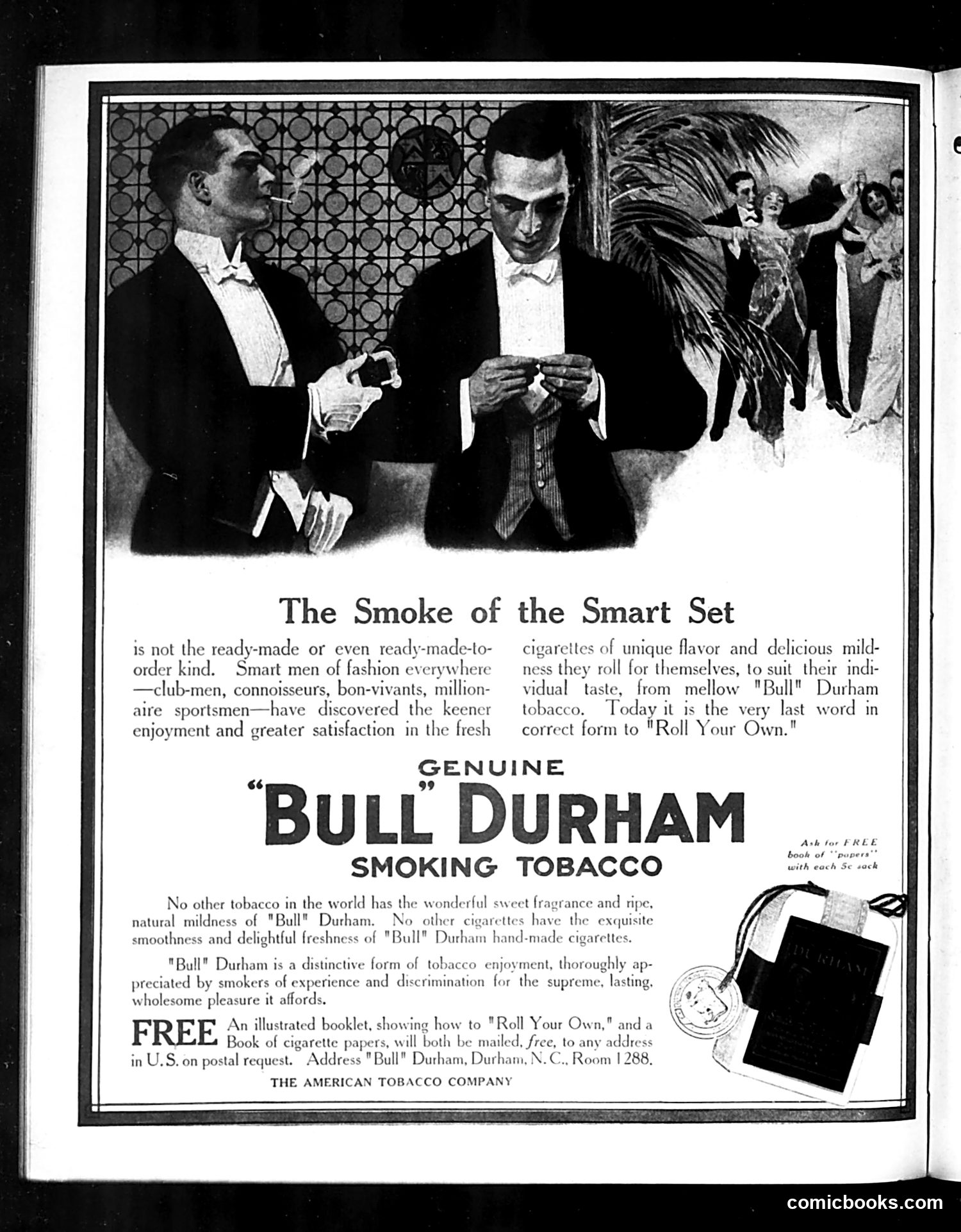
This page is **not satire or political commentary**—it's a straightforward advertisement for Bull Durham smoking tobacco, placed in Judge magazine. The image shows well-dressed men in formal attire (tuxedos, bow ties) in what appears to be an upscale social setting, with additional figures in the background. The ad's pitch is that rolling your own cigarettes from Bull Durham tobacco is a mark of sophistication and refined taste among "club-men, connoisseurs, bon-vivants, millionaire sportsmen"—essentially targeting wealthy, fashionable men. The advertisement emphasizes that hand-rolling cigarettes (rather than buying ready-mades) demonstrates personal discrimination and superior enjoyment. It offers free instructional booklets on "Roll Your Own" technique. This reflects early 20th-century cigarette culture, when rolling your own was marketed as both economical and genteel. There is no satire here—Judge simply accepted tobacco advertising like any other contemporary publication.