
A complete issue · 24 pages · 1914
Judge — July 25, 1914
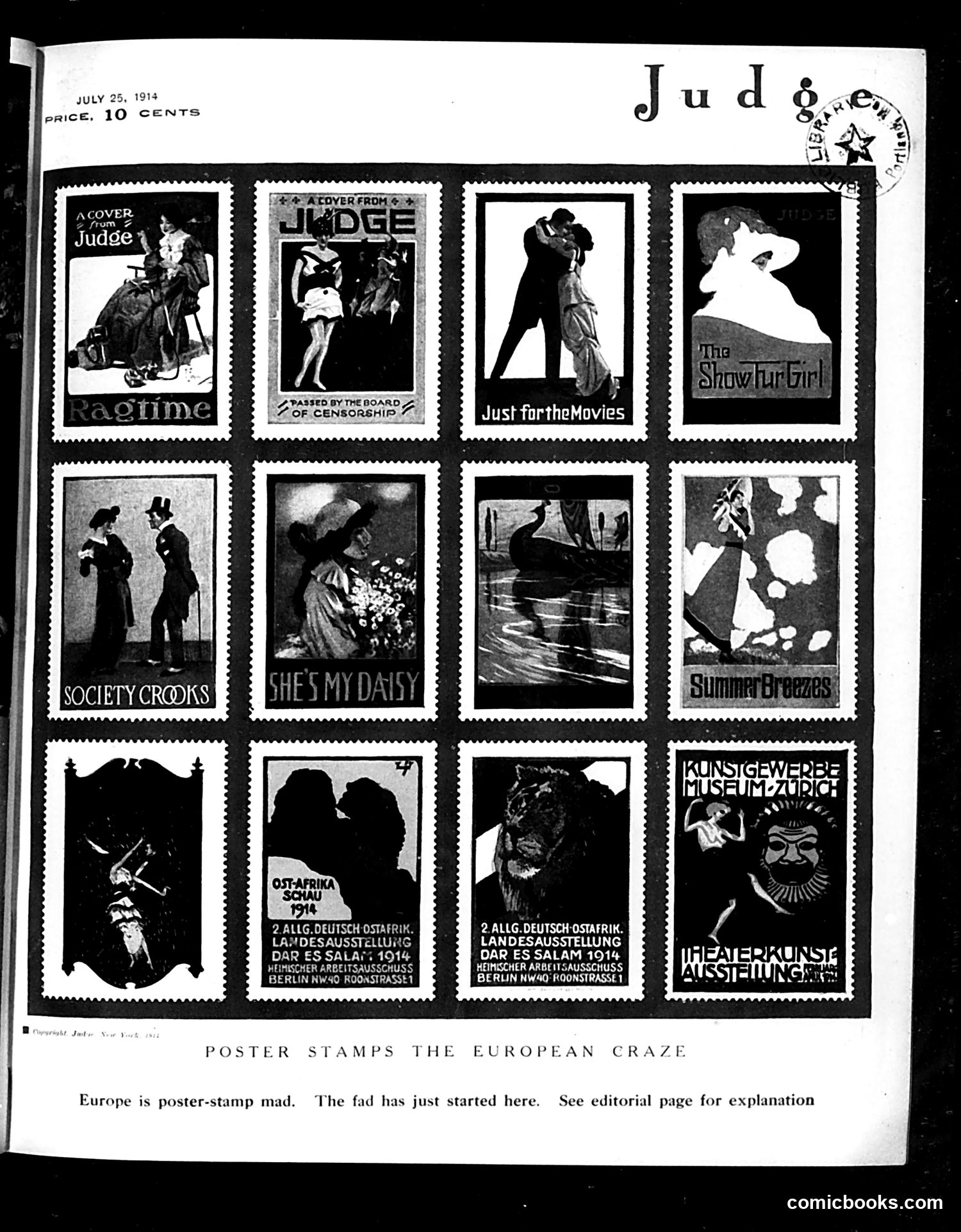
This page satirizes the European craze for movie poster stamps. The headline "POSTER STAMPS THE EUROPEAN CRAZE" with the subtext "Europe is poster-stamp mad. The fad has just started here" indicates this was a new collecting phenomenon reaching America. The twelve stamps shown are reproductions of actual European film posters from 1914, featuring silent films like "Ragtime," "Just for the Movies," and "She's My Daisy." Some stamps appear to be German exhibition posters ("Kunstgewerbe Museum"). Judge's satire mocks Europeans' enthusiasm for collecting decorative stamps depicting movies—treating cinema as high culture worthy of philatelic preservation. The piece suggests American audiences are just beginning this supposedly frivolous trend, warning readers about this imported European fad.
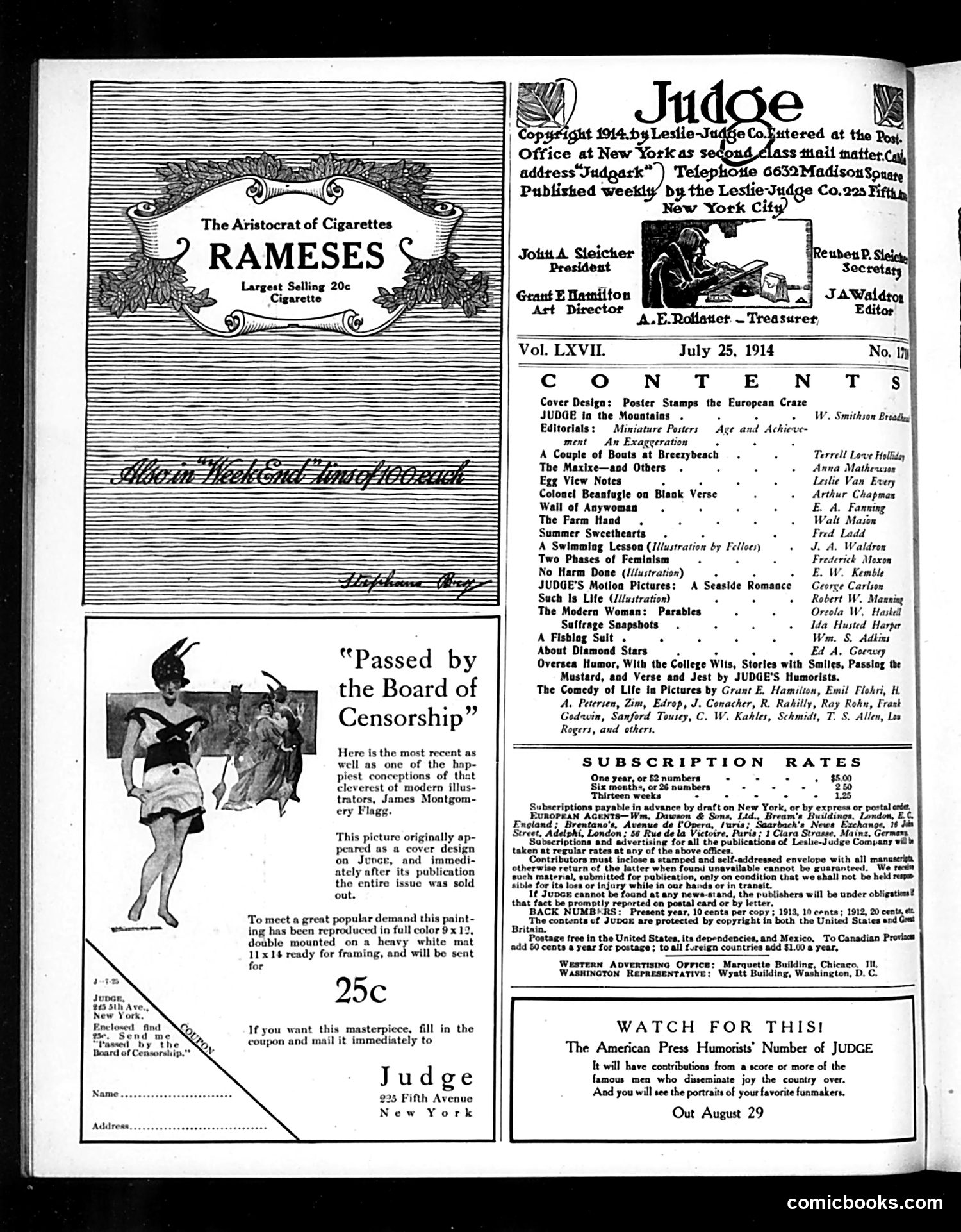
This page is primarily **advertising and editorial matter** rather than substantive political commentary. The main visual content is an advertisement for **Rameses cigarettes** ("The Aristocrat of Cigarettes"), featuring decorative Art Nouveau styling typical of early 20th-century tobacco marketing. Below that is a smaller cartoon advertisement showing a figure in elaborate dress, promoting a censored artwork that can be purchased for 25 cents. The "Passed by the Board of Censorship" caption appears to be **satirical commentary on censorship itself**—suggesting that even controversial artwork could be made acceptable (and profitable) through the censorship process. This likely references contemporary debates about obscenity laws and artistic freedom during the Progressive Era. The rest of the page contains **table of contents, masthead information, and subscription rates**.
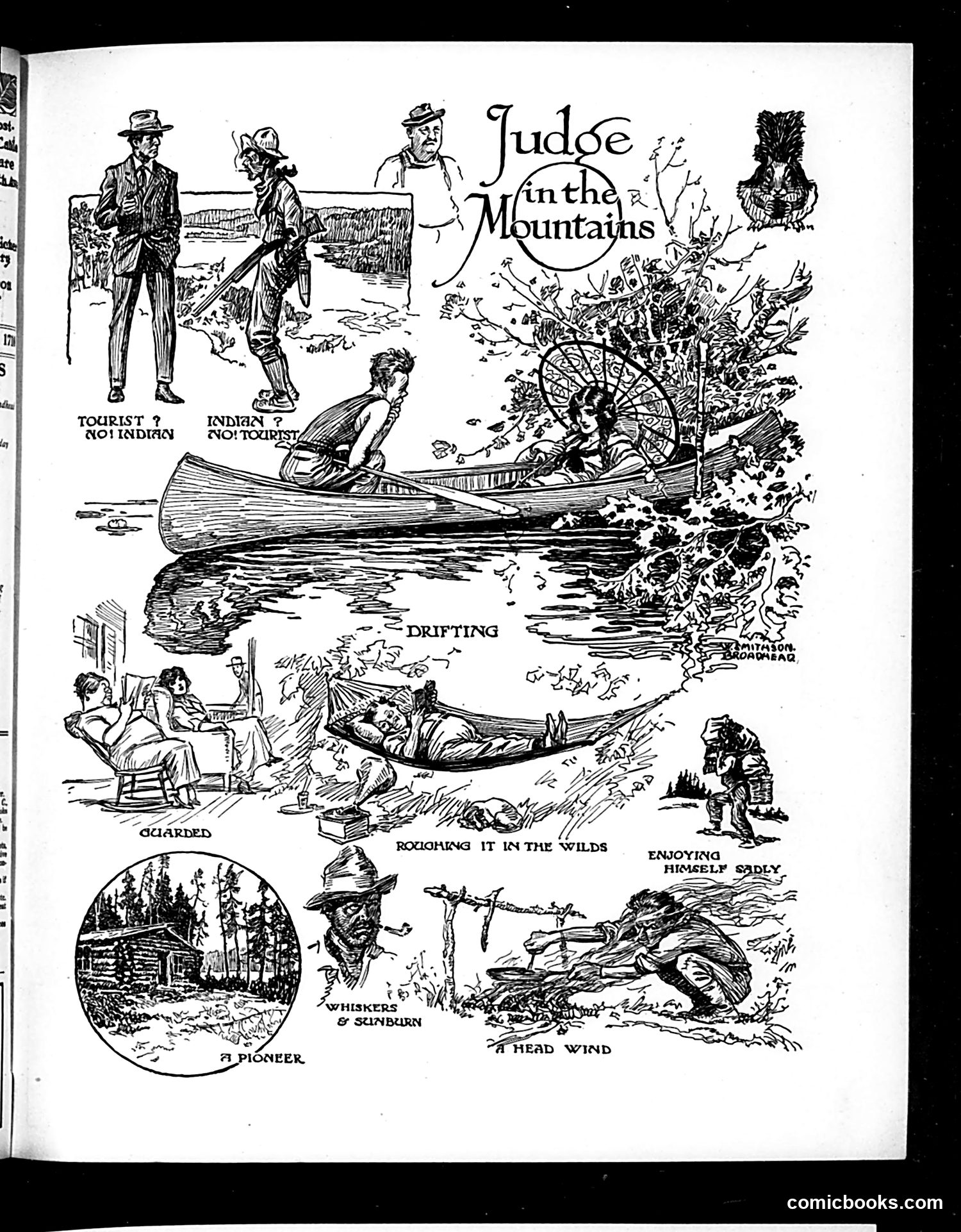
This illustrated page depicts various mountain vacation activities and stereotypes popular in early 20th-century America. The central title vignettes show contrasting tourist types: a "Tourist Notoriety" (well-dressed gentleman) and an "Indian Notoriety" (presumably a Native American guide), establishing a class and cultural distinction. The scenes satirize vacation experiences: "Drifting" (canoeing), "Guarded" (camping), "Roughing it in the Wilds" (outdoor leisure), "Enjoying Himself Sadly" (solitary hiking), "Whiskers & Sunburn" (a pioneer figure), "A Head Wind" (struggling against elements), and "A Pioneer" (log cabin dwelling). The satire mocks how tourists romanticize wilderness experiences while maintaining social pretensions, contrasting genuine frontier life with leisure activities masquerading as rugged adventure.
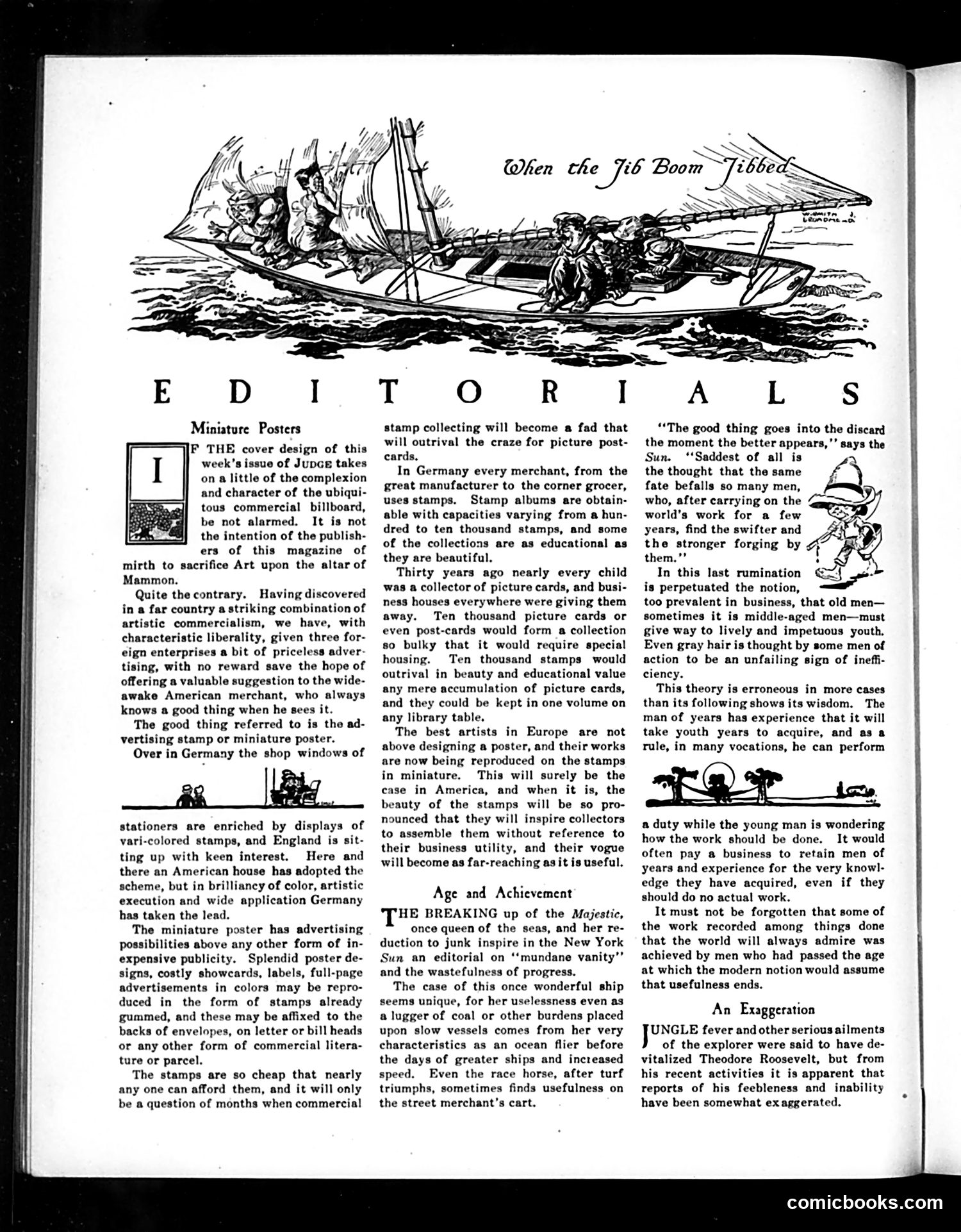
This editorial page features a satirical illustration of a sailboat in distress, captioned "When the Jib Boom Jibbed." The cartoon likely uses nautical terminology metaphorically—a "jibbed" boom refers to a sailing accident where the boom swings dangerously across the deck. The editorials below discuss commercial advertising, specifically miniature posters and stamp collecting. The text argues that artistic poster design has become valuable advertising, with European merchants successfully using decorative stamps. It advocates American merchants adopt similar practices, positioning artistic commercialism as both profitable and culturally valuable. The secondary editorials address aging ("Age and Achievement") and discuss Theodore Roosevelt's health reports, suggesting contemporary readers were concerned about his fitness for office or public activities.
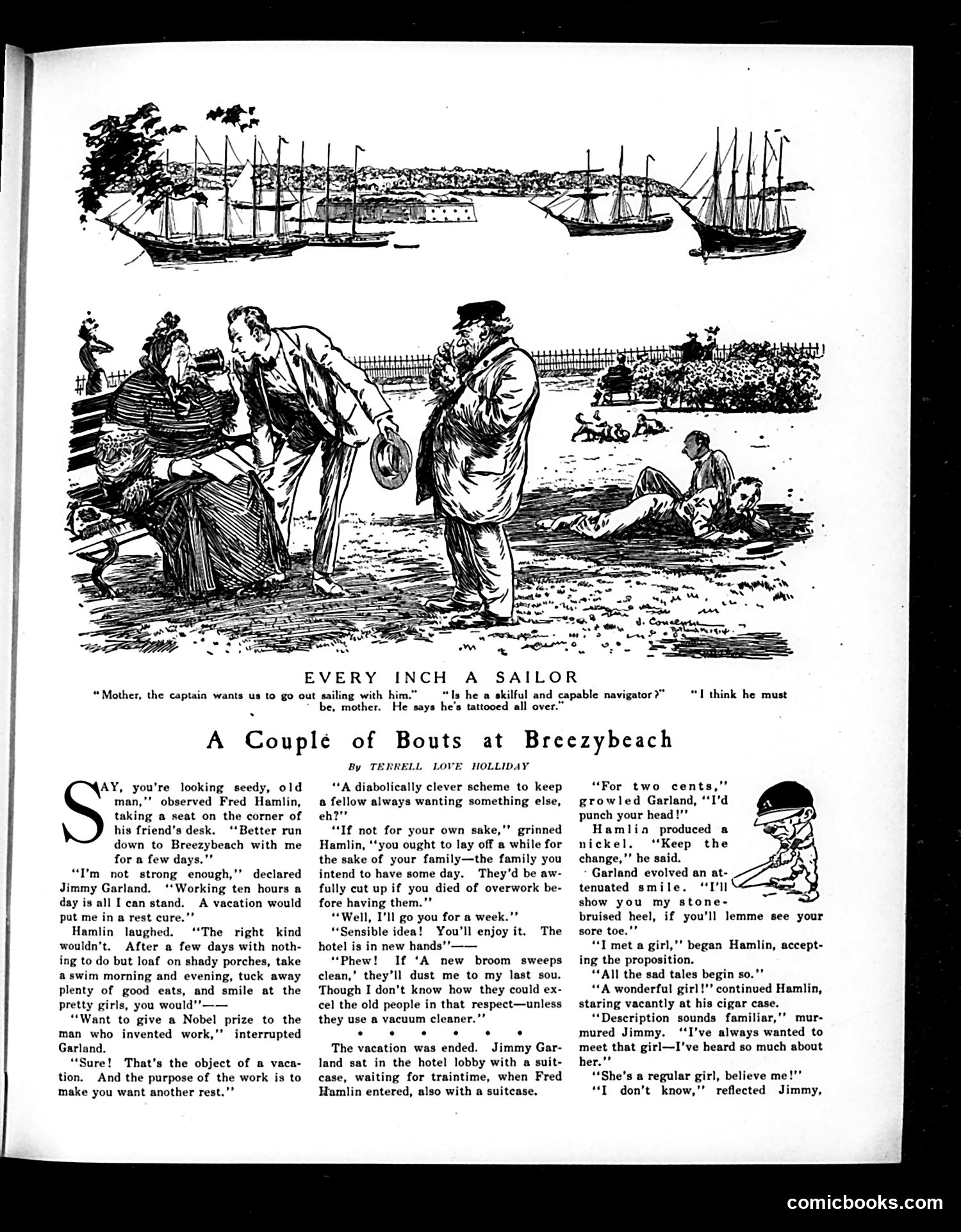
This is a humorous short story by Terrell Love Holliday about working-class vacation humor, not political satire. The narrative depicts Jimmy Garland and Fred Hamlin planning a beach vacation. The joke centers on Hamlin's suggestion that Jimmy should marry a girl to provide him with free domestic labor—a wife who would cook, clean, and manage household tasks ("A new broom sweeps clean"). Jimmy initially resists but eventually agrees to meet a suitable woman. The accompanying illustration shows beachgoers in period dress (appears early 20th century). The humor relies on satirizing marriage as transactional labor exploitation, presented as lighthearted banter between working-class men. The satire targets attitudes toward women's domestic roles and the economic calculations underlying marriage proposals of the era.
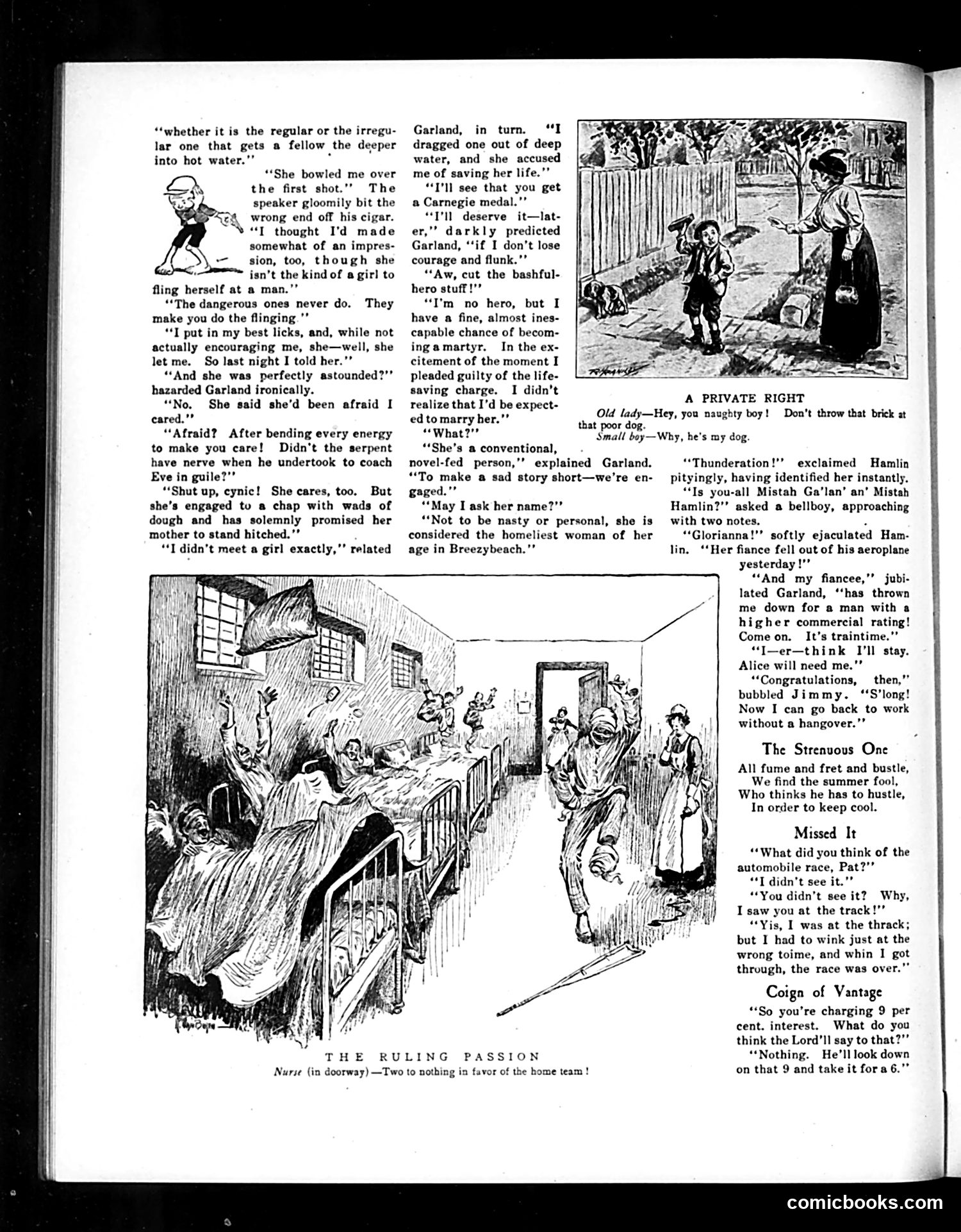
This page contains multiple satirical pieces typical of early 20th-century humor: **Main Story (top)**: A romantic comedy about two men discussing their failed courtships. One man saved a woman from drowning, she assumed he'd propose, and he—caught in the lie—becomes engaged to "the homeliest woman" in town. His friend is equally trapped, engaged to a woman who threw him over for a wealthier man. The satire targets romantic entanglement and social conventions around marriage. **"The Ruling Passion" (bottom left)**: A hospital scene where a nurse prioritizes the home team's sports score over patient care—mocking the era's obsession with baseball and sports fandom. **Smaller pieces**: "A Private Right" jokes about a boy's right to torment his own dog; "The Strenuous One" mocks summer leisure; "Missed It" features Irish dialect humor about a man blinking during a car race; "Coign of Vantage" is a joke about a dishonest banker exploiting religious hypocrisy. The page reflects Judge's typical blend of social satire, romantic comedy, and class-based humor.
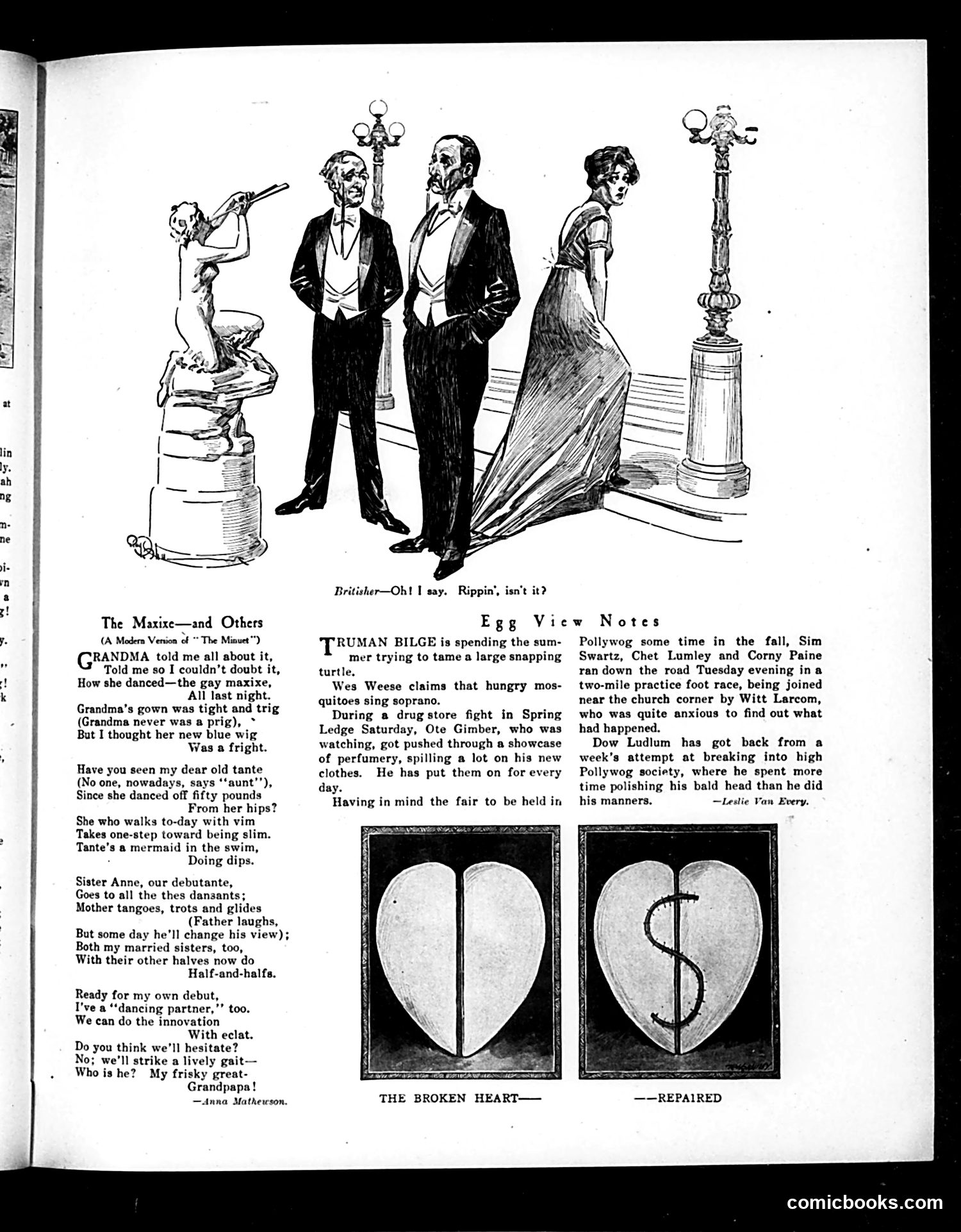
The top cartoon satirizes the early 1900s dance craze, particularly the **maxixe**, a scandalous Brazilian dance that shocked American society. The poem humorously depicts how this "modern" dance has infected an entire family—from grandmothers to debutantes—suggesting how the supposedly improper dance has become socially acceptable across all ages. The central illustration shows two well-dressed men observing a woman in an elegant gown near decorative street lamps, with one saying "Rippin', isn't it?"—British slang expressing approval. This likely comments on how even conservative foreign observers find the new dancing fashionable. The "Egg View Notes" section contains gossipy small-town anecdotes with absurdist humor—taming snapdragons, mosquitoes singing, perfume mishaps—typical filler content. The "Broken Heart—Repaired" images are symbolic illustrations showing a heart split in two, then mended with a dollar sign, likely satirizing mercenary attitudes toward romance or marriage. Overall, the page reflects early 20th-century anxiety about rapidly changing social morals, particularly regarding women's liberation and modern leisure activities.
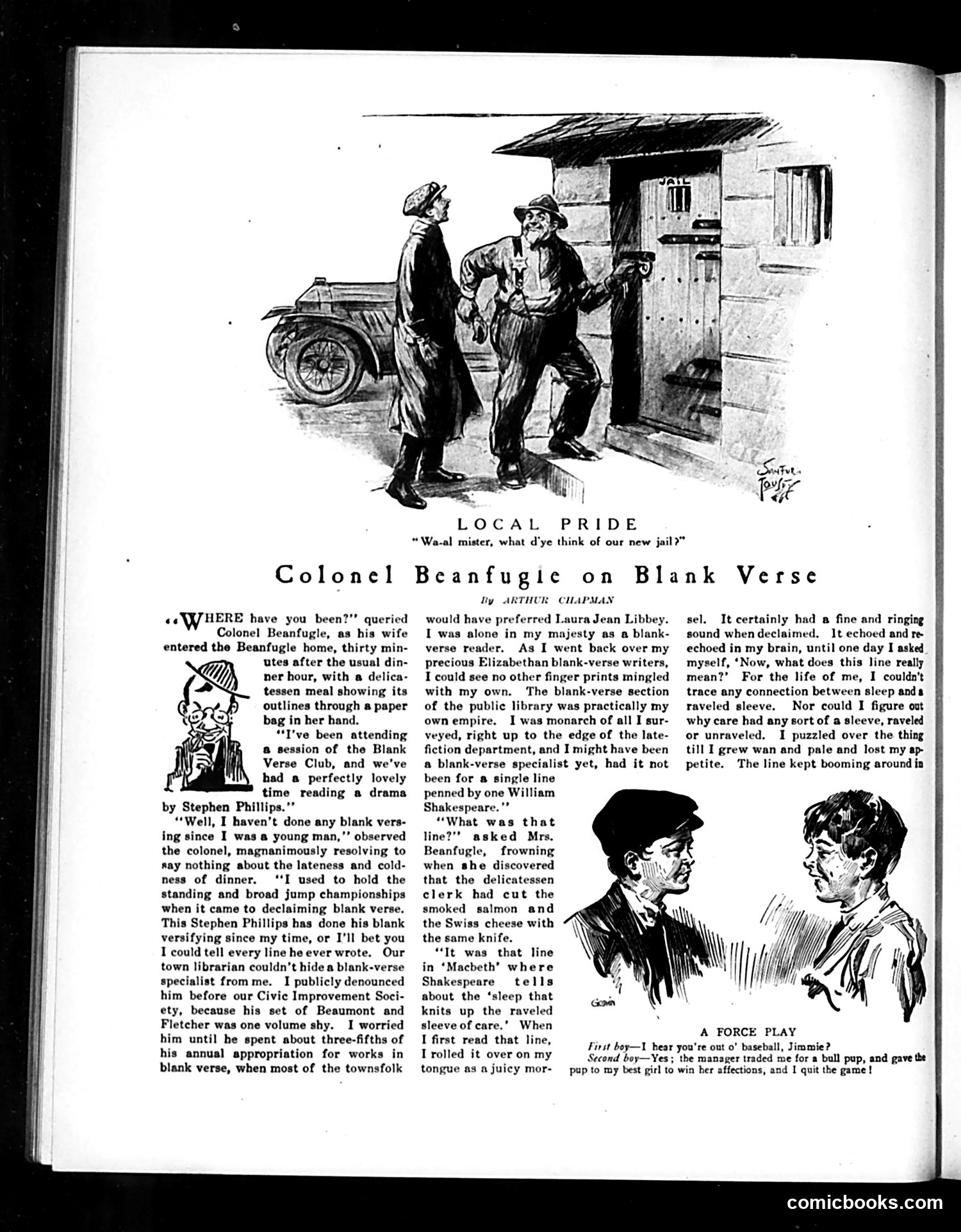
The top cartoon satirizes small-town boasting: a local proudly shows off "our new jail" to a visitor, reflecting provincial pride in civic infrastructure, however modest. The main article mocks Colonel Beanfugle, a self-important small-town intellectual who dominated his library's blank-verse section and publicly bullied the librarian into buying Elizabethan drama. His dominance ended when he encountered a single line from Shakespeare's *Macbeth*—"the sleep that knits up the raveled sleeve of care"—which he couldn't understand. Unable to comprehend why "care" has a "sleeve" or how sleep relates to it, the Colonel became so obsessed and confused that he abandoned blank-verse entirely. The satire targets pretentious amateur literary scholars who weaponize obscure knowledge locally but crumble when confronted with genuine complexity. His tyranny over the librarian is mocked as baseless bluster. The bottom cartoon is unrelated: a boy traded from baseball for a bullpup (given to his girlfriend as a romantic gesture).
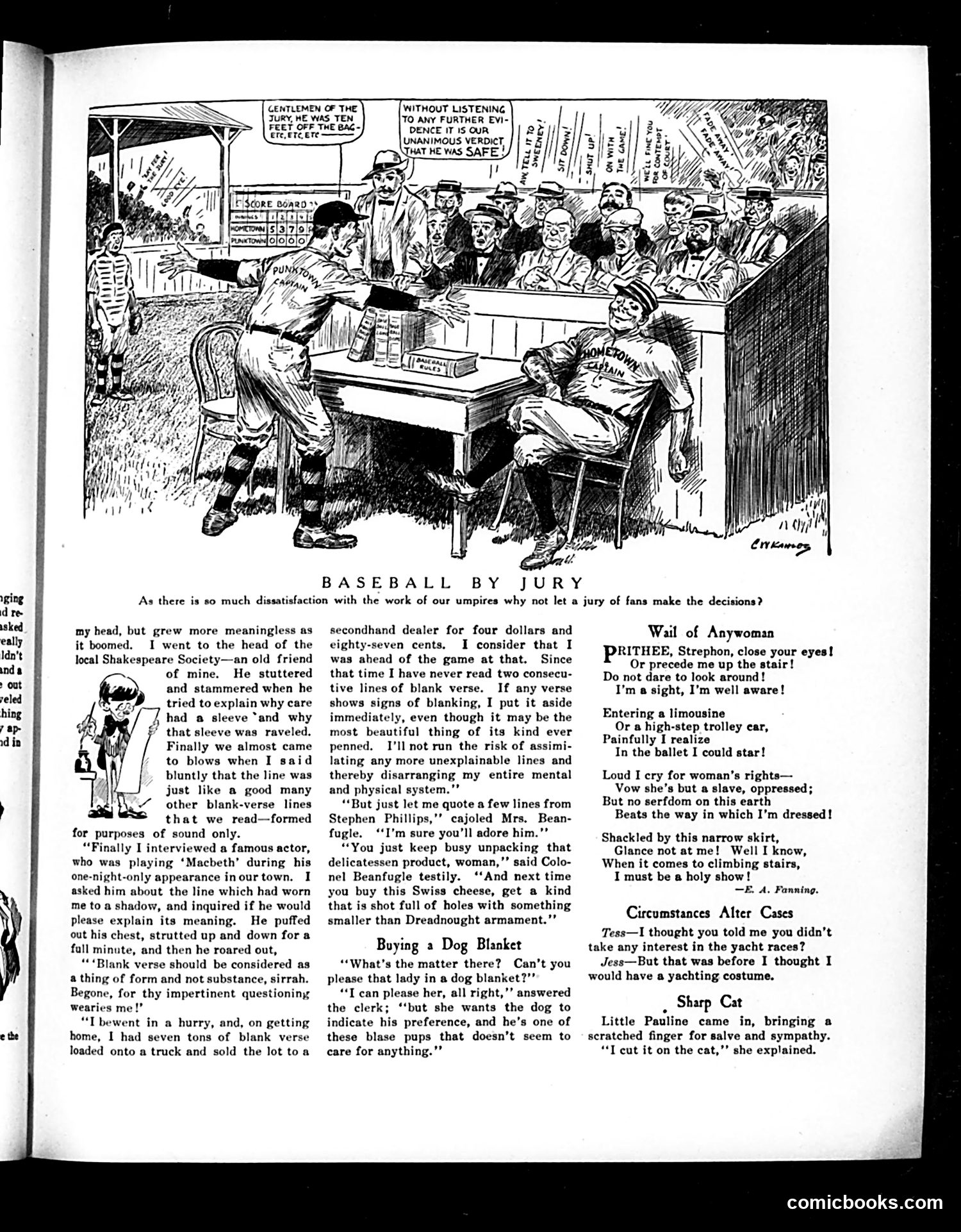
This cartoon satirizes widespread public dissatisfaction with baseball umpires' decisions by proposing an absurd solution: letting a jury of fans make the calls instead. The image shows a courtroom scene where a formal jury delivers a verdict on a baseball play, with spectators and officials packed into the jury box. The satire targets two things: first, the chronic complaints about umpire competence in early 20th-century baseball; second, the American tendency to solve problems through formal legal/democratic processes. By treating a baseball call like a serious court case—complete with jury, witnesses, and formal verdicts—Judge magazine ridicules both the intensity of fan complaints and the notion that democracy works for everything. The cartoon suggests that while fans constantly criticize umpires, a jury system would be equally impractical and absurd, implying umpires, flawed as they are, remain necessary.
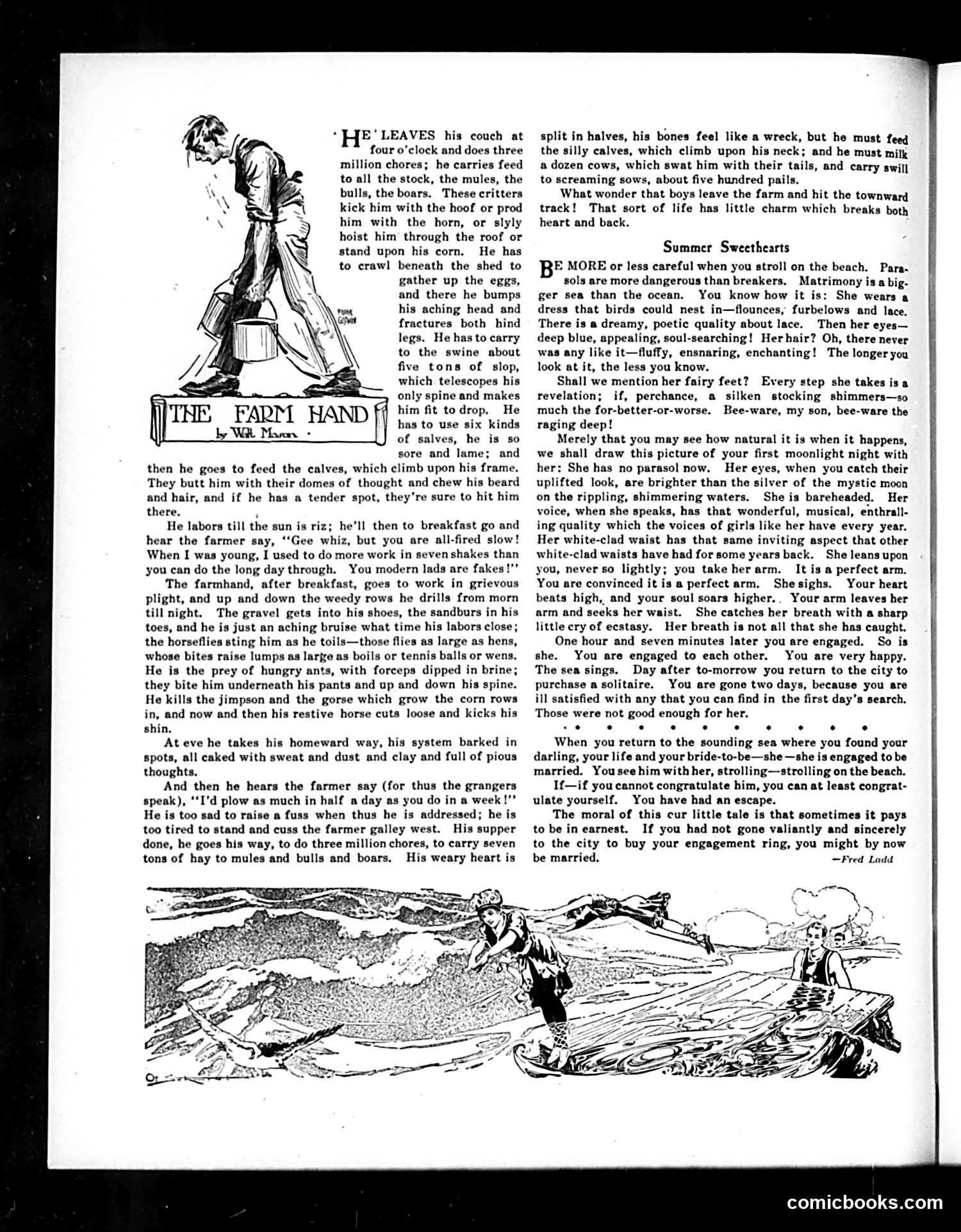
This page contains two distinct pieces from Judge magazine: **"The Farm Hand"** is a satirical poem with illustration mocking rural labor. It depicts a farmworker's exhausting day—beginning at 4 a.m., enduring abuse from livestock, harsh conditions (insects, thorns, sandburs), and ending with contemptuous farmers claiming they worked harder in their youth. The satire targets: (1) the romantic glorification of farm life, and (2) older generations dismissing younger workers as lazy despite demonstrable hardship. The phrase "You modern lads are fakes!" suggests generational tension over work ethic standards. **"Summer Sweethearts"** is lighter satirical commentary on beachside courtship, warning young men about romantic entanglement. It humorously equates matrimony with ocean danger and describes a woman's physical appeal in flowery language before cautioning that initial attraction ("raging deep") leads to marriage. Both pieces appear designed as humorous social commentary for Judge's educated, urban readership—the farm piece critiques rural life and generational conflict; the beach piece pokes fun at romantic idealism.
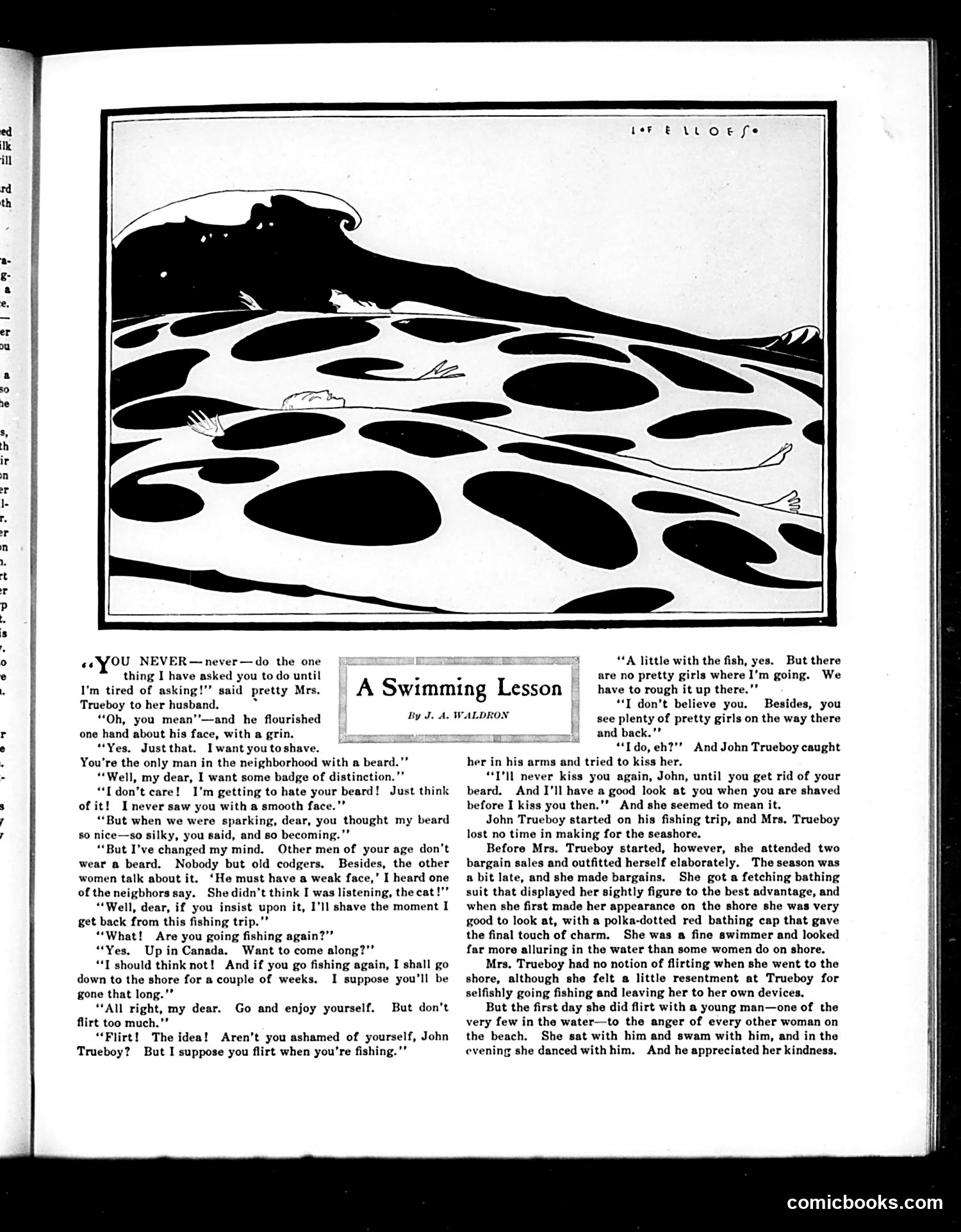
This is a domestic comedy story, not a political cartoon. It depicts a marital disagreement: Mrs. Trueboy demands her husband shave his beard before she'll kiss him again. He refuses, claiming it's a "badge of distinction," and announces a fishing trip to Canada. She threatens to go to the seashore for weeks instead. The satirical point targets early 20th-century gender dynamics and hypocrisy. Mr. Trueboy warns his wife not to "flirt too much" while he claims there are "no pretty girls" where he's fishing—an obvious lie she doesn't believe. The story then shows Mrs. Trueboy immediately flirts with a young man at the beach, validating her skepticism about his fishing trip. The humor lies in how both spouses make excuses to pursue independent leisure while condemning the other's potential dalliances—typical marital double standards of the era.
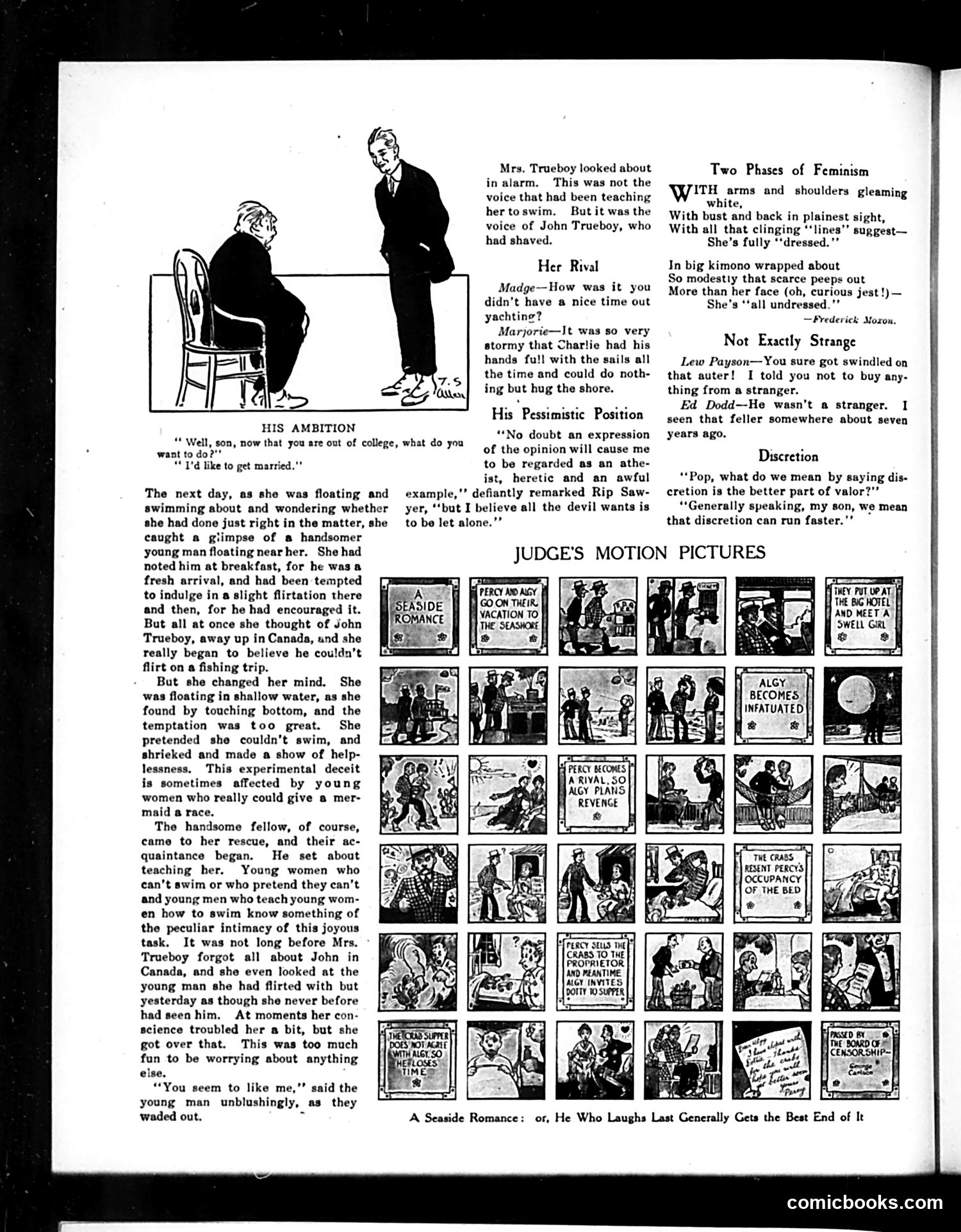
This page from Judge magazine contains several brief satirical pieces mocking early-20th-century social attitudes and gender relations: **"His Ambition"** jokes about a young man fresh from college whose only goal is marriage—satirizing shallow ambition. **"Her Rival"** plays on a woman's excuse for poor yachting (a boyfriend was "hugging the shore" rather than sailing properly)—a double entendre about romantic distraction. **"Two Phases of Feminism"** critiques the contradictions in women's fashion standards: women in revealing modern dress are called "fully dressed," while those modestly covered in kimonos are called "undressed"—mocking arbitrary social judgment. **"His Pessimistic Position"** features a character defending atheistic views, likely referencing contemporary debates over religion and modernity. **"Not Exactly Strange"** and **"Discretion"** offer brief observational humor about human nature. The main cartoon narrative concerns a woman who feigns inability to swim to flirt with an attractive stranger while her fiancé John is away—satirizing female deceptiveness and the compromised morality of romantic temptation. The motion picture frames below appear to be promotional material for Judge's film content.
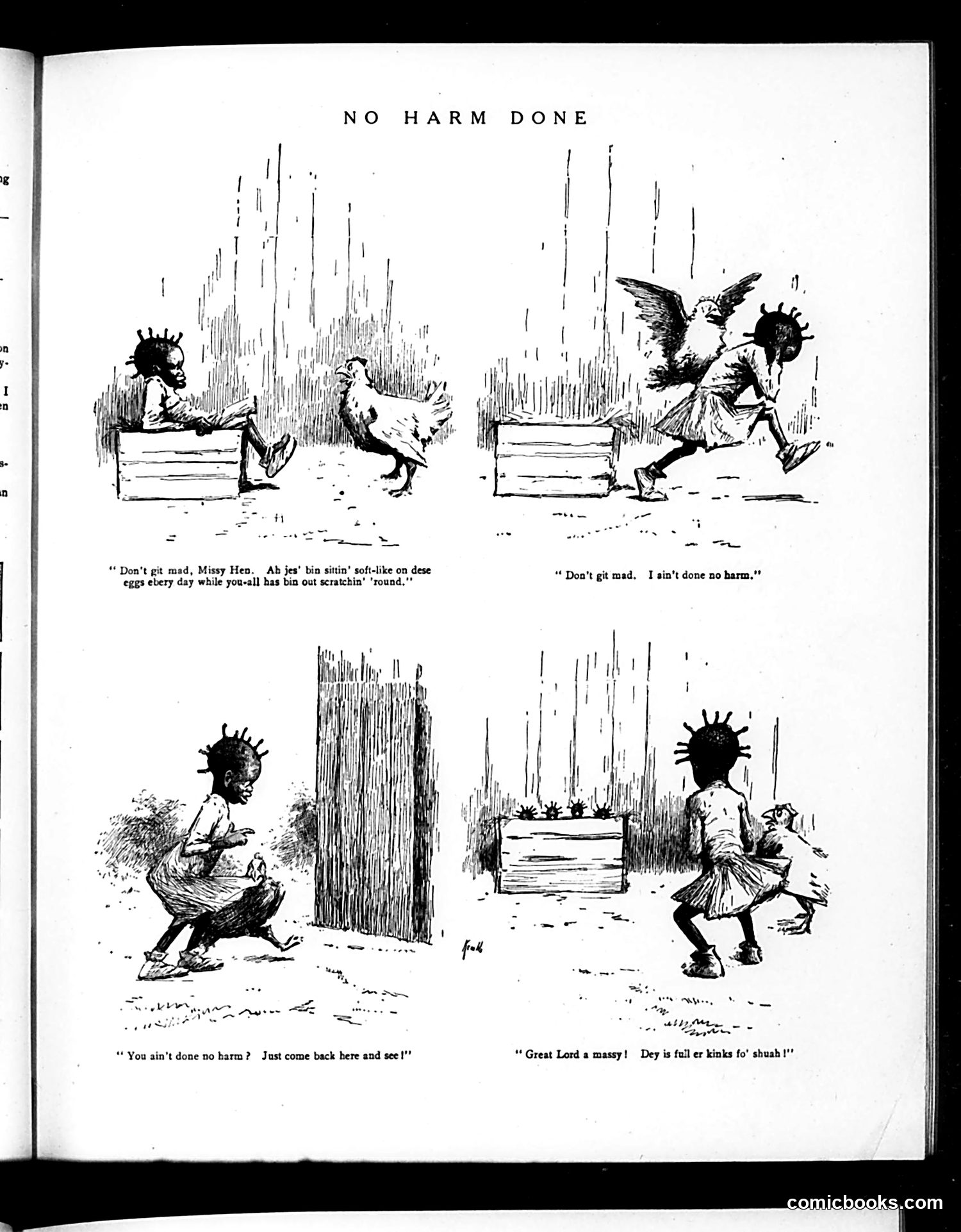
This is a four-panel comic using racist dialect and imagery to satirize incompetence. The caricatured Black figure (depicted with exaggerated features) has been sitting on a hen's eggs while the hen was away, claiming he's done "no harm." The punchline reveals the eggs have been damaged—rendered with kinked/bent lines suggesting deformity. The hen's angry reaction and the male character's defensive claim that he's "done no harm" by merely sitting (passively) criticize the notion that inaction equals harmlessness when entrusted with responsibility. The satire targets carelessness and deflection of blame rather than directly addressing the racist caricature, though the degrading dialect and exaggerated features reflect the period's deeply offensive conventions. The humor derives from the contrast between claimed innocence and obvious failure.
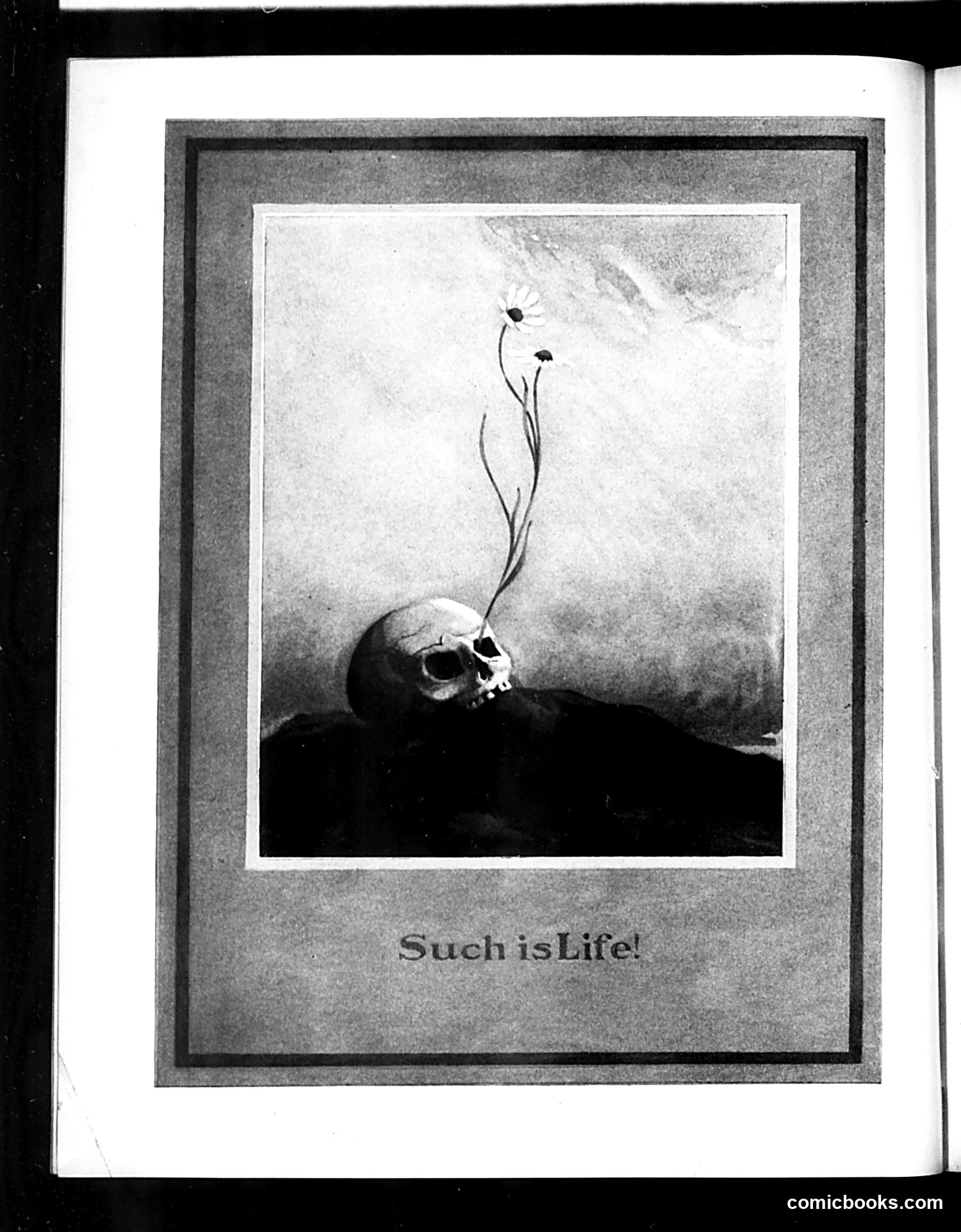
This is a memento mori image—a philosophical meditation on mortality and the transience of life. The cartoon depicts a human skull from which a delicate flowering plant grows. The caption "Such is Life!" suggests acceptance of life's inevitable cycle: death and decay nourish new growth and renewal. This appears to be social commentary rather than political satire. It reflects early-to-mid 20th century aesthetics and philosophical humor common in Judge magazine, using dark imagery to convey a stoic or existential message about human mortality. The juxtaposition of death (the skull) with life (the flowering plant) creates ironic visual poetry—life emerges from death itself, embodying nature's continuous cycle.
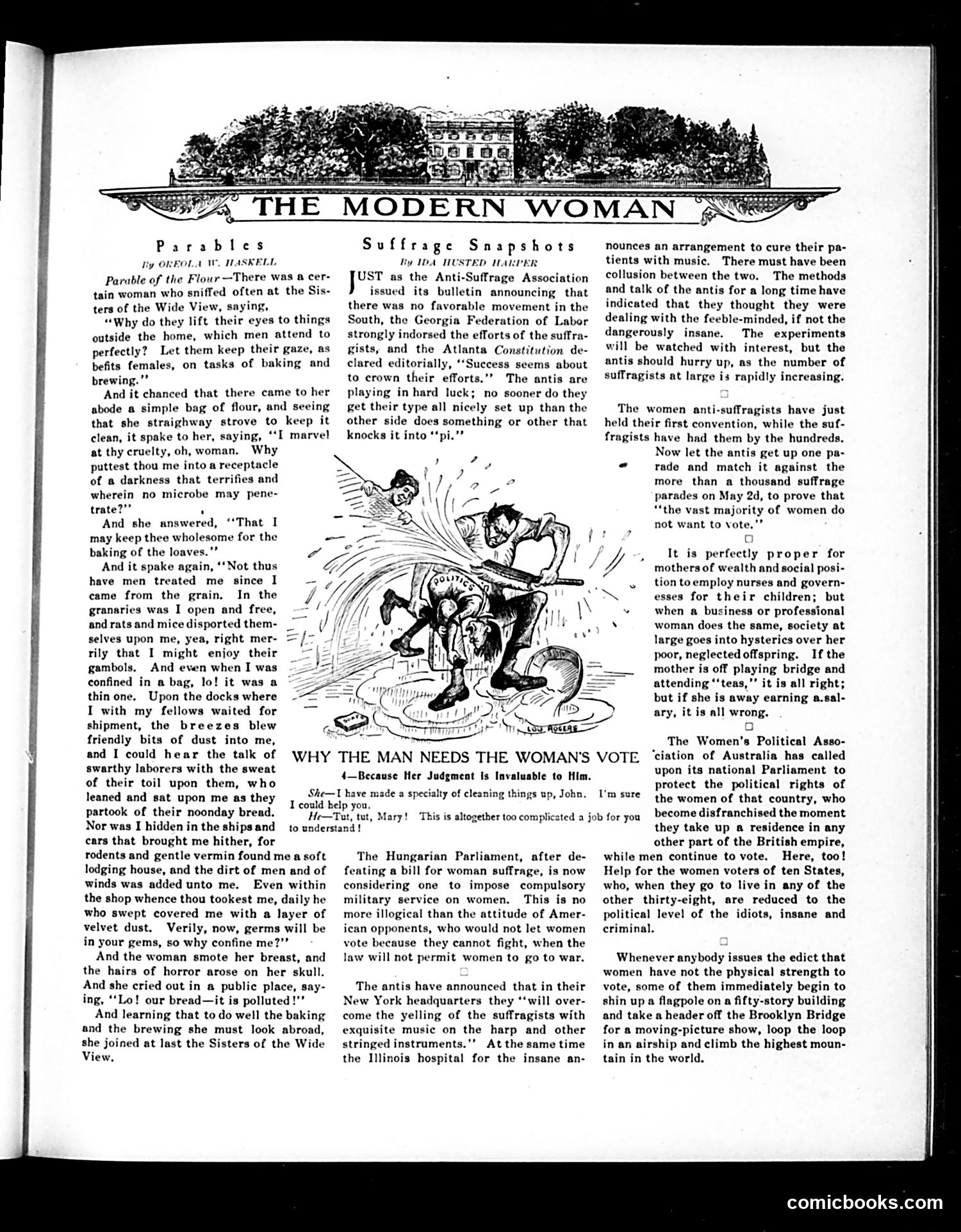
This page contains two satirical pieces arguing **for women's suffrage** during the early 20th-century suffrage movement. **"Parables" (left):** A woman who scorns suffragists for looking "outside the home" keeps flour in a sealed container to preserve it. The flour complains it was dirtier when men handled it—exposed to rodents, dust, and laborers' filth. The moral: women's attention to cleanliness and detail proves they need broader influence beyond domestic tasks. The woman then "learns" this lesson and joins the suffragists. **"Suffrage Snapshots" (right):** Brief satirical news items mock anti-suffrage arguments. Hungary's paradox—denying women votes but considering military service—exposes logical hypocrisy. The joke about anti-suffragists using music to drown out "yelling suffragists" while an insane asylum treats patients with music sarcastically suggests anti-suffragists lack reason. The overall argument: women's demonstrated competence in household management proves they deserve political participation.
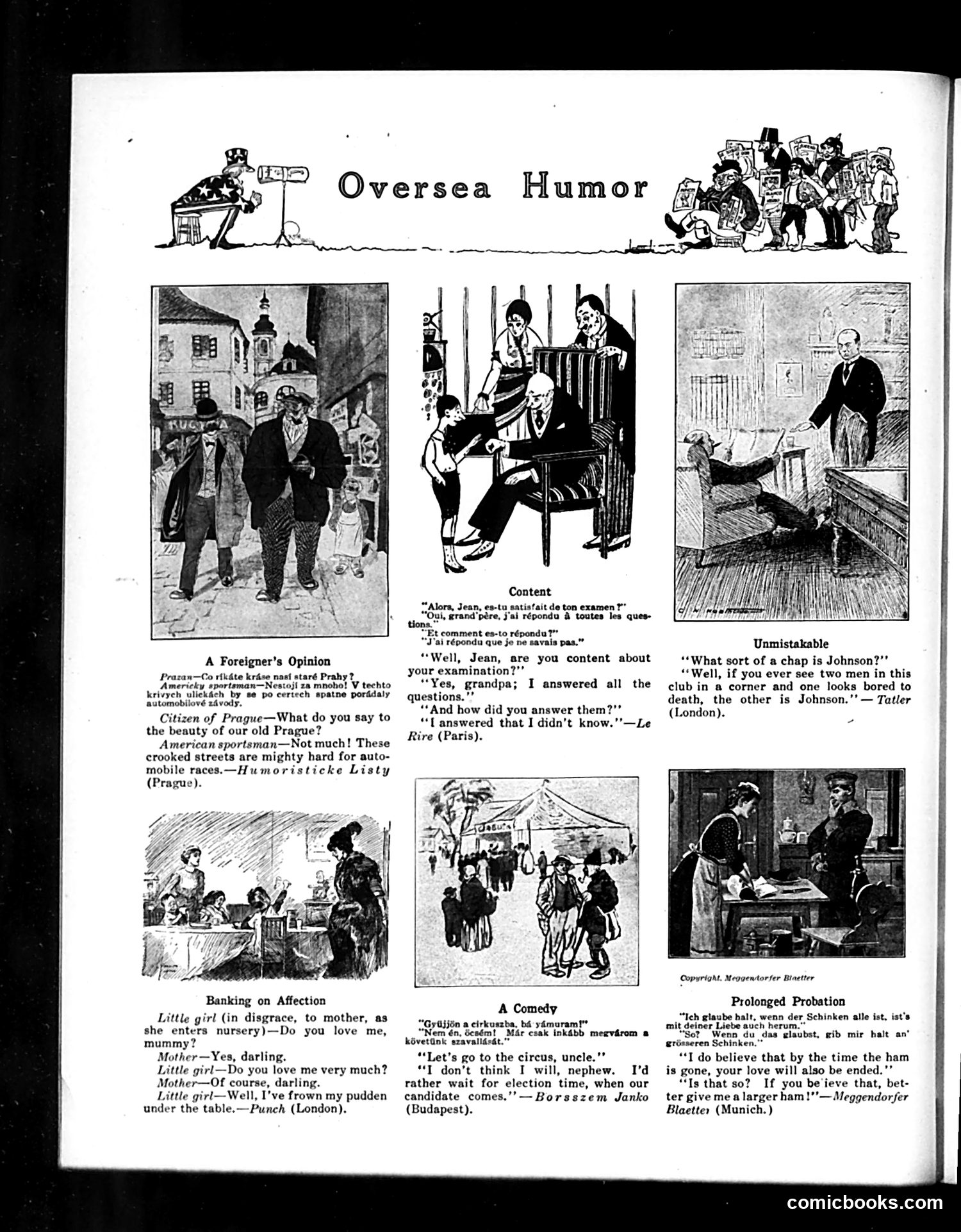
This page collects international jokes and cartoons from various European satirical publications, demonstrating early 20th-century humor across different cultures. **Key items:** - **"A Foreigner's Opinion"**: An American tourist dismisses Prague's historic beauty as unsuitable for automobile racing—satire of American pragmatism and car-culture obsession over cultural appreciation. - **"Banking on Affection"**: A child manipulates her mother's affection to avoid punishment for misbehavior—commentary on parental weakness. - **"Content"**: A student admits he answered exam questions by saying "I don't know"—humor about academic dishonesty or learned helplessness. - **"A Comedy"**: A nephew wants circus tickets; uncle prefers waiting for election season when candidates give speeches—satire of political theater as entertainment. - **"Unmistakable"**: A boring club member is identified by his deadening presence—mild character humor. - **"Prolonged Probation"**: A wife claims her love expires when food runs out; husband demands larger portions—dark marital satire about mercenary affection. The page emphasizes universal themes: materialism, family dynamics, and political absurdity.
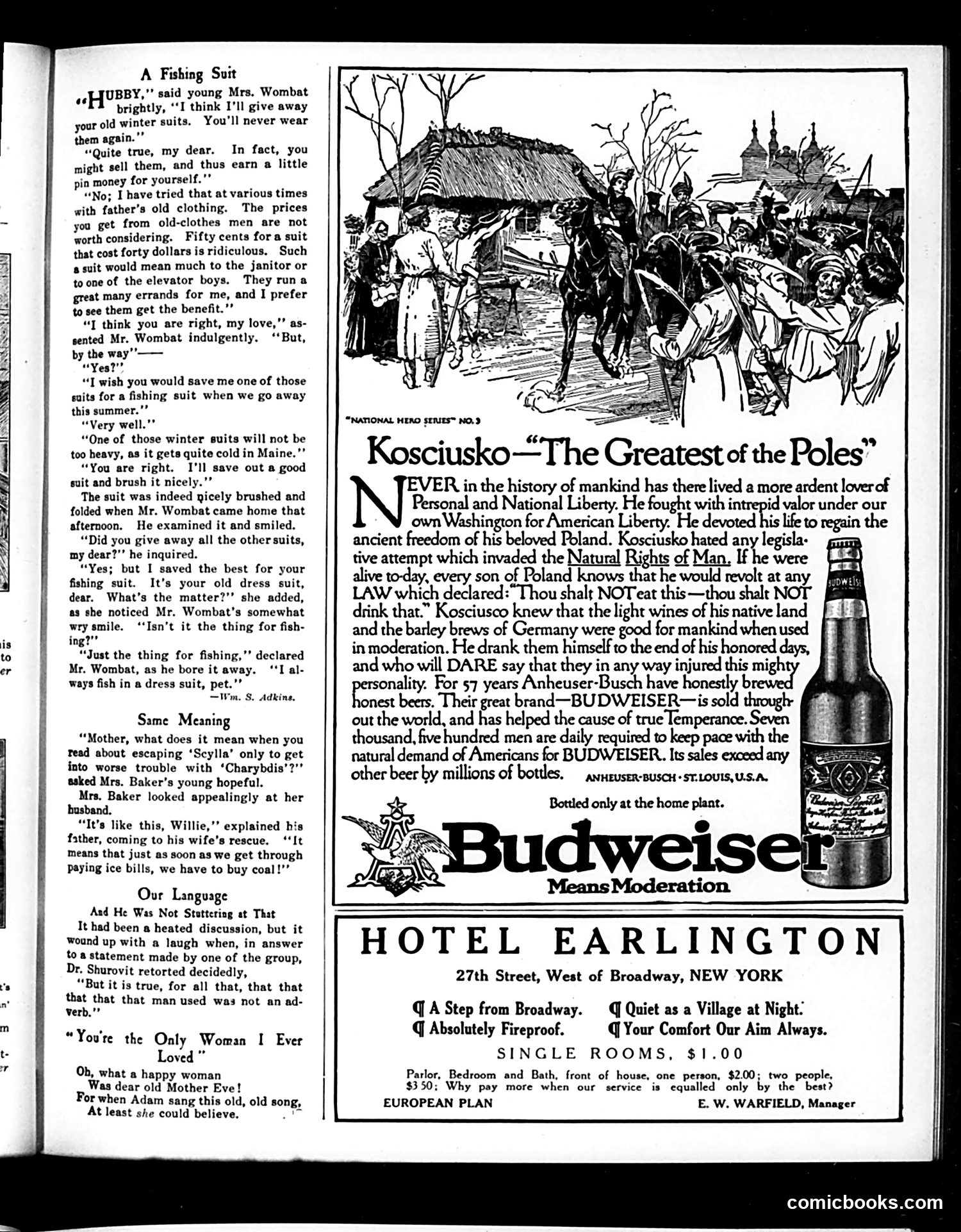
This page contains **humorous domestic sketches** and **advertisements**, not political cartoons. The "Fishing Suit" story satirizes marital dynamics: Mrs. Wombat generously donates her husband's old winter suits to servants, then—as a joke—saves his formal dress suit for his Maine fishing trip, missing the absurdity. The humor lies in the husband's polite acceptance of this ridiculous situation. The main advertisement features **Kosciusko**, a Polish-American Revolutionary War hero, to promote **Budweiser beer**. This is propaganda defending alcohol against Prohibition advocates. The ad claims Kosciusko would oppose laws restricting what people "eat or drink," implying Prohibition violates natural liberty. It's a cynical attempt to associate beer-drinking with patriotism and freedom during the Temperance movement's height. The smaller sketches make light puns about language and domestic economics.
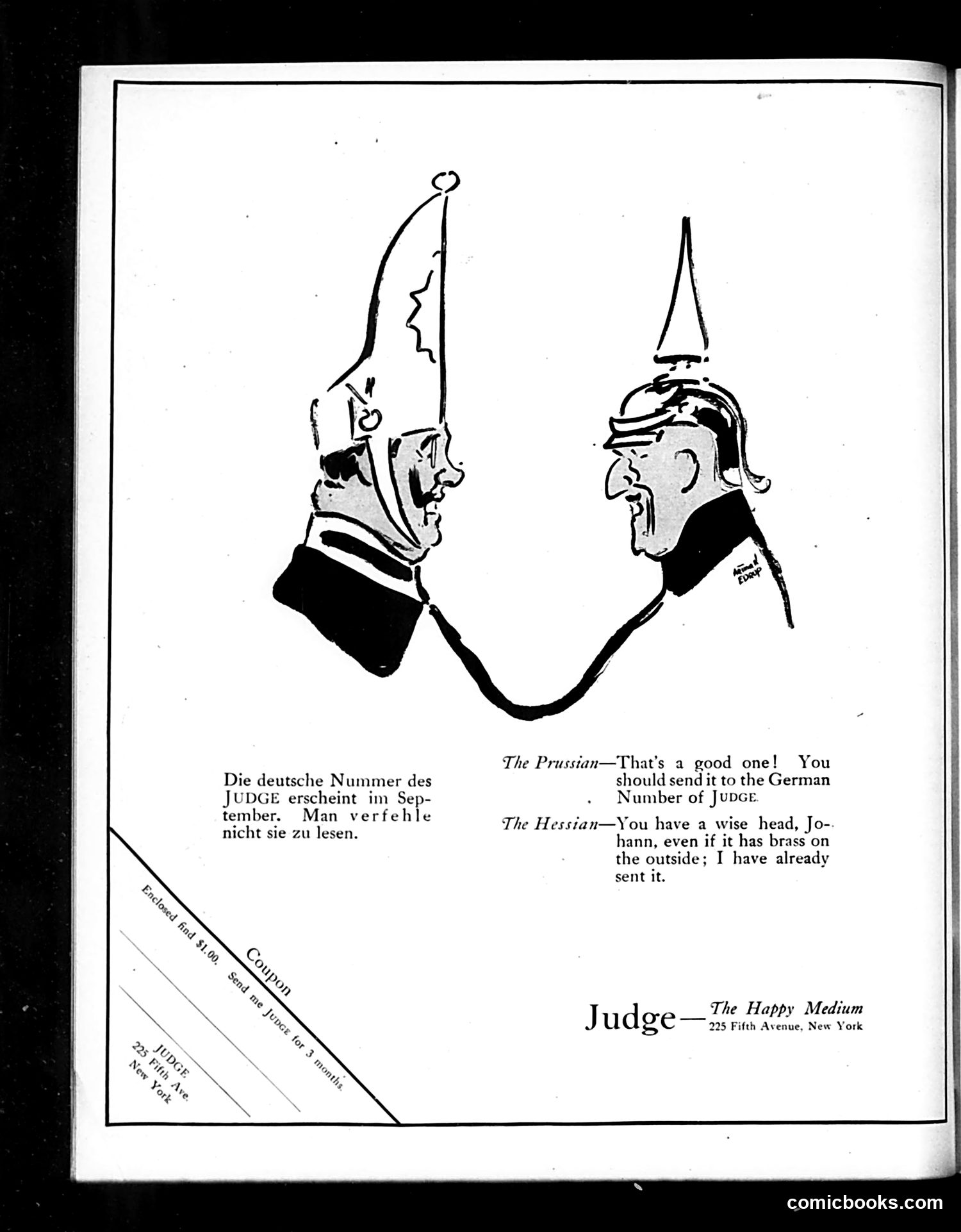
This cartoon satirizes German military figures during what appears to be the early 20th century (pre-WWI era). Two helmeted military men—identified as "The Prussian" and "The Hessian"—are depicted in conversation, their heads connected by a pipe or tube, suggesting they share the same thoughts or ideas. The joke mocks German militarism: The Prussian praises something as "a good one" and suggests sending it to Germany's Judge magazine equivalent. The Hessian responds that he's already done so, implying German officers mindlessly copy each other's ideas. The reference to "brass on the outside" is a pun on military brass (officers) and the literal brass decorations on their spiked Prussian helmets. The satire critiques the rigidity and conformity of German military culture.
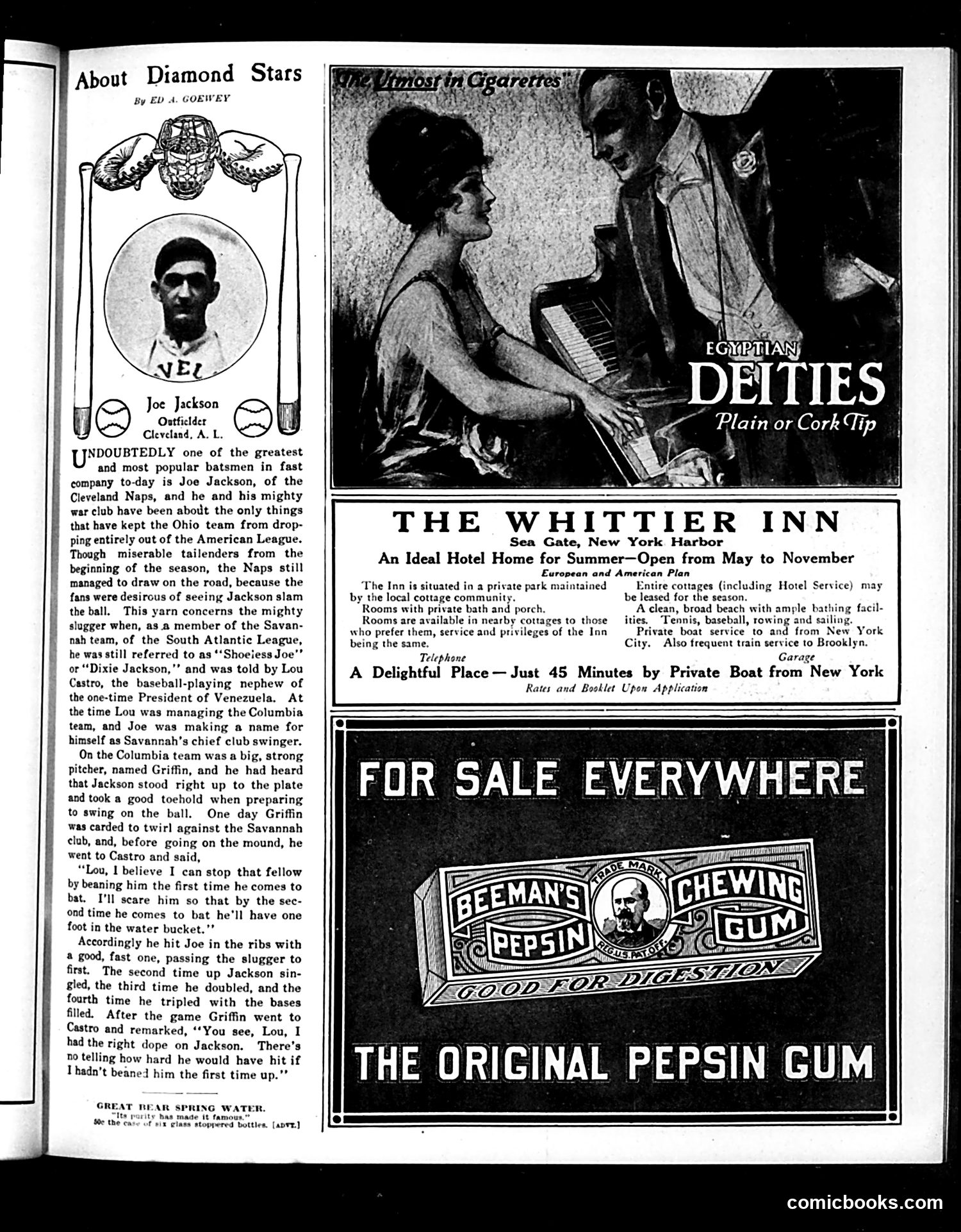
This page is primarily **advertising with one sports anecdote**, not political satire. The main content is "About Diamond Stars," a humorous story about **Joe Jackson**, an outfielder for the Cleveland Naps (early 1900s baseball team). The narrative describes how pitcher Griffin attempted to intimidate Jackson by beaning (hitting) him with a pitch, expecting to frighten him. The joke's punchline: Jackson was unfazed and subsequently got a single, double, and triple—suggesting the beaning had no effect on his aggressive batting. The page also features three advertisements: Egyptian Deities cigarettes, the Whittier Inn hotel in New York, and Beeman's Pepsin Chewing Gum. **Historical note:** This predates Jackson's later infamy in the 1919 Black Sox scandal, when he was banned from baseball for allegedly throwing World Series games.
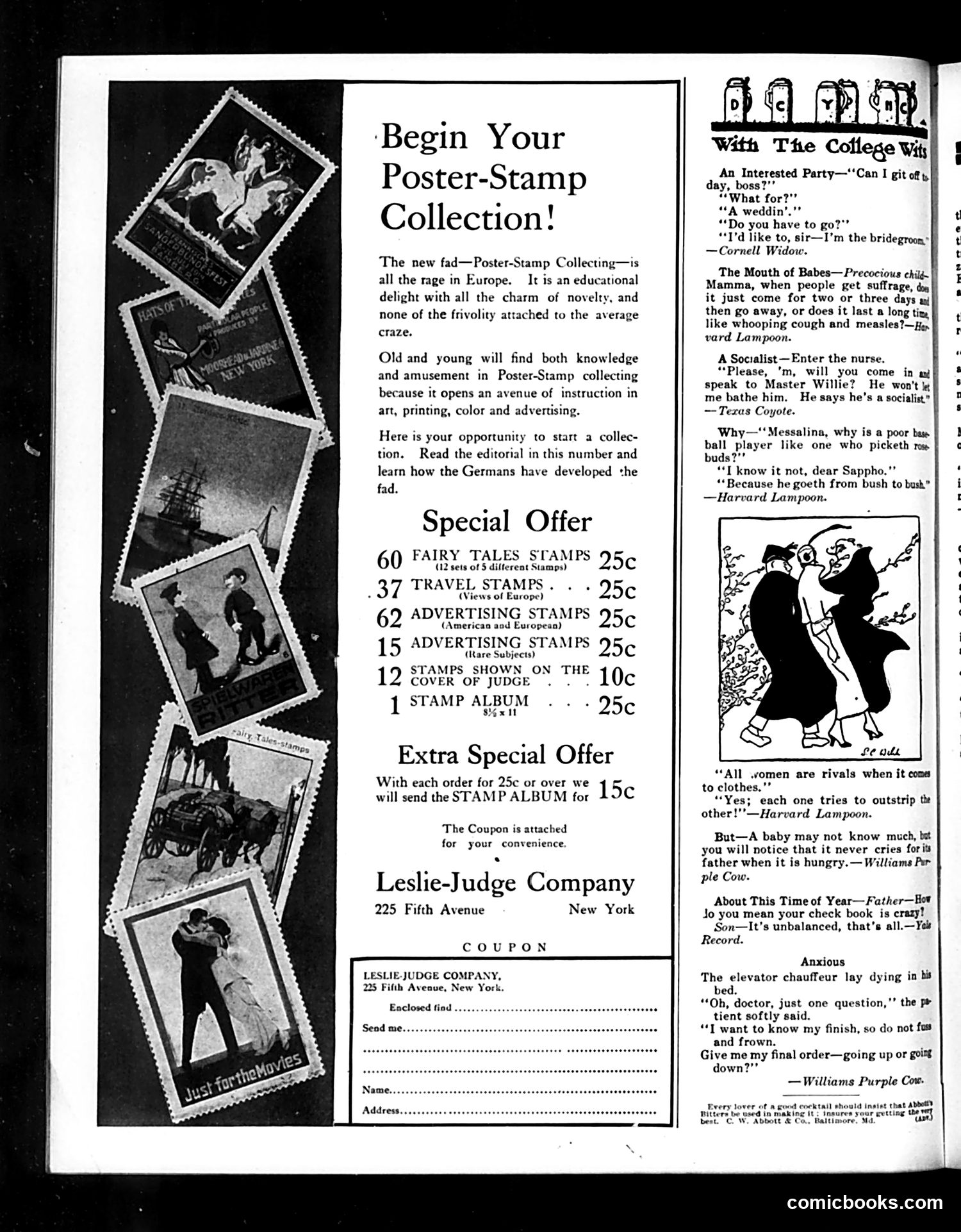
This page is primarily a **commercial advertisement** for the Leslie-Judge Company promoting "Poster-Stamp Collecting"—a European fad the publisher describes as educational and artistic. The left side displays sample decorative stamps featuring scenes from fairy tales and travel imagery. The advertisement frames stamp collecting as refined and intellectually superior to typical "frivolous" crazes, appealing to both children and adults through instruction in "art, printing, color and advertising." The right side contains **humor fillers**—brief joke columns typical of Judge magazine—covering unrelated topics like marriage, women's fashion rivalry, and an elevator operator's death-bed anxiety about "going up or down." These are standard satirical observations on daily life and social customs, not commentary on the stamps themselves. The page represents early 20th-century magazine advertising blended with light social satire, characteristic of Judge's format.
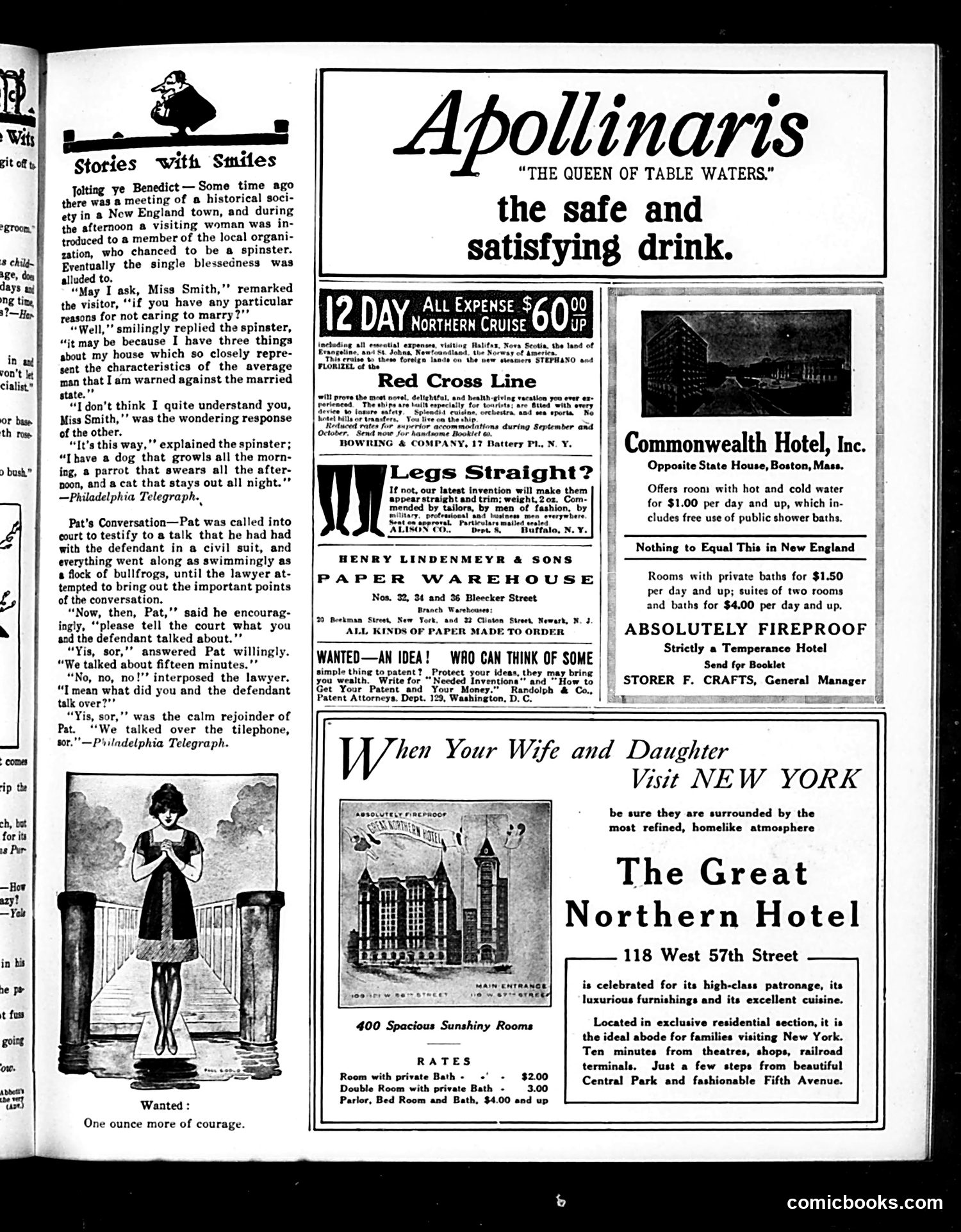
This page is primarily **advertising**, with two brief humorous anecdotes in the "Stories with Smiles" section. **The Humor:** The two jokes mock Irish dialect and literal-mindedness. "Pat's Conversation" plays on an Irish laborer's obtuseness—when asked what he and a defendant "talked over," Pat insists they spoke "over the telephone," missing the lawyer's meaning entirely. The spinster story uses exaggeration: she refuses marriage because her dog growls, parrot swears, and cat stays out—all supposedly representing typical male behavior. **The Advertisements:** The page features period hotel and product ads targeting affluent travelers: Apollinaris mineral water, a Red Cross Line cruise, Boston and New York hotels emphasizing cleanliness and respectability, and a patent invention service. The small cartoon of a woman labeled "Wanted: One ounce more of courage" appears to reference women's changing social roles, though context is unclear. **Historical Note:** These stereotypes—Irish immigrants as dim-witted, women as reluctant wives—reflect early 20th-century Judge magazine's target audience of educated, upper-class readers who found such caricatures amusing.
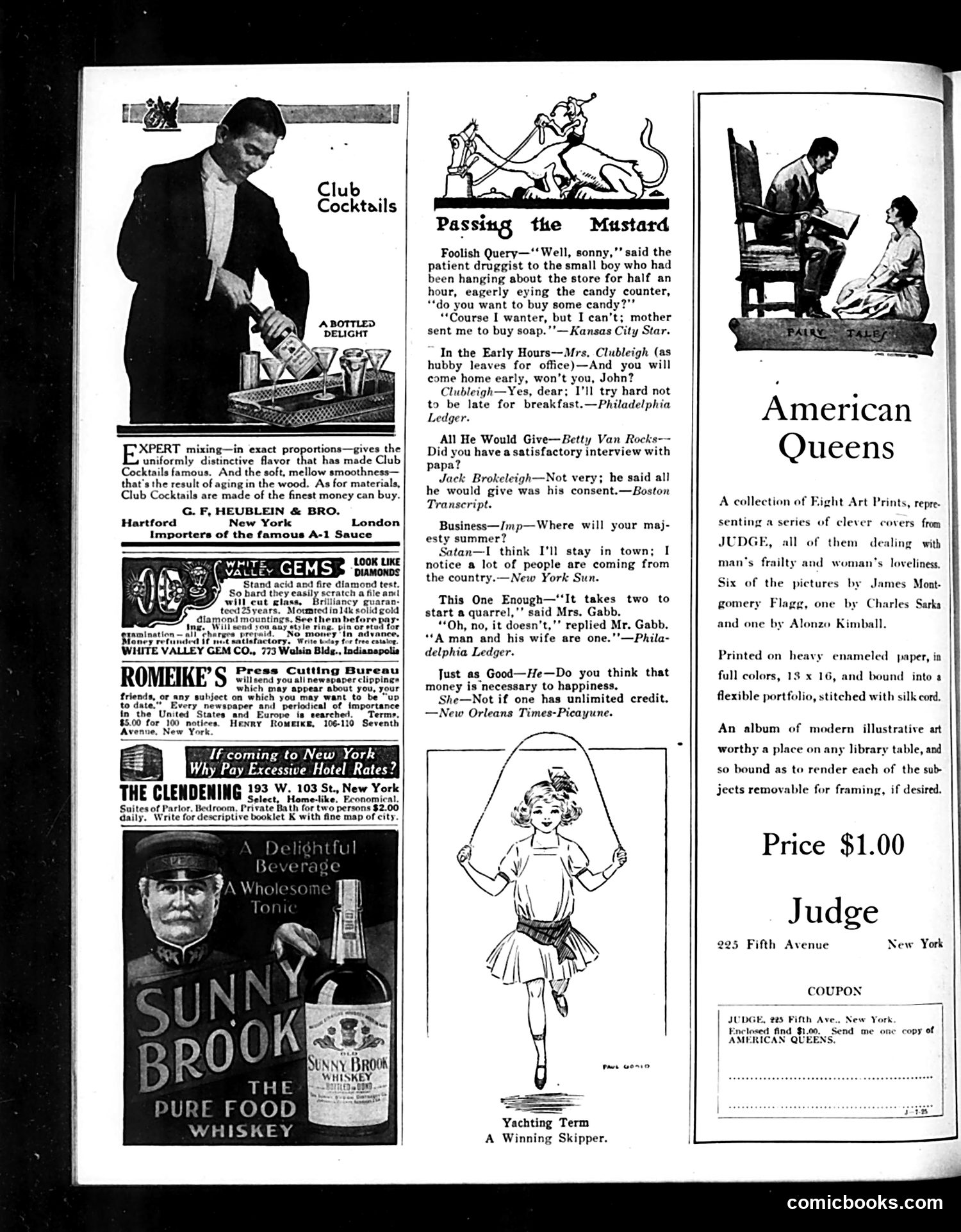
This page is primarily **advertising and promotional content** rather than political satire. The left two-thirds feature ads for cocktails, synthetic gems, press clipping services, a hotel, and whiskey—typical of early 20th-century magazine monetization. The center section contains brief **humorous anecdotes** ("Passing the Mustard") with jokes about domestic life, marriage dynamics, and social situations. These are gentle, non-political humor pieces reflecting period attitudes: wives nag husbands about coming home late; money matters in romance; married couples bicker. The right side advertises **"American Queens,"** a portfolio of eight art prints by notable illustrators (James Montgomery Flagg, Charles Sarka, Alonzo Kimball). The prints depict "man's frailty and woman's loveliness"—suggesting romanticized or potentially salacious imagery targeting male readers. The overall page reflects *Judge*'s business model: combining light social commentary with advertisements and premium content sales to its affluent readership.

This is a **beer advertisement**, not a political cartoon. The page promotes Schlitz beer, a major Milwaukee brewery brand. The ad emphasizes that Schlitz comes "in Brown Bottles" and features the slogan "The Beer That Made Milwaukee Famous"—Schlitz's actual historical marketing catchphrase. The advertisement urges readers to "Order a Case Today" and instructs them to verify authenticity by checking that the crown cap is branded "Schlitz." This suggests concerns about counterfeit or inferior products, which was common during Prohibition era (1920-1933) when legitimate breweries faced competition from bootleggers. The professional engraving of the bottle and prominent branding reflect typical early-20th-century advertising strategies in magazines like *Judge*.
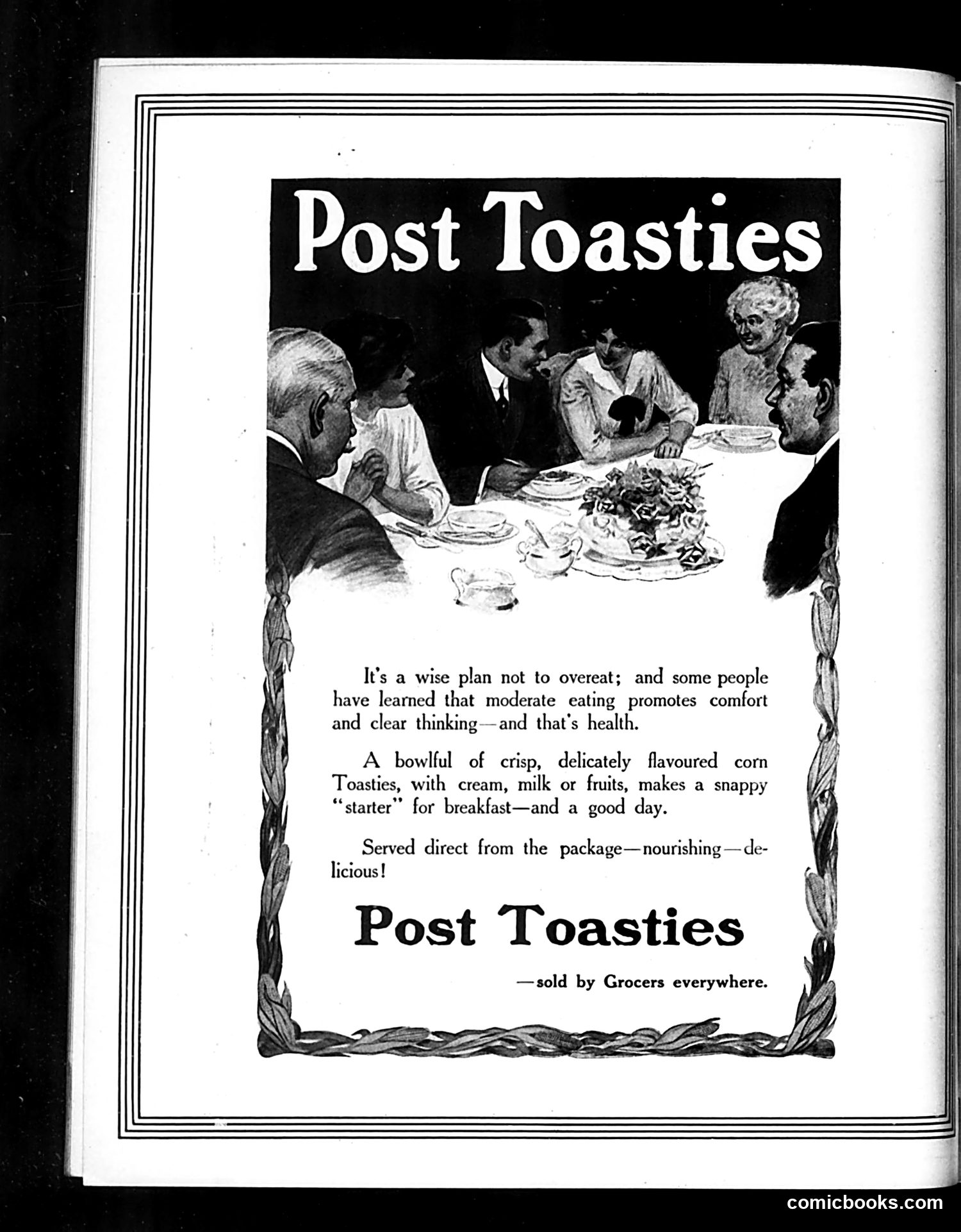
This is a **straightforward cereal advertisement**, not political satire. It appears in *Judge* magazine's advertising section rather than editorial content. The image shows a dining scene with well-dressed men and women enjoying a meal, illustrating Post Toasties cereal as a refined breakfast choice. The advertisement's messaging reflects early 20th-century health concerns: it promotes "moderate eating" for "comfort and clear thinking," positioning the cereal as a sensible, light breakfast "starter" rather than a heavy meal. The appeal is to middle-class respectability and wellness—themes common in period advertising. The text emphasizes convenience ("served direct from the package") and nutritional benefit ("nourishing"). There is no evident political satire or caricature here; it's simply a commercial promoting breakfast cereal through aspirational imagery of genteel dining.