
Judge, 1914-07-25 · page 10 of 24
Judge — July 25, 1914 — page 10: what you’re looking at
What you’re looking at
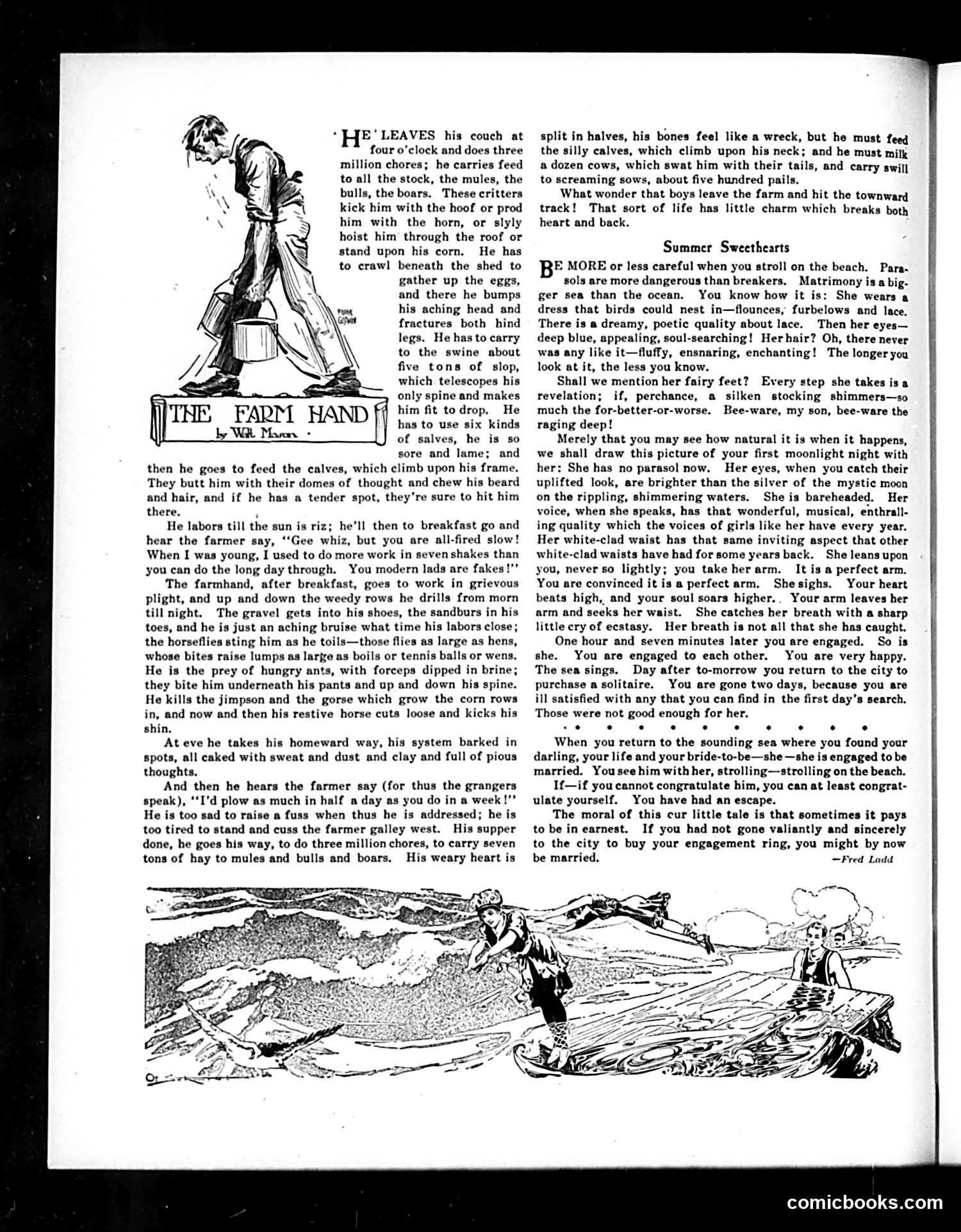
This page contains two distinct pieces from Judge magazine: **"The Farm Hand"** is a satirical poem with illustration mocking rural labor. It depicts a farmworker's exhausting day—beginning at 4 a.m., enduring abuse from livestock, harsh conditions (insects, thorns, sandburs), and ending with contemptuous farmers claiming they worked harder in their youth. The satire targets: (1) the romantic glorification of farm life, and (2) older generations dismissing younger workers as lazy despite demonstrable hardship. The phrase "You modern lads are fakes!" suggests generational tension over work ethic standards. **"Summer Sweethearts"** is lighter satirical commentary on beachside courtship, warning young men about romantic entanglement. It humorously equates matrimony with ocean danger and describes a woman's physical appeal in flowery language before cautioning that initial attraction ("raging deep") leads to marriage. Both pieces appear designed as humorous social commentary for Judge's educated, urban readership—the farm piece critiques rural life and generational conflict; the beach piece pokes fun at romantic idealism.
📄 Transcribed text from this page (OCR, searchable)
Machine-transcribed from the original scan — historical spelling and the odd misread are preserved.
“ HE: LEAVES his couch at four o'clock and does three million chores; he carries feed to all the stock, the mules, the bulls, the boars. These critters kick him with the hoof or prod him with the horn, or slyly hoist him through the roof or stand upon his corn. He has to crawl beneath the shed to gather up the eggs, and there he bumps his aching head and fractures both hind legs. He has to carry to the swine about five tons of slop, which telescopes his only spine and makes him fit to drop. He has to use six kinds of salves, he is so sore and lame; and then he goes to feed the calves, which climb upon his frame. They butt him with their domes of thought and chew his beard and hair, and if he has a tender spot, they’re sure to hit him there. : He labors till the sun is riz; he’ll then to breakfast go and hear the farmer say, ‘‘Gee whiz, but you are all-fired slow! When I was young, I used to do more work in sevenshakes than you can do the long day through. You modern lads are fakes!"’ The farmhand, after breakfast, goes to work in grievous plight, and up and down the weedy rows he drills from morn till night. The gravel gets into his shoes, the sandburs in his toes, and he is just an aching bruise what time his labors close; the horseflies sting him as he toils—those flies as large as hens, whose bites raise lumps as large as boils or tennis balls or wens. He is the prey of hungry ants, with forceps dipped in brine; they bite him underneath his pants and up and down his spine. He kills the jimpson and the gorse which grow the corn rows in, and now and then his restive horse cuts loose and kicks his shin. At eve he takes his homeward way, his system barked in spots, all caked with sweat and dust and clay and full of pious thoughts. And then he hears the farmer say (for thus the grangers speak), ‘‘I’d plow as much in half a day as you do in a week !'" He is too sad to raise a fuss when thus he is addressed; he is too tired to stand and cuss the farmer galley west. His supper done, he goes his way, to do three million chores, to carry seven tons of hay to mules and bulls and boars. His weary heart is a me. XR es split in halves, his bones feel like a wreck, but he must feed the silly calves, which climb upon his neck; and he must milk a dozen cows, which swat him with their tails, and carry swil] to screaming sows, about five hundred pails. What wonder that boys leave the farm and hit the townward track! That sort of life has little charm which breaks both heart and back. Summer Sweethearts BE MORE or less careful when you stroll on the beach. Para- sols are more dangerous than breakers. Matrimony is a big- ger sea than the ocean. You know how it is: She wears a dress that birds could nest in—flounces, furbelows and lace, There is a dreamy, poetic quality about lace. Then her eyes— deep blue, appealing, soul-searching! Her hair? Oh, there never was any like it—fluffy, ensnaring, enchanting! The longer you look at it, the less you know. Shall we mention her fairy feet? Every step she takes isa revelation; if, perchance, a silken stocking shimmers—so much the for-better-or-worse. Bee-ware, my son, bee-ware the raging deep! Merely that you may see how natural it is when it happens, we shall draw this picture of your first moonlight night with her: She has no parasol now. Her eyes, when you catch their uplifted look, are brighter than the silver of the mystic moon on the rippling, shimmering waters. She is bareheaded. Her voice, when she speaks, has that wonderful, musical, enthrall- ing quality which the voices of girls like her have every year. Her white-clad waist has that same inviting aspect that other white-clad waists have had for some years back. She leans upon you, never so lightly; you take herarm. It is a perfect arm. You are convinced it is a perfect arm. Shesighs. Your heart beats high, and your soul soars higher.. Your arm leaves her arm and seeks her waist. She catches her breath with a sharp little cry of ecstasy. Her breath is not all that she has caught. One hour and seven minutes later you are engaged. So is she. You are engaged to each other. You are very happy. The sea sings. Day after to-morrow you return to the city to purchase a solitaire. You are gone two days, because you are ill satisfied with any that you can find in the first day’s search. Those were not good enough for her. ey o 8 6 When you return to the sounding sea where you found your darling, your life and your bride-to-be—she —she is engaged to be married. You see him with her, strolling—strolling on the beach. If—if you cannot congratulate him, you can at least congrat- ulate yourself. You have had an escape. The moral of this cur little tale is that sometimes it pays to be in earnest. If you had not gone valiantly and sincerely to the city to buy your engagement ring, you might by now be married. —Fred Ladd comicbooks.com