
Judge, 1914-07-25 · page 4 of 24
Judge — July 25, 1914 — page 4: what you’re looking at
What you’re looking at
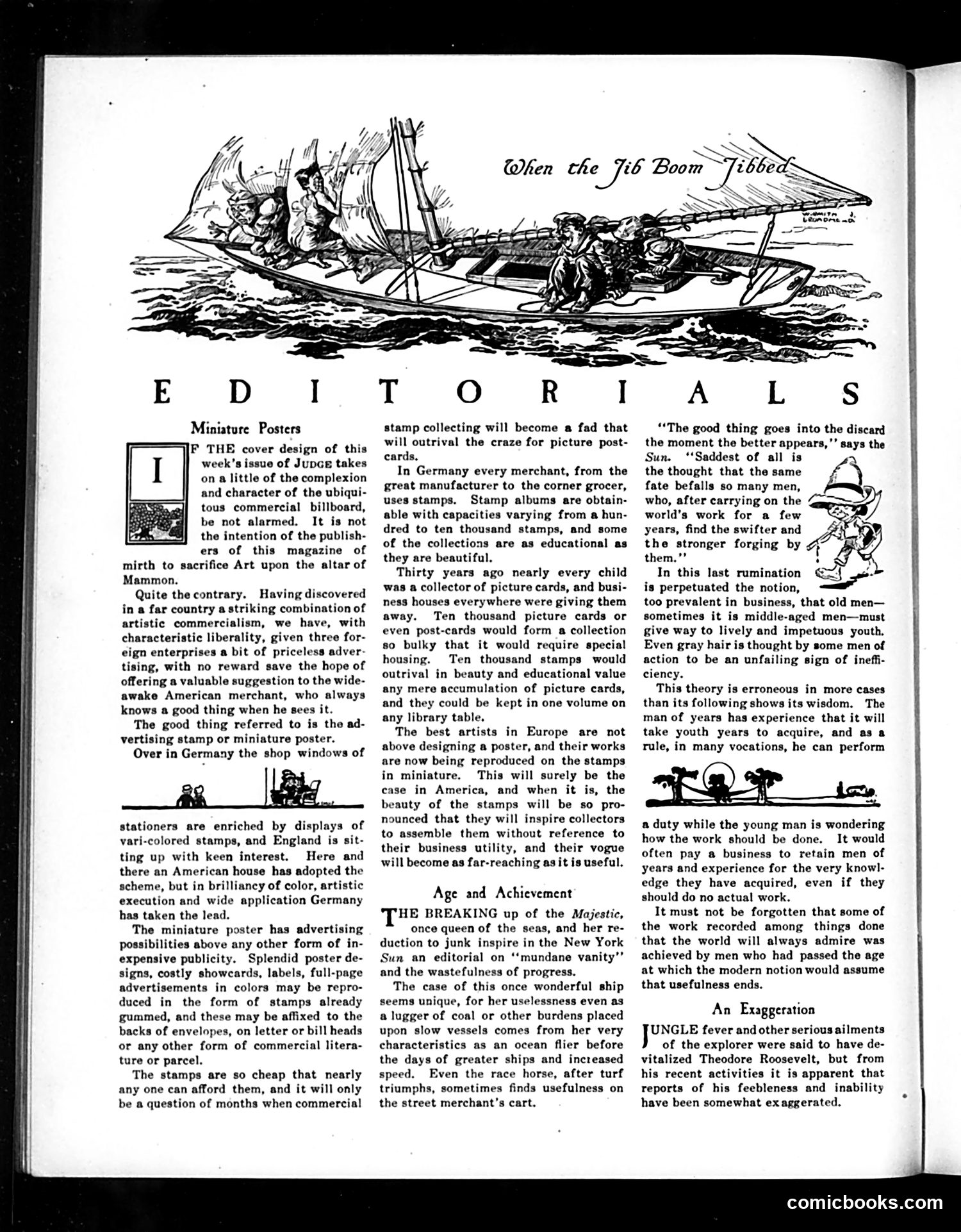
This editorial page features a satirical illustration of a sailboat in distress, captioned "When the Jib Boom Jibbed." The cartoon likely uses nautical terminology metaphorically—a "jibbed" boom refers to a sailing accident where the boom swings dangerously across the deck. The editorials below discuss commercial advertising, specifically miniature posters and stamp collecting. The text argues that artistic poster design has become valuable advertising, with European merchants successfully using decorative stamps. It advocates American merchants adopt similar practices, positioning artistic commercialism as both profitable and culturally valuable. The secondary editorials address aging ("Age and Achievement") and discuss Theodore Roosevelt's health reports, suggesting contemporary readers were concerned about his fitness for office or public activities.
📄 Transcribed text from this page (OCR, searchable)
Machine-transcribed from the original scan — historical spelling and the odd misread are preserved.
Miniature Posters IF THE cover design of this week's issue of Jupce takes on a little of the complexion and character of the ubiqui- tous commercial billboard, be not alarmed. It is not the intention of the publish- ers of this magazine of mirth to sacrifice Art upon the altar of Mammon. Quite the contrary. Having discovered in a far country a striking combination of artistic commercialism, we have, with characteristic liberality, given three for- eign enterprises a bit of priceless adver- tising, with no reward save the hope of offering a valuable suggestion to the wide- awake American merchant, who always knows a good thing when he sees it. The good thing referred to is the ad- vertising stamp or miniature poster. Over in Germany the shop windows of a stationers are enriched by displays of vari-colored stamps, and England is sit- ting up with keen interest. Here and there an American house has adopted the scheme, but in brilliancy of color, artistic execution and wide application Germany has taken the lead. The miniature poster has advertising possibilities above any other form of in- expensive publicity. Splendid poster de- signs, costly showcards, labels, full-page advertisements in colors may be repro- duced in the form of stamps already gummed, and these may be affixed to the backs of envelopes, on letter or bill heads or any other form of commercial litera- ture or parcel. The stamps are so cheap that nearly any one can afford them, and it will only be a question of months when commercial stamp collecting will become a fad that will outrival the craze for picture post- cards, In Germany every merchant, from the great manufacturer to the corner grocer, uses stamps. Stamp albums are obtain- able with capacities varying from a hun- dred to ten thousand stamps, and some of the collections are as educational as they are beautiful. Thirty years ago nearly every child was a collector of picture cards, and bu: ness houses everywhere were giving them away. Ten thousand picture cards or even post-cards would form a collection so bulky that it would require special housing. Ten thousand stamps would outrival in beauty and educational value any mere accumulation of picture cards, and they could be kept in one volume on any library table. The best artists in Europe are not above designing a poster, and their works are now being reproduced on the stamps in miniature. This will surely be the case in America, and when it is, the beauty of the stamps will be so pro- nounced that they will inspire collectors to assemble them without reference to their business utility, and their vogue will become as far-reaching as it is useful. Age and Achievement THE BREAKING up of the Majestic, once queen of the seas, and her re- duction to junk inspire in the New York Sun an editorial on ‘‘mundane vanity’’ and the wastefulness of progress. The case of this once wonderful ship seems unique, for her uselessness even as a lugger of coal or other burdens placed upon slow vessels comes from her very characteristics as an ocean flier before the days of greater ships and increased speed, Even the race horse, after turf triumphs, sometimes finds usefulness on the street merchant's cart. “The good thing goes into the discard the moment the better appears,’’ says the Sun. ‘‘Saddest of all is a the thought that the same fate befalls so many men, who, after carrying on the Qo world’s work for a few SA Ag years, find the swifter and In this last rumination is perpetuated the notion, too prevalent in business, that old men— sometimes it is middle-aged men—must give way to lively and impetuous youth. Even gray hair is thought by some men of action to be an unfailing sign of ineffi- ciency. This theory is erroneous in more cases than its following shows its wisdom. The man of years has experience that it will take youth years to acquire, and as a rule, in many vocations, he can perform a Ok ae a duty while the young man is wondering how the work should be done. It would often pay a business to retain men of years and experience for the very knowl- edge they have acquired, even if they should do no actual work. It must not be forgotten that some of the work recorded among things done that the world will always admire was achieved by men who had passed the age at which the modern notion would assume that usefulness ends. An Exaggeration UNGLE fever and other serious ailments of the explorer were said to have de- vitalized Theodore Roosevelt, but from his recent activities it is apparent that reports of his feebleness and inability have been somewhat exaggerated. comicbooks.com