
A complete issue · 24 pages · 1914
Judge — April 18, 1914
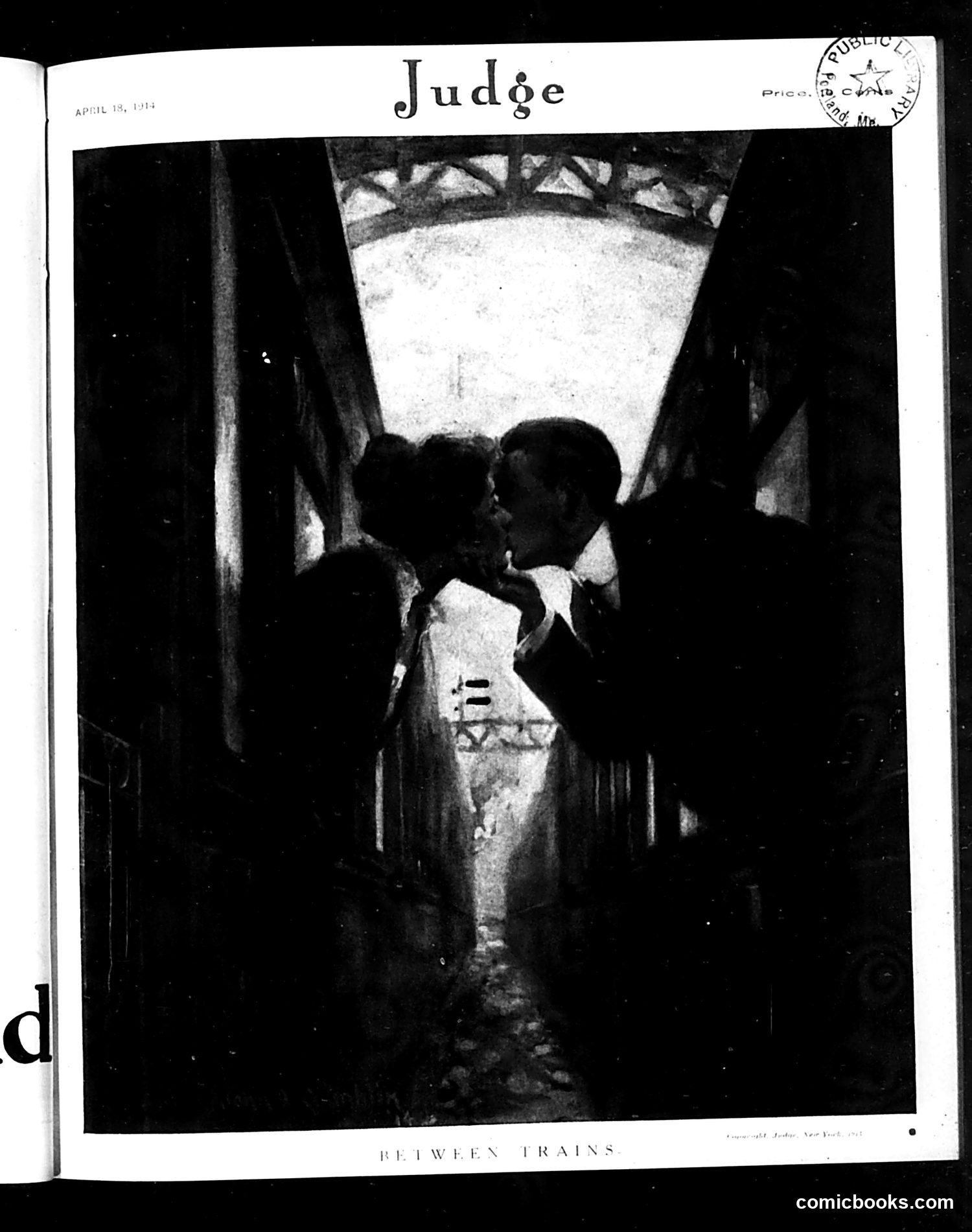
This Judge magazine page from April 19, 1914 shows a photograph titled "Between Trains" depicting what appears to be a romantic or intimate moment between two figures in a narrow passage or corridor between train cars, with bright light visible ahead. Without accompanying caption text or article, the specific satirical point is unclear. However, given Judge's typical content of the era, this likely satirizes either: - A social scandal or romantic affair involving public figures - The behavior of travelers or railway passengers - Contemporary attitudes toward public displays of affection The dramatic lighting and composition suggests this was meant to be humorous or commentary on social propriety, but without visible text explaining the reference, the specific target of satire cannot be definitively determined.
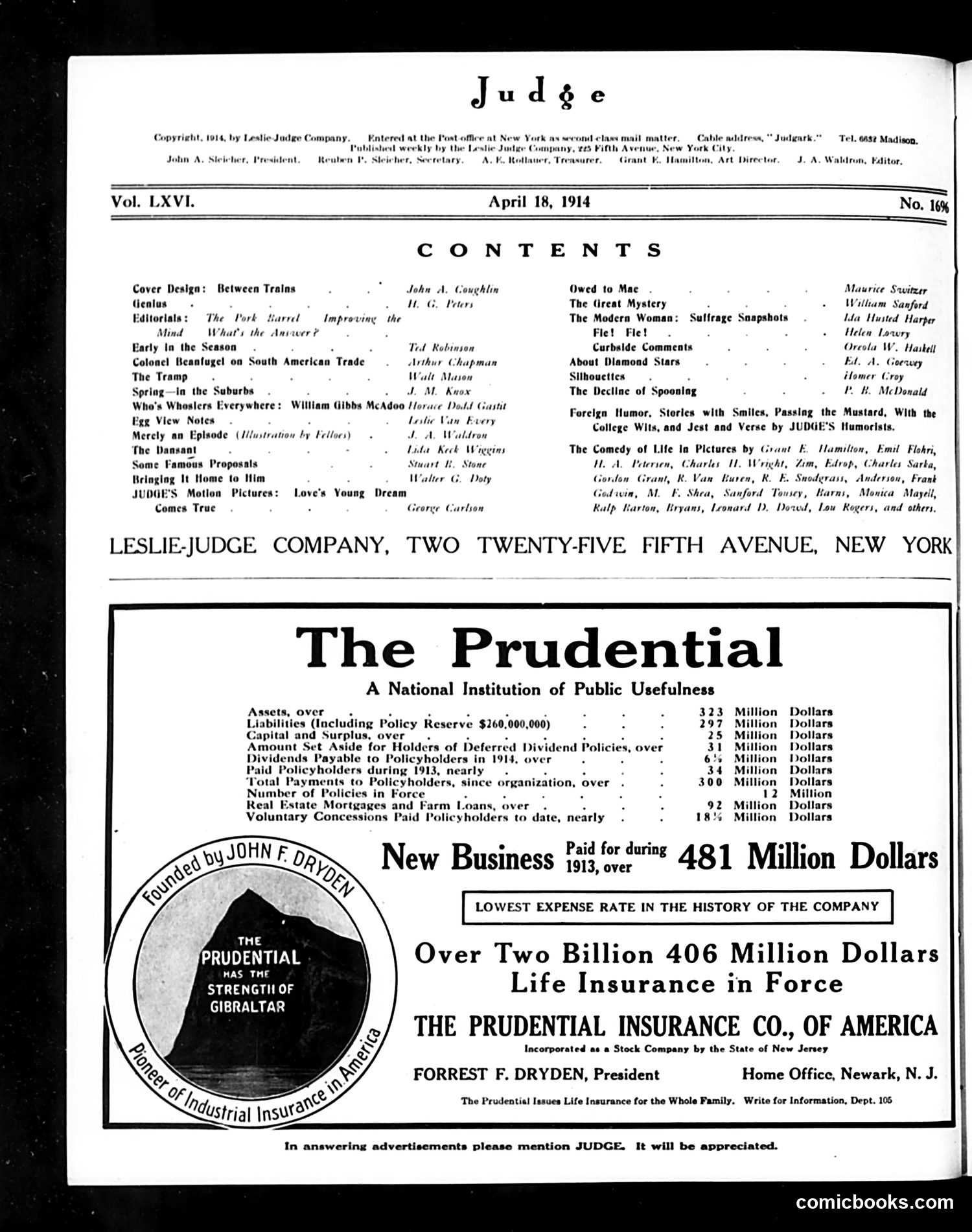
This page is primarily **advertising content** rather than editorial satire. The dominant feature is a large advertisement for The Prudential Insurance Company, which occupies roughly two-thirds of the page. The ad emphasizes the company's financial strength and growth, highlighting "Over Two Billion 406 Million Dollars Life Insurance in Force" and "New Business Paid for during 1913, over 481 Million Dollars." It uses a circular logo featuring Gibraltar to suggest stability and permanence—a common advertising metaphor of the era. The page's upper section shows a table of contents listing various articles and cartoons from this issue, but the actual cartoon images aren't visible in this reproduction. The Prudential advertisement completely dominates the layout, suggesting this was a lucrative sponsorship for the magazine.
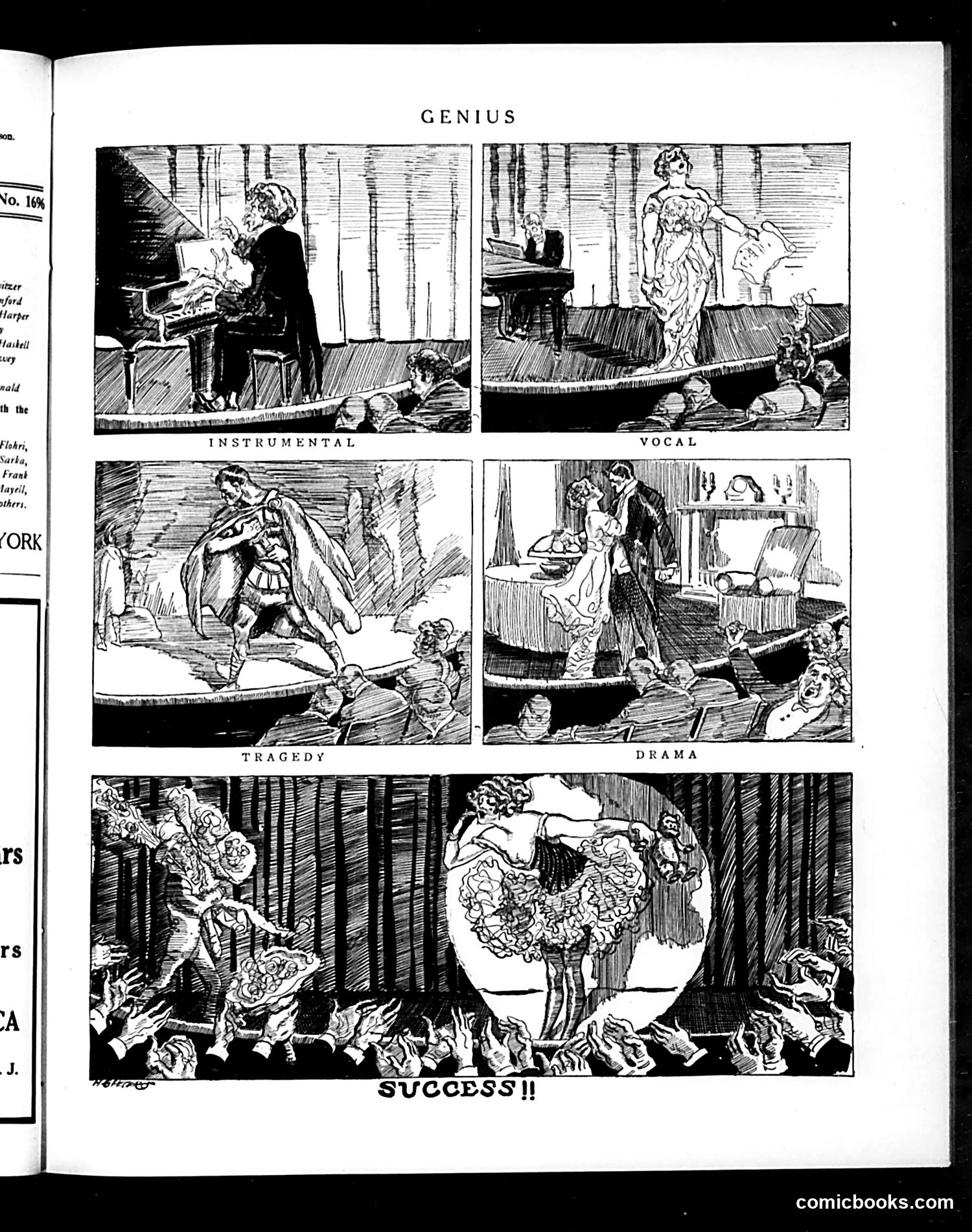
This page presents a five-panel satirical commentary on artistic and theatrical success. The progression moves from "Instrumental" (musical composition) through "Vocal" (singing), "Tragedy," and "Drama" — depicting various performers and musicians at work before audiences. The final panel, "SUCCESS!!" shows an exuberant crowd scene with performers celebrated amid floral tributes and adoring spectators, suggesting the ultimate achievement of fame. The satire appears to mock the journey to artistic recognition — implying that "genius" requires navigating multiple performance disciplines before achieving public acclaim. The elaborate staging and increasingly dramatic presentations suggest commentary on the theatrical pretensions or commercialization of artistic success in early 20th-century American culture. The specific individuals depicted remain unclear without additional context.
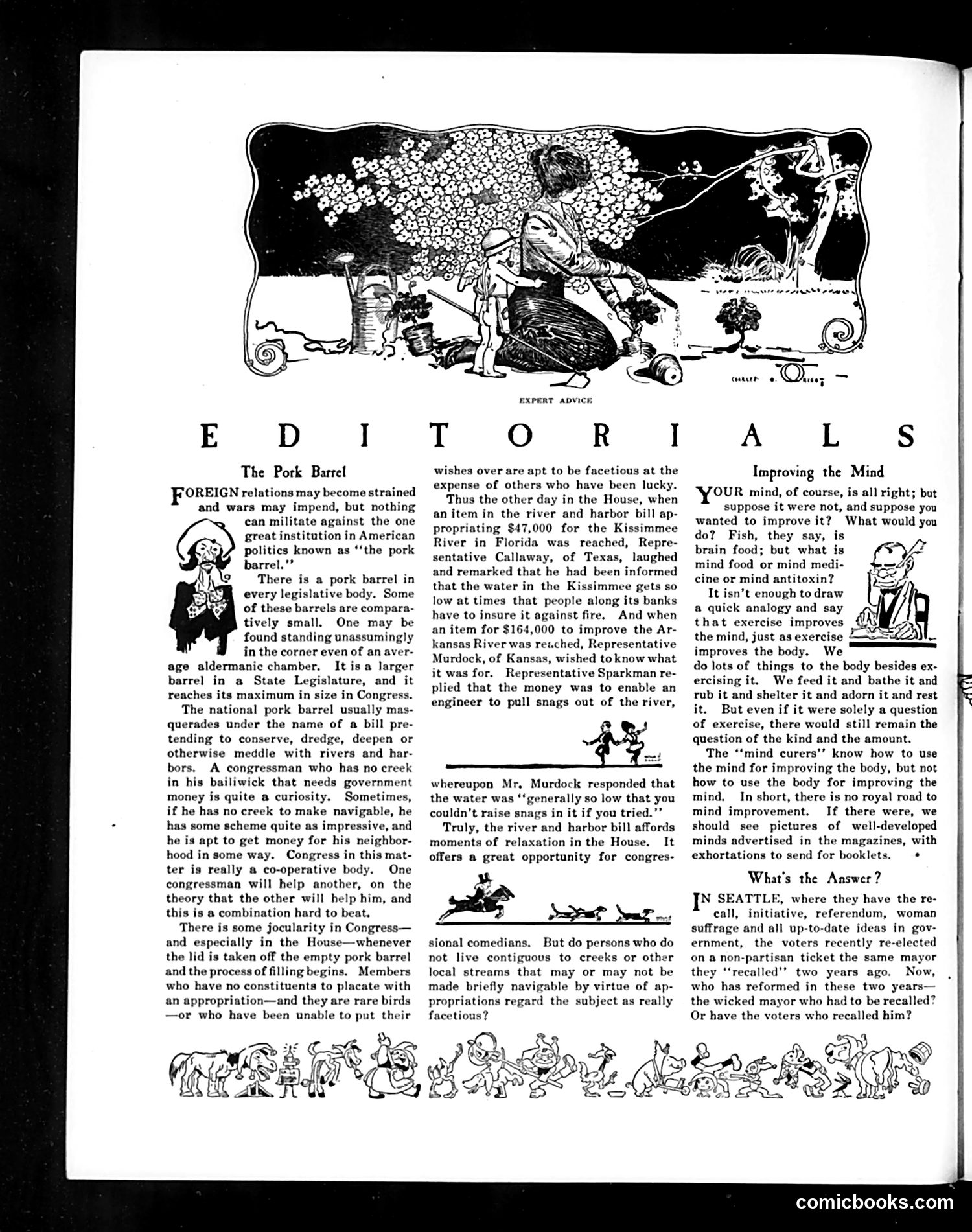
This editorial page contains three distinct pieces of political commentary: **"The Pork Barrel"** satirizes Congressional spending practices, specifically criticizing how legislators secure funding for local projects (navigable rivers, harbor improvements) that benefit their districts. The piece mocks both the practice itself and members who boast about their success in securing appropriations—calling it a "barrel" that reaches "its maximum in Congress." **"Improving the Mind"** responds to debates about exercise and mental development, arguing both body and mind require active use—dismissing simplistic "mind food" theories. **"What's the Answer?"** discusses Seattle politics, questioning whether voters will re-elect a mayor ("recalled" two years prior) or remember his previous removal. The cartoons use whimsical illustrations to accompany these critiques of governmental waste and political memory.
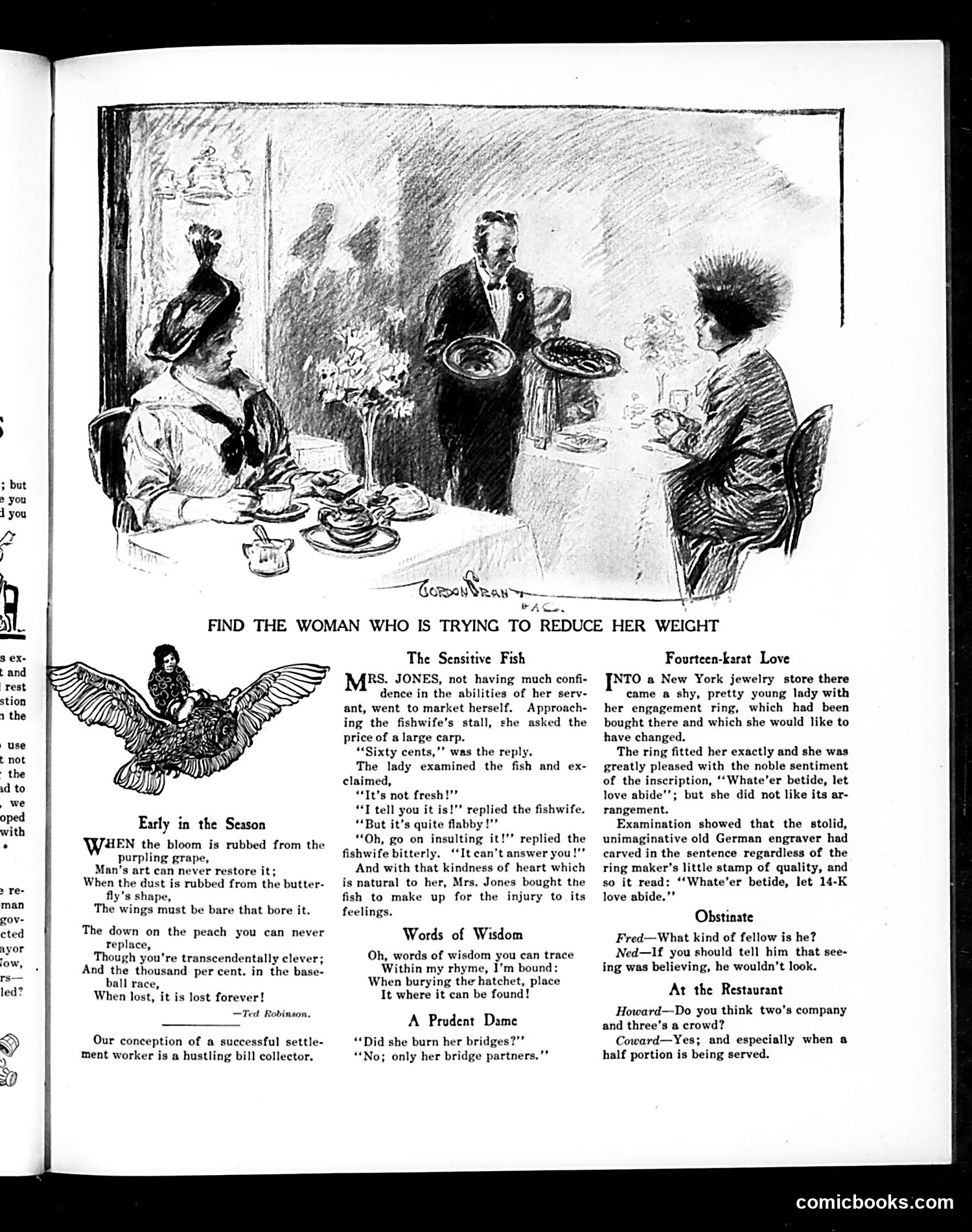
**Main Cartoon ("Find the Woman Who Is Trying to Reduce Her Weight"):** The top illustration shows a dining scene where a waiter serves two women. The puzzle asks readers to identify which woman is dieting. This is satirical commentary on the early 20th-century obsession with weight loss and diet culture among affluent women. The joke appears to be that both women are dining, making the "dieter" identification ironic or impossible—mocking the contradiction between claimed weight-reduction efforts and actual eating habits. **Surrounding Content:** The page includes humorous short pieces and poetry about everyday life ("Early in the Season," "Words of Wisdom," "A Prudent Dame," "At the Restaurant"), typical of Judge's satirical commentary on American society, manners, and domestic life. These sketches target upper-class pretensions and social hypocrisy without referencing specific political events.
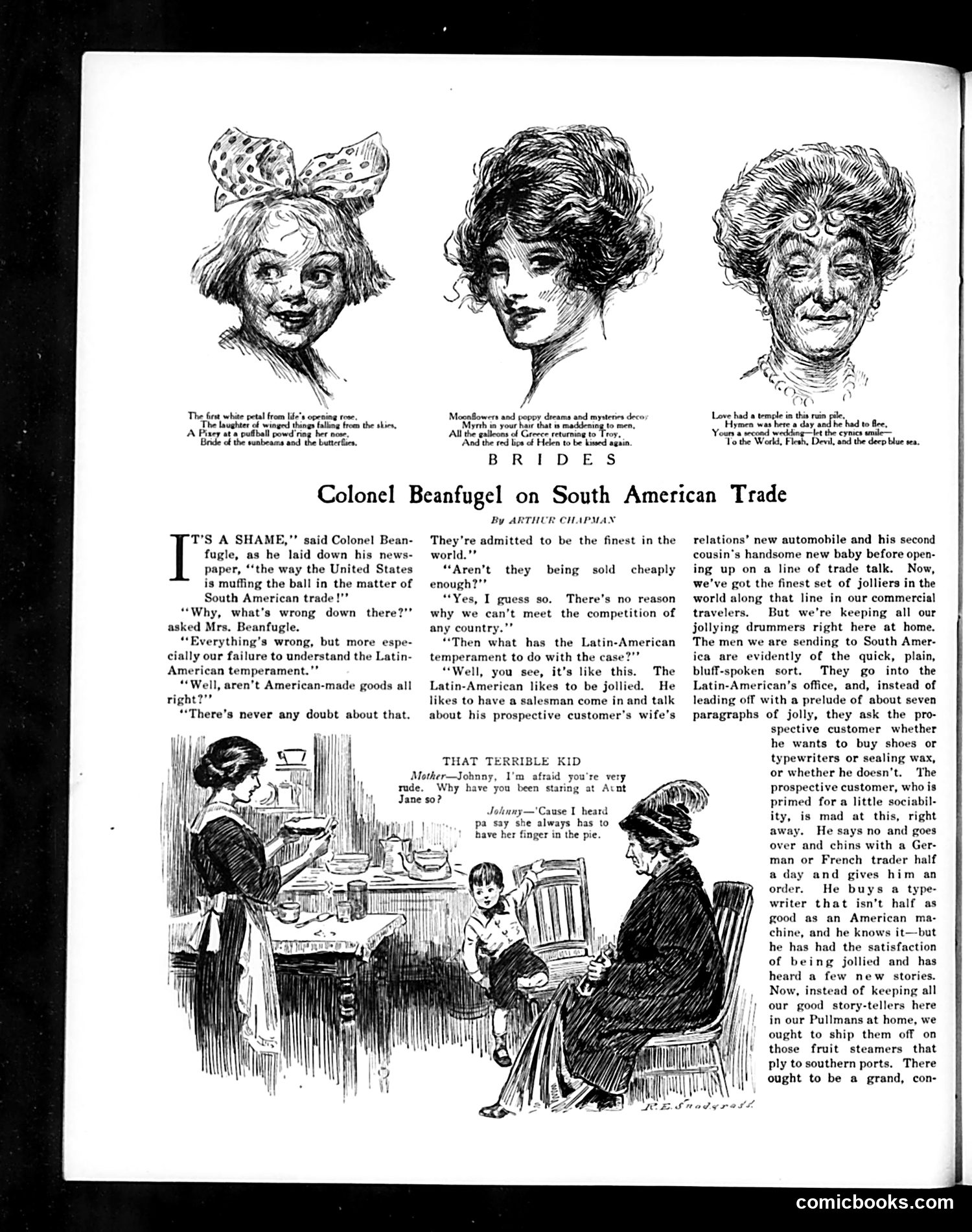
This satirical piece critiques American business practices in Latin America. Colonel Beanfugel argues that while the U.S. produces superior goods, American salesmen fail because they lack "personality"—they're blunt and transactional rather than engaging in the social pleasantries Latin Americans expect. The humor lies in Beanfugel's solution: send America's best "jolliers" (charming storytellers from Pullman cars) to South America as traveling salesmen. The satire suggests that American commercial culture prioritizes efficiency over relationship-building, causing business losses to European competitors who understand the importance of personal rapport. The sidebar joke about "that terrible kid" uses similar logic—the child was rude by staring, just as American salesmen are rude by being direct rather than conversational. The piece reflects early-20th-century anxieties about American competitiveness abroad and stereotypes about Latin American business culture requiring flattery and social engagement.
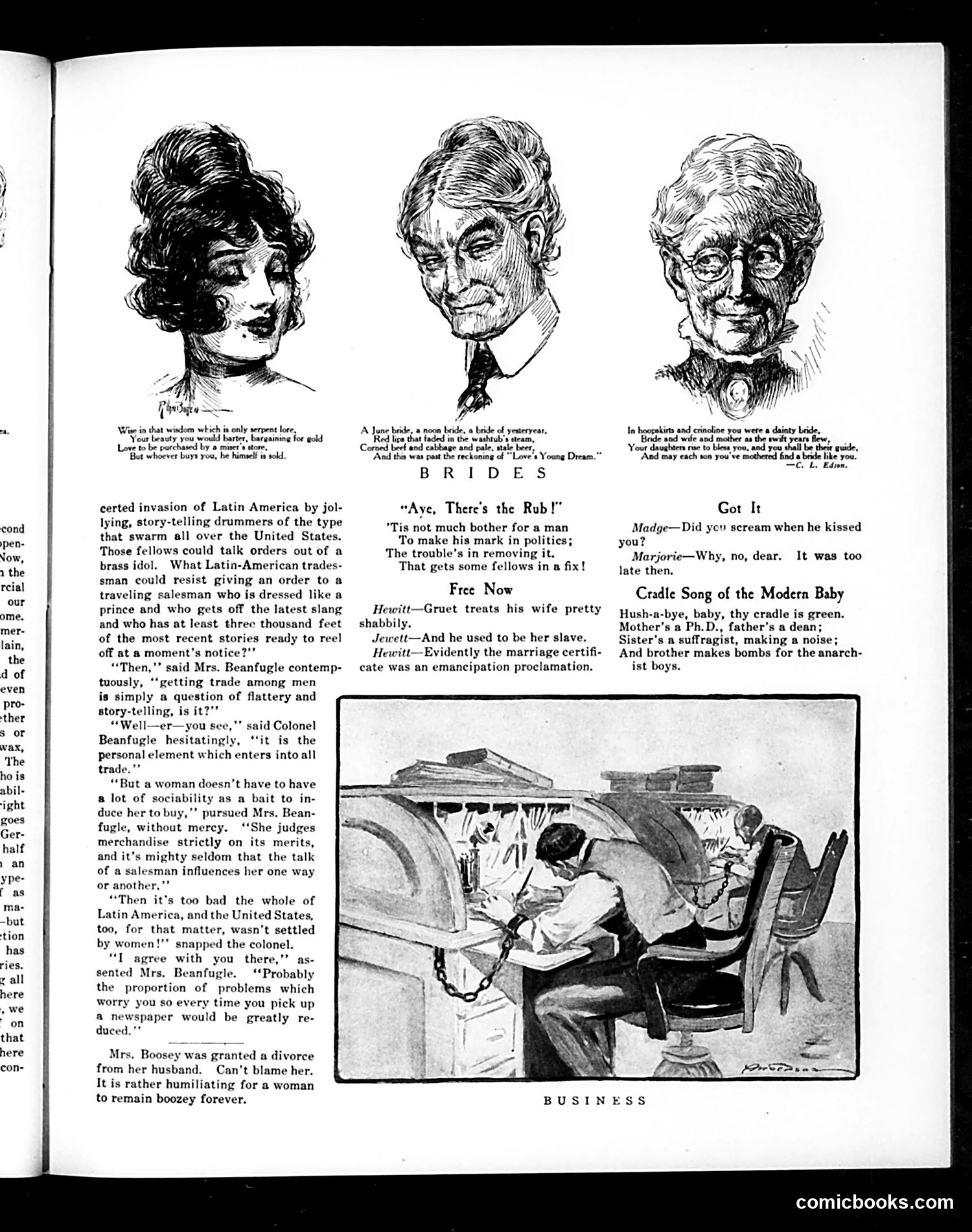
This page from *Judge* magazine contains satirical commentary on early 20th-century American social issues: **"Brides"** section mocks the romantic idealization of marriage—contrasting brides' youthful beauty ("Red lips") with harsh domestic reality ("washtub's steam," "Corned beef and cabbage"). **"Free Now"** jokes about marriage as emancipation: a husband who once served his wife slavishly now treats her poorly after obtaining a marriage certificate, inverting the emancipation proclamation metaphor. **"Aye, There's the Rub"** satirizes politics as leaving permanent, difficult-to-remove marks on politicians' reputations. **"Cradle Song of the Modern Baby"** darkly mocks progressive families: the mother holds a Ph.D., father is an academic dean, the daughter is a suffragist activist, and the son makes bombs for anarchists. The satire targets both women's education/suffrage movements and anarchist political violence as threats to traditional society. The **"Business"** cartoon (bottom) appears to show a businessman or salesman at work, though details are unclear from the image quality.
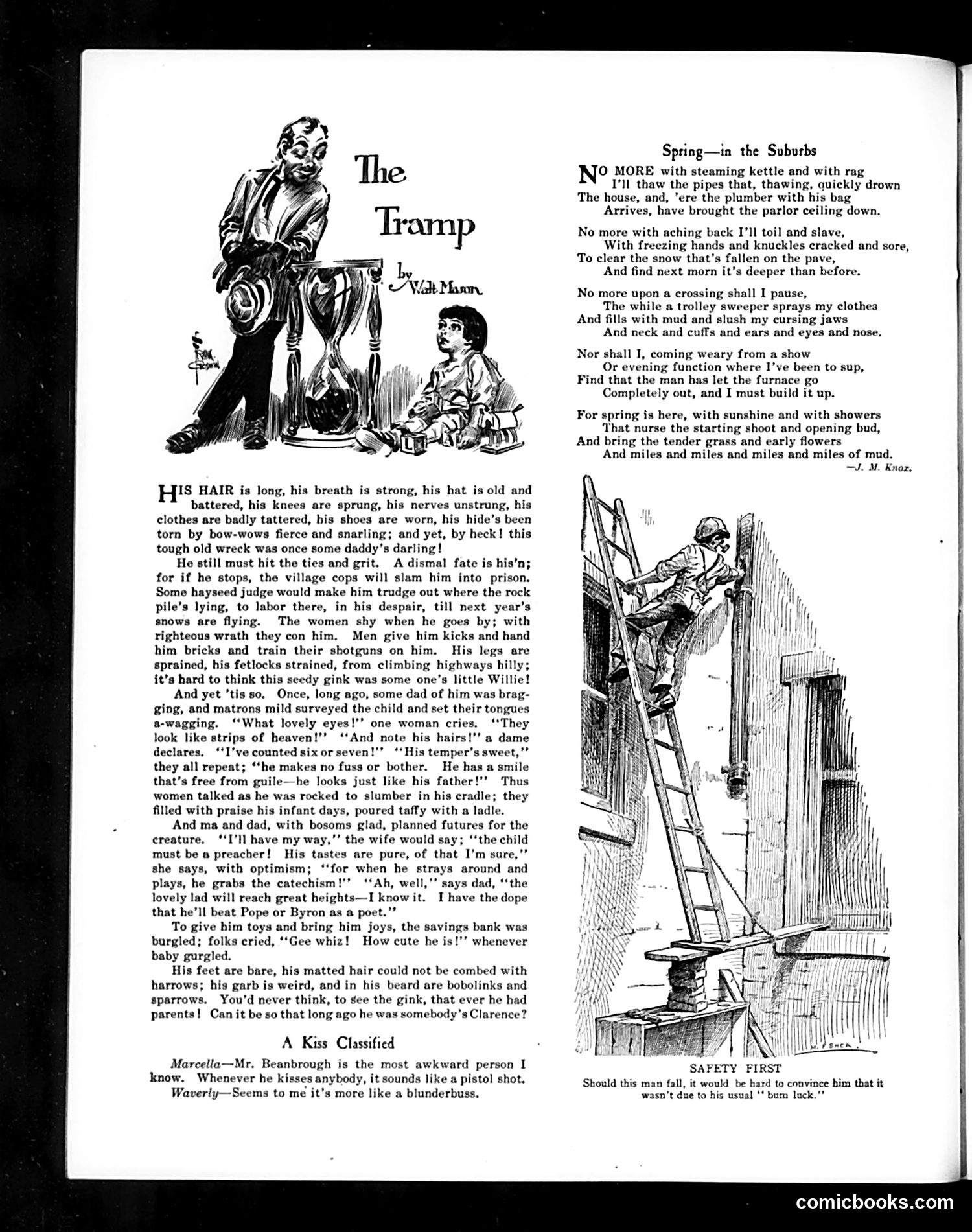
**"The Tramp"** by Walt Mason tells the tragic arc of a vagrant—once someone's beloved child "Clarence," showered with parental hopes and affection, now a broken man rejected by society. The poem's irony is stark: this destitute figure with matted hair and torn clothes was once cherished, yet society now imprisons him, siccs dogs on him, and denies him basic dignity. It's social commentary on how the poor are treated despite their humanity. **"Spring—in the Suburbs"** by J.M. Knox humorously inverts expectations about spring's arrival. Rather than celebrating renewal, the speaker catalogs domestic frustrations: burst pipes, endless snow-clearing, trolley mud-splashing, and failed furnaces. The punchline—"miles and miles and miles of mud"—mocks suburban spring as merely messy rather than rejuvenating. The **"Safety First"** cartoon shows a man on a ladder, captioning that convincing him of genuine accident causes would be difficult given his habitual "bum luck"—implying chronic misfortune becomes self-fulfilling.
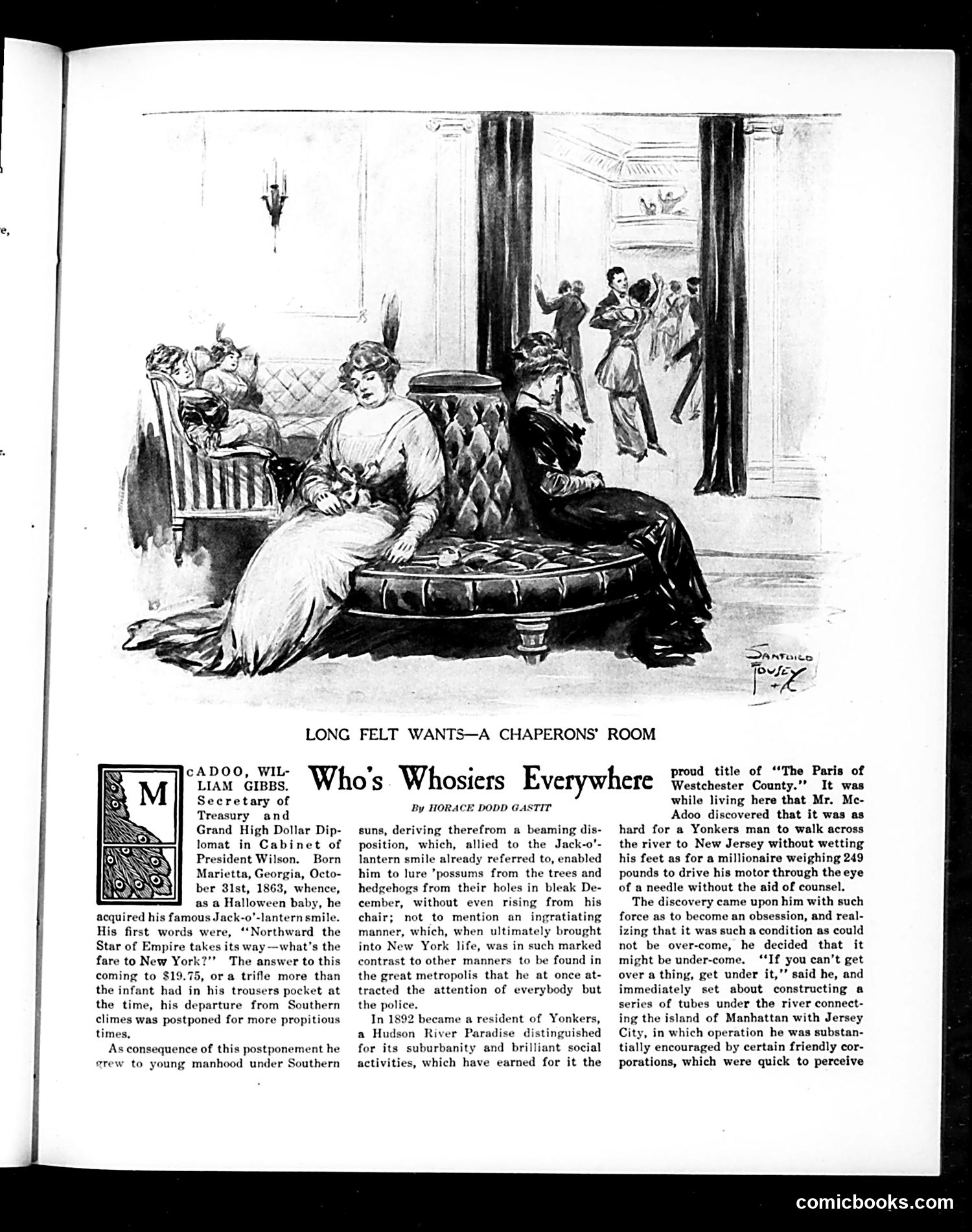
The cartoon satirizes William Gibbs McAdoo, Wilson's Secretary of Treasury and a prominent figure in 1910s-1920s politics. The top illustration jokes about "long felt wants"—a pun on women chaperones needed at social gatherings—showing a woman supervising a chaperoned room while parties continue beyond. The biographical text below mocks McAdoo's Southern background and his relentless ambition. The satire peaks in describing his obsession with building the Hudson River tunnels connecting Manhattan to Jersey City: Judge jokes that since McAdoo couldn't solve the problem of crossing the river while staying dry, he'd go *under* it instead. The humor lies in presenting his major infrastructure project as the quirky fixation of a determined but eccentric personality, while corporations opportunistically support it for profit. The "Jack-o'-lantern smile" reference emphasizes McAdoo's perpetually cheerful demeanor despite his drive.
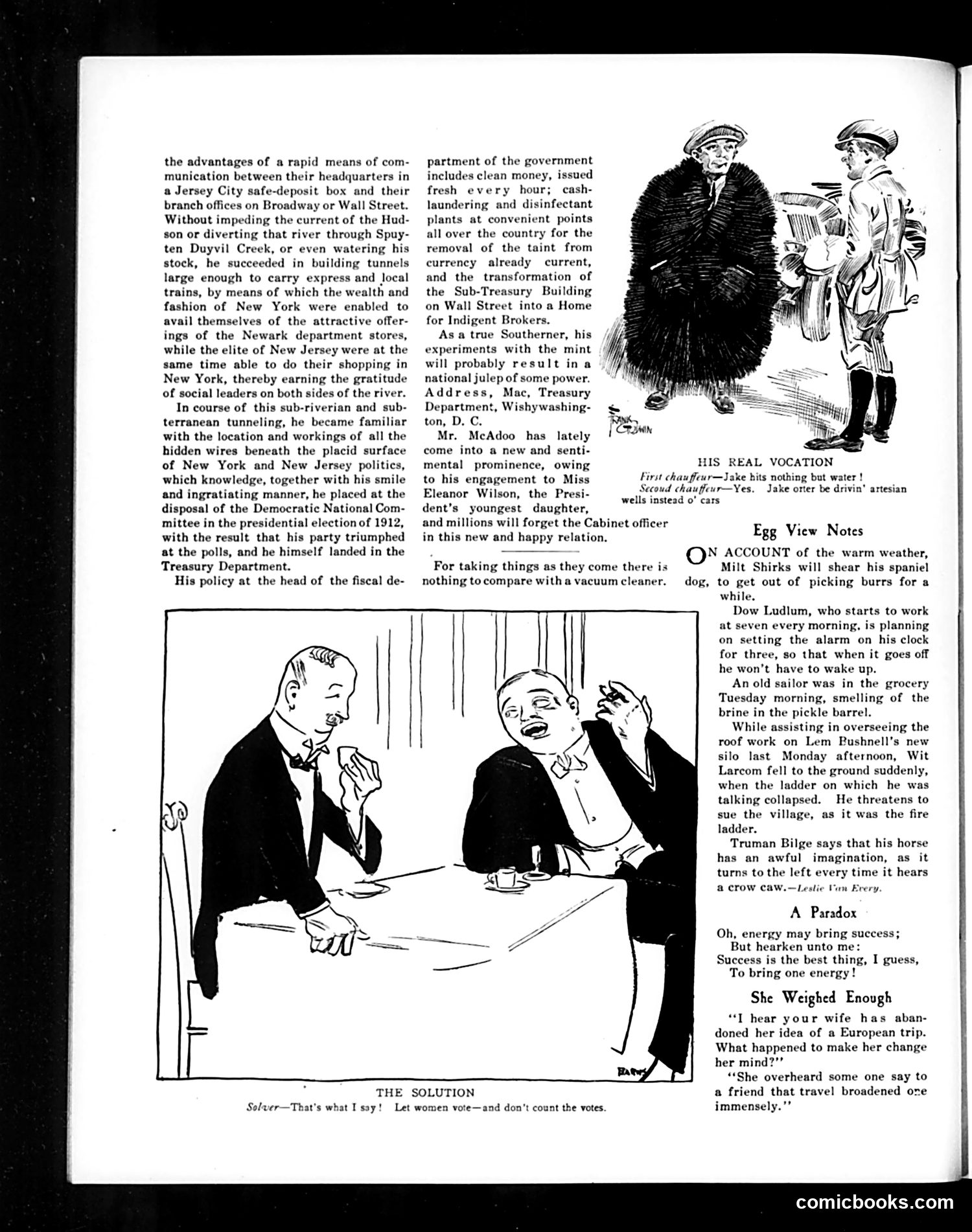
This page satirizes **William Gibbs McAdoo**, Treasury Secretary under President Wilson (1913-1918). The main article mocks his rapid rise through political connections—particularly his role in the 1912 Democratic campaign, which allegedly involved manipulating "hidden wires beneath the placid surface of New York and New Jersey politics." The satire intensifies with McAdoo's recent engagement to Eleanor Wilson, the President's daughter. Judge suggests this romantic announcement will make people forget his questionable Treasury policies, including his absurd schemes for "clean money" issued hourly and "cash-laundering" plants nationwide. The casual reference to him as "a true Southerner" and "julep" jokes reflect period prejudices. **"The Solution" cartoon** appears to reference women's suffrage debates: the caption's dark humor suggests counting women's votes defeats the purpose of granting it. The remaining items are light humor pieces unrelated to the McAdoo satire.
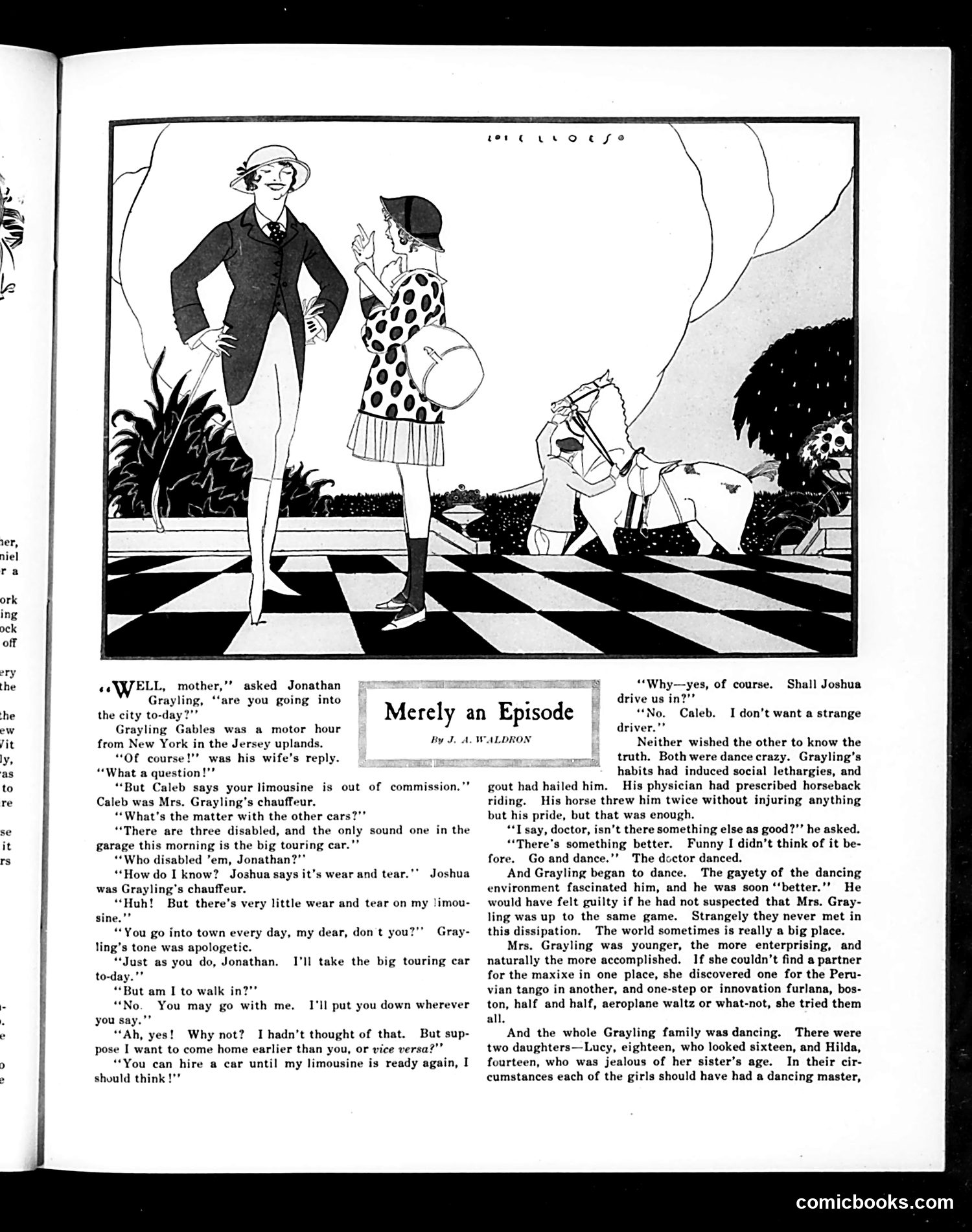
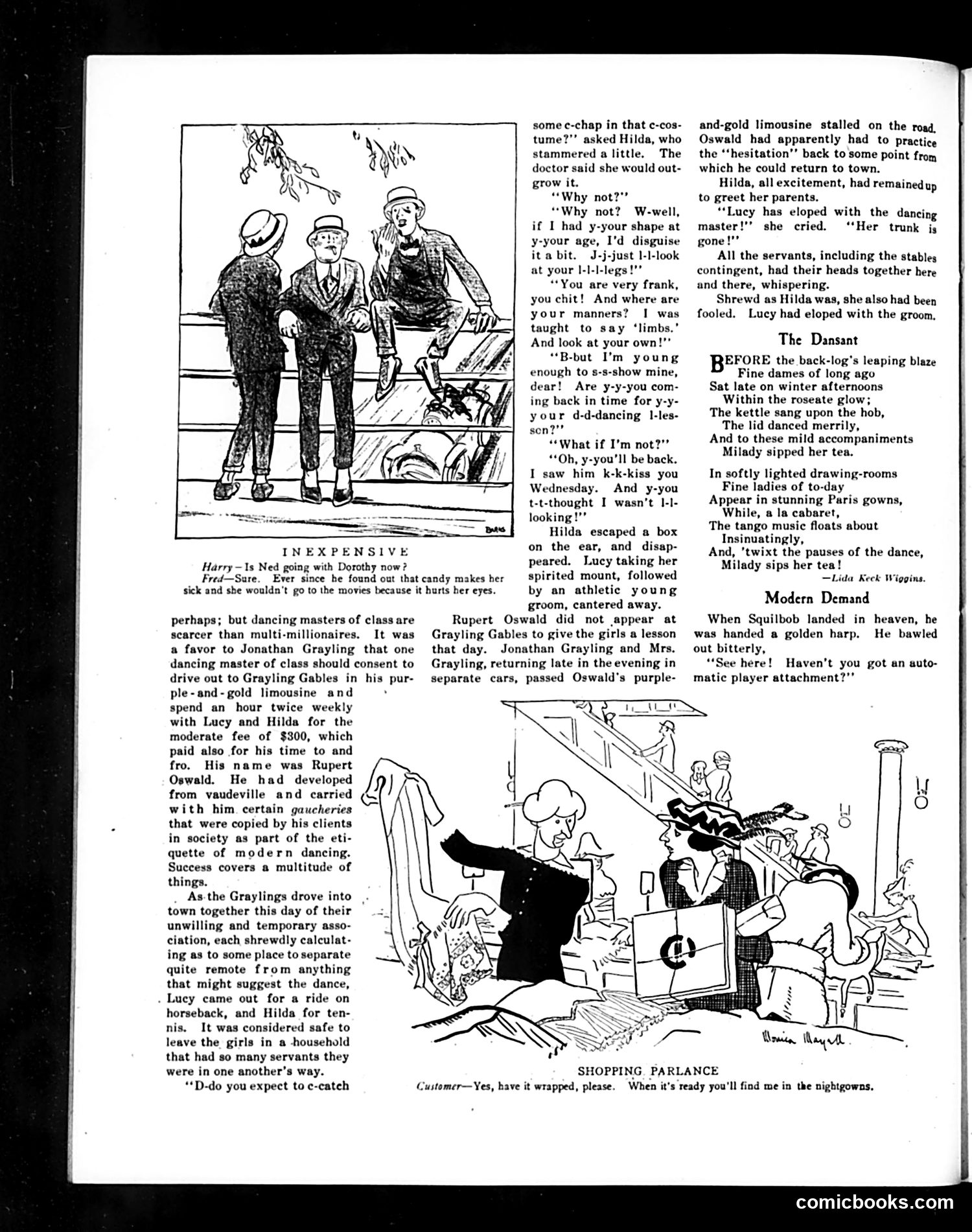
This page contains three distinct pieces of early 20th-century social satire: **"Inexpensive"** (main story with cartoon): A narrative mocking nouveau-riche pretension. The Graylings hire an expensive dancing master, Rupert Oswald, as a status symbol, paying $300 (substantial money then). The irony: their daughter Lucy elopes with the athletic young groom instead, while everyone assumes she's with the fashionable instructor. The satire targets both the family's social climbing and the dancing master's affected "gaucheries" that supposedly mark modern sophistication. **"The Dansant"** (poem): Contrasts genteel Victorians taking tea by firesides with modern women who sip tea between tango dances at cabarets—mocking the frenetic, jazz-age social scene as superficially different but essentially unchanged. **"Modern Demand"** (joke cartoon): A heavenly newcomer demands an automatic player piano, satirizing American consumer culture and mechanical convenience obsession even in afterlife. All three pieces share Judge's characteristic anxiety about modernity, social mobility, and changing manners among the wealthy.
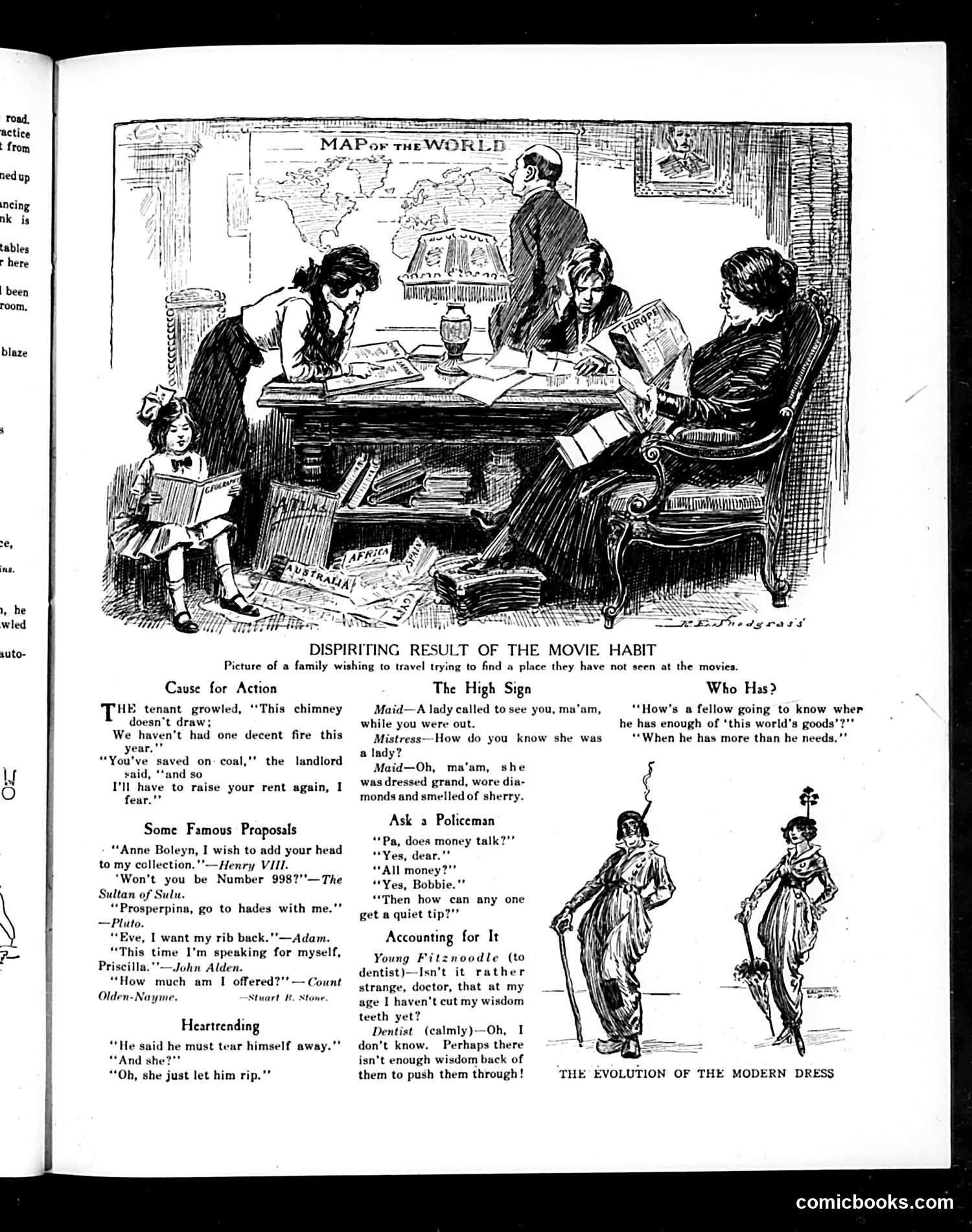
The main cartoon satirizes how cinema's popularity has made real travel seem disappointing. A family sits with maps and travel guides, unable to find any destination they haven't already seen in movies—suggesting films have replaced actual experience and made the world feel already-visited and exhausted. The page collects various humorous one-liners and jokes typical of Judge's satirical style. These include absurdist "famous proposals" (Henry VIII asking Anne Boleyn to add her head to his collection), class commentary (a maid identified as "a lady" by her diamonds and sherry smell), and social critique (a landlord raising rent because tenants saved coal). Two fashion sketches labeled "The Evolution of the Modern Dress" appear at right, likely contrasting historical to contemporary women's clothing. The overall tone mocks contemporary American life: tenant-landlord disputes, materialism, and cinema's grip on public imagination.
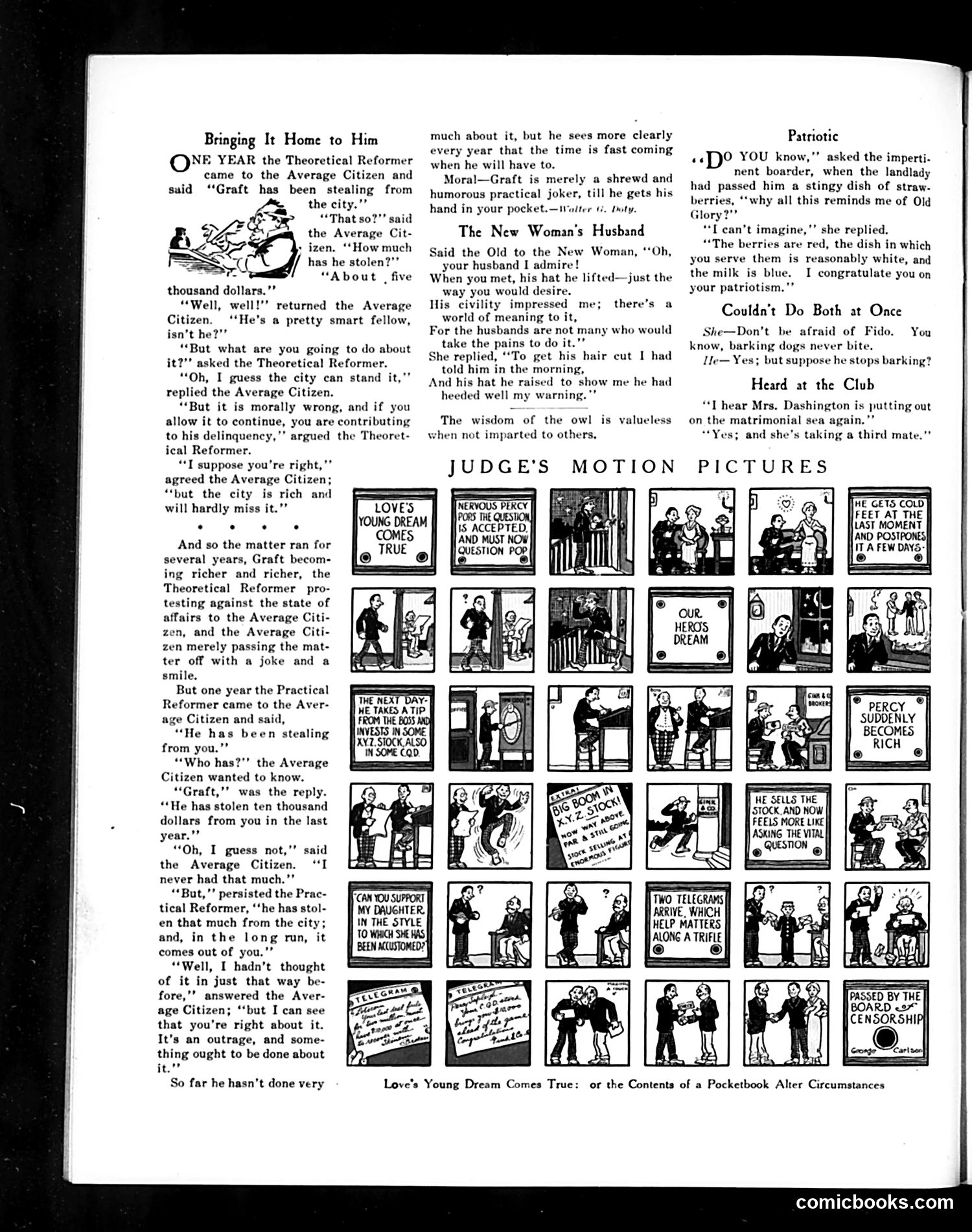
This page satirizes **civic corruption and public apathy** through three main pieces: ## "Bringing It Home to Him" The central narrative mocks how ordinary citizens ignore abstract moral arguments against graft (political corruption/theft). A "Theoretical Reformer" appeals to ethics; the "Average Citizen" dismisses it as harmless—the city is rich enough. Only when a "Practical Reformer" makes it **personal** ("he stole from *you*") does the citizen care. The moral: people ignore systemic theft until it directly affects their wallets. This critiques both corrupt politicians and public indifference. ## The Motion Pictures Strip A series of one-panel silent-film style gags with captions—typical Judge format of the era, mocking melodrama and romantic comedies. ## Supporting Humor Brief satirical quips mock: - The "New Woman's Husband" (a hen-pecked man following his wife's orders, disguised as chivalry) - Patriotic pretense (red/white/blue berries) - Marriage as a maritime venture **Context**: This reflects Progressive Era concerns about municipal corruption and the gap between reformers' idealism and citizens' practical indifference.
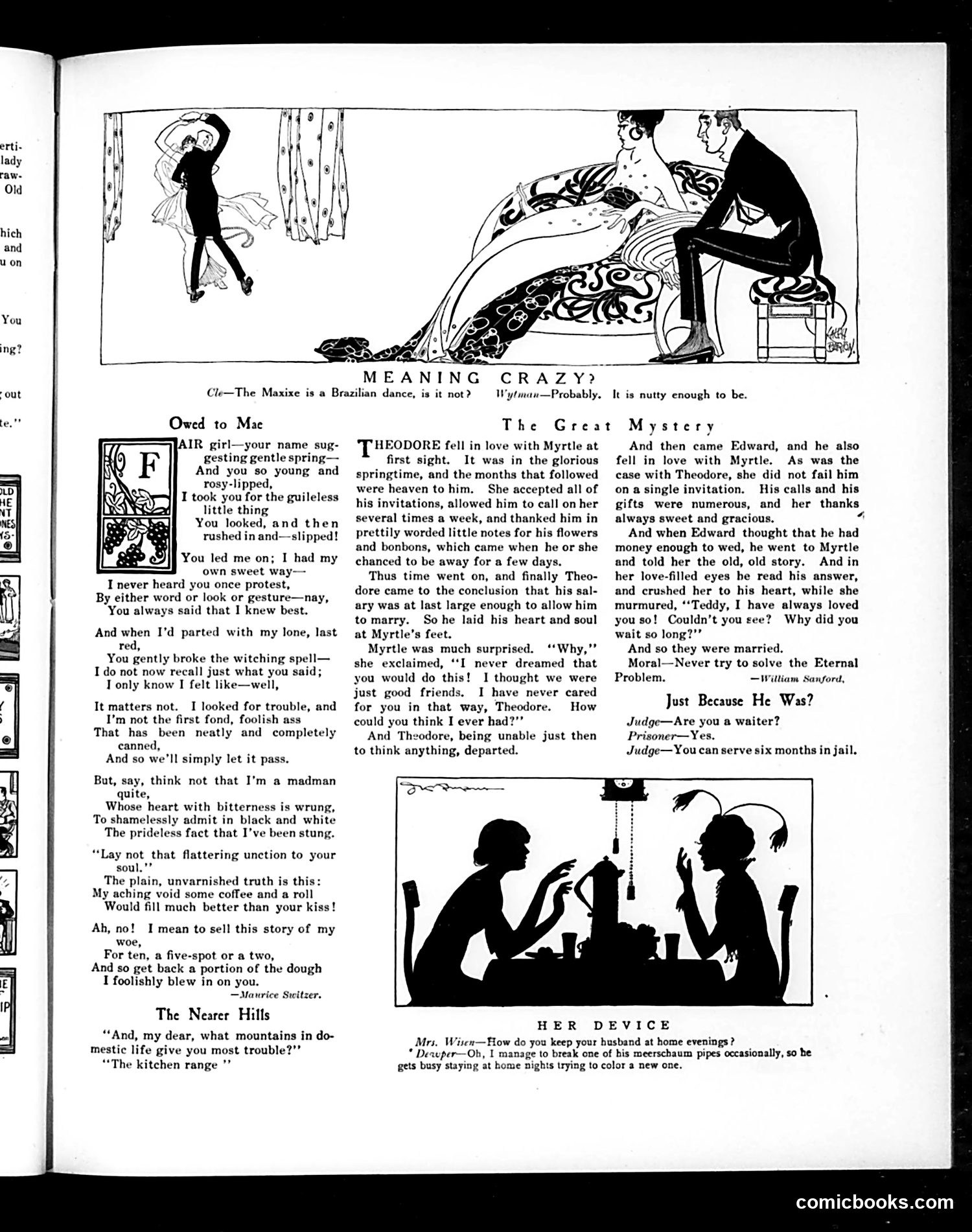
This page contains multiple satirical pieces typical of early 20th-century American humor: **"Meaning Crazy?"** (top): A man observes a couple in bed; he notes the woman is performing the Maxixe (a Brazilian dance), suggesting she's behaving eccentrically or scandalously. The satire mocks both the "exotic" dance craze and marital situations. **"Owed to Mae"**: A poem by Maurice Switzer about a man who fell for a deceptive woman. He provided money and affection, believing her responsive, only to discover she never loved him. The bitter irony: he concludes that coffee and a roll would satisfy him better than her kiss—satirizing romantic disappointment and financial manipulation in courtship. **"The Great Mystery"**: A morality tale contrasting two men pursuing Myrtle. Theodore's cautious, respectful courtship fails; Edward's identical approach succeeds—the "mystery" being why identical behavior produces opposite results. The "moral" cynically suggests the eternal problem of understanding women's inconsistency. **"Her Device"**: A brief joke about a wife who deliberately breaks her husband's pipes so he stays home nights repairing them—satirizing domestic manipulation. All pieces target romantic and marital relationships with cynical, misogynistic humor typical of the era.
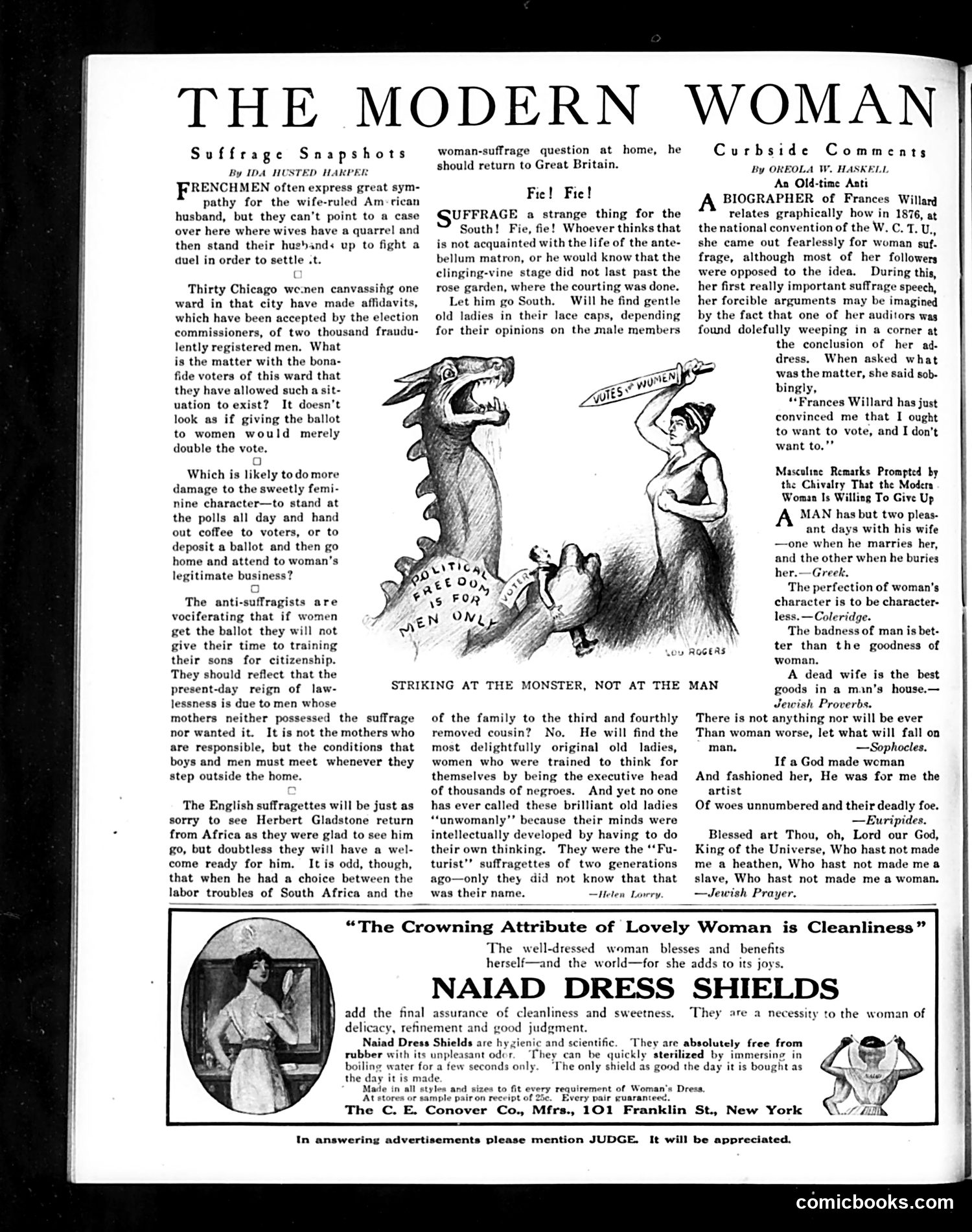
This page satirizes anti-suffrage arguments through pro-suffrage commentary. The central cartoon by Lou Rogers depicts a woman striking a monster labeled "Political Exclusion For Men Only"—representing how suffragists were framed as attacking male political power rather than advocating for equality. The articles mock anti-suffrage claims: that giving women votes would merely "double" fraudulent registrations; that voting would damage women's "feminine character"; that suffrage would neglect child-rearing. The pieces counter these arguments by citing Southern antebellum women who managed plantations and developed independent thinking—proving women's intellectual capacity predated formal suffrage rights. The "Curbside Comments" section notes Frances Willard's 1876 suffrage advocacy, while the final section presents misogynistic historical quotes (from Greek, Coleridge, etc.) to underscore how deeply anti-woman sentiment ran culturally. The page advocates for women's voting rights while exposing the illogic and prejudice underlying opposition.
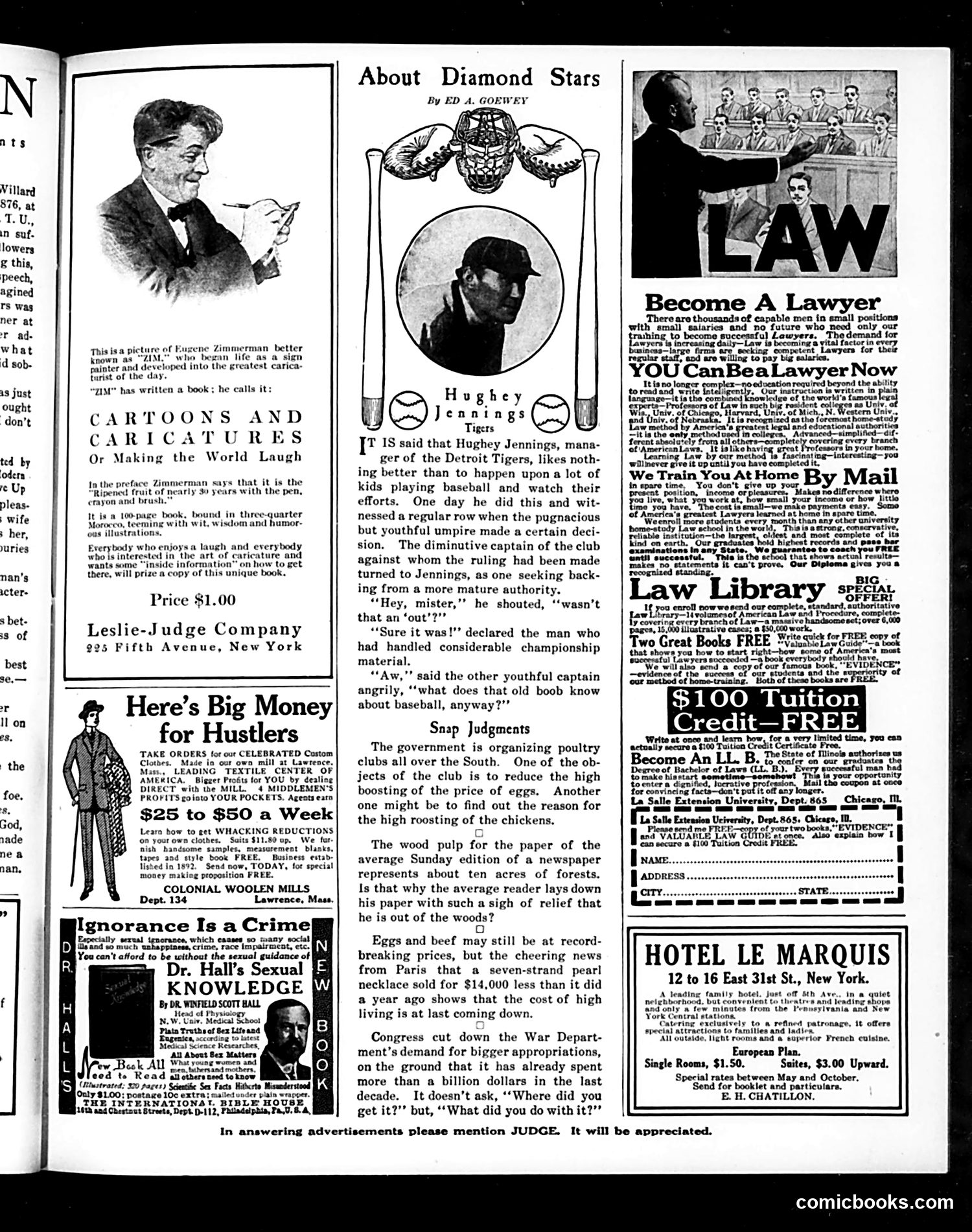
This page features a humorous anecdote about **Hughey Jennings**, manager of the Detroit Tigers baseball team. The joke satirizes the gap between youth and authority: young baseball players argue with an umpire's call, then appeal to Jennings—an adult authority figure—hoping he'll validate their complaint. Instead, Jennings sides with the umpire, disappointing the kids who thought an "older, wiser" adult would back them up. The accompanying decorative header shows baseballs and what appears to be a manager's portrait, establishing the sports context. The humor lies in the children's naive assumption that adult rank automatically means support for their position—a mild social satire on how authority actually operates. The rest of the page contains period advertisements for law training, hotel accommodations, and business opportunities—typical Judge magazine content mixing editorial humor with revenue-generating ads.
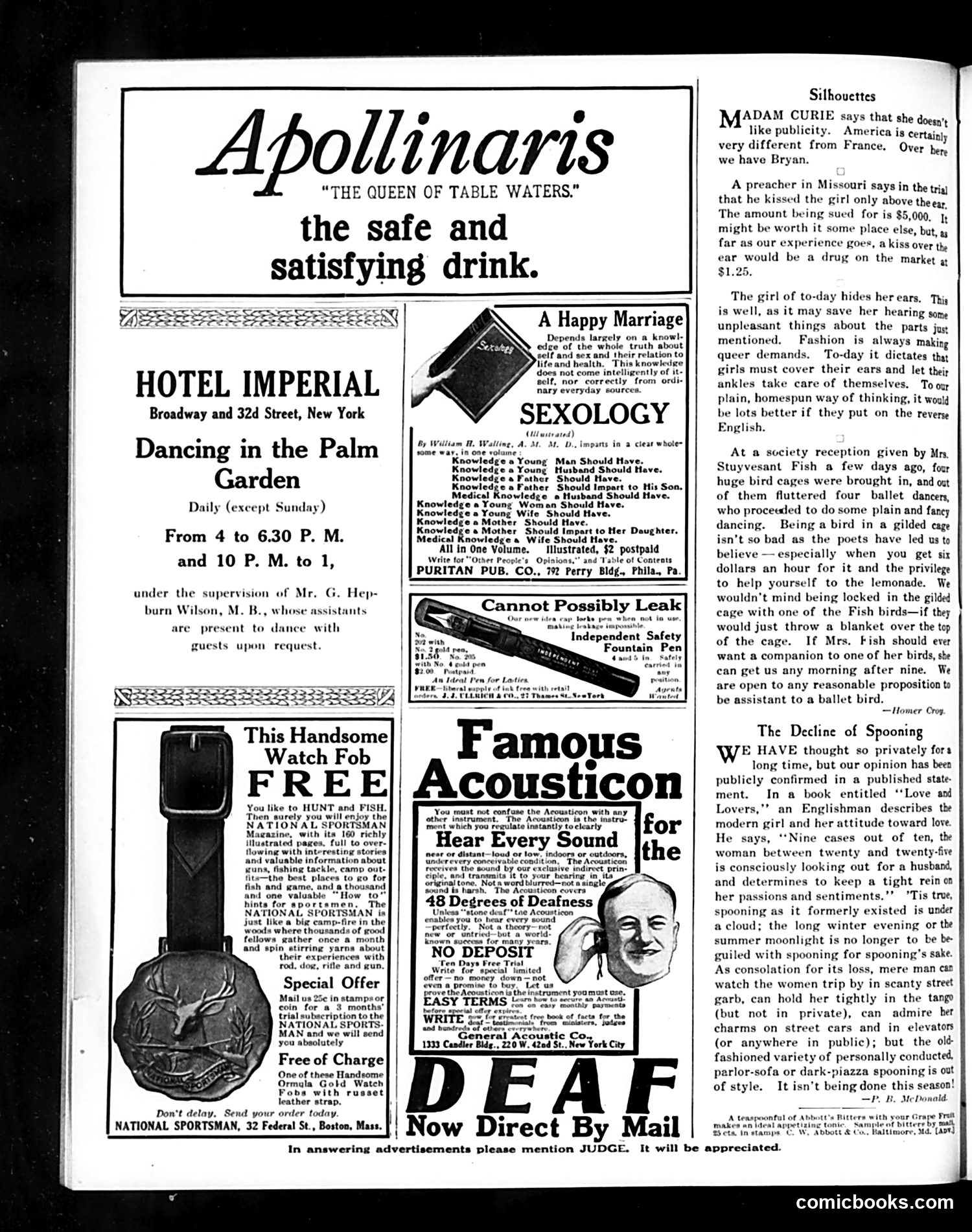
This page is primarily **advertisements and social commentary**, not political cartoons. **Main Advertisements:** - Apollinaris bottled water ("Queen of Table Waters") - Hotel Imperial (dancing venue in NYC) - National Sportsman magazine (hunting/fishing) - Acousticon hearing device - Sexology book (sex education manual) **"Silhouettes" Column (right side):** Brief satirical social observations: - Mocking Madame Curie's privacy preferences as un-American (contrasting her with American publicity-seeker William Jennings Bryan) - Joking about a Missouri lawsuit over a kiss "above the ear" - Criticizing female fashion for hiding ears while exposing ankles - Describing a Mrs. Stuyvesant Fish society party where four ballet dancers emerged from bird cages, sarcastically praising the "glamorous" job at six dollars/hour The humor relies on contemporary social customs (1910s gender norms, fashion oddities, wealthy eccentricity) rather than political content. The page targets American society's peculiarities and contradictions.
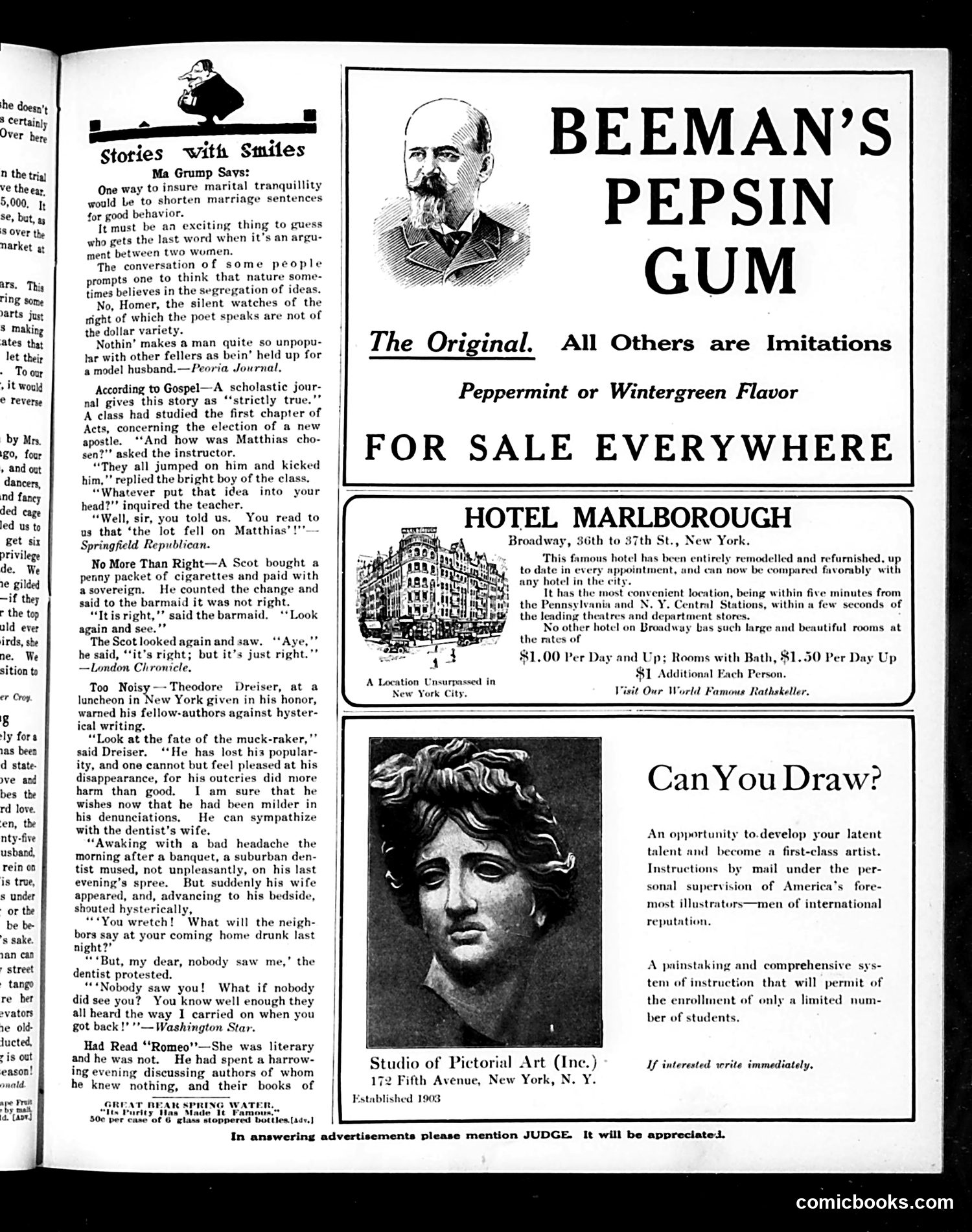
This page from *Judge* magazine is primarily **advertising and humor columns**, not political cartooning. The left column contains brief anecdotal jokes under "Stories with Smiles"—humorous observations about marriage, teaching, and social behavior. These reflect early 20th-century attitudes: jokes about wives nagging husbands, classroom mishaps, and drinking culture. The advertisements dominate the page: **Beeman's Pepsin Gum** claims to be "the Original" (competing brands existed), the **Hotel Marlborough** advertises luxury New York lodging, and the **Studio of Pictorial Art** offers mail-order drawing instruction. The humor relies on now-dated assumptions: gender stereotypes (wives as shrewish), religious/biblical references (Matthias selection), and working-class Scottish stereotypes. The Theodore Dreiser anecdote criticizes muckraking journalism—Dreiser was known for exposés. No specific political figures or events are satirized on this page. It's primarily period advertising and light social satire reflecting conventional attitudes of the era.
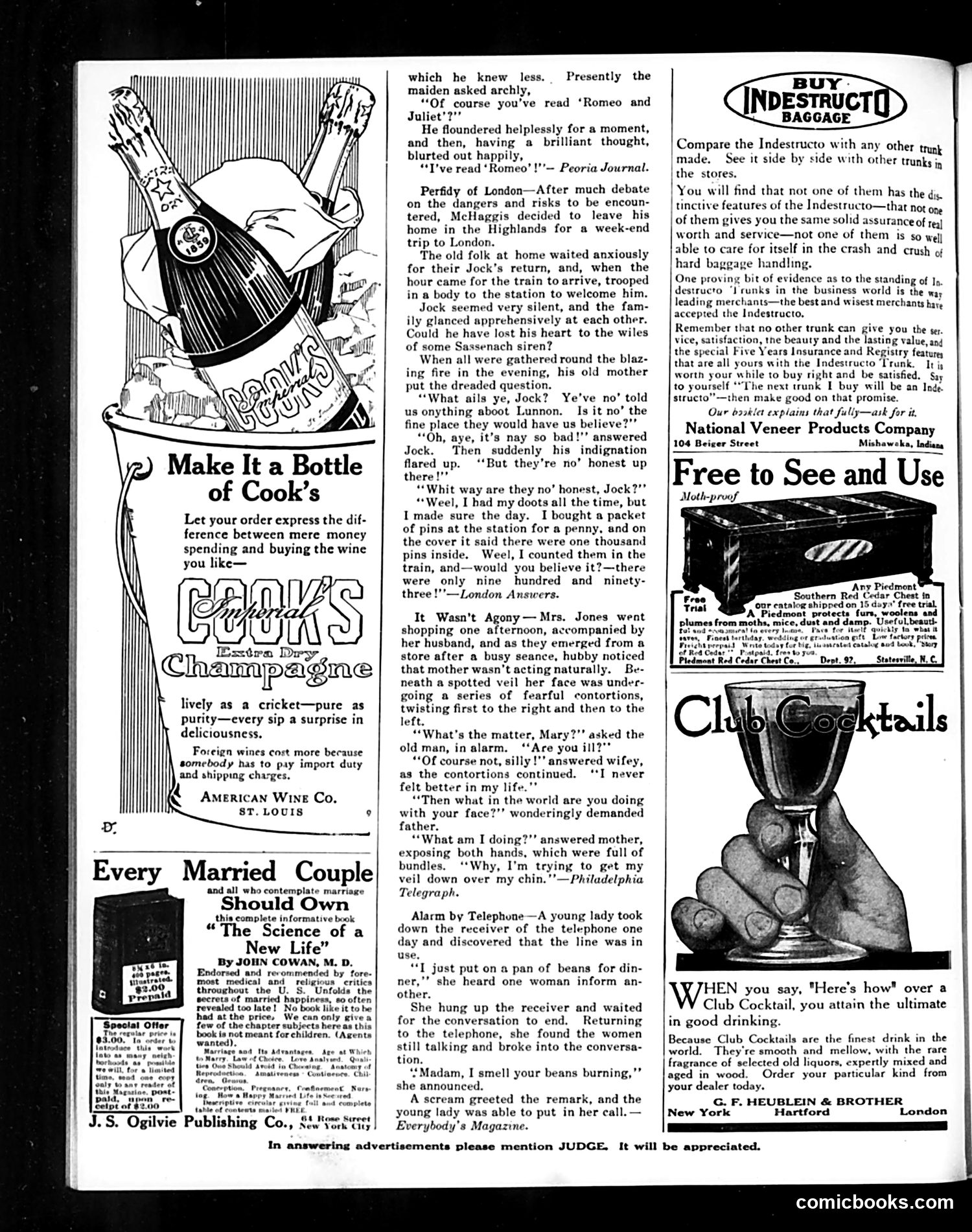
This page is primarily **advertisements and humor anecdotes** rather than political satire. The main content includes: **Advertisements:** - Cook's Champagne (American Wine Co.) - Indestructo Baggage (trunks) - "The Science of a New Life" marriage manual - Club Cocktails **Humorous Stories:** Four brief anecdotes occupy the center column: 1. A young man pretending to have read "Romeo and Juliet" admits he only read "Romeo" 2. A Scottish highlander (Jock) returns from London claiming Londoners are dishonest—he bought pins labeled "1000" but counted only 993 3. A woman contorting her face trying to adjust her veil over her chin 4. A young woman interrupting neighbors' phone conversation to warn them their beans are burning These are mild, genteel humor pieces typical of Judge's family-friendly content. The Scottish dialect humor and the telephone anecdote represent common period comedy tropes. No significant political commentary is present on this page.
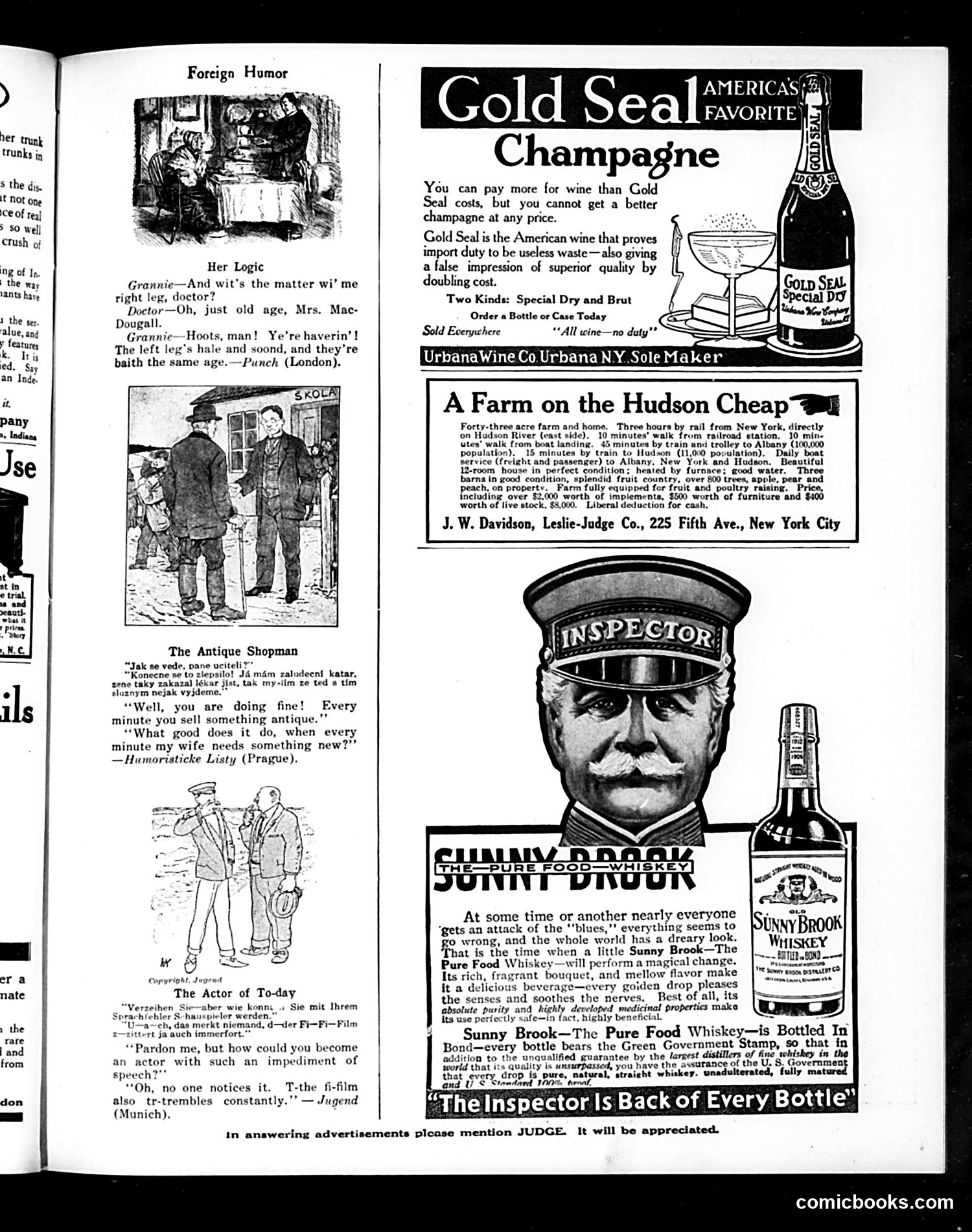
This page from *Judge* magazine contains three international humorous anecdotes followed by period advertisements. The cartoons mock everyday frustrations across cultures: a Scottish grandmother's illogical complaint to her doctor, a Czech antique shopman lamenting his wife's spending despite business success, and a German actor with a speech impediment who succeeds in silent films because "the fi-film also tr-trembles constantly"—satirizing how silent cinema obscures poor acting. The advertisements reflect early 20th-century American commercial concerns: Gold Seal Champagne promotes domestic wine as equal to imports without tariffs, a Hudson River farm listing targets New York commuters, and Sunny Brook Whiskey emphasizes "Pure Food" compliance and government bonding—reassuring consumers about product safety during an era of food adulteration scandals and patent medicine skepticism.
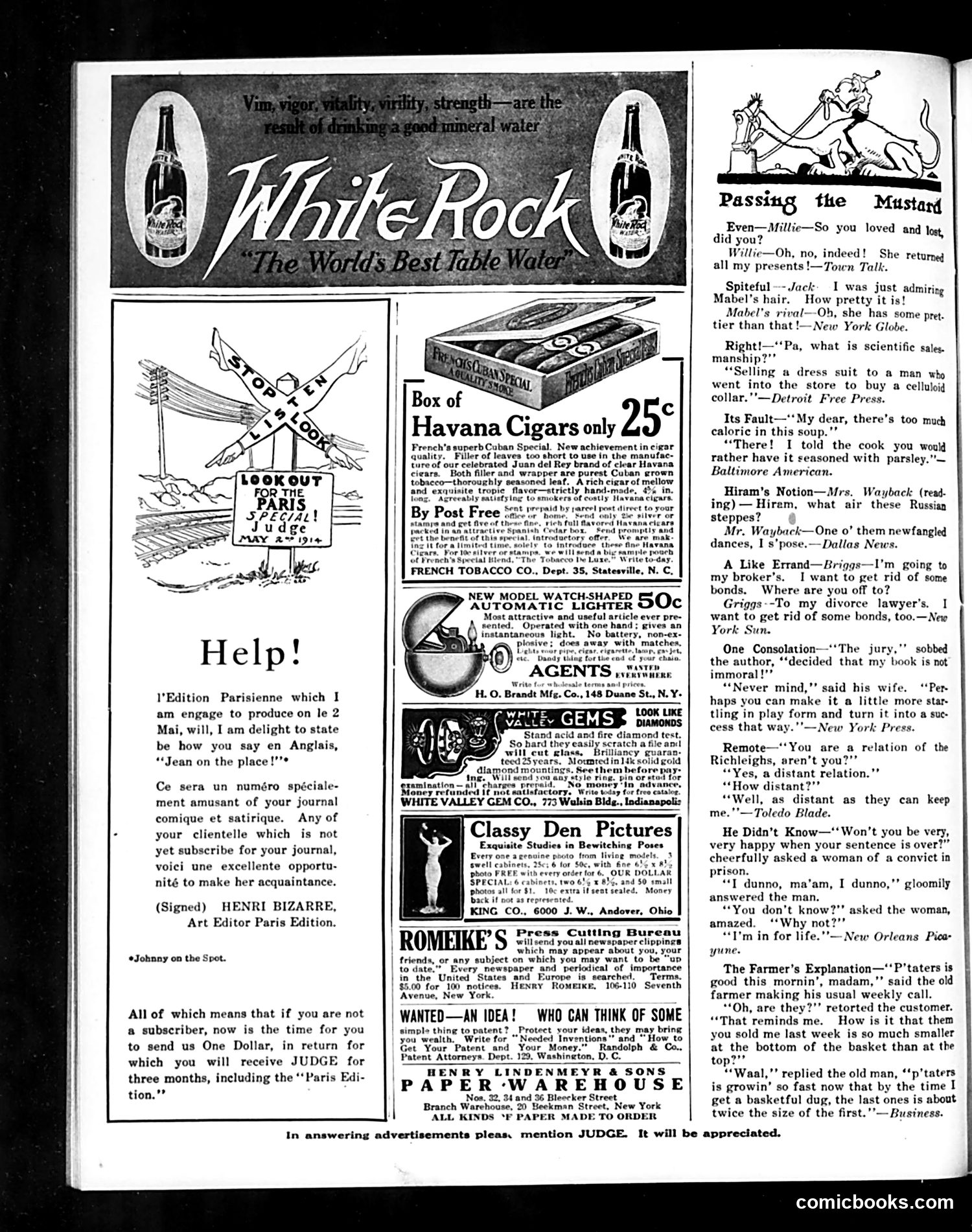
This page is primarily **advertising and subscription solicitation**, not political satire. The dominant content includes: **Main Editorial Feature**: Henri Bizarre, identified as "Art Editor Paris Edition," solicits subscriptions for a special Paris Edition of Judge launching May 2, 1914. He writes in exaggerated French-accented English ("Jean on the place"—meaning "Johnny on the Spot"), promoting the upcoming Parisian satirical edition. **Advertisements**: The page contains typical early-1900s product ads (White Rock mineral water, Havana cigars, watch lighters, diamond gems, and patent services). **Humor Sections**: Small captioned cartoons and joke exchanges address domestic/romantic situations ("Passing the Mustang," "Spiteful," "A Like Errand") with no apparent political content—just period comedy about relationships and everyday life. The page reflects Judge's international reach and expansion into European markets during the pre-WWI era, though the actual satirical content is minimal here.
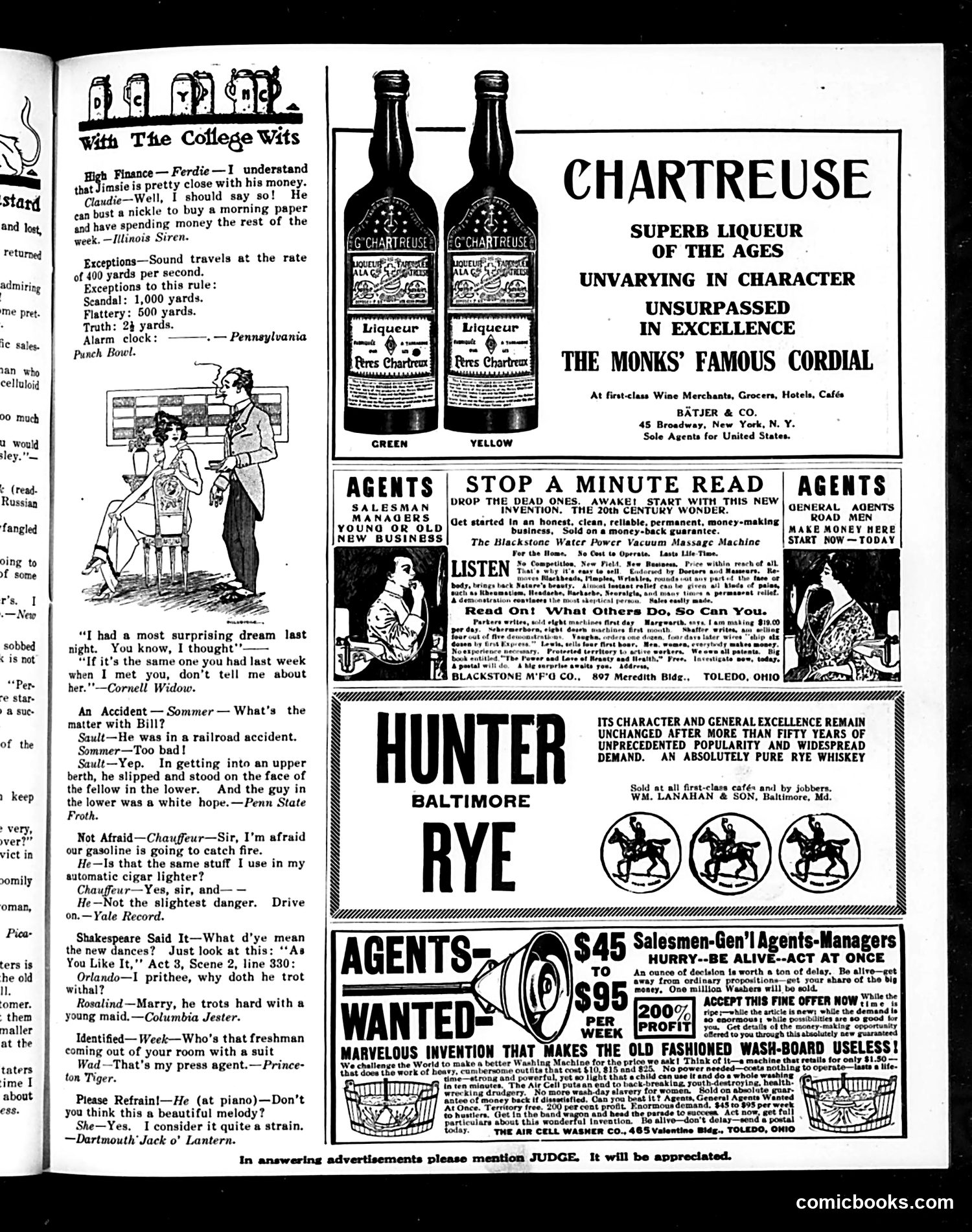
This page is primarily **advertising**, not satirical content. The dominant features are product advertisements for liqueurs, whiskeys, and business "opportunities." **Main Advertisements:** - **Chartreuse** and **Hunter Baltimore Rye** liquor ads emphasize their purity and established reputation - **Blackstone Water Power Vacuum Massage Machine** — a dubious health device promising relief from various ailments - **Wash-machine invention** and **sales agent recruitment ads** offering commissions ($45-$95) to salesmen **The Humor Section** ("With The College Wits"): The left column contains brief jokes from college humor magazines. These are mild observational humor about money, gossip, accidents, and courtship — typical early-20th-century collegiate humor with no overt political content. **Historical Context:** The ads reveal the era's patent medicine/invention culture and aggressive direct-mail sales tactics. The repeated "Act Now!" language and dubious health claims would raise red flags to modern readers but were normalized advertising in this period.
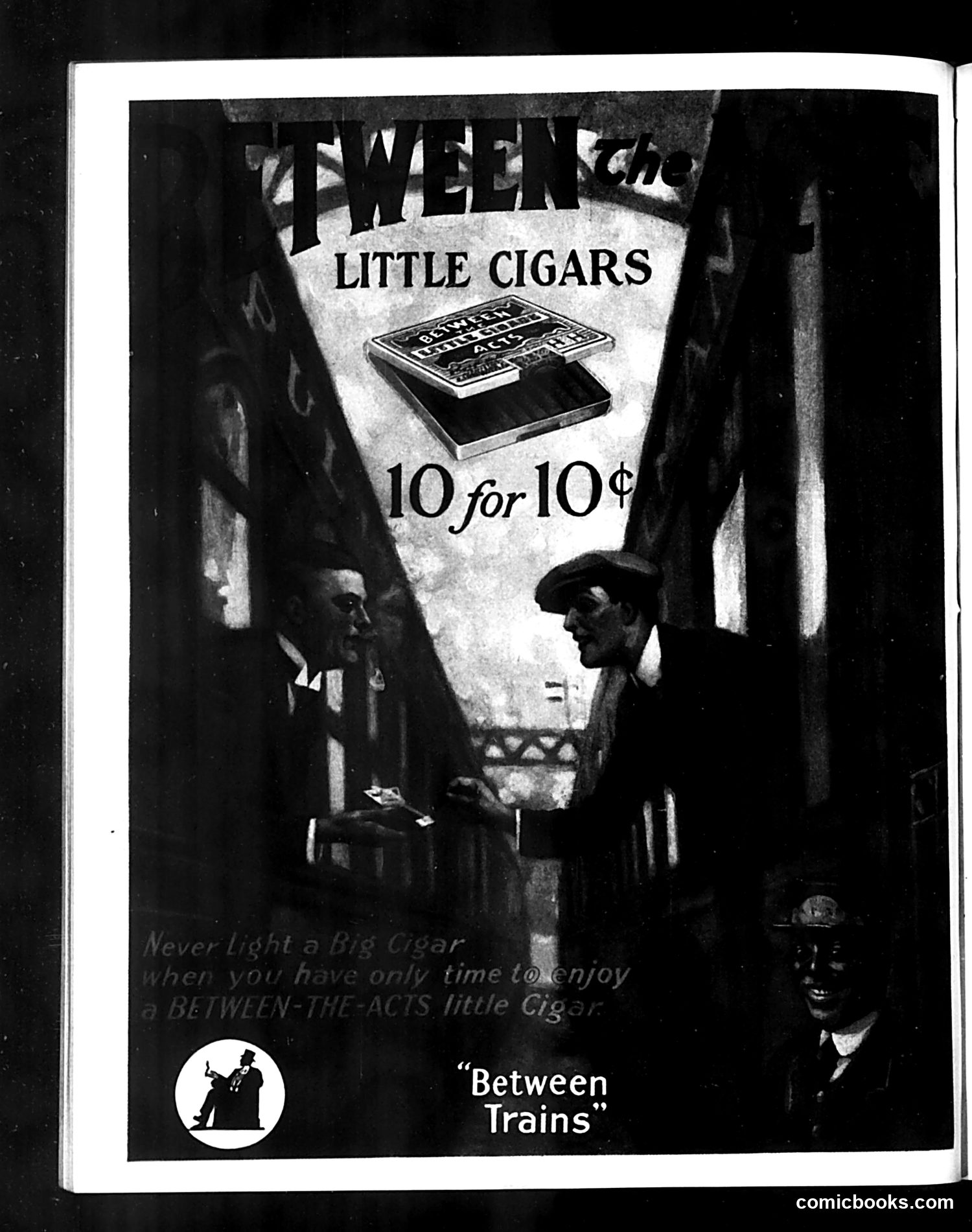
This is a **Tween Little Cigars advertisement**, not political satire. The ad shows two men in what appears to be a train station or similar public space, with a large illuminated sign advertising "Tween Little Cigars" at "10 for 10¢." The tagline reads: "Never light a Big Cigar when you have only time to enjoy a BETWEEN-THE-ACTS little Cigar." The humor is straightforward product marketing—the "Between Trains" scenario suggests a traveler with limited time between departures. The ad positions these small cigars as convenient for brief breaks, appealing to busy professionals. This reflects early 20th-century advertising that normalized casual cigar smoking during everyday activities. No political commentary is present; it's purely commercial messaging from Judge magazine's advertising section.