
Judge, 1914-04-18 · page 14 of 24
Judge — April 18, 1914 — page 14: what you’re looking at
What you’re looking at
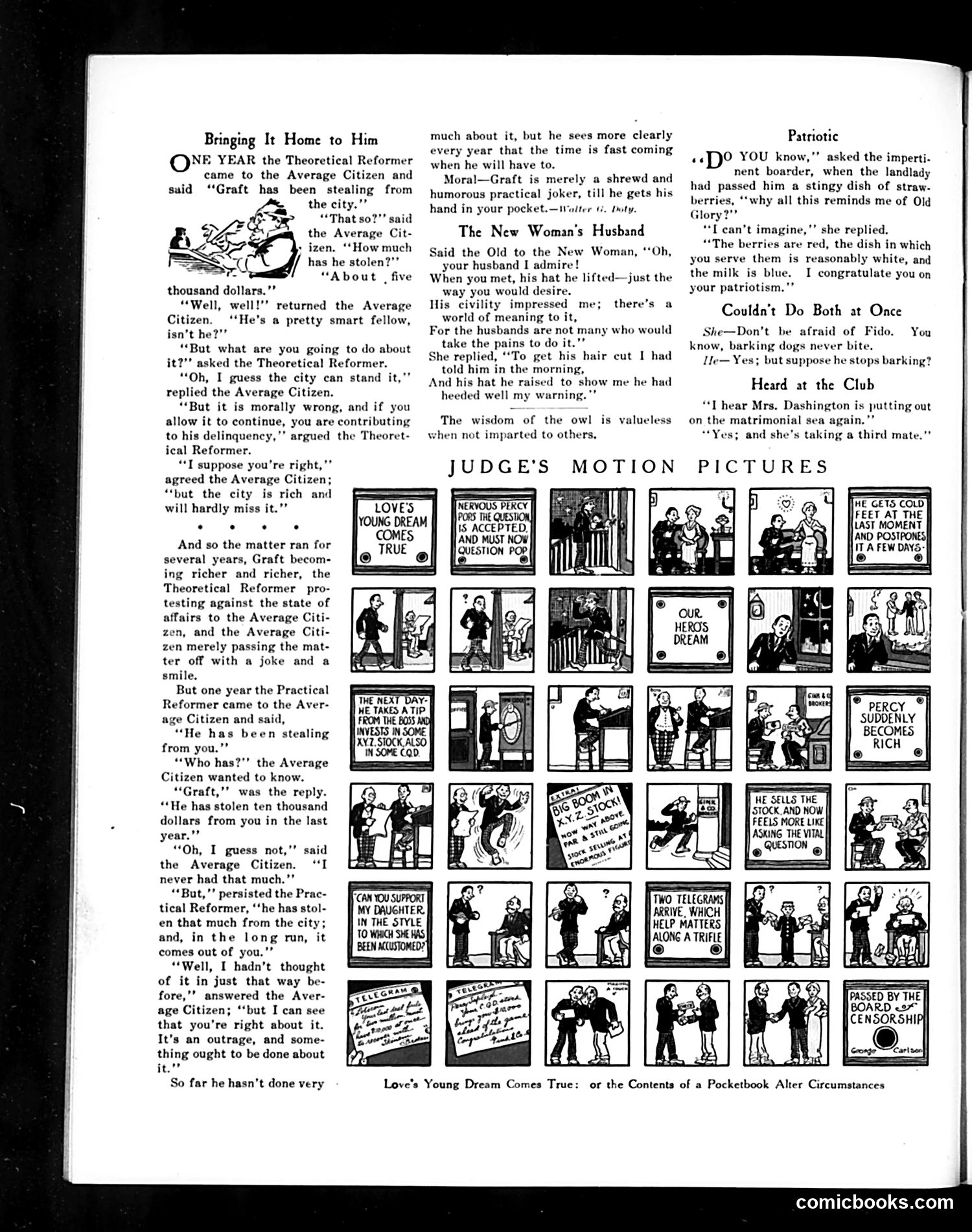
This page satirizes **civic corruption and public apathy** through three main pieces: ## "Bringing It Home to Him" The central narrative mocks how ordinary citizens ignore abstract moral arguments against graft (political corruption/theft). A "Theoretical Reformer" appeals to ethics; the "Average Citizen" dismisses it as harmless—the city is rich enough. Only when a "Practical Reformer" makes it **personal** ("he stole from *you*") does the citizen care. The moral: people ignore systemic theft until it directly affects their wallets. This critiques both corrupt politicians and public indifference. ## The Motion Pictures Strip A series of one-panel silent-film style gags with captions—typical Judge format of the era, mocking melodrama and romantic comedies. ## Supporting Humor Brief satirical quips mock: - The "New Woman's Husband" (a hen-pecked man following his wife's orders, disguised as chivalry) - Patriotic pretense (red/white/blue berries) - Marriage as a maritime venture **Context**: This reflects Progressive Era concerns about municipal corruption and the gap between reformers' idealism and citizens' practical indifference.
📄 Transcribed text from this page (OCR, searchable)
Machine-transcribed from the original scan — historical spelling and the odd misread are preserved.
Bringing It Home to Him NE YEAR the Theoretical Reformer came to the Average Citizen and “Graft has been stealing from > A, the city.”” = “That so?”’ said Vs the Average Cit- » izen. ‘How much has he stolen?”” “About , five thousand dollars.’’ “Well, well!’ returned the Average Citizen. ‘‘He’s a pretty smart fellow, isn’t he?’’ “But what are you going to do about it?’ asked the Theoretical Reformer. “Oh, I guess the city can stand it,’’ replied the Average Citizen. “‘But it is morally wrong, and if you allow it to continue, you are contributing to his delinquency,’’ argued the Theoret- ical Reformer. “I suppose you're right,”’ agreed the Average Citizen; “but the city is rich and will hardly miss i And so the matter ran for several years, Graft becom- ing richer and richer, the Theoretical Reformer pro- testing against the state of affairs to the Average Citi- zen, and the Average Citi- zen merely passing the mat- ter off with a joke and a smile. But one year the Practical Reformer came to the Aver- age Citizen and said, “He has been stealing from you.”” “*Who has?"’ the Average Citizen wanted to know. “Graft,"’ was the reply. “*He has stolen ten thousand dollars from you in the last suid h, I guess not,’’ said the Average Citizen. ‘‘I never had that much.’’ “But,” persisted the Prac- tical Reformer, ‘‘he has stol- en that much from the city; and, in the long run, it comes out of you.’’ “Well, I hadn’t thought of it in just that way be- fore,’”’ answered the Aver- age Citizen; ‘‘but I can see that you're right about it. It’s an outrage, and some- thing ought to be done about it.” So far he hasn't done very Love’s Young Dream Comes True: much about it, but he sees more clearly every year that the time is fast coming when he will have to. Moral—Graft is merely a shrewd and humorous practical joker, till he gets his hand in your pocket.—Walter (2. boty. The New Woman’s Husband Said the Old to the New Woman, ‘‘Oh, your husband I admire! When you met, his hat he lifted—just the way you would desire. His civility impress world of meaning to it, For the husbands are not take the pains to do it She replied, ‘To get his hair cut I had told him in the morning, And his hat he raised to show me he had heeded well my warning.” me; there’s a ny who would wisdom of the owl is valueless The when not imparted to others, JUDGE’S MOTION Patriotic ‘ «‘D° YOU know," asked the imperti- nent boarder, when the landlady had passed him a stingy dish of straw. “why all this reminds me of Old Glory? “*T can’t imagine,”’ she replied. “The berries are red, the dish in which serve them is reasonably white, and Ik is blue. I congratulate you on your patriotism.” Couldn't Do Both at Once She—Don’t be afraid of Fido. know, barking dogs never bite. He— Yes; but suppose he stops barking? Heard at the Club “T hear Mrs, Dashington is putting out on the matrimonial sea again.’ “Yes; and she’s taking a third mate." PICTURES You or the Contents of a Pocketbook Alter Circumstances comicbooks.com