
Judge, 1914-04-18 · page 15 of 24
Judge — April 18, 1914 — page 15: what you’re looking at
What you’re looking at
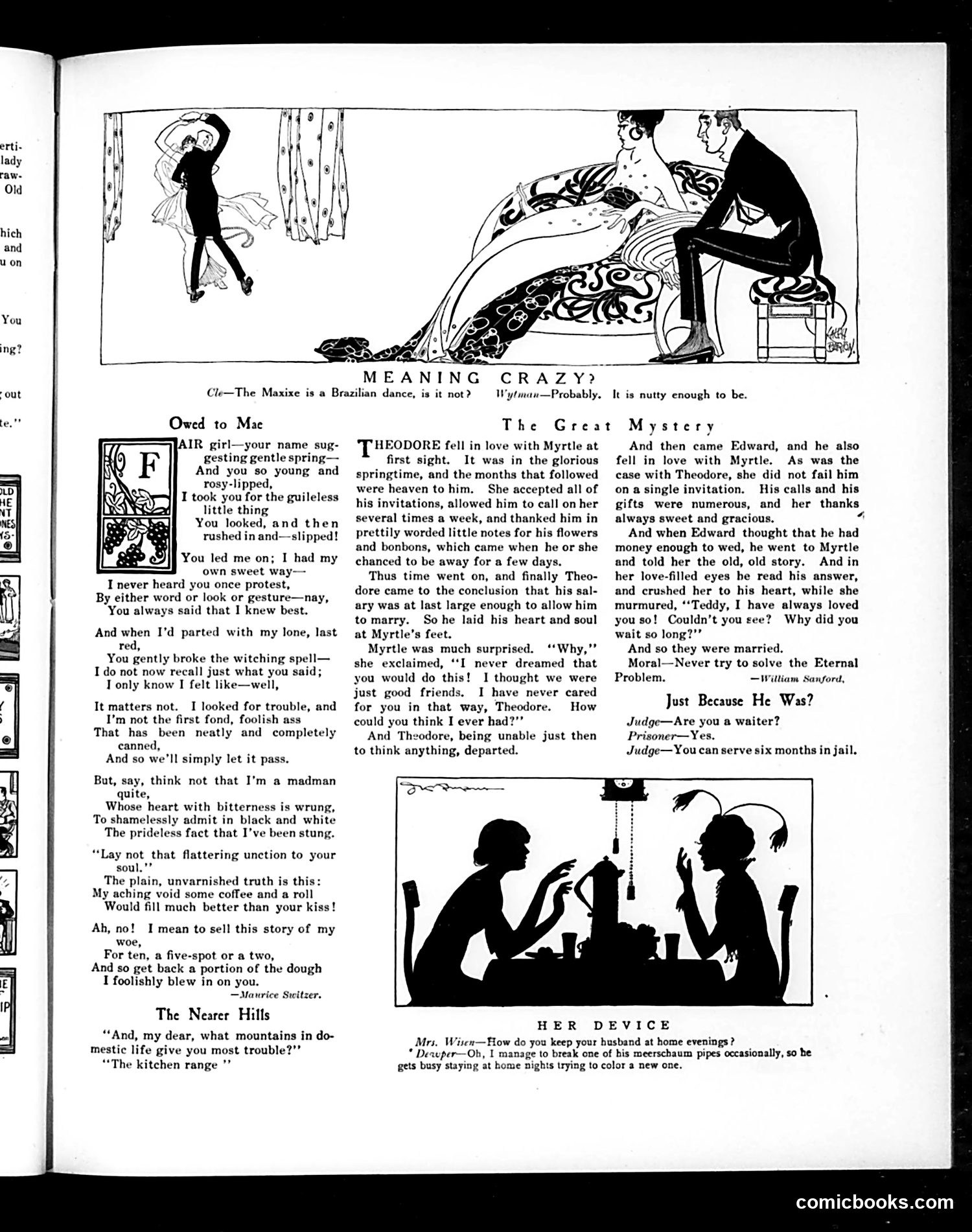
This page contains multiple satirical pieces typical of early 20th-century American humor: **"Meaning Crazy?"** (top): A man observes a couple in bed; he notes the woman is performing the Maxixe (a Brazilian dance), suggesting she's behaving eccentrically or scandalously. The satire mocks both the "exotic" dance craze and marital situations. **"Owed to Mae"**: A poem by Maurice Switzer about a man who fell for a deceptive woman. He provided money and affection, believing her responsive, only to discover she never loved him. The bitter irony: he concludes that coffee and a roll would satisfy him better than her kiss—satirizing romantic disappointment and financial manipulation in courtship. **"The Great Mystery"**: A morality tale contrasting two men pursuing Myrtle. Theodore's cautious, respectful courtship fails; Edward's identical approach succeeds—the "mystery" being why identical behavior produces opposite results. The "moral" cynically suggests the eternal problem of understanding women's inconsistency. **"Her Device"**: A brief joke about a wife who deliberately breaks her husband's pipes so he stays home nights repairing them—satirizing domestic manipulation. All pieces target romantic and marital relationships with cynical, misogynistic humor typical of the era.
📄 Transcribed text from this page (OCR, searchable)
Machine-transcribed from the original scan — historical spelling and the odd misread are preserved.
You ing? Cle—The Maxixe is a Brazilian dance, is it not? Owed to Mae AIR girl—your name sug- gesting gentle spring— And you so young and rosy-lipped, \ S| I took you for the guileless ti) little thing You looked, and then rushed in and—slipped! You led me on; I had my own sweet way— I never heard you once protest, By either word or look or gesture—nay, You always said that I knew best. And when I'd parted with my lone, last red, You gently broke the witching spell— I do not now recall just what you said; T only know I felt like—well, It matters not. I looked for trouble, and I'm not the first fond, foolish ass That has been neatly and completely canned, And so we'll simply let it pass. But, say, think not that I’m a madman quite, Whose heart with bitterness is wrung, To shame ly admit in black and white The prideless fact that I’ve been stung. “Lay not that flattering unction to your soul."” The plain, unvarnished truth is this: My aching void some coffee and a roll Would fill much better than your kiss! Ah, no! woe, For ten, a five-spot or a two, And so get back a portion of the dough I foolishly blew in on you. Maurice Switzer. The Nearer Hills “And, my dear, what mountains in do- mestic life give you most trouble?’’ “The kitchen range "’ I mean to sell this story of my MEANING CRAZY? Wytmau—Probably. The Grea HEODORE fell in love with Myrtle at first sight. It was in the glorious springtime, and the months that followed were heaven to him. She accepted all of his invitations, allowed him to call on her several times a week, and thanked him in prettily worded little notes for his flowers and bonbons, which came when he or she chanced to be away for a few days. Thus time went on, and finally Theo- dore came to the conclusion that his sal- ary was at last large enough to allow him to marry. So he laid his heart and soul at Myrtle’s feet. Myrtle was much surprised. ‘*Why,”’ she exclaimed, ‘I never dreamed that you would do this! 1 thought we were just good friends. I have never cared for you in that way, Theodore. How could you think I ever had?" And Theodore, being unable just then to think anything, departed. t It is nutty enough to be. Mystery And then came Edward, and he also fell in love with Myrtle. As was the case with Theodore, she did not fail him ona single invitation. His calls and his gifts were numerous, and her thanks always sweet and gracious. 4 And when Edward thought that he had money enough to wed, he went to Myrtle and told her the old, old story. And in her love-filled eyes be read his answer, and crushed her to his heart, while she murmured, ‘‘Teddy, I have always loved you so! Couldn’t you see? Why did you wait so long?”’ And so they were married. Moral—Never try to solve the Eternal Problem. —William Sanford, Just Because He Was? Judge—Are you a waiter? Prisoner—Yes. Judge—You can serve six months in jail. HER DEVICE Mrs. Wisen—How do you keep your husband at home evenings? * Dewwper—Oh, I manage to break one of his meerschaum pipes occasionally, so he gets busy staying at home nights trying to color a new one. comicbooks.com