
A complete issue · 24 pages · 1914
Judge — February 21, 1914
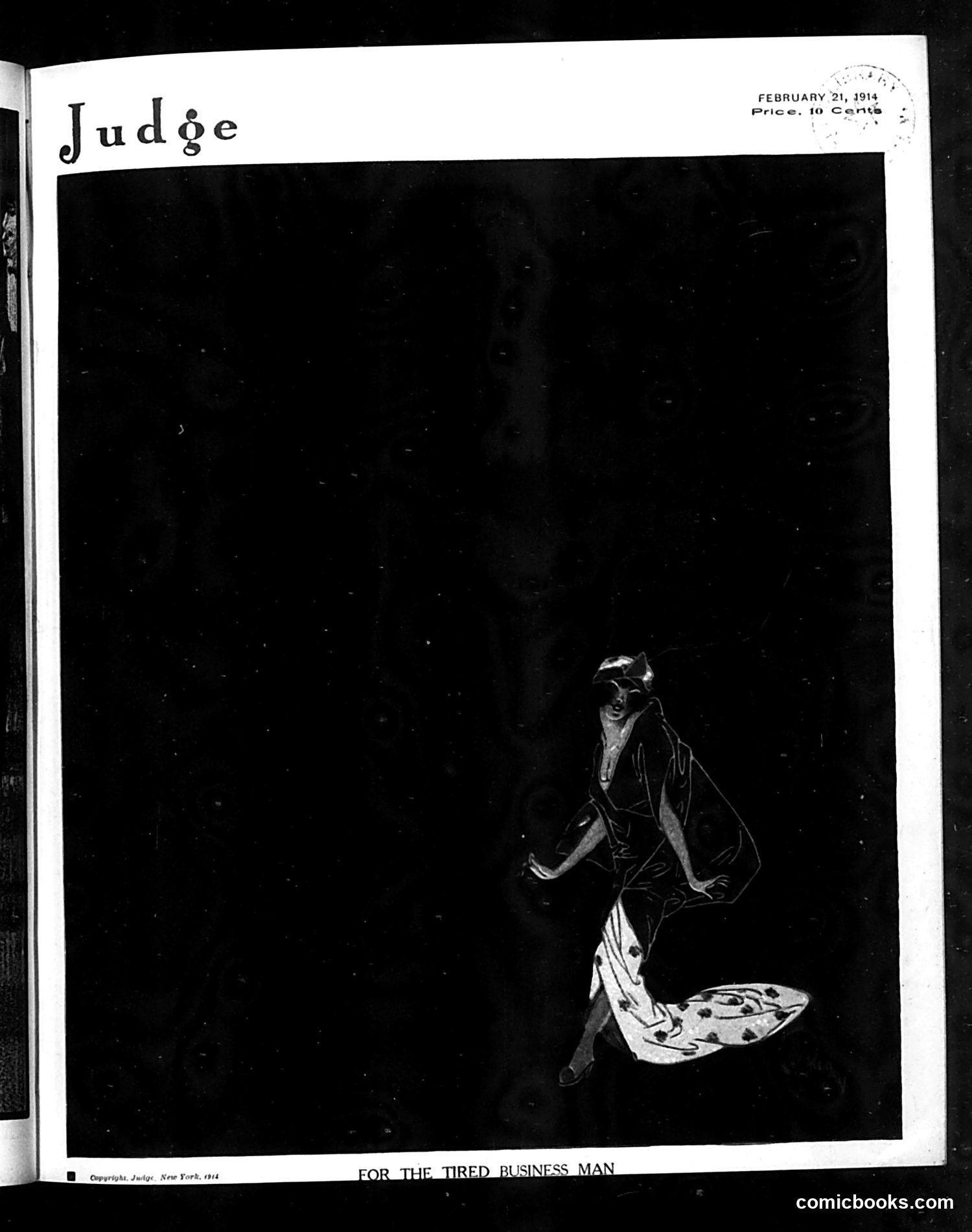
This cover illustration depicts a woman in fashionable early 1900s attire—wearing a dark jacket and wide-brimmed hat—who appears to be a painter or artist. She's shown with an artist's palette, standing against a dark background. The caption reads "FOR THE TIRED BUSINESS MAN," suggesting this image served as escapist entertainment for the magazine's male readership. The satire likely comments on the "New Woman" of the Progressive Era—independent, pursuing professional artistic careers rather than traditional domestic roles. For weary businessmen, this represented both aspirational leisure and perhaps gentle mockery of changing gender roles and women's increasing participation in professional and artistic spheres during this period.
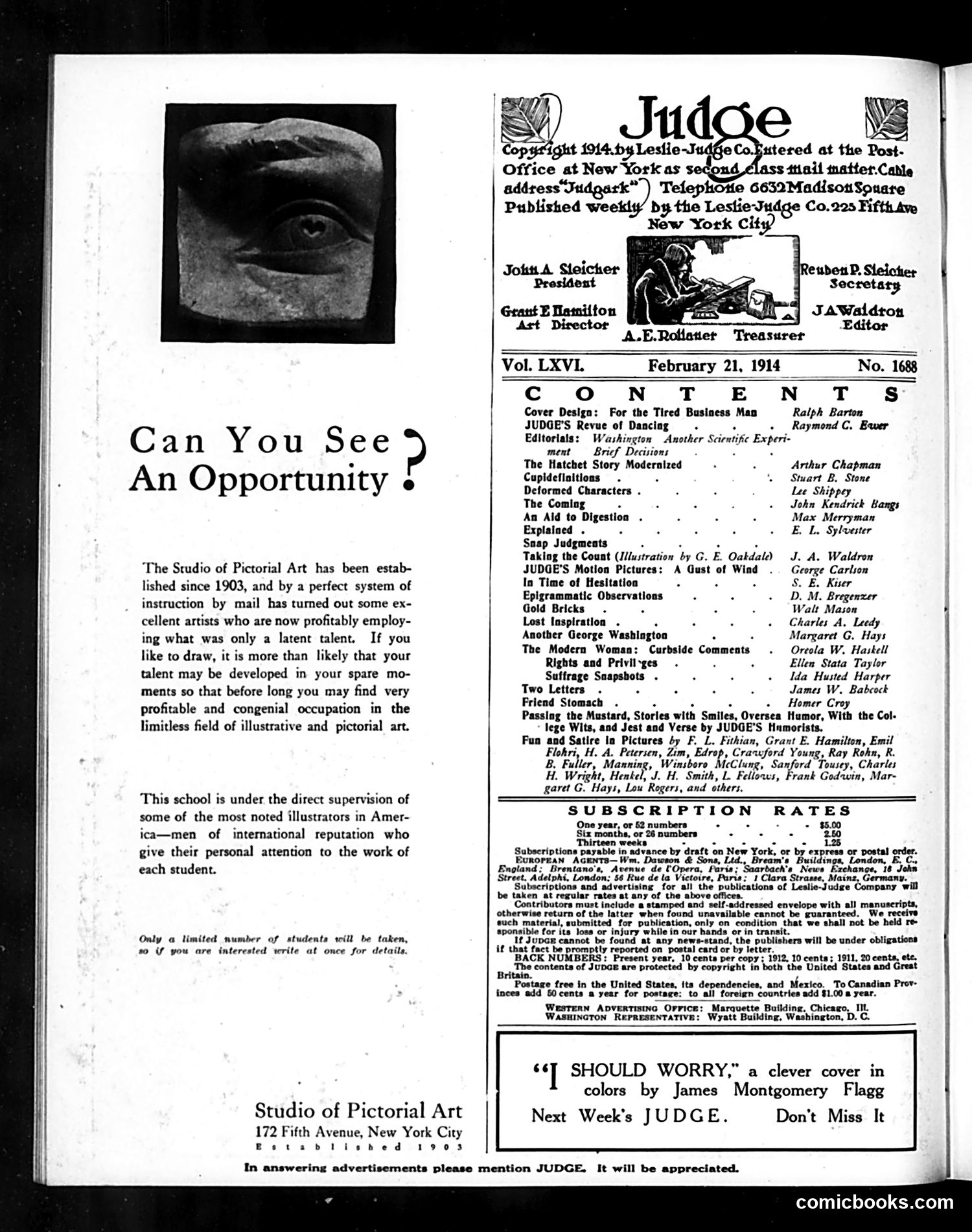
The left side of this page is an advertisement for the "Studio of Pictorial Art" (established 1903), promoting art instruction. The image shows what appears to be a sculptural head in profile. The right side is the magazine's masthead and table of contents for Vol. LXVI, No. 1688. The contents list numerous articles, editorials, and illustrations typical of Judge's satirical humor, including pieces on dancing, capitalists, women's suffrage, and social commentary. Without seeing the actual cartoon illustrations referenced in the contents, I cannot identify specific figures or explain particular satire. However, Judge was known for mocking political figures, social pretensions, and contemporary controversies. The "Suffrage Snapshots" entry suggests commentary on the women's suffrage movement, a major issue in 1914. To fully explain the satire would require viewing the actual illustrations.
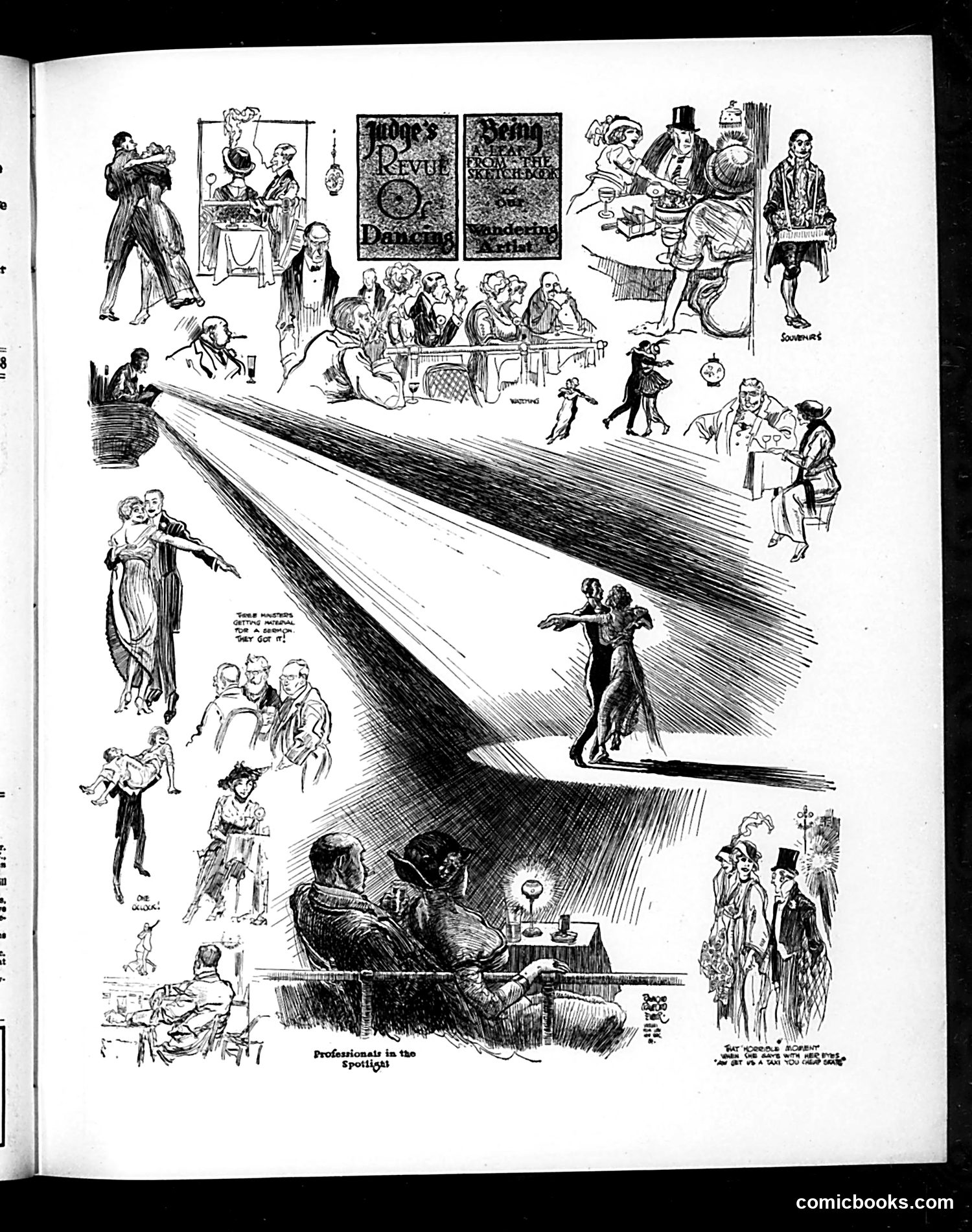
This appears to be a satirical illustration titled "Professionals in the Spotlight," depicting various entertainment and social figures of the era. The central image shows a bright spotlight illuminating performers or public figures, with numerous sketched characters arranged around the margins—suggesting different "types" under scrutiny. The composition critiques how public attention focuses intensely on certain professionals while society watches them perform. The surrounding vignettes likely represent different social classes or professions being examined by society's gaze. Without clearer text or more specific identifying details, I cannot definitively name the particular figures or reference specific contemporary events. The overall satirical point appears to concern public scrutiny of notable individuals and the performative nature of professional life under public attention.
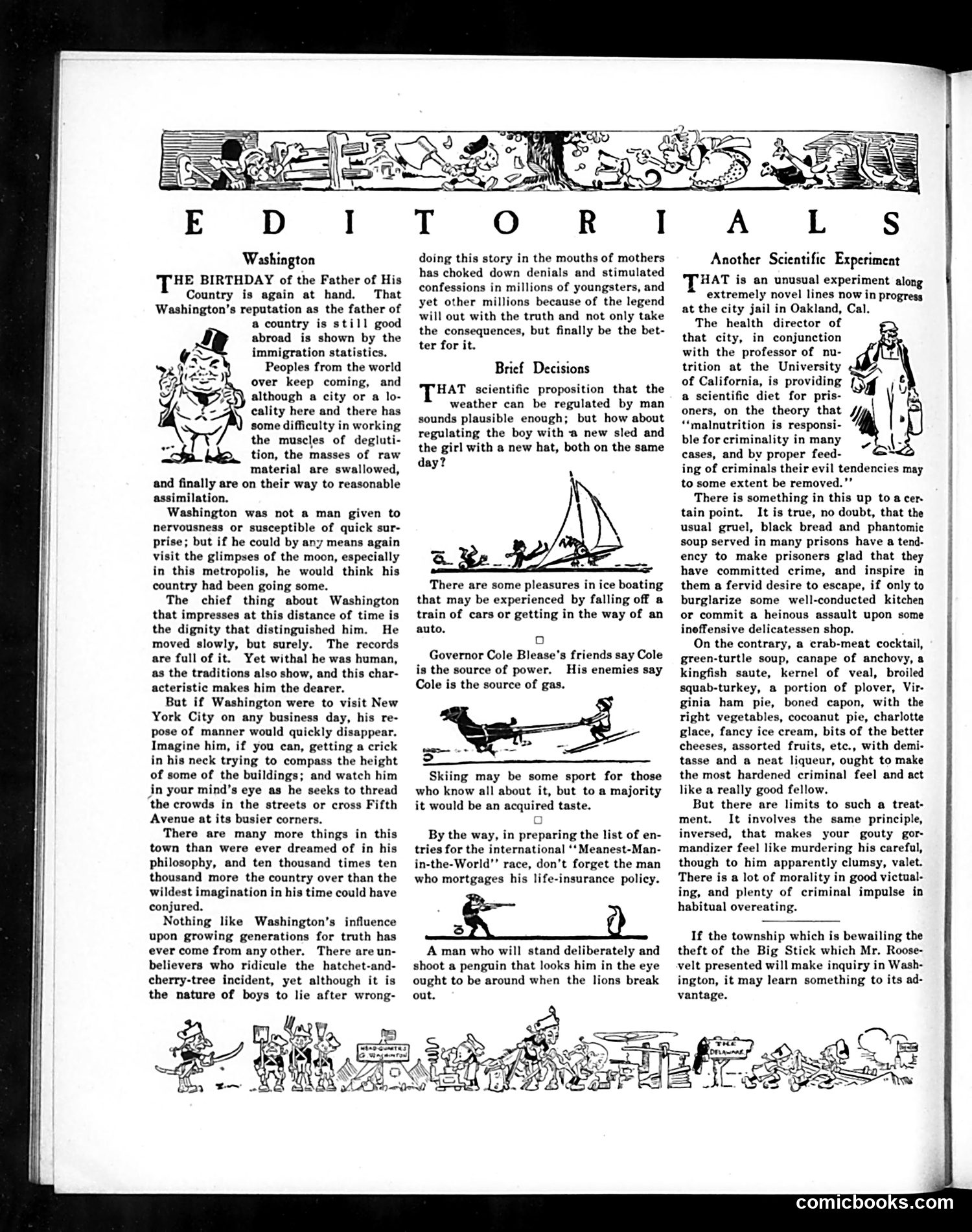
This page contains three editorial pieces from Judge magazine: 1. **Washington's Birthday Editorial**: A commentary on George Washington's reputation as "Father of His Country," noting immigration statistics challenge this narrative. The piece argues Washington wouldn't be nervous about the city's diverse population. 2. **"Brief Decisions"**: Several short satirical items, including: - A joke about regulating boys' and girls' behavior equally - Commentary on boating pleasures and train travel - A quip about Governor Cole Blease (South Carolina governor) being a "source of power" 3. **Prison Diet Reform**: The right column discusses an experiment at Oakland City Jail using improved nutrition to reform criminals, satirizing the notion that better food creates better behavior. The cartoons use crude caricature and sarcasm typical of early 20th-century American satire, attacking both contemporary political figures and social pretensions.
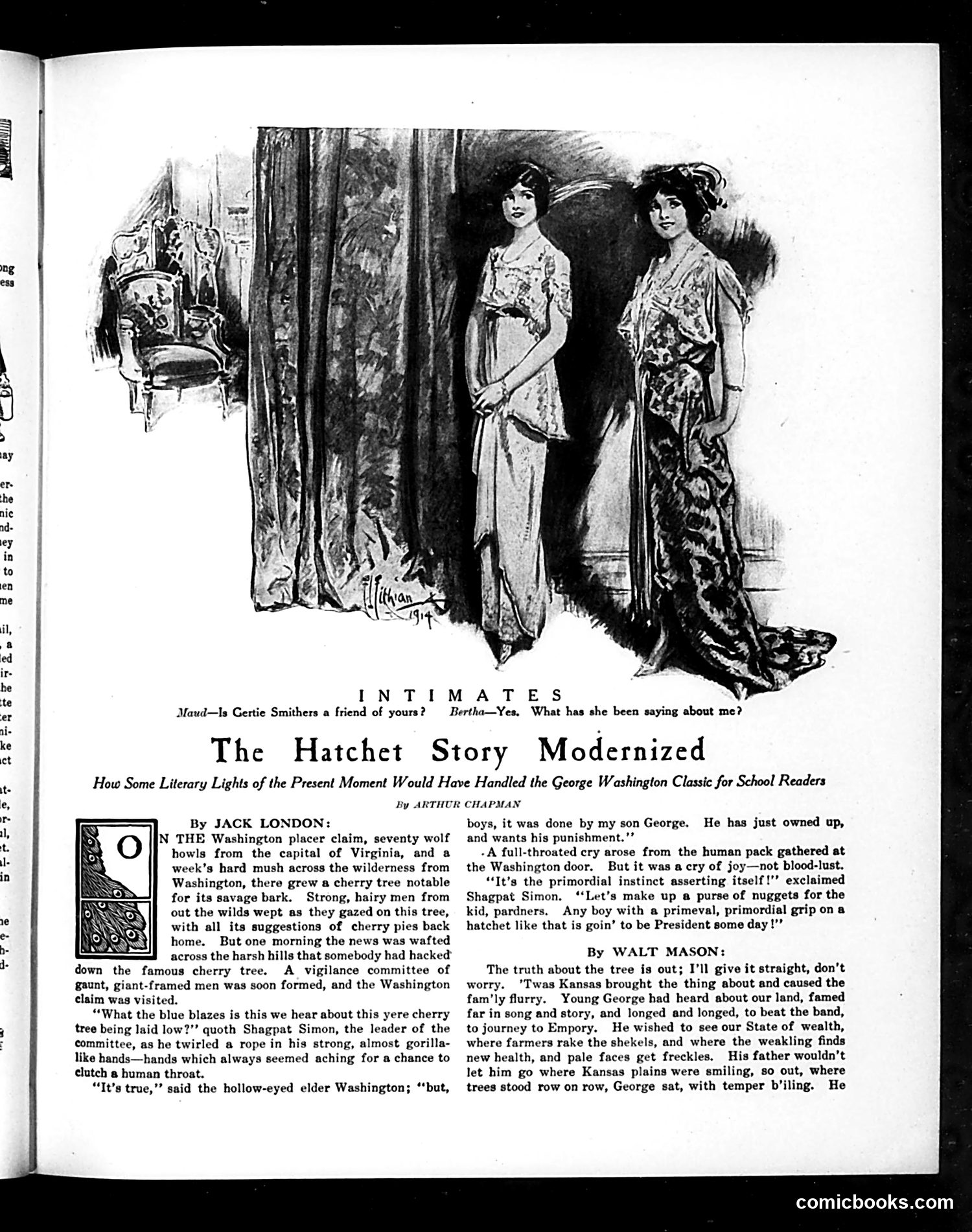
This satirical piece parodies the famous George Washington cherry tree legend (apocryphal story where young Washington confessed to cutting down his father's tree). The illustration shows two women gossiping—"Maud" asking friend "Bertha" what mutual acquaintance "Gertie Smithers" has been saying about her. The text reimagines Washington's legend through contemporary literary voices (Jack London, Walt Mason, and Arthur Chatham are credited). Each writer offers their own modern take: London frames it as frontier roughness, Mason as a Kansas frontier tale about hardship and wandering. The satire mocks how different authors would sensationalize or reframe a simple moral story through their own distinctive styles and contemporary concerns, rather than its original lesson about honesty.
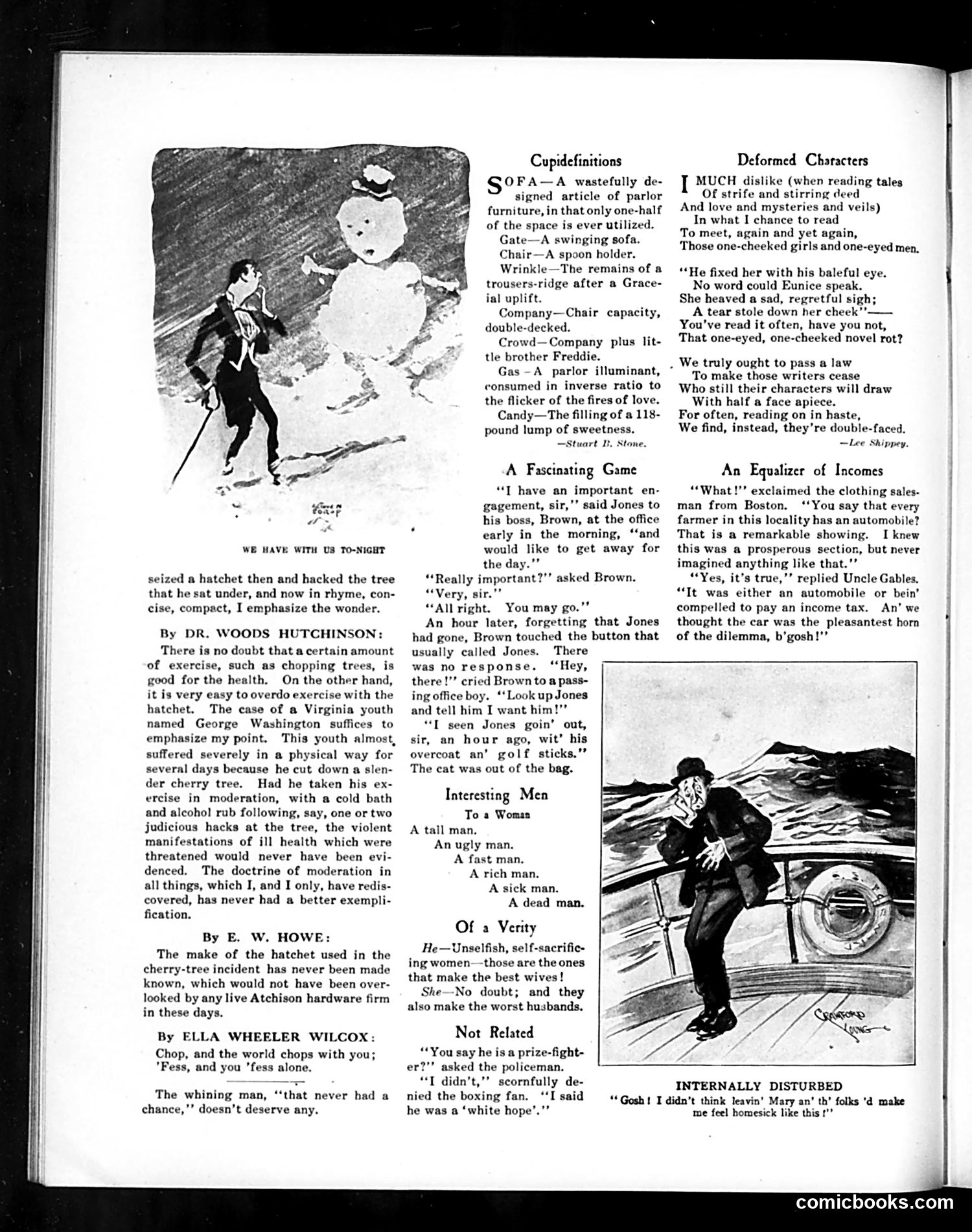
This page satirizes the famous (apocryphal) George Washington cherry-tree legend. The illustration shows Washington with a hatchet and felled tree; multiple prominent writers offer humorous commentary. **The Satire:** Dr. Woods Hutchinson ridicules the myth by "medical analysis"—claiming Washington overexercised with his hatchet and suffered health consequences. E.W. Howe makes a business joke (a hardware store would've publicized the hatchet brand). Ella Wheeler Wilcox offers sentimental verse mocking confession culture. **Context:** By the early 20th century, the cherry-tree story (invented by biographer Mason Locke Weems) was widely recognized as false, making it ripe for satire. Judge exploited this by having respected writers comically treat fiction as historical fact. The other sections—"Cupidefinitions," office humor, and observations on relationships—are typical Judge satirical filler, poking fun at parlor culture and gender dynamics of the era. The "Deformed Characters" piece mocks melodramatic novel writing conventions.
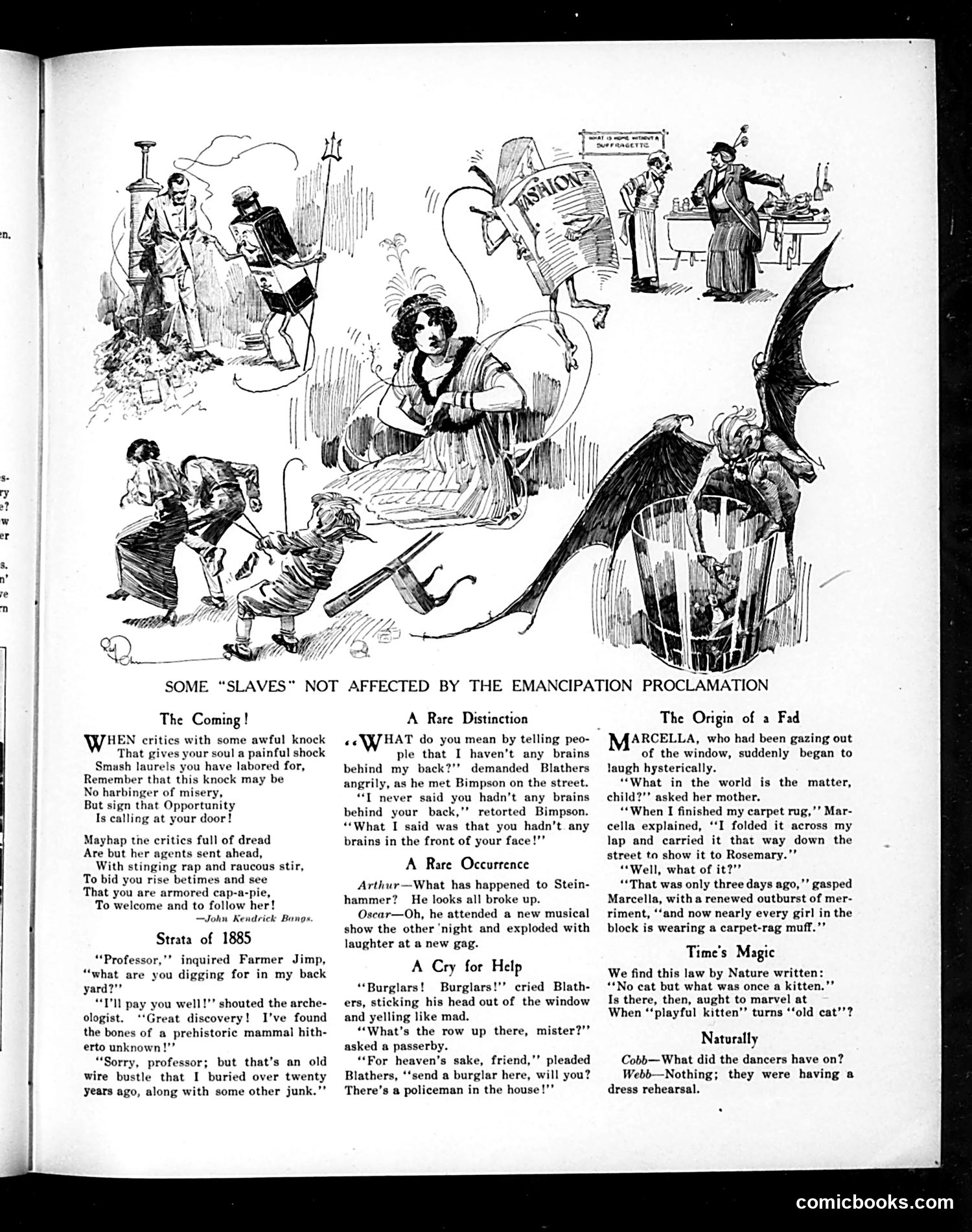
This page contains six brief humorous sketches typical of 1880s satirical magazines: **"Strata of 1885"** mocks pseudo-intellectual pretension: a professor mistakes a discarded wire bustle (a rigid undergarment) for prehistoric bones, highlighting both archaeological credulity and the absurdity of 1880s fashion. **"A Rare Distinction"** is a simple insult joke about Blathers lacking brains "in the front of your face"—wordplay on spatial positioning. **"A Rare Occurrence"** suggests musical comedy is so bad it's shocking when anyone actually laughs. **"A Cry for Help"** plays on the fear of police intrusion—Blathers calls for burglars to protect himself from a policeman in his house, inverting expected social anxieties. **"The Origin of a Fad"** satirizes how quickly absurd fashions spread among women—a carpet-rug carried as a muff becomes trendy within days. **"Naturally"** offers wordplay on cats aging from kittens. The overall tone mocks contemporary vanities, pretension, and social conformity.
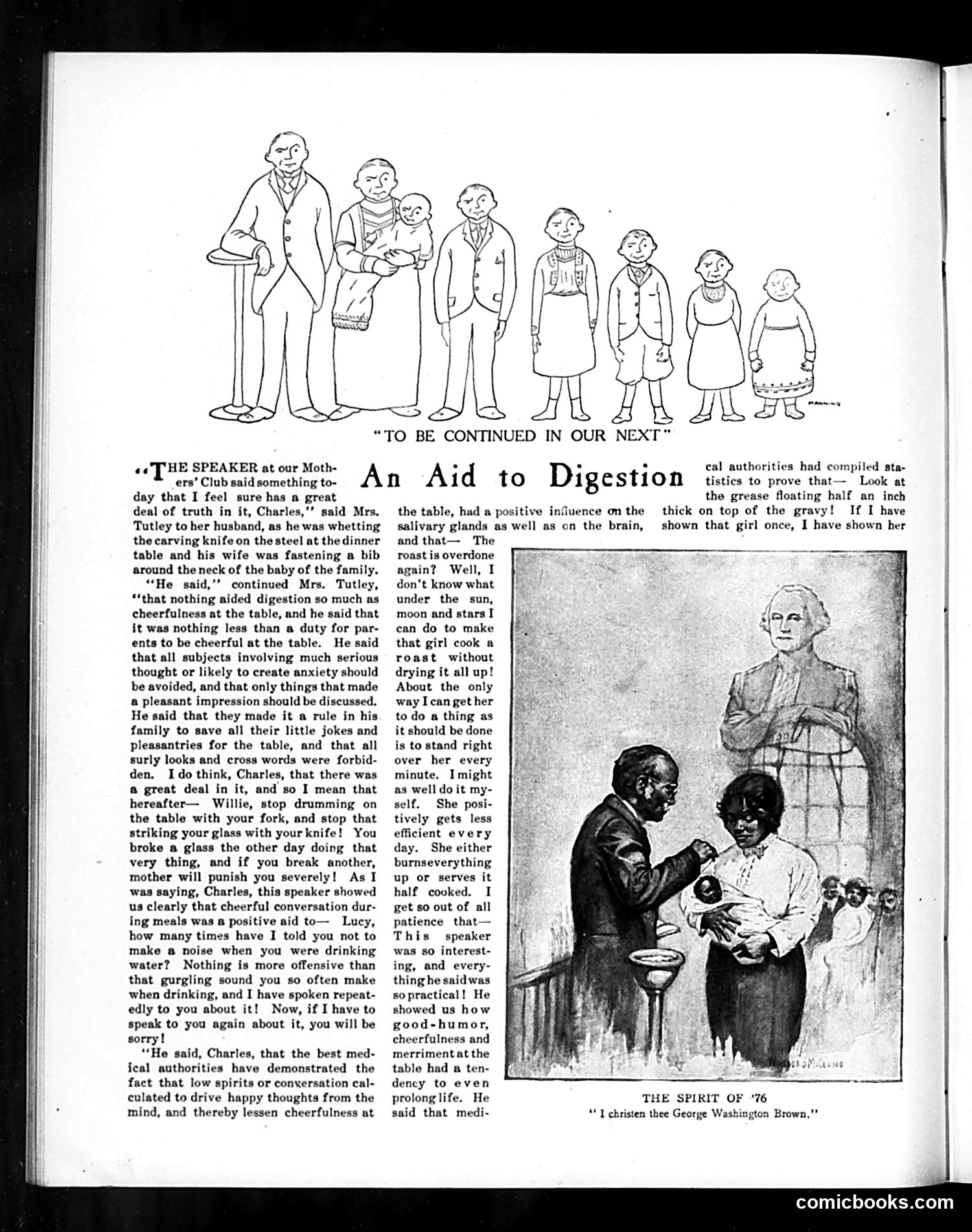
This page satirizes the hypocrisy of domestic advice about mealtime cheerfulness. The text presents Mrs. Tutley recounting a speaker's advocacy for cheerful, pleasant dinner conversation as an aid to digestion—while the illustration shows her simultaneously scolding her children and servants in increasingly harsh terms about noise, breakage, cooking failures, and behavior. The humor lies in the stark contradiction: she praises the speaker's wisdom about maintaining happiness at table while actively creating an anxious, critical atmosphere. Her constant interruptions ("Willie, stop drumming...," "Lucy, how many times...") undermine her own stated endorsement of the philosophy. The lower illustration, captioned "The Spirit of '76," appears to be a separate satirical piece invoking American patriotic imagery, though its specific target remains unclear from the visible content. The satire critiques both self-deluding domesticity and the gap between ideal parenting advice and actual household practice.
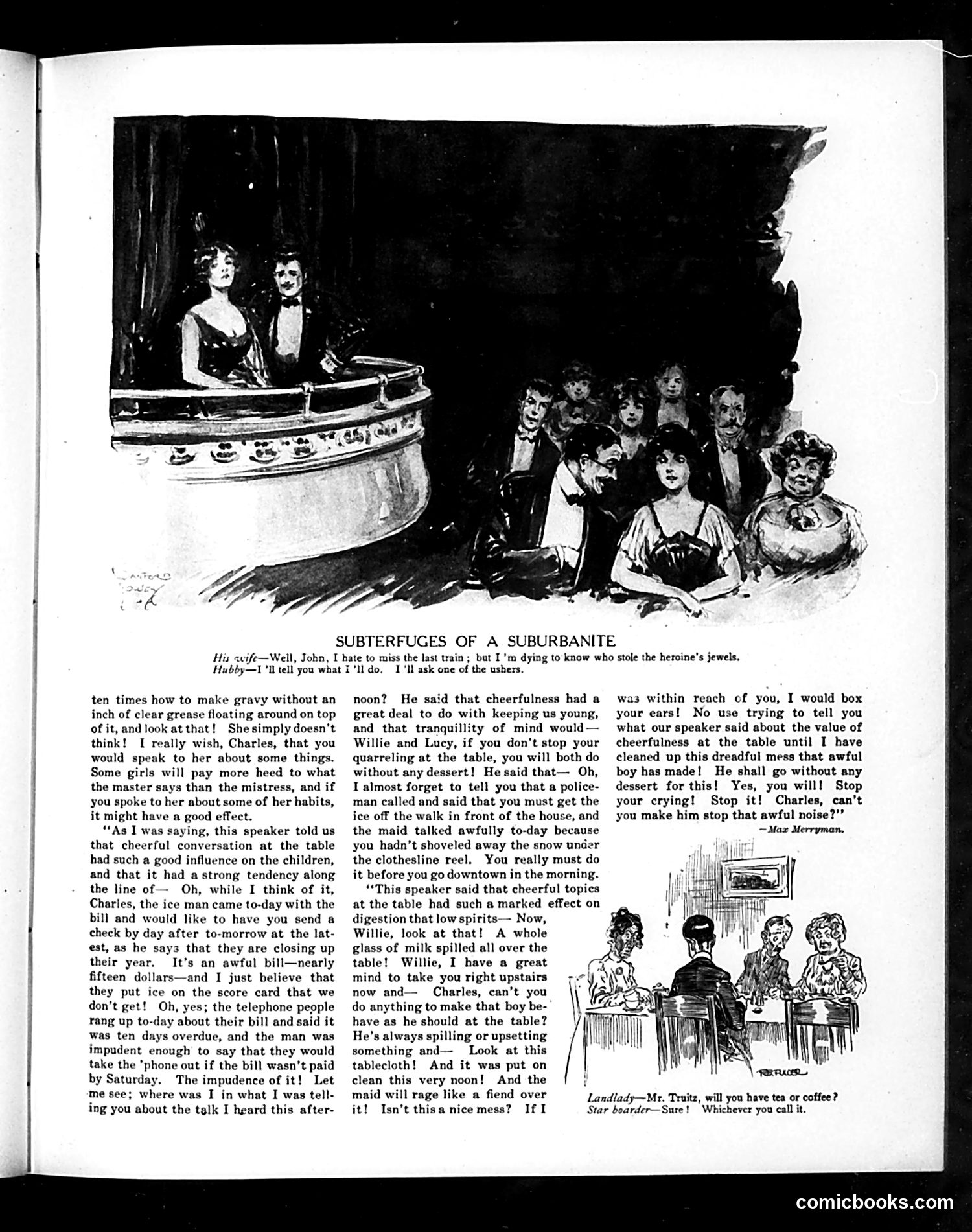
This satirical piece mocks the hypocrisy of middle-class suburban life, specifically targeting a husband who wants to stay out late to hear the end of a serialized story (likely a stage play or serial fiction), claiming he'll tell his wife what happens. The large cartoon shows the wife at a theater box with the husband below, surrounded by servants/staff—illustrating their social pretensions. The main text is a wife's monologue that exposes the contradiction: she lectures about a speaker's advice on "cheerful conversation" promoting family harmony and digestion, yet her actual dinner is chaos—children quarreling, spilled milk, servants misbehaving, unpaid bills from the ice man and telephone company, and her constant nagging. She cannot stop interrupting her own lecture about cheerfulness to scold everyone around her. The joke: suburbanites aspire to refined gentility but their actual domestic life is petty, anxious, and contradictory. The small cartoon at bottom adds a minor joke about a boarding house resident's indifference to tea versus coffee.
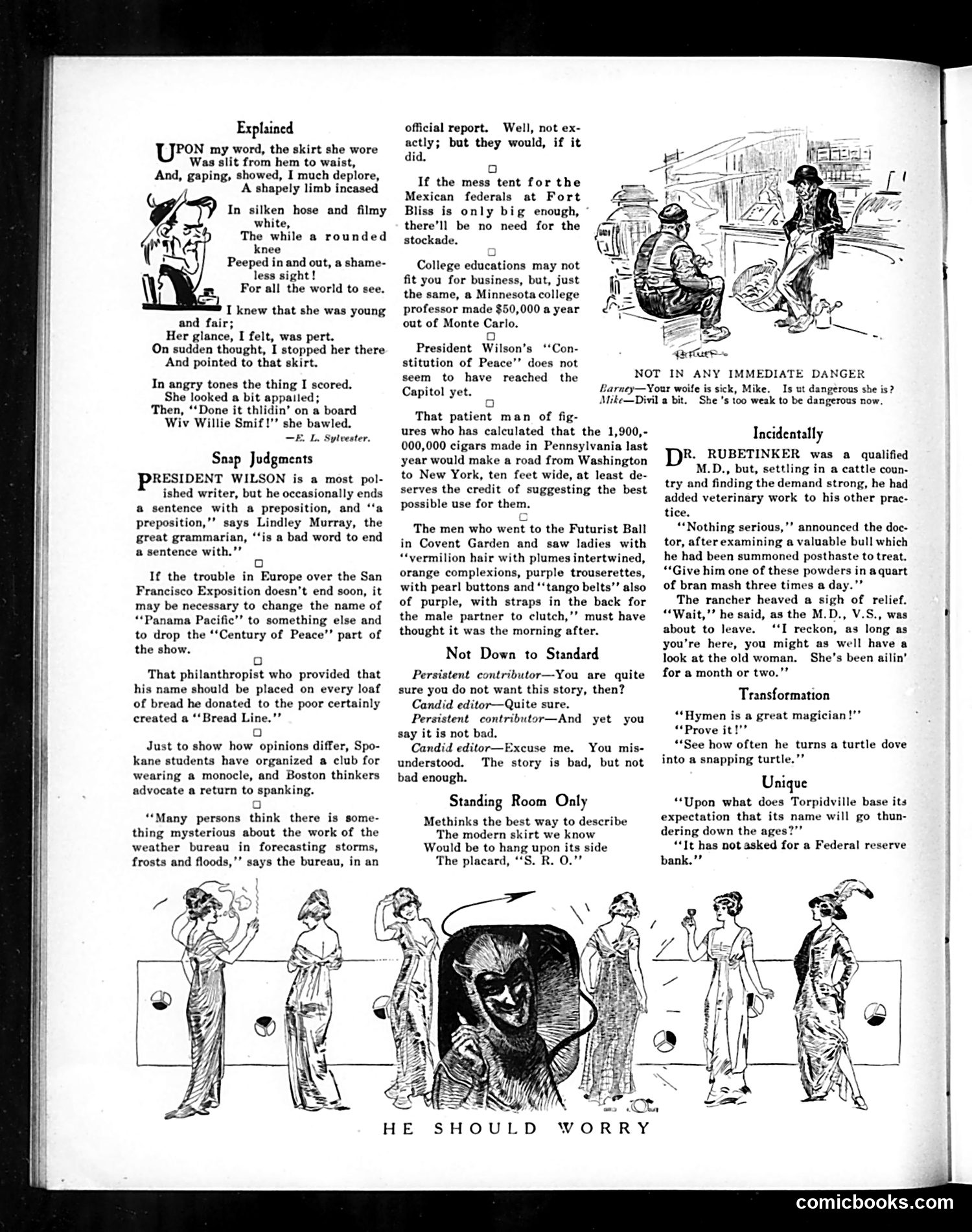
This page contains multiple short satirical pieces mocking contemporary issues (circa 1915-1920): **"Explained"** — A poem about a woman wearing a scandalously short skirt, representing anxieties about women's changing fashion and morality. **"Snap Judgments"** — Brief quips targeting President Wilson (his grammar, his peace initiatives' ineffectiveness), the San Francisco Exposition controversy, and the Mexican Revolution at Fort Bliss. **"Standing Room Only"** — A visual gag suggesting modern skirts are so short they require warning signs. **"He Should Worry"** — A cartoon mocking a man (appears to be a worried figure) surrounded by women, likely satirizing gender relations or male anxiety about female independence. **"Incidentally"** — Humorous anecdote about a rural veterinarian-doctor treating both animals and humans indiscriminately, mocking frontier medicine and class assumptions. The page reflects Judge's satirical focus on contemporary fashions, politics, social change, and gender dynamics of the early 20th century.
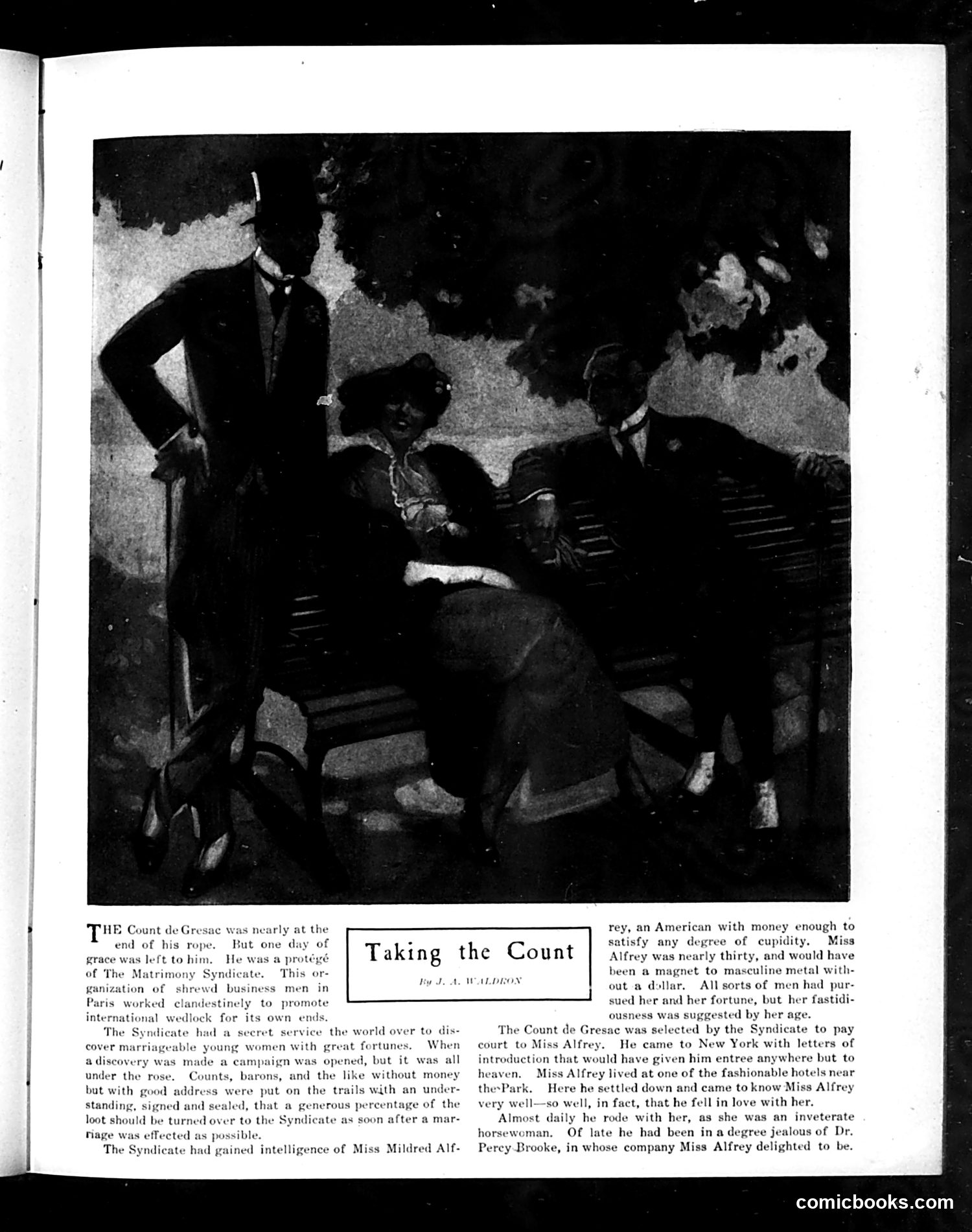
This story satirizes the "matrimonial syndicate" scheme—a business arrangement where wealthy American heiresses are matched with impoverished European nobility for mutual benefit. The Count de Gresac, a broke French aristocrat, is selected by the Syndicate to court Miss Alfrey, a wealthy American woman seeking a titled husband. The joke targets both parties: Miss Alfrey's desperation for a husband despite her fortune, and the Count's willingness to marry for money. The irony deepens when the Count actually falls in love with her—undermining the transactional premise. The photograph shows the Count (standing, left) in formal dress with Miss Alfrey and others, illustrating this "gilded age" phenomenon of European titles being effectively sold to rich American women. The satire mocks mercenary courtship and the pretensions of both aspiring American socialites and impoverished foreign nobility.
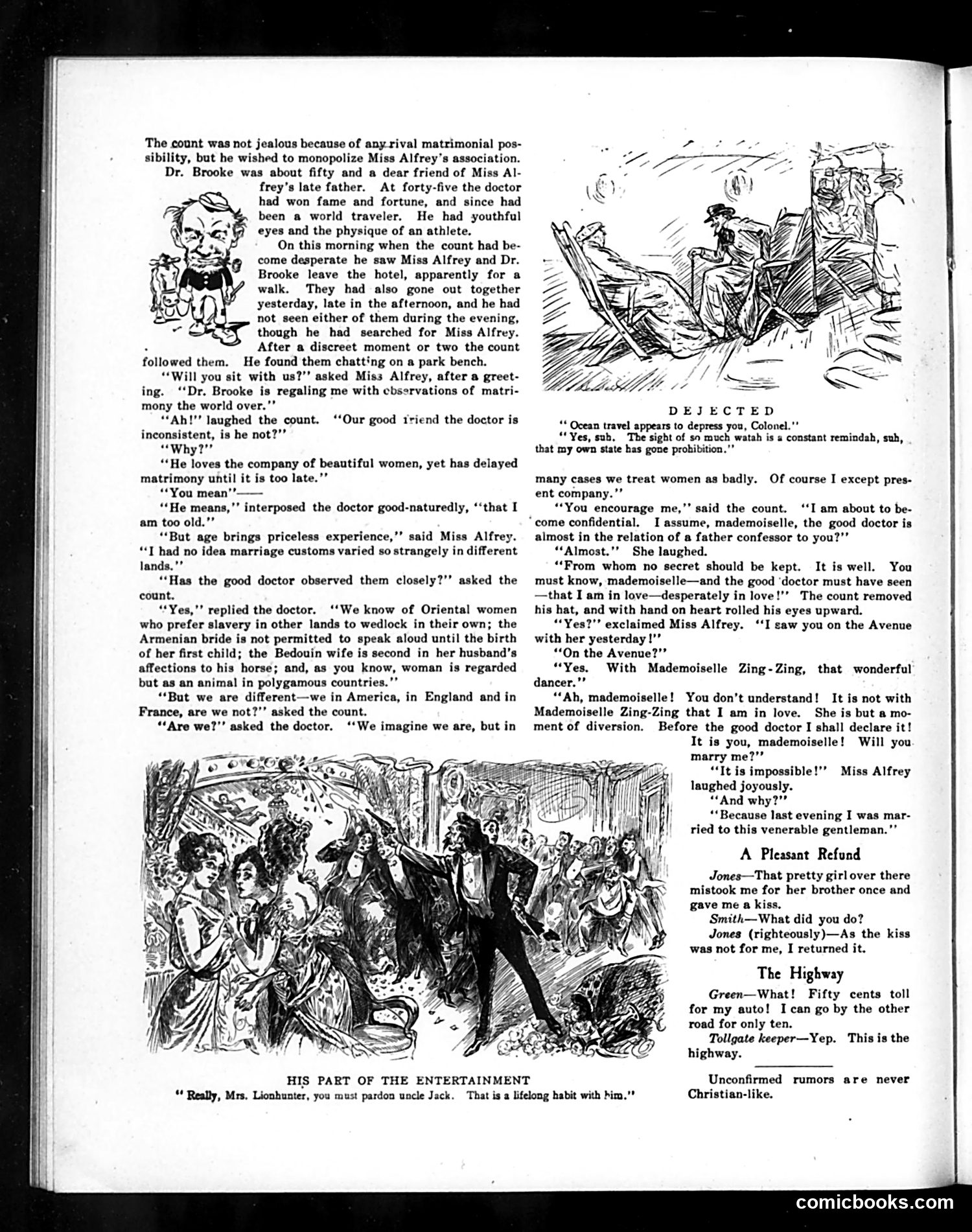
This page contains multiple short satirical pieces typical of Judge magazine's humor: **Main Story ("His Part of the Entertainment"):** A European count pursues Miss Alfrey while Dr. Brooke—her late father's friend—lectures on marriage customs worldwide. The count makes an elaborate romantic declaration, only to learn Miss Alfrey married Dr. Brooke the previous evening. The satire mocks the count's theatrical European romanticism and his assumption that an older, respectable doctor couldn't be a rival. **"Dejected" cartoon:** A Southern colonel laments that ocean travel reminds him his home state has gone into Prohibition—satirizing the 18th Amendment's impact on the South. **"A Pleasant Refund" and "The Highway":** Brief joke pieces about misunderstandings and overpricing. The overall theme targets pretentious European attitudes toward courtship and American social conventions, using the count's dramatic failure as comedic fodder for period readers.
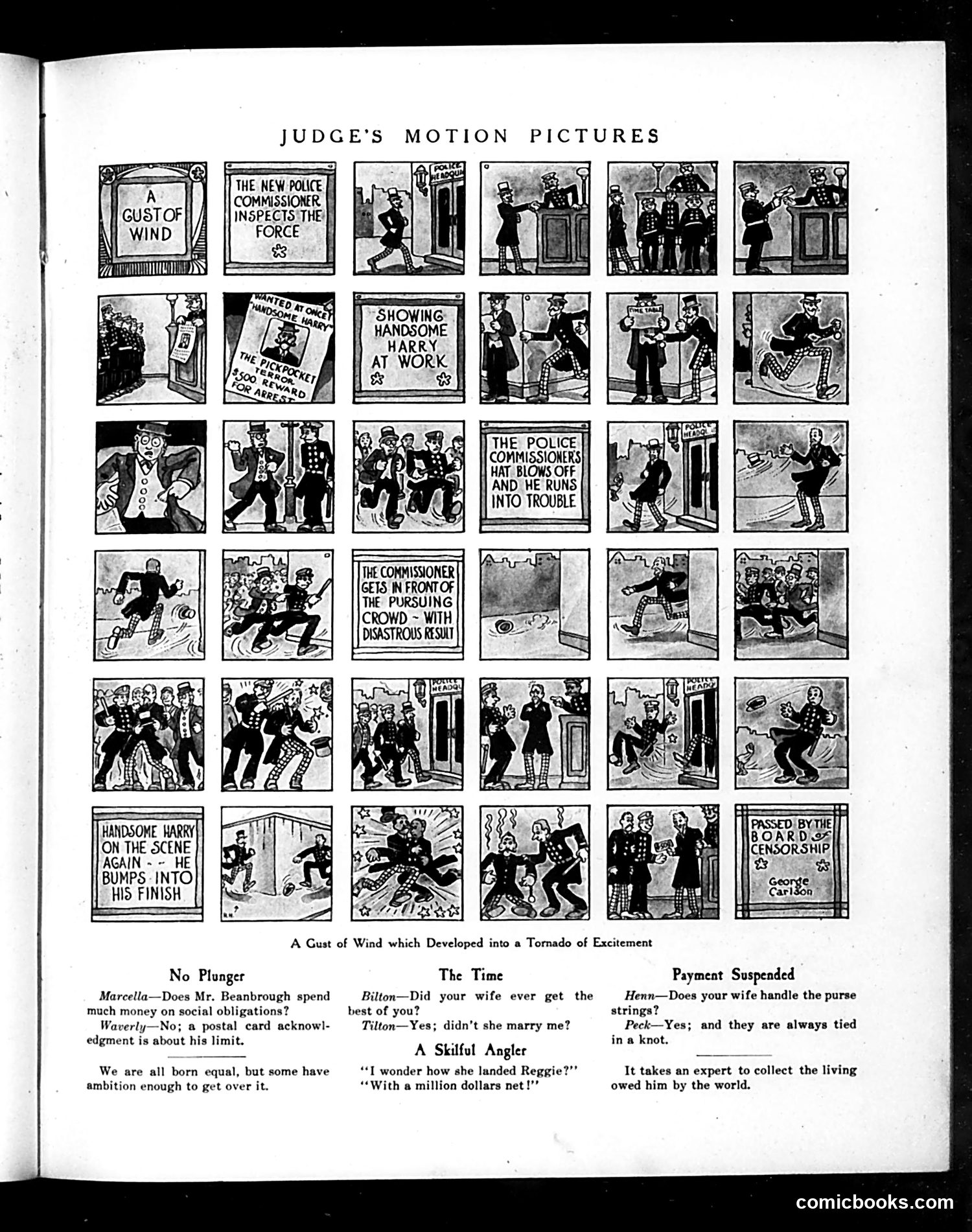
This page showcases a silent film comedy strip (likely featuring Harry Lloyd, referenced in the frames) that parodies police and social mishaps. The narrative follows a police commissioner whose hat blows off, escalating into chaotic street scenes with crowds and physical comedy—a "gust of wind" becoming a "tornado of excitement." Below are unrelated single-panel joke cartoons mocking domestic life and social pretense: husbands criticize wives' spending and dominance; wives control finances; and the final panels mock gold-diggers and social climbing. The closing quips—"we are all born equal, but some have ambition enough to get over it" and commentary on debt collection—suggest Judge's satirical targeting of upper-class pretension and marital power dynamics in the 1920s era. The page exemplifies Judge's blend of slapstick visual humor with acerbic social commentary about marriage, money, and class aspiration.
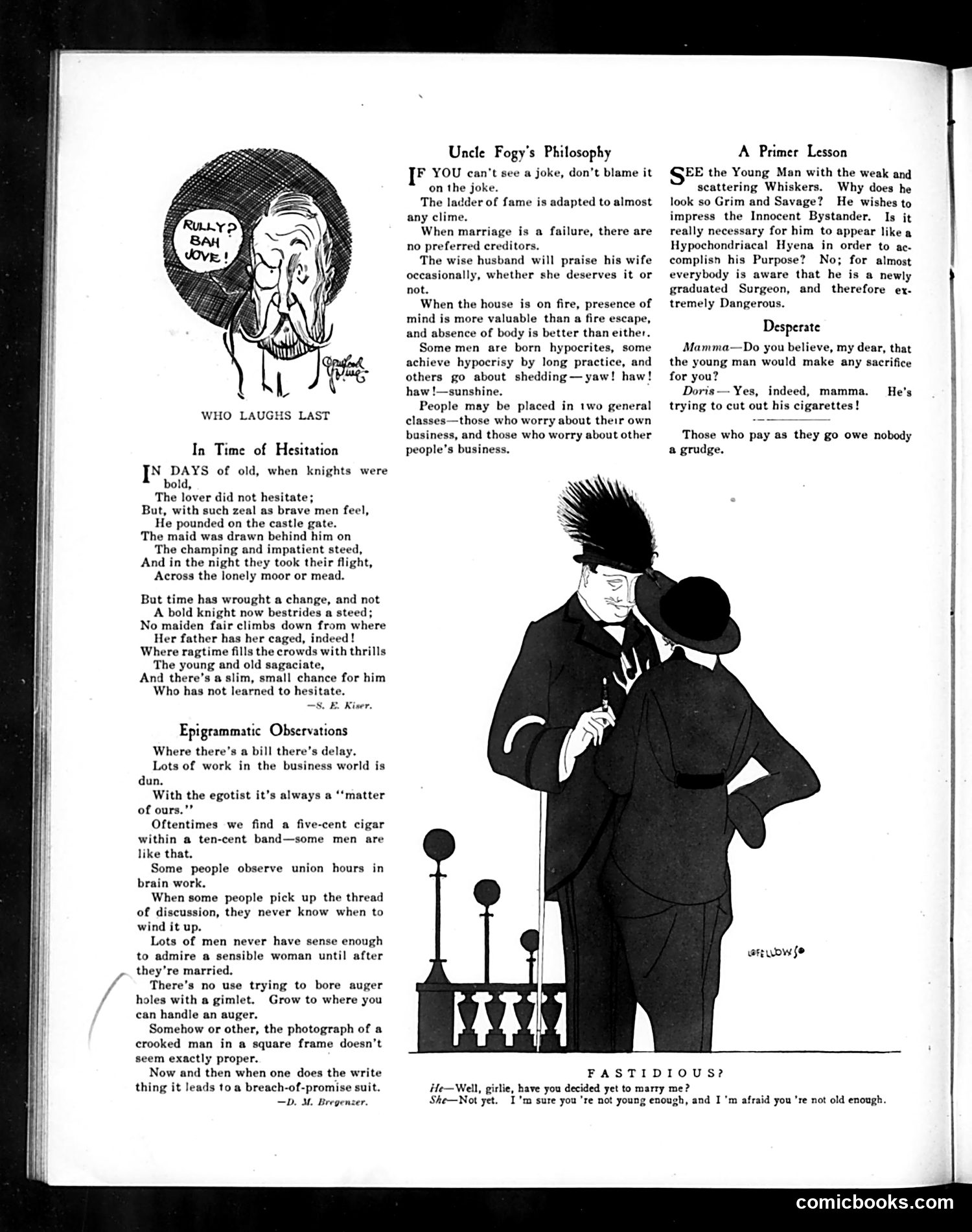
This page from the satirical magazine *Judge* contains several humorous pieces mocking early 20th-century social conventions: **"Who Laughs Last"** contrasts medieval romance (bold knights abducting maidens) with modern courtship, suggesting contemporary suitors lack courage—they "hesitate" rather than act decisively. **"A Primer Lesson"** ridicules newly graduated surgeons who affect an intimidating, savage demeanor to impress bystanders, despite everyone already knowing they're dangerous due to their inexperience. **"Fastidious?"** presents a woman rejecting a suitor for being simultaneously too young and too old—an impossible standard implying women's unreasonable pickiness. The various **epigrams** and **Uncle Fogy's Philosophy** sections offer cynical observations on marriage, business, and human nature typical of the era's satirical humor. The page targets masculine insecurity, professional pretension, and marital dynamics—common Judge themes reflecting anxieties about modern social change.
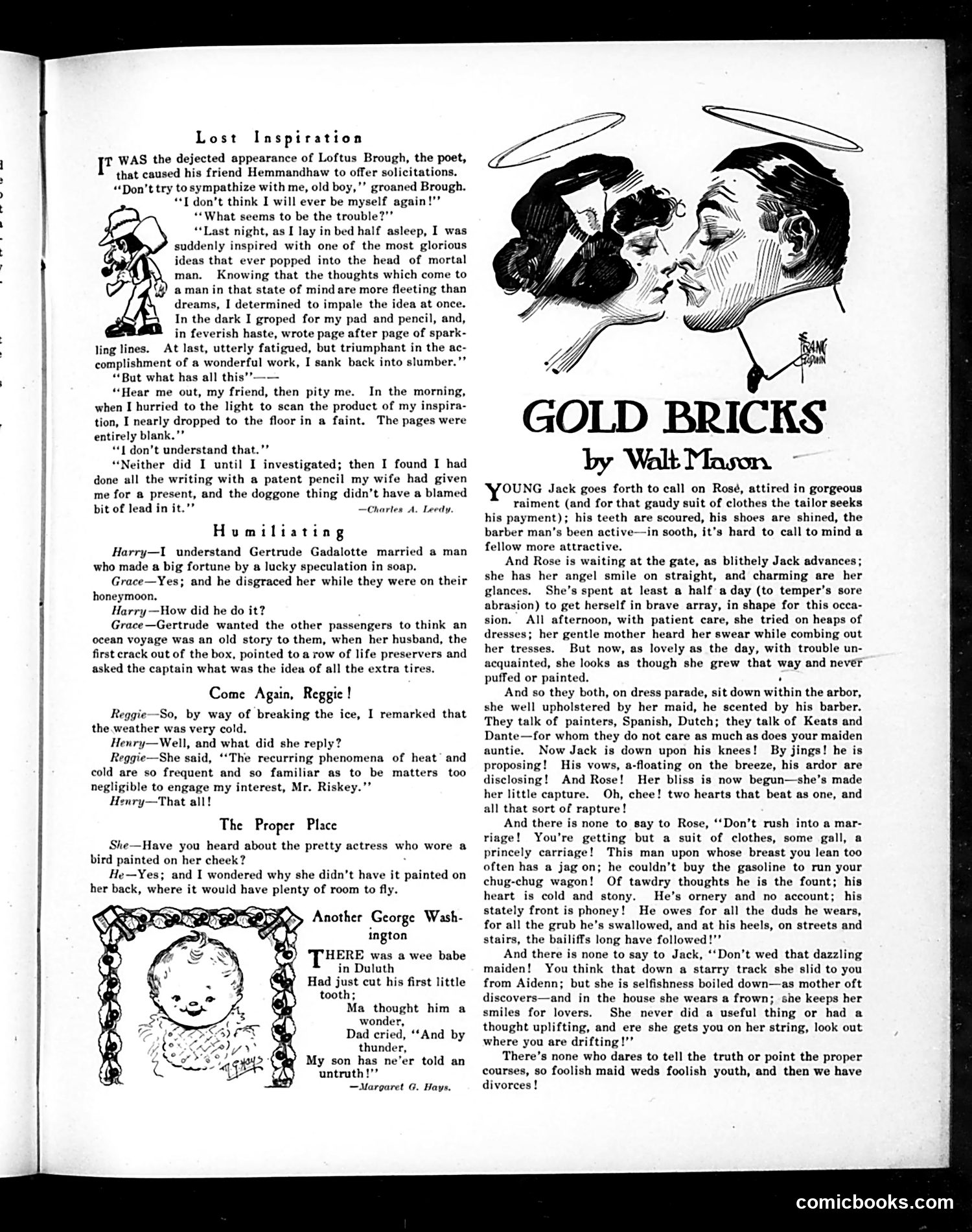
This page contains several brief humorous anecdotes typical of *Judge* magazine's satirical style: **"Lost Inspiration"** mocks a poet who frantically writes brilliant verses in the dark, only to discover his wife's "patent pencil" had no lead—a joke about the gap between artistic inspiration and practical reality. **"Humiliating"** satirizes social pretension: a newly wealthy soap magnate embarrasses his socialite wife by asking the ship's captain about "extra tires" (misidentifying life preservers), revealing his crude origins despite newfound fortune. **"The Proper Place"** is a mild joke about where a bird tattoo on an actress would look better. **"Gold Bricks"** (the main story by Walt Mason) depicts young lovers in their Sunday best, pretending to intellectual sophistication by discussing painters and Dante while actually caring nothing for art—"gold bricks" meaning false pretenses or worthless deceptions. The satire targets romantic couples performing culture and refinement they don't genuinely possess. The cartoons illustrate these themes with period-appropriate line drawings.
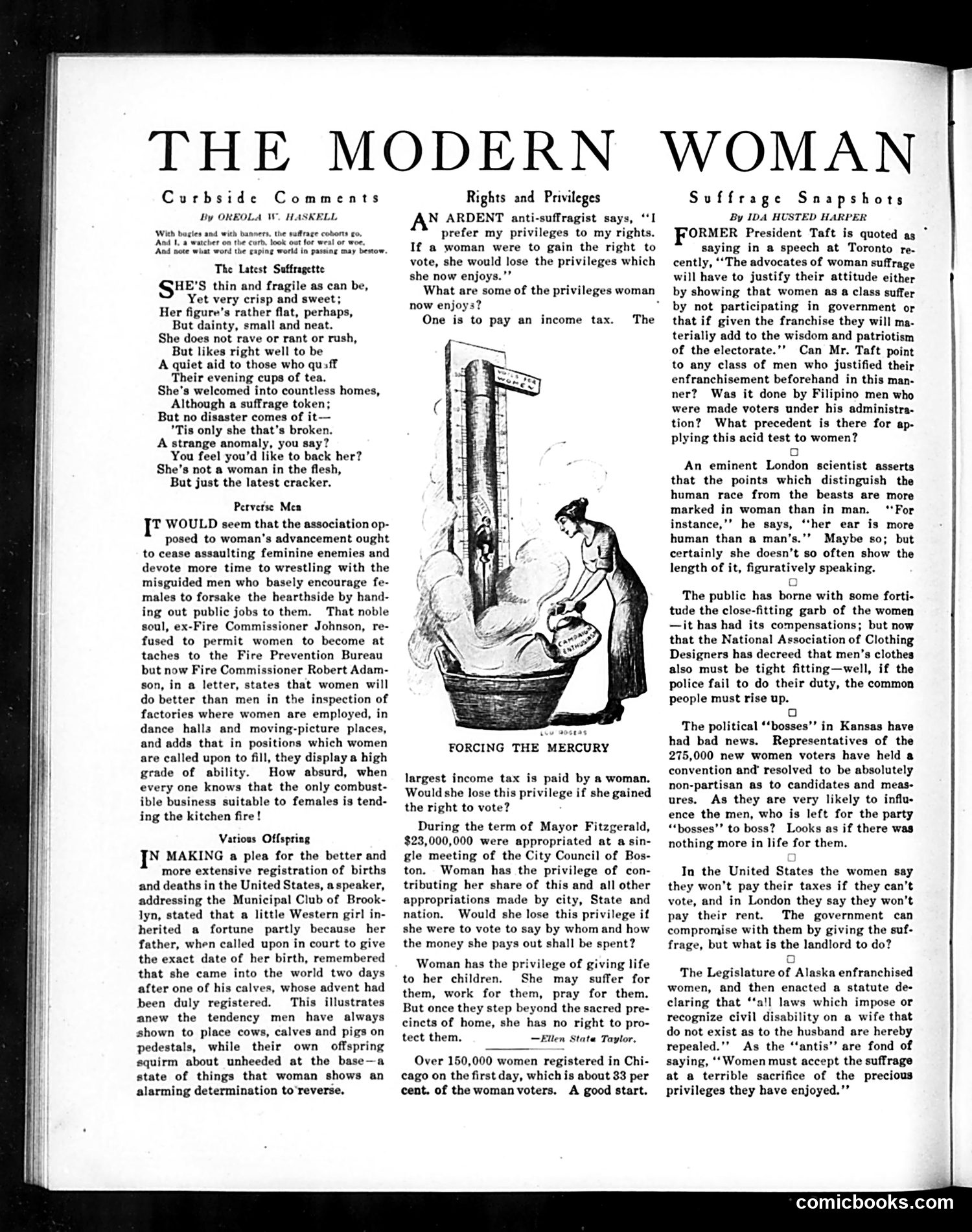
This page from Judge satirizes anti-suffrage arguments through ironic commentary and verse. The central cartoon "Forcing the Mercury" depicts a woman pushing down a thermometer—likely symbolizing women's efforts to suppress or control opposing forces. The "Rights and Privileges" section directly attacks anti-suffragist logic. An opponent claims women would *lose* privileges by gaining voting rights, but the text exposes this as absurd: women already pay income taxes and contribute to government spending without representation, yet have no say in how money is spent or how their children are protected once they leave home. The satire points out the hypocrisy—these aren't real "privileges" but obligations without power. Other sections mock anti-suffragists' arguments: "The Latest Suffragette" joke compares a woman suffragist to a fragile cracker (edible but breakable), and "Perverse Men" criticizes men who oppose women's advancement while employing women themselves. The page advocates for women's suffrage by exposing the illogic of opposing it.
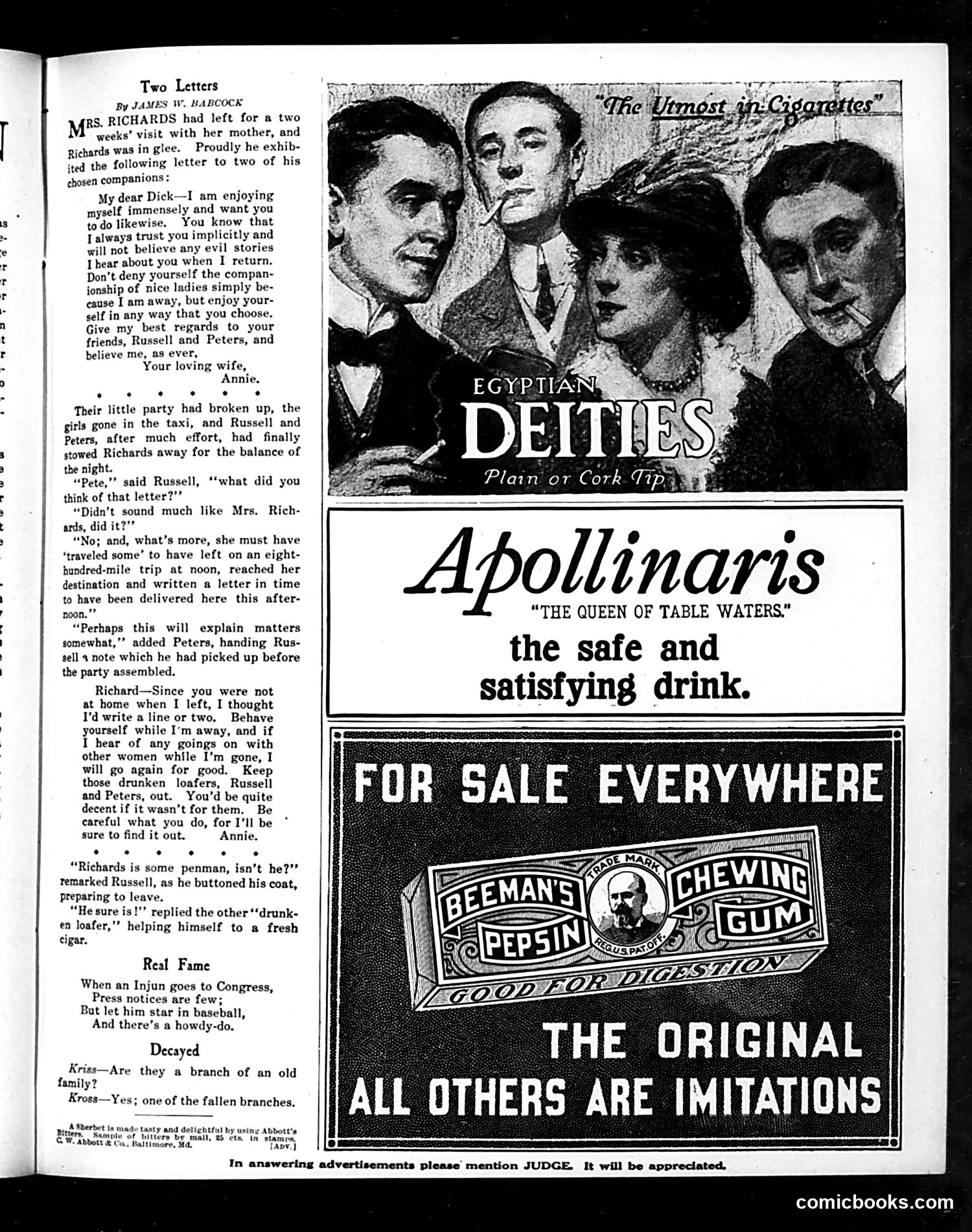
This page contains a short story ("Two Letters") by James W. Babcock about marital deception. Richards receives a forged letter from his wife Annie supposedly permitting him to socialize freely while she visits her mother. His friends Russell and Peters fabricated it to enable their carousing. The trick is revealed when the real letter surfaces—Annie's actual message forbids exactly such behavior and specifically warns him away from his drinking companions. Richards forgoes his night out, and his friends depart sarcastically. The satire targets male infidelity and the casual deception husbands employ to justify misbehavior, while also mocking the gullibility of the unfaithful partner. The remaining content consists primarily of period advertisements (Egyptian Deities cigarettes, Apollinaris water, Beeman's chewing gum) rather than editorial cartoons or political satire.
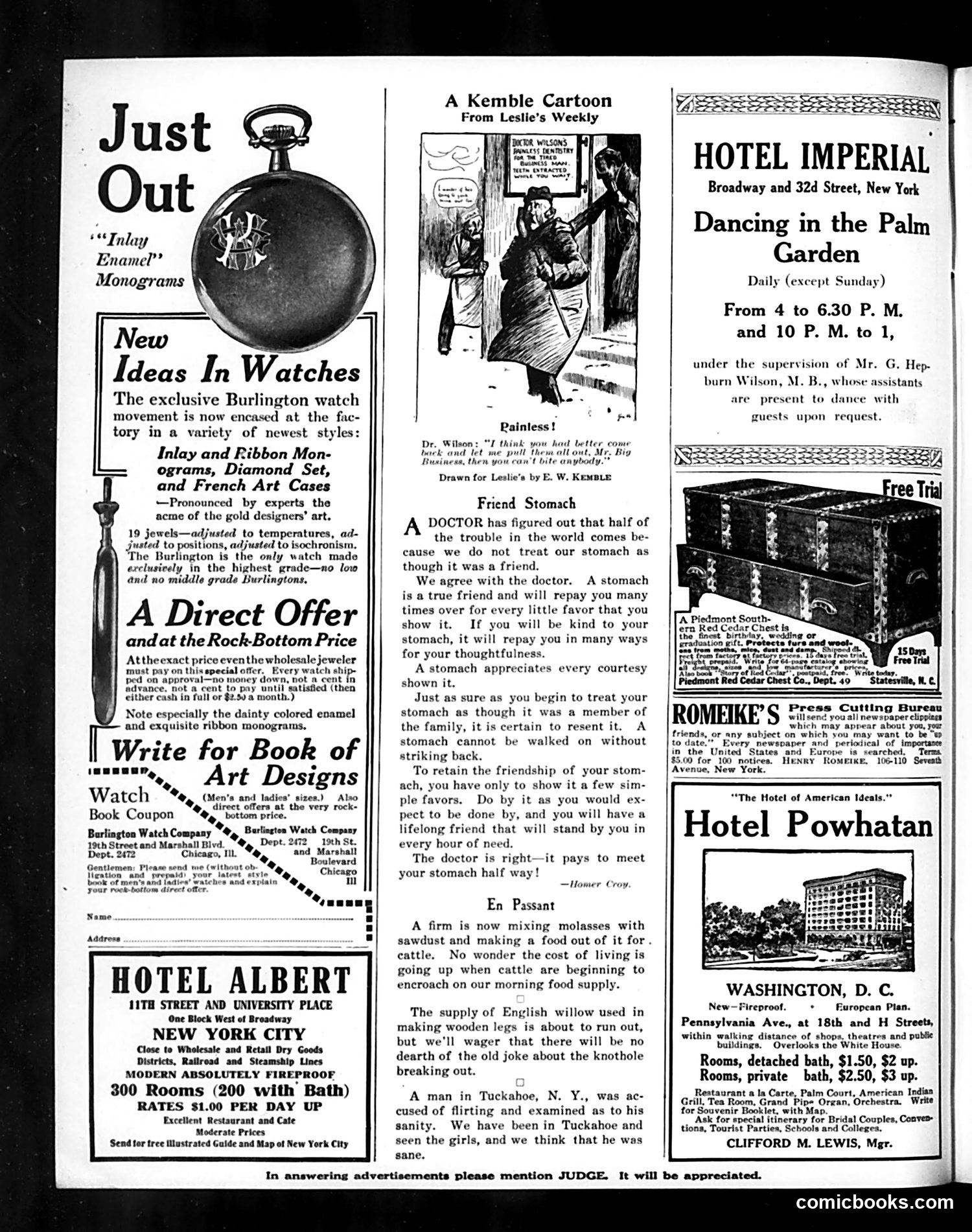
This is primarily an **advertising page** with one cartoon. The Kemble cartoon titled "Rainless!" (credited to Leslie's Weekly) depicts "Dr. Wilson" advising a businessman to "come back and let me pull these oil out" of his affairs before discussing business—likely a contemporary political figure, though the identity is unclear from the image alone. The page's content is overwhelmingly commercial, featuring ads for watches (Burlington), hotels (Albert, Imperial, Powhatan), and other products. The non-advertising text includes "Friend Stomach," a humorous essay advocating stomach health as friendship, and "En Passant," brief satirical commentary on food adulteration and contemporary absurdities (mixing molasses with sawdust for cattle feed, wooden-leg jokes). The overall tone reflects early 1900s American consumer culture and mild social satire rather than sharp political commentary.
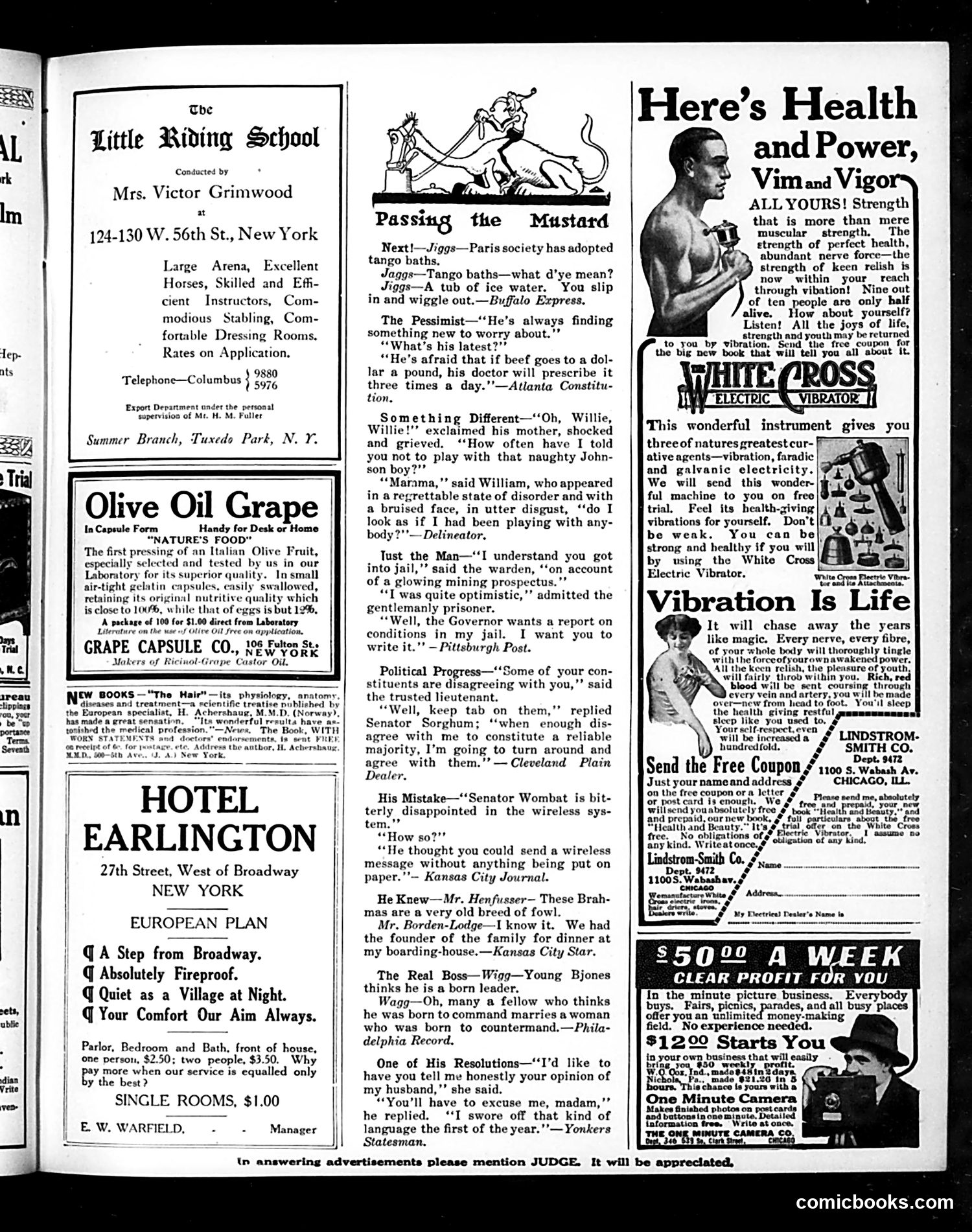
This is primarily a **classified advertisements and humor page** from Judge magazine. The right side features ads for dubious health products (the "White Cross Electric Vibrator" promising strength and vitality through vibration), a hotel, riding school, and olive oil capsules—typical early 20th-century patent medicine marketing. The center column contains brief **satirical jokes** on contemporary topics: - **Political satire**: Senator Sorghum will reverse his positions once enough constituents disagree—mocking politician opportunism - **Wireless technology**: A senator disappointed wireless messages still require paper, reflecting public confusion about new inventions - **Gender dynamics**: A joke suggesting wives "countermand" husbands' authority - **Economic anxiety**: Worried a doctor will prescribe expensive beef if prices rise to a dollar per pound The "Passing the Mustard" section references "tango baths"—a Paris society fad of ice-water immersion. These are light, topical jokes reflecting early 1900s American concerns: technology, politics, marriage relations, and economic pressures. The page layout and tone are characteristic of Judge's mix of advertising and gentle social commentary.
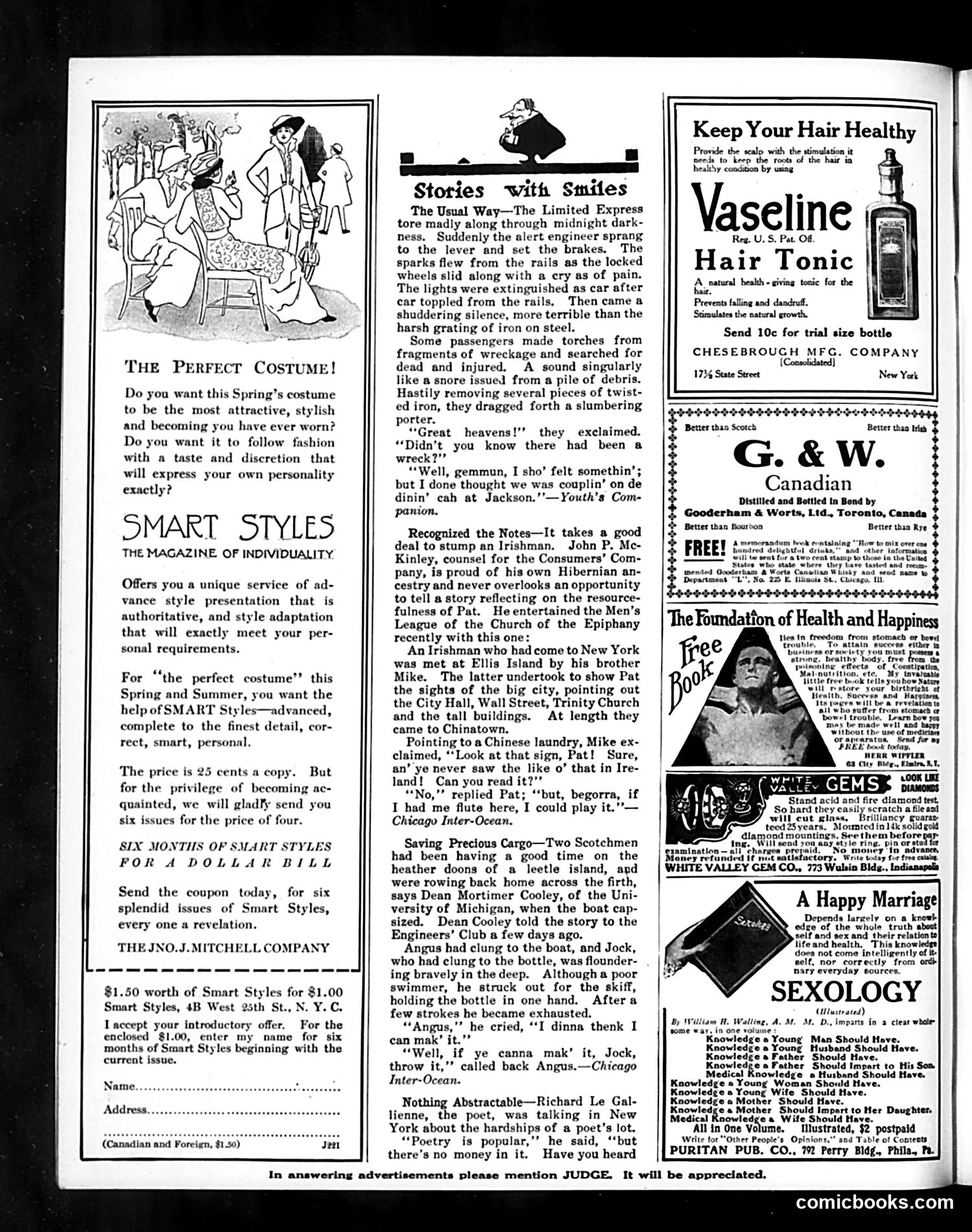
This page is primarily **advertising and light humor**, not political satire. The left side advertises "Smart Styles" magazine for spring fashion. The centerpiece, "Stories with Smiles," contains three short humorous anecdotes: 1. **"The Usual Way"**: A sleeping porter survives a train wreck undisturbed, mistaking the crash for routine coupling—humor based on racial stereotypes about African American railroad workers. 2. **"Recognized the Notes"**: An Irish immigrant mistakes Chinese laundry characters for musical notation, relying on his flute—ethnic humor playing on Irish-American stereotypes and unfamiliarity with Asian writing. 3. **"Saving Precious Cargo"**: Two Scottish men in a sinking boat prioritize saving whisky over a drowning companion—stereotyping Scottish frugality and drinking habits. The page represents **early 20th-century ethnic humor**, relying on exaggerated national and racial caricatures common to Judge magazine's audience. Modern readers would recognize these as offensive stereotypes, though they were mainstream entertainment then.
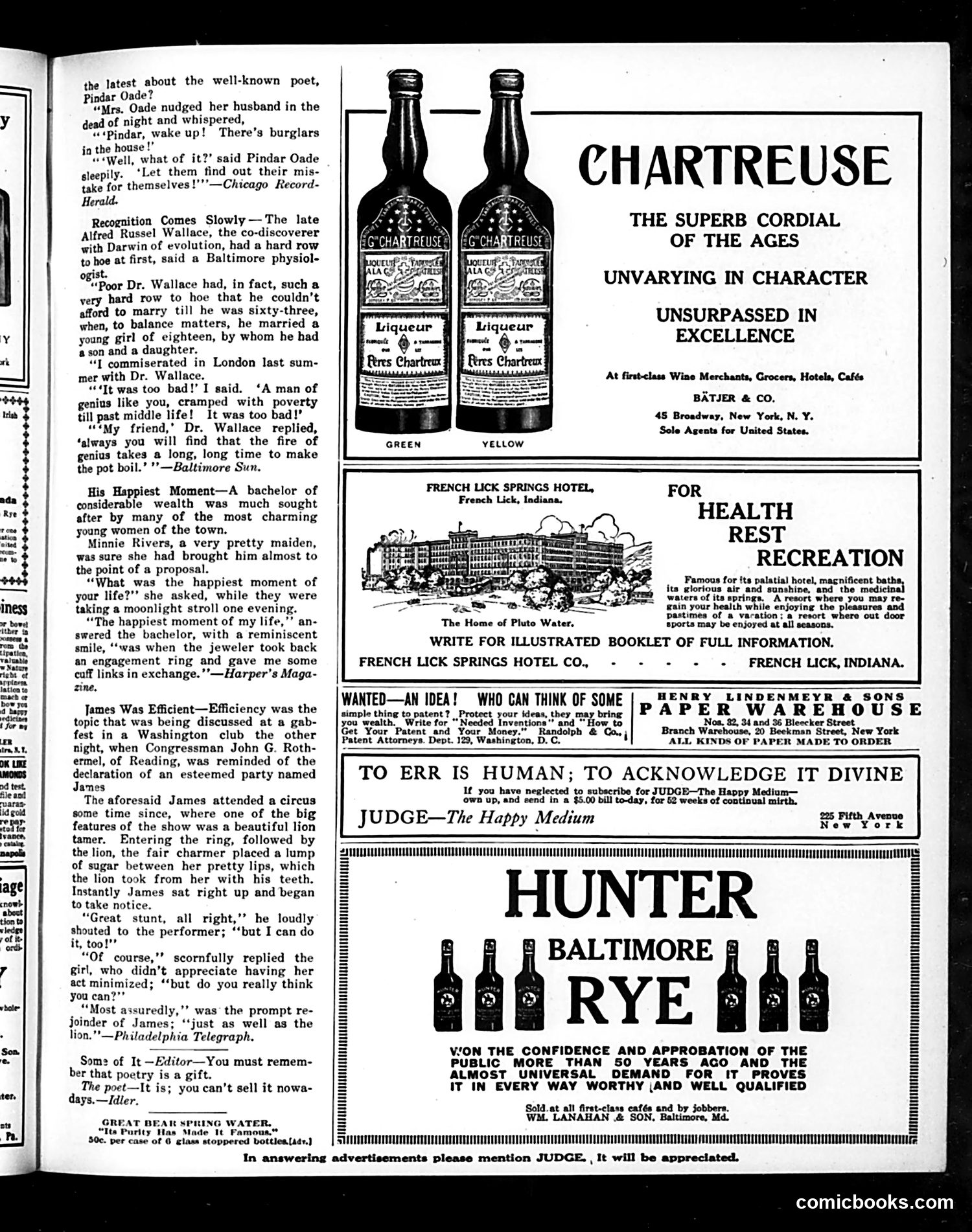
This page is primarily **advertising and humor columns**, not political cartoons. The satirical content consists of brief anecdotes: **Humor pieces** mock: - A poet so obscure that burglars mistake his house for someone else's - Dr. Wallace's delayed marriage due to poverty despite scientific genius - A bachelor who prefers losing an engagement ring to commitment - A man named James who overestimates his abilities after watching a lion tamer **Advertisements** promote: - **Chartreuse liqueur** (cordial) - **French Lick Springs Hotel** (health resort in Indiana) - **Hunter Baltimore Rye** whiskey - Patent services and spring water The humor is gentle, domestic, and non-political—focused on romantic misadventures, poverty, and male vanity rather than social commentary. The page reflects *Judge* magazine's mix of light satire with substantial advertising, typical of early 20th-century periodicals. No specific political figures or events are referenced.
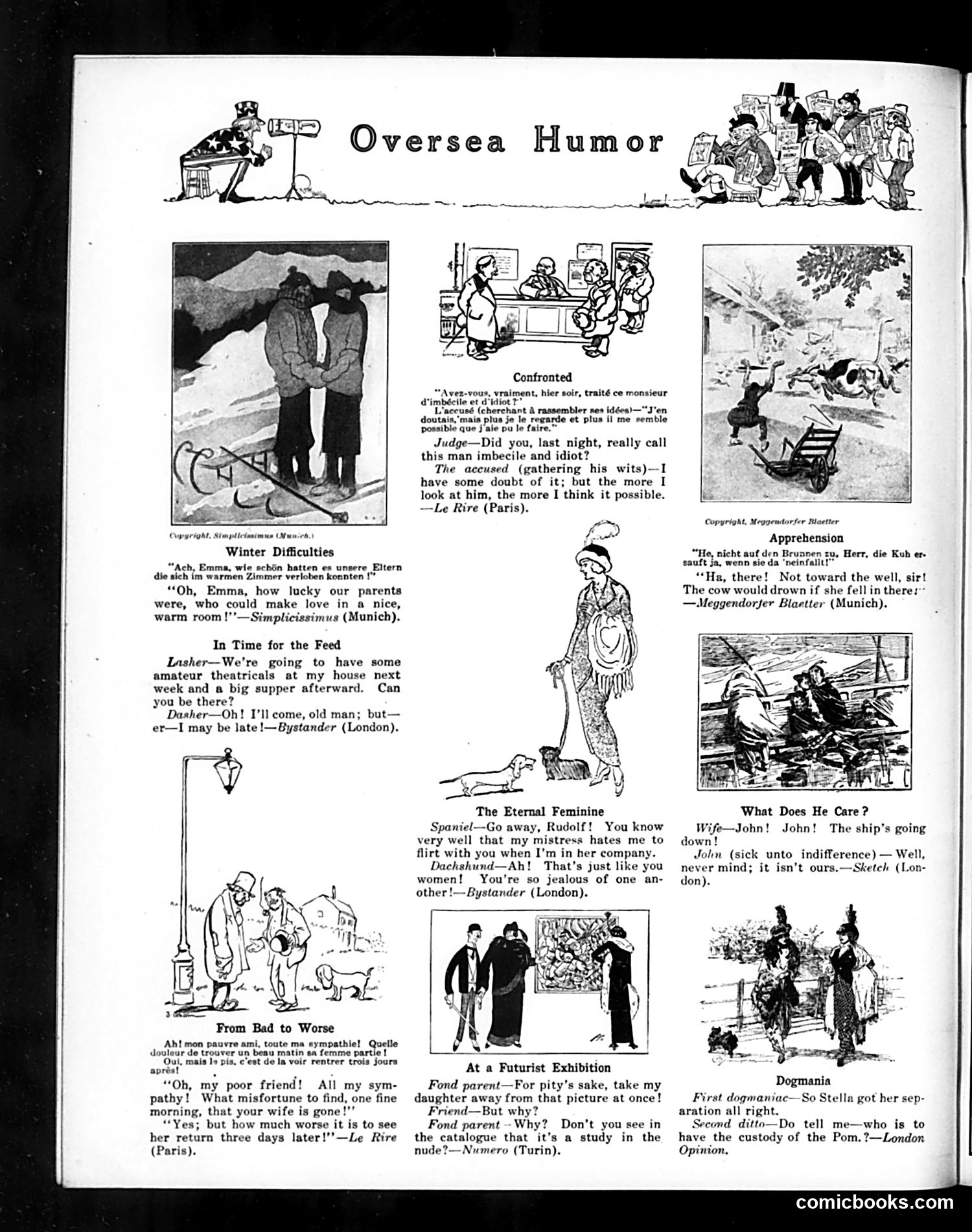
This page collects short humorous anecdotes from European satirical magazines, organized as international "filler" content. Each joke presents everyday social situations with ironic twists: **Notable items:** - **"Winter Difficulties"** and **"From Bad to Worse"** use marital discord as humor—complaints about cold rooms and wives disappearing/returning serve as punchlines about domestic dissatisfaction. - **"Confronted"** plays on courtroom absurdity: a defendant agrees he *might* have insulted someone precisely because looking at them suggests it's plausible. - **"The Eternal Feminine"** uses dog characters to satirize female jealousy stereotypes. - **"At a Futurist Exhibition"** mocks both prudish parents and avant-garde art movements—the "scandal" of nude studies in modernist painting. - **"What Does He Care?"** presents dark comedy: indifference about a sinking ship because it's not the speaker's property. The page reflects early 20th-century attitudes: gender stereotypes, class consciousness, and dismissal of modernism as incomprehensible. Attribution to foreign publications (Munich, Paris, London, Turin) suggests cosmopolitan editorial intent.
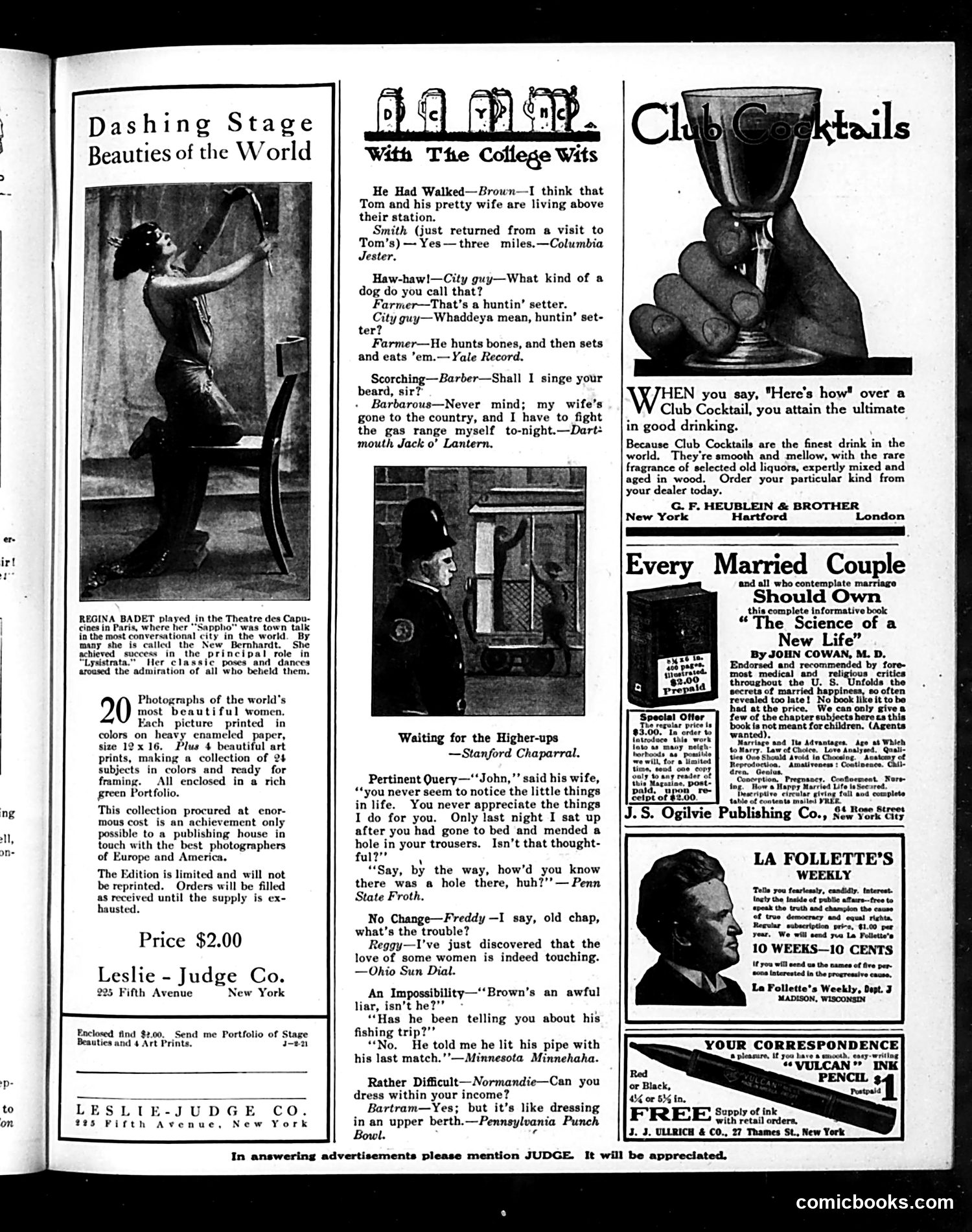
**This page mixes advertising with college humor from Judge magazine.** The left side promotes a portfolio of photographs titled "Dashing Stage Beauties of the World," featuring Regina Badet, a Paris stage actress compared to Sarah Bernhardt. The publisher (Leslie-Judge Co.) marketed this as a luxury collection of 90 photographs of beautiful women, priced at $2.00. The center column contains brief jokes reprinted from college humor publications (Columbia Jester, Yale Record, etc.). These jokes rely on simple misunderstandings: a "huntin' setter" dog that hunts bones, a man scorching his beard while his wife away, and marital banter about noticing small things. They're light, wholesome humor intended for college readers. The right side advertises Club Cocktails by Heublein, marketed as premium mixed drinks, alongside marriage advice books and other products. Overall, this reflects early 1900s attitudes toward entertainment, women's photography, college culture, and consumer goods marketed to middle-class readers.
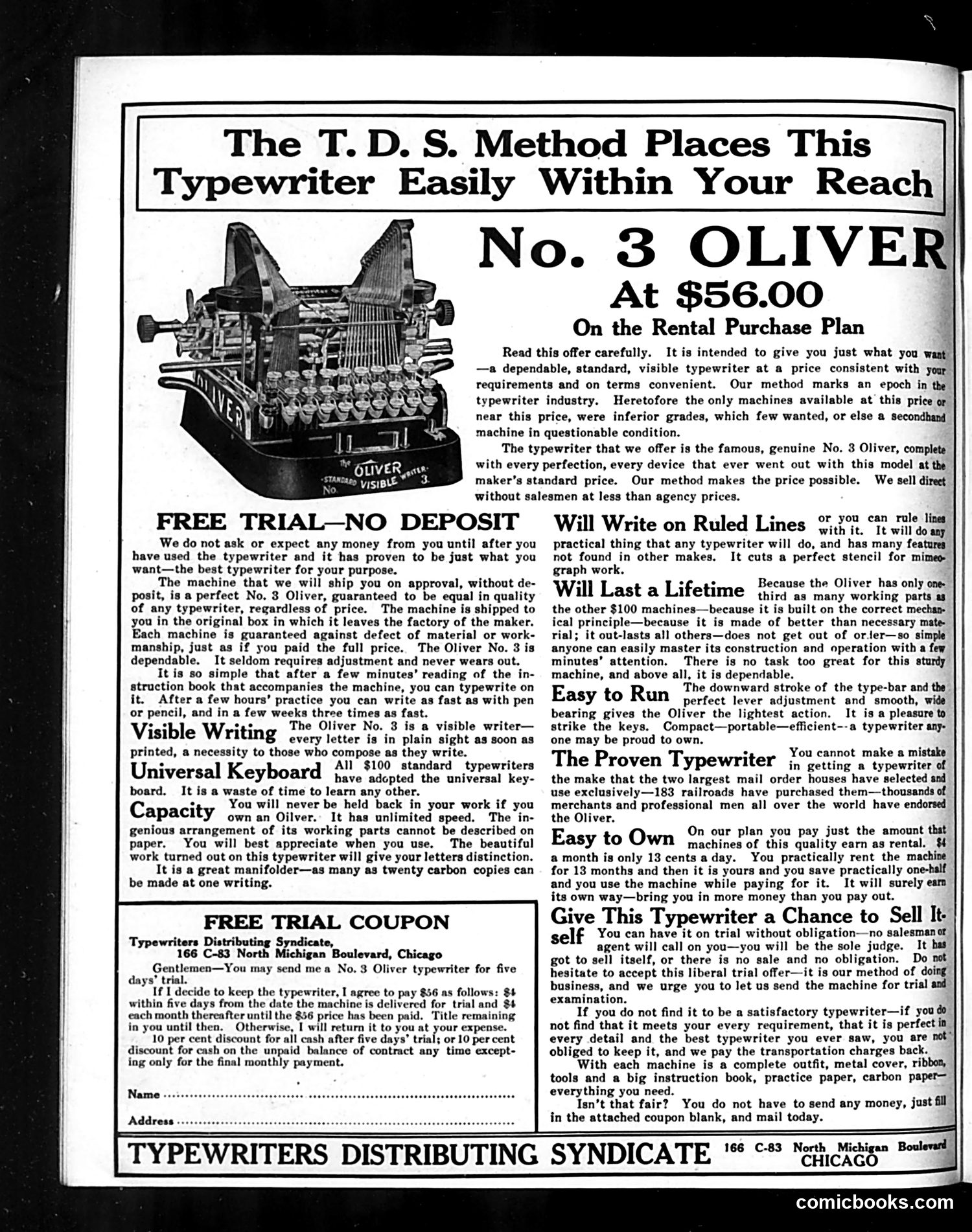
This page is primarily a commercial advertisement for the Oliver No. 3 typewriter, not a political cartoon or satire. It appears in *Judge* magazine but represents straightforward product marketing rather than editorial commentary. The "T.D.S. Method" refers to the Typewriters Distributing Syndicate's rental-purchase plan, offering a $56 Oliver typewriter on installment payments with a free five-day trial and no deposit required. The advertisement emphasizes the machine's reliability, simplicity, and visible writing capability. The detailed copy highlights competitive advantages: it's a quality machine (usually $100) made affordable through direct mail sales without middlemen. Modern readers might note this represents early mail-order commerce and consumer credit innovation. There is no identifiable satire, political reference, or social commentary—simply a period sales pitch using typical era marketing language.