
Judge, 1914-02-21 · page 6 of 24
Judge — February 21, 1914 — page 6: what you’re looking at
What you’re looking at
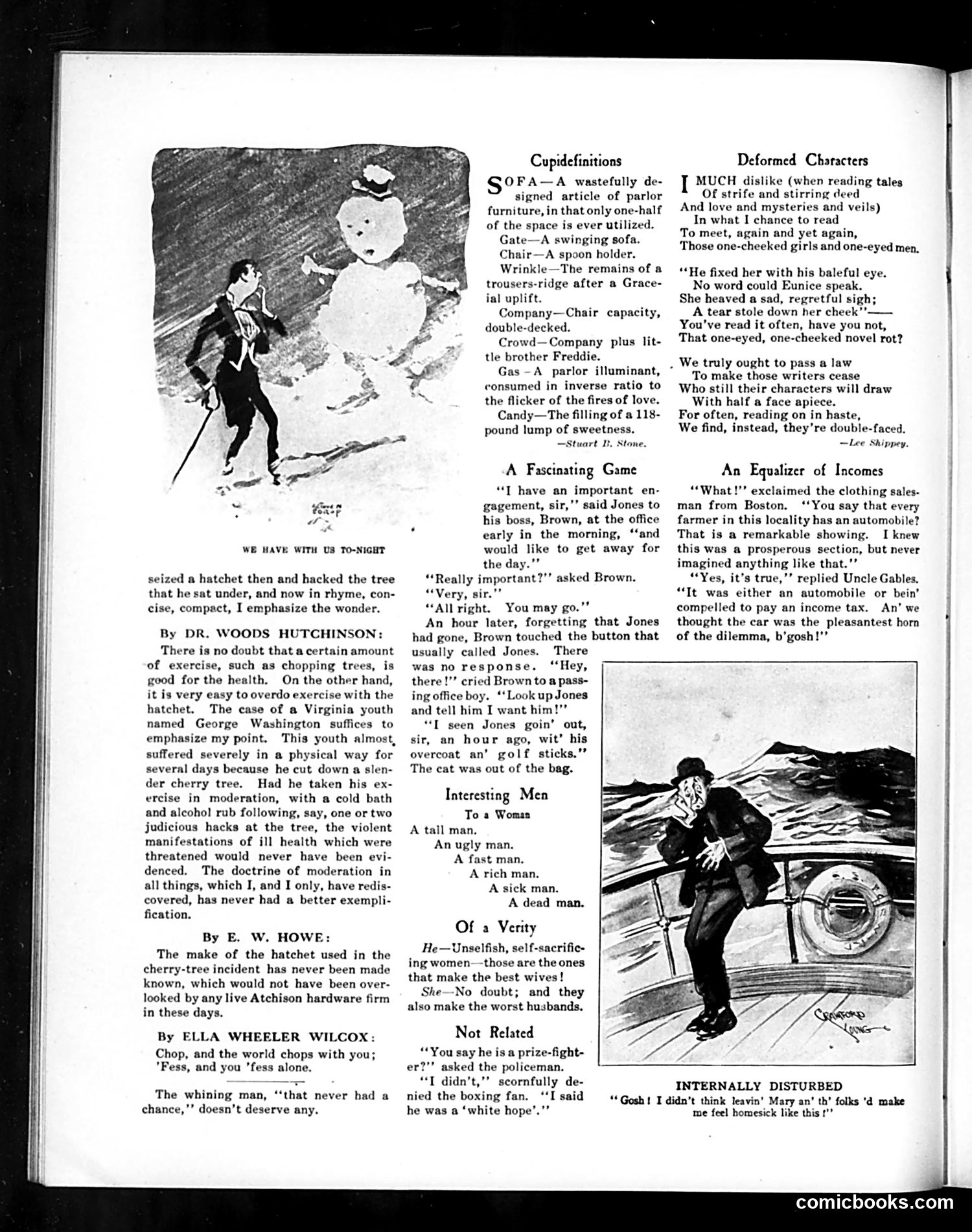
This page satirizes the famous (apocryphal) George Washington cherry-tree legend. The illustration shows Washington with a hatchet and felled tree; multiple prominent writers offer humorous commentary. **The Satire:** Dr. Woods Hutchinson ridicules the myth by "medical analysis"—claiming Washington overexercised with his hatchet and suffered health consequences. E.W. Howe makes a business joke (a hardware store would've publicized the hatchet brand). Ella Wheeler Wilcox offers sentimental verse mocking confession culture. **Context:** By the early 20th century, the cherry-tree story (invented by biographer Mason Locke Weems) was widely recognized as false, making it ripe for satire. Judge exploited this by having respected writers comically treat fiction as historical fact. The other sections—"Cupidefinitions," office humor, and observations on relationships—are typical Judge satirical filler, poking fun at parlor culture and gender dynamics of the era. The "Deformed Characters" piece mocks melodramatic novel writing conventions.
📄 Transcribed text from this page (OCR, searchable)
Machine-transcribed from the original scan — historical spelling and the odd misread are preserved.
_ ext WE HAVE WITH US TO-NIGHT seized a hatchet then and hacked the tree that he sat under, and now in rhyme, con- cise, compact, I emphasize the wonder. By DR. WOODS HUTCHINSON: There is no doubt that a certain amount of exercise, such as chopping trees, is good for the health. On the other hand, it is very easy to overdo exercise with the hatchet. The case of a Virginia youth named George Washington suffices to emphasize my point. This youth almost, suffered severely in a physical way for several days because he cut down a slen- der cherry tree. Had he taken his ex- ercise in moderation, with a cold bath and alcohol rub following, say, one or two judicious hacks at the tree, the violent manifestations of ill health which were threatened would never have been evi- denced. The doctrine of moderation in all things, which I, and I only, have redis- covered, has never had a better exempli- fication. By E. W. HOWE: The make of the hatchet used in the cherry-tree incident has never been made known, which would not have been over- looked by any live Atchison hardware firm in these days. By ELLA WHEELER WILCOX: Chop, and the world chops with you; ‘Fess, and you ’fess alone. The whining man, ‘‘that never had a chance,’’ doesn’t deserve any. Cupidefinitions OFA—A wastefully de- signed article of parlor furniture, in that only one-half of the space is ever utilized. Gate—A swinging sofa. Chair—A spoon holder. Wrinkle—The remains of a trousers-ridge after a Grace- ial uplift. Company—Chair capacity, double-decked. Crowd—Company plus lit- tle brother Freddie. Gas -A parlor illuminant, consumed in inverse ratio to the flicker of the fires of love. Candy—The filling of a 118- pound lump of sweetness. Stuart B. Stone. A Fascinating Game “‘T have an important en- gagement, sir,’’ said Jones to his boss, Brown, at the office early in the morning, ‘‘and would like to get away for the day. “Really important?"’ asked Brown, “Very, sir.” “Allright. You may go."’ An hour later, forgetting that Jones had gone, Brown touched the button that usually called Jones. There was no response. ‘Hey, there !’’ cried Brown to a pass- ing office boy. ‘Look up Jones and tell him I want him!’" “I seen Jones goin’ out, sir, an hour ago, wit’ his overcoat an’ golf sticks.”” The cat was out of the bag. Interesting Men To a Woman A tall man. An ugly man. A fast man, A rich man. A sick man. A dead man. Of a Verity He—Unselfish, self-sacrific- ing women—those are the ones that make the best wives! She—No doubt; and they also make the worst husbands. Not Related “You say he is a prize-fight- Deformed Characters MUCH dislike (when reading tales Of strife and stirring deed And love and mysteries and veils) In what I chance to read To meet, again and yet again, Those one-cheeked girls and one-eyed men, “*He fixed her with his baleful eye. No word could Eunice speak. She heaved a sad, regretful sigh; A tear stole down her cheek’’—— You've read it often, have you not, That one-eyed, one-cheeked novel rot? . We truly ought to pass a law To make those writers cease Who still their characters will draw With half a face apiece. For often, reading on in haste, We find, instead, they’re double-faced. —Lee Shippey. An Equalizer of Incomes “‘What!’’ exclaimed the clothing sales- man from Boston, ‘You say that every farmer in this locality has an automobile? That is a remarkable showing. I knew this was a prosperous section, but never imagined anything like that.’” “Yes, it’s true,’’ replied Uncle Gables. “It was either an automobile or bein’ compelled to pay an income tax. An’ we thought the car was the pleasantest horn of the dilemma, b’gosh!’’ er?’’ asked the policeman. “T didn’t,’’ scornfully de- nied the boxing fan. ‘‘I said he was a ‘white hope’. INTERNALLY DISTURBED “*Gosh ! I didn’t think leavin’ Mary an’ th’ folks ‘d make me feel homesick like this t'’ comicbooks.com